Showing posts with label Palestinian Liberation Now. Show all posts

Friday, August 20, 2010

The Empire Thinks It Has No Close

I am appreciative of the blogs dedicated to telling truth instead of lies. Globeistan (link below) is one of those, revealing that the Empire is wearing a sign that says "no close".

image is from here

This is a cross post:


Visit us at http://globeistan.com/ where Monday to Friday we have new interesting postings for news, views, health, science, art, and more. Spread the word.

If the link doesn't work, please cut and paste the link.

Friday August 20: This is not your country; Help Pakistan’s flood victims; idiosyncratic Islamic practices in Chechnya; Pakistan/nonsense about Mars; Nigeria: Tailor’s advice; Japan’s annexation of Korea; Mosque madness; Are Pakistan’s floods due to climate change? Automatic car transfers/Video

Thursday August 19 Public theft and end of empire; Business class refugees-Tamil Bossa/Video; Australia/Superannuation fraud; Brest-feeding; Bangladesh Army’s business interests; Afghanistan/Couple stoned for adultery; Blackwater accused; Nipple piercings adds to risk of abscesses.

Wednesday August 18: Bangladesh/Bare minimum; Russia & human rights activist’s murder; Indus gone Insane; Pakistan/Why international aid is slow; AFL-CIO’s secret war against Third World workers; India’s new capitalists/Video; Hiroshima/Nagasaki; Britain: Ads that stalks; Prayer heals; Shining Journey celebrates Independence Day.

Tuesday August 17: Israel/Outpost for imperialism; Disease risk for children; Columbia’s indigenous leader shot dead; Waiting for peace; Anglo Saxons/Neither Indian nor British; Construction training for Maldivians in Sri Lanka; 11 technologies in danger of going extinct.

Monday August 16: Colonize space or die out; Why Wikileaks won’t stop war; Russia/Businessman sets out orthodox rules; Inception & top 10 dream movies; Sudan/Child soldiers; Crisis of religious understanding; Mulla Nasruddin’s wisdom; Pakistan to review laws against minorities.

Wednesday, June 30, 2010

Radical Feminist and Womanist Alice Walker on Facing Atrocity and Grief Generated by The White Male Savage

 [image is from here]

Most of this post comes from Democracy Now, April 13, 2010, *here*. The part that I wrote was written today, 30 June 2010 ECD.

I have a friend in the Democratic Republic of Congo, who knows all too well the violence there is created by munitions manufactured and sent down from Europe. Pick any global conflict, and you will find a similar story.

There is no atrocity in the world that WHM have not committed against women of all colors globally. WHM have invaded, infested, and invested in land where white men do not belong, taking possession and ownership, against any sense or semblance of humane standards of being, against any ethical principles created by international anti-genocide councils, against any morality that deserves to be called moral. White Western men, het men, have plotted and schemed to promote poisoning and punishments, degradation and domination wherever they go, without historical exception. If you trace the tracks of violence throughout any continent, whether South America, North America, Asia, Europe, Africa, or Australia, what we see is rape and genocide. What we see is the gross subordination of women to white men's will, the assault of the land, the introduction and maintenance of heterosexism. White Western het men who pretend to be ethical will speak out against human rights violations in places that don't appear to be white-ruled, but, if one digs deep enough, one finds the roots of white het men's violence practically and practiced everywhere. I grew up thinking savages were not white men. I was taught incorrectly. The primary synonym for "white man" is or ought to be "savage". From Rwanda and the Dem. Rep. of Congo to Palestine and Israel, Western white het men have a heavy hand in the violence that is reported worldwide as localised and "ethnic" or "religious". Do not forget who is benefiting from "local" or "regional" conflicts and atrocities. It is Western Christian white het men, more than any other group on Earth.

Part of being in the world means seeing the pain that Christian white het men cause, and knowing who causes it. To see horror and not notice who its manufacturers are, is to not truly see what is happening; it is to see only the consequences of it occurring. Men of all colors are capable of atrocity if they live in places where men are empowered and encouraged to commit it and value it as manly and "good" or "necessary". But the architects of modern (and post-modern) atrocities are white het men. And they are the ones making sure their deadly designs don't die. 


Alice Walker on "Overcoming Speechlessness: A Poet Encounters the Horror in Rwanda, Eastern Congo and Palestine/Israel"

As the 2010 Pulitzer Prize winners are announced, we speak with the first African American woman to be awarded a Pulitzer Prize for fiction: author, poet and activist Alice Walker. She was awarded the 1983 Pulitzer for her novel The Color Purple. She was written many books since then. Her latest, just out, is called Overcoming Speechlessness: A Poet Encounters the Horror in Rwanda, Eastern Congo and Palestine/Israel. [includes rush transcript]

AMY GOODMAN: The list of winners for the 2010 Pulitzer Prize were announced Monday—among them, Sheri Fink, reporter with the nonprofit investigative news group ProPublica. She won the Pulitzer for investigative reporting for her story in collaboration with the New York Times Magazine on the urgent life-and-death decisions made by doctors at a New Orleans hospital when they were cut off by the floodwaters of Hurricane Katrina. Meanwhile, Anthony Shadid walked away with his second Pulitzer for his Washington Post series on the war in Iraq.

Well, my next guest is the first African American woman to be awarded a Pulitzer Prize for fiction: author, poet, activist, Alice Walker, awarded the 1983 Pulitzer for her novel The Color Purple. She has written many books since then. Her latest, just out, is called Overcoming Speechlessness: A Poet Encounters the Horror in Rwanda, Eastern Congo, and Palestine/Israel. Alice Walker, joining us here in our new firehouse—in our new Democracy Now! studios.

Welcome to Democracy Now!

ALICE WALKER: It’s so beautiful.

AMY GOODMAN: Well, welcome to the greenest TV, radio, internet studios in the country. It’s great to have you here.

ALICE WALKER: Thank you.

AMY GOODMAN: And I look forward to speaking to you tonight at the 92nd Street Y in the public conversation. But Alice, this latest book, why did you call it Overcoming Speechlessness?

ALICE WALKER: I wanted to address what I feel is a real problem that we have in the last century, actually, or even before. And that is that things can be so horrible that people lose the ability to talk about them. And I had this happen when I was in college, actually, when I learned that the King of Belgium had decided that if the Africans in the Belgian Congo could not fulfill their rubber quota that he had imposed on them, he could order their hands to be chopped off. This was so appalling to me as a student, as an eighteen- and nineteen-year-old, that I couldn’t speak about it. I just—I put it somewhere that I left for many years. And I think this has happened over and over to people, that they encounter these brutalities, these atrocities, and they literally can’t talk about them, and so we don’t speak. But if we don’t speak, then there’s more of it, and more people suffer. So it’s a call to overcoming speechlessness.

AMY GOODMAN: We just got word that eight Red Cross staff have been kidnapped by an armed group in the eastern Congo. Seven Congolese and one Swiss national were seized on Friday afternoon near the town of Mai Mai [sic]—well, near the town of—in a South Kivu province by the Mai Mai rebels, this according to the Red Cross. You went to eastern Congo?

ALICE WALKER: I was in eastern Congo, and I met some women who were survivors of enslavement and sexual abuse that was so horrendous that it was a challenge to even hear it and even to see some of the damage. On the other hand, I found that by being there, I gave myself some comfort, because I wasn’t trying to see people at a distance and removing myself, my feelings from them. It was very frightening, because there were lots of soldiers everywhere and people who had been damaged by soldiers, you know, people who had lost limbs. And it was traumatic.

AMY GOODMAN: You began, though, by talking about Rwanda, and then you trace the violence to Congo. Talk about Rwanda.

ALICE WALKER: Yes. Well, in Rwanda, because of the killing of so many Tutsis by the Hutu and the—really a slaughter—

AMY GOODMAN: And you trace it back. You go all the way—

ALICE WALKER: Well, I went all the way back to, again, those Belgians, the Belgians, and before them, the Germans. They came into the Congo, and they decided that the Tutsi people, because they had larger skulls, were more like Europeans, and so they should be in charge of the Hutu people, whose skulls apparently were not as large. Anyway, they instigated this rule of one clan by the other, even though these people had been fairly peaceful living together for centuries. And after they had done this, finally, after many years of domination, a century or so, they left. But they left the Hutu in charge of the Tutsi. And so, eventually, the hatred that had been building over a long, long period erupted into genocide.

And so, I had heard about this awful thing that the Hutu Interahamwe people had killed 800,000 of the Tutsi people. And that again was so awful, I couldn’t really entirely let myself feel what it must be like to actually have your body hacked away from you, which is what happened to all of those people. But eventually, I needed to go there, and so I did. And what I found was, you know, that the Rwandan people have done a wonderful job of memorializing what happened, and they have also elected more women to help run the country than almost anywhere else.

But on the other hand, the soldiers and the murderers, a lot of them, just went into the Congo. And so, we went there, not following them, but because we wanted to see the Congo, which is incredibly beautiful. It is the most exquisite country. I had no idea. I mean, lakes and trees and, you know, just a wonderful place, except that it’s torn to bits by the war. And a lot of the people who did the killing in Rwanda are there, and they had been murdering and abusing the people terribly.

And so, one of the women that I talk about in my book is a woman who had been basically chopped up, and I find it hard to talk about it even now. But she survived, and she is now looking for her children, who survived, one or two of them. The Interahamwe people had shot her son and her husband, killed them. So it’s—you know, it’s a kind of violence in the world now that is truly unspeakable. I mean, that is the part of it, that overcoming speechlessness means speaking about what really is unspeakable because it is so terrible.

AMY GOODMAN: You go, in the book, from Rwanda to eastern Congo to Palestine-Israel.

ALICE WALKER: Mm-hmm.

AMY GOODMAN: It was your first trip?

ALICE WALKER: To Palestine? Yes.

AMY GOODMAN: What made you go?

ALICE WALKER: Well, I was actually mourning the death of my own sister, and I thought that, oh, she was, you know, much older, and she was sick, and she died, and we’d had a horrible five or six years before she died. And so I thought, you know, when she dies, I won’t be devastated. And I was completely devastated. It was so painful.

And I was out trying to deal with my own devastation, when I learned about a woman in Palestine, during the bombing, who had been—who had lost five of her daughters, and she herself was unconscious. And it just instantly connected me to her. I felt, what will this be like? Who will tell her? Who will tell this woman when she wakes up that “your five daughters are dead”?

And so I felt that I had to go and present myself to this situation and to be attentive to it in a way that I had started being many years before, except that at the time I was married to and then related to, in many ways, to a Jewish person who always said, well, if you see the Palestinian side, almost anything, you know, positive about the Palestinian side, then it means that you are anti-Semitic. And so, this was so shocking to me that it silenced me for a while. I mean, I said a few things, I wrote a few things. But I felt that I had left something undone. And I realize at this point in my life, and years earlier, actually, that there are things in life that call to us, and they’re ours to do. And this was one of the things that was mine to finish.

And so I went to Gaza, and I met with women who had lost everything, and their children, their houses. You know, I sat on the rubble, even though there was the phosphorus powder, because it was just overwhelming to see the injury and the damage that had been done to these people by the Israeli government. And I knew that it was my responsibility as a writer and as a human being to witness this and to write about it. I mean, why else was I—why else am I a writer? You know, why else do I have a conscience? I think that all people who feel that there is injustice in the world anywhere should learn as much of it as they can bear. That is our duty.

AMY GOODMAN: Would you like to read a little from the book, Overcoming Speechlessness?

ALICE WALKER: I’ll try. I don’t have my reading glasses, but I can do my best.

AMY GOODMAN: Maybe “It Feels Familiar”?

ALICE WALKER: OK, yeah. Alright. Oh, where is it? Where is that, Amy? I don’t see it.

AMY GOODMAN: “It Feels Familiar.” Number seventeen.

ALICE WALKER: OK, I think we might—

AMY GOODMAN: Right there.

ALICE WALKER: Oh, yeah, I’m sorry.

“It Feels Familiar.”

“One of the triumphs of the civil rights movement is that when you travel through the South today you do not feel overwhelmed by a residue of grievance and hate. This is the legacy of people brought up in the Christian tradition, true believers of every word Jesus had to say on the issues of justice, loving kindness, and peace. This dovetailed nicely with what we learned of Gandhian nonviolence, brought into the movement by Bayard Rustin, a gay strategist for the civil rights movement. A lot of thought went into how to create ‘the beloved community’ so that our country would not be stuck with a violent hatred between black and white, and with the continuous spectacle, and suffering, of communities going up in flames. The progress is astonishing and I will always love Southerners, black and white, for the way we have all grown. Ironically, though there was so much suffering and despair as the struggle for justice tested us, it is in this very ‘backward’ part of our country today that one is most likely to find simple human helpfulness, thoughtfulness, and disinterested courtesy.

“I speak a little about this American history, but it isn’t history that these women know.” These are the women, the Palestinian women, I’m with. “They’re too young. They’ve never been taught it. It feels irrelevant. Following their example of speaking of their families, I talk about my Southern parents’ teachings during our experience of America’s apartheid years, when white people owned and controlled all the resources and the land, in addition to the political, legal, and military apparatus, and used their power to intimidate black people in the most barbaric and merciless ways. These whites who tormented us daily were like Israelis who have cut down millions of trees planted by Arab Palestinians, stolen Palestinian water, even topsoil. Forcing Palestinians to use separate roads from those they use themselves, they have bulldozed innumerable villages, houses, mosques, and in their place built settlements for strangers who have no connection whatsoever with Palestine: settlers who have been the most rabidly anti-Palestinian of all, attacking the children, the women, everyone, old and young alike, viciously.”

AMY GOODMAN: Alice, I wanted to go back to March 2009—

ALICE WALKER: Yes.

AMY GOODMAN: —when you were in Gaza, to a video of you there.
    ALICE WALKER: It’s shocking beyond anything I have ever experienced. And it’s actually so horrible that it’s basically unbelievable, even though I’m standing here and I’ve been walking here and I’ve been looking at things here. It still feels like, you know, you could never convince anyone that this is actually what is happening and what has happened to these people and what the Israeli government has done. It will be a very difficult thing for anyone to actually believe in, so it’s totally important that people come to visit and to see for themselves, because the world community, that cares about peace and cares about truth and cares about justice, will have to find a way to deal with this. We cannot let this go as if it’s just OK, especially those of us in the United States who pay for this. You know, I have come here, in part, to see what I’m buying with my tax money.

AMY GOODMAN: That was Alice Walker in 2009, interviewed by my colleague here at Democracy Now!, Anjali Kamat. When you look back at you walking through the rubble of Gaza, your thoughts?

ALICE WALKER: My thought is that I am so glad I was there. I am so glad that I managed to gather myself and present myself to this situation, because it is my responsibility, you know, as a person, as an elder, as someone who cares about the planet, who really wants us all to thrive, you know, or just survive. This is a very thorny issue, and it takes all of us looking at it as carefully as we can to help solve it. It’s not that it’s impossible to solve. But what will help a lot is the insistence by all of us on fairness and on people actually understanding what they’re looking at.

AMY GOODMAN: You say that the Middle East solution is beyond the two-state solution, and you also talk about restorative justice.

ALICE WALKER: Yes, I do, because I believe in restorative justice. I think we could use that here. I mean, I don’t feel great about the past leaders here not being brought to trial, actually, you know. But if we can’t have trial, we could at least have council. I mean, but to let people, any people, just go, after they’ve murdered lots of people and destroyed a lot, is not right. It destroys trust. So—what was the rest of the question?

AMY GOODMAN: And you believe in a one-state solution.

ALICE WALKER: Oh, the one-state solution. Yes, I do. I mean, when I think about my tax money, and I think about, well, you know, given that I’ve already given, and we as a country have given over a trillion dollars to Israel in the last—since, I don’t know, ‘48 or something, but a lot of money that we could have used here, where would I be happiest to see, you know, my money spent? Well, I would be happy seeing my money spent for all the people who live in Palestine. And that means that, you know, the Palestinians who are forced out of their houses, forced off of their land, should come back and share the land, all of it, including the settlements. You know, if I am going to be asked to help pay for settlements, I would like to be, you know, permitted to say who gets to live in them. And I would like the women and children, the Palestinian women and children that I saw, I would like to say—take them by hand and say, “You know what? Look at this. We built this for you. You’re home now.”

AMY GOODMAN: Alice Walker, her latest book, Overcoming Speechlessness: A Poet Encounters the Horror in Rwanda, Eastern Congo, and Palestine/Israel. We will continue our conversation tonight at 8:00 at the 92nd Street Y in New York City at 92nd and Lex. And we will play portions of that here. We’ll also post on our website Anjali’s entire interview with Alice Walker in Gaza last year.


Monday, May 3, 2010

Jews in Europe Sign a Petition Critical of Oppressive Apartheid/anti-Palestinian Policies and Practices

 [image is from here]
 
This is being reprinted here only for purposes of sharing political speech. The link back is *here*. It has not been altered in any way.
 
European Jews sign petition critical of Israel
PARIS — More than 3,000 European Jews, including prominent intellectuals, have signed a petition speaking out against Israeli settlement policies and warning that systematic support for the Israeli government is dangerous.

The petition's signatories include French philosophers Bernard-Henri Levy and Alain Finkielkraut as well as Daniel Cohn-Bendit, a Greens leader in the European Parliament.

Backers — who compare their goals to those of J Street, a liberal pro-Israel Jewish lobbying group in the U.S. — plan to present their position at a news conference at the European Parliament in Brussels on Monday.

Supporters hope to build a European movement that is both "committed to the state of Israel and critical of the current choices of its government."

Israeli columnist Yossi Sarid, a former Cabinet minister identified with Israel's dovish peace movement, praised the initiative in an op-ed published in the Haaretz daily Sunday.

"These are people who seize every opportunity to defend Israel publicly and remain faithful to it," he wrote. "But even their patience is running out and their hearts are filled with sincere concern."

Israel's Foreign Ministry declined to comment because the initiative is not government-sponsored.

Many signatories are from France, where the petition has received much press coverage. France's Jewish community has hotly debated the petition, entitled "Call for Reason." The president of France's leading Jewish association, CRIF, declined to sign, saying he objected to some of its language and its tone.

"Do Israelis need the Jewish Diaspora to know what is 'the right' decision, what should be the borders of a country that their sons and daughters are protecting?" Richard Prasquier wrote in Le Figaro newspaper.

The petition, online at http://www.jcall.eu, says Israel faces a threat in the "occupation and the continuing pursuit of settlements in the West Bank and in the Arab districts of East Jerusalem.

"These policies are morally and politically wrong and feed the unacceptable delegitimization process that Israel currently faces abroad," it says.

It adds that "systematic support of Israeli government policy is dangerous and does not serve the true interests of the state of Israel."

Tuesday, April 13, 2010

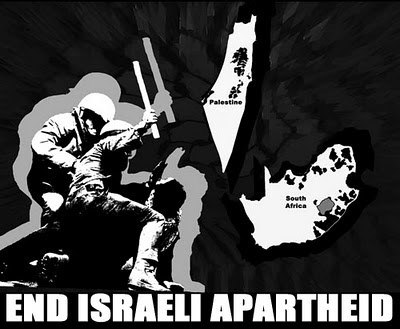
A Survivor of HaShoah (the Nazi Holocaust) Speaks Out on Israel's Racist Policies Against Palestinians: Relocation, Ethnic Cleansing, Apartheid, Mass Murder ARE NOT Jewish Values!

[image is from here.] 

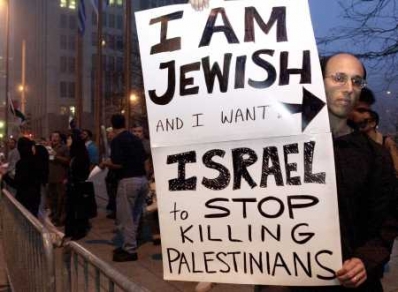
The person in this image is not the author of the piece that follows. There are many Jews who feel this way! Including me. Click on title to return to the site this essay is from.

Weiss: Holocaust Survivor – Why I Support Palestinian Rights

In Canada, Holocaust Memorial Day has been established by Heritage Canada to be on April 11. It is a good opportunity to review what we learn from the Holocaust experience and how we apply these lessons to the troubled situation in the Middle East.

This year, students in more than 60 cities took part in educational meetings on conditions in Palestine as part of Israeli Apartheid Week, held March 1–7. It is a controversial event, not popular in Canadian government circles. It is criticized for supposedly dishonouring the victims of Hitler’s holocaust.

I am a survivor of the Jewish Holocaust, the Nazis’ mass murder of Europe’s Jews. The tragic experience of my family and community under Hitler makes me alert to the suffering of other peoples denied their human rights today – including the Palestinians.

True, Hitler’s Holocaust was unique. The Palestinians are victims of ethnic cleansing and apartheid. Hitler started with that, but went on to extermination. In my family’s city in Poland, Piotrkow, 99% of the Jews perished.

Yet for me, the Israeli government’s actions toward the Palestinians awaken horrific memories of my family’s experiences under Hitlerism: the inhuman walls, the check points, the daily humiliations, killings, diseases, the systematic deprivation. There’s no escaping the fact that Israel has occupied the entire country of Palestine, and taken most of the land, while the Palestinians have been expelled, walled off, and deprived of human rights and human dignity.

Many levels of government have recently been attacking the movement against Israeli apartheid, saying that it is anti-Jewish in character. This is bizarre. When Nelson Mandela opposed South African apartheid, was this anti-White? No, Mandela proposed that all South Africans, Whites included, join on a basis of democracy and equality in freeing the country from racial oppression. And that is precisely the proposal that the movement against Israeli apartheid makes to all inhabitants of Israel/Palestine.

We are told that Israeli Jews will never accept such a democratic solution. Why? Is there something wrong with their genes or their culture? The very notion is absurd – in fact, its logic is anti-Jewish. Opposition to Israeli apartheid is based on hope – a hope founded on the common humanity of the region’s Jewish and Palestinian inhabitants.

Hope from Holocaust Resistance
My family and their community in Piotrkow, Poland, suffered a hard fate under Hitler. The Nazis forced the city’s 25,000 Jews into the first ghetto in occupied Poland. The resistance movement in the ghetto was unable to link up with resistance outside. Only a couple of hundred Piotrkow Jews escaped death.


But my mother and father then lived in Paris. They were active in the ‘Union des Juifs,’ a Jewish resistance organization closely linked to socialist parties and other anti-Nazi groups. When the Nazis started rounding up 
Jews in France, the Union des Juifs hid thousands of Jewish children among anti-Nazis across the country. My parents were killed. But a brave peasant family in Auvergne, at great risk, took me in and hid me. And that is why I am here today.

The Nazis were routed, and the resistance dealt blows to racism that are felt in France even to this day.

There is a lesson here for us today. Hitler seemed all-powerful at the time. But he could not crush the resistance, a broad people’s alliance embracing many religions and many political viewpoints.

We need that kind of alliance in resisting oppression today – including the oppression of the Palestinians.
Jewish Values Are Not Those of Israel’s Apartheid

The United Nations has defined apartheid as “inhuman acts committed for the purpose of establishing and maintaining domination by one racial group of persons over any other racial group of persons and systematically oppressing them.”


The apartheid concept was found in North America when indigenous peoples were confined to reservations in remote corners of the lands stolen from them. The South African Dutch settlers and Israeli government further developed the concept.

Eliminating Israeli apartheid involves three simple measures:


The right of exiled Palestinians to return to their country.

An end to Israeli occupation of Palestinian land.

The right of Palestinians within Israel to full equality.

On July 9, 2005, 170 Palestinian civil society organizations called for boycott, divestment and sanctions (BDS) against the institutions of Israeli apartheid. The BDS movement helped to end the crime of South African apartheid. Since 2005, the BDS movement against Israeli apartheid movement has won wide support around the world.

Nelson Mandela, the great leader of BDS against South African Apartheid, said, that justice for the Palestinians is “the greatest moral issue of the age.”

Support from Jewish Community
I recently discovered that my name is included in a website list of “7,000 self-hating Jews.” Why are Jewish supporters of Palestine labeled as “self-hating”? Because those who make this charge have redefined Judaism in terms of the present policies and character of the Israeli state. They see Judaism as nothing more than a rationale for oppressing Palestinians. What an insult to Jewish religion and culture!


As for the 7,000 self-haters, they need to add a couple of zeros to that total. In my experience, support of Palestine is stronger in the Jewish population than in society as a whole. And Jewish people work alongside their Palestinian brothers and sisters as a strong component of the Palestine solidarity movement.

Holocaust Awareness Week is an appropriate time to review our proud history as Jewish universalists, welcoming and encompassing humanity. We, as Jewish supporters of the Palestinians, stand on the finest traditions of Judaism, its great contributions to human religion, philosophy, science, and solidarity through the ages. The rights we expect for the Jewish people, we demand for all humanity – above all, for the Palestinians that the Israeli government oppresses in our name.

Notes/Sources:
The above article was written by Suzanne Weiss; entitled: “Weiss: Holocaust Survivor – Why I Support Palestinian Rights“.The article can be found on AustraliansForPalestine.

Friday, March 5, 2010

Writer and performer of One-Woman Show, Jennifer Jajeh, interviewed by Palestine solidarity organiser Uda Olabarria Walker

This is a cross post from *here*. Following the interview are links to other posts at The Electric Intifada.

Pushing the boundaries of identity: an interview with Jennifer Jajeh
Uda Olabarria Walker, The Electronic Intifada, 5 March 2010

Jennifer Jajeh (photo by Joseph Sief)

Jennifer Jajeh's critically acclaimed one-woman show, I Heart Hamas and Other Things I am Afraid to Tell You, pulls no punches. From a Ramallah Convention in San Francisco in the 1980s, to casting lines in contemporary Los Angeles, to the front lines of the Israeli occupation and back, Jajeh navigates the complicated and often conflicted terrain of Palestinian identity. Despite the complexity, her journey is anchored by her sole quest to find her own sense of self amidst the noise. This quest supersedes the politics, the expectations and the backlash that a Palestinian identity can carry and becomes universal. The Electronic Intifada contributor Uda Olabarria Walker interviewed Jajeh before she opened her show in Minneapolis in late February 2010.

Uda Olabarria Walker: When you gave the show the title I Heart Hamas and Other Things I am Afraid to Tell You and then launched at the NY Fringe festival in 2008 what were you expecting would happen?

Jennifer Jajeh: First, I was worried no one would come to the show. I also anticipated that there would be some people who would be offended or upset by the title and that there would be some resistance and backlash. Most people understood that title was a provocative, tongue-in-cheek statement and that there was complexity to the show beyond the title, however. In the end, I got pretty good audience and press responses in New York and a fantastic response here in San Francisco one year later.

UOW: The show traces the awakening of your identity, as it becomes, as you have said, "Palestinianized, politicized and radicalized." Can you expand on this?

JJ: I grew up with a split life, half Palestinian and half American --where the two identities were very separate -- to becoming an adult and combining the two. It wasn't until I went to Palestine that I really figured out what it meant for me to be Palestinian on a personal level and what part of that identity felt vital for me. As far as becoming radicalized, it first had to do with pure anger at what I experienced on the ground in Palestine, but now it's about challenging the status quo both externally and within the Palestinian community about what it means to be Palestinian and raising the difficult questions. It was also really important for me to claim my space as a Palestinian woman and look into what it means to be a woman in my community and what the role of women is in the struggle inside and outside that space. So, part of becoming radicalized was also about being a Palestinian woman who openly challenges my own community's ideas about women's roles, sexual mores and religious affiliations and divides. This has been really liberating.

UOW: You share an honest and vulnerable perspective on Palestinian identity. Can you talk a little about the vulnerability of doing something so personal on stage?

JJ: The show has been seriously transformative and it is very scary to put your own life experiences on stage. Each night you relive those experiences and while some are funny, many are very painful. The show is also very honest. You think that because it's your own show, you can say whatever you want about yourself so why not make yourself look good, right? The reality is that the show forces me to be accountable. If I'm dishonest or misrepresent in any way people will not be drawn into the story and take the ride with me. Since the show is my personal, emotional and political journey I share all aspects of it: that includes the shallow, ugly and not very politically correct emotions that I never particularly wanted to share, but are very real. I also talk very honestly about having feelings of anger and desire for retribution for what's happening. I felt very vulnerable going publicly to those deep, dark places but I realized that it was at these precise moments in the show that most people in the audience understood and they were right there with me.

UOW: You have commented before that early on you had some unexpected backlash to the show. Where did this come from?

JJ: In the beginning, some of the Arab community and Arab arts organizations were wary about publicly promoting or endorsing a show with such a controversial title even though privately they were in support. Of course this fear makes sense. Almost 10 years after [the attacks on] 11 September we still feel the weight of heightened anti-Arab racism and Islamophobia. Organizations were fearful of losing funding or alienating their constituencies. This has created a climate where Palestinian and Arab artists are still only supported on a large scale when we represent ourselves as nonviolent and nonthreatening. More surprisingly though was the censorship from the Palestinian artist community. The idea of the show being at all cheeky, button-pushing and irreverent was threatening to people. Some actually said I was being irresponsible by airing internal Palestinian issues, using Hamas in the title, or making light of Palestinian identity. People actually told me to limit what I talked about and to have more digestible content! This is absurd!

UOW: It also seems that people have come to the show with certain expectations. I know some activists left thinking the show wasn't politicized enough or wanted you to make a political statement. What's your response to them?

JJ: They should write their own show. I didn't write this show as a mission statement for any organization or political perspective. The point of the show to explore my identity and the triggers, pressures and complexity this identity holds for one Palestinian in particular, me. The second half of the show is about me coming to terms with the political part of my identity when I go back to Ramallah at the beginning of the second [Palestinian] intifada. But still, the politics are not the only thing that defines me as a Palestinian. There are a variety of Palestinian experiences and if I can get people to sit down and listen to just one of them for an hour and a half, I see it as a major accomplishment. If I have been able to create the space for people to explore the complexity of identity, I have also done well. This is what I'm trying to do with the show; explore identity and raise questions, not push a political agenda.

UOW: I read a comment online from someone who saw the show and said "There is nothing particularly Palestinian about her, except that she tells us she is." What's your reaction to this?

JJ: Well, it's hilarious that someone didn't like the way that I represented my own identity but it's also pretty insulting that someone who would challenge my Palestinian identity and argue that I wasn't Palestinian enough. I don't know if this person expected me to belly dance, smoke an argilah or wear a kuffiyeh throughout the show, or what.

I state very clearly in the show's opening voiceover that "I am not presenting the views or feeling of the average Palestinian, nor do I have any idea what that even means." I felt it was important to put forth very clearly this notion: that there is no prototypical Palestinian. And, that identity is a hell of a lot more complex and individual, and that this story is being told through the lens of a very specific, individual experience. The first part of the show talks about me carrying the weight of other people's expectations around my Palestinian identity, feeling squeezed from all sides by these expectations and dealing with people's often negative, stereotypically racist and completely hilarious reactions to how I actually do express that identity. The [person] who wrote that comment must have missed that.

UOW: The beauty of the show for me is the surprisingly emotional impact it has had on the audience around the issue of identity in general.

JJ: Yes. I wasn't anticipating this response. There were a lot of people from all walks of life who took away something powerful from the show or keyed into some very personal aspects of the issues of identity that the show brings up. From young Latina women to gay Filipino men, I had tons of people sending me emails and messages about how the show really touched on their own struggles of fitting in, being ashamed of their backgrounds and where they came from, or just the craziness of having a big, loud foreign family to contend with. Many people were surprised at how my Palestinian-American experience was so similar to their own experiences of being an outsider. Through this connection, I was then able to take people on the journey to Palestine in such a way that they could hear that story as well.

UOW: You have had some people coming to the show more than once.

JJ: I have had many people come four or five times and bring their friends. I got to the point where I told them they couldn't come anymore or at least had to let me comp their tickets! But I'm happy they felt the work is important, entertaining and relevant enough that they wanted to experience it again with their friends.

UOW: This was your first foray into the medium of the one-woman show. Looking forward, what do you think the role of your art is or should be?

JJ: The role of my art is to push boundaries and to talk about things people are afraid to talk about. I'm hugely interested in people's emotional experiences and psychological processes and how they relate to each other and define themselves. I want to get people to think more deeply, have more empathy, compassion and understanding for the next person. I also want them to push their own boundaries around how they move through the world within their identities.

Uda Olabarria Walker is a San Francisco-based Palestine solidarity organizer.

Related Links

Latest articles on EI:

Palestine : Art, Music & Culture: Pushing the boundaries of identity: an interview with Jennifer Jajeh (5 March 2010)
Palestine : Development: Palestinian women become breadwinners under occupation (5 March 2010)
Palestine : Human Rights: The sounds of piano in Gaza (4 March 2010)
Palestine : Diaries: Live from Palestine: Gaza police forces and their bereaved families rebuild one year on (4 March 2010)
Palestine : Opinion/Editorial: Moment of truth: time to boycott Israel's entire range of injustice (4 March 2010)
Palestine : Human Rights: Picking pebbles to survive in Gaza (3 March 2010)
Palestine : Art, Music & Culture: Refusal to surrender: "My Father was a Freedom Fighter" reviewed (3 March 2010)
Palestine : Diaries: Live from Palestine: "I can't live without this place" (3 March 2010)
Palestine : Human Rights: Rights group: Israeli forces responsible for settlers' provocation at al-Aqsa (2 March 2010)
Palestine : Human Rights: Palestinians excluded from bulk of occupied West Bank (2 March 2010)

Wednesday, February 10, 2010

Black Feminist Mai'a Williams: Come Meet (via Skype) a woman who brings to light the feminist matter of surviving layers of state, imperialist and interpersonal violence and the possibility of response

All that follows is from *here*.

Save the Date 2/24: Transnational Black Feminist Solidarity Featuring Mai’a Williams

February 10, 2010
February’s Eternal Summer of the Black Feminist Mind Potluck Discussion
Black Feminism Lives Worldwide!
(featuring the creative non-fiction of Mai’a Williams on Black feminist solidarity in the Middle East)
When I cyber-met Mai’a she was living in the occupied West Bank of Palestine, getting ready to bring her bright brilliant baby Aza into the world and she wrote me about using the activities in BrokenBeautiful Press’s “Emergency Broadcast” workbook in workshops she was leading between Palestinian and Israeli women.   Mai’a, instigator of the Guerilla Mama Medicine MovementOutlaw Midwife, Reiki master and creator of the Divine Survivors Clinic is has also been doing justice work in the Middle East with her partner Cal for many years.  Check out the links above and email brokenbeautifulpress@gmail.com for a copy of a powerful piece she wrote called “Cleave” about surviving layers of state, imperialist and interpersonal violence and the possibility of response.

AND THEN…come bring food and discuss with Durham’s divine survivors and Mai’a via skype on

Wednesday, February 24th
5:30 pm
@
the Inspiration Station
Come as close to 5:30 as possible to eat and settle in because Mai’a will be joining us live via skype from Cairo @ 6pm EST!!!

Kids are welcome!!!!!!
 
email brokenbeautifulpress@gmail.com for a copy of Mai’a’s piece “Cleave”

Friday, January 15, 2010

WHM Supremacy in Israel is Bolstered Once Again: this time by supporting sex offenders

For an incisive analysis of all of this, please read Scapegoat: The Jews, Israel, and Women's Liberation, by Andrea Dworkin.

All that follows is from the blog of a U.S.-born man who has lived in Israel for 25 years. His blog, Desertpeace, is linked to *here*, and also may be found by clicking on the title just below:

ISRAEL PROTECTS THE ‘HUMAN RIGHTS’ OF SEX OFFENDERS

Parents might want to think twice about allowing their children to visit Israel on youth delegations…. at least until the country gets its priorities straight…. (no pun intended)


The Supreme Court of Israel has officially lost its collective mind.

The Supreme Court accepted an appeal by Yitzhak Mondrovich against his extradition on Thursday, 25 years after he arrived in Israel and 24 years after US authorities indicted him on suspicion of committing 13 sexual crimes against five boys aged nine to 13. 

“The legal and moral basis of the extradition procedure according to the Israeli extradition law is not restricted to being an important tool in the war against international and domestic crime,” Justice Ayala Procaccia wrote.” 

“It is also, at the same time, a procedure which takes human rights into consideration, both by the country requesting the extradition and the extraditing country. The fear of undermining an extradition procedure like this one cannot surmount the need to look at its implications for human rights and the fundamental values of the system of the country being asked to extradite.”


A country that bars journalists from entry, simply because they REPORT the truth about the occupation, bars entry to notable world leaders for fear that they might SEE the truth, is concerned about Human Rights?

What about the rights of the Palestinian people that have been living under the most inhumane occupation in centuries?

What about the rights of the Palestinian residents of East Jerusalem whose homes are siezed illegally by Jewish settlers?

What about the rights of Ethiopian children to go to school?

Obviously none of the above is important enough to be dealt with by the ‘lawmakers’ of the country. 

The article that the above in italics is from can be read HERE.
Zion be proud….. you are showing the world your true colours!

Possibly related posts: (automatically generated)

Monday, December 28, 2009

Pro-Palestinian Freedom March to Israeli Border Set for December 31st


[image is from here]


All that follows is from Alice Walker's blog, here. You can also click on the blogpost title, just below:

Historic Gaza Freedom March to Israeli Border Set For December 31 

Global grassroots initiative in spirit of Gandhi aims to break blockade


HaShoah and Kindertransport Survivor Hedy Epstein, 85, Begins Hunger Strike in Support of the End of Israeli Occupation of Gaza

This post was first read by me at ANG, here. All that follows if from there.

85 year old Holocaust Survivor Hedy Epstein Begins Hunger Strike to Open Gaza Borders #GFM

Palestinian Pundit:

FOR IMMEDIATE RELEASE
Monday, December 28, 2009

By Ali Abunimah
(Ali is in Egypt, with the Gaza Freedom March (GFM). He will keep updating us with the latest news and photos.)

(Left: Kindertransport survivor Hedy Epstein with school supplies destined for Gaza #GFM)

"Hedy Epstein, the 85 year old Holocaust survivor and peace activist, announced that she will begin a hunger strike today as a response to the Egyptian government's refusal to allow the Gaza Freedom March participants into Gaza.

Ms. Epstein was part of a delegation with participants from 43 countries that were to join Palestinians in a non-violent march from Northern Gaza towards the Erez border with Israel calling for the end of the illegal siege. Egypt is preventing the marchers from leaving Cairo, forcing them to search for alternative ways to make their voices heard.

Ms. Epstein will remain outside the UN building at the World Trade Center (Cairo) - 1191 Cornish al-Nil, throughout today, accompanied by other hunger strikers. "It is important to let the besieged Gazan people know they are not alone. I want to tell the people I meet in Gaza that I am a representative of many people in my city and in other places in the US who are outraged at what the US, Israeli and European governments are doing to the Palestinians and that our numbers are growing," Epstein said.

In 1939, when Epstein was just 14, her parents found a way for her to escape the persecution, sending her on the Kindertransport to England. Epstein never saw her parents again; they perished in Auschwitz in 1942. After World War II, Epstein worked as a research analyst at the Nuremberg Trials of Nazi doctors who performed medical experiments on concentration camp inmates.

After moving to the US, Epstein became an activist for peace and social justice causes. Unlike most Holocaust survivors, one of the causes she has taken up is that of the Palestinian people. She has traveled to the West Bank, collected material aid and now she hopes to enter Gaza."