|
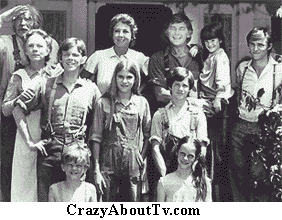
| photo of the cast of The Waltons is from here |
I watch some very mainstream television. This would be a confession if I thought there was something shameful about doing so, but as I have a television and an internet connection too slow to play video (films), what, honestly, are my choices? Corporate TV is what I get, along with
Democracy Now! Today I watched an old episode of
The Waltons from one of its last years on the airwaves, when the grandparents, mother, and John-Boy were no longer on the show. The show didn't do as well in the ratings when the extended nuclear family unraveled due to real-life issues like desire to change jobs, illness, and death.
I loved
The Waltons. And the person in the program I most identified with was... well, there were two. As an intergender male, one was John-Boy, because he was such a caring, sensitive male. The other was Erin, the next-to-youngest girl, because she was sort of invisible as she wasn't statused by being the oldest or the youngest. (I most identified with Jan Brady in
The Brady Bunch, for many of the same reasons.)
As I watched today, I thought about how many television shows I grew up with starred all-white casts, usually Christian ones too.
The Waltons, The Brady Bunch, The The Partridge Family, and Little House on the Prairie were among my favorite shows. I soaked in programs that featured fictional functional families, and functional meant white, Christian, and only heterosexual. I was a gay kid living in a Jewish family. What was I supposed to think of myself by wishing I was part of those families?
What were Black and Brown, Asian, and Indigenous children supposed to long for, to feel that displaced sense of belonging to a fictional family demonstrating unconditional love? How do you feel unconditional love if you're not the color of the family you're watching being loving? There were no dramatic series depicting a nuclear-ish family that was Latina, Asian, or Indigenous. There were a few shows featuring Black families, but only situation comedies. I remember hearing Oprah Winfrey describe the effect of seeing a Black family behave affectionately on television. It happened when Claire and Heathcliff Huxtable cuddled on their couch. She was moved to tears, realising she had gone for all her life to that point never seeing this reflected back to her. I could relate to what she was saying, as I was yearning to see a gay couple of any color relate that way in their fictional home. I'm still waiting to see it.
I'm sorry Oprah had to wait until the 1980s to see a Black woman and man be sweet to one another on television.
I'll Fly Away was one of the first dramatic program featuring a Black family but they had a supportive role that existed around the world of the main family in the show: a white one. I loved
I'll Fly Away too. Regina Taylor was great in a role that didn't give her or her TV family enough air-time.
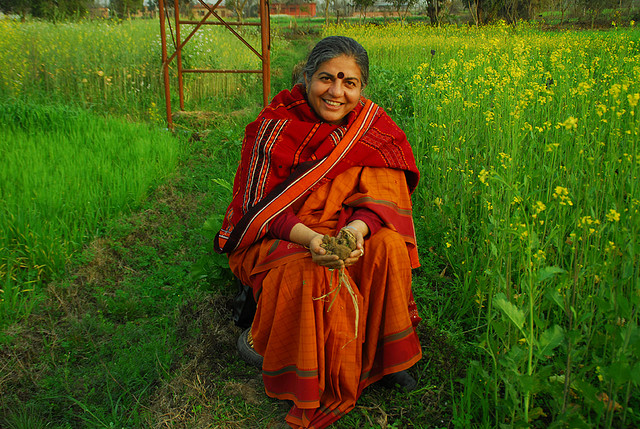
 |
| photograph of Regina Taylor is from here |
For those who don't know--and I'm guessing most of you don't--
I'll Fly Away was a dramatic series that ran for a couple of years in the early 1990s. Like
The Waltons, it was set in the US south. But it took place a couple of decades later, during the Civil Rights struggles. Lilly Harper was the name of a character who, in the story, was hired to work in the home of a widowed white het male lawyer, in part to take care of his three children and also to cook their meals. Occasionally, the storyline took us to her home and life away from the white main characters, especially as her involvement in the Civil Rights movement increased. The lack of central attention on her own life as "more than housekeeper to whites" was not exactly the intention of the show's creators. The network would only support a show that still kept the primary spotlight on white people. From
Wikipedia:
Series creators Joshua Brand and John Falsey have stated that the inspiration for the series was the classic 1962 film To Kill a Mockingbird. While the film centers around attorney Atticus Finch and his family, the pair wondered about the life of Calpurnia, the Finches' African-American maid. Her story goes unexplored in the movie. A serious and seemingly well-educated individual who is respected by her employers, Calpurnia is the inspiration for the character Lilly Harper in I'll Fly Away.
We might take a moment to consider what the employment options were for a woman who was the African American and Southern at that time. We can assume becoming President of the US was not possible, no matter how hard she tugged on those bootstraps. Things have changed since then, but not nearly deeply enough. The proportion of Black women in the US who will be filthy rich remains far less than the proportion of white men. A huge reason for that is laws governing inheritance. Most white families keep their money to themselves.
Options for Black women in the US: what they currently? Not for one woman, but for millions?
I'm watching to see how Oprah Winfrey rescues her network (OWN) from low ratings. I believe she will. She knows far too much about television production and how to get and keep high ratings to not be successful with OWN. She's beginning to put out a brand with some new programming featuring troubled celebrities, which allows her to combine her two most popular elements from the talk show that recently finished out a 25-year career. Those two elements are celebrities and emotional well-being. When watching a news story about the Oprah Winfrey talk show ending, a white middle-class woman spoke about how it was her lifeline to reminders that she has a spiritual life, and to not neglect it.
This tells us so much about CRAP--that it is an anti-spiritual, emotionally unhealthy existence, devoted to consuming, exploiting, and surviving by destroying most of what is around us, if not also ourselves. That a television program that reminds us we are spiritual beings having a human experience is a rarity. And those that also remind us we are existing inside truly vile systems of hierarchical oppression are non-existent. This means we don't really understand how those systems work. And, often enough, we deny they exist at all.
But back to emotional well-being for a moment. If you're really privileged, if you control a lot of the conditions of your life--such as by being economically secure, by not living in a shack--as many millions of good people do, by not being subjected to rape and the threat of rape daily and nightly--you might believe what many white class-privileged people believe: that your well-being is yours to determine.
It is partly ours to determine. But it is also determined by forces around and beyond us. Noticing this means we are called, perhaps, to organise and change those forces so they are more humane and just. But corporate television is owned by powerful companies that are invested in destruction of people, animals, and the Earth, and don't want us organising. So they won't tell us about those systems of harm and inhumanity--how they work, what they are designed to do, and so on.
Understanding those systems and structures has been a primary goal of mine for a long time. Since being nine years old, I'd say. At nine I began to see how things were really fucked up socially with regard to race, ethnicity, and gender. Eventually I added sexuality to the list too. Last on for me was economic status and class.
The principles by which we live our lives--our core philosophies for "good living", are structured for us if we are receiving them from corporate television or by authors who promote values that are not going to prevent them from appearing on corporate television to promote their books. Dr. Phil was supported by Oprah Winfrey. He has the most viewed daytime talk show in the US, now that Oprah's show has stopped airing new episodes.
On OWN, I saw him speaking with the former Duchess of York, Sarah Ferguson. She has a reality show detailing her journey towards greater self-awareness and personal emotional healing. She had a rough childhood emotionally but was stable economically. (Her mother left her when she was twelve, and her father was affectionally distant and very emotionally abusive.) Rarely are connections made between economic poverty and emotional distress, I find. People who are poor are assumed, if living in the US, to be able to pull themselves up from their bootstraps and find happiness in the upper middle class world that remains exclusive and exclusionary to most poor people, by design.
When we're told anyone can do something, we might notice we're not told "everyone can do it"--or even "many". We might notice that US society values
pursuing happiness, not achieving it--unless you're very privileged. Even then happiness might not be yours, but not having to worry about health care and housing, not having to work three jobs to still not be able to pay your bills and feed your children, goes a long way towards being happy. While a few poor, Black, sexually abused children might be able to grow up, like Oprah, and become rich, not all poor people can. Not all Black people can. Not all sexually abused children can. And they can't not because they can't find their bootstraps. They can't because the capitalist, racist, child-hating systems they live in manufacture poverty, oil companies manufacture ecocide and the pornography industry manufactures contempt for women of all colors.
Being told "you can be whoever you want to be" was spoken a lot as President Obama won the election. What wasn't said is that "If we have one Black president, we won't be able to have another one for a score of years; probably longer." What we're not told is that "You won't be able to be president if you're a woman who is Black, Brown, Asian, or Indigenous. Not even a white Christian woman has been president, although I suspect that if Hillary Clinton were the Democratic nominee in 2008, she would have won the top office. How long do you think it will take for us to have an Indigenous president of any gender? A person born in the US also won't become president if they're Jewish or Muslim, even if they're white, male, and heterosexual.
The limitations on what we can do are not discussed as much as the apparent freedoms we have to become whatever we want. I want to live in a world where children and women are not routinely and customarily sexually assaulted. I want a world where no Indigenous people are facing genocidal destruction. I want a world without military wars, without warlords, and without patriarchal tyrants and terrorists. But I suppose that's asking for too much.
So back to the small world of our own private emotional worlds that I'm supposed to be preoccupied with if I'm allowed to think about such things at all.
Online, I found what follows, from
*here*. The author discusses the same program on OWN that I watched. For those who don't know, Sarah "Fergie" Ferguson was married to Prince Andrew of the British Royal Family, but lost the marriage and a lot more. But she's not homeless because Prince Andrew is paying her rent. That's what knowing and being loved and cared about by rich people can do for you. But if the rich are the few--increasingly the tinier few--this means, necessarily, that there will be fewer non-rich people who know them that well.
As I'm not generally cynical, I find some of the concepts here quite moving.
Hi beautiful and powerful women;
While watching the new reality show, "Finding Sarah", I had a breakthrough moment or an "aha" moment as Oprah calls it. Fergie was talking with Dr. Phil and he was explaining why some of us are "blocked" at certain phases of our lives - We all have a personal truth, and that truth is what we really believe about ourselves when nobody is looking or listening. It's what we truly believe about ourselves in the core of our souls. He said, "Personal truth is so important because I think we generate the results in our life that we believe we deserve." I had to rewind that statement several times to totally absorb those powerful words. "Wow", what do I believe I deserve? Have I been blocking myself from all the universe has to share with me by believing I'm undeserving? Dr. Phil went on to say, "If you have a damaged personal truth, you generate the results that match that." "When we grow up, people write on the slate of who we are. People like parents write on our slate. But the most tragic thing of all is when we pick up the pen and start writing and we write the same things they did.." What is your personal truth? What is my personal truth? Do we have a damaged personal truth? That's a powerful question that deserves some honest quiet time to reflect. If your personal truth was damaged like mine was as a child, it's time for us to take that story and write in the the beautiful truth about who we are and what we deserve. We are amazing children and women of God, and while our parents were doing their best to gift us what they could, they probably didn't have the tools to sculpt the masterpiece we are meant to be. Now it's our responsibility to accept God's grace, love, and power so we may soar like angels... The more we have, the more we have to share with one another. We are all beautiful and so deserving of all the miracles, love, abundance, and magic this world and the universe has to share with us. Know how precious and beautiful you are and I ,too, will try to see God's beauty in me. I love all of you and I believe your personal truth is amazing!
You will note that there's no mention of how society, as a whole, or media in particular, writes on our slates. And how even if we have caring families with loving care-givers, a hostile world all jagged and nasty with rape and racism will still find ways to write on our slates.
I had loving care-givers. Several of them. I never went to bed not having eaten all day, and I always had a bed to sleep in. We might say I was lucky, but a whole lot of that not going to bed hungry and having a bed has to do with the particulars of my family's history of being white and therefore able to get employed in certain ways that weren't available to people of color.
I also was bullied for years, sexually abused and sexually assaulted, and endured anti-Semitism and a whole fucking lot of homophobic violence.
The sexual assault, perhaps even more than the bullying, wrote on my slate. What the assaulter wrote on me was this:
You are worthless. You are nothing. You are a thing for me to use as I see fit. You are something for me to wipe myself on. You are dirty. You are bad. You are aren't human in the way that I am human--I get to do stuff to you and you don't get to do stuff to me. Your value is in being used.
As many feminists have noted, this is power boiled down to its essence: the ability to act. The ability to have what one wants done to be done. Crystal Harris just broke off her engagement to Hugh Hefner. He's 85 and she's sixty years younger than him. She decided she didn't want to be a well-kept prisoner. I'm glad. Apparently Hugh is quite a tyrant at home. He demands that things go his way all the damn time. He has movie nights and the women he wants there have to be there--two old movies on two nights; a new movie on the third night. He wants to play cards at certain times, so that's what the women around him do because they know if they don't they'll be tossed out on their exploitively photographed butts. Hugh Hefner is a silk-pajama'ed pimp who figured out how to be a publisher. That's what he ought to be well-known for. But corporate media will tout him as a fighter for justice and freedom; "only his own freedom" is the part that's left out.
I wanted to prostitute myself to procurers on and off during parts of my life and probably the one thing that kept me from doing it was not being homeless and broke. And when I seriously contemplated doing so, I'd come into contact, very strongly, with those messages that the serial rapist of children wrote on my slate. And knowing that selling myself to strange men would deepen the grooves of those etched messages left me very conflicted about following through with what be might be called a compulsion that wasn't acted out for many years.
I acted it out with a male cousin for a few years in motel rooms, answering his calls for sex as he wanted it. That did more deeply etch some of those messages--particularly the ones that told me I was undesirable except to be used. I'm now thinking about how when a man is interested in me that fact alone is triggering. Now I know why: it triggers what, in my memory, is the stuff that happens next: being used and abused.
I am celibate and I am asexual and it is with those conditions in place that I pursue my own form of happiness that doesn't look much like what corporate media tells me I should be acquiring to get it.
I know many people, mostly not white, mostly not men, who also choose to not have sex with other people. Some of them have active and enjoyable sexual relationships with themselves: I call that being celibate. I don't welcome or want sex: I call that being asexual.
I'm not anti-sex any more than I'm anti-food. I think sex can be as good as eating, as nutritious and fulfilling, and as bad compulsively eating CRAPpy food or getting food poisoning. And when you need food, you eat what's available. And when people want sex or romance with others, sometimes they take what they can get.
I watched female cousins choose men who were neglectful and abusive, get divorced, and then meet men who were far more loving. I suspect that they learned something about their value by being so devalued in their first marriages and, importantly, understanding that the messenger was wrong. In reflecting on their first husbands, I am struck with how these young men were very much like many other men around at that time, living in that culture. Curiously, the second husbands were from other states and other cultures. When they had a real opportunity to eat better food, they did. One of my cousins now runs regularly and eats mostly organic food. We didn't know what organic food was when we were kids. We were too busy eating peanut butter with added sugar and hydrogenated oil; with marshmallow fluff, which was basically all sugar; on very white bread made from bleached, bromated flour. The culture wasn't yet selling whole grain bread in the grocery stores. We take what is available, often enough. And that isn't the same as having freedom of choice.
I saw a man on television who was being interviewed by news media. He and his children had no clean water to drink, and no home, and were drinking water gathered from a stream where people washed their clothes and bodies. Thirsty in the heat, he was pouring it into his mouth and, one presumes, into the mouths of his children. He was being as good a care-giver as he could be within the conditions he was living inside. How he was far more like how most people live than how the members of the The Brady Bunch, or even the Depression-era Waltons lived. I remember reading an article in the New York Times about how the Waltons on television we're being depicted at all like how poor whites in that part of the US were actually living during that time in history. The punishing poverty common to that area of the US was removed from their story.
I wanted to believe it was close enough, because believing the television shows were dishonest was too difficult to accept. I needed it too much--to be the Truth. If television lied, that meant I had nothing into which to find my lonely hopes fulfilled.




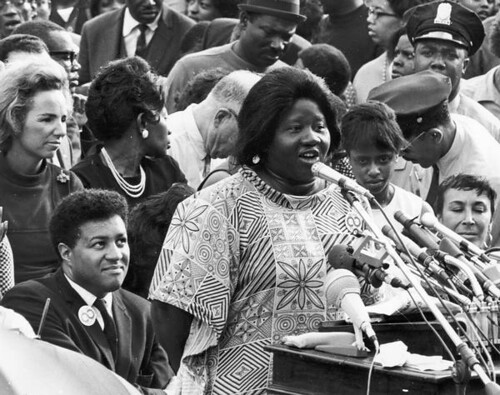
 Johnnie Tillmon was born in Scott, Arkansas, in 1926. A migrant sharecropper’s daughter, she moved to California in 1959 to join her brothers and worked as a union shop steward in a Compton laundry. Tillmon organized workers and became involved in a community association called the Nickerson Garden Planning Organization which was established to improve living conditions in the housing project.