Showing posts with label African American experience. Show all posts

Thursday, February 11, 2016

Happy 100th Birthday to Radical Feminist Flo Kennedy!!!

book cover image is from here

With a debt of gratitude to Sherie M. Randolph, below are snippets from two websites honoring Florynce Kennedy, who would have turned 100 today. When herstory is written by whites or men, Black women get marginalised or left out as central figures. Flo Kennedy was a central figure in radical feminism in the 1970s. First up, from Solidarity:

The Lasting Legacy of Florynce Kennedy, Black Feminist Fighter

— Sherie M. Randolph


SEVERAL DECADES AFTER the 1960s political upheavals, very few people recognize the name of the Black feminist lawyer and activist Florynce “Flo” Kennedy (1916-2000). However, during the late 1960s and 1970s Kennedy was the country’s most well-known Black feminist. When reporting on the emergence of the women’s movement, the media covered her early membership in the National Organization for Women (NOW), her leadership of countless guerilla theatre protests and her work as a lawyer helping to repeal New York’s restrictive abortion laws. Indeed, Black feminist Jane Galvin-Lewis and white feminists Gloria Steinem and Ti-Grace Atkinson credit Kennedy with helping to educate a generation of young women about feminism in particular and radical political organizing more generally.

Yet Kennedy’s activism is marginalized or completely erased from most histories of “second wave” feminism. Those rare references to Kennedy usually highlight her as one of the few Black women in the women’s movement. Kennedy is a significant exemplar of the exclusion of key Black feminist organizers from most feminist scholarship on the movement: the erasure of her critical role speaks to the ways in which feminist literature has failed to see Black women as progenitors of contemporary feminism.

In response to such historical effacement, this article resurrects Kennedy’s political contribution to sixties radicalism and uncovers a Black feminist politics and practice that was not only connected to the mainstream feminist movement but was also closely allied to the Black Power struggle. It challenges previously held rigid dichotomies between the Black Power and women’s movements and illuminates the centrality of Black feminism and Flo Kennedy to both movements.

Kennedy asserted that she could “understand feminism [and sexism] better because of the discrimination against Black people.” Her work in Black movements reveals the Black Power movement as a significant force in shaping contemporary feminist struggles.

Earlier feminist movement scholarship ignores or undervalues the connections between Black Power and feminist struggles. Studies of independent Black feminists and the predominantly white feminist movements cite the increased masculinity that kept feminism and Black Power divided. They are not wrong to do so, but positioning Black Power as primarily an antagonistic influence misses what the movement might tell us about how both Black and white feminists understood liberation and revolution.

For the rest of this post, please visit *here* at Solidarity.


*                  *                  *

What follows next is from Colorlines:

Happy 100th Birthday to the Notable, Quotable Black Feminist Flo Kennedy!

Razor-tongued Black feminist lawyer and activist Florynce "Flo" Kennedy would have turned 100 years old today. To celebrate, we offer you some of her powerful, witty and sometimes profane words.

Sherie M. Randolph  FEB 11, 2016 12:33PM EST

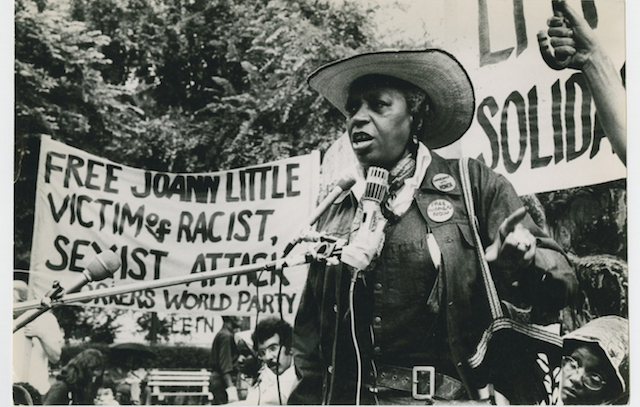
Photo: Bettye Lane
Florynce "Flo" Kennedy speaks at a protest to exonerate a Black victim of attempted rape, Joann Little on July 12, 1975. In 1972, Little, 20, fled her jail cell in Beaufort, North Carolina, after killing the White deputy sheriff who tried to rape her. Little used the jailer’s ice-pick against him and she was placed on trial for murder.  

Florynce "Flo" Kennedy, the charismatic feminist and Black Power activist and lawyer, was born 100 years ago today (February 11). While she is most often remembered as one of the few Black women who worked in the mostly White feminist movement of the 1960s and '70s, Kennedy's influence also flowed from her work within the New Left, Black Power, Civil Rights and autonomous Black Feminist movements.

For the rest of this post, please visit *here* at Colorlines.


                                                *                  *                  *

Finally, to read so much more about Flo Kennedy, please read Sherie's new book:

Florynce "Flo" Kennedy: The Life of a Black Feminist Radical 


Please visit *here* to purchase the book from Charis Books and More, an independent feminist bookstore--for less money than Amazon.com.

Monday, November 2, 2015

'Other' Black Lives Matter


Photo of the leaders of Black Lives Matter, Alicia Garza (left), 
Opal Tometi (center) and Patrisse Cullors (right) is from here


In a recent exchange with S Baldwin, here on the blog, SB pointed out that in addition to Black men's lives, and those of Black male youth, there are other lives that also don't matter as far as mainstream media outlets are concerned: those of Black women and Black girls.

What is not new is that Black women's lives get subsumed in the lives of others who are oppressed and systematically killed. "Black people", too often, are sexistly assumed to only be "Black men". In too many dominant social spaces, trans people of any gender are assumed to be white.

All the Women are White, all the Blacks are Men... comes to mind.

I have had the great honor to hear Alicia Garza speak. To me, she is a solid example of "a great leader". She is also the kind of leader the white and male supremacist mainstream, in media or out of it, will unlikely acknowledge as such. Media doesn't like shared titles. Media likes 'the' leader. But Alicia speaks inclusively, which is in itself rare among white progressives or male radicals. She speaks of all the people, past and present, who art part of political struggles. Keeping with that tradition is not conducive to the Great White Male Leader narrative. Alicia speaks of the leadership and purpose of the Black Lives Matter movement, here:
http://www.truth-out.org/news/item/29813-building-movements-without-shedding-differences-alicia-garza

An excerpt:
It's really hard for people to wrap their heads around a movement that is full of leaders. That's how our homes work; that's how our communities work; that's how our workplaces work, whether or not we want to talk about it. We're just trying to reflect our own realities. We're trying to create more pathways for more people to participate and engage. If we want a full democracy in this country, we can't just have people following one person. Everyone has to feel like they have a stake in shaping the kind of world that we live in. Otherwise, we get into a situation like the one that we're living in now, where nobody's happy with the leadership that we're getting.  -- Alicia Garza

Here are some links detailing the atrocities. There are many and there are not enough, but few of them come from the white male mainstream.

http://www.theroot.com/articles/news/2015/07/at_least_5_black_women_have_died_in_police_custody_in_july_wtf.html

http://www.blackgirldangerous.org/2014/12/whose-lives-matter-trans-women-color-police-violence/

http://www.womankind.org.uk/2015/05/sayhername-police-brutality-against-black-women-in-the-us/

I have thought often about the fact--to me a truthful one--that whites and men cannot lead us--the whole us--anywhere that is radically life-affirming and justice-bringing.


Sunday, September 7, 2014

Please take one minute to sign this Change.org petition to revoke the bail of a cop who serially rapes Black women


First, here's the link to the Change.org petition:

https://www.change.org/p/gov-mary-fallin-revoke-the-bail-for-accused-serial-rapist-daniel-holtzclaw

With great thanks to Son of Baldwin: Twitter: https://twitter.com/SonofBaldwin, Tumblr: http://sonofbaldwin.tumblr.com/.

A few thousand more signatures will make a difference. So please share the Change.org link via Twitter and other social media. Thank you!

From Change.org's petition page:

Revoke the Bail for Accused Serial Rapist Daniel Holtzclaw

Revoke the Bail for Accused Serial Rapist Daniel Holtzclaw

Petition by

Son of Baldwin

Dear Governor Fallin:

We are outraged that Oklahoma City District Court Judge Timothy Henderson saw fit to offer bail to accused serial rapist (and possible murderer) Police Officer Daniel Holtzclaw. Not only did the judge offer an initial bail of $5 million, but REDUCED it to $500,000 for the sole purpose of allowing Holtzclaw to obtain his freedom. We believe the public safety is at risk for as long as Holtzclaw is allowed to remain outside of prison. 

Holtzclaw has been accused, by EIGHT WOMEN, of abusing his power and resources as a police officer as a means to rape them without consequence. These testimonies, given by women who do not know one another, are remarkably consistent and credible and, in the interest of social justice, we demand that Holtzclaw's bail be revoked so each of these women, and every other woman in the community, can be assured that Holtzclaw, through his considerable connections through the Oklahoma City Police Department, will not be able retaliate or enact some sort of revenge against his accusers. 

Anything less than that does not serve the public interest and will not only seem to be a suspicious and concerted strategy on the part of the local government to protect one of its own, but also an attempt by the local government to perpetuate institutionalized and systemic racism and sexism, as all of Holtzclaw's victims are black women. 

So much sympathy and concern have been placed with Holtzclaw and his family. Well, what about the victims and THEIR families?

We cannot imagine a single American agency allowing Holtzclaw mercy, much less bail, if he were black and his victims were white.

Please join us in our efforts to show the world that the United States of America is not a rape culture where rapists are protected and excused. Please show the world that the lives of black women do, indeed, matter. Instruct Judge Henderson to revoke Daniel Holtzclaw's bail.

Signed,

The Concerned Citizens of the World


To:
Gov. Mary Fallin, Oklahoma-05 
Revoke the Bail for Accused Serial Rapist Daniel Holtzclaw
Sincerely,
[Your name]

Wednesday, July 23, 2014

12 Years A Slave: Review

Lupita Nyong'o and Chiwetel Ejiofor, featured in 12 Years a Slave
Before getting to the review, I wanted to let you know about a blog I just discovered. The publisher and editor is Kimberly N. Foster. Here's the link: http://www.forharriet.com/

And speaking of Harriet Tubman and the call to end slavery, I also wanted to offer a review of the film and winner of the latest Academy Award for Best Picture, 12 Years a Slave.

This is the cinematic telling of one U.S. man's true story. Solomon Northup was a real person who was born a free man in the north in 1808. He authored the book, 12 Years a Slave, about his capture in 1841 and release in 1853 from a white Southern hell.

What I appreciated was how the opening scenes might allow a white male viewer to see a Black man in 19th century U.S. as a free man, and how his horror at becoming a slave is not told through his abduction from West Africa, which might allow white people in the U.S. to distance ourselves from his plight. Northup, played superbly by Chiwetel Ejiofor, is "us" more than Kunta Kinte is "us". And for the purposes of a film most appropriately aimed at a white audience, this is crucial. Usually this is done by having the protagonist be white, reinforcing the deadly "Great White Man" myth, in such as in films like 1997's Amistad, 2006's Amazing Grace, and 2012's Lincoln.

I'm not saying the film is made (only) for a white U.S. audience: I'm saying that white people need to see and understand what this film is saying about us. And I'm not saying there isn't a collection of Great or Good White Men in this film. Brad Pitt's character, Bass, is one.

To me, the film brilliantly layers insult over injury, over and over. Each scene is another stark example of how whites conspire, on the institutional level and the interpersonal one, to control the bodies and destroy the dignity of Black people, here in the mid-19th century U.S. south. Each scene details the efforts of those enslaved to survive and not allow their humanity to be completely obliterated under the harsh and horrible lash of antebellum slavery.

The movie is brutal, graphically brutal, horrifyingly brutal, and unflinchingly honest in its depiction and portrayal of white men's sadism and savagery against Black people. In particular, it also depicts the complex relationship between white women and Black women, each group owned by white men. This is shown in the character of Mistress Shaw, played by Alfre Woodard.

But far more graphically, it is rendered through the tortured and tenacious humanity of Patsey, astoundingly acted by Lupita Nyong'o, who won the Academy Award for Best Actress.

A brilliant discussion of the legacy of colonial racist misogyny woven into the relationships of U.S. Black and white women may be read here in a brilliant piece by Michaela Angela Davis titled "12 Years A Slave: Rage, Privilege, Black Women and White Women". Here's the link, followed by an excerpt:

http://jezebel.com/12-years-a-slave-rage-privilege-black-women-and-whit-1452173238
The women in the beautifully brutal film 12 Years A Slave were mangled and maliciously intertwined. The enslaved women lived like beasts and the “free” women behaved like savages, trapped together in a filthy cage of rape, rage and bitter resentment. A resentment so magnificent, it could freshly fester in the psyche of their daughters for centuries to come.

The twisted relationship dynamics between the two lead female characters Patsey (Lupita Nyong’o) and Mistress Epps (Sarah Paulson) in 12 Years A Slave are a horror.
The juxtaposition of such naked racist-misogynist sadism with feeble gestures at Southern white gentility is striking to me, reminding me of how fused the two are, and how dependent they are on one another. The white man who is only brutal is uncouth and risks revealing the putrid soul of whiteness to everyone who want to believe it is natural or God-given. The white man who is only genteel is not doing his job. His job is to rule over, exploit, and dehumanise Black people: to treat Black men as worse than non-human plantation chattel; to treat Black women as chattel and also as a rape object: chattel slave and sexual slave both.

We see how white men, more stupid and less stupid ones, are seduced by an unjust and inhumane ability to rule others. We see the gross arrogance, the supremacist self-delusion that he might be better because he is free, even while he is doomed to moral inferiority due to how he treats other human beings.

As you watch the film, or rewatch it, note how each scene carefully reveals another bloody-sharp facet of what U.S. slavery did to people: the rulers and the ruled, the owners and the owned.

I am led to see more deeply how this is still the case, with more slavery than ever, and at least as much denial that it ought to be abolished once and for all.


Wednesday, July 17, 2013

Please sign this petition in support of Marissa Alexander, who fired a gun in the air to ward off her abuser and got twenty years in prison

 All that follows is from *here*.

PARDON Abused Mother Marissa Alexander for Standing Her Ground

PARDON Abused Mother Marissa Alexander for Standing Her Ground
  • signatures: 75,533

  • signature goal: 100,000
  • Target: Florida Governor Rick Scott
  • Sponsored by: Susan Vaughan

The Stand Your Ground Defense failed domestic abuse victim Marissa Alexander - who didn't shoot anyone.

Only after enduring a year of violence from her husband Rico Gray, who has a documented history of abuse, did she arm herself for protection.

The next threat came just nine days after giving birth to their daughter. Gray, in a rage, cornered her and threatened to kill her. But instead of shooting him, she aimed upward. The only thing she hit was the ceiling.

Gray ran into the street, claiming she threatened to kill him and his boys. Marissa, on his word alone, was arrested and charged with aggravated assault with a deadly weapon.

For protecting her life and children she was just sentenced to twenty years in prison, even though Gray has since admitted his intention to harm her. There's no excuse for Florida to deny this responsible mother her freedom.

Marissa is currently in the process of appealing her conviction. Tell Governor Scott to PARDON Marissa NOW!

Click the following link to sign in support of Marissa Alexander: http://www.thepetitionsite.com/503/600/056/dont-imprison-marissa-alexander-for-standing-her-ground/#letter 


Trayvon Martin and the on-going Genocide of Black and Brown People

image of the late Trayvon Martin is from here

I suggest we ought to understand what happened to Trayvon Martin--his murder at the hands and gun of known serial criminal son-of-a-judge* George Zimmerman (see here, and here: trigger warning for details of child sexual abuse)--through much broader lenses than those used by white male-owned corporate media.  I view such an injustice and grievous act, another loss added to the millions of others, in the context of seeing how many Black and Brown people around the world are allowed to die an unnatural death from the following:

--gross economic discrimination, violence, and terrorism,

--pollution, theft, and destruction of water systems and other natural resources,

--imperialist invasion and occupation,

--wrongful/unjust incarceration alongside serial and mass murder inside and outside the criminal justice system owned and operated by white men and supported by white women

--willful media and medical abuse, negligence, and neglect,

-- coerced and forced indebtedness and dependence on white/colonial societies,

--sexual trafficking and sexual and economic slavery,

--many other forms of well-organised and institutionalised inhumanity leading to disease, depression, and premature death

I come to the conclusion that what happened to Trayvon Martin, including the injustice his family has to endure from a white-majority jury, is neither accidental, aberrant, or anecdotal. (Not, really, that there was any doubt.)

What happened to him is what happens in many different ways to Black and Brown people globally: being targeted for harassment, assault, and death both one at a time and en masse.

If and to whatever extent Trayvon had the courage and will to fight back, it surely wasn't sufficient to save his own life or to take the life of his stalker. We can only hope Black and Brown people prevail. Chances for survival and success beyond survival would greatly and dramatically increase if whites would organise to release the institutional strangling grip of economic, social, and interpersonal murder.

*Thanks to Carolyn Gage for publicly pointing out the particular political significance of this with regard to why he's never been found guilty of anything he's done that is criminal--including messing with a cop, and more recently this murder of a youth.

May Trayvon Martin, and all the other murdered Black and Brown women, men, and children, rest in a kind of peace not socially offered or available while alive.

I close with this statement about the killer, by bell hooks:
"White supremacy has taught him that all people of color are threats irrespective of their behavior. Capitalism has taught him that, at all costs, his property can and must be protected. Patriarchy has taught him that his masculinity has to be proved by the willingness to conquer fear through aggression; that it would be unmanly to ask questions before taking action. Mass media then brings us the news of this in a newspeak manner that sounds almost jocular and celebratory, as though no tragedy has happened, as though the sacrifice of a young life was necessary to uphold property values and white patriarchal honor. Viewers are encouraged to feel sympathy for the white male home owner who made a mistake. The fact that this mistake led to the violent death of an innocent young man does not register; the narrative is worded in a manner that encourages viewers to identify with the one who made the mistake by doing what we are led to feel we might all do to “protect our property at all costs from any sense of perceived threat." This is what the worship of death looks like.
- bell hooks on the Zimmerman verdict    


Monday, February 4, 2013

Remembering the Rich and Radical Political Life of Rosa Parks. Featuring audio of her, on what would have been her 100th birthday!

All that follows is from Democracy Now! (I only added links to the title of Jeanne Theoharis's political biography of Ms. Parks.) You may link back to Democracy Now! by clicking *here*. 

Happy 100th Birthday, Rosa Parks!


Born on Feb. 4, 1913, today would have been Rosa Parks’ 100th birthday. On Dec. 1, 1955, Parks refused to give up her seat to a white passenger on a city bus in Montgomery, Alabama. Her act of resistance led to a 13-month boycott of the Montgomery bus system that would help spark the civil rights movement. Today we spend the hour looking at Rosa Parks’ life with historian Jeanne Theoharis, author of the new book, "The Rebellious Life of Mrs. Rosa Parks." Often described as a tired seamstress, no troublemaker, Parks was in fact a dedicated civil rights activist involved with the movement long before and after her historic action on the Montgomery bus. "Here we have, in many ways, one of the most famous Americans of the 20th century, and yet treated just like a sort of children’s book hero," Theoharis says. "We diminish her legacy by making it about a single day, a single act, as opposed to the rich and lifelong history of resistance that was actually who Rosa Parks was." We also air audio of Rosa Parks in her own words. In the midst of the boycott in April of 1956, she spoke to Pacifica Radio about the action she took. [includes rush transcript–partial. More to come. Check back soon.]
Guest:
Jeanne Theoharis, author of The Rebellious Life of Mrs. Rosa Parks. She is a professor of political science at Brooklyn College and has written extensively about the civil rights and Black Power movements.

Transcript

AMY GOODMAN: A hundred years ago today, civil rights pioneer Rosa Parks was born. It was February 4th, 1913. On December 1st, 1955, when she was 42 years old, she refused to give up her seat to a white man on a city bus in Montgomery, Alabama. She was arrested, convicted of violating the state’s segregation laws. Her act of resistance led to a 13-month boycott of the Montgomery bus system that would help spark the modern-day civil rights movement and launch Dr. Martin Luther King Jr.

We want to go to a clip of Rosa Parks, in her own words. In the midst of the boycott, April 1956, she spoke to Pacifica Radio about the action she took.
ROSA PARKS: I left work on my way home, December 1st, 1955, about 6:00 in the afternoon. I boarded the bus downtown Montgomery on Court Square. As the bus proceeded out of town on the third stop, the white passengers had filled the front of the bus. When I got on the bus, the rear was filled with colored passengers, and they were beginning to stand. The seat I occupied was the first of the seats where the Negro passengers take as they—on this route. The driver noted that the front of the bus was filled with white passengers, and there would be two or three men standing. He looked back and asked that the seat where I had taken, along with three other persons: one in a seat with me and two across the aisle were seated. He demanded the seats that we were occupying. The other passengers there reluctantly gave up their seats. But I refused to do so.
I want to make very certain that it is understood that I had not taken a seat in the white section, as has been reported in many cases. An article came out in the newspaper on Friday morning about the Negro woman overlooked segregation. She was seated in the front seat, the white section of the bus and refused to take a seat in the rear of the bus. That was the first newspaper account. The seat where I occupied, we were in the custom of taking this seat on the way home, even though at times on this same bus route, we occupied the same seat with whites standing, if their space had been taken up, the seats had been taken up. I was very much surprised that the driver at this point demanded that I remove myself from the seat.
The driver said that if I refused to leave the seat, he would have to call the police. And I told him, "Just call the police." He then called the officers of the law. They came and placed me under arrest, violation of the segregation law of the city and state of Alabama in transportation. I didn’t think I was violating any. I felt that I was not being treated right, and that I had a right to retain the seat that I had taken as a passenger on the bus. The time had just come when I had been pushed as far as I could stand to be pushed, I suppose. They placed me under arrest.
AMY GOODMAN: That was Rosa Parks speaking in April 1956 in the midst of the Montgomery bus boycott. She had refused to stand up for a white passenger just a few months before, December 1st, 1955.

Rosa Parks is often described as a tired seamstress, no troublemaker. The fact was, she was a troublemaker, a first-class one. At the time of her arrest, she was secretary of the local NAACP. She raised money to defend the Scottsboro Boys in a rape case that was trumped up, attended trainings at the Highlander Folk School of Tennessee. In fact, she had sat down on the bus before and refused to get up for white passengers. When she died in October 2005, she became the first African-American woman to lie in state in the Capitol Rotunda.

Well, I just recently sat down with Jeanne Theoharis, historian, author of the new book, The Rebellious Life of Mrs. Rosa Parks. She is a professor of political science at Brooklyn College who’s written extensively about the civil rights and Black Power movements. I began by asking her to tell us the story of Rosa Parks.
JEANNE THEOHARIS: This is a story of a life history of activism, of a life history, as she would put it, of being rebellious, right, that starts decades before her historic bus stand and continues decades after. And so, very much what the story I’m trying to tell in this book is the story of that scope. It begins: Her grandfather was a supporter of Marcus Garvey, and so that is really where she gets her start, is with her family, her mother and grandparents. And they sort of inculcate her in a sense of pride and a sense that you demand and expect respect from people around you. And so, it is that spirit that she then brings into the world. She marries Raymond Parks, the first real activist she ever met.
AMY GOODMAN: Marcus Garvey was?
JEANNE THEOHARIS: Marcus Garvey headed the Universal Negro Improvement Association. He was a Pan-Africanist and also a proponent of sort of black nationalism and black pride. And her grandfather was a supporter.
So, she meets her husband, Raymond Parks, and he is working on the Scottsboro case. This is 1931. And the Scottsboro case, these are nine young men, ages 12 to 19, who get arrested riding the rails. Right? This is the Great Depression. And very quickly, the charge turns to rape, and very quickly, they are all sentenced to death, except the youngest one. And so, a support movement grows up—
AMY GOODMAN: These are black boys—
JEANNE THEOHARIS: Black boys.
AMY GOODMAN: —teenagers, and white young women.
JEANNE THEOHARIS: Right.
AMY GOODMAN: Girls.
JEANNE THEOHARIS: Basically, these young boys are riding the train, like many people did. When they get arrested, it is discovered there are two young white women riding the train. And it is that moment where these nine young men—again, ages 12 to 19—where the charge then turns to rape. They were not originally arrested for rape. And so this support defense committee, this grassroots defense committee, grows to defend these nine young men. And Raymond Parks is part of that movement, and that’s what he’s doing when she meets him. And so, he’s sort of the first activist she met, and in many ways, that—her political development as an adult starts with sort of being a newlywed with Raymond and working on the Scottsboro case.
AMY GOODMAN: And what happened to the Scottsboro Boys?
JEANNE THEOHARIS: Ultimately, they are not—they are not executed, and that movement really prevents that travesty of justice from happening.
So then, in 1943, she sees a picture of a classmate attending a local NAACP meeting, and she realizes that women can be part of the NAACP, and so she decides to go and attend a Montgomery NAACP meeting. And she’s the only woman there. And they’re having branch elections, and so she is elected branch secretary at her very first meeting in 1943. And that begins a decade of activism, right, before her bus arrest, where she is working with the NAACP.
And she’s working with a man by the name of E.D. Nixon. And E.D. Nixon is a sleeping car porter, and he’s active in the union of sleeping car porters. And he and Rosa Parks want to transform the branch into a more activist branch, and so he actually runs for president and wins in 1945. And he and Parks set about to investigate cases of white brutality, work on black voter registration. And this is very controversial. And in fact there is controversy in the branch. There are many middle-class members who oppose this. They try to unseat Nixon and, to a certain extent, Parks. But that does not work.
And so, for this decade before her stand, she is doing this very dangerous work. You know, I think we say NAACP today, and it sounds not so dangerous. But to be a NAACP activist in the '40s, doing what she's doing—she’s traveling the state, she’s taking testimony of people, she’s trying to get them to sign affidavits—that is extremely courageous work. And there’s sort of only a small handful of people in Montgomery, you know, sort of committed to doing that work.
AMY GOODMAN: So, how does this moment happen? Actually, as you point out in the book, it wasn’t the first time Rosa Parks sat down on the bus and refused to get up. But explain what was different, when she tried it the first time and when she tried it in 1955.
JEANNE THEOHARIS: So there’s a—right, as you mention, there is a longer history of bus resistance in Montgomery. There had been numerous cases sort of in the decade after World War II, before her arrest in '55, of people getting arrested on the bus. And she's very familiar with many of these cases, so she knows what can happen. A neighbor of hers in 1950 is arrested, thrown off the bus and killed by police. The young Claudette Colvin, in March of 1955, is manhandled by police when she is arrested for her refusal to move. Parks herself had made various stands on the bus. She abhorred the practice that many bus drivers insisted on, where black people would have to pay in the front, get off the bus, and reboard in the back of the bus. And she refused to do that. She had been kicked off the bus by this very same bus driver a decade earlier for refusing to do that. She had had trouble with other bus drivers. She describes some bus driver passing her by because he didn’t—you know, he felt like she was a trouble—you know, she raised trouble. So she had this sort of history of bus resistance. There is this larger history of bus resistance in Montgomery. And then we get to December 1st, 1955.
One other thing is, that summer in August, she had gone for a two-week workshop to Highlander Folk School. They were having a workshop on school desegregation. This is 1955. So, we have the historic decision in 1954, Brown v. Board of Education, but then the Supreme Court comes back in '55, right, and refuses to put a timetable on it, right? It's the historic words: "with all deliberate speed." And so, activists, like Parks, like Myles Horton and Septima Clark, who were running the Highlander workshops at the time—
AMY GOODMAN: In Tennessee.
JEANNE THEOHARIS: In Tennessee. This is a—this is a workshop to bring together people who want to push for and make a plan to implement school desegregation, because the court is clearly not going to press it forward. So she attends this workshop in August, and it is a very important and transformative time for her. She describes it as the first time she felt like she could discuss things with white people and not feel hostility. She’s obviously—there are 48 people attending this workshop. These are all people committed to this work of school desegregation. So, both—her own spirit really lifts. She talks about loving Myles Horton’s sense of humor, getting to just eat and be in a interracial space, that was a matter-of-fact interracial space, that just—that people just ate together, they shared rooms together, they sat outside together, that that freedom was also transformative, personally.
So she comes back, and then, in some ways, the atmosphere of the segregation in Montgomery, the conditions become harder to bear, I think. So, the evening of December 1st, 1955, she’s gotten off work. She actually decides to wait for a less crowded bus, so she goes to a drugstore, buys a few things and boards the bus around 5:30 at night. She sits in the middle section, right? One of the myths is that she was sitting in the white section; she was not. She was sitting in the middle section. The middle section was sort of a no-man’s land, in that the bus driver could ask you to move from that section even though Montgomery city code at the time said black people were not—did not have to get up out of their seats if there was no seats available. But bus drivers routinely violated that city code. So, that night, she’s sitting in the middle section. There are four black people sitting in this row. And at the third stop, the bus fills up, and there is one white man standing. And by the terms of Montgomery segregation, all four people will have to get up so that one white man can sit down. And the bus driver, James Blake, who, like all bus drivers in Montgomery, is carrying a gun, orders them to move. And she refuses.
He says, "I’m going to have you arrested." She says, "You may do that." He gets off the bus, and he first calls the supervisor, his supervisor. And the supervisor says, "Well, get her off the bus." The supervisor—I want to repeat that—just says, "Get her off." He does not say, "Have her arrested." Blake calls the police. The police come and evict her from the bus. And she believes the police don’t want to arrest her. It is Blake who sort of takes that sort of final historical step and says—
AMY GOODMAN: And he’s a white driver.
JEANNE THEOHARIS: He’s a white driver. All the drivers in Montgomery are white. I think one of the less-known facets of the Montgomery bus boycott is that it’s also pressing for black bus drivers. So, yes, he is a white driver. The police—she describes also, in those moments, while Blake is off the bus calling, people grumbling—right, people are clearly nervous. What’s going to happen? The police, you know, take her off the bus. Blake says he wants to sign a warrant. He’s going to come after his run to sign the warrant. And they take her to jail.
And she describes the moment in various ways. She describes it as she had been pushed as far as she could be pushed and that to get up meant that she consented to this, and she did not consent. But one of my favorite passages is also that she talks about finding her arrest annoying. And I think this speaks to how she does not necessarily believe that some movement is going to happen, right? She’s taking this stand because she thinks it’s important. But she finds it annoying because she’s actually working on this youth workshop for the weekend, and she sees this sort of as a distraction, and now she’s gotten herself arrested, right? And who knows how long this is going to take? And who knows what’s going to happen? And who knows if some sort of violent thing is going to happen to her? And so, in that moment, it’s a very hard moment, and then it’s also a moment where she in no way can see what’s about to happen.
AMY GOODMAN: Jeanne Theoharis is the author of the new book, The Rebellious Life of Mrs. Rosa Parks. On this hundredth anniversary of the birth of Rosa Parks, we’ll continue our conversation in a minute.

[break]

AMY GOODMAN: Pete Seeger singing "We Shall Overcome." He wrote it with others, the enduring anthem of the civil rights movement, at the Highlander Folk School in Tennessee, where Rosa Parks trained. This is Democracy Now!, democracynow.org, The War and Peace Report. I’m Amy Goodman, as we return to our conversation with historian Jeanne Theoharis, author of the book The Rebellious Life of Mrs. Rosa Parks. I asked her about the fateful day, December 1st, 1955, in Montgomery, Alabama, when Rosa Parks was arrested for refusing to obey a white bus driver, James Blake, who ordered her to give up her seat to a white passenger. I asked how long Rosa Parks was detained and what she did next.
JEANNE THEOHARIS: She’s held there about three or four hours. She calls home, and her mother is terrified. "Have you been beaten?" She says, "No." And so, her husband starts to get money together to come get her. Meanwhile, someone on the bus goes to tell E.D. Nixon. And E.D. Nixon calls, can’t find out any information, and then calls a white civil rights kind of couple in town by the name of Virginia and Clifford Durr and gets Clifford Durr, who is also a lawyer, to call and find out what’s happened to her. So, both Raymond Parks and Nixon and the Durrs all come to—down and bail her out. And they all go back to the Parkses’ apartment.
AMY GOODMAN: And the Durrs are white, famous civil rights activists.
JEANNE THEOHARIS: The Durrs, famous, whites, activists, leftists. So they all go back to the Parkses’ apartment that night to talk about what happens next, because Nixon, once he knows that she’s OK, is, in a measure, delighted, because she’s exactly the kind of person that is both respected in the community, she’s middle-aged, she’s 42, she’s super tough, right? so he knows—he trusts that she’s not going to flinch under the kind of pressure that’s going to be brought to bear. And so he really wants her to be a test case. And at first, her husband is very nervous both for her safety and their safety, but also because people hadn’t necessarily stayed together around other cases. So he’s worried. But they decide that she is going to go forward with this case.
So she calls a young lawyer and friend of hers, a black lawyer by the name of Fred Gray, to ask him to represent her. And Fred Gray calls Jo Ann Robinson, who’s the head of the Women’s Political Council, a professor at Alabama State. And the Women’s Political Council had been very active around these issues. And Jo Ann Robinson mobilizes that night, and they decide to call for a one-day boycott on the Monday when Parks is going to be arraigned in court. And so Robinson actually sneaks into Alabama State College in the middle of the night with two students and runs off 35,000 leaflets in the middle of the night. At about 3 a.m., she calls E.D.—this is Robinson—and says, "This is what we’re planning." And so, at 5:00 in the morning, Nixon starts to call some of the ministers in town to get them on board for this one-day plan. And it is not 'til midday, when Rosa Parks, as she often does, takes her lunch to Fred Gray's law office, that she finds out sort of what’s happening.
And so, they are planning, again, for just a one-day boycott, at this point, on the Monday. And people are very worried. Will people do it? Will people stick together? And then Monday comes, and it is this amazing—people stay off the bus. She describes it as sort of the best moment of the whole thing. And that night, at a mass meeting at Holt Street Baptist Church, people decide to carry on the boycott sort of—and make it, you know, a longer boycott.
AMY GOODMAN: And they choose a young minister who’s just come into town to be their leader.
JEANNE THEOHARIS: Yes.
AMY GOODMAN: Dr. Martin Luther King.
JEANNE THEOHARIS: They choose him for a number of reasons. In part, he’s young. He’s new. He’s not—he doesn’t have any—he’s not firmly aligned with one side or the other. His church is actually located right across—it’s downtown; it’s right across from the Capitol. So they have the first meeting—the ministers have the first meeting at his church on E.D. Nixon’s sort of idea, in part because it’s so centrally located, and again, because Nixon sees that King doesn’t have enemies in town. And then, it is at Holt Street where we get the first taste of sort of Martin Luther King’s sort of, you know, kind of political and oratorical brilliance, right? because the speech he gives that night is an incredible speech.
AMY GOODMAN: December 5th, 1955.
JEANNE THEOHARIS: Exactly.
AMY GOODMAN: So, Rosa Parks helped to—helps to launch Dr. Martin Luther King.
JEANNE THEOHARIS: Yes, she does. Yes, she does. And in many ways, she—there’s this interesting moment. So, on Monday, right, she goes to court. She’s very quickly convicted. And then she goes back with Fred Gray to his law office. She doesn’t go back to work. She doesn’t go home. She goes to his office, and she answers—
AMY GOODMAN: She worked at Woolworth’s?
JEANNE THEOHARIS: Ah, sorry, she worked at Montgomery Fair. She’s an assistant tailor. Montgomery Fair is the biggest department store in Montgomery at that point. So she’s—she’s working in the men’s shop. But she doesn’t go back to work. And she answers phones in Fred Gray’s office that Monday, and she doesn’t tell people it’s her, right? So this is sort of the paradox of how she negotiates this role. So she’s—she wants to be useful, so she’s answering all these calls. People are wanting to know what’s happening, what they should do. She’s not saying it’s her. And then, meanwhile, she stays and answers phones, while Fred Gray and Nixon and King have a meeting where the Montgomery Improvement Association will be born, right? So, in some sense, she—she’s sort of doing this kind of behind-the-scenes work while the kind of leadership is being formed on that Monday afternoon.
AMY GOODMAN: You talked about December ’55 coming just a few months after the murder of Emmett Till in Money, Mississippi—
JEANNE THEOHARIS: Right.
AMY GOODMAN: —fourteen-year-old African-American boy, seared into the history and consciousness of this country, what happened to him. Describe what happened and how Rosa Parks was affected by it.
JEANNE THEOHARIS: The lynching of Emmett Till happens in August of 1955. But just days before she makes her stand, they’ve had this mass meeting. So, part of what happens is, the two men—because of the attention to the lynching, the two men are actually put on trial, which is sort of a rarity, but they are acquitted. This is Bryant and Milam. And so, a campaign comes up to kind of raise awareness around this, sort of organized in part by Mamie Till, his mother, and T.M. Howard. And so they’ve had—T.M. Howard comes to Montgomery just days before, and they’ve had this big mass meeting. And so, it’s very much on her mind. When she talks about sitting there in those moments, she talks about thinking about her grandfather, she talks about thinking about Emmett Till. And she’s—
AMY GOODMAN: When had he come into town, in Montgomery?
JEANNE THEOHARIS: Howard comes in—I think it’s just literally four or five days. They’ve had this big mass meeting.
AMY GOODMAN: Four or five days...?
JEANNE THEOHARIS: Before her arrest, so—
AMY GOODMAN: So at the end of November, right after Thanksgiving.
JEANNE THEOHARIS: Exactly, exactly. And so it’s really fresh, right? And the organizing is really fresh, right? So, the lynching itself happened in August, but the kind of movement to sort of raise awareness is happening and has come to Montgomery just days before her bus stand. And so she’s very much thinking about that. And the bus driver says, you know, "You all should make it light on yourself and get up." And she thinks to herself, "This is not making it light on us as a people." And she’s thinking about Till, and she’s thinking about this kind of longer history, you know, and the Klan coming to her grandparents’ house, you know, and sort of coming by. And so, it’s very much kind of how she’s—you know, it’s with her that day.
AMY GOODMAN: The Klan came to her grandparents’ house?
JEANNE THEOHARIS: And her grandfather would sit out at night, often with a gun, to protect the house. And she would sometimes sit with him. After World War I, there’s this sort of backlash partly against black service during World War I, and there’s all of this kind of this uptake in violence in 1919, and so that also comes to Pine Level, to Alabama, where she grows up. And so she very much talks about remembering her grandfather sitting out on the porch with a gun, again, ready for sort of the Klan, if they come.
AMY GOODMAN: We’re talking to Jeanne Theoharis, author of The Rebellious Life of Mrs. Rosa Parks. When Rosa Parks died in 2005, there was a huge memorial service for her in Washington, D.C. She was the first African-American woman to lay in state at the Capitol Rotunda, then her body brought to a church before the big funeral in Detroit. And I remember the networks talking about Rosa Parks. I mean, there’s no question it was a big moment, and the media took notice. I remember CNN saying Rosa Parks was a tired seamstress—
JEANNE THEOHARIS: Right.
AMY GOODMAN: —she was no troublemaker. But Rosa Parks, as you point out, was a first-class troublemaker.
JEANNE THEOHARIS: She was.
AMY GOODMAN: So how did the image of her change? What did people understand at the time in 1955?
JEANNE THEOHARIS: I mean, I think there’s sort of two different things at work. Certainly during the boycott itself, they background Rosa Parks’s political history for the safety of the movement, right? Immediately, I mean—
AMY GOODMAN: You mean they put it on the back burner.
JEANNE THEOHARIS: And they play it down, right? They tend to talk about her as a good Christian woman. They tend to talk about her—and this is King, this is the black press, this is even Parks herself, right? They don’t tend to foreground her political history, in part because civil rights protests—this is 1955—are getting—you know, this is the Cold War. They’re immediately redbaited. All sorts of crazy rumors come up about her: She’s a communist plant, she’s an NAACP plant, she’s Mexican, she has a car, she’s not even black—I mean, just all manner of rumors in Montgomery spring up. And so, in part to counter the idea that these are outside agitators, outside forces, coming to—you know, coming to Montgomery, there is a tendency to talk about her, right, just as a kind of local woman, seamstress, Christian, right? So, that obviously then, in the decades afterwards, takes on a life of its own, in terms of her political history.
The other thing, I think, that contributes to this is Rosa Parks leaves Montgomery in '57 and spends the second half of her political life in Detroit, sort of fighting the racism of the Jim Crow North. And so, in many ways, she leaves the South as this movement that she's helped to galvanize sort of takes on, and she has this new place in which she’s sort of struggling in and part of a movement and that is not getting the same kind of attention.
But fast-forward—I think, by the '90s, right, and 2000s, right? In many ways, in the wake of the establishment of the King holiday, we see the civil rights—the history of the civil rights movement begin to get kind of reshaped and twisted into this very happy, limited story of a—this American movement that rises up and changes America, and then we vanquished racism, and there's this dreamy Martin Luther King and this quiet Rosa Parks. They’re sort of the two people we get in that narrative. And that’s a very happy story, and it makes us feel good about ourselves as a nation. And that story, I think, is part of what is at the center of the kind of national spectacle made of her passing.
AMY GOODMAN: Who was Rosa Parks’ hero?
JEANNE THEOHARIS: Rosa Parks’ hero, she describes as Malcolm X. She very much—she loved, she admired, she had—I mean, she had tremendous admiration for King, but she describes Malcolm X as her personal hero. Rosa Parks was a lifelong believer in self-defense. Obviously she gets that from her grandfather. In many ways, Malcolm X reminds her of her grandfather. Malcolm X’s willingness to sort of talk about sort of Northern liberalism and Northern hypocrisy, Malcolm X’s very early opposition to the war in Vietnam—all of these things are very similar to her sort of political outlook, and therefore, I think, she very much looks to him.
AMY GOODMAN: That’s interesting, talking about Vietnam. You write about Rosa Parks as an internationalist.
JEANNE THEOHARIS: Right, right. I mean, she is a very early opponent of the war in Vietnam, as is John Conyers. And she—in many ways, she—she comes to volunteer on John Conyers’ very first campaign, right, for this new—
AMY GOODMAN: Longtime congressmember, dean of the Congressional Black Caucus.
JEANNE THEOHARIS: Right. And he runs for the very first time. Michigan gets a new congressional seat in 1964 that looks like it’s going to, like, perhaps elect a second African American to Congress from Michigan. And this young civil rights lawyer, right, is running on this platform of jobs, peace and justice, right? So he’s running on a kind of anti-Vietnam platform in '64. Rosa Parks, very attracted to this, volunteers on his campaign in 1964 and gets Martin Luther King to come to Detroit on behalf of Conyers, right, basically prevails on King. King is staying out of doing this kind of political stuff; he doesn't. But he can’t say no to her. And this is a very crowded primary; eight people are running. Conyers wins by less than a hundred votes. And so, one of the things that he thinks really contributes is King coming, and part of what gets King to come to Mont—to Detroit, excuse me, is Rosa Parks asking him. And so, one of the first thing Conyers does is he hires Rosa Parks to work in his Detroit office. And he is very much in the forefront of kind of the opposition to Vietnam. And so—and she—and that’s—both of them are sort of working on that, and so she takes—she is part of that sort of—like the Women’s International League for Peace and Freedom. She’s supportive of the Jeannette Rankin Brigade, of the Winter Soldier hearings that are held in Detroit.
AMY GOODMAN: The American soldiers who came back from Vietnam and talked about the atrocities they committed there.
JEANNE THEOHARIS: Right. And those hearings are held in Detroit, and then John Conyers actually goes—you know, is sort of one of the voices to kind of make—to bring those—bring the Winter Soldier hearings to sort of Congress.
AMY GOODMAN: It’s when John Kerry became famous, as this soldier who’s returned and goes to Congress and testifies against the Vietnam War.
JEANNE THEOHARIS: Absolutely, absolutely. And so, that happens in Detroit, and it happens, in part, through kind of Conyers’, you know, kind of work on it.
AMY GOODMAN: Why didn’t Rosa Parks run for Congress in 1964 when the second seat opened up in Detroit?
JEANNE THEOHARIS: She is not someone who seeks or wants that kind of public limelight. She finds her fame sort of hard to bear. She is a sort of stalwart activist. She is a steadfast activist. But Conyers talks about her speaking with her presence, that she went to tons of things, she did what she could do to support, you know, prisoner defense committees, to support the anti-Vietnam—all sorts of movements, but she is not someone who likes to be in—in the front, in the limelight, in the way that running for Congress would have been.
AMY GOODMAN: Historian Jeanne Theoharis, author of the new book, The Rebellious Life of Rosa Parks, professor of political science at Brooklyn College, has written extensively about the civil rights and Black Power movements. When we come back, we speak with Theoharis about what happened after Rosa Parks was arrested and convicted in 1956, how she dealt with losing her job. This is Democracy Now!


Saturday, July 21, 2012

Aurora, Colorado killer, James Holmes: "gunman" or "terrorist"?

ne_072012_colorado_shooting_batman.jpg

. Judy Goos, center left, hugs her daughter's friend, Isaiah Bow, 20, while eyewitnesses Emma Goos, 19, left, and Terrell Wallin, 20, right, gather outside Gateway High School where witnesses were brought for questioning Friday, July 20, 2012, in Aurora, Colo. [Source for photo and caption: here]
Revised later in the day with additional analysis:

Through the sadness and disgust, I am paying attention to how the corporate media portray the white male terrorist who killed a dozen people in an Aurora, Colorado movie theater. Generally, a white man gets called "gunman", a term that comes from 1950s and '60s TV-Westerns where the killer is a loner. James Holmes is being described both as a "gunman" and as a "loner".

The concept of the loner is loaded with racist and sexist meaning: the advantage of being white is that one's race is generally invisibilised by whites, who control the largest systems of power in any white-ruled nation. It is to the advantage of whites to keep our race invisible and out of the realm of political scrutiny. One of several ways this is accomplished is by viewing white people, especially men, as only individuals.

How many times I've heard white men complain about how I categorise white men in terms of their race and gender. They will argue, using very similar lines of argumentation, that "I am not the White Man you speak of. I am just myself, an individual," as if anyone who is white or male doesn't benefit greatly by being a statused/destigmatised member of raced and gendered classes. The claim reveals the privilege and power: he need not know exactly to what degree he benefits in a white supremacist capitalist patriarchy by not being of color or female.

The concept of the white male loner is well-told in white men's myths about themselves. The Lone Ranger was considered alone even while he exploited the fictional assistance of Tonto. In the 18th and 19th centuries, white male trappers and genocidalist settlers in the U.S. relied on Native Americans or on the ways of Indigenous North Americans in order to survive. Men are considered alone, and consider themselves to be all alone, even while they exploit the labor and support of women throughout their lives.

Black or Brown people, women or men, routinely and systematically get identified by whites in terms of their race and how such races of people allegedly commit crime indiscriminately. We do not hear much about Black and Brown people as "loners", and when someone Black or Brown commits the kind of crime whites consider to be "criminal", s/he is always understood to be a criminal in part because s/he is Black or Brown, not in spite of it. This way of understanding humans-as-dangerous means we must ignore who, really, perpetrates atrocities against masses of people and the Earth.

We must ignore how overwhelmingly rich, white men organize and order the mass slaughter of Black, Brown, Asian, and Indigenous people, including, over the last decade, in Iraq and Afghanistan but also within the boundaries of the U.S., where genocide is on-going. And patriarchal war crimes target women and girls for particular atrocities, from sexual assault to sexual slavery to sexualised murder. Such grossly terroristic mass murders are never reported in those terms by corporate media because "terrorist" must be linked in the racist U.S. imagination with "not white", and as if the power men hold over and against women isn't a determining factor.

Current mass media stories of this most recent Colorado horror will exploit this, and are doing so right now. Where did James Holmes learn that men are entitled to direct hostility violently and terroristically against people who are unarmed? I am thinking now of efforts by some feminists to teach women how to operate firearms as means of self-defence, so that at least some men won't assume that women aren't capable of defending themselves with guns.

The sale and distribution of U.S. firearms and military weaponry within and beyond the U.S. is but one way for this country to ensure its dominance. Teaching the most powerful members of society to believe that the powerful have a right (if not also a responsibility) to violently aggress against the oppressed is another approach. James Holmes grew up in a society in which white men get to be terrorists without being called terrorists. In this same society, Black and Brown people of any sex are predetermined to be criminals; one recent publicised tragedy is the murder of Trayvon Martin by George Zimmerman. Among whites I know who fly on planes, Arab Muslim passengers are predetermined to be terrorists and any Arab person or Muslim person is assumed to be a threat to them, simply by not being white or Christian or Jewish. (I'm reluctant to write that without adding this: white Christian men in the U.S. carry far less stigma and have much more institutionalised status and power, including economic power, than do white Jewish men or women.)

My question is:
Beyond what has occurred over the last several centuries in North America and globally, how much more terrorism has to be committed systematically and individually by white, European-descended men for white men to carry the stigma of being a distinctly advantaged and governmentally protected terrorist group?

"Gunman" keeps James Holmes in the realm of heroic anti-hero. Naming him a "terrorist" wouldn't have this effect.

My heart goes out to the loved ones of those killed by James Holmes and to the loved ones of the thousands of people terroristically murdered annually by xenophobic and white male supremacist U.S. police forces and imperialistic and white male supremacist military leaders, aka terrorists.

For more, see this:

http://www.voxunion.com/ExtraJudicialExecutions.pdf


Wednesday, May 23, 2012

Rest in Peace, Donna Summer (born LaDonna Adrian Gaines) 31 December 1948 – 17 May 2012

photograph of Donna Summer is from here

Here at this blog, I endeaver to honor the contributions by women of color to music and the arts in general. Donna Summer was a major figure in the music scene of the mid to late 1970s. Her work continued beyond that time but in the late '70s, if you lived in the US and had access to popular media, it was almost impossible to not know what her latest hits were. Her voice was powerful and amazing. I was very sad to learn of her battle with lung cancer and that she didn't survive it.

Before reaching adulthood, I moved into and through the Disco era. It occurred during a time when some white het men's music was creating a punk rock scene: the music was anti-authoritarian, anarchistic, and deeply white het male supremacist. This branch of white het men's music was overtly condescendingly hostile to the music of women of color and of gay men regardless of race or ethnicity. At least that's how I experienced it. The white het male anger, though righteous, was generally indifferent to the plight of most people on Earth who are neither male nor white yet was assumed by the white men to be speaking for or about all of humanity. The attitude about artists putting out Disco hits, by anti-Disco white men, was that they were unserious and frivolous. They didn't understand the role of celebration and expressiveness of spirit and body that wasn't geared toward fury and destruction. Apparently they'd also never read the work of anarchist Emma Goldman. From Wikipedia:
At the dances I was one of the most untiring and gayest. One evening a cousin of Sasha, a young boy, took me aside. With a grave face, as if he were about to announce the death of a dear comrade, he whispered to me that it did not behoove an agitator to dance. Certainly not with such reckless abandon, anyway. It was undignified for one who was on the way to become a force in the anarchist movement. My frivolity would only hurt the Cause. 
I grew furious at the impudent interference of the boy. I told him to mind his own business. I was tired of having the Cause constantly thrown into my face. I did not believe that a Cause which stood for a beautiful ideal, for anarchism, for release and freedom from convention and prejudice, should demand the denial of life and joy. I insisted that our Cause could not expect me to become a nun and that the movement would not be turned into a cloister. If it meant that, I did not want it. "I want freedom, the right to self-expression, everybody's right to beautiful, radiant things." Anarchism meant that to me, and I would live it in spite of the whole world — prisons, persecution, everything. Yes, even in spite of the condemnation of my own closest comrades I would live my beautiful ideal. (p. 56) 
This incident was the source of a statement commonly attributed to Goldman that occurs in several variants[, including:] 
If I can't dance, I don't want to be part of your revolution!
One of her most pro-woman songs was "She Works Hard For The Money". Closing this post is a link to that 1983 music video. I hope that anarchist, anti-authoritarian white men learn about sexual, racial, and economic politics from this song and from the many voices of so many women of color in and beyond North America who have been speaking out and singing out for a very long time.

Please click on the following link to view the video on YouTube: http://www.youtube.com/watch?v=1TKQcWEXSKU
.

Tuesday, March 20, 2012

The Lynching of Trayvon Martin by George Zimmerman: a perspective

image of George Zimmerman (left) and Trayvon Martin (right) is from here
What follows was written by Carolyn Edgar of CNN and by Michael Skolnick of GlobalGrind. I found these excerpts posted together at Racialicious. I have inserted my own commentary in bold and brackets.
Trayvon Martin was a teenaged boy who was walking home from a convenience store. He was not engaged in an unlawful activity. [Other than being Black in the US and walking in a place where non-Blacks live.] He was in a place where he had a right to be – near the home of his father’s fiancée. [He should have had the right to be there.] George Zimmerman followed him [read: stalked him with the intention of doing harm], even after being told by the 911 dispatcher not to. [His fragrant disregard for the counsel of the 911 dispatcher demonstrates to me that he was wanting some form of public attention, or applause, for what he was about to do.] Zimmerman left his vehicle holding a loaded gun and began pursuing Martin on foot. It is plausible to infer that Zimmerman, not Martin, initiated the attack. The tapes indicate that Zimmerman may have been the aggressor in initiating contact with Martin. ["Plausible"? "May have been"? In what moral universe does disregarding the advice of someone trained to deal with crime and crisis, and instead stalking--with a deadly weapon--an innocent person, NOT constitute "initiating an attack"? How could a boy walking from a store where he purchased Skittles to the home of family constitute, and then screaming for help when his live was threatened, constitute "intitiating an attack"? The boy, by all accounts, was not seeking to engage in any way with the virulently white supremacist George Zimmerman. Would anyone think that a Black or Brown man similarly going after a white boy armed with Skittles would be regarded as anything other than behaving with an intent to kill?] Assuming the published reports are true, Martin, not Zimmerman, was exercising his lawful right to “stand his ground and meet force with force” by engaging in an altercation with Zimmerman. [Florida apparently has a law which allows (wealthier and whiter) people to murder (poorer and darker) people who are in their neighborhood if deemed "threatening". But last I heard, carrying Skittles and minding one's own business, such as by talking with a girlfriend on the phone, isn't threatening behavior to residents of a neighborhood.]
By questioning why Martin didn’t simply stop and answer Zimmerman’s questions, and characterizing Martin as the aggressor [aren't we supposed to teach kids not to talk to strangers?], Sanford Police Department Chief Bill Lee Jr. appears to have assessed the Martin case using the standards that apply to law enforcement officers. [This puts aside the rather unavoidable issue of white supremacist police forces systematically harassing and mass murdering people of color in the US.] This is wrong. Martin was under no legal duty to obey or to cooperate with Zimmerman in being questioned, because George Zimmerman is not a law enforcement officer. [And if he were? What right should a law enforcement officer have to stop such a youth?]
Being the local neighborhood watch captain [read: assassin or cold-blooded killer] does not elevate him to that status. Nor was Zimmerman asked by any law enforcement officer to assist in detaining Martin – in fact, he was specifically told not to follow Martin. Zimmerman is entitled to none of the presumptions available to law enforcement officers under Florida law. The presumptions of acting in good faith that are afforded to law enforcement officers do not apply to Zimmerman. [The presumption of acting in good faith should not apply to armed members of racist police forces.]
- Carolyn Edgar, CNN
I got a lot of emails about Trayvon. I have read a lot of articles. I have seen a lot of television segments. The message is consistent. Most of the commentators, writers, op-ed pages agree. Something went wrong. Trayvon was murdered. Racially profiled. Race. America’s [uber-white] elephant that never seems to leave the room. But, the part that doesn’t sit well with me is that all of the messengers of this message are all black too. I mean, it was only two weeks ago when almost every white person I knew was tweeting about stopping a brutal African warlord from killing more innocent children. [Yeah, about that: white celebs and news people, and their followers, are upset about human rights atrocities when whites don't commit them against Black and Brown people; let's see George Clooney speak out against white and male supremacy in the U.S.A.] And they even took thirty minutes out of their busy schedules to watch a movie about dude. They bought t-shirts. Some bracelets. Even tweeted at Rihanna to take a stance. But, a 17 year old American kid is followed and then ultimately killed by a neighborhood vigilante who happens to be carrying a semi-automatic weapon and my white friends are quiet. Eerily quiet. Not even a trending topic for the young man. [Thank you. And in a report about two kids who very negligently threw a shopping cart over a railing, causing a white woman below to be seriously injured, I took note of how many whites made sure to characterize the two youth as "thugs". The first comment on this story at Huffington Post reads as follows:
05:24 PM on 11/04/2011
Charge them as adults with attempted murder. At 12 years old they should have known they could hurt someone. The severity of the charges must fit the severity of the crime."]
We’ve heard the 911 calls. We seen the 13 year old witness. We’ve read the letter from the alleged killer’s father. We listened to the anger of the family’s attorney. We’ve felt the pain of Trayvon’s mother. For heaven’s sake, for 24 hours he was a deceased John Doe at the hospital because even the police couldn’t believe that maybe he LIVES in the community.
There are still some facts to figure out. There are still some questions to be answered. But, let’s be clear. Let’s be very, very clear. Before the neighborhood watch captain, George Zimmerman, started following him against the better judgement of the 911 dispatcher. Before any altercation. Before any self-defense claim. Before Travyon’s cries for help were heard on the 911 tapes. Before the bullet hit him dead in the chest. Before all of this. He was suspicious. He was suspicious. suspicious. And you know, like I know, it wasn’t because of the hoodie or the jeans or the sneakers. Cause I had on that same outfit yesterday and no one called 911 saying I was just wandering around their neighborhood. It was because of one thing and one thing only. Trayvon is black.
- Michael Skolnick, GlobalGrind
Again, thank you, Michael.

See also *here* and *here* for more on some of these stories at Democracy Now!

What I take from all of this is that the genocide of Black, Brown, and Indigenous people is on-going without relief across the Americas, across Central Asia (including the mass murder of an Afghan family by Sgt. Robert Bales), and across the globe, by wealthy white male supremacists and their imperialist militias. We know, too, that millions of women and girls will be raped, tortured, and murdered by men again this year, for the "crime" of being female, and that the gynocide will not be reported or understood in these terms. 
 
 
The issue of what constitutes crime (including hate crime), terrorism, and human rights violation and who is immune from any and all laws supporting human rights, will not likely be discussed by the most structurally powerful members of my society who engage in criminal and violating behavior. What will be defended in court by supremely well-paid attorneys is the rights of militias and rich folks and whites--disproportionately male--to threaten, harass, terrorise, and mass murder Black, Brown, and Indigenous people by any means "necessary" to sustain and affirm het white male and imperialist corporate power.

To sign the petition calling for the arrest of the assassin of Trayvon Martin, please see *here*.