This blog exists to support liberatory collectivist activism that seeks to uproot patriarchy, colonialism, and capitalism. It also acts to center the experiences, theories, and agendas of radical and feminist women of color.
I haven't written about it lately, but I do love the Beatles. All four. I miss John and George. No, I don't wish Pete Best had remained the drummer because Ringo's love of his three bandmates was some of the glue that held them together as long as they were. I do wish Stu Sutcliffe had lived. To those who know who Pete and Stu are, who also love the Beatles, drop me a note and say hi.
I've heard that half of all Beatles songs were about love. While the Rolling Stones were singing about women as things to be used or put down, John, Paul, and George were writing sensitive songs about women they loved very much, including their mothers who died when they were teenagers, in the case of John and Paul.
I probably believed at one point in time, "All You Need Is Love". And depending on how you understand what love is and what constitutes loving action, I might still agree. As long as it is considered loving to work at radically transforming oppressive systems into humane ones. As long as it is loving to be pro-revolution with the result of change being more love and less hate, more peace and less war, more health and less suffering, more sustainable living and less destructive consumption.
It has been curious to me for some time, as a Jew, that Christians look to a Jew named Jesus for inspiration, support, and healing, but usually forget that his loving actions included challenging a corrupt State, standing with oppressed and denigrated people, including women in prostitution, and rejected any kind of human King or Ruler, instead calling on people to follow something found deep in their hearts. One colleague of mine, who is Christian, Black, and feminist, finds what's radical about his teachings, while most men and whites apparently cannot. Maybe they don't want to do what he's asking them to do because for men and whites, there's a very material and social advantage to maintaining, or at least not interrupting, male and white supremacy.
Jesus sounds like a bit of an anarchist to me.
The Buddha was a rich young man who had to break out of his confined, very privileged life to see how people suffered in ways that never occurred to him. His heart was broken open by what he found out and he spent a great deal of time contemplating what it all meant that some suffer as they do. This led to insights about who we are and can be when we see Samsara for what it is: a realm of human suffering that is not the only realm of Being.
I once heard from a Rabbi that the mystical version of a Jewish G-d isn't one gender, calls on us to bring together the broken pieces of our collective soul, and, with love, heal ourselves and each other.
I don't practice a religion. I'm not atheistic but I'm not exactly a theist either. What I understand to be G-d isn't quite as personified as the Western gods I grew up learning about. Rather than G-d as a being, I think more about G-d as Being and Becoming, showing up in existence and action, and in everything else too.
If love is an action as well as a feeling and experience, then love calls on me to speak out against injustice and systematic harm. Love calls on me to be self-critical, self-compassionate, and critical and compassionate with others also.
I've made mistakes demonstrating a willingness to be critical without showing the compassion. To myself and to others. Mostly to myself.
I am working on bringing more love to the work I do. If I slip up, I hope you'll let me know what I did that wasn't loving so I have a chance to learn from increased awareness of the effects of my actions, to apologise, and to do better in the future.
I am wishing everyone love in their life. Every person on Earth. (Including white heterosexual men!) And peace. And joy. And if you have it or find it, please share that love, joy, and peace with others who need it in ways that respect them and validate their and your own humanity.
(See YouTube for over 80 tribute videos by musicians and fans)
(Check out Google's mainpage for this)
See IMAGINE *here*, featuring John Lennon and Yoko Ono. I'm wishing you joy and peace, Yoko!
I'd kind of like to think, even with the Italian version, that I was named after Julian Lennon. But as I was born over two months before he was, that's unlikely. Julian is now 47. He's lived seven years longer than his father did. I'm wishing you joy and peace, Julian! Joy and peace also to your mum, Cynthia, who wrote a great book about John.
And a very happy, joyful, peaceful 35th birthday to you, Sean!
What follows is from CBS Sunday Morning. Click on title below to Get Back to the original website.
Having Grown Up Separately in the Shadow of a Beatle, the Half-Brothers Discuss Their Careers and Their Close Bond
Sean Lennon, Yoko Ono and Julian Lennon at the opening of an exhibition of Julian's photographs in New York City. (CBS)
Play CBS Video Video The Lennons Come Together John Lennon's two sons grew up living completely different lives raised by two different people. And who would have thought his two long estranged families would ever come together in peace and harmony. But as Anthony Mason now shows us, they have.
(CBS) Fans of John Lennon plan to COME TOGETHER at events around the world next Saturday to mark the anniversary of his birth. Hard to believe, but that's the day Lennon would have turned 70. And who would have thought Lennon's two long estranged families would ever come together in peace and harmony. But as Anthony Mason now shows us . . . they have:
In the often-bitter history of the Beatles family . . . it was a surprising moment of unity.
John Lennon's first wife Cynthia and the woman he left her for, Yoko Ono, embracing.
On the eve of what would have been Lennon's 70th birthday, his two wives and their two sons . . . all together now.
"That was most curious how that came together," said Julian Lennon. "I did tell everybody that everybody was going to be there - and wasn't quite sure if everybody was going to turn up!" he laughed.
The occasion was the opening of Julian Lennon's first exhibition of photographs.
At 47, John Lennon's first-born son is already 7 years older than his father was when he was killed in 1980.
"If millions of people weren't coming up and asking you about your father's 70th birthday, is it something you would be marking in any way?" Mason asked.
"I'm actually looking at my age and his age, going, Jesus, what happened?" Julian laughed. "You know, time has flown. And now more than ever look back with a great deal of respect for him as a man, and his work, but not necessarily as a father. There's a lot of forgiveness now."
It's been the paradox of Julian Lennon's life that he spent his childhood chasing after his father's love, and the years since running from his father's shadow.
He scored a series of his own hits in the Eighties, but was always being measured against his father's almost mythological image:
But earlier this year Julian suddenly set out in a new direction . . . considering a career as a photographer.
"It's kind of unexpected, isn't it?"
"Listen," Lennon replied, "six months ago, I had no idea."
Urged on by celebrity photographer Timothy White, who admired his work, Julian began to put together a show based around a series of landsacpes and skyscapes:
"It sort of became a bizarre hobby. But I can't help myself for taking pictures of clouds," Lennon said.
"I guess also, the other side of the coin is, Dad wasn't necessarily known for his photography. Not that that's the reason I'm doing this by any means."
"But you don't have to suffer the comparison," Mason said.
"Yes, in that respect. So there's a joy in this and a freedom to this."
But Julian has also tried to hold onto him. For years he has been buying up Beatles memorabilia at auctions around the world.
He's collected the Afghan coat John wore on the set of "Magical Mystery Tour."
"How did you feel about having to do that?" Mason asked.
"Well, I mean, it does suck, doesn't it? But if that's the only way I can get them back, then that's what I'm going to have to do."
"What means the most to you?"
"I guess the postcards," Julian said. "It means that he was thinking about me at a time he wasn't around."
After the divorce, Julian often went years without seeing his father, who later doted on his half-brother Sean:
"When I saw the fact that, you know, he'd basically given up music for a couple of years to look after Sean, you know, that was - it was hurtful. I thought, 'Well, why didn't he do that for me?'
"But then in retrospect, and [seeing] what duress he was under at the time when the Beatles hit, I mean, they hit as big as it got. I started to grasp, Well, he couldn't have stopped. You have to let go and sort of say, Well, I get it. I understand. I really do."
The day before the opening of his photography show, his mother Cynthia arrived from Spain where she now lives:
"We've never seen my son so happy as he is now," she said.
When asked if he was nervous, Julian Lennon said, "Yeah. I do get incredibly anxious. Almost borderline panic attacks."
On opening night at New York's Morrison Hotel Gallery, Julian's show packed the house:
"I think it was more insane than backstage after a gig," he said.
The crowd included George Harrison's first wife, Pattie Boyd.
(CBS)
And then Yoko arrived with Sean.
Julian and his younger brother, who is now 34, grew up in different homes, in different countries, but they're very close:
"Julian is the reason I started playing music, actually," said Sean. "Because when I was a kid I remember when his record came out. And he was, you know, the biggest thing that existed in the world."
"Biggest thing in our family," said Yoko.
For the first time together, they talked about their relationship:
"Actually he taught me how to play guitar," Sean said. "I remember him teaching me the song, 'Faith' by George Michael."
"Oh, jeez," Julian exclaimed.
"But the truth is Julian was like my hero. He still is," said Sean.
The show included photographs Julian had taken of Sean, when he surprised him on tour in Eastern Europe a few years ago.
For two weeks, Julian rode the tour bus with his brother:
"So he was your roadie?" Mason asked.
"I actually became the sort of assistant tour manager for restaurants."
Sean said, "He's much better at organizing than I am."
"Just experience, my dear boy," Julian said. "Just experience."
"You're the organized one! Anyway, it was the most touching thing."
Julian's relationship with Sean's mother has been far more difficult.
For years he fought bitterly with Yoko for a share of his father's estate, before they finally reached a settlement.
"You've had your differences in the past," Mason said. "Forgive me, but you've decided to 'give peace a chance.'"
"Jeez!" Julian said. "It's just not worth the stress. It really isn't. The stresses and the strains. I think the key point to all this, for me at least, has been Sean. If I hurt Sean's mother, then I hurt Sean. It's a roundabout way of thinking about things. But because I love Sean so much, I just don't want to hurt him. I can get over it. Have gotten over it."
"And thank you for doing that," Sean said.
"Thank you for being here tonight," Julian said.
In the end, Julian Lennon's show of photographs produced its own remarkable picture, that of John Lennon's family together.
Above, from here, a woman, how to put it de-li-cate-ly, "of color". She disappears into the Earth.
Below, from here, the very good, very light Glinda. She travels via the Sky.
Light is idealized and dark is devalued in this story that permeates our culture. The war of dark and light is the metaphor that perpetuates racism. The metaphor itself derives from Indo-European mythology, and Merlin Stone argues that it originated as religious propaganda that justified the conquest of dark-skinned peoples by light-skinned Aryans. The Indo-Europeans carried it to the East, where they conquered the darker Dravidian people of India. In the West, it filtered through Persian and Greek thought leaving its traces in the Old Testament. Finally it molded the imagery and symbolism of Christianity. It provided justification for the murder of women. (Witches met, after all, at night, and were charged with worshipping the Lord of Darkness.) It legitmized pogroms against dark-haired Jews, and gave a religious justification for the conquest and enslavement of Africans, Native Americans, and other dark-skinned people, whose color was seemingly, proof of being cursed by the God of light. The light/dark metaphor was the underlying theme of Nazi propaganda extolling the virtue of the pure, blond, Aryan race and warning against the threat of pollution by the dark Jews. We are taught the symbol system early: in how many fairy tales is the light-haired sister pure and good, while the dark-haired sister is jealous and evil?
The same splitting of light and dark buttresses the splitting of spirit (light) and body (dark), of male and female, of culture and nature. The split becomes the metaphor of hierarchy, of high (up, out, away from this world, this earth, out-of-body, spiritual, good) and low (base, beastly, bodily, earthly, animal, evil). It supports power-over.
Beware the organizations that proclaim their devotion to the light without embracing, bowing to the dark; for when they idealize half the world they must devalue the rest. -- Starhawk, a white Jewish ecofeminist witch, in Dreaming the Dark, p. 21
Another white Jewish feminist, and lesbian, Andrea Dworkin--frequently termed two words that rhyme with itch, spoke out against the racist danger of biologising male supremacy, in a formidable speech to mostly white women. She stated: I'm a Jew. That is what matters.
She spoke through her fear, to the angry, pale, lesbian face of dangerous ideologies; in this instance the ideology was not promoted by the dominant rulers, but by the oppressed few who have never had any police or military might to carry their erroneous ideas forward against anyone. Not so with their white brothers, and any other group of men, who have demonstrated time and again the entitlement to be grotesquely inhumane in racist and misogynistic ways.
Biologising socially/culturally systemic political harm is not just a dead end in understanding why oppression happens, but it is one of the Master's most popular tools. Along with the belief that women, femininity, femaleness are each inferior to men, masculinity, and maleness, respectively, the ideological foundation of biological explanations for things like rape and racism it is not fit for profeminism. That is my view.
So when someone, even someone I am growing to love, tells me that there's something intrinsically evil about gentile German blood, my blood runs cold fast. "No, that's not true", I want to say, whether or not I do. It isn't true and it won't become true no matter how many times it is repeated. But Truth is rarely the issue in white male supremacist states. Maintaining myths and symbols of white man's greatness is. The section immediately following the passage above from Dreaming the Dark deals with the myth of the Great Man. I recommend reading it.
Maleness isn't evil any more or less than femaleness--whatever those terms means. This means, of course, that femaleness isn't any more dangerous than maleness, in case you're not getting the point here. This is the case despite the fact that dominant cultural forces including my beloved Beatles want me to believe that women are possessed by the devil--even in their heart, that the phrase made famous in song by Electric Light Orchestra, Evil Woman, is not really an oxymoron. Women of color are often portrayed animalistic in white men's imaginations, even while he is Hungry Like The Wolf. The woman is almost constantly called a B*TCH because of that word's origins--a female dog in heat. Animals are more "of the earth" than are white human men, according to white human men's religious and cultural ideologies.
I'm a Jew. And a white one at that. But not blond, pale, or blue-eyed. You aren't likely to convince me that use of dark to mean dangerous, and black to mean bad, concurrently with a proclivity to associate light with safety and security and whiteness with purity and holiness, has no significant relationship to or bearing on white male supremacy's own health and well-being.
It doesn't especially matter to me whether these associations are made in comic books, song, literature, theatre, or by the Phantom of the Opera himself, who sings lustfully of the Music of the Night. andin contexts that are not explicitly referring to humans is harmful to people of color and bolsters white supremacy. Or when such terms are referring to humans but not race or ethnicity I still believe there is cultural loading in the lingo.
Snow White.
A white knight.
Healing white light.
Dark days lay ahead.
Black sheep of the family.
The incredibly lightness of being.
There's a light at the end of the tunnel.
White lies are better than any other kind.
Black magic is the understood as the most powerfully dangerous of all.*
How can such acts of language not be bound up with racism and white supremacy? Will someone please explain how that can work? Because, frankly, I neither see it nor feel it. Experientially, I cringe whenever I hear someone, including people I respect and admire, use these terms in those ways: night, darkness, blackness as negative; the brightness of day, lightness, and whiteness as positive. I can't help it.
Consider this phrase: The dawn of a new day.
Curiously, for Jews, the new day begins at dusk. Adolph Hitler thought us evil, dirty, a contaminant, and in need of extermination. The quicker the better. The world ought to belong to the light-skinned people, was his thinking, called "rational" and logical" and proven by "science" at the time.
I don't accept that these and hundreds of other phrases across languages have no relationship to RACE and RACISM. I have grown a tad recalcitrant on this matter not because it is so beneficial as a radical to be recalcitrant. My radicalism demands a greater regard for on-going self-interrogation and supports the personal-social-political imperative to repeatedly question fundamental beliefs and perspectives.
I am open to hearing compelling arguments that this is not so. What I've gotten thus far is more or less tautological or circular, or misuses white men's science, or Western Civilisation as it's grounding in Truth. To say I question whether white men's truth is Truth is an understatement. The arguments, at least as I hear them, never really successfully escape the european myths and history spelled out by Starhawk, and detailed by Marimba Ani in Yurugu: An African-Centered Critique of European Cultural Thought and Behavior, and, more recently, chronologically laid out in the less spiritual and philosophical and more strictly ethno-historical book, The History of White People, by Nell Painter.
This matter of symbology, language, imagery, and "light and dark" posed as a linear continuum from safe to scary, good to bad, holy to evil is rather central to my political work and spiritual understandings. And it is an on-going and sometimes contentious conversation among myself and some friends. I would argue it is something entirely different in the world of racist ideologies and white supremacist institutions. In societies permeated by white male supremacy, it is a symbology that, in action, spells degradation, subordination, slavery, and death for dark people and all those seen as psychologically-politically dark, such as women, whether light-skinned or dark-skinned. And socially speaking, since whiteness was invented, make no mistake about it: it helps to be lighter. Hence the number of women systematically making their hair blond and trying to make their brown eyes blue.
What follows is all cross posted. Click on title below to link back to Sociological Images blog.
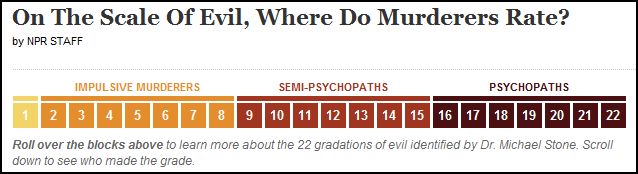
Last week NPR reported on a scale developed by a forensic psychologist, Michael Stone, on which murderers could be placed according to how evil they are (from slightly evil to really, really really evil). To illustrate the scale, NPR developed this graphic:
Let’s say, for the sake of argument, that the artists designing this graphic did not purposefully associate darker skin-like colors with more evil and lighter skin-like colors with less evil. I think this is a fair assumption, though I don’t know for sure that this is true. But let’s give them the benefit of the doubt.
If they didn’t do this on purpose, then race never consciously entered their minds. Once you notice that the colors are skin-like colors, and if you are a member of a society that discriminates against darker-skinned people, you immediately see that this graphic reproduces those stereotypes… AND YOU CHANGE THE COLORS. Any color, going from light to dark, will illustrate intensity. How about red? In Western societies, red is associated with anger. If you insist on using black because black signifies evil in our culture, how about using a true black (that is very rarely if ever seen on people) and a gray scale? How about any color other than brown?
I think this is likely a case in which the producers of the image did not think. And not thinking is one of the most insidious ways that racism and other bigotries get reproduced. People who don’t think about race are the most likely to endorse racial stereotypes. When people who think about race are distracted — with another task, or loud music, or some other intervening stimulus — they are more likely to think stereotypically than when they are not distracted. We can’t be colorblind. Our unconscious is steeped in racial meanings. Consciously fighting those associations is the only way to be less racist.
Not thinking about race is a cousin to thinking racist thoughts. Only thinking hard about race helps alleviate racism. And this graphic is an excellent example of why.
UPDATE: Some readers say that the colors, on their computer, look yellow, orange, and red; others see the skin colors that I see. So there may be significant variation in how these colors appear on different monitors… which is a whole other interesting problem for people who produce web content!
[10 Dec. 2010 ECD addendum: A woman wrote to me noting that some terms that include "black" as negative precede the use of the term "Black" to mean "of African descent" or, in some cases, a U.S. historically specific term replacing "Negro" or used around the same time as the term "Afro-American". In the last thirty years or so, Black has been the preferred term among many African Americans, and the point of this piece isn't that all terms like "black sheep", "black mood" or whatever are intentionally designed or created to be racist (white supremacist); the point is that if they continue to be used in a context of white supremacy, they become part of white supremacy; they become part of how racism is fused to language in the present. For once a society comes to identify a population of human beings as Black or once an oppressed population puts forth the term, Black, to mean "African American" of someone or group from sub-Saharan Africa, we cannot pretend that those other seemingly apolitical, non-racial terms have no political meaning. And, as Starhawk and other herstorians and historians have noted, many terms using "blackness" to mean something negative, bad, or dangerous, did so quite intentionally to promote anti-Black racism and genocide against darker-skinned peoples. But, I'll add that I know people of color, non-white people, who use some of those terms without meaning them to be racist. And it is for any person of color or dark-skinner person to decide how and whether to use any terms they speak or write. I'm putting forth a viewpoint that says that under white supremacy, anything that is "black" or is termed "black" will be degraded and stigmatised as something to be feared or destroyed. And my evidence is what is happening to darker-skinned peoples the world over, at the hands and industries of whites.]


 Sean Lennon, Yoko Ono and Julian Lennon at the opening of an exhibition of Julian's photographs in New York City. (CBS)