Showing posts with label the politics of land and water. Show all posts

Monday, February 18, 2013

Chief Jacqueline Thomas of Saik'uz First Nation Speaks at the Forward on Climate Rally


This occurred on 17 February 2013. I do not know who held the camera but am grateful they recorded Chief Jacqueline Thomas's address.

One of my most significant learnings as someone white, and also as someone male, has been to place the joys, the concerns, the dangerous and deadly conditions, the horrific gynocidal and genocidal realities, the survival strategies, the stories, the perspectives, the philosophies, the analyses, and the ethics of women of color at the center of my heart and mind. And, for whatever it can do, at the center of my blog.


Wednesday, May 2, 2012

Navajo Testimony from Forgotten People at the Open Forum on the Rights of Indigenous People in Tucson, AZ, USA

What follows is being cross-posted from Brenda Norrell's Censored News website. You can link to and read this story at that site by clicking *here*.

Navajos testimony to UN Rapporteur: Housing and Water Rights

Forgotten People goes to the UN to secure
housing and water rights
Press statement by Forgotten People
Photo credit: Forgotten People
Censored News
TUCSON, Ariz. --  Mary Lane, Glenna C. Begay, Leta O’Daniel, Leonard Benally, Marlene Benally and Norris Nez of Forgotten People presented on Land and Resources, Self-Government and the Open Forum on the Rights of Indigenous People in Tucson. 
A delegation of 14 members of Forgotten People met with the UN to call for recognition of the human right to housing and water. They urged the U.S. to pass legislation that abides by the declaration they signed in 2010, which establishes minimum basic rights for indigenous people globally including the U.S.

Forgotten People appreciates the significance of this historic mission by the United Nations to conduct an investigation into the plight of US Native Americans. Forgotten People believes greater investigation needs to be conducted into the lack of housing, poisoning of water sources, and neglect by the US government in our region to identify how the standards of the declaration are reflected in US law and policy and needed reforms and good practices.

A 43-year US government imposed Bennett Freeze affecting approximately 1,500,000 acres denied Navajo people electricity, running water and adequate sewage disposal. Even though the freeze was lifted by President Obama in 2009, they cannot find any funding or plan for rehabilitation for infrastructure, housing, water and roads.  Only 3% of the families have electricity.  Over 90% of the homes do not have access to piped water, requiring families to haul their water from other locations. Only 24 % of homes are habitable today. 

Since 1966, the population in the area has increased by approximately 65 percent, forcing several generations of families to live together in dwellings that have been declared unfit for human habitation.

A Relocation Act passed in 1974, resulted in the forced eviction of over 15,000 head of households and their families. Those that resisted relocation are under siege to this day by the US Department of the Interior Bureau of Indian Affairs using federal monies to confiscate livestock, bulldoze and dismantle water wells and deny people their civil and human rights. Due to a lack of infrastructure, families live in substandard homes, are forced to haul their own water, suffer negative economic and health impacts, are trapped in a circle of poverty and are still drinking contaminated water because they have no choice or have no water at all. 

The U.S. Department of Energy calls Navajo land a “National Sacrifice Area” in a region at the heart of the global warming issue. Black Mesa, Big Mountain is a microcosm of the global problem. The energy is produced on our lands using our resources, yet we receive no benefits from this activity. We suffer the local costs of this production, such as environmental damage and interference with sovereignty. In addition, our traditional lifestyle hangs at the edge of survival in an arid climate, and scientists predict that global warming will cause a permanent drought and dust bowl in the American Southwest, making this life impossible.

Wars of the future will be fought over water, as they are over oil today, as water, our Blue Gold, the source of human survival, enters the global marketplace.  Currently, President Ben Shelly of the Navajo Nation is working with Senator Kyl and McCain to pass legislation for the Little CO River Water Rights Settlement that gives away our water rights to Peabody Coal Company and NGS. Forgotten People believes the Settlement is a tragedy not only due to the minimizing Navajo rights but is waiving hundreds of millions of dollars in potential compensation for rights waived.

To compound the effects, the water rights settlement forever waives without redress for past present and future contamination of water sources when the U.S. EPA reports the presence of over 1,300 abandoned mines on reservation land and up to 25 % of the unregulated sources in the western Navajo Nation exceeds drinking water standard for kidney toxicants including uranium.

Forgotten People believes the US should be held accountable under the declaration and to commitments made internationally which establish minimum basic rights for indigenous people, including UN General Assembly (GA) Resolutions on the right to safe drinking water and sanitation and a commitment by the U.S. EPA at the 2002 United Nations World Summit on Sustainable Development to reduce the number of its citizens lacking access to safe drinking water and sanitation by 50% by 2015.

Forgotten People believes President Obama and Navajo Nation should sign a binding version of the declaration to ensure access to clean and potable water and housing as fundamental human rights and participation in decision-making in matters which would affect their rights under the declaration and international law.

Copies of Forgotten People’s interventions are available. For more information please contact Mary Lane, Vice-President, Forgotten People at (928) 401-1777 or via email: info@forgottennavajopeople.org
Forgotten People

P.O. Box 1661

Tuba City, AZ 86045


(928) 401-1777

--------

Tuesday, January 10, 2012

The Radically Feminist Vandana Shiva on Patriarchal Economics and Agribusiness

image is from here
Small farmers, many of them women, are threatened the world over by corporate agribusiness that follows an aggressive economic-cultural-political anti-Life practice steeped and infused with Western White Male Supremacist values and worldviews. In India, among many other places, there is a crisis. Dr. Shiva has been addressing this crisis, offering radically feminist solutions to the problems of an increasingly globalised conservative capitalist patriarchal way of being that is as unethical ans it is unsustainable.

For some of the written history of this analysis and protest, please click on the following link (title):

Monocultures, Monopolies, Myths And The Masculinisation Of Agriculture
by Vandana Shiva
Director Research Foundation for Science,
Technology and Ecology - India

I found what follows at Toward Freedom *here*. But the original is from Al Jazeera and may be linked to at the end of this excerpt.

Vandana Shiva: No Therapy in Retail

E-mail Print PDF
Al Jazeera
The entry of big corporations into the food chain pushes up retail costs and decreases the share of the farmer.

New Delhi, India - In November 2011, when the UPA government announced that it had cleared the entry of big retail chains such as Walmart and Tesco into India through 51 per cent Foreign Direct Investment (FDI) in multi-brand retail, it justified the decision saying that FDI in retail would boost food security and benefit farmers' livelihoods.

But the assurance that FDI in retail would ease inflation did not resolve the political crisis the government was facing; it deepened it. Parliament was stalled for several days of the Winter Session, after which the government was forced to withdraw its decision.

The story of FDI in retail goes back to 2005, when Prime Minister Manmohan Singh signed an agriculture agreement with the US, along with the nuclear agreement. On the board of the US-India Knowledge Initiative in Agriculture, as it is called, sit Monsanto (the world's leading producer of GM seeds), ConAgra (among the world's biggest agribusinesses, along with Cargill) and Walmart (the world's largest retail giant).

Protests had prevented Walmart's entry into retail, but, in 2007, it did get a backdoor entry through a joint-venture with Bharti (their stores go by the names of Easyday and Best Price Modern Wholesale). No back-end infrastructure has been built so far, one of the other claims of the government about why we need retail giants.

The way the UPA government tried to ram through the decision on FDI in retail - without consulting the opposition parties, or even its allies - was clearly undemocratic. But the decision itself was also flawed. It illustrated a disconnect between an ideology based on market fundamentalism - which is the leaning of the present government - and the Indian reality of small farms and small retail.

Monday, December 12, 2011

CNN Heroes: Soap, Water, Land, Shelter, are all Feminist Issues


Diane Latiker Nonprofit: Kids Off the Block What it does: Gives young people in Chicago a place to hang out and learn valuable life skills so they can stay off the streets and away from rampant gang violence
Diane says: "What I want people to know is that the work that I and so many others do can literally be the difference between life and death for a generation that seems to have lost all hope. ... If I can make a change in a generation, then my community's going to get better -- because they're going to be the ones that take it over."
Exploring the issue: In several cities around the world, streetwise "interrupters" are trying to stop teen violence before it starts.
Donate to Kids Off the Block


Robin Lim Nonprofit: Yayasan Bumi Sehat What it does: Offers free prenatal care, birthing services and medical aid to low-income women in Indonesia
Robin says: "Because the cost of childbirth often exhausts the family's income, the poor and even the middle-income people of the world find themselves in a downward spiral of suffering and loss, just when they should be celebrating the births of their babies."
Exploring the issue: Many women in the developing world do not have access to contraception or maternal care.
Donate to Yayasan Bumi Sehat


Derreck Kayongo
Nonprofit: Global Soap Project What it does: Collects partially used hotel soap in the United States, reprocesses it and then sends it abroad to save lives in impoverished countries
Derreck says: "Because of our work, this world is going to be a better place than we found it -- with no soap being thrown away and with no child or woman ... or any vulnerable populous left without a bar of soap to fend off disease."
Exploring the issue: In developing countries around the world, millions of children lack access to soap and clean water.
Donate to Global Soap Project

What appears above is from *here*.


Watching CNN's annual presentation of honors to various activists around the world, called CNN Heroes, reminds me, once again, of how many issues there are facing women and girls around the world. Far more issues than face those of us who are relatively wealthy, sheltered, and regionally advantaged.

Soap is needed to cleanse the skin of lethal bacteria. Clean, safe, accessible, free water is needed to live and be well. Unpoisoned and unoccupied land is a requirement for self-determination, community, spiritual health, and overall well-being. If one's land and water is occupied and possessed, or ravaged and poisoned by corporate power, by men, or by White-World settlers and invaders, it is difficult to sustain one's own life and the life of one's people. Safe, sturdy shelter is an increasingly rare thing. For women and girls to be physically safe, walls must offer protection from harmful forces both outside and inside.

What CNN Heroes does is to highlight (for two hours each year) activism by individuals, not collective activism designed to overthrow tyrannical and oppressive regimes, including regimes of men warring against women and girls. You will not hear the terms "white supremacy" or "male supremacy" or "the savage blood-thirst of the Western World" named as such in programs produced for CNN. It will honor amazing individuals only as long as those individuals do not publicly call for massive systemic change that disadvantages US corporate, raced, and patriarchal power.

What would the effect on the world be if all Western news media reported 24 hours a day/365 days a year on the necessity and value of anti-oppression activism? When will activists be given more than a few minutes to express thanks to CNN and instead detail how US corporate and military (patriarchal, imperialist) power murders millions of people, mostly poor, of color, and female?

When will Anderson Cooper speak to this in ways that educate his audience to the systemic, institutionalised dimensions of the harms spoken of in this annual special? I wonder. Because as long as the masses of media consumers are led to think that globalised atrocities and injustices are caused by unorganised or merely unfortunate events, we are left ignorant about how to properly support those activists who are working for radical social-political-economic change. And how to be those activists too.


Saturday, October 8, 2011

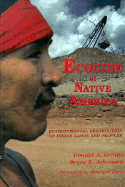
Will "ecocide" gets legal legs in UK and US courts?

image of book cover is from here
Let's not forget that Indigenous activists have been speaking out about this since the White Man's ecocidal practices first violated Sacred Ground. And if you haven't yet, please read the radical ecofeminist books by South Asian activist Vandana Shiva and the white Jewish North American ecofeminist, Starhawk.

From The Guardian:

See the video:

http://www.guardian.co.uk/environment/video/2011/oct/05/mock-ecocide-trial-video

Read the text (and please click on the title to link back to the source web page):

Test trial convicts fossil fuel bosses of 'ecocide'

Top lawyers put fossil fuel bosses on trial in the UK's supreme court in a mock case to explore if ecocide - environmental destruction - could join genocide as a global crime

Update: Two verdicts of guilty, one not guilty: that was the conclusion of the mock ecocide trial (details below) held at the UK's supreme court on 30 September. Real lawyers, judges and a public jury found the CEOs of fictional fossil fuel companies guilty of "extensive destruction, damage to or loss of ecosystem(s) to such an extent that the peaceful enjoyment by the inhabitants of that territory, and of other territories, has been severely diminished", as a result of their company's extraction of oil from tar sands in Canada. The jury found one of the CEOs not guilt on the count of damage caused by an oil spill in the Gulf of Mexico.

Polly Higgins, the driving force behind the trial and who is working to have ecocide join genocide and three other crimes against peace in the UN, said: "For me the trial was a moment of truth. No longer is it acceptable to pursue profit without consequence. Corporate Ecocide is a global crime that is far greater and far more prevalent that most people realise. Those few people who dare to speak up about Corporate Ecocide in Wall Street have been arrested for speaking out about a greater crime, a far greater breach of the peace than their own shouting and campaigning. Surely it is now the time to prosecute the true destroyers of our world."

She added: "I'm not keen to see lots of [people] in the dock. What I want to see is people making responsible decisions. For example, a crime of ecocide could force governments to change the incentive structures for businesses by redirecting subsidises for fossil fuels towards clean energy sources. In this way the dirty energy companies that are wrecking the environment today could be transformed into the clean energy companies of tomorrow."

Original story (29/09/11):
It's a grim list: genocide, crimes against humanity, crimes of aggression (such as unprovoked invasions) and war crimes. All are recognised by the UN as crimes against peace and prosecuted through the international criminal court.

But should the bosses of polluting companies and the leaders of environmentally-unfriendly states join those responsible for mass murder in the dock. They could if a fifth crime against peace - ecocide - joined that list of human evils? The United Nations is now considering the proposal and the first test of how a prosecution for ecocide would work takes place on Friday, with fossil fuel bosses in the dock at the UK supreme court in London. It is a mock trial of course, but with real top-flight lawyers and judges and a jury made up of members of the public. The corporate CEOs will be played by actors briefed by their legal teams.

The crime of ecocide is the brainchild of British lawyer Polly Higgins, who in her UN submission defined it as:
Ecocide: The extensive damage, destruction to or loss of ecosystems of a given territory, whether by human agency or by other causes, to such an extent that peaceful enjoyment by the inhabitants of that territory has been severely diminished.
Crimes being considered for prosecution in Friday's trial include the extraction of oil from Canada's tar sands, a major oil spill in the Gulf of Mexico, fracking for shale gas in Nigeria and bauxite mining of Niyamgiri mountain, India. The real world parallels are not accidental, I'm sure.

An international law against ecocide, enforceable in the UK, will be assumed for the purposes of the mock trial. But there is no script and the jury's verdict is theirs alone to decide. "It is nerve-racking, it is not a done deal," says Higgins.

She argues the link between ecocide and genocide is that damage and destruction to the environment depletes the Earth's resources, which leads to conflict. Only by making ecocide a crime for which individuals can be jailed, will we change the norm which allows profit to be put before the planet, she told me.

Higgins says a key inspiration is William Wilberforce, whose campaigning led to the abolition of slavery in the UK. He changed to norm of how black people were treated, she says, and ecocide law would change the way the planet is treated. "We have go to the point when the ethical imperative trumps the economic imperative," she says. At the moment in many countries, she points out, the first responsibility of CEOs is a financial one to their shareholders. If environmental destruction is not illegal but can boost profit, it will happen, she says.

But she is not anti-corporate or anti-profit, she says: "I started as a corporate lawyer. Now I want to make the problem part of the solution." She says companies should be making profits from solving the problems of global warming, habitat destruction and the extinctions of animals and plants. The companies that traded in slaves did not go out of business after slavery was abolished, she claims.
I asked her about the problem of proving causation between the acts of companies and environmental damage, which has doomed previous attempted prosecutions in the US.

"Genocide is a crime of intent, but ecocide is not," she says. An ecocide law would create a pre-emptive responsibility to prevent ecological damage, she explains, in the same way that "superior responsibility" or "strict liablility" enables people to be prosecuted whether or not they intended to cause damage. "I am really not wanting to see lots of CEOs locked up," she says, but wants them deterred from ecocide in the first place.

I also asked her about the phrase in her ecocide definition that says "whether by human agency or by other causes". If there is a natural disaster, who can be prosecuted? The "other causes" term is there, she says, to place an obligation on governments to intervene in disasters to minimise damage.

If this all seems utter fantasy to you, it is worth noting that Bolivia has already passed laws granting all nature equal rights to humans. Furthermore, ecocide could become an international crime by amendment of the ICC's Statute of Rome, which would need 86 nations to back it. Are there 86 states backing the ICC who feel climate change, the crisis in the oceans and other environmental problems are trashing their "peaceful enjoyment" of the Earth's bounty? I wouldn't be surprised if there were.

Update (11:22 Friday): The two crimes chosen for the ecocide mock trial are the extraction of oil from Canada's tar sands, a major oil spill in the Gulf of Mexico. I'll update the post again when the verdict comes.

Note: The trial, organised by the Hamilton Group, begins at 0900 BST on Friday 30 September and will be broadcast live by Sky News's Supreme Court web channel. Members of the public can attend. I'll post updates on this page. Michael Mansfield QC leads the prosecution against Nigel Lickley QC for the defence. Michael Norman will sit as the judge and the jury are members of the public recruited through Facebook and other social media and vetted for conflicts of interest.


Friday, September 16, 2011

Individual vs. Collective Opportunity: which do we have in the US? (Answer: neither, really)

image of hurricane Katrina is from here
President Obama responded, in my mind cynically, to a criticism by Professor Cornel West and performer Tavis Smiley (see *here* for more). They charge, quite accurately, that he has ignored and been entirely unconcerned and uncaring, in policy and practice, to the plight of the poor in the US, and in particular to the struggles of African American males.

In the US currently, the reported (as opposed to actual) poverty rate among whites is much less than among African Americans. This is a consequence primarily of white supremacy fused to corporate capitalism. No other possibility exists in opportunity or in present life, than Black people in the US remaining significantly and substantively poorer than whites, collectively. Never mind Oprah Winfrey or Barack Obama: it is not simply “opportunity” that got them where they worked very hard to be. It is also a white dominated society's wish to appease anti-racism critics who use individual successes as “proof” that the system can work for any one of us. It most certainly cannot.

The collective and systemic truth of the truly perilous and dire situation for African Americans, among other groups of color, is one that President Obama, for all his intelligence, seems unable to comprehend or at least publicly declare: his “solution” is to attempt to increase opportunities for individuals, never for the collective. (And however inadequate those proposals are [link to his speech] they will not be supported by Conservative elected politicians—every one of 'em voted into office with the great help of corrupt media and corrupt wealth, neither of which is available to poor US Americans as a group.

Unaddressed by any of them is what Black, Brown, and Indigenous women (especially lesbians) in the US face: the devastating combination of capitalism's cruelties heaped onto the other cruelties of white, male, and het supremacy. To hear most prominent Black men in the US speak, you'd think Black (het) men always have it worse than Black (het) women. But to believe that you'd have to pretend that patriarchy, male supremacy, misogyny, and heterosexism don't exist at all, both within Black communities and in the larger white-dominated society. Every manifestation of male power over and against women impacts the lives of Black women—not just white men's misogyny, for example.

But returning to the concerns of West and Smiley, how is it that a very smart US president—of any color—could not get it that the US is well-organised to ensure that some groups of people are held down and spit on while the same US leaders promote the power and interests of a few—and not a few “individuals” either? How is it that Bill Clinton or Barack Obama don't get it that corporate capitalism exists, deregulated or not, to crush the life out of the poor while exploiting their labor and other human resources?

Far more cynical and cruel than President Obama are the white, male, and het supremacist activists who comprise the leadership of the ultra-ConservativeTea Party movement, an extremist activist political organisation looking out only for the interests and power-protection of the wealthiest, whitest, and most heterosexistly male members of society? Among them is the current early leader in the bid for president, governor of Texas, (P)Rick Perry.

The Tea Party, including Perry, advocates a particular vision of the US in which Social Security and Medicare, as federal programs, no longer exist as humane mechanisms to support the lives of the most dispossessed (read: structurally, systematically oppressed) members of society. Dispossessed by intention and design, not effect and bad luck. Nothing is accidental about who is poor in this country, if we look at groups of people, not individuals only.

What the Tea Party, GWBush and Co., Bill Clinton, and Barack Obama all have in common is the downright evil practice of extolling the alleged virtues of a “free” market economy tied to rampant militarism which imprisons most US Americans in debt and despair while horrifically destroying people abroad: particularly the people of Central Asia who happen to live in a region that has oil resources under what remains of its topsoil. The policies of these and other activist leaders are genocide, gynocide, and ecocide wrapped up in liberal platitudes.

Chief among the platitudes is this idea that our economic and social-political systems exist to offer meaningful opportunity to all US citizens. Contemporary forms of capitalism allowed to exist by the wealthy offer nothing of the kind; neither do contemporary forms of white, male, and het supremacy. All these well-organised and well-protected systems of power ensure that varied forms of gross violence and exploitation will be visited upon people who are not wealthy, white, male, or het.

Consider images brought to you by a weather reporter of a hurricane forming in the Atlantic Ocean as it makes its way toward the Caribbean, Gulf coast, and East Coast of the US. Consider how the weather is described as “a system”, sometimes a ferocious one merciless in its power to destroy what humans have constructed.

Consider how such a system, if well-organised, infused with enough energy, structured to swirl at great enough speeds with enough force, will do great harm. How much harm we cannot predict, as evidenced when Hurricane Irene swept up the Mid-Atlantic coast to the Northeast, cutting inland into New England. Consider how Hurricane Katrina, several years ago, in collaboration with ridiculous urban planning and construction along the Gulf coast, in collaboration with a woefully negligent US government, resulted in horror and pain that was thought to be impossible in the US, even in largely Black areas of the country.

The weather system called “a hurricane” in the US, has a structure—the visible structure is part of what constitutes such a system from other weather phenomena.

Corporate capitalism has a structure and it is hierarchical with a concentration of wealth among an elite few and a base of poverty shared among the many. Using the “right” to ownership of property as a means of control with State power backing it, the wealthy can and do exact great force against the poor and working people, exploiting them while telling them they have “opportunity” to also become as ruthless as they are.

In the US, this economic system with its earlier incarnations has resulted in an on-going genocide and has required on-going forms of slavery to be able to exist at all. Part of its structure is raced with white supremacy as one ruling ideology-in-practice. Male supremacy is another: rape and social subordination are two methods of its production: mass terrorism and submission are its objectives. Between the two is the spirit- and sex-shaming ideology-in-practice known as heterosexism. Braided, enforced, and enacted together, they strangle the power, will, and hope out of many of us, leaving us damaged, degraded, and depressed—if not dead. But—always more than the ruling oppressive forces would like—some of us keep fighting those virulently inhumane systems of domination and destruction with a vision of a world of unmilitarised peace, cooperative living, and mutual respect.

What is often missing in humane resistance movements is sustained, collective, group-based radical activism. Currently, struggles to make the US more humane are more like an occasional gust of wind than a well-formed lasting hurricane.

Using the ocean as a metaphor, single waves of activism can perhaps bring attention to horrible conditions and may shift the shape of a beach-front temporarily. But I look forward to the power of the oppressed forming into great unrelenting waves of revolutionary social, economic, and political transformation until the CRAP-infested shore is entirely washed away, allowing Indigenist ways of living to thrive again on this Earth.


Friday, July 29, 2011

Vandana Shiva on 'growth fetishism' and more: "Who Pollutes: The Rich and Powerful or Poor and Powerless?"

What follows is being cross-posted from ZCommunications. Please click on the title below to link back.


Vandana_shiva__environmentalist__at_rishikesh__2007

Who Pollutes: The Rich and Powerful or Poor and Powerless?


On the 29th of June, Prime Minister Manmohan Singh met with editors of a few newspapers. When asked about whether he had been putting pressure on the Environment Ministry to approve environmentally destructive projects, he said “yes”, and justified by quoting Indira Gandhi “poverty is the biggest polluter, we need to have a balance”. Indira Gandhi had said this in Stockholm in 1972 at the first Environmental Conference. She had also quoted from the Atharvaveda – 
“Whatever, I dig of you, O Earth,
May that grow quickly upon you,
O Pure One, may my thrust never pierce thy
Vital points, thy heart”. 
The Prime Minister has conveniently ignored the more significant quote. 
The Prime Minister’s duty is to uphold the nation’s constitution and nations laws, including environmental laws, not subvert them. By admitting that he has been putting pressure on the environment ministry, he has admitted that he is subverting the law. Most commentators view the removal of Jairam Ramesh from the Environment Ministry during the July 12th, 2011 cabinet reshuffle as a further step in environmental deregulation. 
While quoting Indira Gandhi to justify his subversion of environmental law, the Prime Minister seems to have forgotten that Indira Gandhi created the country’s environmental governance structure during her tenure as Prime Minister. It was Indira Gandhi’s intervention that supported the call of movements and scientists to not build a hydro-electric project in Silent Valley in Kerala saving a biodiversity rich ecosystem. It was Indira Gandhi’s concern that Mussorie, the queen of the hills, was being stripped naked by limestone mining that led to the Environment Ministry to take action. We were invited to do the study of the environmental impact of limestone mining in Doon Valley in 1981. Our study became the basis of the Supreme Court case. In 1983, the Supreme Court shut down the mines. 
In the pre-trade liberalization days, it was accepted that if commerce undermines ecosystems which support life, then commercial activity must stop, because life must carry on. Art. 21 of the Constitution make it the duty of the state to protect life. Since ecological processes support life, the state has a duty to protect ecology. 
Under Prof. Manmohan Singh’s leadership since the 1990’s based on “growth fetishism”, all ecological devastation is justified in the name of growth. Who is driving this ecological devastation and the pollution? The rich and powerful corporations or the poor and powerless women, farmers, tribals and the displaced rural communities who become urban slum dwellers? 
The poor live in the places polluted by the rich. They do not cause the pollution. And they live in polluted places because they are displaced from their homes in rural areas where they have lived sustainably for millennia. 
They are victims of pollution because they are victims of dispossession. This is environmental injustice. And it is an inevitable consequence of outsourcing of pollution from rich countries in the garb of FDI.  
Coastal Orissa is a case in point. In the Jagatsingpur district where POSCO’s giant steel plant is planned as the highest FDI of $ 12 billion farmers, grow biodiversity – betel vines and paddy, coconut and cashew, fruits and fish. There is no pollution and no waste.  There is a prosperity that GDP does not count. This economy of sustenance is being uprooted with violence to enable POSCO to export our iron-ore and steel. Every law of the land including the Forest Rights Act and the Coastal Zone Regulation Act are being violated as committee after committee has recognized. And when the Ministry of Environment Committees affirms the violation of laws, it is the Prime Minister who puts pressure on the Environment Minister to give an approval to POSCO. It was the women and children of Govindpur, Dinkia and Nuagaon who lay down in front of the police in the scorching sun to stop the land grab in June. They were still forming a human barricade when I visited on 23rd June.  
The Prime Minister is intervening to promote this land grab and resource grab. POSCO gets our land and our resources. What we will inherit from the POSCO project is ecological destruction, pollution, displaced people and the destruction of our democracy.  
In India, it is the corporations that are building giant coal based power plants who are major climate polluters. It is the automobile industry that pushes more cars on our roads that are leading to higher carbon dioxide emissions. Emissions from the use of fossil fuel are driven by the economically powerful, not the poor. But it is the poor who are most vulnerable to the floods, droughts and cyclones that climate change intensifies. 
The same applies for toxic pollution. In 1996, we filed a case in the Supreme Court to stop the import of toxic waste from the U.S. This waste was generated by rich consumers in the U.S, not by the poor in India who put their lives at risk sorting out the toxic garbage. The Bhopal disaster and it its still continuing toxic pollution was not caused by the poor who died in thousands. It was caused by Union Carbide, now owned by Dow.  
A major issue related to toxics is the pesticide, endosulfan. The U.N has banned it. Most countries of the world have banned it. The Supreme Court has ordered an interim ban. 1000 people have died in Kasargod where endosulfan was sprayed on Cashew plantations for 20 years. More than 9000 are crippled. The innocent victims did not cause the toxic pollution. It was caused by powerful corporations who influence decisions and have blocked a ban on endosulfan, even as people die and children are born disabled. 
Toxic agrichemicals harm all life. Synthetic fertilizers run into rivers and oceans, creating “dead zones”. Nitrogen oxide released from nitrogen fertilizers accumulates in the atmosphere as a green house gas that is 300 times more damaging than carbon dioxide. These synthetic fertilizers also make bombs as the recent terrorist attacks in Mumbai and the Oklahoma bombings in the U.S have shown. 
We now have a new form of pollution in agriculture – genetic pollution from genetically engineered crops. Genetic pollution is destroying biodiversity and devastating farmers livelihoods.  
The poor do not cause chemical and genetic pollution – giant chemical / biotechnology corporations do. And the chemical corporations are also the gene giants who now control seed. Here too, instead of being the voice of poor and vulnerable farmers, the Prime Minister is the voice of powerful global corporations through his repeated reference to genetic engineering as the second Green Revolution.  
Whether it is atmospheric pollution, toxic pollution, genetic pollution or urban waste pollution, environmental pollution is an externality of a greed based economy which privatizes profit and natural resources and socializes pollution. The rich accumulate the land, the biodiversity, the water, the air and the profits. The poor bear the burden of dispossession and accumulated pollution.  
We expect the Prime Minister to uphold India’s Constitution and environmental laws not subvert them. We do not expect him to support and promote the polluters. We expect our Prime Minister to recognize that the poor are victims of pollution and environmental degradation, not its cause. We expect the Prime Minister to remember that he holds our precious natural heritage and natural capital in trust for future generations, not to be given away to greedy corporations and destroyed for short term profits. 
We expect our Prime Minister to grow beyond his “growth fetishism” and recognize that we are all part of Mother Earth, and pollution is violence against the Earth and people.


Thursday, July 21, 2011

Dr. Vandana Shiva, Speaking in Chattanooga, TN, USA, 26 April 2011

It is always a breath of fresh air to hear radical ecofeminist Vandana Shiva speak out for justice for the Earth and its citizens.

All that follows is from YouTube. With thanks to gaingroundcha, for posting this.

Uploaded by on Jul 21, 2011
  
On April 26, 2011, environmentalist Dr. Vandana Shiva spoke in Chattanooga as a part of the Benwood Foundation's George T. Hunter Lecture Series. Her speech focused on the environmental issues surrounding industrial agriculture and the solutions our community can focus on to address those issues.

This video was filmed during her 2-day visit to Chattanooga, and features clips from her speech, as well as personal interviews with Dr. Shiva and engaged Chattanooga citizens.

Edited by Linda Duvoisin

Wednesday, July 20, 2011

Women Rising XXI: Women’s Rights to Water, Land, and Farming

All that follows is from *here*:

Women are gaining influence as leaders throughout the world, fighting for peace, justice, the environment, and civil society. On this program we profile a dynamic partnership between the Women's Earth Alliance and the Global Women's Water Initiative: working on women's rights to water, land, farming and basic human dignity.

Featuring:
Rucha Chitnis, director, Women's Earth Alliance India; Maame Yelbert-Obeng, Women's Earth Alliance Africa; Gemma Bulos, director, Global Women's Water Initiative; Sandra Hay, CEO and filmmaker, Unseen Pictures; Mama Catherine, activist in Cameroon.
Note: Vandana Shiva is an international advisor for Women's Earth Alliance. She is not on the board, as stated on the program.  We apologize for the error.

For More Information:


MUSIC:
'We Rise' by Gemma Boulos
'Solar Rising' by Evan Fraser
'Mother Mbira' by Evan Fraser
'Zawo' by Evan Fraser

Feminist Action Alert: in Support of the Global Women's Water Initiative: Water is a Profeminist Issue

photo of two women carrying water is from here
When I have met white profeminists--on far too rare an occasion, I frequently have heard them speak out for justice and liberation for women. They are most usually referring to freedom from misogynistic interpersonal and media violence, and social and economic inequality as framed within a white, Western understanding of women's struggles globally. I challenge these men to expand their understanding of women's liberation to include the freedom to have clean water to drink and unpolluted land to grow food and maintaining quality of life and to bury one's loved ones, and to not be beholden to white supremacist patriarchal corporate capitalism in any regard. 

All that follows is from *here*:

The Global Women’s Water Initiative is a joint initiative that provides training for grassroots women and groups to implement water related-strategies through appropriate technologies, action planning, seed funding and leadership development so they can improve their communities health, self reliance, and resilience to climate change.


2010 West African Women & Water Training Program from Unseen Pictures on Vimeo.


"We are living in a time when women's voices must be heard, considered
and respected at every level. Recognizing women's vital role in the
environment... is essential for a future of security and peace."

- Dr Wangari Maathai, Nobel Peace Laureate, in her letter of support
for the 2008 African Women and Water Conference

Friday, April 22, 2011

Vandana Shiva and Maude Marlow on the Rights of the Earth

What follows is from Democracy Now! Please click on the title below the video to link back.

Earth Day Special: Vandana Shiva and Maude Barlow on the Rights of Mother Earth

Vandana_maude_ok

This week the United Nations General Assembly discussed international standards that grant nature equal rights to humans. Similar protocols have been adopted by over a dozen U.S. municipalities, as well as Bolivia and Ecuador. Renowned environmentalists Maude Barlow and Vandana Shiva join us. Says Shiva, "Most civilizations of the world, for most of human history, have seen the world in terms of relatedness and connection,” says Shiva. "And if there’s one thing the rights of Mother Earth is waking us to, is: we are all connected." [includes rush transcript]

Guests:
Vandana Shiva, world-renowned environmental leader, feminist and thinker from India, author of many books, including Earth Democracy: Justice, Sustainability, and Peace and Staying Alive: Women, Ecology, and Development. 
Maude Barlow, head of the Council of Canadians, Canada’s largest public advocacy organization. Barlow is also co-founder of the Blue Planet Project and chair of the board of Food and Water Watch. She is the author of Blue Covenant: The Global Water Crisis and the Coming Battle for the Right to Water.
  

Related Links

AMY GOODMAN: As the world celebrates Earth Day, Bolivia is about to pass the world’s first law that grants nature equal rights with humans. The Bolivian delegation to the United Nations urged the global body to adopt a similar law during this week’s Harmony with Nature conference.
DAVID CHOQUEHUANCA: [translated] The United Nations is revolutionizing the way we look at our planet. At the moment, various issues are being receded in the United Nations, and we have begun to discuss the idea of declaring an official International Day of Mother Earth. And we will also soon be discussing what are the rights of Mother Earth.
AMY GOODMAN: That was the Bolivian foreign minister speaking in New York City about the Harmony with Nature dialogue at the United Nations.
This week also marks the one-year anniversary of the BP oil spill; next week, the 25th anniversary of the Chernobyl disaster. Radiation levels around the Fukushima nuclear plant in Japan remain high. As these disasters multiply, Latin American countries such as Bolivia have taken the lead in adopting measures to protect the environment. Ecuador has also adopted a resolution protecting nature.
We speak with two renowned environmental justice activists: Maude Barlow and Vandana Shiva. Maude Barlow is the head of the Council of Canadians, Canada’s largest public advocacy organization. Barlow is also co-founder of the Blue Planet Project and chair of the board of Food and Water Watch. Vandana Shiva, world-renowned environmental leader, feminist and thinker from India, is the author of many books, including Earth Democracy: Justice, Sustainability, and Peace and Staying Alive: Women, Ecology, and Development.
I started our conversation by asking Vandana Shiva about the nuclear catastrophe in Japan and what it has meant for India, where major anti-nuclear protests have been sparked, in which one protester was killed. I asked her to explain what happened.
VANDANA SHIVA: We have a very, very strong anti-nuclear movement in India. And the difference between the Indian movement and any other movement is it’s not just about the stupidity of splitting the atom to boil water, which is what nuclear power ultimately is, creating huge amounts of radiation hazard in the process, but in India it involves the typical violence of land grab. And one of the most fertile parts of India in the Western Ghats, the Ratnagiri district, this planning to set up the biggest-ever nuclear power plant of the world, being built by a French company, AREVA, violating every right of the people, including local democracy, where people have a right to decide what happens. All the local authorities have resigned. And the protests continue. And just two days ago, there was a killing, when the police fired on peaceful protesters. So, in India, the costs are even higher, because the human costs join with the costs of nuclear hazard. And from 23rd to 26th, a march is being organized—and I’m part of the organizing group—from Tarapur, which is the oldest nuclear power plant of India, to Jaitapur, which is where this giant mega nuclear power park is being set up.
AMY GOODMAN: And people live there. They will be displaced?
VANDANA SHIVA: People live there. I mean, typical of such things, they claimed it was barren land and nobody was there. It’s one of the most fertile. That’s where this wonderful Alphonso mango comes from, this amazing, giant-sized, delicious mango. Good fisheries, amazing horticulture, and well-to-do people, because nature is abundant. It’s the Western Ghats, where the monsoon just pours the water. And coastal regions are usually just the more productive, more fertile.
A similar protest is happening around a steel plant called POSCO, a Korean plant, but it’s not owned by the Koreans anymore, it’s owned by Wall Street. It’s owned by the financial institutions of this city, who brought down the world’s economy. And it was very interesting that Warren Buffett was in India about giving, you know, creating the art of giving, and he has huge shares in the steel plant which will displace large numbers of people. And for six years, people have been saying, "No, we will not give our land."
And I think that’s so important, that we need to realize that, first, we don’t give rights to nature. Nature has rights. And more often than not, nature’s rights and people’s rights are allied as one in most places of the world, where, in places like Jaitapur or places like the POSCO area, people are saying, "This land is our mother." This is not an esoteric idea. It’s the most relevant, potent, democratic idea of our times.
AMY GOODMAN: I wanted to ask you about a man you probably would agree with on a number of issues, George Monbiot. He, we recently had on, debating the issue of nuclear power. This is what he had to say.
GEORGE MONBIOT: Well, obviously, what happened—what’s happening in Fukushima concerns me a lot about the area surrounding Fukushima. It’s a horrible, dangerous, extremely traumatic series of events that we are seeing there.
But I’m very worried that the global response to what’s happening in Fukushima will be to shut down nuclear power stations around the world and to cancel future nuclear power stations, and that what will happen is that they will be replaced by coal. Now, coal is hundreds of times more dangerous than nuclear power, not just because of climate change, though, of course, climate change is a big one, but also because of industrial accidents and because of the impacts of pollution on local people. If we just look at industrial accidents alone, these massively outweigh both the fatalities and the injuries caused by any nuclear accident we’ve ever seen. In China alone, last year, 2,300 people were killed in industrial accidents to do with coal mining; purely by coal mining accidents, 2,300 killed. That’s six people a day. That means that in one week, the official death toll from coal in China is greater than the official death toll from Chernobyl in 25 years. And that’s to say nothing of the hundreds of thousands of people contracting really unpleasant lung diseases, which will cause them a very slow and painful and terrible death.
So, what I’m calling for here is not complacency. I think it’s absolutely appropriate to be very concerned, indeed, about what’s happening in Fukushima. But I’m calling for perspective, and I’m saying that we must not replace a bad technology with a much, much worse one, because, unfortunately, that is what’s likely to happen.
AMY GOODMAN: So that was the well-known British columnist George Monbiot, who is in favor of nuclear power, says it’s simply cleaner than coal, and if we’re talking about climate change, which he’s deeply concerned about, nuclear is the answer.
VANDANA SHIVA: Well, what we really need is a coal-free and nuclear-free future, because the sun’s energy is so abundant, and we’ve not even started to tap it in sensible ways. Alternative renewable energies, if only we would put the investments in that direction, would be affordable, would be decentralized. Nuclear must be a centralized system. And as we are witnessing in Jaitapur with the protests, with the shootings and the killings and the place turned into a total police state where nobody can gather, even the elected officials can’t hold meetings, where democracy has to be sacrificed, that’s not the kind of option we need for energy.
And I think it’s wrong of George Monbiot to rubbish the point of view of millions of people around the world, including governments, like the government of Germany said, "We won’t build any more nuclear power plants," China, which has put everything on hold. Now, these countries aren’t crazy. They aren’t a fringe. And I personally get disappointed when friends like George Monbiot think they are the wisest ones on this planet. And just because they have a column, they can switch everyone’s way of thinking. There is an ancient recognition of the hazards of nuclear. I began my life in the nuclear industry of India, and it’s when my sister woke me up to the damages. I wasn’t ever taught radiation biology. We were just taught physics, fission physics. And I realized it was very partial knowledge.
AMY GOODMAN: You are a physicist.
VANDANA SHIVA: Yes. And then I did theoretical physics, and eventually I did foundations of quantum theory. And what I love about the rights of Mother Earth is we’re overcoming the separation between humans and nature that was built into the Cartesian thinking that nature is out there and we are out here, but also the kind of divisive separatedness that Cormac [Cullinan] pointed out yesterday at the United Nations conference on Harmony with Nature. He said, "I began my life fighting apartheid, and apartheid means separateness—separateness on the basis of color." I think separateness is the disease of the past. It’s the dinosaur in the intellectual frame. Separateness was a very artificial imposition. Most civilizations of the world, for most of human history, have seen the world in terms of relatedness and connection. And if there’s one thing the rights of Mother Earth is waking us to, is we are all connected. And it’s in that connection we can’t have arrogant solutions, like nuclear is clean. Just because you don’t see the radiation doesn’t make it clean. Fukushima has become like Chernobyl, and that, the Japanese government is recognizing.
AMY GOODMAN: And so, Maude Barlow, why are you here in New York at the United Nations on this Earth Day?
MAUDE BARLOW: Well, there’s been the debate this week—an interactive dialogue, it’s called—at the United Nations on a resolution on Harmony with Nature that was introduced by the Bolivian ambassador to the U.N. but was adopted by the General Assembly. So we’re beginning the discussion and dialogue at the United Nations on the concept of the right to water. A number of us were in Cochabamba a year ago, this Mother Earth Day, when we finalized this draft of this Universal Declaration on the Rights of Mother Earth. And so, basically, we’re here to introduce it to the U.N. The concept—we eventually want the Universal Declaration on the Rights of Mother Earth to be a companion piece to the Universal Declaration of Human Rights, but we’re not there yet. We understand that. But that’s the goal, both within nation states at the United Nations and then just organizationally. We want people to adopt it and start talking about it. And we have a wonderful new book called The Rights of Nature: The Case for the Universal Declaration on the Rights of Mother Earth. So, this is a beginning of a real process to have a larger dialogue on exactly what Vandana’s saying.
AMY GOODMAN: What is the threat to water in the world today?
MAUDE BARLOW: Well, the threat to water, while just speaking about nuclear, is a wonderful example. It was interesting. I just—and it’s a perfect example of what we’re talking about when we say that we have to recognize nature’s rights—and Vandana is right: it’s not giving, it’s recognizing—is a report I saw the other day on the fish, you know, touched by the radiation contamination from the nuclear plant in Japan, and said, "Don’t worry. By the time it gets to humans, it won’t be harmful." And it was like that’s all that mattered. You know, it’s this human-centric notion that we’re all that matters, that other species of the planet doesn’t matter.
The biggest threat to water in our world is that humans, modern humans, quote, "civilized" humans, see water as a huge resource for our pleasure, profit and convenience, and we do what we want with it. We dump whatever we want in it. We grow whatever we want, wherever we want. We move it wherever we want. And we are running out. There’s a brand new report, says by 2030 the demand in our world for water will outstrip supply by 40 percent. And I don’t know if people can get their heads around how a horrific statistic that is and the suffering that that’s going to cause. You know, you can come at this as some—and, you know, people are already joking: "Oh, you’re talking about rights for ticks and rights for rats." That was—you know, this is the right wing mocking what we’re doing. We’re talking about survival here. We’re talking about human and other species’ survival on this planet, if we don’t change the way we see the world, the way we see nature, the way we see water. It is not a big resource for us. It is the essential—these are the essential elements of a living ecosystem that gives us all life, and this is about survival.
AMY GOODMAN: Maude Barlow, head of the Council of Canadians, Canada’s largest advocacy group, and Vandana Shiva, environmental leader from India. Among her books, Staying Alive: Women, Ecology, and Development. We’ll come back to this Earth Day conversation in a minute.
[break]
AMY GOODMAN: We’re on the road in Washington, D.C., on this Earth Day. We rejoin our conversation with Vandana Shiva, the renowned scientist and environmentalist from India, and Maude Barlow. She’s head of the Council of Canadians, and, well, among her books, Blue Covenant: The Global Water Crisis and the Fight for the Right to Water.
AMY GOODMAN: We saw you in Cochabamba last year when we were covering the conference, the gathering of tens of thousands of people around the rights of Mother Earth, Pachamama, as they said there. Why is Bolivia and Ecuador taking the lead here?
MAUDE BARLOW: Well, partly because they have governments that actually represent a lot of the will of their people. And I can’t imagine what that feels like. We’re going through an election in Canada, and we’re just tearing our hair out, because we’re going to get a bad government again. So I think, partly, you’ve just got a government closer to the needs of the people.
But the Andes are melting. I mean, we have a crisis. A brand new study last week from the Foundation of U.S. Scientists said that La Paz, which is the capital of Bolivia, is in great crisis with a terrible drought threatening the two million inhabitants because of climate crisis. And unless something dramatic changes in a very short period of time, they don’t see any way around this. So it’s affecting their food, it’s affecting their access to water. So it’s very immediate. When you have this kind of immediacy, I think people like the president of Bolivia, Morales, and his ambassador to the United Nations, Pablo Solón, just say, "I don’t care if you like me or not. I’m not particularly here for a popularity contest. I’m here because we’re talking about life and death of the people where we live. And we need to get that urgency out there." And that was—it was Bolivia that led the charge on getting the right to water recognized. And so, similarly, very interesting that it would be the same government—it was Bolivia that said no to the so-called consensus that happened in Cancún, which was based on a market model for the so-called solution to climate. So—
AMY GOODMAN: And what’s wrong with the market model?
MAUDE BARLOW: The market—well, Vandana will have so much to say, too. But basically, the—and the U.N. has just put a huge price tag on nature now. The whole answer, not just to climate crisis, but to the water crisis and the forest crisis, is to put a dollar figure on nature and bring nature into the market system, so that basically all of nature has to compete with other uses for it in order to survive. And it basically—it’s a recipe for disaster. It’s a recipe for the wealthy of the world and the powerful within countries claiming, well, they’re, you know, so much more than others and so much more than nature.
AMY GOODMAN: Vandana Shiva, you’ve been taking on corporations in India and around the world, but talk about the corporatization of nature.
VANDANA SHIVA: I think the consequences of the corporatization of nature is, first and foremost, that at a time where we should be recognizing the integrity of nature, the prior rights of nature, nature’s generosity, the generosity of the earth to provide us life itself, we are going headlong into the path of hallucination, where we’ve assumed we are not just separate, but we are continuing the idea of mastery and conquest over nature, adding to the technological tools, like the idea that we can control nature through nuclear power. Now we want to control nature through market mechanisms and commodification.
Why is that wrong? Firstly, it’s wrong because nature is too rich, too diverse. We know too little about it. So, whatever price we’ll put will be partial. It’ll never catch the whole story. We have not even begun to find out the soil organisms that give us food. We don’t know how different species hang together in a forest to create that amazing biodiversity of the forest. So it will be linear. It will just be just carbon functions, when that’s not the only function of a forest. And it will definitely not take into account the integrity of species. I started Navdanya and saving seeds when I found out that corporations wanted to patent life, when life is not created by them. It is created sui generis. It is part of creation.
But there’s a second problem with the commodification of nature. And that is that it gives a new legitimacy to appropriate and alienate the resources that support people’s lives, especially the resources of the poor. So, what do we see with this new thinking of commodification of nature? We see the biggest land grab that Africa has ever seen, much worse than anything that happened during colonialism. In India, the land grab for mining, for nuclear power plants, for steel plants, is literally becoming a war zone. There’s a green hunt that’s being implemented. Our dear, dear friend, Dr. Binayak Sen, someone like us, was thrown into jail for life imprisonment. Thank goodness the Supreme Court just a few days ago granted him bail, saying that if you carry literature on Marx, it doesn’t make you a Naxalite, just as much as carrying Gandhi’s biography doesn’t make you a Gandhian.
AMY GOODMAN: Well, wait. Stop for a second, because very few people follow this story. And Democracy Now!'s Anjali Kamat went and spent the weekend at the Sens', has been bringing us reports on Dr. Binayak Sen. But in a nutshell, explain his case and the significance of it.
VANDANA SHIVA: Well, Dr. Binayak Sen, as I said, is a dear friend, a medical doctor who has worked to serve the tribals all his life. He was a gold medalist from one of the leading medical colleges of India, but decided instead to go to the villages. He and his wife, Ilina, have worked with the tribals. I’ve worked with them to help set up community seed banks for seed conservation, like we do in Navdanya. Binayak has been working to set up primary healthcare initiatives. And he was also the head of the People’s Union of Civil Liberties.
Now, the commodification and globalization of the resource grab has meant that this area where he worked, which is now called Chhattisgahr, a new state—it’s a very mineral-rich area—that’s where the corporations are going for iron ore. That’s where they’re going for coal mining. And that means they’re violating the rights of the tribals that are institutionalized now in our constitution. We have a Panchayati Raj extension to scheduled areas, which basically means the tribals decide what happens to their land. And when they started to decide—and I was at these public hearings in the early days when, in the '90s, when this law was passed, one after the other, tribals would say, "We don't want money. We want our land. We want our forest. We want our home. We want to live with Mother Earth." That’s when the violence started. And I wouldn’t be surprised if there isn’t a global advising system going on. But now there are private militias in addition to 70,000 paramilitary troops that have been deployed in tribal areas, in the name of controlling the Maoists, but really to flush out the tribals, create an empty land, so the minerals can be grabbed.
Binayak wrote a report for the People’s Union for Civil Liberties, being the vice president, and said this militia was killing innocent tribals. It became the first report. That’s what really got the government very angry with him. And they were targeting him for very long. Eventually they arrested him, planted fake evidence, like putting some letters into someone else’s bag and saying they were handed over by Binayak. It’s a long story; I won’t go into details. But Binayak, who is a medical hero of India, he’s a civil liberties hero of India, he is as good as you can live a life for the people, in service of the people, thrown into prison for life imprisonment. And that’s why his case is so significant, because it’s like, you know, in the Nazi time, you remember that poetry that the priest wrote: "I wasn’t a unionist, so I didn’t speak. And I wasn’t a"—
AMY GOODMAN: "First they came for the unionists; I didn’t speak."
VANDANA SHIVA: Yeah, yeah. And it’s exactly like that. They’ve made a test case of Binayak to say, "Any of you who stand for the rights of Mother Earth, who stand for the rights of people to their resources, watch out. If we can do this to a Binayak, we can do it to you." And that’s why I really believe we are at this watershed. We’ll either go the democratic route, recognizing the rights of Mother Earth, living within the limits of the planet, living a good life with less wastage of resources, or we will go very fast into the path of fascism, militarization. And commodificaton of nature has to be a militarized commodification in today’s time.
AMY GOODMAN: What does "earth democracy" mean, Vandana Shiva?
VANDANA SHIVA: For me, earth democracy means, first, recognizing the fundamental fact that we are part of nature, that human rights and nature’s rights are not separate, because we are just one strand in this amazing mystery and miracle that the earth has created in terms of life. But earth democracy also means democracy in the everyday life of people, exercised daily by ordinary people, not the once in a five-year or four-year election, because everywhere around the world, we are seeing, you can bring someone to power, and they don’t represent your will anymore.
So, democracy under corporate control has mutated from "of the people, by the people, for the people" into "of the corporations, by the corporations, for the corporations." In this country, I watched how Wisconsin suddenly became a playground for destruction of democracy and destruction of the fundamental rights of collective bargaining and public services and public domain, only because there is this corporate pressure on privatizing everything and preventing people from exercising their democratic rights. So, it’s the democratic rights of the people and the earth versus the fictitious corporate rights that corporations have assigned to themselves, and now they’re costing the earth and people too much. They’re bringing nothing in return. It used to be the case that when General Motors put out a car, it gave employment. It even gave salaries so people could buy that car. Today, the corporations give nothing back to society. They just take from nature, take from society, and want to rubbish this planet and rubbish our lives. And I think people are getting fed up. The entire rising in the Arabic world is part of that fed-upness.
AMY GOODMAN: It is also, Maude Barlow, the first anniversary of the BP oil disaster. You come from Canada. There was just a protest around fracking, around BP, around tar sands. Can you talk about what we should understand about where we are headed? In this year, offshore drilling, President Obama said it could resume. People in the United States hardly know what tar sands is, though we get much energy, oil, from Canada.
MAUDE BARLOW: Well, at current rate of growth, the tar sands will become, in the quite soon foreseeable future, the worst site of greenhouse gas emissions in the world. Enormous amounts of water is being destroyed. They’ve taken down a forest, this boreal forest the size of Greece. And there are children in the downstream First Nations communities with bile duct cancer at the age of four. I mean, it is an absolute horror. And what Americans need to know is that it’s coming to a community near you in the form of this dirty oil, the bitumen actually being piped by pipeline over the Ogallala Aquifer to be refined in the Gulf, or there are other pipes now taking it and more to be built to take it to the American side of the Great Lakes. It is corrosive, it’s poison, and it will destroy the water systems if it leaks, which I promise it will.
We also have gas fracking all over North America. This has become just an absolute obsession with people who know about the danger to water, because, of course, what you’re required to do is put massive amounts of chemicals into the water and then steam-blast it into the rock horizontally and to release the gas. And we’re even seeing operations along the Saint Lawrence River, and even the Quebec government has just given operations the OK to explore right within the Saint Lawrence River. And that’s not allowed on the American side, by the way. Usually we say, "Oh, it’s worse on the U.S. side," but it’s not in this case. It’s worse on the Canadian side.
I think the point here, to make the connection to the rights of nature, is that while our governments make noise about caring about the environment and make—on Earth Day, will all make, you know, strong statements about this, all of their actions belie this, from trade agreements, which we continue massively to promote around the world—the bilaterals, there are close to 3,000 of them now—to these big new CETAs, they’re called, Comprehensive Economic and Trade Agreements, which are not just national procurement, but sub-national procurement. That’s water systems and roads and mining operations and municipalities and schools. It’s everything. It’s the next level down, where corporations are going to actually be able to dictate the conditions under which local funding is—how you spend your local money and on what values, and be able to stop fair trade bans and that kind of thing. All of that is galloping along. And this is so-called green economy, as it is seen by the powerful in our world, is basically no change, continued unlimited growth, continued unlimited free trade agreements, continued unregulated investment of the type that’s taking place with the land grab in Africa, but with a green technology. So we’ll just substitute that dirty old technology, which of course they’re not, because the tar sands is the dirty old technology, and that’s what they’re building it on. So it’s just language around caring for the earth.
And what we’re trying to say is that if we’re really going to survive as a species, and if the planet is to survive in any condition as we understand it, we have to shift our thinking and stop thinking of ourselves as being above nature and stop thinking of ourselves as having the rights that no other species has or no other form of the earth has. We just have to change. What would the world look like if we could see it differently? Right now, for most environmentalists, the best we ever get is that we negotiate the amount of toxics being dumped into a particular system, or in the tar sands, all we’re—I mean, all we’ve ended up doing is having a series of reports, which just tell us how bad it is, but we haven’t—we have not managed to stop one pipeline. We have not managed to stop one government expansion, one corporate expansion, in the tar sands in all the years we’ve been fighting it. And I don’t see, frankly, Amy, how we’re going to do that, unless we have a mindset change. I really—I think right now it’s just a negotiation about how much of this toxic waste we’re going to allow and dump into our waters and our air and how much genetic damage we’re going to do as—
AMY GOODMAN: And the mind shift would be what? What do you see needs to happen?
MAUDE BARLOW: The mind shift is that we are a species like any other and that we will not survive unless we place our rights in tandem with the rights of the earth, and then we understand that we come from the earth. Everything we have, everything we wear, everything we eat, everything we touch comes from the earth. And if we don’t change our minds, if we don’t change the way we see the world, if we don’t stop thinking of ourselves as superior, we’re not going to survive. And I see it as an evolutionary step, a human—an evolutionary step in our human development, if we could actually come to this.
And I think that there’s a comparison to the 1948 Declaration of Human Rights, because they fought really hard for that. And people will still say, "Well, what did it mean?" because human rights are still being violated. Well, just because a universal value is broken doesn’t mean it’s not a universal value to have. And we have to add to the universal value of the right of humans, these fundamental rights of humans, the right of the earth to survive and for us to survive together.
VANDANA SHIVA: And I think the more key issue, Amy, is, actually, this is a majority perspective. Most of the indigenous cultures of the world, most of the non-industrialized cultures of the world, most of the non-Western cultures of the world live in the consciousness that we are part of nature and the earth is a mother. We are fighting against dams on the Ganges. And it’s a very real discourse that the Ganges is a divine mother. She has her own standing. And the government cannot block her flow. She has a right to flow free. It’s a real serious discussion in India today. That’s the basis of fighting the dams, not only the environmental impact in terms of displacement. All the work we’ve done against patenting of life, bringing back the integrity of species.
And I think if you really start to connect the dots, you realize that we are at the kind of moment where we were when slavery was being abolished, people. There were crazies then who thought it was right to trade in human beings and own them as property. A few people thought it was wrong. It took a while, but we would never today imagine it’s right to own other human beings. Well, property in nature, property in life forms, patents on life, privatizing water, commodity trading of carbon pollution, the emissions treaty, all of that is as insane and as mad as slavery was. And we need to get out of this bondage, which has been created by a very tiny minority, who have lots to gain by raping the earth and destroying the rights of people.
AMY GOODMAN: One last question, and we just have a minute. Your assessment, as we move into the 2012 presidential election in the United States, of President Obama, from Canada, from India? Maude Barlow?
MAUDE BARLOW: I wish he would stand up for what I think is deepest in his heart, and I wish he would stop giving the other side’s line to the world. We don’t need him to describe or promote the compromises that he’s made. We really desperately need leadership. And I just hope that he understands that that’s the most important thing he can do for us all.
AMY GOODMAN: Vandana Shiva?
VANDANA SHIVA: Well, you know, President Obama has often said Gandhi is his big inspiration. And Gandhi had told us the earth has enough for everyone’s needs, but not for a few people’s greed. When Obama came to India, instead of talking Gandhi, instead of building a common world from U.S. to India on that Gandhian vision of everyone living well with less, he came only to seek $50 billion deals for corporations, for fighter jets, for India joining hands for the invasion of Africa for land grab and the so-called green revolution. I do wish that Obama would exercise the policies that have brought him the inspiration that brought him to power.
AMY GOODMAN: Vandana Shiva, Maude Barlow, thanks so much for joining us on Earth Day.
MAUDE BARLOW: Thank you.
VANDANA SHIVA: Happy Earth Day!
AMY GOODMAN: Environmental leader Vandana Shiva, among her books, Staying Alive: Women, Ecology, and Development. And Maude Barlow, head of the Council of Canadians. Coming up, Van Jones, Tim DeChristopher, Bill McKibben. We’ll be back in 30 seconds.

Also see the following ecocide-related stories: