Showing posts with label white and male supremacy. Show all posts

Saturday, February 3, 2018

The Problem of "Hate Crime" and Individualism


https://www.coe.int/documents/10463064/14588319/hate+speech/e89f89a2-bee0-4004-8cb4-1e2f026c0218?t=1450260737000
image above is from here
[An earlier version of this has been deleted.]

An argument in opposition to First Amendment absolutists is that hate speech is antithetical to free speech: the first exists to prevent or silence the second. I agree. Speech acts seeking the continued oppression or destruction of marginalized or subordinated peoples are oppressive and destructive.

My issue in this post is with the terms such as "Hate Speech" and "Hate Crime". Specifically, what the terms imply about how we understand and act to end oppression.

A crucial tool of White Male Supremacy--the straight kind especially--is the use of individualism to misname structural and systemic problems. One key aspect of individualism, as you may well know, is that oppression is reduced to how people feel about each other in the interpersonal realm. So, if only we loved one another; if only we treated each other as we'd have ourselves treated; if only there was no more hate... then we'd have world peace, or lack of conflict, justice. The problem is presented as "prejudice" or "lack of empathy": emotional or psychological dysfunction, problems of upbringing. We were raised with the wrong values. We had bigoted parents. Even if discussed in a more social way, we hear the problem is "bias" and "intolerance". How watered down and drowned is the language that far more accurately describes the maintenance of oppression as essentially political?

It's not that hate isn't present; it's that it is sometimes in service to class-based subordination--and not always. To whatever absurd level whites fear Black hatred aimed up, any speech used to communicate that 'hate' is not a systemic or institutional problem in the least. Political translation: there is no such thing as Black supremacy in the West. The same with an alleged preponderance of "man-hating" by women, particularly feminists.

The co-called good Christian whites who operated Boarding Schools thought they were being loving, as do many white colonialist Christian proselytisers--however ineffectively. Historically, so-called better treatment or a belief in moral motive is one tool of white male supremacy. One way white male supremacy thrives is by giving an appearance of treating people better on the individual front. The perversely over-quoted passage by King about children holding hands. In such a linguistic and social world, we assume a problem is over--or getting better--if oppressors are treating the oppressed in less overtly subordinating ways. In fact, looking at the systemic problem of het husbands and boyfriends battering women, when he moves into a stage of being remorseful and sorrowful, that is the precursor to another period of physical and emotional violence.

Calling someone a threatening and racist name ought not be framed only or primarily as a hate crime. It is an act of white supremacist subordination and destruction, rarely prosecuted as criminal. Rape is also normal, not 'mean-spirited' in the sense that many men would argue they have great affection for the women they rape. Missed is the comprehension, let alone the alleviation, of the structural-political nature of rape. And in fact, their committed rape(s), self-perceived and self-named as "love-making" are not, strictly speaking, acts of 'hate' as much as they are acts of subordination. This is to say, men lovingly rape. That's only a contradiction in terms if we make emotional states a prerequisite to or component of oppressive acts.

Even terms like 'crime' are misleading. The State uses the term 'crime' as an excuse to arrest and kill oppressed people disproportionately. What the status quo has never adequately understood or appreciated is how 'criminal' the criminal justice system is. That is to say, the system is grievously attached to political and economic hierarchies and won't function otherwise. 'Crime' is a political term in service to the status quo. Routinely, what is considered 'criminal' is effectively 'by definition' in practice, 'regular everyday acts by Black people' that wouldn't be 'criminal' if whites did them. Rape and men's sexual violence against women is not even considered a hate crime!

Stopping sexual harassment and other forms of work site threat and violence is an endemic problem requiring a structural solution. Ending capitalism is part of that. Some call it a need for 'culture change' and I'd agree it is that too, but it is also and far more importantly a permanent political rearrangement. The solution is not only an end to the interpersonal abuse.

Even terms like 'misogyny' and 'homophobia' make it sound like hate, fear, and bigotry are the problem. The corporate media will now occasionally use the term 'misogyny' but avoid the term 'male supremacy.' That says it all. If 'white supremacy' replaces 'racism' as the term used by such media, we may be that much closer to eradicating it. Not that such media has any interest in moving that effort along.

The heinous problems before us are not individualistic, or necessarily hateful or criminal. I support using language that reflects the systemic, historic, structural nature of oppression as the foundation of law-making and efforts to radically change society.

From here: https://www.vice.com/en_us/article/mbpm9y/black-lives-matter-cofounder-patrisse-khan-cullors-is-only-getting-started
One of the most striking things I read in the book was how your pre-teenage brothers didn’t complain that it was unfair police had harassed and abused them for doing absolutely nothing. You write, “By the time they hit puberty, neither will my brothers have expected that things could be another way.” They internalized the devaluation of their lives at such a young age. Can you talk a bit about other ways in which young black children receive this message?

For many marginalized communities, we are told from birth that our lives are valueless. We are told that we don’t deserve things. That poverty is our fault. That our parents’ addictions and prison and inability to feed us is our fault. So if you internalize that, if you internalize the ways in which the world has literally shoved you out, then of course as you get older, you’re not going to believe in yourself. And that translates into not being able to do the things that are the most important and most healthy. We have to talk about changing systems first. We live in a culture that wants to talk about individual first, that tells people they need to take personal responsibility for their hardships. Let’s not do that. Let’s change the system that creates the hardships. That’s the work of Black Lives Matter, that’s the work of #MeToo, #TimesUp, the Women’s March, so many other important organizations that have come together in the past few years. [emphasis mine] -- Co-founder of BLM, Patrisse Khan-Cullors, in an interview about her brand new book, When They Call You a Terrorist


Tuesday, June 7, 2016

The Privileged Rapist: Brock Turner

Before some assessment and analysis of this case, I'll begin with this snippet from NBCnews.com:
It was the epitome of white privilege, the narrative went — a student and star swimmer at prestigious Stanford University is arrested on rape-related charges, and after more than 16 months, he's sentenced to only six months.

And the authorities refuse to let the public see his arrest photo.
Until Monday. Here it is:

IMAGE: Brock Turner
This is attributed to the Santa Clara Sheriff's office

Prior to that we got variations on this image:

This is attributed to Stanford University

One set of questions pertains to the assumptions behind the lack of release of the mug shot. Does wearing a blazer and tie mean someone is safe to be around? Does a hoodie and unkempt hair mean someone is more likely to rape? These are typically classist and racist media and cultural inferences. 

If he were poorer and Black, he’d be called ‘a wild animal’ or ‘a vicious thug’ among other white supremacist coded language for ‘normal Black man’.

Thank goodness two Swedish male students intervened on her behalf, witnessing the rape. Thank goodness he was caught doing such vile violence to her. Here is the statement by one of them, Carl-Fredrik Arndt:

Thank goodness he was caught doing such vile violence (vile-lence) to her. Sexual violence has a long raced, classed history in Amerikkka, against women white and Black, Brown, and Indigenous. From the rape of Indigenous women being slaughtered, to the battering and rape of slaves, to the forced sterilisation of Brown poor women.

What the predator can be thankful for is his race, class, and ethnic background. And his status as a male college student at an elite school and a star athlete to boot–in a predominantly white sport at that. And a few rape culture apologists and accomplices: judge, a father, and a friend who not only have been more than willing to ignore the woman behind the dumpster, but also toss her squarely under the bus.

Brock's father, Dan A. Turner, reportedly also a former Stanford student, issued this inhumanely callous statement, completely obliterating the humanity of the assaulted woman:
“His life will never be the one that he dreamed about and worked so hard to achieve...” “That is a steep price to pay for 20 minutes of action out of his 20 plus years of life.” 
“He will never be his happy go lucky self with that easy going personality and welcoming smile,” the letter says, noting that the former Olympic hopeful is now a registered sex offender.
No mention of being ashamed at what his son did ‘for 20 minutes’. No acknowledgement it was rape, even though there were witnesses. It morphs into a politically and morally neutral 'action'.

Let's replace "His" and "He" with "Her" and "She" and reread the statement.
Her life will never be the one that she dreamed about and worked so hard to achieve. 
She will never be her happy go lucky self with that easy going personality and welcoming smile.
Here is John Pavlovitz's response to Dan Turner:
http://johnpavlovitz.com/2016/06/06/to-brock-turners-father-from-another-father/

Judge Persky has acted on behalf of rapists before. Read about that here:

Most importantly, here is the statement from the victim:

As Andrea Dworkin once wrote, "the punishment for getting drunk and going in a frat boy's dorm room should be a hangover, not rape."

Or being outside. Or at home. Or being anywhere when inebriated. Or not inebriated. What patriarchal rape culture does so well is punish women for simply being.

Sunday, May 8, 2016

Single-cause Analysis in the Age of the Three-Headed Monster

King Ghidorah is a kaiju film creature, also known as the Three-Headed Monster.
The image is from here.
I grew up with an understanding that 'radical' meant 'root' and so 'radical feminism' is the feminism that seeks to expose the root cause of women's oppression. And to uproot it, eradicate it. What I grew up learning was that eliminating patriarchy is what it will take to liberate women.

I accept that as true, but only if that root is understood in its complexity. Because in the world the women I know live in, "patriarchy" isn't only "male supremacy" and "men's violence against women". Most women--if not all women--are harmed and subordinated by those forces. But so too are most women harmed and subordinated by white supremacy and capitalism and other economic systems that require poverty and other gross economic injustice.

I also grew up seeing the limits of Marxist analysis--how it traditionally holds no deep understanding of what causes the oppression of women by men. Also, analysis of white supremacy and racism too often ignores how it is entwined with male supremacy or capitalism.

If I consider any centuries-old atrocity that causes mass destruction to girls and women, it is tied directly to patriarchy (male and hetero supremacy), colonialism (white, Anglo, and Western supremacy), and capitalism (and wealth supremacy).

Trafficking disproportionately exploits and kills girls and women of color, globally. The globalised enslavement and rape of female human beings for profit for pimps and slavers, for the pleasure and dominance of men. All three heads of the beast are implicated.

Seeing patriarchy as a force that operates separately from colonialism and capitalism is an abstraction. But it isn't just abstract: it denies what is happening and to whom it is most happening.

When women and girls of color are centered, it is impossible to ignore how colonialism/white supremacy, capitalism/wealth supremacy, and patriarchy/male supremacy are always operating against the efforts of girls and women to be free.

This blog will not ignore those forces or pretend only one form of supremacy is deadly. Radically supporting the liberation of marginalised girls and women around the world necessitates naming each head of the monster.


Tuesday, March 22, 2016

The Components of Oppression in White Supremacist Capitalist Patriarchy

this image, of a mural by Jim Chuchu,
inspired by the poetry of Staceyann Chin, is from here

The components of oppression in white supremacist capitalist patriarchy, or as it is known here on this blog, Corporate Racist Atrocious Patriarchy (CRAP):

Power-over/Status: The dominant group has a material interest in the system being oppressive and hegemonic. It is in the dominants' material interest to maintain the status quo. These interests include various entitlements, privileges, advantages, benefits, and forms of enfranchisement. Having power means, simply: If you want things done, they get done. If you want something to be a certain way, it is made to be that way; you have meaningful choices of action; you can choose to change political locations on one or more hierarchies. Your values are valued; your personhood is humanised; in myth and legend, in fiction and reality, your humanity is revered as great, genius, holy, or authoritative. Power-over is distinguished from power-with, such as in healthy friendship and communal action.

Subordination/Stigma: There exists a social hierarchy in which there are two main groups, one on top, one on the bottom. The bottom group is thought to exist for the top group. there is no identity for the subordinated group that is not in stigmatised relation to the statused dominant group.

Discrimination/Marginalisation/Segregation/Rejection: Sometimes, as needed, the oppressed group may be cloistered off, kept out, kicked out, removed from society, or purged. This may be done using culture, religion, and law, through uncentering or persistent decentering in theory and social experience. Examples: Jim Crow; poverty; pogroms.

Objectification: the dominant group dehumanises the subordinated one also through physical and sexual objectification. The group is turned into a thing, a commodity. Media reinforces this. Pornography makes it feel like 'sexual fulfillment'. For the oppressed group to be 'sexy', they/we must be available for the dominant group, to do what they want. (Even if they want you to be sexually dominant.)

Exploitation: The dominating group makes economic use of the subordinated group: their resources--emotional, physical, sexual--are taken/stolen or systematically used/used up, or withheld from the oppressed. The oppressed work directly for the benefit of the oppressor class in one way or more. The subordinated group is may be 'merely' used, or also impoverished, imprisoned, or enslaved.

Violence: the oppressed group, in part by being objectified, is targeted throughout their lives as appropriate to do violence to, including violation--being interpersonally abused directly or through proxy bullies and thugs. The violence and violation is coded into law; made to be natural, scientifically or socially inevitable, or God-ordained. Example: heterosexual couples must consummate their marriage--she must be penetrated at least once, by legal/cultural/religious mandate; "the rule of thumb"; lynching.

Bigotry: in addition to being stigmatised, it is common and normal to reduce the subordinated group to a negative characteristic, trait, or quality of being. (Note: bigotry against a dominant group doesn't = oppressing or dominating them.) Example: women are dirty; Black people are dangerous and criminal; gay men and lesbians are child molesters and perverts; trans women being misogynist predators.

Silence, threat, and death: The dominant group successfully silences or destroys the oppressed. Examples: femicide, genocide, systematic lack of access to medical care or refusal of the dominants to develop and distribute appropriate care (AIDS deaths), potable water, nourishing food, one's own homeland; the voices of the oppressed are not given the mic, are not allowed on the stage unless to promote the status quo. The oppressed group is seen as perpetually threatening the stability and status of the oppressor class. Humiliating the oppressor class is punishable by death. So is taking power from them. Serial murder and mass murder of the oppressed group is normal.

Thursday, April 9, 2015

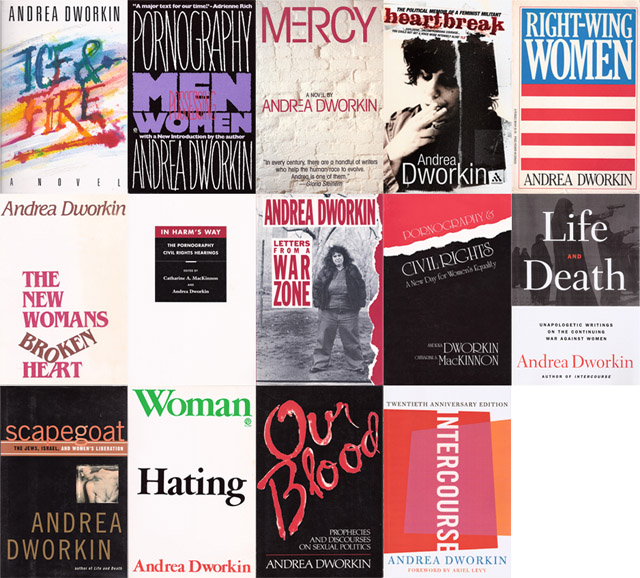
Andrea Dworkin: Ten Years Gone (April 9, 2005 - 2015)

image of Andrea's book covers is from here

Ten years ago Nikki Craft got the news and delivered it to me, so sadly.

Andrea died.

There was shock. Disbelief. Questions. Grief.

It was not only hard to believe, it also raised a new fear about the future: losing such a pivotal feminist figure in the fight against sexual violence, giving voice to her and other women's past and present, she refused to call male supremacist violence anything other than that. Who would continue to name it and speak against it with such literary passion?

What has happened in the last ten years is the continued proliferation of pornography and other systems of sexual exploitation and abuse: pimping, brothel-keeping, and trafficking, for example. Hand-held devices mean people of many ages have visual access to raped children and adults, literally at one's fingertips.

Genocides continue against Indigenous people around the world.

There is more slavery than ever.

Corporate greed continues to destroy the Earth, increasingly swiftly.

The Global North and West continues to colonise, exploit, and pillage the Global South and East.

50 years after Bloody Sunday, white male supremacist atrocities against Black and Brown people is still endemic and normal in the U.S.; the only difference may be some level of recognition and disgust by fellow whites to the ritual harassment and mass murder of Black people by well-organized racist white police forces.

*                    *                    *

April 10th, 2005, Nikki and I got to work immediately--it helped with the grief--to create a website with a memorial page, where people could share their grief, memories, and how their lives were affected constructively by Andrea and her writing: http://www.andreadworkin.net/messages/

I got to know her writing starting in my early twenties, like many of my generation. I consumed her essays, books, wanting to read anything and everything she ever wrote. She shifted my perspective on so many issues or gave political meaning to experiences I hadn't understood.

She affected the trajectory of my activism.

I want to focus, today, on one effect, one not necessarily highlighted when people talk about her.

What I most learned from Andrea is the necessity of facing painful truths denied by the status quo. And challenging the status quo to stop reinforcing and fueling horror. Of course for that to happen, my society would have to radically change: all white and male supremacist institutions would have to be transformed; violent hierarchies dissolved; systemic exploitation, including from sex and work, deconstructed.

What I learned was to make a perspective into something flexible. never absolute; to always challenge myself to stay open to voices of people more marginalised, more silenced. And to use what I know to inform activism in all spheres of my life.
The purpose of theory is to clarify the world in which we live, how it works, why things happen as they do. The purpose of theory is understanding. Understanding is energizing. It energizes to action. When theory becomes an impediment to action, it is time to discard the theory and return naked, that is, without theory, to the world of reality. People become slaves to theory because people are used to meeting expectations they have not originated—to doing what they are told, to having everything mapped out, to having reality prepackaged. People can have an antiauthoritarian intention and yet function in a way totally consonant with the demands of authority. The deepest struggle is to root out of us and the institutions in which we participate the requirement that we slavishly conform. But an adherence to ideology, to any ideology, can give us the grand illusion of freedom when in fact we are being manipulated and used by those whom the theory serves. The struggle for freedom has to be a struggle toward integrity defined in every possible sphere of reality—sexual integrity, economic integrity, psychological integrity, integrity of expression, integrity of faith and loyalty and heart. Anything that shortcuts us away from viewing integrity as an essential goal or anything that diverts our attention from integrity as a revolutionary value serves only to reinforce the authoritarian values of the world in which we live.  —  Andrea Dworkin, Letters from a War Zone, U.S. edition, pages 127-128 [Quote added 1/8/2016]
What I have done in the last ten years is decenter whiteness from my political perspective and from how I comprehend and emotionally experience the world. What I have found is that any effort to do this is met with aggressive resistance just as any challenge to male supremacy is met with hostility.

What I have continued to examine is the relationship and degree of overlap between white and male supremacy. And to see intersectionality as having to do with multiple positions of marginalisation and powerlessness, beyond identity.

I believe the only way through the atrocities--to end them--is to center the lives and voices of people who virtually never make it into corporate media. To center the forms of resistance and social/economic/political transformation invisibilised people have been employing for decades and centuries. To not assume any expression of whiteness or maleness is universal, transcultural, or ahistorical, even while some forms of oppression have existed for millennia; whenever I have seen this done, it both recenters and redenies the ways whiteness permeates everything as male power permeates everything: differently, similarly, and in ways that shift and transmute.

To honor her, I will continue to listen, learn, remember, and do my work in collaboration with people who don't have the unearned privileges I too often take for granted.

To view the quote more easily, you may click here.


Sunday, December 29, 2013

Follow-up to the post: Why do some white folks ask what we should do, to be an ally, when a Black woman is being abused in public by a Black man?

Hello readers.

I received a comment recently that has been published and responded to at the prior post *here*. You can click on the "comments" link at the bottom of the post to see the rest of the conversation to date.


Below is that most recent comment and my critique of it, revised for this new post. (A post-script has been added at the bottom, on 6 January 2014.)


On Thursday, December 26, 2013, enchantedghosts said...
It's been a few months, but I am interested in this question. With a background in psychology, my first reaction to the question of why no one stood up for the panelist is The Bystander Effect. With so many people in the audience, there is a general diffusion of responsibility. Everyone was just waiting for everyone else to take a stand. It's also interesting to note that the moderator (a position that comes with some sense of authority) was the only one who made any real verbal attempt to mediate the situation.  
I also think that this particular situation, where a Black man is threatening a Black woman, is one where many White people feel uncomfortable intervening, for fear of "not doing it right." I think the fear of looking like someone who is trying to play the White Hero overshadows the feeling of responsibility to help out a fellow human being.  
I will admit that I feel terribly out of place to offer any critique of feminism. So take this as an outsider's non-academic opinion, please. But it seems as though at least part of the problem is that people are so afraid of saying the wrong thing or making the wrong move. There is a fear of being labeled as racist or sexist-- so in defense of one's ego and sense of their own moral goodness-- people choose to not act at all.  
This seems to stem from a very closed, angry and unforgiving conversation about these topics. A lot of judgement is thrown around, with very few people willing to extend any understanding towards the fellow people they are supposed to be engaged with. Instead of conversation and dialogue, there is an attempt to prove oneself right at the expense of shaming someone else.  
I don't know how much of this is simply because the internet is a forum which tends to bring out the worst in people's ability to engage in dialogue. Again, this is not my academic field and I am more familiar with what is available via the internet, while acknowledging that this is in no way a forum which speaks for the entire discipline. However, I do believe that if real, social change is something that people want to see happen then there needs to be space for people to make mistakes.  
I don't mean that people engaging in White Hero behavior (or any sexist/racist behavior) should be ignored or encouraged, but that gentle critiques may be better than constant shaming and anger in certain situations. Human beings can only take so much. 


Hello enchantedghosts.

Your response reminds me of how privilege in some ways constructs not only our views and experiences but also what we believe the terms ought to be when engaging with one another.

I'll try and clarify this using portions of your comment, below.

With a background in psychology, my first reaction to the question of why no one stood up for the panelist is The Bystander Effect. With so many people in the audience, there is a general diffusion of responsibility. Everyone was just waiting for everyone else to take a stand.

I agree that The Bystander Effect is one layer of explanation. This layer would likely be operative regardless of race, at least in a country like the U.S. I'm not sure The Bystander Effect is a phenomenon across cultures, however. It's not clear to me whether being a person in an oppressor class fearing judgment from oppressed people is in any way universal and I suspect it's rare rather than routine.

There'd have to be a solid level of privilege-backed liberalism in place, I think. Because if this were a more flagrantly white supremacist context, whites in the audience would be cheering the abuse on, or shouting racist epithets at a Black man abusing a Black woman, and racist misogynist epithets at her. What is unowned if not also repressed, is whites desire to witness such violence occur, as it helps protect rather than interrupt white male supremacy.

But your point is well taken in the context in which this incident happened. And I think there's much more going on that is more controversial to speak about among 'good' whites and 'good' men.

It's also interesting to note that the moderator (a position that comes with some sense of authority) was the only one who made any real verbal attempt to mediate the situation.

One would hope anyone so positionally empowered would be quick to do so.

I also think that this particular situation, where a Black man is threatening a Black woman, is one where many White people feel uncomfortable intervening, for fear of "not doing it right." I think the fear of looking like someone who is trying to play the White Hero overshadows the feeling of responsibility to help out a fellow human being.

While I agree with you, I'm reluctant to let that point of analysis go without deeper examination.

Let's take the context of Nazi Germany, and non-Jewish white German, French, and many other nations' citizens not doing much to intervene on Jews being forcibly removed from neighborhoods, cities, and countries (after increasingly anti-Semitic propaganda and violence prior to removal and mass murder).

What some non-Jewish Germans have said is either, "I didn't know what was going on", or "If I'd tried to intervene, I'd have been shot on the spot."

In schools where bullying is a problem, the Bystander Effect often amounts to someone not wanting the stigma of the abused being attached to someone standing up for the bullied person. 

In situations where gang rape is horrifically occurring, some men on the sidelines might argue that they feared being seen as "not a man" if they verbally or violently intervened against the sexual terrorists/thugs/normal guys. And some of those not-so-innocent bystanders might also join in and become gang-rapists themselves to prove alliance with their more enthusiastically vicious peers.

Taken together, we see that The [Privileged] Bystander Effect has several functions: to allow someone to believe they alone have no particular responsibility to stop unjust violence is one. To allow someone the freedom to not be stigmatised and/or mistreated by the abuser/oppressor. To avoid death, including to the point of becoming one of the abusers/oppressors.

What also must be exposed is what oppressor-class people have to gain by not intervening. It's easy enough for us to think, "The whites did nothing because they didn't want to be misperceived as The White Hero", which sort of sounds like the position is rooted in an egocentric desire to always been seen as good and moral. The key there is "seen as". Because their actions are not good and are not moral, of course. And whites and men wanting to be seen as morally good people within a virulently white male supremacist society serves whom, exactly?

Do oppressor-class people REALLY give a shit what oppressed-class people think of them/us? Maybe that's the case for the few who are judged by other liberal oppressor-class people. The situation linked to in the post here demonstrates to me whites want to be seen as not-racist by other whites. And to the extent they don't want to be seen as not-racist by people of color, it is only to maintain a false appearance in order to maintain white power and position. Whites who did, really, intervene against white violence against people of color, and men who have, really, intervened against male violence against women, do face the real prospect of having that violence turned on them and, at least, losing status among those whites and men around them.

What we see is that whites will excuse each other not intervening. They will be very understanding and quick to defend such inaction. And that's white supremacy in action. Men will excuse each other not intervening. That's male supremacy at work. I offer all that as a foundation for the following challenges to what you offer by way of explanation.

... But it seems as though at least part of the problem is that people are so afraid of saying the wrong thing or making the wrong move.

What constitutes "the wrong thing" or "the wrong move"? As I already described, this is not universal. It is not even regionally or locally predictable.

The wrong thing/the wrong move is usually and overwhelmingly to allow oppressive violence to continue uninterrupted. That's our status quo. It's also status quo for whites and men to deny the violence is happening at all--or is far more rare than the oppressed claim it is. It is also status quo for whites and men to encourage it to happen and to commit it.

It's rare for whites/males to give a shit about what happens to Black people/women, historically and presently. What happens to Black women is especially disregarded by white men, or is consumed as entertainment. The pornography industry is one callous arena offering evidence of callous enjoyment. If we really cared, we'd work collectively to eradicate white male supremacy and the economic and social manifestations of it. We don't. Instead a small minority of us egocentrically care what others think about us when we don't do what we assume others think we should do, as described here:

There is a fear of being labeled as racist or sexist-- so in defense of one's ego and sense of their own moral goodness-- people choose to not act at all.

That's white/male supremacy at work, not just egocentric (im)moral action. Where you go from here is, for me, increasingly problematic and victim-blaming.

This seems to stem from a very closed, angry and unforgiving conversation about these topics.

Who is being "very closed, angry, and unforgiving"? Other whites or people of color?

A lot of judgement is thrown around, with very few people willing to extend any understanding towards the fellow people they are supposed to be engaged with.

Who is throwing judgment? Who is not willing to extend understanding? And who can afford to see their oppressors as "fellow people they are supposed to be engaged with"?

Those who have been systematically and chronically sexually or racially discriminated against, harassed, ignored, and terrorised? The people with severe PTSD developed over years from enduring daily racism and misogyny?

As I read it, you're speaking of people of color being too angry, too unforgiving, too closed, too judgmental, too shaming, and too stingy with understanding and compassion.

Instead of conversation and dialogue, there is an attempt to prove oneself right at the expense of shaming someone else.

Among men and among whites, I've seen this occur. Many times. Whites wanting to demonstrate who is the better ally to POC; men fighting over who is the better feminist. And so on. But we're talking about minority populations of whites and men, of course. The places I've observed this are very few and far between. Very few men interrupt misogynist violence; very few non-Jewish Germans interrupted anti-Semitic Nazi violence in the 1930s and '40s; most whites were privately disdainful of Martin Luther King, Jr., or were publicly hostile when discussing his efforts through the '50s and '60s. Many privately or publicly were relieved when he was assassinated, as they were when Malcolm X was murdered. Consciously or not, whites felt: "Whew! Thank God that attempt to challenge my white power is now without its most public leader." 

Most whites are still hostile to or disdainful of any efforts to weaken white power. And most whites in the U.S. reluctantly endure "Martin Luther King, Jr. Day". Just YESTERDAY--no joke--I heard two whites being irritated that he has "a Day" at all. These two people also agreed Abraham Lincoln was far greater for freeing the slaves, which shows how whites rewrite history to rewrite and rewhite his/story. Lincoln's role in freeing slaves was far less arduous and brave than was Harriet Tubman's. Or the other hundreds of slaves who resisted and fought for freedom.

I don't know how much of this is simply because the internet is a forum which tends to bring out the worst in people's ability to engage in dialogue.

The anonymity factor is likely operating on the internet, but that, too, is a very partial explanation, and misses the politics of what is going down in favor of a psychological perspective. I say this to you as in order to recommend that you offer such a critique to your Psych professors. 

People's ability to engage in dialogue about racism and sexism is far more impaired by racism and sexism among whites and men than it is by anything else. Our reluctance and resistance is evident ubiquitously, in white families, majority-white places of worship, in the white-ruled educational system, and among white psychotherapists, to name but a few spheres of white power-protection. 

When I see conversations between whites and POC online, what I see time and again is whites wanting always to be seen as earnestly intending to be good, and becoming defensive or hostile when they are called out--appropriately--for being racist. I've seen how some POC will far too calmly and patiently attempt to get some white person to see things from their point of view, identifying some interaction or statement by the white person as racist, only to have the white person claim the person of color is wrongfully judging them, as if the white person's character was ever the issue. The same with men. Having their behavior called "sexist" or "misogynistic" becomes something they pretend is a personal attack. A grievous "attack". And they don't see their own defensiveness and/or hostility as any form of attack at all. 

...I am more familiar with what is available via the internet, while acknowledging that this is in no way a forum which speaks for the entire discipline. However, I do believe that if real, social change is something that people want to see happen then there needs to be space for people to make mistakes.

Systematic oppression and flagrant, violent resistance to change, to accountability, to responsibility, ought not be termed "people making mistakes". Whites don't make mistakes, nor do men. What whites and men do is protect our power, privileges, entitlements, and status. There's no mistake about it. When you narrow the lens down to a few internet interactions, it may be too easy to lose sight of the larger political picture, the broader social context for those few interactions.

I don't mean that people engaging in White Hero behavior (or any sexist/racist behavior) should be ignored or encouraged, but that gentle critiques may be better than constant shaming and anger in certain situations. Human beings can only take so much.

White/Male Hero and White/Male Abuser behavior is both ignored (passively allowed) and encouraged (actively allowed) by whites and men. So we have to start there. "Gentle critiques" as defined by whom? Probably only by whites and men, right? "Constant shaming" as defined by whom? Probably only by whites and men, right? This request for the oppressed to offer only "gentle critiques" is, in and of itself, a form of oppressive white/male supremacist behavior. As is someone privileged being calling out by those he oppresses being called "constant shaming". The only constant shaming I'm aware of is the institutional shaming done to oppressed people, actively and passively supported by whites and men. 

Oppressors are always trying to control the behavior of those we oppress, including by telling them how we might best be able to learn from them--if they'd only speak the way we demand they do. But however gentle it is to our ears, we don't hear it because we don't want to or don't have to; so what usually happens is the behavior becomes a tad less gentle. But the behavior I'm talking about isn't that of the oppressed; it's that of the oppressor, who is behaving violently all along but is denying it at every turn. Telling someone you're oppressing to challenge you in a more gentle way is a verbal version of a batterer telling the person being battered to resist in a less aggressive way. Making the oppressed person's allegedly ceaselessly shaming behavior or apparent aggression appear to be "the problem", as you do at times, is a form of violence never called violent by those who do it.

6 January 2014 post-script:
I am thinking now of how any interruption in collective silence may serve to empower others to speak out as well. In the auditorium in which the abuse happened (in the story linked to initially in the last post), just one white man speaking out in any way, even in problematic ways, would likely serve, at the very least, to make space for others to speak out, perhaps more responsibly.

Breaking silence when abuse is happening in front of us, in other words, is often useful in and of itself. That may be so even if it isn't done using the most appropriate or useful language. This is to say, "too little" might be just enough for more to happen. Any individual's action opposing and interrupting abuse in a social space can at least open that space to more challenges of that violence. I think part of the 'white/male hero' phenomenon has to do with the alleged hero wanting all the credit for rescuing the abused person, ignoring how historically and inherently collectivist anti-oppression and anti-abuse work is. There's never a lone hero in such work and any attempts to narratively manufacture or highlight one is usually done to mis- and over-represent the work of one or a few whites and men.


Saturday, October 26, 2013

Why do some white folks ask what we should do, to be an ally, when a Black woman is being abused in public by a Black man?


image is from here
This post is in response to a discussion over to Crunk Feminist Collective. You can read that post and the comments there first if you want, but it's not necessary. But to do so, click on the title of that post just below:

On Black Men Showing Up for Black Women at the Scene of the Crime


The reason it's not necessary is because white folks are asking questions there what white folks ask far too often in the wrong spaces: What should I do to be a good ally to people of color? Usually this assumes people of color exist to educate whites about how to be anti-racist/anti-sexist. And usually in contexts where people of color are not there to teach whites anything. (I mean, like not in a classroom with bell hooks as the professor teaching a course to people of color and whites on how to support one another across various political struggles.)

Too often, in PoC spaces or in conversations led by people of color about something awful that happened to someone, white comments become a white-centered distraction from the main issues.


But related to the post above, I wonder to what extent the Brecht Center is a white-majority or white-run space, an academic space. I wonder how that contributed to the lack of response from the audience to Crunktastic being intimidated, threatened, and assaulted at a progressive political panel discussion, by a well-known Black male activist, Kazembe Balagun. My experience of white and class-privileged academic spaces is that there is an expectation that audiences remain passive witnesses to what's going on (or down) onstage. That to do otherwise is to break the unwritten cultural rules of (non)engagement. I wonder if that's part of this story.

But there are always plenty of explanations for why folks don't intervene on violence against women, including racist misogyny (rarely identified as such). It shows up in male-bonding rituals. It shows up in the refusal of the public to see the harassment, disrespect, disregard, harassment, violation, and abuse of women of color as violence. Other dynamics are described later on in this post.

At issue is our collective response-ability to co-create anti-colonial, anti-patriarchal spaces in which to organise and, well, just live with dignity and relative safety. I've seen response-ability shut down by anti-activist liberal white and male self-reflection. "What can I do that won't be seen as racist or sexist?" is a question in service to white male supremacy. Because "how privileged folks are perceived" already presumes the issue is the image of the oppressors, not the harm done to the oppressed.

I'm making space here, at a white person's blog, for some of that discussion. A white woman at CFC left a comment, which I'm excerpting just below. The reason I'm copying and pasting it here is because she acknowledges this is a conversation that maybe shouldn't happen there and then, at CFC. And I agree. Other whites on that comments page appear to me to be making this about liberal white guilt and the matter of whether we should do anything, rather than about what we must do to intervene when we witness violence occurring right before us in social spaces.

I can’t pretend that the dynamics of my interactions with black women aren’t colored by our different races. I do not want to presume to act or speak for a black woman who is perfectly capable of acting or speaking for herself. Nor do I want to appear to be attempting to exert authority over a space for black people based on my white skin. It can be difficult at times to decide whether my intervention in a tense situation would be seen as welcome support or as hijacking. In this situation, I think the answer is clear (both from my own judgment and from the message of the post), but it’s not always.
Obviously, how a white woman would have felt/what she should have done should not be the center of the discussion here. What happened should be. But there seems to be a substantial discussion going on around that, and thus probably room for a thread or two on this point: that is, how SHOULD an ally best respond in this situation? There may actually be a different answer for other black men, for white women, for white men, etc.
Should whites respond differently to violence happening when the aggressor is a Black man and the person harmed is a Black woman? Are the responsibilities of a white ally to a Black woman facing male supremacist hostility from a Black man (or from a white man, or a man of color who isn't Black) different than the responsibilities of an ally to a white woman facing male supremacist hostility--from a white or Black man, or another man of color?

Beyond, "Don't do something racist", I don't think so. 

But it is, unfortunately, the case that we whites can be confused about what it is to be racist.

One way racism shows up is whites thinking that intervening when a Black woman is being abused by a Black man is in and of itself racist. When, in fact, not intervening is the act of racism, and sexism.

This was going to be my reply at CFC but I've decided to put it here instead and link to this post over there.
 
Dynamics are raced, yes. Always. And gendered. Whatever I did there, if I were there, would have been the actions of a white male. But our race and gender doesn't mean we're not capable of responding to other humans as human beings. 
 
I read another comment, in response to the one quoted above, stating clearly that the woman assaulted is a human being and ought to be responded to as the human being that she is
 
I thought about how whites use our whiteness as a way (and too often an excuse) to not do something we'd do if it were happening to someone white. We don't tend to ask ourselves, when in an all-white forum or social space, "How might my whiteness be a problem here, in possibly intervening when a white man is harming a white woman?" I'm just as white in all-white spaces too. That whole way of responding or not and acting or not is white supremacist to me. 

Black, Brown, white, female, trans, male: if I'm a person in the room, and I see someone being assaulted, I intervene, if I care and if I can. I do what I can do, given my own limitations, strengths, privileges, and experiences of trauma and resistance.  
 
One thing I've seen play out far too often is that whites assume a Black woman (a particular Black woman, any Black woman, or all Black women) is strong enough to handle things on her own. While whites often want someone (of color) to have our back, it is assumed by whites that a Black woman has her own back and doesn't need anything more. The misogynist-racist Super-woman stereotype. There's the issue of Black woman-as-mammy whose only role is to take care of whites. In such a racist imagination, how could she possibly need whites to emotionally or physically take care of her? In reality, in what spaces would whites do so at all without expecting public or private props?
 
I've seen how Black women's womanness is erased and how Black women's Blackness is eraced. Each of which contributes to how Black women's humanity is made invisible socially by white and male supremacy.
 
When women's liberation is discussed in white spaces, the talk often assumes an alleged common denominator of white experience. So Black women, and other women of color, are assumed to be part of that struggle--to be "women"--only to the extent that they share the experiences, analysis, and agendas of whites. Usually unasked and unanswered in such spaces is this question: how could white experience be a common denominator for all women, most of whom are not white?) In my experience, when women of color assert their womanness not in white or colonial terms, or outside a white frame of experience, whites often claim they are being divisive, disruptive, or collaborators with patriarchy. (In truth, whites invisibilising whiteness is always in service to colonial patriarchy.)
  
When Black liberation is discussed in Black spaces, the talk often assumes a common denominator of Black men's experience. So Black women, again, are assumed to be part of the struggle only to the extent that their lives and struggles match up with men's. When Black women assert their own experiences as distinct from men's, the men often rebuke, retaliate, and revolt against the women, proving the point far too predictably.

What gets lost, obviously, is the humanity of Black women as Black, as women, and as Black Women whose lives, however personally complex and culturally dissimilar, do not and cannot only mirror the struggles Black men and white women face, in part because Black women are oppressed by both groups and by white men too.
 
I open the post to comments and conversation.


Tuesday, February 12, 2013

On Trashing, Calling Out, and Accountability, with thanks to A Radical TransFeminist

portrait of Alice Walker is from here

I recently submitted two comments to a white transgender feminist's blog. She didn't publish them but did explain to me that she wouldn't be posting them, which I appreciate her doing. I welcome finding out what it is about the comments that led her to not post them, at a later date when she feels like communicating more with me.

I'd like for the topics to be addressed here to allow any of my readers to comment here on these issues. So I'll post links to her blog's two posts, with my comments in this and the next post to this blog. I'll revise my comments for clarity and to correct some typos.

I'm putting the initials of people's names in the comments below, as I don't have their permission to use their names here. One exception is the name Joreen, which was a chosen name used in movement work by Jo Freeman, a long-time white feminist writer and attorney. Her work is referenced; she isn't a participant in this discussion. See *this* for more, and see *this* for Jo/Joreen's piece on Trashing which is the foundation for the discussion at the other blog.

On Trashing

http://radtransfem.wordpress.com/2013/02/08/a-space-for-conversation-about-trashing/#more-668

Here is a revised version of the comment I submitted:

I’ve witnessed and experienced a lot of destructive dynamics, also some amazingly life-affirming and spiritually supportive dynamics, in feminist and profeminist spaces. I’ve seen far more positive than negative things happen. And I appreciate you creating this space to talk about this issue. While I’d like to be part of this discussion, I’m not sure I should be a contributor. If the issue is how people treat one another harmfully and abusively in the name of feminism and profeminism, I’d like to comment. If, on the other hand, that is the issue (with a focus on trashing), but only within women-only spaces, then that’s not something I’d feel would be appropriate for me, an intergender male, to be part of.

I nodded all the way through your remarks about Joreen’s piece. As a sexual assault survivor, I felt uneasy about the use of the term “psychological rape”. So thank you, L, and H, for sharing your response to that. I was deeply conflicted about whether to even mention it here, because, as H also stated, I don’t know her own story of physical abuse, and because, well, I’m male. The phrase that also felt deeply problematic to me was this one: “like a thousand cuts with a whip”. For me that phrase references an experience of physical-spiritual-political assault at the hands of white supremacists during U.S. slavery, Jim Crow, and since. I don’t think it is appropriate or respectful to survivors of slavery and those racially targeted for such abuse to appropriate the term even as simile.

That said, I respect Joreen’s bravery in tackling this issue and can hear how painful her experiences were. And I’ve seen how people in radical spaces sometimes want to demonstrate their/our/my sensitivity to issues by immediately and primarily pointing out what feels “off” about someone’s remarks, rather than by first highlighting what feels right on.* I feel for the ways she’s been hurt and rejected in spaces and by people she looked to for solidarity and community. I’ve known women hurt in so many ways, most callously, brutally, and lethally by men, but also hurt emotionally and psychologically by other women. And I’ve experienced, just within my own family of origin and friendship circles, how people closest to me in various ways, are capable, due to conditions of trust, shared history, and vulnerability, of hurting me deeply in ways some of my oppressors, now that I’m an adult, are not.

*I have been thinking about  this. I am aware that in online discourse far more than my offline discourse, criticism is, often, "what people do" without necessarily knowing the people we're criticising. This is dramatically different in my offline life. I'll far more typically withhold criticism if I think it might harm a relationship with someone I care about. The relationship's well-being is preferenced over my critical voice; it's not that I work to silence myself exactly; it's that I don't let criticism become the primary value. I suspect that because online forums make space for critique of writings and disagreement over discourse, that gets valued over the relationships that might otherwise form and flourish among the contributors. I've not found online sites to be a place of forming friendship. I've met people online that I've become friends with offline, or in email. But the nature of the online forums don't, for many reasons, create safe-enough space for friendship to bloom, in my experience.

As part of my own effort to disengage from behavior that I now see as non-constructive and anti-revolutionary, I’ve decided not to engage in “snark”, let alone trashing, because I see it as part of the same cluster of cynical, self-protecting while hostile, anti-revolutionary practices that apparently passes for radical and profeminist behavior in lots of places (feminist and non-feminist). I used to direct snarky comments to white men on and off my blog, and I don’t any longer: a white man just submitted a comment to me, on an old post, about his view that misandry is a serious social problem, not as harmful as misogyny, but not non-existent either. I've heard similar things from so many white men that I've grown weary of responding. Often, in my weariness or my laziness, I might resort to snarky response. Because I'd be tempted to do so with this newest comment-submitter, I won't publish his comment and won't respond at all. His comment also violates some of my comment policy. (I don't publish pro-MRA positions here.)

I value direct, emotionally honest communication. And I also have complex PTSD which means that my feelings and reactions sometimes exceed what’s happening in the present. I can suddenly feel tremendously vulnerable or in danger. How I respond in those instances is sometimes out of proportion to what is happening before me because my history is dredged up and projected into the moment. I've often described this as "my past bleeding into my present". Due primarily to privilege, including access to mental health care workers who regard me as fully human because I’m male, white, and not poor, I have learned to identify when I’m triggered and have learned some methods for re-grounding myself in the present. But that’s not always easy or even possible to do. And I also see how, with my many privileges, I can too often get away with not taking full responsibility for my actions and pretend that other conditions are responsible for how I behave.

I have seen how white supremacy and male supremacy generate and exacerbate complex PTSD for white women, for women of color, and for men of color. I’ve seen how whites and men deny that our actions trigger distress and many other feelings and experiences in people we structurally, systemically, institutionally, and interpersonally oppress. And I’ve seen how, when whites and men are called out by women of color especially–almost always in ways that strike me as profoundly measured and respectful, that Calling Out is named many negative things by whites and men. Most of the things it is called effectively (and often enough willfully) work to further hurt, subordinate, and silence women of color. One of the things such Calling Out is called is “Trashing”.

For example, I’ve known whites who consider being named “racist” by a person of color to be a violent and inexcusable form of trashing. And the politics of what is considered violent is noted quite succinctly by the white male radical Derrick Jensen in his Premises of Endgame: “Violence done by those higher on the hierarchy to those lower is nearly always invisible, that is, unnoticed [by oppressors]. When it is noticed, it is fully rationalized. Violence done by those lower on the hierarchy to those higher is unthinkable, and when it does occur is regarded with shock, horror, and the fetishization of the victims.” I thought about that as I was appreciating J.M.’s comment.

One of the requests I hear Joreen making is to not talk about someone’s ‘being’ and instead to critique the behavior or what someone is ‘doing’. This is consistent with my own values: challenge the behavior; don’t go after someone personally. And, when possible, try and hold the whole of someone’s humanity in mind and heart when offering critique. My values were learned mostly by studying and being around modes of critical engagement practiced by womanists and feminists. Alice Walker has been a significant role model in this regard. Her open letter to Tiger Woods is an excellent example. Also Flo Kennedy on horizontal hostility ["Women Against Women: Horizontal Hostility," domestic violence; "Sexuality '85" conference; Alabama NOW; Massachusetts; Ohio; Ontario; Wisconsin; Wyoming], Pearl Cleage on the necessity of oppressors listening to the oppressed-as-experts [see pages 32-33 in Deals With the Devil and Other Reasons to Riot], and Andrea Dworkin as evidenced in her address to allegedly anti-sexist men at a men’s conference.

With that in mind, I’ve also heard many times from women of color how whites and men try and control how women of color behave. They/we try and control how women of color speak, how they express their emotions, and, especially, how and to what degree they critique whites and men. Whites and men (and especially white men) also hold the unearned power to allegedly ‘accurately’ name what occurs, to construct and determine which stories comprise truthful history, and be the final arbiters of (white- and male-centric) justice on matters of social and interpersonal wrongs. As I see it, oppressive sexual and racial politics are at work when people with various forms of privilege agree to critique ‘trashing’ without also explicitly putting on the table the issue of how people with structural advantage and power get to name the behavior of those who are oppressed. In that context, Joreen's or my own priority to be critiqued on our behavior not on our personhood, when the person calling us out is structurally oppressed by us, becomes a secondary matter to oppressed people naming what is harming them in ways meaningful and helpful to them. Simply put, Alice Walker's level of grace and compassion in confronting Tiger Woods is hers to determine; it is not for him to require.

I just want to place that perspective front and center, with the intention of fully supporting your own concerns along those lines, L.

Finally, I'm wishing a belated Happy Birthday to Alice Walker! (Her birthday was February 9th.)


Monday, February 11, 2013

Dr. Vandana Shiva interviewed by Robin Morgan, on rape and globalization

As a kind of personal-political preface to the interview that follows, I'd like to explain why it is I find the exchange so significant.

It should come as no surprise to anyone familiar with my blog that I strongly believe women of color are the global leaders in feminism, as well as regional and national leaders in many places, and ought to be regarded as such by whites and men. Typically, men and whites ignore, silence, marginalise, appropriate, and take credit for the activist work women of color do.

If you take the spotlight off the courageous leadership work of Malcolm X and Martin Luther King, Jr., you see a lot of Black women in leadership throughout the 20th century in the U.S., working very hard, at great cost, to free African Americans from the blight of white supremacy while also addressing sexual politics and male supremacy. Black men's work against racism has been substantial and has also tended to de-center or invisibilise Black women's insights, analysis, and activism. White women's feminist work against sexism and male supremacy has been substantial and ground-breaking in countries where white women live. And it has been a challenge to get the whiteness of the work de-centered or even consistently identified as race-privileged.

My own family background led me to be particularly concerned about sexual violence. For several years, I was drawn to a few white feminist writers who focused on that issue intensely but usually non-intersectionally, and without radically and thoroughly identifying the whiteness in their work. At the same time, thanks to a white lesbian feminist mentor, I was introduced to the work of many womanist and feminist writers of color, mostly from North America and the Caribbean. My own awareness of the work done by women of color outside of white-ruled or white-colonised nations was minimal. Over the last few years I have tried to make this blog a space where voices, perspectives, and commitments to radical social change by women of color are highlighted not footnoted; where women of color are centralised not marginalised.

I do this in part because of once mistakenly determining white work to be the most radical; this was done in part because whites who use the term 'radical' don't identify lack of awareness of their whiteness as anti-radical. This was consistently challenged by radical women of color writer-activists as anti-revolutionary, racist practice. I also noticed far too many white-edited, white-dominated anthologies of activists where women of color got a special chapter on women effected by racial hierarchies (as if white people aren't fundamentally effected by white supremacy and racism), but were rarely invited or expected to speak on behalf of all women. I've seen white pro-radical and feminist websites where the work of women of color is barely mentioned and where white women routinely speak for all women. I've seen gatherings led by whites who pretend they are inclusive and safe for women of color.

Writings and activism which centers the humanity of women is generally and typically regarded by men as being too narrowly about women. Men's writings about only-men or mostly men has been historically regarded by men as about all of humanity, or the segment of humanity worth doing justice work for, or about all people of a particular race; it is rarely-to-never seen as "too narrow in scope", too much about men, too ignorant about women, when reviewed by other men. When men recount the contributions by women to the men's human struggles for justice, women have too often been ignored or footnoted. And when men focus on women, the gaze is often objectifying and the attitude patronising.

It appears that whites and men will not easily regard women of color as fully human with perspectives that whites and men ought to pay attention to, prioritise, privilege, promote, and regard as foundational and central to understanding humanity on the whole.

I have come to the conclusion that women of color, as a global and regional majority by gender and the most diversely raced women on Earth, hold the most complex, radical, sophisticated, and revolutionary views on race, gender, and everything else. This doesn't mean I don't still look to white women and men of color for useful analysis and insight. It means I no longer center and privilege their voices and perspectives.

Vandana Shiva is, for me, a profoundly important world leader on matters of feminism, environmental/Earth justice, global economics, and holistic and humane sustainability. Robin Morgan is a U.S.-based white feminist who has dedicated many decades to the struggle by and for women against men's global woman-hating and woman-subjugating violence. I hold both women in very high regard and was delighted to find this exchange between them recently online.

You may go here, to The Women's Media Center online, to return to the source website. You may stay connected with their efforts here:

title
Economist and ecofeminist Dr. Vandana Shiva addresses the root causes of violence against women. 

Dr. Vandana Shiva—The New Delhi Rape and Globalization

| February 11, 2013
Dr. Vandana Shiva, economist, environmentalist, and feminist, spoke of the public outcry in India and how the devaluing of women in a global economy set the stage for the New Delhi rape. Adapted from a conversation broadcast last month on Women's Media Center Live with Robin Morgan.
Robin Morgan: In a feminist analysis certainly, everything is connected to everything else.  You recently wrote a stunning piece about the ghastly gang rape in New Delhi and the subsequent demonstrations and how violence against women and the economy were all connected.  I’d love you, please, to talk about the points that you raised.
Vandana Shiva: I’ve been working on how the economy’s changing—globalization, free trade, WTO, the structural adjustment. I’ve made the connections between those purposes and what happens to women in what is called the New Economy. They even call it the Emerging Economy, as if a 10,000-year-old civilization emerges only when it is locked into corporate globalization.
The first level at where violence against women begins is in the very defining of the economy.  Economy means household.  It is what women define both inside the physical households, but also the world, inside the planet as the household.  As long as the principles of management came out of that, they focused on sustenance, livelihoods, mutual giving—of course, within the typical patriarchies all our societies have had.
[With] free trade globalization, the first thing they do is knock out that major sector of women’s economy and, as Marilyn Waring has written in If Women Counted, install a production boundary to calculate growth.
The Gross Domestic Product grows every time you can pull something out of nature and something out of women customers’ economy, which means every time you destroy nature and women’s livelihoods, and production, and creativity, you can call it growth.  It’s created to mobilize finances for the war, and it becomes the dominant number imposed on our world.
I’ve been appointed by the King of Bhutan to an expert group we’ve created because Gross Domestic Product is the wrong measure.  The King of Bhutan said we should be looking at the well-being of our people to measure Gross National Happiness.
At this time, growth measured as Gross Domestic Product is already collapsing world-wide. It collapsed with Wall Street.  It’s collapsing in Europe right now in front of our eyes. and it will collapse in India after a few years.  How long can you sustain an eight or nine percent growth that excludes women as the primary backbone of the economy? That is the first violence.
The second violence is in terms of decision-making and politics.  In so many debates in India we hear, “Oh, we can’t have politics in economics.” But every time they make a decision within a patriarchal model of the economy, it is politics.  It’s politics that basically says, “Only corporations count, only the powerful count, and we’re going to mutate democracy from being, “By the people, of the people, for the people,” into being “By the corporations, of the corporations, for the corporations—and the powerful.”
The convergence of economic and political power further excludes women, but it also creates a class with immunity and impunity, which can do all levels of violence, change laws, and remove protections. There’s rape at every level—rape of the earth, rape of our resources, rape of the economy, and rape of women, which is what this drastic, dramatic tragedy has woken up India to.
Then there are other levels of violence because displaced people are more vulnerable.  I was asked by the National Commission of Women to grapple with what globalization was doing to women in India, in terms of two key factors: water, and food and agriculture. At public hearings around the country, whether in Calcutta or down south, women would speak out boldly about how sexual violence has increased and made them more vulnerable as they were being made economic and ecological refugees.
That is at the very foundation of this new liberal model: everything is a commodity.  Everything is property.  Everything has a price and nothing has value. Added to the traditional patriarchies of societies, that's created what I call a super-virus of patriarchy. When two viruses hybridize, they start to kill.
Basically it’s a bit like climate change.  We’ve had cyclones, but Hurricane Katrina and Hurricane Sandy present a different level of violence.  Of course, we know that this is contributed by climate change. We need to start looking at how an economy based on patriarchal fictions—and the corporation is the biggest patriarch in our lives to come—how this patriarchy is combining with traditional patriarchies to unleash even larger violence, both the kind we see on the streets of Delhi and the economic kind, the violence of robbing you of your home, of your foundation.
Our prime minister said recently, it’s these loose-footed migrants that are part of the problem. Because the Delhi rape involved migrants at both ends. The rapists were all living in slums in hugely brutalized conditions, thinking that brutalization is the norm.  The poor girl's father had sold his land because farmers aren’t being allowed to make a living.  Two hundred and seventy thousand Indian farmers have committed suicide.  The rest are hanging on the margins of existence.  He moved to Delhi to load luggage at the airport to be able to survive and send his children to school.
The prime minister just called them loose-footed migrants creating problems. I said, “Mr. Prime Minister, they are a product of your policies.  They are refugees of your economic policies.”  None of these—economics and culture and society—are insulated silos. The patriarchal economic model is becoming the dominant force in our society.  Societies have been reduced to the economy.  Economy has been reduced to the market.  The market has been reduced to what is controlled by finance, capital corporations.  And if all you show is women as commodities, selling other commodities, those images start to further distort already damaged brains.
RM: Isn’t it amazing, Vandana, how when you put something in context—the background of the victim and for that matter of the perpetrators—it changes? Also, I'm reminded of your colleague Ruchira Gupta who wrote a piece in which she pointed out that the commodification of women by the rampant growth of pornography and prostitution sends the message that, in fact, this is what women are for. She connects that to the apparently quite dramatic rise in rape in India.
VS: Hugely dramatic.  Eight hundred percent since the ‘70s and more than 250 percent since India’s economy, was as they say, made "more open" [with globalization]—more open to more violence against women.
RM: From where I sit here in New York, it seems heartening that women in numbers never seen before and accompanied by men as well have been on the streets in not only Delhi but across India.  They haven’t quite made the connections you’re making, but they are on the move protesting violence against women.
What can we do to turn the enormity of this around?  It’s always for example, blown me away, that a woman who is, say, in her fifteenth hour of labor, straining away—the doctor and the nurses and the anesthesiologists are all productive because they are wage labor, but the woman who is actually giving birth is not considered in a productive act.
VS: I think that is the foundational error. Everything that replenishes is treated as not producing at all and everything that’s degrades, everything that depletes, is treated as production.  I call it the creation boundary, which has given us the fiction of growth and the Gross Domestic Product—that destructive acts are creative acts of produce. The really creative acts of nature—of women in their tremendous diversity and amazing ability to juggle 50 jobs, 50 responsibilities—their whole society and economy are treated as unproductive. That, I think, is the most important shift we need to make.
As you know Robin, I come from the part of the Himalayas where it's recognized that women are the main productive force. They go out in the forests [to work] and there's nothing like the rape [that occurs] when you come into the plains where women are no longer considered productive. When I, with my sister, Dr. Meta Shiva, was studying female feticide, we realized that the map of high growth in the patriarchal measure are the same zones with the high levels of extermination of girls—fifty million girls haven't been allowed to be born in the last few decades.
The response in Delhi is beautiful for a number of reasons.
The first, that the younger generation has come. The younger generation was absent from social movements, especially the middle class because they were getting it so good with globalization—the IT jobs that moved to India. They were all seeing themselves as individual consumers, so society did not matter to them. But this rape reminded them that it could have been them coming back from their IT farms, from their phone call service centers.
The second difference is, while we have had a feminist movement in India for a long time, it was only the women. The beauty now is, young men joined. It was a young man who was defending this girl in that bus.  I think for the first time, there’s this new generational solidarity that’s emerging. Those very gutsy young people who are being beaten up and sprayed with tear gas and water canons realized that the state has become militarized. The state itself is a patriarchal institution. It will take time. There will be the hysterical voices saying death sentence, death sentence! But new connections have started to germinate that are really going to make a serious change.
RM: That’s very encouraging.  When you look at the global scale of things, I confess that I look to women not only because we are the majority and that permits more peaceable and more, how shall I say, witty and ingenious new strategies, but also because there’s no area that isn’t a women’s issue.  We spill over into everything if the connections are made.  I definitely see the global women’s movement as the politics of the 21st Century.
VS: We are really living through a period of collapse of all kinds in the patriarchic system.  The collapse of the financial economy they’ve built, a collapse of the eco-systems they have raped.  The UN has recognized that 90 percent of eco-systems are on the verge of collapse, if not already collapsed.  In this period, it’s the creative principle which women bring to bear for the simple reason that they were left to look after the real stuff of life, the goals that really mattered.  So they bring both another world view, another mindset, and other capacities, other skills—which is why I run a grandmother’s university at the new school I created in Dehradun called the Earth University.
RM: I love it.
VS: Ghandi always said a prayer, “Make me more womanly.”  If there is going to be a future for humanity, it will have to be a womanly future. I go to Europe and young men will bring me my books [to sign] and say, "I'm an ecofeminist, Dr. Shiva." That to me is a major, major shift. A shift to a creative economy where women start defining and playing the leadership role but others recognize that there has to be a mind shift.
RM: Whenever I talk to you, I feel both incredibly depressed because one is made yet again to realize the severity of the situation and at the same time, incredibly optimistic because I get from you a validation of everything that we’ve been trying to do and will do more and even better and with more people involved in the future. 
I can’t tell you how grateful I am for your wisdom and your perceptions and for everything that you do.
VS: And Robin, I want to thank you for your vision and leadership and your love.

Once again, to link back to the source website, please click *here*.