Saturday, May 2, 2026

The Tragic Assassination of Yanar Mohammed (25 November 1960 – 2 March 2026)

It is with great sadness that I share news of the killing by two terrorist men of feminist revolutionary activist, Yanar Mohammed. I was blessed to meet and speak with her many years ago. I am devastated by her loss.

Yanar Mohammed was a prominent Iraqi woman human rights defender and feminist, and the co-founder and director of the Organisation of Women's Freedom in Iraq (OWFI). Since 2003, she had worked to protect women facing gender-based violence, including domestic abuse, trafficking, and so-called ‘honour killings.’ Under her leadership, OWFI established a network of safe houses across several Iraqi cities, providing protection and support to hundreds of women. Yanar Mohammed led these efforts despite all the ongoing impediments and risks. She was a strong advocate for secularism and women’s equality. Throughout her activism, Yanar Mohammed faced death threats and, at times, was forced to restrict her movement. (Source: https://www.frontlinedefenders.org/en/case/killing-woman-human-rights-defender-and-feminist-yanar-mohammed)

What follows next is from MADRE, here: https://www.madre.org/media-item/yanarmohammed/ 

On the Assassination of Feminist Leader Yanar Mohammed

Media: Statement Region: Iraq

Today, Yanar Mohammed – one of the most formidable feminist leaders of her generation – was assassinated in her home in Baghdad in what appears to have been a targeted militia attack. We are devastated by her loss, and we mourn with all the people who loved her and whose lives she changed.

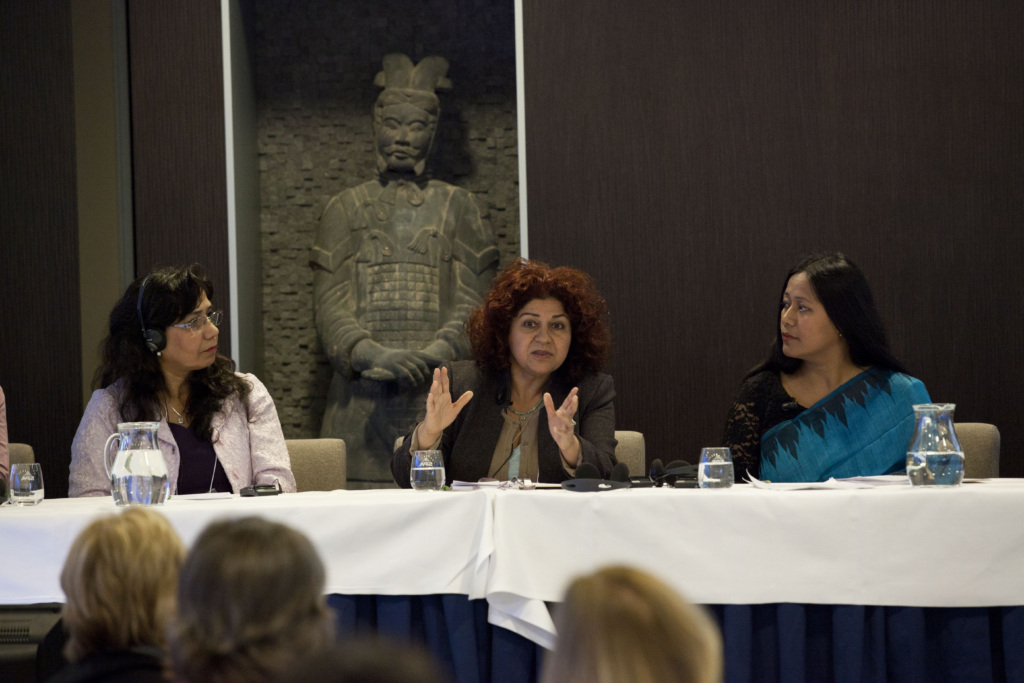
Yanar Mohammed speaks during a panel event

For years, Yanar lived under constant threat, as anti-rights and fundamentalist forces sought to suppress her activism for human rights and democracy. As the Founder of the Organization of Women’s Freedom in Iraq (OWFI), she built an enduring feminist infrastructure to support women and girls confronting violence, displacement, and systemic repression, and to lay the foundation for a better future. She provided food and shelter for survivors of violence and demanded an end to war and militarization.

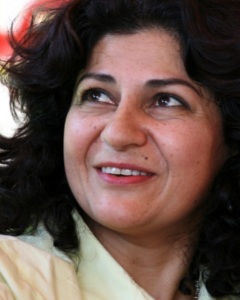
Close-up photo of Yanar Mohammed smiling 

She knew all too well how warmaking devastates communities and accelerates attacks on human rights defenders. In 2004, just after the US launched its war on Iraq, she founded OWFI to protect women, girls, and other marginalized people from these dangers. Almost immediately, she received death threats. She refused to be silent – instead, she called for the solidarity of the international women’s movement. MADRE responded to her, spotlighting her lifesaving work, demanding action from US policymakers, and launching decades of partnership.

Together, MADRE and OWFI provided humanitarian aid, human rights trainings, and community-led organizing for peace and justice throughout Iraq. We provided advocacy and legal support as OWFI fought back against restrictions on women’s shelters and against a years-long campaign of state harassment to impede their work. We will continue to stand by OWFI now, in these terrible days.

Yanar’s assassination is a stark reminder of the risks feminist leaders continue to face globally, and of the ongoing threats to human rights movements. Yet, we also remember that Yanar’s life was a testament to feminist courage rooted in action and fueled by love. She protected people where there was danger, created platforms where women could speak out, and insisted that all people deserve full rights.

As we grieve, we honor a beautiful life that propelled justice – with joy, purpose, love and courage.


Update:

The Yanar Mohammed Feminist Defense Fund was created to honor Yanar and support urgent needs of the organization she founded, Organization of Women’s Freedom In Iraq (OWFI). In addition, Yanar’s Fund will support women in Iraq and throughout the region who defend women’s human rights and carry forward Yanar’s legacy.


___________________________________________________________

What follows is from here: https://marxist.com/assassination-of-yanar-mohammed.htm

We publish here a statement sent to us by the Communist Alternative Organization in Iraq on the tragic death of their comrade Yanar Mohammed, who was assassinated this morning in a criminal terrorist attack at her home. We send our sympathy and solidarity to Yanar’s comrades, family and friends.


Statement on the assassination of dear comrade Yanar Mohammed

With profound sadness, grief, and immense pain, we announce the passing of our dear comrade Yanar Mohammed, President of the Organization of Women’s Freedom in Iraq (OWFI) and member of the Central Committee of the Communist Alternative Organization.

At 9:00 AM Iraq time this morning, Monday, March 2, 2026, two terrorist criminals on a motorcycle opened fire on Comrade Yanar Mohammed at her residence in Baghdad, inflicting severe injuries. Shortly after arriving at the hospital, she tragically passed away.

While we condemn in the strongest possible terms this brutal terrorist crime against a great fighter for the cause of women’s liberation and equality, and a firm, persistent communist militant for human emancipation, we hold the government responsible for uncovering the perpetrators and bringing them to justice.

The memory of Comrade Yanar Mohammed will remain a shining beacon for us in the struggle for women’s liberation and the communist struggle for a world free from all forms of injustice, discrimination, and oppression.

We will issue a later statement regarding the details of the life and struggle of our dear comrade Yanar Mohammed and will announce the dates for memorial services to honor her memory in Iraq and abroad.

The Central Committee of the Communist Alternative Organization in Iraq

March 2, 2026


[We also publish below a biographical note about Yanar Mohammed, sent to us by her comrades in the Communist Alternative Organization in Iraq. What stands out is the figure of a comrade who stood up bravely for the liberation of women and the oppressed, against the barbarism into which imperialism has plunged Iraq since 2003. We salute Yanar Mohammed, a fallen comrade, murdered by the reactionary forces she bravely stood up to all her life.]


The Assassination of Yanar Mohammed: When the Voice of Freedom Is Targeted in the Heart of Baghdad

By Nazar Akrawi,
3 March 2026

At dawn on March 2, 2026, Iraqis awoke to shocking news: the assassination of feminist socialist activist Yanar Mohammed inside her home in Baghdad. This was not an ordinary political crime, but a bloody milestone in a long-standing social and class struggle between two opposing projects: a liberationist, egalitarian vision that links women’s emancipation to a comprehensive socialist revolution, and a sectarian capitalist–religious order seeking to reproduce domination in its most brutal and regressive forms.

A Feminist Icon Confronting a Return to the Dark Ages

For more than three decades, Yanar Mohammed stood as one of the most prominent leaders of the liberationist feminist movement in Iraq. As the founder and head of the Organization of Women's Freedom in Iraq she did not confine herself to theoretical advocacy. She fought daily battles on the ground: organizing demonstrations, establishing shelters for abused women, and exposing the sectarian patriarchal structure that has governed society and the state since 2003.

She was the only Iraqi socialist feminist activist to deliver a speech on the situation of women in Iraq at the headquarters of the United Nations carrying the voices of Iraqi women to the world and affirming that the women’s question is not an isolated “cultural” or “religious” matter, but a fundamentally social question of liberation.

The Class Roots of the Hostility

From a Marxist perspective, this assassination cannot be understood outside the framework of class struggle. The post-2003 order was not merely a political transition; it was a social re-engineering along sectarian–capitalist lines. Civil and secular structures were dismantled, while political Islam, both Shia and Sunni, rose on the ruins of the state, backed by local and global capital.

This alliance between parasitic capitalism and sectarian religious forces required ideological tools to discipline society:

- Reinforcing male authority within the family.

- Subjugating women in the name of “Sharia” and “identity”.

- Presenting poverty and unemployment as moral fate rather than the result of class exploitation.

From this context emerges the intense hatred toward egalitarian ideas. The call for women’s liberation effectively undermines the patriarchal structure that sustains the reproduction of the class system. The call for socialism directly threatens property, privilege, and power.

The Battle Against the Jaafari Personal Status Law

Yanar Mohammed was at the forefront of those who confronted the so-called Jaafari Personal Status Law, which would have permitted the marriage of girls as young as nine and restricted mothers’ rights to custody and divorce. She did not see it as a mere legal amendment, but as a patriarchal and class assault on the bodies of poor girls in particular—who are most often forced into child marriages that perpetuate poverty and dependency.

Her position provoked a fierce campaign against her by influential Shiite religious forces, which filed multiple lawsuits accusing her of “opposing Sharia.” She insisted, however, that women’s liberation cannot be achieved within sectarian legal frameworks, but only through a secular civil state aligned with the working classes.

A Principled Stand Against Militias and ISIS

During the expansion of sectarian militias and the rise of ISIS, Yanar Mohammed adopted a principled stance against both, considering them two faces of the same reactionary violence. She refused to be deceived by sectarian “resistance” slogans and rejected the blackmail of fear in the name of fighting terrorism. At the last conference of her organization, she reaffirmed her rejection of the militarization of society, stressing that women’s weapons are organization and consciousness—not alignment with new repressive axes of power.

The Struggle Over Women’s Shelters

One of her fiercest battles was the defense of shelters for abused women and girls. Sectarian authorities and Shiite militias repeatedly demanded that these shelters be handed over to the state or shut down under the pretext of “protecting morality.” Yanar categorically refused, arguing that returning women fleeing domestic violence to a complicit authority was tantamount to a death sentence.

The issue became the subject of prolonged legal disputes, yet she continued to operate the shelters despite threats, affirming that protecting women is a revolutionary duty before it is an act of charity.

Why So Much Hatred?

The hatred harbored by the sectarian capitalist order and religious parties, particularly Islamist Shiite forces toward Yanar Mohammed and others like her was not personal. It was class fear:

- Fear of a feminist consciousness that links women’s oppression to capitalist exploitation.

- Fear of an independent women’s movement that refuses to be subordinated to ruling parties.

- Fear of a socialist project that exposes sectarianism as a tool for dividing the working class.

When an activist links women’s liberation to socialist revolution, she is not calling for partial reforms, but for a radical alternative. That is what structures of domination cannot tolerate.

A Legacy That Cannot Be Assassinated

The assassination of Yanar Mohammed was an attempt to terrorize women and silence the socialist feminist voice. Yet, in the balance of history, it reveals the fragility of a system that fears a woman whose only weapons were words and organization.

Yanar Mohammed will remain a global icon of liberationist feminist struggle and a symbol of linking women’s emancipation to class struggle. In an Iraq exhausted by sectarianism and corruption, the question remains: can women’s liberation be achieved without the liberation of society as a whole from exploitation?

Her life offered a clear answer: there is no genuine equality without socialism, and no freedom for women within a system founded on class and sectarian oppression.

Wednesday, August 19, 2020

Celebrating the 100th Anniversary of Women's Right to Vote

Utah women of color were part of fight for equal suffrage, historians say

Photos courtesy of Better Days Utah 2020. L to R: Elizabeth Taylor; Alice Kasai; Zitkála-Šá (Dakota); and Hannah Kaaepa (Hawai'ian) with her mother and sister. All fought for women's rights. Source: https://www.sltrib.com/news/2020/08/16/utah-women-color-were/

“Indigenous women have had a political voice in their nations on this land for over 1,000 years,” Sally Roesch Wagner, historian and editor of the 2019 anthology The Women’s Suffrage Movement, points out. “Women’s rights is not a new concept on this land; it’s a very, very old one. And the clan mothers of the six nations of the Iroquois Confederacy, the Haudenosaunee women, have had political voice for 1,000 years.”

The passage above is from a new Time magazine article, August 18th, 2020: "5 Myths About the 19th Amendment and Women's Suffrage, Debunked": https://time.com/5879346/19th-amendment-facts-myths/

On August 19, 2020 there will be a special discussion about the leadership and strategies of Black women during the long fight for suffrage:
https://www.youtube.com/watch?v=GAkgz7oYPV8

Description of the webinar/discussion:
In the standard story, the suffrage crusade began in Seneca Falls in 1848 and ended with the ratification of the Nineteenth Amendment in 1920. But this overwhelmingly white women’s movement did not win the vote for most Black women. Securing their rights required a movement of their own. In “Vanguard,” historian Martha S. Jones offers a new history of African American women’s political lives in America. She recounts how they defied both racism and sexism to fight for the ballot, and how they wielded political power to secure the equality and dignity of all persons. From the earliest days of the republic to the passage of the 1965 Voting Rights Act and beyond, Jones excavates the lives and work of Black women — Maria Stewart, Frances Ellen Watkins Harper, Fannie Lou Hamer, and more — who were the vanguard of women’s rights, calling on America to realize its best ideals.

The book the conversation emerges from is Vanguard: How Black Women Broke Barriers, Won the Vote, and Insisted on Equality for All (September 8, 2020), by Martha S. Jones. Link: http://marthasjones.com/vanguard/

Additional new scholarship in 2020 reveals which women and women's organisations took leadership and had influence en route to this tremendous accomplishment a century ago. This sites lists several other new books honoring the Suffrage Centennial:
http://suffrageandthemedia.org/source/books-new-in-2020-for-the-suffrage-centennial/


Friday, August 7, 2020

Diana E. H. Russell (6 November 1938 - 28 July 2020)

Diana E. H. Russell in 2009. Throughout her career as a scholar she studied and wrote about violence against women, including rape, incest, child abuse and battering.

Credit...Susan Kennedy [Source: https://www.nytimes.com/2020/08/06/obituaries/diana-russell-dead.html]

Rest in power and peace, Diana E. H. Russell!💔
 
I'm trying to imagine all the girls' and women's lives her work and its effects have helped, in part by assisting them in finding their way out of a state of current traumatic and post-traumatic despair, by popularizing the term femicide, by naming men's systematic sexual exploitation of and violence against women that the victims didn't cause or deserve, and by detailing its institutionalised structures. Thank you, Diana. 
 
There are some parts of her story I was not familiar with until reading this article in the New York Times. And there were some appalling aspects to the article. The first was that "men" are not named in the heading which was supposedly making the point it was "men's" violence against women.
 
 
"As a daughter of white privilege growing up in South Africa, her rebellious instincts found an outlet in the anti-apartheid movement." 
 
Why not "...her horror at witnessing racist atrocity led her to the militant wing of the anti-apartheid movement"? That's like saying, Nikki Craft was anti-rape because of her rebellious nature.
 
"In 'The Politics of Rape' (1975), she argued that rape is an act of conformity to ideals of masculinity. Rolling Stone magazine called the book “probably the best introduction to rape now in print.” The best introduction to rape???? 
 
This part is astounding! Dr. Russell’s mother, Kathleen Mary (Gibson) Russell, who was British, had traveled to South Africa to teach education and drama; when she married Mr. Russell, she became a homemaker and had six children but still found time to join the anti-apartheid Black Sash movement. (She was a niece of Violet Gibson, who had attempted to assassinate Mussolini in 1926.) 
 
The "still found time" makes it sound like she did some volunteer work at her church, maybe knitting tea pot cozies. Maybe she was an activist who still found time to look after the children. If you have a much better obit, please send it along.
 
She deserved way better an obituary than that.
 
But with enormous thanks for your life's work, Diana! 💓 Below is a list of her world-changing writings, from Wikipedia.
 
Books
Chapters in books
  • Russell, Diana E. H. (1983). "Research on how women experience the impact of pornography". In Copp, David; Wendell, Susan (eds.). Pornography and censorship. Buffalo, New York: Prometheus Books. ISBN 9780879751821.
  • Russell, Diana E. H. (1992). "Nikki Craft: Inspiring protest: Introduction". In Russell, Diana E. H.; Radford, Jill (eds.). Femicide: the politics of woman killing. New York Toronto: Twayne Publishers. pp. 325–327. ISBN 9780805790283. Pdf.
See also:
"The incredible case of the Stack o' Wheat prints" by Nikki Craft pp. 327-331.
"The evidence of pain" by D. A. Clarke pp. 331–336.
"The rampage against Penthouse" by Melissa Farley pp. 339–345.
  • Russell, Diana E. H. (2002). "Pornography causes violence". In Cothran, Helen (ed.). Pornography. Opposing Viewpoints series. San Diego, California: Greenhaven Press. pp. 48–51. ISBN 9780737707601. OCLC 45698745. Series editors: Mary E. Odom and Jody Clay-Warner.
  • Russell, Diana E. H. (2011). "Russell's theory: exposure to child pornography as a cause of child sexual victimization". In Tankard Reist, Melinda; Bray, Abigail (eds.). Big Porn Inc.: exposing the harms of the global pornography industry. North Melbourne, Victoria: Spinifex Press. pp. 181–194. ISBN 9781876756895.

Wednesday, June 3, 2020

Tamika Mallory: Speaking Truth to Power in Amerikkka

As you may know, Tamika Mallory co-organized the 2017 Women's March on Washington. Here she is addressing a Minneapolis rally on May 29, 2020. This is the most compressed, powerful dose of truth delivered to Amerikkka I've seen or heard since I don't know when. Four versions of this amazing speech follow.

 The first is more complete than most on the web: https://www.youtube.com/watch?v=2wxAhGhHZMI


The second has English subtitles and shows the women who were around her, supporting her:
Link: https://www.youtube.com/watch?v=XkGC1jdEtKc


With the rest I'll just provide the links:

The third video has Spanish subtitles: https://www.youtube.com/watch?v=7QY3Djk68gA
 
And this last one is completely unedited. The volume is low at first but that changes half way in and becomes much clearer and stronger: https://www.youtube.com/watch?v=8Jzku_jx5DQ


Tuesday, May 19, 2020

Black Radical, Lesbian, Queer, Feminist voices

Women's liberation movement - Wikipedia
image of Black feminist marchers is from here
I've been struggling to figure out how to maintain integrity of practice, of action in friendship and within communities and in isolation. How to find my footing, meaning both my voice and in what perspectives my voice is grounded. I hope to write a series of posts about who influences my thinking and doing and where I am landing at this time.

Radical Black feminism, or Black radical feminism, has been a core influence. Some of the key figures for me have been Audre Lorde, Alice Walker, bell hooks, and Alicia Garza, among others. Each woman has addressed different but overlapping concerns. I see Black radical feminist activism addressing white straight male supremacy, white and Black men's violence against Black women; white women's marginalisation of Black women in movement work, Black men's denial of male privilege and power to oppress women, white women's denial of white privilege and power to oppress women and men; men's sexual exploitation and violence against women of color; many forms of gendered-raced violence that systematically oppress and kill Black, Brown, Asian, and Indigenous women and girls; classism, poverty, and economic violence against women; State and police violence that is misogynoirist; military warfare against Asian and Brown women internationally, police violence and slaughter, the prison industrial complex; and the murder of Black trans women and queer liberation; the legacies and continuing force of European colonialism and globalised capitalism; the struggles of Indigenous women; gender; sexuality; and dealing with issues of sustainable action, responsible engagement in community, and creating systems of support for marginalised and invisibilised girls and women.

There is overlap with white radical feminist agendas in fighting heteropatriarchy, calling out male privilege and power interpersonally, socially, and culturally, and men's sexual violence and exploitation of women and girls of all colors; gender; sexuality and lesbian existence. The white radical feminists I'm speaking of include Andrea Dworkin, Catharine A. MacKinnon, Sheila Jeffreys, and Julie Bindel, to name a few key figures who have shaped the direction of liberatory struggle. The first two have been particularly influential to me, most especially Dworkin. These voices are not monolithic and have or have had different areas of focus with lots of overlap. Among some white feminist writers and activists spanning generations, intersectionality and queerness are critiqued as pro-patriarchal, anti-feminist, or not radical. In this last area, I am in disagreement in part due to a commitment respect and honor the struggles of Black feminists even when at odds with white feminist theories or agendas.

So in this short post I want to link to some conversations among Black feminists and Black liberation workers so that we may hear their struggles, their agendas, in their own voices:

Audre Lorde speech, Uses of the Erotic: The Erotic as Power, 1978:
https://www.youtube.com/watch?v=aWmq9gw4Rq0

A conversation on October 13, 2014 with bell hooks and Laverne Cox:
https://www.youtube.com/watch?v=9oMmZIJijgY

A conversation from January 23, 2016, with Barbara Smith, and Reina Gossett, and Charlene Carruthers where liberation struggles are discussed directly:
https://www.youtube.com/watch?v=eV3nnFheQRo

An October 2016 TED Talk on the murder of Black women by Kimberlé Crenshaw:
https://www.youtube.com/watch?v=akOe5-UsQ2o


Wednesday, April 22, 2020

Why Does John Stoltenberg Call Andrea Dworkin a Trans Ally?

This photo of Andrea Dworkin and John Stoltenberg was found here.
[I have revised this piece since published on 4/22.  Julian, 4/26/2020]

PART I: INTRODUCTION

In recognition of the fifteenth anniversary of the passing of the great Andrea Dworkin, her life partner, John Stoltenberg, recently wrote a piece published online at the Boston Review. You may read it here (or see the URL in the notes): "Andrea Dworkin Was a Trans Ally."(1)

I fully appreciate and understand where John is coming from; I share his concern about any ideology or actions that aim to generate bigotry, systemic and interpersonal discrimination, or replicate any incarnation of social supremacy. Like John, I believe Andrea would have passionately opposed such efforts. Unlike John, Andrea would have done so anywhere she found it.

I find the title as well as the content of Stoltenberg's new article problematic in a few ways. Stoltenberg applies a label on Andrea to stick silence to sentiments. Her empathy for the oppressed is established. But there are no public declarations of support for trans agendas, specifically. She wasn't "anti-male" and I don't think she would be "anti-trans", nor should she be labeled as such. But you can't affix absence to affection. You ought not cut terms from a battle not hers and paste them on someone so battle-scarred. I know he appreciates that mislabeling is not cool.(2) I am calling on John to carefully state where she stood and to not misappropriate something she wrote about when her own theory work was problematic, including to her. (More later.)
 
Additionally, I don't see his article addressing whether Andrea was or was not a trans ally. It is about ideas and values: hers, his, and his interpretation of terms some radical feminists sometimes use. His article blurs distinctions, especially Andrea's. Far more seriously, the piece obfuscates what terms Andrea's public work required to convey meaning to incite action in service to revolutionary feminist change. In each of these ways, I feel, he is making a mountain out of a mole hole, disrespecting her in the process. Stoltenberg has said he was naive when approving a publisher's title to his 2014 article, "Andrea Dworkin Was Not Transphobic."(3) How long must naivete nestle in his defensive arsenal? Only a great deal of privilege allows that term to never expire. And this: did Andrea request to be posthumously placed in the middle of a political-polemical battle not chosen by her?

Reader, it gets worse.

PART II: REAL WOMEN
 
John identifies usage of the phrase 'real woman' as a moral affront to what Andrea worked for and valued. At the same time, he neglects to highlight a concern, a nightmare, abundantly evident to her in life under patriarchy that, I believe, most of radical feminism holds central in its theory and activism: womanhood is not chosen; it is enforced. It has a body; the body is female. Andrea graphically described the violence against her, her body, a female one. She described what is done to millions of girls and women, every one female. Noticing this connection (and how does one not?), does not render Dworkin, nor anyone else enduring and bearing witness to the same atrocities, a sex essentialist. As I shall illustrate, it is the most central theme, addressed in dozens of speeches and articles, and in all of her books. I saw her speak several times, I've read her books. This is what I heard:

It is against the female body that male supremacy most egregiously and systematically expresses itself in order to maintain male dominance as natural, God-given, eternal, and inevitable. It is against the female body that intercourse as violence and violation occurs most normally. It is against the female body that patriarchal force is unleashed: brutal, sadistic, bone crushing, and murderous. Through all of her work, Andrea addresses this explicitly: the violence is against the woman's breasts, her uterus, her vagina. What I hear most deeply, most fiercely, in radical feminists' angry opposition to essential elements of trans politics, in part, is this: You are making that understanding seem crazy and immoral. And increasingly verboten. John isn't helping. Patriarchy makes men's treatment of women—for Andrea, for radical feminism, the stubbornly human beings with a female form—intimately oppressive. Her words express this point far better than mine.
The acts of violence depicted in pornography are real acts committed against real women and real female children. (Letters from a War Zone, p. 11)

The woman's material reality is determined by a sexual characteristic, a capacity for reproduction. The man takes a body that is not his, claims it, sows his so-called seed, reaps a harvest—he colonializes a female body, robs it of its natural resources, controls it, uses it, depletes it as he wishes, denies it freedom and self-determination so that he can continue to plunder it... (War Zone, p. 118)
...I have also learned much about male power from [women], once I cared enough about women as such to realize that male power was the theme my own life had led me to. I know male power inside out, with knowledge of it gained by this female body. (War Zone, p. 64)
Now, this repulsion is literal and linear: directed especially against her genitals, also her breasts, also her mouth newly per­ceived as a sex organ. It is a goose-stepping hatred of cunt. The woman has no human dimension, no human meaning. (Intercourse, p. 9)
What is stunning and outrageous to me is that stating this aloud is controversial, unless to menthen it is still outrageous while expected and unremarkable. John, many radical feminists, and anyone who is familiar with her know this: Andrea valued naming conditions as she saw them, full voice. Mincing words or verbal tip-toeing were anathema to her. She hated words being put in her mouth or taken out context. Yet John's representation of her edits out this most incisive fact: Materially, the Venn diagram consists of one circle.

I have disturbingly discovered, over the last decade and a half, that a prerequisite for operating acceptably in white-dominated liberal queer spaces, academic and otherwise,(4) is the silencing of Andrea Dworkin specifically, and radical and lesbian feminists more generally. Those are places I have increasingly avoided due to my disdain for the prevailing ideologies and anti-feminist practice.

You cannot rationally read Dworkin and come away denying that in her worldview and in her experience, melded to the experiences of millions of women, this is realised: male means man, men are male; female means woman, women are female. She didn't shy away from saying so in academic or social circles. She didn't indulge Western theorists who value sexual diversity more than women's liberation, who think by multiplying genders we arrive at new form of freedom. There is no such charge toward metastatic metamorphosis. In the time she was alive, Andrea never articulated a hierarchy in which female women oppress trans women. Female women were, to her, a class of actual (read: real) women: 'women', unmodified by any prefix.

Unabashedly reciting those four passages above will not be tolerated in many settings influenced by the suppositions essential to liberal sex and gender theory. As Women's Studies has shifted to Gender Studies, radical feminist perspectives have been branded a violation of anti-discrimination policy, grounds for dismissal. Those courageous radical feminists who insist on naming the reality they and Andrea experienced, are losing their reputations, their careers, and their safety. Alarmingly, they are being doxed, deplatformed, threatened, and terrorised. About this, thus far, John is silent.
 

PART III: TRANSSEXUALS

In Stoltenberg's article and in others by him published after Andrea's death, he resurrects chapter nine from section four from her first feminist book, Woman Hating (1974). From "Androgyny: Androgyny, Fucking, and Community," the passage prior to the one in his article:
Transsexuality can be defined as one particular formation of our general multisexuality which is un­able to achieve its natural development because of ex­tremely adverse social conditions. (p. 186)
Following her discussion of transsexuality, Dworkin went on to discuss transvestism in the context of an erotically repressive society:
Transvestism is costuming which violates gender imperatives. Transvestism is generally a sexually charged act: the visible, public violation of sex role is erotic, exciting, dangerous. It is a kind of erotic civil disobedience, and that is precisely its value. Costuming is part of the strategy and process of role destruction. We see, for instance, that as women reject the female role, they adopt “male” clothing. As sex roles dissolve, the particular erotic content of transvestism dissolves. (p. 187)
In that chapter, she also wrote uncritically about stigmatised and/or abusive interpersonal contact existing in an erotically repressive society. From the introduction to the section:
Homosexuality, transsexuality, incest, and bestiality persist as the "perversions" of this "human nature" we presume to know so much about. They persist despite the overwhelming forces mar­shaled against them—discriminatory laws and social practices, ostracism, active persecution by the state and other organs of the culture—as inexplicable em­barrassments, as odious examples of "filth" and/or "maladjustment." (p. 174)
In the conclusion, she adds: "We must refuse to submit to the fears engendered by sexual taboos." (p. 192) In 1989, in an interview, Dworkin addressed theorising with unknown and unintegrated knowledge; theory she would abandon and critique.(5)

Once known and integrated, from Pornography: Men Possessing Women (1981) to Heartbreak (2002), she never again speaks of core or peripheral issues in the terms John most utilises: there is no call for an expansive multiplicity of gender; multisexuality ceases to matter; a focus on fictive and static sex roles becomes increasingly astigmatic; the liberators of sexual taboos are revealed to be predators; she ditches androgyny as salvation. She bids a griefless goodbye to all this.

Transsexuality, too, disappears, save for two mentions in the Dworkin-MacKinnon antipornography ordinance: "The use of men, children or transsexuals in the place of women..." and, "[a]ny man, child, or transsexual who alleges injury by pornography in the way women are injured..."(6) About this, John said: "I merely want to point out that Andrea understood in a profound way that a person could be subordinated like a woman without having been assigned female at birth..."

"Subordinated like a woman." Not as a woman. The ordinance brought awareness to the fact that the pornographers can treat anyone like shit, the way women, most often and most centrally, are treated like shit. A girl, a woman: from birth to death. It is clear that Andrea and Catharine, in this radical legal mechanism for ending sex-based discrimination, did not equate being a transsexual with being a woman or a man. For the purposes of their ordinance, reflecting life as they knew it, 'women' were unto themselves as an oppressed sexual-political class.


PART IV: ACCOUNTABILITY

I call upon John to stop inferring that her radicalism is epitomised in a pre-feminist section of Woman Hating and a colonialist chapter in her second book, Our Blood (1976), in which she unpacks the prevailing philosophy of gender, and, alarmingly, posits Columbus as a radical hero. (pp. 97, 110). I believe her radicalism, her mission, is found elsewhere. From the introduction to Woman Hating:
This book is an action, a political action where revolu­tion is the goal. It has no other purpose. It is not cerebral wisdom, or academic horseshit, or ideas carved in granite or destined for immortality. It is part of a process and its context is change. (p. 17)
If John is to reference Andrea's work, he must unsilence her on what mattered most to her. To not do so is misappropriation in the name of radical profeminism. We know he's familiar with the practice. From John's article: "After Andrea’s death in 2005, I became increasingly concerned that she and the radical politics I learned from her were being misappropriated by some..." I call on John to just as resolutely hold himself accountable.

Following her death, it has been sad to see the degree to which John's political trajectory follows a different orbit. I've been outraged to see the ways he's obscured Andrea's. This is my view of their respective work at this point. In the Venn diagram, his circle is the one in many colors; hers is totally eclipsed.

What follows is some of John's work.(7) I believe this is where his passion isin discussions about gender like this:
Think of a color wheel. And don’t think of one with colors segmented by lines like a pinwheel; think of one where the colors blend and blur into one another as they do in the infinitely circular rainbow that is the visible spectrum:


                        Figure 1: Color spectrum wheel
I submit that for any individual, what we think of as sex and gender is actually more like a point somewhere on a color wheel (rather than a point somewhere on a linear continuum with two ends, each of which supposedly represents two poles of a binary).
Reader, that work was not hers.

PART V: CONCLUSION
  
Perhaps Andrea didn't establish a public position one way or the other in such battles because of the time in which she wrote. Mindful of her empathy and compassion for oppressed people, there's simply no evidence of her being a trans ally as I've heard the term used.(8) I say that without satisfaction or derision. I'm stating a fact. As a point of reasonable comparison: if, forty years ago, an out heterosexual man wrote affirmatively about the lesbian, bi, and gay community and had done nothing since to support LGBTQ+ challenges to, and survival within, an outrageously heterosexist society, should he be considered an ally? I hope we'd all conclude the answer must be no. Here, John is the ally; Andrea was the analyst.

What white peopletrans, queer, and otherwisecan do to honor Andrea is to read all her books and fight to end white and male supremacy in all of its manifestations, in every theory and every practice.

Andrea's views are best expressed in her own work on her own terms. Not that they can't be discussed and debated. Not that we can't wonder what position she'd take on any given issue. I can't count how many times I wondered: What Would Dworkin Do? Unfortunately, since death, she's had people who identify in many ways, embracing different ideologies, with various political agendas, metaphorically tugging, tugging on each arm, trying to make a case that she stood firmly on one side or the other of the fierce trans debate. Defended she must be, but not in indefensible ways. Andrea Dworkin fought hard enough in the war zone. Let her rest, with gifts given, in power and peace.


NOTES:
1. "Andrea Dworkin Was a Trans Ally" (2020): http://bostonreview.net/gender-sexuality/john-stoltenberg-andrea-dworkin-was-trans-ally

2. John makes an assumption that 'transsexual' and 'transgender' are synonymous terms. Many of us under the Western queer banner know that to be false. For example, there are queer and trans people of color and Indigenous Two-Spirit and queer people who reject the authority, agendas, and appropriations part and parcel of white gender and sexual politics. There are radical feminist transsexuals who do not identify as transgender for political reasons. The 'trans' moniker, that appears in the title of John's article, in fact, is often used in or by LGBTQIA communities as an umbrella term that includes many people, among whom some ID transsexual, some ID transgender, and many who identify as neither: it may also include folks who are gender fluid, gender non-conforming, and non-binary. Sometimes 'trans*' is synonymous with 'queer.' If he doesn't know this, he should, before trying to identify Andrea as a "trans ally". He, as a gay man, is also not positioned to make the claim. Trans-identified people are, especially trans women and trans men of color. His lack of accountability, if not knowledge, to radical and feminist transsexuals reveals allyhood with only some letters in our alphabet. See note 8 for more.

3. After writing this post, I found an archived article by John titled "Andrea Dworkin Was Not Transphobic." (2014) I had recalled and likely read it when released but couldn't find it. Once tracked down, I was engaged by the comments. They pertain so directly to this discussion that I want to link to them here, with particular shout outs to Morag and Lil Z:
https://web.archive.org/web/20180827101819/http://archive.feministtimes.com/%e2%80%aa%e2%80%8egenderweek-andrea-was-not-transphobic/#comments

4. The spaces I have operated in socially and academically have been white majority and led, or Anglo and Western theory dominated. When we who are white speak of feminism and queer politics, it generally means "white" but without stating so. I am aware of communities, perspectives, and agendas of color. Analysis of the complex challenges, not the least of which is Western and Anglo colonisation in culture and thought, is beyond the scope of this piece about Andrea Dworkin and John Stoltenberg and his use of her writings about sex not race.

5. Dworkin goes on to explicate this statement. Without Apology: Andrea Dworkin's Art and Politics (1998), by Cindy Jenefsky. Page 139, Note 1: https://books.telegraph.co.uk/Product/Cindy-Jenefsky/Without-Apology--Andrea-Dworkins-Art-And-Politics/23799992 (a UK source)

Cindy Jenefsky writes:
In my 1989 interview with Dworkin, she indicated she no longer agrees with suggestions proposed at the end of the book. "I think there are a lot of things really wrong with the last chapter in Woman Hating," says Dworkin. When asked about her discussion of incest in particular, she made reference to several factors which influenced this part of her writing. First, at the time she wrote this part of the book, she was taking care of a child who had been incestuously abused, and even though she had talked with police in Holland about the prevalence of incest there, she says there was a gap between her intellectual analysis and her personal experience. It was only through writing and getting responses to Woman Hating that her subjective experience—not just about the incest, but about wife battery and pornography as well—was validated by others and that she began to understand incest as a form of sexual abuse. She also made reference to being influenced by "years of reading Freud and trying to figure out abstractly what all this was about," especially in the absence of publicly available information about the prevalence and character of sexual abuse. Finally, Dworkin also noted that even though feminists and pornographers were moving in different directions at the time Woman Hating was written, they still shared common roots in the counterculture and sexual liberation movement. Dworkin, interview with the author, 1989.

6. Regarding the ordinance, see Pornography: Men Possessing Women, tenth anniversary edition (1989), new introduction, p. xxxiii. See also, the Massachusetts ordinance (1992): http://www.nostatusquo.com/ACLU/dworkin/OrdinanceMassComplete.html

7. "The Sex/Gender Binary: Essentialism" (2015): http://radfem.transadvocate.com/the-sexgender-binary-essentialism_n_508/

8. "Becoming an Ally to Queer and Trans People of Color (QTPOC)": https://colleges.claremont.edu/qrc/education/enact-allyship/qtpoc-ally/. Also, see the first paragraph in "11 Ways To Be A Trans* Ally, According To Transgender People Themselves" (2015): https://www.bustle.com/articles/76762-11-ways-to-be-a-trans-ally-according-to-transgender-people-themselves

May my white male privilege serve this call to honesty and integrity.


Monday, March 23, 2020

Interpersonally Abusive Men: the work of Feminist Kajsa Ekis Ekman and Pro-feminist Lundy Bancroft

 
book cover

Although this was published several years ago, this book is new to me. It was put on my radar by Swedish feminist Kajsa Ekis Ekman, a writer, journalist, and activist. I found her via this audio recorded lecture wherein she mentions it. She addresses interpersonally abusive men's tactics and behavior in the initial stages and how those tactics may mirror and mimic the country's oppressive male supremacist government and its leaders. The audio link was sent to me from a friend in Serbia. I believe the close translation of the title of the lecture is: Types of Abuse: How to Recognize Your Relationship is Violent. NOTE: It may be very distressing to anyone who has lived through or witnessed an abusive relationship.

https://www.mixcloud.com/TNT_BeFemTalks/s03e03kajsa-ekis-ekman-deset-vrsta-zlostavlja%C4%8Da-kako-prepoznati-da-je-va%C5%A1a-veza-nasilna/?fbclid=IwAR31xA4HeQV2U4mSrSqbzNJZbVSPEeW6GjW_Xne8DTFSfVTclULwBCsyP6Y

Here is a PDF of the book by Lundy Bancroft: Why Does He Do That? Inside the Minds of Angry and Controlling Men 

A summary:
Has your partner changed dramatically from the man you originally got involved with? Do you struggle with trying to understand what is bothering him and how to keep him from exploding? Do you feel like you’re always messing things up in his eyes, and you can’t figure out how to get it right?
Why Does He Do That? has become the go-to book for women who have partners who are angry, controlling, or unfaithful. It answers the 20 questions that women most ask about their partners’ behavior.
Here are just a few:
* “Why did he used to think I was so great and now he often seems to think I’m terrible?”
* “Why does he make everything he does my fault?”
* “Why does he want to have sex after being terrible to me?”
* “Is he going to escalate to physical violence?”
* “How come everybody else seems to think he’s so perfect?”
* “What can I do to get him to change how he treats me?”
This book will help you to sort out whether your partner’s behavior is just “normal relationship stuff” or whether he is trying to control you. And if he is controlling, Lundy will guide you in how to keep yourself safe and sort out the way forward for your life.