Showing posts with label writing saves lives. Show all posts

Wednesday, December 2, 2015

The Transformation of Silence into Language and Action, by Audre Lorde (complete text)

Image taken from Autostraddle - click through to see an interesting article on the evolution of book covers.
two images of Audre Lorde's classic feminist text are from here
The full text of the Audre Lorde speech and essay appears below my intro.
So many people I know fight the debilitating, paralysing fear of speaking out, of being themselves to the best of their knowledge and fierceness, of being grounded in their own liberatory power as they work to share that power to make radical and transformative change collectively and responsibly. 
How do we continue these political struggles and campaigns when fear grips us and draws us repeatedly into silence? Is it more important to know what is underneath our fear, or to find ways to move with it? My tendency is to want the understanding before moving into action; it is a useful and self-defeating way to postpone the action. 
Due to the above questions and concerns, the following writing surfaces perennially in my life and in the lives of so many women I know. In order to share it with you, I found it as a PDF document online and have replicated it here, as it appears in Sister Outsider: Essays and Speeches by Audre Lorde (Crossing Press, 1984; republished in 2007 with a foreword by Cheryl Clarke).  
I have, I hope faithfully, corrected one minor typo from the original and several others that showed up in the pasting process. If you find any other typos, please send me a comment or email so that I may correct it. Note: Audre intentionally does not capitalise 'america'. 
This is earnestly presented here under Fair Use law, without any commercial interest and with the sole intention of sharing Lorde's written and spoken wisdom and political efforts to make the lives of Black lesbians and other women of color central to our revolutionary work. That work has been and remains the heart of this blog. 
If you have not as yet, I shall greatly and joyfully encourage you to read all fifteen chapters of Sister Outsider. For now,

The Transformation of Silence into Language and Action*

I HAVE COME to believe over and over again that what is most important to me must be spoken, made verbal and shared, even at the risk of having it bruised or misunderstood. That the speaking profits me, beyond any other effect. I am standing here as a Black lesbian poet, and the meaning of all that waits upon the fact that I am still alive, and might not have been. Less than two months ago I was told by two doctors, one female and one male, that I would have to have breast surgery, and that there was a 60 to 80 percent chance that the tumor was malignant. Between that telling and the actual surgery, there was a three-week period of the agony of an involuntary reorganization of my entire life. The surgery was completed, and the growth was benign.

But within those three weeks, I was forced to look upon myself and my living with a harsh and urgent clarity that has left me still shaken but much stronger. This is a situation faced by many women, by some of you here today. Some of what I experienced during that time has helped elucidate for me much of what I feel concerning the transformation of silence into language and action.

In becoming forcibly and essentially aware of my mortality, and of what I wished and wanted for my life, however short it might be, priorities and omissions became strongly etched in a merciless light, and what I most regretted were my silences. Of what had I ever been afraid? To question or to speak as I believed could have meant pain, or death. But we all hurt in so many different ways, all the time, and pain will either change or end. Death, on the other hand, is the final silence. And that might be coming quickly, now, without regard for whether I had ever spoken what needed to be said, or had only betrayed myself into small silences, while I planned someday to speak, or waited for someone else's words. And I began to recognize a source of power within myself that comes from the knowledge that while it is most desirable not to be afraid, learning to put fear into a perspective gave me great strength.

I was going to die, if not sooner then later, whether or not I had ever spoken myself. My silences had not protected me. Your silence will not protect you. But for every real word spoken, for every attempt I had ever made to speak those truths for which I am still seeking, I had made contact with other women while we examined the words to fit a world in which we all believed, bridging our differences. And it was the concern and caring of all those women which gave me strength and enabled me to scrutinize the essentials of my living.

The women who sustained me through that period were Black and white, old and young, lesbian, bisexual, and heterosexual, and we all shared a war against the tyrannies of silence. They all gave me a strength and concern without which I could not have survived intact. Within those weeks of acute fear came the knowledge – within the war we are all waging with the forces of death, subtle and otherwise, conscious or not – I am not only a casualty, I am also a warrior.

What are the words you do not yet have? What do you need to say? What are the tyrannies you swallow day by day and attempt to make your own, until you will sicken and die of them, still in silence? Perhaps for some of you here today, I am the face of one of your fears. Because I am woman, because I am Black, because I am lesbian, because I am myself – a Black woman warrior poet doing my work – come to ask you, are you doing yours?

And of course I am afraid, because the transformation of silence into language and action is an act of self-revelation, and that always seems fraught with danger. But my daughter, when I told her of our topic and my difficulty with it, said, "Tell them about how you're never really a whole person if you remain silent, because there's always that one little piece inside you that wants to be spoken out, and if you keep ignoring it, it gets madder and madder and hotter and hotter, and if you don't speak it out one day it will just up and punch you in the mouth from the inside."

In the cause of silence, each of us draws the face of her own fear – fear of contempt, of censure, or some judgment, or recognition, of challenge, of annihilation. But most of all, I think, we fear the visibility without which we cannot truly live. Within this country where racial difference creates a constant, if unspoken, distortion of vision, Black women have on one hand always been highly visible, and so, on the other hand, have been rendered invisible through the depersonalization of racism. Even within the women's movement, we have had to fight and still do, for that very visibility which also renders us most vulnerable, our Blackness. For to survive in the mouth of this dragon we – all america, we have had to learn this first and most vital lesson – that we were never meant to survive. Not as human beings. And neither were most of you here today, Black or not. And that visibility which makes us most vulnerable is that which also is the source of our greatest strength. Because the machine will try to grind you into dust anyway, whether or not we speak. We can sit in our corners mute forever while our sisters and our selves are wasted, while our children are distorted and destroyed, while our earth is poisoned; we can sit in our safe corners mute as bottles, and we will still be no less afraid.

In my house this year we are celebrating the feast of Kwanza, the African-american festival of harvest which begins the day after Christmas and lasts for seven days. There are seven principles of Kwanza, one for each day. The first principle is Umoja, which means unity, the decision to strive for and maintain unity in self and community. The principle for yesterday, the second day, was Kujichagulia – self-determination – the decision to define ourselves, name ourselves, and speak for ourselves, instead of being defined and spoken for by others. Today is the third day of Kwanza, and the principle for today is Ujima – collective work and responsibility – the decision to build and maintain ourselves and our communities together and to recognize and solve our problems together.

Each of us is here now because in one way or another we share a commitment to language and to the power of language, and to the reclaiming of that language which has been made to work against us. In the transformation of silence into language and action, it is vitally necessary for each one of us to establish or examine her function in that transformation and to recognize her role as vital within that transformation.

For those of us who write, it is necessary to scrutinize not only the truth of what we speak, but the truth of that language by which we speak it. For others, it is to share and spread also those words that are meaningful to us. But primarily for us all, it is necessary to teach by living and speaking those truths which we believe and know beyond understanding. Because in this way alone we can survive, by taking part in a process of life that is creative and continuing, that is growth.

And it is never without fear – of visibility, of the harsh light of scrutiny and perhaps judgment, of pain, of death. But we have lived through all of those already, in silence, except death. And I remind myself all the time now that if I were to have been born mute, or had maintained an oath of silence my whole life long for safety, I would still have suffered, and I would still die. It is very good for establishing perspective.

And where the words of women are crying to be heard, we must each of us recognize our responsibility to seek those words out, to read them and share them and examine them in their pertinence to our lives. That we not hide behind the mockeries of separations that have been imposed upon us and which so often we accept as our own. For instance, "I can't possibly teach Black women's writing – their experience is so different from mine." Yet how many years have you spent teaching Plato and Shakespeare and Proust? Or another, "She's a white woman and what could she possibly have to say to me?" Or, "She's a lesbian, what would my husband say, or my chairman?" Or again, "This woman writes of her sons and I have no children." And all the other endless ways in which we rob ourselves of ourselves and each other.

We can learn to work and speak when we are afraid in the same way we have learned to work and speak when we are tired. For we have been socialized to respect fear more than our own needs for language and definition, and while we wait in silence for that final luxury of fearlessness, the weight of that silence will choke us.

The fact that we are here and that I speak these words is an attempt to break that silence and bridge some of those differences between us, for it is not difference which immobilizes us, but silence. And there are so many silences to be broken.


* Paper delivered at the Modern Language Association's "Lesbian and Literature Panel," Chicago, Illinois, December 28, 1977. First published in Sinister Wisdom 6 (1978) and The Cancer Journals (Spinsters Ink, San Francisco, 1980).


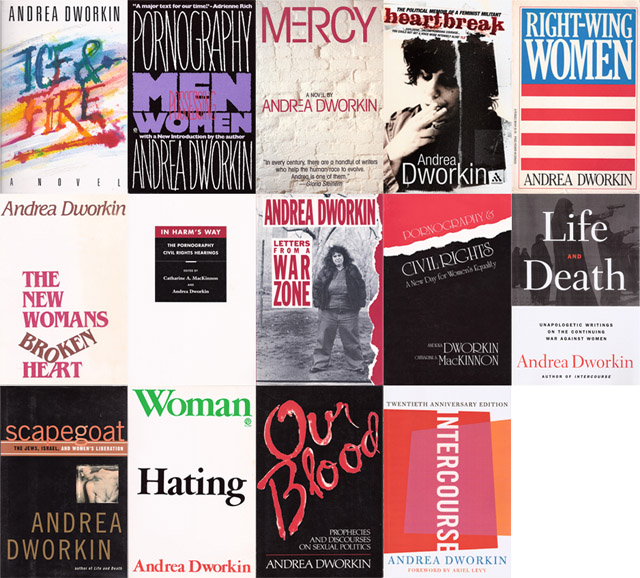
Thursday, April 9, 2015

Andrea Dworkin: Ten Years Gone (April 9, 2005 - 2015)

image of Andrea's book covers is from here

Ten years ago Nikki Craft got the news and delivered it to me, so sadly.

Andrea died.

There was shock. Disbelief. Questions. Grief.

It was not only hard to believe, it also raised a new fear about the future: losing such a pivotal feminist figure in the fight against sexual violence, giving voice to her and other women's past and present, she refused to call male supremacist violence anything other than that. Who would continue to name it and speak against it with such literary passion?

What has happened in the last ten years is the continued proliferation of pornography and other systems of sexual exploitation and abuse: pimping, brothel-keeping, and trafficking, for example. Hand-held devices mean people of many ages have visual access to raped children and adults, literally at one's fingertips.

Genocides continue against Indigenous people around the world.

There is more slavery than ever.

Corporate greed continues to destroy the Earth, increasingly swiftly.

The Global North and West continues to colonise, exploit, and pillage the Global South and East.

50 years after Bloody Sunday, white male supremacist atrocities against Black and Brown people is still endemic and normal in the U.S.; the only difference may be some level of recognition and disgust by fellow whites to the ritual harassment and mass murder of Black people by well-organized racist white police forces.

*                    *                    *

April 10th, 2005, Nikki and I got to work immediately--it helped with the grief--to create a website with a memorial page, where people could share their grief, memories, and how their lives were affected constructively by Andrea and her writing: http://www.andreadworkin.net/messages/

I got to know her writing starting in my early twenties, like many of my generation. I consumed her essays, books, wanting to read anything and everything she ever wrote. She shifted my perspective on so many issues or gave political meaning to experiences I hadn't understood.

She affected the trajectory of my activism.

I want to focus, today, on one effect, one not necessarily highlighted when people talk about her.

What I most learned from Andrea is the necessity of facing painful truths denied by the status quo. And challenging the status quo to stop reinforcing and fueling horror. Of course for that to happen, my society would have to radically change: all white and male supremacist institutions would have to be transformed; violent hierarchies dissolved; systemic exploitation, including from sex and work, deconstructed.

What I learned was to make a perspective into something flexible. never absolute; to always challenge myself to stay open to voices of people more marginalised, more silenced. And to use what I know to inform activism in all spheres of my life.
The purpose of theory is to clarify the world in which we live, how it works, why things happen as they do. The purpose of theory is understanding. Understanding is energizing. It energizes to action. When theory becomes an impediment to action, it is time to discard the theory and return naked, that is, without theory, to the world of reality. People become slaves to theory because people are used to meeting expectations they have not originated—to doing what they are told, to having everything mapped out, to having reality prepackaged. People can have an antiauthoritarian intention and yet function in a way totally consonant with the demands of authority. The deepest struggle is to root out of us and the institutions in which we participate the requirement that we slavishly conform. But an adherence to ideology, to any ideology, can give us the grand illusion of freedom when in fact we are being manipulated and used by those whom the theory serves. The struggle for freedom has to be a struggle toward integrity defined in every possible sphere of reality—sexual integrity, economic integrity, psychological integrity, integrity of expression, integrity of faith and loyalty and heart. Anything that shortcuts us away from viewing integrity as an essential goal or anything that diverts our attention from integrity as a revolutionary value serves only to reinforce the authoritarian values of the world in which we live.  —  Andrea Dworkin, Letters from a War Zone, U.S. edition, pages 127-128 [Quote added 1/8/2016]
What I have done in the last ten years is decenter whiteness from my political perspective and from how I comprehend and emotionally experience the world. What I have found is that any effort to do this is met with aggressive resistance just as any challenge to male supremacy is met with hostility.

What I have continued to examine is the relationship and degree of overlap between white and male supremacy. And to see intersectionality as having to do with multiple positions of marginalisation and powerlessness, beyond identity.

I believe the only way through the atrocities--to end them--is to center the lives and voices of people who virtually never make it into corporate media. To center the forms of resistance and social/economic/political transformation invisibilised people have been employing for decades and centuries. To not assume any expression of whiteness or maleness is universal, transcultural, or ahistorical, even while some forms of oppression have existed for millennia; whenever I have seen this done, it both recenters and redenies the ways whiteness permeates everything as male power permeates everything: differently, similarly, and in ways that shift and transmute.

To honor her, I will continue to listen, learn, remember, and do my work in collaboration with people who don't have the unearned privileges I too often take for granted.

To view the quote more easily, you may click here.


Friday, April 15, 2011

Interview with Writer born in Ghana, raised in the U.S. and now living in Ghana, Meri Nana-Ama Danquah

 From AfricaNews.com. Please click on the title to link back.

Ghana's literary icon: Nana-Ama Danquah

Kent Mensah, AfricaNews editor in Accra, Ghana 
Meri Nana-Ama Danquah is gifted with the prowess of playing with words which compels one to continue to read her works and even call for more. The native Ghanaian is versatile and her literary works exude professionalism. She authored the groundbreaking memoir, Willow Weep for Me: A Black Woman's Journey Through Depression.
Meri Nana-Ama Danquah
She also edited three anthologies: Becoming American: Personal Essays by First Generation Immigrant Women, Shaking the Tree: New Fiction and Memoir by Black Women, and most recently, The Black Body. Danquah's writing has been featured in several magazines and newspapers - The Washington Post, the Los Angeles Times, the Village Voice, Allure, Essence, Emerge and Los Angeles Magazine.

Africanews.com caught up with her in West African nation of Ghana to tell us all about herself and her profession:

Briefly tell us about yourself

Wow. Where to even begin? I was born in Ghana and raised mostly in the United States. I am now based primarily in Accra, Ghana. I'm a mother, an avid reader, an actress, an author, an editor, and a ghostwriter. Hopefully by 2012 I'll be able to add filmmaker to that list.

Obviously, you’re a woman with many hats. Which do you enjoy doing most?

That's like asking a parent to choose which one of their kids he or she loves the most. Each one of the things I do contains a spirit and a magic all its own and, as such, offers its own unique joy and satisfaction.

What motivates you to write?

The need to continue eating and paying bills. Just kidding. Well, maybe I'm being a little serious. I don't think most writers have the luxury, financially or creatively, of being motivated. By that I mean most professional writers, people who are publishing or trying to publish, cannot afford to write only when the "spirit" hits them or when they suddenly find themselves inspired. Completing a full length work requires discipline and hard work, not just inspiration and talent. Also, I think most writers have a backlog of projects. If I didn't have to worry about money for survival and I could devote every hour of every day to my writing, it would still take me more than one lifetime to get through all the ideas for stories, books, plays, and movies that I have floating around in my brain. And as if that's not bad enough, I get new ideas every week so the "to do" list keeps getting longer!

Any role models?

Ah, another "impossible" question. I started out as a poet. In that genre, I admire the work of Lucille Clifton, Audre Lorde, Sharon Olds, Mary Oliver, Kim Addonizio, Yusef Komunyakaa, LeRoi Jones, Kofi Awoonor, Kofi Anyidoho, and Reetika Vazirani. In fiction and nonfiction my tastes are quirky and inconsistent, I can talk more about individual books than individual writers. The Stone Boat by Andrew Solomon is brilliant, as is Drown by Junot Diaz. Edwidge Danticat's Create Dangerously: The Immigrant Artist at Work really spoke to the core of who I am in a way nothing has since, perhaps, Eavan Boland's Object Lessons: The Life of the Woman and the Poet in Our Time. Danzy Senna's Where Did You Sleep Last Night? taught me a lot about the importance of honesty in a writer's work and the price we must sometimes pay for it. Chimamanda Ngozi Adiche's Purple Hibiscus, Helon Habila's Waiting on an Angel, Aminatta Forna's The Devil That Danced on Water, and Sefi Atta's Everything Good Will Come are all breathtaking and they have taught me to not be afraid to write about Africa, in my way and on my terms. I'm anxiously awaiting the May 2011 publication of Catherine McKinley's book Indigo: In Search of the Color That Seduced the World. I've read the first few chapters and was blown away. It's an important and powerful book.

Take us through your leisure time.

People call me a workaholic but I don't see myself that way. I have been blessed with the ability to make my living doing what I most love, so shutting down the computer at 5pm and calling it a day is not as appealing an option for me as it is for some workaday folks. I will often spend my evenings and weekends reading or writing, not because I have to but because I want to. I want to finish that poem or that story and I can think of no place else I'd rather be than at my desk. I also enjoy spending time with my daughter. When she's home from university, she and I hang out a lot. We go to the movies, we travel, we go shopping, we eat out at restaurants or we just sit around and talk. She's got a great sense of humour so we do a lot of laughing together. I have a very small group of girlfriends in Accra, and in Los Angeles, and in Washington, D.C. and in New York. I spend a good deal of time in all of those places. Wherever I happen to be, I always make time to see my sister-friends, as I call them. If I'm dating or in a relationship with someone I will, of course, spend some of my leisure time with him as well.

Which subject(s) interest you most and what are your reasons?

I like to say that I know a little bit about everything in general and a whole lot about nothing in particular. Every subject fascinates me, especially if the person who is teaching or speaking with me is clearly passionate about it. That said, I'm more fascinated by some things than others. I often say that I'm not political but that's not entirely true. I'm extremely political, but not in the way that people use the word these days; I'm not political in the US's Republican/Democrat way or Ghana's NDC/NPP way. Party politics, in my opinion, can be narrow and destructive, with people getting so caught up in the game of one-upping the other side that they forget entirely that their purpose is to serve their constituents and citizens and to do what is in their best interest. I'm more interested in grassroots politics, in everyday people becoming active and realising that they are empowered to navigate their own future and the future of their land. To that end, I'm interested in issues of social justice, especially ones that concern themselves with ending violence against women, exploitation of children for labour, trafficking of human body parts, eradicating poverty and bridging the gap between the haves and the have-nots. I try to do my part to raise awareness about these issues. My reasons? I'll answer that by quoting the English statesman, Edmond Burke, who said, "All that is necessary for the triumph of evil is that good men do nothing."

Among all your writings/books which is your favourite and any particular reason for that?

Once again, it's like asking a parent to choose their favourite child. I'm sure that even if the parent could offer up the name of one child, the answer would change the next day to the name of one of his or her other children. I am proud of all the work that I've done. There are times when I'm more drawn to one than the others but that changes so quickly and often that it's impossible to label any of them a favourite.

Meri Nana-Ama Danquah Photocredit: Korama_A_Danquah
Photo credit: Korama A Danquah

Are writers born or created? Explain.

You're asking me? How would I know? I can only speak for and of myself...and in that case the answer is, "Both." I believe I was born with my love of language, but it was nurtured by all of my mentors, many of whom are people I've never met, authors of books that changed my life and that drew me deeper into this desire to put pen to paper. I also studied. I took independent workshops, I went to formal school programmes.

Who is your audience?

My audience is whoever picks up my work and reads it. The whole point of reading is to be introduced to a world of the author's creation, to see the world from his or her point of view. I would venture to say that it is every writer's wish to have an audience that is beyond his or her wildest imagination, comprised of people who may seemingly be the most unlikely to be drawn to the author's work.

On the average, how long does it take you to complete a book?

When I'm ghostwriting, I can complete a client's book in as little as a few months. The downside, though, is that it means my own work has to be placed on the back burner. Because of this, it has taken me over ten years to complete a book of prose. I'll be spending the months of May and June at a writer's colony in the US to finish that manuscript.

Whose memoir are you hoping to pen one day?

As a writer of literary nonfiction/memoir, I have no desire to pen anyone's memoirs except my own.

How would you describe your style of writing?

I'm the wrong person to ask that question. My job is to write. I'll leave the reviewing, critiquing and describing to those whose job it is to do such things.

When should we expect your next major book?

My next book should be out by 2012, insha'Allah [God willing].

Saturday, February 5, 2011

Pariah: A Film About A Black Lesbian Young Woman Finding Herself in White Het Male Supremacy, Written and Directed by Dee Rees. Produced by her spouse in life and partner in work, Nekisa Cooper

photograph of couple Dee Rees and Nekisa Cooper, filmmakers of "Pariah" is from here

Telling a story is difficult when you struggle to know the story you're telling--because you are living it; because the story isn't done. But any partly autobiographical story will necessarily be a work in process. So it is for partners in life and work, Dee Rees and Nekisa Cooper, writer/director and producer, respectively, of a film getting a lot of attention at Sundance called Pariah. This is a deeply personal story, which means it is also profoundly political.

In a Western world where, far too often, human = white and male, queer = white and male, lesbian = white, and woman = white, it is difficult for me, a white gay male, to fully appreciate the struggles for visibility and validation faced by those of us in the queer community without white and male privileges. Why it is that white queer people think telling stories primarily about whites and men is representative of "us" is beyond me. Most queer people aren't white, after all; most queer people are not male either; and most queer people do not have the kind of economic privileges, social status, and professional clout with which to get films made. So movies from Making Love, to Birdcage, to Brokeback Mountain, to TransAmerica, to The Kids Are All Right do not tell "our" story so much as they tell a small part of our story made to seem complete.

I recommend checking out these films about queer people of color and/or LGBTIQA people who do not live in Anglo-white societies: Black Womyn: Conversations with Lesbians of African Descent; Johnny Greyeyes, The Watermelon Woman, A Litany for Survival: The Life and Work of Audre Lorde, Fire, The Blossoming of Maximo Oliveros, and XXY. I welcome the readers from all over the world alerting me to other films depicting the lives of queer and Two-Spirit people of color, and queer people living in the Pacific Islands, South and Central America, sub-Saharan Africa, Northern Africa and The Middle East, Central Asia, South Asia, Southeast Asia, East Asia, and Black, Brown, Asian, and Indigenous people globally.

White gay activists like Dan Savage state that, increasingly, our people's stories are told in dominant media--on television and in films. But these voices, such as those in Will and Grace and Modern Family, lack authenticity and depth when they are only white or only male (or both). They aren't "us", in other words; they are "the voices of the most privileged" which means the most complex struggles, told as stories in whatever televised or cinematic form, are not familiar to most of us.

As anyone knows who remembers the first lesbian or gay person you saw on television or in film, seeing ourselves reflected back to us in affirming and three-dimensional ways is critically important to our self-esteem and sense of self-worth. This is particularly true for queer youth, who generally and usually do not have any validation or support within families of origin.

I didn't come out to my family of origin until after I was out to myself and my friends. It's the friends that so often help us prepare to tell those family members, who can be liberally accepting or conservatively rejecting. This is one theme in the movie discussed below.

Here is an in-depth article and interview with the filmmakers of Pariah from three and a half years ago when the film only existed as a feature length screenplay and a short film. I have added several links to the article when writers and spiritual-political-creative movements are mentioned, in case any readers here aren't familiar with them. What follows is from Afterellen.com and may be linked back to by clicking on the title just below.


Giving Voice to a "Pariah"

reescooper.jpgpariahclip.jpg

Dee Rees never thought she would become a filmmaker. "My journey into film has been pretty roundabout," she told AfterEllen.com. The Tennessee native started out in the business world, where she met her girlfriend, Nekisa Cooper. The two recently collaborated on the award-winning short film Pariah (Rees wrote and directed; Cooper produced), a coming-of-age story about an African-American lesbian teen who struggles with her sexual orientation in the face of a conservative family.
 
"Going into undergrad, I knew that I loved writing," explained Rees, "but was afraid to major in English or journalism because it didn't seem 'practical.'"

Thankfully, Rees didn't stay long in a field she was unhappy in, but her stint in business did beget the essential partnership behind Pariah's creation. "I met Dee while working at Colgate," Nekisa Cooper recalled in an interview with AfterEllen.com.
 
"We had taken similar paths to get there — we both went to business school and graduated thinking we would take the marketing world by storm," she continued. "Dee was a breath of fresh air for me, and we became fast friends." The pair began dating while Rees looked for graduate programs in which she could follow her true passion.

Her creative drive was originally centered on writing, but film also had a certain appeal. "As I started learning about screenwriting and film programs," Rees said, "I was completely sold on the idea of being able to literally bring my characters to life." She enrolled in film school at New York University, throwing herself into her new craft, and soon called upon Cooper's organizational skills to help produce her films.
 
"I should've gotten an associate's degree from NYU," Cooper said with a laugh, "because I spent so much time going to classes with Dee and meeting the people in that world!"
 
Pariah was a labor of love for both women, who have been blown away by its runaway success on the film festival circuit. The film is the story of Alike (Adepero Oduye), a 17-year-old African-American girl who struggles to find herself and her sexual identity in between two unforgiving worlds. She dons one set of clothes around her gay friends and another around her family, hiding who she is from her judgmental parents.
 
Even the title evokes the outcast, the unwanted — and an emotional chord has been struck within many communities. The film has received high praise and awards from circles as diverse as the Los Angeles Film Festival, Urbanworld and the biggest LGBT film festivals, including Frameline, Outfest, NewFest and the Philadelphia International Gay and Lesbian Film Festival. "It is has been more than we ever could have hoped for," said Cooper.
 

Rees wrote and directed the film as her graduate thesis, with the intention of creating something that could open the doors of communication between families and communities.
 

"I think awareness is the first step in creating change and to opening discussion," she said. "And the film has definitely done that. We were really excited that the film was well-received at Urbanworld [a film festival that focuses on the black community], because it means that people are starting to listen and be open, which was exactly what we were going for."


As a film that encourages discussion, Pariah hits on quite a few heavy topics within its brief running time. Rees sees the film as a parable that everyone can relate to, but it examines the struggles of queer black youth most closely.
 
"Pariah is about identity," Rees explained. "I think that identity is something that everyone has struggled with in some way and at some point in their lives, so I think it's a very universal struggle and experience that all audiences can relate to. At the same time, I did want to bring to light the experiences of gay youth of color because it's a story that hasn't been fully told and needs to be seen and heard."

The project was a tough sell from a production standpoint, hampered by the usual hurdles of making a successful short film: access to good actors, equipment, locations and support that can ruin even the most masterfully written script. "The production experience was extremely intense; it was really hard, dirty work," Rees said. "It was definitely a labor of love, but the actors were amazing. My DP [director of photography], Brad Young, was a genius."
 
She continued: "Nekisa did all the heavy lifting and was a miracle worker in making everything happen and cultivating relationships. [She is] a really supportive and amazing girlfriend and producer, and I feel really lucky to be with her."
The film is a highly personal project for both women. Rees originally wrote Pariah as a feature length, semi-autobiographical piece and based a great deal of Alike's experiences on her own. "Pariah is definitely very personal for me," Rees said.
 
She explained: "When I was growing up, I felt like I was never really comfortable being myself. I've only recently come into and accepted my sexual identity, and when I first moved to New York, it blew my mind that there were these out and proud teenage women who not only knew who they were, but weren't afraid to be themselves. I didn't even know who I was in that sense as a teenager, and I asked myself whether even if I did know back then, would I have had the courage to be who I was? The answer was no."
 
Cooper had a similar connection. "Alike's struggle was and is definitely my struggle, and the struggle of many lesbians," she said. "I wore many masks for a long time — I was one way with my family, one way with my straight white friends, and another way with my straight black friends. It took me a long time to become comfortable with me — with my spirit and all of the good and bad that encompassed it."
 

In fact, some of Alike's experiences are still all too familiar to the filmmakers. In terms of dealing with a lack of acceptance within her own family, Rees said, "[It's] something I'm struggling with now, and something that's going to be a long-term fight for me."
 
Cooper agreed. "Yeah, it's funny, but not funny — our parents haven't seen the film yet, so that kind of will tell you. My family was more accepting, but it's still going to take some time. I'm going to have to sit down with them and sort of preface the film before we watch it together."
 
Cooper grew up as a military brat, constantly moving from town to town. She credits her father's military influence as one of the biggest factors in shaping her savvy business sense and ability to manage a crisis — talents that came in handy during Pariah's production.
 
Rees grew up in rural Tennessee, reading Alice Walker, Maya Angelou, Gloria Naylor, Nikki Giovanni, Zora Neale Hurston and "pretty much any of the writers that were part of the womanist movement and the Harlem renaissance."
 
Living and working together in a creative medium hasn't always been easy, but Cooper and Rees have found a balance that works for them. "I think both of us, coming out of the business world, out of corporate America, we pretty much have a good sense of trying to set boundaries," said Cooper. "I mean, not that it isn't a struggle sometimes — especially when we were in preproduction and shooting — it was kind of difficult to take time just for us and the relationship."
 
That's all changed now that Cooper has left the corporate world for good, and they have both made the jump to the West Coast to pursue their future projects together. "I finally said, 'When are we going to have an opportunity for me to sort of jump?'" Cooper recalled. "So this is it: I'm here — hopefully for the long haul."
Pariah was originally intended to be a feature film, and in fact, the full-length script was written even before the short was made. Rees and Cooper are currently working on making the feature-length Pariah a reality, with Rees finishing up rewrites on the screenplay and Cooper gearing up for the Independent Feature Project market in September.
 
"Nekisa is banging out the final board and budget," Rees said, "and we plan to be done in time for the IFP market this September so that we'll have a complete package and hopefully attract some funders. We've had a lot of industry interest so far and look forward to moving forward soon." She added, "We'd love to shoot this next spring or summer."
 
Additionally, they are currently working on finishing up their feature documentary Eventual Salvation, based on the experiences of Rees' grandmother. "My grandmother is a Louisiana native and was born during the Depression," Rees explained. "She got fed up with all the racism and Jim Crowism here in the United States and decided to move her family to Monrovia, Liberia, in the 1950s.
 
"She lived there for almost 40 years, and remained through much of the civil war until her name turned up on a death list and she was forced to return to the States. In the winter of 2005, with the war finally over and the election of Africa's first female president, Madam Ellen Johnson-Sirleaf, she returned to Liberia to rebuild her home and her community, and Eventual Salvation is the story of that journey."
 
Cooper added: "It is the Africa you haven't seen in the media — images of hope instead of images of despair. Dee, Bradford Young and I are extremely excited to bring these images to the world."
 

Right now, the filmmakers are raising funds to complete the film. "We've been working over the last couple of years to get funding to finish it, basically," Cooper said. "In terms of timing, we're looking to finish it by the end of third quarter this year, and looking to hopefully get it into the festival circuit starting in January."
 
What with getting a feature-length Pariah off the ground and finishing up a multi-year shoot with Eventual Salvation, the filmmakers have their plates full at the moment. But Pariah's success hasn't left them blind to the whims of the business.
 
"This industry is just so fickle," said Cooper ruefully. "You can be hot one day and not the next. But from our perspective, we don't really try to focus on that. We try to focus on telling these stories in the best way that we can." 
*          *           *
PLEASE CONSIDER SUPPORTING THIS FILM MONETARILY, IF YOU ARE FINANCIALLY ABLE TO DO SO. 
The place to do that is HERE: http://www.kickstarter.com/projects/619452369/pariah-the-movie?ref=recently_launched

image of poster for the film, Pariah, is from here

Friday, January 7, 2011

Introducing Lenelle Moïse who is a Haitian-born, U.S.-raised Madivinez Poet (anglo translation: lesbian)

"Pray" © 2010 by Lenelle Moïse


This post comes to you a few days before the one-year anniversary of the atrocity, not the natural disaster, that was the earthquake (and its aftermath, on-going through today) 25km west of Port-au-Prince, Haiti. We must remember the conditions that made this earthquake so lethal to humans was entirely man-made--White Man-made, in fact. I want to introduce my blog's readers to this person, if you don't already know about her and her many contributions to the creative/performance arts and to LGBTSTIA community (the letters I'm now using: lesbian, gay, bisexual, Two-Spirit, transgender, transsexual, intersex, intergender, asexual, gay).


All that follows, including the video above, is from gsfla. (The video is also on YouTube.) Please click on the title below to link back to the source website.


Q&A with Haitian-born lesbian poet Lenelle Moïse, who'll hold workshops with Miami LGBTQ youth


Haitian-born lesbian poet Lenelle Moïse will be in Miami next week for a series of youth workshops sponsored by Tigertail Productions, part of its continuing SpeakOut project for LGBTQ (Lesbian, Gay, Bisexual, Transgendered and Questioning) youth.


Here's a Q&A I did this week with Moïse:
1. Where were you born and raised? I was born in Port-au-Prince, Haiti and raised in Cambridge, Massachusetts.
2. Have you always identified as a lesbian? I’ve always identified as a poet―as someone who engages words to communicate impulses, ideas and affinities. “Lesbian” communicates my impulse to love women, the idea that my love is legitimate, and my affinity with Adrienne Rich, Pat Parker, Audre Lorde and the many lesbian poets who came before and breathe beside me. I’ve reclaimed and prefer the Haitian-Kreyol word “madivinez” because it comes from where I come from and because the word “divine” sits, undeniably, at its core. 
3. Did this create personal conflict or conflict with your family and friends? If so, how did you and they deal with it? The last time I visited my grandparents, they had my junior prom picture on prominent display in their bedroom! In it, I’m wearing a white dress and my date is a nice, upper middle-class boy. That image was the highest aspiration someone else had for my life. During my twenties, I often felt that I was being prayed against and ignored. But, recently, after years of performing my autobiographical solo show "Womb-Words, Thirsting," my parents and siblings finally came to see it. They laughed, cried and applauded. My father told me he was proud of me. My mother lead a standing ovation. We struggle but there’s hope. In the meantime, I surround myself with supportive friends and allies. 
4. What advice do you give to young people – particularly young Haitian Americans – who are coming out? We have to love ourselves enough to get free. As far as I’m concerned, stubborn self-love is a cultural legacy. Back in 1804, our Haitian ancestors defeated their French slave captors. It was the only successful slave revolt ever recorded in history. I owe it to my ancestors to break free from oppression or bigotry in any form. I wrote an essay with more advice called “Letter to a Haitian Daughter.” 
5. When did you first become interested in poetry? I was five years old. My uncle was a poet―clever, rhyming and riveting. He performed during church services. He was the first person to ask me to write and recite a poem. I haven’t stopped since. 
6. At what point did you realize that you could become a professional performer? Did your family encourage or discourage you? I’m so grateful for my arts education! I went through wonderful theatre departments in high school, Ithaca College and Smith College. My instructors have always been active theatre professionals. They never spared me a challenge. Their example encouraged me to spread my wings, full time. 
7. What advice do you have for young people who want to become professional performers? Study. See as many live performances as you possibly can. Read and reread performance texts. Risk open mic nights. Find mentors and colleagues. Take workshops. Rehearse independently and often. Invest your years and your tears. 
8. What are the professional highs and lows you’ve experienced? I’ve performed Off-Broadway, at the United Nations and at theatres and colleges across the USA. But what I chase is the elated exhale I experience after I solve the puzzle of a new song or play or poem. That “eureka” moment is what keeps me writing in the face of racism, sexism and heteronormativity. That eureka moment rocks.
Here's a news release with all details about Moise's visit:

Featuring Tigertail SpeakOut Workshops & Slam for Gay Youth

(MIAMI, FL – December 8, 2010) Tigertail Productions continues its SpeakOut project for LGBTQ (Lesbian, Gay, Bisexual, Transgendered and Questioning) teens with a weeklong residency with nationally recognized, Northampton, MA Poet Laureate, writer and spoken word artist Lenelle Moïse. School and community workshops, a panel discussion, a poetry slam for LGBTQ youth, and a reading for a general audience, take place. All events are free. For more information and a full schedule visit www.tigertail.org or call Tigertail at 305 324 4337. 
Haitian-American powerhouse Lenelle Moïse is an award-winning poet, playwright, essayist, composer and nationally touring performance artist. She creates intimate, fiery, politicized, texts about the intersection of race, class, gender, sexuality, spirituality, culture and resistance. Her hip-hop bred, jazz-infused delivery is at once conversational and polished. Fueled by the motto “Words rouse worlds,” she regularly presents interactive performances and workshops that empower diverse groups of people to creatively speak up and act for social change. Equipped with an MFA from Smith College, Moïse has been a guest artist at the United Nations, the Culture Project, the Louisiana Superdome, the Omega Institute and dozens of theatres, colleges and conferences across the United States and Canada. Her critically acclaimed Off-Broadway play Expatriate inspired her upcoming second CD The Expatriate Amplification Project. 
During her residency, Lenelle Moïse will lead workshops for students at Miami-Dade public high schools, hosted by individual Gay Straight Alliances/ Safe Schools South Florida and other groups. The public high schools involved include North Miami Senior, Dr. Michael M. Krop and North Miami Beach Senior. Other workshops will take place at the Miami Arts Charter school and Pridelines. SpeakOut workshops train LGBTQ youth in writing and speaking skills within a medium that blends poetry, theater and hip hop culture and also provides opportunities for LGBTQ teens to perform their work.  
The youth component of the residency culminates in a SpeakOut Open Mic and Slam for GLBT teens, hosted by Lenelle Moïse at the Miami Beach Regional Library, 227 22nd Street, Miami Beach, on Thursday, January 13. This is an opportunity for teens to read and perform their poetry. There is no charge to attend but each participant must be under 21-years old and material must be gay friendly. No reservations are needed. Those interested in the Open Mic and Slam register at the event between 5:00 and 5:30pm at the Miami Beach Regional Library. For more information on all youth events visit Tigertail on the web atwww.tigertail.org or call 305 324 4337. 
Finally, Lenelle will read and perform her writings and poetry on Friday, January 14 at 8:00 pm, at Books & Books, 265 Aragon Avenue, Coral Gables. This event is free and open to the general public. 
“Lenelle Moïse is an informed, versatile, and articulate voice that needs to be heard by South Florida audiences, both in the schools and in the community,” said Mary Luft, Tigertail Executive Director.  “Our Tigertail SpeakOut project, which has presented such artists as Emanuel Xavier, Scott Turner Schofield, Regie Cabico and Staceyann Chin, continues this season to bring quality LGBTQ programming to Miami.”  
SpeakOut grows out of Tigertail Productions’ existing and highly successful Tigertail WordSpeak teen spoken word project, which brings poets and performers to Miami each year to lead workshops for teens. Tigertail also sponsors and coaches a WordSpeak team of Miami teens who attend the national Brave New Voices spoken word youth slam and festival in the summer. Tigertail produces a book and a CD of the teen poems. Gay teens from the SpeakOut project have the opportunity to participate in the main WordSpeak program adding their unique voices to Miami’s youth culture.  
Tigertail Productions, founded in Miami in 1979, is Florida's pioneer of innovative cultural work, and produces a full season of contemporary performance, along with projects in the literary and visual arts. Tigertail’s 2010-2011 events began October 14 with a book launch of Tigertail, A South Florida Poetry Annual: Selected Collective, then continued November 13, 2010, 8:30pm with a concert by the Benjamin Herman Quartet at the Byron Carlyle on Miami Beach. December 28 is a book launch of the teen spoken word book WordSpeak, January 28 & 29, 2011, Jess Curtis/Gravity Dance, a mixed-ability group from Berlin and San Francisco performs at Inkub8, as part of danceAble and FDA WinterFest, February 11 & 12 at the Colony Theatre the illustrious Japanese dance duo, Eiko & Koma perform, March 11, again at the Colony Theatre, the legendary blues artist Henry Gray & The Cats, April 16 the virtuoso guitarist Bill Frisell performs music from his latest CD at the Colony; and spoken word and literary arts events take place throughout the year, including, Sunni Patterson with WordSpeak the end of March/April and the Tigertail fundraiser, May 14. For more information about Tigertail and full season details visit them on the web at www.tigertail.org or call 305 324 4337. 
The SpeakOut program and Lenelle Moïse residency is made possible in part by a grant from the GLBT Community Projects Fund at Dade Community Foundation, Greater Miami’s permanent endowment made possible by generous donors since 1967, ES Moore Family Foundation, Miami Dade Public Library, Miami Dade Public Schools, Miami River Inn, Books & Books, Safe Schools of South Florida. Tigertail is a NPN Partner of the National Performance Network (NPNN). This project is made possible in part by support form the NPN Performance Residency Program. Major contributors to the National Performance Network include the Doris Duke Charitable Foundation, Ford Foundation, the National Endowment for the Arts (a federal agency), the MetLife Foundation and the Nathan Cummings Foundation. For more information visit www.npnweb.org. 
Tigertail's 2010/2011 Season is made possible by community partners and supporters including the Albion Hotel; Arthur F. and Alice E. Adams Charitable Foundation; Barefoot Wine & Bubbly; Albion Hotel; Biscayne Times; Books & Books; Bresaro Suites at the Mantell Plaza; Cafeina; The Children's Trust; City of Coral Gables Cultural Arts Program; City of Miami Beach Cultural Affairs Program, Cultural Arts Council; Consulate General of the Netherlands; Dade Community Foundation; E.S. Moore Family Foundation; Florida Dance Association; Florida Department of State, Division of Cultural Affairs and the Florida Arts Council; Florida Literary Center; Galeria del Sol; The Galler Group; Greater Miami Convention and Visitors Bureau; MiamiArtzine.com; Miami Salon Group; Miami-Dade County Department of Cultural Affairs and the Mayor and Board of County Commissioners; Miami-Dade County Public Library; Miami-Dade County Public Schools; Miami River Inn; National Dance Project of the New England Foundation for the Arts, with lead funding from the Doris Duke Charitable Foundation, additional funding provided by The Andrew W. Mellon Foundation, The Ford Foundation and MetLife Foundation; National Endowment for the Arts; National Performance Network with major funding from the Doris Duke Charitable Foundation, Ford Foundation, the National Endowment for the Arts (a federal agency), Altria, MetLife Foundation and the Nathan Cummings Foundation; The New Hotel; Pridelines; Publix Super Markets Charities; Rain Organics; Safe Schools South Florida; Rain Vodka Organics; The Law Office of Linda M. Smith; South Arts; Vortex Communications; WDNA & WLRN FM and many individual supporters.

Lenelle Moïse SpeakOut Schedule in Miami

Monday, January 10
9:15-10:15am,
 Performance and Workshop with GLBT support groups at North Miami Beach Senior High School
Tuesday, January 11
2:30-3:30pm, 
Workshop with GLBT support groups at North Miami Senior
7:00-8:30pm,Panel Discussion, Little Haiti Cultural Center,212 NE 59th Terrace, Miami, Gender, Race, and Class: Art and Social Activism, with Rosie Gordon-Wallace, Octavio Campos, Edouard Duval Carrié and Lenelle Moïse.
Wednesday, January 12
2:30-3:30pm, 
Performance and Workshop with GLBT support groups at Dr. Michael Krop Senior High School
6:00-8:00pm Workshop for LGBTQ teens from Pridelines Youth Services.
Thursday, January 13
5:30 pm,
 SpeakOut Open Mic and Slam for GLBT youth hosted by Regie Cabico at the Miami Beach Regional Library, 227 22nd Street, Miami Beach. Each participant (21 and under please) gets a chance to arouse, provoke and inspire with spoken word poetry! Material needs to be gay friendly. Free and open to all teens with no reservations needed. Sign up at the event.
Friday, January 14
8:00 pm, Reading and performance at Books & Books, 265 Aragon Avenue, Coral Gables. Free and open to all. 
For more information contact Tigertail at 305 324 4337 or visit their website at www.tigertail.org. There is no charge for SpeakOut programs.
Tigertail Productions   842 NW Ninth Court   Miami, Florida 33136   305 324 4337   www.tigertail.org

Read more: http://miamiherald.typepad.com/gaysouthflorida/2011/01/qa-with-haitian-born-lesbian-poet-lenelle-mose-wholl-hold-workshops-with-miami-lgbtq-youth.html#ixzz1ANPLqghr

Sunday, November 28, 2010

Some Essential Reading: Works by Audre Lorde

image of book cover of The Cancer Journals is from here

I found this on About.com and thought I'd post it here for y'all. (Click on the title to link back.) I have to say that The Cancer Journals is rarely mentioned as essential feminist reading, but, for me, it surely is. Along with her poems and essays and speeches, The Cancer Journals offers critical understanding of the experience of battling life-threatening illness and Audre uniquely notes how race, sexuality, gender, and other dimensions of political being are forged and enforced by CRAP to try and ensure no Black women survive. 
 
Her discussions of surgery and prosthetic devices were and are tremendously important to me, and her courage to speak out about these issues, at a time when no one was, is astounding. And, sadly, we live in a time when no one is speaking out about this matter of wearing prosthetic breast-forms, which are never, ever women's breasts: the presence of implants, reconstructed breasts, and inserts into the bra do not "make someone a woman". She also notes the chilling realities of how environmental terrorism, along with white and male supremacy, is part of women's lives. Chemicals manufactured to make us sick are not part of a sustainable society. 
 
I honor Audre Lorde's courage to time and again face her own vulnerabilities which were never only her own, and were also very much her own.

Essential Feminist Books By Audre Lorde

The Warrior Poet Also Wrote Warrior Prose

By , About.com Contributing Writer
Audre Lorde was a poet who contributed greatly to feminist theory. She called herself a "Black lesbian feminist warrior poet." As a feminist poet, a lesbian mother, an artist, and a child of West Indian immigrants, she rejected descriptions that limited her or other women to only one category. Books by Audre Lorde include not just feminist poetry, but also memoir, essay and personal mythology.

Audre Lorde's writings offer stories of life experience and her vision of black feminist consciousness. The "warrior poet," as she described herself, offered both warrior poetry and warrior prose.A Few Essential Audre Lorde Books
  • Cables to Rage (1970)
    Audre Lorde's second published volume of poetry was Cables to Rage. The poems in Cables to Rage explore themes of love, relationships, childbirth and raising children. The poem "Martha," which appears in Cables to Rage, is often called Audre Lorde's first overtly lesbian poem.
  • From a Land Where Other People Live (1973)
    Audre Lorde's third volume of poetry, From a Land Where Other People Live, explores the complexities of identity while also developing the theme of injustice. During the 1960s and 1970s, in both poetry and life, Audre Lorde fought against using one-word labels to dismiss or marginalize those who are labeled. From a Land Where Other People Live was nominated for a National Book Award.
  • Coal (1976)
    Coal reached a larger audience and continued Audre Lorde's exploration of multiple layers of identity. The poem "Coal" begins "I/is the total black, being spoken/from the earth's inside." The substance of coal is a metaphor for her own essence, a blackness from inside of the earth that provides essential fuel and becomes a diamond.y
  • The Cancer Journals (1980)
    The Cancer Journals
    chronicles Audre Lorde's experience with breast cancer. The book is a collection of her writings, part essay and part memoir. Audre Lorde began writing journal entries six months after her mastectomy. She asks in The Cancer Journals where she can find a model or guide to help her understand how to deal with cancer. She also questions Western medicine and asserts that women should control their own health and healing.
  • Zami A New Spelling of My Name (1982)
    Zami: A New Spelling of My Name is Audre Lorde's "biomythography." She weaves poetry, stories and real-life recollections of her coming of age in New York City. She also recalls early experiences with poetry and the political women's scene. The book meanders through school, work, love and family with equally vivid memories of childhood classrooms, a factory job or the 1950s lesbian bars in New York.>
  • Sister Outsider (1984)
    Sister Outsider is another collection of Audre Lorde's writings, essays and speeches. Feminism, racism, emotion, sexism within the black community, racism within the feminist community - all of these ideas and more were examined in Audre Lorde's life and writing. In Sister Outsider, she continues to grapple with erotic power, personal power and wholeness. Significant essays in Sister Outsider include:
    • "The Uses of the Erotic: The Erotic as Power"
    • "Scratching the Surface: Some Notes on Barriers to Women and Loving"
    • "The Uses of Anger: Women Responding to Racism"
    • "An Open Letter to Mary Daly," written in 1979

Wednesday, November 17, 2010

Tyler Perry's Gender Problem: Enuf is Enuf. Two articles by Courtney Young

image of Ntozake Shange play poster and photo of Tyler Perry is from here

From The Nation. Please click on each title to link back.

For Colored Girls, Is Tyler Perry's Film Enuf?


Courtney Young
November 12, 2010

What is the price paid when a director widely considered to be anti-feminist interprets a beloved black feminist text for film? Can a piece as endearing as Ntozake Shange's 1975 classic choreopoem For Colored Girls Who Have Considered Suicide When the Rainbow is Not Enuf reach its full cinematic potential outside the hands of a black female director? When movie mogul Tyler Perry first announced he would be reviving the celebrated text for the screen, many fans of the original production reacted with dismay, worry, even anger. A deft combination of poetry, music and movement, the choreopoem gives life to the voices of seven unnamed women distinguished on stage only by a singular color of dress. The piece allows each woman to relay her story frankly, at times through a collective narration, airing a host of issues that affect black women's lives—rape, abortion, domestic abuse and child murder, but also love, sex, and friendship. Would the complexity of black women's lives and voices survive in Perry's hands?

Before the film even hit theatres on November 5, reviews were running the gamut. At The Hollywood Reporter, Kirk Honeycutt eviscerated the film as "too crude and stagy for Shange's transformative evocation of black female life." New York magazine's David Edelstein excoriated Perry's translation, concluding, "He has taken Shange's landmark poem cycle…cut it up, and sewn its bloody entrails into a tawdry, masochistic soap opera that exponentially ups the Precious ante." But not all reviewers found the film to be an unmitigated disaster. Mark Anthony Neal, a professor at Duke University, writing for The Loop, asserts that, "The film's commercial success marks one of the visible moments for mainstream Black Feminism, within a national culture that has been largely ignorant of Black feminist writing and art."

The $20.1 million raked in over opening weekend undoubtedly makes Perry's first R-rated film a financial success. But its initial popularity in no way mitigates Perry's ultimate transgression, committed by so many when adapting classic works: failing to present the characters as they are, rather than as he wants them to be. Perry's refusal to stretch the boundaries of black female expression, which is key to Shange's text, beyond the scope of his own familiarity indicts his direction.

A number of recurring themes inform or, at times, dictate the actions of Perry's female protagonists across his films, with religious messaging being one of them. His choice to center For Colored Girls on this theme is no exception. But Perry fails to fully comprehend Shange's complex portrayal of the ways that black women find God. Shange articulates a spirituality that is fluid and introspective, even divinely feminine. Religion is never centrally cast in the text; spirituality is rather understood as a vehicle through which black women communicate with each other and with themselves. Arguably, the most widely quoted moment in For Colored Girls is when the "lady in red," one of the most memorable characters of the production, asserts, "I found god in myself & i loved her/ i loved her fiercely."

Perry understands religion to be much more domineering. Whoopi Goldberg's character Alice (created solely by Perry and not found in the original text) is a religious fanatic, who literally hoards one daughter and divorces herself from the other with dogma. Conservative religious (as well as homophobic) agendas abound in a reading of Janet Jackson's character, Jo, who discovers her husband secretly has sex with men and has infected her with HIV. When Jo confronts her husband, he retorts that his actions are in part a reaction to her refusal to submit to him, and dim her professional ambitions.

In Shange's choreopoem, the stage is for women and women only. She trusts the power of women vocalizing their own experiences, particularly as they relate to violence. Shange wrote of her need to create For Colored Girls: "I felt the urgency of the moment to tell the long-untold stories of women." But the rape and abuse narratives in Perry's film prioritize men's experiences. One of the most upsetting scenes of Perry's film occurs when Anika Noni Rose's character Yasmine, a dancer and carefree spirit, is brutally date-raped. The scene is cut with images of Jackson's Jo watching an operatic performance of La Donna In Viola ("the lady in purple"—an allusion to one of the characters in the original choreopoem). During the performance, Jo's husband, Carl, covertly exchanges looks of desire with another male patron. The interplay between Yasmine's rape and Carl's flirtation foregrounds male perpetrations of violence and desire in a text that was deliberate in privileging black women's uncompromising expressions of both desire and violence.

Perry also inserts often brutal male characters during crucial moments in female characters' expression of angst or pain in a way that is heavy-handed and antithetical to the original text. Men drive the action and the confessionals in the film, particularly in the case of Crystal, played by Kimberly Elise, a woman battered by the father of her children, Beau Willie. In one of his rages, Beau Willie drops the children from their apartment window, killing them. This scene is taken from one of the confessionals of the choreopoem's lady in red. The lady in red is a powerful author of this tale in the play, moving, acting and reacting to the depth of such pain, but in the film version, Crystal becomes a passive receptacle of Beau Willie's rage, and all of her actions are in response to his. The play intends to let women own trauma confessionals, but Perry's male gaze is written all over these stories.

The brightest light of Perry's production is the remarkable performances; Anika Noni Rose and Loretta Devine in particular have magical moments. As the film ends, the women stand in line, holding each other, wrapped in the weight of their own traumas, a powerful reminder of the number of beautiful, talented black actresses that have yet to find steady employment in Hollywood and independent film, theater and television. Seeing all of these actresses together reminded me that Hollywood is neglecting a powerful resource—black women.

But seeing extraordinary black actresses together is not enough. Perry's most significant failure is understanding that while black women writers like Shange write about the traumas and hate that black women must constantly negotiate, they also speak to joy, solidarity, and the beauty of blackness. Shange published For Colored Girls during a time when some of the best of black feminist literature, written by luminaries such as Toni Morrison, Toni Cade Bambara, Sonia Sanchez and Alice Walker, was being published; these authors, too, were able to express desire and violence simultaneously. Each time I read Shange's text or see it performed publically, I've always walked away triumphant, in awe. After seeing Perry's film, I walked away feeling nothing but sadness.

To hear Perry tell it, black women are forever in flux amidst hate. But Shange's For Colored Girls grapples with much more than the weight of trauma, injustice and abuse inflicted upon the black female body, the black female spirit. It also revels in the joys of being a black woman—the delights of sisterhood, the majesty of black beauty and the ecstasy of love reciprocated and good sex. Perry's filmmaking doesn't rise to meet the challenge. Some literary and theatrical works are so deeply moving that they belong not only to the author, but to the readers who love the work. For Colored Girls also belongs to black women.


Tyler Perry's Gender Problem


Tyler Perry has rapidly become the most bankable African-American moviemaking brand in Hollywood and an entrepreneurial heavyweight. The seven feature films he has conceived and produced have earned more than $300 million at the box office, with an average opening-weekend gross of $25 million--no small feat for films with predominately black casts. He credits his creative inspiration for these films, in part, to African-American women. So far, so good--that is, until you see the films.

Perry's films typically follow the same timeworn narrative: a woman experiences abandonment and/or abuse at the hands of a "bad" man; she takes umbrage, lashing out at those closest to her, most notably a "good" man in her life; she experiences a revelatory moment of change; and she ends the film settled down with the good man who promises her a better life.

Though Perry repeatedly references his admiration for and allegiance to African-American women as a foundation of his work, his portrayal of women of color undermines the complexity of their experience through his reductionist approach to his characters and his dependence on disquieting gender politics. Perry may see himself as creating modern-day fairy tales for black women, but what he may not realize is that fairy tales, in general, have never been kind to women.

The crux of Perry's gender problem lies in his reliance on conservative gender politics that eschew a more progressive, inclusive agenda. Each of his films advances nearly the same message to his audience (which is overwhelmingly African-American, female, devoutly Christian and over 30). Be demure. Be strong but not too strong. Too much ambition is a detriment to your ability to find a partner and spiritual health. Female beauty can be dangerous. Let a man be a "man." True female fulfillment is found in the role of wife and/or mother. To this effect, the black church plays a central role in Perry's vision. While the church championed equality during the civil rights movement and was instrumental in fighting for the advancement of African-Americans along the lines of race, it has routinely adopted a more conservative agenda along the lines of gender. In using a traditional religious paradigm as the linchpin for his work and by investing in prevailing gender politics, Perry is proposing an agenda that reinforces rather than revolutionizes the marginalized way that black womanhood has been portrayed in popular culture.

Most of Perry's films are based on plays that he wrote, produced, directed and starred in early in his career. More or less morality tales, these plays introduced strong female protagonists and a fervent religious message, and oftentimes featured the gun-toting, sassy, buxom mother figure, called Madea, a character played by Perry himself in drag. Perry has joined the growing cohort of contemporary black male comedians who have played big, sassy black women who dole out sage advice--with an undercurrent of violence--at the flip of a coin. And while Madea is arguably Perry's most popular creation, she too has her critics. "Tyler keeps saying that Madea is based on black women he's known, and maybe so.... But Madea does have connections to the old mammy type. She's mammy-like. If a white director put out this product, the black audience would be appalled," says pre-eminent film scholar Donald Bogle. Black female relationships within Perry's films are often interrupted by the Madea character, who shows up in order to "teach" these women the proper way to femininity that will ultimately lead to Prince Charming and a happy ending.

To be sure, Perry's rise is impressive. He rose from homelessness to owning his own studio on the former headquarters of Delta Air Lines. His House of Payne and Meet the Browns enjoy regular programming on TBS. His book Don't Make a Black Woman Take Off Her Earrings sold 400,000 copies in its first year of release. His DVDs have sold over 25 million copies. And he does cast a host of black actresses in leading roles, such as Lynn Whitfield, Cicely Tyson, Angela Bassett, Sanaa Lathan, Gabrielle Union, Taraji P. Henson and Alfre Woodard--women who have been largely overlooked by Hollywood. Yet the roles he provides these celebrated actresses with are hardly ideal.

Perry has been incredibly prolific, producing films at an average of two per year. His next film, I Can Do Bad All By Myself, will be released in early September. As in many of his previous films, women will deal with abuse, abandonment and collapsing family structures, in addition to both physical and sexual violence. But the process by which these women move from tragedy into hope is problematic. Perry is uniquely poised to become the second most influential African-American in media (following Oprah Winfrey, of course) and is quickly on his way to reaching the exclusive billionaires' club. But shouldn't he consider creating characters that speak to complexity and not caricature? How can black women achieve equity in media ownership, images and leadership if they're always portrayed as stereotypes? Mr. Perry, you owe your audience something better.

About the Author

Courtney Young
Courtney Young is a graduate of Spelman College and New York University. Her upcoming book by the Feminist Press is a critique of images of Black women in popular culture.

Monday, August 23, 2010

Ricky Martin's Memoir "ME" due OUT in early November 2010

this is the cover of Ricky Martin's 2010 memoir
_____________________________________
A quartet of posts about Ricky Martin:
http://radicalprofeminist.blogspot.com/2010/11/abrazos-to-ricky-martin-for-saying-out.html 
http://radicalprofeminist.blogspot.com/2010/08/ricky-martins-memoir-me-due-out-in.html
http://radicalprofeminist.blogspot.com/2010/03/more-on-ricky-martin-coming-out-from.html
http://radicalprofeminist.blogspot.com/2010/03/la-vida-loca-is-far-less-loca-as-ricky.html
_____________________________________

It was a whole new layer of education for me, as a white U.S.er, to witness reactions to Ricky Martin coming out. Almost without exception, white folks joked about it in a kind of "AS IF WE DIDN'T KNOW THAT!" sort of way. We white people don't tend to consider the importance of events for many communities who are not white. I believe LGBTI youth, particularly and especially Puerto Rican and Latino gay youth, have benefited by a decades-long international celebrity coming out as not heterosexual.

White cynical or casual response only demonstrates that when one has privilege, one usually doesn't "get it" about what events mean for people without it. This is glaringly obvious when I witness what WHM with class-privilege organise about: challenging feminists; pretending women have more institutional power than men; freaking out about white populations decreasing--regardless of whether or not they are; freaking out about people of color generally--varying the ethnic group by the year or decade; ignoring the conditions Indigeous people live with due to global WHM supremacy and globalised capitalism. Currently in the U.S., this is the era of scapegoating two specific groups, while never not stigmatising African Americans. With specific focus, Muslims of color who are from what's termed the Middle East, or Central Asia--which is not where most Muslims of color live, btw. Most Muslims who are not white live in Indonesia. Also, Mexicans (who, due to Mexico being in the Americas, are already "Mexican American") and Mexican U.S. Americans are being targeted as the 'dangerous populations'--by the folks who control and own Western mass media: white het men. When will WHM realise whites and men are perpetually 'the dangerous populations' here, in the U.S.? I predict "not soon".

Meanwhile, non-dangerous South American people are doing some amazing things that whites could and ought to learn about such as how to shift politics away from corporate capitalism's imperative of serving the needs of the few, to instead prioritising the experiences and wishes of the many. (I think in English it's called "democracy", but I've become confused about what that really means, because I keep hearing in WHM U.S. press how we go to war with nations of color, mass murdering the civilians there, to promote "democracy". This has been the government and racist patriarchal press position for so long that I think in English, the term "promoting democracy" has become a synonym for "behaving in a genocidally racist manner, using military force".

What the white media in the U.S. could do to support the older understanding of "democracy" is supportively welcome the perspectives of people who are not white het men. Accordingly, and because I respect the man, I am posting this, to promote Ricky Martin's new memoir, Me, due out in a couple of months or so.

Memoir usually differs from "autobiography" in structure. They are typically more likely to actually be written by the person themself, not by someone else to whom biographical information was provided. Western autobiographies tend to be organised around linear chronology: perhaps a bit about one's grandparents or parents, then about one's birth through the time of writing. Memoirs may or may not be structured that way; they may also be more creative in style and have come under critique by some for purporting to be "true" while containing fictional elements. That most people's own versions of their lives contains fictional elements is ignored in that critique. I guess the issue is intentionally, willfully fictionalising parts or aspects of one's life without letting the reader known the degrees to which that was done. Memoirs may also focus on a few themes, and not necessarily tell you what happened every single year of someone's life.

Regardless of the book's structure, I'm looking forward to reading its content. Thank you, Ricky, for writing it. I have little doubt it will be VERY important to many gay youth, of many colors and ethnicities, even while too many whites, men, and heterosexuals roll their cynical, callous, casual, or cruel eyes.

What follows is cross posted from *here*.

Aug 19, 2010

Ricky Martin to talk sexuality, fatherhood in memoir

Ricky Martin will get personal about livin' la vida loca in his upcoming memoir, Me.

USA TODAY's Cindy Clark reports that the Grammy-Award winning artist opens up for the first time about his early childhood, his experiences as a member of the boy band Menudo, and coming to terms with his sexuality. Martin also talks about being a father and his work with children around the world.

Both English- and Spanish-language editions, called Me and Yo respectively, will be published in hardcover on Nov. 2 from Celebra, a division of Penguin Group.