Showing posts with label women's activism. Show all posts

Monday, November 2, 2015

'Other' Black Lives Matter


Photo of the leaders of Black Lives Matter, Alicia Garza (left), 
Opal Tometi (center) and Patrisse Cullors (right) is from here


In a recent exchange with S Baldwin, here on the blog, SB pointed out that in addition to Black men's lives, and those of Black male youth, there are other lives that also don't matter as far as mainstream media outlets are concerned: those of Black women and Black girls.

What is not new is that Black women's lives get subsumed in the lives of others who are oppressed and systematically killed. "Black people", too often, are sexistly assumed to only be "Black men". In too many dominant social spaces, trans people of any gender are assumed to be white.

All the Women are White, all the Blacks are Men... comes to mind.

I have had the great honor to hear Alicia Garza speak. To me, she is a solid example of "a great leader". She is also the kind of leader the white and male supremacist mainstream, in media or out of it, will unlikely acknowledge as such. Media doesn't like shared titles. Media likes 'the' leader. But Alicia speaks inclusively, which is in itself rare among white progressives or male radicals. She speaks of all the people, past and present, who art part of political struggles. Keeping with that tradition is not conducive to the Great White Male Leader narrative. Alicia speaks of the leadership and purpose of the Black Lives Matter movement, here:
http://www.truth-out.org/news/item/29813-building-movements-without-shedding-differences-alicia-garza

An excerpt:
It's really hard for people to wrap their heads around a movement that is full of leaders. That's how our homes work; that's how our communities work; that's how our workplaces work, whether or not we want to talk about it. We're just trying to reflect our own realities. We're trying to create more pathways for more people to participate and engage. If we want a full democracy in this country, we can't just have people following one person. Everyone has to feel like they have a stake in shaping the kind of world that we live in. Otherwise, we get into a situation like the one that we're living in now, where nobody's happy with the leadership that we're getting.  -- Alicia Garza

Here are some links detailing the atrocities. There are many and there are not enough, but few of them come from the white male mainstream.

http://www.theroot.com/articles/news/2015/07/at_least_5_black_women_have_died_in_police_custody_in_july_wtf.html

http://www.blackgirldangerous.org/2014/12/whose-lives-matter-trans-women-color-police-violence/

http://www.womankind.org.uk/2015/05/sayhername-police-brutality-against-black-women-in-the-us/

I have thought often about the fact--to me a truthful one--that whites and men cannot lead us--the whole us--anywhere that is radically life-affirming and justice-bringing.


Sunday, March 22, 2015

The Life without Privilege: the Inhumane Consequences of Pro-Prostitution Politics, part 2. Ruchira Gupta's challenge to the UN


photo of Ruchira Gupta is from here
This is the 2nd in a three-part post.

Part 1: click here
Part 3: click here

What follows is the writing of Ruchira Gupta. Anything in brackets and italics was written by me.  -- Julian

I was the 2015 Woman of Distinction Awardee by the United Nations NGO CSW/NY. I gave the  Keynote speech on International Women's Day, March 8, at Apollo Theatre to 1500 feminist activists from the whole world, who had come to the New York to offer advice and consult with the United Nations at the 59th session of the United Nations meeting on the Commission on the Status of Women.

[The speech may be viewed and heard here, or by clicking on the link @ "Keynote speech" above:]
https://www.youtube.com/watch?v=qpnUgqgpXLY

This was 20 years after the big Beijing Women's meeting in 1995 which created a platform for action for the UN and governments to improve the status of women. I had attended the Beijing as a young reporter. Inspired by the survivor testimonies of victims of Domestic Violence I heard at Beijing, I went back in 1996 and completed a documentary,  The Selling of Innocents highlighting the voices of victims of prostitution and sex trafficking. I won an Emmy for outstanding investigative journalism and quit journalism to form an NGO, Apne Aap (self-empowerment) Women Worldwide, with the 22 women who had told their stories in my documentary, and had at one time formed a circle around me to protect me from a pimp who had stuck a knife at my throat when I was filming. This was 14 years ago. Apne Aap now has reached more than 20,000 girls, women and their family members  

And now I was honoured by my peer group of NGOs who had given me the CSW NGO/NY Woman of Distinction  award at the UN. I was thrilled. To my dismay I got an email from them on the eve of my keynote speech saying that UN Women had asked them to tell me that " I should not speak on prostitution or put UN Women, " on the spot. I was surprised that the UN was trying to censor an NGO and that they should tell me not to speak on prostitution when my work was with victims of prostitution.

I went ahead and gave a speech which was a call to action to all UN policy makers, governments and NGOs to include the "last" girl as they were drawing up policies and not just represent the viewpoint of the "first" girl. I also asked us as a global family to watch out for backdoor policy creation by some people in the UN who sent out notes and reports by independent experts asking for governments to legalize pimping and brothel keeping. I mentioned how this contradicted  the UN's own Universal Declaration of Human Rights and UN Protocol to end Trafficking in Persons. 

By asking for legalization of pimping, the UN Women note and an independent UNAIDS report let down the rights of the "last" girl who needed those who exploited her to be punished not protected and certainly not legalized. 

We have still to get an appointment with the UN on this, though we have been trying for two years!


[Details:]

1. On October, 2012, UNDP, UNFPA and UNAIDS released a report by independent experts titled: ”Sex Work and the Law in Asia and Pacific": On Page 7 of that report, they ask all countries to change laws to decriminalize pimping and brothel keeping. The exact quote is:

"Decriminalization of sex work requires the repeal of laws that criminalize activities associated with sex work, including removal of offences relating to soliciting; living on the earnings of sex work; procuring; pimping; the management and operation of brothels; and promoting or advertising services".

2. Apne Aap was shocked by this. Decriminalizing pimping and brothel would give impunity to all those who enslaved hundreds and thousand of girls and lived off selling them to 8-10 customers every night. In January, 2013, We wrote a letter to the head of UN Women saying:

"We ask that UN Women advocate with other UN agencies, as the agency charged with representing the voices of women, to recognize that commercial rape is the same as non-commercial rape and to remove all demands advocating for decriminalizing pimping and brothel-keeping. We want an end to impunity for all those who take advantage of our vulnerabilities to sexually exploit us. We want them to be held accountable and we want laws that penalize and punish them. By calling for the decriminalization of pimping, UN agencies are effectively helping the sex-industry and impeding our access to justice."

This was signed by 61 organizations representing the most vulnerable groups in South Asia and at the very minimum representing more than 150,00,00 people. 

3. We got a note from  UN Women saying they stood by the UNAIDS report:

"UN Women also supports the regulation of sex work in order to protect sex workers from abuse and violence."

4. We asked UN Women to clarify if they meant that regulation of sex work meant decriminalizing pimping and brothel keeping. If they did not agree with this recommendation of UNAIDS they should say so. We were told that we would get a meeting in August, 2013. It is March, 2014 and we have not heard anything. In the meantime, the Chair of the NCW in India says she wants to legalize prostitution by decriminalizing pimping and brothel keeping because that is a UN recommendation.

I have asked UN women to not to recognize JUST the rights of privileged and powerful women, but also of the weakest and last girls as they develop policies and decide budget allocations. I have said while they recognize the right of those with choices to be sex workers, they should recognize the absence of choices of hundred and thousands of prostituted women and girls.

I have also asked UN women not to create the dangerous precedent of creating policies through the backdoor, through notes and reports by independent experts and dilute agreed upon conventions and protocols by member states and civil society.

Ruchira Gupta


Thursday, October 30, 2014

A call for support for nina de jesus and Lisa Rabey: being threatened legally for calling a man's actions abusive and predatory


political poster is from here

The information on that can be found here: http://teamharpy.wordpress.com/why-are-we-being-sued/

From the link above:

Why are we being sued? 
Joseph Murphy (aka Joe Murphy) has begun legal proceedings naming nina de jesus and Lisa Rabey as defendants in a defamation lawsuit, asking for a total of 1.25 million dollars in damages1. 
Mr. Murphy claims that we: 
have injured his personal and professional reputation, and have lowered him in the estimation of right-thinking members of society, generally, and, in particular, have caused him to be regarded with feelings of hatred, contempt, ridicule, fear, dislike, approbrium or disesteem. The defendants’ statements are clearly defamatory and impossible to justify.2 
Mr. Murphy claims that Ms. Rabey “posted the following false, libelous and highly damaging tweet accusing the plaintiff of being a ‘sexual predator'”3. He further claims that Ms. de jesus wrote a blog post that “makes additional false, libelous, highly damaging, outrageous, malicious statements against the plaintiff alleging the commission of sexual harassment and sexual abuse of women and other forms of criminal and unlawful behaviour”4. 
Both Ms. Rabey and Ms. de jesus maintain that our comments are fair and are truthful, which we intend to establish in our defense. Neither of us made the claims maliciously nor with any intent to damage Mr. Murphy’s reputation.


Also she is raising money for a defense fund here: http://teamharpy.wordpress.com/legal-defense-fund/

From the second link, just above:


Legal Defense Fund 
Joseph Murphy (aka Joe Murphy) has begun legal proceedings naming nina de jesus and Lisa Rabey as defendants in a defamation lawsuit, asking for a total of 1.25 million dollars in damages1. 
Unfortunately, lawsuits are quite expensive and Lisa is currently unemployed and nina is underemployed: neither of us as the financial resources to stand up for our right to free speech and to defend ourselves in court against this lawsuit. 
We are asking for financial help from our communities and allies for our legal defense. We also understand that people may not be able to help us financially, so we also welcome support in the form of boosting our fundraising efforts and general moral support. 
Click here to donate to the Team Harpy Legal fundNote: Our funds are going to be held by a third party, to be dispensed whenever we incur costs.

  1. Please consult the statement of claim served to nina, for full details (Court File no. Cv.14-5.8411, of the Ontario Superior Court of Justice). 
Please visit this third site as well:
And calling for witnesses here: http://teamharpy.wordpress.com/call-for-witnesses/

Julian

Saturday, October 26, 2013

Why do some white folks ask what we should do, to be an ally, when a Black woman is being abused in public by a Black man?


image is from here
This post is in response to a discussion over to Crunk Feminist Collective. You can read that post and the comments there first if you want, but it's not necessary. But to do so, click on the title of that post just below:

On Black Men Showing Up for Black Women at the Scene of the Crime


The reason it's not necessary is because white folks are asking questions there what white folks ask far too often in the wrong spaces: What should I do to be a good ally to people of color? Usually this assumes people of color exist to educate whites about how to be anti-racist/anti-sexist. And usually in contexts where people of color are not there to teach whites anything. (I mean, like not in a classroom with bell hooks as the professor teaching a course to people of color and whites on how to support one another across various political struggles.)

Too often, in PoC spaces or in conversations led by people of color about something awful that happened to someone, white comments become a white-centered distraction from the main issues.


But related to the post above, I wonder to what extent the Brecht Center is a white-majority or white-run space, an academic space. I wonder how that contributed to the lack of response from the audience to Crunktastic being intimidated, threatened, and assaulted at a progressive political panel discussion, by a well-known Black male activist, Kazembe Balagun. My experience of white and class-privileged academic spaces is that there is an expectation that audiences remain passive witnesses to what's going on (or down) onstage. That to do otherwise is to break the unwritten cultural rules of (non)engagement. I wonder if that's part of this story.

But there are always plenty of explanations for why folks don't intervene on violence against women, including racist misogyny (rarely identified as such). It shows up in male-bonding rituals. It shows up in the refusal of the public to see the harassment, disrespect, disregard, harassment, violation, and abuse of women of color as violence. Other dynamics are described later on in this post.

At issue is our collective response-ability to co-create anti-colonial, anti-patriarchal spaces in which to organise and, well, just live with dignity and relative safety. I've seen response-ability shut down by anti-activist liberal white and male self-reflection. "What can I do that won't be seen as racist or sexist?" is a question in service to white male supremacy. Because "how privileged folks are perceived" already presumes the issue is the image of the oppressors, not the harm done to the oppressed.

I'm making space here, at a white person's blog, for some of that discussion. A white woman at CFC left a comment, which I'm excerpting just below. The reason I'm copying and pasting it here is because she acknowledges this is a conversation that maybe shouldn't happen there and then, at CFC. And I agree. Other whites on that comments page appear to me to be making this about liberal white guilt and the matter of whether we should do anything, rather than about what we must do to intervene when we witness violence occurring right before us in social spaces.

I can’t pretend that the dynamics of my interactions with black women aren’t colored by our different races. I do not want to presume to act or speak for a black woman who is perfectly capable of acting or speaking for herself. Nor do I want to appear to be attempting to exert authority over a space for black people based on my white skin. It can be difficult at times to decide whether my intervention in a tense situation would be seen as welcome support or as hijacking. In this situation, I think the answer is clear (both from my own judgment and from the message of the post), but it’s not always.
Obviously, how a white woman would have felt/what she should have done should not be the center of the discussion here. What happened should be. But there seems to be a substantial discussion going on around that, and thus probably room for a thread or two on this point: that is, how SHOULD an ally best respond in this situation? There may actually be a different answer for other black men, for white women, for white men, etc.
Should whites respond differently to violence happening when the aggressor is a Black man and the person harmed is a Black woman? Are the responsibilities of a white ally to a Black woman facing male supremacist hostility from a Black man (or from a white man, or a man of color who isn't Black) different than the responsibilities of an ally to a white woman facing male supremacist hostility--from a white or Black man, or another man of color?

Beyond, "Don't do something racist", I don't think so. 

But it is, unfortunately, the case that we whites can be confused about what it is to be racist.

One way racism shows up is whites thinking that intervening when a Black woman is being abused by a Black man is in and of itself racist. When, in fact, not intervening is the act of racism, and sexism.

This was going to be my reply at CFC but I've decided to put it here instead and link to this post over there.
 
Dynamics are raced, yes. Always. And gendered. Whatever I did there, if I were there, would have been the actions of a white male. But our race and gender doesn't mean we're not capable of responding to other humans as human beings. 
 
I read another comment, in response to the one quoted above, stating clearly that the woman assaulted is a human being and ought to be responded to as the human being that she is
 
I thought about how whites use our whiteness as a way (and too often an excuse) to not do something we'd do if it were happening to someone white. We don't tend to ask ourselves, when in an all-white forum or social space, "How might my whiteness be a problem here, in possibly intervening when a white man is harming a white woman?" I'm just as white in all-white spaces too. That whole way of responding or not and acting or not is white supremacist to me. 

Black, Brown, white, female, trans, male: if I'm a person in the room, and I see someone being assaulted, I intervene, if I care and if I can. I do what I can do, given my own limitations, strengths, privileges, and experiences of trauma and resistance.  
 
One thing I've seen play out far too often is that whites assume a Black woman (a particular Black woman, any Black woman, or all Black women) is strong enough to handle things on her own. While whites often want someone (of color) to have our back, it is assumed by whites that a Black woman has her own back and doesn't need anything more. The misogynist-racist Super-woman stereotype. There's the issue of Black woman-as-mammy whose only role is to take care of whites. In such a racist imagination, how could she possibly need whites to emotionally or physically take care of her? In reality, in what spaces would whites do so at all without expecting public or private props?
 
I've seen how Black women's womanness is erased and how Black women's Blackness is eraced. Each of which contributes to how Black women's humanity is made invisible socially by white and male supremacy.
 
When women's liberation is discussed in white spaces, the talk often assumes an alleged common denominator of white experience. So Black women, and other women of color, are assumed to be part of that struggle--to be "women"--only to the extent that they share the experiences, analysis, and agendas of whites. Usually unasked and unanswered in such spaces is this question: how could white experience be a common denominator for all women, most of whom are not white?) In my experience, when women of color assert their womanness not in white or colonial terms, or outside a white frame of experience, whites often claim they are being divisive, disruptive, or collaborators with patriarchy. (In truth, whites invisibilising whiteness is always in service to colonial patriarchy.)
  
When Black liberation is discussed in Black spaces, the talk often assumes a common denominator of Black men's experience. So Black women, again, are assumed to be part of the struggle only to the extent that their lives and struggles match up with men's. When Black women assert their own experiences as distinct from men's, the men often rebuke, retaliate, and revolt against the women, proving the point far too predictably.

What gets lost, obviously, is the humanity of Black women as Black, as women, and as Black Women whose lives, however personally complex and culturally dissimilar, do not and cannot only mirror the struggles Black men and white women face, in part because Black women are oppressed by both groups and by white men too.
 
I open the post to comments and conversation.


Sunday, February 17, 2013

Happy 80th Birthday, Yoko Ono!

photograph of Yoko Ono is from here
Below is a collection of three recent news articles about the one and only Yoko Ono. Monday, February 18th is her 80th birthday. Happy Birthday, Great Woman/Artist/Activist!! Thank you for decades of your creativity, sensitivity, and strength.  Love, Julian

Before we get to the articles, immediately below are sister and brother, Martha and Rufus Wainwright, singing "Happy Birthday" to Yoko Ono in English and German--and she's there, in Berlin!!! Her son Sean Ono Lennon is MC'ing the event. You get to hear him briefly at the end.


See *here* for more on that special concert for her.


(Please click on the article titles to link back to their source website.)

Yoko Ono turns 80 with no thought to slowing down

February 16, 2013|By John Timpane

On Monday, Yoko Ono, a collaborator with everyone from John Cage to John Lennon to Dirty Loud, will turn 80. She'll be a rocktogenarian. They say it's her birthday. Happy birthday to her.

Artist, poet, musician, philanthropist, activist, performance/conceptual art pioneer, Ono is now a world-beating disco diva, having enjoyed nine consecutive No. 1 hits on the Billboard Dance charts. She's become a favorite artist for the mashup/remix DJs of the moment.

"I say I'm a lucky girl," Ono says by e-mail.

An explosion of Ono-related activity greets her 80th. There's a bunch of books. Of her own work, there's the lovely Yoko Ono: An Invisible Flower, of drawings and one-line poems, and The Infinite Universe at Dawn. And Yoko Ono: Collector of Skies, by Nell Beram and Carolyn Boriss-Krimsky.

There are art retrospectives around the world, including Half-A-Wind Show, which opened Friday at the Schirn Kuntshalle in Frankfurt, Germany, from which it will tour the world.

All of her albums will be reissued this year. A new one's in the works with her floating orchestra, the Plastic Ono Band.

The indie band tUnE-yArDs has released a 10-inch single with a new version of her 1972 rocker "We're All Water" and a remix of her 1973 tune "Warrior Woman." It's to benefit the Rockaway Waterfront Alliance, which funnels aid to the region hit by Hurricane Sandy.

Many musicians of the last 40 years look to Yoko Ono as a pioneer and idol. She is widely revered by punk rockers as one of the first to do real punk. New Wavers see her as a mom to the movement.

She has cowritten and released a new dance tune, "Hold Me," with DJ Dave Aude, with remixes by Dirty Loud, Emjae, Tommie Sunshine, and R3hab. Lady Gaga's a Yoko Ono scholar, as are RZA and Polyphonic Spree.

Sandy. Fracking. Peace. The Beatles. Punk. Disco. Even to her, it must seem surreal sometimes.
 
"I wandered into doing music with the most prominent musicians in avant-garde, jazz, rock in history, and now this," she writes.

Her first husband, Toshi Ichiyanagi, was an avant-garde composer. Together, they performed with John Cage. Her friend Ornette Coleman helped invent free jazz. She brought to John Lennon's music things she'd been up to for decades already.

As for the music of 2013, she likes the creativity and sonic iconoclasm of the mash-up generation.
 
"I think the producers in the dance world are the stars now. They bring over 10 thousand music lovers to the festivals, whenever they decide to do one. That's because their field of music is creating a revolution in music. I respect them and love the field."

She and the planet have seen many revolutions since her birth in 1933 in Tokyo. Her father was an international banker, and the family moved frequently, to San Francisco in 1935, back to Japan in 1937, to New York in 1940, back to Japan in 1941.

Twelve-year-old Ono huddled in a shelter during the March 9, 1945, firebombing of Tokyo (though in a distant neighborhood). Her family saw hard times for a few years, but by the early 1950s, they had moved to New York, and Ono was at Sarah Lawrence College, where she excelled at music theory and sight-singing.
 
Ono was a regular at the bohemian/Beat gatherings and loft concerts of the 1950s, forerunners of the "happenings" of the 1960s. Her 1969 Bed-Ins with Lennon, protesting the Vietnam War, were but one stop in a lifelong activism for peace. Her Imagine Peace Tower, a column of skyward searchlights on Viey Island near Reykjavik, Iceland, will light up Monday for her birthday. On her Twitter account, Ono encourages people to tweet the Tower (@IPTower) with good thoughts.

She and son Sean Lennon launched Artists Against Fracking in July. They and actress Susan Sarandon did a protest tour last month of Pennsylvania fracking sites such as Franklin Forks.

You have to ask: Where does she get the energy?

"When you are in love," Ono says, "when you are crazy about something and doing it because of that, there is no scheduling challenge, and it is never a burden. . . . I get the energy from loving what I do."
 
Could anybody really write her biography? "I don't think it is that necessary to have a biography of me," she says. "One will never be able to check the whole of me. Even I couldn't."
--
Contact John Timpane at 215-854-4406
or jt@phillynews.com, or follow on Twitter, @jtimpane.
___ (c)2013 The Philadelphia Inquirer Visit The Philadelphia Inquirer at
www.philly.com Distributed by MCT Information Services

Oh Yoko! Ms. Ono at 80


February 18 is Yoko Ono’s 80th birthday—it’s a day to celebrate her art, music and activism. She’s done more in the last year than most of us do in a decade: campaigned against fracking and honored Julian Assange; mounted a major retrospective of her art in London last summer at the prestigious Serpentine Gallery, and another, bigger one in Frankfurt last week at the celebrated Kunsthalle Schirn; and made music with the Plastic Ono Band.

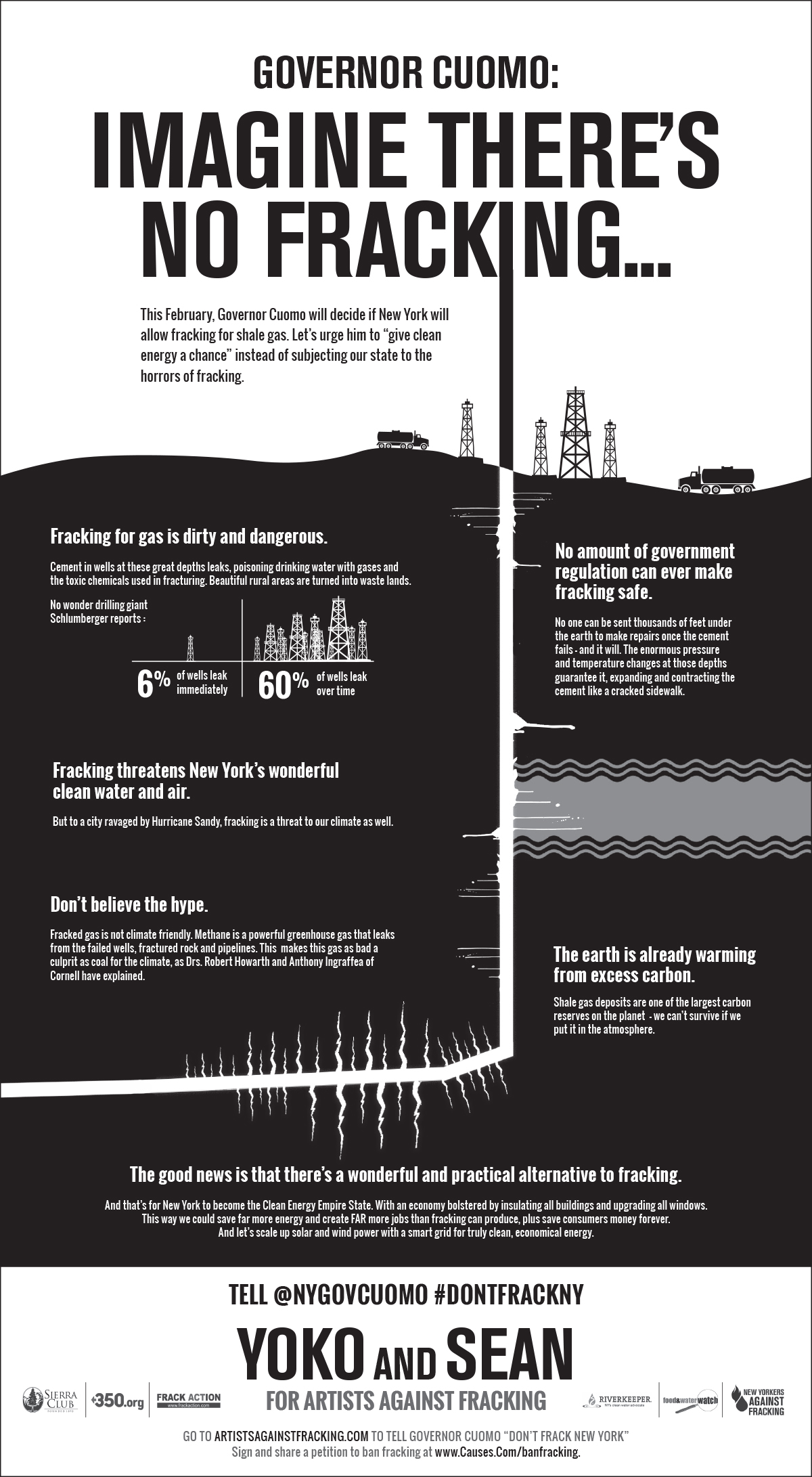
The anti-fracking campaign has been her biggest political undertaking in several years. First there were the billboards and full-page ads in The New York Times (and also The Nation): “Imagine There’s No Fracking”—addressed to New York Governor Andrew Cuomo, signed “Yoko and Sean” (her son, Sean Ono Lennon).

But the anti-fracking campaign involves a lot more than billboards. She organized Artists Against Fracking, and signed up more than 200 people, including Salman Rushdie, Jeff Koons, Alec Baldwin, Martha Stewart, David Geffen, Anne Hathaway, Jimmy Fallon—and Lady Gaga, with her 34 million Twitter followers. In Albany in January she delivered an anti-fracking petition to Governor Cuomo with more than 50,000 signatures. Also in January she and Sean and Susan Sarandon led a bus tour of Dimock, Pennsylvania, where the local water supply has been contaminated by fracking. And now she is running a new TV ad.
 
She explained the problem with fracking concisely in The New York Times letters column in December: “Evidence shows that there is no amount of regulation that can make fracking safe.… 6 percent of the wells leak immediately and 60 percent leak over time, poisoning drinking water and putting the powerful greenhouse gas methane into our atmosphere… We need to develop truly clean energy, not dirty water created by fracking.”

And the campaign had a victory last week, when Governor Cuomo announced a delay in the decision on fracking for more study of health effects. The New York Times story quoted Donald Trump as spokesman for the pro-fracking forces, and Yoko as the voice of the opposition.

“Imagine There’s No Fracking” of course recalls a certain song that begins “Imagine there’s no heaven,” which in turn was based on Yoko’s 1964 book Grapefruit, with its conceptual art “instructions”: “imagine one thousand suns in the sky…” The anti-fracking billboards also recall her antiwar activism in the 1960s, when she and Lennon put up billboards in Times Square in 1969, and then in cities all over the world: “War is Over: If You Want It.”

On another front, she honored Julian Assange at a public event in Manhattan on February 3.  At her annual Courage Award ceremony, she told an audience of activists, artists and some diplomats that “Julian Assange took a courageous step by rightfully returning what belongs to the public domain. For that reason, I believe we need to stand behind him.” Assange, who has taken refuge in the Ecuadorian Embassy in London, accepted the award via two of his legal counselors: Baltasar Garzón Real of Spain—he’s the prosecutor who pursued Pinochet for crimes against humanity—and Michael Ratner, the legendary President Emeritus of the Center for Constitutional Rights, who delivered Assange’s acceptance speech to the audience that included Laurie Anderson, John Waters, Lou Reed and Daniel Ellsberg.

Earlier in 2012 Yoko honored Russia’s feminist punk band Pussy Riot, whose members are currently in jail after criticizing Vladimir Putin. She also paid tribute to Rachel Corrie, the 23-year-old American activist who was crushed to death by an Israeli bulldozer in 2003 while she was protesting the demolition of Palestinian homes.

Then there are the retrospectives of her career as an artist, a career which began before the Beatles and continues today, fifty years later.  From the beginning she has mixed conceptual art and performance art. Her work has been playful and sometimes painful, and includes films as well as those “instructions” that require the viewer’s participation.

One of my favorite recent discoveries was a piece in the highly-regarded land art group show, “Ends of the Earth,” last year in LA at the Museum of Contemporary Art. I had never thought of Yoko doing work related to people like Robert Smithson of Spiral Jetty. But the land art show opened with Yoko’s Sky TV from 1966: an old TV set broadcasts a live feed, from a video camera on the roof, of the sky above the museum. It’s surprising and delightful, and “real” in way that’s different from everything else in the museum. It’s also a pioneering work of video art. (Sky TV is a permanent installation in New York City at the Asia Society.)

And we have her music—especially the unforgettable “Walking on Thin Ice” from December, 1980. The “Thin Ice” video is part of the Frankfurt retrospective, along with Sky TV.

One more thing that made this past year a good one: for those who were still wondering whether Yoko broke up the Beatles, Paul McCartney declared officially that she did not. When John met Yoko in 1968, he explained, “part of her attraction was her avant garde side.… She showed him another way to be, which was very attractive to him. So it was time for John to leave”—but “he was definitely going to leave, one way or another." The story was headline news.

And of course we have Lennon’s wonderful songs about her: from the 1969 song about their wedding, that begins “Standing on the dock in Southhampton” (the Beatles’ last number-one hit), to Lennon on the 1971 Imagine album, singing “In the middle of the night I call your name…” to 1980’s Double Fantasy, and “Even after all these years/I miss you when you’re not here…”

To celebrate her 80th birthday she’s playing a live concert in Berlin at the legendary Volksbuhne, the “People’s Theater,” with the current Plastic Ono Band, headed by Sean.

Happy Birthday, Yoko!


Yoko Ono retrospective opens in Frankfurt

The largest-ever retrospective of works of Yoko Ono, once described by her late husband John Lennon as "the most famous unknown artist in the world", opened Friday in Frankfurt's Schirn Kunsthalle.

Ono, who turns 80 next week, "is a unique, indeed perhaps even a mythical figure, not only in the art world, but in the field of music and the peace and feminist movements as well," said the museum's director Max Hollein.

Most people probably know Ono as the wife and widow of the Beatle, John Lennon who was shot dead outside his New York apartment in 1980.

And the two famously staged "Bed-Ins" in 1969 as a non-violent protest against war.

But Ono, born on February 18, 1933, was an avant-garde conceptual artist in her own right long before she met Lennon and was associated with the likes of composer John Cage and the founder of the Fluxus contemporary art movement, George Maciunas.

"She is familiar to practically everyone, yet only very few people are fully aware of the outstanding artistic oeuvre she has created. Yoko Ono's 80th birthday offers us an ideal opportunity to change that," Hollein said.

The exhibition, entitled "Half-a-wind show. A retrospective", surveys around 200 objects, films, spatial installations, photographs, drawings and textual pieces from the past 60 years of Ono's career.

It pays particular attention to works from the 1960s and 1970s, featuring groundbreaking works such as the "Instructions for Paintings" first shown in 1961 and 1962 and the performance "Cut Piece" from 1964, in which the audience was invited to cut the clothes from the artist's body with sharp scissors while she sat on the stage.

A number of large-scale installations and recent works are also on display and Ono has also developed a new work -- the installation and performance "Moving Mountains" -- specifically for the Frankfurt exhibition.

Curator Ingrid Pfeiffer said Ono's work "often tends toward the immaterial, the substance of which consists to a lesser extent of objects and installations but to a significant degree of ideas and texts. It is not easily presented."

Ono, wearing her trademark sunglasses, told a news conference that Lennon "used to say to me: 'bring me some truth'."

"We artists have the dignity to tell the truth to the people, unlike politicians," she said.

"But we only know half the truth. The other half is invisible. You have to imagine it, you are the creator, you have to participate. You change the world by being yourself."

The exhibition runs in Frankfurt until May 12 after which it will tour to Denmark and Austria and then move to the Guggenheim museum in Bilbao in Spain. 

(http://www.schirn.de/en.html)

Tuesday, August 14, 2012

Fall 2012 Screening Schedule for "Audre Lorde - The Berlin Years"

This is being cross-posted, in full, from here: http://blogs.indiewire.com/shadowandact/fall-screening-schedule-for-audre-lorde-the-berlin-years-home-video-release-info?nl_success=true#nlform

You may also click on the title below to link back to the source website.

With thanks to Tambay A. Obenson!


Fall Screening Schedule For 'Audre Lorde - The Berlin Years' + Home Video Release Info

News
by Tambay A. Obenson
August 12, 2012 1:12 PM
  • |

Previously profiled on S&A, it made its world premiere in the Panorama Documentary section at the Berlin Film Festival in February, and last screened at the Blackstar Film Festival in Philly last week.

Now Dagmar Shultz's Audre Lorde - The Berlin Years 1984 to 1992 will continue its screening tour, and specific dates and locations have been provided for upcoming screenings over the next few months, in the USA.

So if you're interested in seeing it, take a look at the schedule below and find out if it'll be coming to your neck of the woods. I especially encourage you folks in the USS to attend these screenings if in you're area, and if you're interested in seeing the film, because, a message posted on the film's Facebook page yesterday stated that:

Home video distribution in North America is not clear yet, but will follow soon after.

"Soon after" being after Third World Newsreel releases the film to the education market in September. So, if you don't see it at one of the below screenings, it may end up being some time before you are actually able to, since it's not clear when it'll become available on home video for you to rent or purchase.

It's stated that the DVD will have some special features including Audre reflecting on her work two months before her passing, Audre in conversation with Ellen Kuzwayo, deleted scenes and more. 

As a recap... the film focuses on...

Audre Lorde's years in Berlin in which she catalyzed the first movement of Black Germans to claim their identity as Afro-Germans with pride. As she was inspiring Afro-Germans she was also encouraging the White German feminists to look at their own racism

The trailer for the film is embedded below; and underneath the trailer, see the upcoming USA screening schedule:


Fall 2012 USA Audre Lorde Film & Cultural Festival tour

University of Hawai’i The complete program of the Festival
Contact: Prof. Christina Gerhardt
Sept. 20 & 21
University of California, Berkeley Reading by Ika Hügel-Marshall from Invisible Woman: Growing Up Black in Germanyand screening of “Audre Lorde – the Berlin Years 1984 to 1992”
Contact: Alisa Bierria
Sept. 25
Sonoma State University Reading by Ika Hügel-Marshall from Invisible Woman: Growing Up Black in Germany and screening of “Audre Lorde – the Berlin Years 1984 to 1992”
Contact: Prof. Michaela Grobbel
Sept. 27
Goethe-Institut, San Francisco
Berlin and Beyond” film festival
Reading by Ika Hügel-Marshall from Invisible Woman: Growing Up Black in Germanyand screening of “Audre Lorde – the Berlin Years 1984 to 1992”
Film: Director Sabine Erlenwein, Geothe-Insititut
Reading: Dr. Marion Gerlind, Gerlind Insititute for Cultural Studies
Sept. 29
University of Illinois at Chicago Reading by Ika Hügel-Marshall from Invisible Woman: Growing Up Black in Germany Contact: Proof. Elizabeth Loentz
Oct. 2
Northwestern University, Evanston, Illinois The complete program of the Festival
Contact: Proof. Anna Parkinson
Oct. 3 & 4
Harvard University, DuBois Institute 
Reading by Ika Hügel-Marshall from Invisible Woman: Growing Up Black in Germany and screening of “Audre Lorde – the Berlin Years 1984 to 1992”
Contact: Dr. Abby Wolf
Oct. 9
University of Massachusetts
Reading by Ika Hügel-Marshall from Invisible Woman: Growing Up Black in Germany and screening of “Audre Lorde – the Berlin Years 1984 to 1992”
Contact: Proof. Sara Lennox
Oct. 10 - Reading
Oct. 11 - Screening
Hunter College, NY
Reading by Ika Hügel-Marshall from Invisible Woman: Growing Up Black in Germany and screening of “Audre Lorde – the Berlin Years 1984 to 1992”
Contact: Rupal Oza
Oct. 16
www.audrelorde-theberlinyears.com
www.ika-huegel-marshall.de
www.dagmarschultz.com
(click here to download this schedule)
The complete Program of the festival includes:
The films:
  • A Litany for Survival: The Life and Work of Audre Lorde by Ada Griffin and Michelle Parkinson
  • The Edge of Each Other's Battles: The Vision of Audre Lorde by Jennifer Abod
  • Hope in My Heart: The May Ayim Story by Maria Binder
  • Audre Lorde - The Berlin Years 1984 to 1992 by Dagmar Schultz
The reading by Ika Hügel-Marshall from Invisible Woman: Growing Up Black in Germany

Saturday, January 14, 2012

Women Activists in Haiti: Two Years after the Earthquake

http://a8.sphotos.ak.fbcdn.net/hphotos-ak-snc6/168535_479421267412_248636582412_6351175_1973671_n.jpg
photo of activists, including Elvire Eugene (second from left), is from here
It has been two years since the devastating earthquake devastating Port-au-Prince, killing hundreds of thousands and leaving many people vulnerable to the ravages of gross governmental neglect, the violence of globalisation and poverty, the on-going efforts at colonlisation by the US, and the ceaseless threat and violence of men against women.

Many women like Elvire Eugene fight back. Here is an exceprt of a news story about the work of Elvine and other women in Haiti (source: vday.org, *here*)
Lawyers and women's activists representing 30 grassroots organizations from across Haiti came together to discuss what needed to be done to address gender-based-violence in post-earthquake Haiti.
The meeting was coordinated by longtime V-Day activist Elvire Eugene, who is connected to many local partners and national networks working on women's issues in Haiti and is well suited to lead critical work on the ground. Judie C. Roy, a former presidential candidate and prominent activist, was also in attendance, as well as members of the Women's Ministry. During the meeting, a Task Force was formed to see the group's work through to completion. Members chose Elvire Eugene, Judie C. Roy and activist Marie Gislhene Mompremier to lead the Task Force.

Here are some links to other stories about activist women in Haiti.

From the Institute for Justice and Democracy in Haiti:

Haitian Peasant Women as Poto Mitan, Central Pillar”: An interview with Iderle Brénus Gerbier (Other Words)

20 December 2011 Comments: 0
By Alexis Erk­ert, Other Words

[Excerpt:]
The Hait­ian soci­ety is essen­tially macho, and the Hait­ian politi­cians and inter­na­tional inter­ests oppress Haiti’s own chil­dren. Farm­ers become vic­tims again and again and women are always held back. But these women con­tinue to sup­port their country.
Our goal is to achieve respect for the rights of Hait­ian women. Despite their posi­tion as poto mitan, as the main car­ri­ers of the national econ­omy, rural Hait­ian women always suf­fer in our soci­ety. Most of these women have no direct access to agri­cul­tural lands and income is strictly con­trolled by men, despite their role in agriculture.

See also:

Two Years Later, Where Is The Out­rage? (Lethaitilive.org) — Jan­u­ary 3, 2012

and,

http://ijdh.org/projects/rapp

And finally, for now, From MADRE's website (please click on the title just below for more):

Press Release: Groups Release Report Analyzing Sexual Exploitation in Haiti

Posted on: Thursday, January 12, 2012
FOR IMMEDIATE RELEASE:
CONTACT: Stephanie Küng, MADRE, media@madre.org;
Blaine Bookey, Center for Gender & Refugee Studies, bookeybl@uchastings.edu;
Margaret Satterthwaite, NYU Global Justice Clinic, satterth@exchange.law.nyu.edu

Haitian Women and Girls Trading Sex to Survive
Groups Release Report Analyzing Sexual Exploitation


January 12, 2012—New York, NY—Two years after an earthquake devastated Haiti, a report detailing the impact of sexual exploitation on displaced Haitian women and girls has been released. The report is authored by MADRE, the Commission of Women Victims for Victims (KOFAVIV), the International Women’s Human Rights (IWHR) Clinic at the City University of New York (CUNY) School of Law, the Global Justice Clinic at NYU School of Law (GJC) and the Center for Gender & Refugee Studies at UC Hastings College of the Law (CGRS).

The drastic increase in sexual violence in displacement camps has been well documented since the disaster. But another face of the epidemic has emerged as a pressing issue: the sexual exploitation of displaced women and girls.

Displaced women and girls have lost family and community members, along with the protection and safety nets those relationships offered. Because of poverty and a lack of economic opportunity, many women and girls are forced to trade sex for shelter, money or even a single meal. In many cases, those demanding sex are the very people who hold themselves out as representatives of the people—members of camp committees.

The report was compiled based on interviews with Haitian women and girls who have either engaged in transactional sex or who know people who have. Information was also collected through interviews with Haitian government officials, service providers and women’s rights advocates. The report highlights current barriers to addressing sexual exploitation and offers recommendations to protect the human rights of women and girls engaging in transactional sex. In addition, the report offers a unique legal analysis of the protections available for women and girls who have experienced a wide range of human rights violations associated with sexual exchanges.

Marie Eramithe Delva, co-founder of KOFAVIV said today, “Displaced women and girls are being forced by circumstance into survival sex. It is an epidemic, but one that has gotten little attention from the Haitian government or international community.”

Lisa Davis, MADRE Human Rights Advocacy Director and Clinical Professor of Law for the IWHR Clinic at CUNY Law School said today, “International law recognizes that an individual’s decision to engage in sex should be the result of free choice. The majority of women and girls interviewed do not have a choice. They are displaced and with few other options. In turn, they are at increased risk of sexual violence and health threats. We must shed light on this crisis.”

Blaine Bookey, Staff Attorney for the CGRS said today, “Although almost all individuals interviewed for this report recognized that sexual exploitation is widespread, representatives of government agencies responsible for addressing sexual exploitation hold stereotypes related to gender and poverty that present an obstacle to implementing practical solutions. Beyond this, the Haitian government’s inability to develop a meaningful response to sexual exploitation is also due to a stark lack of resources. I am hopeful the report will help breakdown these harmful stereotypes and bring much needed resources to bear.”

Margaret Satterthwaite, Professor of Clinical Law for the GJC and Faculty Director of the Center for Human Rights and Global Justice at NYU School of Law said today, “Survival sex will not end until Haitian women and girls can access what they need to live.  Haitian women want economic opportunities and the capacity to access basic resources.  The international community should work closely with the Haitian government to create jobs, extend microcredit to women, and provide free education to all.”

Virtual Briefing: Join the authors of this report on Tuesday January 17 at 1 pm EST, for a conference call. RSVP at media@madre.org for call-in information.

To read the report in full, click here.


Friday, May 27, 2011

"Sl*twalk"... another point of view

image is from here
The poor people in my family don't walk down the street claiming they are the negative stereotypes rich people assume about them. Their dignity and desire not to participate in their own oppression in such a way is too great for them to do that. The people of color I know well, both women and men, don't walk through the street calling themselves the terms whites hurl at them. Only some structurally privileged women want to publicly use misogynist terms, like "dyke" and "sl*t", and "b*tch". It's part of an anti-radical tactic sometimes called "reclamation". I have lived my adult life using the term "dyke" positively. But I get how that is a race-, gender-, region-, language-, and class-privileged experience to be able to do so.

I'm not comfortable with the term "sl*twalk" being promoted as liberatory or pro-woman as it strikes me as deeply discriminatory against the most poor and otherwise marginalised women who do not have the status to embrace terms like "sl*t" as empowering or part of a liberation movement. The reclamation of oppressive, dehumanising terms--the terms men use to insult and degrade women in an anti-woman society--is not part of my political program, and I don't support it. There are other problems too. Such as trying to salvage a term that describes an idea about a kind of person that is linguistically so culturally relative that to embrace it is to continue to support or "reclaim" the particular anglo-patriarchal cultures in which the term exists, such as those in North America. It's not exactly that all women within a society are oppressing themselves by using those terms; it's that they are oppressing other women.

Ageism: the term conjures a gross stereotype of some women of some ages, none of whom are "sl*ts".

Ableism: the term assumes people walk. Many women do not.

Racism and classism: it is disproportionately race- and class-privileged women who assume that reclaiming misogynist terms and behaviors is empowering to ALL women. It isn't.

Sexism and misogyny: the term is one of the most virulently anti-woman, sexually oppressive terms in the English language.

Heterosexism: the term is generally used against women who are choosing to be sexually available to men, within whatever limited options, with strict codes of compulsory heterosexuality in place. Many women are not choosing to be sexually available to men. And the term invisibilises those women.

The term participates in many other forms of exclusion, discrimination, and marginalisation. Such is the case when privileged few try and show up whenever efforts are made by privileged people to reclaim the terms that are used by men against many multiply disadvantaged, discriminated against women.

I was glad to read this excerpt from another blog, but not for the racism, ethnic insensitivity, and other forms of oppressive privilege on the part of some whites, which result in the need for it to be written at all. Please click on the links below the quoted passage. What follows is something I read over at The Angry Black Woman blog *here*. With thanks to her and also to the author of this writing, Mehreen Kasana.
“As a Muslim feminist woman of color, I cannot relate to Slutwalks as it caters mostly to the definition of emancipation set by white women. Slutwalks deviate in terms of delivering the message against sexual assault. It turns a blind eye to women of cultures where flimsy clothes don’t necessarily lead to rapes. Muslim women get raped too. Nassim Elbardouh is right. “Do Not Rape” Walk sounds better. This isn’t to say that I don’t support Slutwalks. I simply can’t relate to a liberating movement that does not liberate nor acknowledge me. Western feminism, despite its undeniable achievements, still perpetuates the image of a white woman as the liberated one. If these feminists do claim to represent all women, they need to understand the dynamics of the cultures other women hail from. Don’t care if you’re wearing a thong or burka, no one has the right to rape you. Burka clad brown Muslim women get raped too. Represent us. I want a movement that represents me regardless of my color and creed. End victim blaming and rape culture by representing everyone.”

Mehreen Kasana  (via intoxicatedspirit)

30 May 2011 UPDATE: Please also see this:
'SlutWalk completely ignores the way institutional violence is leveled against women of color ... and it wont strip the word “slut” from its hateful meaning. The n-word, for example, is still used to dehumanize black folks, regardless of how many use it among themselves. If SW has proven anything, it is that liberal white women are perfectly comfortable parading their privilege...& ignoring women of color.'

http://tothecurb.wordpress.com/2011/05/13/slutwalk-a-stroll-through-white-supremacy/

Wednesday, May 4, 2011

When are these stories of terrorism going to get coverage on CNN, ABC, CBS, and NBC?

Photo: Havasupai gathering to halt uranium mining in Grand Canyon/copyright Brenda Norrell

The photo above and all that is below is from Brenda Norrell at Censored News. I hope she's in charge of a one of the last few news media conglomerates soon. Then maybe we'll find out about the unreported terrorism committed by the U.S. government leaders and corporate heads against Indigenous people across the globally and locally. Please click on the title below to link back. Thank you so very much, Brenda. And thank you to all the Indigenous activists who go unnamed by corporate news media.

Notes from the Fifth World: Protecting Mother Earth

Censored News

--US theft of Navajo water rights hits snag in Congress
--Zapatistas march in silence San Cristobal, May 7
--Wounded Knee, SD, Environmental Film Forum May 7
--Protect Glen Cove, Day 18
--'Lets Rape Mother Earth' American Indian leaders testify in DC
--Elderly activists use wire cutters to break into Navajo base to protest nuclear industry
--Protect Grand Canyon from uranium mining
--Haiti farmers burn Monsanto genetically modified seeds, Navajo Nation farm keeps using them
--UN OBSERVER & International Report seeks to begin publishing again

US theft of Navajo water rights hits snag in Congress
The plan to dupe Navajos out of their Arizona water rights, and their future, has hit a snag. Non-Indian attorneys were recently able to convince the Navajo Nation Council to approve the theft of Navajo water rights in Arizona. The US is using water rights settlements with Indian Nations to steal American Indian water rights all across the west. As former Navajo Chairman Peter MacDonald points out, the Winters Doctrine assures Navajos and other Native Americans of expansive water rights. It is a fact that the US doesn't want American Indian Nations to pursue in federal court. Meanwhile, the US wants the rights to Colorado River water in Arizona, and rivers throughout the west, for cities, power plants and corporate profits. The US has non-Indian attorneys working for Indian Nations to secure the theft of their water rights.
  
Kathy Helms reports in the Gallup Independent, "The proposed $800 million Northeastern Arizona Indian Water Rights Settlement Agreement approved by the Navajo Nation last November is 'too expensive' and will not be introduced to Congress in its current form, according to court documents."
Helms quotes a report dated April 19 from Arizona Superior Court Special Master George A. Schade Jr., stating that parties to the settlement were informed March 24, by U.S. Sen. Jon Kyl, R-Ariz., that the proposed settlement is too expensive. "Navajo Nation water rights attorney Stanley Pollack stated in the report that Kyl is unwilling to introduce legislation to authorize the settlement in its current form given the current political and fiscal climate in Washington." (Read more in the May 2, 2011 Gallup Independent)

Zapatistas march in silence in San Cristobal May 7, 2011
Subcomandante Marcos: The indigenous Zapatistas will march in silence in the city of San Cristóbal de Las Casas, Chiapas on May 7 to exercise our constitutional rights. After ending the march in silence, we will speak our words in Spanish and in our native languages, and after that we will return to our communities, villages and homes. In our silent march we will bring banners and signs with messages saying “Stop Calderón’s war,” “No more blood,” and “We have had it up to here.” We ask that you convey these words to the family members of the 49 boys and girls who died and the 70 others who were injured in the tragedy at the ABC daycare center in Hermosillo, Sonora, to the dignified Madres de Ciudad Juárez, to the Baron and Reyes Salazar families from Chihuahua, to the family members and friends of the victims in this arrogant war, to the human rights defenders of citizens and immigrants, to all of those who come together for the National March for Justice and against Impunity. Read statement in English/Espanol: http://bsnorrell.blogspot.com/2011/05/zapatistas-march-in-silence-may-2011.html

Also see:
Frontera NorteSur News: Zapatistas join Drug War Protest:
http://censored-news.blogspot.com/2011/05/fns-news-zapatistas-join-drug-war.html

Wounded Knee Environmental Film Forum May 7, 2011
An Environmental Awareness Film Forum will be held on Saturday, May 7, 2011 at 1pm at the Wounded Knee District School in Manderson, SD. Three films will be screened, followed by Guest Speakers to present updates on the environmental protection work they are involved in. The films include Water Is Life by Art Is Action, which is an 8 minute show that chronicles the impacts of uranium mining to the drinking water and health conditions on the Pine Ridge Indian Reservation and that examines the dwindling drinking water supply in this area; the 28 minute film Poison Wind by 220 Productions, which shares the voice of the Navajo Nation and other tribal peoples in the southwestern United States who are impacted by uranium mining; and a work in progress by Prairie Dust Films which documents support for and opposition against uranium mining in Nebraska and in the Black Hills of South Dakota.  
More:
http://www.oweakuinternational.org/Owe_Aku_IJP/Film_Forum.html and
http://bsnorrell.blogspot.com/2011/04/wounded-knee-sd-environmental-film-and.html

Protect Glen Clove, Day 18, May 1, 2011
It was a very social Sunday. Internationally acclaimed actor Michael Horse and his partner Pennie Opal Plant from Gathering Tribes Art Gallery in Berkeley paid us a visit and donated much needed supplies. Artists from Oakland donated two spray-painted banners. A limo pulled up to the gate, full of DJs from a local radio station, who visited and brought us fruit. Then a trio of Mormons appeared–after being informed that proselytizing to our participants was forbidden, they joined us for a short while.

Doug and Clayton Duncan from Robinson Rancheria and Gary Thomas of the Elem Pomo Roundhouse shared the story of the massacre of their ancestors at Bloody Island and offered songs. Their family members sang healing songs and danced in honor of the women, accompanied by prayers offered by a Taino Elder from Puerto Rico. More: http://www.protectglencove.ogr/


'Lets Rape Mother Earth' Indian leaders testify on energy in DC

Testimony in DC by Tex Hall, Ben Shelly and others: http://naturalresources.house.gov/Calendar/EventSingle.aspx?EventID=229900
Dine' Citizens against Ruining our Environment points out Navajo President Ben Shelly's bizarre testimony (at Censored News.) Shelly released a press statement promoting the planned Desert Rock Power plant. Tex G. Hall, Chairman Mandan, Hidatsa and Arikara Nation of the Fort Berthold Reservation, wants more oil and gas drilling into Mother Earth. Hall says the US has too much "unnecessary red tape and bureaucratic delays" to carry out the destruction he desires for dollars. During the testimony in DC, Michael Connolly, Campo Band of Mission Indians, spoke out for renewable energy. The Chickasaw encouraged biofuel. Testimony includes statements from Crow Tribe in Montana and Ute Tribe of the Uintah and Ouray Reservation.  
During the climate summits in Cochabamba, Bolivia, and Cancun, Mexico, in 2010, there were no US elected Native American leaders present to join Bolivian President Evo Morales in his global efforts to protect Mother Earth and assure the rights of Nature. The UN climate summit will be in South Africa in Nov/Dec 2011. Join the efforts of President Morales, Bolivia and the global Indigenous and grassroots movement: http://pwccc.wordpress.com/

Elderly activists break into Navy base with wire cutters to protest nuclear industry
Elderly activists break into Navy base with wire cutters, sit and pray to protest nuclear industry, sentenced to prison

Fr. Steve Kelly, who was in Tucson to protest US torture, is once again dancing to the slammer. Steve had spent so much time in prison for protesting the nuclear industry, and literally trying to beat nuclear weapons into plowshares, I asked him how he could choose, and endure, so much time in prison.

Steve said enthusiastically, "Oh, there's never enough time!" His face lit up, and he told me how he continued his protest in prison, which meant being put into solitary confinement. There, he kept busy writing letters and of course praying. I asked him if they gave him paper for all those letters. He said that he makes do by writing in the margins of those he receives. The next day he quietly stepped across the line at Fort Huachuca Army base, with Fr. Louis Vitale, our friend from the Western Shoshone nuclear protest and arrests, and the two of them were arrested. They were protesting the torture training at Fort Huachuca Army Intelligence Center in southern Arizona, and US torture at Abu Ghraib. --Two of the heroes I've been honored to meet. --Brenda Norrell, Censored News

Read more: CounterPunch Bill Quigley: Two Grandmothers, Two Priests and a Nun go to a Nuclear Base: http://www.counterpunch.org/quigley03292011.html

Protect the Grand Canyon from uranium mining
For the past two years, the Grand Canyon has been protected from the ravages of uranium mining. 
Now, the temporary mining moratorium is set to expire, and the Grand Canyon's fragile ecosystem, stunning beauty, and vital water supply are threatened by 1,100 new mining claims that have been filed within 5 miles of this priceless "crown jewel."

The Bureau of Land Management (BLM) is considering a 20 year ban on mining to protect the Grand Canyon's entire 1-million acre watershed. But there are other proposals on the table, and industry lobbyists are encouraging BLM to open the floodgates for the uranium mining rush. It's essential that we urge the BLM to protect the Grand Canyon.

Join me in defending the Grand Canyon. Submit a public comment to BLM to protect the Grand Canyon from uranium mining:
http://act.credoaction.com/campaign/grand_canyon_mining/?r_by=-4026599-38PDmDx&rc=mailto1

Haiti burns Monsanto seeds, Navajo Nation farm keeps using them
Haitians burned 400 tons of Monsanto seeds, with 10,000 earthquake-devastated farmers refusing to plant the genetically modified seeds. Meanwhile, the Navajo commercial farm, Navajo Agricultural Products Industries, continues to use Monsanto genetic hybrid corn for planting, as promoted on its website.  
NAPI's produce, Navajo Pride, is sold commercially and is among the genetically altered products now sold on grocery shelves in supermarkets, trading posts, etc. Navajo corn is sold as feed corn, ultimtely becoming part of beef and chicken. The corn is sold as Navajo Pride Popcorn.

In interviews, Navajos point out the history of genocide with foods, from the introduction of white flour at the prison camp at Bosque Redondo, to the USDA commodities of grease and empty starch, to the trading posts packed with lard, Spam and potato chips. Now genetically modified foods can be added to this.  
The NAPI farmland, on Navajo Nation land near Farmington, N.M., is also the site of a Raytheon Missiles  plant. 
Haitians burn Monsanto seeds:
http://www.truth-out.org/the-new-earthquake-manifest-haiti-monsantos-destiny66930
Navajo Agricultural Products using Monsanto genetic hybrids
http://www.navajopride.com/article.php?method=News&Sid=Corn

UN OBSERVER human rights news from the Hague
Good news from Paul Rafferty, who had to temporarily cease publication of the UN OBSERVER & International Report at the Hague, for financial reasons.
Paul is now searching for a sponsor to resume the online and print publication.
Sponsors please contact Paul Rafferty, publisher, prafferty@thehagueobserver.com or Brenda Norrell, human rights editor, at brendanorrell@gmail.com

Also see:
Japan's Radioactive Nightmare Hits Home for Navajos
http://bsnorrell.blogspot.com/2011/04/japans-radioactive-nightmare-hits-home.html
Earthcycles and Censored News plan Native Youth Media Workshop for summer of 2011
http://bsnorrell.blogspot.com/2011/04/navajo-youth-media-workshop-june-2011.html
Protect Glen Cove
http://www.protectglencove.org/