Showing posts with label white Christian atrocity. Show all posts

Saturday, October 22, 2011

June Jordan: speaking about the 99% and the 1% in 1995 as if it was today

portrait of June Jordan is from here
[T]he quest for white male supremacy jeopardizes most of America. And, to a horrifying extent, our common enemies need to do little more than stand aside and watch the rest of us sink into mistaken animosities. [...]

Since 1964, race has been redefined by millions and millions of new arrivals who have begged or borrowed their way onto these shores. Black and white formulations have begun to yield, as they must, to demographic facts of a multiplicity of colors, languages, and legacies, brightening our continental landscape, and our horizons. Correspondingly, our definitions of racist convictions and behavior must be re-examined--and expanded as well: Beyond white hatred for people of African descent, the push for white supremacy punishes, and hopes to extirpate, every people that is not "white" and, also, "Christian." Of course, this necessary redefinition identifies most human beings as members of a hatefully composed target population.

That's the down-side. The good news is that we, the undesirable, vastly outnumber what is, in fact, a national and international minority of dangerous, hyperactive true believers.

Since 1964, issues specific to female life have emerged from traditional invisibility and sorry realms of isolated individual pain. Difficult questions about the meaning and the purpose of female identity have surfaced from fearsome areas of our collective consciousness. And a unifying, global awareness may yet ignite into an overdue, a successful, majority crusade for our fully realized, and liberated, human being.

Sexuality has become an openly political battleground. And class considerations increasingly compel our acknowledgement and response, even while Marxist forms of analysis retain very little of their practical and/or theoretical credibility.

As a Black woman living with change and beset by continuing situations of peril, I am the same and I am different, now. For me, winning has become the point. I have known and I have seen too many people dead, absolutely dead and gone, to settle for resistance or struggle: I am working to win.

Thirty-one years ago death did not seem or feel like anything relevant or decisive. But now whenever somebody dies in spirit or in flesh, I have learned to count that as an inconsolable irreplaceable loss. I am fighting to enlighten and protect my life by joining forces with my students, my comrades, and my colleagues for the enlightenment and rescue of all sociable and tender qualities of human life everywhere.

Hatred kills people. Cruelty kills people. Greed kills people. Egomania kills people. Stupidity kills people and trees and water supplies and systems of public education.

But I have come to understand that I am not surrounded by enemies. I teach and I write and I walk and I talk among people who want what I want: Good health, safety, a fair chance at happiness, and a growing environment of friends. I am clear about this: Most folks are really okay, not demonic or heartless or closed. But then it's the powerful few--forever on camera/on microphone--the powerful few who forever keep us inaudible and unknown to each other, or else all the while they disseminate scary information.

[...] [T]here is a hideous, neo-Nazi world view loose on the land. And adherents to that hatred aim to subjugate, or exterminate, everything and everybody who is not Christian and white and male and heterosexual.     -- June Jordan, in the new introduction of her book of essays, Civil Wars, April 27, 1995

Monday, March 14, 2011

Adolph Hitler's lover, Eva Braun, dressed up as a Jewish white man dressed up as a non-Jewish Black man...

photo of A. Hitler and E. Braun is from here
The photograph above is not the one making the news. It appears to be a moment where ol' Adolph is catching a few zzzz's while not attending to his genocidal agenda to wipe Jews from Europe and beyond--if only there had been no Resistance. Who knew Adolph and Eva also had fun with anti-Black racist drag?

Quiz: How many forms of gross exploitation, sexual, ethnic, and racist insensitivity and inhumanity, and genocidal heinousness are wrapped up in this smallish news story?

Please click on the title below to link back.

Photo of Adolf Hitler's lover Eva Braun dressed as black man emerges
Published: Friday, Mar 11, 2011, 14:23 IST
Place: London | Agency: ANI

A collection of photographs of Adolf Hitler's lover Eva Braun has surfaced, and in one of them she is featured with black make-up and dressed like a man.
The picture had been taken in 1937 when Braun was 25, and she had captioned the image "Me as Al Jolson". Jolson was a Jewish American star, the Sun reported.
The images had been found in 1945 at Hitler's Bavarian mountain retreat, the Berghof, but they lay forgotten in US archives until this week.
Other snaps show Hitler playing with the young daughter of one of Braun's pals, and messing about with her pet dogs.

Tuesday, December 14, 2010

The Social Ecology of Native Girls' Vulnerability, by Avi Âviâja

Photo of two Indigenous Australian girls is from here. Photo: Wayne Quilliam/OxfamAUS

This is a cross-post from an activist friend. Please click on the title below to link back. With great thanks to Avi for all her determination, dedication, and hard work for human rights for Indigenous Peoples globally. For me this points to an issue which was first highlighted explicitly by the Indigenous North American radical feminist and writer, Andrea Smith. She addresses the responsibility of white and non-Indigenous activists to center the experiences and analysis of Fourth World girls and women when considering the focus of our political action. To not do so is to leave this diverse population of women and girls marginalised and invisibilised. It is to say the genocide/gynocide of Indigenous girls and women is not important enough to make it a focus of our political work. This blog seeks to centralise the experiences of girls and women of color, and to remind other activists that women and girls of color are most of the world's human population. In particular, the issues facing Indigenous girls highlights the many forms of oppression that girls oppressed by gender, age, race, capitalism, ethnicity, region, religion experience, and white male supremacy.

Please join Avi and me in not ignoring these girls when you consider what courses of progressive and radical activism to take up or continue working on. If you are Western, white, trans, or male, please ask yourself this: How does the work you do make life less oppressive and more liberatory for Native girls? Is the political work you do directly accountable to Indigenous girls and women? In what ways do you support the efforts, actions, and empowerment of Indigenous women and girls?

The Social Ecology of Native Girls' Vulnerability
by Avi Âviâja

INDIVIDUAL:

1. Poverty.
2. Physical/Sexual Abuse.
3. Parents affected by generational Trauma.
4. Parents affected by FSAD/Mental Illness.
5. Prostitution/Survival sex.
6. Substance Abuse.

NEIGHBORHOOD/COMMUNITY/ENVIRONMENT:

1. Social Isolation.
2. Visible Active Sex Trade.
3. The Don’t Talk Rule.
4. Limited Jobs, Few Options for Education and Career Planning.
5. Community normalization of Violence.
6. Gang Activity.
7. Crime based underground Economy.

INFLUENCE OF THE MAJORITY SOCIETY:

A. Government action:
1. Cultural and Human Genocide.
2. Reservation System.
3. Urban Relocation.

B. Media Glamorization of sexual exploitation:
1. Sex as Marketing Tool.
2. Emphasis on money as proof of Success.
3. Targeting of Native women for sexual exploitation.

• Unequal gendered consequences for roles in prostitution.
• Federal definition of “desiring” Victims.
• Government priorities based on group size and influence.
• Underfunded “Safety net” Systems.
• Racism.
• Socioeconomic inequality.

C. Government Action:
1. Boarding Schools.
2. Indian Adoption.
3. PROJECT Sterilization.

Thursday, December 2, 2010

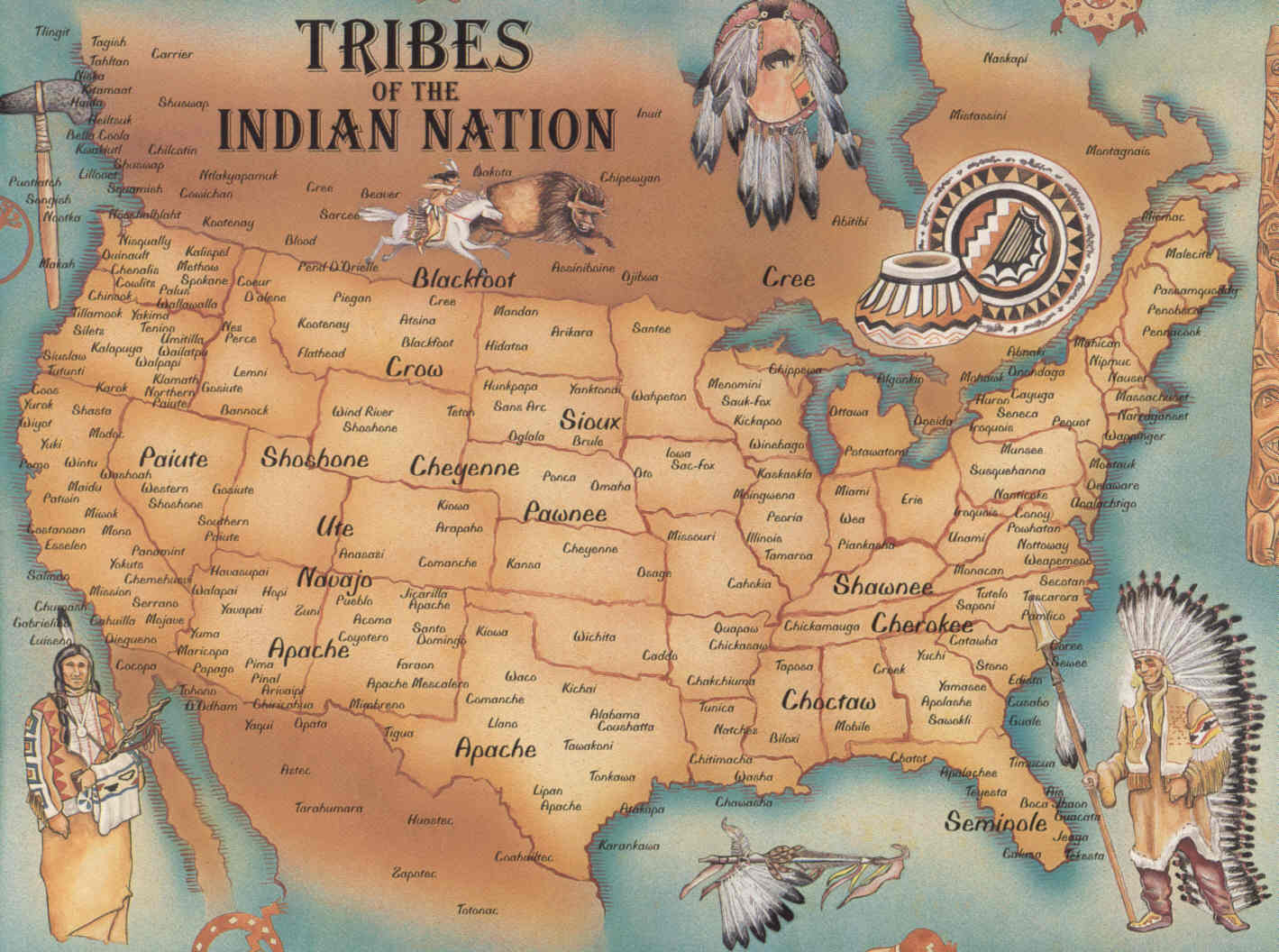
First Nations and American Indian Societies and Gender: a primer for whites

image of map, available to be seen larger, is from here
The above map might more accurately be called: 


Nations of The Indigenous Peoples 
of the North American Region

But I expect things I encounter about First Nations peoples and American Indians that are not from the people directly to be inaccurate most of the time.

I just heard the news that the prominent, famous actor who is from the U.S. but lives in France has been cast in yet another terribly racist role: that of Tonto. The actor's name is Johnny Depp and he has gone from being someone whose work I respected, to being among my least favorite actors. He keeps doing work that is so grotesquely racist that it is stunning to me that such films, as the Pirates of the Caribbean series, are still able to be funded. It's not surprising to me that they are funded; just stunning. That anything so racist is funded by Hollywood comes as no surprise whatsoever. I hope the producers and Johnny Depp are targeted for protest and boycott. The last thing I want to see is any movie about "The Lone Ranger" and his "sidekick" Tonto--perpetuating the racist/genocidal mythology that "it's all good" between the White Man and the Red Man, or, in the case of the image below, the whiter man and the greyer man.

image of "Tonto and The Lone Ranger" is from here

"Tonto" was played by First Nations athlete and actor, Jay Silverheels, Mohawk, born on the Six Nations of the Grand First River Nation, Ontario in 1937. In the early 1960s, assisted in the establishment of the Indian Actors Workshop in Echo Park, California as a place where American Indian actors could develop their acting skills. The workshop is still active. Jay died in 1980 at the age of 67. I think the white guy had a name and a a life too. The horse was named "Silver" in the TV series, "The Lone Ranger". Both characters' histories go back to a late 1930's serial.

But it's not really all that good--I mean between the White Man and the Red Nations. It's mostly quite atrocious, actually, if the whole ugly truth is to be told. It's particularly atrocious for the American Indian and First Nations women who are systematically raped and prostituted by and for the White Het Man. And the sooner Hollywood gets that straight and responsibly, not exploitively, portrays that reality accurately (and not with Kevin Costner as some sort of white hero, either) the better.
Even outside of Hollywood, stereotypes abound in white dominant culture about what it means to be American Indian. Growing up, within white-dominated queer culture, I heard tale of "the Berdache" as a great example of how much more liberal Native Americans were--you know, all those Native Americans who shared one culture that had this place in it for the Berdache.

About that term, from Wikipedia, *here*:
The term berdache is also used to indicate "two-spirit" individuals, but is increasingly considered outdated and inappropriate. According to the American Heritage Dictionary, 4th. ed., berdache is North American French, tracing back, through European French, Italian, Arabic, Persian, Middle Persian, and Old Iranian, to Proto Indo-European welƏ, "to strike, to wound"; making the term "berdache" a linguistic relative of such words as "Valhalla", "Valkyrie" and "vulnerable".

There are, in fact, many indigenous terms for these individuals in the various Native American languages — including Lakota winktje and Navajo nádleehí (Burrus & Keller, 2006: p. 73).

Berdache is a generic term that was used primarily by anthropologists in the past (no longer an accepted concept or term within the field). It is a loan from French bardache implying a male prostitute or catamite. The word's origin is complex: the French derives from the Spanish bardaxa or bardaje / bardaja via Italian bardasso or berdasia via Arabic bardaj: البَرْدَجُ" meaning "captive, captured" from Persian bardaj < Middle Persian vartak < Old Iranian *varta-, cognate to Avestan varəta- "seized, prisoner," formed from an Indo-European root *welə- meaning "to strike, wound." The term berdache is widely considered offensive, due to its roots.

Use of the term has widely been replaced with two-spirit (except in scholarly literature,) which originated in Winnipeg, Canada in 1990 during the third annual intertribal Native American/First Nations gay and lesbian conference. It is a calque of the Ojibwa phrase niizh manidoowag (two spirits). It was chosen to distance Native/First Nations people from non-natives as well as from the words berdache and gay.
The concepts of gender and "traditional" gender and sex roles--if by that we mean "Western white heteropatriarchal" gender and sex roles--are culturally-specific and temporally relative ideas and realities. The atrocious racist/misogynistic/heterosexist reality of the last half-millennium especially but also for far longer than that, is that many, but not all, Indigenous/Aboriginal/Native/First Nations peoples have been invaded and occupied by whites and their customs, religions, and languages. Invasion came with variations: colonisation of people who lived on land before whites came, and mass murder of those people. Colonisation was done by white women and men. Mass murder was usually done by white men.

A perhaps incalculable number of whole cultures and nations were destroyed; in North America alone it is estimated that between 70-90 million people were savagely and barbarically slaughtered by the creators of modern "civilisation" and that this slaughter was part of the meaning and value of "being civilised" and/or "Christian". Many nations and cultures so invaded still survive and have had to negotiate survival in the presence of the occupying force, usually euro-anglo-white. Both women and men of anglo-white-euro-Christian descent and belief have played various sadistic and criminal roles in the destruction of Indigenous peoples, particularly but not only in what Westerners/whites call North America.

Prior to and also since invasion, there have been many varied ways of being gendered, sexed, and/or expressing sexuality. Some of these forms of relating and being were not constant over the course of one's lifetime. Some were modified according to economics--not capitalist economics, but "economics" as in "what a people needed to do to survive". If what we call "men" were needed to cook and sew, then in some instances men cooked and sewed. If what we call "women" were needed to slaughter non-human animals and engage in warfare with enemies, then in some instances they did so. I have written a while ago about one "woman" as the white West defines this term, who did fight with the males of her people. Her name was Lozen, she was Chihenne-Chiricahua Apache, and her story is *here*.

It is a serious problem of subjective language and worldview that when white Westerners tend to "study" other peoples, we tend to impose our own values, assumptions, worldviews, and philosophies onto the people we are studying. This can manifest in many ways that make meeting with other people and sharing ideas and concepts difficult if not impossible, because rarely do whites and Westerners seek to give up our own views of things and "check them at the door" when entering the spaces of other societies. So we tend to collapse or condense what we see that may be more diverse than what we "know" into pre-packaged categories we bring with us. Societies have existed and still do exist that are matrilineal and matriarchal, or one or the other but not both.

Assumptions by some whites and Westerners that "only patriarchy" exists now is wrong, and racist. Assumptions by some whites and Westerners that there are only two genders or sexualities are wrong and racist. Assumptions by some whites and Westerners that gender is only a dominator-hierarchy for all people living on the Earth is wrong and racist. What is not common to human history, much as some white het men fear it, is this: a matriarchal society which subordinates men to women. This is not evidenced in societies known about or written about. What appears to be the case is that some patriarchal societies were and are especially brutal to women. Some of these patriarchally brutal societies were Indigenous. Most current patriarchal societies that are pro-rape and pro-male supremacist are not Indigenous.

I recommend reading what follows, if you are white and non-Indigenous, ethnically or racially. When you are finished, I imagine that you, like me, will find it far more difficult to make assumptions about "Native Americans honoring a third gender" or "not honoring a third gender", or "embracing homosexuality as well as heterosexuality" or "not embracing homosexuality as comparably valuable to heterosexuality". This is because "homosexuality", "heterosexuality", and "gender" are, in and of themselves, anglo-white-euro concepts that don't apply to all peoples, especially to people who do not rise out of those regions where white-anglo-euro people lived or live, or once colonised or colonise to this day.

I'll note that terms like "Sioux" and "Iroquois" are not Indigenous terms chosen by the people who are called those national names. They may have been appropriated, but what we know is that their linguistic heritage is French, not Indigenous North American. That is what what appears below offers alternative names for the people who are sometimes called "Iroquois" and "Sioux". In one case the non-French term was provided by Wikipedia. In the other case I added the non-French terms.

What follows is, by and large, from Wikipedia. Please click on the title to link back to the source web page.

Gender roles in First Nations and Native American tribes

This article concerns the "traditional" gender roles of some of the Native American, Canadian First Nation and Aboriginal peoples, and the Indigenous peoples of North America. The roles vary greatly from region to region and from tribe to tribe, and in some cases even from band to band within a tribe or people. Pre-Columbian era gender role traditions may be a historical heritage, and not in contemporary practice.

Contents


Algonquians

In the traditions of the major Algonquian First Nations, a more or less egalitarian view of gender roles is taken. Chastity and marital fidelity are emphasized as honourable aspects of character, for both men and women. Historically, certain Algonquian bands were noted for the stability of their conjugal unions, as opposed to their serially monogamous Iroquois neighbours, whose marriages were often short-lived. The responsibility of caring for young children was shared between both parents to a greater extent among the Algonquians than among most other native groups.

Among the Ojibwa and Menominee, both in the past and on present-day reserves/reservations, agricultural activity is often based on the collaborative work of married couples. For example, the harvest of manoomin (wild rice) is done by couples in special canoes (traditionally made of birch bark, although in recent years some aluminum ones have begun to appear). One spouse, the "poler", pushes the canoe with a directional pole, while the other, the "knocker", sits or stands in the canoe and thrashes the rice against the rim beam (a process which can garner 200 kg of rice daily). The partners may take turns at knocking and poling, since poling is harder.

The Mississauga were considered "cast-off" by the Anishinaabe tribes because the Mississauga practised polygynous marriage, and violated other aspects of Midewiwin morality.[citation needed]

The Tidewater and Chesapeake tribes (ie: Powhatan and Nottoway people), although they spoke an Algonquian language, culturally shared less commonalities with other Algonquians. They were culturally closer to Southeast Indians, and had a gender-based division of labour more akin to that of the Southeast tribes.


Apache

Although the traditional Apache had different adult gender roles for men and women, the skills of both were taught to both boys and girls. They all learned how to cook, follow tracks, skin leather and sew stitches, ride horses, and use weapons. This was done because the Apache realized that new and unforeseen situations would require that gender roles change over time in order for the tribe to survive and adapt. [1]


Dene – Athabascans

The Dene tribe (Athapaskans) of Athabascan speaking people, are patriarchal and patrilineal. During the 16th through mid-19th centuries, among the Dene in Alberta, married women were the first to go hungry if food was not available,[2] and in the early trading era were often expected to carry burdens of meat or furs on their backs. According to historian Carl Waldman, the Chipewyan (Denesuline) Athabascan women were "at the mercy of their husbands", and their lot was probably worse than the women of any other aboriginal tribe.


Inuit

Gender roles vary widely among the Inuit. Early Inuit were likely very pragmatic and had few preconceptions concerning "appropriate" male and female roles.

Over time, various views of gender were developed, for example:
  • In the Baffinland Inuit settlements of the Frobisher Bay and Pangnirtung areas, "traditional" gender roles and ideologies are strikingly similar to and have been influenced by those of late 19th-century and early 20th-century Britain.[citation needed]
  • The Greenlanders and Caribou Inuit are very egalitarian with regard to gender.
  • There are no known "third gender" roles in Inuit culture, and almost throughout the Inuit cultural region male or female homosexuality was not respected.[citation needed]


Iroquois or Haudenosaunee

Although different roles were traditionally assumed for males and females, they overlapped to a significant degree. The Great Law of Dekanawida gives approximately equal rights to each sex. The chief was always male, but was elected by women.
In the Iroquois culture up until the middle of the 19th century serial monogamy was common among the Iroquoians. Although adultery was frowned upon, divorce and remarriage were not. Due to the Iroquois matrilineal system, children usually stayed with the mother rather than the father, if divorce occurred. Most divorced mothers quickly remarried. [3]


Navajo

The third gender role of Nadle (meaning "one who is transformed" or "one who changes"), beyond contemporary anglo-american definition limits of homosexuality, was part of the Navajo Nation society, a "two-spirit" cultural role. The renowned 19th century Navajo artist Hosteen Klah (1849–1896) is an example. [4][5][6]


Osage

The Osage, although considered patriarchal like all Siouans, did not have rigidly defined gender roles. During the 18th century the care of corn and squash crops was done primarily by women, although men also participated, and men's participation in the growing of these crops increased greatly during the 19th century. When the Osages sent expeditions onto the plains for trading and Bison hunting; the expedition groups were composed largely of men, but women were frequently found in the groups as well, according to contemporary writings of the French who traded with them.


Pacific Northwest Coast peoples

The wide variance in gender roles between Pacific Northwest Coast peoples has been a subject of sociological study for a century and a half, as is their different history of having gone directly from hunting-and-gathering to commerce and exploration.[citation needed]

The Haida are matriarchal or matrilineal, whereas many other Pacific Coast peoples are patriarchal, or patrilineal. The Kwakwaka'wakw are considered bilineal.[citation needed]

It was erroneously thought by many 19th-century anthropologists that the Kwakwaka'wakw were becoming more patrilineal as time went on, but studies of history show that the opposite was in fact taking place.[citation needed] (Some early anthropologists subscribed to the now-disproven hypothesis that all societies move from matriarchy to patriarchy as they advance.)[citation needed]

Of the inland Ktunaxa people, or "Kootenai tribe," the early 19th century person Kaúxuma Núpika lived a third gender role of the culture, beyond contemporary anglo-american definition limits of homosexuality. [7]


Puebloan peoples

Of the Puebloan peoples, the Tanoans and Hopi are matrilineal, with property inherited through the maternal line. Men do most of the agricultural fieldwork, except for corn planting which is a community event in which both men and women participate. The native Tanoan religious system, unlike Hopi mythology, was dominated by men, as was the tribe's political system. [8]

Spanish records and native traditions indicate that when the Pueblo settlements were being built (after those of the Ancient Pueblo Peoples during the 15th to 18th centuries), the work was done by both sexes: framing of the poles was the man's role in pueblo-building, but the mixing of plaster and the concretion of walls were done by women. Hopi pueblos are said to have been built by men and women working together, although whether they followed this cooperation of labor is obscure.

Among the Hopi, unlike in many other tribes, the arts of weaving and leatherwork were not confined to women, but were done by men as well. Many Hopi husbands made moccasins for their wives, sometimes from the skins of jackrabbits they collected in hunting. [9]

A third gender role of Lhamana (Ihamana), beyond contemporary anglo-american definition limits of homosexuality, is accepted by many Pueblo peoples, as part of the "two-spirit" cultural role. The 19th century Zuni person We'wha (1849–1896) is an example. [10][11]


Sioux or Lakota or Dakota or Santee

The Sioux are patriarchal and have historically had highly defined gender roles. In the 19th century, a number of ritualized customs pertaining to gender were recorded among the Sioux, e.g. that the women were to walk five feet behind the men in processions (among the Lakota), and that men customarily harvested wild rice whereas women harvested all other grain (among the Dakota or Santee).[12]

A third gender role of Badés, beyond contemporary anglo-american definition limits of male or female homosexuality, is accepted by many Sioux, as part of the "two-spirit" cultural role. The 19th century Crow people Osh-Tisch and Pine Leaf are examples. [13][14][15][16]


See also


References

  1. ^ 100 Native Americans Who Shaped American History, Juettner, 2007.
  2. ^ Waldman & Braun
  3. ^ A History of the Native Americans, passim.
  4. ^ Franc Johnson Newcomb (1980-06). Hosteen Klah: Navaho Medicine Man and Sand Painter. University of Oklahoma Press. ISBN 0806110082.
  5. ^ Lapahie, Harrison, Jr. Hosteen Klah (Sir Left Handed). Lapahie.com. 2001 (retrieved 19 Oct 2009)
  6. ^ Berlo, Janet C. and Ruth B. Phillips. Native North American Art. Oxford: Oxford University Press, ISBN 978-0-19-284218-3 . pg. 34
  7. ^ Salmonson, Jessica Amanda. (1991) The Encyclopedia of Amazons. Paragon House. Pages 39 and 267. ISBN 1-55778-420-5
  8. ^ A History of the Native Americans, 2001.
  9. ^ American Indians Yesterday and Today, Grant, 1958.
  10. ^ Aldrich, Robert & Wotherspoon, Garry, editors (2001). Who's Who in Gay and Lesbian History, from Antiquity to WWII. Routledge, London. ISBN 978-0-415-15983-8
  11. ^ http://andrejkoymasky.com/liv/fam/biow2/weiwha01.html . accessed 7/4/2010
  12. ^ Jonathan Periam, Home and Farm Manual, 1884, likely citing USDA brief on "Wild Rice".
  13. ^ Will Roscoe (2000). Changing Ones: Third and Fourth Genders in Native North America. Palgrave Macmillan. p. 25, 35. ISBN 0312224796
  14. ^ Sabine Lang (1998). Men as women, women as men: changing gender in Native American cultures. University of Texas Press. p. 117. ISBN 0292747012
  15. ^ Thomas D. Bonner (Ed.): The Life and Adventures of James P. Beckwourth, Harper & Brothers, New York, 1856, p. 201–203, 403
  16. ^ Edwin T. Denig: Five Indian Tribes at the Upper Missouri, University of Oklahoma Press, Norman, 1961, p. 195–200

Sources and further reading

Saturday, November 20, 2010

Indigenous Sovereignty, November 21 -28, 2010 ECD, Toronto and other Cities Across Canada

What follows is a cross post from The Speed of Dreams blog. Please click on the title just below to link back. With gratitude to Rowland Túpac Keshena.

The Indian Act

Posted: November 20, 2010 by Rowland Túpac Keshena in Ideas: History, Places: Northern Turtle Island (Canada), Struggles: Imperialism/De-Colonization, Struggles: Indigenous Struggles
 

As this upcoming week is Indigenous Sovereignty Week, organized in various cities across Canada, I present a short lesson on the history and uses of the Indian Act, from Defenders of the Land.

The Indian Act is one of the cornerstones of Canadian colonialism. Some of the main points we need to remember about the Indian Act are:
  • It imposes a foreign system of government on First Nations in which accountability is to colonial masters in Ottawa, not to our people
  • The government controls the disbursement of federal money to band councils and uses this as a means of controlling band councils’ political decisions.
  • Through the Indian Act, the government gives itself the power to determine who is an Indian and who is not.
  • The Indian Act was imposed on First Nations without our consent and it has no basis in treaty
  • Its fundamental purpose is not protection, but assimilation and termination of Indigenous Peoples.
History of the Indian Act
Before Confederation, legislation had been passed in Upper Canada dealing with the protective duties of the crown in relation to Indigenous Peoples. As Canada increasingly sought to open land for settlement and resource extraction, Indigenous peoples were seen as a barrier that had to be overcome. This drove a new approach to Indian policy by the Crown: assimilation and termination. These policy objectives have driven federal Indian policy from that time until the present. The first legislation to reflect this shift in policy was the Act for the Gradual Civilization of the Indian Tribes of the Canadas (1857).  The purpose of this Act was the “gradual removal of all legal distinctions” between Indians and settlers, and it provided criteria for so-called “enfranchisement”. This marked the beginning of intrusive legislative measures which began to interfere in the internal affairs of the Indian nations. At the same time, these pieces of legislation increasingly contradicted the nature and scope of the treaty relationship, and the terms of the treaties themselves.

The first Indian Act was passed in 1876.This Act embodied all of the contradictions of previous legislation, only more so. On the one hand, there were sections which highlighted the protective duties of the Crown, and provided a legislative base for the implementation of the treaties. On the other hand, there were sections which were highly intrusive and which focused on the government priorities of assimilation, “enfranchisement”, and “civilization”. This Indian Act was the model for colonial laws in Australia and for the Apartheid system in South Africa. Under the Indian Act, the government assumed control of and responsibility for Aboriginal lands. The Indian Act unilaterally gave the government the power to deem who was a “status Indian” and who not.

During the early years of the Indian Act, First Nations persisted in electing their customary leadership, who generally proved more stubborn in resisting the changes Ottawa was trying to impose. As a result, the Indian Act was amended and tinkered with to produce a leadership selection process that would favour leaders more pliant to Ottawa’s will. The imposed system of governance also disenfranchised women, who had played important roles in government in many nations. Fierce resistance in some nations was put down by force.

Over the next 80 years, the Act was amended numerous times, focusing more and more on intrusion, control, and assimilation, and less and less on protection and the treaties. Controls and prohibitions were placed on ceremonies, leadership selection, mobility off-reserve, trade & commerce, and the raising of funds for claims. Government was given increased powers to break up Indian reserves and Indian Bands. In 1884, companion legislation was passed - An Act for conferring certain privileges on the more Advanced Bands of the Indians of Canada, with the view of training them for the exercise of municipal powers. Among other things, it provided for Band Councils to levy taxes from Band members. This was the first example of government policy which persists to this day – the attempt to assimilate First Nations by turning them into municipalities “like others” and calling this “self-government”. The real objective is to strip First Nations of their Aboriginal and collective rights.

Among provisions of the Indian Act in these early years:
  • Under the Act, it was an offense for an Indian to retain a lawyer for the purpose of advancing a claim.
  • Under the Act, traditional ceremonies like potlatches and sundance were banned.
  • Under the act, Indians could not vote — unless they gave up status. The aim was assimilation and an end to “the Indian problem”.
  • Indigenous people were also required to get a pass from the Indian agent (a white bureaucrat appointed by Ottawa) if they wanted to leave the reserve. These pass laws inspired similar apartheid laws in South Africa.
  • After Mistahimaskwa’s Sun Dance at Poundmaker’s reserve in 1884, which was attended by 2000, Canada amended the Indian Act to make it illegal for 3 or more Indians to gather in one place.
  • Under the Act, Indians people could be jailed for drinking alcohol.
  • In 1927, Indian political organizing was outlawed.
  • Under the Indian Act, a woman who married a non-Native man would lose her Indian status, without gaining any right to vote.
Recent reforms of the Indian Act
Beginning in 1951, Canada began a series of reforms to the Indian Act. None of these, to this day, has questioned the core of government policy: maintaining the government’s fiduciary, trust, and protective duties to First Nations only until such time as the policy goal of assimilation, termination, and extinguishment has been achieved. The 1969 White Paper of the Trudeau government and the Buffalo Jump Memo of the Mulroney government define the underyling approach of Canada: Under the guise of “giving” Indigenous Peoples the “same” rights as other people, the White Paper proposed to eliminate Indigenous Peoples’ inherent, collective, and treaty rights by eliminating the legal concept of Indian Status and repealing the Indian Act. The White Paper was met with fierce resistance from First Nations, led by people like George Manuel and Harold Cardinal, who presented an alternative Red Paper proposing a new relationship based on Aboriginal and treaty rights.

The Mulroney government’s Buffalo Jump Memo adopted an even more deceitful approach, which has persisted in federal Indian policy to this day.  The memo used the metaphor “Buffalo Jump” after a Plains practice of herding unsuspecting bison over a cliff to their death. The memo proposed a series of apparently innocuous policy changes that Indians would voluntarily accept, so that Indigenous Peoples would be herded towards assimilation and extinction. It proposed a ‘management approach’ for First Nations policy & programs, which had the following intent:
  • Limiting & eventually terminating the federal trust obligations.
  • Reducing federal expenditures for First Nations, underfunding programs, and prohibiting deficit financing.
  • Shifting responsibility and costs for First Nations services to provinces and “advanced bands” through co-management, tri-partite, and community self-government agreements.
  • “Downsizing” of the Department of Indian Affairs and Northern Development (DIAND) through a devolution of program administration to “advanced bands” and transfer of programs to other federal departments.
  • Negotiating municipal community self-government agreements with First Nations which would result in the First Nation government giving up their Constitutional status as a sovereign government and becoming a municipality subject to provincial or territorial laws.
  • Extinguishing aboriginal title and rights in exchange for fee simple title under provincial or territorial law while giving the province or territory underlying title to First Nations lands.
Comprehensive reforms embodying the approach of the White Paper and the Buffalo Jump Memo have periodically been put forward by Canada, notably in the 2001 First Nations Governance Act, and in a 2009 agenda of administrative reforms to Indian Governance by the Harper government to achieve most of these objectives without a political process or consultation which could block it. This agenda and its intent were leaked and blocked by widespread outrage.

To date, the government’s motives for reform to the Indian Act have not been about refounding the relationship between Indigenous Peoples on a basis of respect and responsibility, and recognition of Indigenous and Treaty rights. Amendments to the Indian Act have never seriously considered the wider issues:
  • Relationship between the Indian Act and treaty & aboriginal rights
  • Relationship between s.91(24) authority and the Crown’s trust, fiduciary and treaty obligations
  • Relationship between the Indian Act, s.91(24) authority, and the inherent right of self-government
Instead, reforms have sought to achieve the following ends:
  • Shedding fiduciary and trust responsibilities
  • Fiscal restraint and cutting the costs of Indian expenditures
  • Reducing the burden of C -31 implementation
  • Encouraging integration into the provincial mainstream
  • The imposition of taxation
  • Diluting or neutralizing constitutional and treaty protections and obligations.
Conclusion
The fundamental intent and effect of the Indian Act is to manage, assimilate, and terminate Indigenous Peoples in Canada. The Indian Act has been, and continues to be, an unjustified infringement on the Aboriginal & treaty rights of the First Nations. They have never consented to its application.

Wednesday, November 17, 2010

Southern Border Indigenous Peoples Roundtable Symposium, Thursday 18 Nov 2010 ECD, Tuscon, AZ: streaming live!

With thanks to Brenda at Censored News. All that follows is from her blog, *here* and *here*.

INDIGENOUS BORDER RIGHTS LIVE THURSDAY

Censored News
http://www.bsnorrell.blogspot.com

Join us live online Thursday, Nov. 18, or in Tucson, 10 am to 2 pm, for the Southern Border Indigenous Peoples Roundtable Symposium, broadcast live by Earthcycles and Censored News at http://www.earthcycles.net/ Radio stations can download the mp3 audios, and viewers can watch the live video.

Sponsored by the Indigenous Alliance Without Borders/Alianza Indigena Sin Fronteras

Welcome Invitation Indigenous Border Roundtable


Watch live streaming video from indianborder at livestream.com

Welcome to the Southern Border Indigenous Peoples Border Roundtable Symposium to be broadcast live Thursday, Nov. 18, 10 am to 2 pm, Arizona time. Sponsored by the Indigenous Alliance without Borders/Alianza Indigena Sin Fronteras.


Broadcast live by Earthcycles and Censored News.

Monday, November 8, 2010

DIGNITY: RIGHTS OF INDIGENOUS PEOPLES, 10 November 2010, 6:30pm - 9pm, Urban Zen Center, NYC

With thanks to Brenda Norrell, this is cross-posted from Censored News, *here*.

Sunday, November 7, 2010

Owe Aku in New York Nov. 10: Declaration on the Rights of Indigenous Peoples


Lakotas join Amnesty International and Cultural Survival in New York

Censored News
http://www.bsnorrell.blogspot.com

Download or print poster at:
http://www.scribd.com/doc/41451888/DIGNITY-Invitation

Owe Aku International Justice Project will participate in a panel discussion at the Zen Center in New York's Greenwich Village that is being co-hosted by Amnesty International, Cultural Survival and the Zen Center. The subject of the evening is to raise awareness of the Declaration on the Rights of Indigneous Peoples currently being "reviewed" by the State Department of the United States, one of two nations in the world to have not endorsed the Declaration. The community is invited for free - see the invitation for information and to rsvp. Owe Aku IJP looks forward to seeing a good turn out from New York's Native community.

Owe Aku International Justice Project
invited to particpate in
"DIGNITY: Rights of Indigenous People."
Wednesday November 10th from 6:30 to 9 PM
Urban Zen Center - 711 Greenwich Street

A panel discussion on the specifics of the Declaration, the importance of human rights, and the need to preserve Indigenous wisdom and customs.

Hosted by Urban Zen and Cultural Survival

Panelists Include:
  • Elsa Stamatopoulou, Former Chief of the Premanent Forum on Indigenous Issues at the United Nations
  • Larry Cox, the Executive Director from Amnesty International
  • Les Malezer, Native Australian of the Gabi Gabi Community, General Manager for the Foundation of Aboriginal and Islander Research Action
  • Kent Lebsock, Lakota, Director, Owe Aku (Bring Back the Way) International Justice Project

PLEASE NOTE: The Native and Indigenous communities are invited to attend that evening as the guests of Urban Zen and Amnesty International.

Those wishing to attend should RSVP at RSVP@urbanzen.org. For more information, a detailed schedule of events, or to register, please visit www.urbanzen.org or call 212.414.8520.
Kent Lebsock
Coordinator

Owe Aku International Justice Program
oweakuinternational@me.com

Monday, October 18, 2010

The U.S. GOP and The Genocide of American Indians: The Links are Here

image is from here
An excerpt from what follows:
The U.S. government dehumanized the Plains Indians, describing them as “wild beasts,” in order to justify slaughtering them, just as Sherman and his wife, among many others, dehumanized Southerners during and after the War Between the States.

The same dehumanization by the government’s propaganda machine would eventually target Filipinos, who were killed by the hundreds of thousands at the hands of the U.S. Army during their 1899–1902 revolt against the U.S. conquest of their country barely a decade after the Indian Wars had finally ended.

President Theodore Roosevelt “justified” the slaughter of hundreds of thousands of Filipinos by calling them “savages, half-breeds, a wild and ignorant people.” [See Jim Powell’s Bully Boy: The Truth about Theodore Roosevelt’s Legacy.]

Dehumanization of certain groups of “resisters” at the hands of the state’s propaganda apparatus is a prerequisite for the culture of war and violence that has long been the main preoccupation of the U.S. state.

It was not necessary to kill tens of thousands of Indians and imprison thousands more in concentration camps (“reservations”) for generations in order to build a transcontinental railroad. Nor were the wars on the Plains Indians a matter of “the white population’s” waging a war of extermination.

This war stemmed from the policy of the relatively small group of white men who ran the Republican Party (with assistance from some Democrats), which effectively monopolized national politics for most of that time.

These men utilized the state’s latest technologies of mass killing developed during the Civil War and its mercenary soldiers (including the former slaves known as “buffalo soldiers”) to wage their war because they were in a hurry to shovel subsidies to the railroad corporations and other related business enterprises.

From AlterNet. You may click on the title to link back.

Exposing the GOP's Shameful Historical Role in the Native American Genocide

How the Native American extermination campaigns merged the dangerous forces of a standing army with the business/political interests of the Republican Party.

October 11, 2010 |

Editor's Note: The genocide against Native Americans remains one of the most shameful chapters of U.S. history (and indeed one that continued through Ronald Reagan’s presidency with U.S.-backed slaughters in Central America).

However, from the Civil War through the end of the 19th Century, the extermination campaigns also merged the dangerous forces of a standing army with the business/political interests of the Republican Party, as the Independent Institute’s Thomas J. DiLorenzo writes in the following excerpted guest essay:

The real culture of violence in the American West of the latter half of the 19th Century sprang from the U.S. government’s policies toward the Plains Indians. It is untrue that white European settlers were always at war with Indians, as popular folklore contends.

Trade and cooperation with the Indians were much more common than conflict and violence through the first half of the 19th Century.

Terry Anderson and Fred McChesney relate how Thomas Jefferson found that during his time negotiation was the Europeans’ predominant means of acquiring land from Indians. By the 20th Century, some $800 million had been paid for Indian lands.

These authors also argue that various factors can alter the incentives for trade, as opposed to waging a war of conquest as a means of acquiring land. One of the most important factors is the existence of a standing army, as opposed to militias, which were used in the American West prior to the War Between the States.

A standing army, according to Anderson and McChesney, “creates a class of professional soldiers whose personal welfare increases with warfare, even if fighting is a negative-sum act for the population as a whole.”

The change from militia to a standing army took place in the American West immediately upon the conclusion of the War Between the States. The result, write Anderson and McChesney, was that white settlers and railroad corporations were able to socialize the costs of stealing Indian lands by using violence supplied by the U.S. Army.

On their own, they were much more likely to negotiate peacefully. Thus, “raid” replaced “trade” in white–Indian relations. Congress even voted in 1871 not to ratify any more Indian treaties, effectively announcing that it no longer sought peaceful relations with the Plains Indians.

Anderson and McChesney do not consider why a standing army replaced militias in 1865, but the reason is not difficult to discern. One has only to read the official pronouncements of the soldiers and political figures who launched a campaign of extermination against the Plains Indians.

On June 27, 1865, General William Tecumseh Sherman was given command of the Military District of the Missouri, which was one of the five military divisions into which the U.S. government had divided the country.

Sherman received this command for the purpose of commencing the 25-year war against the Plains Indians, primarily as a form of veiled subsidy to the government-subsidized railroad corporations and other politically connected corporations involved in building the transcontinental railroads.

These corporations were the financial backbone of the Republican Party. Indeed, in June 1861, Abraham Lincoln, former legal counsel of the Illinois Central Railroad, called a special emergency session of Congress not to deal with the two-month-old Civil War, but to commence work on the Pacific Railway Act.

Subsidizing the transcontinental railroads was a primary (if not the primary) objective of the new Republican Party.

As Dee Brown writes in Hear That Lonesome Whistle Blow, a history of the building of the transcontinental railroads, Lincoln’s 1862 Pacific Railway Act “assured the fortunes of a dynasty of American families . . . the Brewsters, Bushnells, Olcotts, Harkers, Harrisons, Trowbridges, Lanworthys, Reids, Ogdens, Bradfords, Noyeses, Brooks, Cornells, and dozens of others,” all of whom were tied to the Republican Party.

The federal railroad subsidies enriched many Republican members of Congress. Congressman Thaddeus Stevens of Pennsylvania “received a block of [Union Pacific] stock in exchange for his vote” on the Pacific Railroad bill, writes Brown.

Republican Congressman Oakes Ames of Massachusetts was a shovel manufacturer who became “a loyal ally” of the legislation after he was promised shovel contracts. A great many shovels must have been required to dig railroad beds from Iowa to California.

Sherman wrote in his memoirs that as soon as the war ended, “My thoughts and feelings at once reverted to the construction of the great Pacific Railway. … I put myself in communication with the parties engaged in the work, visiting them in person, and assured them that I would afford them all possible assistance and encouragement.”

“We are not going to let a few thieving, ragged Indians check and stop the progress [of the railroads],” Sherman wrote to Ulysses S. Grant in 1867. [See Michael Fellman’s Citizen Sherman: A Life of William Tecumseh Sherman.]

The chief engineer of the government-subsidized transcontinental railroads was Grenville Dodge, another of Lincoln’s generals during the war with whom Sherman worked closely afterward.

As Murray Rothbard points out, Dodge “helped swing the Iowa delegation to Lincoln” at the 1860 Republican National Convention, and “[i]n return, early in the Civil War, Lincoln appointed Dodge to army general. Dodge’s task was to clear the Indians from the designated path of the country’s first heavily subsidized federally chartered trans-continental railroad, the Union Pacific.”

In this way, Rothbard concludes, “conscripted Union troops and hapless taxpayers were coerced into socializing the costs of constructing and operating the Union Pacific.”

Immediately after the war, Dodge proposed enslaving the Plains Indians and forcing them “to do the grading” on the railroad beds, “with the Army furnishing a guard to make the Indians work, and keep them from running away.”

Union army veterans were to be the “overseers” of this new class of slaves. Dodge’s proposal was rejected; the U.S. government decided instead to try to kill as many Indians as possible.

In his memoirs, Sherman has high praise for Thomas Clark Durant, the vice president of the Union Pacific Railroad, as “a person of ardent nature, of great ability and energy, enthusiastic in his undertaking.” Durant was also the chief instigator of the infamous Credit Mobilier scandal, one of the most shocking examples of political corruption in U.S. history.

Sherman himself had invested in railroads before the war, and he was a consummate political insider, along with Durant, Dodge, and his brother, Senator John Sherman.

President Grant made his old friend Sherman the army’s commanding general, and another Civil War luminary, General Phillip Sheridan, assumed command on the ground in the West.

“Thus the great triumvirate of the Union Civil War effort,” writes Sherman biographer Michael Fellman, “formulated and enacted military Indian policy until reaching, by the 1880s, what Sherman sometimes referred to as ‘the final solution of the Indian problem.’”

What Sherman called the “final solution of the Indian problem” involved “killing hostile Indians and segregating their pauperized survivors in remote places.”

“These men,” writes Fellman, “applied their shared ruthlessness, born of their Civil War experiences, against a people all three [men] despised. … Sherman’s overall policy was never accommodation and compromise, but vigorous war against the Indians,” whom he regarded as “a less-than-human and savage race.”

All of the other generals who took part in the Indian Wars were “like Sherman [and Sheridan], Civil War luminaries,” writes Sherman biographer John Marszalek. “Their names were familiar from Civil War battles: John Pope, O. O. Howard, Nelson A. Miles, Alfred H. Terry, E. O. C. Ord, C. C. Augur . . . Edward Canby . . . George Armstrong Custer and Benjamin Garrison.” General Winfield Scott Hancock also belongs on this list.

Sherman and Sheridan’s biographers frequently point out that these men apparently viewed the Indian Wars as a continuation of the job they had performed during the Civil War.

“Sherman viewed Indians as he viewed recalcitrant Southerners during the war and newly freed people after: resisters to the legitimate forces of an ordered society,” according to Marszalek. “During the Civil War, Sherman and Sheridan had practiced a total war of destruction of property. … Now the army, in its Indian warfare, often wiped out entire villages.”

Fellman writes that Sherman charged Sheridan “to act with all the vigor he had shown in the Shenandoah Valley during the final months of the Civil War.” Sheridan’s troops had burned and plundered the Shenandoah Valley after the Confederate army had evacuated the area and only women, children, and elderly men remained there.

Even Prussian army officers are said to have been shocked when after the war Sheridan boasted to them of his exploits in the Shenandoah Valley.

“[Sherman] insisted that the only answer to the Indian problem was all-out war — of the kind he had utilized against the Confederacy,” writes Marszalek. “Since the inferior Indians refused to step aside so superior American culture could create success and progress, they had to be driven out of the way as the Confederates had been driven back into the Union.”

Sherman’s compulsion for the “extermination” of anyone opposed to turning the U.S. state into an empire expressed the same reasoning he had expressed earlier with regard to his role in the War Between the States.

In a letter to his wife early in the war, he declared that his ultimate purpose was “extermination, not of soldiers alone, that is the least part of the trouble, but the people.”

Mrs. Sherman responded by expressing her similar wish that the conflict would be a “war of extermination, and that all [Southerners] would be driven like the swine into the sea. May we carry fire and sword into their states till not one habitation is left standing.” [See John Bennett Walters’s Merchant of Terror: General Sherman and Total War.]

Sherman did his best to take his wife’s advice, especially during his famous “march to the sea.” It is little wonder that Indian Wars historian S. L. A. Marshall observes, “[M]ost of the Plains Indian bands were in sympathy with the Southern cause” during the war.

One theme among all of these Union Civil War veterans is that they considered Indians to be subhuman and racially inferior to whites and therefore deserving of extermination if they could not be “controlled” by the white population.

Sherman himself thought of the former slaves in exactly the same way. “The Indians give a fair illustration of the fate of the negroes if they are released from the control of the whites,” he once said. He believed that intermarriage of whites and Indians would be disastrous, as he claimed it was in New Mexico, where “the blending of races had produced general equality, which led inevitably to Mexican anarchy.” [See Lee B. Kennett’s Sherman: A Soldier’s Life.]

Sherman’s goal was to eliminate the possibility that such racial amalgamation might occur elsewhere in the United States, by undertaking to effect what Michael Fellman called a “racial cleansing of the land,” beginning with extermination of the Indians.

Sherman, Sheridan, and the other top military commanders were not shy about announcing that their objective was extermination, a term that Sherman used literally on a number of occasions, as he had in reference to Southerners only a few years earlier. He and Sheridan are forever associated with the slogan “the only good Indian is a dead Indian.”

Sherman announced his objective as being “to prosecute the war with vindictive earnestness . . . till [the Indians] are obliterated or beg for mercy.” According to Fellman, Sherman gave “Sheridan prior authorization to slaughter as many women and children as well as men Sheridan or his subordinates felt was necessary when they attacked Indian villages.”

In case the media back East got wind of such atrocities, Sherman promised Sheridan that he would run interference against any complaints: “I will back you with my whole authority, and stand between you and any efforts that may be attempted in your rear to restrain your purpose or check your troops.” [Fellman’s Citizen Sherman]

Sherman and Sheridan’s troops conducted more than one thousand attacks on Indian villages, mostly in the winter months, when families were together. The U.S. army’s actions matched its leaders’ rhetoric of extermination.

As mentioned earlier, Sherman gave orders to kill everyone and everything, including dogs, and to burn everything that would burn so as to increase the likelihood that any survivors would starve or freeze to death.

The soldiers also waged a war of extermination on the buffalo, which was the Indians’ chief source of food, winter clothing, and other goods (the Indians even made fish hooks out of dried buffalo bones and bow strings out of sinews).

The escalation of violence against the Plains Indians actually began in earnest during the War Between the States. Sherman and Sheridan’s Indian policy was a continuation and escalation of a policy that General Grenville Dodge, among others, had already commenced.

In 1851, the Santee Sioux Indians in Minnesota sold 24 million acres of land to the U.S. government for $1,410,000 in a typical “trade” (as opposed to raid) scenario. The federal government once again did not keep its side of the bargain, though, reneging on its payment to the Indians. [See David Nichols’s Lincoln and the Indians: Civil War Policy and Politics.]

By 1862, thousands of white settlers were moving onto the Indians’ land, and a crop failure in that year caused the Santee Sioux to become desperate for food. They attempted to take back their land by force with a short “war” in which President Lincoln placed General John Pope in charge.

Pope announced, “It is my purpose to utterly exterminate the Sioux. . . . They are to be treated as maniacs or wild beasts, and by no means as people with whom treaties or compromises can be made.”

At the end of the month-long conflict, hundreds of Indians who had been taken prisoner were subjected to military “trials” lasting about ten minutes each, according to David Nichols. Most of the adult male prisoners were found guilty and sentenced to death — not based on evidence of the commission of a crime, but on their mere presence at the end of the fighting.

Minnesota authorities wanted to execute all 303 who were convicted, but the Lincoln administration feared that the European powers would not view such an act favorably and did not want to give them an excuse to assist the Confederacy in any way. Therefore, “only” 38 of the Indians were hanged, making this travesty of justice still the largest mass execution in U.S. history.

To appease the Minnesotans who wanted to execute all 303, Lincoln promised them $2 million and pledged that the U.S. Army would remove all Indians from the state at some future date.

One of the most famous incidents of Indian extermination, known as the Sand Creek Massacre, took place on Nov. 29, 1864. There was a Cheyenne and Arapaho village located on Sand Creek in southeastern Colorado.

These Indians had been assured by the U.S. government that they would be safe in Colorado. The government instructed them to fly a U.S. flag over their village, which they did, to assure their safety.

However, another Civil War “luminary,” Colonel John Chivington, had other plans for them as he raided the village with 750 heavily armed soldiers. One account of what happened appears in the book Crimsoned Prairie: The Indian Wars (1972) by the renowned military historian S. L. A. Marshall, who held the title of chief historian of the European Theater in World War II and authored thirty books on American military history.

Chivington’s orders were: “I want you to kill and scalp all, big and little; nits make lice.” Then, despite the display of the U.S. flag and white surrender flags by these peaceful Indians, Chivington’s troops “began a full day given over to blood-lust, orgiastic mutilation, rapine, and destruction — with Chivington . . . looking on and approving,” according to Marshall, who writes that the most reliable estimate of the number of Indians killed is “163, of which 110 were women and children.”

Upon returning to his fort, Chivington “and his raiders demonstrated around Denver, waving their trophies, more than one hundred drying scalps. They were acclaimed as conquering heroes, which was what they had sought mainly.” One Republican Party newspaper announced, “Colorado soldiers have once again covered themselves with glory.”

An even more detailed account of the Sand Creek Massacre, based on U.S. Army records, biographies, and firsthand accounts, appears in Dee Brown’s classic Bury My Heart at Wounded Knee: An Indian History of the American West:

“When the troops came up to [the squaws,] they ran out and showed their persons to let the soldiers know they were squaws and begged for mercy, but the soldiers shot them all. . . . There seemed to be indiscriminate slaughter of men, women and children. . . . The squaws offered no resistance. Every one . . . was scalped.”

The effect of such behavior was to eliminate forever the possibility of peaceful relations with these Indian tribes. They understood that they had become the objects of a campaign of extermination.

As Brown writes, “In a few hours of madness at Sand Creek, Chivington and his soldiers destroyed the lives or the power of every Cheyenne and Arapaho chief who had held out for peace with the white men.” For the next two decades, the Plains Indians would do their best to return the barbarism in kind.

The books by Brown and Marshall show that the kind of barbarism that occurred at Sand Creek, Colorado, was repeated many times during the next two decades. For example, in 1868 General Winfield Scott Hancock ordered Custer to attack a Cheyenne camp with infantry, which Custer did.

The attack led Superintendent of Indian Affairs Thomas Murphy to report to Washington that “General Hancock’s expedition . . . has resulted in no good, but, on the contrary, has been productive of much evil,” according to Brown.

A report of the attack prepared for the U.S. secretary of the interior concluded: “For a mighty nation like us to be carrying on a war with a few straggling nomads, under such circumstances, is a spectacle most humiliating, and injustice unparalleled, a national crime most revolting, that must, sooner or later, bring down upon us or our posterity the judgment of Heaven.”

As the war on the Cheyenne continued, Custer and his troops apparently decided that to “kill or hang all the warriors,” as General Sheridan had ordered, “meant separating them from the old men, women, and children. This work was too slow and dangerous for the cavalrymen; they found it much more efficient and safe to kill indiscriminately. They killed 103 Cheyenne, but only eleven of them were warriors,” Brown writes.

Marshall calls Sheridan’s orders to Custer “the most brutal orders ever published to American troops.” This is a powerful statement coming from a man who wrote 30 books on American military history.

In addition to ordering Custer to shoot or hang all warriors, even those that surrendered, Sheridan commanded him to slaughter all ponies and to burn all tepees and their contents. “Sheridan held with but one solution to the Indian problem — extermination — and Custer was his quite pliable instrument,” writes Marshall.

One of the oddest facts about the Indian Wars is that Custer famously instructed a band to play an Irish jig called “Garry Owens” during the attacks on Indian villages. “This was Custer’s way of gentling war. It made killing more rhythmic,” writes Marshall.

During an attack on a Kiowa village on Sept. 26, 1874, soldiers killed more than one thousand horses and forced 252 Kiowas to surrender. They were thrown into prison cells, where “each day their captors threw chunks of raw meat to them as if they were animals in a cage,” Brown writes.

On numerous occasions, fleeing Indians sought refuge in Canada, where they knew they would be unmolested. Canadians built their own transcontinental railroad in the late nineteenth century, but they did not commence a campaign of extermination against the Indians living in that country as the government did in the United States.

No one denies that the U.S. government killed tens of thousands of Indians, including women and children, during the years from 1862 to 1890. There are various estimates of the number of Indians killed, the highest being that of historian Russell Thornton, who used mostly military records to estimate that about 45,000 Indians, including women and children, were killed during the wars on the Plains Indians.

It is reasonable to assume that thousands more were maimed and disabled for life and received little or no medical assistance. The thousands of soldiers who participated in the Indian Wars lived in a culture of violence and death that was cultivated by the U.S. government for a quarter of a century.

The culture of violence in the American West of the late nineteenth century was created almost entirely by the U.S. government’s military interventions, which were primarily a veiled subsidy to the government-subsidized transcontinental railroad corporations. As scandals go, the war on the Plains Indians makes the Credit Mobilier affair seem inconsequential.

There is such a thing as a culture of war, especially in connection with a war as gruesome and bloody as the war on the Plains Indians.

On this topic, World War II combat veteran Paul Fussell has written: “The culture of war . . . is not like the culture of ordinary peace-time life. It is a culture dominated by fear, blood, and sadism, by irrational actions and preposterous . . . results. It has more relation to science fiction or to absurdist theater than to actual life.”

Such was the “culture” the U.S. Army created throughout much of the American West for the quarter century after the War Between the States. It is the “culture” that all military interventions at all times have created, and it contrasts sharply with the predominantly peaceful culture of the stateless civil society on the American frontier during much of the 19th Century.

It is not true that all whites waged a war of extermination against the Plains Indians. As noted earlier and as noted throughout the literature of the Indian Wars, many whites preferred the continuation of the peaceful trade and relations with Indians that had been the norm during the first half of the 19th Century. (Conflicts sometimes occurred, of course, but “trade” dominated “raid” during that era.)

Canadians built a transcontinental railroad without a Shermanesque campaign of “extermination” against the Indians in Canada. It is telling that the Plains Indians often sought refuge in Canada when the U.S. Army had them on the run.

The U.S. government dehumanized the Plains Indians, describing them as “wild beasts,” in order to justify slaughtering them, just as Sherman and his wife, among many others, dehumanized Southerners during and after the War Between the States.

The same dehumanization by the government’s propaganda machine would eventually target Filipinos, who were killed by the hundreds of thousands at the hands of the U.S. Army during their 1899–1902 revolt against the U.S. conquest of their country barely a decade after the Indian Wars had finally ended.

President Theodore Roosevelt “justified” the slaughter of hundreds of thousands of Filipinos by calling them “savages, half-breeds, a wild and ignorant people.” [See Jim Powell’s Bully Boy: The Truth about Theodore Roosevelt’s Legacy.]

Dehumanization of certain groups of “resisters” at the hands of the state’s propaganda apparatus is a prerequisite for the culture of war and violence that has long been the main preoccupation of the U.S. state.

It was not necessary to kill tens of thousands of Indians and imprison thousands more in concentration camps (“reservations”) for generations in order to build a transcontinental railroad. Nor were the wars on the Plains Indians a matter of “the white population’s” waging a war of extermination.

This war stemmed from the policy of the relatively small group of white men who ran the Republican Party (with assistance from some Democrats), which effectively monopolized national politics for most of that time.

These men utilized the state’s latest technologies of mass killing developed during the Civil War and its mercenary soldiers (including the former slaves known as “buffalo soldiers”) to wage their war because they were in a hurry to shovel subsidies to the railroad corporations and other related business enterprises.

Many of them profited handsomely, as the Credit Mobilier scandal revealed. The railroad corporations were the Microsofts and IBMs of their day, and the doctrines of neomercantilism defined the Republican Party’s reason for existing. [See Thomas DiLorenzo’s Lincoln Unmasked: What You’re Not Supposed to Know about Dishonest Abe.]

The Republican Party was, after all, the “Party of Lincoln,” the great railroad lawyer and a lobbyist for the Illinois Central and other Midwestern railroads during his day.

Thomas J. DiLorenzo is a Research Fellow at The Independent Institute, and Professor of Economics at Loyola College in Maryland.

References

Anderson, Terry, and P. J. Hill. 1979. An American Experiment in Anarcho-capitalism: The Not So Wild, Wild West. Journal of Libertarian Studies 3: 9–29.
Anderson, Terry, and Fred L. McChesney. 1994. Raid or Trade? An Economic Model of Indian-White Relations. Journal of Law and Economics 37: 39–74.
Benson, Bruce. 1998. To Serve and Protect: Privatization and Community in Criminal Justice. New York: New York University Press for The Independent Institute.
Brown, Dee. 1970. Bury My Heart at Wounded Knee: An Indian History of the American West. New York: Holt.
———. 2001. Hear That Lonesome Whistle Blow. New York: Owl Books.
DiLorenzo, Thomas J. 2006. Lincoln Unmasked: What You’re Not Supposed to Know about Dishonest Abe. New York: Crown Forum.
Fellman, Michael. 1995. Citizen Sherman: A Life of William Tecumseh Sherman. Lawrence: University of Kansas Press.
Franz, Joe B. 1969. The Frontier Tradition: An Invitation to Violence. In The History of Violence in America, edited by Hugh D. Graham and Ted R. Gurr, 127–54. New York: New York Times Books.
Fussell, Paul. 1997. The Culture of War. In The Costs of War: America’s Pyrrhic Victories, edited by John Denson, 351–57. New Brunswick, N.J.: Transaction.
Hollon, W. Eugene. 1974. Frontier Violence: Another Look. New York: Oxford University Press.
Kennett, Lee B. 2001. Sherman: A Soldier’s Life. New York: HarperCollins.
Marshall, S. L. A. 1972. Crimsoned Prairie: The Indian Wars. New York: Da Capo Press.
Marszalek, John F. 1993. Sherman: A Soldier’s Passion for Order. New York: Vintage Books.
McGrath, Roger. 1984. Gunfighters, Highwaymen, and Vigilantes: Violence on the Frontier. Berkeley and Los Angeles: University of California Press.
Mises, Ludwig von. 1998. Human Action. Scholar’s Edition. Auburn, Ala.: Ludwig von Mises Institute.
Morris, Roy. 1992. Sheridan: The Life & Wars of General Phil Sheridan. New York: Vintage Books.
Nichols, David A. 1978. Lincoln and the Indians: Civil War Policy and Politics. Columbia: University of Missouri Press.
Powell, Jim. 2006. Bully Boy: The Truth about Theodore Roosevelt’s Legacy. New York: Crown Forum.
Roback, Jennifer. 1992. Exchange, Sovereignty, and Indian-Anglo Relations. In Property Rights and Indian Economies, edited by Terry Anderson, 5–26. Savage, Md.: Roman & Littlefield.
Rothbard, Murray N. 1997. America’s Two Just Wars: 1775 and 1861. In The Costs of War: America’s Pyrrhic Victories, edited by John Denson, 119–33. New Brunswick, N.J.: Transaction.
Sherman, William T. 2005. Memoirs. New York: Barnes & Noble.
Thornton, Russel. 1990. American Indian Holocaust and Survival: A Population History Since 1492. Oklahoma City: University of Oklahoma Press.
Umbeck, John. 1981. Might Makes Rights: A Theory of the Formation and Initial Distribution of Property Rights. Economic Inquiry 19: 38–59.
Walters, John Bennett. 1973. Merchant of Terror: General Sherman and Total War. New York: Bobbs-Merrill.
Thomas J. DiLorenzo is a Research Fellow at The Independent Institute, and Professor of Economics at Loyola College in Maryland.