Showing posts with label Yanar Mohammed. Show all posts

Friday, March 22, 2013

Terrorism and Horror in Iraq and Afghanistan: reports from Yanar Mohammed and Arundhati Roy

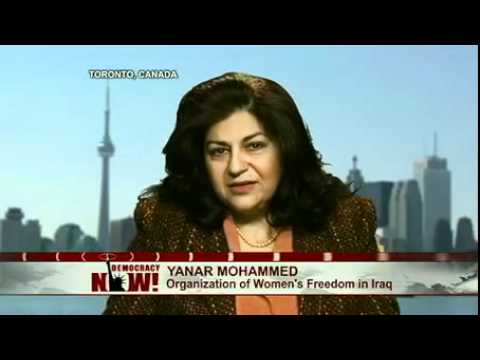
This is an older video still of Yanar Mohammed appearing on Democracy Now! She now lives and works in Iraq. The image is from here.

image of Arundhati Roy is from here
This post's links detail why 'First World'-only justice movements, for people in the First World, are anti-woman if they don't center the experiences of women around the world enduring injustices and horrors not generally experienced by privileged women, and men, in the First World.

For me, a white male from the misnamed First World, seeing images is going to be as bad as it gets. I won't endure the experience of holding a baby with horrifying birth defects, nor will I be a woman who lives in a country where these birth defects, rape, military invasion, and white, patriarchal, imperialist terrorism are, together, committed by the military from the U.S. I can suffer from seeing images and hearing stories, but that's quite different from being the terrorised, horrified person in them.

The U.S. war on Iraq began ten years ago this week. Democracy Now! has been reporting on this war's crimes against humanity, and what U.S. media will not tell us about it. We must, collectively, require accountability and justice from the U.S. for these war crimes.

http://www.democracynow.org/2013/3/20/dahr_jamail_returns_to_iraq_to

Here, Yanar Mohammed speaks about the atrocities facing women:

http://www.democracynow.org/2013/3/20/right_to_heal_iraqi_civilians_join

An excerpt of the transcript:
NERMEEN SHAIKH: And what do you see has happened in Iraq in these last 10 years?
YANAR MOHAMMED: It’s just getting worse. We are again in a police state. We have armies, police and all kinds of intelligence institutions around us. We have SWAT. We have anti-riot. It’s all kinds of security institutions around us.

And on top of that, I see the women in my country getting much weaker. I see an epidemic rise in certain kinds of birth defects. And when we try to organize women—we sent women from my organization to a town in Haweeja. We were surprised to see hundreds of children that had birth disabilities. We see things in Iraq that we’ve never seen in our lives.

I also see young women, orphans of war, female orphans of war, that are being trafficked. And the state absolutely has no obligation towards them. The young women who are being trafficked come to our organization and to our shelters. They don’t even have the right to citizenship in Iraq. We are speaking here about tens of thousands of orphans of war who are absolutely not being taken care of. Neither the Iraqi government nor the U.S. experts in Iraq do anything about it.

Here, Arundhati Roy speaks out about the complete psychosis of U.S. leaders in thinking things are better for women in Afghanistan now than ten-plus years ago:

http://www.democracynow.org/2013/3/18/arundhati_roy_on_iraq_wars_10th

Below is an excerpt from the transcript:
We are dealing with a psychopathic situation. And all of us, including myself, we can’t do anything but keep being reasonable, keep saying what needs to be said. But that doesn’t seem to help the situation, because, of course, as we know, after Iraq, there’s been Libya, there’s Syria, and the rhetoric of, you know, democracy versus radical Islam. When you look at the countries that were attacked, none of them were Wahhabi Islamic fundamentalist countries. Those ones are supported, financed by the U.S., so there is a real collusion between radical Islam and capitalism. What is going on is really a different kind of battle.
And, you know, most people are led up a path which keeps them busy. And in a way, all of us are being kept busy, while the real business at the heart of it—I mean, apart from the people who suffered during the war. Let’s not forget the sanctions. Let’s not forget Madeleine Albright saying that a million children dying in Iraq because of the sanctions was a hard price but worth it. I mean, she was the victim, it seems, of the sanctions; you know, her softness was called upon, and she had to brazen herself to do it. And today, you have the Democrats bombing Pakistan, destroying that country, too. So, just in this last decade, Afghanistan, Pakistan, Iraq, Libya, Syria—all these countries have been—have been shattered.
You know, we heard a lot about why—you know, the war in Afghanistan was fought for feminist reasons, and the Marines were really on this feminist mission. But today, all the women in all these countries have been driven back into medieval situations. Women who were liberated, women who were doctors and lawyers and poets and writers and—you know, pushed back into this Shia set against Sunnis. The U.S. is supporting al-Qaeda militias all over this region and pretending that it’s fighting Islam. So we are in a situation of—it is psychopathic.

Thursday, January 5, 2012

Yanar Mohammed on The War (Men's Against Women) In Iraq

photo of Yanar Mohammed with a male soldier is from here

What follows is an excerpt from an article I read at OpEdNew.com. For the whole article, please go *here*.

... Yanar Mohammed , founding director of the Organization of Women's Freedom in Iraq (OWFI), was interviewed on the state of Iraq as the American occupation ends.  She described Iraqi cities full of destroyed buildings and broken streets, with intermittent electricity and unsafe drinking water.  Iraq, she said, is now a country of 99% poor and 1% rich living in the Green Zone, burdened with the most corrupt government in the world that is giving control of oil resources to multinational oil companies.
Iraqi women "are the biggest losers" in this war, Mohammed asserted, ending up with extreme lack of freedom, lack of social security, lack of opportunity, and increased sexual terror.  Her organization has conducted extensive high-risk investigations into the prevalence and plight of Iraqi widows, women kidnapped and killed, and women trafficked into prostitution. Fifteen percent of Iraq's 1 to 2 million widows are seeking temporary marriages out of economic desperation and extreme insecurity in being a single woman. By 2006, OWFI had observed an "epidemic rise" in the number of women prostituted in brothels, workplaces, and hideouts in Baghdad. Through covert investigation, they learned of the trafficking of women within Iraq for Iraqi men in all regions and for US military, as well as to nearby countries.  Democracy in Iraq has been crushed for women. 
American women soldiers in Iraq were big losers, also.  Nearly 200,000 served there, in as dangerous situations as men.  Though barred from combat, they patrolled streets with machine guns, served as gunners on vehicles, dismantled explosives, driven trucks down bomb-ridden streets, and rescued the dead and injured in battle zones. These same women found themselves, concurrently, caught in a second, more damaging war - a private, preemptive one in the barracks.   As one female soldier put it, "They basically assume that because you are a girl in the Army, you're obligated to have sex with them."  Resisting sexual assault in the barracks spills over to battlefield, according to many women veterans, in the form of relentless verbal sexual harassment, punitive high-risk assignments, and the morbid sense that your back is not being watched. ...

Saturday, December 17, 2011

Yanar Mohammed on the On-going White and Male Supremacist Occupation of Iraq by the US: "This is not a democratic country." ... "Women are the biggest losers in all of this."

image of cartoon is from here

I am hearing arrogant and ridiculous reports in the US from media (owned by corporations that wish to control the minds of any who listen) that Iraq is now a sovereign state. We must ask: if Iraq had as much "presence" in the US, on US soil, would conservative racist/white supremacist white men in the US consider this a sovereign state? Doubtful. What we'd do in response to even a threat of such an occupation is amp up our racist/white supremacist campaigns against all people of color, wage more wars against Central Asia, and do so in the name of "freedom". The arrogance is also showing up in the brazenness of corporate media representatives admitting why US forces occupied and are still illegally and criminally in Iraq. (Not that the US media calls it a crime or a violation, mind you.)

Recently, NBC News, on a program called Rock Center, admitted in very clear language that the US is NOT leaving Iraq, and that many forces remain, including the CIA and other cover operations. (See *here* for more.)

When major corporate news sources admit, also, that the US went to war against the Iraqi people to occupy the country to protect unjust, criminal access to oil reserves there (as if the US has a right to all oil everywhere, and may stake out claims to it using the most blunt and horrific military force at will). But possession of oil and possession of land is all part of a larger struggle at global imperialism which, as you may know, is laid out in a plan concocted by the likes of Donald Rumsfeld--who you'll hear from later in this post--Paul Wolfowitz, and Dick Cheney. Each of those men should be in prison for life for crimes against humanity. For more on this blatantly white male supremacist/Western imperialist effort, see *here*.

What follows is from Democracy Now!, *here*.

Iraqi Women’s Activist Rebuffs U.S. Claims of a Freer Iraq: "This Is Not a Democratic Country"

Yanar_mohammed
Yanar Mohammed, president of the Organization of Women’s Freedom in Iraq, joins us to discuss the impact of the nearly nine-year U.S. occupation, particularly on Iraqi women. "The Iraqi cities are now much more destroyed than they were, I would say, like five years ago," Mohammed says. "In the same time, we have turned to a society of 99 percent poor and 1 percent rich, due to the policies that were imposed in Iraq." Mohammed decries the repression of Iraqi protesters that joined the Arab Spring in a February 25th action. "The women are the biggest loser in all of this. We went to the Iraqi squares. We demonstrated. The Arab Spring was there very strongly but got oppressed in ways that were new to Iraqi people. Anti-riot police of the American style was something that we witnessed there... This is not a democratic country." [includes rush transcript]

AMY GOODMAN: We wanted to also bring into this discussion Yanar Mohammed. She is president of the Organization of Women’s Freedom in Iraq. Usually in Iraq, she right now is joining us from Toronto.
Yanar, talk about this last more than eight years of the invasion and the occupation.
YANAR MOHAMMED: If I start with the basics, the Iraqi cities are now much more destroyed than they were, I would say, like five years ago. All the major buildings are still destroyed. If you drive in the streets of the capital, your car cannot survive more than one month, because all the streets are still broken. So there was no reconstruction for the buildings, for the cities.
And in the same time, we have turned to a society of 99 percent poor and 1 percent rich, due to the policies that were imposed in Iraq. While Iraq has more than one million widows—some of the counts say one million, some of the counts say two million widows—these widows try to survive on a salary of $150, and most of them cannot get this salary because they don’t have proper ID due to internal displacement. And in the same time, the 1 percent, who lives—of Iraqis, who lives in the Green Zone, they drown in a sea of money. And there was a scandal of losing $40 billion from the annual budget of the country, and nobody is accountable for it. So we have—after nine years, we have the most corrupt government in the world.
We are divided to a society of Shias, who are ruling, and Sunnis, who want to get divided from the country of Iraq. We are now on the verge of the division of country according to religions. And to ethnicities, it has already happened. We know that the Kurdish north is now a Kurdistan, the region of Kurdistan. And the constitution that we have in Iraq allows everybody to get divided or to get their autonomy. So now the Sunni parts of Iraq, they want to be their own agents. They don’t want to be part of the central government anymore. And in the same time, destruction is everywhere. Poverty is for all the people but the 1 percent who are living inside the Green Zone.
And I would like to add one thing. If President Obama wants to make it sound like one unified society, that’s not the true story. We are living in a huge military camp, where one million Iraqi men are recruited in the army. And on top of that, there’s almost 50,000 militia members, of the Sadr group and the other Islamist group, who are not only local militias, like army within the country, but they are now being exported to other countries to oppress the Arab Spring in Syria and maybe later on in other countries. We are not a united country, because the Islamic Republic of Iran, which is another country, has the upper hand in Iraq. And the decisions that were done lately about who stays from the Americans and who doesn’t stay inside Iraq was due to the pressure of the Islamic Republic of Iran. They are the decision makers in Iraq.
And the biggest loser out of all of this are the women. Now, by the constitution, there are articles that refer us to the Islamic sharia, when this was not in action in the times of the previous regime. Under Islamic sharia, women are worth half a man legally and one-quarter of a man socially in a marriage. And we still suffer under this. As a women’s organization, we daily meet women who are vulnerable to being bought and sold in the flesh market. We see widows who have no source of income, and nobody to get them IDs for themselves and their children, because they have been internally displaced. So poverty and discrimination against women has become the norm. And the government doesn’t care much about this. They talk about it a lot, but not much is being done about it. And—
JUAN GONZALEZ: Yanar, I’d like to ask you, on another matter, the—we had a quote earlier in the show from President Obama saying that, unlike historical empires of the past, the United States doesn’t go into countries for territory or resources, but because it’s right. Could you talk to us about what has happened to the resources of Iraq, to the oil of Iraq? To what degree now are American companies involved that they were not before the war?
YANAR MOHAMMED: In the last year, we were told that Iraq’s economy is going to be changing, and there’s going to be a new phase of investment. But in reality, those who were invited into the Green Zone were surprised to see that it’s all about privatization, that we have new foreign oil companies. Some of them are already functioning in the south, like British Petroleum, who have an oil field from which they are extracting oil.
They are beginning to—they have brought some foreign workers to work in there, and they have totally discriminatory workplaces where the foreigner is paid much more than the Iraqi. I was told that the foreigners are paid in the thousands of dollars monthly, while an Iraqi employees is paid something like $400. And even the workplaces are very discriminatory and racist, in the sense that the foreigner workers are treated much better than the Iraqi employees.
And the question is, how did they get these foreign oil companies to come into Iraq? Like British Petroleum is one of them. It has many oil fields. It’s functioning. It’s extracting Iraqi oil. On which terms? We, the Iraqi people, don’t know. On which agreement did they come and they are functioning fully in Iraq? We, the Iraqi people, don’t know.
And the question is, why is all the money being shared by the 1 percent who are ruling Iraq and the U.S. administration and all these multinational companies, while the Iraqi widows cannot even have $150 as a salary? Most of the widows we’ve met in our organization do not have one penny coming into their pockets. No government finds themselves accountable for the women of Iraq, who have been turned deprived because of this war.
And I would like to add one thing. There is a new generation of women and men in Iraq who are totally illiterate. You see a woman in her twenties. She might have children, or not, and that’s another story about the widows. But she has witnessed no schooling because of the sectarian war, because of the war on Iraq. It’s a generation of illiteracy in Iraq, while, before this war, you know, we know that Iraq in the 1980s, and even in the following years, it had the highest literacy rate in the Arab world.
And the last point I would like to add, and I would have liked you to ask me about it, is the Arab Spring, when it started in Iraq, specifically on the day of February 25. When the government held a curfew in all the Iraqi cities, especially in Baghdad, we had to walk three hours to reach to the Tahrir Square of Baghdad, and 25,000 people were in that square expressing their political will that this is not the political system that they want to rule them—the Islamist government of the Shia, who is oppressing all the others, the Sunni, who are oppressed in the west, the ethnic divisions on the people.
And mind you, the gender divisions? In the Tahrir Square of Baghdad, many of us women were there, and we were so respected. Nobody told us to put on the veil on, while in these days the prime minister’s office is spreading out policies that all the female workers in the public sector will have to wear decent dress code—decent as in respecting our culture. The prime minister is imposing a mentality of discriminating against women based on Islamic sharia, while the demonstrators of the Arab Spring in Iraq want an egalitarian society.
And one thing that this new democracy, so-called democracy, proved in Iraq is that they were the best in oppressing the Arab Spring in Iraq. They sent us police, army and anti-riot groups to shoot us with live ammunition in the Tahrir Square. They detained and they tortured hundreds and thousands of us demonstrators. And this is because we only led a free demonstration.
And this is not only one demonstration. All the Fridays since the beginning of February have witnessed demonstrations in the main squares of Iraq—Baghdad, Sulaymaniyah, Basra, Samarra, all of Baghdad. People went into the squares, and there were no slogans of asking for a religious government. The U.S. administration came into Iraq: it divided the Iraqi people according to religion, according to their sect, according to their ethnicity. It’s divide and conquer. And now the women are the biggest loser in all of this. We went to the Iraqi squares. We demonstrated. The Arab Spring was there very strongly but got oppressed in ways that were new to Iraqi people. Anti-riot police of the American style was something that we witnessed there. The big vehicles that sprayed us with the hot water, polluted water, pushed us out of these squares. And sound bombs were thrown at us, live ammunition, the full works. This is not a democratic country. And it is not united, because it’s being divided into Sunni, Shiite and Kurdish regions.
AMY GOODMAN: Yanar, I wanted to end by going back to the beginning, if you will, going back to 2003 to the words of then-Secretary of Defense Donald Rumsfeld after the fall of Baghdad.
DEFENSE SECRETARY DONALD RUMSFELD: Iraqis celebrating in the streets, riding American tanks, tearing down the statues of Saddam Hussein in the center of Baghdad, are breathtaking. Watching them, one cannot help but think of the fall of the Berlin Wall and the collapse of the Iron Curtain. We are seeing history unfold, events that will shape the course of a country, the fate of a people, and potentially the future of the region.
AMY GOODMAN: That was Donald Rumsfeld in 2003. Yanar, we have 30 seconds. Your final response?
YANAR MOHAMMED: I think that the victims and the parents of the victims of this war, the half-a-million dead of this war, were not invited to the celebration of the U.S. and the military in Baghdad. They should have been invited to give their say about this Iraqi war that left their families hungry and poor and really unable and helpless.
AMY GOODMAN: Yanar Mohammed, I want to thank you for being with us, president of the Organization of Women’s Freedom in Iraq.

Saturday, September 3, 2011

"Female Trafficking Soars in Iraq", by Rebecca Murray, with news from Yanar Mohammed

All that follows in this cross-post is from *here* at IPSNews.net.

Female Trafficking Soars in Iraq 
By Rebecca Murray

BAGHDAD, Aug 27, 2011 (IPS) - Rania was 16 years old when officials raped her during Saddam Hussein’s 1991 crackdown in Iraq’s Shia south. "My brothers were sentenced to death, and the price to stop this was to offer my body," she says.

Cast out for bringing ‘shame’ to her family, Rania ran away to Baghdad and soon fell into living and working in Baghdad’s red light district.

Prostitution and sex trafficking are epidemic in Iraq, where the violence of military occupation and sectarian strife have smashed national institutions, impoverished the population and torn apart families and neighbourhoods. Over 100,000 civilians have been killed and an estimated 4.4 million Iraqis displaced since 2003.

"Wars and conflicts, wherever they are fought, invariably usher in sickeningly high level of violence against women and girls," Amnesty International states.

Rania worked her way up as a sex trafficker’s deputy, collecting money from clients. "If I had four girls, and about 200 clients a day - it could be about 50 clients for each one of them," she explains.

Sex costs about 100 dollars a session now, Rania says. Many virgin teenage girls are sold for around 5,000 dollars, and trafficked to popular destinations like northern Iraq, Syria and the United Arab Emirates. Non-virgins are about half that price.

Girls who run away to escape domestic violence or forced marriage are the most vulnerable prey for men working for pimps in bus stations and taxi stands. Some girls are also sold into marriages by family relatives, only to be handed over to trafficking rings.

Most of Iraq’s sex traffickers are predominantly female, running squalid brothels in neighbourhoods like the decrepit Al-Battaween district in central Baghdad.

Six years ago, a raid by U.S. troops on Rania’s brothel brought her nefarious career to an abrupt end. The prostitutes were charged along with everyone else for abetting terrorism.

Imprisonment changed Rania’s life. While she served time in Baghdad’s Al-Kadimiyah lock-up – where more than half the female inmates serve time for prostitution – a local women’s support group befriended her. Today she works for them as an undercover researcher, drawing on her years of experience and connections to infiltrate brothels throughout Iraq.

"I deal with all these pimps and sex traffickers," Rania says, covered in black, with black, lacquered fingernails and gold bracelets. "I don’t tell them I’m an activist, I tell them I am a sex trafficker. This is the only way for me to get information. If they discover that I’m an activist I get killed."

In one harrowing experience, Rania and two other girls visited a house in Baghdad’s Al-Jihad district, where girls as young as 16 were held to cater exclusively to the U.S. military. The brothel’s owner told Rania that an Iraqi interpreter employed by the Americans served as the go-between, transporting girls to and from the U.S. airport base.

Rania’s co-workers covertly took photos of the captive teenagers with their mobile phones, but were caught. "One girl went crazy," Rania recalls. "She accused us of spying. I don’t know how we escaped," she exclaims. "We had to run away - barefoot!"

Before the Gulf War in 1991, Iraq enjoyed the highest female literacy rate across the Middle East, and more Iraqi women were employed in skilled professions, like medicine and education, than in any other country in the region.

Twenty years later Iraqi women experience a very different reality. Sharia law increasing dominates everyday life, with issues like marriage, divorce and honour crimes implemented outside of the court system, and adherence to state law.

"Many factors combined to promote the rise of sex trafficking and prostitution in the area," a Norwegian Church Aid report said last year.

"The US-led war and the chaos it has generated; the growing insecurity and lawlessness; corruption of authorities; the upsurge in religious extremism; economic hardship; marriage pressures; gender based violence and recurrent discrimination suffered by women; kidnappings of girls and women; the impunity of perpetrators of crimes, especially those against women; and the development of new technologies associated with the globalisation of the sex industry."

The International Organisation of Migration (IOM) estimates 800,000 humans are trafficked across borders annually, but statistics within Iraq are very difficult to pin down.

Although the Iraqi constitution deems trafficking illegal, there are no criminal laws that effectively prosecute offenders. Perversely, it is often the victims of trafficking and prostitution that are punished.

IOM is currently working with an inter-ministerial panel to lobby for a new reading of the revised counter-trafficking law, which has been stalled by the government since 2009.

"We have reports about trafficking both inside and out of Iraq," says senior deputy minister, Judge Asghar Al-Musawi, at the Ministry of Migration and Displacement.

"However, I admit that Iraqi government institutions are not mature enough to deal with this topic yet, as the departments are still in their growing phase."

Human Rights Watch (HRW) says the government has done little to combat the issue. "This is a phenomenon that wasn’t prevalent in 2003," says HRW researcher, Samer Muscati.

"We don’t have specific statistics. This is the first part to tackle the problem; we need to know how significant and widespread the problem is. This is something the government hasn’t been doing. It hasn’t monitored or cracked down on traffickers, and because of that there is this black hole in terms of information."

Zeina, 18, is an example of an invisible statistic. According to the local Organisation of Women’s Freedom in Iraq (OWFI), she was 13 when her grandfather sold her to a sex trafficker in Dubai for 6,000 dollars. She performed only oral sex with customers until a wealthy man paid 4,000 dollars to take her virginity for one night.

After four years of prostitution, Zeina finally escaped the United Arab Emirates and returned back to her parents in Baghdad. She approached the authorities and took her grandfather to court. However, Zeina has since disappeared. OWFI has learned she was sold again, this time by her mother to a sex trafficker in Erbil.

OWFI director Yanar Mohammed says her office has been threatened for their advocacy against the lucrative trafficking industry, especially reporting on an infamous brothel owner in Al-Battaween district known as Emam.

"In each house there are almost 45 women and it is such a chaotic scene where women get treated like a cheap meat market," describes Mohammed. "You step into the house and see women being exploited sexually, even not behind closed doors. So the woman who runs these houses makes an incredible income, and has a crew around her to protect what she does."

Emam is said to enjoy close ties with the Interior Ministry, and has never had one of her four houses shut down. Despite OWFI’s expose, her operations are unaffected.

Mohammed sighs. "Iraq has a whole generation of women who are in their teens now, whose bodies have been turned into battlefields from criminal ideologies." (END)
 

Friday, August 26, 2011

Feminist Action Alert: Please Read this Report and Sign a Petition to Support Women's Rights Activists In Iraq

AWID Logo
image is from here

What follows is from *here* and is cross-posted at this blog for the purposes of garnering more support and securing more safety and freedom for Yanar Mohammed and other revolutionary feminist activists in Iraq. With great thanks to Yanar Mohammed, to AWID, to trust.org, and to Amanda Shaw.


Warning: the news below is both grim and graphic.

Realistic hope for change comes with sustained (and reported) organising and other actions of resistance and revolution. Prayers and power for all women in Iraq and to the women in any country where US and NATO military forces are occupying, committing gynocidal atrocities that are not reported at all in Western Patriarchal Corporate media. Please take a moment to sign the petition linked to at the end of the body of this report.

You may also link back by clicking on the title below. 

The Word on Women - The Other Tahrir Square: Attacks Continue On Women Human Rights Defenders In Iraq

By AWID Friday Files | 6 hour(s) ago | Comments ( 0 )
By Amanda Shaw
Women have been at the forefront of demonstrations across the Middle East and North Africa (MENA) in the recent popular uprisings, which have received much media and international attention. In contrast, coverage of attacks on women human rights defenders (WHRDs) in Iraq’s Tahrir Square demonstrations has been limited, AWID asks why.
On the frontlines of demonstrations or behind the scenes as tech-savvy organizers, women have played pivotal roles in the recent democratic revolutions and uprisings in the MENA region. Women’s activism and organizing in Tunisia, Egypt, Bahrain, Yemen and Libya has garnered substantial international attention. Yet in spite of several attacks, including sexual assaults, on Iraqi women activists and their organizations since February, women’s roles in Iraq’s Tahrir Square demonstrations have generated less media coverage. And the violence against them has intensified since June, one of the deadliest months so far in 2011 for Iraqis.
The Organization for Women’s Freedom in Iraq (OWFI) is one of the leaders of Iraq’s Tahrir Square demonstrations, helping to organize youth activists and advocating for women’s rights. AWID takes a look at OWFI’s work, the situation of women human rights defenders (WHRDs) in Iraq and asks why the other Tahrir Square is receiving so little international attention.
Women’s Rights and Women Human Rights Defenders in Iraq
Since the U.S. Invasion in 2003, hundreds of thousands of Iraqi civilians have died as a result of the conflict, nearly 4.8 million have been forcefully displaced and almost 750,000 women widowed. Even before the invasion, and as a result of years of economic sanctions and war, Iraqis experienced high rates of violence, displacement, exile, widowhood, unemployment and illiteracy. Today, Iraqi women face violence from all sides: from armies and security forces, sectarian and tribal leaders as well as from private security contractors unaccountable to international law.[1]
Different political factions including opposition and resistance movements have also tended to target women and gender relations in their political projects, whether through physical violence or legislation.[2] According to OWFI’s 2010 Annual Report, women in Iraq experience gender-specific forms of violence that include so-called ‘honour’-based violence, trafficking, violence toward women accused of prostitution, being unveiled, and wearing makeup.[3]
It is within this context of militarization, religious, sectarian and political fragmentation, widespread violence (including various forms of violence against women) and increasingly conservative visions of gender relations that Iraqi WHRDs organize. They face the same denial of civil and political rights as all citizens – including those of peaceful assembly, association, expression and the right to life and security – but with gender-specific consequences.[4] Some Iraqi WHRDs take part in mixed human rights groups or social movements, while others denounce the disappearance of family members  or work directly on women’s rights agendas.
The context of the invasion and occupation of Iraq by foreign troops has led to a particularly problematic dynamic for those working on women’s rights who may be labelled “western” or “traitorous” for their work, which may also be seen by some Islamists as associated with the supposedly secular agenda of the Saddam Hussein regime.[5] Given this difficult context, Iraqi WHRDs may be forced to abandon their political activities, go into exile or focus instead on surviving and caring for family members.
But in spite of these enormous challenges, Iraqi WHRDs continue their work in addressing violence, resisting militarism and organizing for democratic change. Some of the major achievements of the Iraqi women’s movements include campaigns against a discriminatory law governing marriage, divorce and child custody and limiting the constitutional role of Islam, lobbying for gender quotas in political representation as well as working to ensure legislation complies with international conventions such as the Convention on the Elimination of All Forms of Discrimination Against Women (CEDAW).[6]
The Other Tahrir Square
Since 2010’s inconclusive elections, the Iraqi coalition government has been plagued by infighting and financial scandals, while many Iraqis still lack basic services and employment opportunities are few.[7] Inspired in part by events elsewhere in the region, Iraqi citizens have gathered every Friday since February in Baghdad’s own Tahrir Square to protest corruption, poor government and basic services, high unemployment and lack of freedom of expression.
Authorities have responded harshly, banning street demonstrations and attempting to confine large gatherings to football stadiums.[8] As a result, there have been a number of clashes between pro-democracy demonstrators on the one hand and security forces and pro-government demonstrators on the other, resulting in the deaths of at least 125 people, hundreds wounded and the arrest and detention of dozens of activists.[9] Among the activists who have been attacked are several associated with OWFI, which has played a key role and helped to increase women’s visibility in the square demonstrations.
OWFI’s current president, Yanar Mohammed, co-founded the organization during the 2003 U.S. invasion by putting up a sign reading “Women’s Freedom in Iraq” in a burned out bank in Baghdad. OWFI advocates for change in the structures that allow violence against women to be perpetrated with impunity, implementing programs that strengthen women’s political participation and promote freedom from violence. They have established an underground network of safe houses for women escaping violence, advocate for women in prison, organize against sexual trafficking and run a newspaper and radio station. Since its original three members, the size of the organization has grown or shrunk depending on the country’s security situation; OWFI currently has almost 60 activists, hundreds of supporters in person and online and is active in four cities in central, western and southern Iraq.
Targeting OWFI and other Iraqi Activists
Since the Friday Tahrir Square demonstrations began in February of this year, OWFI activists have experienced violent and sexualized attacks, intimidation and harassment preventing them from carrying out their work. There have also been reprisals against their youth allies, including detentions and kidnappings. In an interview posted on the organization’s website, OWFI President, Yanar Mohammed, cites their work in organizing the youth at Tahrir Square as being one of the main reasons why OWFI activists have been targeted.
On Friday June 10th, after the expiration of a one-hundred-day deadline, set by Prime Minister Nouri Al-Maliki for improving basic services, demonstrators gathered because there were no noticeable changes in the provision of electricity, water, jobs, or in ending corruption. At this demonstration, four women from OWFI’s 25-member delegation were attacked, sexually assaulted and beaten by pro-government demonstrators who destroyed their banners, beat them with wooden sticks, and groped their bodies. The attack was seen by OWFI as an attempt to shame the activists in public space.
OWFI activists met in the first week of July to discuss a strategy in the face of this violence, and on July 8th, a bus full of female activists and some youth supporters returned to Tahrir Square with banners reading “Beating of Tahrir Women Increased Our Determination for Change,” and “Instead of fulfilling the promise of the hundred days, they released their thugs on us”.[10] Activists Jannat Basim, Aya Al Lami, and Yanar Mohammed were interviewed by the media and used a megaphone to announce their determination to continue challenging the authorities in spite of repression. But as the delegation left the square, pro-government supporters intimidated and physically attacked youth activists that were accompanying the OWFI delegation, surrounded their bus and attacked the activists through the doors and windows. One youth supporter was kidnapped and later released. Only when foreign journalists were called to the scene did the pro-government supporters abate.
U.S.-based women’s rights organization MADRE has described repression against OWFI as “an attempt to terrorize women who have been the catalysts for demonstrations that call for a new Iraq.” As Yanar Mohammed describes in a MADRE Interview “when the humiliation is sexual, in a society like Iraq, they know it will break the women.”
The Role of International Solidarity
The mainstream media has largely ignored these events and the recent upsurge in violence in Iraq, some citing readers’ “Iraq fatigue” to justify their lack of coverage.[11] According to Yanar Mohammed, media coverage plays an essential role in helping to protect women human rights defenders, “if you are an outspoken feminist in Iraq these days and you are demonstrating in Tahrir Square, you have actually no protection. So media [coverage] is the best protection.” Moreover, international solidarity efforts – campaigns and other forms of calling attention to the work of WHRDs – are made all the more challenging by the complex terrain of an Iraq overwhelmed by foreign intervention. At the same time, Mohammed marks an important distinction:
“Even if the U.S. intervention that happened before – the military intervention – has destroyed our lives, we need a civilian intervention now. We need the American people to support and empower us again so we can take matters into our own hands and hold free elections." [12]
Indeed, broad-based international (and not just U.S.) solidarity with Iraqi WHRDs remains important in helping them continue their work. As female activists occupy center stage elsewhere in the region’s democratic revolutions and uprisings, the activists in Iraq’s Tahrir Square should also be counted among them.
Sign the MADRE petition condemning the attacks on OWFI and other activists here.
Notes:
1. http://www.globalfundforwomen.org/impact/success-stories/153/1827-impact-of-militarism-on-women-in-the-middle-east-a-north-africa
2. Al-Ali, N. and Pratt, N. (2008) “Women’s organizing and the conflict in Iraq since 2003” Feminist Review 88, pg. 74-85. Pg. 75.
3. OWFI Annual Report, 2010.
4. Ibid.
5. Al-Ali, N. and Pratt, N. pg. 81.
6. Al-Ali, N. and Pratt, N. Pg. 76.
7. http://www.npr.org/2011/07/11/137771025/dispute-over-key-jobs-stalls-iraqs-government
8. http://www.hrw.org/en/news/2011/04/21/iraq-widening-crackdown-protests
9. http://edition.cnn.com/2011/WORLD/meast/07/08/iraq.protest/
10. Personal Communication, Yanar Mohammed, 20 July 2011.
11. http://www.newstatesman.com/blogs/the-staggers/2011/07/iraq-iran-largely-term-media
12. http://msmagazine.com/blog/blog/2011/06/13/iraqi-feminists-sexually-assaulted-during-pro-democracy-protests/

Tuesday, March 8, 2011

Happy 100th International Women's Day! Celebrate! And please support MADRE and activist sisters around the world!

image is from here
What follows is from *here*.

MADRE News

Happy International Women's Day!

Posted on: Tuesday, March 8, 2011
For 100 years, women worldwide have demonstrated for their rights every March 8.
In honor of this 100th International Women’s Day, MADRE is mobilizing 100 people to each give $100 to help secure the rights that women have won over the last century.

We want you to be a part of this campaign to celebrate the past and shape the future by propelling the gains of the global women’s movement into the next century. 

Despite our many achievements, women’s voices are still too often ignored by world leaders.
We want women like Malya Villard-Appolon of our sister organization in Haiti to be heard when she denounces the epidemic of rape in the displacement camps. We want women like Sandra Gonzalez of our sister organization in Guatemala to be heard when she condemns violations of women’s labor rights in sweatshops. We want women like Yanar Mohammed of our sister organization in Iraq to be heard when she sounds the call for democracy and women’s rights in her country.

You can help Malya, Sandra, Yanar and other MADRE partners raise their voices as they work for justice and human rights.
Click here to donate.
The $100 you raise or donate helps MADRE to:  
  • Give women community-based activists the training they need to participate effectively in political processes—from local government all the way to the United Nations.
  • Create popular versions of legal texts so that international law can be a powerful tool in the hands of women at the community level.
  • Advocate at the United Nations and within governments for local women’s organizations to have a seat at the table when policies are being made that impact their lives.

As we amplify our sisters’ voices, we want to amplify your voice, too.

When you raise or donate $100 this month, you will have the opportunity to send a message of support and connect directly with one of our partners: Malya Villard-Appolon in Haiti, Sandra Gonzalez in Guatemala, Yanar Mohammed in Iraq or Fatima Ahmed in Sudan.  These are women who, with MADRE’s support, have helped change the course of international debate on women’s human rights issues.
There is no better time to help amplify their voices than this 100th International Women’s Day.
IWD2011 MalyaIn June 2010, Malya Villard-Appolon, MADRE partner and women's rights activist from Haiti testified before the UN Human Rights Council in Geneva.  She spoke about her experience as a woman living in a camp for displaced people and about the devastating levels of sexual violence she has witnessed in the camp. She spoke about the life-saving work she helped lead through KOFAVIV, a grassroots women’s group that provides urgent care to rape survivors. Malya’s courageous testimony helped galvanize support for a groundbreaking legal decision upholding the rights of women in Haiti.

IWD2011 sandra
In December 2009, the UN launched a Latin American regional initiative, to combat violence against women. MADRE partner Sandra Gonzalez of Guatemala spoke at the launch of this campaign about violence against women sweatshop workers. Sandra has done more than just document labor and human rights violations. Her organization, the Women Workers Committee, has built a community for women workers and provides them with opportunities for empowerment through literacy classes, health fairs and sexual rights trainings.

IWD2011 yanar
 Yanar Mohammed co-founded the Organization of Women’s Freedom in Iraq (OWFI) after the US invasion in 2003. She set up a series of shelters that served as an underground railroad for women escaping the violence and death threats that escalated dramatically during the occupation. In March 2010, she traveled to UN headquarters for a major gathering on women’s human rights to demand global action to protect women. Now, she is a leading voice among the protestors demanding real democracy in Iraq.

IWD 2011 Fatima
 In December 2009, Fatima Ahmed, the head of our partner organization in Sudan, Zenab for Women in Development, attended the UN Climate Conference in Copenhagen.  She told hundreds of government representatives and civil society activists that smallholder women farmers must be an integral part of our global response to climate change. Then she went home to continue to lead the first ever women farmers union in Sudan, and make sure that the women have the training and resources they need to adapt to climate change.

These are some of the voices you support by being part of our campaign to raise $100 from 100 people in honor of 100 years of International Women’s Day.  

Join the campaign today.

Friday, March 4, 2011

Yanar Mohammed Reports on the Protests and Revolutions for Freedom


image is from here

All that follows is from MADRE News website, *here*.


The Day of Iraqi Rage

Posted on: Thursday, March 3, 2011
Keywords: Iraq, Middle East
We just received the following update from Yanar Mohammed, the director of our partner organization in Iraq, the Organization of Women's Freedom in Iraq (OWFI). She writes about the spread of demonstrations from the wider region into Iraqi cities and about the violent tactics that Iraqi security forces are using against protestors.


Last Friday, February 25, was a historic day in Iraq. The revolution earthquakes in Egypt, Tunisia, and Libya sent shockwaves in our direction.

(Photo at left: Yanar Mohammed, OWFI Director)The main squares of most Iraqi cities were filled with protestors raising the same demands of providing electricity, employment, an end to governmental corruption, and a plea for general freedoms.

Although the government announced a curfew and closed all streets from vehicular movement, and the highest religious clerics discouraged the people from protesting, almost 70,000 people gathered in the main squares in all of Iraq, united around their main demands.

For the first time in eight years, the demonstration united people of different religions, ethnicities, sects, and political affiliations to denounce the extreme and continuous corruption and demand a share for the people in the countries resources from oil.

OWFI plays a role in the political participation of women within movements for national freedoms and liberties in Iraq. Although our numbers are small when compared to the huge demonstrating masses, the purpose was to help organize some of the freedom-loving youth groups which had started from facebook, but grew and multiplied in February. OWFI was one of the organizers of the demonstrations in Baghdad and Samarra raising slogans of change, right to work, and of course, equality.

--------

Al Tahrir Demonstration in Baghdad

Although the demo was announced as a peaceful one, the security forces ended it at 5pm by throwing sound bombs, splashing hot water, shooting plastic bullets, and live bullets at the demonstrators.

When we would not move, but chant slogans of relentless struggle, the security trucks began to drive down the square to chase and shoot us with live bullets, and beat up many of the demonstrators who fled into the alleys surrounding Al Tahrir square. One of our male supporters was shot in the knee, while two others were beaten by the US-trained anti-riot police and the Iraqi army. Almost 20 people were shot in that day around the square, although the announced numbers were much less. Some died while the wounded were detained.

For those of us who ran to safety, we had to walk 5 hours in order to reach our homes in streets where cars were not allowed to drive.

-----

In the western city of Samarra, OWFI women and men were leading the demonstrators, and raising banners demanding support for the widows who are a majority among the women of Samarra. It was a precedent for a tribal community protest to be led by women.

At the same time in most Iraqi cities, the army shot the demonstrators in the evening, attempting to disperse the demonstrators. 7 were killed in this city, while 15 were wounded.

-----

Demonstrations happened in parallel in the Kurdish North and the South, making it clear that nobody cared for the artificially created division lines of sunni, shia, Arab, Kurd, Turkmen, etc… It was a day of a unified struggle against corruption, oppression, basic rights and freedoms.

-----

While most demonstrating groups carried banners demanding reform of the government, the shooting and harassment of the demonstrators by anti-riot police and by the army shifted the slogans toward ones which rejected the oppressive measures.

------

OWFI had carried the banner of "change" since the beginning of the demonstration, and advised groups of cooperating youth demonstrators to do the same. The opposition media picked up the slogan and announced it on local TVs:"…that OWFI activist Yanar Mohammed will demand (Change) in the coming demonstration next Friday."

------

We are organizing for the coming Friday, hoping that the streets will be open, and that the army will let us into Al Tahrir square after 30 hours from now.


Wish us good luck,
Yanar Mohammed

Photos:


[Yanar also sent the videos below with this note: "please take a look at the short video clips we took of the demonstration before the shooting. We were still smiling as the shooting had not begun."]

You Can't Inspire, Sustain, or Spell Revolution Without LOVE

photo of James Baldwin is from here

photo of Audre Lorde is from here

photo of Andrea Dworkin is from here

What follows is written with gratitude and love to James Baldwin (August 2, 1924 – December 1, 1987), Audre Lorde (February 18, 1934 – November 17, 1992), Andrea Dworkin (September 26, 1946 – April 9, 2005), and Chrystos (born November 7, 1946), whose photo appears below.

And to She who speaks wisdom, whether I listen to Her or not.

One my deepest frustrations about white and male people--including myself--is our inability or unwillingness to ground our political actions in radical love. Radical politics must have a root spiritual base, because the struggles will always been more challenging than we can endure. And so we need forces beyond our individual selves to access when we are feeling or are beaten down.

photo of Malalai Joya is from here
photo of Yanar Mohammed is from here
photo of Vandana Shiva is from here
I've seen revolutionary activists who act with love. Malalai Joya and Yanar Mohammed are among them. So too is Vandana Shiva. I call upon the love found in the work of James Baldwin, Audre Lorde, and Audrea Dworkin; I keep their spirits and their work in my heart. They transformed rage into a deep loving regard for humanity. It was still rageful, at times, but not without love as its base. I'm not saying they didn't hurt, exploit, or abuse anyone. I know better. But in their life-long radical political practice, they made sure to keep a profound respect and deep regard for humanity as a foundational revolutionary value.

Sometimes I wonder if part of the pact whites and men make in order to maintain their whiteness and manhood (or whatever I, as intergender, hold in myself) is that we give up our capacity to love, deeply, radically, and in ways that will support and sustain revolutionary action. Because what I see is that we whites, for example, too often use disagreement as a way to disconnect. And there's too little love to be found in the oppressive institutions we passively and actively support.

There will always be compelling reasons to part company. And we will always have reasons to turn away from one another, in hurt, in anger, while triggered, when too tired to speak what needs to be said to move forward towards healing. But we cannot afford to not move forward, more deeply into ourselves, in community, if we are to create a movement that can resist the forces of the white Master. When we are using  and holding tight to all the most anti-humane tools of the white Master, we can be sure he will continue to rule our lives and destroy the lives of those of us with fewer privileges and dominant social visibility.

In North and Central America, African American, Caribbean, Latina, Asian, and Indigenous women are systematically disappearing without regard or notice from whites and men. This gross human destruction is due, often enough, to men's and whites' violence and our refusal to join forces with Black and Brown women globally to intervene and stop the atrocities which appear in many forms.

Girls and women across ethnicity are incested, battered, raped, trafficked, and enslaved by men--of all races. Why do men, collectively, care so little about this? Is it really because men need some women to be tortured and terrorised, exploited and violated, in order to have a good life as men define it?

This is not to say that people of color have some God/dess-given ability to love. To survive being oppressed and abused, we often absorb society's messages about us, too often open- or close-hand delivered by our alleged loved ones--family members and people in our communities. This lack of love may be delivered with looks and tones of voice that lack compassion, care, regard, and respect. And internalised oppression and self-hatred are viciously successful means through which the oppressor maintains his rule.

But class and race privileged do make disconnection into a kind of sign of righteousness, I find. I see that in the white blogosphere, and offline also. If you're REALLY radical, you'll shut up, shut down, or shut out those who disagree with you. You'll cut people out of your life so swiftly because, well, you can afford to do so.

I know from some of the women of color in my life that this "deleting" of people is a luxury many women of color cannot afford. To cut people out is, often enough, to be entirely without support--however uneven that support is. And with no friends there is also no institutional support. In a society that is founded on your invisibility or that requires your slavery, imprisonment, destruction, or death, without human contact there isn't much else. There's no summer home with a room of one's own in which to write and gaze out at the sea. There's no police force that isn't terroristic. There's no court system that wants to see you and justice meet. Every white-man-made institution is designed to make women of color do the hardest work of all people for the benefit of the very few who do not ever have to work so hard, collectively. Exhaustion and exasperation doesn't make love easy.

So why is it that whites and men are so versed in uncompassionate action when we are disproportionately cared for and about by other people? When we have more social resources with which to take care of ourselves? When we make all kinds of pacts to stick together when challenged by women of color but not so much when we challenge each other?

Watching the news, seeing the revolutionary struggles that have been occurring with amazing bravery and compassion for one's citizens being oppressed, I am reminded of how much love is missing from the more privileged classes of people who might join forces with the most disenfranchised among us.

I'll pray to the Goddess that somehow, She will lead us to each other across difference, across disagreement, and across the divides that become chasms and mass graves most often for those of us who are neither white nor male.
photo of Chrystos is from here

Chrystos once said to me, after an embrace, "Make beautiful things."

Disrespect and disharmony aren't all that beautiful, are they? While honesty requires telling truths that can be unintentionally hurtful, it ought not require any willfully harmful action. Goddess help me understand the difference, with what I do and what I receive that others do.

Goddess be with me and help me through my triggered states of being. Goddess bless me, and those working for a better, more beautiful world. Goddess inform my choices about how to act towards my enemies, my friends, and all our relations.

Friday, December 3, 2010

Why Isn't Anderson Cooper REALLY Keeping Them Honest?? Because U.S. Billionaires With Corporate Welfare Protections and UNTAXED Foreign Bank Accounts and Other Billionaire Corporate Pimps Control The Media

image is from here
To Anderson Cooper,

I see you as one of very few voices in media who might be willing to tell the truth to the U.S. American people. I hope you have the integrity and corporate backing to do that, but I doubt you have the latter even if you do have the former.

Why don't you keep them honest and keep us informed about how the richest U.S. citizens are protected from paying their fair share of taxes? Why don't you report on how corporate loopholes still exist, how foreign bank accounts exist, and how much U.S.-earned money is siphoned off and stashed there by the richest U.S. Americans? And how that money only goes to the families of the wealthiest citizens due to corrupt inheritance laws--it doesn't go into the economy generally.

Why don't you report on how the discussion about the rich only wanting what is "fair for all Americans" is a sick joke? Why don't you, someone with professional and economic clout, call out the richest of the rich on the fact that they don't and never had paid all they should for the money they earn, and how funds siphoned off into foreign bank accounts--notably in Switzerland and the Cayman Islands, are not being re-invested to make this economy "strong-like-bull", as the most rich, their politicians, and their media shills report?

Why did you allow a segment of non-news reporting, a pseudo-debate between a white Conservative woman and a Black Liberal man to go unchallenged in follow-up reports? Why don't you stop wasting media time with such spectacular nonsense and instead hold uber-wealthy white men accountable to their repeated self-serving media lies about what it will take to balance the budget and end the federal deficit and national debt?

Why don't you note that if the U.S. had simply not engaged in two utterly corrupt wars for the better part of a decade--those in Iraq where there were no weapons of mass destruction, and in Afghanistan, where Osama bin Laden doesn't live, we would have a very different economic reality now? I hear tell that Karzai and his cronies are not responsible people. Why, then, does the U.S. government do business with him? How fucked up is that? What sort of waste of tax payers' dollars is that?

Why don't you spend a week, or two weeks, or three weeks, of programming on AC360 and in CNN special reports, interviewing no one else but Malalai Joya and RAWA, Yanar Mohammed of Women's Freedom in Iraq, Dr. Vandana Shiva of Navdanya, Ruchira Gupta of Apne Aap, and one of your own CNN Heroes, Anuradha Koirala of Maiti Nepal, about the bloody dots that your program thus far refuses to connect? Is it really beyond your scope to note the many connections between Western conglomerated media and how it silences women like those named above, U.S. militarism and its corruption, ecocidal environmental practices like those of BP and ExxonMobil, the exploitation of the Global South by the Global North, and sexual trafficking and slavery? Does the U.S. public have a right to hear from these women or not? Are you worried about allowing that depth of keeping the U.S. government and military honest on your program? Would you be fired the next day if you allowed those two women to speak honestly?

Why don't you do a series of reports on how the economic system is set up to protect the interests of the wealthy and punish and destroy the poor, in part by making poor youth vulnerable to being trafficked, pimped, and repeatedly raped for the pleasure and profit of very rich white men, primarily, not, as your reports indicate, for the profit going to street criminals and street pimps?


Why don't you note that if major corporations, alone, paid what they should, we wouldn't need to tax the working poor, the working class, or the middle class at all? Why don't you note how much of all the wealth, all the income made in the last ten years went to the top one percent of the richest people in the U.S.? Why don't you note, for example, that at least 80+% of ALL income was earned by the top few percent of people in this country and that should tax breaks happen for those earning less than $250,000/year and people earning $500,000 or more a year have to pay more, that will not hurt our economy or the rich AT ALL. Why don't you call it out that when the rich speak of doing what's fair, that there's nothing fair, moral, decent, or humane about what they do? They work a system organised by them and for them. Wall Street and the Rich are protected by a DADT foreign banking and corporate headquartering system that is about as dishonest, immoral, and corrupt as it gets. The IRS has a flimsy DADT policy with those uber-rich U.S. Americans and we all know it. Where's the economic "fairness" in the top five percent of U.S. Americans HOARDING the money people make in this country?

I await your reporting during your five hours of programming a week, on these and related issues. And stop wasting our time with ridiculist-worthy nonsense like this pseudo-debate "TAX CUT SHOWDOWN: GOP, Dems battle over Bush-era tax rates". A waste of media space NON-Discussion with Cornell Belcher and Dana Loesch. Anderson, why didn't you call out Ms. Loesch for being a racist/classist media shill for super-rich white boys (and a few white girls too)? Why did you even allow her onto your program? So we could watch the fireworks in this completely uninformative "debate"? Shame on you for allowing that anti-journalistic CRAP to air.
image from Dec. 1, 2010 AC360 program, is from here

Please, Anderson, at the very least, connect the economic, social, and political dots between these two stories:
 
December 1st, 2010
02:37 PM ET
Hoyer to allow vote Thursday on middle class tax cuts

By: CNN Congressional Producers Deirdre Walsh and Evan Glass

Washington (CNN) – On the same day Congressional and White House negotiators met to broker a compromise on how to deal with the Bush-era tax cuts that are expiring at the end of the year, House Majority Leader Steny Hoyer announced that House Democrats would push ahead on a vote Thursday to permanently extend tax breaks just for those making $250,000 a year or less. Republicans argue tax cuts should be extended for everyone, including the wealthy.

Hoyer said the House bill would include permanent extensions of income tax rates for the middle class, plus tax breaks for married couples, the child tax credit, and the earned income tax credit.

The Maryland Democrat insisted that there was common ground between Republicans and Democrats on ensuring there are no tax increases for people making $250,000 or less and cited several polls showing the American public supports this approach. "We have agreement on that. There is not agreement on other aspects of issue, as you all know. But it is a shame that what we have agreement on is being held hostage by that on which we do not have agreement."

Hoyer maintained that moving forward with just a vote on the so-called middle class tax cuts would not interfere with the negotiations on the broader tax cuts, telling reporters Wednesday he spoke with the House Democratic negotiator in the talks, Maryland Democratic Rep Chris Van Hollen. "He and I both agree that this matter moving forward should not undermine negotiations on a compromise," Hoyer said.

Outgoing House Speaker Nancy Pelosi told CNN the vote was always part of the Democrats' plans and was intended to press the importance of their policy stand.

"To show our position very clearly that Democrats support tax cuts for the middle class. We think it is fairer thing to do and is necessary at this time in our economy," Pelosi said.

Hoyer emphasized that Democrats are following through on a commitment to avoid tax increases on the middle class. Republicans, he said, are the ones who decided in 2001 to let the tax cuts expire this year. "It is an effort to show, as we said before the election, that we were going to make sure the middle income working men and women of America did not have the consequences of the Republican sunset."

House GOP Whip Eric Cantor said in a statement the Democrats' plan is a "non-starter, and is completely contrary to the discussions that we had with the President yesterday at the White House. This is nothing more than political chicanery and undermines the President's ongoing discussions and efforts on tax rates."


Cantor said the tax cuts should be extended for everyone.


"We call on Speaker Pelosi and President Obama to stop the gimmicks and allow all members of the House – Republican and Democrat – to vote on legislation that would prevent tax increases for every American, "he said.

(Julian's note to Eric Cantor: why don't you own your own constituency's chicanery and gimmicks, such as corporate welfare loopholes and allowing foreign bank accounts to be untouched by the IRS? Whip those forms of corruption, why don't ya?)

*          *          *


CNN Producer's Notebook: Surviving slavery

Posted: December 2nd, 2010 05:10 PM ET

Alexandra Poolos
AC360° Editorial Producer

Editor's Note: For more on this story, don't miss a special "AC360°" series, "American Slaves: Hiding in Plain Sight," tonight at 10 ET on CNN.


(CNN) - It all started with a random phone call early last summer.

Bridgette Carr, a leading attorney on trafficking cases, and I had worked together previously, and I wanted to see whether she was working on any interesting cases. Experts like Carr say that there are more slaves now than ever before. Worldwide, currently there are an estimated 12.3 million people enslaved. But last year, across the globe, only some 49,000 were rescued.

Carr hesitated for a moment on the phone before describing a case that involved dozens of young girls enslaved in Newark hair braiding salons that had taken three years to prosecute. Like many attorneys and activists who work with slavery victims, Carr is extremely protective of her clients. But she felt it was important to see how interested they might be in talking with AC360°.

Related: Held as slaves, now free

The response was startling. Two of the girls, who chose not to reveal their real names, said they wanted to talk, as long as we could protect their identities and locations. The young women were very clear about their reasons for talking: Both felt it was important for Americans to know that slavery is happening in front of their very eyes.

“I just want to help other people who might be in the same situation as I was,” “Jacqueline” told me over the phone, describing the years of abuse, back-breaking work in salons, withheld meals and loss of hope that she would ever be free. “What happened to me years ago still hurts me in so many ways…but slavery is around us. And you have to recognize it. When you see a little girl doing something and they are too young for it, [you] should do something. I think of all the people who asked me how young I was, and they just believed me. They could have done something. They could have saved me.”

“Nicole” echoed the same disbelief that after years of braiding hair everyday, no one went to the authorities or questioned their made up stories of not being underage. She said that everyday she hoped a customer or one of the many owners, who had unwittingly hired them not realizing their wages were being confiscated, would notice something was wrong. “At first when the police got us, I realized that we weren’t the first,” Nicole said. “It felt like this was hidden to people in the U.S. We were there for so long. It [took] forever for us to be rescued.”

Despite their conviction that Americans should hear their stories, both girls were frightened to talk to us. The head trafficker had been sentenced to 27 years in prison, but still Nicole and Jacqueline didn’t want their locations disclosed. The closer we got to the taping date, the more anxious they became. At one point, both pulled out, saying that they would only do the interview if their faces were concealed. “I have had victims’ cars bombed for this kind of stuff,” Carr told me over the phone.

Eventually, Nicole agreed to take the risk and appear on-camera. Jacqueline felt the danger was too high. When we met both of the young women, however, they told their stories bravely and eloquently. “The traffickers, they took my childhood from me, my teen-hood. They took it from me,” Nicole said. “They took everything away from me.”

In the process of reporting, another victim named Zena came forward. She took us on a tour of the Newark neighborhood, showing us the apartments were she had been enslaved and the salons where she had worked seven days a week, sometimes 14 hours a day. “Sometimes I cry,” she said. “It's not - it was not easy living in this house. I was just stuck, and I was in prison.”

The most inspiring part of these interviews was the resilience and courage each of the survivors showed. All three of the girls have moved on with their lives - securing jobs and making plans for college.

Despite the fact that all three lived a nightmare for years, each is determined not to allow the traffickers to steal their dreams. “I have found my dreams again,” Jacqueline told us. “I just want to help other people who might be in the same situation as I was. I realize now I can do something with my life. I am smart. All the years that she took from me, I am getting them back. I have told my story before, and each time it makes me stronger. I know that every obstacle that comes my way, I know I can overcome them.”

And readers of this blog, please write in at the Live Blog for Anderson's program, and let him know which rich pimps he could be reporting on if he's truly interested in keeping them honest.

Here's your chance to talk directly to AC360° during the program. Send instant feedback and sound off on tonight's headlines. Read and react to what viewers have to say, right here, right now.
JOIN AC360° LIVE BLOG: 10p-11p ET