Showing posts with label feminism. Show all posts

Saturday, May 2, 2026

The Tragic Assassination of Yanar Mohammed (25 November 1960 – 2 March 2026)

It is with great sadness that I share news of the killing by two terrorist men of feminist revolutionary activist, Yanar Mohammed. I was blessed to meet and speak with her many years ago. I am devastated by her loss.

Yanar Mohammed was a prominent Iraqi woman human rights defender and feminist, and the co-founder and director of the Organisation of Women's Freedom in Iraq (OWFI). Since 2003, she had worked to protect women facing gender-based violence, including domestic abuse, trafficking, and so-called ‘honour killings.’ Under her leadership, OWFI established a network of safe houses across several Iraqi cities, providing protection and support to hundreds of women. Yanar Mohammed led these efforts despite all the ongoing impediments and risks. She was a strong advocate for secularism and women’s equality. Throughout her activism, Yanar Mohammed faced death threats and, at times, was forced to restrict her movement. (Source: https://www.frontlinedefenders.org/en/case/killing-woman-human-rights-defender-and-feminist-yanar-mohammed)

What follows next is from MADRE, here: https://www.madre.org/media-item/yanarmohammed/ 

On the Assassination of Feminist Leader Yanar Mohammed

Media: Statement Region: Iraq

Today, Yanar Mohammed – one of the most formidable feminist leaders of her generation – was assassinated in her home in Baghdad in what appears to have been a targeted militia attack. We are devastated by her loss, and we mourn with all the people who loved her and whose lives she changed.
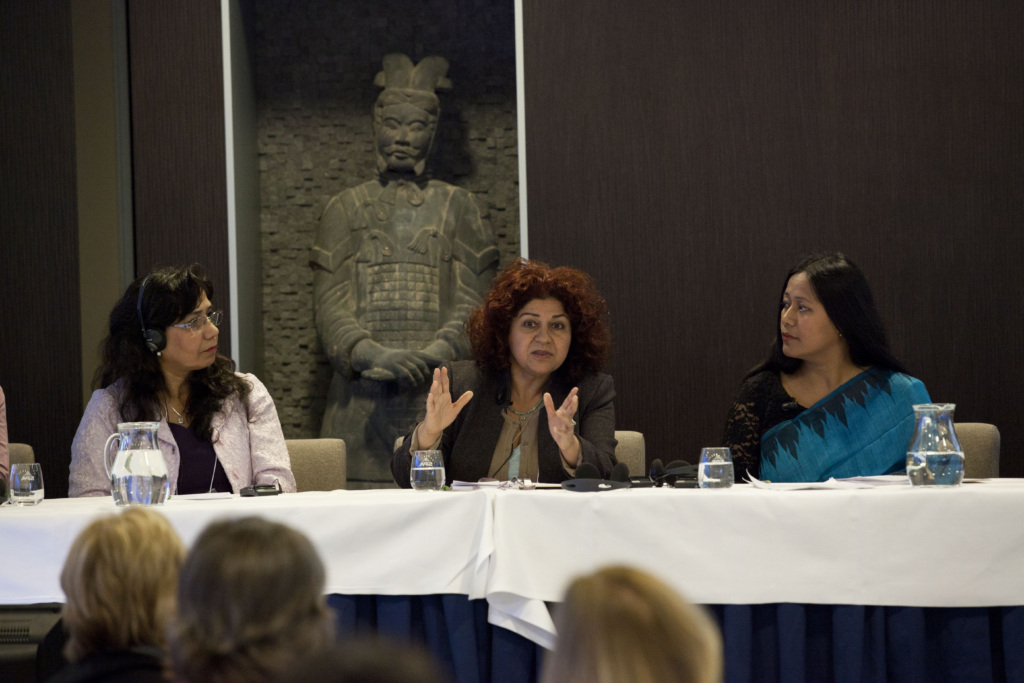
Yanar Mohammed speaks during a panel event

For years, Yanar lived under constant threat, as anti-rights and fundamentalist forces sought to suppress her activism for human rights and democracy. As the Founder of the Organization of Women’s Freedom in Iraq (OWFI), she built an enduring feminist infrastructure to support women and girls confronting violence, displacement, and systemic repression, and to lay the foundation for a better future. She provided food and shelter for survivors of violence and demanded an end to war and militarization.
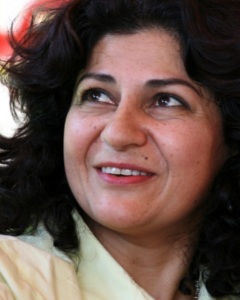
Close-up photo of Yanar Mohammed smiling 

She knew all too well how warmaking devastates communities and accelerates attacks on human rights defenders. In 2004, just after the US launched its war on Iraq, she founded OWFI to protect women, girls, and other marginalized people from these dangers. Almost immediately, she received death threats. She refused to be silent – instead, she called for the solidarity of the international women’s movement. MADRE responded to her, spotlighting her lifesaving work, demanding action from US policymakers, and launching decades of partnership.

Together, MADRE and OWFI provided humanitarian aid, human rights trainings, and community-led organizing for peace and justice throughout Iraq. We provided advocacy and legal support as OWFI fought back against restrictions on women’s shelters and against a years-long campaign of state harassment to impede their work. We will continue to stand by OWFI now, in these terrible days.

Yanar’s assassination is a stark reminder of the risks feminist leaders continue to face globally, and of the ongoing threats to human rights movements. Yet, we also remember that Yanar’s life was a testament to feminist courage rooted in action and fueled by love. She protected people where there was danger, created platforms where women could speak out, and insisted that all people deserve full rights.

As we grieve, we honor a beautiful life that propelled justice – with joy, purpose, love and courage.


Update:

The Yanar Mohammed Feminist Defense Fund was created to honor Yanar and support urgent needs of the organization she founded, Organization of Women’s Freedom In Iraq (OWFI). In addition, Yanar’s Fund will support women in Iraq and throughout the region who defend women’s human rights and carry forward Yanar’s legacy.


___________________________________________________________

What follows is from here: https://marxist.com/assassination-of-yanar-mohammed.htm

We publish here a statement sent to us by the Communist Alternative Organization in Iraq on the tragic death of their comrade Yanar Mohammed, who was assassinated this morning in a criminal terrorist attack at her home. We send our sympathy and solidarity to Yanar’s comrades, family and friends.


Statement on the assassination of dear comrade Yanar Mohammed

With profound sadness, grief, and immense pain, we announce the passing of our dear comrade Yanar Mohammed, President of the Organization of Women’s Freedom in Iraq (OWFI) and member of the Central Committee of the Communist Alternative Organization.

At 9:00 AM Iraq time this morning, Monday, March 2, 2026, two terrorist criminals on a motorcycle opened fire on Comrade Yanar Mohammed at her residence in Baghdad, inflicting severe injuries. Shortly after arriving at the hospital, she tragically passed away.

While we condemn in the strongest possible terms this brutal terrorist crime against a great fighter for the cause of women’s liberation and equality, and a firm, persistent communist militant for human emancipation, we hold the government responsible for uncovering the perpetrators and bringing them to justice.

The memory of Comrade Yanar Mohammed will remain a shining beacon for us in the struggle for women’s liberation and the communist struggle for a world free from all forms of injustice, discrimination, and oppression.

We will issue a later statement regarding the details of the life and struggle of our dear comrade Yanar Mohammed and will announce the dates for memorial services to honor her memory in Iraq and abroad.

The Central Committee of the Communist Alternative Organization in Iraq

March 2, 2026


[We also publish below a biographical note about Yanar Mohammed, sent to us by her comrades in the Communist Alternative Organization in Iraq. What stands out is the figure of a comrade who stood up bravely for the liberation of women and the oppressed, against the barbarism into which imperialism has plunged Iraq since 2003. We salute Yanar Mohammed, a fallen comrade, murdered by the reactionary forces she bravely stood up to all her life.]


The Assassination of Yanar Mohammed: When the Voice of Freedom Is Targeted in the Heart of Baghdad

By Nazar Akrawi,
3 March 2026

At dawn on March 2, 2026, Iraqis awoke to shocking news: the assassination of feminist socialist activist Yanar Mohammed inside her home in Baghdad. This was not an ordinary political crime, but a bloody milestone in a long-standing social and class struggle between two opposing projects: a liberationist, egalitarian vision that links women’s emancipation to a comprehensive socialist revolution, and a sectarian capitalist–religious order seeking to reproduce domination in its most brutal and regressive forms.

A Feminist Icon Confronting a Return to the Dark Ages

For more than three decades, Yanar Mohammed stood as one of the most prominent leaders of the liberationist feminist movement in Iraq. As the founder and head of the Organization of Women's Freedom in Iraq she did not confine herself to theoretical advocacy. She fought daily battles on the ground: organizing demonstrations, establishing shelters for abused women, and exposing the sectarian patriarchal structure that has governed society and the state since 2003.

She was the only Iraqi socialist feminist activist to deliver a speech on the situation of women in Iraq at the headquarters of the United Nations carrying the voices of Iraqi women to the world and affirming that the women’s question is not an isolated “cultural” or “religious” matter, but a fundamentally social question of liberation.

The Class Roots of the Hostility

From a Marxist perspective, this assassination cannot be understood outside the framework of class struggle. The post-2003 order was not merely a political transition; it was a social re-engineering along sectarian–capitalist lines. Civil and secular structures were dismantled, while political Islam, both Shia and Sunni, rose on the ruins of the state, backed by local and global capital.

This alliance between parasitic capitalism and sectarian religious forces required ideological tools to discipline society:

- Reinforcing male authority within the family.

- Subjugating women in the name of “Sharia” and “identity”.

- Presenting poverty and unemployment as moral fate rather than the result of class exploitation.

From this context emerges the intense hatred toward egalitarian ideas. The call for women’s liberation effectively undermines the patriarchal structure that sustains the reproduction of the class system. The call for socialism directly threatens property, privilege, and power.

The Battle Against the Jaafari Personal Status Law

Yanar Mohammed was at the forefront of those who confronted the so-called Jaafari Personal Status Law, which would have permitted the marriage of girls as young as nine and restricted mothers’ rights to custody and divorce. She did not see it as a mere legal amendment, but as a patriarchal and class assault on the bodies of poor girls in particular—who are most often forced into child marriages that perpetuate poverty and dependency.

Her position provoked a fierce campaign against her by influential Shiite religious forces, which filed multiple lawsuits accusing her of “opposing Sharia.” She insisted, however, that women’s liberation cannot be achieved within sectarian legal frameworks, but only through a secular civil state aligned with the working classes.

A Principled Stand Against Militias and ISIS

During the expansion of sectarian militias and the rise of ISIS, Yanar Mohammed adopted a principled stance against both, considering them two faces of the same reactionary violence. She refused to be deceived by sectarian “resistance” slogans and rejected the blackmail of fear in the name of fighting terrorism. At the last conference of her organization, she reaffirmed her rejection of the militarization of society, stressing that women’s weapons are organization and consciousness—not alignment with new repressive axes of power.

The Struggle Over Women’s Shelters

One of her fiercest battles was the defense of shelters for abused women and girls. Sectarian authorities and Shiite militias repeatedly demanded that these shelters be handed over to the state or shut down under the pretext of “protecting morality.” Yanar categorically refused, arguing that returning women fleeing domestic violence to a complicit authority was tantamount to a death sentence.

The issue became the subject of prolonged legal disputes, yet she continued to operate the shelters despite threats, affirming that protecting women is a revolutionary duty before it is an act of charity.

Why So Much Hatred?

The hatred harbored by the sectarian capitalist order and religious parties, particularly Islamist Shiite forces toward Yanar Mohammed and others like her was not personal. It was class fear:

- Fear of a feminist consciousness that links women’s oppression to capitalist exploitation.

- Fear of an independent women’s movement that refuses to be subordinated to ruling parties.

- Fear of a socialist project that exposes sectarianism as a tool for dividing the working class.

When an activist links women’s liberation to socialist revolution, she is not calling for partial reforms, but for a radical alternative. That is what structures of domination cannot tolerate.

A Legacy That Cannot Be Assassinated

The assassination of Yanar Mohammed was an attempt to terrorize women and silence the socialist feminist voice. Yet, in the balance of history, it reveals the fragility of a system that fears a woman whose only weapons were words and organization.

Yanar Mohammed will remain a global icon of liberationist feminist struggle and a symbol of linking women’s emancipation to class struggle. In an Iraq exhausted by sectarianism and corruption, the question remains: can women’s liberation be achieved without the liberation of society as a whole from exploitation?

Her life offered a clear answer: there is no genuine equality without socialism, and no freedom for women within a system founded on class and sectarian oppression.

Wednesday, August 19, 2020

Celebrating the 100th Anniversary of Women's Right to Vote

Utah women of color were part of fight for equal suffrage, historians say

Photos courtesy of Better Days Utah 2020. L to R: Elizabeth Taylor; Alice Kasai; Zitkála-Šá (Dakota); and Hannah Kaaepa (Hawai'ian) with her mother and sister. All fought for women's rights. Source: https://www.sltrib.com/news/2020/08/16/utah-women-color-were/

“Indigenous women have had a political voice in their nations on this land for over 1,000 years,” Sally Roesch Wagner, historian and editor of the 2019 anthology The Women’s Suffrage Movement, points out. “Women’s rights is not a new concept on this land; it’s a very, very old one. And the clan mothers of the six nations of the Iroquois Confederacy, the Haudenosaunee women, have had political voice for 1,000 years.”

The passage above is from a new Time magazine article, August 18th, 2020: "5 Myths About the 19th Amendment and Women's Suffrage, Debunked": https://time.com/5879346/19th-amendment-facts-myths/

On August 19, 2020 there will be a special discussion about the leadership and strategies of Black women during the long fight for suffrage:
https://www.youtube.com/watch?v=GAkgz7oYPV8

Description of the webinar/discussion:
In the standard story, the suffrage crusade began in Seneca Falls in 1848 and ended with the ratification of the Nineteenth Amendment in 1920. But this overwhelmingly white women’s movement did not win the vote for most Black women. Securing their rights required a movement of their own. In “Vanguard,” historian Martha S. Jones offers a new history of African American women’s political lives in America. She recounts how they defied both racism and sexism to fight for the ballot, and how they wielded political power to secure the equality and dignity of all persons. From the earliest days of the republic to the passage of the 1965 Voting Rights Act and beyond, Jones excavates the lives and work of Black women — Maria Stewart, Frances Ellen Watkins Harper, Fannie Lou Hamer, and more — who were the vanguard of women’s rights, calling on America to realize its best ideals.

The book the conversation emerges from is Vanguard: How Black Women Broke Barriers, Won the Vote, and Insisted on Equality for All (September 8, 2020), by Martha S. Jones. Link: http://marthasjones.com/vanguard/

Additional new scholarship in 2020 reveals which women and women's organisations took leadership and had influence en route to this tremendous accomplishment a century ago. This sites lists several other new books honoring the Suffrage Centennial:
http://suffrageandthemedia.org/source/books-new-in-2020-for-the-suffrage-centennial/


Sunday, February 21, 2016

"Andrea Dworkin's Woman Hating and the Priority of Sisterhood" -- a new guest post by Margo Schulter

Andrea Dworkin Quotes - StoreMyPic | Page 3
image of quote of Dworkin's is from here

What follows was submitted as a comment to a recent post. It concerns a predominantly white-centered battle between some people identified as radical feminist, and some identified as transgender. But as its length would have required breaking it up into several sections, I decided I would post it here as a separate entry, with permission. Margo is white and has been directly involved in Radical and Lesbian Feminist community. Julian


Andrea Dworkin's Woman Hating And 
The Priority Of Sisterhood

by Margo Schulter

As a transsexual Lesbian feminist who has been seeking to help build inclusive women's and Lesbian communities based on radical feminist values for 42 years, I can hardly consider the meaning of Andrea Dworkin's writings on intersex and transsexual people in Woman Hating (1974), and on "multisexuality" both there and in "The Root Cause" (1975), as a mere academic question. As a Second Waver myself, I will here try to offer a bit of perspective both on the current context in which these issues arise, and on why Andrea Dworkin might later have mixed feelings about some of what she said in Woman Hating.

Indeed, anyone acquainted with the achievements of Dr. Helen O'Connell, for example, would know that some of what Dworkin presented in 1974 is now outdated science; while other portions might be strongly dependent on the specific backdrop of 1960's counterculture, or open to dangerous misunderstandings that Dworkin might have preferred not to highlight when choosing the best passages for an online library of her writings. I'll address some of these points below, and argue that her views on intersex and trans people very likely do not fall in these categories, a conclusion I share with her close colleague and uncompromising radical feminist Catharine MacKinnon, as well as her partner John Stoltenberg.

This dialogue about Woman Hating grows in good part out of a courageous act of John Stoltenberg in 2013: analyzing and defending the ethics of Chelsea Manning in exposing war crimes of the colonialist patriarchy. http://thefeministwire.com/2013/10/the-postconventional-ethics-of-chelsea-manning/. In the process, because he correctly gendered Chelsea Manning, he attracted considerable negative attention from feminists who hold the view that trans women either are men and should be gendered accordingly, or at least are "males" or "nonfemales" with no place in the women's and Lesbian communities.

In response, Stoltenberg in 2014 wrote a piece for the Feminist Times theme of #GenderWeek, "Andrea was not transphobic." http://www.feministtimes.com/%E2%80%AA%E2%80%8Egenderweek-andrea-was-not-transphobic/. This was a powerful act of allyship with trans women in general and transsexual radical Lesbian feminists coming from Andrea's Second Wave roots in particular. And for some "true believers" that it is possible to be a zealous follower of the feminism of Andrea Dworkin and Catharine MacKinnon and at the same time seek the systematic exclusion of transsexual women from feminist and Lesbian communities, Stoltenberg's arguments pointed to an anomaly. Given Dworkin's position that all transsexual people are in "primary emergency" (a condition she had earlier defined as applying, for example, to Africans and African-Americans in the Maafa, Indigenous people in the Turtle Island Holocaust starting soon after 1492, and Jews in the Shoah), how could a follower of Dworkin seek the general exclusion or marginalization of transsexual women as a subgroup of the sex class female?

What I would emphasize is that accepting what Dworkin said in 1974 and 1975 about intersex and transsexual people and "multisexuality" leaves open a vast range of questions about how feminists in 2016 should approach real differences in experiences and vulnerabilities among women at many intersections of oppression. Thus private groups and spaces for either women who are Assigned Female At Birth (AFAB) or women who are trans may sometimes serve valuable purposes. But I do see Dworkin's views as incompatible not only with a general rejection or exclusion of transsexual women from the women's and Lesbian communities, but equally with the attitude of some trans women who distrust or devalue all women who are AFAB, often based on a supposed "cis/trans" binary, which I find as misleading as the sex and gender binaries that Dworkin challenged. If I ask for inclusion and solidarity as a Lesbian woman who enjoyed some male privilege until I transitioned at age 22, as well as a survivor of trans oppression, I surely must stand shoulder to shoulder in solidarity with women who have never enjoyed male privilege and are survivors of AFAB socialization. As Audre Lorde and other Women of Color have especially shown, sisterhood is a multidimensional reality: but surely it must be a two-way street on the elementary level that I acknowledge the 99% and more of my sisters in the female sex class who have indeed survived AFAB socialization, and have experienced things I cannot imagine. They are my older sisters, not my "cis oppressors"; rather, the patriarchy is our common oppressor.

Here I should also point to something that dyadic (nonintersex) people like Andrea Dworkin and Janice Raymond, and also on a humbler level myself, got wrong at least by omission in the 1970's: the vital intersex issue of childhood medical abuse. The practice of Intersex Genital Mutilation (IGM), optional surgery performed on nonconsenting infants and children to bring them into conformity with the patriarchal sex binary and its heteronormative obsession with the penetrative sexual act that Andrea Dworkin would address in Intercourse (1987), should have attracted the passionate condemnation of all feminists for a number of reasons. In reality, however, it only happened when intersex people themselves very visibly spoke out, starting in the mid-1990's. Yet Woman Hating beautifully expresses some of the feminist values fulfilled by the militant intersex movement starting some two decades later, with IGM still very much an issue in many parts of the world.

As you note, Julian, Andrea Dworkin later indicated her own misgivings with some portions of Woman Hating. Should we take this to include the passages on intersex and transsexual people? Here I would suggest a reasoned approach in weighing the probabilities of what she may have intended.

First, as I mentioned, there are statements she made or cited in 1974 that we now know to be wrong in ways very, very, important for Lesbian feminists and feminists in general, as with this: "the clitoris is a vestigial penis."

In fact, as Dr. Helen O'Connell of Australia has shown in paradigm-changing research, the clitoris is far larger and more complex than the external and visible portion homologous to the glans penis: that is only, as the African-American feminist Sophia Wallace puts it, "the tip of the iceberg" of the internal clitoris, including the shaft, the crura or legs, and the bulbs (formerly called "vestibular bulbs"). In short, the clitoris overall is about the same size as the penis, except that it is mostly internalized and yet more richly innervated (supplied with nerves) and intricate! Thus the human phalloclitoris (as it is often termed in the intersex community) or virga (a medieval Latin term that can apply to clitoris or penis, and I would propose also the range of intermediate forms), differs along the female-male continuum not so much in size as in the degree of internalization or externalization. Here Woman Hating needs an update which I am sure that Dworkin would support, whether or not she was aware of this issue when she chose for other portions of her work to have priority in an online archive.

She might have yet more serious concerns about portions of her chapter on "multisexuality" that addressed the incest taboo, for example, or "bestiality." Here I agree with at least one other commentator that from a truly radical perspective that values human empathy and respectful touch, the "erotic" may embrace many forms of affection that the patriarchal mindset simply cannot comprehend. But such words, in the context of a culture where physical and sexual child abuse are rife, may have later struck her as, to say the least, inapposite. She may have realized that she had looked too far ahead of her times in a way which might endanger those she most wanted to protect: abused women and children. And I will add my conviction that her concern in this regard embraces not only the vast majority of women and girls who are AFAB, but also trans women subject to rape and other crimes of violence.

In contrast, her words about intersex and transsexual people do not pose a similar risk. As long as transsexual Lesbian feminists and other transsexual women who participate in feminist groups behave as sisters, understand that women who have survived AFAB socialization are in this sense our seniors, and respect the basic rule of enthusiastic consent and noncoercion that no Lesbian owes sex to any other Lesbian, regardless of birth assignment, there should be no insoluble problems. And members of feminist communities who do not meet these expectations, regardless of birth assignment, can and should be asked to leave.

Julian, you also raise a point where there has been a rather heated dialectic of conflict, as I might say, but a ready synthesis is available. You are absolutely right that it is implicit in Dworkin that the vast majority of women are AFAB, and are indeed oppressed under the brutal patriarchal hierarchy of gender because of their actual or perceived reproductive capabilities which, under patriarchy, become vulnerabilities.

Thus transsexual women who are good feminists recognize that in that sense, within the female sex class we are the exception rather than the rule, which makes it all the more important for us to show sex-class consciousness and solidarity by supporting women's reproductive rights as a women's issue and feminist issue. What hurts our sisters, hurts ourselves.

Although Andrea does not address the details of how transsexual women might interact with other women in the feminist movement, a discussion early in Woman Hating about "primary emergency" indicates that women who have special oppressions and, for me, AFAB oppression as well as trans or intersex oppression amply qualifies here have a responsibility also to look to the general experience and interests of the female sex class. That means at once recognizing, for example, that negative menstrual stereotypes and insulting language demean all women, include those of us who never ourselves have periods, and that discussions of menstruation and allied health concerns should be welcome in inclusive women's groups; and also that women who share the experience of menstruation may sometimes want to have rituals of a kind led by Z Budapest for themselves only.

From this perspective of interpreting Andrea's views from 1974 in an inclusive and flexible way, John Stoltenberg's arguments for the spirit of inclusion are powerfully supported by Catharine MacKinnon, whose opposition to pornography and what she terms prostitution and I term sexage work (from the French sexage, a feminist concept meaning sex-based servitude or slavery) is well known. She speaks best for herself: http://radfem.transadvocate.com/sex-gender-and-sexuality-an-interview-with-catharine-a-mackinnon_n_433

As a Second Wave feminist, I would add that recognizing a continuum of physical sex (with intersex people representing natural variations rather than pathological cases) and of what we perceive under patriarchy as gender identities and styles of gender expression, in no way makes the gender hierarchy of patriarchy less real or oppressive! Andrea shows that we can use common sense and hirstorical experience to recognize both what is brutally "real" under patriarchy, and what is ultimately "true" about feminist possibilities, without any need for "postmodernism." Kate Millett and Andrea Dworkin had it right: while "gender identity" or "sex identity" develops in the first years of life in a given social context as a basic reality for an individual, transsexual or otherwise, the patriarchal system of gender is not just a "performance," or an even playing field with equally valid "choices." Being raped, or facing an unwanted pregnancy, is not just a theatrical scene; the playing field of gender roles and expressions under patriarchy is not level ground, but has a twisted topology of threatened and too often realized violence. This violence, as it affects women who are AFAB, transsexual, and/or intersex, is something that Woman Hating calls on all women to oppose in common sisterhood.

The way I like to phrase an inclusive feminist approach is this: "The rule does not exclude the exceptions, and neither do the exceptions exclude the rule." Thus the vast majority of women are AFAB, and a large portion of this majority face the risk of unwanted pregnancy facts essential in understanding the origins and nature of patriarchy as enforced reproductive labor and slavery, and the need of all women, including intersex and transsexual women, to unite in order to liberate our sex class. The presence of a relatively few acculturated transsexual women in the feminist and Lesbian communities need in no way decenter the concerns of women who are AFAB, and good feminist process will maintain balance. Such process, of course, depends on the acknowledgment of privileges and immunities, including, for those of us who are transsexual women, past male privilege and also immunity from childhood AFAB socialization.

A Second Wave tradition which I strongly support is the principle that each affinity group within the greater feminist and Lesbian communities can set its own boundaries. Thus a group like the Women's Liberation Front (WoLF) has every right to define itself as AFAB only. In fact, I admire many of the declared rules and guidelines of this group on conduct both online and in the larger world, and would see an effort to build similar groups and communities including women regardless of birth assignment as a sisterly response. Thus WoLF is free to set its own boundaries, and other affinity groups are free to do the same. Radical feminism is large enough to have room for both types of groups and private spaces.

In short, as I hope to have suggested by this point, living by Andrea Dworkin's radical feminist values as expressed in Woman Hating is a high challenge for transsexual women as well as women who are AFAB, including intersex women regardless of birth assignment. It means recognizing the material reality of women's reproductive slavery, and the psychological oppression of AFAB socialization, that we too need to center early and often. In short, if we identify as women, we must identify with women, so that sisterhood overcomes the illusory "cis/trans" binary. Sisterhood first and foremost! That seems to me implicit in everything that Andrea Dworkin has written.

Thursday, February 11, 2016

Happy 100th Birthday to Radical Feminist Flo Kennedy!!!

book cover image is from here

With a debt of gratitude to Sherie M. Randolph, below are snippets from two websites honoring Florynce Kennedy, who would have turned 100 today. When herstory is written by whites or men, Black women get marginalised or left out as central figures. Flo Kennedy was a central figure in radical feminism in the 1970s. First up, from Solidarity:

The Lasting Legacy of Florynce Kennedy, Black Feminist Fighter

— Sherie M. Randolph


SEVERAL DECADES AFTER the 1960s political upheavals, very few people recognize the name of the Black feminist lawyer and activist Florynce “Flo” Kennedy (1916-2000). However, during the late 1960s and 1970s Kennedy was the country’s most well-known Black feminist. When reporting on the emergence of the women’s movement, the media covered her early membership in the National Organization for Women (NOW), her leadership of countless guerilla theatre protests and her work as a lawyer helping to repeal New York’s restrictive abortion laws. Indeed, Black feminist Jane Galvin-Lewis and white feminists Gloria Steinem and Ti-Grace Atkinson credit Kennedy with helping to educate a generation of young women about feminism in particular and radical political organizing more generally.

Yet Kennedy’s activism is marginalized or completely erased from most histories of “second wave” feminism. Those rare references to Kennedy usually highlight her as one of the few Black women in the women’s movement. Kennedy is a significant exemplar of the exclusion of key Black feminist organizers from most feminist scholarship on the movement: the erasure of her critical role speaks to the ways in which feminist literature has failed to see Black women as progenitors of contemporary feminism.

In response to such historical effacement, this article resurrects Kennedy’s political contribution to sixties radicalism and uncovers a Black feminist politics and practice that was not only connected to the mainstream feminist movement but was also closely allied to the Black Power struggle. It challenges previously held rigid dichotomies between the Black Power and women’s movements and illuminates the centrality of Black feminism and Flo Kennedy to both movements.

Kennedy asserted that she could “understand feminism [and sexism] better because of the discrimination against Black people.” Her work in Black movements reveals the Black Power movement as a significant force in shaping contemporary feminist struggles.

Earlier feminist movement scholarship ignores or undervalues the connections between Black Power and feminist struggles. Studies of independent Black feminists and the predominantly white feminist movements cite the increased masculinity that kept feminism and Black Power divided. They are not wrong to do so, but positioning Black Power as primarily an antagonistic influence misses what the movement might tell us about how both Black and white feminists understood liberation and revolution.

For the rest of this post, please visit *here* at Solidarity.


*                  *                  *

What follows next is from Colorlines:

Happy 100th Birthday to the Notable, Quotable Black Feminist Flo Kennedy!

Razor-tongued Black feminist lawyer and activist Florynce "Flo" Kennedy would have turned 100 years old today. To celebrate, we offer you some of her powerful, witty and sometimes profane words.

Sherie M. Randolph  FEB 11, 2016 12:33PM EST

Photo: Bettye Lane
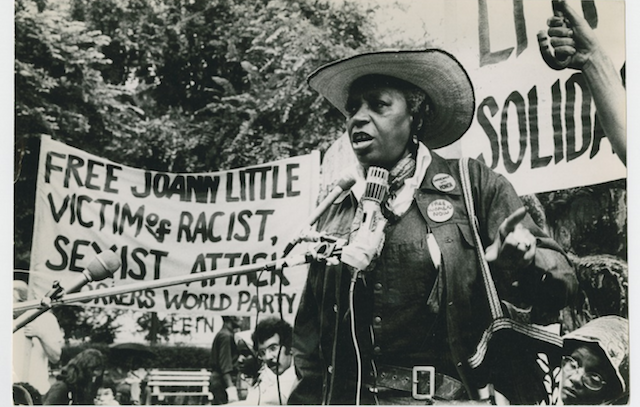
Florynce "Flo" Kennedy speaks at a protest to exonerate a Black victim of attempted rape, Joann Little on July 12, 1975. In 1972, Little, 20, fled her jail cell in Beaufort, North Carolina, after killing the White deputy sheriff who tried to rape her. Little used the jailer’s ice-pick against him and she was placed on trial for murder.  

Florynce "Flo" Kennedy, the charismatic feminist and Black Power activist and lawyer, was born 100 years ago today (February 11). While she is most often remembered as one of the few Black women who worked in the mostly White feminist movement of the 1960s and '70s, Kennedy's influence also flowed from her work within the New Left, Black Power, Civil Rights and autonomous Black Feminist movements.

For the rest of this post, please visit *here* at Colorlines.


                                                *                  *                  *

Finally, to read so much more about Flo Kennedy, please read Sherie's new book:

Florynce "Flo" Kennedy: The Life of a Black Feminist Radical 


Please visit *here* to purchase the book from Charis Books and More, an independent feminist bookstore--for less money than Amazon.com.

Thursday, April 9, 2015

Andrea Dworkin: Ten Years Gone (April 9, 2005 - 2015)

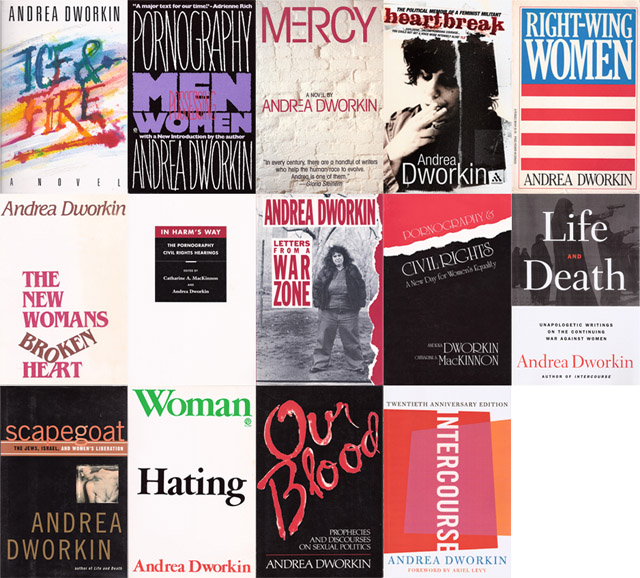
image of Andrea's book covers is from here

Ten years ago Nikki Craft got the news and delivered it to me, so sadly.

Andrea died.

There was shock. Disbelief. Questions. Grief.

It was not only hard to believe, it also raised a new fear about the future: losing such a pivotal feminist figure in the fight against sexual violence, giving voice to her and other women's past and present, she refused to call male supremacist violence anything other than that. Who would continue to name it and speak against it with such literary passion?

What has happened in the last ten years is the continued proliferation of pornography and other systems of sexual exploitation and abuse: pimping, brothel-keeping, and trafficking, for example. Hand-held devices mean people of many ages have visual access to raped children and adults, literally at one's fingertips.

Genocides continue against Indigenous people around the world.

There is more slavery than ever.

Corporate greed continues to destroy the Earth, increasingly swiftly.

The Global North and West continues to colonise, exploit, and pillage the Global South and East.

50 years after Bloody Sunday, white male supremacist atrocities against Black and Brown people is still endemic and normal in the U.S.; the only difference may be some level of recognition and disgust by fellow whites to the ritual harassment and mass murder of Black people by well-organized racist white police forces.

*                    *                    *

April 10th, 2005, Nikki and I got to work immediately--it helped with the grief--to create a website with a memorial page, where people could share their grief, memories, and how their lives were affected constructively by Andrea and her writing: http://www.andreadworkin.net/messages/

I got to know her writing starting in my early twenties, like many of my generation. I consumed her essays, books, wanting to read anything and everything she ever wrote. She shifted my perspective on so many issues or gave political meaning to experiences I hadn't understood.

She affected the trajectory of my activism.

I want to focus, today, on one effect, one not necessarily highlighted when people talk about her.

What I most learned from Andrea is the necessity of facing painful truths denied by the status quo. And challenging the status quo to stop reinforcing and fueling horror. Of course for that to happen, my society would have to radically change: all white and male supremacist institutions would have to be transformed; violent hierarchies dissolved; systemic exploitation, including from sex and work, deconstructed.

What I learned was to make a perspective into something flexible. never absolute; to always challenge myself to stay open to voices of people more marginalised, more silenced. And to use what I know to inform activism in all spheres of my life.
The purpose of theory is to clarify the world in which we live, how it works, why things happen as they do. The purpose of theory is understanding. Understanding is energizing. It energizes to action. When theory becomes an impediment to action, it is time to discard the theory and return naked, that is, without theory, to the world of reality. People become slaves to theory because people are used to meeting expectations they have not originated—to doing what they are told, to having everything mapped out, to having reality prepackaged. People can have an antiauthoritarian intention and yet function in a way totally consonant with the demands of authority. The deepest struggle is to root out of us and the institutions in which we participate the requirement that we slavishly conform. But an adherence to ideology, to any ideology, can give us the grand illusion of freedom when in fact we are being manipulated and used by those whom the theory serves. The struggle for freedom has to be a struggle toward integrity defined in every possible sphere of reality—sexual integrity, economic integrity, psychological integrity, integrity of expression, integrity of faith and loyalty and heart. Anything that shortcuts us away from viewing integrity as an essential goal or anything that diverts our attention from integrity as a revolutionary value serves only to reinforce the authoritarian values of the world in which we live.  —  Andrea Dworkin, Letters from a War Zone, U.S. edition, pages 127-128 [Quote added 1/8/2016]
What I have done in the last ten years is decenter whiteness from my political perspective and from how I comprehend and emotionally experience the world. What I have found is that any effort to do this is met with aggressive resistance just as any challenge to male supremacy is met with hostility.

What I have continued to examine is the relationship and degree of overlap between white and male supremacy. And to see intersectionality as having to do with multiple positions of marginalisation and powerlessness, beyond identity.

I believe the only way through the atrocities--to end them--is to center the lives and voices of people who virtually never make it into corporate media. To center the forms of resistance and social/economic/political transformation invisibilised people have been employing for decades and centuries. To not assume any expression of whiteness or maleness is universal, transcultural, or ahistorical, even while some forms of oppression have existed for millennia; whenever I have seen this done, it both recenters and redenies the ways whiteness permeates everything as male power permeates everything: differently, similarly, and in ways that shift and transmute.

To honor her, I will continue to listen, learn, remember, and do my work in collaboration with people who don't have the unearned privileges I too often take for granted.

To view the quote more easily, you may click here.


Friday, March 8, 2013

Happy International Women's Day!!!!

poster from the 100th IWD in 2011 is from here
From internationalwomensday.com:
IWD is now an official holiday in Afghanistan, Armenia, Azerbaijan, Belarus, Burkina Faso, Cambodia, China (for women only), Cuba, Georgia, Guinea-Bissau, Eritrea, Kazakhstan, Kyrgyzstan, Laos, Madagascar (for women only), Moldova, Mongolia, Montenegro, Nepal (for women only), Russia, Tajikistan, Turkmenistan, Uganda, Ukraine, Uzbekistan, Vietnam and Zambia. The tradition sees men honouring their mothers, wives, girlfriends, colleagues, etc with flowers and small gifts. In some countries IWD has the equivalent status of Mother's Day where children give small presents to their mothers and grandmothers.

In celebration of all the work, all the hard labor, all the unrecognised contributions women across the globe make to humanity, especially to their own humanity, I post this in honor of women around the world!

Monday, February 11, 2013

Dr. Vandana Shiva interviewed by Robin Morgan, on rape and globalization

As a kind of personal-political preface to the interview that follows, I'd like to explain why it is I find the exchange so significant.

It should come as no surprise to anyone familiar with my blog that I strongly believe women of color are the global leaders in feminism, as well as regional and national leaders in many places, and ought to be regarded as such by whites and men. Typically, men and whites ignore, silence, marginalise, appropriate, and take credit for the activist work women of color do.

If you take the spotlight off the courageous leadership work of Malcolm X and Martin Luther King, Jr., you see a lot of Black women in leadership throughout the 20th century in the U.S., working very hard, at great cost, to free African Americans from the blight of white supremacy while also addressing sexual politics and male supremacy. Black men's work against racism has been substantial and has also tended to de-center or invisibilise Black women's insights, analysis, and activism. White women's feminist work against sexism and male supremacy has been substantial and ground-breaking in countries where white women live. And it has been a challenge to get the whiteness of the work de-centered or even consistently identified as race-privileged.

My own family background led me to be particularly concerned about sexual violence. For several years, I was drawn to a few white feminist writers who focused on that issue intensely but usually non-intersectionally, and without radically and thoroughly identifying the whiteness in their work. At the same time, thanks to a white lesbian feminist mentor, I was introduced to the work of many womanist and feminist writers of color, mostly from North America and the Caribbean. My own awareness of the work done by women of color outside of white-ruled or white-colonised nations was minimal. Over the last few years I have tried to make this blog a space where voices, perspectives, and commitments to radical social change by women of color are highlighted not footnoted; where women of color are centralised not marginalised.

I do this in part because of once mistakenly determining white work to be the most radical; this was done in part because whites who use the term 'radical' don't identify lack of awareness of their whiteness as anti-radical. This was consistently challenged by radical women of color writer-activists as anti-revolutionary, racist practice. I also noticed far too many white-edited, white-dominated anthologies of activists where women of color got a special chapter on women effected by racial hierarchies (as if white people aren't fundamentally effected by white supremacy and racism), but were rarely invited or expected to speak on behalf of all women. I've seen white pro-radical and feminist websites where the work of women of color is barely mentioned and where white women routinely speak for all women. I've seen gatherings led by whites who pretend they are inclusive and safe for women of color.

Writings and activism which centers the humanity of women is generally and typically regarded by men as being too narrowly about women. Men's writings about only-men or mostly men has been historically regarded by men as about all of humanity, or the segment of humanity worth doing justice work for, or about all people of a particular race; it is rarely-to-never seen as "too narrow in scope", too much about men, too ignorant about women, when reviewed by other men. When men recount the contributions by women to the men's human struggles for justice, women have too often been ignored or footnoted. And when men focus on women, the gaze is often objectifying and the attitude patronising.

It appears that whites and men will not easily regard women of color as fully human with perspectives that whites and men ought to pay attention to, prioritise, privilege, promote, and regard as foundational and central to understanding humanity on the whole.

I have come to the conclusion that women of color, as a global and regional majority by gender and the most diversely raced women on Earth, hold the most complex, radical, sophisticated, and revolutionary views on race, gender, and everything else. This doesn't mean I don't still look to white women and men of color for useful analysis and insight. It means I no longer center and privilege their voices and perspectives.

Vandana Shiva is, for me, a profoundly important world leader on matters of feminism, environmental/Earth justice, global economics, and holistic and humane sustainability. Robin Morgan is a U.S.-based white feminist who has dedicated many decades to the struggle by and for women against men's global woman-hating and woman-subjugating violence. I hold both women in very high regard and was delighted to find this exchange between them recently online.

You may go here, to The Women's Media Center online, to return to the source website. You may stay connected with their efforts here:

title
Economist and ecofeminist Dr. Vandana Shiva addresses the root causes of violence against women. 

Dr. Vandana Shiva—The New Delhi Rape and Globalization

| February 11, 2013
Dr. Vandana Shiva, economist, environmentalist, and feminist, spoke of the public outcry in India and how the devaluing of women in a global economy set the stage for the New Delhi rape. Adapted from a conversation broadcast last month on Women's Media Center Live with Robin Morgan.
Robin Morgan: In a feminist analysis certainly, everything is connected to everything else.  You recently wrote a stunning piece about the ghastly gang rape in New Delhi and the subsequent demonstrations and how violence against women and the economy were all connected.  I’d love you, please, to talk about the points that you raised.
Vandana Shiva: I’ve been working on how the economy’s changing—globalization, free trade, WTO, the structural adjustment. I’ve made the connections between those purposes and what happens to women in what is called the New Economy. They even call it the Emerging Economy, as if a 10,000-year-old civilization emerges only when it is locked into corporate globalization.
The first level at where violence against women begins is in the very defining of the economy.  Economy means household.  It is what women define both inside the physical households, but also the world, inside the planet as the household.  As long as the principles of management came out of that, they focused on sustenance, livelihoods, mutual giving—of course, within the typical patriarchies all our societies have had.
[With] free trade globalization, the first thing they do is knock out that major sector of women’s economy and, as Marilyn Waring has written in If Women Counted, install a production boundary to calculate growth.
The Gross Domestic Product grows every time you can pull something out of nature and something out of women customers’ economy, which means every time you destroy nature and women’s livelihoods, and production, and creativity, you can call it growth.  It’s created to mobilize finances for the war, and it becomes the dominant number imposed on our world.
I’ve been appointed by the King of Bhutan to an expert group we’ve created because Gross Domestic Product is the wrong measure.  The King of Bhutan said we should be looking at the well-being of our people to measure Gross National Happiness.
At this time, growth measured as Gross Domestic Product is already collapsing world-wide. It collapsed with Wall Street.  It’s collapsing in Europe right now in front of our eyes. and it will collapse in India after a few years.  How long can you sustain an eight or nine percent growth that excludes women as the primary backbone of the economy? That is the first violence.
The second violence is in terms of decision-making and politics.  In so many debates in India we hear, “Oh, we can’t have politics in economics.” But every time they make a decision within a patriarchal model of the economy, it is politics.  It’s politics that basically says, “Only corporations count, only the powerful count, and we’re going to mutate democracy from being, “By the people, of the people, for the people,” into being “By the corporations, of the corporations, for the corporations—and the powerful.”
The convergence of economic and political power further excludes women, but it also creates a class with immunity and impunity, which can do all levels of violence, change laws, and remove protections. There’s rape at every level—rape of the earth, rape of our resources, rape of the economy, and rape of women, which is what this drastic, dramatic tragedy has woken up India to.
Then there are other levels of violence because displaced people are more vulnerable.  I was asked by the National Commission of Women to grapple with what globalization was doing to women in India, in terms of two key factors: water, and food and agriculture. At public hearings around the country, whether in Calcutta or down south, women would speak out boldly about how sexual violence has increased and made them more vulnerable as they were being made economic and ecological refugees.
That is at the very foundation of this new liberal model: everything is a commodity.  Everything is property.  Everything has a price and nothing has value. Added to the traditional patriarchies of societies, that's created what I call a super-virus of patriarchy. When two viruses hybridize, they start to kill.
Basically it’s a bit like climate change.  We’ve had cyclones, but Hurricane Katrina and Hurricane Sandy present a different level of violence.  Of course, we know that this is contributed by climate change. We need to start looking at how an economy based on patriarchal fictions—and the corporation is the biggest patriarch in our lives to come—how this patriarchy is combining with traditional patriarchies to unleash even larger violence, both the kind we see on the streets of Delhi and the economic kind, the violence of robbing you of your home, of your foundation.
Our prime minister said recently, it’s these loose-footed migrants that are part of the problem. Because the Delhi rape involved migrants at both ends. The rapists were all living in slums in hugely brutalized conditions, thinking that brutalization is the norm.  The poor girl's father had sold his land because farmers aren’t being allowed to make a living.  Two hundred and seventy thousand Indian farmers have committed suicide.  The rest are hanging on the margins of existence.  He moved to Delhi to load luggage at the airport to be able to survive and send his children to school.
The prime minister just called them loose-footed migrants creating problems. I said, “Mr. Prime Minister, they are a product of your policies.  They are refugees of your economic policies.”  None of these—economics and culture and society—are insulated silos. The patriarchal economic model is becoming the dominant force in our society.  Societies have been reduced to the economy.  Economy has been reduced to the market.  The market has been reduced to what is controlled by finance, capital corporations.  And if all you show is women as commodities, selling other commodities, those images start to further distort already damaged brains.
RM: Isn’t it amazing, Vandana, how when you put something in context—the background of the victim and for that matter of the perpetrators—it changes? Also, I'm reminded of your colleague Ruchira Gupta who wrote a piece in which she pointed out that the commodification of women by the rampant growth of pornography and prostitution sends the message that, in fact, this is what women are for. She connects that to the apparently quite dramatic rise in rape in India.
VS: Hugely dramatic.  Eight hundred percent since the ‘70s and more than 250 percent since India’s economy, was as they say, made "more open" [with globalization]—more open to more violence against women.
RM: From where I sit here in New York, it seems heartening that women in numbers never seen before and accompanied by men as well have been on the streets in not only Delhi but across India.  They haven’t quite made the connections you’re making, but they are on the move protesting violence against women.
What can we do to turn the enormity of this around?  It’s always for example, blown me away, that a woman who is, say, in her fifteenth hour of labor, straining away—the doctor and the nurses and the anesthesiologists are all productive because they are wage labor, but the woman who is actually giving birth is not considered in a productive act.
VS: I think that is the foundational error. Everything that replenishes is treated as not producing at all and everything that’s degrades, everything that depletes, is treated as production.  I call it the creation boundary, which has given us the fiction of growth and the Gross Domestic Product—that destructive acts are creative acts of produce. The really creative acts of nature—of women in their tremendous diversity and amazing ability to juggle 50 jobs, 50 responsibilities—their whole society and economy are treated as unproductive. That, I think, is the most important shift we need to make.
As you know Robin, I come from the part of the Himalayas where it's recognized that women are the main productive force. They go out in the forests [to work] and there's nothing like the rape [that occurs] when you come into the plains where women are no longer considered productive. When I, with my sister, Dr. Meta Shiva, was studying female feticide, we realized that the map of high growth in the patriarchal measure are the same zones with the high levels of extermination of girls—fifty million girls haven't been allowed to be born in the last few decades.
The response in Delhi is beautiful for a number of reasons.
The first, that the younger generation has come. The younger generation was absent from social movements, especially the middle class because they were getting it so good with globalization—the IT jobs that moved to India. They were all seeing themselves as individual consumers, so society did not matter to them. But this rape reminded them that it could have been them coming back from their IT farms, from their phone call service centers.
The second difference is, while we have had a feminist movement in India for a long time, it was only the women. The beauty now is, young men joined. It was a young man who was defending this girl in that bus.  I think for the first time, there’s this new generational solidarity that’s emerging. Those very gutsy young people who are being beaten up and sprayed with tear gas and water canons realized that the state has become militarized. The state itself is a patriarchal institution. It will take time. There will be the hysterical voices saying death sentence, death sentence! But new connections have started to germinate that are really going to make a serious change.
RM: That’s very encouraging.  When you look at the global scale of things, I confess that I look to women not only because we are the majority and that permits more peaceable and more, how shall I say, witty and ingenious new strategies, but also because there’s no area that isn’t a women’s issue.  We spill over into everything if the connections are made.  I definitely see the global women’s movement as the politics of the 21st Century.
VS: We are really living through a period of collapse of all kinds in the patriarchic system.  The collapse of the financial economy they’ve built, a collapse of the eco-systems they have raped.  The UN has recognized that 90 percent of eco-systems are on the verge of collapse, if not already collapsed.  In this period, it’s the creative principle which women bring to bear for the simple reason that they were left to look after the real stuff of life, the goals that really mattered.  So they bring both another world view, another mindset, and other capacities, other skills—which is why I run a grandmother’s university at the new school I created in Dehradun called the Earth University.
RM: I love it.
VS: Ghandi always said a prayer, “Make me more womanly.”  If there is going to be a future for humanity, it will have to be a womanly future. I go to Europe and young men will bring me my books [to sign] and say, "I'm an ecofeminist, Dr. Shiva." That to me is a major, major shift. A shift to a creative economy where women start defining and playing the leadership role but others recognize that there has to be a mind shift.
RM: Whenever I talk to you, I feel both incredibly depressed because one is made yet again to realize the severity of the situation and at the same time, incredibly optimistic because I get from you a validation of everything that we’ve been trying to do and will do more and even better and with more people involved in the future. 
I can’t tell you how grateful I am for your wisdom and your perceptions and for everything that you do.
VS: And Robin, I want to thank you for your vision and leadership and your love.

Once again, to link back to the source website, please click *here*.


Wednesday, September 12, 2012

Audre Lorde's Legacy Film & Cultural Festival 2012 marks the 20-year anniversary of Audre Lorde's passing: Press Release

photo, taken by  Dagmar Schulz, is from here
Audre Lorde died on November 17, 1992 after a long battle with cancer. To honor her life's work the following event has been planned. All that follows in this post is the press release that I found on WindyCityMedia:

  Windy City Times    Download PDF Issue

Audre Lorde Legacy Films screening here From a news release 2012-09-12


Audre Lorde's Legacy Film & Cultural Festival 2012 marks the 20-year anniversary of Audre Lorde's passing. She was a highly influential, award-winning African-American, lesbian, poet, author, mother, teacher and activist. In honor of her legacy four films will be will be brought to universities, libraries, and community venues, accompanied by a reading from the biography of Ika Hugel-Marshall. Fall 2012 USA tour of the Audre Lorde Legacy Film & Cultural Festival with Ika Hugel-Marshall and Dagmar Schultz

The films:
-A Litany for Survival: The Life and Work of Audre Lorde by Ada Griffin and Michelle Parkinson
-The Edge of Each Other's Battles: The Vision of Audre Lorde by Jennifer Abod
-Hope in My Heart: The May Ayim Story by Maria Binder
-Audre Lorde—The Berlin Years 1984 to 1992 by Dagmar Schultz

The reading:
-Ika Hugel-Marshall from Invisible Woman: Growing Up Black in Germany
University of Illinois at Chicago, Oct. 2
Screening of "Audre Lorde—the Berlin Years 1984 to 1992"
Contact: Prof. Elizabith Loentz (loentz@uic.edu).
Northwestern University, Evanston, Illinois, Oct. 3, 4

The films include:
Audre Lorde - The Berlin Years 1984 to 1992 (2012). Dagmar Schultz, 58 minutes
This film introduces American audiences to a littleknown chapter of Audre Lorde's prolific life. From 1984 through her death in 1992, she spent a part of each year in Berlin, Germany, first as a visiting professor, but more significantly, as the mentor and catalyst who almost single-handedly ignited the Afro-German movement. With her active support a whole generation of writers and poets for the first time gave voice to their unique experience as people of color in Germany. Lorde had a decisive impact on white women—challenging them to acknowledge the significance of their white privilege—and to deal with difference in constructive ways.

The film outlines her contributions to the German discourse on racism, xenophobia, antisemitism, classism, and homophobia within the Black movement and the Black and White women's movement, a discourse alive and growing today. Present-day interviews explore the lasting influence of Lorde's ideas and the impact of her work and personality.

The film contains never-before seen images and audio recorded during this period of Lorde's life, showing Lorde on and off stage. Dagmar Schultz, a personal friend and her German publisher, will be present to introduce the film and follow up with Q&A. web site: www.audrelorde-theberlinyears.com .

A Litany for Survival: The Life and Work of Audre Lorde, (1995). Michelle Parkerson and Ada Griffin, 90 minutes

An epic portrait of Audre Lorde, whose writings—spanning five decades—articulated some of the most important social and political visions of the century. From Lorde's childhood roots in NYC's Harlem to her battle with breast cancer, this moving film explores a life and a body of work that embodied the connections between the Civil Rights movement, the Women's movement, and the struggle for lesbian and gay rights. At the heart of this documentary is Lorde's own challenge to "envision what has not been and work with every fiber of who we are to make the reality and pursuit of that vision irresistible." web site: http://www.twn.org/catalog/pages/cpage.aspx?rec=1126&card=price.

The Edge of Each Other's Battles: The Vision of Audre Lorde (2002). Jennifer Abod, Ph.D., 59 minutes

This powerful documentary is a moving tribute to Audre Lorde (1934-1992). One of the most celebrated icons of feminism's second wave, Lorde inspired several generations of activists with her riveting poetry, serving as a catalyst for change and uniting the communities of which she was a part: black arts and black liberation, women's liberation and lesbian and gay liberation.

Nowhere was this more apparent than the groundbreaking I AM YOUR SISTER CONFERENCE which brought together 1,200 activists from 23 countries, including thrilling footage of the inimitable Lorde herself, and candid interviews with conference organizers. This film powerfully brings Lorde's legacy of poetry and politics to life and conveys the spirit, passion and intensity that remains her trademark.
web site: http://www.wmm.com/filmcatalog/pages/c621.shtml.

Hope in My Heart: The May Ayim Story (1997). Maria Binder, 29 minutes
A moving documentary about the life and untimely death of Ghanaian- German poet, academic and political personality May Ayim.

May Ayim was a personal friend of Audre Lorde. As to Lorde's influence on her poetic work Ayim said: "One of my models is Audre Lorde, (...) who does stand very much behind what she is doing and expressing it openly, for instance, that she is lesbian, mother, Black, poet, cancer survivor. The way she stood there saying who she was impressed me a lot, because normally people hide behind their words."


Ayim was one of the founders of the Black German Movement, and her research on the history of Afro-Germans, but also her political poetry, made her known in Germany and other countries. Ayim wrote in the tradition of oral poetry and felt a strong connection to other black poets of the diaspora.

Poetry gave her an opportunity to confront the white German society with its own prejudices. Interviews and poems reveal the search for identity, how and why the term Afro-German was introduced. An insightful look at how a young black woman experiences the German reunification. (German with English subtitles).

Dagmar Schultz, co-producer of the film and publisher of May Ayim, will be present to introduce the film and to follow up with Q&A. web site: http://www.twn.org/catalog/pages/cpage.aspx?rec=1015&card=price.

In addition to the films, author Ika Hugel-Marshall, M.A., will appear in person to read from her autobiography, Invisible Woman: Growing Up Black in Germany (2001). She was the recipient of the Audre Lorde Literary Award, which enabled her to write this critically acclaimed work. Hugel-Marshall also appears in the film Audre Lorde - The Berlin Years, and was a close personal friend of Lorde. web site: www.ika-huegel-marshall.de Dagmar Schultz, Ph.D., was a co-founder of the Feminist Women's Health Center in Berlin in 1974, the first of its kind in Germany. In 1974 she also co-founded Orlanda Women's Press (Orlanda Frauenverlag) and was its (co-)publisher until 2001. In addition, Schultz was a professor at Berlin universities. Since 2004, Dagmar Schultz has been involved in writing and in organizing reading tours in the US for her partner Ika Hugel-Marshall (author of Invisible Woman. Growing up Black in Germany) as well as other projects. In 2007 she co-produced the film Hope in My Heart.


— The May Ayim Story. Recently she was awarded the Margherita-von-Brentano-Preis 2011, by the Free University of Berlin, for work and projects which further the development of equal rights and opportunities for women in academia and the promotion of women's and gender studies and research. She is the producer of the documentary Audre Lorde — The Berlin Years 1984 to 1992. web site: www.dagmarschultz.com .

This event could be presented as a full day, or cover two evenings. Suggested tour dates with Ika Hugel-Marshall and Dagmar Schultz are February through March (African-American and Women's History Months) and/or September 2012.
www.northwestern.edu


Saturday, August 25, 2012

Writings by Audre Lorde, including "Man-Child: A Black Lesbian Feminist Response" and "A Litany For Survival". Also, a new book of Lorde's writings, I Am Your Sister: Collected and Unpublished Writings of Audre Lorde !!

image of book cover is from here

Revised on the 26th , 29th, and 30th of August 2012, and December 2, 2015.

I just found a website that has a photocopy of Audre Lorde's classic essay from Sister Outsider, titled: "Man-Child: A Black Lesbian Feminist Response". If you haven't yet, I encourage you to read it and to read the whole book along with it. Here is the URL and link to that one chapter: http://www.scribd.com/doc/103750751/Audre-Lorde-Man-Child.

I have been saddened to see how many younger people online believe that radical feminist = white woman. I know that many, but not all, of the people publicly naming themselves radical feminist or the more contemporary and racially narrow term, rad fem, are white women. I've written about how I don't equate the terms: radical feminist and rad fem. I've hopefully respectfully challenged the white supremacy of white-majority and white-led organising by people who identify as rad fem *here* in an earlier post.

Of course most of the whites who organise politically are not feminists. They are anti-feminists, racists, and misogynists, protecting white male power at all costs. But unlike anti-feminists and other misogynists, rad fems and I share a lot in common: our critique of pornography and prostitution as male-protected and mass produced forms of men raping and enslaving women and girls; a serious analysis of human sexuality as it is constructed and acted out in heterosexist and male supremacist contexts; and a de-marginalising of male supremacy and patriarchy when analysing and challenging increasingly globalised systems of oppressive, terroristic, and deadly power.

In fact, many of the people who claim to be the definitive example of "human" are white men. And we certainly know that even though white men write most Western history books--that have systematically left out or distorted the accomplishments, the history, of white women, women of color, and men of color--that surely doesn't mean only white men are human. Nor is it the case that only white women are radical feminists, lesbian or not. Many of my role models growing up through my early adulthood were Black and Brown radical lesbian feminists.

My focus, here at this blog, on women of color is seen by some whites and many men as divisive. Some view this centralising of women of color at a pro-feminist website as one way to focus on the differences between women rather than the similarities. I hardly see how focusing on women of color is divisive. Nor do I see it as divisive to point out where white supremacy lives and breathes. Whites want to keep white power all to ourselves thereby dividing humanity into raced "haves" and "have nots". Exposing and challenging white supremacy is an effort to end divisions of social power among humans; its aim is to equalise the control of and the access to resources among humans, including intellectual resources.

Another way to approach the issue would be to ask: Is focusing primarily or entirely only on the written and other activist work of whites divisive? Because that's what most whites do, often thinking they are representing "all men" or "all women" or "all queer people" when doing so. So it comes across to me as problematic when a white person, in my case a white male, who doesn't wish to marginalise women of color is seen as promoting divisions among women. Why isn't this blog seen as unifying women by focusing on the work of women of color? And, if whites wish to deal with our white supremacy in public ways, how does identifying where it lives further divide humanity?

I'd argue that routinely and systematically ignoring, tokenising, or marginalising the activist work of women of color is divisive. It maintains white supremacy and male supremacy. So too does using terms like "radical" by whites who don't include "white" when naming ourselves. The name of this blog certainly participates in that pattern. It would visibilise (and challenge) whiteness more if I termed it "A Radical White Profeminist". It would also serve to make it visible as a particular and non-universal political condition.

I now consider any white person refusing or neglecting to name our structural location by race when we describe our political position, as supporting and reinforcing white supremacy. Were I to start my blog now, I'd name it with "white" being in the title.

I have grown up hearing Audre Lorde and Barbara Smith be regularly identified by whites as Radical Black Feminists or Black Lesbian Feminists. Mary Daly and Sheila Jeffreys have only ever been identified by whites as "Radical Feminists" or "Lesbian Feminists". I hope it's clear how that way of naming white people reinforces whiteness as somehow not worth mentioning. But the "worth", or value, of not mentioning it is the white power that is so well-protected in the practice of whites not naming ourselves with that term. This is a crucial, and often enough unconscious, practice of protecting the very brutal power underlying and enforcing unnamed whiteness. The brutality is aimed squarely at people of color, with especially horrific forms leveled against women of color.

Conscious or not, it is an undenibly political decision to not mention our whiteness as a structural place of power in a white male supremacist system. (This is not, as some have indicated, primarily an issue of naming one's "identity"; this writing isn't advocating what is sometimes termed "identity politics".) If it is not deemed collectively necessary for whites who name ourselves as "radical" to also name and own our own whiteness as a political reality, how do we practice being responsible and accountable to those we structurally oppress by race?

It's not a radical practice for white folks to "disappear" our whiteness in our writings and other work, in my opinion which has been informed by dozens of radical activists of color, most of them feminist. It's not even liberal. It's politically conservative; it has many of the same effects as mainstream neo-Conservative and more publicly marginalised White Nationalist agendas.

White males making our race invisible but our gender visible serves white and male supremacy because the two systems, particularly in the West, are inextricably linked and are mutually reinforcing. Both work together to oppress and destroy women of color. Put another way: let's consider white radical Andrea Dworkin's definition of "feminist" which has been summarised as follows: if it hurts women, feminists are against it. Surely white supremacy as well as male supremacy hurts women (of color). So to ignore race in one's feminist and pro-feminist work is to participate in the deeply racist practice of pretending women of color are not "women"--unless they, too, are somehow presented as unraced. Ironically, whites are very reluctant to do that. Only whiteness is to be systematically ignored-while-protected.

The same is true for men of color who name their race as a structural position of marginalisation and oppression but not their gender as a structural position of power over all women. Men of color not identifying their gender as a structural source of oppressive power serves not only male supremacy, but also white supremacy. Because protecting any male power, as such, bolsters white men's power as men, but particularly as white men.

As I see it and hear about it from radical and feminist women of color, those two systems of power--male and white supremacy--together with capitalism, are the main dividers of humans into--according to power elites--those who are meant to survive and those who are not.

This matter is addressed in those terms in at least two pieces of writing by Audre Lorde. One is in a speech in the book Sister Outsider titled "The Transformation of Silence into Language and Action". This is also contained in another book discussed below. Another discussion of this theme is in a poem titled "A Litany for Survival", which may be read in full, along with several other of Lorde's poems, here.

Finally, I offer a link to a relatively new book (2009 hardcover, 2011 paperback), of Audre Lorde's work. The book is titled: "I Am Your Sister: Collected and Unpublished Writings of Audre Lorde", edited by Rudolph P. Byrd, Johnnetta Betsch Cole, and Beverly Guy-Sheftall.

 I have had the pleasure of hearing Johnnetta Cole speak, many years ago. Calling the three editors only "editors" would not be to understand their role in the creation of this book. Rudolph Byrd offers a significant introduction of the works contained in the volume. Johnnetta Cole offers a chapter in the section of the book called "Reflections", which also contain chapters by Alice Walker, bell hooks, and Gloria I. Joseph. Beverly Guy-Sheftall closes the book with her epilogue.