Showing posts with label Latina/o liberación. Show all posts

Thursday, April 21, 2011

And We're Still Discussing Marx WHY? For those who don't already, practice this: Indigenist Feminism

image of Karl Marx is from here
Various significant philosophers--women all of them--have far more important analyses of men's political economies, social relations, and oppression of the masses than Karl Marx. Here are three of them: Vandana Shiva, Marimba Ani, and Catharine MacKinnon.

My question, as yet unanswered, is: does the author of a new book on Marx deal with what these, and so many other women, have to say about globalised forms of patriarchal, capitalist, and white supremacist class-based oppression?

I don't believe the philosophies of prominent white men can rescue us from the the ravages of those structurally, institutionally empowered savages. I think that anti-savage Indigenous activists, most especially women, can save the planet. Because those are the only philosophies that carry forth traditions of living with the Earth and seeing the Earth as a Living Being. Marx did not. Nor do any white marxists I ever known. They tend to be very pro-urban, pro-civilisation theorists, actually. And if you don't get what's genocidal and ecocidal about being pro-urban and pro-civilisation, get to reading more Indigenous activists work.

It is, in my opinion, women and men across the Americas--well, in South and Central America-- who have made the best use of Marx's theories. And I hope the people--Brown, Indigenous, and Black--in those regions continue to organise to keep CRAP-loaded U.S. economic, cultural, and military policies and practices out.

I offer some other reading suggestions below, in my comment--the lone one--following this book review by Chris Nineham, at Counterfire.org. Please click on the title just below to link back. And please see the post from bermudaradical @ The Speed of Dreams, following my comment.


Chris Nineham reviews Marx at the Margins, which reveals Marx and Engels as pioneers in the struggle against colonialism and racism.

Kevin B. Anderson, Marx at the Margins: On Nationalism, Ethnicity, and Non-Western Societies (University of Chicago Press 2010), xi, 319pp.

Marx at the Margins very successfully defends Marx and Engels against claims that their analysis of capitalism was economistic and Eurocentric. The charge that the founders of Marxism downplayed politics and reduced history to economic issues is common. It normally comes from the right wing, but has been taken up over the years by various figures on the left, including notably Edward Said. Said argued that Marx ignored the importance of colonialism, race and identity in the making of the modern world.

The connected accusation of Eurocentrism is partly based on a few instances of questionable language used by Marx and Engels. It is sustained however by the argument that Marx saw development through the prism of Western experience, that he predicted the rest of the world would pass through the same stages of development as Europe in what Anderson calls a ‘unilinear’ way. Anderson does not just deal convincingly with these charges, he establishes that the truth is the very opposite. He shows that Marx was a pioneer of anti-imperialism, and a champion of political causes that many on the left ignored. Both their writings and the political record show that Marx and Engels believed the struggle for democracy and national liberation were crucial components in the struggle for human emancipation.

The case for Marx’s Eurocentrism rests partly on a reading of the Communist Manifesto. The first part of the manifesto famously describes some of the achievements of capitalism; the way it overcomes isolation, brings technological advance and generates an historically unparalleled surplus. In a condescending phrase Marx argues capitalism draws ‘even the most barbarian nations in to civilisation’ (p.9). Occasional slips like this show Marx did not always find the language to distance himself from the prejudices that surrounded him, but they tell us nothing of much use about his politics.

The Manifesto has a two-sided take on capitalism. As Anderson notes Marx leaves all his criticisms of capitalism to the second half of the book. It would be absurd to see the Manifesto, calling as it does for the system’s overthrow, as an apology for any aspect of that system. If there is a weakness it is one of omission: Marx does not describe the specific degradations of colonialism.

The second source of criticism is Marx’s early 1850s writing on India. Edward Said has particularly taken Marx to task for his apparent softness on the civilising tendencies of British colonialism in Marx’s essay The British Rule in India. Others like Aijaz Ahmed, however, have criticised Said’s ‘postmodern kind of anti-colonialism’ (p.22), and argued that it ignored the need to challenge caste oppression, something that Marx and other progressive Indians supported. As Marx became more engaged with the question of development, his position quickly became more dialectical. In 1853, the same year he wrote The British Rule in India, Marx wrote in another essay the following:

The Indians will not reap the benefits of the new elements of society scattered amongst them by the British bourgeoisie, till in Great Britain itself the now ruling classes shall have been supplanted by the industrial proletariat, or till the Hindoos themselves have grown strong enough to throw off the English yoke altogether (The Future Results of British Rule in India, cited p.23).

As Irfan Habib argues, these lines show Marx not just setting the emancipation of colonial peoples as an objective for British workers, remarkable enough for the time, but also suggests he thought Indian national liberation might come before the emancipation of the European working classes. ‘Such insight and vision’ argues Habib, ‘could come from Marx and Marx alone’ (p.23).

Marx’s subsequent writing on India shows a growing indignation at the horrors of colonialism but also a sense of the interdependence of anti-colonial and anti-capitalist struggles elsewhere. In 1858, after the great Sepoy Rebellion that shook the colonial administration, Marx wrote in a remarkable letter to letter to Engels in the same year, that ‘India is now our best ally’ (p.41). Anderson documents in great detail the fact that Marx and Engels energetically supported the struggles of oppressed people all around the world. Such support was not just an add-on to an essentially class or economics-based worldview. The liberation of the Polish people and other oppressed nationalities in Russia, for example, was a central part of Marx’s strategic thinking. He saw their defeat in 1864 as a historic blow: ‘The suppression of the Polish insurrection and the annexation of the Caucasus, I regard as the two most important events to have taken place in Europe since 1815’ (p.66).

Similarly, Marx was a fervent supporter of the struggle against slavery in the US and elsewhere, and was particularly excited by resistance amongst slaves themselves. In another letter to Engels he wrote:  ‘In my view, the most momentous thing happening in the world today is, on the one hand, the movement among the slaves in America, started by the death of Brown, and the movement among the slaves in Russia’ (p.85). It was actually under the impact of the American Civil War, the movement in Europe in support of abolition, and the Polish insurrection that the First International was created. In the International’s inaugural address Marx makes the point that it was protests against intervention by the working classes of England that stopped ‘the West of Europe from plunging headlong in to an infamous crusade for the perpetuation of slavery on the other side of the Atlantic’ (p.108).

The charge that Marx imposed Western development models turns out to be a travesty as well. Examining in detail some of Marx’s neglected journalism and notebooks, Anderson shows that Marx spent a huge amount of time and energy studying the specifics of social relations and the particular prospects for development in India and Russia and North Africa. Marx actually suggested the possibility of unique developmental paths from communal agricultural forms to socialism in Russia (in tandem with the struggles of the European working class). He polemicised against other writers who believed feudal relations dominated in Asia. Marx argued for the existence of a different formation, an ‘Asiatic mode’ with no analogue in Western history.
There has been a lot of criticism of this notion, but Anderson explains that Marx’s view of the Asiatic mode and communal relations in India were complex and changing. While in his early essays for example he judged communal forms in the Indian village as the basis for ‘Oriental Despotism’, by the time he wrote the Grundrisse in 1857 he viewed them more sympathetically as a counterpoint to the disempowered and atomized state of the modern working class. Later, he suggested the destruction of communal relations could become a flashpoint of resistance to encroaching capitalism.

Marx’s support for national self-determination and his hopes for path-breaking leaps in the underdeveloped world were not accidental. They flowed from his hostility to capitalism as a whole. His tireless campaigning against the British occupation of Ireland, for example, was linked to the struggle for class unity in Britain. He argued the task of the General Council of the International in London was to ‘awaken the consciousness of the English working-class to the notion that, for them, the national emancipation of Ireland is not a question of abstract justice of humanitarian sentiment, but the first condition of their own social emancipation’ (p.150). It was precisely because he was a revolutionary dedicated to the root and branch overthrow of the system that he welcomed and supported any movement that challenged the power of its main protagonists.

Exactly the opposite of the caricature then, is true. Far from leading him to productivism or a mechanical theory of predetermined stages, Marx’s analysis led him to a deep understanding of the contradictions and destabilising unevenness of capitalist development, and to welcome every rebellion more consistently and enthusiastically than any other western contemporary. Marx and Engels fought battles in the movement at the time for this kind of political, global approach, against those like Proudhon who wanted to reduce the movement to the spontaneous class struggle.

In his inaugural address to the International, Marx argued that the struggle against slavery, the Polish insurrection and the Russian occupation of the Caucasus have ‘taught the working classes the duty to master themselves the mysteries of international politics… the fight for such a foreign policy forms part of the general struggle for the emancipation of the working classes’ (p.67).

Andersons’ book is important not just as a refutation of views hostile to Marx on the right and left. His understanding of Marxism helps us counter economism on the Marxist left itself, and to chart our way forward in a complex global situation. To this day there is a tendency to downplay the importance of struggles against imperialism and struggles for democracy, and to focus on a narrowly defined class struggle. Our world is shaped by democratic revolution and imperialist war. Just as in Marx’s day, for instance, racism and division at home are linked to overseas occupation. Our movement needs a ‘foreign policy’ as part of our own struggle for emancipation.

Comments  

#1 RE: Marx at the Margins: A pioneer of anti-colonialism — JulianReal 2011-04-21 03:10
I hope Kevin B. Anderson has contended with the critiques (of the pro-genocidal aspects of marxism-in-practice) from Ward Churchill and of the perspectives of both Marx and Engels put forth by Catharine A. MacKinnon.

A discussion of the first critique is here:

peopleofcolororganize.com/.../...

I don't find anything radically pro-Indigenist in Marx. His worldview and value of "civil" democratic society isn't even consistent with Indigenism. "Civility" as practiced by white men across the dominant political spectrum has been killing Indigeous people for centuries and ends up with a vision of society that is anti-Indigenist, refusing to return humanity to a spiritual state of belonging with the Earth, not on it.

See also, Yurugu, by Marimba Ani:
www.amazon.com/.../0865432481

And few defenders of Marx will take up MacKinnon's analysis of Marx and Engels.

See here for more:
tinyurl.com/mackinnononmarxandengels/

And for much more on Indigenism, Feminism, and Activism, please see this from Speed of Dreams. With thanks to Rowland Túpac Keshena and Jessica Yee. Please click on the title to link back. For some REALLY annoying reason, Blogger won't let me put this blog in my blogroll. Here's the URL: http://bermudaradical.wordpress.com/

A Short Course in Indigenous Feminism

Posted: January 24, 2011 by Rowland Túpac Keshena
Indigenous feminists, like Jessica Yee pictured here, are on the rise and they aren't takin' shit from nobody
For those who don’t know much about me, I am a currently studying for a Masters Degree in Public Issues Anthropology, specializing in an analysis of revolutionary Native nationalist and anti-colonialist movements in North Amerika. I also have really strong interrelated interests in Native revolutionary critical pedagogy, the “reindigenization” of the Chicano-Mexicano community and movement and, the subject of this post, indigenous feminism. Anyway, one of the perks of my program is that I can create my own courses, and I’ve taken such a route this semester by creating my own directed studies course in indigenous feminist theory.
The growth of indigenous feminism is, for me, a huge interest, both personal and academic, not just because of the obvious importance struggling against both white supremacist (neo)colonial capitalism and hetero-patriarchy if we want to achieve meaningful freedom, justice and equality, but also because for a long time the status quo within our movement was that you could not be both a feminist and a native warrior. On the one hand we are not Native enough if we call ourselves and our movement feminist, but on the other we are not feminist enough for the whitestream feminists since we are pointing out that the whitestream movement does not take us, and our unique experiences and struggles into account. I am an indigenous man and I find this to be one of the greatest failings of our movement, and for that reason I wholeheartedly endorse, support and promote the rise of an indigenous feminism.
Anyway, with that in mind and in the spirit of sharing ideas, and radical education I’ve decided to post my reading list, derived from a list created by Jessica Yee for [B*TCH] Magazine, for others to take a look a lot, critique and/or otherwise contribute their thoughts. It’s made up of a mix of books and articles, both academic and non-academic, which are available on line.

Saturday, February 26, 2011

Support Indigenous People Protesting the Militarisation of the Border, Border Patrol Abuses, and Racist,Terroristic Legislation in Arizona

image of protest is from here
With thanks to Brenda at Censored News. Please click on title to link back.
Thursday, February 24, 2011

Two more arrests as Indigenous protest Border Patrol and militarization


stopbordermilitarization@gmail.com

http://www.oodhamsolidarity.blogspot.com/
http://www.survivalsolidarity.wordpress.com/

Border Patrol Headquarters Occupation Protesters Stand Trial to Fight Charges

Two Arrested During March to End Border Militarization and Racist Laws

Press statement

TUCSON – On February 23, more than 40 protesters took to the streets – two were arrested – while six people who locked-down and occupied the US Border Patrol Tucson Headquarters on May 21, 2010 stood trial fighting charges of "criminal trespassing" and “disorderly conduct.”

Lawyers William G. Walker and Jeffrey J. Rogers represented the six as the city prosecutor called Border Patrol agents and Tucson Police to testify. The defense argued the trespassing charge was not properly filed and were granted a request to file a memorandum addressing the technicality. The trial is expected to continue on March 22, 2011. Corresponding rallies and actions are being planned.

At 1:30 pm people gathered in downtown Tucson at Library Park for a rally and then took the streets with banners reading, “Indigenous Resistance, Protect Sacred Places”, “Free Movement for People Not Commerce, Tear Down the Wall” and chanting “No Borders, No Border Patrol.”

Two people were arrested for allegedly hanging a banner that read “Las Paredes Vueltas de su Lado son Puentes (Torn Down Walls Become Bridges)” on a street traffic light. They were arraigned and released at 8 pm at Pima County Corrections.

Additional banners were hung at various locations throughout Tucson stating “Egypt, Wisconsin, O’odham Solidarity," “No raids, No deportations, No colonialism” and “Stop Militarization on Indigenous Lands."

O’odham Elders attended the court proceedings to demonstrate their support.
Donations can be made to support direct action efforts through Border Opposition Action Fund at http://www.borderopposition.blogspot.com/

END BORDER MILITARIZATION NOW! 
Communiqué from the occupiers of the Border Patrol Headquarters in Tucson, Arizona

We demand that the Border Patrol (BP), Immigration Customs Enforcement (ICE), their parent entity, the Department of Homeland Security (DHS), and the Obama administration end militarization of the border, end the criminalization of immigrant communities, and end their campaign of terror which rips families apart through increasing numbers of raids and deportations.

The state thrives off of the climate of terror and fear that racist laws like HB2281 and SB1070, and new proposed laws like SB1611, 1308, 1309, 1405, have caused. This terror also manifests with thousands of troops invading indigenous lands, such as the Tohono O’odham, Yaqui, Kickapoo, Lipan Apache, to name a few. Since the creation of the current U.S./Mexico border, 45 O’odham villages on or near the border have been completely depopulated. This terror manifests with the bones of thousands – making the southern Arizona desert a grave yard, where the hopes and dreams of migrant families are stomped into the ground by border patrol agents, National Guard, minute men, and profiteering coyotes.

Through the military strategy of terror and fear the state maintains power and control.

We take direct action because we have decided not to be afraid. We are more afraid of not standing up to the state and what other crimes against humanity will be committed if it remains unchallenged.

We are not guilty of criminal trespassing or disorderly conduct.

The state, and by extension the border patrol, is guilty of occupying and destroying indigenous communities and ripping families apart. The development of the border wall has led to desecration of ancestor’s graves, it has divided communities and prevents them from accessing sacred places. When will this end?

These buildings, the court house, are made of brick and mortar and are the same brick and mortar that are the operation streamline immigration court just down the street. It is a direct manifestation of this system’s criminalization, where in the 3 hours that we’re in court today, nearly 100 people will be detained, adjudicated and deported through the streamline process.

Who are these building for? Who do they benefit? These are the same brick and mortar prisons are made of. It’s the same steel and concrete that is ripped from Mother Earth that’s used to build the border wall.

Politicians aren’t going to negotiate away our oppression. They are sitting in the chairs in their offices that are built on it. Our oppressors can only maintain their oppression as long as we are afraid of them.

If they are not going to do it, then we are going to find creative and direct ways to ensure that our communities are safe. We recognize that this is not going to happen within the walls of these institutions, these walls, these borders. It’s only going to happen if we tear them down. What does that look like?

Let’s come together, strategize, and embrace diverse tactics to effectively become the answer.

Today we also shed the term immigrant that has been used to attack our brothers and sisters, mothers and fathers, grandmothers and grandfathers, and children, many of whom are also indigenous, and to acknowledge and help restore the full human dignity that has been stripped away. To be immigrant should not be considered a crime unless 99 % of the U.S. is going to be ashamed and guilty of their pasts.

Our relatives are attacked on both sides of the border by colonial governments. The migration that the U.S. government is attempting to stop is driven more than anything else by the economic policies of the U.S. Free trade agreements such as NAFTA have severely reduced the ability of Mexicans and others from the global south to sustain themselves by permitting corporations to extract huge amounts of wealth and resources from these countries into the U.S. This has led to millions of people risking the terror and death that so many face to cross into the U.S. looking for ways to better support their families.

If the U.S. really intends on reducing migration it must end its policies of exploitation and wealth extraction targeted at the global south and instead pursue policies of economic, environmental and social justice for all human beings on the planet, thus reducing the drive to immigrate. But are they really going to do that?

Direct Action is about Direct Democracy. Building community is about communication, having respect for each other and doing something.


This is a struggle for freedom of movement and self-determination for all!

No racist laws, No colonial borders, WE WILL NOT STOP!

~NO BORDERS NO BORDER PATROL~ 

Thursday, October 14, 2010

A White U.S. American Watches the Rescue Effort at the San Jose copper mine in Chile


Near Copiapo, now above ground, 32 Chilean men and one Bolivian man have reason to celebrate a job well done with their loved ones--namely, staying alive on very little food and liquid for a period of time in which most would perish. And not going insane. And not giving up hope that they would again see the light of day. There were many jobs to do: from organising the men trapped 2000 feet down inside the Earth's rocky layer, to portioning out food, to planning and completely the rescue mission. This was a collective effort and I believe the will of the Chilean people was a huge part of what made this effort successful. Including, of course, the wills and collaborative work of those 33 miners. I hope they remain well, or regain health. I know one of the older men is battling lung illness from being a miner since the age of fourteen.

It was kind of strange how Western reporters kept saying they are being brought back "to Earth" as if inside the Earth is somewhere else. It was also disturbing to realise I'd never in my life seen so many people from Chile on U.S. television, named. Indeed, South American non-Indigenous and Indigenous people are not usually on television at all in Chicago. It was striking to see a population of people who the U.S. media usually goes out of its way to ignore, carry a news story for so long. It made me think about how much closer we all might feel to one another if the Western media focused on stories that show the humanity of people it usually invisibilises or stereotypes, in part so that when the U.S. militarily invades these places, most U.S.ers will not feel like we know anything about the people there--including that they are people.

Throughout the Americas, South to North, there are many compelling and joyous news stories of people of color that warrant national and international Western attention. I look forward to the day when the stories of women are as compelling as the stories of men, where the women, too, end up alive. Because the news that sporadically makes its way up here is that Brown and Black women are found dead, all of them murdered by men. Names are often not given, and the lives of the women killed are not described as the men's lives below are described. This is the first time I've learned the details of the lives of anyone from South America. The U.S. media barely lets us know the names of countries and their presidents.

For now, I will keep joy in my heart, and on this blog, due to the successful rescue effort that all of Chile deserves to celebrate for a very long time.

What follows next is from *here* at CNN.

In order, the men pulled from the San Jose mine in Chile, with some anglicised details on each in the order that returned to ground level from the mine. (Esperanza is translated into English below as "hope".)

1. 12:11 a.m. - Florencio Avalos, 31, the second-in-command of the miners, was chosen to be first because he was in the best condition, and best able to deal with any difficulties that might arise.

2. 1:10 a.m. - Mario Sepulveda Espina, 40, captivated Chileans with his engaging personality in videos sent up from underground.

3. 2:08 a.m. - Juan Illanes, 52, is a married former soldier who urged his fellow miners to be disciplined and organized while trapped.

4. 3:09 a.m. - Carlos Mamani, 24, the lone Bolivian, started at the mine five days before the collapse. One of 11 children who emigrated because he could not find work, he has been promised a house and a job by Bolivian President Evo Morales.

5. 4:10 a.m. - Jimmy Sanchez, at 19, is the youngest miner and father of a months-old baby.

6. 5:34 a.m. - Osman Isidro Araya, 30, a father of three, had planned to quit the mine at the end of August because of the risk.

7. 6:21 a.m. - Jose Ojeda, 47, is a widower with no children who has diabetes. Two of his nephews were at the site to greet him.

8. 7:02 a.m. - Claudio Yanez, 34, is a drill operator who requested cigarettes be sent down while awaiting rescue and expressed disgust at the nicotine patches he received instead.

9. 7:59 a.m. - Mario Gomez, at 63, is the oldest of the miners. He also is the most experienced, having first entered a mine shaft to work at age 12.

10. 8:52 a.m. - Alex Vega, 31, who is married with two children, had been saving to buy a house and move out of his parents' home. His father helped in rescue efforts - using a false name because officials prohibited relatives from doing the dangerous work.

11. 9:31 a.m. - Jorge Galleguillos, 55, was injured in at least two earlier mining accidents. He has 13 brothers and requires medication for hypertension. Officials have promised to help his son, who is a university student.

12. 10:11 a.m. - Edison Pena, who is 34 and married, was reportedly among the most depressed of the trapped men and asked rescuers to send down a photo of the sun. He tried to run every day for exercise, and is a fan of Elvis Presley.

13. 10:54 a.m. - Carlos Barrios, 27, is the father of a 5-year-old boy. He is separated from his wife.

14. 11:30 a.m. - Victor Zamora, 34, was an auto mechanic and laborer who has worked at the mine for five years. He sent up poems to his wife, who is pregnant, and is the father of a 4-year-old boy. While underground, he complained of tooth pain.

15. 12:07 p.m. - Victor Segovia, 48, kept a diary of life below, asking those above to send down more pencils and paper. He has five children, is an electrician and plays guitar.

16. 12:49 p.m. - Daniel Herrera, 37, was a truck driver and taxi driver. Herrera is single; his mother and sister have been waiting for him at "Camp Hope," the relatives' encampment outside the mine.

17. 1:38 p.m. - Omar Reygadas, 56, helped organize life below ground and reportedly survived other collapses in the mine. A widower, he has six children, 14 grandchildren and four great-grandchildren, including one born while he was trapped.

18. 2:49 p.m. - Esteban Rojas, 44, proposed a church wedding "once and for all" in a message to the woman he married in a civil ceremony 25 years ago. They have three children.

19. 3:27 p.m. - Pablo Rojas, 45, reportedly went to work at the mine six months ago to help pay university fees for his son, who is studying medicine. He is married.

20. 3:59 p.m. - Dario Segovia, 48, is a lifelong miner whose father first took him underground at age 8. Twice married, he had three children from each marriage. He had worked at the mine for three months, drilling holes for dynamite. He has 12 brothers and sisters.

21. 4:31 p.m. - Johnny Barrios Rojas, 50, worked for 25 years at the mine and served as the medic for the group because he'd had first aid training. Awaiting above are relationships that need healing as well: his wife and his lover met at Camp Hope.

22. 5:04 p.m. - Samuel Avalos, 43, is married with three children, had been working as a street vendor and got a job at the mine for more money.

23. 5:32 p.m. - Carlos Bugueno, 26, found himself trapped alongside a childhood friend, Pedro Cortez. A passionate soccer fan, he asked to have game broadcasts piped below. Relatives said the former security guard went to work at the mine to earn money for a car and house.

24. 5:59 p.m. - Jose Henriquez, 55, formed and led a prayer group while trapped and had friends send 33 small Bibles down the tiny supply hole. Chilean reports say that in January he helped save several miners who had passed out in the mine, apparently due to gas, and had to be rescued himself when he was overcome returning for another miner. Married with twin daughters, he has spent 33 years in the mines and survived a landslide on the surface in 1986.

25. 6:24 p.m. - Renan Avalos, 29, is the brother of the first man out. He had worked at the mine five months.

26. 6:51 p.m. - Claudio Acuna, 35, proposed to his girlfriend Fabiola Araya from below ground. He has two children.

27. 7:18 p.m. - Franklin Lobos, 53, a former professional soccer player, drove the bus that carried the miners to work. Lobos was a midfielder on the Chilean teams La Serena, Iquique and Cobresal, and was on the national team that qualified for the 1984 Olympics in Los Angeles. He has two daughters.

28. 7:44 p.m. - Richard Villaroel, 23, is returning to his wife, who is in the late stages of pregnancy.

29. 8:13 p.m. - Juan Carlos Aguilar, 46, has worked as a miner since he was 19. He is married with two children.

30. 8:37 p.m. - Raul Bustos, 40, a hydraulic engineer, was caught up in both of Chile's two recent tragedies. The tsunami caused by February's earthquake destroyed the shipyard where he worked. So he journeyed north to work in the mine — two months before he was trapped there. He would travel back 20 hours by bus to visit his wife and two children.

31. 9:01 p.m. - Pedro Cortez, 25, an electrician, helped install the communications system used to talk back and forth with the surface. He lost a finger in an earlier mining accident. He and his wife are separated and have one daughter.

32. 9:28 p.m. - Ariel Ticona, 28, was still awaiting rescue when his wife gave birth to their second daughter. They named her "Hope." He worked with Cortez to install the underground communications system.

33. 9:55 p.m. - Luis Alberto Urzua, 54, shift foreman at the time of the collapse, is widely credited with helping the men survive by enforcing tight rations of their limited food, lights and other supplies. Speaking for the miners shortly after their discovery, he told Chilean President Sebastian Pinera: "We hope that all of Chile shows its strength to help us get out of this hell."

Saturday, September 11, 2010

The Male Supremacist Left Has Never Put Indigenous Women First or Central in Cultural-Historical Analysis and Story-telling

photo of Indigenous activists who are not men is from here, from the NACLA website
Let's consider the article that follows not only in the terms in which I discuss it. In reading it, I learned more than I knew about the history of Indigenous resistance movements across what is called in English Latin* America. (As far as I know, *Latin isn't spoken anywhere in the region, unless by individuals who have studied the deceased European language.) And the article is important. There's two distinctly different kinds of political work I tend to critique here. There is that work that is clearly oppressive, even while its activists may proclaim themselves victims, such as men who delusionally think feminists oppress them as a group. Then there is the work I generally support and feel encouraged by, but find problematic in some regards. What follows is certainly in the second category.

So much of how the often-enough anglo- and euro-centric white male supremacist West conceives of and describes "everyone else" is mired in an often unselfconscious sort of master managerial myopia, in which "everyone else" exists to serve the white male supremacist imagination and his life and ways of being. His existence rests entirely on privileges and entitlements to treat the rest of the world as "his". In such a view, woman of any color is the permanent other, while men of color meander in and out of the consciousness as "sort of real". Not existent enough, however, to warrant reorganising one's values and practices to accommodate, centralise, and see the authority of Indigenous women and their understandings, needs, and demands.

Critiques of capitalism are necessary, as are radical and revolutionary challenges to it. Organising or maintaining forms of social organisation antithetical to capitalism, which is also to say "beyond it" and "not needing it" will one day thrive, if Life ever thrives again on Earth beyond capitalism. But capitalism is infused with and dependent on other ideologies. And those ideologies have values and practices that are both institutionalised and set into interpersonal existence through processes that make the presence of them functionally inevitable but not existentially inevitable. Things appear to exist as if they always will, even while we know they didn't always exist. From whiteness, to gender dualism that is a dominator hierarchy, to money economies, we can go down the line of oppressive systems of thought, behavior, and political social organisation and arrive at the conclusion that what exists now is not likely to remain as it is. This is particularly true of systems which are inherently non-sustainable, or worse, anti-sustainable. Capitalism is that. So too is patriarchy. So too is white supremacy. So too is anti-Indigenism. So too are ecocidal societies. If we consider the fact that the white male supremacist West is all of those, we arrive at a crisis not of how these oppressive systems will end, but who will survive them, and in what condition.

Women lead in many Indigenous societies. This is not a fact you'd be able to discern from the writing that follows. Patriarchal and white supremacist ideologies are bound up in the practice of capitalism, more intensely and expansively since it has "gone global". Across the globe, women of all colors resist and rebel. They rebel with a cause: the cause of justice, of liberation, and not all those concepts come from the West. One doesn't require knowledge of Marx and Engels to understand one is targeted for genocide. One doesn't need theories of men to know that woman-hating is a lived lethal atrocity, sometimes expressed with passion, sometimes with callousness.

Where are Indigenous women resisters in this story that follows? Do they exist at all? Are they named? Who is served by rendering them invisible as such? I would argue that whenever history is only his-story, patriarchy is reinforced through story-telling, even while other ideological atrocities are being challenged.

NOTE: most of the rest of this intro by me was deleted in order to not misrepresent the man who posted the piece below to his blog, but didn't author it. I thank him for taking the time to write to me to correct my misperceptions of him, generally, and of him being the author of the piece that follows. Again, he isn't. The author is a writer for NACLA. 

Rowland, I hope to get to know you better. My sincere apologies for being so sloppy here with the initial intro.

Please click on the title to link back to the article's source site.

After Recognition: Indigenous Peoples Confront Capitalism

Posted by rowlandkeshena on September 10, 2010

See this and other articles in the NACLA Report’s September/October 2010 issue.

Indigenous peoples across Latin America have in recent years taken a leading position in defending national sovereignty, democratic rights, and the environment. A renewed cycle of capitalist accumulation in the region centered on mining, hydrocarbon extraction, and agro-industrial monocultures has sparked the new round of indigenous resistance. Drawing on organizational and political legacies of the peasant and agrarian struggles of previous decades, indigenous groups in the 1980s and 1990s grew and gained strength from an international arena in which governments were encouraged to recognize and promote cultural and minority rights in return for continuing debt relief and development aid.

In a wave of constitutional reforms, Colombia (1991), Guatemala (1993), Mexico (1993), and Peru (1993) took the unprecedented symbolic step of recognizing the cultural rights of indigenous people. More recently indigenous political mobilizations in Ecuador (2008) and Bolivia (2009) have led to constitutions that recognize those states’ plurinational character and, in the case of Bolivia, establish limited autonomy for indigenous peoples. While these state-led reforms represent one response to indigenous peoples’ demands for recognition of cultural identities and rights, they have done little to address either their long-standing demands for justice or their rejection of the extractivist economies, environmental devastation, and rampant social inequality that characterize neoliberal capitalism.

This issue of the NACLA Report explores the contributions and creative possibilities of indigenous movements at a moment when indigenous politics has moved beyond requests for state recognition and inclusion. In this period “after recognition,” indigenous activists, organizations and communities are challenging both the claims that liberal national states exert over indigenous resources and territories, and the misplaced social and economic priorities of neoliberal capitalism.

*

The creative force of indigenous political mobilization as a catalyst for broader popular political struggles was brought to world attention on January 1, 1994, when the Zapatista Army of National Liberation took over several cities in the southern Mexican state of Chiapas. Despite the Mexican government’s military and media offensive against the Zapatistas, which continues to this day, the 1994 uprising—timed to coincide with the first day of the North American Free Trade Agreement—helped launch a national debate about democratic participation, autonomy, economic justice, and political inclusion. In the years since 1994, Zapatista organizations have drawn on indigenous philosophies of authority and community to articulate ideals of direct democracy and political participation that go well beyond liberal models of both representational democracy and cultural recognition.

The Zapatista challenge emerged in response to a neoliberal economic model that reduced social spending, deregulated key industries, dismantled unions, undermined workers’ rights, and deployed increasingly authoritarian measures against social movements, ranging from the criminalization of public protests to full-scale counterinsurgency doctrine. These measures, together with neoliberalism’s ongoing commitment to environmentally destructive industries like oil, mining, logging, as well as large infrastructure projects and single-crop commercial agriculture, pose the most severe threat in history to indigenous survival.

Even as Latin American popular movements face severe challenges from both the global economic crisis and the policies of their neoliberal states, indigenous organizations throughout Latin America are responding to both state repression and the uncontrolled looting of their countries’ natural resources, with new and creative perspectives on development and the crisis of the liberal nation-state. In doing so, they confront the region’s elected governments, including the new progressive nationalist governments, which have had difficulty thinking past the economic development model promoted by the World Bank, International Monetary Fund, and the World Trade Organization: fostering capitalist expansion through exploiting natural resources.

In the face of this, indigenous peoples ask why it is always necessary to privilege profits over life, to defend the rights of corporations and not the rights of Mother Earth, and to treat nature as a resource for the taking. In the terrain of politics as well, indigenous mobilizations have challenged the dominance of vertical decision-making on both the right and left, and the neoliberal state’s tired mantras of national security and economic interest.

A significant case is the 2008 Colombian minga, which propelled the country’s indigenous movement to the center of the political stage (see “Colombia’s Minga Under Pressure”). With this massive national mobilization, indigenous peoples demonstrated their capabilities to convene a broad range of social and political forces, and to articulate a platform of action that directly challenges the Colombian neoliberal state’s commitments to the U.S.-Colombia Free Trade Agreement, militarization, mining, and industrial agriculture.

Despite significant advances, indigenous movements continue to face serious challenges. Neoliberal agendas allow no room for the negotiation of territorial or political rights, and the entrenched racism of Latin America’s criollo or mestizo elites makes it difficult for indigenous perspectives and voices to be heard. Examples of this abound. In Mexico, indigenous communities have confronted the failures of the state judicial system, as well as increasing violence from state police, paramilitaries, and drug traffickers by forming community police who work to enforce their constitutional rights to autonomy and peace (see “Indigenous Justice Faces the State”).

In Brazil, indigenous territories and ways of life are directly threatened by the Lula government’s unwavering support for massive hydroelectric projects, such as the Inambari dams, which will flood more than 113,000 acres of rainforest on the Peruvian-Brazilian border, or the Belo Monte dams, which will divert more than 80% of the Xingu River (see “Brazil’s Native Peoples and the Belo Monte Dam”). In Peru, the political elite’s and mining sector’s disdain for Mother Earth directly threatens the survival of indigenous peoples, yet communities from the Andes and Amazon have joined forces to resist state efforts to expand extractive industries and to deny indigenous rights (see “El buen vivir”).

Indigenous political forces face similar challenges in those countries where progressive governments—brought to power, to varying degrees, by indigenous movements—continue to promote mining and other extractive industries, to deny rights to prior consultation, to ignore indigenous territorial autonomies, and to directly threaten both the environment and indigenous life. In Ecuador, indigenous movements have confronted the Rafael Correa government’s developmental strategy, which privileges mining and oil, and in September 2009 they mobilized to protest legislation that threatened to remove control of water resources from local communities and open the way for privatization of water. Correa responded by labeling indigenous leaders “terrorists.”1 In Bolivia, indigenous movements have also joined to confront the country’s first indigenous president, Evo Morales, over the distribution of profits from gas and mining opera¬tions and the determination of autonomous territories, and even to demand the outright abolition of extractive industries (see “Bolivia’s New Water Wars”).

Indigenous organizations in different countries have articulated similar responses to extractive economies. In 2009, at the IV Continental Summit of Indigenous Peoples and Nationalities of Abya-Yala, held in Puno, Peru, 5,000 delegates from across the Americas issued a declaration in which they offered “an alternative of life instead of a civilization of death.” In its call for a “global mobilization in defense of Mother Earth and the World’s People,” the summit acknowledged that this struggle—and the global crisis it addresses—demands a broad alliance with non-indigenous social and political actors.2The summit’s anti-capitalist, anti-systemic platform resonates with declarations put forward by the Zapatistas, the World Social Forum, and other Latin American indigenous and popular organizations.

As indigenous movements act to hold their elected governments to account, they are not asking merely for recognition or for increased electoral participation. Their goal is not to participate in more of the same but to build something better. They question the primacy of an economic model that values private profit over life and the Mother Earth. They also remind us that popular and oppositional politics must look beyond elections and state-centered models of representative democracy that have historically marginalized and silenced not only indigenous peoples, but also a wide spectrum of disenfranchised and poor populations. They ask us, above all, to think creatively about how our commitments to political change must start not with a quest for power, but rather with respect for life, and for the ways of life and mutual well-being that indigenous organizations call el buen vivir.

Monday, August 23, 2010

Ricky Martin's Memoir "ME" due OUT in early November 2010

this is the cover of Ricky Martin's 2010 memoir
_____________________________________
A quartet of posts about Ricky Martin:
http://radicalprofeminist.blogspot.com/2010/11/abrazos-to-ricky-martin-for-saying-out.html 
http://radicalprofeminist.blogspot.com/2010/08/ricky-martins-memoir-me-due-out-in.html
http://radicalprofeminist.blogspot.com/2010/03/more-on-ricky-martin-coming-out-from.html
http://radicalprofeminist.blogspot.com/2010/03/la-vida-loca-is-far-less-loca-as-ricky.html
_____________________________________

It was a whole new layer of education for me, as a white U.S.er, to witness reactions to Ricky Martin coming out. Almost without exception, white folks joked about it in a kind of "AS IF WE DIDN'T KNOW THAT!" sort of way. We white people don't tend to consider the importance of events for many communities who are not white. I believe LGBTI youth, particularly and especially Puerto Rican and Latino gay youth, have benefited by a decades-long international celebrity coming out as not heterosexual.

White cynical or casual response only demonstrates that when one has privilege, one usually doesn't "get it" about what events mean for people without it. This is glaringly obvious when I witness what WHM with class-privilege organise about: challenging feminists; pretending women have more institutional power than men; freaking out about white populations decreasing--regardless of whether or not they are; freaking out about people of color generally--varying the ethnic group by the year or decade; ignoring the conditions Indigeous people live with due to global WHM supremacy and globalised capitalism. Currently in the U.S., this is the era of scapegoating two specific groups, while never not stigmatising African Americans. With specific focus, Muslims of color who are from what's termed the Middle East, or Central Asia--which is not where most Muslims of color live, btw. Most Muslims who are not white live in Indonesia. Also, Mexicans (who, due to Mexico being in the Americas, are already "Mexican American") and Mexican U.S. Americans are being targeted as the 'dangerous populations'--by the folks who control and own Western mass media: white het men. When will WHM realise whites and men are perpetually 'the dangerous populations' here, in the U.S.? I predict "not soon".

Meanwhile, non-dangerous South American people are doing some amazing things that whites could and ought to learn about such as how to shift politics away from corporate capitalism's imperative of serving the needs of the few, to instead prioritising the experiences and wishes of the many. (I think in English it's called "democracy", but I've become confused about what that really means, because I keep hearing in WHM U.S. press how we go to war with nations of color, mass murdering the civilians there, to promote "democracy". This has been the government and racist patriarchal press position for so long that I think in English, the term "promoting democracy" has become a synonym for "behaving in a genocidally racist manner, using military force".

What the white media in the U.S. could do to support the older understanding of "democracy" is supportively welcome the perspectives of people who are not white het men. Accordingly, and because I respect the man, I am posting this, to promote Ricky Martin's new memoir, Me, due out in a couple of months or so.

Memoir usually differs from "autobiography" in structure. They are typically more likely to actually be written by the person themself, not by someone else to whom biographical information was provided. Western autobiographies tend to be organised around linear chronology: perhaps a bit about one's grandparents or parents, then about one's birth through the time of writing. Memoirs may or may not be structured that way; they may also be more creative in style and have come under critique by some for purporting to be "true" while containing fictional elements. That most people's own versions of their lives contains fictional elements is ignored in that critique. I guess the issue is intentionally, willfully fictionalising parts or aspects of one's life without letting the reader known the degrees to which that was done. Memoirs may also focus on a few themes, and not necessarily tell you what happened every single year of someone's life.

Regardless of the book's structure, I'm looking forward to reading its content. Thank you, Ricky, for writing it. I have little doubt it will be VERY important to many gay youth, of many colors and ethnicities, even while too many whites, men, and heterosexuals roll their cynical, callous, casual, or cruel eyes.

What follows is cross posted from *here*.

Aug 19, 2010

Ricky Martin to talk sexuality, fatherhood in memoir

Ricky Martin will get personal about livin' la vida loca in his upcoming memoir, Me.

USA TODAY's Cindy Clark reports that the Grammy-Award winning artist opens up for the first time about his early childhood, his experiences as a member of the boy band Menudo, and coming to terms with his sexuality. Martin also talks about being a father and his work with children around the world.

Both English- and Spanish-language editions, called Me and Yo respectively, will be published in hardcover on Nov. 2 from Celebra, a division of Penguin Group.

Friday, August 20, 2010

The Empire Thinks It Has No Close

I am appreciative of the blogs dedicated to telling truth instead of lies. Globeistan (link below) is one of those, revealing that the Empire is wearing a sign that says "no close".

image is from here

This is a cross post:


Visit us at http://globeistan.com/ where Monday to Friday we have new interesting postings for news, views, health, science, art, and more. Spread the word.

If the link doesn't work, please cut and paste the link.

Friday August 20: This is not your country; Help Pakistan’s flood victims; idiosyncratic Islamic practices in Chechnya; Pakistan/nonsense about Mars; Nigeria: Tailor’s advice; Japan’s annexation of Korea; Mosque madness; Are Pakistan’s floods due to climate change? Automatic car transfers/Video

Thursday August 19 Public theft and end of empire; Business class refugees-Tamil Bossa/Video; Australia/Superannuation fraud; Brest-feeding; Bangladesh Army’s business interests; Afghanistan/Couple stoned for adultery; Blackwater accused; Nipple piercings adds to risk of abscesses.

Wednesday August 18: Bangladesh/Bare minimum; Russia & human rights activist’s murder; Indus gone Insane; Pakistan/Why international aid is slow; AFL-CIO’s secret war against Third World workers; India’s new capitalists/Video; Hiroshima/Nagasaki; Britain: Ads that stalks; Prayer heals; Shining Journey celebrates Independence Day.

Tuesday August 17: Israel/Outpost for imperialism; Disease risk for children; Columbia’s indigenous leader shot dead; Waiting for peace; Anglo Saxons/Neither Indian nor British; Construction training for Maldivians in Sri Lanka; 11 technologies in danger of going extinct.

Monday August 16: Colonize space or die out; Why Wikileaks won’t stop war; Russia/Businessman sets out orthodox rules; Inception & top 10 dream movies; Sudan/Child soldiers; Crisis of religious understanding; Mulla Nasruddin’s wisdom; Pakistan to review laws against minorities.

Monday, August 9, 2010

From John Perkins: Reject Corporate-Rule in Venezuela

image is from here

image of map of South America is from here
Hello dear A.R.P. readers across the Americas and beyond,

If I were to publish a list of the ten WHMen I most respect, John Perkins would surely make the list. I have heard him speak, and he shows great love and compassion for everyone, even understanding how the most corrupt people are caught in systems that control them as much as they control the systems.

See *here* at Amazon.com for a list of his excellent eye-opening books.

He's written a great deal about corporate greed and corruption, globalisation, anti-Indigenism, the destruction of the Earth and poor people by the rich corporate leaders and their lackies, who care only about vampiric consumption of the world's resources and making a profit, while caring nothing at all about human, non-human animal, or other life on Earth. Morally bankrupt and ethically unconscious aren't sufficient terms to describe these white het men who are also hit men at the tippety-top of  the systems of atrocity they oversee.

In South America, there has been astounding success in saying a big ol' NO! to globalising corporate capitalism, which also means, necessarily, saying no to many forms of genocide and ecocide.

With varying levels of success, a form of democracy exists across the continent that has never existed in supposedly "democratic" countries like the U.S., where our elections are media-events and where the public is left without information about how federal governmental politics works, what the true agendas are, and how any candidate who makes it to the top of our two party system will likely support the oppressive status quo.

Many leaders across South America are listening to the voices of The People--marginalised people, not the ruling class, and not the Pundits and Pollsters. Over the last decades, the changes have been dramatic and unequivocally pro-human/anti-corporate globalisation, which is not to say there are human rights for all people in South America. Indigenous women activists need plenty of support. So too do Black and Brown women fighting for women's human rights against the deadly mix of white and het male supremacy.

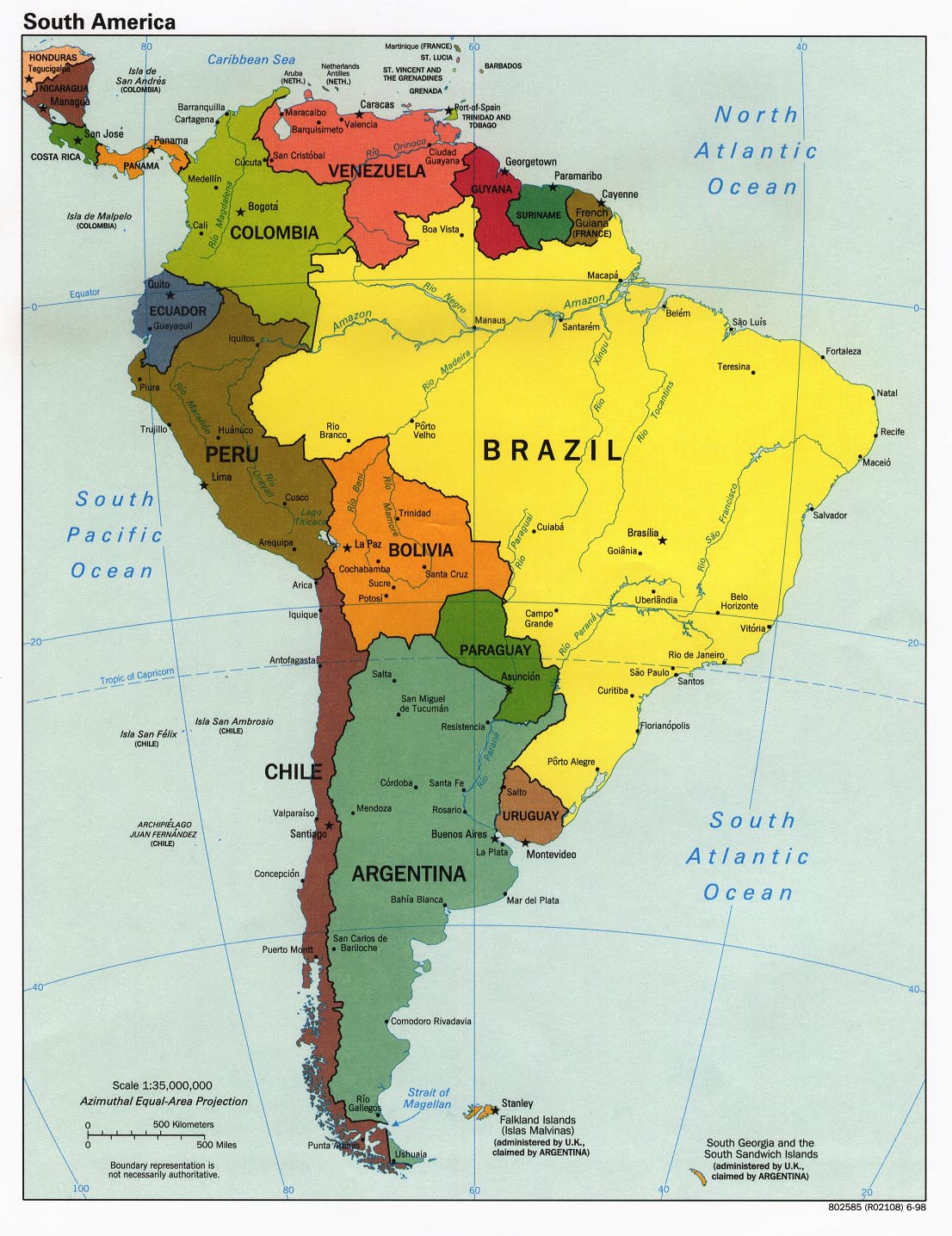
Colombia and Venezuela--note their location in the map--are still dealing off the radar with the U.S. in ways that threaten the region, and Mexico and Haiti are among two countries in Central America that the U.S. are working to manipulate and control in various ways, including militarily and through the spread of the cancer called corporate capitalism, destroying the possibilities of local/regional economies and social justice.

Basically, the U.S. wants military bases in all of these places to then attempt to militarily control more of each region of the world. This is partly how it works, in one of those countries: the U.S. sends weapons to Mexico, which allow more drug-trade/war related murders to happen there, allegedly making the case for increasing the U.S. military presence in that country. Everywhere the U.S. military is present, women are trafficked and raped.

Below is John Perkins latest newsletter:

Reject Corporatocracy Ambitions in Venezuela

Dear Friends,

Venezuela, Colombia, Iran, Afghanistan, Pakistan, Wikileaks, BP, assassination squads - these are times that try our souls (to paraphrase Tom Paine). These are times that raise our ire. These are times for action!

I receive lots of emails about the subjects listed above. In recent days I have been inundated with emails from people who believe the U.S. is about to take action against the Chavez administration in Venezuela and that the action will appear as a grass-roots movement initiated in Colombia . Many ask me to speak out against this.

I have no inside information as to whether or not this is true but I do know that Washington was elated at the election of its puppet, Juan Manuel Santos, to the presidency of Colombia, by the agreement to establish seven new U.S. military bases on Colombian soil, and that "wars on drugs" are often supported by the CIA as a way of financing its own "Black Ops" and also as an excuse for donating US military aid to countries that then are required to purchase equipment made by the corporatocracy (this model was perfected by the British during the 1800s Opium Wars and further refined by the CIA in Asia's Golden Triangle).

Many of my Latin American friends are convinced that the rising drug violence in Mexico is a response to the success of the Colombia drug wars - that it reflects the corporatocracy's determination to take greater control over Mexico, and through it, Central America, and that it is manipulated by the CIA. I can not verify the validity of this theory but it would be not inconsistent with things I experienced as an economic hit man. The fact that so many people are so deeply suspicious of Washington's motives sends a strong signal.

I am speaking out at every opportunity I have. On radio shows, at events where I lecture, and in my writings. I want to urge you to join me and to ask all your friends and your Facebook and Twitter connections to do so also. You and I have the power to prevent such actions - in Venezuela, Iran and throughout the world. We MUST exercise that power. These times are our testing ground.

The tired war machine that our country's leaders revert to in order to promote long-term economic gain for just a few elite must cease.

I'm asking for your help and your participation in raising a storm. Pick an issue or issues - any of the ones listed at the beginning of this article, or others that draw on your personal passions. Please do all the following and together our voices will be heard:

1. Write to every blog you can about this and link to ones that battle corporatocracy
2. Write letters to your local newspapers
3. Send emails to your elected officials
4. Do not buy from BP, Exxon, Chevron/Texaco (destroyed large sections of the Amazon), or Shell (responsible for the hanging of Ken Saro-Wiwa and his companions in Congo). If you must buy gas, do it from Citgo; a Venezuela-owned corporation, it is also the only major oil company that finances education and health services to some of the world's most impoverished people. Write emails to all these companies telling them why you are taking such actions.

We know that all the blustering of the Pentagon and White House over the Wikileaks disclosures is another indication that Washington is trying to cover up the crimes it commits in its rush toward resource domination. Rather than focusing on the real crimes committed by our troops in Afghanistan, Iraq, and elsewhere and the need to bring the guilty parties to trial and assure that such acts are never repeated, the U.S. government directs its energy at ferreting out the whistleblowers.

What we have to do is stop being hoodwinked by the communications people who constantly try to thwart us from reacting to the real issues at hand. We must start demanding transparency in our government and corporations and in their dealings with other countries. We must not let the U.S. propaganda networks blind us with fear. We must not reengage the old war machine in order to create a false economic boost for our country and devastation for so many others.

These are times when the corporatocracy is attempting to consolidate its power. It is up to each and every one of us to stand firm against those attempts. A line is being drawn in the sand in places like Venezuela and Iran. By the attack on Wikileaks. And the crimes of BP. Please take my hand and step across that line with me. United we will stop the U.S. from marching further to the drum of corporatocracy imperialism.

Many thanks and blessings,

John

John Perkins

New York Times bestselling author of "CONFESSIONS OF AN ECONOMIC HIT MAN" and "THE SECRET HISTORY OF THE AMERICAN EMPIRE"

http://www.JohnPerkins.org

http://www.dreamchange.org

Twitter: @economic_hitman

Sunday, July 18, 2010

What's Right[-wing] About This Picture?

Jaharah Applebum-Cobblepot
[I found this image online, but not at a specific URL and I searched for it on a URL but couldn't find it.]

11.11.2010 update:
Here's one like it:
image is from here

I'm kind of expecting crayon makers to come out with a "Whiter Shades of Pale" series any day now.

Saturday, May 29, 2010

National Day of Action Against Racism

 [photograph of Jose Matus is from here]

Cross posted from Censored News here.

Indigenous Alliance without Borders: National Day of Action Against Racism

NATIONAL DAY OF ACTION AGAINST RACISM AND RACIST LAWS - THE EVENTUALITY OF THE PHOENIX POSOLE PACHANGA

SATURDAY, MAY 29, 2010
By Jose Matus, Yaqui, director of Alianza Indigena Sin Fronteras

Alianza Indigena Sin Fronteras joins and stands strongly in support of all the people and organizers of the National Day of Action Against Racism and Racist public policies and laws. White America and especially Arizona's racist politicians are seeing a resurgence of Indigenous America in the form of immigrants who are descendants of North America's Indigenous populations. As Indigenous America, they are terrifying precisely because they have a moral claim to cross the border imposed on their lands.

Since the 1990's, the immigrant communities in Arizona have experienced in their everyday lives hatred, xenophobia, bigotry, abuse and rights violation while living in Tucson, Phoenix and throughout the state. The actions of the Arizona State Legislature extends the militarization of the border to the entirety of the state - that will legally codify law enforcement's petulant behavior and legitimize racial profiling, discrimination against non-Whites with a peculiar accent and style of dress.

The evolution of the United States anti-immigrant legislation and border enforcement policies in modern times have always and continue to affect indigenous communities on either side of the southern border. Rights of mobility and passage, federally-recognized sovereignty and self-determination rights, and access to traditional land sites and ceremonial grounds have been sorely compromised to the detriment of Elders, families, and youth.

Now, Arizona's passage of SB 1070 will do nothing to curtail the influx of undocumented migration, people and drug smuggling, border deaths and violence. It will create more problems for all people of color, abuse of power will be outrageously exercised and cruelly administered at the hands of those who have been convinced of their righteousness of ignorance and the unjustness of anti-immigrant enforcement policies.

Although some local Law Enforcement Officials have vowed not to comply with SB 1070, it is understood by many that this law could be perverted to excess by those who deem themselves the right to hold extraordinary power of authority. The nationally notorious racist Maricopa County Sheriff, Crazy Joe Arpaio, will clearly exercise this extraordinary power in the self-proclaimed right to get all those undocumented individuals he calls criminals that live within the confines of Maricopa County. He will continue his campaign of tyranny within the Mexican immigrant and Yaqui indigenous communities.

Is this the type of freedom our Troops of Color - our youth are fighting for as members of the U.S. Armed Forces - For Racist Politicians to implement racist laws in the name of National Security and community safety!

"Care of human life and happiness, not their destruction, is the first and only legitimate object of good government." - Thomas Jefferson

It is time for all those people of color that don' t vote to get involved in Civic Participation - Vote and Get Out the Vote! Lose or continue to be fighting for your rights!!

It is time to organize, speak out, join forces with other people of color movements to bring attention and fight for Human Rights and Human Life!

WE AS INDIGENOUS PEOPLES MUST BE PART OF THE POSOLE PACHANGA. WE DON'T WANT TO LIVE IN A NO-BROWN TOWN AND STATE!
ALIANZA INDIGENA SIN FRONTERAS STRONGLY SUPPORTS & WILL PARTICIPATE IN THIS HUMAN RIGHTS MOVEMENT

Friday, May 21, 2010

No Good: "Bad cop, Bad cop". The Rapist, Racist WHM Immigration Police Officer: Bradley Stewart Wagner

Good Bad cop, Bad cop.

TRIGGER WARNING: Accounts of gross sexual assault by a California WHM police officer follow. (He is no longer a police officer.)

This is the horror of the normal misogynist-rapist cop, whose photo was unavailable, conveniently for him. If you think this won't be replicated in Arizona when the new law takes effect, you might want to reconsider how systemic and interpersonal abuses of power work.

This is a cross post. Click on title to link back to source on OCWeekly (Orange County News).

Bradley Stewart Wagner, Ex-Anaheim Cop, Convicted of Threatening Women With Deportation if They Did Not Have Sex With Him


cop-with-flashlight.jpg
To hear supporters of Arizona's controversial immigration law tell it, local law enforcement officers will do no more than follow federal law in arresting people who are in this country illegally.

Those arguments assume these are "good cops" they're talking about. You don't hear much about "bad cops" who could dangle the threat of deportation over those they encounter to coerce information, confessions or degrading sexual acts out of them.

After all, 62-year-old Anaheim cop Bradley Stewart Wagner did that without the powers of a new immigration law.

Check out the Orange County District Attorney's Office statement on the now-former APD officer's conviction after the jump, and think about similar tarnished badge holders in Arizona.

May 17, 2010

FORMER POLICE OFFICER CONVICTED OF VICTIMIZING THREE WOMEN, INCLUDING FORCING ONE TO ENGAGE IN SEX ACTS UNDER THREAT OF DEPORTATION
A former police officer for the Anaheim Police Department (APD) was convicted today of victimizing three women while on duty in a marked police patrol car, including threatening to have two of them deported and forcing one to orally copulate him. Bradley Stewart Wagner, 62, Perris, pleaded guilty to one felony count each of forcible oral copulation and oral copulation under the color of authority for Jane Doe #1, one felony count of sexual battery by restraint for Jane Doe #2, and one felony count of false imprisonment by violence or deceit and one misdemeanor count of being an officer acting without regular process for Jane Doe #3. Wagner faces a sentence of four years in state prison at his sentencing on July 14, 2010, at 8:30 a.m. in Department C-55, Central Justice Center, Santa Ana.

Jane Doe #1

Shortly after midnight on Nov. 11, 2005, Wagner turned on his overhead lights and pulled Jane Doe #1 over on Kramer Boulevard while on-duty in a marked patrol car. The victim, who is primarily a Spanish speaker, was driving home alone from work in her van and pulled over in a parking lot.

Wagner approached the victim's window and asked if she had any legal papers or a driver's license. Upon learning that Jane Doe #1 did not have any legal papers, the defendant told the victim that he could have her deported and instructed her to move her car across the street into another parking lot on East La Jolla Avenue. The defendant followed Jane Doe #1 across the street, had her get out of her vehicle, and fondled her breasts under the false pretense of searching her.  He told the crying victim that he wanted sex from her in exchange for not having her deported.


Wagner again instructed Jane Doe #1 to move her van, this time leading her to a dark, secluded industrial area. He had Jane Doe #1 get out of her van, pulled up her shirt to expose her bra, and forced her to pull down her pants. The victim pleaded for the defendant to stop and told him she was married with children. The defendant exposed his erect penis and forced Jane Doe #1 to orally copulate him by repeatedly pushing her head down as she gagged and struggled to pull away. The defendant finally released the victim as she began to vomit. He then wrote a phone number on a lottery ticket, gave it to the victim, and left.


Jane Doe #1 reported the sexual assault the following day to APD. As a result of media coverage on this case, two additional victims came forward. None of the three victims know each other or the defendant.


Jane Doe #2

Between Oct. 31, 2005, and Nov. 5, 2005, Wagner pulled over Jane Doe #2, an unlicensed Spanish speaking woman, on two occasions while on-duty in a marked patrol car. The second time Jane Doe #2 was pulled over, Wagner had the victim follow him into a secluded alley behind a business. The defendant asked Jane Doe #2 for sex after telling her that she could be deported or be sent to jail, and rubbed her vagina over her clothes. Wagner asked the victim for sex, but let her go after she resisted and agreed to meet him the following night. The victim did not return to meet the defendant.

Jane Doe #3

Between Sept. 1, 2005, and Nov. 10, 2005, Wagner pulled over Jane Doe #3, an undocumented Spanish speaking woman, on four occasions while on-duty in a marked patrol car. The defendant asked the victim personal questions, including whether she was married or had children, and let her go each time without writing her a ticket.     

Deputy District Attorney
Lynda Fernandez is prosecuting this case.

Saturday, May 15, 2010

A Profeminist Report on Male Supremacist Resistance to Gender Equality in Chile

[image of Chilean feminists marching is from here]


Please click on the Title just below in order to link back to the source webpage.


CHILE
Gender Equity Progress Blocked by Hard-Core "Machismo"
By Daniela Estrada

SANTIAGO, May 14, 2010 (IPS) - More than 60 percent of Chileans surveyed by the United Nations Development Programme (UNDP) are opposed to full equality between women and men, according to a new national report released by the agency on Friday.

Pablo González, coordinator of the 2010 UNDP National Human Development Report from Chile, told IPS that the basic message of the study is the following: "Chile has made a great deal of progress with regard to gender equity, and people value this progress, but nonetheless, we have come up against entrenched pockets of resistance that will hinder further progress.

"Now it is important to tackle certain aspects resistant to change, which include the country’s culture, which is not egalitarian," added González, who presented the main findings of the study, subtitled "Gender: The Challenges of Equality", at a report launch held in the seat of the national government, currently led by right-wing President Sebastián Piñera.

A survey conducted by the UNDP in 2009, which served as the basis for the report, found that 62 percent of Chileans, both male and female, are opposed to full equality between the sexes.

Of this total, 18 percent are classified as "machista" - people who believe that men should have the power, give the orders and be the "breadwinners", while women should obey and limit themselves to their roles as mothers and wives.

Close to 80 percent of these "machistas" are men from lower socio-economic brackets, and most live in the southern region of the country, according to the study.

Another 18 percent of respondents are considered "traditional": they believe that men and women should complement and support one another while fulfilling their traditional roles. This group is made up primarily of people over the age of 50, and is evenly divided between men and women. They tend to be from the lower middle class and have strong religious ties.

The remainder of those resistant to full gender equality, who accounted for 26 percent of respondents, fall under the category of "pragmatists" – people who feel that gender roles can be modified when necessary, but that it is important to maintain the difference between the sexes and traditional morals. These pragmatists are mainly middle-aged and middle-class Chileans.

The other 38 percent of respondents, who do support the concept of gender equity, fall into two categories.

On the one hand, there are the "fighters", who made up 15 percent of respondents. The majority of them are women who feel that they essentially do everything, but it is men who have the advantages.

The remainder are classified as "liberal" (23 percent). In their opinion, there are no differences between the sexes, and everyone is equal and independent. Most members of this group are relatively young and from higher income brackets.

"Another hard core of resistance is shared responsibility for domestic tasks: women continue to do most or all of the household chores, which means that many women who have entered the job market essentially work a double shift," noted González.

In fact, a full 78 percent of the women surveyed by the UNDP reported that they are solely or mainly responsible for housework, while 52 percent of men responded that they "normally don’t do anything."

González stressed that different policies are needed to address the different realities faced by women in Chile.

Rural or urban women with precarious employment or "machista" husbands do not have the same needs as higher-income women who choose to stop working temporarily to devote themselves to raising children and subsequently find it difficult to re-enter the labour market, he said.

On the UNDP’s Human Development Index, which measures life expectancy, education and income, Chile ranked in 44th place among 182 countries in 2009, thus classifying as a country with a "high" level of human development.

But when it comes to the Gender Empowerment Measure, also calculated by the UNDP, this South American country of 17 million people ranked 75th among 109 nations.

The continued inequality faced by women is illustrated by other statistics as well.

Women’s participation in the paid labour force rose from 32 percent to 49 percent between 1987 and 2006, but still lags behind other countries in Latin America.

Women also occupied only 22 percent of high-level political posts in Chile in 2009, in the legislative and executive branches as well as within political parties.

When it comes to the UNDP’s measure of women’s "economic power", the situation is even worse: only five percent of company managers, board members and executives in Chile are women.

Meanwhile, the UNDP report also found that between 2006 and 2009, during the administration of Chile’s first female president, socialist Michelle Bachelet, the largest number of bills related to gender equity were tabled in parliament compared to any other period since 1990, the year that democracy was restored after 17 years of dictatorship.

On Apr. 29, President Piñera announced the creation of a Presidential Advisory Committee on Women, Work and the Family. The committee has been given a 90-day mandate to study alternatives aimed at increasing women’s participation in the workforce while protecting the family and eliminating the obstacles that keep women from having children.

These include a proposal for longer and more flexible maternity leave, which is currently 84 days. (END)

To U.S.ers: Let Us All Speak Out in Solidarity: Mohawk Women Condemn Fascist Arizona Law

[image is from here]

This is a cross post from Censored News and Mohawk Nation News, and was found by me *here*.

Saturday, May 15, 2010


Mohawk Women Condemn Fascist Arizona Law


Mohawk Nation News
http://www.mohawknationnews.com

MNN. May 14, 2010. On November 7, 2007 the Women Title Holders presented the Mohawk position to the Indigenous ‘Border’ Summit held at the Tohono O’Odham Territory. A wall is being built through the middle by Mexico and the US. Arizona’s new illegal laws on racial profiling and censoring truth in Arizona is trying to declare war on Indigenous and international law. They are destined to lose.

TO: The invaders of Great Turtle Island, all their criminal agencies and their international terrorist allies.

RE: Rotino’shonni:onwe freedom to traverse Onowaregeh, Great Turtle Island, and beyond without hindrance from the invading aliens and their agents; and to conduct trade and commerce without interference.

PREAMBLE: Only we, the original peoples, have sovereign authority on Onowaregeh, Great Turtle Island. We cannot forfeit our natural birthright. We survived mass murder, chemical and biological warfare, starvation, physical and mental torture, lies, ignorance and genocide.

Fabricated colonial nations of Canada, US and Mexico and other corporate ‘franchises’ of Europe are squatting on Indigenous lands that leech off our peoples and resources.

WAMPUM 44 Kaianereh’kowa [our constitution]. We the Kohtihon’tia:kwenio – Women Title Holders – are the caretakers of the land, water and air of “Onowaregeh”; we have the duty to preserve and protect the land for the future generations.

a.WHEREAS the Two Row Wampum Agreement and Wampum 58 of the Kaianereh’kowa, the Great Law, stipulate that no one shall restrict our freedom of passage on our lands and beyond; these imaginary lines [borders] were created by foreign capitalist corporations named “Canada”, “US” and “Mexico”. They illegally usurped and divided up our lands and resources, without our knowledge or consent; and we will continue to assert our sovereignty and alliances among our nations as we have done since time immemorial.

b.WHEREAS respect for our rights to our land are acknowledged in the “constitutions” of Canada and the US; they are not sovereign because they can never have our land.

c.WHEREAS the Charter of the United Nations requires respect by all members for equal rights and self-determination of all peoples; and to resolve differences peacefully.

d.WHEREAS these three colonies must respect our political rights as set out in the International Covenant on Civil and Political Rights, the Universal Declaration of Human Rights, the Convention on the Prevention of Genocide, UN Convention on Economic, Social and Cultural Rights and other international legal instruments.

e.WHEREAS General Assembly Resolution 1541 [XV] requires the informed consent of the people before they are included in another state, as affirmed by the international Court of Justice in the Western Sahara case. Sovereignty rests only with the people. We cannot become part of the colonial states that are squatting on our land. Canada, US and Mexico cannot force us to become citizens without our knowledge and consent.

f.WHEREAS according to article 15 of the Universal Declaration of Human Rights, Sections 1 and 2, every nation has a right to its nationality; and no nation can change another nation’s identity by imposing restrictions to travel, trade and commerce throughout all of the Americas.

g.WHEREAS these immigrants to our lands are committed to uphold equality of all peoples.

h.WHEREAS Canada, US, Mexico and all other colonial states cannot legally encroach on the true Indigenous people; and our perspectives on us, our land, resources, air and water cannot be ignored.

i.WHEREAS foreign invaders cannot force us to carry alien passports and other identity; we have agreements and identification to travel the lands of our Indigenous allies. The “Haudenosaunee Passport” is for travel outside of Onowaregeh.

j.WHEREAS the Two Row Wampum Agreement provides we are free to pass and re-pass by land or inland navigation or by air onto our territories; to carry on trade and commerce with each other; we may hunt and fish anywhere on our territory; foreigners cannot extort taxes, duties or fees from us; and we shall have free passage over all toll roads and bridges that have been built on Onowaregeh.

k.WHEREAS human life is sacred to us; the International Covenant on Civil and Political Rights provides that every human being has the inherent right to life and fundamental freedom; these three colonies must stop murdering and detaining our people for crossing their illegally imposed economic borders.

l.WHEREAS the UN Declaration on the Rights of Indigenous Peoples has been adopted by a majority of 144 states; we claim as collectives and as individuals all the human rights and fundamental freedoms provided in the Charter of the United Nations, the Universal Declaration of Human Rights and international law, without forced assimilation, destruction of our culture and undermining of our nations.

m.WHEREAS torture is intentional, premeditated, systemic and scientific; it is designed to break down our dignity, social fabric and foment terror within our Peoples.

WE, THE KOHTIHON’TIA:WENIO, GIVE FULL NOTICE THAT:

Canada, US, Mexico and other colonial franchises must cease and desist their attempts to violate our authority; they must deal with us on a nation-to-nation basis as required by our inherent rights and international law; these foreign entities must go through proper diplomatic channels, which are the Governor General of Canada and the Presidents of the US and Mexico.

WE, THE KOHTIHON’TIA:KWENIO, AS MEMBERS OF THE ROTINO’SHONNI:ONWE, DEMAND THAT THE COLONIES OF CANADA, US, MEXICO OR ANY OF THEIR FRANCHISES, CORPORATIONS AND AGENTS:

1.Respect our inherent rights, laws, ancient customs, traditions and agreements.

2.Be held responsible for murder, torture and theft, which are violations of the Great Law, Two Row Wampum, the first laws of the Americas and international law; disarm, stop detaining, murdering, torturing, raping and robbing us; and stop imposing their illegal judicial harassment and prison system on us.

3.Put away their guns and corporate by-laws so we can resolve our differences peacefully by rediscovering the spirit of the Two Row Wampum and the Covenant Chain that affirmed our international relationship centuries ago.

4.Disband their puppet band and tribal councils; restore proper diplomatic relations with our inherent traditional governments; and respect their agreements with us and their obligations under international law.

5.Abuse of people on any basis, especially race, religion, nationality, belief or membership in any social group in unacceptable; colonizers must become partners with us to end the cycle of abuse, criminalization of our people, and to extend dignity, equality and a voice to all.

6.We extend our message to all peoples oppressed by colonizing forces.

KOHTIHON’TIA:KWENIO OF THE KANION’KE:HAKA OF THE ROTINO’SHONNI:ONWE:

Kahentinetha, MNN Mohawk Nation News
Kahentinetha2@yahoo.com For more news, books, to donate and to sign up for MNN newsletters and to go to www.mohawknationnews.com MNN Category “border”.

Store: Indigenous author – Kahnawake books – Mohawk Warriors Three – Warriors Hand Book – Rebuilding the Iroquois Confederacy.

Category: Border – Central/South America - World – Colonialism - Indian holocaust/genocide – Great Turtle Island – History – New World Order – courts/police Economics/trade/commerce – Land/environment – military/industrial complex.

Tags: North American Indians – Turtle Island – Indian holocaust/genocide – Canada/US/Mexico – NAU North American Union – History Canada/US – United Nations.

NOTE: This this matter was brought to the attention of Canada in an action in the Supreme Court of Canada – Kanion’ke:haka Kaianereh’ko:wa Kanon’ses”neh v. Attorney General of Canada and Her Majesty the Queen in Right of Ontario, Court File: 05-CV-030785.

The constitutional jurisdiction issue went before the U.S. Supreme Court. See No. 05-165: 2005. In re: Kanion’ke:haka Kaianereh’ko:wa Kanon’ses:ne, Non-party, Petitioner/Movant/Appellant, The Canadian St. Regis Band of Mohawk Indians, Plaintiffs, Respondents v. The State of New York, Defendants, Respondents, Petition for Writs of Certiorari and Quo Warranto with Prohibition and Mandamus in Aid to Prevent Genocide. Rules 17.1 and 20.1.