Showing posts with label Indigenous women's activism. Show all posts

Wednesday, August 19, 2020

Celebrating the 100th Anniversary of Women's Right to Vote

Utah women of color were part of fight for equal suffrage, historians say

Photos courtesy of Better Days Utah 2020. L to R: Elizabeth Taylor; Alice Kasai; Zitkála-Šá (Dakota); and Hannah Kaaepa (Hawai'ian) with her mother and sister. All fought for women's rights. Source: https://www.sltrib.com/news/2020/08/16/utah-women-color-were/

“Indigenous women have had a political voice in their nations on this land for over 1,000 years,” Sally Roesch Wagner, historian and editor of the 2019 anthology The Women’s Suffrage Movement, points out. “Women’s rights is not a new concept on this land; it’s a very, very old one. And the clan mothers of the six nations of the Iroquois Confederacy, the Haudenosaunee women, have had political voice for 1,000 years.”

The passage above is from a new Time magazine article, August 18th, 2020: "5 Myths About the 19th Amendment and Women's Suffrage, Debunked": https://time.com/5879346/19th-amendment-facts-myths/

On August 19, 2020 there will be a special discussion about the leadership and strategies of Black women during the long fight for suffrage:
https://www.youtube.com/watch?v=GAkgz7oYPV8

Description of the webinar/discussion:
In the standard story, the suffrage crusade began in Seneca Falls in 1848 and ended with the ratification of the Nineteenth Amendment in 1920. But this overwhelmingly white women’s movement did not win the vote for most Black women. Securing their rights required a movement of their own. In “Vanguard,” historian Martha S. Jones offers a new history of African American women’s political lives in America. She recounts how they defied both racism and sexism to fight for the ballot, and how they wielded political power to secure the equality and dignity of all persons. From the earliest days of the republic to the passage of the 1965 Voting Rights Act and beyond, Jones excavates the lives and work of Black women — Maria Stewart, Frances Ellen Watkins Harper, Fannie Lou Hamer, and more — who were the vanguard of women’s rights, calling on America to realize its best ideals.

The book the conversation emerges from is Vanguard: How Black Women Broke Barriers, Won the Vote, and Insisted on Equality for All (September 8, 2020), by Martha S. Jones. Link: http://marthasjones.com/vanguard/

Additional new scholarship in 2020 reveals which women and women's organisations took leadership and had influence en route to this tremendous accomplishment a century ago. This sites lists several other new books honoring the Suffrage Centennial:
http://suffrageandthemedia.org/source/books-new-in-2020-for-the-suffrage-centennial/


Friday, March 4, 2016

Indigenous Activist Berta Cáceres Assassinated In Honduras


From SOA Watch:

Human Rights Organizations Demand an Investigation of the Circumstances Surrounding the Assassination of Berta Cáceres, the General Coordinator of COPINH
At approximately midnight last night, the General Coordinator of COPINH, Berta Caceres was assassinated in her hometown of La Esperanza, Intibuca. At least two individuals broke down the door of the house where Berta was staying for the evening in the Residencial La Líbano, shot and killed her. COPINH is urgently responding to this tragic situation.
Berta Cáceres is one of the leading indigenous activists in Honduras. She spent her life fighting in defense of indigenous rights, particularly to land and natural resources.
Cáceres, a Lenca woman, grew up during the violence that swept through Central America in the 1980s. Her mother, a midwife and social activist, took in and cared for refugees from El Salvador, teaching her young children the value of standing up for disenfranchised people.
Cáceres grew up to become a student activist and in 1993, she cofounded the National Council of Popular and Indigenous Organizations of Honduras (COPINH) to address the growing threats posed to Lenca communities by illegal logging, fight for their territorial rights and improve their livelihoods.
For the rest of the article, please see here at SOA Watch.

Saturday, February 27, 2016

Military Perpetrators of Sexual Slavery, Rape, and Murder Found Guilty in Guatemala

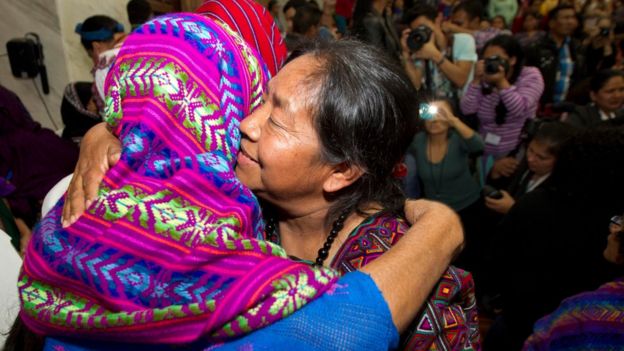
There were jubilant scenes in court when the verdict was announced
[this AP image is from here]
Mientras exista justicia para el más débil, para el desfavorecido, hay esperanza en un futuro digno para todos.  [translation at the bottom of this post]


"This is historic, it is a great step for women and above all for the victims" -- Rigoberta Menchu, Nobel Peace Prize winner who attended the hearing


From the BBC, 27 February 2016:

Guatemala: Rape sentences in landmark military trial

A Guatemala court has sentenced two former members of the military to 360 years in jail for the murder, rape and sexual enslavement of indigenous women.

Francisco Reyes Giron and Heriberto Valdez Asij were found guilty of crimes against humanity.

The historic ruling is the first successful prosecution for sexual violence committed during Guatemala's military conflict in the 1980s.

There were jubilant scenes in court as the judge read out the sentence.

"This is historic, it is a great step for women and above all for the victims," said Nobel Peace Prize winner Rigoberta Menchu, who attended the hearing.

Francisco Reyes Giron, who was the commander of the Sepur Zarco military base, was found guilty of holding 15 women in sexual and domestic slavery and for killing one woman and her two daughters.

Heriberto Valdez Asij, a paramilitary who carried out commissions for the army, was convicted for the same enslavement, as well as the forced disappearance of seven men.

The victims have been demanding accountability for the crimes at Sepur Zarco for decades.

For the rest of that story, please go to *this BBC site*. But for more, please also go to Global Voices or Intercontinental Cry for *this report*. From that article, this excerpt:

While international observers praised the efforts of the national courts, a deep reflection came from the national organisation comprising all universities — the CEUG (in Spanish, Coordinadora Estudiantil Universitaria de Guatemala), which has played a crucial role recently in the battle against corruption, summarised in one line why the ruling is vital for the future of the nation:

Mientras exista justicia para el más débil, para el desfavorecido, hay esperanza en un futuro digno para todos. 

[As long as there is justice for the underdog, for the vulnerable, there is hope for a dignifying future for all of us #SepurZarco]


Saturday, February 6, 2016

*Feminist Action Alert* for Joanne Shenandoah (Wolf Clan member of the Oneida Nation), Activist against Human Rights Abuses and Native American Music Award winner

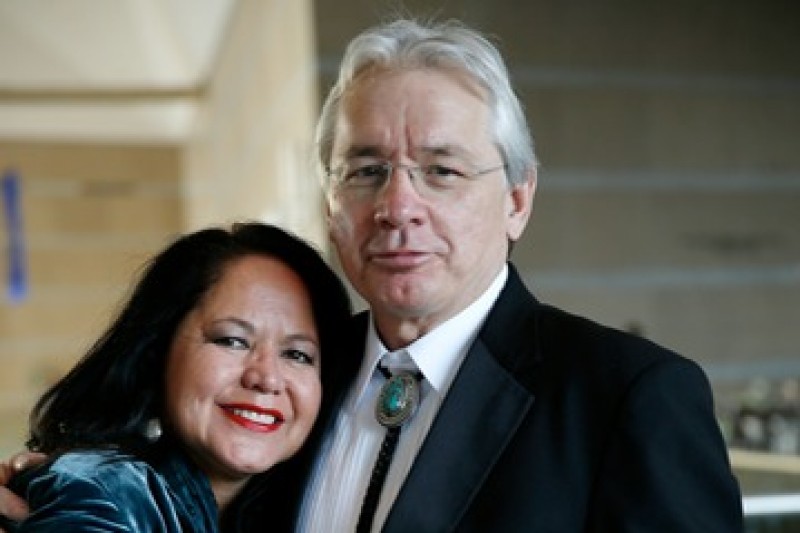
photograph of Joanne Shenandoah with husband Doug George-Kanentiio is from here

I wish Joanne all the support necessary to obtain the liver transplant she needs. I thank Brenda Norrell @ Censored News for alerting me to this with her blog post. Everything that follows in this post is from this gofundme page: https://www.gofundme.com/joanneshenandoah

Joanne Shenandoah is a wolf clan member of the Oneida Nation, Haudenosaunee (Six Nations Iroquois) Confederacy. She is the mother of Leah Shenandoah, the wife of Doug George-Kanentiio, the sister of five siblings and the daughter of the late Maisie Shenandoah, Oneida clanmother, and Clifford Shenandoah, an Onondaga chief. She is a composer and performer,  Native American Music Award winner, the co-chair of the US Attorney General's Task Force on Preventing Child Abuse on Indian Territory, has acted in films, written music for documentaries, sang at seven Native American US Presidential inaugurations, recorded 17 award winning albums, donated thousands of hours to communities and those in need and taken an active part in combating human rights abuses while becoming an advocate for universal peace. She has represented her people on many commissions and before many forums. She sang at the Vatican to honor St. Kateri of the Mohawks and for his Holiness the Dalai Lama. She was awarded an honorary Ph.D. in music from Syracuse University. She has performed at the Parliament of the World's Religions; whenever asked to use her talents she has responded.  

Joanne contacted a serious abdominal infection this past summer which spread to her liver and resulted in its gradual failure. She has endured 4 long hospital stays and was in an induced coma for two weeks. As a result of the infection her liver is failing and she has been placed on the New York State liver transplant list. She is now subject to infections and pnuemonia while waiting a transplant. The waiting time for a transplant in New York may take a year or more leaving Joanne subject to repeated cycles of illness. The Mayo Clinic in Jacksonville, Florida does transplants at a much higher rate than in New York and is willing to take Joanne, meaning the operation and healing period is greatly reduced and she may return to good health. The Clinic requires the total payment to be made at the time of her acceptance into their program and the cost is comparable with other transplant centers. The key is how soon this can be done. The longer Joanne waits the greater the stress on her physical health. She needs to undergo this procedure as soon as possible. The cost for the transplant, prolonged two month stay and all associated procedures is $450,000.00 which goes directly to the Mayo Clinic. Joanne's family and friends are trying to reach this amount through insurance policies, catastrophic resources provided by the Indian Health Service and donations.

Joanne has been a beacon of light and inspiration for Native people everywhere. Her diginity and creativity has inspired and affected e she has met. She has been particulary sensitive to children and women of all backgrounds. A transplant means she can return to performing, to sharing her music and culture around the world. It means she can live. Her family is initiating this effort on behalf of one of North America's most wonderful talents. Their gratitude, and that of Native people everywhere, will be immense.  We cannot allow this light to be diminished.
[To be part of this effort, please visit this website: https://www.gofundme.com/joanneshenandoah]


Saturday, May 18, 2013

Who Among the non-Indigenous Stand with Indigenous People to End Genocide?


https://blogger.googleusercontent.com/img/b/R29vZ2xl/AVvXsEi0s9ga1_hJHtWPrTXTRUF_vjyGoqbLk4yw845Tcd2FMpuxrrFmPmPry5UnDjx3TGLswydT26UYDtswIUTSQIMA05Edyyu1kV7PPaaP1ILiSzZfxVKj_pswEBbvoG9VTRP5d-cygVgRhgOQ/s1600/DSC_0494.jpg
photo of Indigenous activist Rigoberta Menchú is from here
I'm not sure what has to happen for genocide to end. Hopefully not the disappearance of all despised and oppressed people. Hopefully not the destruction of all Indigenous people and their homelands, if they still have their homelands. See these two stories if you are not aware that genocide is on-going. The first was shown on NBC, which surprised me as corporate media usually ignores these realities, and/or profits from them. But thank you to Ann Curry for reporting this infuriating story.


And from Democracy Now!, this recent interview with Rigoberta Menchú:
http://www.democracynow.org/2013/5/15/nobel_laureate_rigoberta_mench_hails_genocide


One small step is to sign this petition:

http://www.change.org/en-GB/petitions/ministry-of-environment-quito-ecuador-stop-selling-last-of-the-ecuadorian-amazon-rainforest-to-oil-companies

Please let me know what else is being done.


Monday, February 18, 2013

Chief Jacqueline Thomas of Saik'uz First Nation Speaks at the Forward on Climate Rally


This occurred on 17 February 2013. I do not know who held the camera but am grateful they recorded Chief Jacqueline Thomas's address.

One of my most significant learnings as someone white, and also as someone male, has been to place the joys, the concerns, the dangerous and deadly conditions, the horrific gynocidal and genocidal realities, the survival strategies, the stories, the perspectives, the philosophies, the analyses, and the ethics of women of color at the center of my heart and mind. And, for whatever it can do, at the center of my blog.


Sunday, July 1, 2012

Action Alert on the Coming of Age Ceremony (June 30 - July 3, 2012) of the Winnemem Wintu Tribe, California

This is one story among thousands of on-going struggles by Indigenous activists that go unreported by dominant/corporate/WhiteMan's media, so that the majority of people will be ignorant about the on-going genocide (physical, cultural, environmental, economic, spiritual, and political) of Indigenous People globally.

For additional information on what follows, please click *here*. To link back to Brenda Norrell's website, Censored News, where I found this information, please click on the title just below, or on Brenda's name at the end of this post. Everything that follows in this post is from Brenda's site.

Winnemem Wintu: Coming of Age Day 1, 2012

July 1, 2012: While difficulties with the Forest Service "closure" mar the ceremony, we remain focused on bringing the future chief into womanhood in the best way possible. As indigenous people of this watershed, we have the right to maintain our traditional ways without molestation.

Winnemem Wintu Tribe
At dawn, on the first day of the Coming of Age ceremony, a lake user let us know he had a "357" and was willing to use it. Even with a Forest Service "closure" for health and safety issues, we don't feel very safe.
Chief Caleen Sisk and her nephew Arron Sisk are vowing to continue their fast until a BIA representative meets with them to discuss the protection of Winnemem rights as a historically recognized tribe.

Please contact:
Amy Dutschke, of the BIA Sacramento Office
(916) 978-6000 or (916) 978-6099 amy.dutschke@bia.gov
"Meet with Chief Caleen Sisk!"


Sunday, June 3, 2012

Ten Thoughts on the Current Conflicts Between RadFem and Transgender Activists

photograph is from here
[Note: this post may also be read *here* on Tumblr.]

Keywords for this post could include "Sheila Jeffreys" and "RadFem2012", although the post is about issues beyond any one activist and that single event. Nonetheless, for some of the most current discussion serving as partial background for what follows, please see *here* and *here* (each at The Guardian).

1. I strongly believe female women ought to able to organise politically in social spaces free from harassment and interruption from male men, and from males who don't identify as men, and from transgender and transsexual-identified people, and from queer-identified and male-identified people who are anti-radical and anti-feminist. To the female women who are attempting to do so: Good luck with that.

2. The current conflict between RadFem-identified women and transgender-identified people is glaringly white. As far as I can tell, the spokespeople for both groups are white with other structural advantages too; they appear to represent white-majority and white-dominated groups. Nowhere are the experiences of women of color and trans people of color centered. This means that it is likely that only white ways of resolving conflict will be employed and that other-than-white ways of resolving conflict will be avoided and ignored.

3. "RadFem" is not a synonym for Radical Feminism or Revolutionary Feminism, if Radical and Revolutionary Feminism, in and also beyond the U.S., is centrally (read: not peripherally, parenthetically, or through footnote) the work of activists and authors including Flo Kennedy, Audre Lorde, Alice Walker, Barbara Smith, bell hooks, Andrea Smith, Patricia Hill Collins, and hundreds of other radical, womanist, and feminist women of color. "RadFem", as far as I can tell, is a term owned and promoted by an exclusively white group of female women. Such exclusive whites-only and/or white-dominated organising functions to maintain white supremacy even as it seeks to eradicate male supremacy.

4. "Transsexual" and "Transgender" are anglo-centric, white-centric terms and ways of dealing with a white male supremacist sex-race hierarchy based on the subordination of girls and women to everyone else. The analysis and practices that come from white transsexual and transgender activists often minimises or overtly ignores male and white supremacy while promoting liberal ideas and theories about sex and gender. Overall, white transgender theory and practice is, in my view, anti-radical and anti-revolutionary. Its theorists and spokespeople refuse to put women of color--many of whom do not embrace terms like "transgender" or "radical feminist"--at the center of their theories and practices. Many women of color who resist euro-/anglo-/white supremacy and Western cultural imperialism have their own understandings and experiences of gender and resistance that are not linguistically (or otherwise) existent in the white trans and non-trans imaginations.

5. White het male supremacist societies, such as many in the West, are dominated by liberal and conservative economic and social philosophies and value systems. In such systems and societies, there are two fundamental and ruthlessly enforced rules or codes of conduct:
  • female girls and female women are supposed to exist in service to everyone else of every age. This includes being accessible, accommodating, acquiescent, appeasing, pleasing, arousing, submissive, silent, subservient, and subordinate.
  • people of color are supposed to be of service to whites across sex. This includes being the opposite of "uppity", being respectful to whites in ways whites determine to be respectful, not being threatening, and being submissive, silent, subservient, and subordinate.
A third rule is that whites and men ought never be fully or consistently accountable to women of color. If it appears to happen it will be accidental or in service to maintaining white control and male power.

6. There is a map of gender that whites have constructed and live by. It is a map detailing various routes of conquest and access into the lives of females of all ages, including girls and women across region, race, and age. It is a map of how to be a male man, which posits "man" as the opposite of and in a supremacist position over everyone female and feminine, as male men define and enforce such terms. It is a map of how to be white while ignoring the meaning and power of whiteness, including in progressive and radical white groups. It is a map that currently while marginally allows for the existence of transsexual and transgender people. But beneath that map are other, older maps. If you peel away or scrape off the surface map, you may find these older maps with other languages and ways of being. There are also contemporary social spaces where people of color are redefining and re-inventing non-white ways of being gendered without ignoring or minimising the power and prevalence of white and male supremacy. The disruption and interference, both psychically and physically, perpetrated by whites and men over and against female, intersex, and other people of color is so ever-present as to be unremarkable and unnoticeable by whites and men.

7. In many of these current debates, what female girls of color experience globally is ignored or unknown. How heterosexualised white and male supremacy, Western cultural imperialism, globalised corporate capitalism, and formal and covert militarism each impact the lives of girls of color is not consistently centralised in the theories, policies, and practices of whites who claim to be fighting for liberation. When girls of color are mentioned, it is usually to make points that (consciously or not, intentionally or not) either reinforce the rampant white supremacy in liberal and radical political struggles by and for whites, or reinforce the ruling male supremacy in conservative and orthodox political systems by and for men.

8. Right now, there are non-trans female people of color, and trans people of color, and third gender, and other-than-trans, and other-than-cis-gender people of color who do not see or experience each other as "the  enemy" and who work together on small-scale and larger-scale liberation projects against the many forces that seek their invisibilisation and destruction.

9. I support female and intersex women and trans people of color being centrally involved in all revolutionary liberation struggles in ways that they determine to be politically viable and mutually respectful. Indigenous and non-Indigenous women of color are organising and sustaining most liberation struggles around the world. Far too many whites and men ignore them or try to subordinate and silence them, ignoring the destruction, disappearance, and deaths of girls and women of color, by murder and other means, including in the midst of very contentious debates between RadFem-identified whites and transsexual- and transgender-identified whites.

10. If your own liberation work doesn't name, address, and consistently centralise the many economic, sexual, and raced hardships and horrors that over-determine and destroy the lives of millions of girls and women of color globally, and if your own civil rights and human rights work doesn't employ the survival strategies and revolutionary values and practices of Indigenous and non-Indigenous activist women of color, why doesn't it?


Wednesday, May 2, 2012

Ofelia Rivas, Paloma Oldham, Claire Bergstresser, and other marchers declare state of human rights emergency in Arizona

What follows was found by me at Censored News. With thanks to Brenda Norrell.
This is a cross-post with a link, *here*, back to her website and the article's appearance there.


Marchers declare state of human rights emergency in Arizona

Please read this Peaks update as well: Stop Snowbowl: Upcoming Flagstaff Elections, Know Where They Stand (http://indigenousresistance.org/stop-snowbowl-upcoming-flagstaff-elections-know-where-they-stand/)

By Klee Benally
Censored News
http://www.bsnorrell.blogspot.com
Photos by Ethan Sing and Shelby Ray

FLAGSTAFF, Ariz. -- More than 300 people including dozens of organizations rallied in Wheeler Park, then marched through the streets of downtown Flagstaff, Arizona in response to escalating human rights violations.

"Arizona is in a state of human rights emergency," stated Eli Isaacs, a volunteer with the Repeal Coalition and an organizer of the march. "We may come from different parts of this community and face different issues, but this racist state and greedy corporations can only push us so far. With our backs against the wall, its easy to see the same forces are oppressing us all, its natural to find unity against common oppressors."

Community members and students addressed reproductive justice, hetero-sexism, cultural survival, racism, sexism, ageism, police brutality and racial profiling. The gathering spoke out against racist laws such as SB1070 and HB2281, and John McCain and John Kyl's water settlement. They urged protection of the San Francisco Peaks and all other sacred places. They agreed to be in solidarity and to support one another in the struggle for human rights.

Luis Fernandez, from Arizona ALCU, asked the crowd what human rights were. Voices rang out, crying "Access to shelter, enough food, safe birth control, freedom to worship as you please" and more.

In August 2011, The Havasupai Tribe, Klee Benally, a Dine’ (Navajo) activist, and the International Indian Treaty Council, filed an Urgent Action / Early Warning Complaint with the United Nations (UN) CERD Committee, on the desecration of Sacred San Francisco Peaks, Arizona. The complaint addressed Arizona Snowbowl’s clear-cutting of 40 acres of pristine forest and the laying of over 5 miles of a waste water pipeline in furtherance of a US Forest Service and City of Flagstaff supported project to spray artificial snow made of waste water effluent on the Holy San Francisco Peaks.

The Committee on the Elimination of Racial Discrimination, known internationally as the CERD Committee is charged with monitoring compliance with the International Convention on the Elimination of all forms of Racial Discrimination (ICERD).

“The Forest Service, the City of Flagstaff, and the courts have proven that they do not understand or respect our spiritual ceremonies and practices and our spiritual relationship to the Earth,” said Klee Benally, arrested multiple times while demonstrating to protect the Holy Peaks. “We have no guaranteed protection for our religious freedom as Indigenous Peoples in the US. The desecration of this Holy site is an attack on our cultural survival.”

Steve Kugler, an advocate for the homeless, stated, "During 2007’s winter solstice, a Homeless Memorial Day Service was conducted on city hall lawn. Twelve names of the city’s unsheltered people that died from exposure during the winter were read.

Unknown to the public, twelve more people had died. These twelve were not acknowledged by city officials, nor were they mentioned in Flagstaff’s media. I feel that the officials did this, because the unreported twelve people were not substance abusers, they are a blight to Flagstaff’s service industry.

My take is that Flagstaff has 2,500 all season, homeless, people who do not have a voice. Thirty percent of the 2,500 homeless are students. Let me be their voice. Flagstaff’s city’s officials were elected by the people to be a proxy voice for the people. Do Flagstaff’s citizens have justice when its elected officials feel that they are above the law, adhere to their own agendas and are not accountable to the people that elected them to office?"

Ofelia Rivas from O'odham Voice Against the Wall, talked about resisting border militarization and how she just testified before a UN special rapporteur in Tucson, Ariz. "The rights of mother earth is what we need to protect today to survive as human beings." stated Rivas.

Paloma Allen, O'odham, who has been working to stop loop 202 from desecrating the sacred South Mountain in Phoenix stated, "Indigenous rights and indigenous identity don't mean anything to this state, that's why we have to be vocal."

Lola, a youth member of a new Flagstaff based group called B.L.A.S.T. spoke passionately about how she has been impacted by Arizona's immigration laws, "This has affected me by my family getting deported, I cannot see them any more because they are on the other side of the border. It just hurts me inside to have them leave and just wake up one day and they're not there. What if that was your family getting deported, what if that was your mother getting put in jail? That is not good, that's not a way we as humans should be treated. We all have rights we all should be treated equal, so I do not understand why they are trying to take away our families."

Raquel, a former member of Tucson based U.N.I.D.O.S., the youth organization that occupied Tucson Unified School District's (TUSD) school board meeting last year, stated, "It's very clear the path that this state lays for youth of color.

It's very clear from the militarization of schools, from the militarization of neighborhoods, from the militarization of the border itself on O'odham lands. The reason that ethnic studies is under attack is because these classes represent a rupture in the plan that Arizona had for youth of color. The TUSD fears resistance so much that every parent or teacher has to go through metal detectors."

Claire Bergstresser, an NAU student and member of Immigration Action Research Team, directly addressed SB1070 and HB2281. Bergstresser quoted HB 2281 as "prohibiting ethnic solidarity" and responded to it by expressing, "I could not understand why our government had mixed politics with education, why students were being limited education on ethnic studies, the things that they can connect with, understand, and love." Bergstresser addressed the crowd, "Your voice and your passions hold no borders and will be heard. At the end of the day, it is not the loudest voices that are remembered but the ones with the passion and courage to listen, express and act in the name of something bigger than yourself. We will march today for our passions, we will march today in the name of human rights, but also we will march today to have our voices heard."

.


Navajo Testimony from Forgotten People at the Open Forum on the Rights of Indigenous People in Tucson, AZ, USA

What follows is being cross-posted from Brenda Norrell's Censored News website. You can link to and read this story at that site by clicking *here*.

Navajos testimony to UN Rapporteur: Housing and Water Rights

Forgotten People goes to the UN to secure
housing and water rights
Press statement by Forgotten People
Photo credit: Forgotten People
Censored News
TUCSON, Ariz. --  Mary Lane, Glenna C. Begay, Leta O’Daniel, Leonard Benally, Marlene Benally and Norris Nez of Forgotten People presented on Land and Resources, Self-Government and the Open Forum on the Rights of Indigenous People in Tucson. 
A delegation of 14 members of Forgotten People met with the UN to call for recognition of the human right to housing and water. They urged the U.S. to pass legislation that abides by the declaration they signed in 2010, which establishes minimum basic rights for indigenous people globally including the U.S.

Forgotten People appreciates the significance of this historic mission by the United Nations to conduct an investigation into the plight of US Native Americans. Forgotten People believes greater investigation needs to be conducted into the lack of housing, poisoning of water sources, and neglect by the US government in our region to identify how the standards of the declaration are reflected in US law and policy and needed reforms and good practices.

A 43-year US government imposed Bennett Freeze affecting approximately 1,500,000 acres denied Navajo people electricity, running water and adequate sewage disposal. Even though the freeze was lifted by President Obama in 2009, they cannot find any funding or plan for rehabilitation for infrastructure, housing, water and roads.  Only 3% of the families have electricity.  Over 90% of the homes do not have access to piped water, requiring families to haul their water from other locations. Only 24 % of homes are habitable today. 

Since 1966, the population in the area has increased by approximately 65 percent, forcing several generations of families to live together in dwellings that have been declared unfit for human habitation.

A Relocation Act passed in 1974, resulted in the forced eviction of over 15,000 head of households and their families. Those that resisted relocation are under siege to this day by the US Department of the Interior Bureau of Indian Affairs using federal monies to confiscate livestock, bulldoze and dismantle water wells and deny people their civil and human rights. Due to a lack of infrastructure, families live in substandard homes, are forced to haul their own water, suffer negative economic and health impacts, are trapped in a circle of poverty and are still drinking contaminated water because they have no choice or have no water at all. 

The U.S. Department of Energy calls Navajo land a “National Sacrifice Area” in a region at the heart of the global warming issue. Black Mesa, Big Mountain is a microcosm of the global problem. The energy is produced on our lands using our resources, yet we receive no benefits from this activity. We suffer the local costs of this production, such as environmental damage and interference with sovereignty. In addition, our traditional lifestyle hangs at the edge of survival in an arid climate, and scientists predict that global warming will cause a permanent drought and dust bowl in the American Southwest, making this life impossible.

Wars of the future will be fought over water, as they are over oil today, as water, our Blue Gold, the source of human survival, enters the global marketplace.  Currently, President Ben Shelly of the Navajo Nation is working with Senator Kyl and McCain to pass legislation for the Little CO River Water Rights Settlement that gives away our water rights to Peabody Coal Company and NGS. Forgotten People believes the Settlement is a tragedy not only due to the minimizing Navajo rights but is waiving hundreds of millions of dollars in potential compensation for rights waived.

To compound the effects, the water rights settlement forever waives without redress for past present and future contamination of water sources when the U.S. EPA reports the presence of over 1,300 abandoned mines on reservation land and up to 25 % of the unregulated sources in the western Navajo Nation exceeds drinking water standard for kidney toxicants including uranium.

Forgotten People believes the US should be held accountable under the declaration and to commitments made internationally which establish minimum basic rights for indigenous people, including UN General Assembly (GA) Resolutions on the right to safe drinking water and sanitation and a commitment by the U.S. EPA at the 2002 United Nations World Summit on Sustainable Development to reduce the number of its citizens lacking access to safe drinking water and sanitation by 50% by 2015.

Forgotten People believes President Obama and Navajo Nation should sign a binding version of the declaration to ensure access to clean and potable water and housing as fundamental human rights and participation in decision-making in matters which would affect their rights under the declaration and international law.

Copies of Forgotten People’s interventions are available. For more information please contact Mary Lane, Vice-President, Forgotten People at (928) 401-1777 or via email: info@forgottennavajopeople.org
Forgotten People

P.O. Box 1661

Tuba City, AZ 86045


(928) 401-1777

--------

Saturday, April 21, 2012

Male Supremacy, White Supremacy, and Heterosexism: what's missing from this list of oppressive forces?

image of book cover is from here
As I consider the movements organised to oppose and eradicate each of the above forms of grotesquely inhumane power, I am reminded that something is missing. Even if we work to end white and male supremacy and heterosexism, we are left with a world of industrialised and post-industrialised citizens who won't necessarily hear, comprehend, or respond to the activism of Indigenous People. Indigenism, when centered on women's experiences, offers a worldview that necessarily takes on white and male supremacy, and globalised Western economic and cultural imperialism.

It is the anti-oppression work that cannot divorce human rights from land rights, or destruction of people with destruction of the Earth. Indigenous People live on smaller and smaller portions of land, increasingly possessed and pillaged by white male and corporate power-brokers. A few years ago the call to Indigenist consciousness rang loudly in my head and I see how easy it is to let that echo fade. My world, my daily life, isn't obviously tied in obvious ways to the struggles of Indigenous people either regionally or globally. At least not as I experience my world of relative economic security, white-centered and white-dominated living, and heteromale supremacist values and expectations. My world is a world in which whites fight for land, and once possessed it is never relinquished. It is a world that uses science and spirituality differently, towards different aims. It is a world in which conceptions of gender and ethnicity are often considered matters of individual choice, not structural, social imposition.

I am beginning to question how and to what degree discussions of gender identity, when divorced from the politics of race, class, and region, locates the arguers' positions as anti-Indigenist. Among very socially and environmentally advantaged people, the practice of isolating forms of oppression is typical: one may fight for queer rights, for women's rights, or for the rights of the working poor. But often enough each of those struggles entails demanding or achieving access into a dominant society that is hell-bent on destroying every Indigenous person on Earth who isn't willing to divorce themselves from their own ethnic and ancestral traditions.

We know that the "kinder, gentler" version of genocide is, rather than committing mass-slaughter outright, to demand that Indigenous people give up language and land, among other things. And to assimilate into usually white supremacist society. White male-ruled nation-states are, without exception, anti-Indigenous: genocidal and ecocidal.

The white men who pride themselves on taking a "radical" stance on The Environment are notoriously misogynistic, racist, classist, and Western-focused, seeing land as something for white men to control, even if the effort is to "liberate" the land; white male environmentalists are known for taking on Indigenous People, framing the latter as the exploiters or heartless ones, and white men as the moral saviors of the Earth. For decades, I have seen how whites and men are famous for not being accountable to Indigenous women activists.

As a "First-worlder", I know that my concerns will tend to be myopic and self-centered. This is often enough true for me as a white person and as a male also. After all, the conditions most people live in are not the conditions I live in. I have to venture out of my tiny, powerful scene and myopic worldview to get to know people living with traditions and threats viscerally, experientially unknown to me.

I have posted about this before, but here again is an important piece of writing about the need to center Indigenous women's lives and work in social justice movements:

http://unsettlingamerica.wordpress.com/2011/09/08/indigenous-feminism-without-apology/

If you want to see a good example of how a "First World" activist refuses the perspective and worldview of a "Third World" activist, watch (and read) this:

Part 1:
http://youtu.be/3BcVxgW-vO8

Part 2:
http://youtu.be/pPue0Gq4JmE

Transcript

AMY GOODMAN: Our guests are Gwynne Dyer — he’s author of Climate Wars: The Fight for Survival as the World Overheats — and Vandana Shiva joins us, an Indian environmentalist, scientist, philosopher, global justice activist and eco-feminist, a longtime critic of genetically modified crops and the system of corporate-driven agriculture and neoliberal globalization that’s privatized natural resources and impoverished farming and indigenous communities across the Global South.
Well, we’re talking about geoengineering. You just came from giving a speech last night at St. John the Divine. What are your thoughts on geoengineering, Vandana Shiva?
VANDANA SHIVA: Well, three thoughts. The first is, it is the idea of being able to engineer our lives on this very fragile and complex and interrelated and interconnected planet that’s created the mess we are in. It’s an engineering paradigm that created the fossil fuel age, that gave us climate change. And Einstein warned us and said you can’t solve problems with the same mindset that created them. Geoengineering is trying to solve the problems with the same old mindset of controlling nature. And the phrase that was used, of cheating — let’s cheat — you can’t cheat nature. That’s something people should recognize by now. There is no cheating possible. Eventually, the laws of Gaia determine the final outcome.
But I think the second thing about geoengineering is, we’ve just had the volcano in Iceland, in — yes, it was Iceland. And look at the collapse of the economy. And here are scientists thinking that’s a solution? Because they’re thinking in a one-dimensional way. It’s linear, issue of global warming, anything to do global cooling. I work on ecological agriculture. We need that sunlight for photosynthesis. The geoengineers don’t realize, sunshine is not a curse on the planet. The sun is not the problem. The problem is the mess of pollution we are creating. So, again, we can’t cheat.
And the final issue is that these shortcuts that are attempted from places of power — and I would add, places of ignorance — of the ecological web of life, are then creating the war solution, because geoengineering becomes war on a planetary scale, with ignorance and blind spots, instead of taking the real path, which is helping communities adapt and become resilient. That’s the work we do in India. We save the seeds that will be able to deal with sea level rise or cyclones, so that we have salt-tolerant varieties. We distributed them after the tsunami. Last year we had a monsoon failure. But instead of sending armies out, we distributed seeds. And the farmers who had seeds of millets had a crop. The farmers who were waiting for the green revolution chemical cultivation had a crop failure. So building resilience and building adaptation is the human response. It’s the ecological response. And we don’t have to panic. The panic and fear is coming out of ignorance.
JUAN GONZALEZ: I’d like to ask you about the — something you’ve talked about quite often: the global land grab that is going on around the world by countries fearing the scarcity in terms of their food products, going out and grabbing other countries’ lands. Could you talk about that?
VANDANA SHIVA: Well, you know, my last book, Soil Not Oil, I talk about the fact that, you know, the oil culture has given us climate change. And if we continue on that same paradigm, the only next step is eco-imperialism: grab what remains of the resources of the poor and take it to create insularity and a false defense of security, because the planet is interconnected, our lives are interconnected. The rich cannot isolate themselves in islands of defense against a planetary instability. The other option is earth democracy, as I talk about it. Now, those who have power, those who have money, and those who are driven by greed and injustice, are now seeking to grab the lands of the poor. It’s happening on a very large scale in Africa. It’s happening in India. The World Bank is promoting it, because there’s this very false idea that large-scale farms will help us with food security, when all the detail is showing smaller farms produce more food, so if you have to be food secure, you’d better be small. Diversified farms can deal with climate change much better, because if one crop doesn’t do well, some other crop will do fine. And the monoculture of large farms will be more vulnerable to climate collapse. And, of course, the biggest issue is half the world farms, you can’t rob them of their livelihoods.
Forget the running out of water and climate wars related to water wars. You’re going to have — you already are having in India, as a result of the land grab, in this case more for mining and industry, what we are seeing is a war within. And Operation Green Hunt has been launched by the government in order to clean out the lands to be able to grab the lands on behalf of corporations. We talked about the Kashmir crisis and the shootouts. But those scenes are taking place in every remote tribal area today. And that issue of war for resources, that as long as you’re powerful, you have the right to grab anyone’s resources, and you have a right to use all kinds of illegitimate violence, that militarized mindset that I say comes from capitalist patriarchy, is really at the root of so many of our problems, which is why we need to feel at home with nature, and we need to recognize that the resources of the earth belong to all, have to be shared. And the land rights of the poor defenseless indigenous person and the peasant is the biggest peace initiative of today, and it’s the biggest climate insurance of today.
AMY GOODMAN: Gwynne Dyer, define and defend geoengineering, and tell us which governments are engaging in it.
GWYNNE DYER: Well, first of all, Vandana and I agree about 95 percent.
VANDANA SHIVA: We agree about the problem, that there is a problem.
GWYNNE DYER: Yeah, yeah. We agree about the problem, and I don’t disagree with any of her solutions. But I don’t think they’re going to happen in time, if we do not intervene directly, as well, to avoid a massive human dieback in population. We are heading for the brink very fast.
VANDANA SHIVA: But your solutions commit the planet to a massive dieback.
GWYNNE DYER: I don’t — I don’t agree with you. Holding the temperature down is an intervention. It’s an intervention that’s intended to be temporary. It wins you time to get your emissions down. The goal is still to get the emissions down. And many other goals that you and I would agree upon are attainable, but only with time. And we don’t have the time. We are going to be — the last report out of the Hadley Center suggested, on current track, we are four degrees Celsius hotter, average global temperature, by 2060. It’s only fifty years.
VANDANA SHIVA: But Gwynne, every one of your solutions is further disrupting the web of life, which is the problem. The problem is not warming and cooling. We can survive. The planet can survive that.
GWYNNE DYER: Oh, of course, it can. But not all of us.
VANDANA SHIVA: Yeah, but the problem —- not all of us, but the problem is the -— geoengineering is an experiment. It is not a solution.
GWYNNE DYER: No.
VANDANA SHIVA: And you cannot experiment in such a violent way without full assessment of the impact. And as I said, just the simple thing of blocking the sun rays is a problem for the planet. It’s a problem for humanity.
GWYNNE DYER: You’re talking one percent. I mean, you’re talking about one percent of solar radiation.
VANDANA SHIVA: No, but the iron filings? Iron filings being thrown into the ocean?
GWYNNE DYER: I don’t like iron —- that’s ridiculous.
VANDANA SHIVA: Or reflectors in the sky, or artificial volcanoes. But that’s geoengineering. Every one of them, if the solution is looked at, all its spinoffs, in a full ecological way, and a full social impact of what does it mean. And the most important thing is, it’s undemocratic. I think the crisis of the climate is so serious that people need to be involved. The problem of geoengineering or genetic engineering is a bunch of experts sitting with a bunch of corporations saying, "We’ll decide on behalf of the people."
GWYNNE DYER: Vandana.
VANDANA SHIVA: That’s part of the problem.
GWYNNE DYER: Yeah.
VANDANA SHIVA: And that’s why I really respect Evo Morales.
GWYNNE DYER: Well, I’m -—
VANDANA SHIVA: He called the people of the world after the collapse of Copenhagen, and so the people of the world will decide the solution.
GWYNNE DYER: OK, the people of the world will not decide. You know that, and I know that. This is not —-
VANDANA SHIVA: But they are deciding.
GWYNNE DYER: I haven’t noticed yet.
VANDANA SHIVA: Well, there’s a Universal Declaration on the Rights of Mother Earth that came out of that amazing gathering, that we need to shift to an earth-centered paradigm -—
GWYNNE DYER: I’d love to believe this.
VANDANA SHIVA: — rather than an arrogant, narrow, reductionist, mechanistic, science expert-based paradigm.
GWYNNE DYER: Do you know what will happen? Do you know what will happen —-
AMY GOODMAN: I just want to interrupt for a second -—
GWYNNE DYER: Yeah.
AMY GOODMAN: — to say, Gwynne Dyer, if you can explain —- I don’t even think most people understand what geoengineering is.
GWYNNE DYER: OK. Geoengineering is short-term interventions to avoid a climate runaway disaster, in order to give us more time to get our emissions down, which, in themselves, will cause a runawa, climate disaster if we simply allow them to go ahead. Without geoengineering, you hit that disaster in less than fifty years. And you probably need more than fifty years to get your emissions down. Now, first of all, obiously, you’ve got to do the experiments. You’ve got to figure out are there horrendous side effects you don’t want to do. But if you don’t do this, you know who dies first? It’s the people in the tropics and the subtropics. Not up here. We watch you die on television.
JUAN GONZALEZ: Can I ask you, in terms of geoengineering, what companies or what governments are now promoting this as a potential solution?
GWYNNE DYER: We still don’t have any official government commitment to it anywhere.
JUAN GONZALEZ: What companies are investing in it and developing it?
GWYNNE DYER: Companies are investing in a couple of marginal things that, frankly, I don’t believe have any credibility. Vandana mentioned iron filings chucked into the sea. Well, I don’t think that’s actually -—
AMY GOODMAN: What does that do?
GWYNNE DYER: Well, the idea was you cause blooms of algae, which will then die, and as their bodies drop to the seabed, embed carbon in the seabed, and take it out of the atmosphere.
AMY GOODMAN: And volcanoes, what are they?
GWYNNE DYER: Well, the volcano, the idea is that big volcanoes, when they explode, put sulfur dioxide, large amounts of it, into the stratosphere, where it stays for a couple of years, because it doesn’t rain up there. The particles stay, and they reflect enough sunlight to lower the temperature of the earth.
AMY GOODMAN: And seeding the clouds?
GWYNNE DYER: Seeding the clouds is make them more reflective, spray up some sea water into low-lying clouds, and they’ll reflect a little bit more incoming sunlight than they did before —-
AMY GOODMAN: And what else?
GWYNNE DYER: —- and lower the temprature. The other proposals — I mentioned, you know, paint the hollow roofs green —- or white, but I think that’s probably a one-time solution.
VANDANA SHIVA: And I wouldn’t object to that.
GWYNNE DYER: No, I wouldn’t object -—
VANDANA SHIVA: What color you paint, it doesn’t really matter.
GWYNNE DYER: Yeah, yeah. There’s a new one that’s come up recently. A fellow at Harvard suggested that you could actually begin with rivers and resevoirs, but put rather microscopic scale bubbbles into the water, which would whiten it. In other words, you know, it would reflect more sunlight than normal dark water does, without actually changing the quality of the water.
AMY GOODMAN: And as Juan asked, the corporations involved?
GWYNNE DYER: In none of these cases so far are there corporations involved. This is coming out of the scientific community. They’re looking for —-
AMY GOODMAN: Is it also coming out of the Pentagon?
GWYNNE DYER: —- links with both the Pentagon, I think, and the scientific community, and with corporate funding. But the initiatives are coming out of the scientific community. The scientific community is scared and desperate. I mean, there’s an undercurrent of panic in most of the interviews that I held with the scientists.
AMY GOODMAN: Well, Vandana, Gwynne’s argument that there’s just not enough time to talk about the people-oriented solutions you’re talking about?
VANDANA SHIVA: Well, the first thing is, there’s never enough time, but you have to find the solutions. And to use the excuse of immediacy and urgency to take the wrong action is not a solution. In terms of time, we do orgaic farming, and again, in my book Soil Not Oil, we’ve shown that a localized ecological biodiverse system of farming could solve 40 percent of the climate problem, because 40 percent emissions are coming from food miles, nitrogen oxide emissions, cutting down the Amazon forest, all linked to a globalized industrialized food system. Tomorrow we can do that. In three years’ time, all of the world’s farming could be ecological, absorbing the carbon dioxide and putting fertility back in the soil. It’s not a fifty-year experiment. It’s an assured, guaranteed path that has been shown to work.
And it does three things for you. It reduces emissions, while increasing food security and food productivity and increasing water security, because soils rich in carbon and organic matter are the best reservoir of water. But I want to just mention — actually, there’s — just as there are a group of scientists who are panicking because of their reductionist approach —- I’m a scientist. The reason I do ecology today is because I realize science was just shrinking in terms of the knowledge an individual gets in a particular stream. And so many of the narrow expertise is where you’re getting this panic, because they don’t know there are other solutions. I’d love to take some of your geoengineering friends from the scientific community to our farm, to show here’s a solution that works in the short run, in the immediate run. But there is an organized movement now -—
GWYNNE DYER: I don’t think —- I don’t think that they -—
VANDANA SHIVA: I want to mention this.
GWYNNE DYER: Yes.
VANDANA SHIVA: There is a movement against geoengineering called HOME — Hands Off Mother Earth —- citizens telling irresponsible scientists, arrogant in their path, hands off mother earth.
GWYNNE DYER: Look, your solutions are good. They will work. And if you were the dictator of the world and could impose -—
VANDANA SHIVA: Which I would never be.
GWYNNE DYER: No, but let me finish. Let me finish. If you were the dictator of the world —-
AMY GOODMAN: You have ten seconds.
GWYNNE DYER: —- and could change land ownership patterns in the United States, like that, you could have it all done in three years.
VANDANA SHIVA: It’ll happen.
GWYNNE DYER: You can’t do that.
VANDANA SHIVA: No, it will happen.
GWYNNE DYER: Not in three years. Not in thirty.
VANDANA SHIVA: The young people will. They are ready to make change.
AMY GOODMAN: We will leave it there. Vandana Shiva, her books — well, among them, Soil Not Oil. And Gwynne Dyer, Climate Wars: The Fight for Survival as the World Overheats


Tuesday, January 31, 2012

Recent Indigenous Women's Activism: Debra White Plume (Lakota), Louise Benally (Navajo), Ofelia Rivas (O'odham), and the women of Winyan Ituwan

Water and land are radical and profeminist issues. For current news in this regard, please see what follows. And please note in these stories how the US government deliberately and destructively pits oppressed groups against one another for its own greedy genocidal, ecocidal gain.

The following four news stories are brought to my attention thanks to Brenda Norrell at Censored News.You may click on the respective titles to link back to the original site where I found them. And please do, and check out many other Censored News stories.

Debra White Plume: A Thread in the Beautiful Fabric of Resistance


.
Photos by Vi Waln
A Thread in the Beautiful Fabric of Resistance
by Debra White Plume
Censored News
http://www.bsnorrell.blogspot.com/

Water is finite, and sacred. “Mni wicozani”, through water there is life. We must drink clean, nourishing water to live. Just as Mother Earth is made up of a lot of water, our human bodies are 70% water. That is why at Full Moon, and the tides change, some human beings have strong, unpredictable behavior. To our Lakota people, mni (water) is our first medicine, our first home. There are entire spiritual and social teachings that we learn as we grow up, our Lakota World View about water. Mni is our relative, and Lakota Law compels us to protect our relatives. Mother Earth is our relative.

This belief led our organization Owe Aku (Bring Back the Way), which is involved with cultural preservation and revitalization, Treaty Rights and Human Rights, to begin looking at disproportionate cancer and diabetes rates on the Pine Ridge Homeland. This research took us places we never thought we would be! We examined air and water quality studies, which led us to the Cameco, Inc. in situ leach uranium mine 30 minutes from our southern border. We learned that ISL uranium mining contaminates an incredible amount of water, on a daily basis. Cameco was up for license renewal and had submitted another application to open a second mine. We researched that process, and found we could submit interventions, based on science and law. We did that, and are now plaintiffs in the case against Cameco’s ‘right’ to poison our water. That was 7 years ago. This work continues.

Water protection work requires constant research, in doing so I learned about the tarsands oil mine in First Nations Territory in the Athabascan River Basin where Ft McMurry is, in Canada. Learning about that mine and its’ impacts to Mother Earth was mind jolting, so I began to speak out more about this horrendous desecration of Mother Earth and our First Nations relatives. The tarsands oil mine is decades old, and has become the dirtiest mining operation in the world. The corporations snuck in decades ago, fooling elected leaders into signing contracts of extraction, contracts that are resulting in increased forms of rare cancer, people are dying, so are fish, moose and other animals that the people depend on for food. It has become a food issue. Will it become a famine issue? The pristine Boreal Forest is being clearcut, the Amazon of the North is being destroyed, millions of birds and other animals have died, species have become extinct. The mine uses 3 to 4 barrels of pristine drinking water to create 1 barrel of oil, each day. It creates so much green house gases, the output can hardly be measured.

Studying the tarsands oil mine led to the discovery of TransCanada corporation’s intent to build and operate the Keystone XL oil pipeline from the tarsands oil mine into Montana, South Dakota, Nebraska, Kansas, Oklahoma, and Texas where it would be refined and shipped out to who-knows-where. We learned the KXL oil pipeline was three feet in diameter, thin, and would high pressure slurry the heavy crude oil that had to be heated to 150 degrees F to liquefy it enough to push through that pipeline. There is a union worker who turned whistle blower when he was fired for declaring the pipe defective, which corporate workers would re-tag as approved. He gave up a lifelong career. I met him in DC.

The pipeline would cross our Rural Water pipeline, which transports drinking water from the Missouri River, 200 miles away, to our communities on the Pine Ridge. The KXL pipeline would cross 200 lakes and streams and rivers. It would be buried in the Ogllala Aquifer, which irrigates 30% of the food grown in the USA, and which provides drinking water for 2 million people, and for cattle, horses, buffalo and other four legged. Trans-Canada would use a lot of drinking water to mix with that heavy crude. Sacred and social teachings about water propelled me into devoting more and more time into fighting the life and death situation that this oil pipeline had become. I knew the threats to our ground and surface from uranium mining, and learning about this oil pipeline taught me that it threatens our very lives, for where would we get enough drinking water for the 50,000 Oglala Lakota people on the Pine Ridge when the pipeline spilled or leaked? Who would care enough to do something about it? The technology does not exist to clean up this kind of heavy crude. No pipe has been created that does not leak or spill.

Friends from the Indigenous Environmental Network contacted me, and we began a dialogue about water protection, contamination, a number of other topics. Tribes along the pipeline route took action to oppose the pipeline. Every Native Nation organization in the USA raised their voice to say No. I decided to go to Washington, DC to participate in a Senate Briefing Hearing, and meet with the State Department officials about Ft Laramie Treaty violations and violations of the Declaration on the Rights of Indigenous Peoples adopted by the United Nations in 2007. I traveled with others to Pierre, SD to testify at a State Dept hearing, but was not able to, as I was number 152. I saw drunken union workers testify about how they needed a job welding. They mostly came from out of state.

Then my family and I decided I would go to Washington DC. I participated in a civil disobedience direct action, trespassed at the White House and got arrested, along with 1200 other people who wanted to help get this issue into the minds of mainstream America and the attention of President Obama. There were a dozen of us Native Nations people who were arrested. The Lakota people on Pine Ridge hosted Tom Weis, who rode a solar powered bike from Montana to Texas to raise awareness along the KXL oil pipeline route. We hosted a Rally for Mother Earth in Pine Ridge, and a march. We hosted a Ride for Solidarity with ranchers, farmers, Lakota people, and an American movie star, Darryl Hannah. We had radio shows, wrote articles, attended events. Next thing I knew, I was on the Tour of Resistance, I flew 10,000 miles in 5 weeks. Halfway through, I lost my hairbrush, my comb, and only had one sock. Good thing it was almost over by then! On January 15, a group of us Lakota people hosted Winyan Ituwan, a women’s gathering with the focus on Mother Earth and Sacred Water, with guest speakers including Kandi Mosset of IEN and Tantoo Cardinal, a Cree movie star from Canada. All to raise awareness and resistance to uranium mining and the KXL oil pipeline and the tarsands oil mine, and protection for our sacred water.

Nebraska started out to protect the Ogllala Aquifer, but became involved in negotiations to allow the pipeline in along an undetermined route. South Dakota GAVE KXL $30 million in tax breaks to come here, Montana made concessions as well. However, individuals and groups got involved, big time. Environmental groups, many other civic groups, thousands of people on both sides of the Canadian/USA border spoke with the same voice, STOP THE PIPELINE. Nobel Laureates, Native Nation and First Nation Chiefs and Presidents, scientists, retired military, Olympic Medalists, Senators, Congressmen, actors, writers, students, people from all walks of life raised their voices and risked their freedom to stop the pipeline. Rarely did USA’s mainstream media cover any of this, but in the little towns and small cities, local newspapers and radio shows did. Word got out, numbers of resisters grew. The last time I went to DC, I spoke at a rally of 15,000 people, we circled the White House 4 times. People came from all over, to speak with one voice. We made friends and allies.

Nebraska politicians had a special hearing to allow KXL to come in, but the White House heard the message to protect the Ogllala Aquifer. Then TransCanada pushed the USA to make a decision, and elected politicians lifted their voices to support the KXL, attached a new bill as a rider to a jobs bill, gave the White House 60 days to let KXL in or to reject the pipeline as against the national interest.

On January 18, 2012, the State Dept and President Obama rejected the pipeline, as 60 days was inadequate to conduct environmental impact studies. However, TransCanada can still apply for a new permit.

Each of us who worked on this life and death situation, we are a thread in this fabric of resistance. Folks wrote letters, gave speeches, cooked food, wrote emails, tweeted, did FaceBook postings, made banners, pitched in gas money, made tshirts, made phone calls, did research, made copies, stood in line to testify, got arrested, lobbied Senators and Congressmen, babysat, loaned out their cars, offered a couch or a spare room, musicians/artists doing pro bono benefits, shared frequent flyer miles, took pictures, raised money, it was truly a collective action to protect our water and Mother Earth.

There is no one person, nor one organization, that stopped the pipeline, this victory that may be temporary, this partial victory, as the tarsands oil mine is still operating. It was the love of the many, for Mother Earth and coming generations, the many prayers and sacrifices that gave this movement its power. I believe love is stronger than greed. I believe that people working together can be just as effective as the world’s richest corporations. I believe Mother Earth wants to live, and we cannot live without Her. I believe our Lakota prophecy, “Someday the Earth will weep, She will cry with tears of blood. You must make a choice. You help Her, or She will die. When She dies, you too will die.”

All over the world, events are unfolding, 200 tornadoes in two days last summer? Earthquakes and shakes where there have been none for hundreds of years? Floods? Droughts? All common weather events, but uncommon in the repeated occurrences or place of occurrence. Every summer has been hotter than the last since 1996. Mother Earth is telling us something, She is crying, and She is rising. Crying Earth Rise Up! Whatever befalls Mother Earth, befalls the people of Mother Earth. Such a struggle is made up of many, many threads, together we form a beautiful fabric of resistance, and protection for our Mother, Mother Earth.

The last time we left DC, my friend and I saw a huge red tailed hawk, he swooped over us, and over the White House, and he flew to the west. The day of Winyan Ituwan Winter Gathering, we saw a bald eagle circle over us, and he flew off to the West. Sacred messages ... if we listen, we can hear, if we hear, we can understand. When we understand, we give thanks. Lila wopila iciciyapi. Hecetuye.

*          *          *

Navajo Louise Benally: Arizona racism and coal fired power plants

Louise Benally during Salt River Project protest,
speaking out against the coal fired Navajo
Generating Station. Photo: Resist ALEC
By Brenda Norrell
Censored News

On First Voices Indigenous Radio today, WBAI New York, Louise Benally, resisting relocation at Big Mountain on the Navajo Nation, described the detriment of coal fired power plants and racism in Arizona.

Louise said regardless of the struggles, Navajos living on the land still live in harmony with the land. Louise described the natural herbs and healing ceremonies that come from the wild, now being contaminated by pollution. "It is doing a lot of destruction." She spoke on the chemical trails settling in the water and environment.

"Those are real problems we are faced with now, because a lot of the vegetation is being wiped out." She said Peabody coal mine releases pollution to the regional watershed on Black Mesa. "It is just devastating," she said, to live in this situation.

Louise Benally confronts Salt River Project staff.
Photo Resist ALEC.
She also described the three coal fired power plants on the Navajo Nation. There are the two in the Four Corners area near Farmington NM which leave a grey haze over the skies. Then there is the Navajo Generating Station near Page, Ariz., producing more contamination. These coal fired power plants carry electricity to cities like Phoenix and Tucson while Navajos suffer with disease and pollution.

"We can't just continue to produce, produce and produce pollution," said Louise, adding that these coal fired power plants are making the ice melt in the Arctic.

Louise described the changes to the climate and how development is creating this. If the land is not healthy, then life is not healthy either, Louise said, describing the Navajos respiratory problems and cancer.

Describing how Arizona just banned ethnic studies, she said, "It is just really sad."

Radio show host Tiokasin Ghosthorse described how the scheme was to make it look like the so called land dispute was between Hopi and Navajo. This scheme kept people from getting involved because they were led to believe it was an internal dispute between the two nations, rather than what it was: A carefully designed scheme to remove thousands of Navajos from Black Mesa to make way for Peabody coal mining, which continues today.

Louise said, "They were pitting tribe against tribe to get at the resources," explaining how they did this to get at the coal and resources.

Louise said the Navajo tribe is not realizing the depletion of the resources, and what Peabody is doing. However, she said the Hopi tribe is beginning to realize the detriment to the natural resources.

She said Native people need to revitalize the old ways and sustainable food. "We can still use the earth as our healing substance."

Tiokasin closed by pointing out that in the city, people don't take responsibility for taking care of the land and say it is the US government's responsibility to deal with it.

Listen to archive later today, Thursday at:
http://www.firstvoicesindigenousradio.org/program_archives

*          *          *
 

O'odham Ofelia Rivas: URGENT Halt Gold Mining in Sacred Quitovac


URGENT: PROTECT SACRED QUITOVAC FROM GOLD MINING
O'ODHAM LANDS -- (Jan. 30, 2012) Ofelia Rivas, O'odham, speaks on the urgent need to protect Quitovac from gold mining. Quitovac is the sacred ceremonial community of O'odham south of the border in Sonora, Mexico.
Funds are needed now for travel in Sonora, and meetings with Sonoran officials, to halt this gold mining by Silver Scott Mines, Inc. Video by Censored News.

READ MORE on genocidal gold mining planned for Quitovac:
http://bsnorrell.blogspot.com/2011/12/traditional-oodham-halt-mining-genocide.html
Donate to O'odham Solidarity Project:
http://www.solidarity-project.org/

Direct cash donations are also essential! Please remember that every little bit helps! Donate to the O'odham Voice Against the Wall
Mail well concealed cash or money order to:
Ofelia Rivas
PO. Box 1835
Sells, Arizona 85634

Ofelia Rivas e-mail: oodhamrights@gmail.com


*          *           *

Vi Waln: Winyan Ituwan Women of Vision


Winyan Ituwan holds first of four gatherings

Photos and article by Vi Waln
Lakota Country Times Editor


.
Photos by Vi Waln: Top - Phyllis Young and Madonna Thunder Hawk; 2nd - Olowan Sara Martinez and Pte San Win; 3rd - Kandi Mossett, Marie Randall, Tantoo Cardinal and Tiana Spotted Thunder; 4th Members of the Cante Ohitika (Brave Heart Society) also attended the gathering in Porcupine, SD. Faith Spotted Eagle spoke about building young women through traditional ceremony. Pictured behind her are society members (L-R) Frances Bullshoe, Brittany Poor Bear, Alex Romero Frederick, Jennifer Takes War Bonnet, Jennifer Drapeaux and Theresa Hart. 5th: More than 200 men, women and children attended. 6th: Regina Brave. Arlette Loud Hawk spoke about being a female Tokala whip bearer. Thank you Vi for the photos!

PAHIN SINTE OWAYAWA – “This is a collective effort to bring women together to share experience, wisdom and vision; our Earth Mother needs us to stand up for her to be a voice for these young girls to walk in our path,” stated Pte San Win, one of the organizers of the initial Winyan Ituwan gathering. “We hope to inspire and encourage you to go home with lots of information for your family.”

Topics discussed at the gathering revolved around the desecration of Mother Earth and water, as well as mining issues facing the people living on the Great Plains of the United States. In addition, the traditional roles and responsibilities of Native women were presented. Over 200 people attended.

Lorraine White Face prayed with her macaw feather fan and blessed everyone with sage smoke. Opening prayer was offered by Esther White Face. Singing a beautiful opening song were duet Tianna Spotted Thunder and Autumn Two Bulls.

“Each and every one of us is special. Faith, hope and love will make a better generation for all of us,” stated Marie Randall. “As women we all carry the water of life and we must care for ourselves because of the children. We must have the courage to change because the gifts that were given to us by Tunkasila are suffering. I encourage all of you to teach the children to love and respect one another. I am not afraid to be Lakota.”

“Water is the first medicine,” stated Cordelia White Elk.

“Tunkasila gave us the guidance to do this,” Debra White Plume stated. “We want to share the love we have for Unci Maka, we are trying to live in a good way.

The power comes from love, the work we do comes from our love of Lakota ways. Pine Ridge has been fighting uranium mining being done south of us. We have challenged their right to mine uranium because we have scientific evidence that the mine site near Crawford, NE is linked to our drinking water. We have been fighting North Trend for 7 years now. We use water in every single ceremony. This is the same water that was here when the dinosaurs were here; it is our duty and privilege to fight for drinking water. These are issues that are genocidal to our people. If water is contaminated where are we going to get water for 50,000 Oglala? What about water for our horses and other animals?”

“We never started out to fight the biggest uranium mine under Cameco; we started out trying to find out why things were happening to our people. It doesn’t matter who tests the water, the results are always the same. We have to fight for the water to keep it clean and keep it good. We have to speak up, we have to take action. They may have a lot of money but we have a lot of love. There can be no more desecrating of Unci Maka; we are going to defend our sacred water. It’s hard to be Lakota because you have to stand up. Our courage is greater than the corporations and government who want to take our water.

“The Keystone XL pipeline expansion will cross the Lyman Jones Rural Water System in many places. It will cross the Mni Wiconi Water System in two places. We are trying to teach our non-Indian allies to call Earth our Mother instead of a planet,” stated White Plume.

The Keystone XL pipeline expansion consists of a 1,912-mile pipeline that would transport crude oil from Alberta, Canada to Texas. The proposed project could transport up to 830,000 barrels of dirty tar sands crude per day right through the Ogallala Aquifer which supplies drinking water to over 2 million people and countless animals, trees and plants. National lawmakers have used their power of politics to force President Obama to decide by February 21 if he will sign the permit needed for TransCanada to build the pipeline.

“Even in the 1800’s geologists in the area already knew what was in that land,” stated Tantoo Cardinal, a Cree actress who grew up near the Athabasca oil sands. “Everything that had to do with our culture was outlawed. I saw people who lived a life of strength off the bush. The outlawing of language and ways was an attempt to sever our connection to the Creator. This made us mean to each other too. When I was young we would go on berry picking trips and we could get our water out of the lake. Our children aren’t going to know that. Now, 10% of the fish coming out of the water are abnormal.”

“The people who come to Fort McMurray have no love for the land, they come for money. Even though we had no ceremonies we had medicine. There’s medicine on that land. A woman from Yellow Knife has medicine to doctor AIDS. There is medicine to doctor AIDS in that land they are killing. We were right from the beginning. Our treaties were established because we know our Mother. We have the blueprint. We have to discern who are allies are, defenders of the Earth come in all colors. In that knowing, in that teaching is where the women stand. Women’s place hasn’t been respected. The Earth is being treated the same way women are being treated.

“Sands are the grit that wears and tears on that pipe,” Cardinal continued. “All we have had are lies from this civilization, so why would they start telling us the truth now?”

“In 1947 the US Government built a dam,” stated Kandi Mossett, a Mandan/Hidatsa/Arikira tribal member who is currently employed with the Indigenous Environmental Network. “We were forced into a cash economy; it was like walking through door never to go back. When women eat mercury contaminated fish it affects our bodies. We are always told that we can’t eat the big fish we catch in Lake Sakakawea anymore. There are many flares or giant candles of natural gas now. Many tribal members were paid $34 an acre for their land versus the $5,000-$6,000 an acre paid to non-Indians.

“Now, every single place you go you see trucks hauling water in and hauling water out. Many people have died in head-on crashes with the trucks. It’s all for oil mining. It’s wrong. The tribally elected leaders at Fort Berthold are not my leaders. Women have to lead, let us show you how to lead. A Tribal Environmental Code was just passed last year. There are many open valves. There are 2,500 chemicals in that fracked water that leaks out of the valves on the trucks. Tribal police have no jurisdiction over the truck drivers. People are getting money now and they are happy because we’ve been poor for so long. Drugs are coming in worse than they were before. We need to stop it at all costs.

“Why should you care what is happening on Fort Berthold?” Mossett asked. People need to care because “it’s affecting you down here. Green water found in Lake Sakakawea was said to be a blue green algae bloom which is toxic.” Also, leakage that “cannot be seen with the naked eye but infrared cameras shows the constant smoke coming from pipes and those round storage tanks along with frack trucks around the reservation. People are not dumb. People just became complacent. I survived cancer when I was 20 years old. I refused chemotherapy, I refused radiation. There’s so much to fight for an as long as I have a breath in me I am going to go anywhere to lift people up. Forget the Keystone XL pipeline; we are going to kill it. As long as there are little kids running around we are going to fight.”

“Kandi Mossett is my hero,” stated Phyllis Young, a newly elected tribal council representative at Standing Rock. “She inspired me to pass legislation against fracturing. Demonstrations are significant; we need to have an Occupy Wall Street type of event in the Black Hills. We have the Standing Rock directors working to beef up the regulations we have. We are also trying to prohibit horizontal drilling. I have been on the tribal council for two months and we will do everything we can to stop the Keystone XL pipeline.”
“What is it going to take for activism in Indian Country?” Madonna Thunder Hawk asked. She is currently working on Indian Child Welfare Act violations in East River South Dakota. “Check the NPR.org website for documents about the Department of Social Services. Lean on your tribal councils because they have to make child welfare a priority. Not one tribe in the State of South Dakota has made child welfare a priority. Kids are kept in the system for the money. They are drugged up and then when they age out they dump them back into the Indian community. I’m hoping there will be younger women who will pick up this fight.”
"I love my people,” stated Regina Brave who is also a long-time activist for the Lakota. “This whole country still belongs to us; I want you to remember that. They want to build Keystone XL through here because they called this a sparsely populated area. We have farmers, ranchers and processing plants. 75% of the groceries people take for granted come from this sparsely populated area. We have a right to protest and shut down TransCanada, we have to stop it. We are a nation fighting for survival. 2012 is the beginning of a whole new era for Indian people, it’s time for women to stand up and start fighting. We waited for a long time for this to happen where we could stand together and fight.”

“I believe this is an historical gathering,” stated Faith Spotted Eagle. “We have a responsibility to recreate societies. In 1994 we revived the Brave Heart Society. We have to build these young women. There are 90 girls scattered across the country that have been through the Isnati ceremony.”

Brittany Poor Bear, a Brave Heart Society member, offered a prayer for the wamakaskan.

Russell Means’ recent bout with cancer “was a powerful and humbling experience,” stated his wife Pearl Means. “But the power of our ancestors and spirituality is hard to express. We are downwind from North Dakota which is where the largest strip mining in the country is taking place.”

Other speakers included Arlette Loud Hawk who spoke as the Whip Bearer for the Tokala Kit Fox Warrior Society. Troy Lynn Yellow Wood talked about the roles of women. Special guest speakers included Alex White Plume, Russell Means, and Lily Mae Red Eagle.

Winyan Ituwan is a collective effort to bring women together to share experiences, vision, and wisdom. There were many door prizes including propane and other gifts. Winyan Ituwan is the first of four women’s gatherings, with one set for spring, summer and fall. People can call             605-899-1419       or connect at Winyan Ituwan on Face Book for more information.

“Each of us has power in our thoughts and in prayer. When we think and pray in a good way that is what we add to the atmosphere,” stated Cardinal.