Showing posts with label men's war against women. Show all posts

Saturday, February 27, 2016

Military Perpetrators of Sexual Slavery, Rape, and Murder Found Guilty in Guatemala

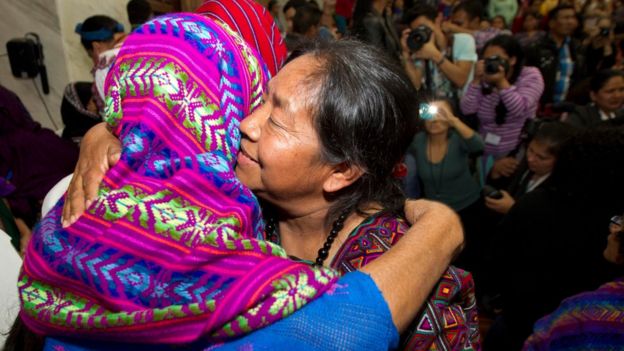
There were jubilant scenes in court when the verdict was announced
[this AP image is from here]
Mientras exista justicia para el más débil, para el desfavorecido, hay esperanza en un futuro digno para todos.  [translation at the bottom of this post]


"This is historic, it is a great step for women and above all for the victims" -- Rigoberta Menchu, Nobel Peace Prize winner who attended the hearing


From the BBC, 27 February 2016:

Guatemala: Rape sentences in landmark military trial

A Guatemala court has sentenced two former members of the military to 360 years in jail for the murder, rape and sexual enslavement of indigenous women.

Francisco Reyes Giron and Heriberto Valdez Asij were found guilty of crimes against humanity.

The historic ruling is the first successful prosecution for sexual violence committed during Guatemala's military conflict in the 1980s.

There were jubilant scenes in court as the judge read out the sentence.

"This is historic, it is a great step for women and above all for the victims," said Nobel Peace Prize winner Rigoberta Menchu, who attended the hearing.

Francisco Reyes Giron, who was the commander of the Sepur Zarco military base, was found guilty of holding 15 women in sexual and domestic slavery and for killing one woman and her two daughters.

Heriberto Valdez Asij, a paramilitary who carried out commissions for the army, was convicted for the same enslavement, as well as the forced disappearance of seven men.

The victims have been demanding accountability for the crimes at Sepur Zarco for decades.

For the rest of that story, please go to *this BBC site*. But for more, please also go to Global Voices or Intercontinental Cry for *this report*. From that article, this excerpt:

While international observers praised the efforts of the national courts, a deep reflection came from the national organisation comprising all universities — the CEUG (in Spanish, Coordinadora Estudiantil Universitaria de Guatemala), which has played a crucial role recently in the battle against corruption, summarised in one line why the ruling is vital for the future of the nation:

Mientras exista justicia para el más débil, para el desfavorecido, hay esperanza en un futuro digno para todos. 

[As long as there is justice for the underdog, for the vulnerable, there is hope for a dignifying future for all of us #SepurZarco]


Monday, January 25, 2016

femicidio, woman-killing, femicide

image of Mexco's disappeared and murdered women and girls is from here

The murder of women is but one course of action in the maintenance of globalised colonial male supremacy.

____________________________


A video about the atrocities.


____________________________


MEXICO’S MISSING AND MURDERED
The numbers are staggering: Six women killed every day, according to one organization. Over the past two decades, reports Brooke Binkowski in Mexicali, Mexico, the killing or disappearance of women has become so frequent, a new term has entered the country’s lexicon: femicidio

For more of the news story, please go to this website: 
http://www.theglobeandmail.com/news/world/mexicos-epidemic-of-missing-and-murdered-women/article25137141/

_____________________________

From one year ago today, from Censored News, with thanks to Brenda Norrell, link included below:

More Femicide Victims Identified from Border Graveyard
By Frontera NorteSur
Censored News
January 25, 2015

Women's/Human Rights News
The parents of Esmeralda Castillo Rincon recently heard sad news about their long-disappeared daughter. The 14-year-old had been missing from her Ciudad Juarez home since 2009, and the parents had waged a long campaign demanding her safe return.

On January 16, however, the Chihuahua state prosecutor's office (FGECH) notified Jose Luis Castillo and his wife, Martha Rincon, that Esmeralda's remains were among those of other female murder victims recovered from the Navajo Arroyo in the Juarez Valley bordering the United States in 2012 and 2013. [Read the rest of this news story here:] http://bsnorrell.blogspot.com/2015/01/more-femicide-victims-identified-from.html#more


What will the story be in another year?


Tuesday, January 29, 2013

What is Women's Courage When Men Define the Terms?

image is from here
Over at Shakesville, I just read Melissa's post "Women are Brave", which you may link back to by clicking *here*. Rather than post a comment on a feminist blog, I'll put my comment here in my own space. I've learned that a male voice isn't always appropriate, and is often enough unwelcome, in spaces designed to be woman-centered.

Her post led me to think back to something I once read by Andrea Dworkin on the subject. I did some searching and found Andrea Dworkin's chapter in her book Our Blood, called "The Sexual Politics of Fear and Courage". A scanned version of the book is available to be read as a pdf document (or may be downloaded) *here*.

As I reflect on Melissa's blog, Dworkin's work, and on the purgatory of contemporary U.S. society, I am struck with the degree to white men define the terms so many of us live by. Inside a white male supremacist system, "courage" is traditionally and ubiquitously understood to be masculine in nature, belonging to men; a capacity understood patriarchally to be inherently male and associated with strength. Fear is understood to be feminine in nature, the "natural" province of women, and is associated with weakness. For men and boys to be what men determine to be "weak", including by being afraid, is--so the status quo society says--to be less manly and more like a woman or girl. For women to be courageous and strong as men define it, is to be unwomanly and more like a man. If she isn't punished for being "brave" in the patriarchal definition of the word, she might gain temporary male status.

In Melissa's incisive account of a stand-up comedy club, I find examples of how men define not only terms but also act them out in social spaces. At the club, a combination of men's sexual violence against women, including the threat of violence and "jovial" harassment and objectification, ensures that women aren't likely to be too unafraid. As Dworkin has stated, "By the time we are women, fear is as familiar to us as air. It is our element. We live in it, we inhale it, we exhale it, and most of the time we do not even notice it." Curiously, the only men I know personally who seem to have this deep-seated fear-orientation to the world are male survivors of child sexual abuse. While women do, in fact, live with courage and bravery as they negotiate many challenges and obstacles, men do their best and worst to make sure fear, in women, is never completely irrational or unwarranted.

The misogynist violence that men direct at women ensures that those men aren't seen--by other woman-hating men--as too weak. Rape is one of many acts in which males may cast off their supposed weakness and exercise patriarchal power by terrorising and violating women. War is another realm where men get to be brave and heroic by doing violence and 'conquering' fear, against the bodies, minds, and spirits of threatened people. Military war, when perpetrated by the Western world, is also the place where imperialism, white supremacy, capitalism, and colonialism are acted out in patriarchal terms. Invasion is always sexualised in the male supremacist imagination.

It's going to be interesting to see how U.S. female soldiers in military combat are regarded by male soldiers: will the women be seen as heroic, like the men? Will any individual woman in military combat be treated more like one of the guys? Or will her patriarchally-defined courage be seen as tainted by her gender? (Sort of the way bigoted straight men argue that marriage is tainted if queers--defined by dominant straight male society as feminine men and masculine women--can do it too.) A serious concern is that any woman in military combat may be additionally vulnerable to rape by male soldiers who want to be sure she doesn't believe she's equal to men. I say additionally because we know this is already happening endemically and systematically to civilian girls and women, and to women troops off the battlefield. Or, rather, off the battlefield that men name as such, for many private and social spaces men occupy are battlefields for women, such as the bed, the home, the workplace, and the street.

We also know that U.S. male soldiers practice rape against the women and girls of invaded countries, usually populated by people of color: even a partial list of such countries invaded and/or occupied by U.S. troops or covert operations is long: Japan, Korea, Vietnam, Guatemala, El Salvador, Grenada, Iraq, Pakistan, Afghanistan. Taken together, the body count is in the many hundreds of thousands; how many of those murder victims were also victims of rape is impossible to say. It was likely to be grossly under-reported or not reported at all: all forms of men's sexual violence is under-reported because terrorising people and forcing submission works to silence and shame them. If we leave out all other European countries that made conquest and occupation of other sovereign nations a national pastime, and only focus on Britain's imperial invasions, we are left with very few countries untouched by brutal, white imperial/patriarchal force. (Source for that comment is *here*.)

What we may notice internationally in the West is that when European white women are in seats of typically and traditionally white male power, they sometimes argue, over the disdainful shouts of men, for equality not supremacy. See, for example: To End Extreme Poverty, Let’s Try Ending Extreme Wealth or this: This bold equality push is just what we needed. In 1997.

When we consider the politics of many prominent, activist women of color, we see comprehensive intersectional analysis and proposals for global peace and justice. See, for example: Staying Alive: Women, Ecology, and Development, by Vandana Shiva, and The Winona LaDuke Reader: A Collection of Essential Writings.

A flip side of this issue of gender and courage is seen when we try and make heroes of  men who preached against many forms of violence, such as Rev. Dr. Martin Luther King, Jr. or John Lennon. This is not at all to say either man was non-violent historically in their own lives. At least John Lennon spoke honestly about his abuses as such and endeavored to be a different kind of man in his later years. At least Dr. King set an honorable example of how to love one's enemy while holding them accountable for their crimes against humanity. But when such men advocate peace-not-war, or equality with women, they become vulnerable to being stigmatised 'feminine'.

Referencing Melissa's post, it says a great deal that men on stage doing comedy or men in the audience, need to reinforce and verbalize the worst aspects of male supremacist/patriarchal practice, and in particular to affirm a phallic identity. I admire the woman who did her own comedy, successfully, disproving so much that is taught in a racist patriarchal society like ours about women's power to create something new that is solely hers while deeply shared, in the midst of a culture of sexual predation and cultural appropriation. More power to her. More power to all women fighting for justice and equality.

Despite the saying that sits atop this post, liberally redefining terms won't shift society's political hierarchies. Many of us strive to make language express the complexities of who we are. As I listen to those singly or multiply oppressed, I hear again and again how difficult it is to make the dominant language speak their truths. It is courageous, isn't it, to endure and survive rape and warfare? I'd say so. But will patriarchal men ever see the courage of it, or only determine her survival to be a residual sign of his weakness?

However we maneuver meanings and memes, such effort is insufficient if our goal is liberation. The means and machinery of gynocidal straight male supremacy and genocidal and imperialist white supremacy must be shut down; new systems and institutions fostering equality and non-violence must become the status quo. Only then will new definitions have rooting and resonance beyond small, non-dominant groups of people. And only then will whole truths be spoken about life under siege, without interruption and mistranslation by the former masters.

Referring back to the phrasing in the image above, I'd say: "When peace-work is routinely seen as courageous, and war-making is popularly viewed as the work of cowards, we will know substantive, life-affirming change has occurred."

And when women of color define the terms we all live by, and govern globally, I will know we have radically purged ourselves of purgatory, razed hell, and brought heaven down to Earth.


Thursday, January 5, 2012

Yanar Mohammed on The War (Men's Against Women) In Iraq

photo of Yanar Mohammed with a male soldier is from here

What follows is an excerpt from an article I read at OpEdNew.com. For the whole article, please go *here*.

... Yanar Mohammed , founding director of the Organization of Women's Freedom in Iraq (OWFI), was interviewed on the state of Iraq as the American occupation ends.  She described Iraqi cities full of destroyed buildings and broken streets, with intermittent electricity and unsafe drinking water.  Iraq, she said, is now a country of 99% poor and 1% rich living in the Green Zone, burdened with the most corrupt government in the world that is giving control of oil resources to multinational oil companies.
Iraqi women "are the biggest losers" in this war, Mohammed asserted, ending up with extreme lack of freedom, lack of social security, lack of opportunity, and increased sexual terror.  Her organization has conducted extensive high-risk investigations into the prevalence and plight of Iraqi widows, women kidnapped and killed, and women trafficked into prostitution. Fifteen percent of Iraq's 1 to 2 million widows are seeking temporary marriages out of economic desperation and extreme insecurity in being a single woman. By 2006, OWFI had observed an "epidemic rise" in the number of women prostituted in brothels, workplaces, and hideouts in Baghdad. Through covert investigation, they learned of the trafficking of women within Iraq for Iraqi men in all regions and for US military, as well as to nearby countries.  Democracy in Iraq has been crushed for women. 
American women soldiers in Iraq were big losers, also.  Nearly 200,000 served there, in as dangerous situations as men.  Though barred from combat, they patrolled streets with machine guns, served as gunners on vehicles, dismantled explosives, driven trucks down bomb-ridden streets, and rescued the dead and injured in battle zones. These same women found themselves, concurrently, caught in a second, more damaging war - a private, preemptive one in the barracks.   As one female soldier put it, "They basically assume that because you are a girl in the Army, you're obligated to have sex with them."  Resisting sexual assault in the barracks spills over to battlefield, according to many women veterans, in the form of relentless verbal sexual harassment, punitive high-risk assignments, and the morbid sense that your back is not being watched. ...

Saturday, September 3, 2011

"Female Trafficking Soars in Iraq", by Rebecca Murray, with news from Yanar Mohammed

All that follows in this cross-post is from *here* at IPSNews.net.

Female Trafficking Soars in Iraq 
By Rebecca Murray

BAGHDAD, Aug 27, 2011 (IPS) - Rania was 16 years old when officials raped her during Saddam Hussein’s 1991 crackdown in Iraq’s Shia south. "My brothers were sentenced to death, and the price to stop this was to offer my body," she says.

Cast out for bringing ‘shame’ to her family, Rania ran away to Baghdad and soon fell into living and working in Baghdad’s red light district.

Prostitution and sex trafficking are epidemic in Iraq, where the violence of military occupation and sectarian strife have smashed national institutions, impoverished the population and torn apart families and neighbourhoods. Over 100,000 civilians have been killed and an estimated 4.4 million Iraqis displaced since 2003.

"Wars and conflicts, wherever they are fought, invariably usher in sickeningly high level of violence against women and girls," Amnesty International states.

Rania worked her way up as a sex trafficker’s deputy, collecting money from clients. "If I had four girls, and about 200 clients a day - it could be about 50 clients for each one of them," she explains.

Sex costs about 100 dollars a session now, Rania says. Many virgin teenage girls are sold for around 5,000 dollars, and trafficked to popular destinations like northern Iraq, Syria and the United Arab Emirates. Non-virgins are about half that price.

Girls who run away to escape domestic violence or forced marriage are the most vulnerable prey for men working for pimps in bus stations and taxi stands. Some girls are also sold into marriages by family relatives, only to be handed over to trafficking rings.

Most of Iraq’s sex traffickers are predominantly female, running squalid brothels in neighbourhoods like the decrepit Al-Battaween district in central Baghdad.

Six years ago, a raid by U.S. troops on Rania’s brothel brought her nefarious career to an abrupt end. The prostitutes were charged along with everyone else for abetting terrorism.

Imprisonment changed Rania’s life. While she served time in Baghdad’s Al-Kadimiyah lock-up – where more than half the female inmates serve time for prostitution – a local women’s support group befriended her. Today she works for them as an undercover researcher, drawing on her years of experience and connections to infiltrate brothels throughout Iraq.

"I deal with all these pimps and sex traffickers," Rania says, covered in black, with black, lacquered fingernails and gold bracelets. "I don’t tell them I’m an activist, I tell them I am a sex trafficker. This is the only way for me to get information. If they discover that I’m an activist I get killed."

In one harrowing experience, Rania and two other girls visited a house in Baghdad’s Al-Jihad district, where girls as young as 16 were held to cater exclusively to the U.S. military. The brothel’s owner told Rania that an Iraqi interpreter employed by the Americans served as the go-between, transporting girls to and from the U.S. airport base.

Rania’s co-workers covertly took photos of the captive teenagers with their mobile phones, but were caught. "One girl went crazy," Rania recalls. "She accused us of spying. I don’t know how we escaped," she exclaims. "We had to run away - barefoot!"

Before the Gulf War in 1991, Iraq enjoyed the highest female literacy rate across the Middle East, and more Iraqi women were employed in skilled professions, like medicine and education, than in any other country in the region.

Twenty years later Iraqi women experience a very different reality. Sharia law increasing dominates everyday life, with issues like marriage, divorce and honour crimes implemented outside of the court system, and adherence to state law.

"Many factors combined to promote the rise of sex trafficking and prostitution in the area," a Norwegian Church Aid report said last year.

"The US-led war and the chaos it has generated; the growing insecurity and lawlessness; corruption of authorities; the upsurge in religious extremism; economic hardship; marriage pressures; gender based violence and recurrent discrimination suffered by women; kidnappings of girls and women; the impunity of perpetrators of crimes, especially those against women; and the development of new technologies associated with the globalisation of the sex industry."

The International Organisation of Migration (IOM) estimates 800,000 humans are trafficked across borders annually, but statistics within Iraq are very difficult to pin down.

Although the Iraqi constitution deems trafficking illegal, there are no criminal laws that effectively prosecute offenders. Perversely, it is often the victims of trafficking and prostitution that are punished.

IOM is currently working with an inter-ministerial panel to lobby for a new reading of the revised counter-trafficking law, which has been stalled by the government since 2009.

"We have reports about trafficking both inside and out of Iraq," says senior deputy minister, Judge Asghar Al-Musawi, at the Ministry of Migration and Displacement.

"However, I admit that Iraqi government institutions are not mature enough to deal with this topic yet, as the departments are still in their growing phase."

Human Rights Watch (HRW) says the government has done little to combat the issue. "This is a phenomenon that wasn’t prevalent in 2003," says HRW researcher, Samer Muscati.

"We don’t have specific statistics. This is the first part to tackle the problem; we need to know how significant and widespread the problem is. This is something the government hasn’t been doing. It hasn’t monitored or cracked down on traffickers, and because of that there is this black hole in terms of information."

Zeina, 18, is an example of an invisible statistic. According to the local Organisation of Women’s Freedom in Iraq (OWFI), she was 13 when her grandfather sold her to a sex trafficker in Dubai for 6,000 dollars. She performed only oral sex with customers until a wealthy man paid 4,000 dollars to take her virginity for one night.

After four years of prostitution, Zeina finally escaped the United Arab Emirates and returned back to her parents in Baghdad. She approached the authorities and took her grandfather to court. However, Zeina has since disappeared. OWFI has learned she was sold again, this time by her mother to a sex trafficker in Erbil.

OWFI director Yanar Mohammed says her office has been threatened for their advocacy against the lucrative trafficking industry, especially reporting on an infamous brothel owner in Al-Battaween district known as Emam.

"In each house there are almost 45 women and it is such a chaotic scene where women get treated like a cheap meat market," describes Mohammed. "You step into the house and see women being exploited sexually, even not behind closed doors. So the woman who runs these houses makes an incredible income, and has a crew around her to protect what she does."

Emam is said to enjoy close ties with the Interior Ministry, and has never had one of her four houses shut down. Despite OWFI’s expose, her operations are unaffected.

Mohammed sighs. "Iraq has a whole generation of women who are in their teens now, whose bodies have been turned into battlefields from criminal ideologies." (END)
 

Friday, August 26, 2011

Feminist Action Alert: Please Read this Report and Sign a Petition to Support Women's Rights Activists In Iraq

AWID Logo
image is from here

What follows is from *here* and is cross-posted at this blog for the purposes of garnering more support and securing more safety and freedom for Yanar Mohammed and other revolutionary feminist activists in Iraq. With great thanks to Yanar Mohammed, to AWID, to trust.org, and to Amanda Shaw.


Warning: the news below is both grim and graphic.

Realistic hope for change comes with sustained (and reported) organising and other actions of resistance and revolution. Prayers and power for all women in Iraq and to the women in any country where US and NATO military forces are occupying, committing gynocidal atrocities that are not reported at all in Western Patriarchal Corporate media. Please take a moment to sign the petition linked to at the end of the body of this report.

You may also link back by clicking on the title below. 

The Word on Women - The Other Tahrir Square: Attacks Continue On Women Human Rights Defenders In Iraq

By AWID Friday Files | 6 hour(s) ago | Comments ( 0 )
By Amanda Shaw
Women have been at the forefront of demonstrations across the Middle East and North Africa (MENA) in the recent popular uprisings, which have received much media and international attention. In contrast, coverage of attacks on women human rights defenders (WHRDs) in Iraq’s Tahrir Square demonstrations has been limited, AWID asks why.
On the frontlines of demonstrations or behind the scenes as tech-savvy organizers, women have played pivotal roles in the recent democratic revolutions and uprisings in the MENA region. Women’s activism and organizing in Tunisia, Egypt, Bahrain, Yemen and Libya has garnered substantial international attention. Yet in spite of several attacks, including sexual assaults, on Iraqi women activists and their organizations since February, women’s roles in Iraq’s Tahrir Square demonstrations have generated less media coverage. And the violence against them has intensified since June, one of the deadliest months so far in 2011 for Iraqis.
The Organization for Women’s Freedom in Iraq (OWFI) is one of the leaders of Iraq’s Tahrir Square demonstrations, helping to organize youth activists and advocating for women’s rights. AWID takes a look at OWFI’s work, the situation of women human rights defenders (WHRDs) in Iraq and asks why the other Tahrir Square is receiving so little international attention.
Women’s Rights and Women Human Rights Defenders in Iraq
Since the U.S. Invasion in 2003, hundreds of thousands of Iraqi civilians have died as a result of the conflict, nearly 4.8 million have been forcefully displaced and almost 750,000 women widowed. Even before the invasion, and as a result of years of economic sanctions and war, Iraqis experienced high rates of violence, displacement, exile, widowhood, unemployment and illiteracy. Today, Iraqi women face violence from all sides: from armies and security forces, sectarian and tribal leaders as well as from private security contractors unaccountable to international law.[1]
Different political factions including opposition and resistance movements have also tended to target women and gender relations in their political projects, whether through physical violence or legislation.[2] According to OWFI’s 2010 Annual Report, women in Iraq experience gender-specific forms of violence that include so-called ‘honour’-based violence, trafficking, violence toward women accused of prostitution, being unveiled, and wearing makeup.[3]
It is within this context of militarization, religious, sectarian and political fragmentation, widespread violence (including various forms of violence against women) and increasingly conservative visions of gender relations that Iraqi WHRDs organize. They face the same denial of civil and political rights as all citizens – including those of peaceful assembly, association, expression and the right to life and security – but with gender-specific consequences.[4] Some Iraqi WHRDs take part in mixed human rights groups or social movements, while others denounce the disappearance of family members  or work directly on women’s rights agendas.
The context of the invasion and occupation of Iraq by foreign troops has led to a particularly problematic dynamic for those working on women’s rights who may be labelled “western” or “traitorous” for their work, which may also be seen by some Islamists as associated with the supposedly secular agenda of the Saddam Hussein regime.[5] Given this difficult context, Iraqi WHRDs may be forced to abandon their political activities, go into exile or focus instead on surviving and caring for family members.
But in spite of these enormous challenges, Iraqi WHRDs continue their work in addressing violence, resisting militarism and organizing for democratic change. Some of the major achievements of the Iraqi women’s movements include campaigns against a discriminatory law governing marriage, divorce and child custody and limiting the constitutional role of Islam, lobbying for gender quotas in political representation as well as working to ensure legislation complies with international conventions such as the Convention on the Elimination of All Forms of Discrimination Against Women (CEDAW).[6]
The Other Tahrir Square
Since 2010’s inconclusive elections, the Iraqi coalition government has been plagued by infighting and financial scandals, while many Iraqis still lack basic services and employment opportunities are few.[7] Inspired in part by events elsewhere in the region, Iraqi citizens have gathered every Friday since February in Baghdad’s own Tahrir Square to protest corruption, poor government and basic services, high unemployment and lack of freedom of expression.
Authorities have responded harshly, banning street demonstrations and attempting to confine large gatherings to football stadiums.[8] As a result, there have been a number of clashes between pro-democracy demonstrators on the one hand and security forces and pro-government demonstrators on the other, resulting in the deaths of at least 125 people, hundreds wounded and the arrest and detention of dozens of activists.[9] Among the activists who have been attacked are several associated with OWFI, which has played a key role and helped to increase women’s visibility in the square demonstrations.
OWFI’s current president, Yanar Mohammed, co-founded the organization during the 2003 U.S. invasion by putting up a sign reading “Women’s Freedom in Iraq” in a burned out bank in Baghdad. OWFI advocates for change in the structures that allow violence against women to be perpetrated with impunity, implementing programs that strengthen women’s political participation and promote freedom from violence. They have established an underground network of safe houses for women escaping violence, advocate for women in prison, organize against sexual trafficking and run a newspaper and radio station. Since its original three members, the size of the organization has grown or shrunk depending on the country’s security situation; OWFI currently has almost 60 activists, hundreds of supporters in person and online and is active in four cities in central, western and southern Iraq.
Targeting OWFI and other Iraqi Activists
Since the Friday Tahrir Square demonstrations began in February of this year, OWFI activists have experienced violent and sexualized attacks, intimidation and harassment preventing them from carrying out their work. There have also been reprisals against their youth allies, including detentions and kidnappings. In an interview posted on the organization’s website, OWFI President, Yanar Mohammed, cites their work in organizing the youth at Tahrir Square as being one of the main reasons why OWFI activists have been targeted.
On Friday June 10th, after the expiration of a one-hundred-day deadline, set by Prime Minister Nouri Al-Maliki for improving basic services, demonstrators gathered because there were no noticeable changes in the provision of electricity, water, jobs, or in ending corruption. At this demonstration, four women from OWFI’s 25-member delegation were attacked, sexually assaulted and beaten by pro-government demonstrators who destroyed their banners, beat them with wooden sticks, and groped their bodies. The attack was seen by OWFI as an attempt to shame the activists in public space.
OWFI activists met in the first week of July to discuss a strategy in the face of this violence, and on July 8th, a bus full of female activists and some youth supporters returned to Tahrir Square with banners reading “Beating of Tahrir Women Increased Our Determination for Change,” and “Instead of fulfilling the promise of the hundred days, they released their thugs on us”.[10] Activists Jannat Basim, Aya Al Lami, and Yanar Mohammed were interviewed by the media and used a megaphone to announce their determination to continue challenging the authorities in spite of repression. But as the delegation left the square, pro-government supporters intimidated and physically attacked youth activists that were accompanying the OWFI delegation, surrounded their bus and attacked the activists through the doors and windows. One youth supporter was kidnapped and later released. Only when foreign journalists were called to the scene did the pro-government supporters abate.
U.S.-based women’s rights organization MADRE has described repression against OWFI as “an attempt to terrorize women who have been the catalysts for demonstrations that call for a new Iraq.” As Yanar Mohammed describes in a MADRE Interview “when the humiliation is sexual, in a society like Iraq, they know it will break the women.”
The Role of International Solidarity
The mainstream media has largely ignored these events and the recent upsurge in violence in Iraq, some citing readers’ “Iraq fatigue” to justify their lack of coverage.[11] According to Yanar Mohammed, media coverage plays an essential role in helping to protect women human rights defenders, “if you are an outspoken feminist in Iraq these days and you are demonstrating in Tahrir Square, you have actually no protection. So media [coverage] is the best protection.” Moreover, international solidarity efforts – campaigns and other forms of calling attention to the work of WHRDs – are made all the more challenging by the complex terrain of an Iraq overwhelmed by foreign intervention. At the same time, Mohammed marks an important distinction:
“Even if the U.S. intervention that happened before – the military intervention – has destroyed our lives, we need a civilian intervention now. We need the American people to support and empower us again so we can take matters into our own hands and hold free elections." [12]
Indeed, broad-based international (and not just U.S.) solidarity with Iraqi WHRDs remains important in helping them continue their work. As female activists occupy center stage elsewhere in the region’s democratic revolutions and uprisings, the activists in Iraq’s Tahrir Square should also be counted among them.
Sign the MADRE petition condemning the attacks on OWFI and other activists here.
Notes:
1. http://www.globalfundforwomen.org/impact/success-stories/153/1827-impact-of-militarism-on-women-in-the-middle-east-a-north-africa
2. Al-Ali, N. and Pratt, N. (2008) “Women’s organizing and the conflict in Iraq since 2003” Feminist Review 88, pg. 74-85. Pg. 75.
3. OWFI Annual Report, 2010.
4. Ibid.
5. Al-Ali, N. and Pratt, N. pg. 81.
6. Al-Ali, N. and Pratt, N. Pg. 76.
7. http://www.npr.org/2011/07/11/137771025/dispute-over-key-jobs-stalls-iraqs-government
8. http://www.hrw.org/en/news/2011/04/21/iraq-widening-crackdown-protests
9. http://edition.cnn.com/2011/WORLD/meast/07/08/iraq.protest/
10. Personal Communication, Yanar Mohammed, 20 July 2011.
11. http://www.newstatesman.com/blogs/the-staggers/2011/07/iraq-iran-largely-term-media
12. http://msmagazine.com/blog/blog/2011/06/13/iraqi-feminists-sexually-assaulted-during-pro-democracy-protests/

Friday, August 12, 2011

Thoughts today about how white het male supremacy works and how to unemploy it

http://www.liquiddnb.com/download/mix/yubardnb_-_liberation-28562.jpg
image is from here


In the all-too-real world, what possibly can be done to stop male supremacist power, het supremacist power, and white supremacist power from being exercised in the world against most humans on Earth and against the rest of Life on Earth?

Activism is happening across the globe and has been for hundreds of years and it is to those activists we must look for guidance and wisdom.

Indigenous activists have been resisting and combating the racist invasions and attempts at complete colonisation and genocide for as long as European men have been waging war against Indigenous people.

Women across region and race have been resisting and combatting male supremacist oppression and violence for as long as men have organised power into patriarchal force.

In the last decades, at least, non-het people have organised for rights, dignity, and survival in a world of rampant heterosexuality and virulent heterosexism.

I believe that all of us who are privileged by race, class, ethnicity, gender, and sexuality must look to the activist work done by Indigenous women, and radical feminists across race and region, including radical feminist Lesbian activists. This blog has attempted to highlight some of the herstory and practice of resistance and challenge to oppressive power organised into identities and institutions made to seem completely natural and not at all organised.

Most people do not face one form of oppression only. Indigenous women and most non-Indigenous women of color, for example, even if not involved with daily struggles to combat white people's dominance directly and intimately, are unlikely to be free of it institutionally: economically, culturally, and politically. From white het male military invasion to impoverishment ensured by corporate globalisation to social organisation designed to shut out, shut up, or kill women of color, we live in a world where lethal and atrocious violence is commonplace and is assumed by dominants to be inevitable. The assumption is what we might call "wishful thinking" on the part of those with no heart or soul.

Lesbian womyn necessarily face misogyny and heterosexism aimed at them as "despised others".There is no support beyond Lesbian organisations and networks for Lesbian support, empowerment, and liberation. Even queer communities that I witness or know about are largely anti-Lesbian. Consider the implications of that for on-going Lesbian existence. 

I live a life largely removed from the struggles of poor women of color and of lesbians who don't speak English. To know anything meaningfully and deeply, to the bone, I have to be available to and in alliance with people who are not necessarily in my offline life. Most struggles will not be bone-deep real to me because I simply don't know what is going on and am not on the receiving end of the force.

One is led to believe the role of media is to inform us of the important struggles, if not also offer wisdom. In the information era, there is virtually no wisdom coming out of the mouths and corporate boardrooms of rich white het men. And the information spewing forth is utterly and ubiquitously self-serving.

As I type this, Somali women refugees are fighting for survival for themselves and loved ones. The media will report in Western countries what all the good things are that Western countries are attempting to do to participate in relief efforts and how they'd succeed were it not for bad people of color getting the way. The media will make it seem like the (white) US and other (white) Western countries are "good" and that it is lucky for poor women of color globally that the US and other Western countries exist. Lost in the self-congratulatory media blitz is the fact that if the US got out of North America, and if whites all went back to their countries of origin, over time women of color would fare far better than they do now.

Charity efforts don't empower whole groups of people even while they may well save lives. And saving lives of people unjustly targeted for destruction is good to do. But what is not effectively communicated by media is how it will be women, lesbian and not, from the countries where whites dominate and invade, who are most capable of knowing what is wrong and how to correct it. What we see is women across Asia, Africa, and the Americas working to make life more humane and free. Not white men. White men work to destroy life. And white men succeed.

However it is possible in your area, please support the work of women of color globally who are challenging white, het, and male supremacist abuses of power, and other forces seeking destruction, whether interpersonally acted out or done so institutionally and through international systems of harm.

Please don't forget that whites, hets, and men are positioned to be dominant oppressors as whites, as het people, and as men. While each group argues precisely the opposite, they are not structurally positioned to be effective or wise leaders of liberation struggles to end white supremacy, het supremacy, and male supremacy.

At the very least, we can share knowledge, if not also wisdom, and organise our efforts with one another to achieve freedom from WHM supremacist force and the values and practices it calls great.


Friday, August 5, 2011

Warren Jeffs and the US Military: same values--all of 'em WHM Supremacist


photo of serial rapist Warren Jeffs is from here

How it is that het men aren't stigmatised as child-rapists is beyond me. How it is that the US military can be seen as anything resembling "good" is also beyond me.

I am hearing about how the US military is suffering no economic downturn, doesn't know from recession, and will be profiting mightily--in every way--due to a very corrupt white male-led system of lack of checks and no balances.


The system was created by white het men and for white het men, well before white het manhood had cogealed into a globalised system of atrociously abusive power.

One white het man is allegedly "Christian". His name is Warren Jeffs. He represents some old-school white and male supremacist ideas about what girls and women are for. His view is that of  contemporary and past slave-holders: they exist for the Master, and he surely believes he's the master and, due only to his WHM supremacist location and privileges, is believed by man. Were he Black, Brown, Indigenous, Asian, Muslim, Jewish, gay, or a woman, he wouldn't have the positional/structural power he has had to rape and procure girls and women, including, especially, relatives of people he's already raped and procured.

Warren Jeffs is a slave-master. He controls minds and uses forms of force we're not likely to know too much about because when it comes to keeping control of other people, white het men do not like to brag about all the ways they do it, unless they can make it appear that girls and women are begging for such mistreatment and abuse.

I await his sentencing for committing crimes of sexual abuse, rape, and predation.

What Warren has against him is the fact that he's a single person, not a whole system of terrorism and corruption like the US military industrial complex. Because if he were a whole massive system, he'd be untouchable.

People will go hungry, people will die, people will become homeless, people will be raped, people and other sentient beings will be poisoned. This will be accomplished for great unstoppable profit by the US military. Its greediness for unchecked power, imbalanced control, Empire-bolstering domination, and various other manifestations of gynocidal, genocidal, and ecocidal destruction apparently knows no bounds and doesn't seek to encounter them.

US corporations and its military are the current slave-masters in a globalised economic world where might makes right and the weak are most of us.

President Eisenhower's caution to the future US, to curb the power of the military industrical complex, are unheeded. And he was no angel.

We've got the devil in charge and he isn't a US president: he's a force far beyond the power and control of presidency. We've been witnessing that during the weeks of ridiculous discussion about things like the debt ceiling. There's one way to bring the US into what many people might term "economic stability" (which would remain ecocidal, genocidal, and gynocidal), and that is to end our wars.

Ending het men's wars against girls and women ought to rise up as a central issue for human concern and social justice. Hopefully with Warren Jeffs behind bars, at least one predator/perpetrator will not be able to get his rapist hands on another female human being.


Sunday, July 24, 2011

Lesbian Separatism: A Profeminist Gay Male's Perspective


http://t1.gstatic.com/images?q=tbn:ANd9GcRmcqBRxg3gs3oSgogScx03fRf8CERnjPC8rDRxDJXvkEN-V3tQxg
image is from here


(I write this at a time of loss of a recent friendship. The reason for the friendship ending was my own persistent insensitivity to the political-personal realities she faces daily. I ended the friendship.)

You may be wondering who in the world would want a gay male's perspective on Lesbian Separatism? Well, I'm not sure, to be honest. But perhaps out there somewhere are queer people or het men who don't understand why any woman of any race would choose to be a Lesbian Separatist and would like to know why it ought to be politically supported, not insulted, not degraded, not considered a consequence only of male violence against women, and so on.

I'll note from the start of this post that I'm white and all my experiences of Lesbian Separatism, as an outsider, are as a white gay male. The Lesbian Separatists I have known are of many class backgrounds; mostly working and middle class, all US, and all English-speaking. That's but one small population of Lesbian Separatists worldwide, and although many US people will deny this, or simply don't know it, Lesbian Separatism exists the world over.

The first time I learned of Lesbian Separatism was I was part of an urban Lesbian/Gay/Bi community, back in the 1980s. It was white-dominated, mixed class, and largely academically educated. But the L.S., as far as I knew, was not born of the Academy, which is what I've seen of other queer cultures and identities in my community, such as being trans, genderqueer, and polyamorous: I know not one person who is trans, genderqueer, or polyamorous who wasn't informed and introduced to these cultures in the Academy, which may explain why they are decidedly liberal in political viewpoint and alliances. I suppose I had a crush on the first Lesbian Separatist I knew. She had a L.S. friend who I'd encounter later in my life in a really ugly way, but this woman wow'ed me. She had children—all girls. She lived her life, as far as I know from other Lesbian women, entirely without men in it.

I was in awe. It never occurred to me that people could organise their lives to only have women in them, as the largely secular society I lived in merged women and men, assimilating women into a form of racist, heterosexist, capitalist male supremacist society that greatly enforced women caring for men, girls caring for men, and women and girls defining their ambitions and actions in terms of how men felt about them. I got how entirely fucked up that was and it led me to wear out a t-shirt that proclaimed, “A Woman Without a Man is Like A Fish Without a Bicycle”. A white Lesbian woman who was not Separatist gave it to me.

As I lived in queer community, I learned being a Lesbian Separatist didn't provide one with the ideal life I imagined—rather foolishly. To be a woman is to know what men do to women. To be Lesbian is to know what het people do to Lesbians. To be a Separatist, as I heard about it as a supporter of Lesbian Separatism, was to become the target of animosity and alarming levels of hostile judgment of not only straight men, gay men, and het women, but also of other lesbians who denounced it as hateful, bigoted, exclusionary, and so on.

So, really, it was to be marginalised in already marginalised cultures. As for the latter charge, I've witnessed few sexual cultures more exclusionary than het culture. Those of us who are not het are purged from it, are scorned and ridiculed in our youth, and are either hated outright, or are “tolerated” in the most condescendingly obnoxious ways. I've had to separate almost entirely from my white Christian het-obsesses family due to their utter refusal to acknowledge or be responsible with their heterosexual power and privileges. Needless to say, the women in my family have had much more to endure in the way of insults and assaults from men they were married to than the men have. Overall, the men have done well, having someone to wash their clothes, clean their homes, and be sexually available to them. I'm not making any determination about the women's agency here, except to note that being a Lesbian Separatist was not, ever, an option presented to them. It isn't a reality any more than being a Buddhist nun or monk is an option to them. But at least they may have seen some news stories about Buddhists who live cloistered lives; not so with Lesbian Separatists.

Corporate media hasn't touched the subject in the last twenty years, to the very best of my recollection. Curiously, corporate media is liberally reporting on trans existence--never beyond M2F and F2M white, class-privileged social circles, however. But trans issues are respectfully if narrowly reported on so much more so than on white, class-privileged Lesbian Separatist or lesbian feminist experience. For example, Chaz's physical/surgical transformation as well as the empathically told stories and political struggles of several white transsexual people are well-known to het middle Amerikkka; the work of Sheila Jeffreys and of any Butch Lesbian Feminist is not. It appears to me that CRAP-loaded media power is far less threatened by people surgically changing their gender than by Butch and Radical Lesbian women who want to demolish male supremacy and maintain sites of on-going radical resistance and woman-centered anti-gynocidal culture. CRAP-loaded media won't go there at all.

The second most exclusionary cultures I'm aware of are het men's culture and gay men's culture. Het men have loads of power with which to determine their social lives. They often organise it to leave out or exclude all women and gay men. Gay men often organise their lives to leave out het men and all women. My experience of gay male culture is that it is attached to forms of misogyny and sexism, as well as to some forms of heterosexism, that it won't acknowledge or responsibly and radically transform.

The first challenge to Lesbian Separatism that I read in print was by Audre Lorde in Sister Outsider. I took in her words carefully, and have reread the essay on occasion to remind myself of her challenges and points of view, and ended up believing and taking to heart what she had to say while also supporting Lesbian Separatism as a political practice. I understand that many women, most women, who live in a secular or religious heterosexist society will not likely be able to be Lesbian Separatist.

The reason I support it is because I support women doing more than surviving het and gay male supremacist societies. I support women living relatively well in them, to whatever extent that is possible, and it does appear to be possible with greater ease among class-privileged people especially.

The single most abusive challenge to Lesbian culture that I've ever seen, other than by het and gay male-identified people, is from trans people. So severe is the social and cultural assault against Lesbians, including Separatists, that I'm not sure it can be overstated.

What has been alarming for me to witness is how liberally accepted and supported the invasion and violation of Lesbian lives and culture has been by every demographic imaginable. Well, het men actually don't seem to give a shit, but that's because they view Lesbianism as being for them. Trans activists and het male supremacists together and apart exploit, appropriate, and attempt to colonise, control, and dominate Lesbian spaces, politics, and lives. Where is the progressive to radical outrage about this happening?

Whenever I've heard trans activists—always white, almost always class-privileged—a tiny percent of the actual trans community that will never make it to the stage and the mic, I've heard how put upon and degraded trans people are by Lesbians. I've never once heard from trans people how they invade and violate Lesbian culture and community. Not once. I've never heard trans people be respectful and responsible with the privileges that have—various but apparent—to invade and violate Lesbian women.

Now, what we must keep in mind is how girls and women across sexuality, class, region, and race are sexually violated in every way conceivable—and in many inconceivable ways—by males including by boys, men, and some trans people who were born male-bodied and who remain male-bodied.

Male-bodied people are arguing that they are Lesbian, as are formerly male-bodied people. I find this beyond insensitive to Lesbian culture and community. (To come into these feelings, I have to center the experiences of Lesbians, not trans people or anyone else. To do this, I'd argue, is a radical profeminist act.) All of us are socialised—normally coerced, manipulated, and terroristically forced--to care for and about anyone who wasn't born and raised as a girl, regardless of whether or not she is female-bodied or intersex. We are all taught to not respect or regard the physical and communal integrity of anyone who is female-bodied and women and Lesbian.  We are all taught that women exist to serve and service men. Even in queer communities, Lesbian energies have been spent caring for gay men and gay male energies do not come back to reciprocate the love. Therefore it doesn't surprise me that het, queer, and trans people assume they have the right to invade Lesbian spaces, lives, and communities.

What do you call a politic and practice that privileges males or formerly male-identified people disrespecting Lesbian lives, relationships, communities, and political projects moving us toward greater liberation for Lesbian women? How does it come to pass that this is seen as regressive, oppressive, and bigoted: being female and loving females as a woman and as a Lesbian and wanting to be with females only? How is it bigoted, regressive, or oppressive for females forced to be women under patriarchal violence, who are denied social permissions and privileges to love other women, to seek to do so in peace?

I'll share an anecdote. Not quite ten years ago now, I encountered a very “educated” white male who was sexually active only with women. A white gay male I knew, who was an age-peer of his (I was older than both young men) had a serious crush on him, and hoped they'd be sexual together, but this het-active male—who identified as pansexual for some reason—never wanted to have sex with any male-bodied person. He's only ever been sexual with female-bodied people who identify as women. The gay male I knew pined for him as did a few het women. He was considered “attractive” by many people across sexuality.

Then one day he told me he was a Lesbian. Really. He did. And he made some convoluted case for this being “true”. I called his sorry ass out on it. I said, “You're always going to be socially male, socially perceived as a man, and anyone who is with you will not be with a Lesbian.” I said he'd better be responsible with his male privileges, power, and entitlements, and that among those was the power to name himself as he wished, in ways completely unaccountable to and disrespectful of women. I told him to not attempt to manipulate Lesbian and bisexual women by pretending he was Lesbian. After all, had he grown up with a female body, knowing what it was to desire people whose bodies were like “his”? No. Had he had girlhood crushes on girls, feeling ashamed or being made to feel wrong for liking people of the same sex? No. Had he encountered all the many forms of discrimination, threat, and violence that Lesbian young women face? No. But he wanted to declare himself a Lesbian. Why? Because he was a het male with all the arrogance and entitlements in place to believe he could do so and get away with it. And he was getting away with it in some parts of the liberal circles he operated in. He was not expecting to come up against any radical opposition because for the most part none existed, until he confided in me. I supported him, instead, in owning his own political location, power, privileges, and entitlements, but not abusing them.

I've also disagreed with het men and het women for telling me they were, really, gay men. I've told them I find their self-definitions an expression of gross insensitivity to those of us who are gay.

For some strange reasons which will be analysed and determined in the next generation, trans existence is being respected in ways and in places that Lesbian existence is not. I don't support one group utterly invading and violating another, and that's what has happened socially and politically to Lesbian community by trans-identified people. 

I've heard people argue the parallel to being a Jew: some people convert, and aren't they then Jews? Well, religiously and culturally, yes, but ethnically and historically no. And, here's the significant difference: Jews welcome Jews who convert. That "welcoming" is a rather critical part of the reality. If a grossly disregarded, ignored, assaulted, mistreated, subjugated people struggling for survival don't welcome you in, and if you have some privileges, media access, community support, and institutional power and resources that they do not, and you insist you belong, you might wish to consider any outsider's insistence of inclusion a form of obnoxious and violating aggressive and oppressive behavior.

But back the not insignificant matter of men's violence against female-bodied people. Can you possibly imagine what it must be like to try and carve out some relationships and social-cultural spaces free of men, free of male bodies and all the many triggers they carry, free of male privileges and entitlements showing up in all their glaring arrogance and insistence, only to have your culture and being invaded by male-bodied people claiming to be Lesbian? I cannot fully imagine it, really. But it horrifies me to consider it.

If you want to compassionately imagine it in more detail, I encourage you to read what Lesbian women have written about such invasions and violations. To put in bluntly, it's a systematic gross assault against the psyches and bodies of women who have already endured--like all women who grew up as girls--the gross assault of het men's systematic violence, in the home and outside the home. That's what it is. And while liberal, progressive, and radical-minded folks do seem to oppose violence against women, somehow all go silent when it comes to trans-invasion of Lesbian lives and communities. Or, not silent but instead aggressively and outspokenly supportive of trans people showing up wherever they choose to or decide to, claiming rights to be celebrated, cared for, and employed by Lesbians, naming themselves however they wish no matter how insulting and insensitive to Lesbians that naming and those many other actions are.

I stand with Lesbian women, including, now at a more respectful distance, with Lesbian Separatist women in opposing any and all invasions and violations, all forms of insensitivity and aggression leveled by trans-identified folks and their liberal supporters.

I have had a few friendships for not too long periods of time—from hours to weeks to months to years—with a few white Lesbian Separatist women. I have found each woman to be deeply caring, profoundly thoughtful, sensitive, and woman-loving. I support any Lesbian living her life as she wishes and as she is able, with all the threats and dangers of male supremacist/male-adoring/phallocentric, liberal, and grossly heterosexist society condemning Lesbians as essentially bigots and haters. The liberal queer community, on the whole, has done nothing to deepen our understanding of the reasons for militant resistance to trans invasion; they have done the opposite: they have perpetuated the myth that Lesbian = hater. 

Liberal queers and privileged trans activists are doing to Lesbians what men do to women' generally: portray them only as hateful, scornful, reactionary human beings without a self-determining political cause worth fighting for. When lesbophobia and anti-Lesbian bigotry is seen as just as much of a social offence, as just as intolerable, just as obnoxious, violent, egregious, inhumane, and threatening as homophobia and transphobia, I'll know something radical has shifted in the society I live in. I'll know that male supremacy, heterosexism, and liberalism have each loosened their braided cultural gynocidal death-grip on Lesbian women's lives.

For more on Lesbian Rights, see *here*.

Monday, June 20, 2011

Domestic Terrorists, Misopedists, and Serial Violators of Women: what terms do you use for these abusers?


WE MUST STOP ABUSIVE MEN 
FROM COMMITTING
image is from here
AGAINST WOMEN 
AT HOME

Change "Domestic Violence"
(Reasoning: too invisibilising of the fact that the primary emergency is horrendously abusive men controlling, dominating, beating, mind-fucking, serial raping, and crushing the wills of women, so...)
To "Domestic Terrorism", "Patriarchal Domestic Terrorism" and "Men Terrorizing Women Domestically"


Change "LGBT" (eliminate GLBT
(Reasoning: total invisibilisation of intersex, intergender, and asexual people; also, finding an acronym that visibilises Two Spirit, Same-Gender Loving, and Non-Gender Conforming--or Gender Non-Conforming--people)
To  "LGBTIA"


Change "pedophilia" and "pedophile"
(Reasoning: no harmer of children should be popularly called "a lover of children" or a "child-lover", so...)
To "misopedia" and "misopedist", or "child hating" and "child-hater", or "child raping" and "child-raper"


Change "Sexual Trafficking and "Sex Trafficking"
(Reasoning: invisibilises the age- and gender-based harm completely)
To "Rapists Trafficking Girls" and "Pimps Trafficking Raped Girls"


Change "Porn Addict" and "Sex Addict"
(Reasoning: Makes the actions seem harmless, like no one is being hurt and oppressed)
To "Serial Violator of Women"

What do you think, readers? Concerns? Questions? Comments? Answers?

Friday, June 17, 2011

Are Women's Rights also Human Rights? An Answer for James Huff and Any Man who Denies Patriarchal Atrocity Exists

image is from here
There is a pause on my conversation with Men's Rights activist James Huff. He has had some personal issues (not negative) that are taking up his free time but has assured me when that time is restored to his schedule he'll get back to our discussion--and will answer my questions.

In my conversation thus far with James, it has become clear that his views of the world are shaped by his experiences, with what he reads and otherwise studies being an integral part of his experience. I offer what follows as expansive education for James and for all men who minimise the frequency and effect of patriarchal atrocities also called "normal life". It is my contention that people who are structurally positioned to not know about those of us who are located elsewhere (structurally, not necessarily regionally), routinely utilise privileges and entitlements to refuse to know, to ignore, to deny the very harsh and horrific realities of most other people on Earth.

Men don't have to know what women experience as terrorism from men. Whites don't have to know what people of color experience that white people and white supremacist institutions make impossible for people of color to ignore and deny. Non-Indigenous people can believe genocide is only something that has happened decades or centuries ago in most places around the world, not currently; it happens currently, globally, to Indigenous people, and part of non-Indigenous people's education ought to include knowing the means by which contemporary genocides are unrelentingly occurring. Heterosexual males don't have to experience the worst of heterosexism, and therefore can believe that being lesbian and gay is just another way of being and not also a particular way of surviving heterosexist norms, including normalised violence. I have begun to let James know about this, and he has been movingly receptive.

Refusing to know something is difficult when it is punched into your face, rammed into your body, or robbing you of your homeland, culture, and future. The statused refusers get to name misogynist-racist-heterosexist reality one thing while it is named something else entirely by those of us stigmatised on the receiving end of the force. Part of how privileged people name reality is to frame it as a set of intellectual ideas and limited experiences.

Poverty is experienced as an idea by rich people. Genocide is something that isn't happening in North America and globally to Indigenous people, according to most whites. Rape culture is experienced as theory by men. Domestic terrorism is not a term that is even used by men, unless referring to how men threaten each other's governments within one's own country.

Denying the most potent aspects of reality happens in marginalised communities too. The few trans activists who are getting to the microphone are pretending "gender" is solely a matter of difference, with the problem being the rigidity of a two-sex binary. To radical feminists, the problem of gender is one of dominance, with meaning and substance communicated through force, coercion, violation, and subordination--by men against women. To deny that gender, in the West and elsewhere, is about dominance more than it is about difference is to refuse to know a whole lot about what is happening to girls and women around the world. It also means one cannot know much about what is happening to oneself on the social-political level, if one is transsexual.

Some of us who are marginalised socially participate in the systems of denial defended by social dominants. We can do this more easily if we are denied the analytic tools and activist means of taking on the deeper issues. Trans people's and non-trans people's rejection of radical feminism's key insights is one way to perpetuate and promote this denial. I'd argue that only the most privileged trans people can afford to not know that gender is domination and subordination of human beings designated as girls and women by people who identify as men. For the few trans people who physically transition their gendered identities within the hierarchy, the violence that visits women for being women, instituted by men, will likely show up. There is a collective cost to humanity when any group denies the systemic and systematic violence visited on some of us.

James is someone who has as much privilege and entitlement as anyone can have in the US; he could be wealthier, perhaps. But he and most of his MRA brothers who make themselves known have economic entitlements and privileges (such as to ignore poverty as a systemic political problem). He and most of his MRA brothers have race entitlements and privilege (such as to pretend that whites don't describe and treat Black, Brown, and Asian people in ways that are dehumanising: including classist, misogynist, heterosexist, and racist). He and most of his MRA brothers have gender and sexuality entitlements and privilege (such as ignoring how lesbians, gay and trans people experience the world due to being on the receiving end of the force, coercion, insult, degradation, and domination of heterosexism).

Indeed, if James wishes to, he can deny there are such things as political privileges and social entitlements all together. He and his brothers can pretend those unjust rewards and unfair advantages are distributed based on structural social location (and not biology or nature). He can fundamentally deny there is patriarchal force operating in the world. His brothers regularly do. He can also deny whiteness means gross dominance over and against people of color.This means and his brothers likely prefer to see whiteness as a natural occurrence, like having light skin with little pigment.

When privileged and entitled white men hear me discuss whiteness and manhood as political forces, they often and mistakenly pretend I'm being a bigot, rather that describing structured, institutionalised social reality. It is useful to privileged white men to ignore these realities and to deny them, and to refuse to learn about them: they get to think what happens to them that appears to be unfair or unjust is the most terrible thing happening on Earth. This is one point at which social denial turns into dangerous delusion.

I offer the following to James, and other privileged men, as descriptive of one key part of what's wrong with the world we are living in: it is ruled and regulated by men, against women with no systemic relief or radical reform for women as a class.

What follows is from *here*.

Are women's rights, human rights?

By Kali Goldstone - posted Friday, 17 June 2011
Gender persecution is "aggression against and exploitation of women, because [they] are women, systemically and systematically." Even though women can be abused similarly to the ways in which men are abused, women are also violated in specific ways in which men are not. Notably, if men are violated in such ways, they become the exception to the rule.

Many of these "sex-specific violations are sexual and reproductive" including rape, sexual murder, battery, 'honor killings,' suttee, dowry burnings, Female Genital Mutilation (FGM), prostitution, forced abortion, sterilization and motherhood and sexual violence of any kind. A 1989 UN report declares that the "risk of violence and violation within the household is one thing women, irrespective of their social position, creed, color or culture, share in common."

So this begs the question, how come the international legal order is not predicated on the need to address such crimes even though many are expressly prohibited in international law and all of them within armed conflicts? Why is the presence of this pattern of destruction of women, as women, a reality, but absent in international law?


It's a Man's World:

Perhaps some of the answers lie in the fact that violations of men are better understood within the dynamic of human rights violations, as such ideas were based upon the experience of men. Law was created by men, whose perceptions were translated into ideas that were analogous with the male orientated experience. In turn, this experience dictated national and international conceptions of the human rights dynamic.

Domestically, the state is male, in that it chose to perpetuate the pre-state civil society distribution of power and resources, whereby women were dominated by men. This dichotomy was accepted as normal, neutral and good and characterized as a state of equality.

However, these state paradigms are not neutral at all. They are a self-fulfilling prophecy in relation to men as a group. These men did not provide for those who did not have such rights, like women. This was not even contemplated. The fact that they denied rights to women, for example the right to vote, is not in their interest to acknowledge. This was the beginning of the manifestation of gender blinded law.

In reality, domestic law rarely acknowledges that women are violated in these ways. For example, 33 of 50 U.S. states regard spousal rape as a lesser crime with the perpetrator charged with related crimes such as assault, battery or spousal abuse. In some countries, women are even criminalized for the behavior perpetrated against them. In Afghanistan, Saudi Arabia and Iran, if a married woman is raped, she will often be charged with adultery and the penalty for such a crime can be death.

As Catharine MacKinnon suggests "gender is an inequality of power, a social status based on who is permitted to do what to whom." Humankind maintains a legal way of thinking about equality which was created by Aristotle: legal equality is to treat similarly situated people alike. Therefore, 'equality' becomes the right to be treated like the white male given that white man's culture is the dominant culture.

History dictates the subordination of women to men and thus women's enforced inequality is a reality of which is mirrored in domestic and international law. "When men sit in rooms, being states, they are largely being men."

Throughout the world women have had, and still have, so little voice and influence in public debate and within their governments.

Moreover, women are routinely violated every day, in every country, in times of war and peace. Even though atrocities like rape and sexual murder are officially illegal, these practices are commonly permitted under domestic and international law. They are permissible and understood as an "excess of passion in peace," or the "spoils of victory in war," or as the "liberties . . . of their perpetrators."

In 1948 the Universal Declaration of Human Rights defined what being human is and the rights associated with being a human. It has been 63 years since its inception. Yet, within the human rights paradigm, what is perpetrated against women is viewed as either "too specific to women to be seen as human or too generic to human beings to be seen as about women."

The State vs. Women:

In terms of men's private acts against women, a legal exception exists in wartime. Atrocities committed by soldiers against civilians are always, in essence, state acts. However, "men do in war what they do in peace." In this way, the lack of acknowledgement and action that defines peacetime continues in war when it comes to the treatment of women, regardless of international humanitarian law.

The parties to the conflict and the atrocities perpetrated are covered by international humanitarian law. Yet, as we can see unfolding in Darfur and the Congo, rarely are international instruments, invoked to prevent or stop the atrocities or hold the perpetrators accountable.

The more a conflict can be defined as internal, as domestic, as social, the "more feminized the victims become no matter the gender," thus reducing the likelihood that international human rights will be established as being violated, irrespective of the reality of that war.

It must be understood that this is not because women's human rights have not been violated, it is because the violations of women have been obscured.

This shroud occurs in two distinct ways. Firstly, when women are violated like men, the abuse is not characterized as violations of women's human rights. For example, when women, with men, are murdered and buried in mass graves, beaten and tortured, these women are defined in history as part of a group, as Colombian (nationality) or Jewish (religion). The specific crimes that they as women faced, are lost in the identity of a more readily distinguishable group.

Secondly, in peacetime, contained by daily hostilities, women are raped and assaulted by partners, family and friends. However, these atrocities are not distinguished as human rights violations, their victims become the "desaparecidos of everyday life," and what is done to them "smells of sex."
Thus when a husband abuses his wife in her home, humanity is not seen to be violated.

Link Between Gender Based Crimes and Human Rights Law:

No international instrument expressly prohibits gender-based crimes. There is no enumerated ground in any international convention that includes 'based on sex or gender' as an element.

An example of this is the Refugee Convention, which fails to reference gender as a ground for persecution. Article 1A(2) explicitly marks "race, religion, nationality, membership to a particular social group or political opinion" as reasons for persecution. Therefore, a woman cannot receive surrogate protection from another country on the basis that she is being persecuted because she is a woman.

There are only rare references to sex or gender in international humanitarian law or to any crimes that include sex as an element. Crimes against humanity, which can often be gendered, for example rape, sexual slavery, enforced prostitution and forced pregnancy, are not a component of treaty law, they are characterized as international customary law. Hence there is no duty to prevent such atrocities and very little impetus for one state to interfere in another's internal affairs.

However, it must be noted that the Rome Statute of the International Criminal Court (ICC) changed this. In article 7(1)(h) the ICC defined persecution on the basis of gender as a crime against humanity, while in 7(1)(g) "rape, sexual slavery, enforced prostitution, forced pregnancy, enforced sterilization, or any other form of sexual violence of comparable gravity" are considered crimes against humanity when "committed as part of a widespread or systematic attack directed against any civilian population." 

Furthermore, while many international crimes are based on sex, for example, rape in war and trafficking in women, international law has a tendency to "suppress their gendered element." There is no international crime that acknowledges the "destruction of women as women, as a group or as members of the group."

The Convention on the Elimination of All Forms of Discrimination Against Women (CEDAW) classifies such discrimination against women in "largely gender-neutral and referential terms." CEDAW guarantees the enjoyment of rights "on a basis of equality of men and women."
However, this has been construed non-substantively and claims by individuals or groups, claims against governments who remain inactive, and claims against private parties, have been regarded as impermissible.

Nevertheless, the CEDAW committee has finally recognized violence against women as a type of sex discrimination, thus making states accountable for 'private acts' if they fail to prevent, investigate or punish discriminatory acts of violence. But this is impossible to enforce.

While Art. 3 and 26 of the International Covenant on Civil and Political Rights (ICCPR), guarantees sex equality, only the Optional Protocol allows complaints by individuals coupled with state parties. Nonetheless, only those states that have expressly signed and accepted this Optional Protocol can enable individuals or groups of that state to report breaches of the Convention.

Many states who are signatories to the ICCPR have not signed onto the Optional Protocol. For example, the United States has not signed or ratified the protocol and only after the war did the former Yugoslavian states separately sign on. The ICCPR cannot be interpreted retrospectively, thus successfully denying victims of the war in the former Yugoslavia from reporting past atrocities.

Furthermore, the International Court of the Former Yugoslavia (ICTY) has inherited the present construction of humanitarian crimes in its founding statute, which seeks to diminish women's harm and has yet to expressly distinguish gender based crimes.

In Art. 5(g) of the ICTY statute, rape is only established as a crime against humanity, not as a tool of genocide. Like other domestic and international forums, the ICTY is hindered by "legally institutionalized sex inequality," is easily manipulated by the historical denial of sexual and reproductive harm to women, and is obligated to grant institutional deference to states.

Yet again, state sovereignty is used as a tool by the international legal order to ensure that the ICTY does not effectively address sexual and reproductive atrocities committed in the former Yugoslavia and does not provide justice for those who are left without effective recourse for violations of their human rights.

Hence there is only a limited practical and bona fide link between the types of sexual and reproductive atrocities committed against women, as women, and the international human rights law available to such victims to hold the perpetrators accountable or to seek surrogate protection.

It is glaringly obvious that if a society does not grant you rights, so that a state does not have to even deny them to prevent you from possessing them, then the fact that they are somewhat expressly guaranteed in international law, is useless.

The law must liberate itself from this "essentialist circularity." One way of achieving this might be to empower women to confront the state committing such human rights violations against them, through international and domestic forums coupled with the ability to directly challenge men in society who harm them.

It must be recognized in law that the violation of women sexually and reproductively is a "form of unequal treatment." The links between marriage, battery, sexual harassment, rape, prostitution and sexual humiliation in the home, at work, in pornography, in brothels and in the streets, must be made in order to fully grasp the unequal treatment of women by society and thus the law.

Cultural practices like aborting female fetuses, female infanticide and the deprivation of nutrition to girls and women, which guarantees that millions of girls are never even born or mature to become second class citizens, needs to be incorporated into the human rights discourse and instruments.
Further, rape in genocide must be understood to be what Andrea Dworkin coined as "gynocide;" the destruction of women as women, as a group or as members of the group.

Catharine MacKinnon urges that grounds like ethnicity and sex be joined so that crimes against humanity like suttee, FGM, honor killings and rape perpetrated in rape/death camps can be defined as what they really are: "destructive acts against women "in part" on ethnic grounds combined with sex."
Perhaps then, women will be granted legal avenues for prevention, recourse to and accountability for reproductive and sexual crimes committed against them. Perhaps then, when a woman is harmed reproductively or sexually, in war or in peace, humanity will be understood to have been violated.