Thursday, March 18, 2010

Think Dick Tracy: "Dick" is a Synonym for Cops who are Detectives for a Reason, too often

[image is from here]

What follows after my short rant is a cross post from Stop Sexist Remarks blog, here. I am sorry to hear that any woman would have to hear this kind of infuriating CRAP from any law enforcement personnel, but the law is, after all, WHM supremacist. So why am surprised. I'm not. I'm infuriated. I've encountered this shit before. Immediate job termination for any police detective should be mandatory should an officer of the law make a woman feel responsible for men's violations of her. To the cop mentioned below: FUCK YOU!

To Cynthia: I'm sorry this happened. It's disgusting what he said/did. And what the other guy did, of course. Blaming women for being violated by men OUTSIDE THEIR HOMES because the women dress comfortably INSIDE their own homes... Grrrrr. Classic misogynist blaming of the victim. And of course some asshole men blame women for "enticing" them. To those men: get your balls cut off and stay inside your own homes, with shades drawn so you can't be "enticed" by what a neighbor woman is wearing in her own home.

The Serious Nature of Sexist Remarks

One summer night soon after I had graduated from college oh so many years ago, I settled into my favorite chair to talk by phone with the man I was seeing. We were in the final throes of summer, the weather was warm, and light had begun fading a little earlier each evening. The windows of the small house I was renting were open, the shades flapping gently with the breeze. As dusk descended, I glanced up from our engaging conversation to see what looked like a man staring in one of my windows.

My friend told me to hang up, call the police, shut all the windows and then call him back; he would stay on the phone with me until the police arrived. The lone male officer who showed up did a quick tour of the perimeter of my property and returned to my front door to report that he hadn’t seen anyone and if there was someone at the window, they must have moved on. As he was leaving, he turned around and said, “You probably shouldn’t sit around your house wearing shorts like those.”

I was startled then and I am angry now when I think about that remark. If a man broke into my home, was I to believe that I caused him to do so because I was wearing running shorts in the privacy of my living room? Was I not allowed to leave my curtains open because to do so was an invitation to others to come onto my property to watch what I was doing? (It should be noted that you could not see into my living room from the street.) When I think about that comment, it reminds of the importance of the work we are doing to stop sexist remarks.

The messages that we send to women by suggesting that they adjust their behavior in light of the potential actions of others is dangerous. It establishes boundaries that women must live within to be safe or acceptable and therefore—oh so subtly—sets limits on almost all the life choices they will make.

I wish that I could say that times have changed and that those types of messages were a thing of the past—but they are not. We hear them daily, and they seep into our consciousness—the judge who calls attention to the clothing of a young girl who was victimized, the scholar who suggests that girls aren’t good at math or science, and the pundits who describe a woman politician as not attractive enough (or the female newswoman as too attractive). They rob us of our freedom to be who we are, to make the most of our talents, and to select from an array of options when deciding how we want to live our lives.

Sexist comments are not harmless “slips of the tongue” or teasing remarks that we need to “get over.” Sexist comments are serious messages about women that help to define our culture, and we ignore them at our own risk.

Cynthia

LGBT? Where's the I for Intersex? What about the Asexuals? Will Two Spirit people EVER be in the consciousness of dominant cultural queer folks? Why the B at all??? I'm left with LATSTIG

[this image graphically representing Two Spiritedness is from here]

I am retiring the socially used congregation of unpronouncable letters for the queer community: LGBT. There has been a Q for "questioning" tacked on at times. And sometimes there's an A at the end, for Allies. Screw that. If you're an ally, you don't need a letter of your own: you need to be an ally without giving a shit whether or not you have a letter. And if you're questioning, join the list when you've got some answers.

LGBTQA

And a heartfelt farewell to the sexist GLBT.

GLBT

I am increasingly perplexed at the complications involved in writing about something that has been on my mind and in my body, for years: the whole matter of LGBT community: what it is, whether it is, and why it is what it is.

What follows are a series of observations, critical thoughts, beliefs, feelings, and conclusions. None are, in any sense, "done". This is an ongoing conversation within myself and among myself and my queer friends. And to all those who aren't queer: this is not your conversation; read if you wish, and please don't comment. To anyone who is queer, whether genderqueer or queer in terms of not being heterosexual, feel free to post comments as long as they abide by the comment guidelines, which you can find linked to in the top right area of this blog.

I'll start by saying that I understand that all of us who are not appropriately gendered and sexed, and who aren't heterosexual, are stigmatised as many things, none of them good. And that appropriately gendered men who are heterosexual in certain ways, are statused in ways gender, sex, and sexuality queer folks aren't likely to be any time soon. In this way, whether we are addressing the same political issues or not, we are made into a political group, just as "people of color" are formed by the presence of white supremacist violence and racism. And people of color, let's be clear, are the majority of who comprises queer community. Not that white run queer and anti-queer magazines will indicate that.

My white and mixed-class history is not with gay activism. In my little worlds, "gay activism" was white, male dominated, and middle class, through and through. It had little to no relevance for the issues that I cared about and fought for: fighting male supremacy, racism, and, later, classism. There were queer people fighting those things, but not near me. And so my associating with "Gay Politics" remains a classist, sexist, racist movement designed and organised around some very privileged gay men, who want "in" to the world of even more privileges that white, class-privileged, het men enjoy.

From the start, I was far more interested in what lesbians were doing politically, as they tended to be feminist, for one thing, and tended to be more concerned about issues beyond their own direct experience, for another. The feminists who were lesbian were those I most identified with, although I knew and valued the work of plenty of heterosexual feminists as well.

"Progressive" men, back in the day, were interested in questioning gender roles, as it was termed, but not entitlements and privileges, let alone power. Gay men already had a head start on questioning all this, as we didn't fit a heteropatriarchal model very well, given that the model is founded on interpersonally oppressing a woman who you are romantically and sexually involved with, as well as oppressing and dehumanising women socially and publicly. We gay men do that part, in many ways, and one of them is through what is called Drag Shows, in which gay and het men, and now het and lesbian women, do their best to portray the most stereotypical presentations of gendered being, while also being classist and racist as hell.

I have never really understood why the B is in the group. Because regardless of who you can imagine yourself sleeping with, regardless of who you fuck, regardless of who you desire to be sexually or romantically involved with, who you pine away for, have a crush on, or fool around with when drunk, if you're not identified socially as lesbian or gay, you're not dealing with what lesbian and gay people deal with--which is the awareness that we are, without question, outside the mainstream due to who we love in ways forbidden by heteropatriarchal mandates and customs. Bisexuality comes in and out of vogue in a way that being lesbian or gay does not.

I know so many lesbians and gay men who have been hurt and used by people seeking to find out just how bi they are, at our expense. This has happened to me several times. And, yes, part of being lesbian and gay in my society means we are raised to think being het is the most desirable thing ever, and so we are often attracted to people who are out as het, or, bi. Our bad? I'm not so sure.

In the conversations I've had with whites on queerness, not one has been about our obliteration of Indigenist understandings and experiences of what we call "queerness". The idea that "queer" folks might not be queer, but might, instead, be revered and valued as important members of society was not part of my worldview until I read about Two Spirit stories and how some Indigenist societies, traditionally, did not understand there to be only two genders or only one way to express sexuality.

And in conversations about sexuality, the notion that some of us are asexual doesn't seem to occur to most people, and I think that's because part of compulsory heterosexuality is compulsory sexuality. For more on that, see *here*.

I've just seen (again) how major media deals, currently, with trans issues. CNN has been doing a lot on the subject--relatively speaking. They normally don't deal with queer issues. But this weekend they've shown a special called "Her Name Was Steven" and an interview on AC360 with Chaz Bono. Both of these people have class privilege. Most trans people do not.

To deal only with class-privileged folks means you're more likely to be dealing with medical issues, surgery, hormone therapies, psychiatric perspectives, and being fired from prestigious jobs with big salaries. So as far as media goes, I don't feel I've ever seen any adequate representation of trans people and trans issues. The same goes for lesbian and gay issues, of course, as most of us who gain media attention are also white and middle class.

The issues tangled up with being trans cross many issues, but only a few are focused on when the subjects are white and class privileged. For example, how racism and transphobia intersect, how poverty and transgendered reality interweave, is never talked about on television, in my experience. We see cases brought before the Supreme Court where a teacher or city manager were fired due to transitioning. But what about the sanitation worker, the factory worker, and the server at a restaurant? Is their firing going to get a hearing at the Supreme Court? I doubt it. And part of the reason for that is that working class people can't afford the surgery, and so live with being trans in a way that people with big bucks don't have to. People with enough spare cash can life with the realistic potential of life being different, in terms of what one's anatomy looks and feels like.

So what we get on CNN and elsewhere is whether someone is going to have their dick cut off and.or inverted into a vagina, and what the effects of taking certain hormones over time are. I just found out that penises can shrink when taking "female" hormones over a period of time. Does this mean that the inverted constructed vagina is smaller the longer one waits to have surgery, assuming someone can, and wants to? We get what's going to happen to the former or current spouse, who was married to someone who wasn't the same gender as them, but who may decide to appear to be that gender to the general public. We deal with how this will impact the children. These people who make the news tend to be liberal and secular, so we don't get to see how being trans plays out in religious community, in cultures where church, temple, and synagogue are central to daily or weekly life.

So am I supposed to base my view about "trans people in queer community" based on what CNN has to say on the subject? I better not. Because dominant media also wants to tell me a story about what becoming a woman means, which means telling me what being a woman is. And it's not pretty. And the jokes abound about how "ugly" men who try and look like women are, as if women all look feminine and should want to. If a woman isn't at all pretty, dominant society doesn't consider her attractive. That's fucked up beyond belief, and is terribly ageist and ableist as well.

Being a woman is so many things that none of the lesbian feminist women I know, of many ethnicities and classes, ages and abilities, consider all that important. The lesbian women I know have to contend with being rejected for rejecting dominant society's standards of femininity, which, it is enforced, are for women to maintain, through purchasing products that create something called "the way women are supposed to look". The lesbian women I know have to fight this battle daily: of being misperceived to be a man, for being seen to be a lesbian, for being misperceived to be heterosexual and "interested" in men. I know lesbian women whose gender identity is fairly ambiguous and who, during the day, are harassed for that reason, but, somehow, at night, are targeted by men who realise they are women and can be harassed and threatened as such. There are heterosexual women who also don't pass as women, as it is defined by racist heteropatriarchy, but unlike with lesbian women, there is not generally any support from ones friends for rejecting the standards imposed by het male supremacist society.

The political project of the lesbian women I have known throughout my life is to do at least two of the following things: challenge patriarchy, challenge white supremacy, and challenge capitalism. In the reporting done on gay men and transgendered people, these matters are not the issue. It is presented as possible, if not probable, that one can be a white gay man and a class privileged trans person and somehow find ones way into the dominant culture, with struggle and many stories of discrimination and homophobia and transphobia.

Finding a way into society is not the project of the lesbian women I know. They do have to survive, but are not trying to reproduce racist capitalist patriarchy in their lives, if possible.

This was never "the term of choice" when I was young. It was and remains a term of derision. Then again, so too does the term "gay". What's a gayboy to do? I could call myself Queer as there are parts of Gender Studies Departments that promote "Queer Studies" which gives a kind of legitimacy to "queerness" that lesbianism and gayness have never enjoyed academically. This whole matter of calling oneself queer is, in my experience, also very tied to class, or at least to access to post-grade school education.

That matter aside, what queerness has become, in my view, is deeply problematic for anyone who wishes to challenge racist heteropatriarchy. I know there are some radical and militant anti-capitalist, anti-patriarchal, and anti-racist queer groups: usually and most often comprised of people who are not white or class privileged. But queerness, perhaps because one can get a Liberal Arts degree studying it, is dangerously liberal in its political agendas. This is true of gay male politics too, generally. And there's something spreading through my community, called liberalism, that means it's now "cool" for lesbian women to promote wearing high heels as somehow liberatory. And it's really "cool" for women to be into pornography, and to value turning oneself into pornography, for people to watch, because it is liberating one's sexuality. I don't see it that way.

Queerness has also functioned, in my experience, to make it more difficult to identify fully as lesbian or gay, and that means that, in this regard and others queer culture dovetails nicely with dominant society, which also would rather not hear about those of us who are LESBIAN and GAY.

Queerness supports fluidity in sexuality, and many lesbian and gay men's sexuality is no more fluid and changing from year to year than many heterosexuals' sexuality. But now there's a perception that if one's sexuality isn't fluid, it's not honest. Polyamory has also taken hold, and while I think this has many radical applications to interrupting heteropatriarchy, what it has meant is that many times, someone's lesbian partner is sleeping with a dood. Or lesbians are encouraged to think of themselves as "bois". And to use male pronouns, not female ones. Because the stigma of being transphobia, when leveled accurately or not against a radical feminist nontrans woman is effectively silencing, I have yet to see meaningful conversation about the issues of misogyny and antilesbianism raised by Sheila Jeffreys in her book Unpacking Queer Politics.

We have to remember that everything female is degraded in dominant society, so the pressure is unrelenting to do away with femaleness as much as possible, or to embrace a form of it that is utterly self-dispossessed and radically impotent. During my lifetime, gayness has also taken a beating from heteropatriarchal imperatives that "femininity" is bad, and so personal ads have tended to note that "fats and femmes" are not desired. As if someone is only their weight or lack of butchness. I don't tend to see gay personal ads that indicated "butch and masculine men are not desired". Why is that?

At least in lesbian community, there still seems to be room to be a range of ways, vis a vis femmeness and butchness. The question is to what degree can one be neither and not be categorised as one or the other. I know lesbian women who insist every women is one or the other, and I find this view terribly misogynistic and heteropatriarchal.

I have never understood my identity or gender presentation as "femme" or "butch". I reject both options as perilously racist, misogynistic, and ageist. My personal-political role models were women and men who didn't identify as either one. I know that in some cultures, butchness and femmeness are significant in ways that they aren't in my own ethnic group. So, for example, when I hear whites put down Black women for participating in butch and femme roles in predominantly African American community contexts, I want to tell them, "Really, this is none of your business". Zami, by Audre Lorde, and other works by Black lesbian writers, have instructed me on how dealing with gender imperatives if not white is different and more tricky than dealing with it in white cultures. This is partly because race is gendered, and therefore stigmatised. So being a Black gay man or a Latino gay man, is a different matter than being a white gay man. Race and class can simultaneously reduce and expand opportunities to reject dominant expectations and pressures to conform to white het male supremacist standards. Place trans identity into this mix and you've got choices and struggles that dominant society, including the queer nontrans folks among it, are not likely to appreciate fully or appropriately.

A few months ago I saw a video by an intersex person who warned other intersex people to steer clear of trans community, because trans community promoted as liberating having surgery, whether or not one could afford it. And intersexed existence if far more likely to regard "gender surgeons" as fascistic enemies who butcher our young. To be intersex is very complicated, as there are so many ways to be interesexed. And none of them are allowed to exist without invasive questions and condescending assumptions about what being human is. As Toby once said on the Sally Jessy Raphael Show once stated, one need not have a gender to be human.

To be intersexed and not be medically labeled, well... good fucking luck. Lesbians and gay man, can, to some degree, be assumed to be "born that way" and for "that way" to not require surgical interventions. Not so with many intersexed people. From birth forward, surgery designed to make only two genders socially real is present and waiting, with sharpened knife in hand.

I have always felt a particular kinship with intersex people, as well as lesbian and gay people, because we, collectively, tend to view the medical establishment as suspect, not saviors. I find that the trans community views many dominant institutions with less skepticism. And this may simply be due to having a different condition that warrants different considerations for how to resolve matters during one's lifetime, if possible.

Asexuality, like intersexuality, cannot be easily comprehended by dominant society as anything other than "unfortunate" or "in need of some form of intervention: surgical, if intersex, psychological if asexual. Fuck all that. Trans folks get both imperatives, regardless of what any given trans person wants for themself: surgical, hormonal, and psychological "preparation" is called for by the medical establishment for anyone who wishes to transition, as if transitioning necessarily means having surgery or taking hormone injections. Again, class is an issue here, as is culture. One Indigenist North American person I discussed some of these issues with remarked how odd dominant society is to think that something has to be "done" to people who are queer and trans. Why can't people just "be" who we are, including transgendered? This acquaintance told me, in their society, there are eleven genders... none of which require surgery. Hmmm.

I'm not suggesting this means trans folks who want surgery, and who can afford it, ought not get it. As a white trans person said when I brought up this other conversation, "Well, I don't live in that society, do I?" Good point. We live in a transphobic, homophobic, anti-Indigenist, racist, heterosexist, masculinist, and misogynistic one.

And it is easy to forget, when obsessing about matters of trans-surgery, that there's a gender that isn't trans that is told to get surgery in order to fulfill the promise of what their gender offers society. That gender is "women".

Dominant society tells all women, any women, however you understand the term "women" to do things to their bodies that men are not compelled and impelled to do. The list is long from tending to hair, removing hair, coloring hair, curling and straightening hair, and cutting hair regularly, or not often at all depending on ethnicity and other factors such as age. When I was young, white women could let their hair grow and grow. Some whiteboys could too, but not without being ridiculed by some. Some people of color could grow out their hair, but to do so and not have it chemically treated was seen as a political act. White women growing out there hair was not seen as political. It was what was fashionable to do.

Lesbians, more than any other queer group in dominant society, have great range in how gender is presented. Not safely, mind you. But gay men, to me, seem far more rigid about adhering to masculine norms not serving the radical agenda that used to be part of our community. With Two Spirit, trans, assexual, and intersex folks: the pressure to conform is intense, and the likelihood of finding "community" far more difficult. It's difficult enough for lesbians and gay men, but looking back on my life, there were always non-het people in it. There were always gay males around somewhere. We might not have been out to one another, but I knew I wasn't the only one. I think if I were trans or intersex, this sense of "not being the only one" would be more distant and abstract. As an asexual, let's just say you're likely to meet one other person in your lifetime who identifies as such and has thought significantly about this matter as it relates to capitalist, hypersexxxual society.

Segments of each group, whether lesbian, asexual, Two Spirit, transgender, asexual, or gay are physically and culturally invisible as such. Most of us are ridiculed and scorned, invisibilised and stigmatised by socially dominant men, based on what we look like alone or based on what dominants assume about us. Asexuals, Two Spirited people, and butch lesbians of any color or class are totally, absolutely invisibilised by dominant media. And if a butch woman accidentally appears on television, she is regarded with contempt, and is called ugly. The physical transformation of the not-butch woman singer, Susan Boyle, was a good example of gender policing. I knew she wouldn't be allowed to keep those bushy eyebrows. She's "a woman" after all. Women are supposed to HAVE bushy eyebrows. Except, well, some women do. No one makes Andy Rooney of 60 Minutes tweeze his eyebrows all to hell. This is sexism and this is misogyny. And this is the extreme contempt reserved for women who do not look femme. That many, many women don't look femme, including many femme women, seems to be of no consequence to the preservers of the status quo. Even femme women on television can barely be over fifty, and if they are, they'd better be wearing makeup, dresses or skirts, and be doing something noticeably expensive with their hair.

What I conclude from all of this is that forging alliances, while never easy between the have and the have nots, the "innies" and the "outies", will be made far easier if challenging white supremacy, capitalism, dominant institutions, and patriarchal mandates are central to the struggle to find ways to be human while fending off inhumanity targeting those of us who are not and will never be heterosexual or gender-appropriate. For those of us who salute and wave the LATSTIG flag.

Um, can someone design a LATSTIG flag?

News With Nezua: A War and Peace Combo Edition: Is USA a synonym for WAR? And, on the Internet, Conversation, and pressing Pause

Note:
News With Nezua vids first appear Monday mornings at La Frontera Times. Wednesdays they show up at UMX, as well as in a dim setting at The XOLAGRAFIK Theater. For those who desire closed captioning or can’t view this player, check back later for links to YouTube.

28 Feb 2010 ECD News With Nezua:
THE WAR ON POVERTY. The War on Drugs. The War on Terrorism. Is it safe to say the USA loves war? Is it more accurate to say the USA is war? Could the nation exist as we know it were we not maintaining a War on Truth every day?

Related Posts with 
Thumbnails
How do we find justice in such a place? Let’s envision a land that exists hand in hand with truth. Let’s fight for that vision.

News With Nezua | The War on Truth from nezua on Vimeo.


14 March 2010 ECD News With Nezua:
IT’S ABOUT RHYTHM. It’s about flow. It’s about an inner-guided and inspired voice, communication. Expression. Connection. But what is left out when we plug into a current that demands no lull?

News With Nezua | Surfing the Sinewave from nezua on Vimeo.

Wednesday, March 17, 2010

Why Boys Are Heterosexist Boys and Sexual Harassers and Rapists of Girls

[image is from here]

Below is a discussion and review of a part of a book with a strange, anti-gay title, which, presumably, is being passed off as acceptable, for one reason or another.

What follows offers experiential evidence that compulsory heterosexuality in combination with virulent lesbophobia and homophobia, in combination with passive acceptance of sexual harassment of girls in grade school, in combination with a climate of "boys will be heterosexist boys", in combination with refusing to teach boys about asexuality and what respect for girls looks like, means that the distance from boys being those violatingly misogynistic boys, and boys and men being rapists, is not measurable in theoretical experiential miles, but in inches.

The image chosen to introduce this post was done to get us off the one-track mind of genetic determinists, sociobiologists, and evolutionary psychologists, who grossly misrepresent (and incorrectly imagine) our ancient human past and our genetic present. This is done in order to portray a contemporary set of pro-rape practices that is wrongly assumed to be inevitable and natural. It is neither natural nor inevitable. If it were nature, we'd have to kill men. If it were inevitable, we'd have to quarantine men and boys who demonstrate disrespect for women and girls. Why it is men argue that it is both, is beyond me, unless they want their nuts shot off, along with their heads. The post which uses that image is one fucked up racist/classist piece of CRAP, although it does take the position that rape is not natural or inevitable, but the privileged white woman who wrote it needs to have her privileges check and her education adjusted. To read that piece, called "Is Rape an Evolutionary Trait?" see *here*.

What follows is from here at the Yes Means Yes blog.

Compulsive Heterosexuality And Rape Culture

Yesterday I reviewed Dr. C.J. Pascoe’s book Dude, You’re A Fag. One thing I said I might do is deal at greater length with the public exhibition of symbolic heterosexuality among boys, and how it relates to rape culture. So, this post is that.

Pascoe notes a lot of disturbing, invasive, violent sexual harassment by boys against girls in her year in a California high school. This behavior formed the material for the third chapter of the book, and she concluded with this observation:
As a feminist researcher I was saddened and quite frankly surprised to discover the extent to which this type of sexual harassment constituted an average high school day for youth at River High. Though much of the media and many cultural critics repeatedly claim that we have entered a postfeminist age, these scenes at River High indicate that this age has not yet arrived. In fact gender practices at the school – boys’ control of girls’ bodies, almost constant sexual harassment, and continual derogatory remarks about girls – show a desperate need for some sort of sexual harassment education and policy enforcement in schools.
P. 114.

Pascoe has some observations of how this culture of constant, low-level assault on girls’ autonomy relates to rape culture, though that is an aside to her book. I have been thinking about closely related issues lately so I have some thoughts of my own. In particular, I want to examine how these behaviors and norms relate to what we know about rapists in the population, particularly from the work of Lesak and McWhorter; see here and here.

The kinds of interactions she witnesses were somewhat shocking. To appreciate the flavor of it, I’ll quote several passages at length here:
On Halloween, Heath arrived at school dressed as an elf carrying a sprig of mistletoe and engaged in a fairly typical ritual of getting girls. He told anyone who would listen that an elf costume was a brilliant idea for Halloween because “it’s the wrong holiday!” … [Heath] lifted the mistletoe above his head and, moving from behind the table, walked up to a group of girls. They looked at him with a bit of trepidation and tried to ignore his presence. Finally one acquiesced, giving him a peck on the cheek. Her friend followed suit. Heath strutted back to the table and victoriously shook hands with all the boys. …
While the boys laughed and celebrated Heath’s triumph of will, the girls may not have had the same reaction to his forced kisses. In a study of teenagers and sexual harassment, Jean Hand and Laura Sanchez (2000) … girls overwhelmingly indicated that being kissed against their will was the worst form of sexual harassment …
Of course it is unlikely that boys, or girls, would recognize these sorts of daily rituals as sexual harassment; they are more likely seen as normal, if perhaps a bit aggressive, instances of heterosexual flirtation and as part of normal adolescence (N. Stein 2005).
Pp. 93-4.
Shane grabbed her neck with on hand and forehead with the other, shoving her head backward and forward. Cathy squealed, “You’re messing up my hair!” As he continued to yank her head around, Cathy tried to do her work, her pen jerking across the page. While this sort of interaction regularly disrupted Cathy’s work and looked exceedingly painful, she never seriously tried to stop it. When I asked Cathy why they interacted like this, she answered, “He has always been like that with me …He just beats on me.” Her response echoed Karin Martin’s (1996) finding that adolescent girls, especially working-class girls, don’t have a strong sense that they control their own bodies. While some girls, such as Shawna, were able to assert subjectivity and deny the primacy of boys’ desire … not all girls felt entitled to or expressed alternative definitions of gender. … Cathy’s affectively flat response to my question revealed that she simply didn’t have access to or couldn’t express her own bodily needs, desires, and rights.
P. 99.
“[I hate] When mixed girls date white guys! Mixed girls are for me!” Shawna attempted to interrupt his rant, saying, “What if the girl doesn’t want to date you? Girls have a say too.” Darnell responded, not in as much jest as one might hope, “No they don’t. White boys can date white girls, There’s plenty of ‘em. They can even date black girls. But mixed girls are for me.” Darnell’s frustration reflects a way in which racialized, gendered and sexual identities intersect. While he felt that he had a claim on “getting girls,” as a “mixed” guy he saw his options as somewhat limited. Girls and girls’ bodies were constructed as a limited resource for which he had to compete with other (white) guys.
P. 96.

Pascoe calls this out for what it is: a chest-beating display of dominance that has little to do with sexual orientation or desire and everything to do with a gender performance that positions the boys in relation to other boys. The boys themselves seem to know this:
The way boys talked about heterosexual practices and orientations in their interviews reveals that their public sexuality was as much about securing masculine social position as it was about expressions of desire or emotion. David explicitly talked about this “image” problem as one of “peer pressure,” saying, “If you haven’t scored with someone, then you are not adequate to anyone else, you know?”
P. 89, emphasis supplied.

The boys felt pressure to be sexually active, and to be reported to be sexually active. One boy said, “If a guy wasn’t having sex, ‘he’s no one. He’s nobody.’” P. 88. Their ostentatious displays of “heterosexuality” are designed to repudiate the spectre of the “fag” identity, a failed gender identity in the Judith Butler sense, that is a major part of what Pascoe identifies as the way gender performance among high school boys is policed. The boys’ own relationships incorporate challenges to perform in this way:
The ritual of “getting girls” played out in this homecoming skit illustrates one of the ways compulsive heterosexuality becomes part of boys’ friendships and interactional styles. “Rock” and “Jackson,” like boys at River High, jokingly challenged each other to dominate – or, in their words, to “get” a girl. In these rituals girls’ bodies functioned as a symbol of male heterosexuality and tangible evidence of repudiation of same sex desire (Butler 1999).
P.93

Pascoe coins a term for this, playing off Rich’s term “compulsory heterosexuality.” Pascoe calls these displays to ward off gender policing “Compulsive Heterosexuality.”

So … how does compulsive heterosexuality relate to rape culture? I can identify several ways. As a threshold matter, much of this behavior is itself sexual assault. Just because it is short of rape doesn’t make it acceptable. Pascoe in places calls it sexual harassment; but the physically invasive acts are not just harassment. They are assault.

Next, what Pascoe describes relates to rape culture in a very direct causal way. These boys are under pressure to “get girls” or “have sex”, not for intimacy with a partner or even for self-gratification, but to meet the obligations of their peer community’s gender norms. For that purpose, girls’ autonomy is an irrelevancy or even a hindrance. One student basically admits to rape, while trying to distance himself from what he perceives as real rape:
“The majority of the girls in eighth and ninth grade were just stupid. We already knew what we were doing. They didn’t know what they were doing, you know?” When I asked him to explain this, he continued, “Like say, comin’ over to our house like past 12:00. What else do you do past 12:00? Say we had a bottle of alcohol or something. I’m not saying we forced it upon them. I’m sayin’ …” He trailed off here as he tried to explain that he didn’t need to actually rape girls, though his friends did[.]
P. 88.

This account matches exactly what Lisak tells us to expect. This boy thinks real rape involves overt force, but he has a practiced technique — which he developed very early — of using isolation and alcohol to inhibit or defeat girls’ resistance to sexual conduct that they did not want. So, he’s a rapist, but he does not identify what he does as rape. (Notably, Pascoe does not, either. That may have been a choice driven by a desire to stay focused on her larger points.)

Another way that this behavior relates to rape culture is that it normalizes violent interactions where boys impose their desires on female bodies as a display of dominance. Pascoe applies this analysis:
What really undergirded all of these interactions is what some feminists call a “rape paradigm,” in which masculinity is predicated on overcoming women’s bodily desire and control. A dramatic example of this “rape paradigm” happened between classes during passing period. Walking between government and drama classes, Keith yelled, “GET RAPED! GET RAPED” as he rhythmically jabbed a girl in the crotch with his drumstick. She yelled at him to stop and tried to kick him in the crotch with her foot. He dodged and started yelling, “CROTCH! CROTCH!” Indeed, the threat of rape was what seemed to underlie many of these interactions where boys repeatedly showed in cross-gender touching that they were more physically powerful than girls.
Pp. 99-100, emphasis supplied.

As Pascoe noted in the passage about Cathy, above, girls are routinely hurt and physically manipulated by boys in this environment, but often have no access to tools to stop it. They are being taught that they quite literally cannot stop a boy from doing what he wants with their bodies, while the boys are being taught that doing what they want with a girl’s body even when she says no increases their status among other boys. A clearer recipe for rape I can’t imagine.

In fact, the dynamic is so clearly one that negates girls’ autonomy that it’s a wonder our culture doesn’t teach all high school boys to rape. And yet, most don’t. Lisak’s and McWhorter’s samples show that the overwhelming majority of boys are not growing up to be rapists, and that the serial rapists are a single-digit percentage of the population. And even those are not using force. In high school, force and complaint are obviously taken very lightly; so why are those boys who do grow up to be rapists not completing the progression, and using overt physical force to rape?

Actually, I think this is where decades of “no means no” has been effective. At some point, these boys seem to understand that the use of force against girls’ bodies stops being something acceptable and becomes something they could get in trouble for. Even the rapist understood that.


I’ve argued before, in the linked posts on Lisak’s work, that rapists do what they do because it is effective. I’ve argued that it is effective because rapists can rape outside the recognized narrative of rape, and when they do so they will have ready-made defenses.

To my mind, the most powerful way in which the dynamics Pascoe recorded feeds rape culture, is also the most insidious. This behavior is the tall grass in which the predators hide. Pascoe noted that teachers never intervened to stop this behavior. p. 99. It was so normalized as to be part of the wallpaper. This is a culture where:

- boys’ physical abuse of girls who shut down and barely complain is normal;
- boys’ pursuit of sexual activity that girls do not want is normal;
- boys’ sense of entitlement to date women of their choice is normal;
- girls’ assertion and determined defense of bodily boundaries is not normal.

That is to say, the wallpaper of daily life is so close to what rapists actually do that it is trivially easy for them to operate without drawing suspicion. That’s what it means to have a social license to operate. This culture creates the climate in which they can do what they do without seeming aberrant.

There is a cure for this disease. The cure is an environment where girls’ bodily autonomy and agency are the norm, and invasions against it are the aberration. But to get there, we have to have a culture where girls can identify and vindicate their own desires: only subjects have autonomy, and a girl who can’t say “yes” has no space to say “no.” We have to, as a culture, want — yes, I said want — girls to know what they want, and to go about getting it; in order that they may also know what they don’t want, and understand clearly that they are entitled to reject that. And our boys — for some of us, our sons — must be made to understand that, as Shawna said in the quoted passage above, “girls have a say.” In fact, girls have an equal say, and if she’s not having fun, you have to stop.

U.S. White Lefty Jed Brandt on the need for Communism, the ineffectual agenda of Pres. Obama, and the failure of U.S. society to meet the needs of the vast majority of U.S. people

[image is from here]

Here's some cool info about Jed from Wikipedia. If you're wondering if he's white, here's how you know: they don't mention it.

Jed Brandt (b. Cleveland, Ohio) is an American communist.[1] His writing, photography, design and artistic work has appeared in the Indypendent, and other publications.[1] On March 1, 2010, Fox News television host Glenn Beck dedicated a segment to reporting on Brandt for a speech given at the Brecht Forum.[2][3] Brandt is a member of the Kasama Project and advocates for the formation of a new communist movement.[1]

Early life

Raised in West Virginia, Brandt relocated to Chicago. He was a founder of Youth Against Apathy, a high-school network with communists, anarchists and bohemian youth from across Northern Illinois.[1]

At age 15, he was tried on felony charges of aggravated battery (on a police officer) after "unarresting" someone from a squad of riot police in front of Chicago's main military recruiting station on the eve of a threatened US invasion of Nicaragua. Hospitalized in the arrest with multiple contusions. He was exonerated when the bite mark allegedly delivered by Brandt on the arresting officer's hand did not match his slightly crooked teeth.[1]

In 1996, Brandt, along with student leaders from across the city, formed the Student Liberation Action Movement. He was the editor of the radical CUNY-wide tabloid Spheric, and then the Hunter College Envoy, founded by the editor of the National Guardian, James Aronson. Both newspapers received awards from the Campus Alternative Journalism Project for reporting and graphic design.[1]

Jed was also briefly a member of the Revolutionary Communist Youth Brigade, where he burned an American flag of the steps of the Art Institute of Chicago, an act he said was in solidarity with all humanity and for "a world without borders."[1]

Professional life

Brandt was a staff illustrator for Vibe Magazine, and has done publication design and reporting for LeftTurn, Political Affairs, Monthly Review online, and numerous other publications. His first investigative article was written on the police torture case involving Chicago's then-Commander of Detectives John Burge, for the now-defunct Revolutionary Worker newspaper.[1]

Brandt studied philosophy and history at the City University of New York, Hunter College, with an emphasis on legal and social systems theory. He is currently in Kathmandu, Nepal, reporting on the Himalayan revolution.[1][4]
*          *          *

I am going to post two parts of one speech by Jed Brandt. I'd like you to listen carefully to him, which you are likely to do as he's white and a male who speaks English. And he's not gay. So you know, he speaks truth. And I like a lot of what he has to say. Especially about the invisibilisation of white Jewish Communist efforts in NYC that created things like rent controlled housing, co-operative housing, co-operative grocery stores, and decent living conditions for people who could not become homeless. Sound scary yet?

What I don't think is centralised sufficiently in his talk is this: the perspective and interests of Indigenous people, the place of patriarchal atrocity and male supremacy in what he's discussing, and the necessity of centralising heterosexism in his talk. He also doesn't address the fundamental problem with white male supremacist society, which is that it isn't sustainable at all. If you want to know more about that, read another white het guy, Derrick Jensen, who DOES place Indigenism, radical feminism, and "the problem of civilisation" centrally in his framework and understanding of what's fucked up about this society... the U.S. one.

But, you know, what do you expect: he is, after all, a white het guy. But he's engaging, dynamic, and radical. I like that about him. He also is not ignorant about radical feminism, although you'd never know it from what he says below. But I will post a quote of his, about Andrea Dworkin, so you get what intelligent white het men can say about their own ignorance, when they acknowledge and own it as that, and stop pretending they view the world accurately, always.

And one more thing: these two parts fly by: he talks fast and fierce and before you know it a few minutes have gone by. Listen quickly.
Part 1 of 2:


Part 2 of 2:


Now, the quote:
"All I knew about Dworkin was that she hated men, hated sex, wanted to help the government censor porn and hated my dick, which I so very much loved. In other words, I knew nothing of Andrea Dworkin except what others had said about her. That she was ugly and bitter, the personification of female resentment" -- Jed Brandt

That quote is from this short piece (below), reflecting on the work of Andrea Dworkin in the days following her death, almost five years ago now. Clicking on either the name, the date, the category, or "Email this article", just a few lines down, will link you back to the original source, The Indypendent.

‘I’m a Radical Feminist, Not the Fun Kind’: Andrea Dworkin, Philosopher, Dies at 58

By Jed Brandt
From the April 20, 2005 issue | Posted in Culture | Email this article
 
I only met Andrea Dworkin once, in passing, at a Brooklyn cafe where I was parsing the Village Voice job listings and halfreading a Don DeLillo book that caught her eye. She was a large woman, powerful in presence even when seated. She had the same wild, Jewish hair and piercing, yet gentle eyes as my mother. Two smart women of the generation that broke out with what they used to call Women’s Liberation, they had learned not to fear their own intelligence no matter who they scared. All I knew about Dworkin was that she hated men, hated sex, wanted to help the government censor porn and hated my dick, which I so very much loved. In other words, I knew nothing of Andrea Dworkin except what others had said about her. That she was ugly and bitter, the personification of female resentment.

“DeLillo always almost gets it, enough anyway to keep me hoping his next book will finally deliver,” she said. I was reading Mao II, and this was before DeLillo finally did bring it home with Underworld, and so I learned that whatever ‘70s time warp she was stuck in, she certainly knew how to read. And then, to my surprise, I learned that she had a male partner, a slight, blond-haired man she introduced as John, who finally joined her before I returned to looking at my book, thinking, “What a hypocrite! She hates men and then sits down to coffee with some guy.” They held hands across the little table, talking easy and light with each other on an average weeknight in Park Slope 12 years ago.

“I am a radical feminist,” she said of herself, “not the fun kind.” Still a man-child when I met her, I hadn’t learned of the real power even ordinary men have when it comes to women. I was born in the early ‘70s, a part of the first generation to come of age after the sexual revolution – used to it, taking it for granted. We were all friends, boys and girls, and without children of our own, or serious jobs and responsibilities, “the patriarchy” seemed little more than some boogieman that timid, out-of-step feminists used to justify their own existence. And then, one by one through our early 20s, I watched as my lovers and friends sold themselves. They stripped or whored to get through school or just to buy dope. They settled for baby-daddies not worth their time, got beaten and stayed with their abusers because, “That’s just how guys are, it’s more complicated than it looks,” as if a bruise could be anything but what it is. I watched my sisters become what men wanted them to be. Men just like me. Because men can. Because decades after women’s liberation, everyday equality is still just a specter. I came to see why Andrea Dworkin is so feared she has to be maligned. I had to become a man to really read her.

Dworkin never said that all sex was rape, even if she saw how the cock is a weapon. She never, no matter how easily her provocations could be misread, claimed that men and women could not love each other. Care for each other. Dream out loud of a world where we don’t know each other by how we hurt each other. She was a philosopher. She didn’t smile when she wrote how women are hurt, beaten, raped. By men who love them. By men who hate them. By men. She wrote of sex without the giggle or sly nod women so often use to put men, and themselves, at ease. She left no easy out for the decent man to say, “Yes, all this rape is terrible – but not me.”

Uninterested in pleasantries, she was intolerant of women’s pain. She did not hate the victims of oppression, but the acts so mundane that no one had seen fit to mention them. The breaking of wives, the training of boys to “become men,” the male right to buy women’s bodies and painted smiles, pornography as “men possessing women.” When Hannah Arendt generalized the banality of Nazi evil, she was applauded. Dworkin applied the same principle to our intimate lives and was spit on. For hating rape they said she hated sex.

Gloria Steinem said, “Every century, there are a handful of writers who help the human race to evolve. Andrea is one of them.” Let that be her epitaph, for from her we can learn the measure of our own progress. Flawed, prone to over-extending simple truths, she was a giant.

For nine years, The Indypendent has printed truth in the face of power. With political and economic systems faltering, there is an opportunity for real change from the bottom up. But this means having a vibrant independent media. Consider supporting The Indypendent as a monthly sustainer, donating as little as $5 a month. Please visit indypendent.org/donate.

The Crime of Carving Swastikas in the Skin of a Woman is not only Racist and Anti-Semitic

[image is from here]

It's also a pornographically misogynistic violation of a female human being. The swastika, and Nazism generally, is a genre of pornography, which should surprise no one, given that all pornography is fascistic to women as a class of human beings subordinated internationally to men who deem themselves superior to women. From Wikipedia, we find out this:
Adult films also exploited Nazi scenarios in a string of sadomasochistic "roughie" pornographic films in the '70s and early '80s. Examples include the Mitchell brothers' Hot Nazis, Nazi Love Island with John Holmes and Seka, and Hitler's Harlot. One of the last entries, Stalag 69 (1982), starred Angelique Pettyjohn as an Ilsa-type SS officer. The story was largely a remake of Love Camp 7, bringing the cycle back to its origins. The genre remained mostly dormant for the next two decades. In 2006, Mood Pictures, a Hungarian producer of S&M films, released Gestapo, Gestapo 2, and Dr. Mengele in 2008, all of which are set in a Nazi prison camp and pay homage to Ilsa and the Italian exploitation films.
Neo-Nazi groups (anti-feminist, anti-immigration, anti-queer, and pro-white and pro-Fascistic European Nationalism) are strengthening across Europe and their core is patriarchal racism, which you'd never know from reports like this one by Phil Dickens from an anarchist site, Property is Theft.

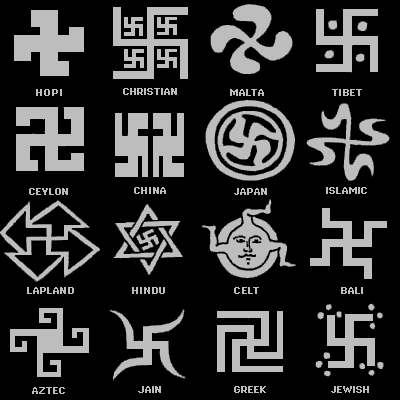
This is not a specifically a "Greek" problem, but Greece (like other European States and white het male-dominated States, such as Australia, the U.S. and the UK), is struggling in many ways, with great economic instability and grossly racist elements. This video describes some of the current climate, but also does some racist things, like calling fascists "primitive" and using the Mayan, Kuna (Panama), and Hopi, West, South, Southeast, and East Asian symbol (in Hinduism, Jainism, and Buddhism, for example; in Sanskrit, Japanese, Chinese languages) to mean the Nazi swastika, as if one is the same as the other. So there's a kind of racism against Indigenous peoples that inheres in the way this story is being told. It also has roots in pre-Christian Europe, including parts of Scandinavia, Eastern Europe, Germany, and Greece, specifically.

Generally, if not conclusively, the Nazi swastika can be identified and distinguished by color combination and by the fact that the uncriss-crossed elements can read as "SS", and the symbol is tilted on its edge. In many other societies, it reads "ZZ" to Anglocise it, and lies flat on one of its four sides.

For more (and in some cases repetitive) history on the culturally diverse and distinguishing features of many of these symbols, most of which do not refer to anything fascistic, but some of which due mean "purity", see this, from *here*:
The swastika is an equilateral cross with arms bent at right angles, all in the same direction, usually the right, or clockwise. The swastika is a symbol of prosperity and good fortune and is widely dispersed in both the ancient and modern world. It originally represented the revolving sun, fire, or life. The word swastika is derived from the Sanskrit swastika which means, "conducive to well- being". The swastika was widely utilized in ancient Mesopotamian coinage as well as appearing in early Christian and Byzantium art, where it was known as the gammadion cross. The swastika also appeared in South and Central America, widely used in Mayan art during that time period.

In North America, the swastika was a symbol used by the Navajos. The swastika still continues today to be an extensively used sign in Buddhism, Jainism, and Hinduism. In Buddhism, a swastika represents resignation. In Jainism, it delineates their seventh saint, and the four arms are also used to remind the worshiper of the four possible places of rebirth; the animal or plant world, in Hell, on Earth, or in the spirit world. To Hindus, the swastika with the arms bent to the left is called the sathio or sauvastika, which symbolizes night, magic, purity, and the destructive goddess Kali. In both Hinduism and Jainism, the swastika or sathio is used to mark the opening pages or their account books, thresholds, doors, and offerings.

The swastika was a symbol for the [predominantly Indian/Iranian, but also European/Iranian] Aryan people, a name which, in Sanskrit means "noble". The Aryans were a group of people who settled in Iran and Northern India. They believed themselves to be a pure race, superior to the other surrounding cultures. When the Germans looked for a symbol, they looked for a symbol which represented the purity which they believed they contained. The Nazis regarded themselves as "Aryans" and tried to steal the accomplishments of these pre-historic people.

In Nazi Germany, the swastika with its arms turned clockwise became the national symbol. In 1910, a poet and nationalist Guido von List suggested that the swastika as a symbol for all anti-Semitic organizations. When the National Socialist Party was formed in 1919, it adopted the ancient symbol, the swastika, giving it the worst meaning possible, destroying the good symbolism which the swastika had held for thousands of years prior.

In 1935, the black swastika on a white circle with a crimson background became the national symbol of Germany. The major difference between the Nazi swastika and the ancient symbol of many different cultures, is that the Nazi swastika is at a slant, while the ancient swastika is rested flat.
What follows is from *here*, and was originally posted on 9 March 2010 ECD.

Anti-Racism Rally

Via Kathimerini
Residents of Hania as well as teachers and students staged a demonstration in the Cretan port yesterday to protest a string of racist attacks in the area in recent weeks, culminating at the end of last month in an attack on a teacher who had swastikas carved into her skin. “We are marching today to remind young people that their grandfathers fought so that the swastika would not fly on flags in the Cretan sky,” a protest organizer said. Police said they believe the perpetrators had targeted the 27-year-old teacher because she had been offering Greek language lessons to the children of immigrants.
*          *          *
Finally, here is a video on racist, anti-immigrant fascistic activist groups in Greece, with the wrong symbol representing the Nazi swastika. It tells some of the recent history of this activism:

Lee Maracle on the Need and Necessity of Ontario First Nations Public Libraries

With apologies for it being too wide for this blog, you can see the whole original *here* on YouTube.