Sunday, February 21, 2016

"Andrea Dworkin's Woman Hating and the Priority of Sisterhood" -- a new guest post by Margo Schulter

Andrea Dworkin Quotes - StoreMyPic | Page 3
image of quote of Dworkin's is from here

What follows was submitted as a comment to a recent post. It concerns a predominantly white-centered battle between some people identified as radical feminist, and some identified as transgender. But as its length would have required breaking it up into several sections, I decided I would post it here as a separate entry, with permission. Margo is white and has been directly involved in Radical and Lesbian Feminist community. — Julian


Andrea Dworkin's Woman Hating And 
The Priority Of Sisterhood

by Margo Schulter

As a transsexual Lesbian feminist who has been seeking to help build inclusive women's and Lesbian communities based on radical feminist values for 42 years, I can hardly consider the meaning of Andrea Dworkin's writings on intersex and transsexual people in Woman Hating (1974), and on "multisexuality" both there and in "The Root Cause" (1975), as a mere academic question. As a Second Waver myself, I will here try to offer a bit of perspective both on the current context in which these issues arise, and on why Andrea Dworkin might later have mixed feelings about some of what she said in Woman Hating.

Indeed, anyone acquainted with the achievements of Dr. Helen O'Connell, for example, would know that some of what Dworkin presented in 1974 is now outdated science; while other portions might be strongly dependent on the specific backdrop of 1960's counterculture, or open to dangerous misunderstandings that Dworkin might have preferred not to highlight when choosing the best passages for an online library of her writings. I'll address some of these points below, and argue that her views on intersex and trans people very likely do not fall in these categories, a conclusion I share with her close colleague and uncompromising radical feminist Catharine MacKinnon, as well as her partner John Stoltenberg.

This dialogue about Woman Hating grows in good part out of a courageous act of John Stoltenberg in 2013: analyzing and defending the ethics of Chelsea Manning in exposing war crimes of the colonialist patriarchy. http://thefeministwire.com/2013/10/the-postconventional-ethics-of-chelsea-manning/. In the process, because he correctly gendered Chelsea Manning, he attracted considerable negative attention from feminists who hold the view that trans women either are men and should be gendered accordingly, or at least are "males" or "nonfemales" with no place in the women's and Lesbian communities.

In response, Stoltenberg in 2014 wrote a piece for the Feminist Times theme of #GenderWeek, "Andrea was not transphobic." http://www.feministtimes.com/%E2%80%AA%E2%80%8Egenderweek-andrea-was-not-transphobic/. This was a powerful act of allyship with trans women in general and transsexual radical Lesbian feminists coming from Andrea's Second Wave roots in particular. And for some "true believers" that it is possible to be a zealous follower of the feminism of Andrea Dworkin and Catharine MacKinnon and at the same time seek the systematic exclusion of transsexual women from feminist and Lesbian communities, Stoltenberg's arguments pointed to an anomaly. Given Dworkin's position that all transsexual people are in "primary emergency" (a condition she had earlier defined as applying, for example, to Africans and African-Americans in the Maafa, Indigenous people in the Turtle Island Holocaust starting soon after 1492, and Jews in the Shoah), how could a follower of Dworkin seek the general exclusion or marginalization of transsexual women as a subgroup of the sex class female?

What I would emphasize is that accepting what Dworkin said in 1974 and 1975 about intersex and transsexual people and "multisexuality" leaves open a vast range of questions about how feminists in 2016 should approach real differences in experiences and vulnerabilities among women at many intersections of oppression. Thus private groups and spaces for either women who are Assigned Female At Birth (AFAB) or women who are trans may sometimes serve valuable purposes. But I do see Dworkin's views as incompatible not only with a general rejection or exclusion of transsexual women from the women's and Lesbian communities, but equally with the attitude of some trans women who distrust or devalue all women who are AFAB, often based on a supposed "cis/trans" binary, which I find as misleading as the sex and gender binaries that Dworkin challenged. If I ask for inclusion and solidarity as a Lesbian woman who enjoyed some male privilege until I transitioned at age 22, as well as a survivor of trans oppression, I surely must stand shoulder to shoulder in solidarity with women who have never enjoyed male privilege and are survivors of AFAB socialization. As Audre Lorde and other Women of Color have especially shown, sisterhood is a multidimensional reality: but surely it must be a two-way street on the elementary level that I acknowledge the 99% and more of my sisters in the female sex class who have indeed survived AFAB socialization, and have experienced things I cannot imagine. They are my older sisters, not my "cis oppressors"; rather, the patriarchy is our common oppressor.

Here I should also point to something that dyadic (nonintersex) people like Andrea Dworkin and Janice Raymond, and also on a humbler level myself, got wrong at least by omission in the 1970's: the vital intersex issue of childhood medical abuse. The practice of Intersex Genital Mutilation (IGM), optional surgery performed on nonconsenting infants and children to bring them into conformity with the patriarchal sex binary and its heteronormative obsession with the penetrative sexual act that Andrea Dworkin would address in Intercourse (1987), should have attracted the passionate condemnation of all feminists for a number of reasons. In reality, however, it only happened when intersex people themselves very visibly spoke out, starting in the mid-1990's. Yet Woman Hating beautifully expresses some of the feminist values fulfilled by the militant intersex movement starting some two decades later, with IGM still very much an issue in many parts of the world.

As you note, Julian, Andrea Dworkin later indicated her own misgivings with some portions of Woman Hating. Should we take this to include the passages on intersex and transsexual people? Here I would suggest a reasoned approach in weighing the probabilities of what she may have intended.

First, as I mentioned, there are statements she made or cited in 1974 that we now know to be wrong in ways very, very, important for Lesbian feminists and feminists in general, as with this: "the clitoris is a vestigial penis."

In fact, as Dr. Helen O'Connell of Australia has shown in paradigm-changing research, the clitoris is far larger and more complex than the external and visible portion homologous to the glans penis: that is only, as the African-American feminist Sophia Wallace puts it, "the tip of the iceberg" of the internal clitoris, including the shaft, the crura or legs, and the bulbs (formerly called "vestibular bulbs"). In short, the clitoris overall is about the same size as the penis, except that it is mostly internalized — and yet more richly innervated (supplied with nerves) and intricate! Thus the human phalloclitoris (as it is often termed in the intersex community) or virga (a medieval Latin term that can apply to clitoris or penis, and I would propose also the range of intermediate forms), differs along the female-male continuum not so much in size as in the degree of internalization or externalization. Here Woman Hating needs an update which I am sure that Dworkin would support, whether or not she was aware of this issue when she chose for other portions of her work to have priority in an online archive.

She might have yet more serious concerns about portions of her chapter on "multisexuality" that addressed the incest taboo, for example, or "bestiality." Here I agree with at least one other commentator that from a truly radical perspective that values human empathy and respectful touch, the "erotic" may embrace many forms of affection that the patriarchal mindset simply cannot comprehend. But such words, in the context of a culture where physical and sexual child abuse are rife, may have later struck her as, to say the least, inapposite. She may have realized that she had looked too far ahead of her times in a way which might endanger those she most wanted to protect: abused women and children. And I will add my conviction that her concern in this regard embraces not only the vast majority of women and girls who are AFAB, but also trans women subject to rape and other crimes of violence.

In contrast, her words about intersex and transsexual people do not pose a similar risk. As long as transsexual Lesbian feminists and other transsexual women who participate in feminist groups behave as sisters, understand that women who have survived AFAB socialization are in this sense our seniors, and respect the basic rule of enthusiastic consent and noncoercion that no Lesbian owes sex to any other Lesbian, regardless of birth assignment, there should be no insoluble problems. And members of feminist communities who do not meet these expectations, regardless of birth assignment, can and should be asked to leave.

Julian, you also raise a point where there has been a rather heated dialectic of conflict, as I might say, but a ready synthesis is available. You are absolutely right that it is implicit in Dworkin that the vast majority of women are AFAB, and are indeed oppressed under the brutal patriarchal hierarchy of gender because of their actual or perceived reproductive capabilities — which, under patriarchy, become vulnerabilities.

Thus transsexual women who are good feminists recognize that in that sense, within the female sex class we are the exception rather than the rule, which makes it all the more important for us to show sex-class consciousness and solidarity by supporting women's reproductive rights as a women's issue and feminist issue. What hurts our sisters, hurts ourselves.

Although Andrea does not address the details of how transsexual women might interact with other women in the feminist movement, a discussion early in Woman Hating about "primary emergency" indicates that women who have special oppressions — and, for me, AFAB oppression as well as trans or intersex oppression amply qualifies here — have a responsibility also to look to the general experience and interests of the female sex class. That means at once recognizing, for example, that negative menstrual stereotypes and insulting language demean all women, include those of us who never ourselves have periods, and that discussions of menstruation and allied health concerns should be welcome in inclusive women's groups; and also that women who share the experience of menstruation may sometimes want to have rituals of a kind led by Z Budapest for themselves only.

From this perspective of interpreting Andrea's views from 1974 in an inclusive and flexible way, John Stoltenberg's arguments for the spirit of inclusion are powerfully supported by Catharine MacKinnon, whose opposition to pornography and what she terms prostitution and I term sexage work (from the French sexage, a feminist concept meaning sex-based servitude or slavery) is well known. She speaks best for herself: http://radfem.transadvocate.com/sex-gender-and-sexuality-an-interview-with-catharine-a-mackinnon_n_433

As a Second Wave feminist, I would add that recognizing a continuum of physical sex (with intersex people representing natural variations rather than pathological cases) and of what we perceive under patriarchy as gender identities and styles of gender expression, in no way makes the gender hierarchy of patriarchy less real or oppressive! Andrea shows that we can use common sense and hirstorical experience to recognize both what is brutally "real" under patriarchy, and what is ultimately "true" about feminist possibilities, without any need for "postmodernism." Kate Millett and Andrea Dworkin had it right: while "gender identity" or "sex identity" develops in the first years of life in a given social context as a basic reality for an individual, transsexual or otherwise, the patriarchal system of gender is not just a "performance," or an even playing field with equally valid "choices." Being raped, or facing an unwanted pregnancy, is not just a theatrical scene; the playing field of gender roles and expressions under patriarchy is not level ground, but has a twisted topology of threatened and too often realized violence. This violence, as it affects women who are AFAB, transsexual, and/or intersex, is something that Woman Hating calls on all women to oppose in common sisterhood.

The way I like to phrase an inclusive feminist approach is this: "The rule does not exclude the exceptions, and neither do the exceptions exclude the rule." Thus the vast majority of women are AFAB, and a large portion of this majority face the risk of unwanted pregnancy — facts essential in understanding the origins and nature of patriarchy as enforced reproductive labor and slavery, and the need of all women, including intersex and transsexual women, to unite in order to liberate our sex class. The presence of a relatively few acculturated transsexual women in the feminist and Lesbian communities need in no way decenter the concerns of women who are AFAB, and good feminist process will maintain balance. Such process, of course, depends on the acknowledgment of privileges and immunities, including, for those of us who are transsexual women, past male privilege and also immunity from childhood AFAB socialization.

A Second Wave tradition which I strongly support is the principle that each affinity group within the greater feminist and Lesbian communities can set its own boundaries. Thus a group like the Women's Liberation Front (WoLF) has every right to define itself as AFAB only. In fact, I admire many of the declared rules and guidelines of this group on conduct both online and in the larger world, and would see an effort to build similar groups and communities including women regardless of birth assignment as a sisterly response. Thus WoLF is free to set its own boundaries, and other affinity groups are free to do the same. Radical feminism is large enough to have room for both types of groups and private spaces.

In short, as I hope to have suggested by this point, living by Andrea Dworkin's radical feminist values as expressed in Woman Hating is a high challenge for transsexual women as well as women who are AFAB, including intersex women regardless of birth assignment. It means recognizing the material reality of women's reproductive slavery, and the psychological oppression of AFAB socialization, that we too need to center early and often. In short, if we identify as women, we must identify with women, so that sisterhood overcomes the illusory "cis/trans" binary. Sisterhood first and foremost! That seems to me implicit in everything that Andrea Dworkin has written.

Friday, February 19, 2016

Is John Stoltenberg Wrong? On Andrea Dworkin, Sex Difference, and Gender Dominance


image of book cover is from here

What follows seeks a careful, thoughtful read of Andrea Dworkin's early writings. I hope to make two points:

1. Andrea's view of 'woman' was directly and politically tied to the female body—unambiguously.
2. John Stoltenberg decontextualises or overvalues key points in some of her early work, points she later abandoned or came to understand as politically problematic. In the process, the core of her work is ignored.

In John's article, "Andrea Dworkin was not Transphobic", he stated that her early views were profound and life-changing for him. From "Andrea Was Not Transphobic" at Feminist Times:
One passage in Woman Hating changed my life forever:
“The discovery is, of course, that “man” and “woman” are fictions, caricatures, cultural constructs. As models they are reductive, totalitarian, inappropriate to human becoming. As roles they are static, demeaning to the female, dead-ended for male and female both.”
That is the opening of the last chapter of the book, chapter 9: "Androgyny: Androgyny, Fucking, and Community." Also from that chapter, page 175:
... The first question then is: What of biology? There are, after all, men and women. They are different, demonstrably so. We are each of one sex or the other. If there are two discrete biological sexes, then it is not hard to argue that there are two discrete modes of human behavior, sex-related, sex-determined. One might argue for a liberalization of sex-based roles, but one cannot justifiably argue for their total redefinition.  
Hormone and chromosome research, attempts to develop new means of human reproduction (life created in, or considerably supported by, the scientist’s laboratory), work with transsexuals, and studies of formation of gender identity in children provide basic information which challenges the notion that there are two discrete biological sexes. That information threatens to transform the traditional biology of sex difference into the radical biology of sex similarity. That is not to say that there is one sex, but that there are many. 
The issue, in part, is this matter of whether there are "two discrete biological sexes". Beginning on page 176, she offers the following evidence of the two not being "discrete", or polar opposites, biologically:
The words “male” and “female, ” “man” and “woman, ” are used only because as yet there are no others. 
1. Men and women have the same basic body structure. Both have both male and female genitals —the clitoris is a vestigial penis, the prostate gland is most probably a vestigial womb. ... 
2. Until the 7th week of fetal development both sexes have precisely the same external genitalia. Basically, the development of sex organs and ducts is the same for males and females and the same two sets of ducts develop in both.  
3. The gonads cannot be said to be entirely male or female. Dr. Mary Jane Sherfey writes: In their somatic organization, the gonads always retain a greater or lesser amount of the opposite-sex tissue which remains functional throughout life. 
4. Chromosomal sex is not necessarily the visible sex of the individual. It happens that a person of one chromosomal sex develops the gonads of the other sex. Gonadal sex and chromosomal sex can be in direct contradiction.  
5. Chromosomal sex is not only XX or XY. There are other chromosomal formations, and not much is known about them or what they signify.  
6. A person can have the gonads of one sex, and the secondary sexual characteristics of the other sex.  
7. Men and women both produce male and female hormones. The amounts and proportions vary greatly, and there is no way to determine biological maleness or femaleness from hormone count.  
8. One hormone can be transformed by the body into its “opposite, ” male into female, female into male.  
9. It is now thought that the male hormone determines the sex drive in both men and women. 
10. The female hormone (progesterone) can have a masculinizing effect. Dr. Sherfey writes:
We may have difficulty conceiving it, but natural selection has no difficulty using sexually heterotypic structures for homotypic purposes. For example, progesterone is the “pregnancy hormone” essential for menstruation and the prolonged pregnancy. It is as uniquely a “female” hormone as one can be. Yet progesterone possesses strong androgenic properties. It may be used to masculinize female embryos. In 1960, Jones (27, 63) demonstrated that progesterone given to human mothers early in pregnancy to prevent threatened miscarriages. . . severely masculinized a female fetus.
11. Visible sex differences are not discrete. There are men with tiny cocks, women with large clits. There are men with highly developed breasts, women with almost no breast development. There are men with wide hips, women with no noticeable hip development. There are men with virtually no body hair, women with much body hair. There are men with high voices, women with low voices. There are men with no facial hair, women who have beards and mustaches.  
12. Height and weight differences between men and women are not discrete. Muscle structures are not discrete. We know the despair of the tall, muscular woman who does not fit the female stereotype; we know also the despair of the small, delicate man who does not fit the male stereotype. 
13. There is compelling cross-cultural evidence that muscle strength and development are culturally determined. There are cultures in which there are no great differences in somatotype of men and women...
14. There are hermaphrodites in nature. Robert T. Francoeur, in Utopian Motherhood: New Trends in Human Reproduction, admits: The medical profession and experimental biologists have always been very skeptical about the existence of functional hermaphrodites among the higher animals and man, though the earthworm, the sea hare, and other lower animals do combine both sexes in the same individual.
We are not being told two sexes don't exist, in nature or otherwise; we are being told they don't exist 'discretely'. Any casual observations of humans around the world, and even within one culture or region, bears that out: females and males are not "opposites" or entirely physically different kinds of people. Due to that, she concludes, "[w]e are justified in making a radical new formulation of the nature of human sexuality. We are, clearly, a multisexed species which has its sexuality spread along a vast fluid continuum where the elements called male and female are not discrete."

This is a crucial point for John in his work. The insight also informs the work of others, many of whom are neither radical nor feminist.

Gender, sex, and sexuality as "a vast fluid continuum" is pursued by many white sexual Liberals and Queer Theorists in the following decades. I describe them as Liberals because, unless exceptionally, they are not engaged in efforts to eradicate colonialist patriarchy from the roots up. And too often they seek to distance themselves from those who do. A problem occurs when focus on sexual fluidity or continuums becomes the primary work, not in collaboration or coalition with radical and feminist activists.

Achieving greater dignity and visibility to those who are intersex or transsexual is a worthwhile endeavor—life saving for some. But seeking visibility in an unchallenged status quo was not the objective, even in this early work of Andrea's. We are being led to consider the following:
"...the concrete implications of multisexuality as we find it articulated in both androgynous mythology and biology necessitate the total redefinition of scenarios of proper human sexual behavior and pragmatic forms of human community. If human beings are multisexed, then all forms of sexual interaction which are directly rooted in the multisexual nature of people must be part of the fabric of human life, accepted into the lexicon of human possibility, integrated into the forms of human community. By redefining human sexuality, or by defining it correctly, we can transform human relationship and the institutions which seek to control that relationship. Sex as the power dynamic between men and women, its primary form sadomasochism, is what we know now. Sex as community between humans, our shared humanity, is the world we must build." 
Isolated from her core message, some of the above can come across as post-modern and Liberal Queer Theory-making. It is important to note, the problem with post-modernism isn't its discursive critique of colonialist patriarchal modernism; it is its belief that changes in language adequately lead to sufficient changes in culture, and therefore society. The problem with Liberalism isn't that it necessarily refuses Radicalism. The problem is that people are seduced by speaking and writing projects that don't disturb the major power-brokers of society. And, it is easier to target radical activists than be accountable to them. It is also pro-hegemonic to ignore those who are most harmed by systems of exploitation and violence, effectively protecting and preserving the status quo.

People, usually those atop various political hierarchies, are far too satisfied to avoid and ignore the most heinous realities: they can also better afford to do so. I know of no one who occupies various positions at the bottom of several political hierarchies who are Liberal or who believe that only reforming colonialist patriarchy is sufficient to save their lives.

Yet, Liberals can and have worked with Radicals; the problem is that because Liberals don't actively pursue radical transformation, they instead attack Radicals and their theories and agendas, often as being illiberal and even conservative. To the extent that people seeking to reform the status quo only endeavor to create more text, more identities, or more laws within patriarchy, they are liberal and a problematic form of post-modern. Academic discourse aside, it means they are invested, often without intent and usually without awareness, in the mass subordination, enslavement, and murder of women and girls.

According to Andrea, "redefining human sexuality", or "defining it correctly" does not, by itself, leave us with something other than "the power dynamic between men and women, its primary form sadomasochism", unless we build it. Dworkin, in this abandoned early theory, is calling for a more complex, non-hierarchical mythology of gender and sex as part of an overall program of dismantling patriarchy. It is not an end unto itself. The goal is not "more genders". The goal is the end of gender-as-hierarchy, and all expressions of male supremacist violence. So if we don't get there by changing terms and sexual categories, how do we?
"We must destroy the very structure of culture as we know it, its art, its churches, its laws." — Andrea Dworkin, "The Rape Atrocity and the Boy Next Door", page 48, Our Blood.
The project isn't primarily discursive (one of creating new theory) or one of expanding identities (as liberal genderqueer proponents do). It is eradicating male supremacist violence, including as it expresses itself through culture, art, religion, and laws.

To appreciate the implications of anything she wrote, one must face this fact:

Andrea's writing was a radical and feminist political act; she wrote as an activist, building revolution into her prose and nonfiction. She wanted patriarchy dead as soon as possible, accomplished by ending all forms of sexual violence against women and girls—against their spirits and minds, and against their female bodies. This, more than anything else, was what I believe Andrea wanted to see achieved.

We must also keep this in mind. With Nikki Craft alone, over a period of years, Andrea carefully selected the contents of the Andrea Dworkin Online Library. The section from Woman Hating now being promoted by John as, according to him, dis-identifying womanhood with femaleness, was not chosen by Andrea as something she wanted to have preserved in cyberspace. What she did choose was a portion of part 2, "The Pornography" as an introduction to a full chapter called "Woman as Victim: Story of O", pp. 53-63, from Woman Hating, copyright © 1974 by Andrea Dworkin.

From "The Pornography":
Pornography, like fairy tale, tells us who we are. It is the structure of male and female mind, the content of our shared erotic identity, the map of each inch and mile of our oppression and despair. Here we move beyond childhood terror. Here the fear is clammy and real, and rightly so. Here we are compelled to ask the real questions: why are we defined in these ways, and how can we bear it?
Now, the opening paragraph from "Woman as Victim: Story of O": 
The Story of O, by Pauline Reage, incorporates, along with all literary pornography, principles and characters already isolated in my discussion of children's fairy tales. The female as a figure of innocence and evil enters the adult world—the brutal world of genitalia. The female manifests in her adult form—cunt. She emerges defined by the hole between her legs. In addition, Story of O is more than simple pornography. It claims to define epistemologically what a woman is, what she needs, her processes of thinking and feeling, her proper place. It links men and women in an erotic dance of some magnitude: the sado-masochistic complexion of O is not trivial—it is formulated as a cosmic principle which articulates, absolutely, the feminine.
What is epistemically existent is the colossal and subordinating violence done to women's female bodies by men. This, not the separation of female bodies from women's lives, is what Andrea exposed.

Far less frequently quoted than some of what is above, is this: Andrea states, "I think there are a lot of things really wrong with the last chapter of Woman Hating." See, Without Apology: Andrea Dworkin's Art and Politics, by Cindy Jenefsky (1998). The quote is from page 139, in her notes to chapter 3. Her point is not thoroughly discussed so we do not know all of what she meant.

John's article continues:
That belief in the possibility of life beyond gender was a core of both her work and mine. A speech I gave within a few months after our meeting was published as Refusing to Be a Man (the title I gave my first book). In a speech of Andrea’s written about a year later she drew a distinction between reality and truth in order to say that: 
“while the system of gender polarity is real, it is not true…. [T]he system based on this polar model of existence is absolutely real; but the model itself is not true. We are living imprisoned inside a pernicious delusion, a delusion on which all reality as we know it is predicated.”
As already indicated, I do not believe "life beyond gender", per se, was "a core" of her work. The distinction may appear subtle, but here, John is conflating his own literary and political project with hers, implying a mutually reinforcing intellectual pursuit and activist agenda. We are deliberately told the chronology of their early writings. But the thing is, he has not strayed from his earliest points. She moved on.

The speech he links to above appears as chapter 9 in Our Blood, "The Root Cause". I shall excerpt a substantial portion of the speech, here:
One basic principle of reality, universally believed and adhered to with a vengeance, is that there are two sexes, man and woman, and that these sexes are not only distinct from each other, but are opposite. The model often used to describe the nature of these two sexes is that of magnetic poles. The male sex is likened to the positive pole, and the female sex is likened to the negative pole. Brought into proximity with each other, the magnetic fields of these two sexes are supposed to interact, locking the two poles together into a perfect whole. Needless to say, two like poles brought into proximity are supposed to repel each other. 
The male sex, in keeping with its positive designation, has positive qualities; and the female sex, in keeping with its negative designation, does not have any of the positive qualities attributed to the male sex. For instance, according to this model, men are active, strong, and courageous; and women are passive, weak, and fearful. In other words, whatever men are, women are not; whatever men can do, women cannot do; whatever capacities men have, women do not have. Man is the positive and woman is his negative.
... 
This diseased view of woman as the negative of man, "female by virtue of a certain lack of qualities," infects the whole of culture. It is the cancer in the gut of every political and economic system, of every social institution. It is the rot which spoils all human relationships, infests all human psychological reality, and destroys the very fiber of human identity.

This pathological view of female negativity has been enforced on our flesh for thousands of years. The savage mutilation of the female body, undertaken to distinguish us absolutely from men, has occurred on a massive scale.
Here we see the core theme of her work, well reiterated, consistent with the quote above from "The Rape Atrocity". "The diseased view" is not that woman has a female body. "The pathological view" is not that women are female. The sociopathology is the uses and abuses to which women's female bodies are put, in patriarchal cultural mythology and in hard-core practice.

Advocating the addition of other genders, while leaving unchallenged the tyrannical sexual hierarchy that is globalised, is not a revolutionary effort. It is liberal to the core. The big mistake is thinking Dworkin sought to separate women's resistance to patriarchy from being female, or men's efforts to transform themselves from being male. What Andrea sought was the end of any association, presented to us as both truth and reality, of being a woman with being feminine and submissive, or being a man with being masculine and predatory.

Addendum:
Many people I know, respect, and love are intersex, non-binary, or transsexual. There is no unspoken claim here by me that Andrea was anti-transsexual or that she denied the existence of intersex people. She was an astoundingly empathic and compassionate human being, very much against cruel stereotyping and hatred of any group systematically targeted for violence and socially marginalised by the powerful. She wrote in Woman Hating, page 182:
...whatever we choose to make out of the data of what is frequently called Intersex, it is clear that sex determination is not always clearcut and simple. Dr. John Money of Johns Hopkins University has basically isolated these six aspects of sex identity: 
1. Genetic or nuclear sexuality as revealed by indicators like the sex-chromatin or Barr-body, a full chromosomal count and the leucocytic drumstick;
2. Hormonal sexuality which results from a balance that is predominantly androgenic or estrogenic; 
3. Gonadal sexuality which may be clearly ovarian or testicular, but occasionally also mixed; 
4. Internal sexuality as disclosed in the structure of the internal reproductive system; 
5. External genital sexuality as revealed in the external anatomy, and finally; 
6. Psychosexual development which through the external forces of rearing and social conditioning along with the individual's response to these factors directs the development of a personality which is by nature sexual. 
At this point, Dr. Money is more commonly known to have been a child abuser and pro-predation.

And from page 186:
Transsexuality  
How can I really care if we win “the Revolution”? Either way, any way, there will be no place for me. A transsexual friend, in a conversation 
Transsexuality is currently considered a gender disorder, that is, a person learns a gender role which contradicts his/her visible sex. It is a “disease” with a cure: a sex-change operation will change the person’s visible sex and make it consonant with the person’s felt identity.  
Since we know very little about sex identity, and since psychiatrists are committed to the propagation of the cultural structure as it is, it would be premature and not very intelligent to accept the psychiatric judgment that transsexuality is caused by faulty socialization. More probably transsexuality is caused by a faulty society. Transsexuality can be defined as one particular formation of our general multisexuality which is unable to achieve its natural development because of extremely adverse social conditions.  
There is no doubt that in the culture of male-female discreteness, transsexuality is a disaster for the individual transsexual. Every transsexual, white, black, man, woman, rich, poor, is in a state of primary emergency (see p. 185) as a transsexual. There are 3 crucial points here. One, every transsexual has the right to survival on his/her own terms. That means that every transsexual is entitled to a sex-change operation, and it should be provided by the community as one of its functions. This is an emergency measure for an emergency condition. Two, by changing our premises about men and women, role-playing, and polarity, the social situation of transsexuals will be transformed, and transsexuals will be integrated into community, no longer persecuted and despised. Three, community built on androgynous identity will mean the end of transsexuality as we know it. Either the transsexual will be able to expand his/her sexuality into a fluid androgyny, or, as roles disappear, the phenomenon of transsexuality will disappear and that energy will be transformed into new modes of sexual identity and behavior.
She goes on to discuss Transvestism, Bestiality, and Incest, although not in the pro-predation, pro-perpetration ways that MRAs claim. But it should be quite clear that what she proposes here was later rejected for several reasons, in part because it is victim-ignoring, politically naive, and speculative relative to her later work. For example, this, from page 180 of Woman Hating:
It is interesting here to speculate on the perceptions of men like Lionel Tiger (Men in Groups) who in effect project human cultural patterns of dominance and submission on the animal world. For instance, Dr. Sherfey tells us that “In many primate species, the females would be diagnosed hermaphrodites if they were human” (Italics hers.) Most probably, we often simply project our own culturally determined modes of acting and perceiving onto other animals—we effectively screen information that would challenge the notions of male and female which are holy to us. In that case, a bias toward androgyny (instead of the current bias toward polarity) would give us significantly different scenarios of animal behavior.
Nothing too dangerous happens to non-human animals if we don't bother to notice that female and male are not the only presentations of sexed being. A lot happens to them, and to us, if we fail to challenge the ways female human beings across their lifetimes, as girls and as women, are harassed, threatened, beaten, raped, and murdered, precisely for being female women. Colonialist patriarchy is a core problem in the West and beyond. Girls across the globe are imperiled right now, but more generations of girls will continue to be if we ignore the bulk of what Andrea so truthfully described in her work across the 1980s and until her death, about entirely unspeculative gendered atrocities.


Monday, February 15, 2016

Fighting Sexual Exploitation: In Solidarity with My Life My Choice!

This is the opening of a statement by Audrey Morrissey, the Associate Director of My Life My Choice, who is a trafficking survivor.
My Experience in the Sex Trade Had Nothing to Do with Choice
audrey-1
I was first sold for sex when I was 16. My boyfriend told me that if I loved him and our daughter, I’d work the corner so we could have a better life. He made me think there were no other options. He convinced me I wasn’t doing it for him, but for us. 
I know there are some women who say they do this willingly—they call themselves “sex workers.” Maybe that’s their truth, but that’s not mine. 
Nor is it the truth for the hundreds of girls I’ve counseled over the past 12 years at My Life My Choice.
For the rest of her statement, please go here to demandabolition.org.

I stand in solidarity with My Life My Choice. Here is the summary of their work:
Harnessing the strength of the collective voices of survivors, My Life My Choice empowers vulnerable youth to be agents of change in their own lives and in the movement to end the commercial sexual exploitation of children.
Here is their mission statement:
The mission of My Life My Choice is to prevent the commercial sexual exploitation of adolescents through survivor-led programs that educate and empower youth to find their voice and create a positive life path while working to eliminate the violence and victimization of sexual exploitation. 
We have a laser focus on strengthening the power, and amplifying the voices, of those who are most vulnerable and of those who have survived exploitation.
We are building a network of allies to stand up to the force of the illegal sex industry and create long-lasting social change.
Here is their history:
In 2001, a young Boston woman was brutally murdered. She was 17 years old and living in a Child Protective Services (CPS) funded group home. Unbeknownst to any of the caring adults in her life, she was being commercially sexually exploited. At the time of her death, leaders across Boston came together to say "was this an isolated incident or the tip of the iceberg?” We quickly learned that it was the tip of the iceberg. Out of Latasha's death, My Life My Choice was born. 
Today, My Life My Choice offers a unique continuum of survivor-led services spanning provider training, prevention groups for vulnerable adolescent girls, survivor mentoring to young victims of commercial sexual exploitation, and advocacy and leadership development. Our programs are grounded in the strength and resiliency of survivor leaders. 

To all the employees, volunteers, and activists affiliated with My Life My Choice, thank you for all you do for girls and women!  -- Julian


Sunday, February 14, 2016

AIM Co-founder Clyde Bellecourt's question to Bernie Sanders: "I want to know, if you become the President of the United States, are you going to honor those treaties made with Indian People?"


Caption: Clyde Bellecourt gets the microphone makes a speech and asks Bernie Sanders if he is elected president will he honor treaties the US made with Native Americans.

A portion, transcribed:

Clyde Bellecourt (White Earth Band of Ojibwe):
I want to know if you're going to honor those treaties? I want to know, if you become the president of the United States, are you going to honor those treaties made with Indian People?

Bernie Sanders: 
The Native American people have gotten a terrible deal from the American government. I will do everything I can to redress that, absolutely. 

Clyde Bellecourt:
You haven't answered the question. You still haven't answered the question!

Please also see *this post at Censored News*.


Thursday, February 11, 2016

Happy 100th Birthday to Radical Feminist Flo Kennedy!!!

book cover image is from here

With a debt of gratitude to Sherie M. Randolph, below are snippets from two websites honoring Florynce Kennedy, who would have turned 100 today. When herstory is written by whites or men, Black women get marginalised or left out as central figures. Flo Kennedy was a central figure in radical feminism in the 1970s. First up, from Solidarity:

The Lasting Legacy of Florynce Kennedy, Black Feminist Fighter

— Sherie M. Randolph


SEVERAL DECADES AFTER the 1960s political upheavals, very few people recognize the name of the Black feminist lawyer and activist Florynce “Flo” Kennedy (1916-2000). However, during the late 1960s and 1970s Kennedy was the country’s most well-known Black feminist. When reporting on the emergence of the women’s movement, the media covered her early membership in the National Organization for Women (NOW), her leadership of countless guerilla theatre protests and her work as a lawyer helping to repeal New York’s restrictive abortion laws. Indeed, Black feminist Jane Galvin-Lewis and white feminists Gloria Steinem and Ti-Grace Atkinson credit Kennedy with helping to educate a generation of young women about feminism in particular and radical political organizing more generally.

Yet Kennedy’s activism is marginalized or completely erased from most histories of “second wave” feminism. Those rare references to Kennedy usually highlight her as one of the few Black women in the women’s movement. Kennedy is a significant exemplar of the exclusion of key Black feminist organizers from most feminist scholarship on the movement: the erasure of her critical role speaks to the ways in which feminist literature has failed to see Black women as progenitors of contemporary feminism.

In response to such historical effacement, this article resurrects Kennedy’s political contribution to sixties radicalism and uncovers a Black feminist politics and practice that was not only connected to the mainstream feminist movement but was also closely allied to the Black Power struggle. It challenges previously held rigid dichotomies between the Black Power and women’s movements and illuminates the centrality of Black feminism and Flo Kennedy to both movements.

Kennedy asserted that she could “understand feminism [and sexism] better because of the discrimination against Black people.” Her work in Black movements reveals the Black Power movement as a significant force in shaping contemporary feminist struggles.

Earlier feminist movement scholarship ignores or undervalues the connections between Black Power and feminist struggles. Studies of independent Black feminists and the predominantly white feminist movements cite the increased masculinity that kept feminism and Black Power divided. They are not wrong to do so, but positioning Black Power as primarily an antagonistic influence misses what the movement might tell us about how both Black and white feminists understood liberation and revolution.

For the rest of this post, please visit *here* at Solidarity.


*                  *                  *

What follows next is from Colorlines:

Happy 100th Birthday to the Notable, Quotable Black Feminist Flo Kennedy!

Razor-tongued Black feminist lawyer and activist Florynce "Flo" Kennedy would have turned 100 years old today. To celebrate, we offer you some of her powerful, witty and sometimes profane words.

Sherie M. Randolph  FEB 11, 2016 12:33PM EST

Photo: Bettye Lane
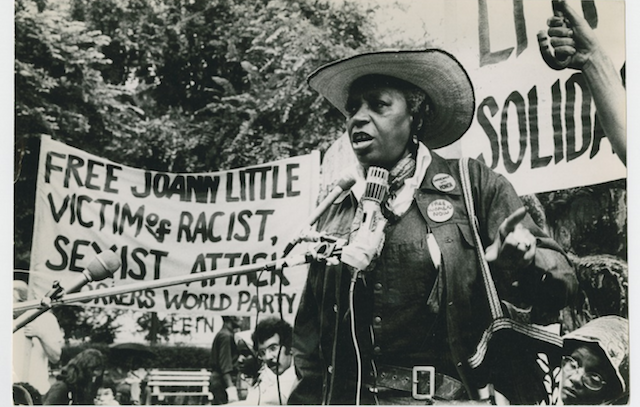
Florynce "Flo" Kennedy speaks at a protest to exonerate a Black victim of attempted rape, Joann Little on July 12, 1975. In 1972, Little, 20, fled her jail cell in Beaufort, North Carolina, after killing the White deputy sheriff who tried to rape her. Little used the jailer’s ice-pick against him and she was placed on trial for murder.  

Florynce "Flo" Kennedy, the charismatic feminist and Black Power activist and lawyer, was born 100 years ago today (February 11). While she is most often remembered as one of the few Black women who worked in the mostly White feminist movement of the 1960s and '70s, Kennedy's influence also flowed from her work within the New Left, Black Power, Civil Rights and autonomous Black Feminist movements.

For the rest of this post, please visit *here* at Colorlines.


                                                *                  *                  *

Finally, to read so much more about Flo Kennedy, please read Sherie's new book:

Florynce "Flo" Kennedy: The Life of a Black Feminist Radical 


Please visit *here* to purchase the book from Charis Books and More, an independent feminist bookstore--for less money than Amazon.com.

The Hidden Essentialisms in White, Trans, Anti-Radical Feminist Discourse


essentalism Power Point slide is from here

I want to explicitly state a Trigger Warning, in particular for survivors of patriarchal sexual atrocities. There is not anything very graphic below, but particular manifestations of rape culture are discussed by me as an important factor in understanding male socialisation and privilege.

I have had the feeling, for years, that important stuff ain't getting named, when I read some arguments white anti-RF pro-trans people make to discredit and distance themselves from those seemingly essentialist white Radical Feminists. What isn't getting named, are the experiences of most people in the world. What isn't getting named are hidden forms of 'essentialism'. I'm not yet hearing anti-essentialist pro-trans activists call this stuff out in trans-friendly spaces, possibly because that would mean decentering whiteness as a norm.

While I made a very small change to some of the content, the whole of what follows has been copied and pasted from the comments section of an A.R.P. post from late 2011: https://radicalprofeminist.blogspot.com/2011/11/andrea-dworkin-on-transsexuality-and-on.html

The comments, however, are brand new as of February 2016.


Blogger enhanta bodlar said...
Julian: it seems like you believe that trans women specifically are subject to male socialization and thus, male privilege--and in the case that they are also white, another level of advantage. However, despite being exposed to a form of male socialization, transgender women do not receive the same social instruction that shapes cisgender males, as they still internalize the example of female behavior that influences female socialization. Trans women's socialization really is distinct to trans women, and in reality they do not really benefit socially from any element of male socialization they may retain.

Blogger Julian Real said...
Hi enhanta,

TW for discussion that includes violating practices in rape culture.

My response is in a few parts.

Thank you so much for your comment. I'll do my best to clarify my position. Most trans women I have known grew up with some levels of male socialisation, male privilege, male entitlements, and so forth. Some with a great deal of it. Here's one example. A white, class-privileged trans woman was raised to be a boy and a man. She excelled in Anglo-white-masculine pursuits, including using firearms, negotiating a world from the vantage point of having wealth, and having a military career. She transitioned in her forties. She got involved with a nontrans lesbian and became controlling and abusive, in ways typical of people socialised to value power and domination as white men practice it. She was possessive. She leaned on her partner for economic survival. (Her family disowned her and she had no poverty survival skills.) This rendered her especially dependent on her partner, who grew up in poverty. She was sexually coercive and insensitive to her partner's reality as an incest survivor. (Of course some nontrans lesbian women can be batterers and committers of sexual assault: the point is that it is still learned from patriarchal socialisation.)

And, of course, regardless of being trans or not, whatever sex or gender we were or are, we are all raised, systematically, to value maleness, manhood, and masculinity. Some of that maleness and manhood is more despised, due to being raced Black or Brown, being effeminate, and so forth. And some forms of femininity and womanhood are less despised in colonial patriarchies, such as lighter-skinned people of color relative to darker-skinned people of color.

So I would say *we all do*, to varying extents: we are, collectively, subjected to colonial and patriarchal male socialisation, regardless of gender. And, in this view, there's no way a U.S.-raised trans woman would be exempt from such male socialisation, even if one never identified as a male, or boy, or man. If the issue is whether and how we benefit from it, I'd argue that, too, is very complicated, due to age, region, ethnicity, race, sexuality, generation, class, weight, height, build, tone of skin, abilities, and religion, among other variables.

Blogger Julian Real said...
When you state this, "transgender women do not receive the same social instruction that shapes cisgender males", do you mean pre-transition or post-transition? And, are you assuming all transgender women are transsexual, or have transitioned in medical or other ways? The current measure of being trans in trans spaces I'm familiar with is how one identifies, not what one has done in an effort to mitigate dysphoria, to whatever (again very varied) extents that has existed in one's life. Many trans, non-gender conforming, and genderqueer people do not identify as male or female, as masculine or feminine, and so have a different relationship to binary socialisation than do those who find meaning in expressing what they understand to be 'one end' of the binary. I find that younger people in queer communities are less 'observant' of the gender binary.

I reject the cis and trans linguistic binary because many, if not most, trans people also carry various forms of what is termed 'cis' privilege--particularly if one did not suffer greatly from dysphoria and if one is not transsexual. "Trans womanness" is not one thing, does not necessitate having dysphoria, does not mean one didn't feel like the gender of the child they were assigned at birth. For some, dysphoria comes later, for some 'dysphoria' isn't the compelling experience leading one to ID as trans.

Also, many people are 'trans' to gender dominants: whites view Black nontrans women's cisgender as unstable, for example. Many nontrans people who cannot but help present as gender ambiguous, or as effeminate males, or as butch lesbians, are not viewed as 'cis' by nontrans people. We all have our own relationships to the values and victimisations of male socialisation.

You write, "they still internalize the example of female behavior that influences female socialization".

On what are you basing that? Again, who is the 'they'? Black women internalising misogynoir? Many nontrans gayboys positively internalise the example of female behavior that influences their own socialisation--this is true of some non-gay boys too. The very elements that are highlighted as 'female behavior' may be embraced by a group of Brown gay men while rejected by white lesbians.

Blogger Julian Real said...
***TW for discussion of the violations of rape culture***:

You continue, "Trans women's socialization really is distinct to trans women, and in reality they do not really benefit socially from any element of male socialization they may retain."

What is this alleged universal (or 'essential') distinction? I'd appreciate it if you could articulate that.

Do class-privileged white trans women not benefit from any element of rich white male socialisation, if that socialisation acculturates someone to be a more successful navigator of white male supremacist society, such as the corporate business world? What are the lessons learned when one's experience in childhood, when socially regarded as an adolescent boy by other boys, was to not be targeted for sexual 'interest' and assault by those boys? Being bullied and being forcibly fingered are two distinct experiences, are they not? How does not being part of the group targeted for sexually violent groping and physical invasion benefit one? Perhaps the answer is: One isn't sexually assaulted by those boys at age 11 through 13. That's quite a specific benefit of male socialisation, is it not? What about a father by-passing 'the boys' bedroom to rape his daughters down the hall? Are you saying there's no benefit to that socialisation, for the trans child who the father regards as a boy (even if this child feared being discovered as a nonbinary child)? This trans child likely does not live with the internalised disgust and shame of their body that their sisters may carry, nor the fear of men entering their sleeping space. That child's shame may be quite different, but we ought not conclude there were no benefits to not being raped from ages three to ten.

To make the arguments you present, we have to essentialise transness, do we not? And cisness as well? And to standardise male and female socialisation out of the real world, such that race and other factors don't 'factor in'?

I look forward to your responses and to continuing the conversation.


Sunday, February 7, 2016

"Proud To Be", a Superbowl Day Message about a Racist Sports Team Name

Even neoconservative white men are capable of understanding it is wrong and oppressive to use racist slurs or honored names for sports team mascots. I hope within the next couple of years, all the egregious team name-calling, from high school to college to professional sports, has vanished, leaving Indigenous people in the U.S. with that much more regard and respect from Anglos.