Saturday, February 5, 2011

Earnestine "Amma" Smith's story told by her granddaughter, Dee Rees, in the 2008 film Eventual Salvation

Before the feature length film, Pariah, was made, Dee Rees made a very moving film about her grandmother, Earnestine "Amma" Smith. I am happy to promote it through this post.


Founded in 1847 as a home for former African-American slaves, the West African nation of Liberia has welcomed generations of expatriate Americans fleeing racism. One such immigrant was Earnestine “Amma” Smith, who settled in the capital, Monrovia, in 1958. An educator and landowner, Amma fled her new home during the recent deadly civil wars. Smith’s granddaughter, documentary filmmaker Dee Rees, accompanies Amma on her return to a new Liberia, now governed by Africa’s first woman president, as she attempts to rebuild her life.

Pariah: A Film About A Black Lesbian Young Woman Finding Herself in White Het Male Supremacy, Written and Directed by Dee Rees. Produced by her spouse in life and partner in work, Nekisa Cooper

photograph of couple Dee Rees and Nekisa Cooper, filmmakers of "Pariah" is from here

Telling a story is difficult when you struggle to know the story you're telling--because you are living it; because the story isn't done. But any partly autobiographical story will necessarily be a work in process. So it is for partners in life and work, Dee Rees and Nekisa Cooper, writer/director and producer, respectively, of a film getting a lot of attention at Sundance called Pariah. This is a deeply personal story, which means it is also profoundly political.

In a Western world where, far too often, human = white and male, queer = white and male, lesbian = white, and woman = white, it is difficult for me, a white gay male, to fully appreciate the struggles for visibility and validation faced by those of us in the queer community without white and male privileges. Why it is that white queer people think telling stories primarily about whites and men is representative of "us" is beyond me. Most queer people aren't white, after all; most queer people are not male either; and most queer people do not have the kind of economic privileges, social status, and professional clout with which to get films made. So movies from Making Love, to Birdcage, to Brokeback Mountain, to TransAmerica, to The Kids Are All Right do not tell "our" story so much as they tell a small part of our story made to seem complete.

I recommend checking out these films about queer people of color and/or LGBTIQA people who do not live in Anglo-white societies: Black Womyn: Conversations with Lesbians of African Descent; Johnny Greyeyes, The Watermelon Woman, A Litany for Survival: The Life and Work of Audre Lorde, Fire, The Blossoming of Maximo Oliveros, and XXY. I welcome the readers from all over the world alerting me to other films depicting the lives of queer and Two-Spirit people of color, and queer people living in the Pacific Islands, South and Central America, sub-Saharan Africa, Northern Africa and The Middle East, Central Asia, South Asia, Southeast Asia, East Asia, and Black, Brown, Asian, and Indigenous people globally.

White gay activists like Dan Savage state that, increasingly, our people's stories are told in dominant media--on television and in films. But these voices, such as those in Will and Grace and Modern Family, lack authenticity and depth when they are only white or only male (or both). They aren't "us", in other words; they are "the voices of the most privileged" which means the most complex struggles, told as stories in whatever televised or cinematic form, are not familiar to most of us.

As anyone knows who remembers the first lesbian or gay person you saw on television or in film, seeing ourselves reflected back to us in affirming and three-dimensional ways is critically important to our self-esteem and sense of self-worth. This is particularly true for queer youth, who generally and usually do not have any validation or support within families of origin.

I didn't come out to my family of origin until after I was out to myself and my friends. It's the friends that so often help us prepare to tell those family members, who can be liberally accepting or conservatively rejecting. This is one theme in the movie discussed below.

Here is an in-depth article and interview with the filmmakers of Pariah from three and a half years ago when the film only existed as a feature length screenplay and a short film. I have added several links to the article when writers and spiritual-political-creative movements are mentioned, in case any readers here aren't familiar with them. What follows is from Afterellen.com and may be linked back to by clicking on the title just below.


Giving Voice to a "Pariah"

reescooper.jpgpariahclip.jpg

Dee Rees never thought she would become a filmmaker. "My journey into film has been pretty roundabout," she told AfterEllen.com. The Tennessee native started out in the business world, where she met her girlfriend, Nekisa Cooper. The two recently collaborated on the award-winning short film Pariah (Rees wrote and directed; Cooper produced), a coming-of-age story about an African-American lesbian teen who struggles with her sexual orientation in the face of a conservative family.
 
"Going into undergrad, I knew that I loved writing," explained Rees, "but was afraid to major in English or journalism because it didn't seem 'practical.'"

Thankfully, Rees didn't stay long in a field she was unhappy in, but her stint in business did beget the essential partnership behind Pariah's creation. "I met Dee while working at Colgate," Nekisa Cooper recalled in an interview with AfterEllen.com.
 
"We had taken similar paths to get there — we both went to business school and graduated thinking we would take the marketing world by storm," she continued. "Dee was a breath of fresh air for me, and we became fast friends." The pair began dating while Rees looked for graduate programs in which she could follow her true passion.

Her creative drive was originally centered on writing, but film also had a certain appeal. "As I started learning about screenwriting and film programs," Rees said, "I was completely sold on the idea of being able to literally bring my characters to life." She enrolled in film school at New York University, throwing herself into her new craft, and soon called upon Cooper's organizational skills to help produce her films.
 
"I should've gotten an associate's degree from NYU," Cooper said with a laugh, "because I spent so much time going to classes with Dee and meeting the people in that world!"
 
Pariah was a labor of love for both women, who have been blown away by its runaway success on the film festival circuit. The film is the story of Alike (Adepero Oduye), a 17-year-old African-American girl who struggles to find herself and her sexual identity in between two unforgiving worlds. She dons one set of clothes around her gay friends and another around her family, hiding who she is from her judgmental parents.
 
Even the title evokes the outcast, the unwanted — and an emotional chord has been struck within many communities. The film has received high praise and awards from circles as diverse as the Los Angeles Film Festival, Urbanworld and the biggest LGBT film festivals, including Frameline, Outfest, NewFest and the Philadelphia International Gay and Lesbian Film Festival. "It is has been more than we ever could have hoped for," said Cooper.
 

Rees wrote and directed the film as her graduate thesis, with the intention of creating something that could open the doors of communication between families and communities.
 

"I think awareness is the first step in creating change and to opening discussion," she said. "And the film has definitely done that. We were really excited that the film was well-received at Urbanworld [a film festival that focuses on the black community], because it means that people are starting to listen and be open, which was exactly what we were going for."


As a film that encourages discussion, Pariah hits on quite a few heavy topics within its brief running time. Rees sees the film as a parable that everyone can relate to, but it examines the struggles of queer black youth most closely.
 
"Pariah is about identity," Rees explained. "I think that identity is something that everyone has struggled with in some way and at some point in their lives, so I think it's a very universal struggle and experience that all audiences can relate to. At the same time, I did want to bring to light the experiences of gay youth of color because it's a story that hasn't been fully told and needs to be seen and heard."

The project was a tough sell from a production standpoint, hampered by the usual hurdles of making a successful short film: access to good actors, equipment, locations and support that can ruin even the most masterfully written script. "The production experience was extremely intense; it was really hard, dirty work," Rees said. "It was definitely a labor of love, but the actors were amazing. My DP [director of photography], Brad Young, was a genius."
 
She continued: "Nekisa did all the heavy lifting and was a miracle worker in making everything happen and cultivating relationships. [She is] a really supportive and amazing girlfriend and producer, and I feel really lucky to be with her."
The film is a highly personal project for both women. Rees originally wrote Pariah as a feature length, semi-autobiographical piece and based a great deal of Alike's experiences on her own. "Pariah is definitely very personal for me," Rees said.
 
She explained: "When I was growing up, I felt like I was never really comfortable being myself. I've only recently come into and accepted my sexual identity, and when I first moved to New York, it blew my mind that there were these out and proud teenage women who not only knew who they were, but weren't afraid to be themselves. I didn't even know who I was in that sense as a teenager, and I asked myself whether even if I did know back then, would I have had the courage to be who I was? The answer was no."
 
Cooper had a similar connection. "Alike's struggle was and is definitely my struggle, and the struggle of many lesbians," she said. "I wore many masks for a long time — I was one way with my family, one way with my straight white friends, and another way with my straight black friends. It took me a long time to become comfortable with me — with my spirit and all of the good and bad that encompassed it."
 

In fact, some of Alike's experiences are still all too familiar to the filmmakers. In terms of dealing with a lack of acceptance within her own family, Rees said, "[It's] something I'm struggling with now, and something that's going to be a long-term fight for me."
 
Cooper agreed. "Yeah, it's funny, but not funny — our parents haven't seen the film yet, so that kind of will tell you. My family was more accepting, but it's still going to take some time. I'm going to have to sit down with them and sort of preface the film before we watch it together."
 
Cooper grew up as a military brat, constantly moving from town to town. She credits her father's military influence as one of the biggest factors in shaping her savvy business sense and ability to manage a crisis — talents that came in handy during Pariah's production.
 
Rees grew up in rural Tennessee, reading Alice Walker, Maya Angelou, Gloria Naylor, Nikki Giovanni, Zora Neale Hurston and "pretty much any of the writers that were part of the womanist movement and the Harlem renaissance."
 
Living and working together in a creative medium hasn't always been easy, but Cooper and Rees have found a balance that works for them. "I think both of us, coming out of the business world, out of corporate America, we pretty much have a good sense of trying to set boundaries," said Cooper. "I mean, not that it isn't a struggle sometimes — especially when we were in preproduction and shooting — it was kind of difficult to take time just for us and the relationship."
 
That's all changed now that Cooper has left the corporate world for good, and they have both made the jump to the West Coast to pursue their future projects together. "I finally said, 'When are we going to have an opportunity for me to sort of jump?'" Cooper recalled. "So this is it: I'm here — hopefully for the long haul."
Pariah was originally intended to be a feature film, and in fact, the full-length script was written even before the short was made. Rees and Cooper are currently working on making the feature-length Pariah a reality, with Rees finishing up rewrites on the screenplay and Cooper gearing up for the Independent Feature Project market in September.
 
"Nekisa is banging out the final board and budget," Rees said, "and we plan to be done in time for the IFP market this September so that we'll have a complete package and hopefully attract some funders. We've had a lot of industry interest so far and look forward to moving forward soon." She added, "We'd love to shoot this next spring or summer."
 
Additionally, they are currently working on finishing up their feature documentary Eventual Salvation, based on the experiences of Rees' grandmother. "My grandmother is a Louisiana native and was born during the Depression," Rees explained. "She got fed up with all the racism and Jim Crowism here in the United States and decided to move her family to Monrovia, Liberia, in the 1950s.
 
"She lived there for almost 40 years, and remained through much of the civil war until her name turned up on a death list and she was forced to return to the States. In the winter of 2005, with the war finally over and the election of Africa's first female president, Madam Ellen Johnson-Sirleaf, she returned to Liberia to rebuild her home and her community, and Eventual Salvation is the story of that journey."
 
Cooper added: "It is the Africa you haven't seen in the media — images of hope instead of images of despair. Dee, Bradford Young and I are extremely excited to bring these images to the world."
 

Right now, the filmmakers are raising funds to complete the film. "We've been working over the last couple of years to get funding to finish it, basically," Cooper said. "In terms of timing, we're looking to finish it by the end of third quarter this year, and looking to hopefully get it into the festival circuit starting in January."
 
What with getting a feature-length Pariah off the ground and finishing up a multi-year shoot with Eventual Salvation, the filmmakers have their plates full at the moment. But Pariah's success hasn't left them blind to the whims of the business.
 
"This industry is just so fickle," said Cooper ruefully. "You can be hot one day and not the next. But from our perspective, we don't really try to focus on that. We try to focus on telling these stories in the best way that we can." 
*          *           *
PLEASE CONSIDER SUPPORTING THIS FILM MONETARILY, IF YOU ARE FINANCIALLY ABLE TO DO SO. 
The place to do that is HERE: http://www.kickstarter.com/projects/619452369/pariah-the-movie?ref=recently_launched

image of poster for the film, Pariah, is from here

Wednesday, February 2, 2011

Iraq: Living in Hiding. The Reality of Men's Rape of Women as Warfare

Direct from PBS.org, *here*.


Conflict Zones: Pakistan and Afghanistan


Iraq: The Hidden Crime of Rape
By Anna Badkhen

The three policemen put a burlap sack over Khalida’s head and took her to the Iraqi Interior Ministry in Baghdad. There, they interrogated her and beat her, knocking out her front teeth. Then they tore off her clothes and took turns raping her.

“After they finished, the fourth man came into the room,” Khalida told me, stubbing out one cigarette to light another. “He was an officer. I could see the rank on his shoulders. He looked at me and said: ‘Oh, it’s my bad luck that you’re bleeding, because it was supposed to be my turn.’” The officer ordered his men to get rid of Khalida. They wrapped her in a blanket, put her in a car, and dumped her, hemorrhaging, on a Baghdad sidewalk.

“No one knows exactly how many Iraqi women have been raped since the U.S-led invasion in 2003, but activists in Iraq and abroad put the numbers in the thousands.”

Soon after the rape, Khalida escaped to Jordan, and then to the United States. Her mother and sister still live in Iraq.

protest
It took weeks of careful negotiations before the reporters gained the trust of women in the shelter.
No one knows exactly how many Iraqi women have been raped since the U.S-led invasion in 2003, but activists in Iraq and abroad put the numbers in the thousands.  Human rights groups began to see an increase in rapes in Iraq immediately after the fall of Hussein’s regime, and evidence that different factions were targeting women. In 2008, Amnesty International reported that “crimes specifically aimed at women and girls, including rape, have been committed by members of Islamist armed groups, militias, Iraqi government forces, foreign soldiers within the U.S.-led Multinational Force, and staff of foreign private military security contractors.”

The report went on to say that such crimes are rarely prosecuted or even recorded by Iraqi officials.

Under Saddam’s Baath Party rule, security forces used torture and rape against political prisoners; and the dictator’s eldest son, Uday, reportedly ordered any woman who caught his eye to be delivered to his palace. But rape was otherwise not widespread.

“There was law,” said Yanar Mohammed, an Iraqi women’s rights advocate and feminist. “Nobody would go around raping.”

“Mohammed became our guide into Iraq’s largely hidden world of sexual abuse against women. Her organization is the only non-governmental group south of the semi-autonomous Kurdish region that operates shelters for rape victims.”

According to Mohammed, who heads the Organization for Women’s Freedom in Iraq, a nonprofit group that works directly with rape victims, “By the end of 2003, everyone had a story of five or ten women being kidnapped; some were raped and thrown by the side of the street, others were disappeared.”

Iraqi doctors told me that they also began to see a rise in rape cases one month after the war started. Lawlessness and sectarian violence quickly engulfed Iraq after the fall of Saddam, leaving women particularly vulnerable.  In 2005 alone, Mohammed’s organization estimates that 2,000 girls were raped.

In March 2009, Oxfam reported that the conflict had left an estimated 740,000 Iraqi widows -- most of them losing their husbands since the 2003 invasion. This means hundreds of thousands of Iraqi women have lost the traditional protection of male family members, including husbands, brothers and fathers, leaving them far more defenseless against rape.

In many areas across the country where tribal justice has filled a void left by the war, rape victims become casualties of a double jeopardy. They are often shunned and sometimes killed by family members to remove the perceived shame the abuse has brought on the family’s honor.

protest
With no other place to go, women often bring their children with them to the shelter.
Hanna Edwar, head of the Iraqi Women’s Network in Baghdad, told me that the practice, known as “honor killings,” has the tacit support of the Iraqi government. While premeditated murder in Iraq carries a prison sentence of at least 15 years, a typical sentence for honor killings is about six months, she said.

“Even our own visit to the safe house in Baghdad carried risk for the women there: as foreigners, we could draw unwanted attention to the shelter. To help protect the shelter’s whereabouts, we were not allowed to take along our translator.”

To find out more about Iraq’s rape crisis, I traveled to Baghdad in March with photojournalist Mimi Chakarova (see her accompanying slideshow). I had already interviewed rape victims from Iraq who were living as refugees in neighboring Jordan. There, I learned of the work Mohammed was doing through her organization in Iraq. It’s also where I met Khalida and heard her story.

Mohammed became our guide into Iraq’s largely hidden world of sexual abuse against women. Her organization is the only non-governmental group south of the semi-autonomous Kurdish region that operates shelters for rape victims.

It took weeks of careful negotiations before we were able to gain the confidence of the women who run the clandestine network of shelters and the women who have sought refuge there. Mohammed and other volunteers live in constant fear of reprisals from sectarian militias.
We stayed at a heavily fortified hotel in downtown Baghdad, outside the relative security of the Green Zone. Whenever we left the hotel, we put on black abaya robes and headscarves to blend in. Interviewing people on the street was out of the question: it would attract too much attention. And when our female Iraqi interpreter did speak to women about their experiences, she often refused to translate their stories because she was embarrassed.

Often, Iraqi women are too ashamed or afraid to report rape to the police; and when they do report abuse, officials typically dismiss their claims. Confirming the Amnesty report, a government spokesman told me that the Iraqi government does not keep records of rape cases. When I asked why not, he refused to elaborate.

protest
Women put on traditional dress before they go out in public.
Salma Jabou, the advisor to President Jalal Talabani on women’s affairs, told me that Iraq has no laws to protect rape victims. American forces, which are preparing for a gradual withdrawal, also have no authority to interfere. The Ministry for Women’s Affairs, set up in 2003, has made so little difference in protecting women’s rights that Nasal Al-Samaraie, the appointed minister, resigned in March, saying that her mission was “very hard, if not impossible, to achieve.”

The job is mostly left to non-governmental agencies backed by international aid. Mohammed’s shelter network is partially funded by the international women’s rights organization MADRE, based in New York. MADRE’s spokesperson Yifat Susskind told me that Mohammed’s network has given refuge and counseling to thousands of Iraqi women since the first shelter opened in 2004. Despite the need for more support, Mohammed says the Iraqi government has continually denied her group permission to officially operate the shelters or offered to provide any government assistance. Instead, she houses the women in several rundown, rat-infested apartments, hiding the women not only from potential assailants but also from Iraqi authorities.

According to a recent report by Amnesty International, gunmen attacked a women’s shelter in the Kurdish- controlled north. The men were believed to be relatives of a woman seeking refuge inside. Mohammed’s shelters are among only a handful of safe houses for rape victims in the entire country.

Even our own visit to the safe house in Baghdad carried risk for the women there: as foreigners, we could draw unwanted attention to the shelter. To help protect the shelter’s whereabouts, we were not allowed to take along our translator, a postgraduate student at Baghdad University. To reach the safe house, we first had to meet with a volunteer at the organization’s headquarters. There, we put on veils andabayas. For added security, we waited until darkness. Then another volunteer drove us through a dusty maze of Baghdad’s bullet-scarred streets.

When we arrived, we shuffled through the shelter’s unmarked plywood door the way most Iraqi women move about in a place where they have become targets: eyes cast, heads bowed, and in silence -- like shadows.

For a glimpse of life inside the shelter, watch the accompanying slideshow: Iraq: Living in Hiding, by Mimi Chakarova.

Anna Badkhen’s reporting trip to Baghdad was made possible by a grant from the Center for Investigative Reporting.

Tuesday, February 1, 2011

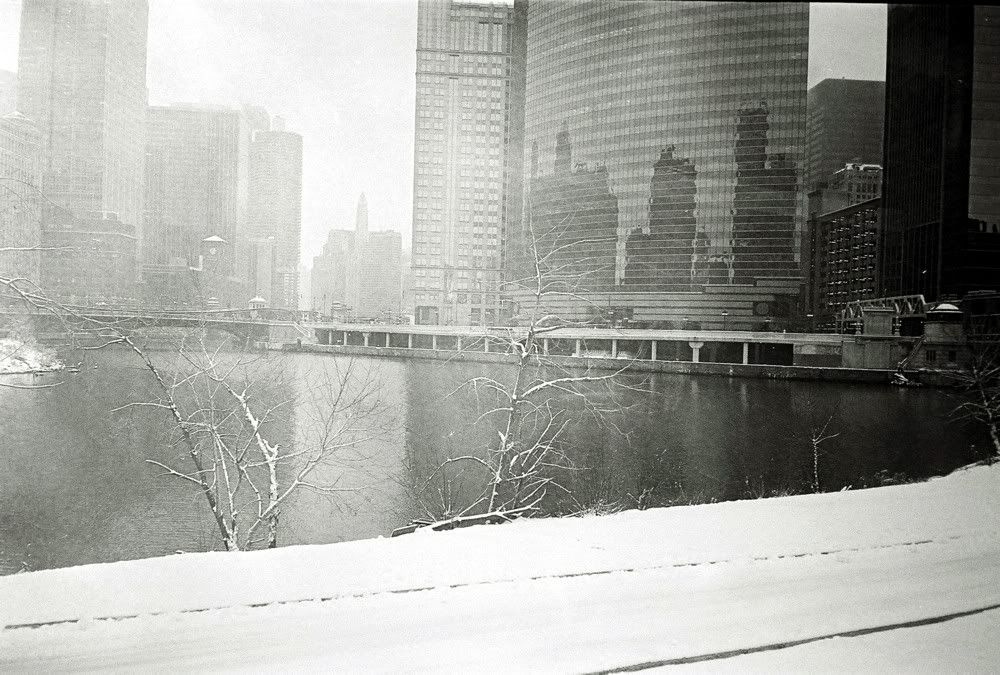
As The Chicago Blizzard Hits, I wonder: Why is there so much attention on Weather, and not so much on Rape-as-Terrorism, Planned Poverty, Genocide, and U.S. corporate flagrant maintenance of Ecocide?

image of Chicago in winter is from here
I live where it snows in the winter-time. It snows a lot. It snows regularly. Some of those are big storms. We have had a lot of storms in the U.S., and this is probably partly due to corporate pollution, which is also responsible for floods in many places, mud-slides (only possible in places where all the trees have been removed). The devastation of global earthquakes in the last 13 months has been devastating because of Western white greed, stealing the trees from Haiti, for example, to benefit Europe. This is the history and this is the present: white male-dominated and/or white-majority countries lay claim to the resources of other places, as if the rest of the world, and the Earth itself, exists to meet the needs of whites at the expense of everyone and everything else.

When will the early-day programs such as Good Morning White America (a title that comes from the late, great Flo Kennedy), Today in Whiteland, and The CBS White Morning Show, and the all-day networks like CNN (Corporate News Network), MSNBC (Male Supremacist New Broadcasting Company), and FOX (Fucking Outrageous Xenophobia), start reporting on things more dire than a winter weather snow system?

Things like rape-as-terrorism, which is part of men's war against women? Or things like poverty as a planned systematic assault against those who didn't have parents who left them lots of money? Or corporate destruction of the Earth, or U.S. cultural and military imperialism, named as such? Or the Prison Industrial Complex? I'm waiting, but I'm not holding my breath.


Monday, January 31, 2011

Questioning M2F Entitlements that Women Raised as Girls Don't Have: More on Trans Political Agendas, Practices, and the Challenges of Radical Feminism (or Radical Pro-Feminism)

image is from here
NOTE: on 9 Feb. 2011, I changed the title of this post to remove the term "cisgender women" and replace it with "women raised as girls". I did this in response to one of the comments posted below.

In the last few months, I have posted probably two dozen times about issues in trans and radical feminist politics. And, to date, almost no one has been willing to engage with these issues in responsible, respectful ways.

I understand why any of us who are queer/genderqueer/trans/intergender/GNC would want to lay claim to 'being one gender', if that gender is not the one someone was raised as but didn't experience oneself as being, when the defining feature of our outsiderhood is that we've had a mixed gender experience.

I don't understand the politics of fighting for trans-visibility while also demanding to be termed in ways that renounce or refuse to acknowledge being transgender or transsexual as anything other that conservatively assimilationist. I also want to point out that working to be termed "women" or "men", if M2F or F2M erases or invalidates the experiences of women who were girls as a distinct social-political experience, and, for that matter, the experience of men raised as boys. It also makes a very transphobic assumption that most trans people are living lives that are not what is termed "cisgender". Lest we forget, most trans people have bodies that are not surgically altered, that appear gender ambiguous; as the gender they are socially perceived to be; as the gender which has or doesn't have male privileges and entitlements embedded in it.

Someone whose name I don't have permission to use wrote to me recently pointing out a few other issues with the concept of "cisgender". I have slightly modified some of the points raised to me in that email and I thank them for writing.

"Cisgender privilege" is specifically defined in a way that excludes anyone who does not want to transition, or transition completely. If you do not hate the way your primary and secondary genitalia is formed or appears, or if you do not strongly dis-identify with your genitals--enough to get drugs or surgery to change them--then apparently you're cisgendered and carry all the privileges the term is designed to confer. (This is how the term has been described by some trans activists and trans spokespeople.)

So the idea that someone is "privileged" specifically for not wanting to get drugs or surgery on or to reshape their genitalia, when most people can't afford to do so, is oxymoronic.

If you are genderqueer but do not want to alter yourself surgically or with hormones, does that mean:

a. you're comfortable with the way you are perceived?
b. you are judgmental and dismissive of the people who are different than you?

Don't both "a" and "b" both have to be true for cisgender privilege to exist? In my experience, genderqueer people are unlikely to find those both to be true of them as individuals.

While I understand anyone not wanting to so consistently be living along the outer margins of status quo society (often in only some regards), to do so by denying one's acquired, practiced, and structurally well-protected privileges is, to my view, status quo political behaviour that reeks of white and male supremacy. When a few vocal white M2F pseudo-spokespeople for "trans experience" do it, I certainly experience it as male supremacist. As a person in trans/intergender community, does my subjectivity and perspective on this matter as much as the white class-privileged M2F person who claims to not be male supremacist? You'd think, because I am male, that it would.

"You call me what I demand to be called, or else you will be stigmatised and marked as a bigot and hater" is not a politic or a practice that is enforceable or practical for most oppressed people to employ. Why, then, do M2F transsexuals get to employ it as if it is an entitlement and a right? How many women of color, trans or not, get to be termed what they most wish to be called? How many men of color, trans or not, have that luxury?

A queer white, ethnicity-, class-, ability-, and profession-privileged person named Noah has showed up here accusing me--a gay, Jewish, disabled, non-profession-statused, transgender/intergender person, of being "transphobic", as if me advocating a responsible radically pro-feminist trans politic is anti-trans!

A very anti-radical, anti-feminist race-privileged, class-privileged transsexual person named Sara has come here and made individualistic arguments that show no regard or respect for the anti-patriarchal efforts of women to remove all man-infestations of anti-lesbian white male supremacy from the Earth. Sara basically denies there is such a thing as "patriarchy".

A non-transgender person, a Latina woman vlogger who calls herself Divinity, who works in close alliance with a well-known white misogynist/anti-feminist non-trans man/troll has expressed gross disregard and disrespect for the radical feminist of color politic and ethic of naming white male privilege where and when it rears its entitled head.

I have posted thoughtful responses to each of these people. Only Sara has been willing to engage respectfully, if not responsibly. Noah has presented gross condescension as "respectful engagement". Divinity has not engaged with me at all.

I have noted several instances where male supremacist and other oppressor privileges are present in some arguments put forth by a few trans people. What I see online, argued determinedly and systematically by a very few transsexual and transgender people, is not what I see or experience offline.

What trans people I know off-line request is to be respected as people, to be shown basic human regard, to be treated with consideration, to not be assumed to be anti-feminist, and to be termed "transgender", understanding gender to be socially constructed. Their stance with regard to radical feminism--white and of color; lesbian and not--does not resemble or support the views expressed by people like Divinity, Sara, and Noah.

For a few very privileged M2F transsexual people (claiming status as spokespeople for all trans people) to demand use of arguments or terms that obfuscate or evade responsibility and accountability for the political privileges one carries is just plain ol' status quo oppressor behavior. (Including statements like this one: "Any critique of trans experience is regarded as transphobic." This would mean that trans people questioning our own experiences, and interrogating the meanings of our emotions and feelings, is "transphobic", which of course is horseshit. It would also mean that lesbian feminists with totally legitimate political critiques, such as Carolyn Gage's analysis of the life of Tenna Brandon, is transphobic and not useful to our experience and political agendas. I think work such as that must be engaged with. Pun intended.)

I will expect those few transsexual cyber-"activists" who pose as pseudo-spokespeople and non-trans Internet trolls who claim to speak for all trans people, or who claim to "represent", legally and otherwise, ALL trans people, to do one of two things:

1. To disrespectfully and/or unintelligently and/or anti-radically and/or anti-feministly respond to what is in this post because they have the privilege and entitlement to be disrespectful without being accountable.

2. To ignore and disregard anyone with whom they disagree because they have the status and power to not need to engage with people with fewer privileges who are charging the male-privileged pseudo-spokespeople with defending and upholding male supremacy.

For me, queer politicals as it manifests interpersonally and socially fails to even achieve being "progressive" in the ways it supports lack of insight and analysis into what "gender" means and is, politically, in Western or Western-colonised societies. Traversing a hierarchy by changing external gender cues (and I'm understanding this is done for some people to feel less internal disonnance), is to privilege the capacity to do so (a privilege not available to most people) while also acting on the entitlement to deny privileges one either believes they never had (M2F), or to deny the threat to women and girls of privileges and entitlements one moves into (F2M).

Poor people who become rich acquire privileges while also carrying a legacy of having been poor. Rich people who become poor, if raised rich, do not lose their class privileges in so many regards.

Many class-privileged people I know, when in college, claim to be "poor". This term is used so often as to de-politicise the social meaning and global experience of poverty. I've always called out people who do this: not having money readily available isn't "poverty" if one is raised with class-privilege. It is a temporary loss of some of the abilities one has with money in the bank.

While gender privilege acquisition, or loss, is not the same as wealth acquisition or loss, what remains constant-while-not static is the effect of one's upbringing on how one engages with the world.

There is a pretense and claim of "never having been a boy" that a few very vocal, very cyber-dominant F2M pseudo-spokespeople make. This must be called out in all cases: the issue is not whether one "was a boy"; the issue is whether one was raised with male privileges, whether they were consciously and willfully acquired and acted out, or not. As a child who never felt like a boy, who didn't identify with boys, who didn't like or gravitate towards "boy-behavior", and who was bullied and ostracised throughout my social childhood for playing with and befriending girls-as-political peers, for doing "girly" things, for "throwing like a girl", for refusing to play boy team sports, I nonetheless acquired plenty of male privileges and entitlements--far more than any F2M across a similar period of one's life.

The proof (for me) of the unacknowledged male privileges, entitlements, dominance, supremacy, and power is that when this charge is made by a few M2F transsexual people--of never having or not having male privileges and entitlements--it can be dismissed by those few M2F pseudo-spokespeople by consistently calling the exposer of this political truth "grossly insensitive" or "being a bigot". Where else does this happen?

Anyone hear of these terms: "femi-nazi" and "misandrist"?


I personally-politically find the appropriation of the term "feminazi" to be anti-Semitic but it too, as I know you all too well know m Andrea, is another linguistic device loaded with political meaning, used against women who resist and challenge men's domination and rule. I ought not and will not tell you what terms to use to describe yourself online. I'm only noting that I find the term anti-Semitic, particularly when used by non-Jewish people. (And, m Andrea, I don't know whether or not you are Jewish.)

But what I'm addressing also applies to the terms: "femi-fascist", "misandrist", and "misandry". They are over-used enough, deliberately and systematically, in radio and other media, and often online, in certain very privileged circles, so that hopefully a few people who are men or who are defenders of men will also believe the terms refer to something that is socially and structurally existent (even though it isn't). Misogyny is structurally/socially existent. Male supremacy is also. White supremacy and dominance and rule of the wealthy is also.

In conclusion, for this post, I'll note that there are rather glaring political problems with the terminology constructed within some trans circles to marginalise and portray girls who grow up to be women as "oppressors" of trans people, or as having privileges trans people do not. Again, most trans people are not surgically or hormonally transitioning and are in the same perceived category as any woman or girl, or any female person who is genderqueer but not trans. There is also a glaring level of unacknowledged privilege among the few M2F and other transgender and transsexual people who are claiming that girls and women raised as girls have more privileges than they do. Among those privileges is the power to name reality and to socially name, with authority, "who one's oppressor is".

Our collective social justice and political liberation struggles are not served by refusing to own or discuss when and where white and male privileges are present but denied.

I welcome respectful discussion on these and related issues.

Saturday, January 29, 2011

Questioning Science at Questioning Transphobia: an engaging discussion

image is from here

[6 Feb. 2011 NOTE: I misunderstood who the author is of the post linked to below. Apologies both to Lisa and the actual author, Quinnae Moongazer. I've made the corrections in my response as it now appears below.]

At Questioning Transphobia, there is a very thoughtful post which I've responded to. My comment is so damned long, however, that I'm not sure it will even be accepted by the system that accepts comments for submission. (I know some commenters here are very frustrated with Blogger for not being able to easily submit comments, especially lengthy ones. As am I.)

Below is a link to that post. I recommend reading it and the twenty or so comments following it. You may get there by clicking on the title of the post just below. As I don't copy and paste it here, all that follows is the link to it and my response. I have typo corrected and otherwise revised my response since submitting it to the discussion at the Questioning Transphobia blog.

Raiders of the Lost Etiology


Hi Quinnae. Thanks for this post! I have responses to you and a few commenters above as well. This make be a multi-post comment.

I'll first out myself as white, class-privileged, gay, male, Western, Jewish, intergender, and disabled. I'll also state general agreement and support for your post, an the comment of GallingGalla.

Some of what I am reading above is deeply troubling to me, however. I find it problematic, racist, and overly steeped in unquestioned Western argumentation.

I'll begin with this passage from Em:
I do believe however that there is a blindingly obvious form of absolute biological proof of trans people though – and that is the existence of trans people, all over the world, and in all different cultures, with all different tones of skin colour, socioeconomic brackets, religions and speaking all sorts of different languages (these things have all been proposed by people opposed to biological proof of gay, ADHD, Dyslexia, trans, etc.)

As Quinnae notes above, there are plenty of scientists always at the ready to naturalise, biologise, or "evolutionise" things like global warming, white supremacy, male supremacy, and heterosexism, and the existence of "gender". Trans experience isn't global, Em. It doesn't show up in all societies. To say this is to be grossly racist, to me.

Male supremacy is global while not universal, as is white supremacist racism, as are the environmental and economic effects of corporate capitalism. This observation ought not be made into an argument that such phenomena are natural, biological, or inevitable, imo.

To make this claim--that being trans is biological-not-social--is to practice a kind of Anglo-English-Western imperialism of language overlaid onto other cultures--typical of Westerners and whites, in my experience. We view "gender"--our contemporary very historically, culturally, and regionally specific forms of it--as "universal" because we only see what we want to see.

Many cisgender people do this and now some transgender people do this, and in neither case is it unoppressive or respectful of the incredible diversity of Indigenous (and non-Indigenous) social experience, worldview, and values.

Two-Spirited being is not, as I understand it from Two-Spirit people, reducible or appropriately translated to being  "trans"; not is it ("it" being "not one thing") an expression of "genderedness" alone; nor is it a form of "bisexuality".

That Two-Spirited Being is considered by non-Indigenous peoples and specifically Western whites to be all of those, or some of those, only means white Westerners cannot conceive of gender and sex in ways that we don't regard as existent.

Being Two-Spirited and the ways that "Gender" and "Sexuality" express themselves--as whites define and defend those terms, as well as Two-Spirited reasons for being, are quite diverse, not universal, and don't break down into being "cis" and "trans", "het" and "not het", or "man" and "woman". The whole worldview into which Two-Spirited being exists is outside the dominant paradigms of white het male supremacist civilisation.

Some cultures and societies--and whole vast civilisations that still exist and have been around for tens of thousands of years--haven't had or don't have any understanding of "gender" the way English-speaking Westerners do. Even in Sweden, "Gender" is generally an academic concept more than a social reality. So being "transgender" as opposed to "transsexual"--a distinction made in our community, is not even possible in many parts of the world.

As many trans people have expressed to me and elsewhere: "I don't know what I would be or what I'd consider myself to be if I didn't grow up where and when I did. I don't know how I'd understand my feelings and experiences, or what conclusions I'd come to about their cause and remedy."

Being "trans" is a culturally relative experience, which in no way makes it illegitimate or deserving of hatred, discrimination, or violence. It is as legitimate as being Black. And being "Black" is not a biological condition. It is a cultural and political one.

Using "biology" as a means of achieving "realness" is, as Quinnae says, typically eugenic approach to solidifying identity and appeasing anxieties. As a Jew, who has noted our passing through another International [Nazi] Holocaust Remembrance Day, I strongly oppose all attempts to "legitimise" ourselves using the Western scientific method.

And as someone who is pro-Indigenist and anti-racist, I morally object to irresponsibly or sloppily applying our terms onto other people and societies we know little to nothing about.

Does this seem to be a reasonable objection and political position, Em?

Proving through science that ADHD and depression is "real"--as in measurable through blood tests and brain scans and treatable by psychopharmacology; or that autism is "diagnosable" early in life; or that "sexual orientation" can be detected in utero, fails (miserably and dangerously) to produce any explanations for the values embedded in the Western scientific project, which, from the start and through to this day are gynocidal and genocidal. Any "orientation" is, it seems to me, necessarily social, relative, and anti-biological, as that term "biological" is tossed about. This applies to sex, gender, ethnicity, culture, class, and race. Cardiovascular disease, many cancers, and diabetes are "real" and are medically diagnosable. They are also, very clearly, consequences and conditions of living in dominant Western civilisation or other societies profoundly effected by it. We can trace the emergence of these illnesses and diseases to the emergence of the influence of the dominant civilisation that produces them. So, in this sense: is diabetes *primarily* a biological condition, or a cultural and social one?

For much more on the unowned and hypocritical racist values in white Western science and philosophy, please read the relevant chapters of Yurugu by Dr. Marimba Ani. See also the collected work of Dr. Vandana Shiva for the dangers of not keeping in check one's own worldviews and assumptions about human and social nature.

Quinnae wrote:
Everyone’s gender is constructed, no one is born a man or a woman.

This statement, when made--word for word--by cisgender radical lesbian feminists, is called "grossly transphobic", "bigoted", and "oppressive". Does that mean it is, intrinsically? I'd say it is a well-reasoned/intuited/felt observation about ourselves in patriarchal society.

Meanwhile, ALL the trans people I know offline make no claims whatsoever about trans experience being asocial or ahistorical. We accept that it is what it is in the era and region it shows up in. Our understandings of it are shaped by our concepts--which are highly relative--by our worldviews, by our assumptions about what 'biology' is, by what 'nature' is, etc.

Keep in mind, Em, that to Western scientists, "chi" energy or life-force is non-existent. It is not scientifically measurable. So, then, does it exist? Even Western medicines like homeopathy have no explanation or "proven validity" in the U.S. medical world. Does that mean homeopathy is ineffective in ending ear infections in infants and young children?

Lisa wrote:
Where are the studies that inquire why cis people are cis?

There are many hundreds of years of very pro-patriarchal Western "scientific" studies and philosophical positions arguing everything from the fact that there is only one sex: male (and that females are 'inverted' males)--see "Making Sex" by Thomas Laqueur. There are thousands of studies demonstrating that there are only two sexes: male and female, with males being naturally dominant and superior and making an argument for surgical interventions against the bodies of intersex babies, children, and adolescents.

Those of us who are intersex question how even terming ourselves "intersex" reinforces the scientific argument for surgical interventions. I fully accept that some of us are intersex. But those of us who are intersex (and intergender, transsexual, and transgender) are named this within a context of a sex-gender hierarchy posing dangerously as an apolitical binary.

How dominant society understands, names, and "treats" intersex people's bodies is profoundly social and political. So it is with transsexual people. And everyone else too.

There are scientists who have been making the case, for a very long time, that men's rape of women is inevitable. Some allegedly moral religious "scholars" and leaders note that manhood and maleness are more divine than womanhood and femaleness.

Most scientific studies try and make a case for white het male supremacy being existent naturally; such studies make claims of being entirely objective and without political bias.

Scientific arguments are put forth that heterosexuality is natural and biological, as well as G-d-approved. They have cropped up especially since various forms of Lesbian and Gay Liberation movements have come on the scene.

Why do we wish to grasp so tightly to The Master's Tools? This is answered, in part, by what aaskew is addressing above.

But clinging to science for personal self-validation, esteem, is accomplished--if in fact it is accomplished--undermines social justice movements for liberation from the tyranny of social hierarchies posing as biological binaries. It is a bit like believing in homo/hetero-sexuality being "natural": we utterly dismiss and invisibilise all of the women who have chosen to be lesbian when we try and make the case for a "gay gene". We do this generally in ways that deny and invisibilise patriarchy as a force constructing and policing our identities.

And, you have to dismiss a whole lot of social/cultural/historical experience to arrive at such a conclusion (that "sex" or "gender" is primarily or only natural).

We reinforce very dangerous premises to feel this temporary peace-of-mind that would best be arrived at on a collective level through other, more political and communal means.

Those tools are harming whole groups of people, even while they may serve the most privileged among the marginalised. Are we to be accountable to those of us who are harmed and destroyed by these "studies" and this "science", or aren't we?

Shall only the most privileged among those of us who are genderqueer get to decide to what extent appropriating the dominant discources and scientific studies is harmful and destructive? Ought not those Two-Spirit and other Indigenous People worldwide get to weigh in? How about poor queer people of color in the Global East and South?

I am concerned that the lens is narrowed down, above, to assume that whites and Westerners know much about anything at all. I think we know very little that is of value, actually. Ours is an anti-sustainable, death-worshipping, rape-glorifying, genocide-celebrating civilisation, after all.

Are our dominant society's tools to be accepted to allow a few of us feel better, when it means the political philosophies and arguments underlying gynocide, genocide, and ecocide must be bolstered? What is the primary moral principle in that strategy for achieving "wholeness"? Whose "wholeness" gets privileged here? The Earth's? Indigenous People's? Cisgender women and girls? Or a few class-, education-, region-, and race-privileged trans people?

I am calling out to the commenters, here and elsewhere across the blogosphere, for a more responsible trans-affirming ethic and political practice.

LBTQI Palestinian Women and Gay Orthodox Jewish Men Speak Out

photo of Palestinian human rights activists is from here

I found this at the website linked to by clicking on the title.

New Book on LBTQI Palestine Women Released

Palestinian Gay Women publishes Waqfet Banat, a collection of personal stories shared by Palestinian Lesbian, Bisexual, Transgender, Queer and Intersex (LBTQI).

WaqfetBanat-2010-09-20-13-58.jpg
Waqfet Banat is a sincere narration of personal stories shared by Palestinian Lesbian, Bisexual, Transgender, Queer and Intersex (LBTQI)women; stories we were often unable to share with those closest to us.  

With this edition, we tell our stories, portraying our struggles; many of which we fought alone, defying all odds, in search of our identity, questioning our sexual orientation, and finally realizing that this is who we are?this is who we really are.

Waqfet Banat is now available for sale in English, in order to purchase a copy please send a $ 25 or 20EUR check (including shipment) to:  Aswat- Palestinian Gay Women. P.O Box 44628, Haifa 31445

What follows is from YouTube: