Thursday, January 27, 2011

The 15th Native American Film + Video Festival: "Qapirangajug: Inuit Knowledge and Climate Change"

From Censored News, *here*. Thank you, Brenda.


New York film fest: Qapirangajug: Inuit Knowledge and Climate Change


Subject: Environmental Focus Opens Native American Film + Video Festival in New York City:
Mar 31-Apr 3, 2011

The New York screening premiere of “Qapirangajuq: Inuit Knowledge and Climate Change” by renowned Nunavut-based director Zacharias Kunuk (“Atanarjuat: The Fast Runner”) and Winnipeg researcher and filmmaker Dr. Ian Mauro (“Seeds of Change”) will open the 15th Native American Film + Video Festival. Produced by the Film and Video Center of the Smithsonian’s National Museum of the American Indian, the festival is held at the New York City branch of the museum from Thursday, Mar. 31 to Sunday, Apr. 3. The festival will include some 100 films and an international symposium about endangered indigenous waterways, “Mother Earth in Crisis,” on Friday, Apr. 1.

All programs are free to the public. Reservations are recommended for evening programs.

Screening on Thursday, Mar. 31, “Inuit Knowledge” teams the filmmakers with Inuit elders and hunters to uncover the social and ecological impacts of a warming Arctic. The film will also be simultaneously stream on the Internet courtesy of Isuma TV, an independent network of Native and Inuit media, at http://www.facebook.com/l/410765-6MnFeUEBI-zMPu9G1Omw;www.isuma.tv. Dr. Mauro will be in attendance for the screening and Zach Kunuk will be available via Skype. Both filmmakers will be available to answer questions from audiences worldwide via Twitter.

The day-long symposium, “Mother Earth in Crisis,” features award-winning films on Native perspectives about the fate of the earth and its rivers throughout the hemisphere. The program includes discussion with the filmmakers following each screening and a panel with environmental and indigenous organizations, moderated by Tonya Gonnella Frichner, of the American Indian Law Alliance. Co-presented with Amazon Watch, International Rivers and Rainforest Foundation.

The festival showcases outstanding feature films, short fictions, documentaries, animations and youth works from throughout the Americas. Screenings take place each evening and on Friday, Saturday and Sunday afternoons. Other featured works include “Kissed by Lightning” by Shelley Niro (Mohawk); a a contemporary story based on a traditional tale; “Y el Rio Sigue Corriendo/And the River Flows On” by Carlos Efraín Pérez Rojas (Mixe), an award-winning film from Mexico about communities threatened by a dam project; and the world premiere of “Apache 8,” a documentary by Sande Zeig, telling the story of the first all-female wildland firefighting crew, comprised entirely of White Mountain Apache women.

The 15th Native American Film + Video Festival is a production of the National Museum of the American Indian’s Film and Video Center. The program is made possible with public funds from the New York State Council on the Arts, a State Agency. Special support has also been provided by the Ford Foundation and the Academy of Motion Picture Arts and Sciences.

The Smithsonian’s National Museum of the American Indian, the George Gustav Heye Center, is located at One Bowling Green in New York City, across from Battery Park. The museum is free and open every day from 10 a.m. to 5 p.m.; Thursdays until 8 p.m. Call (212) 514-3700 for general information and (212) 514-3888 for a recording about the museum’s public programs. By subway, the museum may be reached by the 1 to South Ferry, the 4 or 5 to Bowling Green or the R to Whitehall Street.

LINK:  www.americanindian.si.edu

Monday, January 24, 2011

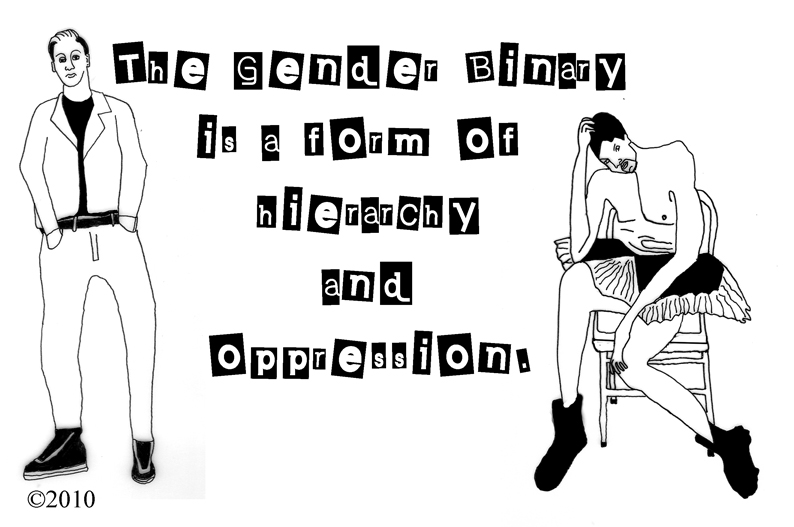
"A Political Hierarchy in Gender Binary Drag", or When is a binary not a binary? When we're talking about a gendered, raced, sexed, classed HIERARCHY

this graphic is from here at veganarchist.com
NOTE: revised and added to on 25 Jan. 2011 ECD. (See the third and fourth paragraph from the end of the post going up, not from the beginning of the post. I write there about gender dysphoria a bit.)

For me, this is THE critical question that is responsible for two distinct realities in the white het male dominated West:

--radical feminism as presented by some cisgender women--including the work of radical white women and radical women of color, and

--cis queer politics including the description of trans identities as presented by some transsexual people, but not by many trans- and inter-gender people.

I have yet to hear what's radical about the contemporary liberal queer/transsexual understanding of gender. Can someone please tell me who benefits from rendering "gender" apolitical? Since when is political oppression only "social options"?

For me, first of all, we have the same phenomenon, albeit from a white class-privileged location socially. I never felt "like a boy" as boys around me most often behaved; I rejected a lot of what 'being a man' had to offer me, while of course soaking up a lot of privileges--they come with the location, I realised, not the identity. Men like John Stoltenberg and Robert Jensen seem to make a case for rejecting manhood on the interpersonal/behavioral level, which I think denies the harshest truth--womanhood and manhood are not embedded primarily in our identities; they are embedded in systems, institutions, structures, locations, positions. None of which go anywhere if we shift our individual identities.

This is my view: racist patriarchy can do very well, thank you, with queer folks in it, with trans folks in it, because it's not the binary it most needs to hold onto; it's male supremacy. And male supremacy thrives in queer/trans community. As does misogyny.

The trick--and I do feel it's a nasty trick--of uber-WHM supremacist academy's post-modernist and post-structural perspectives (we can note the view that there's some sense of getting beyond structural reality in the very term), is that the "problem" is "the gender binary" always worded exactly that way. The irony of post-structuralism being used to maintain oppressive structures seems lost on many in the Academy. PoMo is Mo in PoMo clothing.

"The gender binary". The gender binary? Gender has been many things across cultures, but it being a "binary" isn't really the issue. In patriarchal societies, especially white ones and white-colonised ones, gender is a socially enforced hierarchy--regardless of how many there are. That is the issue. So if we don't deflect from the "hierarchy" by calling it a "binary", we end up having to directly face a very misogynistic system that can find places for male women and female men; for any permutation and combination of femininity and masculinity, as long as feminine always means "less than" masculine, and masculine always means "power over" the feminine.

"Cowboys and Indians" isn't a binary. Nor is Nazi/Jew. Nor is Black/white. Nor, in my view, is man/woman. Those are hierarchies--in the first case a game white children played around me as if it were a binary--that's the trick: to make it appear to be "us vs. them" as if there's some sort of level playing field. As if the Indians could win one day; the cowboys the next. Meanwhile, the actual genocide of American Indians and the existence of cowboy culture across the mid and southwest is what? Not relevant? Not real? Interferes with the fun of the game? This is my issue with queer drag: to turn a condition requiring great violence into a fun time without noting that it is, to the core, violence--directed against women and girls--is to be terribly disrespectful to those who pay the highest price for 'behaving like women'.

When I bring this concern, this critique to pro-feminist queer folks, they say, "we just wanna have fun". That's privilege--to be able to have fun with the reprehensible terroristic destruction of a class of people. Shall we have a game of Nazi-Jew also? How about White Master-Black slave? Oh, wait: we do that too. Those are called "genres" in pornography, which people consume as pleasure.  They are also the role-play games some people act out for fun. To better understand what's oppressive about that, I recommend reading Audre Lorde's contribution to Against Sadomasochism. To reduce a sadist or a slaver to being "just a role I play" is to be utterly insensitive to those who are experiencing denigration, humiliation, and possession by very unfun sadists and slavers.

To turn a hierarchy into a binary is a pretty fiendish thing to do, if one's people are being destroyed by the hierarchy in binary's clothing.

Social hierarchies are political systems of grossly cruel power exercised in every way through every method, to keep women and girls down relative to men and boys; to keep Black and Brown people down; to keep American Indians on the "endangered species list". It'd be like saying "hunter and lion" is a binary. Huh??

The white/het/cis/male supremacist hierarchy will keep trans folks out if they're seen as "a bunch of queers" (whether or not they are) because "queers" are seen as doing one of two things, neither of which is "difference" except in the most liberal sense. Society isn't threatened by difference, exactly, in this view. It is threatened by specific challenges to white supremacy and to het male supremacy--to the institutionalised ideologies and practices of each form of dominance and subordination. South Africa, for example, doesn't have a race binary, exactly. They have more than two categories of raced being. But guess which one is on top? Whiteness.

So it will be with any additional categories in a male supremacist system. It won't matter whether or not there are transmen, as long as cismen--cis HET men--are dominant. This is why, to me, "queer politics" is constructed to be liberal not radical, and largely anti-woman and anti-lesbian. From a dominant cultural standpoint, "lesbianism" rejects male supremacy by rejecting one of its key mandates: that all girls and women be sexually or otherwise physically and intimately involved with boys and men. To not do this is always seen by men-in-power as a big ol' fuck you to men. As if woman-loving couldn't possibly be anything else. It's all about the boyz. All the time. But, nonetheless, "d*kes" are beaten up for not being willing and welcoming of men's sexuality, which is to say men's invasions and violations of women and girls.

Gay males are rejected, ostracised, beaten, and occasionally killed by het men predominantly because, in the words of John Stoltenberg, they are seen to participate in the degraded status of the female. Bottom line: gay males are seen as men who suck dick and are fucked by dick. So whether lesbian or gay, these "orientations" are seen to threaten het male supremacy's codes of conduct: all dicks must be weapons used against women not men; and all women must be available for men's dick-tutorial target practice.

How, then, did we collectively arrive at a theory of "difference" (or of a conception and articulation of gender as a binary) when there's such glaring "dominance" and a well-protected (and generally invisibilised or naturalised) hierarchy? C. A. MacKinnon writes about this in detail--the very serious dangers to women of turning "dominance" into "difference" but specifically in terms of how the law recognises--or doesn't--that women aren't the same as men and also aren't just "different" from men. There are very real, dire consequences for women globally, and for anyone and everything else white het men dominate (including animals and the Earth) if male supremacy isn't even named when we discuss and challenge "gender".

My question, really for all of us who are trans- and inter-gender, is this: "what does it mean, materially, spiritually, socially, to say "we don't feel like [a specific sex]": who told us what "being female" or "being male" is supposed to feel like, be experienced as, or be socially made into? And, to the extent we don't identify with or feel at home in our bodies, can we at least respectfully discuss the many reasons why that occurs without politically privileging those that appear to re-biologise "sex"? How does "I don't feel like a female" compare to "I don't feel like a woman and didn't feel like a girl"? And how does a social program of genderqueer people demanding to be considered "men" and "women" by society and the State interrupt or challenge a "gender binary", anyway? How does sexual trauma in childhood effect our own "at-homeness" in our bodies. I'm not making the case that "everyone who wants to surgically change their bodies from one sex to another" is a survivor of sexual assault.

I'm suggesting that there are many reasons why we don't feel comfortable in our own skin, why we are repulsed by our bodies, why we feel alien inside them, etc. And these many reasons should be discussed online so that someone else who comes along and feels alien inside their skin can have many ways to understand this, and not just have a few people referring them to a doctor who has their own interests to sell a way of understanding "gender dysphoria". Gender dysphoria needs to be unpacked, as well as regarded as real.

Why are so many white class-privileged queer-defined people unwilling to engage on these rather critical subjects while being willing to write about "the gender binary"? More queer lives are impacted by male dominance than by "a binary called sex". Most queer people's and most women's lives are greatly impacted by many forms of male supremacist values and practices than by "the binary problem". Most of our lives, worldwide are shaped horrifically by poverty, rape, trafficking, famine, HIV, corporate/class warfare and globalisation, racism and genocide, nuclear and other toxic/lethal waste, and the social degradation of female human beings globally. These are not "ideas" that must be engaged: they are hard-core realities that must be challenged and ended.

Discussing "the gender binary" is a politically mistaken and socially irresponsible way to refer to "what's wrong with gender", which is that men are killing, maiming, and otherwise harming women and girls. All over the planet. To invisibilise a political hierarchy called "gender" is part of the work of pro-patriarchs, who pretend cisgender women are the most powerful people on Earth. Why are queer folks doing that work for heteropatriarchal cis men? They really do know how to do it by themselves (well, with women raising them, feeding them, tending to them, and otherwise nurturing them throughout their lifetimes). If we're to end male dominance and male violence, wouldn't it make sense for all of us who are not cis het men, and a few who are, to join together in the struggle to challenge and dismantle patriarchal oppression?


Dear Sebastian. A letter of loss and love.

image is from here
Dear Sebastian,

I know this should never see the light of day. It, like much of what should be barely whispered between us, is meant only for the night. This letter, like anything uttered close to the ear, is also only for eyes that see beyond life as it is cast wretchedly into the harsh glare of whiteness.

You are a seeker of night vision. This is what drew me to you, in part. Also your beauty, if I may be so shallow as to say so. But beauty is always more than skin deep. Your skin, pale as melting snow--and nearly as cold, nonetheless pulsed warm blood as red as any other.

Your aesthetics and your values are what set you apart. Also your intellect which cloaked a heart as tender as it was reclusive. Your artistic soul--I'd say 'brilliant' if it weren't so overused to describe white men--combined with your physical beauty made you irresistible to me. Or, rather, made wanting you irresistible. The wanting was the thing I seemed to have fallen in love with, as you left me before I could really know whether or not I was in love with you. You were off in a hurry, a mad flurry of panic, flying into the arms of a woman to whom you will likely tell nothing at all that is barely spoken, broken by volume and torn apart only by the softest touch.

We could not be truly honest face to face--at least not about our deepest feelings for one another. And so we did not touch. For, in touch, all would have been known in a rush of trembling apprehension, a torrent of feeling fused to knowledge neither one of us was willing to bear or birth.

So our love was and remains still born, from womb to tomb with no passage through life. And it lay between us like a lost letter, yellowed envelope, never delivered, but sent with every intention of being received.

Reception requires a lot, I realise now. To attempt, in good faith, to take in the wholeness of a person is to admit another can never be possessed. And so the act of loving is, perpetually, perennially, the act of letting go. You and I spoke to each other all those days most vulnerably in the silences between our words. I read your face like one of your poems, with about as little comprehension. But I knew at least one poem was to me. That gave me reason enough to keep trying to discern meaning. But I tend to want too much from meaning. I want certainty like a rich man wants gold or a stage actor seeks applause: enough is never enough and inevitably the greedy and the desperate are left broke and alone.

To receive you was always to open my hand and welcome your flight. And you've flown. Away. Yet despite knowing you are no personal homing pigeon nor dove of peace you came back, but not to me.

Sebastian, I want you here--my lips murmuring in your ear, our bodies within reach--for a moment or a lifetime I cannot say. I want to touch you to know if our love is real and to see if, against all men's laws of nature, it can be brought presently to life.


Free Workshops on Global Feminist Activism by UK Feminista! Feb. 1 in Bristol, Feb. 2 in Birmingham, Feb. 5 in Leeds. To celebrate the 100th Anniversary of International Women's Day!!!

this photograph was part of the workshop news release below


  UK Feminista
Workshops on Global Feminist Activism Announced
UK Feminista has teamed up with Women for Women International to host a series of free regional workshops on global feminist activism. The workshops will take place in Bristol, Birmingham and Leeds:


Bristol: Tuesday 1 February, 6.30-8.30pm. More details
Birmingham: Wednesday 2 February, 5.30-7.30pm. More details
Leeds: Saturday 5 February, 3-5pm. More details

About the workshops: 8th March 2011 is International Women's Day (IWD) - and 
this year marks the 100th anniversary of IWD. These workshops will explore how women’s rights are progressing globally and how UK activism can further women’s rights around the world. You'll be able to meet activists from your area and discuss  how to make IWD 2011 a truly memorable day. 

You'll also find out at the workshops how to organise a 'Join Women on the Bridge'  
event for IWD. To find out more about Women for Women International's Bridge project visit their website or download a toolkit
 
To book your place at a workshop email Sarah Haynes:  

The workshops are free to attend but advance booking strongly recommended. 

Stay up to date 
with UK Feminista on 
Twitter and Facebook
 Web: www.ukfeminista.org.uk      Email: info@ukfeminista.org.uk

Sunday, January 23, 2011

Calling All Activists--Across Africa, Asia, the Pacific Island nations, the Caribbean, the continents of the Americas, Australia, and Europe: I Welcome You to Share what You're Doing to Challenge and Stop Men's Domination of Women. Here.

image is from here

I am writing to ask women (or anyone else) the world over who are working to end male supremacy, male dominance, and men's abuses of women and girls to promote their activism here, if doing so would be helpful to their efforts.

Please post your actions, report your notices, news, and events, and allow other women to be inspired and encouraged by the work you are doing.

And men who are working with accountability to womanist and feminist activists, please let me know what you're doing.

I'm hoping that seeing what people are doing the world over will serve to support other women whether people in activist groups or people who are working in their own lives to resist patriarchal atrocities and abuses as best they can.

My hope is that the network of women working to end male domination grows, and gets stronger and stronger. And that people in various parts of the world can make lasting connections, build sustainable communities, regain stolen land and resources, grow healthy food, make streets, neighborhoods, and homes safe, and increase the support you have for the difficult and wonderful work you are doing.

You may post comments to this blog or send me an email with any information you'd like me to share here. The address is: aradicalprofeminist@gmail.com

To all women working to resist and transform patriarchal societies into woman-respecting humane ones: Thank you.

Friday, January 21, 2011

Dora Byamukama on The Truth and Consequences of Climate Change in Africa, and what we can do

image of globe featuring Africa front and center is from here
To listen to women of color globally means you get how interconnected the following are: economics, environmental issues, men's violence against women, racism, and heterosexism.


What follows is from New Vision Online, except the small photograph, which is from *here*. Please click on the title below to link back.

Climate change is upon us

By Dora Byamukama


IN the recent past, it was possible to predict with some degree of certainty when the wet and dry seasons were expected. This made it relatively easy for farmers to plan for planting, weeding and harvesting. Currently, the weather is less predictable. All this goes to show that there is climate change.

Changing weather patterns spell doom for humanity because this, among other things, contributes to food insecurity and negatively impacts on economies which heavily rely on agriculture such as most of those on the African continent.

Climate change is defined as a long-term change in the statistical distribution of weather patterns over periods of time that range from decades to millions of years. It may be a change in the average weather conditions or in the distribution of weather events with respect to an average, for example, greater or fewer extreme weather events.

There are various causes of climate change which include greenhouse gas emissions, such as those emitted by the manufacturing and construction sector; generation of electricity and heating and the transport sector. There is burning of fossil fuels such as coal, oil and gas to support the various sectors. This burning of fossil fuels greatly increases the atmospheric concentration of greenhouse gases, trapping more of the sun's energy near the Earth's surface. In response, our planet is warming at an unprecedented rate and ecosystems such as forests and swamps are changing. Forests are steadily disappearing and swamps drying up.

Many nations have adopted policies to reduce greenhouse gas emissions, but a comprehensive and effective international climate treaty remains part of a continuing debate.

Solutions to dealing with the challenge of climate change include activities aimed at mitigation or at adaptation, among others. Mitigation is human intervention to reduce the sources or enhance the sinks of greenhouse gases. Examples include using fossil fuels more efficiently for industrial processes or electricity generation, switching to renewable energy such as solar energy or wind power, improving the insulation of buildings, and expanding forests and other 'sinks' to remove greater amounts of carbon dioxide from the atmosphere.

It should be noted that even the most effective reductions in greenhouse gas emissions would not prevent further climate change impacts thus making the need for adaptation unavoidable. Adaptation is a response to climate change that seeks to reduce the vulnerability of natural and human systems to climate change effects. It is acknowledged that even if greenhouse gas emissions are stabilised relatively soon, climate change and its effects will last many years, and adaptation will be necessary.

Communities I visited, such as those living in the Nandi hills of Kenya and the Mt. Elgon region have undertaken activities that promote environmental protection and improve livelihoods. These include beekeeping in forests; manufacture of bio-gas from cow dung which supplies homes with light and cooking fuel. The same cow dung is used to revitalise soil fertility. Replication and multiplication of such activities at each household level has capacity to gradually positively impact on climate change.

At an individual level, actions that can make a difference to climate change include:

--Changes in the way we produce and use energy as a starting point in trying to reduce emissions. Each individual needs to be frugal and thus deploy energy conservation measures such as use of energy-saving devices such as bulbs and renewable energy such as solar and bio-fuels.

--Promote purchase of energy-efficient appliances and construction of houses that allow maximum use of natural light and better insulation;

--Make it a goal to plant at least five trees near your homestead and two when one is cut. Plant trees specifically for fuel systematically in order to avert depletion of forests. Plant different crops taking into account the changing seasons;

--Promote soil conservation and environmental protection by farming methods such as terracing; growing of organic plants and use organic waste in order to maintain soil fertility;

--Reduce use of private cars in inner cities in order to reduce carbon dioxide emissions from cars. Activities which have multiple benefits such as walking and biking should be encouraged;

--Support industries that adopt mechanisms to mitigate carbon emissions such as planting of trees and proper waste management;

--Prepare for floods and landslides by, for example, setting up dikes or planning for retreat from areas prone to such occurrences;

--Adhere to environmental protection laws and support enforcement of such laws by reporting practices that destroy the environment;

--Support enactment of laws such as that on inheritance of land by women who are the majority of land users and therefore have a stake in its preservation and conservation.

--At every opportunity create awareness about environmental change and action that one can take to avert self-destruction;

We should realise that use fossil fuels such as petrol, paraffin and charcoal create vast quantities of carbon dioxide, which in turn cause global warming and will thus lead to self-destruction.

You and I have a legal and moral duty to act now in order to avert imminent disaster. Plant a tree today for starters.

Anti-Globalisation Film: "The Economics of Happiness", with Dr. Vandana Shiva


  = GENOCIDE, GYNOCIDE, AND ECOCIDE  

If you watch the video below, note who "we" are considered to be. Are "we" Indigenous people who have been battling for economic and environmental self-sufficiency and survival for centuries? Genocide is a known cause of unhappiness. Are "we" women, across region, race, and ethnicity, who have been resisting and fighting to end patriarchal atrocities, known to cause unhappiness? If "we" didn't include Western middle-class white het men and concern for their happiness, would this film have been funded? I wonder. My guess is no.

Since Dr. Vandana Shiva is featured in this film, I'm promoting it.

What follows is cross-posted from the Huffington Post. Please click on the title to link back.

Catherine Ingram

Catherine Ingram

Posted: January 19, 2011 05:39 PM
What An Inconvenient Truth did for understanding climate change, a new film, The Economics of Happiness, is sure to do for understanding localization versus globalization. Even for those who are well versed in the negative effects of globalization, this film will further expose the systemic structures that drive the machine. But the film also offers hope in examples of the ways that localization could save us. I know of no other film that so clearly explains both of these divergent paths into the future.
Interspersed with interviews with some of the leading ecologists and thinkers of our time (Bill McKibben, David Korten, Vandana Shiva, Richard Heinberg, U.K. member of parliament Zac Goldsmith, and many others), the film chronicles a worldwide movement for localization that is underway.
But the first part of the film looks at what economic globalization has wrought. In sometimes heart-breaking imagery, the film exposes many of the effects of globalization; the ways that it destroys livelihoods and foments conflicts; the ways that people are forced off their lands, in many cases having those lands appropriated by governments doing the bidding of corporations. As Vandana Shiva, the renowned ecologist and physicist, says in the film, this process has driven 100,000 Indian farmers to suicide -- and this is just one tragic example of many.
One of the thorniest issues to understand is that of global trade, which is widely assumed to be beneficial, even in the most progressive circles. However, we see in the film the ways in which global trade is destroying the environment as countries routinely import and export massive quantities of identical products. For instance, the U.K. exports as much butter and milk as it imports. The U.S. exports about 900,000 tons of beef and veal and imports roughly the same quantities. All of this wasteful trade massively contributes to CO2 emissions and is only possible because our tax dollars go to trans-national corporations in the form of hidden subsidies.
Globalization also causes feelings of alienation. As we see in the film, young people in the less industrialized parts of the world are made to feel backward and inferior in contrast to the romanticized media images of the West. Even in the West, where marketing now targets children at earlier and earlier ages, the message is, you are not enough. You need the latest fashions, the latest technological devices, the perfect body and face to be someone. These pressures are linked to a worldwide epidemic of depression and psychological disorders.
But The Economics of Happiness, as one would surmise from its title, is not a picture of gloom. The film convincingly depicts the multiple benefits of localization. "It's not only a better way, it is inevitable," says filmmaker Helena Norberg-Hodge.
"As the price of energy escalates and as the global economy becomes even more destabilized, we will have no choice but to turn to each other. If we start now, instead of waiting for further collapse, we will have a better chance of building up more diversified and thriving local economies, and we will be happier for it."

Norberg Hodge and her organization, the International Society for Ecology and Culture, have been promoting localization for over three decades on every continent. These experiences have provided unique insights into the connection between well-being and a more localized life -- a life in which our basic needs are met closer to home.

"Localization is about connection," says Norberg-Hodge. "It is about re-establishing our interdependence with others as well as with the natural world around us. And this connection is fundamental to our very happiness." In the faltering cracks of the global economy, these are the real "green shoots" to be hopeful about.
The Economics of Happiness will be launched in public screenings in the U.S., Europe, and Asia throughout January and February. For more information: www.theeconomicsofhappiness.org
Watch the trailer here: