Wednesday, October 20, 2010

White Men's Profeminist Writing, White Radical Feminist Writing, and The Writing of Radical Feminist Women of Color: Guess Which Writing is Most Important to Read In Order to Know Much about Humanity?

image of bell hooks' book cover with photo of a young bell hooks is from here

bell hooks, Barbara Smith, Chrystos, Audre Lorde, Gloria Anzaldua, Alice Walker, Andrea Smith, Patricia Hill Collins, and many, many other radical women of color and women of color radical feminists have impressed upon me the need to center into one's analysis of oppression and resistance to it, the experiences, voices, and perspectives of women of color: Asian women and women from the Global South; Indigenous, Native, Aboriginal, First Nations, and Fourth World women; Arab, Latina, Brown, and Third World women; African American women, Black women, and women from the African Diaspora; lesbian, Two Spirit, and gender non-conforming women. Consider, please, the words of Barbara Smith here and note how her humanitarian consciousness about "women" cannot and does not remove poor women internationally and regionally from her analysis of oppressive conditions feminism exists to confront and change.


It is with a bit of trepidation that I post what follows below, as it is written by a white man. I don't experience white men, collectively or generally as being intellectually, politically, or spiritually capable of grasping the significance of the problem of marginalising women of color's voices generally, and specifically within what is called "radical feminism". This doesn't even address the problem of white men not being willing to discuss and publicly challenge white men to deal with how white men oppress all women, across sexuality, race, region, class, ethnicity, age, and levels of ability.

For me, "radical feminism" was never "white", but I know for many, many people, it is white or appears white--I know that in many collections of radical feminist or liberal feminist books, writings and analysis, theory and experience, poetry and fiction, essays and speeches by women of color are often reserved and relegated, racistly and grossly, to the "race/racism" section of the book, as if women of color can only speak about race and responding to racism, and as if women of color don't speak generally or specifically for all women. Clearly the problem with such books is that they don't often or usually conceive of "race and racism" as being a matter whites must deal with, contend with, challenge, and confront intrapsychically, interpersonally, and internationally.

From the start of my own feminist education--my education in understanding and challenging normative and unquestioned racist patriarchal modes of operation--I was reading the writings of radical feminist women of color concurrently with the writings of radical feminist white women. In most white writing, always by men and usually by women, I found an ignorance--willful or not--about the reality that whites are a politically created ethnic and social group with specific privileges and entitlements. Whites are not spokespeople for some universal notion of woman or humanity. Too often the whites I read spoke for all women. As if all women experience what white women do. As if white women experience what all women do. Needless to say--or needed to say--this is most certainly not the case. This blog here exists to challenge many things; that idea that whiteness speaks for all of humanity is one ridiculous notion I hope this blog refutes beyond resuscitation or renewal.

The idea of putting white women's (or any men's) voices above women of colors' voices is not ethically or morally or politically or spiritually or intellectually or emotionally reasonable, defensible, or tolerable. That this is systematically done by whites and by men is entirely conceivable to me--I witness it happening all the time on white men's blogs, on men of color's blogs, and, most systematically and egregiously, on white men's blogs.

But this willful or active ignorance is also reprehensible and anti-feminist, to me--it is, in a word, anti-humane. For a discussion on the importance of not centering white voices in any resistance movement, in any anti-oppression movement or effort, see this post at the Crunk Feminist Collective blog. White feminists and feminists of color have often made the point that most women who do "feminist work" don't identify as "feminist" in part because most women around the world don't speak English as a first or second language and also because among English speakers, many women don't learn the term "feminist" or what it means in their own communities. Both my grandmothers didn't know what the term meant or had very limited ideas about it meaning "bra burners" or some other white het male supremacist media-concocted notion.

I am also critical of Academic writing as it exists in my own realms of experience. Not all of it, by any means. But much of it--even most of it. I find it indulges a kind of abstraction, an intellectual pursuit not readily tied to experience, and a kind of elitism in language-use that means most people who are literate will never read it or comprehend it, not because of a lack of intelligence or what is sometimes called "sophistication", but rather because the language itself, from the start, was designed not for human consumption generally and humanely, but for the benefit of a few monetarily and materially. That said, I have written to Rad Geek congratulating him on getting this latest work published. And it ought to be noted that I don't believe all very specific forms of language--such as the language used to describe art, or the language used to describe horticultural processes, are not valuable, or ought not exist. I'm making the point that when language is used in such a way that it is mostly a very privileged and powerful minority (Western Academically educated English-speaking people) who use it, white male supremacy is likely reinforced by its usage and it warrants critique on those grounds, if not also on other grounds. And that said, I have benefited greatly from reading the work of some academics, usually those who are also activists, such as Catharine A. MacKinnon, the white, class-privileged radical feminist. I value her work greatly.

But I'm not sure what I think about this work discussed and presented below by Rad Geek. I've not read it carefully and so don't offer it up as representative, in any way, of my own thinking or values. As alluded to above, or spelled out in no uncertain terms here in the post and elsewhere on this blog, I'm skeptical about using white men's Leftist or Libertarian (or neoLiberal or neoConservative) theories to better illuminate the meaning, function, and practice of radical feminist theories and practice. But as there are so few men who take radical feminist theory seriously--even that of only white radical feminists. Rad Geek is surely among those white men who had read with intellectual and political interest and openness the work of white radical feminists. He's done so for many years. So I wanted to promote his latest work and appearances here. I'm willing to do this partly because I get how some white men will only listen to other white men, no matter the topic--even if the topic is the oppression of women (and by "women" I DON'T mean "white" women only).

What follows is from Rad Geek People's Daily. Please click on the title below to link back to his blog which has more information.

Rad Geek Speaks: “Women and the Invisible Fist,” bringing Molinari to the Marxians, and Libertarian-Left Radical Philosophizing  

(posted 19 October 2010 ∙ 10:35 pm)

I’m pleased to say that my paper Women and the Invisible Fist: How Violence Against Women Enforces the Unwritten Law of Patriarchy[1] has been accepted for a panel at the Ninth Biennial Radical Philosophy Association Conference next month in at the University of Oregon in Eugene.

The RPA, if you’re not familiar with it, publishes Radical Philosophy Review, puts on conferences of its own, and puts on regular panels at the American Philosophical Association Eastern and Pacific Division meetings, on (engaged) radical philosophizing, critical theory, feminism, postcolonialism, academic Marxism, and the like. As RPA would have it, Founded in 1982, RPA members struggle against capitalism, racism, sexism, homophobia, disability discrimination, environmental ruin, and all other forms of domination. We also oppose substituting new forms of authoritarianism for the ones we are now fighting. … We believe that fundamental change requires broad social upheavals but also opposition to intellectual support for exploitative and dehumanizing social structures. Since this conference’s theme is Violence: Systemic, Symbolic, and Foundational, I figured that the Invisible Fist essay was apropos, and might provide a chance for some interesting Left / Left-Libertarian engagement and dialogue. Since the program committee seems to agree, I will be there representing the Molinari Institute.[2] If you happen to be around southern Cascadia next month, here’s my panel. It’d be great to see you there:
The Ninth Biennial Radical Philosophy Association Conference

Violence: Systemic, Symbolic, and Foundational

November 11th-14th
University of Oregon in Eugene, Oregon
Conference Program available online

V-E: A Culture of Violence Against Women

Friday, November 12th 2010, 3:45–5:15pm
Rouge Room, Erb Memorial Union
University of Oregon, Eugene, OR
Chair: Gertrude Postl, Suffolk County Community College
  • Christa Hodapp, University of Kentucky. Identity Through Destruction
  • Charles Johnson, Molinari Institute. Women and the Invisible Fist
  • Jacob Held, University of Central Arkansas. Revisiting MacKinnon via Rae Langton: Pornography as Illocutionary Disablement and Civil Suits as a Means to Enfranchise the Silent Majority
I can’t speak for the others; but here’s my abstract. (If you’ve read the post with a similar title, you’ll already have a general idea; but there’ve been some changes, and like all academic enterprises, this one needs a tl;dr summary.)
When feminist theorists challenge the common dichotomies of pervasive private crimes from public policy, and of personal problems from political struggles against oppression, antifeminist critics often treat the challenge to this distinction as if it were a simple replacement of the private with a conventional understanding of the political – treating feminist analyses of patriarchy as little different from the use of conspiracy theories to explain the prevalence of male violence. I argue that, contrary to these canonical misunderstandings, the central insights of feminist analysis of patriarchal violence may be articulated with help from a surprising source – the work of radical libertarian social theorists, in particular the Austrian free-market economist Friedrich Hayek. Using philosophical analysis and critique to charitably reconstruct Susan Brownmiller’s “Myrmidon theory” of stranger-rape, as presented in Against Our Will, in light of Hayek’s conception of social order as importantly structured by emergent “spontaneous orders” which are “results of human activity but not of human design,” I argue that the dialogue provides critical terms to articulate the radical feminist critique of rape culture, while also claiming and importantly enriching the concept of “spontaneous order” as a tool for radical social critique. When this analytic reconstruction is supplemented with a discussion of recent empirical data on the pervasiveness of rape, drawn from social-science and public health literature on male violence against women, it reveals a distinctive picture that should be of prime importance both to radical feminists and to serious libertarians: a pervasive, diffuse threat of violence that constrains the liberty of women in everyday life to move and act and live as they want, but which, unlike the kinds of State violence which male radicals are accustomed to discussing — modes of domination handed down according to explicit State policies, ratified through political processes, promulgated from the top down and consciously carried out by officially appointed or deputized agents of the State — expresses itself instead in attitudes, behaviors, and coercive restrictions that are largely produced by bottom-up, decentralized forms of violence without conscious collaboration or conspiracy, sometimes in conflict with the explicit provisions of the law, in which women are battered into the social position they currently occupy as if by an invisible fist. I conclude that this unexpected convergence of Brownmiller and Hayek provides (1) a mutually illuminating dialogue on methodology in radical social theory and analytical understandings of structural violence, (2) a surprising synthesis of radical critiques of the construction of identity with radical critiques of domination through the state, and (3) an opportunity to ramify and radicalize understanding of both the feminist insight that “the personal is political,” and the Hayekian insight that society is structured by emergent orders that are “results of human activity but not of human design.”

Monday, October 18, 2010

Larry King Live Tonight: Sexual Trafficking of Women and Girls Globally by Men who are Pimps and Slavers

Head's up:
From CNN.com:
October 18, 2010

Tonight on Larry King!

Posted: 06:28 PM ET
 
Human Trafficking in America Exposed! 

Women and children bought and sold as
slaves right here in our own backyard!
Dan Rather will tell us which city is “Pornland”.
A former sex slave reveals her shocking story.
And Julia Ormond and Mira Sorvino tell
us what’s being done to stop the
imprisonment of garment workers and others.
Would you be surprised to find out that
human trafficking is prevalent in the textile and
agriculture sectors and NOT just the sex industry?

Filed under: Larry King Live

Olive Lembe Kabila Leads Protest March Against Sexual Violence in DR Congo

From Aljazeera.net. Please click on the title to link back. With gratitude and appreciation for all the women protesting against atrocities against women perpetrated by men.

DR Congo women march against rape

Olive Lembe Kabila, wife of Joseph Kabila, president of the Congo, led protest against sexual violence in eastern city.

Last Modified: 17 Oct 2010 19:25 GMT


 The UN estimates that 15,000 women were raped in eastern Democratic Republic of Congo last year [AFP] 

Thousands of women have marched against sexual violence in eastern Democratic Republic of Congo (DRC), where the miseries of war have been compounded by mass rapes.

About 1,700 women who had attended a week-long forum on peace and development in Bukavu, the capital of South Kivu province, joined in the march on Sunday, which was led by Olive Lembe Kabila, the wife of the president, Joseph Kabila.

The atmosphere of the march was colourful and peaceful, and many demonstrators carried banners with slogans such as "No to sexual terrorism".

"Coming here is important because violence towards women is used systematically as a weapon of war," Miriam Nobre, an organiser of the march with the World March of Women, said.

The UN estimates that 15,000 women were raped in eastern DR Congo last year. Numerous Congolese and overseas rebel groups are active in the region, while government forces are also accused of mistreating civilians.

'Regaining dignity'

"We have fought this for years, and now it seems that the international community is genuinely interested in our problems," Nene Rukunghu, a doctor at a hospital in Bukavu where rape victims are treated, said.

"We must fight against impunity, so that the perpetrators of violence are punished, to allow women can regain their dignity. Despite what they endure, Congolese women are strong and able to stand up again," she said.

According to the UN Population Fund, there were 17,507 sexual violence attacks throughout Congo in 2009 - including more than 9,000 in North and South Kivu, which have been at the centre of the conflict in the east.

The scale of rapes and sexual violence has not diminished much this year, according to the fund, known as UNFPA, which collects data in Congo.

It said there were 7,685 attacks in Congo between January and June, including more than 4,500 in the two Kivu provinces.

Abubakar Dungus, a UNFPA spokesman, said 5,427 of the sexual attacks this year - about 70 per cent - were perpetrated "by men in uniform''. It was unclear if he was referring to soldiers or rebels.

The U.S. GOP and The Genocide of American Indians: The Links are Here

image is from here
An excerpt from what follows:
The U.S. government dehumanized the Plains Indians, describing them as “wild beasts,” in order to justify slaughtering them, just as Sherman and his wife, among many others, dehumanized Southerners during and after the War Between the States.

The same dehumanization by the government’s propaganda machine would eventually target Filipinos, who were killed by the hundreds of thousands at the hands of the U.S. Army during their 1899–1902 revolt against the U.S. conquest of their country barely a decade after the Indian Wars had finally ended.

President Theodore Roosevelt “justified” the slaughter of hundreds of thousands of Filipinos by calling them “savages, half-breeds, a wild and ignorant people.” [See Jim Powell’s Bully Boy: The Truth about Theodore Roosevelt’s Legacy.]

Dehumanization of certain groups of “resisters” at the hands of the state’s propaganda apparatus is a prerequisite for the culture of war and violence that has long been the main preoccupation of the U.S. state.

It was not necessary to kill tens of thousands of Indians and imprison thousands more in concentration camps (“reservations”) for generations in order to build a transcontinental railroad. Nor were the wars on the Plains Indians a matter of “the white population’s” waging a war of extermination.

This war stemmed from the policy of the relatively small group of white men who ran the Republican Party (with assistance from some Democrats), which effectively monopolized national politics for most of that time.

These men utilized the state’s latest technologies of mass killing developed during the Civil War and its mercenary soldiers (including the former slaves known as “buffalo soldiers”) to wage their war because they were in a hurry to shovel subsidies to the railroad corporations and other related business enterprises.

From AlterNet. You may click on the title to link back.

Exposing the GOP's Shameful Historical Role in the Native American Genocide

How the Native American extermination campaigns merged the dangerous forces of a standing army with the business/political interests of the Republican Party.

October 11, 2010 |

Editor's Note: The genocide against Native Americans remains one of the most shameful chapters of U.S. history (and indeed one that continued through Ronald Reagan’s presidency with U.S.-backed slaughters in Central America).

However, from the Civil War through the end of the 19th Century, the extermination campaigns also merged the dangerous forces of a standing army with the business/political interests of the Republican Party, as the Independent Institute’s Thomas J. DiLorenzo writes in the following excerpted guest essay:

The real culture of violence in the American West of the latter half of the 19th Century sprang from the U.S. government’s policies toward the Plains Indians. It is untrue that white European settlers were always at war with Indians, as popular folklore contends.

Trade and cooperation with the Indians were much more common than conflict and violence through the first half of the 19th Century.

Terry Anderson and Fred McChesney relate how Thomas Jefferson found that during his time negotiation was the Europeans’ predominant means of acquiring land from Indians. By the 20th Century, some $800 million had been paid for Indian lands.

These authors also argue that various factors can alter the incentives for trade, as opposed to waging a war of conquest as a means of acquiring land. One of the most important factors is the existence of a standing army, as opposed to militias, which were used in the American West prior to the War Between the States.

A standing army, according to Anderson and McChesney, “creates a class of professional soldiers whose personal welfare increases with warfare, even if fighting is a negative-sum act for the population as a whole.”

The change from militia to a standing army took place in the American West immediately upon the conclusion of the War Between the States. The result, write Anderson and McChesney, was that white settlers and railroad corporations were able to socialize the costs of stealing Indian lands by using violence supplied by the U.S. Army.

On their own, they were much more likely to negotiate peacefully. Thus, “raid” replaced “trade” in white–Indian relations. Congress even voted in 1871 not to ratify any more Indian treaties, effectively announcing that it no longer sought peaceful relations with the Plains Indians.

Anderson and McChesney do not consider why a standing army replaced militias in 1865, but the reason is not difficult to discern. One has only to read the official pronouncements of the soldiers and political figures who launched a campaign of extermination against the Plains Indians.

On June 27, 1865, General William Tecumseh Sherman was given command of the Military District of the Missouri, which was one of the five military divisions into which the U.S. government had divided the country.

Sherman received this command for the purpose of commencing the 25-year war against the Plains Indians, primarily as a form of veiled subsidy to the government-subsidized railroad corporations and other politically connected corporations involved in building the transcontinental railroads.

These corporations were the financial backbone of the Republican Party. Indeed, in June 1861, Abraham Lincoln, former legal counsel of the Illinois Central Railroad, called a special emergency session of Congress not to deal with the two-month-old Civil War, but to commence work on the Pacific Railway Act.

Subsidizing the transcontinental railroads was a primary (if not the primary) objective of the new Republican Party.

As Dee Brown writes in Hear That Lonesome Whistle Blow, a history of the building of the transcontinental railroads, Lincoln’s 1862 Pacific Railway Act “assured the fortunes of a dynasty of American families . . . the Brewsters, Bushnells, Olcotts, Harkers, Harrisons, Trowbridges, Lanworthys, Reids, Ogdens, Bradfords, Noyeses, Brooks, Cornells, and dozens of others,” all of whom were tied to the Republican Party.

The federal railroad subsidies enriched many Republican members of Congress. Congressman Thaddeus Stevens of Pennsylvania “received a block of [Union Pacific] stock in exchange for his vote” on the Pacific Railroad bill, writes Brown.

Republican Congressman Oakes Ames of Massachusetts was a shovel manufacturer who became “a loyal ally” of the legislation after he was promised shovel contracts. A great many shovels must have been required to dig railroad beds from Iowa to California.

Sherman wrote in his memoirs that as soon as the war ended, “My thoughts and feelings at once reverted to the construction of the great Pacific Railway. … I put myself in communication with the parties engaged in the work, visiting them in person, and assured them that I would afford them all possible assistance and encouragement.”

“We are not going to let a few thieving, ragged Indians check and stop the progress [of the railroads],” Sherman wrote to Ulysses S. Grant in 1867. [See Michael Fellman’s Citizen Sherman: A Life of William Tecumseh Sherman.]

The chief engineer of the government-subsidized transcontinental railroads was Grenville Dodge, another of Lincoln’s generals during the war with whom Sherman worked closely afterward.

As Murray Rothbard points out, Dodge “helped swing the Iowa delegation to Lincoln” at the 1860 Republican National Convention, and “[i]n return, early in the Civil War, Lincoln appointed Dodge to army general. Dodge’s task was to clear the Indians from the designated path of the country’s first heavily subsidized federally chartered trans-continental railroad, the Union Pacific.”

In this way, Rothbard concludes, “conscripted Union troops and hapless taxpayers were coerced into socializing the costs of constructing and operating the Union Pacific.”

Immediately after the war, Dodge proposed enslaving the Plains Indians and forcing them “to do the grading” on the railroad beds, “with the Army furnishing a guard to make the Indians work, and keep them from running away.”

Union army veterans were to be the “overseers” of this new class of slaves. Dodge’s proposal was rejected; the U.S. government decided instead to try to kill as many Indians as possible.

In his memoirs, Sherman has high praise for Thomas Clark Durant, the vice president of the Union Pacific Railroad, as “a person of ardent nature, of great ability and energy, enthusiastic in his undertaking.” Durant was also the chief instigator of the infamous Credit Mobilier scandal, one of the most shocking examples of political corruption in U.S. history.

Sherman himself had invested in railroads before the war, and he was a consummate political insider, along with Durant, Dodge, and his brother, Senator John Sherman.

President Grant made his old friend Sherman the army’s commanding general, and another Civil War luminary, General Phillip Sheridan, assumed command on the ground in the West.

“Thus the great triumvirate of the Union Civil War effort,” writes Sherman biographer Michael Fellman, “formulated and enacted military Indian policy until reaching, by the 1880s, what Sherman sometimes referred to as ‘the final solution of the Indian problem.’”

What Sherman called the “final solution of the Indian problem” involved “killing hostile Indians and segregating their pauperized survivors in remote places.”

“These men,” writes Fellman, “applied their shared ruthlessness, born of their Civil War experiences, against a people all three [men] despised. … Sherman’s overall policy was never accommodation and compromise, but vigorous war against the Indians,” whom he regarded as “a less-than-human and savage race.”

All of the other generals who took part in the Indian Wars were “like Sherman [and Sheridan], Civil War luminaries,” writes Sherman biographer John Marszalek. “Their names were familiar from Civil War battles: John Pope, O. O. Howard, Nelson A. Miles, Alfred H. Terry, E. O. C. Ord, C. C. Augur . . . Edward Canby . . . George Armstrong Custer and Benjamin Garrison.” General Winfield Scott Hancock also belongs on this list.

Sherman and Sheridan’s biographers frequently point out that these men apparently viewed the Indian Wars as a continuation of the job they had performed during the Civil War.

“Sherman viewed Indians as he viewed recalcitrant Southerners during the war and newly freed people after: resisters to the legitimate forces of an ordered society,” according to Marszalek. “During the Civil War, Sherman and Sheridan had practiced a total war of destruction of property. … Now the army, in its Indian warfare, often wiped out entire villages.”

Fellman writes that Sherman charged Sheridan “to act with all the vigor he had shown in the Shenandoah Valley during the final months of the Civil War.” Sheridan’s troops had burned and plundered the Shenandoah Valley after the Confederate army had evacuated the area and only women, children, and elderly men remained there.

Even Prussian army officers are said to have been shocked when after the war Sheridan boasted to them of his exploits in the Shenandoah Valley.

“[Sherman] insisted that the only answer to the Indian problem was all-out war — of the kind he had utilized against the Confederacy,” writes Marszalek. “Since the inferior Indians refused to step aside so superior American culture could create success and progress, they had to be driven out of the way as the Confederates had been driven back into the Union.”

Sherman’s compulsion for the “extermination” of anyone opposed to turning the U.S. state into an empire expressed the same reasoning he had expressed earlier with regard to his role in the War Between the States.

In a letter to his wife early in the war, he declared that his ultimate purpose was “extermination, not of soldiers alone, that is the least part of the trouble, but the people.”

Mrs. Sherman responded by expressing her similar wish that the conflict would be a “war of extermination, and that all [Southerners] would be driven like the swine into the sea. May we carry fire and sword into their states till not one habitation is left standing.” [See John Bennett Walters’s Merchant of Terror: General Sherman and Total War.]

Sherman did his best to take his wife’s advice, especially during his famous “march to the sea.” It is little wonder that Indian Wars historian S. L. A. Marshall observes, “[M]ost of the Plains Indian bands were in sympathy with the Southern cause” during the war.

One theme among all of these Union Civil War veterans is that they considered Indians to be subhuman and racially inferior to whites and therefore deserving of extermination if they could not be “controlled” by the white population.

Sherman himself thought of the former slaves in exactly the same way. “The Indians give a fair illustration of the fate of the negroes if they are released from the control of the whites,” he once said. He believed that intermarriage of whites and Indians would be disastrous, as he claimed it was in New Mexico, where “the blending of races had produced general equality, which led inevitably to Mexican anarchy.” [See Lee B. Kennett’s Sherman: A Soldier’s Life.]

Sherman’s goal was to eliminate the possibility that such racial amalgamation might occur elsewhere in the United States, by undertaking to effect what Michael Fellman called a “racial cleansing of the land,” beginning with extermination of the Indians.

Sherman, Sheridan, and the other top military commanders were not shy about announcing that their objective was extermination, a term that Sherman used literally on a number of occasions, as he had in reference to Southerners only a few years earlier. He and Sheridan are forever associated with the slogan “the only good Indian is a dead Indian.”

Sherman announced his objective as being “to prosecute the war with vindictive earnestness . . . till [the Indians] are obliterated or beg for mercy.” According to Fellman, Sherman gave “Sheridan prior authorization to slaughter as many women and children as well as men Sheridan or his subordinates felt was necessary when they attacked Indian villages.”

In case the media back East got wind of such atrocities, Sherman promised Sheridan that he would run interference against any complaints: “I will back you with my whole authority, and stand between you and any efforts that may be attempted in your rear to restrain your purpose or check your troops.” [Fellman’s Citizen Sherman]

Sherman and Sheridan’s troops conducted more than one thousand attacks on Indian villages, mostly in the winter months, when families were together. The U.S. army’s actions matched its leaders’ rhetoric of extermination.

As mentioned earlier, Sherman gave orders to kill everyone and everything, including dogs, and to burn everything that would burn so as to increase the likelihood that any survivors would starve or freeze to death.

The soldiers also waged a war of extermination on the buffalo, which was the Indians’ chief source of food, winter clothing, and other goods (the Indians even made fish hooks out of dried buffalo bones and bow strings out of sinews).

The escalation of violence against the Plains Indians actually began in earnest during the War Between the States. Sherman and Sheridan’s Indian policy was a continuation and escalation of a policy that General Grenville Dodge, among others, had already commenced.

In 1851, the Santee Sioux Indians in Minnesota sold 24 million acres of land to the U.S. government for $1,410,000 in a typical “trade” (as opposed to raid) scenario. The federal government once again did not keep its side of the bargain, though, reneging on its payment to the Indians. [See David Nichols’s Lincoln and the Indians: Civil War Policy and Politics.]

By 1862, thousands of white settlers were moving onto the Indians’ land, and a crop failure in that year caused the Santee Sioux to become desperate for food. They attempted to take back their land by force with a short “war” in which President Lincoln placed General John Pope in charge.

Pope announced, “It is my purpose to utterly exterminate the Sioux. . . . They are to be treated as maniacs or wild beasts, and by no means as people with whom treaties or compromises can be made.”

At the end of the month-long conflict, hundreds of Indians who had been taken prisoner were subjected to military “trials” lasting about ten minutes each, according to David Nichols. Most of the adult male prisoners were found guilty and sentenced to death — not based on evidence of the commission of a crime, but on their mere presence at the end of the fighting.

Minnesota authorities wanted to execute all 303 who were convicted, but the Lincoln administration feared that the European powers would not view such an act favorably and did not want to give them an excuse to assist the Confederacy in any way. Therefore, “only” 38 of the Indians were hanged, making this travesty of justice still the largest mass execution in U.S. history.

To appease the Minnesotans who wanted to execute all 303, Lincoln promised them $2 million and pledged that the U.S. Army would remove all Indians from the state at some future date.

One of the most famous incidents of Indian extermination, known as the Sand Creek Massacre, took place on Nov. 29, 1864. There was a Cheyenne and Arapaho village located on Sand Creek in southeastern Colorado.

These Indians had been assured by the U.S. government that they would be safe in Colorado. The government instructed them to fly a U.S. flag over their village, which they did, to assure their safety.

However, another Civil War “luminary,” Colonel John Chivington, had other plans for them as he raided the village with 750 heavily armed soldiers. One account of what happened appears in the book Crimsoned Prairie: The Indian Wars (1972) by the renowned military historian S. L. A. Marshall, who held the title of chief historian of the European Theater in World War II and authored thirty books on American military history.

Chivington’s orders were: “I want you to kill and scalp all, big and little; nits make lice.” Then, despite the display of the U.S. flag and white surrender flags by these peaceful Indians, Chivington’s troops “began a full day given over to blood-lust, orgiastic mutilation, rapine, and destruction — with Chivington . . . looking on and approving,” according to Marshall, who writes that the most reliable estimate of the number of Indians killed is “163, of which 110 were women and children.”

Upon returning to his fort, Chivington “and his raiders demonstrated around Denver, waving their trophies, more than one hundred drying scalps. They were acclaimed as conquering heroes, which was what they had sought mainly.” One Republican Party newspaper announced, “Colorado soldiers have once again covered themselves with glory.”

An even more detailed account of the Sand Creek Massacre, based on U.S. Army records, biographies, and firsthand accounts, appears in Dee Brown’s classic Bury My Heart at Wounded Knee: An Indian History of the American West:

“When the troops came up to [the squaws,] they ran out and showed their persons to let the soldiers know they were squaws and begged for mercy, but the soldiers shot them all. . . . There seemed to be indiscriminate slaughter of men, women and children. . . . The squaws offered no resistance. Every one . . . was scalped.”

The effect of such behavior was to eliminate forever the possibility of peaceful relations with these Indian tribes. They understood that they had become the objects of a campaign of extermination.

As Brown writes, “In a few hours of madness at Sand Creek, Chivington and his soldiers destroyed the lives or the power of every Cheyenne and Arapaho chief who had held out for peace with the white men.” For the next two decades, the Plains Indians would do their best to return the barbarism in kind.

The books by Brown and Marshall show that the kind of barbarism that occurred at Sand Creek, Colorado, was repeated many times during the next two decades. For example, in 1868 General Winfield Scott Hancock ordered Custer to attack a Cheyenne camp with infantry, which Custer did.

The attack led Superintendent of Indian Affairs Thomas Murphy to report to Washington that “General Hancock’s expedition . . . has resulted in no good, but, on the contrary, has been productive of much evil,” according to Brown.

A report of the attack prepared for the U.S. secretary of the interior concluded: “For a mighty nation like us to be carrying on a war with a few straggling nomads, under such circumstances, is a spectacle most humiliating, and injustice unparalleled, a national crime most revolting, that must, sooner or later, bring down upon us or our posterity the judgment of Heaven.”

As the war on the Cheyenne continued, Custer and his troops apparently decided that to “kill or hang all the warriors,” as General Sheridan had ordered, “meant separating them from the old men, women, and children. This work was too slow and dangerous for the cavalrymen; they found it much more efficient and safe to kill indiscriminately. They killed 103 Cheyenne, but only eleven of them were warriors,” Brown writes.

Marshall calls Sheridan’s orders to Custer “the most brutal orders ever published to American troops.” This is a powerful statement coming from a man who wrote 30 books on American military history.

In addition to ordering Custer to shoot or hang all warriors, even those that surrendered, Sheridan commanded him to slaughter all ponies and to burn all tepees and their contents. “Sheridan held with but one solution to the Indian problem — extermination — and Custer was his quite pliable instrument,” writes Marshall.

One of the oddest facts about the Indian Wars is that Custer famously instructed a band to play an Irish jig called “Garry Owens” during the attacks on Indian villages. “This was Custer’s way of gentling war. It made killing more rhythmic,” writes Marshall.

During an attack on a Kiowa village on Sept. 26, 1874, soldiers killed more than one thousand horses and forced 252 Kiowas to surrender. They were thrown into prison cells, where “each day their captors threw chunks of raw meat to them as if they were animals in a cage,” Brown writes.

On numerous occasions, fleeing Indians sought refuge in Canada, where they knew they would be unmolested. Canadians built their own transcontinental railroad in the late nineteenth century, but they did not commence a campaign of extermination against the Indians living in that country as the government did in the United States.

No one denies that the U.S. government killed tens of thousands of Indians, including women and children, during the years from 1862 to 1890. There are various estimates of the number of Indians killed, the highest being that of historian Russell Thornton, who used mostly military records to estimate that about 45,000 Indians, including women and children, were killed during the wars on the Plains Indians.

It is reasonable to assume that thousands more were maimed and disabled for life and received little or no medical assistance. The thousands of soldiers who participated in the Indian Wars lived in a culture of violence and death that was cultivated by the U.S. government for a quarter of a century.

The culture of violence in the American West of the late nineteenth century was created almost entirely by the U.S. government’s military interventions, which were primarily a veiled subsidy to the government-subsidized transcontinental railroad corporations. As scandals go, the war on the Plains Indians makes the Credit Mobilier affair seem inconsequential.

There is such a thing as a culture of war, especially in connection with a war as gruesome and bloody as the war on the Plains Indians.

On this topic, World War II combat veteran Paul Fussell has written: “The culture of war . . . is not like the culture of ordinary peace-time life. It is a culture dominated by fear, blood, and sadism, by irrational actions and preposterous . . . results. It has more relation to science fiction or to absurdist theater than to actual life.”

Such was the “culture” the U.S. Army created throughout much of the American West for the quarter century after the War Between the States. It is the “culture” that all military interventions at all times have created, and it contrasts sharply with the predominantly peaceful culture of the stateless civil society on the American frontier during much of the 19th Century.

It is not true that all whites waged a war of extermination against the Plains Indians. As noted earlier and as noted throughout the literature of the Indian Wars, many whites preferred the continuation of the peaceful trade and relations with Indians that had been the norm during the first half of the 19th Century. (Conflicts sometimes occurred, of course, but “trade” dominated “raid” during that era.)

Canadians built a transcontinental railroad without a Shermanesque campaign of “extermination” against the Indians in Canada. It is telling that the Plains Indians often sought refuge in Canada when the U.S. Army had them on the run.

The U.S. government dehumanized the Plains Indians, describing them as “wild beasts,” in order to justify slaughtering them, just as Sherman and his wife, among many others, dehumanized Southerners during and after the War Between the States.

The same dehumanization by the government’s propaganda machine would eventually target Filipinos, who were killed by the hundreds of thousands at the hands of the U.S. Army during their 1899–1902 revolt against the U.S. conquest of their country barely a decade after the Indian Wars had finally ended.

President Theodore Roosevelt “justified” the slaughter of hundreds of thousands of Filipinos by calling them “savages, half-breeds, a wild and ignorant people.” [See Jim Powell’s Bully Boy: The Truth about Theodore Roosevelt’s Legacy.]

Dehumanization of certain groups of “resisters” at the hands of the state’s propaganda apparatus is a prerequisite for the culture of war and violence that has long been the main preoccupation of the U.S. state.

It was not necessary to kill tens of thousands of Indians and imprison thousands more in concentration camps (“reservations”) for generations in order to build a transcontinental railroad. Nor were the wars on the Plains Indians a matter of “the white population’s” waging a war of extermination.

This war stemmed from the policy of the relatively small group of white men who ran the Republican Party (with assistance from some Democrats), which effectively monopolized national politics for most of that time.

These men utilized the state’s latest technologies of mass killing developed during the Civil War and its mercenary soldiers (including the former slaves known as “buffalo soldiers”) to wage their war because they were in a hurry to shovel subsidies to the railroad corporations and other related business enterprises.

Many of them profited handsomely, as the Credit Mobilier scandal revealed. The railroad corporations were the Microsofts and IBMs of their day, and the doctrines of neomercantilism defined the Republican Party’s reason for existing. [See Thomas DiLorenzo’s Lincoln Unmasked: What You’re Not Supposed to Know about Dishonest Abe.]

The Republican Party was, after all, the “Party of Lincoln,” the great railroad lawyer and a lobbyist for the Illinois Central and other Midwestern railroads during his day.

Thomas J. DiLorenzo is a Research Fellow at The Independent Institute, and Professor of Economics at Loyola College in Maryland.

References

Anderson, Terry, and P. J. Hill. 1979. An American Experiment in Anarcho-capitalism: The Not So Wild, Wild West. Journal of Libertarian Studies 3: 9–29.
Anderson, Terry, and Fred L. McChesney. 1994. Raid or Trade? An Economic Model of Indian-White Relations. Journal of Law and Economics 37: 39–74.
Benson, Bruce. 1998. To Serve and Protect: Privatization and Community in Criminal Justice. New York: New York University Press for The Independent Institute.
Brown, Dee. 1970. Bury My Heart at Wounded Knee: An Indian History of the American West. New York: Holt.
———. 2001. Hear That Lonesome Whistle Blow. New York: Owl Books.
DiLorenzo, Thomas J. 2006. Lincoln Unmasked: What You’re Not Supposed to Know about Dishonest Abe. New York: Crown Forum.
Fellman, Michael. 1995. Citizen Sherman: A Life of William Tecumseh Sherman. Lawrence: University of Kansas Press.
Franz, Joe B. 1969. The Frontier Tradition: An Invitation to Violence. In The History of Violence in America, edited by Hugh D. Graham and Ted R. Gurr, 127–54. New York: New York Times Books.
Fussell, Paul. 1997. The Culture of War. In The Costs of War: America’s Pyrrhic Victories, edited by John Denson, 351–57. New Brunswick, N.J.: Transaction.
Hollon, W. Eugene. 1974. Frontier Violence: Another Look. New York: Oxford University Press.
Kennett, Lee B. 2001. Sherman: A Soldier’s Life. New York: HarperCollins.
Marshall, S. L. A. 1972. Crimsoned Prairie: The Indian Wars. New York: Da Capo Press.
Marszalek, John F. 1993. Sherman: A Soldier’s Passion for Order. New York: Vintage Books.
McGrath, Roger. 1984. Gunfighters, Highwaymen, and Vigilantes: Violence on the Frontier. Berkeley and Los Angeles: University of California Press.
Mises, Ludwig von. 1998. Human Action. Scholar’s Edition. Auburn, Ala.: Ludwig von Mises Institute.
Morris, Roy. 1992. Sheridan: The Life & Wars of General Phil Sheridan. New York: Vintage Books.
Nichols, David A. 1978. Lincoln and the Indians: Civil War Policy and Politics. Columbia: University of Missouri Press.
Powell, Jim. 2006. Bully Boy: The Truth about Theodore Roosevelt’s Legacy. New York: Crown Forum.
Roback, Jennifer. 1992. Exchange, Sovereignty, and Indian-Anglo Relations. In Property Rights and Indian Economies, edited by Terry Anderson, 5–26. Savage, Md.: Roman & Littlefield.
Rothbard, Murray N. 1997. America’s Two Just Wars: 1775 and 1861. In The Costs of War: America’s Pyrrhic Victories, edited by John Denson, 119–33. New Brunswick, N.J.: Transaction.
Sherman, William T. 2005. Memoirs. New York: Barnes & Noble.
Thornton, Russel. 1990. American Indian Holocaust and Survival: A Population History Since 1492. Oklahoma City: University of Oklahoma Press.
Umbeck, John. 1981. Might Makes Rights: A Theory of the Formation and Initial Distribution of Property Rights. Economic Inquiry 19: 38–59.
Walters, John Bennett. 1973. Merchant of Terror: General Sherman and Total War. New York: Bobbs-Merrill.
Thomas J. DiLorenzo is a Research Fellow at The Independent Institute, and Professor of Economics at Loyola College in Maryland.

Saturday, October 16, 2010

A DEFINITION OF RAPE & 10 Questions About Rapists and Truth-telling

image/anti-rape slogan is from here
Revised on 17 Oct. 2010 ECD

1. What percent of men who are rapists admit to those they've violated and abused that they committed rape?

2. What percent of men who are rapists, when appropriately charged with rape, deny the rape charge?

3. What percent of men who are rapists, when accused of rape, claim the accuser is a liar?

4. What percent of married men who are rapists, when they rape their own child, admit to doing so to their spouse?

5. What percent of child molesters confess to the police that they are raping and sexually assaulting children?

6. What percent of men who rape women in systems of prostitution believe they have committed rape?

7. What percent of men who are married to a woman and believe that married men are entitled to sex from their spouses, believe that a husband coercing or forcing his wife to have sex is rapist behavior?

8. What percent of men who publicly accuse women of falsely accusing men of rape have also committed rape against a woman, or a child of any gender, at least once in their lifetime?

9. What percent of men who are falsely accused of rape by someone, have, in fact, raped someone else in their lifetime who never accused them of rape?

10. What percent of men rape over the course of their lifetime?


The definition of a man or male committing rape, here, is this: 
penetrative sexual contact with another person that is unwelcomed, unwanted, or undesired; 
that is forced or coerced in ways that the man knows will enable him to have penetrative sex without her/him giving expressed permission; 
penetrative sex that happens when s/he has never indicated, verbally or not, "yes" to it happening; that is obtained while the raped person is drugged, drunk, or dissociated sufficiently for her/him to not be able to give meaningful consent;  
that occurs while the person penetrated is unconscious or dead; that is accomplished by waiting for the raped person to be drunk enough to be coerced into having sexual intercourse that he knows s/he wouldn't consent to while sober; 
penetrative sex that happens when a man or male assumes he is socially or personally entitled to have sexual intercourse, doesn't obtain explicit permission to do so when he initiates it, and doesn't bother to find out if she welcomes and wants it; 
penetrative sex that happens when a man is economically or socially empowered to obtain sexual intercourse when he wants it and acts out those privileges and that power when s/he doesn't have exactly the same level of social, personal, cognitive, economic, or political power, privilege, and sense of entitlement; 
penetrative sex that happens after s/he has said yes to kissing and fondling, but no to penetrative sex of any kind, and he proceeds to have sexual intercourse with her/him; 
penetrative sex obtained in a context where s/he fears he (or more than one man) may kill or injure her if s/he resists it or protests in any way; 
penetrative sex that happens while or soon after he (or any man present) is holding a knife or gun or other weapon, such as a fist or a threat, that instills fear and/or terror in her/him; 
penetrative sex that occurs while s/he is being beaten up; 
penetrative sex that occurs between a man and a child; penetrative sex that occurs between a free man and a slave and/or anyone being sexually trafficked.

Rape, or abusive penetrative sex is first and foremost defined and determined through description of the experience by the one harmed. Penetrative sex, abusive or not abusive, doesn't necessarily involve a male/man's penis. If it is abusive, it might involve his hands or any other part of his body or any object he uses to invasively breach the trust and the physical boundary of another human being. The invaded person decides what is invasion, not the invader. How the invaded and/or violated and betrayed person feels is one part of what may determine whether rape has occurred. If the person assaulted is so dissociated prior to the assault or during the assault, so as to not feel anything at all, to not be present, then how s/he feels at a later time maybe be necessary information. It may take years to know this. Therefore a male/man who has invaded or violated another human being who doesn't state this happened right way ought not conclude no assault or rape occurred.


If you are a male/man and read that definition and feel like there's no way for you to have sexual intercourse or penetrative sex that isn't rape, and you've had penetrative sex, you ought to assess how many times you've committed rape and report yourself to the police as a sex offender. You also ought to not have sex again until you know how to have sex in a context of mutuality, concern, regard, respect, and overt consent being present.

To those who accuse "radical feminists" (or, in this case here, a radical profeminist) of stating that "all men are rapists", please note that the questions posed her make no such assumption, and, in fact, assume that not all men are rapists. I know not all men are rapists. I don't know what percentage of men commit rape or sexual assault at some point in their lives or many times throughout their lives, but I know, based on every bit of evidence out there that it's not the percentage that anti-feminist/anti-"misandrist"/pro-patriarchal/male supremacist men claim. Across the web at pro-rape websites and rape apologist websites, men claim that only 1% are rapists. I know that most men who rape don't admit to having raped and/or don't consider what they did to be rape. And I know most women and children who have been incest, molested, sexually assaulted, and/or raped, do not report it to any authority figure empowered to take action against the assaulter. When rape-apologist, patriarchy-denying men proclaim that a high number of rape charges by women against men are "false" they ought to factor in two main thing:

--most men who are rapists don't know when they've raped or choose to deny they have raped
--the rapes committed by men against women who subsequently don't speak out about being raped must count as experiences of rape that were not falsely reported--no report means no false report; no pro-rapism activists I know consider unreported rape to exist-as-real-rape or be relevant to any statistics on rape and false or true accusations of it. This is but one self-serving manipulation and denial of truth and reality male supremacists frequently engage in. They don't believe in ending rape as a practice of subordination, violation, and terrorism. They don't believe men are responsible for one another's behavior. They don't believe they do anything at all to promote rape.

In a society where rape is, among other things, a means of abusively dominating and harming individuals who are part of a larger group of oppressed people (women) oppressed by men, to argue individualistic non-responsibility is to render oneself ethically, morally, socially, and politically responsible for perpetuating rape, just as anyone who knows bullying exists and is not bullied and does nothing to stop it is partly responsible for the maintenance of bullying culture.

If you are a man and do not speak out against rape, and do not make sure you know how to prevent yourself from raping someone, you are either passively maintaining and actively perpetuating rape culture, and may also be perpetrating rape.

Please do not assume you or any man is incapable of committing rape, assault, or sexual violation of another person. Believing you and  any other man, or men generally, are "good, decent people" doesn't mean any man or men are not capable of committing sexual assault including rape. I have known very good men who have committed rape. Some of the best (most humane) het men I know, in fact, have committed rape and admit to having done so.

Why Most Rapists Have a Permanent "Get Out of [Going to] Jail Free" Card

image of card from Parker Bros. Monopoly board game is from here; we can note the figure on the card is white, a man, and not poor--his well-tended moustache was a sign of class privilege at the time

The above video is from CBS News and if it is not playing properly above, it may be viewed *here*. Please disregard the stupid commercial before the news segment: it's important to capitalist media but not to those of us who are sexual assault survivors, that we get sold lots of CRAP before we find out any accurate information about rape. Please also note the racism in the report. Note which cities are targeted in the CBS report. What is the race of the raped person? Also ask yourself this question: What race do you associate with each of the cities noted that were investigated, before they get to the part about NYC's practice of testing all rape kits. This is how WHM supremacist media perpetuate racist myths while telling stories that contain accurate information. And the racism is not just in trying to associate men of color with "the rapists", but it is also by associating only white women as the women who are raped. To erase women of color as a population of women raped by het men of all colors is to perpetuate white het male supremacy. To ignore the rape of poor women is, in the U.S., both an act of classism and an act of racism, as the population of poor people in the U.S. are disproportionately poor. That poor women being raped is almost entirely ignored by the media is one way to perpetuate white het male supremacy. To ignore the fact that one in three women (compared to one in four women nationally) are raped, primarily by white men, when the women are American Indian, is also to perpetuate white het male supremacy.

If you only see men of color shown as rapists on television, ask why that is. It's not because men of color rape more than white men do. It is because the media wants you to think men of color, especially Black and Brown men, rape more than white men do. It's also because the racist police are more likely to arrest a Black or Brown man accused of rape than a white man. If you only see white women shown as the population of women who are raped, ask yourself why that is. It's not because only white women are raped.

If you see more news stories on television about the problem of men being falsely accused of rape than you do of men being accurately accused of rape, ask yourself why that is. It's not because most accusations of rape, by a woman against a man, are false. Well over 90% of accusations of rape by women against men are truthful, accurate, and valid. Most men who are rapists will never be [accurately] accused of rape.

If men who are rapists are not described as domestic terrorists by the media, ask yourself why that is. It's not because men who rape in this country aren't domestic terrorists. It's because women being terrorised by men is not considered "terrorism". It's not considered terrorism because men aren't terrorised.

All of this perpetuates white het male supremacy and systemic and systematic rape as a form of social-political control and domination of women by men, by denying various truths about rape in the U.S.

Not Surprising: Men Who Are College Students and Rapists Don't Get Arrested or Even Expelled From School Most of the Time While One in Four Female College Students Will Be Sexually Assaulty By a Male Student/Rapist Before Graduation


image is from here
To hear privileged het men talk, you'd think the social atrocity is het men being falsely accused of rape by a woman or girl. To witness social activity--aka, reality--you realise the atrocity, with regard to rape, is rape: all forms of it, against females of all ages by het males of many ages. To understand how many het male rapists there are registered and actively predatorial and regularly perpetrating rape in colleges across the U.S. is something most het men don't wish to consider, let alone take action against--meaning, to stop rape: to end rape on college campuses and to end rape off college campuses. 

Het men will frequently cry foul when accused of rapes they commit. Few men who rape have the courage or "the balls" to use the lexicon of masculinist men, to admit when they rape a woman and to turn themselves into to appropriate authorities for appropriate consequences. Few of the men who are accurately accused of rape will see a day in jail, let alone many days and nights in jail. 

I wonder what percent of men who are college students (accurately accused of rape by a woman) claim not to be a rapist, to have done nothing wrong, to have committed no crime? What percent of men who are college students and rapers of women students accuse those he rapes of lying if she accuses him of doing what he did? I'd like to know. If anyone knows, please post the answer here. 

Two articles follow. Each may be linked back to their source by clicking on the title.
 
While a man who rapes off-campus could face years in jail for his crime, a man who rapes on-campus is unlikely to even be expelled.

Two Michigan State University basketball players accused of sexually assaulting a young woman in their dorm are off the hook, according to a report released by The Michigan Messenger.
Many elements of the case are typical of campus acquaintance rape scenarios. The accused are college athletes and the assault allegedly occurred after a night of drinking and casual socializing:
The victim told police the players penetrated her in various positions. The victim told detectives the players allegedly asked her ‘how does that feel?’ and ‘how do you want it?’ The victim says she told the players she didn’t want it and gave ‘other indicators she was not a willing participant.’
The victim told police that the players pinned her down, but at one point she freed her arms momentarily and struck one in the face. In response, he allegedly said, “Don’t. Just relax. C’mon baby,” as he continued to assault her.
But what sets this particular case apart from others is that one of the accused players actually corroborates the victim’s statement, admitting to authorities that he knew the young woman was unwilling:
During his interview with detectives, the one player who volunteered a statement corroborated much of the victim’s statement, the report shows. He told investigators that when it was clear from the victim’s statements that she did not want to have sex, he stopped. However, the other player continued ‘despite her reluctance and statements that she did not want to continue.’ The victim confirms that player’s account.
The player told detectives he was concerned “over the girl’s reaction to the circumstances,” noting she was “timid” and “not aggressive.” The player then admitted to detectives that he understood how the woman believed she was not welcome to leave the room, in part because she kept referencing that the two were “bigger” than her.
Given the player’s affirmation of the victim’s statement, the case against the men should have been a “slam dunk.” Accordingly, the MSU Police Department wasted no time sending their report to the prosecutor’s office, with the recommendation that both men be charged with Criminal Sexual Conduct 1, the severest level of sexual assault under Michigan law.

But the assigned prosecutor, Stuart Dunnings, has declined to press charges against the athletes, saying that the prosecutor’s office is not convinced that force or coercion occurred in this case (a judgment directly contradicted by the police report), and that the victim herself chose not to press charges (a claim denied by the victim).

Dunning’s decision, while reprehensible, shouldn’t be surprising. An investigation of sexual assault on campuses conducted last year by The Center for Public Integrity (CPI) found that the number of prosecutions of campus acquaintance rapes is minuscule. When prosecutors turn down these cases, the only available recourse for many victims is to seek justice through their university’s disciplinary system. Unfortunately, most colleges are ill-equipped to investigate and resolve sexual assault cases, and moreover are unwilling to impose harsh sanctions on perpetrators.

A 2002 report [PDF] commissioned by the Department of Justice found a number of inherent problems with university policies and practices regarding sexual assault, including a tendency to “unintentionally condone victim-blaming.” Only 38 percent of schools require sexual assault sensitivity training for campus law enforcement, while only 37 percent fully comply with federal regulations about reporting crimes. The CPI investigation similarly found that even when college administrators deem a student guilty of sexual assault, they are reluctant to expel the perpetrator:
Verdicts are educational, not punitive, opportunities. … Not every sexual offense deserves the harshest penalty, [administrators] argue; not every culpable student is a hardened criminal.
So, while a man who rapes off-campus could face years in jail for his crime, a man who rapes on-campus is unlikely to even be expelled. In too many cases, student rapists face mere suspension or even lighter sanctions. The tendency among administrators to view sexual assaults as “teachable moments” flies in the face of evidence that student rapists are often serial rapists—guilty of victimizing an average of six women during their college career.

The decision to absolve student rapists of their crimes can be costly, as doing so could violate Title IX, the federal civil rights law that bars sex discrimination in publicly funded educational programs. In recent years, the ACLU has won two landmark lawsuits against public universities guilty of letting rapists off the hook. In 2008, Arizona State University paid out $850,000 after it failed to expel an athlete with a history of harassment who later raped a young woman, and in 2007 the University of Colorado paid out $2.5 million after members of its football team sexually assaulted two women.

Whether Michigan State University will take action against the basketball players accused of rape remains to be seen. The prospects don’t look good. While the Office of Postsecondary Education shows that the university reported 32 forcible sex offenses on its campus between 2007 and 2009, it does not show any reports of disciplinary actions associated with those crimes.

Catherine Traywick is an Arizona-based blogger for The Media Consortium.

*          *          *

Rape.
Photo: domesticviolence

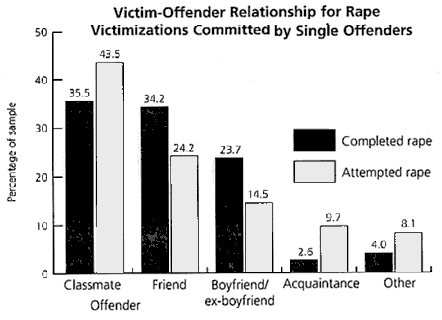
The summer is over. For many female college students it's once again time to hit the books. If your a freshman, it's a brand new life experience. New friends. New romances, and a sense of freedom like no other. It's also a time when we are most vulnerable. How vulnerable? 1 in 4 college females will be raped by the time they walk down the aisle and accept their degree. The statistics are staggering.

A recent study from the Department of Justice estimated that 25 percent of college women will be victims of rape or attempted rape before they graduate within a four-year college period, and that women between the ages of 16 to 24 will experience rape at a rate that's four times higher than the assault rate of all women.

Here's the problem. Many campus assault victims stay quiet or refuse to get help. A lot of times when people think of being raped, they think of someone dressed all in black, lurking in the bushes. This is so very, very far from reality. A rapist can be someone you know. Someone who you are friends with, or even someone you are dating. The bottom line is that when you say...NO.....It means NO.

A wonderful guide that is put out by the Department of Justice is called, Acquaintance Rape of College Students by Rana Sampson. It's a guide that should be read by parents as well as students. Here is the link for the entire booklet: http://www.cops.usdoj.gov/pdf/e03021472.pdf

Rape is a very personal violation. Most women do not want to report it due to all the additional mental anguish it entails. It's also a "he said, she said" assault. They fear that no one will believe them. Well, there is plenty of help out there AND YES THEY WILL BELIEVE YOU. You just have to ask.

The following website, AARDVARK, which stands for An Abuse, Rape and Domestic Violence Aid and Resource Collection, is one of Florida's leading organizations for help in all areas of rape and domestic violence. It has all the information you will need in seeking help by those who know what you are going through. They offer all kinds of resources in your specific town, as well as books and DVD's to help you with this difficult time in your life. Here is their link: http://www.aardvarc.org/dv/states/fldv.shtml