Friday, May 28, 2010

To White Folks: Listen to THESE Delta Blues... from the SW Coast of Nigeria, not the SE Coast of the U.S.: Emem Okon on Chevron's Atrocities

 [photograph of Emem Okon is from here]
I came to tell Chevron that they have oppressed in the Niger Delta region with impunity for the past fifty years, poisoning our waters, devastating our environment, killing the fish we eat, burning poison gas through gas flares in the Niger Delta that has caused cancer, asthma, corroding our roofs. And they have not done anything to alleviate the sufferings of the people as a result of their—as the result of their activities. And what they did on Wednesday was a demonstration of the fact that they are not ready to change their mode of oppression in the Niger Delta region, and they are not ready to recognize and respect the human rights of the people, and they are not ready to change the inhumane way they treat the communities in which they oppress.

I am surprised at the attention that the BP oil spill has attracted in the United States, and I expect that the condition in the Niger Delta should attract the same coverage and that the international community should impress it on Chevron and every other oil community to stop their inhuman activity and abuse of human rights in the Niger Delta region. -- Emem Okon

Obviously, as Emem says, there’s a BP-size disaster every single day in these Chevron-affected communities, and whether that is taking place in Burma or Alaska, Colombia—one of the most amazing things was that as we walked into the meeting, there was a photograph of a basket from the Wayuu community of Colombia that was hanging in Chevron’s headquarters. Well, a representative of the Wayuu community of Colombia, Debra, was left outside, denied her proxy access in to actually address that community, but they hung the basket. -- Antonia Juhasz
It is becoming painfully, disgustingly, horrifically, and blatantly clear that when gross environmental destruction that is also ecocidal impacts white people's lives in the West, it is A BIG IMPORTANT DEAL while when Indigenous women activists speak out about gross environmental destruction, which is also GENOCIDAL (and ecocidal), the white, white West and other major media don't really give shit.

This is my experience generally: the concerns that I hear about over and over from women of color are not "concerns" to whites and men unless they directly impact the lives of whites and men.

So please post news stories about what Indigenous women activists, and other activist women of color are speaking out about.Because, as you'll see, not even Democracy Now gives Indigenous women activists enough time to speak.

From Democracy Now, here:

Chevron Has 5 Activists Arrested and Bars Entry to Global Victims of Its Practices at Annual Shareholders’ Meeting

Chevron has had five protesters arrested at its annual shareholders meeting in Houston and refused to allow another two dozen people from Chevron-affected countries around the world, like Nigeria, Ecuador and Burma. Those denied entry held legal shareholder proxies. The True Cost of Chevron Network says it organized the protest to call attention to Chevron’s human rights and environmental record. We speak to Antonia Juhasz, director of the Chevron Program at Global Exchange, who spent the night in jail after her arrest; and Emem Okon, an activist from Nigeria and the founder and executive director of Kebetkache Women Development and Resource Center in the Niger Delta.

Guests:
Antonia Juhasz, director of Global Exchange’s Chevron Program.
Emem Okon, Nigerian women’s rights advocate and environmentalist. She is the founder and executive director of Kebetkache Women Development and Resource Center in the Niger Delta.

AMY GOODMAN: We turn now to Chevron. Juan?

JUAN GONZALEZ: Yes, to the practices of another oil giant, the Chevron company. On Wednesday, Chevron had five protesters arrested in Houston at its annual shareholders’ meeting and refused to allow another two dozen people from Chevron-affected countries around the world, like Nigeria, Ecuador and Burma. Those denied entry held legal shareholder proxies.

The True Cost of Chevron Network says it organized the protest to call attention to the company’s human rights and environmental record. The five who were arrested are activists from groups like Amazon Watch and the Houston-based environmental group TEJAS. They were all released on Thursday.

AMY GOODMAN: Among those arrested was author Antonia Juhasz, director of the Chevron Program at Global Exchange. She was detained after questioning Chevron’s CEO John Watson during an open comment period for proxy holders. Antonia Juhasz joins us from Houston, as does Emem Okon, an activist from Nigeria and the founder and executive director of Kebetkache Women Development and Resource Center in the Niger Delta.

We welcome you both to Democracy Now! Antonia, let’s begin with you. What happened? What did you ask Chevron’s President, CEO? And how did you end up in jail?

ANTONIA JUHASZ: Chevron truly exposed its great fear at having the true cost of its operations being revealed to its shareholders and the media. It revealed its great fear at the communities who are actually impacted by Chevron being able to tell the truth about its operations. And I think most importantly, it revealed in Houston how it treats those who come to tell the truth about its operations, engage with the company, with a brutal response, a response that stifles the ability of free speech. And that was a very small taste of what’s experienced much more dramatically at Chevron’s hands all around the world.

I actually went in as a shareholder. I spoke during the shareholder response time. And as I was saying to the gathered shareholders that Chevron had denied—after showing a video of its impacts in communities during the shareholder meeting, it refused to then let those actual representatives from those communities, who had literally traveled from Burma, from Australia, from Alaska, from Nigeria, from Ecuador, all over the world, into the meeting. As I was saying, "These are the people who are here to tell you about your corporation and its operations," I was aggressively grabbed by the police, by private security. I was dragged very forcibly—I still have a handprint on my arm from the law enforcement—dragged, prone on my back, out the back, thrown by four police officers it took to get me, lift me into and move me into the van, and arrested. And I was charged with criminal trespass and disrupting a meeting, and I was incarcerated for twenty-four—a twenty-four-hour period.

And all that time, there were—the few representatives who have gotten—got in, from Angola and Kazakhstan and representing the Philippines, were—we took over the meeting and said essentially that Chevron is lying, it is afraid, it is afraid to expose the true cost of operations—of its operations. But I think most importantly, what we demonstrated was that Chevron is afraid of the organizing against it, that when the communities from the location where it operates not only tell the truth about what it does, but link and form a community and a network, that we send an enormous amount of fear and shock through this company, because, believe me, this has never happened in a Chevron meeting before. They have never felt the need to have such aggressive, physical, abusive tactics to arrest activists in the front from Richmond, California, from Houston, Texas, from around the world, and to drag me physically from inside the meeting.

JUAN GONZALEZ: Antonia, according to one report that I read, the company chairman had to actually adjourn the meeting at a certain point, because he wasn’t able to get control of it?

ANTONIA JUHASZ: This was new CEO John Watson’s very first meeting as the CEO of the company, and he absolutely lost control of the meeting. He chose to bring in an enormous, as I said, quantity of security that filled the meeting. And actually, it seemed like they were starting to outnumber the actual attendees. And he chose to have that very aggressive and physical response to me simply highlighting that people like Emem Okon from Nigeria and people from all over the world were being denied access. We then—the shareholders were actually trying to listen to me. We were also chanting. And at one point, the CEO, John Watson, simply threw up his hands and said, "You know, I don’t know what to do. I guess the meeting’s adjourned." And that was the end of the meeting, as we continued to voice our opposition and statements of Chevron’s lies and the true cost of its operations, and essentially broke up and ended the meeting in that way.

AMY GOODMAN: Emem Okon, you came from Nigeria for the Chevron shareholders’ meeting.

EMEM OKON: Yes.

AMY GOODMAN: From the Niger Delta. Why?

EMEM OKON: Yeah, I came from all the way from the Niger Delta region of Nigeria to be at the Chevron shareholders’ meeting. I came to represent the voices of the community women in the Niger Delta region that are suffering the direct impact of Chevron oil and gas activities in the Niger Delta. And what I witnessed on Wednesday during the shareholders’ meeting is a demonstration of the lack of respect of human rights by Chevron. Chevron has a beautiful human rights policy, where they guarantee a two-way communication between the community people and Chevron. But on Wednesday, they outrightly did not respect even their own human rights policy. What happened is a confirmation and a demonstration of the abuse of human rights in the Niger Delta region by Chevron. It’s the demonstration by the use of brutal force by Chevron to suppress the indigenous people of the Niger Delta region. It’s a direct demonstration of the fact that Chevron does not listen to the voices of the people, to the complaints of the people, to the plight and conditions of the people of the Niger Delta communities.

I came to tell Chevron that they have oppressed in the Niger Delta region with impunity for the past fifty years, poisoning our waters, devastating our environment, killing the fish we eat, burning poison gas through gas flares in the Niger Delta that has caused cancer, asthma, corroding our roofs. And they have not done anything to alleviate the sufferings of the people as a result of their—as the result of their activities. And what they did on Wednesday was a demonstration of the fact that they are not ready to change their mode of oppression in the Niger Delta region, and they are not ready to recognize and respect the human rights of the people, and they are not ready to change the inhumane way they treat the communities in which they oppress.

I am surprised at the attention that the BP oil spill has attracted in the United States, and I expect that the condition in the Niger Delta should attract the same coverage and that the international community should impress it on Chevron and every other oil community to stop their inhuman activity and abuse of human rights in the Niger Delta region.

AMY GOODMAN: Did the meeting take place—I know Chevron has taken over the Enron building in Houston. Is that where the meeting took place? And where do you go from here?

ANTONIA JUHASZ: Yeah, very appropriate. And actually, in Houston, it’s still referred to as the old Enron building. Chevron simply moved in after Enron exploded—or went kaput, excuse me, and hired on many former Chevron energy traders, as a matter of fact, and continued on with its own business. What happened was that we had, you know, this amazing network of community members. Obviously, as Emem says, there’s a BP-size disaster every single day in these Chevron-affected communities, and whether that is taking place in Burma or Alaska, Colombia—one of the most amazing things was that as we walked into the meeting, there was a photograph of a basket from the Wayuu community of Colombia that was hanging in Chevron’s headquarters. Well, a representative of the Wayuu community of Colombia, Debra, was left outside, denied her proxy access in to actually address that community, but they hung the basket.

So where we go next is that we actually take this victory of really taking over the meeting, I think, dominating what the shareholders—

AMY GOODMAN: We have ten seconds.

ANTONIA JUHASZ: —had to hear, dominating what the press had to hear, and carrying the energy and power of this network—we are denied access into the meeting, but we carried our message outside. We continued to organize and strategize over these next two days of how you really work together as communities across a broad spectrum of oil’s influence to not only demand a change within that company, but to carry that energy to demand much greater restrictions, regulations, reining in and ultimately retiring of the entire oil industry and by the power and advocacy, most importantly, of those communities and their advocates at the front lines of oil’s [inaudible]—

AMY GOODMAN: Antonia, we have to leave it there. I want to thank you for being with us. Antonia Juhasz, director of Global Exchange’s Chevron Program. And Emem Okon, founder and executive director of Kebetkache Women Development and Resource Center in the Niger Delta.

*          *          *

Please also note these related stories:

Navajos told to sit in back of the room at mining conference

First Nations to Shell: Tar Sands Devastating for Boreal Forest

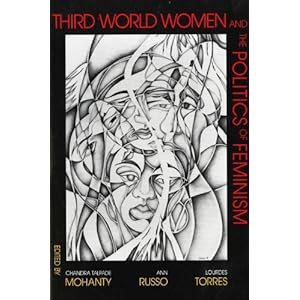
Radical Feminist Chandra Talpade Mohanty: Third World Women and the Politics of Feminism

[photograph of Chandra Talpade Mohanty is from here]

[image of book cover is from here]

This book is almost twenty years old. And nothing has gotten better, collectively, for women of color around the world. And so much has gotten worse.

Daily, it seems, I encounter white resistance to decentering white experience when it comes to being responsible and responsive to radical feminists of color who do and do not live in "the West". Daily, it seems, I encounter men's resistance to decentering adult male experience when it comes to being accountable and active in allegiance and alliance with radical feminists of color anywhere in the world. And for the women of color I know, it never "seems" to be daily: it is daily.

I do not see too much difference between this white resistance to and male dominance over women of color. Both political groups make life so much harder for the people who are the world's majority. My view is shaped by what women of color tell me directly not by what my white male privileged eyes are positioned, structurally in the world, to see. For my perspective, my view, if left to my white brothers to define and describe, would mean that the voices of women of color do not exist at all. My white brothers tell me it is white men's suffering that always matters most, and that no other suffering ought to be compared to it. Because, you see, white men, and to varying degrees, most whites and most men, are understood by white men to be more human than all women of color.

When I encounter this complete lack of responsibility and accountability to women of color, I want to spit in the faces of white men who refuse to give up the ridiculous idea that they are "the" definition, the superior standard, the exemplary example of what it means to be human. I have been turning away from the white men now for years, sometimes quickly and sometimes slowly. And also from the whites and the men who want me to ignore women of color--or to listen to whites and men more carefully, with more compassion for their pain, pretending their pain is qualitatively more important, more urgent, in need of more attention, than the pain of women of color across the globe.

I more carefully listen instead to what women of color have to say. I do this in the hopes that my actions here will be appropriately, humanely responsible and responsive and might also facilitate the cracking and breaking apart of some of the concrete ground of colonialism, corruption, and carnivorous misogyny that is now globalised for the pleasure and profits of white men over and against everyone and everything else. "Everything" here meaning all non-human life on Earth.

The white male Christians have got this quite wrong: the End of Western Civilisation will not release white men to heaven, but will send them directly to hell. And in that fire--molten and deep, their souls will know a kind of suffering they never conceived of while roaming or walking the Earth. To the white men who have refused to conceive of women of color as exemplary human beings by refusing to listen to what responsible, humane women say, I state this: one day you will know to the bone and beyond, what you built a world to avoid experiencing.

I pray that when the time, the End Time, comes, that corrupt, corporatised, incompetent, callous, cruel, contemptuous white wealthy men will die first and that the Earth will belong, for however much time, to the Life that those men seek to destroy and are currently proving successful in destroying.

Given what Indigenous women around the world and other women of color are reporting about what white men's corporations and callous practices are doing, how can anyone conclude that white men ought to be in charge of any institution or industry at all?

*          *          *
The source for some of what follows is here]

Third World Women and the Politics of Feminism

Edited by Chandra Talpade Mohanty, Ann Russo, and Lourdes Torres

Paperback
“The essays are provocative and enhance knowledge of Third World women’s issues. Highly recommended . . . ” —Choice

“ . . . the book challenges assumptions and pushes historic and geographical boundaries that must be altered if women of all colors are to win the struggles thrust upon us by the ‘new world order’ of the 1990s.” —New Directions for Women

"This surely is a book for anyone trying to comprehend the ways sexism fuels racism in a post-colonial, post-Cold War world that remains dangerous for most women." —Cynthia H. Enloe

" . . . provocative analyses of the simultaneous oppressions of race, class, gender and sexuality . . . a powerful collection." —Gloria Anzaldúa

" . . . propels third world feminist perspectives from the periphery to the cutting edge of feminist theory in the 1990s." —Aihwa Ong

" . . . a carefully presented wealth of much-needed information." —Audre Lorde

“ . . . it is a significant book.” —The Bloomsbury Review

“ . . . excellent . . . The nondoctrinaire approach to the Third World and to feminism in general is refreshing and compelling.” —World Literature Today

“. . . an excellent collection of essays examining ‘Third World’ feminism.” —The Year’s Work in Critical and Cultural Theory

These essays document the debates, conflicts, and contradictions among those engaged in developing third world feminist theory and politics. Contributors: Evelyne Accad, M. Jacqui Alexander, Carmen Barroso, Cristina Bruschini, Rey Chow, Juanita Diaz-Cotto, Angela Gilliam, Faye V. Harrison, Cheryl Johnson-Odim, Chandra Talpade Mohanty, Ann Russo, Barbara Smith, Nayereh Tohidi, Lourdes Torres, Cheryl L. West, & Nellie Wong.

Publishers Weekly 

[source: here]
[T]his collection of 15 essays offers examples of current feminist perspectives on race, class and Third World issues, and thoughts on appropriate approaches to these subjects. M. Jacqui Alexander's "Redrafting Morality" examines Trinidad and Togabo's 1986 Sexual Offenses Bill, finding that government has a "major stake in promoting and defending conjugal masculinity" and in subordinating women by recognizing them only as "wives." In "Gender and Islamic Fundamentalism," Nayereh Tohidi notes how the position of Iranian women has deteriorated since 1979--despite their active participation in the uprising against the Shah--and concludes that "the women's question should not be relegated to the days after the revolutionital in text." Russo, in "We Cannot Live Without Our Lives," argues that white feminists should not dismiss racism as "their" problem but "work with women of color as peers . . . which means we must give up sole power and control of feminist organizations, political agendas, and theoretical perspectives."

Thursday, May 27, 2010

Oil Companies Commit Not Only Ecocide, but Genocide

 [image is from here]

The news of the month in the U.S. dominant media is the massive destruction of ocean and its life, the wetlands and its life, and human communities including many people of color impacted economically due to the disaster. BP is a white British corporation which has shown gross disregard for ocean life, land life, and human rights. Below is one more example of what is horribly wrong with the oil extraction and gasoline production and distribution companies. Following this report is another from Democracy Now with some fairly concise discussion about the horror that is this oil company's massacre of life. A white man who has written about the ocean is a guest, Carl Safina. An excerpt from the article that comes first in this post is here:

Indigenous community leaders Guillermo Grefa (Kichwa) from Rumipamba, Ecuador and Emem Okon from Nigeria accused Chevron's operations of causing the extinction of indigenous peoples, while Debora Barros Fince (Organizacion Wayuu Munserrat, La Guajira, Colombia) added that Chevron supports the paramilitary operations of the current government in Colombia. Grefa asked, "When are you going to clean up what you have contaminated?
An excerpt from the video later in this post is here:
[T]he dispersant is a toxic pollutant that has been applied in the volume of millions of gallons and I think has greatly exacerbated the situation. I think the whole idea of using a dispersant is wrong, and I think it’s part of the whole pattern of BP trying to cover up and hide the body. They don’t want us to see how much oil, so they’ve taken this oil that was concentrated at the surface and dissolved it. But when you dissolve it, it’s still there, and it actually gets more toxic, because instead of being in big blobs, it’s now dissolved and can get across the gills, get into the mouths of animals. The water below the floating oil was water. Now it’s this toxic soup. 
...

And in fact, unfortunately, the Obama administration, I think, blew it on the high ground here. You know, there was Sarah Palin, "drill, baby, drill," right? So we don’t want that; we elect Obama. And then what happens is we get "drill, baby, drill." That’s what we got. -- Carl Safina

This is a cross post by Brenda at Censored News. Click on the title just below to link back. Thank you, Brenda.

Chevron Disrespects Indigenous Leaders Exposing True Cost of Chevron


http://www.truecostofchevron.com/
Contacts: Diana Pei Wu, dianapeiwu@gmail.com, 510-333-3889
Sangita Nayak, emailsangita@gmail.com, 414-412-4518


Chevron Disrespects Community Leaders Exposing True Cost of Chevron


Indigenous and global leaders ignored by Chevron decision-makers, expect showdown at shareholder meeting

Hi res, rights free photos available at http://rainforestactionnetwork.smugmug.com/Change-Chevron/True-Cost-of-Chevron-Press/12311033_j4CMA#878829788_Uw4tB

Update: Protesters arrested outside Chevron stockholder meeting on Wednesday
http://www.chron.com/disp/story.mpl/metropolitan/7022962.html

HOUSTON -- After traveling from as far as Australia, Burma, Nigeria, Ecuador and Alaska, community leaders and authors of the newly released report "The True Cost of Chevron: An Alternative Annual Report" were rebuffed by Chevron CEO John Watson when they tried to deliver their report at the company's Houston office on Tuesday. The report details Chevron's human rights abuses and environmental destruction around the globe.

"Chevron refuses to face its own true cost. Community and Indigenous leaders came from around the world from the locations where Chevron operates, and they were left waiting in a lobby," said Antonia Juhasz, lead author and editor of the new report and director of the Chevron Program at Global Exchange, calling the Chevron actions "disrespectful." She and the rest of the Coalition await the shareholder meeting tomorrow, where a Chevron representative agreed to a "point by point rebuttal" to the new report.

Indigenous community leaders Guillermo Grefa (Kichwa) from Rumipamba, Ecuador and Emem Okon from Nigeria accused Chevron's operations of causing the extinction of indigenous peoples, while Debora Barros Fince (Organizacion Wayuu Munserrat, La Guajira, Colombia) added that Chevron supports the paramilitary operations of the current government in Colombia. Grefa asked, "When are you going to clean up what you have contaminated?"

Many of the leaders demanded that Chevron be held accountable for the deaths of their community members, such as Reverend Ken Davis, from Richmond California, who said, "Chevron takes out profits, and I have to see people to their graves." T.J. Buonomo, a former U.S. Army military intelligence officer and a member of Iraq Veterans Against the War, challenged the Chevron representative on Chevron's practices lobbying the Iraq government and the U.S. government to allow oil extraction in Iraq while it is still under military occupation. He said, "You don't consider that inappropriate? You can't bring those lives back."

At the press conference preceding the confrontation with Chevron, Elias Isaac of the Open Society Initiative for Southern Africa in Angola said that "Chevron's CEO John Watson has said that he is "humbled" by BP's explosion in the U.S. Gulf, "instead, he should be ashamed of his own company's offshore operations which cause persistent, ongoing, daily abuses of the environment, our livelihoods, and public health." The devastation caused by Chevron's offshore operations was also the focus of remarks given by Tom Evans of Cook InletKeeper, Homer, Alaska and Emem Okon of Keebetkache Women Development and Resource Center in Nigeria.

The True Cost of Chevron network leaders, experts and supporters will be rallying outside the shareholder meeting, Wednesday, May 26, at 7 a.m., at 1500 Louisiana St in Houston, and over forty will be attending the shareholder meeting at 8 a.m.

They will also attend a Houston community-led toxic tour of Chevron's operations in the Houston Ship Channel immediately following the toxic tour.


Renowned Marine Biologist Carl Safina on the BP Oil Spill’s Ecological Impact on the Gulf Coast and Worldwide

Transcript from the above video:

As we continue our discussion on the BP oil spill, we turn to its long-term ecological impact. Carl Safina, the founding president of Blue Ocean Institute, warns the ecological fallout from the spill may be felt across much of the world. [includes rush transcript]

JUAN GONZALEZ: As we continue our discussion on the BP oil spill, we turn now to look at the long-term ecological impact of the spill. Our next guest testified before Congress last week and warned the fallout from the spill may be felt across much of the world. Joining us here in New York is Carl Safina, the founding president of Blue Ocean Institute. He’s author of many books about marine ecology and the ocean, including Song for the Blue Ocean.

Welcome to Democracy Now!

CARL SAFINA: Thanks for having me.

JUAN GONZALEZ: What message did you bring to Congress?

CARL SAFINA: Well, that this is not just a regional disaster, although it certainly is, but that the Gulf of Mexico is a tremendous engine of life and also a tremendous concentration zone, where animals from the whole open Atlantic Ocean funnel into the Gulf for breeding and millions of animals cross the Gulf and concentrate there on their northward migration and then fan out to populate much of North America and the Canadian Arctic, the East Coast, the Canadian Maritimes. So it’s a real hotspot, and it’s a terrible place to foul.

AMY GOODMAN: Tuna?

CARL SAFINA: The bluefin tuna that occupy most of the North Atlantic Ocean have two separate breeding populations. One breeds in the Mediterranean. The other breeds in the Gulf. So all the tuna that populate the East Coast, the Canadian Maritimes, the Gulfstream, even that go as far as the North Sea, many of those are from the western population and breed only in the Gulf of Mexico. This is their breeding season. They’ve just about finished now. And their eggs and larvae are drifting around in a toxic soup of oil and dispersant.

AMY GOODMAN: Talk about the dispersant Corexit.

CARL SAFINA: Well, the dispersant is a toxic pollutant that has been applied in the volume of millions of gallons and I think has greatly exacerbated the situation. I think the whole idea of using a dispersant is wrong, and I think it’s part of the whole pattern of BP trying to cover up and hide the body. They don’t want us to see how much oil, so they’ve taken this oil that was concentrated at the surface and dissolved it. But when you dissolve it, it’s still there, and it actually gets more toxic, because instead of being in big blobs, it’s now dissolved and can get across the gills, get into the mouths of animals. The water below the floating oil was water. Now it’s this toxic soup. So I think that in this whole pattern of BP trying to not let people know what’s going on, the idea of disperse the oil is a way of just hiding the body. But it actually makes the oil more toxic, and it adds this incredible amount of toxic pollutant in the dispersant itself.

JUAN GONZALEZ: And the potential you were talking about, that this is the season when so much of the marine life and the bird life is creating their young, what is the effect on the birds, on those birds that are about to hatch or maybe are already in the process of hatching?

CARL SAFINA: Yeah, well, not only do you have birds there that are breeding, like the pelicans and some of the gulls and some of the terns, those birds will probably have a completely catastrophic breeding season, because it’s not just birds on the beach or birds in their nest. Their parents make a living diving into water. There’s no way around that. You can put booms that are twenty-feet high. They’re going to fly out to feed. And when I was there, we could see on the Chandeleur Islands quite a few of the terns were already lightly oiled, but they will just get progressively more and more oiled. And no amount of protecting the area where the nests are is going to change the fact that the parents are going to have a tremendous amount of trouble. And many of them will just get killed.

But also, there were sanderlings, ruddy turnstones, black belly plovers and a dozen other species that don’t stay there. They’re moving, and they’re migrating through. They come—they winter as far south as southern South America. They nest across the Canadian tundra and in the High Arctic. They’re some of the longest-distance migrants in the world. They cannot do that unless their fathers are working. And if their feathers are sticking together, they’re not going to be able to make it. They don’t have the energy to get to where they’re going to go. So they’re going to be dropping out along the way. The other thing is you have peregine falcons that are coming across from the Yucatan on their way to breeding grounds in the Arctic—excuse me—and as far away as Greenland. They will be selectively picking off these birds that are compromised. So they will be getting higher doses of oil. So this is just a horrible place to have something like this happening, because it’s such a concentration point for animals that move.

AMY GOODMAN: What about the question of bombing the actual—where the leak is coming from? Some say BP doesn’t want to do it, because then they would have to rebuild if they would ever get to offshore drill again. But what effect would that have?

CARL SAFINA: Oh, well, I’m not a—you know, I’m not a drilling technologist, and I don’t know if it would work. But actually, bombing part of the sea floor right there, I think, would have no real ecological effect other than the noise, which would affect marine mammals like dolphins and whales. But, you know, one or two blasts, I think, if it shut the oil off, would probably have been worth trying. But I don’t know if that would work.

AMY GOODMAN: Who do you think should be in charge of this operation, this cleanup operation?

CARL SAFINA: Well, BP had a lease to drill. They did not have a lease to pollute the Gulf of Mexico. They did not have a lease to blow oil into the environment. They did not have a lease to disperse the oil and try to hide the body. They don’t have a lease to clean up. They don’t have a lease to make the fishermen sick. They don’t have a lease to tell the United States, "We’ll keep using a dispersant that’s banned in Europe, even though you’re telling us to stop using it." They should have been shoved out of the way on day two. And there should have been a war council of all the other oil companies that know how to drill to focus on stopping the oil from coming out of the hole. And then BP’s responsibility—they are responsible, but they obviously don’t know what to do, and they can’t do it, and they’re not doing it. Their responsibility should be what they’re good at: pay money. Pay money to the United States. They’re on our property. They’re in our water. They’re making our people sick. They’re destroying our wildlife. Pay money and have the United States take over.

JUAN GONZALEZ: This whole issue of drilling in areas so deep that if there is an accident you cannot really get there to fix it, what is it—you know, to me, it’s almost like Three Mile Island or Chernobyl. It’s like you never—you were guaranteeing people that it would never happen, but once it happens once, you realize the potential catastrophe that you are creating through this process. What is your sense of the future of ocean drilling, in terms of what this has told the rest of the people of the United States and the world?

CARL SAFINA: Right, well, there have been other blowouts, and there have been major oil spills. It’s different than Chernobyl because we know it happens. It happens. It’s happened before. It will happen again. And it’s happening right now. So, you know, and obviously they didn’t have any backup plan. It’s as if having poked 30,000 holes into the sea floor of the Gulf of Mexico and have 5,000 rigs operating, it never occurred to them to say, "Oh, what if oil starts coming out of one of those holes, like it has in other places at other times?" They were completely unprepared. They don’t have the equipment. They don’t have booms that can work in open water. And what the obvious take-home message is, we don’t know how to do this. We can poke the hole. We don’t know how to deal with some things that we know happen, because they’ve happened. But people have not developed the technology or warehoused the tools or created booms that work in ocean swell conditions or any of that stuff. We’re trying to wring the last drops out of a depleting resource. And this really needs to be the pivotal moment where we say oil is declining, we need a national energy policy that looks past oil. You know, BP, at one time they said that their name meant "beyond petroleum." Now it’s "beyond pathetic." But we really need to get past oil.

AMY GOODMAN: What about "beyond prosecution"? Are they? And should they be held criminally liable?

CARL SAFINA: Of course they’re criminally responsible. They were trying to hurry up. When you have an argument on a rig about how fast to go and what to do, you don’t tell people, "Just hurry it up." I mean, this is absolutely criminal. And I think that—you know, we’re still asking, "Oh, can we go in? Can we use respirators?" This is insane.

AMY GOODMAN: The Atlantis, deepwater offshore drilling site, has that been shut down, which dwarfs the Horizon Deepwater?

CARL SAFINA: Actually, I don’t know if that’s still going on or has been shut down.

AMY GOODMAN: Has all offshore drilling been shut down? No?

CARL SAFINA: No, not at all. And in fact, unfortunately, the Obama administration, I think, blew it on the high ground here. You know, there was Sarah Palin, "drill, baby, drill," right? So we don’t want that; we elect Obama. And then what happens is we get "drill, baby, drill." That’s what we got. We got a stepped-up effort to eliminate the ban on offshore drilling that was, what, a couple of generations old. And now they’re stuck with that, because, of course, nobody wants to actually do the smart thing and say, "Oh, you know what? We made a mistake," because then, oh, they’ve lost face. So, oh, we can’t lose face. The obvious right thing is the drilling ban was the right thing to do. The drilling ban is the right thing to do. We don’t know how to take care of these problems. We need to stop it. We need to make this a pivotal moment and have a national energy policy for the first time that gets beyond this and phases out fossil fuels, which kill people, make people sick and detroy the environment.

AMY GOODMAN: We want to thank you very much for being with us, Carl Safina, founding president of the Blue Ocean Institute. He has written a number of books, including Song for the Blue Ocean.

Wednesday, May 26, 2010

Radical Feminist Andrea Smith on Re-centering Feminism

 [photograph of Andrea Smith is from here]

A while ago I posted on the racist myth of the three waves theory in white feminism. *Here* is that post. 

I recently came across this 2006 essay by Andrea Smith and want to credit her and many other radical feminists of color and womanists for making this case in many ways. Audre Lorde, Barbara Smith, bell hooks, and on and on. There are so many fabulous women who have worked to set the record on something other than a white-centered turntable.

Source website for what follows is here: http://www.leftturn.org/?q=node/396

Without Bureaucracy, Beyond Inclusion: Re-centering Feminism

Published on: June 01, 2006
Both scholars and activists have tended to periodize the feminist movement into the so-called first, second, and third waves of feminism. The “first wave” is characterized by the white suffragette movement; the “second wave” is characterized by the formation of the National Organization for Women, abortion rights politics, and the fight for the Equal Rights Amendments. Suddenly, as if having no prior organizing history, women of color make an appearance during the “third wave,” transforming feminism into a multicultural movement.

But the problems with this approach become clear when acknowledging that the histories of feminism extend beyond these narrow waves. For example, if one were to develop a feminist history centering Native women, feminist history in this country would start in 1492 with the resistance to patriarchal colonization. The insistence on a first, second, and third wave approach toward understanding feminism therefore keeps white feminism at the center of our analysis and organizing practice.

Consequently, many analyses of “the women’s movement” tend to focus on liberal white feminist organizations that emerged during the “second wave.” Critics, such as Barbara Epstein and others, point to the fact that these organizations have come to function less as movements and more as bureaucratic non-profits who do advocacy work without any substantial grassroots base. Rather than assert a politics of long-term social transformation, these groups focus on lobbying the state through issue-specific reform.

On the one hand, as William Saletan of Slate Magazine notes, this approach has worked for certain issues. He contends that pro-choice strategists –– generally affiliated with NARAL Pro-Choice America and Planned Parenthood –– intentionally chose to reject a reproductive rights-based framework in favor of one that focused on privacy from “big government.” That is, the government should not have the right to intervene on the right to decide if they want to have children. This approach appealed to those with libertarian sensibilities who otherwise might have no sympathy with feminist causes. The impact of this strategy was that it enabled the pro-choice side to keep Roe v. Wade intact, but only in the most narrow of senses.

Ultimately, the logic behind this approach could be used against a broader pro-choice agenda. For instance, the argument that government should not be involved in reproductive rights decisions could then be used by pro-life advocates against federal funding for abortions because government supposedly has no business in providing funding for abortion services.

Co-optation blues
For the anti-violence movement, the shift toward bureaucratization coincided with the influx of federal and state dollars into anti-violence programs, particularly with the Violence Against Women Act. Anti-violence groups then began to shift their focus from anti-violence organizing to anti-violence support services. With the restrictions that federal monies often place on the type of work anti-violence groups can do, their work became state-friendly (such as calling for increased criminalization of domestic and sexual violence) rather than state-resistant (such as violence-prevention initiatives or alternatives to incarceration).

Thus began an increasing split between groups that do organizing and groups that meet the immediate needs of their constituents. This split can be seen as gendered in that organizing spaces devolved into masculinist public spaces where everyone is supposed to be healthy with no problems. Personal problems became relegated to a private space, implying that one is supposed to get help on their own time, disconnected from a larger political organizing framework.

This depoliticized personal work has therefore become a main focus of a co-opted feminist movement. While “the personal is political” was one mantra of the many in the women’s movement, the political has in many ways become personal. That is, instead of looking at the personal as the basis to do political organizing work, many groups stayed simply at the level of personal development or support groups.

The fracture between the personal and political, services and organizing, has meant that instead of women and survivors of violence becoming agents for solving problems, they receive apolitical “self-help” and a band-aid of social services.

Currently, many right-wing individuals hold prominent positions within domestic and sexual violence agencies with no commitment to feminist politics whatsoever. In fact, anti-violence activist Beth Richie is completing a book in which she talks about how “we won the mainstream and lost the movement.” In light of these trends, one could become very depressed about the women’s movement. However, this depression assumes these corporate-model non-profits are the center of the women’s movement.

Beyond inclusion
There have been numerous multi-racial and multi-national women’s anthologies calling for a radical transformation of the mainstream women’s movement.

Experiencing the multiple realities of sexism, racism, classism, (and other “isms”), women of color are often uniquely situated to see the need to organize against oppression on numerous levels. They are the targets of violence directed at communities of color, and at the same time are targeted by violence committed within communities of color. This positionality allows them to see the need to develop a dual-organizing response that creates and restores healthy communities while resisting white supremacy, capitalism, and oppression. By contrast, male-dominated racial justice groups and white-dominated feminist groups tend to focus on singular and either external or internal oppressions, rather than dealing with all simultaneously.

But by and large, the response of white liberal feminist groups to these “multicultural” challenges has been simply to “multiculturalize” their organizations; that is, they welcome “third wave” women of color and other marginalized women into their ranks as long as the multicultural difference they make has no significance for how these organizations will define the work. Inclusivity has therefore come to mean that we start with an organizing model developed with white, middle-class people in mind, and then simply add a multicultural component to it.

This approach also contributes to dysfunctional organizing patterns in which women of color, poor women, etc., often find ourselves spending inordinate amounts of time trying to influence the large liberal feminist organizations such as NOW and NARAL, as if they embody the women’s movement. This can be called the “women of color caucus” approach to politics, whereby a caucus is formed within a larger organization or an independent group is developed that focuses solely on allying with the larger organizations.

Our work then becomes focused on yelling at white women for being racist. And if we become very good at this task, white women start paying us to yell at them. This approach can be lucrative for some individual women of color, but does not actually impact the political direction of these bureaucratic organizations. More significantly, this work does not help women of color organizing build its own power.

Re-centering feminism
By implying that they are part of a “third wave” of feminism—a notion that still centers the histories of white middle-class women—feminists of color can be self-marginalizing. Without focusing on developing our own independent and alternative power base, women of color organizations are not in positions to negotiate with power brokers and mainstream pro-choice organizations, or to hold them accountable.

For example, many women of color groups mobilized to attend the 2004 March for Women’s Lives in Washington, DC, in order to expand the focus of the march from a narrow pro-choice abortion rights agenda to a broad-based reproductive rights agenda. While this broader agenda was reflected in the march, it became co-opted by the pro-choice paradigm in the narrow media coverage. Virtually no newspaper described the march as anything other than a pro-choice, abortion rights march. To quote New Orleans health activist Barbara Major, “When you go to power without a base, your demand becomes a request.” Without a base of radical women of color, lobbying bigwig feminist organizations can be a disempowering plea.
As critical race theorist Kimberle Crenshaw has noted, it is not enough to be sensitive to difference; we must ask what difference the difference makes. Instead of saying, how can we include women of color, women with disabilities, etc., we must ask what our analysis and organizing practice would look like if we centered them in it. By following a politics of re-centering rather than inclusion, we often find that we see the issue differently, not just for the group in question, but everyone.

An example of this re-centering is the way the national organization, INCITE! Women of Color Against Violence, developed its analysis of domestic and sexual violence. We saw that it did not make sense to focus our strategies on involving the criminal justice system in addressing violence, because as women of color we are just as victimized by the criminal justice system as we are by interpersonal gender violence in our communities.

In coming up with alternatives, some people thought we should involve the medical system as part of an anti-violence strategy. However, when we re-centered the discussion around women with disabilities, we saw that the medical system was as punitive as the criminal justice system, and we needed to work on developing alternative strategies. In the end, neither the criminal justice nor the medical system was going to solve the problem of violence for anyone, not just for women with disabilities and women of color.

Building autonomy
Many grassroots organizations are posing important challenges to how radical women of color should position themselves vis-à-vis the liberal feminist establishment. Fundamentally, these new projects and analyses do not start from or solely identify with the history and establishments of white liberal feminism.

Basing their origins of feminism on the resistance to European colonialism, The Native Feminisms Without Apology project, for example, is not particularly concerned with allying, critiquing, or relating itself to liberal feminist organizations. Many other grassroots organizations such as Sisters in Action for Power in Portland and Sista II Sista in Brooklyn, are developing radical responses to issues like violence that are not filtered through the mainstream reproductive justice or anti-violence organizations.

These projects are reunifying the personal and political, and struggling to provide immediate services in empowering forms, as well as building collective political strength. The Boarding School Healing Project, based on developing a movement of survivors of American Indian Boarding Schools, is working to heal deep trauma but resisting the temptation to simply provide services and then organize. Otherwise, one member says, “It will be like we’re just doing something to survivors again, instead of doing something with them.”
Radical women of color organizations are also grappling with structures of collectivity and accountability. In the face of the shift to top-down, bureaucratic structures of organizing, yet with the knowledge that unstructured leadership can lead to unspoken hierarchies, these groups are working to make accountable and egalitarian leadership a reality rather than simply a principle.

The focus on building autonomous power does not imply separatism. In fact, this model of radical women of color organizing is not simply based on a narrow politics of identity but more on a set of political practices designed to eliminate the interlocking systems of oppression based on heteropatriarchy, white supremacy, capitalism and colonialism—a vision that is liberating for all peoples. Unlike the demobilizing reformism of the mainstream women’s movement, this organizing is about asserting power and taking responsibility for transforming the world. As Native feminist activist Justine Smith stated: “You can’t win a revolution on your own. And we are about nothing short of a revolution. Anything else is just not worth our time.”

ABOUT THE AUTHOR
Andrea Smith is a co-founder of INCITE! Women of Color Against Violence and the Boarding School Healing Project.

Tuesday, May 25, 2010

A White UK Feminist book review of Afghan Radical Feminist Malalai Joya's Autobiography, A Woman Among Warlords [including U.S., UK, and other NATO Warlords]

 
[image of book cover is from here]

What follows is cross posted from *here*.

Book Review: Raising My Voice: The Extraordinary Story of the Afghan Woman Who Dares to Speak Out by Malalai Joya

Author: Natalie BennettPublished: May 23, 2010


When I was running for the Green Party in the recent British general election, there was one issue on which I had no doubt how audiences at hustings and meetings would react positively – our call to withdraw British (and NATO) troops from Afghanistan. Surveys show around 70% of the public back that stance, and it was close to 100% of the audiences at hustings.

As I told them, I’d had in the past some doubts about our party’s policy of immediate withdrawal, having been worried about the human rights situation that we’d leave behind, particularly for women. But it was a Human Rights Watch report last year, which found 60-80% of the marriages of Afghan women and girls are forced, and learning that the brave women of Rawa are calling for withdrawal that led me to change my mind.
Having just read the autobiography of Malalai Joya, an outstanding Afghan woman MP, I’m now even more strongly of that view. (It was published in the US as A Woman Among Warlords: The Extraordinary Story of an Afghan Who Dared to Raise her Voice.)

She’s an extraordinarily brave, stalwart – and very, very young! — woman who has dedicated her life, and taken enormous risks, to speak out on human rights in her native land. And she says very clearly – and loudly and publicly in her own land, which led to her being expelled from parliament – that the people the U.S. and its allies are backing in Afghanistan are entirely the wrong people, the old warlords, many of them in her eyes (and those of others) war criminals. And she has no doubt that this foreign occupation can only prolong and amplify her nation’s problems.

Her story is an extraordinary one. Certainly, she was lucky in her parents, particularly her father, a democracy activist who moved his family around Iran and Pakistan as an exile in search for good schooling for them. (He, like the rest of her family, can’t be identified for their own safety – the name ”Joya” is one she adopted to protect them.) There must be many other potential Malalai Joyas in Afghanistan who will never get that essential foundation or confidence.

But there’s no doubt she was exceptional. Noticed as a fine teacher in the refugee camps, at the age of 21 she was sent to found an underground girls’ school in Herat by the Organisation For Promoting Women’s Capabilities. Only three years later, she was appointed to head its work in three provinces, just before 9/11. Under the new regime, despite its resistance, on her account she set up a clinic, orphanage and was able to distribute food supplies.

Monday, May 24, 2010

Demand a Public Inquiry into the Prejudice and Discrimination against Indian Mothers and Their Children and those in other Ethnic Minority Groups, and of the Racism and Sexism which is Occurring in the Family Courts of Australia

     
[image is from here]

AND MOTHERS OF COLOR 
ARE WOMEN [HUMAN] TOO!

What follows next is an excerpt from what comes later in this post. This is the story of an Indian mother, from the National Peak Body for Safety and protection of Parents and Children. (Their website is here: www.safety4parentsandkids.org.au.)
Throughout my pregnancy with my daughter, my partner took no interest in our child and I was left to care for my daughter in her early years, as a natural process. However her father has been able to use the Court and its processes against me by making false accusations against me alleging that I was abusing our daughter and despite there being no evidence whatsoever to support his false allegations.

The Court however gave sympathy to him as he was able to gain supportive testimony from his white friends. This was a cruel irony as it was the father who had abused the child, after years years of ill-treating and abusing me within the relationship and he had left bruises on me and my child’s body, with fingerprint marks on her body, and has used my daughter as a weapon against me, by taking her to various people, privately and making her say or do things to denigrate and dehumanize me.

The Courts went against the advice of a family report writer that the child will be at risk of abuse in her father’s care.

If I can speak like an Indian, then he made me look like a second class citizen by his manipulation and deceit of some of the professionals who are not held accountable due to there being immunity for them in the Family Law Act.

When my daughter was a baby we escaped from his violence towards us both to a Women’s refuge, and got counseling for our sufferings and traumas. I was hit in the stomach during the pregnancy, and the police documented this, but then I was told not to mention this in the Family Court, as the Judges do not want to hear about domestic violence or abuse of children in such Courts despite the evidence of the abuse. And Judges take retaliatory measures against mothers who raise such issues.

At issue is how racism and misogyny, colonialism and classism, and other systems of oppression of women and girls specifically, all conspire against mothers of color who are mistreated, abused, discriminated against, and betrayed by white male supremacist courts and criminal justice systems. The effort is always underway to destroy relationships between mothers and the children they wish to raise in safety and in peace. Usually, it is the men and men's laws in these women's and girls' lives who seek to destroy the bonds by destroying either or all of the females. Too often, governing authorities conspire with the men to violate the human rights of women and girls, mothers and daughters. This is a global problem, but this one story is about a woman and her daughter struggling to be reunited as they wish. Please read it with an open heart and support her efforts in any way you can.

I have copied and pasted the following, sent to me by email, in full support of Indian and other women of color in Australia and elsewhere who are in need of human rights, and of having their human rights affirmed and supported by Australian and International Human Rights Groups, all relevant governments, policy-makers, social service agencies, and by humanity in general.

*          *          *

Dear Sir/Madam,

I am writing to you to seek your help as I feel my daughter and I are suffering racial and sexual prejudice and discrimination in the Family Law Courts of Australia under the Family Law Act 1975.

I am of direct Indian heritage and was born in Fiji and my daughter shares my cultural and ethnic inheritance, although her father and my former partner is Caucasian Australian Nationality.

I was born in a good Indian family in Fiji, my great grandparents having been taken there by British under the indentured labor system. They often complained of the abuse they had suffered from the British. In such terms as described in this document, I feel that I am now re-living the torture and trauma in Australia and its “Family” laws. Such laws are now giving preference and paramountcy to the rights of fathers after separation and such preferential treatment is rigidly administered by the Family Courts. The State Government systems cannot intervene effectively and in many instances choose not to interfere. Children have died and mothers murdered as a result of these complexities that have existed in the history of Australian laws, agreements and the constitution, leaving vulnerable mothers and voiceless children abused from both systems, with no one assuming any responsibility.

My parents weren’t wealthy, but managed to raise ten children, and prioritized education, and sent me to a prestigious private girls’ boarding school, where I assumed a number of leadership roles. My parents did not hit us or abuse us, and taught us to be good kids and citizens to pursue our dreams. All of my families have migrated overseas, and we mostly married into white nationals. I have qualified in nursing since coming to Australia in 1982. I am currently practicing in mental health nursing field in psychiatry, after completing a Master of Advanced practice in Mental health. I am currently in-charge of my shift co-ordination and care in an acute 19 bed mental health ward bed working for the State Government.

My current situation with having to go through this process, and to have recovered from domestic violence and abuse, I feel that it is essential and an ethical duty of care as a nurse to help improve and reform the abusive practices and systems under Governments, and find justice and improve human lives and particularly of those who are voiceless and vulnerable under such oppressive, and perhaps corrupt systems. I myself have been labeled, stigmatized and abused whilst attempts to protect my daughter and her rights, and have been denied care of my child, who she feels safe with.

Australian people are generally good, but seem not to be aware that such laws are abusive towards women and children, and it is worse for Indian nationals such as myself as we are doubly prejudiced, it appears because of our Indian backgrounds.

I suffered many years of violent attacks and abuse within my relationship with my daughter’s father, yet when this matter was brought to the attention of the Family Court, it was completely ignored and the case was turned against myself. I was and have been a loving and caring mother to our daughter since separation. My daughter was unwanted by her father, and her father assaulted me to get rid of her till the day she was born. He approached my families to force me to have an abortion, and he was told to grow up and be a man, but he never proved to be one in the context of his abusive and malicious behaviour towards the child and me.

He abandoned me during my pregnancy, and then according to the Australian Laws, they started to remove my child from me at her three years of age, by making false allegations against me. The abuser of White Australian National who has not been able to keep a job, a woman, began on a meditated mission to make me look really bad as a mother to my daughter, through the corrupt professionals in the family court systems.

This was only the beginning of years of discrimination against me as a mother by the Australian Family Court where I have been treated as little more than a nuisance and inconvenience to the supremacist white males in the judiciary and the legal profession. The other professionals that need to be tested are the psychiatrists who make false diagnosis and breach diagnostic guidelines, and the other report writers, such as social workers and psychologists, who align their self-interests with the family law courts. Family courts actually have preferred report writers, and these people are not objective and many children have suffered lifelong impact, death and women have also been abused. These report writers are not held accountable. In my own daughter’s case, a particular report writer had her whispering in his ear, with physical body contact [in] a private locked room all by himself, breaching significant professional boundaries and trust of a mother. My child complained of distress and was relieved to be out of that room, and she further complained that the man had shared personal stories and described his family life and talked about his pregnant wife and so, which from my own nursing point of view is completely unprofessional. Such people are still practicing, under the family law act, and our complaints are ignored by the Australian Governments. At the time my daughter was only five years old, and I knew I will be seeking justice one day when I would feel recovered and empowered to speak out, and deep down I knew that I will one day.

My daughter is now twelve years old. I will briefly detail her story to you for now, and I am currently compiling a story of her life and the abuse she has suffered in much more detail for publication later.

Throughout my pregnancy with my daughter, my partner took no interest in our child and I was left to care for my daughter in her early years, as a natural process. However her father has been able to use the Court and its processes against me by making false accusations against me alleging that I was abusing our daughter and despite there being no evidence whatsoever to support his false allegations.

The Court however gave sympathy to him as he was able to gain supportive testimony from his white friends. This was a cruel irony as it was the father who had abused the child, after years years of ill-treating and abusing me within the relationship and he had left bruises on me and my child’s body, with fingerprint marks on her body, and has used my daughter as a weapon against me, by taking her to various people, privately and making her say or do things to denigrate and dehumanize me.

The Courts went against the advice of a family report writer that the child will be at risk of abuse in her father’s care.

If I can speak like an Indian, then he made me look like a second class citizen by his manipulation and deceit of some of the professionals who are not held accountable due to there being immunity for them in the Family Law Act.

When my daughter was a baby we escaped from his violence towards us both to a Women’s refuge, and got counseling for our sufferings and traumas. I was hit in the stomach during the pregnancy, and the police documented this, but then I was told not to mention this in the Family Court, as the Judges do not want to hear about domestic violence or abuse of children in such Courts despite the evidence of the abuse. And Judges take retaliatory measures against mothers who raise such issues.

My daughter was born very sickly, and spent seven weeks in the Intensive care unit, whilst I stood by her side 24/7, and spent my stay at Macdonald house, her father was trying to score another relationship and rarely visited our child during this time and was further abusive in front of an incubated baby fighting for her life, where the nurses asked me to stay away from the father’s abuse towards me in front of our sick child and to be careful of his abusive behaviour.

After being taken through this oppressive legal system, for the third time by the father in the last ten years, the eventual outcome has been that my former partner was given custody of our daughter and I was permitted only occasional supervised contact with her.

My daughter became suicidal at having been removed from my care and remains so, often saying that her life is no longer worth living. She is also at a high risk of suffering abuse and neglect and such neglect for her care has often been apparent when I have seen her on the rare occasions I am permitted to. She had also been growing side burns on her face with some confusions of her true identity when she was removed for an extended period of time from my maternal input.

All of my child's rights have been violated under the Family Law Court, and the U.N Charter of Rights for Children. She is not permitted to speak on her own behalf and the only evidence of her views permitted by the Court have been comments reported by others, such as the report writers privately hired by the father or his school friends and which she made under duress and threat by her father. The Court has abysmally failed to protect her from her father’s abusive and oppressive treatment of her despite years of recorded examples of his violence and controlling nature. The recent findings of a study demonstrated, that the children were being abused in the family courts, with having lifelong impacts on their ability to function or to lead a normal life enjoyed by others. Such studies are posted on a website http://www.safety4parentsandkids.org.au, reports by AIFS commissioned by Rudd Government.

The Father and the Family Court have also denied my daughter rights to her culture, to networking and learning or keeping up with what she has enjoyed, and she is also denied her rights to having contact with her maternal families.

My daughter’s health, safety and wellbeing have been put at risk on many occasions, but the Courts have used present laws, and denial of domestic violence and abuse in their culture of practice to ensure our safety and the child’s developmental needs. Whilst the abusive professionals and judges collude, and structure their cases to keep their jobs, courts and monetary interests, the governments and the Chief justice is unable to direct the court to stop the abuse of my daughter and myself.

In our cases, and that of other female Indian nationals, one of whom is a doctor, and we are under the same Judge who removed our children from us. I know of another Indian woman who had her children removed from her too by the Brisbane family court. The chief justice says she is powerless to tell the judge to protect my child from harm, and recently my daughter’s risks have increased more. The MP’s say it is a criminal offence for them to intervene and yet it is their responsibility for enacting legislations. So perhaps the Human rights need to intervene and let us know who should be responsible for the identified risks I have reported as a nurse to protecting my child from further, harm, danger, abuse, and lifelong impact from her abusive father, given a four year child Darcy Freeman was picked up and thrown off the bridge in Melbourne as a result of such abusive and oppressive systems in Australia. Darcy suffered before she died from the injuries she sustained. She was picked up in front of her two brothers, and the calls from the maternal families to the authorities and systems was ignored. The lifelong impact on her brothers and her families can never be forgiven. Is human life so worthless?

It appears, not only do the students from India living in Australia are prejudiced, but we are prejudiced as mothers, who have been married to White Australian National abusive males, and they are protected in the family courts. Whenever legal proceedings have taken place the systems and the professionals have been white male nationals, and many of the mothers from all nationals including Australian mums are struggling to protect their children and themselves from their abusers and the systems in place. There is no accountability of the professionals and the systems. This allows corruption to breed and many children have died, and mums have been abused.

I now am aware of about 147 women, many of them from ethnic minority groups who have been fighting to protect themselves in the family law court system and the State systems, coming to no solutions due to the complexities in the law, system, and a lack of accountability of the professionals, who protect the abusers. There is both clear and covert evidence that females and particularly non-Australian females, are suffering racial and sexist prejudice and discriminations in the Family Courts. There are many more calls from mothers of desperation to wanting to protect their children, and now I speak not only as a mother, but as a Nurse under my ethical duty of care as a nurse, to ask Human rights to respond to such calls, as my efforts have placed my own child and hundreds of children in dangerous and difficult situations.

Even though I work as a psychiatric nurse now, and have been working as a nurse for over twenty years, I have been kept below poverty line, to be fighting for my daughter's protection. All my monies are taken up by the court processes and the professionals, and yet my daughter remains in the total control and care of our abuser, who uses various tactics, to manipulate her, induce fear in her, denigrate me, and cause her to make false allegations to others to service her father’s sickly needs of inflicting ongoing abuse and violence on both of us, yet there is nothing to protect us. The hope of a good life over here has been persecuted by the legal professionals and abusive systems, where I am unable to keep fighting for my child, but I will as her mother to protect her from abuse, neglect and death.

The male judicial officers and other professionals were very prejudiced and frequently stated “Oh she is Indian, and was born in Fiji” as though constantly reminding the Court and each other that we were not white Australian and should be treated less favorably. It is like they have a right to treat us with less dignity and respect because of our cultural background. My daughter and I have been treated like second class citizens.

Other Indian mothers and myself are not abusive to our children in the way these courts and professionals have painted us to be.

My daughter was taken to another Australian national woman, with a comprehensive list of statements denigrating me, and even though she had suspicions of the father’s influence, as did a few others previously, the present family court judge ignored these and twisted facts in a proposed report. My daughter was also taken to her school teachers, Anglican schools the father works for them) to make false statements about me. The headmaster and the principle of St Hilda’s Anglican school, and I notice there are several international Asian and Indian schools attending, breached his own school policy on reporting procedures, and instead made false statements, covered up the father’s abuse in the family law courts. The Anglican schools are well known to cover up abuse, and butter up International people and market their schools, but the students must be kept an eye on.

The Anglican school refused to give me any information to me, the Police and family services failed to protect my baby, one and only.

Generally, I will be described as a good caring professional, and have been regarded well in my profession, with publications in news journals, and I am a good law abiding citizen. I am hoping to introduce this abuse of women and children in our nursing forums through publications, as we often have mothers admitted to health services to be diagnosed, but a lot of them suffer elements of PTSD, anxiety and depression from abuse of their partners. Kids also suffer, and there is plenty of documented evidence available for this. I will forward you my last newsletters which covers a number of concerns for the safety and wellbeing of mothers and children in these systems.

The Father of my child was so abusive after we escaped horrendous abuse and feared for our safety, and during our stay with him, that he did not and has not stopped this, due to a lack of protection from the Australian Government laws, or respect of our Human rights, and we have endured this level of abuse for the last ten years in the family law courts. My daughter has been set up and taken to various crooks, to make up false allegations about me, and slowly she was removed from my loving and healthy care to be handed to her abusive and dysfunctional father, who is a white Australian national.

I was so upset, that I carried out research and learnt that a number of other Nationals were also prejudiced in the family law courts, and as I have mentioned another Indian doctor, under the same Judge is fighting to see her children, and I have encouraged her to write to the Indian Consular General and request for some protection of us and our children and to hold Australian Government accountable. We request that the Indian Consular general keep a register of the Indian people being abused through these government systems. At the moment only 1% of mothers fall in our category and I bet that we form this one percent of their statistics.

At least we would like to keep you informed as we fear for our lives and our children’s lives, wellbeing, development and safety from harm caused to them from such abuse not only by our perpetrator but abusive system and professionals. The abuse extends to the father using others like not only schools, but our landlords, real estate, and police to make false allegations and persecute and imprison us, thank fully he has not succeeded even though we have nearly lost all our dignity, pride as Indian women and also our enjoyment of monetary earnings in this country.

Many normal Australian Nationals may not be prejudiced, but the government policies are, and the judicial officers and the professionals who are handpicked and chosen by the family law courts are because the system is set up to be abusive, controlling and damaging to mums and kids, and we as Indian nationals are worse off, and they speak of us as second class citizens, who deserve to be abused. My grandparents were telling us how the British abused their parents, but this has not been any easy for me or my daughter, even in 2010.

I am educated in Australia and have been working and contributing my fair share, but in the last two years, found the abuse of women and children to be so bad, including my own, that I began to learn more about the corruption and abuse of women and children, that I carried out surveys, where 147 people told the darkest stories of family law courts, and where many mothers have been murdered, their children have been picked up and thrown off the bridge, gassed, burnt, suffocated, raped, strangled, and the horrible things they do to each other.

Many children and mums/parents have developed mental illnesses, and there is no protection of us as Indian nationals either, and on many occasions we have felt prejudiced, as the white professionals impose their own history and knowledge of abuse on us. There is no respect for our cultural heritage and it is now confirmed in the family courts. The family courts have robbed me of everything.

My daughter is twelve years old, and she was doing Bollywood because she loved it, with a professional school and I have videos of her love for her culture, and she attended classes, and her father failed to take her for choreography and show, he fraudulently amended documents for the purpose of the family law court judge would probably say he couldn't care less.

The Bollywood school and a lawyer wrote to the father, and the courts saying the child will benefit from these classes, and was happy and enjoying it, but the father refused to allow a simple and harmless way of learning about her culture. It is legislated in the family law act that children have a right to enjoying their culture but this has been breached.

If it was not for my daughter, and a lack of protection for my child by the Australian governments, I would gladly go back home and live there, as this abuse of my beautiful and lovely child and me is becoming intolerable, and I have come to a point of breakdown and have had to take days off to overcome the assault on my integrity as a mother, an Indian contributor to Australian government, and to helping my patients. I cannot believe how they can paint someone so badly and make it almost look real.

In my current case, the judge has accepted everything the father has made up, without any investigations, proof, or allowing the child an independent voice through Independent children’s lawyer. The Judge has become irrational and very controlling because he may be worried that the corruption, collusion may be exposed. The father even is allowed to get away with lying to the Commonwealth government depts. Center link and child support agency, and although these depts. persuaded me to report but they failed to do anything. The father alleged that I was making death threats and made up a false affidavit, without a signature or date, and filed it. He openly in front of the contact center professionals makes statements of denigration of me in front of my daughter, inducing fear in her, and yet they don’t do anything. At the contact center, my mother came to visit her grand daughter, the ladies started shouting and screaming at me and my mother, you can just imagine my sickly mother was so fearful, she said she will not go back there again.

I lodged a complaint to the FAHCSIA, the government ministry responsible for contact center rules and funding and they failed to investigate these. So the governments are making rules at these centers and have so far isolated my daughter from all her maternal families for the last two years. The father took us to court three times, each time gaining more and more leverage, and now completely violating my daughter’s most basic and human rights, and stopping her contact, and exposing her to a greater unacceptable risk of harm with the proposed orders.

My daughter has not wanted this to happen and the judge wanted to make an order to stop contact, but not the child. The judge is irrational and is being extremely biased, as I would describe it, and can’t be considered someone who respects our Indian culture, motherhood or good parenting of children.

My daughter and I have been supposed to be getting one x 2-hour contact at a supervised contact center. The judge has tried everything to stop my contact and when all else failed he just handed my daughter to her and our abuser, and has left her in a very difficult position, where she will perhaps not be able to have any relationship with me as the child's mother or for her to know her cultural heritage, my daughter expressed to her father of suicidal thoughts, where the pressure he put on her, made her this way where she said "I will strangle myself" and that "this was only way out of this", and she was complaining of having isolative behaviours, and she is too fragile to resist his psychological abuse and harm. He has been making her believe that I being her mother was sick in the head. In my opinion, and other people’s opinion, the family court was recommended that the father go through further assessment and he was not made to do so, and then the child was to be properly assessed but this did not occur.

My child loves being with me, she has a closer attachment and bond with me.

My daughter has been violated of her rights due to the family law legislation allowing judges to be racist and prejudicial, to see me only at supervised visits, for the four years. This has taken a lot out of me and no doubt my child.

My daughter is so frightened of her father, to be saying anything positive about me as she gets into trouble; her journal led worst kinds of abuse she inflicted from the hands of our abuser and to no avail.

My daughter waited to see me at the contact centre with her first menarche, she did not know what it was and pulled me by the arm and said, "mum help me I don't know what it is and what to do about it" You can imagine as a loving mum, how I felt for my daughter, she waits to see me if she had any complaints, of personal nature, to tell me to remove an earring from her ears if they become infected, and also to take lice out of her hair, and she loves Indian foods especially her mum's curries. Don't get me wrong we are very Australian, but we also appreciate our culture, Bollywood and traditions. When she was in my care, she loved singing some of the songs, but due to the family law courts, she has probably forgotten all of her cultural heritage. I have DVDs of her love for the two cultures which she is made of. If you can understand, it is very important for one's identity formation, and accepting themselves as individuals. This was confirmed to the court by a consultant clinical psychologist, and also identified the dangers for the child by being left in the care of our abuser, but the arrogance of the family law courts, and the prejudicial nature of the judge, makes it very hard to protect our Indian children from the white Australian Nationals.

I can cite you abuse after abuse, but it is too traumatic right now as I write.

I just wish to inform you that not only the students are targeted here, but our children are taken away from us and handed to abusive Australian nationals, and also many mums and kids from their own culture suffer because of a sexist and misogynistic culture here. You may want to keep an eye on me and my daughter, as I feel quite unsafe and apprehensive, and even more so as Mental health nurse, as I know there are risks to us in every form, including suicide of my daughter eventually, to get rid off us, as we continue to suffer the abuse not from the abuser, but the prejudiced judges, State systems who fail to protect us and in fact come after us and further cause more damage, by making false allegations to a view to intimidating and wanting to imprison us, and of course the Australian Government not acting on risks when it is highlighted to them due to the laws.

My daughter and I hope to be reunited so neither of us wish to suffer mental illness, harm and damage to our lives; we cannot go through any more mental torture. We really want to feel safe, and share some happiness. I have been a worker in this country all my life, but my monies goes to all the Australian Nationals, professionals involved in abusing us, I drive the oldest car, I have gone without food, clothing and the basic essentials a person will need, and yet my income is high enough to lead a lovely and wonderful life, but they keep doing things to me and my daughter, so the father can stay at home and bludge, and the professionals keep taking everything I earn, to protecting my daughter, and seeing her at every opportunity. We have had enough abuse, and it is becoming unbearable.

I am also raising these issues with the Human Rights Commission as I not only fight to protect my own child, but for many other mums and kids, and those of their own Nationals too, who are losing their children to the abusers in the Australian Family law system. I ask for your help in protecting my daughter and other kids and mums and hold to account those abusers and abusive systems.

I will appreciate if you can help to protect us from these abusive people and systems please; I am not sure how to escape these human torture and trauma for my daughter and myself, and many other mums and kids. They are just focused on making money out of us, and all my earnings goes to lawyers, courts and tax.

I would like to tell my great grandparents about this worse form of trauma and torture due to the laws in Australian family law courts, where there is no justice, cover up of abuse, no proof, no investigations, and constructing me as a bad mother and abusing my child by handing her to abusers, greedy in-humane professionals who are chosen by the family law courts as witnesses, and they have immunity to protect them.

What I am saying is that the normal psychologist is no good, it has to be the preferred family court one, and these people breed corruption and abuse children and women in their systems and there are many failed cases from such professionals, of them quoted in my present case. I cannot imagine how they sleep, knowing the abuse they cause to us, and more so to us as Indian Nationals. Some judges use the term social engineering and it is not clear if we as mums and our children are being experimented on, these experiments must stop due to ethical consideration, as it is doing more harm and deaths to our kids. As a nurse I have seen many abused kids and mums being thrown into health care systems with abuse and mental illnesses, and I am now hoping to make the nurses unions aware of this ethical consideration and the abuse and harm to kids, who will never be able to enjoy their full potential as an adult, in their relationships, careers or happiness.

The Australian government is aware of my fight to protect my child, and so is the Chief justice, but they keep telling me that they can't intervene with family courts due to the protective laws given to them, even if my child has indicated she can be suicidal, and they also have disregarded my risk assessment as a mental health nurse to the welfare, safety and protection of my one and only child, due to the prejudiced judge, and the system in them. The Rudd government hopefully will help reform the laws to protecting all kids and mums , and also putting in place that the cultural heritage is not prejudiced of children in any way, notwithstanding that the law is there, but the current judge doesn't really care, and has been very controlling of the case, not allowing me and my daughter any freedom to be normal, they are probably hoping and it is evidenced that either she or I will break down , so we will never be able to tell our stories, so here is part of my story for your perusal.

I do not condemn Rudd government though, as it is the first government that has woken up to the corruption and abuse of women and children since the last government made laws to have us abused in the system. But Rudd government has not acted on recommendations from their own recent reviews into the workings of the Family Courts, and it is yet to be seen if mothers and children are protected from their abusers, and the abusive legal systems in Australia.

Many thanks for reading my correspondence, recently they are in the process of completely stopping my daughter’s contact with me by making orders that violates our basic human rights, and even though I have suffered PTSD, anxiety and heading towards a breakdown, with taking time off work as a nurse, I thought if I do, please be kept informed and question the government on our behalf please, we beg you to protect us and especially my daughter, who has a close and loving relationship with me, and her maternal families. The DVDs and exercise books the child wrote in and presented to the courts, and without us knowing that we will be abused again through family courts will show how much she misses her maternal families and how happy she is in our loving care, enjoying the benefits of maternal input, and her enjoyment of her cultural heritage. The courts are wrong, in-humane and set up for the abusers to abuse us even more if we happen to be non-Australian Nationals. They have also denied my elderly mother who is the most wonderful person in the world her rights to see her grandchild, and my daughter wants to see her too, but we haven’t been able to see our families, it just goes on and the sad, cruel and terrible decisions of the family law courts is violating her human rights, and this must be addressed by the Human Rights Commission. I will fight tooth and nail to protect my baby, but please keep yourselves informed. I have real fear that someone could be set up to harm me, or harms my child if I continue to protest about these injustices. Here's one of thousands of examples of women being killed, and children being harmed, or killed and a case that sent shivers through the nation and world was the case of precious Darcy Freeman:

http://www.canberratimes.com.au/news/local/news/general/murdered-mum-foresaw-death/348977.aspx

In conclusion, I beg you to write to the Australian government and ask that they commission a Public Inquiry into the prejudice and discrimination against Indian mothers and their children and those in other ethnic minority groups, and of the racism and sexism which is occurring in the Family Courts of Australia.

What is happening in such Courts is the worst kind of human torture, when children are being separated from loving mothers without any proof or good reason. And such mothers are being treated so abominably by the Courts.

This is the Secret Shame of Australia and is happening almost daily in some part of Australia. The Family Courts have no interest in, nor concern for Truth and Justice, nor the Principles of Natural Justice, only to securing favorable treatment and outcomes for white Australian fathers, no matter that they may be dangerous violent abusers, drug dealers, have criminal records, or are mentally disordered.

I thank you for taking the time to read my letter, and please if you consider replying then, also send me an email.

I formally ask the UN Human Rights to investigate my complaints and that the matter be subjected to International Courts with a view to holding Australian family Law Courts liable for the prejudice of us for reasons mentioned above, and to prejudice me as a Psychiatric registered nurse to protecting our practice in recognition of risks to vulnerable people of the lifelong impact or death of children and ignoring my risk assessments. This case advocates for many cases, of mums and kids being prejudice and such submission is made under the National Peak Body for Safety and Protection of Parents and Children.


With kind regards

[an Indian mother, from the National Peak Body for Safety and protection of Parents and Children]

*          *          *
Contacted:

20 May 2010
To Mr Amit Dsgupta
Indian Consular General
Sydney
indian@indianconsulatesydney.org

Pro Sarva Daman Singh
Brisbane
indcon@optusnet.com.au

Cc: UN Human Rights Commission
Complaints to human rights commission: Where to send communications?

Communications intended for handling under the Council Complaint Procedure may be addressed to:
Human Rights Council and Treaties Division
Complaint Procedure
OHCHR-UNOG
1211 Geneva 10, Switzerland
Fax: (41 22) 917 90 11
E-mail: CP@ohchr.org

ccc: Senator Claire Moore
Australian MP, Australian Government
senator.moore@aph.gov.au

*          *          *

Once again, if anyone wishes to learn more about the National Peak Body, please visit this website: 
www.safety4parentsandkids.org.au.