Tuesday, December 8, 2009

New Feminist Activism and Awareness in the UK: HURRAY!


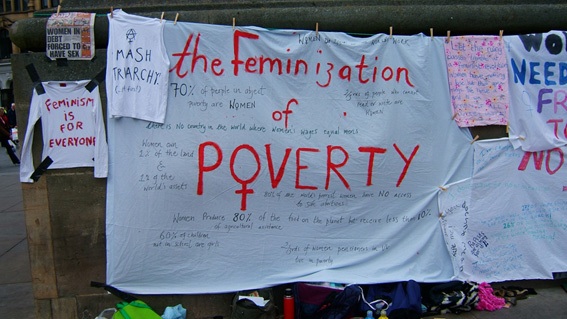
Above: A group of Radical/Anarcho Feminists from Newcastle upon Tyne gathered at Greys Monument in the city’s centre on Saturday 7th March 2009 to take action on the eve of International Women’s Day.
[this image was found here]

A.R.P.'s UK correspondent, Christina, has provided me with two new articles, highlighting what's going down across the pond. One of the links she sent was in the last post. This other link has to do with the well-needed burst of feminism in the UK, due in part to the failures of a racist, pornographised culture to do anything good for women, and the sleazy tactics of Father's Rights groups to strengthen hetero male supremacy and harm children and women.

Hi Julian,
 
Here is a bit of good news.  Sadly it is only a STEP in the right direction.  But at least it is something.
 
  
Now more then ever we need to be educating our young girls, especially girls of colour about the evils of WHMs.  They need to realise that there is much that still needs to be done and by standing together we could remove all WHMs from power and liberate our nations.
 
Both the US and UK are crying out to be liberated from these evil oppressive WHMs.
 
Christina

[What follows is from that link above.]

The march of the new feminists

Women's groups are thriving for the first time in a decade as young Britons rediscover gender issues
By Susie Mesure

Sunday, 29 November 2009
    March against male violence: 2,000 women joined the 2008 Reclaim the Night demo in London
    FAWCETT SOCIETY
    March against male violence: 2,000 women joined the 2008 Reclaim the Night demo in London

    They are the Topshop generation: young girls more used to partying than protesting; keener on women's looks than women's lib. But now they have had enough. A new wave of feminists, some still in their teens, are putting the struggle for women's rights back on the agenda for the first time in a decade. 


    The feminist resurgence has spawned a flurry of new blogs, magazines, books, societies, conferences and protest marches – and this time dungarees are out.

    On university campuses, women's groups are thriving once more, while hundreds of women each month are joining new feminist networks in cities from Birmingham and Manchester to Glasgow and London.
    The old-school Fawcett Society, which dates back to the suffragists, has seen its membership jump by 25 per cent in the past 12 months and the number of its newsletter subscribers double; while earlier this month, more than 2,000 women took to London's streets to "Reclaim the Night" from the men who make them unsafe. Similar marches have been held in cities all over the country. And websites such as The F-Word, started by Catherine Redfern eight years ago as a forum for contemporary feminism, is getting more than 110,000 hits a month.

    Campaigners say the trigger for the new burst of activity is a growing frustration that women still lag men in all walks of life a century after the suffragettes began their fight. In the workplace, the boardroom and the home, not to mention the political system and in popular culture, women are still battling acute gender bias that means globally they earn less, despite working harder than men. According to Professor Richard H Robbins, women do two-thirds of the world's work, yet receive only 10 per cent of the world's income.

    Activists also cite a growing "objectification" of women that has recently seen universities reintroduce beauty pageants and the number of lap-dancing clubs in the UK explode to 300 – not to mention the proliferation of lads' magazines such as Nuts and Zoo, which feminist groups such as Object are fighting to get banished to newsagents' top shelves.

    Finn Mackay, who heads the London Feminist Network, said young women were leading the new movement "because they are the ones bearing the brunt of today's objectifying culture and they have stopped finding that amusing".

    A new poll of feminists revealed that nearly half are under 25, with almost three-quarters of the 1,300 surveyed saying they started to identify with being a feminist while still in their teens.

    Catherine Redfern, who conducted the survey for Reclaiming the F Word: The New Feminist Movement, which she is co-writing with Kristin Aune, said: "We want to tell people that feminism is still here, and is a growing, vibrant movement." Theirs is one of three books on feminism due out in the next few months, including Natasha Walter's Living Dolls: The Return of Sexism.

    Kat Banyard, the Fawcett Society's campaigns director and author of The Equality Illusion, due out in March, said: "The mainstreaming of the sex industry has been the biggest catalyst [for the resurgence]. It's brought sex on to the high street. The bottom line is there is a need for feminist activism, despite the gains that have been made."

    Campaigners such as Object's Anna van Heeswijk are already notching up victories. An amendment to the Police and Crime Bill was passed earlier this month that will help to halt the sex industry's proliferation on to the high street. "Next year could be the year that we reclaim the F-word for what it is, one of the world's most important movements for social justice," Ms van Heeswijk added.

    Ellie Levenson
    The Noughtie Girl's Guide to Feminism
    Although not to everyone's tastes – ie, the chick-lit approach – the former comedian's take on lipstick feminism ended an 11-year feminist publishing drought this summer.

    Natasha Walter
    Living Dolls: The Return of Sexism
    After arguing feminism shouldn't police women's clothes and sexual behaviour in her last book, she's back, worrying about the hypersexual culture round young girls.

    Kat Banyard
    The Equality Illusion
    The title says it all: the Fawcett Society's campaigns officer rips apart the belief that feminism has achieved its aims – men and women are equal – and calls for more action.

    What's Wrong with the Father's Rights Movement? Read this...


    [image is from here]


    Thanks to Christina, the A.R.P. UK correspondent, for bringing this to my attention. Her email to me reads as follows:
     
    Together with MRAs I find fathers rights extremely irritating and offensive.
    Fathers rights (FRs) are just another white hetro boys club set up by predominantly WHMs to ensure that their rights to own and oppress their own wives and daughters are maintained. 
     
    I came across this article on FRs and how it contributes to violence against women.  Personally I believe the article is not been critical enough about FRs but at least it shows that people are realising that FRs is a problem.
    http://survivingdating.com/?p=1084
     
    As far as I am concerned all divorces should take place under feminist law instituted by a feminist judge who is only concerned about protecting the wife and child and not helping WHM oppress and harass their wife and child.
     
    Christina
    *     *     *
    All that follows is from that link above.
    *     *     *

    Sign this petition to stop court ordered child abuse in your Congressional district!

    Father’s Rights and Violence Against Women 

    by Dr. Michael Flood

    In this talk, I’m going to focus on the ‘fathers’ rights’ movement, and their impact on violence against women.

    Introduction: The fathers’ rights movement
    The fathers’ rights movement is defined by the claim that fathers are deprived of their ‘rights’ and subjected to systematic discrimination as men and fathers, in a system biased towards women and dominated by feminists. Fathers’ rights groups overlap with men’s rights groups and both represent an organised backlash to feminism. Fathers’ rights and men’s rights groups can be seen as the anti-feminist wing of the men’s movement, the network of men’s groups and organisations mobilised on gender issues (Flood, 1998).
    fathers rights, feminism, domestic violence, violence against children, battered women, men's rights movement

    Two experiences bring most men (and women) to the fathers’ rights movement. The first is deeply painful marriage breakups and custody battles. Fathers’ rights groups are characterised by anger and blame directed at ex-partners and the ‘system’ that has deprived men or fathers of their ‘rights’, and such themes are relatively common among men who have undergone separation and divorce. The second experience is non-resident fathers’ dissatisfaction with loss of contact with their children or with regimes of child support.

    The fathers’ rights movement focuses on trying to re-establish fathers’ authority and control over their children’s and ex-partners’ lives, on gaining an equality concerned with fathers’ ‘rights’ and status rather than the actual care of children, and on winding back legal and cultural changes which have lessened gender inequalities.

    Fathers’ rights groups are well-organised advocates for changes in family law, and vocal opponents of feminist perspectives and achievements on interpersonal violence.

    Impact of the fathers’ rights movement on violence against women
    The fathers’ rights movement has had four forms of impact on violence against women.

    Priviledging contact over safety
    Most importantly, the fathers’ rights movement has influenced family law, with damaging consequences for women, children, and indeed men. Above all, fathers’ contact with children has been privileged, over children’s safety from violence. [See The Custody Scam, the story of Dawn Axsom, Child Abuse: When Family Courts Get it Wrong, Letter to Judge from Jury foreman regarding prosecution of mother trying to protect her children from abusive father, or watch the PBS documentary Breaking The Silence; Children's Stories at the bottom of this post.--Deborrah]

    An uncritical assumption that children’s contact with both parents is necessary now pervades the courts and the media. The Family Court’s new principle of the ‘right to contact’ is overriding its principle of the right to ‘safety from violence’. The Court now is more likely to make interim orders for children’s unsupervised contact in cases involving domestic violence or child abuse, to use hand-over arrangements rather than suspend contact until trial, and to make orders for joint residence where there is a high level of conflict between the separated parents and one parent strongly objects to shared residence.

    The fathers’ rights movement has been unsuccessful in achieving its key goal of a rebuttable presumption of children’s joint residence after separation. However, other changes in family law and government policy over the last two years have reflected its influence. Recent reforms mean that greater numbers of parents who are the victims of violence will be subject to further violence and harassment by abusive ex-partners, while children will face a greater requirement to have contact with abusive or violent parents.

    Current government policy echoes many of the key themes of the fathers’ rights movement. Both government policy and many fathers’ rights groups are guided by two central, and mistaken, assumptions: that all children see contact with both parents as in their best interests in every case, and that a violent father is better than no father at all (DVIRC, 2005, pp. 5-6). Both bodies talk of ‘conflict’ rather than violence, neglect violence as a legitimate issue for the courts and family services to address, emphasise mediation and counseling as solutions, and focus on punishing women for making false allegations or breaching contact orders.

    Discrediting victims
    The second impact the fathers’ rights movement has had on violence against women is in discrediting victims. Fathers’ rights groups tell two key lies.

    First, fathers’ rights groups tell the lie that women routinely make false accusations of child abuse to gain advantage in family law proceedings and to arbitrarily deny their ex-partners’ access to the children.
    Second, fathers’ rights groups tell the lie that women routinely make up allegations of domestic violence to gain advantage in family law cases and use protection orders to remove men from their homes or deny contact with children rather than out of any real experience or fear of violence.

    I have written detailed critiques of these first two lies, and they are available both online and in the latest issue of the Australian journal Women Against Violence. I can send copies to anyone who wishes.

    Men’s versus women’s violence (Impact on perceptions of intimate violence)
    Related to this, the fathers’ rights movement also has had some impact on public perceptions of intimate violence. In particular, it tells the lie that domestic violence is gender-equal or gender-neutral – that men and women assault each other at equal rates and with equal effects.

    While I’ve called this a lie, this is one claim for which there is some academic support.

    To support the claim that domestic violence is gender-symmetrical, advocates draw almost exclusively on studies using a measurement tool called the Conflict Tactics Scale. The CTS situates domestic violence within the context of “family conflict”. It asks one partner in a relationship whether, in the last year, they or their spouse have ever committed any of a range of violent acts. CTS studies generally find gender symmetries in the use of violence in relationships. There are three problems with the use made of such studies by fathers’ rights activists.

    First, men’s rights and fathers’ rights groups make only selective use of this data, as CTS authors themselves reject efforts to argue that women’s violence against men is as common or as harmful as men’s violence against women (Kimmel 2001, p. 22).

    dating violence, domestic violence, abusive men, child custody battles, child abuse, violence against women, abusive menSecond, there are methodological problems with the Conflict Tactics Scale. The CTS is widely criticized for not gathering information about the intensity, context, consequences or meaning of the action. The CTS ignores who initiates the violence (when women are more likely to use violence in self-defense), assumes that violence is used expressively (e.g. in anger) and not instrumentally (to ‘do’ power or control), omits violent acts such as sexual abuse, stalking and intimate homicide, ignores the history of violence in the relationship, neglects the question of who is injured, relies on only one partner’s reports despite poor interspousal reliability, and omits incidents after separation and divorce, which is a time of increased danger for women.

    Third, a wide range of other data find marked gender asymmetries in domestic violence. For example, crime victimization studies based on large-scale aggregate data, household and crime surveys, police statistics, and hospital data all show that men assault their partners and ex-partners at rates several times the rate at which women assault theirs and that female victims greatly outnumber male victims (Tjaden & Thoennes 2000, pp. 25-26).

    Feminist and other scholars have worked to reconcile the conflicting findings of these bodies of data. One important insight is the recognition of different patterns of violent behaviour in couples and relationships. Some heterosexual relationships suffer from occasional outbursts of violence by either husbands or wives during conflicts, what some (Johnson 1995, 284-285) call “common couple violence”.

    Here, the violence is relatively minor, both partners practise it, it is expressive in meaning, it tends not to escalate over time, and injuries are rare. In situations of “patriarchal terrorism” on the other hand, one partner (usually the man) uses violence and other controlling tactics to assert or restore power and authority. The violence is more severe, it is asymmetrical, it is instrumental in meaning, it tends to escalate, and injuries are more likely.

    CTS studies are only a weak measure of levels of minor ‘expressive’ violence in conflicts among heterosexual couples. They are poorer again as a measure of ‘instrumental’ violence, in which one partner uses violence and other tactics to assert power and authority (Johnson 1995, 284–285).

    There is no doubt that men are the victims of domestic violence. Men experience domestic violence at the hands of female and male sexual partners, ex-partners, and other family members.

    A growing body of research tells us that there are important contrasts in women’s and men’s experiences of domestic violence. Women are far more likely than men to be subjected to frequent, prolonged, and extreme violence, to sustain injuries, to fear for their lives, and to be sexually assaulted (Kimmel 2001, 19; Bagshaw et al. 2000). Men subjected to domestic violence by women rarely experience post-separation violence and have more financial and social independence. Female perpetrators of domestic violence are less likely and less able than male perpetrators to use nonphysical tactics to maintain control over their partners (Swan & Snow 2002, 291-292).

    Women’s physical violence towards intimate male partners is often in self-defense (DeKeseredy et al. 1997; Hamberger et al. 1994; Swan & Snow 2002, 301; Muelleman & Burgess 1998, 866). On the other hand, women’s intimate violence can also be motivated by efforts to show anger, a desire for attention, retaliation for emotional hurt, and so on (Hamberger et al. 1994). It is inadequate to explain women’s violence simply in terms of their own oppression and powerlessness, and naïve to assume that women are immune from using violence to gain or maintain power in relationships (Russo 2001, 16-19).

    Men are likely to under-estimate and under-report their subjection to domestic violence by women (George 1994, 149; Stockdale 1998, 63). There is no evidence however that male victims are more likely to under-report than female victims. In fact, men tend to over-estimate their partner’s violence and under-estimate their own, while women do the reverse (Kimmel 2001, 10-11).

    The fathers’ rights movement’s attention to domestic violence against men is not motivated by a genuine concern for male victimisation, but by political agendas concerning family law, child custody and divorce (Kaye & Tolmie 1998, pp. 53-57). This is evident in two ways.

    First, the fathers’ rights movement focuses on this violence when the great majority of the violence inflicted on men is not by female partners or ex-partners but by other men. Australian crime victimisation surveys find that less than one percent of violent incidents among men is by partners or ex-partners, compared to one-third of incidents among women (Ferrante et al. 1996, 104). Boys and men are most at risk of physical harm from other boys and men.

    Second, the fathers rights’ movement seeks to erode the protections available to victims of domestic violence and to bolster the rights and freedoms of alleged perpetrators, and this harms female and male victims of domestic violence alike. I turn to this now.

    Protecting perpetrators and undermining supports for victims
    The fourth way in which the fathers’ rights movement has had an impact on violence against women is in its efforts to modify responses to the victims and perpetrators of violence.

    The fathers’ rights movement has sought to wind back the protections afforded to the fictitious ‘victims’ of violence and to introduce legal penalties for their dishonest and malicious behavior. The Lone Fathers’ Association and other groups argue that claims of violence or abuse should be made on oath, they should require police or hospital records, and people making allegations which are not then substantiated, and those who’ve helped them, should be subject to criminal prosecution. They call for similar limitations to do with protection orders.

    Fathers’ rights groups also attempt to undermine the ways in which domestic violence is treated as criminal behavior. They emphasise the need to keep the family together, call for the greater use of mediation and counseling, and reject pro-arrest policies.

    Such changes would represent a profound erosion of the protections and legal redress available to the victims of violence and the ease with which they and their advocates can seek justice. This agenda betrays the fact that the concern for male victims of domestic violence often professed by fathers’ rights groups is rhetorical rather than real. While such groups purport to advocate on behalf of male victims of domestic violence, they seek to undermine the policies and services that would protect and gain justice for these same men. [bold added by Julian]

    Fathers’ rights groups often respond to issues of domestic and sexual violence from the point of view of the perpetrator. And they respond in the same way as actual male perpetrators: they minimise and deny the extent of this violence, blame the victim, and explain the violence as a mutual or reciprocal process (Hearn, 1996, p. 105).

    This sympathy for perpetrators is evident in other ways too. Fathers’ rights advocates have expressed sympathy or justification for men who use violence against women and children in the context of family law proceedings. And, ironically, they use men’s violence to demonstrate how victimised men are by the family law system (Kaye & Tolmie, 1998a, pp. 57-58).

    Members of fathers’ rights groups also act as direct advocates for alleged perpetrators of violence against women. For example, one group distributes pamphlets for ‘victims of a false AVO’, giving no attention to how to respond to ‘true’ perpetrators of violence nor to the safety of family members.

    Fathers’ rights groups also attack media and community campaigns focused on men’s violence against women, call for the de-funding and abolition of what they call the “domestic violence industry”, and engage in the harassment of community sector and women’s organisations which respond to the victims of violence.

    Other, positive responses by men: The White Ribbon Campaign
    This is all pretty depressing news. In this context, I’ve been especially heartened to see a growing positive response by men, in alliance with women, to help stop violence against women. I will focus on one such response.

    White Ribbon Day is the largest effort by men across the world, working in partnership with women, to end men’s violence against women. White ribbons are worn on the day by men to show their concern about violence against women, and by women who are supporting men. It takes place on November 25th, the International Day for the Elimination of Violence Against Women.

    In Australia, White Ribbon Day is organised in part by UNIFEM, a women’s organisation, but it is conducted in partnership with men and men’s organisations. The White Ribbon Campaign focuses on the positive roles that men can play in helping to stop violence against women.

    To find out more, visit the website: http://www.whiteribbonday.org.au/

    Conclusion
    To continue our efforts to prevent violence, several strategies are necessary.

    We must continue to respond effectively to those who’ve experienced this violence, the coalface work that some of you already do.

    We must continue to keep the issue of violence against women on the public agenda.

    We must step up efforts to engage men in positive ways, building partnerships with supportive men and men’s groups. We must confront, or sidestep, the dangerous ambitions and dishonest claims of the men’s and fathers’ rights backlash.

    The achievements of the fathers’ rights movement are already putting women, children and indeed men at greater risk of violence and abuse. The fathers’ rights movement has exacerbated our culture’s systematic silencing and blaming of victims of violence and hampered efforts to respond effectively to the victims and perpetrators of violence.

    However, the new politics of fatherhood has not been entirely captured by the fathers’ rights movement. There is potential to foster men’s positive and non-violent involvement in parenting and families. Key resources for realising the progressive potential of contemporary fatherhood politics include the widespread imagery of the nurturing father, community intolerance for violence against women, growing policy interest in addressing divisions of labour in child care and domestic work, and men’s own investments in positive parenting.

    However, thwarting the fathers’ rights movement’s backlash requires that we directly confront the movement’s agenda, disseminate critiques of its false accusations, and respond in constructive and accountable ways to the fathers (and mothers) undergoing separation and divorce (Flood, 2004, pp 274-278).

    Beating the backlash
    The following are some of the political strategies we can use to help beat the fathers’ rights backlash.
    Discredit fathers’ rights groups. Emphasise that they;
    • Are interested only in reducing their financial obligations to their children;
    • Are interested only in extending or regaining power and authority over ex-partners and children.
    • Do nothing to increase men’s actual share of childcare / parenting or men’s positive involvement in parenting both before and after separation.
    • Collude with perpetrators of violence against women and children, protect and advocate for perpetrators, or are perpetrators.
    • Produce critiques of their lies and their strategies which are credible and accessible.
    • Co-opt the new politics of fatherhood;
    • Support positive efforts to respond to separated fathers. (And emphasise that FR groups fix men in anger and blame, rather than helping them to heal.)
    • Build on men’s desires to be involved (and nonviolent) parents.
    • Find alternative male voices: supportive men and men’s / fathers’ networks and groups.
    ‘Speaking as a father…’

    Tell women’s stories

    Atrocity tales: Stories of abuse and inequality.

    In letters, submissions, on talkback, etc.

    (But beware of the ways in which these can (a) portray women only as victims, (b) homogenise and essentialise women’s (diverse) experiences of violence, and (c) undermine credibility and support. )
    Find and nurture male allies: in government, the community sector, academic, etc.

    More widely, we must continue do the work of violence prevention: to undermine the beliefs and values which support violence, challenge the power relations which sustain and are sustained by violence, and promote alternative constructions of gender and sexuality which foster non-violence and gender justice.

    [For much more of Michael's writings please visit the website he created. This page is of his writings only, but there's LOTS there to bring men's attention to: http://www.xyonline.net/category/authors/michael-flood -- Julian]

    Contact the Author:
    Dr Michael Flood
    Postdoctoral Fellow
    Australian Research Centre in Sex, Health and Society (ARCSHS)
    La Trobe University
    E-mail: michael.flood[at]anu.edu.au
    PO Box 4026, Ainslie ACT, 2602
    Presentation in Panel, “Myths, Misconceptions, and the Men’s Movement”, at Conference, Refocusing Women’s Experiences of Violence, Sydney, 14-16 September.

    The Preacher Peeled His Facemask Off and Revealed He Was a Pimp


     [Image of bust of a slave boy is from here. He has a Trajanic haircut and was named Martial Roman, 98-117 CE/ECD. Marble. Photographer: Getty Villa.]

    TRIGGER WARNING: THIS IS FICTION ABOUT BEING POSSESSED BY PIMPS

    by Julian Real, 2009


    The Preacher peeled his facemask off and revealed he was a Pimp. The next thing that happened was that the Pimp peeled his facemask off and revealed he was a Preacher.

    And so it went, facemask off again and again, Preacher to Pimp, Pimp to Preacher. Sometimes the Pimp was the owner of a brothel, sometimes he had a "collection" of girls and young women, and a young man or two, people he'd seasoned to be "his" money makers by making them accept that all you can do is allow men to have sexxxual access to you, and for the Pimp this was good and right. He preached the goodness and rightness of this like a Catholic leading a congregation to a false heaven. Sometimes the Pimp was a corporate capitalist, overseeing multinational corporations that enslave men, women, and children--disproportionately the latter two groups, to work without wages, to work for a penny an hour, to do work that is needed by thew workers only because it pays more than not working for that Pimp. And because their own economic systems were overtaken by Economic Hitmen, spreading the Word of the Corporate Pimp. But, as always, the Pimp profits far more than they do, which is also to say they never profit.

    What is taken from them is far more expensive than any amount of money they earn. In the poorer countries, indebted to the White Pimps, everyone is more vulnerable in some ways. And stronger in others. Their strength, in part, is in knowing this is not the only way. They remember the past before the Corporate Pimp came to the villages. I never knew such a time. I grew up in land possessed by the White Pimp. Sometimes these White Pimps tells the adult parents in poorer countries he can do good by them, and make sure their children have a better life, get a good education, get good jobs and send back money so they can join their children in the Promised Land. Or return to start small businesses there. But once the White Pimp has the children he turns them into his sexxx slaves, he trafficks them around the world, he turns women into sexxx slaves and trafficks them around the world. This is no way to be a world traveler.

    When I was trafficked as one of the young males, all I saw was the same basic thing over and over. Never new art collections or historic sites. Never grand vistas or ecological wonders. All I saw was the Prostituter's will manifested in his body actions, and then the next, or many at the same time. All I saw was greed, and more greed. All I saw was men who couldn't ever really see me as a person. All I ever saw was that the world was filled with Prostituters content to give their money to my Pimp so they could have access to me to do to me whatever they wanted to do. Often they enjoyed rape. Or just humiliating me. Or just turning me into some actor in their sick play. Sometimes they wanted me to "hurt them". I didn't want to--I knew what it was to be hurt--but if I didn't they'd beat me until I did it. The Pimp would sometimes get angry at them for beating me. He'd tell them "That's MY job!"

    Sometimes when the Pimp was busily seasoning the newer "acquisitions", the Pimp let me live with one of these Prostituters, who paid my Pimp handsomely for the ability to have me around. Sometimes the Prostituter-Purchaser fed me delicious food and pretended to love me. I thought maybe I loved him for a time. But he required me to still have sexxx with him. I knew I couldn't ever say no to him and I never dared to. And he'd arrange for me to do sexxx with all kinds of people. He'd meet people on an Internet group. Then they'd show up. If I refused to give them all what they wanted, of my body, the Prostitutor-Purchaser beat my body. He'd beat me into doing what they all wanted and I learned it is better to do what they want right away, than be beaten and do it later, bruised. When the bruises healed, I was sent back to my Pimp, but something strange happened for one instant. As I left the house where there was good food, I watched my Pimp open his car door and let out a younger male, who went into this same house as I left and got into my Pimp's car. As I passed him he looked down, but I took his face in my hand and looked into his eyes. There wasn't much there, but I tried to communicate to him to not fight, to never say no; that it will be better for you that way. I wanted to spare him some of the beatings. He looked very sad, and it was, in that instant, like looking into a cracked mirror. I saw my own sadness for the first time.

    I learned a lot during that time. About Powerful men and how to survive among them. About the world of Powerful men and how they operate; how they know each other through the computer; how they make all this possible; how they pass women and children around regarding our humanity as dirt. I learned so many ways of being treating like dirt.

    Once back with my Pimp I met a women who was not as young as many of the people he owned. She was brought to him by someone to be a part of a sexxx threesome. My pimp had told someone he needed an older woman. She was 27. Her name is L. My Pimp gave her and me to a Pornographer. He's the one that wanted to see a threesome and film it. He has a man there for us to have sexxx with. This Pornographer was the Director. He ordered us to do whatever he wanted. The man was cruel; I could tell he'd been making these films for a long time. He was 29.  L. gave me drugs to be able to do the film work and not look afraid or exhausted or anything at all. I wished I'd had those drugs earlier in my life. But more than that I wished to be out of this, without any drugs, without any Pimps. That's some of what I thought about when drugged, how maybe I could be free of all this, while the scenes were filmed. We worked for him for two days and got too bruised to be of any more use to him. Then he was done with us, so he called my Pimp to come and get me. I'm not sure what the plan was for L. This was when the miracle happened. She had a plan. She knew this Pornographer and L. had saved some money and gave it to him if he'd let us go before my Pimp got there. He agreed. He was high on something at the time and didn't seem to care too much, but he counted the cash. So we escaped.

    We walked fast on the streets. L. knew the city like it was mapped into her mind. She took me down alleys and through dead buildings willed with crack addicts who were of no use to the Pimps because they were too unhealthy. She took me to one building where we were let in only when she said something into a buzzer speaker by a locked entrance door.

    Inside there was furniture, food, and clothes. And a shower. And there were bedrooms that weren't for sexxx. There were about a dozen people living there. It looked like we'd all been through similar stuff. Some of them were still using drugs. But I stopped right away because I felt like maybe I could get closer to my dream of being free.

    This place also had books. L. told me about a writer, Andrea Dworkin, who didn't think we were dirty and said that Pimps lie about what women are for. I couldn't believe someone was allowed to say what she wrote and not be harmed. L. said Andrea had already been harmed.

    L. told me she'd been making connections to other women who had read many books by many women who told the truth about men who hurt women and who were hurt in other ways too, by famine, by men's wars against each other, by racism, because they were lesbians. Some of the people who lived at this home had escaped their Pimps, or made deals with a Procurer to get away. No one ever let any of us go without being paid, though. Except for two or three who were not from our world.

    They were part of a world I imagined was part of the free world. But their stories were also very sad. They'd been treated like dirt at their first homes by the Father, or in their second homes by the Husband. The Husbands were not so different from the Pimps. Except the women could eat there and sleep there and pretend they were not at all like us. They judged us at first, until they knew the truth that we all shared--that none of us were free and living as an unfree person means you do a lot of things you don't want to do, to survive.

    The safe home had people in it who looked haunted. Some of them couldn't get off the drugs and got very sick. Some got sick from diseases they got from the Procurers. L. and I spent our days working to meet others who escaped and we led them to our safe house. It was often sad there, but it was safer than life with the Pimps and the Prostituters. It was free of the external horrors of what Pimps and Procurers do.  But we knew the horrors, and so in that sense we were all haunted.

    Once off drugs, my mind cleared and I felt lots of feelings that I'd never allowed myself to feel before. I felt grief and rage. Something resembling Life entered my eyes.

    During this time some of us read to each other, because many of us didn't know how to read at all, or only a little bit. I learned more about how to read there. L. knew three languages: Spanish, French, and English, and she had been sent to many colonised lands where those languages were spoken. So she knew a lot more than most of us and told us what she knew of the world. Her skin was dark brown. Mine was light brown. The people in the safe house were all colors. L. taught many things to those of us who didn't read well, including how to read in at least two languages. She said only knowing one language is a way to not be free. I didn't understand this at first.

    She had done the most reading of all of us in the safe house and she was strong in ways I envied. Her strength came from knowing her own pain, understanding it, feeling it, and not pretending that she didn't have it. Most of us tried to escape our pain a lot of the time. She taught me there was no freedom in doing that. I watched some in the safe house hurt their own bodies, stay on drugs, or berate themselves in their own minds; they kept repeating what the Pimps and Procurers told them they were. But L. didn't do this. Instead she read Andrea Dworkin books to us. We learned that Pimps lie. At first it didn't feel true. Both Andrea and L. said we weren't dirt. No one was dirt. Not even dirt was dirt. I had to think about this for a long time.

    Slowly I began to understand her. By learning to read and helping each other learn to feel our pain, and our rage, we grew stronger. And we could speak out loud about our stories. One of the women not from my world told us about her husband who was a Catholic Priest. He proclaimed the Power of God to be Righteous and Holy and that Man must Rule women or else they would become heathens, pagans, beasts. He was very respected in his town. He was admired, she said. He proclaimed himself to be a Truth-Teller. She was Black but her husband was white. His congregation was filled with white husbands who beat their wives and raped their wives and also their own children, and sometimes other family's children. Once, she told us where the Priest's church was so L. and I went to hear him. L. was stared at because she was darker brown than me. I passed as white. But the place was really, really white. I didn't know such places existed. They acted strangely even though we'd stolen some clothes from a Goodwill and dressed like they did. We heard this White Priest speak about the Will of God, and I realised his god was also a Pimp. I asked my friend about this, and she said Yes. The White Man's god is usually a Pimp and to beware of anything white men teach.

    No woman is the only battered woman or the only raped woman or the only incested girl. No woman is the only one owned by a Pimp or rented by a Procurer. And if the Preacher is white, beware. For he speaks only of Pimp-the-Father as the one and only god. I don't think white men know G-d at all. I only know about Her because she whispers to me often. She always did but I had to stop listening once the Pimp took me and began to brainwash me. Her voice and his couldn't co-exist in me. So only when his voice was gone, and the memory of it got quieter in my head, Her voice could be heard again. She spoke of Freedom and Love. And she spoke of the importance of feeling rage and learning to say No to men.

    There are people wandering the Earth who have been told by other Pimps and Preachers that it is ok to treat women like what they think of as dirt. And they do hideous things to people who they get control of, often teens who are desperate and hungry. Or those children who were told they'd have a better life. If only their parents knew. If only they knew. But maybe it is better that they not know. Their choices are limited once the White Man takes over your economic system, your culture, and tells you your history isn't right or accurate.

    The other day I was walking the street looking for any boys who seemed lost. My friend was out looking for girls and women. When possible we tried to get to them before the Pimps did. And what I saw was another miracle: that boy who replaced me in the Procurer's house was doing the same thing I was! He had Life in his eyes, pain and rage. He was part of another safe house. We embraced and we cried. I hadn't cried in a long time. It felt good.

    He told me his story. He'd been raised by a white Preacher who incested him and also seasoned him too. But he did something I didn't know you could do. One day, while his Father-Preacher-Pimp slept, he took a knife and stabbed him in his cold, corrupt heart. And then he ran away. And now he was as free as he had ever been in his life.

    Monday, December 7, 2009

    An Andrea Dworkin Quote, that fits with recent discussions

    Dworkin said in a speech delivered at Smith College that later become a chapter in her book Our Blood: Discourses and Prophesies on Sexual Politics, “As feminists, we inhabit the world in a new way. We see the world in a new way…We intend to change it so totally that someday the texts of masculinist writers will be anthropological curiosities. What was that Mailer talking about, our descendants will ask, should they come upon his work in some obscure archive. And they will wonder–bewildered, sad–at the masculinist glorification of war; the masculinist mystifications around killing, maiming, violence, and pain; the tortured masks of phallic heroism; the vain arrogance of phallic supremacy; the impoverished renderings of mothers and daughters, and so of life itself. They will ask, did those people really believe in those gods?”
    (source: here)

    Who's Your Terrorist? Notes on Who is Socially Allowed to Define the Term and Name the Perpetrators


    [image of text is from here]

    Offline I am in discussion with a rare white heterosexual profeminist man who wonders about how to effectively intervene on men's sexist behaviors. This post is for him and all the other men who wonder about how to do this effectively and in alliance with feminist women. It is for radical feminists here to tell me whether what I do here is in alliance with them. Some of what I do, admittedly, is not.

    What follows will likely not make much sense unless and until you perceive and realise the following social truth, a truth about "civilisation" as white men define the term:
    Civilization is based on a clearly defined and widely accepted yet often unarticulated hierarchy. Violence done by those higher on the hierarchy to those lower is nearly always invisible, that is, unnoticed. When it is noticed, it is fully rationalized. Violence done by those lower on the hierarchy to those higher is unthinkable, and when it does occur is regarded with shock, horror, and the fetishization of the victims. -- Derrick Jensen, Endgame: Volume One
    I have been following some blog discussions, where men get to say what is and isn't sexist, heterosexist, misogynistic, and violent.

    I want to publicly support at least a few radical feminist women (one of whom is white) who are identifying a rather pernicious and persistent problem in patriarchies: the matter of who gets to define terms, name behavior, and be seen socially as an annoyance, a threat, or a terrorist? Who gets to be defined as sane or crazy, mentally well or mentally ill? Who gets to be seen and treated as if what they have to say makes sense and who gets to be treated systematically as if what they have to say is utter rubbish, without veracity, validity, or merit?

    One woman is having to make the case that a man is being a misogynistic jerk, and is likely an abuser of women, for he goes out of his way to defend abuses of women as legitimate forms of behavior by men towards women. For more on that, go to the Celie's Revenge blog.

    Another woman has been feeling crazy because some dickwaddish man who portrays himself as profeminist or antisexist, will not be accountable to her, and will, instead, remain silent while others repeatedly abuse her in writing.

    To that woman I wrote a slightly different version of what follows. You might wish to note that this blogger uses the term "her" and "she" generically, to refer to people male and female. I do not:
    Keep in mind the madness, truly, is in the way [he] has been behaving throughout, along with his supporter(s), and in the way the [allegedly profeminist group he has connection to] is NOT responding. THAT is patriarchal, pro-male supremacist madness (called perfectly acceptable and nonviolent behavior by the powers that rule).

    What you're experiencing, if I'm hearing you and understanding your plight with any degree of accuracy, is an appropriate response to madness presented as normality. AND that you have been feeling what I can only term "an appropriate range of feelings", including, partly, feeling crazy for thinking there's something really wrong going on in this antifeminist/anti-woman militantly "climate-controlled environment" called white male supremacist "civilisation".

    What is one to feel in a situation that is utterly insane and maddening? Sane? Happy? Calm? At peace? I don't think so.

    The dilemma faced by most oppressed people that I know, including myself as a gay white Jewish man on two of those four counts, is that if we are to refuse to name things the way dominant society does, and, especially, if we are to DEMAND accountability, we will be made to feel like we're ridiculous, silly, crazy, stupid, and EXTREMELY hostile to "a normal, well-functioning society".

    The violence the society does is not called violence, after all. Any resistance to it, or critique of it's alleged non-violence is considered an atrocity against the State and its actors.

    For more on that go to the blog Another Scene is Possible.

    A third situation has to do with a woman questioning the ethics, the politics, of why and whether a state or government gets to label someone a terrorist, and whether carriers of HIV ought to be called, specifically, "bioterrorists". To that woman I responded with a revised version of what follows:

    If we’re going to go THERE, as a society…….
    Then aren’t all heterosexually active men “bioterrorists” if they carry the forms of HPV that cause cervical cancer in women, if such men either rape women or coerce women into having genital sexual intercourse without a condom–or any other form of sex that allows for the virus to be spread–including a man touching his own genital fluids and then touching her genitals (that’s all it takes). Or any man who welcomes the opportunity to have genital sexual intercourse without a condom by any woman with a cervix who is not aware he has such strains of HPV?

    We know the raper is a terrorist, regardless; well, "decent good civilised people don't" but some of us do. But any man that carries the strains of HPV that cause cervical cancer who hase the kinds of sexual contact that allow any woman he is sexual with (any woman with a cervix), to contract this STI/STD, is putting that woman’s lives at risk--isn't he? And what shall we call him if we're going to call the man with HIV a "bioterrorist"?

    IF we’re going to go THERE, let’s not discriminate and leave out all the straight men do to spread lethal STIs/STDs that aren't HIV.

    For more on that go to the blog The Feminist Texican.

    And finally there's the "proudsoldier" who stopped by here and posted what was, to me, a piece of intellectual and political absurdity. Here's my exchange with him, which just took place on the thread about the Montreal Massacre, posted here on Dec. 5th, for Dec. 6th. I am especially disgusted with this man for having the audacity to say what he did in a place designed to honor and remember women killed by a man. You'll see what occurs to him to say, in some form of disgust or outrage, in response me taking a bit of time to remember one particular politically common woman-killing atrocity. He seems intent on naming THAT assassin some sort of quirky atypical madman, while calling the others good and decent men. I disagree.

    proudsoldier said...
    I read this and am so very sad on your confusion of what all decent men stand for. The basic good that we all live to protect is never recognized by your harsh minority huddled in coffee shops or campus basements. While you use your limited and small voice to lay waste, remember those of us fighting and dying every day to protect mothers’ daughter and SONS in shit holes like Afghanistan. Of course you won’t. Like any political body you will use the actions of a sick maniac as a calling card to support your bitterness and discrimination. It's ok though, the vast huge majority is with us. Including my now past working mother who always said. "Be a man". To the jerk off that killed the women? It's sad before you erased the lives of so many future mothers, wives and professionals that you didn't reverse the order of your crime. I dare you to post this. Of course you won’t. But thats ok, we will still rise everyday, in filth & poor weather to protect you as best we are able, against people that hate, world wide until the only thing we have left to offer is our lives. The very brush you hate is now the same one you use. [end of proudsoldier's rant.] My response to his histerical rant is here. Scroll down on that blog page if you wish to read it.

    Saturday, December 5, 2009

    Gynocide: Recognising the 20th Anniversary of the Montreal Massacre of Fourteen Women, Killed on 6 December 1989


    [memorial image with names of women is from here]

    "We have been asked by many people to accept that women are making progress, because one sees our presence in these places where we weren't before. And those of us who are berated for being radicals have been saying: 
    'That is not the way we measure progress. We count the number of rapes. We count the women who are being battered. We keep track of the children who are being raped by their fathers. We count the dead. And when those numbers start to change in a way that is meaningful, we will then talk to you about whether or not we can measure progress.'"--Andrea Dworkin [this quote is from:]
    MASS MURDER IN MONTRÉAL -- The Sexual Politics of Killing Women, in Life and Death.


    I remember the day very well. It was a horrible thing to learn about; the details unfolded and I can recall specifically when the misogynist assassin's statement was released, and the terror of knowing that now feminists and women who are perceived as such will not just be mistreated, misunderstood, maligned, and viciously degraded by corporate pimps. Now men will kill women "more efficiently", not just one by one privately, but in groups in social spaces. I knew this was, in no uncertain terms, a political act of misogynistic terrorism. And I remember being furious that the press kept focusing on the mass murderer, on his life, as if there were secrets in his past that could explain this.

    What more of an explanation is there than the fact that in North American in 1989, as before and ever since, woman-hating is enacted by men violently and systematically against the minds and bodies of women, with systems of white male supremacist power firmly in place to ensure such men don't stop. I remember being shaken by the virulence of the killer's woman-hating--so undisguised, so utterly blatant, and so terribly lethal.
    Surely now, I thought twenty years ago, we--the many citizens and the press and other media of the West--cannot deny that gynocide (or as many women say, femicide) is a fiction. Surely now it is plainly clear to all that this is much more than an idea in many men's minds, that it isn't just privatised and happening to one woman at a time.

    What I didn't quite imagine--only because I didn't want to believe that men would remain so grotesquely callous--is that twenty years later there would be men, individually and in groups, who celebrate the murderer as a hero for men. Knowing this, and everything else that I know that men do to women to control them and to harm them, means that nothing is off limits in the misogynist imagination, and that as long as State power is on men's side, as long as there are male supremacist States, there can be no meaningful progress, no significant movement toward safety and dignity for girls and women.

    So my hope and my support for a revolution led by women grows stronger every day, as I know nothing short of radical change will do. And this shift must include the removal not just of all who harm women misogynistically, but also the removal of those men, each and every one of them members of the dominant gender class, who would consider a killer of eleven women going to an engineering school a hero for men. If one's humanity is so void, so bankrupt, then let these beings disappear from the Earth, for the good of all.

    If you don't yet know the horrific story, just below is a link to the powerful telling by Lee Lakeman of Vancouver Rape Relief. To read her account, click on the following URL: http://www.rapereliefshelter.bc.ca/dec6/leearticle.html

    ALL OF WHAT FOLLOWS is a news article offering some reflection on what's happened in the last twenty years. And remembrances of that awful day. It is from here.

    'Progress and regress' in women's rights since Montreal Massacre: Prof.

    Friday, December 4th, 2009 | 1:00 pm
    Canwest News Service

    Sunday marks the 20th anniversary of the day Marc Lepine walked into Montreal's Ecole Polytechnique and, in the guise of fighting feminism, killed 14 women in the deadliest shooting in Canadian history.

    For many Canadians, who will never forget where they were when they heard the news, the day is seared into their consciousness and a rallying point in combating violence against women. But today's campuses are filled with undergraduates who were toddlers, or not yet born, when the Montreal Massacre occurred and for whom the event has little, if any, direct resonance.

    "I think we have to acknowledge that Dec. 6, 1989 changed how Canadians think about violence against women," said Connie Guberman, status of women officer and women's studies professor at the University of Toronto.

    "So whether one is 18-years-old and wasn't born yet, the historical reality for those of us who have been around awhile (is that) that mass murder, which is the largest in Canada's history, changed our consciousness about the issue of violence against women. Prior to 1989, those of us active in this movement had to convince people that it was a real issue."

    U of T held ceremonies at all three of its campuses on Friday, she said, with the focus on fighting violence against women as well as paying tribute to the 14 lives lost.

    Ecole Polytechnique will mark the sombre milestone with a ceremony that's expected to draw 1,000 people, and they're encouraging members of the community to leave flowers at a memorial bearing the names of the 14 women killed.

    At Montreal's McGill University, the student society's Sexual Assault Centre is hosting a memorial on Sunday, but Daniel Redmond, a 24-year-old social work student who spearheaded a white-ribbon campaign for men against violence against women, was surprised more wasn't done to honour the 20th anniversary.

    People his age or slightly younger know about Dec. 6 and its significance if they're socially aware, he says, but "it's not visceral to this age group anymore."

    "I think part of it comes from an overall desire to move past it and to let it go," he said of the relatively quiet passing of the anniversary. "Too many people are not recognizing that it is still an issue."

    Monique Frize had just assumed the national role of Nortel-NSERC Women in Engineering Chair at the time of the shooting, and her first duty was attending the funeral services of the victims. She remembers looking at the white caskets and the families, she said, and vowing to draw more women into the field where Lepine felt they didn't belong.

    Since then, there's been "progress and regress" in women's rights, she said, but Dec. 6 taught her and many others the meaning of feminism – a lesson she believes is needed now for younger generations who are adverse to the term and being "gagged."

    "People would say: 'Are you a feminist?' and I'd say no because I didn't know what it was, but I'd been a feminist all my life without knowing," said Frize, now an engineering professor at Carleton University, with a joint appointment at the University of Ottawa. "I took the massacre as violence against women in an ultimate, extreme way, but it also to me represents violence in families and homes, in the military, violence to women in general."

    Recent cases have seen women and girls targeted for mass murder by men who blamed them for their problems, as Lepine did.

    George Sodini opened fire on an aerobics class full of women in Pennsylvania in August, after posting online diary entries ranting about his rejection by the opposite sex.

    In 2006, Charles Carl Roberts entered an Amish schoolhouse in Pennsylvania, ordered the boys to leave and shot the girls in the head, killing five of them aged seven to 13. A suicide note he left for his wife claimed he had molested two young female relatives years earlier and feared he would do so again.

    The Women's Resource Centre at the University of Calgary co-ordinates a Polytechnique memorial every year, says executive director Stephanie Garrett, and the event is one of the university's biggest in terms of drawing people from the wider Calgary community.

    "The people who come every single year are always the same people, of a certain generation where they were either at university at the same time as this took place, around the same age as the women that were killed, or else they were in some way related to the issue so they feel a strong need to remember once a year and reflect on what happened," she said.

    They work hard to help younger students understand the context of Dec. 6 and how it relates to them now, Garrett said, and they've seen students tackling these issues in contemporary ways, hosting social networking groups and screening Polytechnique, the 2009 film dramatization of the events.

    "Having not faced all of the news and understanding of it at the time, it's different for them," she said. "But we also live in a completely different world where they have far more international media and communications around the war in Iraq and Afghanistan, and there's a more global feel to the issues."

    In a statement, Ecole Polytechnique said the courage, solidarity and accomplishments of members of the school community over the last 20 years are the best homage they can offer to the victims' memory.

    "On this occasion, we would like to reaffirm our hope and faith in the future," the school said. "Time does not heal a tragedy like this one, but life is here and waiting for us to live it.
    14 women died at Marc Lepine's hands on Dec. 6, 1989:
    Genevieve Bergeron
    Helene Colgan
    Nathalie Croteau
    Barbara Daigneault
    Anne-Marie Edward
    Maud Haviernick
    Barbara Klucznik-Widajewicz
    Maryse Laganiere
    Maryse Leclair
    Anne-Marie Lemay
    Sonia Pelletier
    Michele Richard
    Annie St-Arneault
    Annie Turcotte
    Canadians of different ages have different impressions of the event, but many will never forget where they were when they heard the news.

    – "I was living in Moncton and I was upstairs reading and my husband called from downstairs, 'Monique, Monique, come and see this!' I went down (to watch the news) and we were both in tears, it was unbelievable. My first day on the job, instead of being in my office at the University of New Brunswick, it was at the cathedral in Montreal for the funeral. It was a hard way to start a job attracting more women into engineering."

    – Monique Frize, retirement age, an engineering professor at Carleton University and the University of Ottawa who had just been appointed Nortel- NSERC Women in Engineering Chair at the time of the shooting.

    – "I know exactly where I was. Dec. 6, 1989 was a Wednesday; for many years I taught the introduction to women's studies course on Wednesdays at that time and it was the last class of the term. The class ended at 9 o'clock and we all said goodbye, and by the time I got home, I had calls from students saying, 'Are you all right? I need to connect with you.' They felt that they would have been the targets if it had been on our campus, students in women's studies. They phoned me at home and they left messages at my office to say, 'I need to connect with someone. Can you believe this happened? How do we make sense of it?'"

    – Connie Guberman, 54, status of women officer and professor of women's studies at the University of Toronto.

    – "I'm not sure how well I understood it. All I knew is that in your gut, anytime you hear that multiple women were killed by a man who believed they shouldn't be studying what they were studying, you know that you want to do something about that. You know that those people still exist; violence takes place in different ways now."

    – Stephanie Garrett, 29, executive director of the Women's Resource Centre at the University of Calgary.

    – "People who are specifically fitting in my age group or the year or two around that, there does tend to be some awareness of it, despite the fact that personally, I would have been four when the massacre occurred. At each point that I've looked at it and kind of taken it in, you get that drop in your stomach. Every time, I'm just horrified and I hear his words and it just, for lack of a better word, it just shreds me."

    – Daniel Redmond, 24, social work student at McGill University who's running a white-ribbon campaign for men against violence against women.

    From Marx to Morales: on Eurocentrism, Marxism, and Latin American Liberation Struggles


    Please let me know if there are other writings like this by Latina and Central and South American women, particularly Indigenous women. I greatly prefer herstory/history and analysis from the people who are doing the activism, especially from women of color in countries and regions that are and are not white-majority. As U.S. Supreme Court Justice Sonia Sotomayor indicated, generally speaking, a Latina woman is going to be smarter and wiser about most things than a U.S. white man, given life experience, political/structural location, and the lack of entitlements to not be aware of what's happening to women of color, who are, after all, the human majority. This global majority includes Black women, Asian women, and Indigenous women globally, in and beyond the Americas, across the so-called Northern and Southern hemispheres of the Earth.

    On occasion, white men do occasionally have something critically insightful to say about our ecocidal ways of being and the political practices that enforce and constitute our manhood, our heterosexism, our whiteness, or our Western biases and eurocentrism. Hence my recommendations that Western white men read the work of both Derrick Jensen and fellow radical, but not a relative, Robert Jensen whose work I deeply appreciate and am happy to promote. For the record, I am not a marxist, not that there's anything wrong with that. I am a radical profeminist/pro-Indigenist. And to my knowledge, there few to no marxists who are both of those things, hence my allegiances elsewhere.

    To be clear: ALL THAT FOLLOWS (including the image beginning this post) IS FROM HERE.

    John Riddell is co-editor of Socialist Voice, a newsletter and content service that provides news and analysis of today’s struggles of the workers and oppressed, from the standpoint of revolutionary Marxism. It is based in Canada but is international in scope. He is also the editor of The Communist International in Lenin’s Time, a six-volume anthology of documents, speeches, manifestos and commentary. This article is based on his talk at the Historical Materialism conference at York University in Toronto on April 26, 2008.

    Karl Marx

    Over the past decade, a new rise of mass struggles in Latin America has sparked an encounter between revolutionists of that region and many of those based in the imperialist countries. In many of these struggles, as in Bolivia under the presidency of Evo Morales, Indigenous peoples are in the lead.

    Latin American revolutionists are enriching Marxism in the field of theory as well as of action. This article offers some introductory comments indicating ways in which their ideas are linking up with and drawing attention to important but little-known aspects of Marxist thought.

    Eurocentrism
    A good starting point is provided by the comment often heard from Latin American revolutionists that much of Marxist theory is marked by a “Eurocentric” bias. They understand Eurocentrism as the belief that Latin American nations must replicate the evolution of Western European societies, through to the highest possible level of capitalist development, before a socialist revolution is possible. Eurocentrism is also understood to imply a stress on the primacy of industrialization for social progress and on the need to raise physical production in a fashion that appears to exclude peasant and Indigenous realities and to point toward the dissolution of Indigenous culture.[1]

    Marx’s celebrated statement that “no social order ever perishes before all the productive forces for which there is room in it have developed”[2] is sometimes cited as evidence of a Eurocentric bias in Marxism. Karl Kautsky and Georgi Plekhanov, Marxist theorists of the pre-1914 period, are viewed as classic exponents of this view. Latin American writer Gustavo Pérez Hinojosa quotes Kautsky’s view that “workers can rule only where the capitalist system has achieved a high level of development”[3] — that is, not yet in Latin America.

    The pioneer Marxists in Latin American before 1917 shared that perspective. But after the Russian Revolution a new current emerged, now often called “Latin American Marxism.” Argentine theorist Néstor Kohan identifies the pioneer Peruvian Communist José Carlos Mariátegui as its founder. Mariátegui, Kohen says, “opposed Eurocentric schemas and populist efforts to rally workers behind different factions of the bourgeoisie” and “set about recapturing ‘Inca communism’ as a precursor of socialist struggles.”[4]

    National subjugation

    José Carlos Mariátegui

    Pérez Hinojosa and Kohen both take for granted that Latin American struggles today, as in Mariátegui’s time, combine both anti-imperialist and socialist components. This viewpoint links back to the analysis advanced by the Communist International in Lenin’s time of a world divided between imperialist nations and subjugated peoples.[5] Is this framework still relevant at a time when most poor countries have formal independence? The central role of anti-imperialism in recent Latin American struggles would seem to confirm the early Communist International’s analysis.

    Pérez Hinojosa tells us that Mariátegui recognized the impossibility of national capitalist development in semi-colonial countries like Peru. The revolution would be “socialist from its beginnings but would go through two stages” in realizing the tasks first of bourgeois democratic and then of socialist revolution. Moreover, the Peruvian theorist held that “this socialist revolution would be marked by a junction with the historic basis of socialization: the Indigenous communities, the survivals of primitive agrarian communism.”[6]

    Subsequently, says Kohen, the “brilliant team of the 1920s,” which included Julio Antonio Mella in Cuba, Farabundo Martí in El Salvador, and Augusto Sandino in Nicaragua, “was replaced … by the echo of Stalin’s mediocre schemas in the USSR,” which marked a return to a mechanical “Eurocentrist” outlook.[7]

    Writing from the vantage point of Bolivia’s tradition of Indigenous insurgency, Alvaro García Linera attributes Eurocentric views in his country to Marxism as a whole, as expressed by both Stalinist and Trotskyist currents. He states that Marxism’s “ideology of industrial modernisation” and “consolidation of the national state” implied the “‘inferiority’ of the country’s predominantly peasant societies.”[8]

    Cuban revolution
    In Kohen’s view, the grip of “bureaucratism and dogmatism” was broken “with the rise of the Cuban revolution and the leadership of Castro and Guevara.”[9] Guevara’s views are often linked to those of Mariátegui with regard to the nature of Latin American revolution — in Guevara’s words, either “a socialist revolution or a caricature of a revolution.”[10] That claim was based on convictions regarding the primacy of consciousness and leadership in revolutionary transitions that were also held by Mariátegui.

    Guevara also applied this view to his analysis of the Cuban state and of Stalinized Soviet reality. Guevara inveighed against the claim of Soviet leaders of his time that rising material production would bring socialism, despite the political exclusion, suffering, and oppression imposed on the working population.[11] (See “Che Guevara’s Final Verdict on Soviet Economy,” in Socialist Voice, June 9, 20081.)

    Marx’s views
    In Kohen’s opinion, the Cuban revolution’s leading role continued in the 1970s, when it “revived the revolutionary Marxism of the 1920s (simultaneously anti-imperialist and anti-capitalist) as well as Marx’s more unfamiliar works—above all his later works that study colonialism and peripheral and dependent societies. In these writings Marx overcomes the Eurocentric views of his youth.”[12]

    Kohen identifies the insights of the “Late Marx” as follows:
    • History does not follow an unvarying evolutionary path.
    • Western Europe does not constitute a single evolutionary centre through which stages of historical development are radiated outwards to the rest of the world.
    • “Subjugated peoples do not experience ‘progress’ so long as they remain under the boot of imperialism.”[13]
    Latin American thought here rests on the mature Marx’s views on capitalism’s impact on colonial societies, such as Ireland. It also intersects with Marx’s late writings and research known to us primarily through Teodor Shanin’s Late Marx and the Russian Road.[14] Shanin’s book can now be usefully reread as a commentary on today’s Latin American struggles.

    Marx devoted much of his last decade to study of Russia and of Indigenous societies in North America. His limited writings on these questions focused on the Russian peasant commune, the mir, which then constituted the social foundation of agriculture in that country.

    Russia’s peasant communes
    The Russian Marxist circle led by Plekhanov, ancestor of the Bolshevik party, believed that the mir was doomed to disappear as Russia was transformed by capitalist development. We now know that Marx did not agree. In a letter to Vera Zasulich, written in 1881 but not published until 1924, he wrote that “the commune is the fulcrum for social regeneration in Russia.” The “historical inevitability” of the evolutionary course mapped out in Capital, he stated, is “expressly restricted to the countries of Western Europe.”[15]

    The preliminary drafts of Marx’s letter, included in Shanin’s book, display essential agreement with the view of the revolutionary populist current in Russia, the “People’s Will,” that the commune could coexist harmoniously with a developing socialist economy.[16]

    Ethnological Notebooks
    These drafts drew on Marx’s extensive studies of Indigenous societies during that period, a record of which is available in his little-known Ethnological Notebooks.[17] We find his conclusions summarized in a draft of his letter to Zasulich: “The vitality of primitive communities was incomparably greater than that of Semitic, Greek, Roman, etc. societies, and, a fortiori, that of modern capitalist societies.”[18]

    In her study of these notebooks, Christine Ward Gaily states that where such archaic forms persist, Marx depicts them fundamentally “as evidence of resistance to the penetration of state-associated institutions,” which he views as intrinsically oppressive.[19] The clear implication is that such archaic survivals should be defended and developed.

    The Marxists of Lenin’s time were not aware of this evolution in Marx’s thinking. Thus Antonio Gramsci could write, a few weeks after the Russian October uprising, “This is the revolution against Karl Marx’s Capital. In Russia, Marx’s Capital was more the book of the bourgeoisie than of the proletariat.”[20] Yet despite their limited knowledge of Marx’s views, the revolutionary generation of Lenin, Luxemburg, Trotsky, Bukharin, Gramsci, and Lukács reasserted Marx’s revolutionary stance in combat with the “Eurocentrist” view associated with Karl Kautsky and the pre-war Socialist International that socialist revolution must await capitalism’s fullest maturity and collapse.

    Shanin generalizes from Marx’s approach to Russia in 1881 in a way that links to a second characteristic of Latin American revolution. “The purest forms of ‘scientific socialism’ … invariably proved politically impotent,” he argues. “It has been the integration of Marxism with the indigenous [i.e. home-grown] political traditions which has underlain all known cases of internally generated and politically effective revolutionary transformation of society by socialists.”[21]

    Here we have a second field of correlation with the Latin American revolutionary experience, with its strong emphasis on associating the movement for socialism with the tradition of anti-colonial struggle associated with the figures of the great aboriginal leaders and of Bolívar, Martí, and Sandino. This fusion of traditions emerges as a unique strength of Latin American Marxism.

    Mariátegui captured this thought in a well-known passage:
    “We certainly do not wish socialism in America to be a copy and imitation. It must be a heroic creation. We must give life to an Indo-American socialism reflecting our own reality and in our own language.”[22]
    Following the October revolution of 1917, Marx’s vision of the mir’s potential was realized in practice. The mir had been in decline for decades, and by 1917 half the peasants’ land was privately owned. But in the great agrarian reform of 1917-18, the peasants revived the mir and adopted it as the basic unit of peasant agriculture. During the next decade, peasant communes co-existed constructively with the beginnings of a socialist economy. By 1927, before the onset of Stalinist forced collectivization, 95% of peasant land was already communally owned.[23]

    There is a double parallel here with present Latin American experience. First, the Bolsheviks’ alliance with the peasantry is relevant in Latin American countries where the working class, in the strict sense of those who sell their labour power to employers, is often a minority in broad coalitions of exploited producers. Second, survivals of primitive communism, including communal landholding, are a significant factor in Indigenous struggles across this region.

    National emancipation
    A third correspondence can be found in the Bolsheviks’ practice toward minority peoples of the East victimized and dispossessed by Tsarist Russian settler colonialism. Too often, discussions of the Bolsheviks’ policy on the national question stop short with Stalin and Lenin’s writings of 1913-1916, ignoring the evolution of Bolshevik policy during and after the 1917 revolution. Specifically:
    • The later Bolsheviks did not limit themselves to the criteria of nationhood set out by Stalin in 1913.[24] They advocated and implemented self-determination for oppressed peoples who were not, at the time of the 1917 revolution, crystallized nations or nationalities.
    • They went beyond the concept that self-determination could be expressed only through separation. Instead, they accepted the realization of self-determination through various forms of federation.
    • They implemented self-determination in a fashion that was not always territorial.
    • Their attitude toward the national cultures of minority peoples was not neutral. Instead, they committed substantial political and state resources to planning and encouraging the development of these cultures.[25]
    On all these points, the Bolshevik experience closely matches the revolutionary policies toward Indigenous peoples now being implemented in Bolivia and other Latin American countries.

    Ecology and materialism

    Evo Morales

    Finally, a word on ecology. The boldest governmental statements on the world’s ecological crisis are coming from Cuba, Bolivia, and other anti-imperialist governments in Latin America.[26] The influence of Indigenous struggles is felt here. Bolivian President Evo Morales points to the leading role of Indigenous peoples, “called upon by history to convert ourselves into the vanguard of the struggle to defend nature and life.”[27]

    This claim rests on an approach by many Indigenous movements to ecology that is inherently revolutionary. Most First-World ecological discussion focuses on technical and market devices, such as carbon trading, taxation, and offsets, that aim to preserve as much as possible of a capitalist economic system that is inherently destructive to the natural world. Indigenous movements, by contrast, begin with the demand for a new relationship of humankind to our natural environment, sometimes expressed in the slogan, “Liberate Mother Earth.”[28]

    These movements often express their demand using an unfamiliar terminology of ancestral spiritual wisdom — but behind those words lies a worldview that can be viewed as a form of materialism.

    In pre-conquest Andean society, says Peruvian Indigenous leader Rosalía Paiva, “Each was a part of all, and all were of the soil. The soil could never belong to us because we are its sons and daughters, and we belong to the soil.”[29]

    Bolivian Indigenous writer Marcelo Saavedra Vargas holds that “It is capitalist society that rejects materialism. It makes war on the material world and destroys it. We, on the other hand, embrace the material world, consider ourselves part of it, and care for it.”[30]

    This approach is reminiscent of Marx’s thinking, as presented by John Bellamy Foster in Marx’s Ecology. It is entirely appropriate to interpret “Liberate Mother Earth” as equivalent to “close the metabolic rift.”[31]

    Hugo Chávez says that in Venezuela, 21st Century Socialism will be based not only on Marxism but also on Bolivarianism, Indigenous socialism, and Christian revolutionary traditions.[32] Latin American Marxism’s capacity to link up in this way with what Shanin calls vernacular revolutionary traditions is a sign of its vitality and promise.

    I will conclude with a story told by the Peruvian Marxist and Indigenous leader Hugo Blanco. A member of his community, he tells us, conducted some Swedish tourists to a Quechua village near Cuzco. Impressed by the collectivist spirit of the Indigenous community, one of the tourists commented, “This is like communism.”
    “No,” responded their guide, “Communism is like this.”[33]

    Related Reading

    Footnotes
    [1] “Alvaro García Linera, “Indianismo and Marxism” (translated by Richard Fidler), in Links International Journal of Socialist Renewal5.
    David Bedford, “Marxism and the Aboriginal Question: The Tragedy of Progress,” in Canadian Journal of Native Studies, vol. 14, no. 1 (1994), 102-103.
    Hugo Blanco Galdos, letter to the author, December 17, 2007.
    [2] Karl Marx, A Contribution to the Critique of Political Economy, in Karl Marx, Frederick Engels, Selected Works, Moscow: Progress Publishers, 1969, vol. 1, p. 504.
    [3] Gustavo Pérez Hinojosa, “La heterodoxia marxista de Mariátegui.” Rebelión, October 30, 20076..
    [4] Néstor Kohan, “El marxismo latinoamericano y la crítica del eurocentrismo,” in Con sangre en las venas, Mexico: Ocean Sur, 2007, pp. 10, 11.
    [5] See, for example, V.I. Lenin’s report on the National and Colonial Questions to the Communist International’s second congress, in Collected Works, Moscow: Progress Publishers, 1969, vol. 31, pp. 240-41; and the subsequent congress discussion and resolution, in John Riddell, ed., Workers of the World and Oppressed Peoples, Unite!, New York: Pathfinder Press, 1991, vol. 1, pp. 216-290.
    [6] Hinojosa, “Mariátegui.”
    [7] Kohen, “Eurocentrismo,” p. 10.
    [8] García Linera, “Indianismo.”
    [9] Kohen, “Eurocentrismo,” p. 10.
    [10] Ernesto Che Guevara, “Message to the Tricontinental,” in Che Guevara Reader, Melbourne: Ocean Press, 2003, p. 354.
    [11] See, for example, “Algunas reflexiones sobre la transición socialista,” in Ernesto Che Guevara, Apuntes críticos a la Economía Política, Melbourne: Ocean Press, 2006, pp. 9-20.
    [12] Kohan, “Eurocentrismo,” pp. 10-11.
    [13] Ibid., p. 11
    [14] Teodor Shanin, ed., Late Marx and the Russian Road: Marx and the “Peripheries of Capitalism,” New York: Monthly Review Press, 1983.
    [15] Shanin, Late Marx, p. 124.
    [16] Ibid., p. 12, 102-103.
    [17] Lawrence Krader, ed., The Ethnological Notebooks of Karl Marx, Assen, NE: Van Gorcum, 1972.
    [18] Karl Marx, Frederick Engels, Collected Works, Moscow: Progress Publishers, 1989, vol. 24, pp. 358-59.
    [19] Christine Ward Gailey, “Community, State and Questions of Social Evolution in Marx’s Ethnological Notebooks,” in Anthropologica, vol. 45 (2003), pp. 47-48.
    [20] Antonio Gramsci, “The Revolution against Das Kapital7
    [21] Shanin, Late Marx, p. 255.
    [22] Marc Becker, “Mariátegui, the Comintern, and the Indigenous Question in Latin America,” in Science & Society, vol. 70 (2006), no. 4, p. 469, quoting from José Carlos Mariátegui, “Anniversario y Balance” (1928).
    [23] Moshe Lewin, Russian Peasants and Soviet Power, New York: W.W. Norton, 1968, p. 85.
    [24] J.V. Stalin, “Marxism and the National Question,” in Works, Moscow: FLPH, 1954, vol. 2, p. 307.
    [25] See Jeremy Smith, The Bolsheviks and the National Question, 1917-23, New York: St. Martin’s Press, 1999;
    John Riddell, “The Russian Revolution and National Freedom.” Socialist Voice, November 1, 20068.
    [26] See, for example, Evo Morales, Felipe Perez Roque, “Bolivia and Cuba Address the UN: Radical Action Needed Now to Stop Global Warming.” Socialist Voice, September 26, 20079.
    [27] Ibid.
    [28] From a presentation by Vilma Amendra of the Association of Indigenous Councils of Northern Cauca (Colombia) at York University, Friday, January 11, 2008.
    [29] Address to Bolivia Rising meeting in Toronto, April 5, 2008.
    [30] Interview with Marcelo Saavedra Vargas, April 21, 2008.
    [31] John Bellamy Foster, Marx’s Ecology: Materialism and Nature, New York: Monthly Review Press, 2000.
    [32] See, for example, speech by Chávez on December 15, 2006, summarized in “Chávez Calls for United Socialist Party of Venezuela.” Socialist Voice, January 11, 200710.
    [33] Blanco’s remarks to an informal gathering in Toronto, September 16, 2008.