Thursday, March 11, 2010

BREAKING NEWS: A Man Can Carefully, Thoughtfully Read Andrea Dworkin's Writing: Evidence HERE!

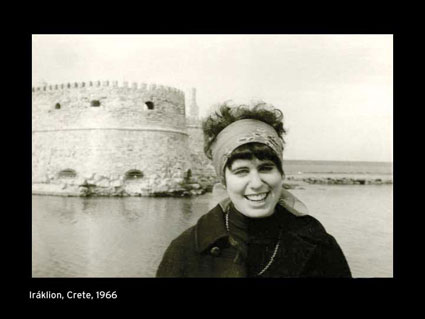
Andrea Dworkin in Crete, 1966

FIRST LOVE
A chapter from an unpublished novel
by Andrea Dworkin

Copyright © 1978, 1980 by Andrea Dworkin.
All rights reserved.
 
 [the above image and information is from here. I post this with deep gratitude to Nikki Craft, for all her work to keep the writings, videos, and memory of Andrea Dworkin alive]
 

Please note: the piece of writing, which I adore, called "First Love", is linked to in the first sentence of Andrew Stafford's discussion of her work, just below. If you haven't yet read "First Love", now's your chance. It is amazing and so beautifully, powerfully written.

What follows is from *here*.

Thursday, March 11, 2010


In Andrea Dworkin’s chapter “First Love” she writes about how concrete the world really is and how wrongly we are taught to live. She starts off by talking about the world and how fragile it is, and of all the horrors that lie within it. She then goes on to depict her love for literature and art and how she wants to be an author some day. This is important because she says that books and art are not to be analyzed or memorized, like we are taught, but to be lived through their emotions and meanings. That literature is a conversation through time, from one author to the next.

I personally like these early points that she makes because I believe that in the world we live in seldom do people look at the world like this. In school we are taught to read a book and take notes on the important parts, to memorize what is happening so we can pass the quizzes and tests that are sure to come on this subject. We do not look at the messages of the things we learn, or the beauty of art, we only do what is necessary to get by with a good grade. But Dworkin talks about really seeing the world and enjoying it for what it is.

The chapter then goes on to talk about her relationship with a man in Greece when she was merely a teenager. She tells of how he was her first love and how she can still see his face today burned into her brain. Even when she was married to another man several years later she still dreamt of this man that she only refers to as E, but Dworkin was forced to leave E because of his dominance and oppression that he applied to her. Dworkin was a very sexually active kid and when she met E they immediately fell in love, they both seemed to love culture, nature, and sex. She was a 19 year old American living in Greece with him and they loved each other. Dworkin decided that she did not want to be just a house mom, so she began to write stories and poetry. This posed a threat to E however as her love for literature and art seemed to interfere with his idea of her love for him. They began fighting over this issue, at first with words and later with violence. He raped her multiple times and tore her rectum, stating that if she truly loved him it was her job to accept this painful sex, and that she must “take it.” So she did. As this went on however she began to resent him and eventually would no longer put up with it. She had to choose between being nothing and accepting her lover, or leaving him and being the writer and poet that she dreamed of being. This was not an easy choice for Dworkin as she explains that she truly did love him and even still does today. But she chose to be separated for a while and to move on without him. Their love was to much however and after a short time they returned to one another, however, while Dworkin was away E had contracted gonorrhea from a young Greek man and gave it Dworkin upon her return. So in the following weeks Dworkin left him for good, not because of the rape or the sexually transmitted disease she explains, but as she put it her “drive to become.” She could not put up with his non-acceptance of her wanting to be more than just a women, she needed to be a successful writer and philosopher, so she chose the other life. This is what truly drove her away because as a youth in America she had suffered many horrible relationships and was even abused in an American jail by two doctors. Her love of literature is what drove her to become a writer so she could voice her hardships and her love for the world and for nature. But E could not accept this and she was driven away from him. Dworkin wrote that she thought the pain from being away from him was going to literally kill her and that this physical pain was with her at all times, and she even feels it sometimes today.

This of course is a fictional story told by Dworkin, but puts across a very serious message. That no matter how binding a love might be, if it is not right than you must move on. Love can be painful in many ways, but the physical pain she received from her man was to much to bear for her. This combined with the fact that he would not accept her drive for something more overcame her love for E and forced her to leave. Obviously I think that if any women is in a abusive relationship than they should get out of it, but the real message is that a relationship can be abusive in more than a physical way. If someone is unwilling to accept who you are and who you want to be, it can be just as bad as if he is physically oppressive.

Andrew Stafford
9:51 AM

1 comments
j.fish said...

I also really liked, and fully agreed, with those early points Dworkin makes about the world and how wrongly we are taught to live. It is sooooo true that school teaches us to read a book, take notes on the important stuff, memorize that stuff so we will be able to pass the test and come out of the class with a good grade. That isn't learning at all! That is just teaching us to be puppets of the system. It makes me sick. Sometimes I feel like a hypocrite for being in school, because the current mode of education in America (teaching us to be puppets of the system, preparing us for jobs and careers) is everything that I stand against. I will not be a puppet, a pawn of the bureaucracy that is America. But then again, that is why I am studying philosophy. I have no idea what "I'm going to do with my degree." And frankly I don't care. I love philosophy, just as Dworkin loves literature and art. And the love I feel for philosophy (among many many other things) is what I'm going to do with my life. I also wanted to agree with your last paragraph; love can be oppressive and harmful in other ways than just physical. I think a big part of Love as Freedom is acceptance. If she loves literature and art, let her love literature and art! Attempts to change someone because one does not like the things (s)he is interested in is not love at all. Dworkin's story in First Love is a great example of this. I think that part of Love as Freedom means total acceptance of who the other person is, with no desire to change any part of that person. Love as Freedom (partly) means loving someone exactly as they are.

White Educated Men and Sexist Illiteracy. Q: What does "The End of Manhood" mean? A: Assumptions by White Men Vary Depending on the Gender of the Person who Writes about it

Click on the image above to enlarge it, if you're having trouble reading the small text under the photograph.
[image above is from here]

Below is the cover of a decidedly unfascistic, anti-genocidal book, that, were it written by a woman, far too many men would assume was fascistic and pro-genocidal. I'll prove this point in this post.

[image of John Stoltenberg's book cover is from here]

Let us consider this thoughtful review of a book from *here*, by John Stoltenberg, by a named Andrew Sherblom:

The End of Manhood:

A Book for Men of Conscience

By John Stoltenberg
New York: Penguin, 1994. 308 pp. $21.00, $10.95 (paper).

If all violence committed by males were somehow eliminated from the planet, we wouldn't need a special issue on violence. And yet, discussions of gender, and especially "masculinity," as a socially constructed identity that needs to be engaged and deconstructed are often marginalized into gender studies, or, worse yet, women's studies (as if it's their problem) and are virtually missing as a focus within debates about violence and violence prevention. The detailed critiques and impassioned common sense of feminist thinkers through twenty-five years of "women's liberation" in the women's movement have helped make possible the current men's movement, with its similar aspirations of "liberation." Exactly what men need to be liberated from is, of course, the first central question one must address before any meaningful movement toward male liberation can begin. In The End of Manhood: A Book for Men of Conscience, author and lecturer John Stoltenberg addresses this question and a host of others with a bold passion, sense of humor, gift for story telling, and a deep commitment to what he calls "loving justice."

Stoltenberg presents a radical critique of the very concept "manhood," arguing that it serves no socially desirable function — only hurtful functions that can and should be eliminated from men's personal identities and social interactions. He presents a provocative alternative to most thinking about men and the problematic aspects of our behavior and identity. He bases his critiques on the claim that "manhood," in all of its various masculine incarnations, is at odds with, and in fact mutually exclusive of, an authentic sense of "selfhood" — a selfhood necessary for relating to others in just, moral, and non-violating ways. He argues:

This book therefore rejects the widespread notion that "manhood" can be somehow revised and redeemed — the contemporary project variously described as "reconstructing," "reinventing," "remythologizing," "revisioning," and re-whatevering gendered personal identity so as to bring its hapless adherents back into the human fold. That project is utterly futile, and we all have to give it up, as this book will carefully explain. (p. xiv)

Stoltenberg's book provides a detailed and complex analysis of gender relations and identity formation around his underlying argument that gender is nothing more than a means of social control that is harmful to individuals, families, and society because the culturally defined ways of "being a man" are generally at odds with intimacy and real interpersonal connection. As boys take on a "masculine" identity in place of a true sense of themselves, they lose those parts of themselves in conflict with "manly" values — their sensitivity, vulnerability, emotions, affections — all of which are needed for achieving intimacy and love. The falseness and distance of their own ways of being in relationship typically leave males feeling lonely, insecure, and scared of honest intimacy, which in turn makes it difficult for them to have loving relationships where they can finally get the love they've always wanted. In the face of this downward spiral, Stoltenberg argues, the only reasonable response is to change our focus from achieving manhood to achieving "personhood," and do away altogether with the concept and social institution of "manhood." Stoltenberg illustrates the social coercion and shame used to pressure boys into accepting, rather than resisting, this social identity and way of being, despite its obvious costs to them as human beings. He argues that the true philosophical nature of this conception of masculinity is based on competition, a lust for power, domination, mistrust, insecurity, and a deep-seated disconnection from life.

In addition to being a thorough presentation of a radical theoretical perspective, Stoltenberg's book is a practical guide to living as a human raised to be a man. Even his chapter titles reveal the practical nature of his questions and discussions. In "How Can I Be Closer to People — In Friendship and In Love?" the author crystallizes his central concerns about the relationship between manhood and intimacy:

We often experience the dichotomy between manhood and selfhood in our daily lives — but without knowing quite how or why. Lacking words to comprehend the contradiction, we suddenly stumble upon it when we feel blocked about revealing ourselves in a close relationship, for instance, or when we emotionally withdraw from intimacy without any apparent reason. (p. 12)

Using guided fantasy, stories from his own life and knowledge, and careful theoretical attention to language and conceptual framework, the author further explores relationships that create manhood and those that create personhood. Stoltenberg walks readers through portrayals of various types of interpersonal relationship and their consequences — for example, of having one's parents' and friends' love and acceptance of you be conditional on your conformity to gender expectations. He contrasts these conditional relationships with relationships that would support the health and growth of one's selfhood:

The ideal experience of having a father [is a close relationship with] an influential grownup who plays a significant role in the development of a child's relation to selfhood. This imagined ideal father [is] depicted as having passed on to the child not only a core of self-esteem, but also an indelible memory of how self-esteem can be bestowed: When one is the recipient of a love that is not conditional upon conformity to gender expectations, one not only learns something very important about the reality of one's own selfhood; one also learns a crucial lesson in the process by which human selfhood is passed on: One human being initiates another into selfhood by beholding them, affirming them, supporting them, and not betraying them. (p. 50)

In discussing father-son relationships, the author highlights the ways in which traditional fathers hurt their sons, often inadvertently, in teaching them to be men. By not being critical of "manhood" themselves, especially in its emotional distancing — a major ramification of manhood right in their own relationships with their sons — fathers are abandoning their sons and teaching them the same empty, out-of-relationship, emotionally disconnected manhood they embody. This kind of father-son relationship, Stoltenberg argues, leaves the boy feeling hurt and betrayed, a critical feature of this ongoing cycle of disconnection, because it creates in the boy an ability to betray others, to violate as he has felt violated. This has enormous implications for anyone interested in violence by adolescent boys and violence prevention with younger children.

Stoltenberg argues that it is males' insecure striving to live up to this socially imagined standard of manhood and a blind allegiance to it as their true identity and deepest self that allows — even makes inevitable — their betrayal of the women in their lives. In a chapter called "A Six-Pack of Tools for Deconstructing Dad," Stoltenberg investigates the traditional husband-wife relationship in this culture, and the typical ways in which wives were/are expected to diminish themselves in relation to their husband: to be less outspoken, less forthcoming, less present, and less real as a whole person. The author points out that if men bring this expectation to their intimate relationships with women, there is an inevitable contradiction:

The ironic thing about being stuck inside a manhood mask — especially if you're a husband and father — is that if you make your love for someone else conditional upon whether they properly diminish themself, you inevitably end up trying to be in love with someone who keeps slipping into nonexistence right before your eyes. If they assert their whole personhood, you find ways to make clear that you might punish them with your anger and withhold your love. . . . They must get smaller, weaker, less confident, less capable, less forthright, less intelligent, less interesting, less exuberant, less robust, less initiating — less themself in many ways. (pp. 68–69)

Stoltenberg also argues that single mothers are unjustly faulted for not providing a "father figure" or, as he puts it, "a carrier of manhood" in the home. He asserts that nothing about a child's secure sense of selfhood — nothing about one's assurance that one is loveable and knowable — depends developmentally on the child's conformity to the strictures of proper gender role:

The love of a child's unique human self does not come from a parent's manhood, and no child becomes eligible for such a love by embodying manhood. Selfhood-affirming love is what each child deserves, and it can be amply and variously expressed to any child by any concerned and present grownup — someone born penised as well as the human who gave the child birth. (p. 81)

The author acknowledges that while many young men experience a "longing for manhood," what they are really longing for is the fulfillment of basic human needs: to feel safe, to feel sustained, to feel seen, and within that safety and being known, to feel sexual (p. 95). He argues that we must learn to recognize our longing for manhood as an ineffective means of meeting our basic human emotional needs, and that this recognition is a crucial stage in the lifelong process of learning to love moral ways of being more than one loves the identity of "manhood" (p. 100).

There are many themes in this book directly relevant to male violence, especially against women. The author's discussion of gender anxiety, especially as it relates to sexuality, and the overriding need to prove one's manhood speaks directly and cogently to questions of sexual objectification, date rape, sexual harassment, pornography, and homophobic violence, and the ways that these are predictable outcomes of a conscious and unconscious social process creating men out of humans.

Stoltenberg connects his discussion of gender and being with other philosophical and spiritual traditions, such as the work of Martin Buber, acknowledging that

very near the end of writing The End of Manhood, I realized I had unconsciously borrowed Buber's concept of "I-You." I had renamed it the two-way truth of selfhood: your sense of yourself as a real human self that can only come from recognizing and regarding someone else as a real human self also; your sense of yourself as a real human self that can only come from being recognized and regarded by someone else as a real human self also. Or, as I had inadvertently restated Buber yet again: you are never more real than when someone else is real to you. (p. 303)

Given this understanding of being an authentic "self," the author says, for all practical purposes and in everyday, practical effect — in how one deliberates, in what one cares about, in the values one bases all one's relational choices upon — the beginning of selfhood means the end of manhood (p. 308). Moreover, Stoltenberg says, these are not simply questions of personal philosophy or spiritual integrity, they are matters of the utmost social importance:

The manhood problem is everyone's, even if everyone doesn't have the same problem. We all must confront whatever it is that makes communication between people raised to be a man difficult, or stressful, or less than truthful, or hostile, or threatening and predicative of violence — to one another or to a third party. Whatever it is that gives rise to threats and standoffs and various temperamental outbursts between people raised to be men . . . whatever that drama is, it has consequences and implications for everybody, not just for humans raised to be a man. Everyone is affected when manhood masks clash, or trash, or collide, or collude. So, whatever can be learned from telling our truth, we must let everyone in on it. Everyone, somehow, has a stake in that knowledge. Everyone's well-being ultimately depends on it. (p. 24)

While The End of Manhood is a genuine contribution to understanding the effects of "masculinity training" on boys' and men's relationships with others and themselves, including male violence, there is one area that I believe needs further attention. The central metaphor of males learning to identify with and adhere to a socially constructed manhood ends up carrying all the weight for men's dysfunction, insensitivity, cruelty, selfishness, and desire to control others. The ideology of manhood is only one of several ideologies that embodies and contributes to disrespect, domination, exploitation, and violence in society, or, put differently, perhaps manhood should be seen as one site among many in which a domination-oriented, violence-prone ideology is acted out. While this masculinist ideology is an important site for social change, it is perhaps a mistake to subsume all of men's hateful and hurtful behavior under the gender umbrella.

While the author argues that other typical sites of disconnection in men's lives — for example, racism, economic exploitation, and ethnic and religious hatred — are modeled on the manhood ideology, it is easy to feel they are being given secondary status in a hierarchy of ideological oppressions. In addition, in centering one's critique of men's violence in their manhood, it becomes difficult to extend the argument to include women, many of whom support not only traditional male "gender identification," but also the values and worldviews advocated by traditional masculinity: competition, hierarchy, exclusion, exploitation, and the use of force. While women's disconnected behavior, such as voting for Ronald Reagan, Adolf Hitler, or Maggie Thatcher, their active participation in the Klan, or their abuse of children, is beyond the scope of this book, it would be helpful if this critique of men's disconnection could dovetail with similar critiques of other human disconnection.

The author's dichotomy between "manhood" and "selfhood," while useful for illustrating his points and intriguingly provocative, loses a sense of the complexities and contradictions within individual people. It is unclear whether "personhood," which by Stoltenberg's definition embodies a way of being based on equality, concern, and connection with others, is a global disposition and way of being, or whether one can be a "person" in some relationships and at some times, and be a "man" at others.

All things considered, Stoltenberg's arguments do challenge educators to take up this discussion and confront their own ingrained reluctance to question social relations that are as personal as gender identity. In this important and clear-sighted book, educators will find new perspectives on intimacy, identity, gender, and violence that promise to enliven and clarify discussions around violence and youth. These perspectives will also push each reader, male or female, to question their own allegiance to "manhood," and to gender identity generally. As Stoltenberg points out early in his book, and then illustrates throughout, "the very manhood act we embrace is inimical to intimacy and trust. And so long as we keep up the manhood act, we miss the point of being human" (p. 11).

Stephen Andrew Sherblom 
Now, anywhere in that review, does Andrew assume Mr. Stoltenberg is calling for the mass extermination of men? No.
And yes, let a woman make a similar critique and she is assumed to be the resurrection of Hitler, even when she's dead. Witness the following, about John Stoltenberg's life partner:

From *here*.
David writes:


David F Mayer
While reading it, I wondered what kind of nutcase wrote it.
Mon Mar 8, 2010 3:43pm
99.174.179.44

It was clearly written by someone who has never been to Israel, or at least, never seen anything in Israel with open eyes. When I saw the by-line at the end, then I knew: Andrea Dworkin! From perusing her books, one gets the idea that she wants men exterminated utterly. I suspect that she favored phylogenetic cloning of women, permitting the species to survive entirely without men. See the first quote below, where she wants manhood destroyed entirely.

I hate to pull the poisoned well on you, but Andrea Dworkin was a nutcase's nutcase. Here are some of her lunacies.

http://www.brainyquote.com/quotes/authors/a/andrea_dworkin.html

Only when manhood is dead - and it will perish when ravaged femininity no longer sustains it - only then will we know what it is to be free.

No woman needs intercourse; few women escape it.

A commitment to sexual equality with males is a commitment to becoming the rich instead of the poor, the rapist instead of the raped, the murderer instead of the murdered.

Marriage as an institution developed from rape as a practice. Rape, originally defined as abduction, became marriage by capture. Marriage meant the taking was to extend in time, to be not only use of but possession of, or ownership.

http://en.wikipedia.org/wiki/Intercourse_%28book%29
She was violently opposed to all heterosexual intercourse.

http://womenshistory.about.com/od/quotes/a/andrea_dworkin.htm
Romantic love, in pornography as in life, is the mythic celebration of female negation. For a woman, love is defined as her willingness to submit to her own annihilation. The proof of love is that she is willing to be destroyed by the one whom she loves, for his sake. For the woman, love is always self-sacrifice, the sacrifice of identity, will, and bodily integrity, in order to fulfill and redeem the masculinity of her lover.

David F Mayer

I reply *here* and below:


Julian Real
Andrea Dworkin
Thu Mar 11, 2010 7:09pm
70.16.103.145

@David F. Mayer

This is a site for discussion of "ethics", yes? You show yourself to be deeply unethical in your misrepresentation of a Jewish woman who is dead and can't speak back to you. Rather cowardly, eh? Is cowardice one of your ethical positions too, in addition to lying about people and grossly misrepresenting their character and words?

Let's, together, consider each of those quotes and how they DON'T indicate what you incorrectly assume they do.

1. http://www.brainyquote.com/quotes/authors/a/andrea_dworkin.html
Only when manhood is dead - and it will perish when ravaged femininity no longer sustains it - only then will we know what it is to be free.

So, um, David, she's not talking about women killing MEN, or for killing at all. She's calling for an end to women's femininity being defined in terms of (and by the acts of) men ravaging women. She's talking about an oppressive social construction called "manhood". Are you familiar with this way of discussing social reality? Apparently not.

I recommend you read John Stoltenberg's book, "The End of Manhood: A Book for Men of Conscience"--Dworkin's life partner, btw. Do you honestly think John is calling for men to die, in his "book for men of conscience"?

Consider this book by a careful, thoughtful reader of Dworkin's writings, Robert Jensen: "Getting Off: Pornography and the End of Masculinity". You might try READING both of those books by men--since you obviously don't read any of Dworkin's--and note how neither call for exterminating men. Should you get around to reading Dworkin's essays, you will note how she doesn't either, ever.

Have you actually read one single book by Andrea Dworkin? Honestly. If "honesty" is an ethic you value? Have you read one whole essay of Dworkin's on which to base your rather disgusting opinion of her? And, do you think it would be "ethical" to do so?

The extermination of people was something Dworkin abhorred, being an ethical person and all. Andrea lost female and male family members in HaShoah, you know. Do you get how callous your comments about her are? You know she adored her nephew, her brother, and her father right? You know she loved her male life partner of thirty years, yes, and expressed, in her work, her appreciation to men who supported ending violence against women. How "unethical" of her, eh? What a "lunatic"--you portray yourself to be, in your sloppiness here on this site. I hope you do more careful work elsewhere.

Do you know that she had something very directly critical to say to any woman who did call for believing in "female superiority"? You might want to read that too:

Biological Superiority:
The World's Most Dangerous and Deadly Idea
1977

Which can be found here:
http://www.nostatusquo.com/ACLU/dworkin/WarZoneChaptIIID.html

2.
No woman needs intercourse; few women escape it.

And, what about that wouldn't be true? And how the hell do you read that as a call for men to be exterminated. That's laughable, David. You really think noting that most women can't avoid intercourse and that no woman needs it is a call to kill men? (Seriously?)

3.
A commitment to sexual equality with males is a commitment to becoming the rich instead of the poor, the rapist instead of the raped, the murderer instead of the murdered.

This is akin to saying a call for African Americans to be socially, behaviorally equal to whites is a call for Blacks to be the lynchers, not the lynched, the racial profilers, not the profiled. In the history of the U.S.'s unethical society, lynching was and profiling is a practice of whites against Blacks (which is to say, not Blacks against whites). I live in a society in which rape and the murder of women is a systematic practice of men against women (that men do not work collectively to stop). Instead eroticise and glorify sexualised violence against women in media.

My mother, female cousins, my aunt, and female friends have been incested and raped, by men, not by women. None of those men have been prosecuted. Do you call that justice? Does that outrage you as much as what a woman says that is critical of what men do to women with impunity? A woman I knew for years was murdered by her ex-boyfriend, because he couldn't possess her any more. You've heard of things like this happening, yes? And not so much of women murdering men, right?

How is Andrea Dworkin's statement a call for men to be exterminated??? Are you really that incapable of reading and comprehending the simplest things?

4.
Marriage as an institution developed from rape as a practice. Rape, originally defined as abduction, became marriage by capture. Marriage meant the taking was to extend in time, to be not only use of but possession of, or ownership.

Do you know the history of marriage? She isn't making this up, you know? You can find the same history without reading anything she wrote. Why don't you? Please. And stop misportraying what Dworkin said.

5.
http://en.wikipedia.org/wiki/Intercourse_%28book%29
She was violently opposed to all heterosexual intercourse.

No, she wasn't. And you have produced nothing at all to indicate she was "violently" anything!

Do you mean "violently" the way too many men violently rape women? The way men crawl into elderly women's apartments, and fathers crawl into their daughters' bedrooms to sexually assault them?

Where's your ethical concern about that, David? You're actually more upset about the writings of someone who died almost five years ago than the violent acts of men against women, daily?

Are you? I'm asking.

If so, what does that say about your own ethics? I await your answer, sir. As for your lies, please see this, for some truth, on Dworkin and Catharine MacKinnon NEVER saying anything about "all sex being rape" or being against all heterosexual intercourse:

http://www.snopes.com/quotes/mackinnon.asp

6.
http://womenshistory.about.com/od/quotes/a/andrea_dworkin.htm
Romantic love, in pornography as in life, is the mythic celebration of female negation. For a woman, love is defined as her willingness to submit to her own annihilation. The proof of love is that she is willing to be destroyed by the one whom she loves, for his sake. For the woman, love is always self-sacrifice, the sacrifice of identity, will, and bodily integrity, in order to fulfill and redeem the masculinity of her lover.

Can you tell me, Mr. Ethics (ahem), what the context is for her making that statement? Can you name the essay or chapter from which that quote was "borrowed" and who, speficially, decontextualised it in order to distort her meaning? You're familiar, yes, of people taking quotes out of context to distort meaning and misrepresent the views of the author?

You get that she analysed literature and many other forms of media, yes? She analysed men's behavior in societies in which women are overwhelmed, normally, by men, as romance, and as rape. And have you read romance novels from decades ago, and what it implies about women's agency relative to men?

Can a woman write about what media has to say to women about "femininity" (and masculinity) without being accused of calling for the mass extermination of men?

Can a woman do this, David, without you demeaning and insulting her?

Or are you so delusional as to not be able to tell the difference between each of those quotes and, say, what appears in Mein Kampf? Are you really that dense? You surely are presenting yourself as seriously and misogynistically biased in your perspective on a feminist writer.

Does your G-d call on you to unfairly and unjustly publicly demean deceased writers? Why don't you own what your own hang-ups are, rather than project them onto a feminist? Wouldn't that be the more ethical thing to do?

To clarify more lies about her that you apparently find status in spreading around, please see this page:

http://www.nostatusquo.com/ACLU/dworkin/LieDetect.html

Again, I await your reply, and your apology to a deceased person. That would be the humane thing to do, yes? A form of atonement for the act of slander you've committed above?

Julian
Wednesday, March 10, 2010

Mary Daly Memorial Service, May 1, 2010 ECD

 [photograph of Mary Daly is from here]

With thanks to Heart at Women's Space. This is a cross post.
The power of your presence is requested at a memorial. All are welcome.
Re-membering Mary Daly
A celebration of her life and work will take place on Saturday, May 1, 2010 at 2 P.M. at:
The Auditorium of Washburn Hall
Episcopal Divinity School
99 Brattle Street
Cambridge, MA
It will help in our organizing if you visit www.marydaly.org by April 4, 2010 and let us know your plans to attend.
Linda Barufaldi, Emily Culpepper, Mary E. Hunt,
Nancy Kelly, Nancy O’Mealey, Jennifer Rycenga
Directions: http://www.eds.edu/sec.asp?cat=16&page=139
Parking: http://www.eds.edu/sec.asp?cat=198&page=188

White Feminist and Writer Artemis March, on the Story Patriarchs Won't Tell You about Ancient Europe

Artemis March, PhD, MBA, Vassar graduate, and former Fellow at the Radcliffe Institute, has been evolving her own brand of narrative nonfiction for twenty years without realizing it was preparing her to write this book. A sociologist by training, she first got into the storytelling business at the Harvard Business School where she designed dozens of teaching case studies, many of them best-sellers, for students and executives. Numerous articles and her work with clients reveal the largely invisible patterns and practices which foster or inhibit the spread of successful innovations and breakthrough organizational paradigms. Her consulting practice focuses on patient-centered care at every stage of life. In Dying into Grace, Dr. March draws on her signature gifts to distill the core structure organizing caregiving, give form and voice to a dance of ephemeral moments and subtle movement, and create a groundbreaking, relational paradigm that releases the transformative potential in dying.

Artemis wrote a beautiful book called Dying Into Grace: Mother and Daughter... A Dance of Healing. For those who have time with a dying elderly loved one, and for more on this book, please see *here*. Moving on to an examination of a different kind of death and story-telling: the death of the non-patriarchal past to a patriarchal present, and the challenge to tell another story. Please click on the title below to link back to the source of this article on the blog Reclusive Leftist.

Hiding the Truth in Plain Sight: Exhibition of Prepatriarchal Old European Artifacts

By Artemis March, Ph.D. · Tuesday, March 9th, 2010 ·
Female Figurine Fired Clay Cucuteni, Drăguşeni, 4050–3900 BC Botoşani County Museum, Botoşani: 7558 Photo: Marius Amarie
Female Figurine, Fired Clay
Cucuteni, Drăguşeni, 4050–3900 BC
Botoşani County Museum, Botoşani: 7558
Photo: Marius Amarie

In honor of Women’s History Month, I’m pleased to present this guest post by my friend Artemis March. — V.S.

When I heard about the extraordinary exhibit of 250 artifacts from prepatriarchal “Old Europe” (c. 6500-3500 BCE) that will be shown at 15 East 84th St, NYC—the Institute for the Study of the Ancient World (ISAW)—until April 25, I wanted people to know about it. For those of us who are familiar with Old Europe and its monumental implications for women, it becomes a matter of: when can I get to NY? But for anyone who doesn’t—and that’s probably most of us—why should she bother to fit it into her busy schedule?
Rest assured that I wouldn’t be making a big deal about this exhibit if it were just about recovering more pieces from the past that enrich the Old Story—which is the direction in which the NY Times and the archaeological establishment would point us. It’s much more than that. It’s about undoing the erasure of women, gender-balanced social worlds, the sacred conceived and imaged as female, and of scholars who dare to see and tell Another Story. It’s about countering the erasure of those whose research threatens the monopoly of the patriarchal story and its alleged innateness and universality. It’s about forestalling the co-optation of the most powerful paradigm-breaking case yet unearthed.

As Mary Daly used to say, by distorting and disappearing our past, they have ravaged and purloined our present and our future. Disappearing acts have gone on for millennia, and they are going on right now, right in front of us. They can be blatant and concrete, as in the absence of women on our currency, our stamps, and the paucity of female statuary in our public life—a situation Lynette Long has recently taken on. They can be as elemental and profound as changing cosmological deities and their stories from female to male—a transition that the late Paula Gunn Allen tracked in numerous Native American traditions, and observed is still taking place. Disappearing acts can be far more devious, complex, and multi-layered as is the case with bringing these Old European artifacts forward.


The well-presented, beautifully-lit exhibit of artifacts on loan here from museums in Bulgaria, Romania, and Moldava gives visibility to the physical residues of Old European cultures. It is not to be missed. At the same time, the cultural meanings and political significance of those artifacts are being distorted and disappeared by those who have framed and interpreted the exhibition in its catalogue, wall panels, and lectures. These same biases are reflected in the NYT article that alerted many people about the exhibition, thereby beginning to shape the lens through which they see it.

Reading that article or the wall panels at the exhibit, you would never know that the Lithuanian-born archaeologist Marija Gimbutas was the one who had discovered and named Old Europe, excavated many of its artifacts, and brought forward many more that had been languishing in the back rooms of Eastern European museums (she could read about 20 languages). You would never know that it was she who recognized that these artifacts belonged to distinct-yet-related cultures in southeastern Europe—thus giving rise to the umbrella term Old Europe. You would think that the current crop of (predominantly male) archaeologists came up with this idea all by themselves.

Reading the NYT article or the wall panels at the exhibit, you would never know that her recognition of their distinctive commonalities arose via their marked contrast with the weapons-focused artifacts of the Indo-Europeanized cultures that replaced them and in which she was a world-class authority. You would not have a clue as to why this Old European civilization was “lost.” You would think that it had been “rescued from obscurity” by the male archaeologists who put together the exhibition rather than by Marija. You would never realize how these unnamed archaeologists are advancing their own careers by appropriating parts of her work that they can safely reframe and slip into the Old Story.

You would never know that Old Europe points to Another Story behind the patriarchy. Instead, they slide it into their one and only Story—the Androcentric Story, in which all societies and cultures are assumed/projected to have been formed by men, about men, for men, and organized around hierarchy and domination. Take one example.

As you enter the gallery that displays some of the gold artifacts found in a cemetery at Varna (a mid-fifth millennial trading center on the western edge of the Black Sea), the very first wall panel slips in the phrase “Old European chieftains” to identify those buried with the biggest stashes of gold ornaments. The curatorial archaeologists who framed the exhibit are not at all shy about assuming that only chieftains could warrant such gifts in the afterlife. Such boldness contrasts sharply with how agnostic the wall panels are on many subjects, especially with regard to how this civilization came to be “lost.”

It is instructive to note what they dance around (the role of external groups, especially the “steppe elements” putatively equated with the Indo-Europeans, in disappearing Old Europe) and what they conveniently treat as fact: male centrality and hierarchy in Old Europe—despite all the evidence against the existence of chieftains, hierarchy, and domination, and favoring matrilocality, matrilinearity, and gender balance. Such evidence is trumped by unstated androcentric assumptions: gold jewelry found with men = prestige items = hierarchy = domination = male authority. When women are buried with gold jewelry (as some were) or ceremonial ornaments, the assumption is that they were trying to look attractive to men, or that they were a big man’s wife—not that they were honored as clan mothers, wise elders, or priestesses.

Yet it is the latter interpretation that fits with the traditional burial patterns of Old Europe prior to the acceleration of trade, the appearance of the Varna cemetery, the infiltration of “steppe elements” into the Danube Valley, and the appearance of defensive measures such as fortifications—all beginning around 4400-4300 BCE. Old European burials were communal, and grave goods symbolic of the person’s gifts and skills in the life just passed. Elder women were the most honored and clearly central to the symbolic and spiritual life of the community. By contrast, Indo-European burials were for individual men. Grave goods were his possessions for the afterlife; they sometimes included women, servants, and/or horses. The Varna cemetery appears at that transitional moment, and does not seem to fit either pattern.

Despite its not being representative of Old Europe, the curators not only use gold artifacts to map hierarchical assumptions onto Varna, but also project them back onto 2000 years of Old European development and fluorescence. They thereby conflate the social structure that they impute to Varna with the social structure of Old Europe of the preceding two millennia. By setting the parameters of Old Europe between 5000 and 3500 BCE and naming the exhibit by this period, the curators have conveniently blurred all that, mixing up traditional Old European patterns with those affected by the intrusion of expansionary elements whose values and social structures were their antithesis. The consequence (and the purpose?) of this conflation is to perpetuate the lie that all societies of any complexity are organized around male hierarchy and that its seeds are present in all societies.

To appreciate the enormity of what’s at stake here, I invite you to read Joan Marler’s summary of Gimbutas’ work discovering and reconstructing Old Europe (OE), and another about her interpretation of its demise and the prehistoric transition to patriarchy in Europe. Marler is executive director of the Institute of Archaeomythology, dedicated to developing interdisciplinary approaches to the study of prehistoric and present cultures.

The disappearing acts perpetrated through the OE exhibit are hardly unique. Another example is the archaeological team at a key Neolithic site in Asia Minor (Çatalhöyük). Marguerite Rigoglioso exposes the strategies and tactics through which they deny evidence of, and even the possibility of, prehistoric female deities and female authority, and try to marginalize and discredit Gimbutas and others who have the courage to name what they see rather than project a patriarchal pattern onto every prehistoric society.

Marler’s and Rigoglioso’s work helps to bring home an appreciation of the some of the layers and complexity of the struggle to reverse millennia of female invisibility and the intense political struggles over the all-important issues of patriarchal origins and its finite existence rather than its alleged innate nature. Male entitlement, sole male authority, and male control over women are not god-given or “how things are,” but integral to an historically finite, socially constructed type of socio-political system that’s been around for only a few thousand years.

Logistics: The ISAW museum is closed on Monday, open 11-6 Tuesday-Sunday and until 8 on Friday. It is housed in a lovely, six-story townhouse just off Fifth Avenue. It is handicapped accessible, with an elevator just to your left as you come in that takes you up the ten steps or so to the first floor where the two galleries are. Another elevator goes to all floors, including the basement where restrooms are located. If you drive into the City, street parking is possible even during the day, but you do have to slug the meter every hour. A quarter gives you ten minutes, so bring a roll of quarters.

Admission to the museum is free. On the first floor, there is an unattended coatroom, and three guards on duty. Cameras are not allowed. There is a guest book, and you can also get a form from the office to give feedback. Catalogues are kept in that office. The 4-pound, $50 “catalogue” is a beautifully designed, hardcover book produced in Italy, full of gorgeous photographs, letters from museum directors who loaned the artifacts, and ten articles by archaeologists. It is an excellent record of a once-in-a-lifetime exhibit, the mentality of the archaeological establishment, as well as of how the process of erasure works.

They do not allow chairs in the two galleries, but when you need to sit, there is a bench in the foyer that overlooks two spectacular pieces and has a map mural at which to gaze (which is in the catalogue as well). I was there around 5 PM prior to a lecture, and then again mid-morning into early afternoon. I saw a small but steady stream of quietly engrossed visitors—predominantly women, but many men as well.
©Artemis March, Ph.D

"Gay Marriage": An Agenda for What and for Whom?

The poster is from the LAGAI website, here.
A bit on LAGAI before moving on. What follows next is from that website, linked to just above.


Who We Are
We are a small independent radical queer activist group. We started in 1983 as Lesbians and Gays Against Intervention and have been through a bunch of name changes, but kept our acronym, even though no one can figure out what it stands for any more. We are so grassroots, you almost can't find the root. We get no grants (well, okay, we got two small grants from Resist about five years ago), have no staff, don't lobby, don't try to control the gay movement. We work on local San Francisco/Bay Area issues and national and international issues. We are the proud publishers of UltraViolet, an every-other-monthly free newspaper.


What What We Believe
We are anti-authoritarian, anti-militarist, pro-feminist and anti-racist, and we demand that queer issues never be put on the back burner. We will accept nothing less than full civil rights for lesbian, gay, bisexual and transgendered people, but we believe some rights are not worth fighting for. We do not think queers or straights should be in the military of a society like the u.s., or probably any government, and we feel that the queer liberation position is to oppose marriage as the central institution of patriarchy, not to try to get married ourselves.
Read  LAGAI member Kate's radical rant at the 2005 San Francisco Pride Celebration.

Listen to LAGAI member Deeg on Gendertalk Radio.

Check out UltraViolet, our official "organ".

What We Do
We do poster campaigns and small direct actions, and participate in larger demonstrations and organizing coalitions. We are active in protests against war, the death penalty and police brutality, in the Justice In Palestine Coalition and the struggle to save social security and workers' rights.

You can contact us by clicking here or by calling us at 510-434-1304.

*           *          *
Next up is this piece by a Alexander Cockburn, titled "Gay Marriage: Sidestep on Freedom's Path". I found it *here* at Counterpunch. And I'll comment about the article within it and after it, with my usual "bold and in brackets" approach to rudely interrupting the comments of other people. A prerequisite for understanding my perspective on this matter, may be found by reading this discussion, "Is Gay Marriage Racist?", by Priya Kandaswami, Mattie Udora Richardson, and Marlon M. Bailey. And this piece, "Is Gay Marriage Anti Black?" by Kenyon Farrow. My sincere thanks to them for exploring this matter from a radical perspective.
*          *          *

Gay Marriage [when will this issue be called "Lesbian Marriage" with everyone assuming that means "Gay and Lesbian Marriage"? And, note: this was written way, way back in March 2004.]

Sidestep on Freedom's Path [there are often these questions for me when I see this term "freedom" used in the context of social justice and liberation from oppression: Freedom for whom? Freedom from what? Freedom from whom? Freedom to do and be what? 

By ALEXANDER COCKBURN [this is what Alexander looks like: 


He's entirely white--born in Scotland in 1941, raised in the Republic of Ireland, and now a U.S. citizen, and, um, a man, and apparently heterosexual and sexist too, in that oh-so-cool Lefty whitehetboy way. He's known for being critical of Israel, and his book on being called anti-Semitic, titled The Politics of Anti-Semitism. Leave it to the non-Jews to tell us what is and is not anti-Semitic. He's liberal on "speech", speaking against Germany's attempt to crack down on Scientology. He's white-right-wing on Global Warming, denying it is caused by industrially "civilised" humans.]

Alexander writes [and I interject]:
I'm for anything that terrifies Democrats, outrages Republicans, upsets the applecart. [To me, this makes him sound like an intellectual rebel, not someone with radical political principles.] But exultation about the gay  marriages cemented in San Francisco, counties in Oregon and New Mexico and some cities in New York is misplaced. [One more time: who thinks it's sexist to call the issue "gay" marriage? I do. It's racist too, for maybe more complicated reasons, having to do with the fact that many man-folks who aren't white and are queer don't identify as "gay" if a man who loves men romantically and sexually. Some of us identify as Same-Gender-Loving, and some as Two Spirit, for example. And those are just two of the English terms. And I don't accept that any "Same-sex" marriage is "cemented" anywhere. Not with such laws being overturned by courts, politicians, and popular referenda.]

Why rejoice when state and church extend their grip, which is what marriage is all about. Assimilation is not liberation, and the invocation of "equality" as the great attainment of these gay marriages should be challenged. [This can get complicated, but let's keep it simple: civil rights struggles in the U.S. are not merely "assimilationist" and are not for a very privileged non-gay (as far as I know) man to term as only assimilation. I have been guilty of this too: of thinking everything that affords rights to oppressed people in an oppressive State are not at all liberatory. And, well, it's not for the privileged to make that call, in my current view. My views on same sex marriage have been formed by reading criticisms of it as a key agenda item for queer politics in the U.S. by radical queer people of color, primarily. And I do have my own more personal views that are more rooted in my history and life beyond social engagement with political activism] Peter Tatchell, the British gay leader, put it well a couple of years ago: "Equality is a good start, but it is not sufficient. [Maintaining "civilisation" isn't sufficient either, but I rarely hear white Leftyboys speak against civilisation. Equality is often a key step in establishing the social position to then do more radically transformative work. Although I'd be interested to know the history of this. To what extent does achieving "equality" with the oppressor instigate more radical action, or appease the masses of the oppressed? Not that it's gonna be either/or.] Equality for queers inevitably means equal rights on straight terms, [I'd say on white middle class straight terms, which is a large part of the problem] since they are the ones who dominate and determine the existing legal framework. [I agree that whites, het males, and the wealthy dominate and determine the existing legal codes and parameters.] We conform -- albeit equally -- with their screwed up system. ["We" often don't have a choice.] That is not liberation. It is capitulation." [Or, it's survival. Only the most privileged folks in a society can afford to assume it is only capitulation. And it may well be capitulation also. But to capitulate means to "give up" or "surrender" and that assumes a position of power from which one might negotiate other terms of social change and transformation.]

So the good news, as that excellent paper, Ultra Violet (newsletter of LAGAI ­ Queer Insurrection) recently put it, is not that 400 gay couples are now legally married in San Francisco but that 69,201 in the city (Ultra Violet's number) are still living in sin. [Well, that doesn't tell me much. Most of society is apathetic, so what motivates queer couples in S.F. to marry or not marry isn't revealed with a number. And to what extent does living in a queer-friendlier town mean that a non-het person in a "couple relationship" doesn't feel so compelled to "marry"?]

Marriage diverts us from the path of necessary reform. [I'd leave it to the most marginalised and invisibilised queer folks to determine the course of action, and certainly do not give authority to anyone who isn't queer to make such determinations. Basically, if you're a het white guy, please shut up about this matter.] Civil union, today lawful only in Vermont, is what makes sense as a national cause. Unmarried couples, straight or gay [he's quite politically correct, using sexist language, which is also evident if you hear how he speaks about het women], need to be able to secure joint property, make safe wills, be able to have hassle-free hospital visits and so forth. [I'd argue non-couples need to be able to do this as well: best friends, roommates, relatives in chosen families--many people who wish visit loved ones with whom they don't have sex or a romantic connection. As a committed single and celibate person, "civil union" has nothing at all to offer me and those who are closest to me.] But issues of hospitals visits or health care should have nothing to do with marriage, and marriage as a rite should have nothing to do with legal rights. [I agree with that.] Separate "marriage" from legal recognition of a bond, of a kinship. [I personally believe the separation of Church and State has always been more illusory than legal. I mean if most leaders in a country are Christian and white, het and men, to what extent are their spiritual/religious/moral/ethical/political views outside their political agendas? Given that under white het male control and domination, the society remains staunchly white het male supremacist, in custom and law, institutionally and interpersonally, means, to me, that a radical change in society is called for, and that an end to all white het male supremacist institutions is necessary for a society to no longer be ruled by the values and practices, customs and ideologies of white het male supremacy.]

There's a fork in the road for progressives. [And a spoon, and several knives. And watch out, another tree is down, and one path is washed out. And who says radicals are progressives? This assumption alone tells us a lot about Alexander Cockburn. As it does when people equate being "liberal" with being "radical". Huh? Not on this blog.] One path is sameness, expanding a troubled institution to same sexers. [As opposed to the "opposite" sexers, I suppose. I don't think our people are so neatly categorisable, and I'm not talking about PoMo nonsense. I'm talking about the fact that there are intersex and trans people who don't have "a same sex partner" or "an opposite sex partner".] But that path detours the real problems of relationships today and their official recognition. [Like the maintenance of heterosexuality, and romance, and love, and sex, as those are currently defined and regulated?] As a generation of feminists and the divorce rate attest, marriage is in sore trouble, [Hmm. Does he mean to be implying a connection between feminism and divorce? Might a separate reason be that fewer people give a shit about religious imperatives? Might also "the Playboy" image have taken root with enough class privileged men to warrant them fucking around with many women rather than "settle" down with one woman? It's a patriarchal tactic to put the responsibility for all social shifts on feminism, as if feminists have ever had more power than ruling antifeminist het white men--who, increasingly, are choosing "a relationship" with pornography over a human being they live with.] well beyond powers of recuperation offered in Bush's proposed constitutional amendment which would be a touching souvenir of a world long gone. [GWBush is a sorry excuse for a person worthy of any form of leadership. How horrifying that he was--illegally and corruptly--president, twice.] Why are prenuptial agreements become common among people of moderate income? Prenups challenge the one-size-fits-all straitjacket of marriage, as do other important arrangements devised in recent years in response to changing anthropological and moral circumstance: coparent adoptions, adoptions by single people [ah, yes, the single people!], many varieties of public and private domestic partnerships, civil unions. Expand and strengthen the options. Get religion out of the law. [And get the WHM supremacist law out of society. Does it occur to Alexander that that's a problem?]

Civil union across the country would help to level a playing field that's got increasingly uneven across the past generation. [Alex, it's never been close to level. And in the last generation a lot has happened in society, most notably the near-death experience of social radicalism in the U.S.] In some corporations gay [not lesbian?] couples have health benefits that unmarried straight couples don't. [That's news to me.] Contrary to endless rants about the "marriage penalty" in the federal tax code, a larger number of people enjoy a marriage bonus, as the House Ways and Means Committee determined in 1999. [Who named that committee, anyway? "Ways and Means"?]

Unmarried workers may lose hundreds or even thousands of dollars per year in employee benefits compensation. For example, as the Unmarried America website points out, "Most states will allow workers to collect unemployment compensation if they quit a job to move to a new area when their spouse is relocated by his or her company. But state laws usually will not give these benefits to a worker who quits to relocate with his or her domestic partner." [Or to those who are single who leave work. Or who leave work to care for a more elderly person in their life.]
There are so many tricky questions, particularly now that morals and the surgeon's knife have deepened their own relationship. What happens, when someone who's had a sex change [does he mean penile implants in male-men? And does he get how not all trans folks--most, actually, are not having surgery? And that many intersex people resist having surgery?], who is already receiving domestic partner benefits at work for his [again with the sexist lingo: dood, please; read a womanist or feminist book and get a clue!] male partner, goes through sex reassignment surgery and acquires the physical impedimenta of the opposite sex? ["impedimenta of the opposite sex"? So he actually thinks women and men are opposites?? And "impedimenta" is his oh so cute term for "any objects that impede progress". Men's uses of our dicks as weapons impedes women's freedom from rapist society. Alexander's sexism and misogyny impedes women's liberation from male dominance.] Should the couple lose their bennies until they get legally hitched? [It's not the couple that should have the bennies, in this view, it's the community and its members. It's the people, irrespective of what sort of relationship they are in. If they're part of a society, they need the "bennies", yes? Do single people NOT need someone to be with them when hospitalised? Do class-privileged single people NOT need to decide what to do with whatever possession they have, before they die? And don't inheritance laws keep the rich rich, and not do squat to make the poor less poor?]

None of this should have anything to do with various rites of marriage such as a hippy New Age union cemented waist deep in a river with solemn invocation of the winds and other natural forces, or a white wedding in a high Episcopal church. [Any institutionalised, ritualised practice that is normalised in dominant society WILL have something to do with everything, in my view.]
"The pursuit of marriage in the name of equality", says Bill Dobbs, radical gay organizer, "shows how the gay imagination is shrivelling." [It was strategic, and built on the best case scenario for white gay men with class privilege, in my view. Nuclear family values have usually been tied to white and class privileges.] Judith Butler, professor at UC Berkeley, exhibited kindred disquiet in a quote she gave the New York Times last week. "It's very hard to speak freely right now, but many gay [and lesbian?] people are uncomfortable with all this, because they feel their sense of an alternative movement is dying. Sexual politics was supposed to be about finding alternatives to marriage." [Well, I agree with JB there, and feel queer culture on the whole has taken a turn towards either assimilationism or breaking off. And neither route really has staying power, to me. A radical agenda, radical reforms, not joining the military or marriage, is what I hope for, personally. But again, given my levels of privilege, it's not for me to set that agenda.]

As Jim Eigo, a writer and activist whose thinking was very influential in the early days of ACT UP put it a while back, what's the use of being queer if you can't be different? [That presumes a lot about being queer. Like that it is, necessarily, a difference in the ways that heterosexist society makes it out to be. It isn't necessarily. But it can be, on our own terms.] "Why are current mainstream gay [and lesbian?] organizations working to strike a bargain with straight [male] society that will make some queers less equal than others? [Um, given that queers are different classes, races, and genders, we are, already ranked differently both beyond and within our communities. So let's be honest about that, at least. Rich white gay men in the Castro don't give a fuck about poor gay men living on the street, and gay men have never demonstrated any radical commitments to lesbian issues, ever.] Under its terms, gays [and lesbians?] who are willing to mimic heterosexual relations [um, we can do that, and do that, with or without marriage rights] and enter into a legally-enforced lifetime sexual bond with one other person [which some queer people desire and want and ought to do if it works for them] will be granted special benefits and status to be withheld from those who refuse such domestication...[benefits and status also refused single people of any sexuality or gender, especially females, and benefits and status denied to all people who are not "coupled" heterosexually.] Marriage has no more place in efforts to achieve equality than slavery or the divine right of kings. [Well, that's a bit much. Marriage, currently, is not slavery, except for women who are enslaved by their husbands. I find that kind of hyperbole racist and classist to the core.] At this juncture in history, wouldn't it make more sense for us to try to figure out how to relieve heterosexuals of the outdated shackles of matrimony?" [I'm all for dissolving all marriage rights.]

And why marriage to just one person? Why this endless replication of the Noah's Ark principle? [Alexander, are you aware of a concept, in practice, called polygamy?? And the fact that marriage has never stopped any man who seeks it, from obtaining sex outside of marriage?]

For me the cheering political lesson is that Mayor Gavin Newsom of San Francisco felt the hot breath of a challenge from his left (in the form of his Green opponent Matt Gonzalez) and felt impelled to radical action to consolidate his victory. That's good, because it shows the value of independent radical challenges, but that's where my cheers stops. Gay marriage is a step back in the march towards freedom. Civil unions for all! [Civil and human rights for all, regardless of relationship status!]

[I'll conclude by saying that my own political stance is far more in line with radical lesbian feminism, asexuality, and intersex oppression, than it is with gay agendas, bisexuality, and transgender politics. And that, friends, is a conversation for another time. I don't think that just because we toss a bunch of letters together, such as LGBTIQA, that that means we agree on much that we're supposedly fighting against, and for.]

Tuesday, March 9, 2010

When You Realise Who Has Power, Really, When You're Paid to Whip Men

'Whip Smart': Memoirs Of A Dominatrix

[cross post from *here*]

March 8, 2010
Audio for this story from Fresh Air from WHYY will be available at approx. 5:00 p.m. ET
Melissa Febos
Enlarge Caitlin Delohery,
Author Melissa Febos lives in Brooklyn.
Whip Smart
text sizeAAA
March 8, 2010
Melissa Febos' new memoir, Whip Smart, details the four years she spent working as a dominatrix. Febos enacted fantasy sequences, spanked grown men and verbally humiliated them for $75 an hour in a dungeon located somewhere in midtown Manhattan.

Febos, who writes that she got started in sex work to pay for a drug habit, tells Terry Gross that working in a dungeon felt like "being in a womb."

"Pretty much all of the dungeons were outfitted with some sort of coat rack-related thing that had all sorts of floggers, riding crops," she says. "We had giant coils of rope in our utility closet — like thousands of feet that we would just cut off when you needed it. There were gas masks and cages and a big hanging Inquisition-style cage in the red room. And there were mirrors along all of the walls, and they were really vast — and with all of the walls and the ceilings painted, it had a very specific effect."

That effect, says Febos, was creating a fantasy world for her clients — and for herself.

"In the beginning, it did feel pretty powerful to act out those roles, but after a little while it wasn't my fantasy in most cases," she says. "In a lot of ways, [enacting the scenarios] felt more humiliating to me than it did to them."

Febos currently teaches writing at SUNY Purchase College and the Gotham Writers' Workshop. She received an MFA from Sarah Lawrence College.

Antifeminist Het FATHERS RIGHTS ALERT: It's HET FATHERS who want THE RIGHT to KILL HET GUYS--for doing what THOSE FATHERS ONCE DID. (It's not Radical Feminists)

Cleaning This Gun (Come On In Boy) - Rodney Atkins  

Lyrics:

The Declaration of Independents,
Think I could tell you that first sentence,
but then I'm lost, I cant begin to count the theories,
I've had pounded in my head, that I forgot,
I don't remember all that Spanish or the Gettysberg Address,
but there is one Speech from High School I'll never forget,
[Chorus]
Come on in boy sit on down and tell me 'bout yourself,
So you like my daughter do you now,
Yea we think shes somethin' else,
Shes her daddy's girl, her momma's world,
She deserves respect, that's what she'll get,
Ain't it son, now ya'll run along and have some fun,
I'll see you when you get back,
Bet I'll be up all night,
Still cleanin' this gun


Well now that I'm a father,
I'm scared to death one day my daughter is gonna find,
That teenage boy I used to be,
that seems to have just one thing on his mind,
Shes growin' up so fast it wont be long before,
I'll have to put the fear of God into some kid at the door,

[Chorus]
Yea come on in boy sit on down and tell me bout yourself,
So you like my daughter do ya now,
Yea we think she's somethin' else,
Shes her daddy's girl, her momma's world,
She deserves respect, that's what she'll get,
Now ain't it son, now ya'll go out and have some fun,
I'll see ya when you get back,
Probably be up all night,
Still cleanin' this gun

Now its all for show,
Ain't nobody gonna get hurt,
Its just a daddy thing.
And hey believe me man it works 

[Chorus]
Yea come on in boy sit on down and tell me bout yourself,
So you like my daughter do ya now,
Yea we think shes's somethin' else,
She's her daddy's girl her mommas world,
she deserves respect that's what she'll get,
Ain't it son, ya'll run along and have a little fun,
And I'll see ya when you get back,
Probably be up all night,
Still Cleanin' This Gun..HAHA...Now son ya'll buckle up and have her back by 10...lets say about 9..30...Drive Safe

*          *           *
I have known several het fathers of daughters, and all of 'em, yup, ALL of 'em say the same damned thing: that if they found out  their teenage daughter was dating someone like THEY used to be when they were younger, they'd shoot the fucker. And they don't look forward to the day when normal het guys date THEIR daughter, because, well, you know... all guys are DOGS. I've heard a het guy, not anyone who'd ever call himself "feminist" say this to me: "You know, all guy's are DOGS", and he was including himself in that group. And by dogs, he meant "no good, selfish assholes, who will take what they want from girls, even if it means fucking her and fucking her over. He meant that het guys cheat, one way or another. And he meant that het guys don't respect girls. THAT'S what he meant, and the reason I know is because I've asked the het guys who say this what they mean by it, to be sure I'm not filtering it and distorting it through "a radical feminist" lens. (Ahem.) Nope. I'm not. It's what het guys say about each other. I heard one het father talking to another in a grocery store aisle--one guy worked there, the other was a shopper, and they were comparing notes on their concerns about their daughters dating het guys. And they agreed, "I wouldn't want her dating anyone like how I was when her age!" And they meant it. And they weren't radical feminists either. So who is it that confuses het sex with rape? Read on, and then give me your answer.


By Pete Kotz in Heroes, assault
Thursday, Feb. 25 2010 @ 11:31AM


william-kelly_opt.jpg
UPDATE: There may be another reason why William Kelly shot his daughter's boyfriend in the balls. Randall Carter is 29; Amanda Kelly is only 18. Dad couldn't have been happy that his high-school age daughter was prancing around with a much older man... [click on title above for the rest]

See also: here, here, and here. And all that follows...these are all pieces, and they fit together neatly, if atrociously.

Antifeminist Father kills both his daughter and her boyfriend after finding them in bed together. See story here.

And when the father is white and U.S., him killing his two daughters is blamed on medication, not his patriarchal culture, like the Afghan father.

Here's a story about a father who kills his wife and his children, to spare them HIS shame of being in financial ruin. NOT, apparently, due to cultural practices, like the Afghan father.

How much murder of wives, girlfriends, boyfriends of one's daughter's boyfriend, and the rape of one's own daughter has to happen before we call it part of his patriarchal cultural norms?

*          *          * 
Question [from *here]
Help answer this question below. 

If you got home and someone was rapeing your daughter and had a gun to her head. would you A use your cell and call the cops frist. B threaten to kill them with a gun.then call 911 are C Kill them without them knowing you were there then call 911?

Answers. 29 helpful answers below.

  • by Froggy on July 17th, 2009
    Froggy
    Kill them with a clean shot to the head will cause him to release his gun, then bury him in the backyard. Who wants to waste many days and hours in a courtroom because of a scumbag. Oldtime justice prevails!
    • Like (10 people like this.)  

    • by That Guy Again on July 17th, 2009
      That Guy Again 
      BANG! 
      rapist gonads fall to the floor...
      30 long seconds for him to wonder what life will be like without scrotum....
      Then...
      BANG!!!
      Rapist has third eye centered above the other two...
      Dial 911
      I yell...
      "STOP OR I'LL SHOOT!!!"
      Then BANG!!!
      I hang up the phone so the dispatcher doesn't have to hear the second two shots.
      No comments. Post one | Permalink

       
    • by Arisztid in a COAT of Rromani awareness on August 22nd, 2009
      Arisztid in a COAT of Rromani awareness
      First, I would come up behind him and remove the gun. I can move very quietly and know how to disarm and knock out an attacker. Then I would start.

      He would be begging to die by the time I was done with him. I wonder exactly how much of his own gun would fit up his arse. I think I could get quite a bit up there.

      I always keep a roll of duct tape on hand which would take care of that noisy screaming problem. The duct tape would be handy for immobilization uses because I would check my daughter first and take care of her before I started on the rapist.

      His body would not be found. I know about American "justice" and I know he would get off with nowhere near what he deserved.

      911 would not be involved and his body would be deposited in bits over a multi state area.
      No comments. Post one | Permalink

       
    • byGreekgodon July 17th, 2009
      Greekgod
      bang your dead
      No comments.Post one | Permalink

       
    • by sprky777on July 17th, 2009
      sprky777
      I could imagine I would take that gun from him so fast and beat him with it. he would be begging me to shoot him with his own gun.
      but I can reason that it would be better to shoot him with mine first for legal reasons.

      Now consider this. Your daughter is being raped, then she has a man killed right over her. would she be comforted by that result? Either way you have some work to do now to keep her mind straight.
      No comments.Post one | Permalink

       
    • bySunshine in a COAT of Sunshineon July 17th, 2009
      Sunshine in a COAT of Sunshine
      Try to kill them and then call the Police....Wow what a question! +5
      Makes ya think.....But it is your child!
      No comments.Post one | Permalink

       
    • byScrappyon July 17th, 2009
      Scrappy
      C. Why take a chance on him killing her while waiting on police. I would then plead insanity.
      No comments.Post one | Permalink

       
    • byThe Chiefon August 31st, 2009
      The Chief
      You describe a circumstance, but the devil is in the details. EXACTLY what I would do depends entirely on those details.

      I was once DR'd in a similar question for stating this, but it IS true.

      I cannot say for sure that I would shoot the guy. Because the details of the encounter may prevent that.

      I cannot say that I would call 911 right away, because the details may also preclude that as well.

      One thing I CAN say is this:

      Given an opening, I WOULD use deadly force.

      Paraphrasing the definition the darkvox gave in his answer (obviously military in origin, as it's the one I learned many years ago), deadly force it that which maims or kills. (The Weapons Officer at my first command smiled at me when I gave him that definition and made me look up the official one and memorize it!)

      The applicable circumstance which 'authorizes' the use of deadly force in this situation is the threat of serious bodily injury or death of my daughter.

      Now, given the choice, this is what I would LIKE to happen:

      1. Call 911 FIRST. Backup is essential. And if this guy gets away, he's a danger to others as well. Calling for help lets others know what's wrong in case the situation goes even further wrong. Otherwise, I risk total failure should I be killed. Then my daughter has absolutely NO hope. And I will put the phone down after the original information is passed, maintaining the connection so the police can hear and be kept informed as they approach.

      2. If I can take him down without him seeing me or knowing I'm there, and have a reasonable chance of doing so without him harming my daughter, I will. "Take down" means with all the force I have available to me in as deadly a fashion as I can. I will NOT be shooting at his knees or gun hand as a method of taking him down.

      3. If I cannot take him down without being seen, then I will have to put myself in the best mindset I can. Because I'm a damn good shot and if I can take a squirrel in the head with my pistol, then I can take this guy without hitting my girl. He can't hide behind her completely.

      4. This may sound strange. But I will risk a non-life threatening injury to my daughter by me in order to stop a certain death to her by him.

      I once had this discussion about the use of deadly force with my wife, many years ago. She does not agree with me and thinks I should shoot the bad guy in the knee or something. I do not, and CANNOT agree with her.

      If the circumstances arise where I am considering the use of deadly force, it's because I truely believe SOMEONE IS GOING TO DIE IF I DON'T! That said, it's him or me: once I pull a weapon under these circumstances, it will be with the full intent and purpose of taking his life as the ultimate solution. I cannot afford any half measures on this, and if I'm not willing to do this...I might as well never pull my weapon out.

      Other options which don't include guns are also available. And I'll use them if required.
    • by Anonymouson July 17th, 2009
      Click, click, boom, he's dead.
      No comments.Post one | Permalink

       
    • byguitar_player_92on July 17th, 2009
      guitar_player_92
      well if had agun to her head and threatened to kill her if i came any where near her. I would not call the cops. I would hand him over that easily. Because if i ever caught him.
      No comments. Post one | Permalink


    • by-Icy-on July 17th, 2009
      -Icy-
      i would kill them first but then i have a license to do this.
      No comments.Post one | Permalink

       
    • byShemarq feels like changing it upon July 17th, 2009
      Shemarq feels like changing it up
      He'd be dead. Period.
      No comments.Post one | Permalink

       
    • bydarkvoxon August 8th, 2009
      darkvox
      Deadly Force is the force in which a person uses for the purpose of causing, or that a person knows, or should know, would create a substantial risk of causing, death or serious bodily harm. The use of Deadly Force is justified only under conditions of extreme necessity as a last resort, when all lesser means have failed or cannot reasonably be employed.

      Check Self defense or the defense of others.
      Nope Defense of assets involving national security.
      Check Defense of assets not involving national security, but inherently dangerous to others.
      Check Protection of public health or safety.
      Check Prevention of serious offenses against persons.

      My check list says he is one dead guy.
      What would have stopped him from killing her if you came home later? He could be holding one of your guns.
      No comments.Post one | Permalink

       
    • byAnonymouson August 31st, 2009
      Kill them dead....
      No comments.Post one | Permalink


    • byBrianon August 31st, 2009
      Brian
      C.
      A and/or B would give the rapist a chance to kill her
      No comments.Post one | Permalink

       
    • byJadeon August 31st, 2009
      Jade
      Assuming that his gun will not discharge due to the impact:
      I would quietly call 911 and immediately shoot him, then tell the 911 operator where the coroner can pick up his body. Of course, my youngest daughter is a 4th degree black belt (trained in many styles of martial arts and weaponry) so the guy would probably already be in small pieces or begging someone to please arrest him when I got there.
      No comments.Post one | Permalink


    • byAnonymouson August 22nd, 2009
      Anonymous
      i would grab him by the hair with my gun to his head
      tell my daughter to get out of the room and booom
      ps if i had a daughter
     [Click *here* to see the rest of the answers.]
    *          *          *
I offer proof above and below that it is nonfeminist HET FATHERS who want het guys dead, for fucking and/or raping females, not radical feminists. And it's het fathers who routinely, regularly, threaten to kill guys for fucking girls, not radical feminists. And it's het fathers who worry, A LOT, about their daughters getting raped by boys, not radical feminists. And it's het fathers who regularly say "I know how I was at that age!" meaning, he wasn't respectful of girls' boundaries and feelings in obtaining sex. Meaning, the line between sex and rape was so slim, that he'd want to KILL any boy who does to a girl what HE once did to girls.


Now, why is it that those P.R.I.C.K.s who are always quoting a dozen sentences from radical feminists as "irrefutable evidence" that some women HATE men, including and especially Valerie Solanas, who, I'd argue, was not a radical feminist... why is it that they DON'T quote regular ol' antifeminist-misogynistic HET FATHERS--THE ONES WHO WANT ALL THOSE RIGHTS--who want to KILL het men??? 

DO FATHERS' RIGHTS GROUPS SUPPORT FATHERS' RIGHTS TO BEAR ARMS AND USE THEM TO KILL GUYS WHO FUCK THEIR 14 AND 15 YEAR-OLD DAUGHTERS? Why not? If "the issue" is fathers having rights, and fathers being allowed to "protect" their daughters from harm, and if they view guys having sex with girls as not okay, what's the problem with letting het father's blast the brains out of those boys? Isn't this an issue for the National Rifle Association and Father's Rights groups???

There are WAY more of them than there are radical feminists, and those het men have a lot more access to guns and know how to use 'em, than do radical feminists, as a group. So who is the danger, the threat, to the lives of het men? Radical feminists? No. Het men? Yup. Read on... if you care to read the truth. Some of it is grotesquely, if unremarkably misogynistic, referring to girls as sl*ts and wh*res, but never referring to boys and guys that way. Surprised? ... Me neither.


Postby Scott123 on Thu Feb 25, 2010 2:18 pm 
         Reako wrote:
AgoniesCreep wrote:Obviously there needs to be some form of protection from the "to catch a predator" freeks who surf the web looking for virgins to deflower but, we really take it too far sometimes. The only chics that are still virgins at 17 are the ones who are so ugly that they couldn't get laid in a kennel or a prison. There's alot of girls who've been with 5 guys or more by the time they're 15 & I don't think we should throw a guy in prison over a chic who'll be screwing someone else two days after he's gone. An awfull lot of the blame is the parents fault for not keeping a better eye on the little slut anyway.
I chased high school girls till I was 26 & only stopped after a close call with parents who were living in total denial over what a slut their little girl (16) was. My own 13 year old daughter scares me to death cuz she's a mirror image of myself so I keep a very close eye on her but, I'm not stupid enough to think she'll be wearing white on her wedding day. We talk alot & I've told her not to be a whore about it & make sure she gets on B.C. before she does anything stupid. I or her mom moniter all of her computer activity & I suspect that she'd already have lost it if not for dad's watchfull eye.  
America was founded by puritans & we are way more anal about sex then they are in europe because of it. I didn't lose my virginity till I was 17 & I hated it & totally felt like a freek because I wasn't slick enough to get the ball rolling sooner. I probely would have done better in school if I wasn't obsessing over sex as a 14 year old & up. I was so sad, very much like the guys in "American Pie". As a father I'd totally high five my 14 year old son if he was nailing a hot teacher.[/quote]

Not for nothing but chasing high school girls at 26 is creepy and sad. When I was in high school there was this 23 year old creep chasing after my GF. She was 15 I was 17. I caught that creepy pedo and beat his ass.
What if a hot teacher was was nailing your 14 year old daughter...would you high five him?

Reako-Seriously dating a 15 year old at age 17? No offence man but couldn't you find any girls your own age? If my daughter (when she's 15) brings home a 17 year old....Someones gonna get there ass kicked!
Scott123
Posts: 6178
Joined: Fri Jun 13, 2008 4:16 pm
Location: Free Agent


Postby Reako on Thu Feb 25, 2010 2:21 pm
Scott123 wrote:
What if a hot teacher was was nailing your 14 year old daughter...would you high five him?

Reako-Seriously dating a 15 year old at age 17? No offence man but couldn't you find any girls your own age? If my daughter (when she's 15) brings home a 17 year old....Someones gonna get there ass kicked!
Think you need to go back and re-read the post Scott. I did not say I would high 5 my son though your edit of it almost makes it look like I did.

And yes OMG, 2 high school kids dating is so out of wack!!!!!.
Reako
Posts: 1443
Joined: Wed Jul 23, 2008 9:40 pm


Postby Scott123 on Thu Feb 25, 2010 2:31 pm
Reako wrote:
Scott123 wrote:
What if a hot teacher was was nailing your 14 year old daughter...would you high five him?

Reako-Seriously dating a 15 year old at age 17? No offence man but couldn't you find any girls your own age? If my daughter (when she's 15) brings home a 17 year old....Someones gonna get there ass kicked!
Think you need to go back and re-read the post Scott. I did not say I would high 5 my son though your edit of it almost makes it look like I did.

And yes OMG, 2 high school kids dating is so out of wack!!!!!.
The high five comment was meant for the original poster...The 17 year old dating a 15 year old was meant for you. I think it's a lil lame...just my two cents.

I'm sure you crushed tons of ass.


Oh yeah-I didn't edit anything...I Highlited.
Scott123
Posts: 6178
Joined: Fri Jun 13, 2008 4:16 pm
Location: Free Agent


Postby AgoniesCreep on Thu Feb 25, 2010 3:10 pm
Reako wrote:
AgoniesCreep wrote:Obviously there needs to be some form of protection from the "to catch a predator" freeks who surf the web looking for virgins to deflower but, we really take it too far sometimes. The only chics that are still virgins at 17 are the ones who are so ugly that they couldn't get laid in a kennel or a prison. There's alot of girls who've been with 5 guys or more by the time they're 15 & I don't think we should throw a guy in prison over a chic who'll be screwing someone else two days after he's gone. An awfull lot of the blame is the parents fault for not keeping a better eye on the little slut anyway. 
I chased high school girls till I was 26 & only stopped after a close call with parents who were living in total denial over what a slut their little girl (16) was. My own 13 year old daughter scares me to death cuz she's a mirror image of myself so I keep a very close eye on her but, I'm not stupid enough to think she'll be wearing white on her wedding day. We talk alot & I've told her not to be a whore about it & make sure she gets on B.C. before she does anything stupid. I or her mom moniter all of her computer activity & I suspect that she'd already have lost it if not for dad's watchfull eye.  
America was founded by puritans & we are way more anal about sex then they are in europe because of it. I didn't lose my virginity till I was 17 & I hated it & totally felt like a freek because I wasn't slick enough to get the ball rolling sooner. I probely would have done better in school if I wasn't obsessing over sex as a 14 year old & up. I was so sad, very much like the guys in "American Pie". As a father I'd totally high five my 14 year old son if he was nailing a hot teacher.
Not for nothing but chasing high school girls at 26 is creepy and sad. When I was in high school there was this 23 year old creep chasing after my GF. She was 15 I was 17. I caught that creepy pedo and beat his ass.
Looking back on it, I agree. However, you show me a 26 year old who dosen't think high school girls are sexy & I'll show you a homosexual. I should have known better but, I met her through a 28 year old buddy who was nailing her so it's not like I tricked a sweet little virgin & deflowered her.
AgoniesCreep
Posts: 804
Joined: Sat Mar 28, 2009 1:44 pm


Postby CopperHeart on Thu Feb 25, 2010 3:12 pm
With that said, a 17-year old boy dating a 15-year old girl (as terrifying as that is to me as a parent) is actually within the realm of "normal".
CopperHeart
Posts: 17716
Joined: Mon Sep 22, 2008 9:11 pm
Location: Connecticut by way of California by way of Brazil by way of Argentina by way of West Germany

Postby Reako on Thu Feb 25, 2010 3:21 pm
CopperHeart wrote:With that said, a 17-year old boy dating a 15-year old girl (as terrifying as that is to me as a parent) is actually within the realm of "normal".
When you consider I was a junior who just terned 17 recently and she was a sophmore soon to be 16 yeah. I think we were like a year and 3 months apart. Hard to remember ALL the details as that was literally 20 years ago. As a father (which I am not) I would be mortified that my teenage daughter were dating anyone no matter their age laugh.
Reako
Posts: 1443
Joined: Wed Jul 23, 2008 9:40 pm


Postby Reako on Thu Feb 25, 2010 3:24 pm
AgoniesCreep wrote:
Looking back on it, I agree. However, you show me a 26 year old who dosen't think high school girls are sexy & I'll show you a homosexual. I should have known better but, I met her through a 28 year old buddy who was nailing her so it's not like I tricked a sweet little virgin & deflowered her.
Oh Im sure she wasnt. Its still a bit creepy. Its one thing to look at a 16, 17 year old girl and see an attractive female its another to actually do something *shrug*.

I cant say much maybe, my current GF is 11 years younger then I am (Im 37, shes 26)
She teases me all the time when I talk about jobs, events whatever I did in the 90s she always tells me her age at that time.
Reako
Posts: 1443
Joined: Wed Jul 23, 2008 9:40 pm

Postby BringUFCtoDetroit on Thu Feb 25, 2010 3:25 pm
Reako wrote:
CopperHeart wrote:With that said, a 17-year old boy dating a 15-year old girl (as terrifying as that is to me as a parent) is actually within the realm of "normal".
When you consider I was a junior who just terned 17 recently and she was a sophmore soon to be 16 yeah. I think we were like a year and 3 months apart. Hard to remember ALL the details as that was literally 20 years ago. As a father (which I am not) I would be mortified that my teenage daughter were dating anyone no matter their age laugh.
I did the same thing. I was 17 and the girl was fifteen but there was only a year and some months between us. Not a big deal. Until I got her pregnant. My daughter is 8 now, but I would be psychotic if my daughter brings home a 17 year old boyfriend when she is fifteen. Not because of the age but because I know what I did and there is only one thing a 17 year old boys thinks about.

BringUFCtoDetroit
Posts: 161
Joined: Thu Dec 10, 2009 6:29 pm
*          *          *

Now I ask you: do fathers maintain the right to kill boys--or men--who date their daughters? And do they exercise the right to kill whoever they want, including their wives? And do they exercise their right to fuck whoever they want, including their daughters? Yup, they do. And did Valerie Solanas kill anyone? Nope. And did Andrea Dworkin, Robin Morgan, Germaine Greer, and Catharine MacKinnon, and other white radical feminists kill anyone at all or argue for the right to maintain their ability to? Nope. So WHAT THE FUCK do you think the explanation is for MEN quoting FEMINISTS who don't respect men's power to fuck and fuck over girls and women? And NOT quoting each other for doing THE SAME THING. Well, not exactly the same thing. For one thing, radical feminists don't have the power to do harm that fathers do. And for another, the HET FATHERS and OTHER ANTIFEMINIST MEN think MEN DO IT NATURALLY AND INEVITABLY. Radical feminists don't. So why don't these stoopid het male P.R.I.C.K.'s go after EACH OTHER on their blogs and message boards? I'll tell you why. Because they're dick-whipped and cower before each other in fear. They don't have THE FUCKING BALLS to call each other out on what THEY do, not what radical feminists (don't) do.