Showing posts with label Western Cultural Imperialism. Show all posts

Sunday, November 15, 2015

Terrorist Attacks, ISIS, ISIL, and U.S.-Western Complicity


quote by Noam Chomsky is from here

French president vows war without pity on terroristsNov. 14, 2015 - 1:25 - Francois Hollande addresses media after visiting the Bataclan concert hall

(Source: http://video.foxnews.com/v/4614516815001/french-officials--2-jihadi-sites-destroyed-in-raqqa-syria/?playlist_id=trending#sp=show-clips) 

As I'm sure most of you have heard and seen, terrorist atrocities were committed in Paris this past Friday. Also in Beirut on Thursday. What I am hearing in corporate media is that the white West will even more militantly go after terrorist groups formed in Western, Central, and Southern Asia. What is abbreviated as "ISIS", "ISIL", and any other militant terrorist groups formed in those regions are targeted to be wiped out. So far, the West has not only been unsuccessful at this aim, but has acted in ways that only fuel more terrorism, including our own.

The West's inept effort to stop ISIS and ISIL becomes even more of a sham when we learn that we have a hand in training members of those organizations.

June 26, 2014:
“The United States itself has been complicit in training the members of ISIS in Syria who later came to Iraq and began to input their essentially reign of terror on the Iraqis,” William Beeman, professor of anthropology at The University of Minnesota, told Press TV from Minneapolis. (Source: http://www.presstv.com/detail/2014/06/26/368780/us-complicit-in-training-isil-members/)

June 3, 2015:
A declassified secret US government document obtained by the conservative public interest law firm, Judicial Watch, shows that Western governments deliberately allied with al-Qaeda and other Islamist extremist groups to topple Syrian dictator Bashir al-Assad.

The document reveals that in coordination with the Gulf states and Turkey, the West intentionally sponsored violent Islamist groups to destabilize Assad, and that these “supporting powers” desired the emergence of a “Salafist Principality” in Syria to “isolate the Syrian regime.”

The revelations contradict the official line of Western governments on their policies in Syria, and raise disturbing questions about secret Western support for violent extremists abroad, while using the burgeoning threat of terror to justify excessive mass surveillance and crackdowns on civil liberties at home.
(Source: https://medium.com/insurge-intelligence/secret-pentagon-report-reveals-west-saw-isis-as-strategic-asset-b99ad7a29092)

This is U.S. and Western history across the vast continent of Asia: terrorizing and otherwise destablizing regions of the world, through invasion, occupation, economic exploitation and slavery, resource theft, poisoning military warfare, mass murder, genocide, or all of the above. This is also the history of Europeans in the Americas. 

The West has committed this terrorism for hundreds of years, without pity.


Monday, July 18, 2011

"All the whites are racist. All the men are sexist." Part 2. An Interview with Julian Real on Racist Pro/feminism and White Power exercised as allegedly "radical" and “feminist”

http://www.speakoutnow.org/img/pic/McIntosh.jpg
photograph of Peggy McIntosh is from here
An excerpt from Peggy McIntosh, White Privilege: Unpacking the Invisible Knapsack, 1989
"I was taught to see racism only in individual acts of meanness, not in invisible systems conferring dominance on my group. I think whites are carefully taught not to recognize white privilege, as males are taught not to recognize male privilege. So I have begun in an untutored way to ask what it is like to have white privilege. I have come to see white privilege as an invisible package of unearned assets that I can count on cashing in each day, but about which I was "meant" to remain oblivious. White privilege is like an invisible weightless knapsack of special provisions, maps, passports, codebooks, visas, clothes, tools , and blank checks." -- Peggy McIntosh [source: *here*]
I: You appear to be critiquing radical feminists in ways that several white women view as anti-woman.

JR: I've been accused of attacking some white radical feminists, not “radical feminists” generally. (See *here* for a post about the misuse of the term “attack”. And see *here* for the Facebook discussion being referred to below.) A fundamental expression of white power is when white people present ourselves as unraced, whether among woman-haters or feminists—radical or otherwise. To declare one's political location and affiliation, one's identity and values, and leave out the fact of being white if one is white, is a very political act, as we well know when men claim to be human-only, or believe men's literature, or leaders, represent all humans in their country or, more preposterously, “universally”. To even believe this—to get to believe this—is a huge entitlement among whites and men that I don't see women of color online feeling entitled to do quite so much—or doing at all. When one is either white or a man, one is raised to believe one is human, more or less: less if a man of color not a white man; less if a white woman not a white man.

So what's anti-woman about pointing out, non-misogynistically, how and where racism lives and breathes? What it looks like? Where it hides—or appears to hide to whites? One would have to render women of color not women to conclude this is anti-woman. Because as Andrea Dworkin said, “If it hurts women, feminists are against it.” But that doesn't quite appear to be the cherished motto or practiced politic if one looks at how anyone white responds to challenges and charges of white supremacy among whites. And when whiteness is readily, glaringly apparent to people oppressed by it, whites tend to miss it, don't see it, or pretend not to see it.

I: But being white means one doesn't see whiteness or its effect, right? Why would you call it out as if it's a politically egregious thing to do?

JR: When men tend to miss where sexism and misogyny lives—and men across class and race do this systematically and with the great and horrible political effect of maintaining and enforcing male supremacy. When men don't see it or pretend not to see it, few whites who are pro/feminist claim that's not a glaring example of men's sexism and misogyny. Few white pro/feminists I know get upset or defensive or antagonistic to males who call out how and when men do that. It's considered respectful and responsible for pro/feminists to call it out, to name it, to identify it, to not pretend it's really not the men's fault for not seeing it. The unconsciousness isn't an excuse, after all. Nor should it be.

I: That's sure my experience! That seems to be one of the main practices among class-privileged folks, actually—to put forth effort to name the systems of harm and how and where misogynist harm happens. Except with regard to class! [laughs]

JR: Yeah, about that. So how does naming when and where racist-misogyny happens become a form of irresponsible sexism or a practice of anti-feminist male supremacy? All my adult life I've witnessed or read about women of color calling out both racism and sexism—and heterosexism and classism and other forms of oppression. And all my adult life I've seen how whites and men refuse to engage responsibly.

I: Do you think white women who are practicing racism should be accountable to you?

JR: No. I don't think women across race or region are or ought to be accountable to me, as a male. But that doesn't mean whites across gender can't and shouldn't engage on these issues.

I: If I may, why don't you call yourself a “man”. You seem to only use the terms “adult” and “male” which structurally speaking means “a man”, doesn't it? I don't see you refusing to use the term “white”. So why reject the term “man” for yourself?

JR: I am “a man” structurally, in the sense that wherever I am, I don't appear to be a woman or someone who is transsexual, transgender, or intersex—and I don't appear to be any of the latter three in part because of gross stereotypes of what non-trans and non-intersex people believe trans and intersex people look and act like. But in my mind, soul, politics, and practice, I'm a "non-observant" man as much as possible--I'm making a parallel here to being a non-observant Jew--someone who doesn't practice the "faith" so to speak. (I'm not exactly a non-observant Jew, however. Just for the record. Non-religious: yes; non-observant: no.) I obviously maintain my institutional and interpersonal privileges and have some male supremacist entitlements—not the het kind. And those may be acted out by me against any woman, with intention or by effect.

I: So do you understand and appreciate why some white women think your challenges to white women about their racism is sexist or offensive?

JR: I understand it. Women ought not be lectured by men—or males—about anything. I suppose in the truest sense of the word, though, I don't appreciate the refusal to engage on the matter of whiteness—I won't make my practice not calling out racism, in other words. If racism is presented to me—as it was on that Facebook discussion page—or if I come across it, it's not going to be unnoticed or given a pass. Women across race who I know generally assume and expect that if I encounter sexism or misogyny, I'll call it out when men exhibit it. They don't assume I'll call it out when women exhibit it, however. And I get why that is.

I: What leads you to not call out women's sexism, say, among white women?

JR: Because it really isn't my work to do it, as male who is not gender-oppressed by them. It isn't my work to do it and that conclusion is one I come to by listening to women, not by arriving at it based on my own musings and thinking removed from women's lives.

I: If you think racism is a form of sexism, and vice versa, isn't calling out white women's racism also calling out sexism—the sexism of white women towards women of color?

JR: Yes, I suppose it is. But doing political practice isn't like doing math: the equations and solutions aren't set or preordained. What whites generally refuse to do, across gender, is to name and challenge whiteness and its political effects over and against women of color. Some whites, like Tim Wise, will speak out about white supremacy and racism, but he systematically keeps men at the center of his concerns and analysis. His work is structurally racist-sexist. I don't see women of color in the center of his consciousness or writings. And many white men who are profeminist—well, the few who are!! [laughs]—will pretend that only reading what white feminists have to say, or only being accountable to white women, is sufficient to understand the political condition of women and be a responsible ally.

This single idea-in-practice—that whites can speak for all humans; that white men speak for all men; that white women speak for all women—is nothing at all but a racist notion, so women of color have told me. And I have observed this and felt in my own gut too. And the question I brought to Facebook was to ask how whites' protection of our own racism is similar to men's protection of sexism. And it's quite stunning to me, if not surprising, to see what white women did in response to me proposing that as a topic for serious political reflection and discussion.

I: What? What did you notice?

JR: I noticed how many whites or white-privileged people immediately needed to challenge not white's racism and white supremacy, but my reasoning for asking the question, or my “right” to ask it. One white woman in particular, C., came forth in a posture of what felt to me like aggression and insult, and not much visible interest in exploring the many ways whites are racist.

I: Why do you think she did that?

JR: I could speculate all day long, but trying to imagine what's in her mind or heart isn't really appropriate, in my view. Noticing how her behavior participates in standard racist political practice is something I will call out, however. Because so much of what she did is “classic” white supremacist behavior. Classic. Like, one could predict it, script it, and then watch whites show up and say the lines. It's as predictable as what men say about feminism; what men typically say about women's struggles for human rights and liberation from patriarchal crimes and atrocities. The patterns, the practices, are remarkable similar.

I: What's similar? What do you see?

JR: Well, the first thing I see is the dynamic of trying to move the topic of conversation off the matter at hand—in this case whiteness and racist-misogyny, and how pervasive and protected both are by whites across gender. We all know some of the ways people do this. A cheating husband comes home and his wife asks, “Were you out with another woman?” He could say “Yes” or “No”; he may lie and say “No”. But what typically happens is he'll shift the focus to the interrogator, the questioner, and make her wrong or feel ashamed in some way for having asked the question at all—a question that was right on the spot. A question that, if answered honestly and directly, would reveal he was cheating on her. So instead he says CRAP like “Why is that the first thing you have to say to me?!! Why are you so fucking paranoid? Why don't you trust me?!” “I just walked in the door after working late and THIS is what I have to greet me?!”

The whole point of this strategy is to evade responsibility for what one has done that is being named.

I: You realize, I hope, that you are positioning white women as abusers and you as the victim, in your analogy.

JR: I am trying to identify an oppressor dynamic that also plays out among oppressed people—it's what my feminist mentor called a structure of enemyhood. I'm just giving an example of how it tends to play out, so we might compare that to what C. did when I posed the question I did. It doesn't have to be me as victim, in other words—and it's not in this instance, structurally, even while I do view her as, effectively, not much more than a shaming bully and protector of white power, in terms of the role she takes on in the conversation. But an oppressor to the husband might ask him the same question, right? I mean if the husband is Black or Brown, or poor, and a rich white attorney or police officer asks him if he was out cheating on her, he will likely employ similar strategies—perhaps not as misogynistic in effect, if the interrogator is a male. In fact, if the questioner is male, what he's likely to do is bond with the husband against the wife—they will do their male supremacist bonding behavior, such as a wink between the males when one of them names her as something akin to a jealous b-word.

But as I see it, from my decidedly privileged point of view, what C. does in that conversation is perhaps just as misogynistic in effect if the interrogator—the attorney or the police officer—is female. But not interpersonally—only socially. She's not my oppressor structurally, by gender. And by race we're peers. She's also Lesbian so I could be her oppressor as a gay male, and am, structurally. And the intention is not really the salient issue here; the effect is. What is the effect of anyone who is white showing up to a conversation in part about unnamed and willfully refused acknowledgement of racism and white supremacy, only to take the focus off of that and place it elsewhere? It would be one thing if I posted the discussion to a white woman's page on Facebook; that could be seen as an aggressive act on my part—and it would be one too! But I posted the question to my own page, among my own readers. Again, I don't have any contact with C. I had no idea she'd show up—to do what she did there, which was mostly avoid taking the question seriously.

I: Even if it requires speculation, why do you think she showed up there and said what she did?

JR: Well, I suppose to establish some sort of dominance, to shame the questioner, to be a bully and therefore silence me because taking the question seriously would mean looking at something she doesn't want to look at. That's my hunch, and I could be completely wrong, of course. But it comes off as a Facebook version of attempting to silence the messenger or derail the conversation. Because she exercised her power in ways that appear to be pro-woman but are, to me, effectively silencing of women of color. To protect white power in a space is to effectively render it hostile space for anyone of color—that's my view. And it's my view that men or males who show up in woman-only spaces attempting to get the women to take care of or attend to the needs of the interrupter or invader, is decidedly male supremacist behavior.

But, she'd have to speak for herself. I seriously doubt, if this were true, that she'd own she did what she did to protect white power over and against women of color.

I: How, specifically, are women of color silenced by her actions in the discussion, Julian?

JR: Did you notice what the women of color stated there—how and where their voices were present compared to the white voices? Whites pretty quickly dominated the scene. She took up a lot of space as a white person in a space that while white-majority, was attempting to create safe space for women of color to speak to or respond to the issues raised in the question. When a white person derails the conversation away from white power and white privilege, how does that make a space more safe for anyone who isn't white? Especially if the people who aren't white witness a white person challenge another person questioning racism, in interpersonally abusive or shaming ways? Shall people of color show up and assume they'll be treated BETTER than I was—me, a white male? What structural realities would permit any woman of color to be treated BETTER by C.? Her efforts at white dominance –willful, conscious, or neither—mean that she is effectively making the space a more white supremacist one that it would be if she arrived and directly spoke to the question before us, in ways that responsibly owned her own political location as a white person, I mean. In my experience, whites are about as ignorant about how to be responsibly white (meaning, effectively anti-racist) in a social space as men are ignorant about how to be responsible men (effectively anti-sexist) in social spaces.

What we see is one woman of color expressing concern or regard for me, and C. going out of her way to shame and attempt to degrade or disempower me. So, effectively, she's calling the woman of color stupid for caring about me, right? That was passive-aggressive racist-misogyny, as far as I'm concerned. I'm not at all saying she was intending to silence or shame women of color; I'm saying her actions participate in dynamics that do just that and aren't likely to do much else other than that.

I'm not likely to welcome her voice here on my blog unless she owns her whiteness first and throughout the conversation. This blog exists to promote safe and responsibly anti-racist/anti-sexist spaces for women of color to read and participate as they wish to.

I: So what do you want to have happen?

JR: I want the question posed to be directly responded to by anyone who is interested in identifying how white power is expressed and exercised; I want the women of color who show up to be more, not less, comfortable and supported in speaking their truths. I don't want the matter of white power—and its many abuses—to be steered away from by whites. But what white women and men are likely to do is make sure that the focus goes anywhere else but on how they express whiteness oppressively in the environment of people of color.

I: Are you disappointed that white women from Rad Fem Hub have been so unresponsive to what you've written about their blog's racist structure and practices?

JR: I don't have any need or particular wish for them to respond to ME. I mean if they wish to, fine. But what I want for the cause of lessening white power in the world is for them to deal concretely and responsibly with their own white power, which, as far as I can determine, they won't even admit they have on the blog which positions itself, names itself, as a place to go for unraced Radical Feminist theory and practice. So that means the blog is not likely to be a safe space for radical feminist women of color. It means any woman of color is likely to encounter many forms of racist behavior there. And, perhaps even more dangerously than that, it means the white supremacy embedded in their views and values will continue to go unnamed and unnoticed by them. And it means many more radical feminist women of color will not be so likely to embrace the term “radical feminist” because, here again, it is associated with racist white women. And it means white pro/feminists will scratch our/their heads wondering why the circle of colleagues and the communities of resistance are so overwhelmingly white. They are that way because the white folks work very hard to ensure they remain that way. Or they just don't do anything to interrupt or notice the structural racism, and so the white power just flows on and on, unchallenged.

I: Do you think white radical feminists ought to change their views on pornography, prostitution, and the other matters which most centrally concern them?

JR: I think they ought to tell their readers or followers what's privileged about their perspectives and politics, and also listen to radical feminist women of color around the world about what issues are most pressing and oppressive. Because it's not likely to be the same constellation of conditions that effects class-privileged, mostly het, white women from the US and Australia. But I appreciate and deeply value the white radical feminist perspectives on pornography and prostitution. I've benefitted from them greatly and I think anyone familiar with my blog's contents will see those views represented and supported here. But before more white women show up here or anywhere else to try and shame me or any messenger of bad news about white supremacy—or to pretend anyone challenging white supremacist power and white supremacist protectionism is THE obstacle to resolving the problem of a lack of sisterhood, they might want to ask how the following contribute to ensuring that “radical feminism” appears and is white supremacist when done by whites: how many millions of white women practice racism, including racist-misogyny? 

How many decades of white's willful refusal to de-center whiteness means that women of color and everyone else too, except white women, will view white radical feminism as “radical feminism”? 

How much white collusion with white men's economic systems and social practice means that women of color's conditions won't shift as white women work to accomplish their goals? 

How much white adherence to white male power structures—including structures of enemyhood within oppressed groups will ensure that white ways rule and disagreement means a form dissent experienced only as betrayal? 

How much unspoken or vocal insistence that whites, not women of color, must be in leadership in spaces, regions, and countries that aren't all white and that are committing genocide and gynocide against Indigenous women has to continue before we get that white supremacist power is operating in that insistence? 

When will whites acknowledge, openly, publicly, on their “radical” blogs and in other social spaces, how all of that and more destroys the possibility of global sisterhood while invisibilising the work of women of color globally to continue to accomplish what white women, white men, and men of color cannot and will not accomplish? As long as those other groups maintain or do battle for a dominant position relative to one another, they cannot be responsive allies to radical women of color who, despite that oppressive struggle for dominant position among whites and men, are moving the world toward liberation for all women. It is women of color, not whites, not men, who continue to fight the multiple systems of harm and horror that oppress and kill them. When will it occur to whites and men to ask this simple question: “How can I assist you and be a caring ally?”

In closing, I welcome any and all white readers to carefully review the following, which is from *here*:
Here are some excepts from a paper by Peggy McIntosh. A professor and feminist at Wellesley College. She published the list in a Working Paper in 1989. She developed her list after first considering how positions of dominance and subordinance in society via gender lead privileged groups (men) to be unaware of their priviledge. From there, she decided racial priviledge must act the same way. The privileged group (whites) must be generally unaware of their priviledge. She describes ways in which this unawareness is maintained by white society -- and of course the list, which is frequently published without the rest of her article [a PDF doc] (Thanks goes to Jeff Hitchcock for the background information).

ON THE INVISIBILITY OF PRIVILEGE

from Dr. Peggy McIntosh, Wellesley College Center for Research on Women... "I had been taught about racism as something which puts others at a disadvantage, but had been taught not to see one of its corollary aspects, white privilege... "I have come to see white privilege as an invisible package of unearned assets which I can count on cashing in each day, but about which I was 'meant' to remain oblivious. White privilege is like an invisible weightless knapsack of special provisions, assurances, tools, maps, guides, code books, passports, visas, clothes, compass, emergency gear and blank checks. "Whites are taught to think of their lives as morally neutral, formative and average, and also ideal, so that when we work to benefit others, this is seen as work which will allow 'them' to be more like 'us.'" Dr. McIntosh has named some of the ways of white privilege:
1. I can if I wish arrange to be in the company of people of my race most of the time.
2. I can avoid spending time with people whom I was trained to mistrust and who have learned to mistrust my kind or me.
3. If I should need to move, I can be pretty sure of renting or purchasing housing in an area which I can afford and in which I would want to live.
4. I can be pretty sure that my neighbors in such a location will be neutral or pleasant to me.
5. I can go shopping alone most of the time, pretty well assured that I will not be followed or harassed.
6. I can turn on the television or open to the front page of the paper and see people of my race widely represented.
7. When I am told about our national heritage or about "civilization," I am shown that people of my color made it what it is.
8. I can be sure that my children will be given curricular materials that testify to the existence of their race.
9. If I want to, I can be pretty sure of finding a publisher for this piece on white privilege.
10. I can be pretty sure of having my voice heard in a group in which I am the only member of my race.
11. I can be casual about whether or not to listen to another person's voice in a group in which s/he is the only member of his/her race.
12. I can go into a music shop and count on finding the music of my race represented, into a supermarket and find the staple foods which fit with my cultural traditions, into a hairdresser's shop and find someone who can cut my hair.
13. Whether I use checks, credit cards or cash, I can count on my skin color not to work against the appearance of financial reliability.
14. I can arrange to protect my children most of the time from people who might not like them.
15. I do not have to educate my children to be aware of systemic racism for their own daily physical protection.
16. I can be pretty sure that my children's teachers and employers will tolerate them if they fit school and workplace norms; my chief worries about them do not concern others' attitudes toward their race.
17. I can talk with my mouth full and not have people put this down to my color.
18. I can swear, or dress in second hand clothes, or not answer letters, without having people attribute these choices to the bad morals, the poverty or the illiteracy of my race.
19. I can speak in public to a powerful male group without putting my race on trial.
20. I can do well in a challenging situation without being called a credit to my race.
21. I am never asked to speak for all the people of my racial group.
22. I can remain oblivious of the language and customs of persons of color who constitute the world's majority without feeling in my culture any penalty for such oblivion.
23. I can criticize our government and talk about how much I fear its policies and behavior without being seen as a cultural outsider.
24. I can be pretty sure that if I ask to talk to the "person in charge", I will be facing a person of my race.
25. If a traffic cop pulls me over or if the IRS audits my tax return, I can be sure I haven't been singled out because of my race.
26. I can easily buy posters, post-cards, picture books, greeting cards, dolls, toys and children's magazines featuring people of my race.
27. I can go home from most meetings of organizations I belong to feeling somewhat tied in, rather than isolated, out-of-place, outnumbered, unheard, held at a distance or feared.
28. I can be pretty sure that an argument with a colleague of another race is more likely to jeopardize her/his chances for advancement than to jeopardize mine.
29. I can be pretty sure that if I argue for the promotion of a person of another race, or a program centering on race, this is not likely to cost me heavily within my prsent setting, eben if my colleagues disagree with me.
30. If I declare there is a racial issue at hand, or there isn't a racial issue at hand, my race will lend me more credibility for either position than a person of color will have.
31. I can choose to ignore developments in minority writing and minority activist programs, or disparage them, or learn from them, but in any case, I can find ways to be more or less protected from negative consequences of any of these choices.
32. My culture gives me little fear about ignoring the perspectives and powers of people of other races.
33. I am not made acutely aware that my shape, bearing or body odor will be taken as a reflection on my race.
34. I can worry about racism without being seen as self-interested or self-seeking.
35. I can take a job with an affirmative action employer without having my co-workers on the job suspect that I got it because of my race.
36. If my day, week or year is going badly, I need not ask of each negative episode or situation whether it had racial overtones.
37. I can be pretty sure of finding people who would be willing to talk with me and advise me about my next steps, professionally.
38. I can think over many options, social, political, imaginative or professional, without asking whether a person of my race would be accepted or allowed to do what I want to do.
39. I can be late to a meeting without having the lateness reflect on my race.
40. I can choose public accommodation without fearing that people of my race cannot get in or will be mistreated in the places I have chosen.
41. I can be sure that if I need legal or medical help, my race will not work against me.
42. I can arrange my activities so that I will never have to experience feelings of rejection owing to my race.
43. If I have low credibility as a leader I can be sure that my race is not the problem.
44. I can easily find academic courses and institutions which give attention only to people of my race.
45. I can expect figurative language and imagery in all of the arts to testify to experiences of my race.
46. I can chose blemish cover or bandages in "flesh" color and have them more or less match my skin.
47. I can travel alone or with my spouse without expecting embarrassment or hostility in those who deal with us.
48. I have no difficulty finding neighborhoods where people approve of our household.
49. My children are given texts and classes which implicitly support our kind of family unit and do not turn them against my choice of domestic partnership.
50. I will feel welcomed and "normal" in the usual walks of public life, institutional and social.

"Having described this, what will we each do to lessen this imbalance of power and privilege? Will we choose to use 'any or our arbitrarily-awarded power to try to re-construct power systems?'
 

Friday, June 17, 2011

Fictional Functional Families, Hugh Hefner, and the Matter of Freedom of Choice

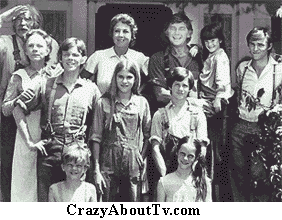
photo of the cast of The Waltons is from here

I watch some very mainstream television. This would be a confession if I thought there was something shameful about doing so, but as I have a television and an internet connection too slow to play video (films), what, honestly, are my choices? Corporate TV is what I get, along with Democracy Now! Today I watched an old episode of The Waltons from one of its last years on the airwaves, when the grandparents, mother, and John-Boy were no longer on the show. The show didn't do as well in the ratings when the extended nuclear family unraveled due to real-life issues like desire to change jobs, illness, and death.

I loved The Waltons. And the person in the program I most identified with was... well, there were two. As an intergender male, one was John-Boy, because he was such a caring, sensitive male. The other was Erin, the next-to-youngest girl, because she was sort of invisible as she wasn't statused by being the oldest or the youngest. (I most identified with Jan Brady in The Brady Bunch, for many of the same reasons.)

As I watched today, I thought about how many television shows I grew up with starred all-white casts, usually Christian ones too. The Waltons, The Brady Bunch, The The Partridge Family, and Little House on the Prairie were among my favorite shows. I soaked in programs that featured fictional functional families, and functional meant white, Christian, and only heterosexual. I was a gay kid living in a Jewish family. What was I supposed to think of myself by wishing I was part of those families?

What were Black and Brown, Asian, and Indigenous children supposed to long for, to feel that displaced sense of belonging to a fictional family demonstrating unconditional love? How do you feel unconditional love if you're not the color of the family you're watching being loving? There were no dramatic series depicting a nuclear-ish family that was Latina, Asian, or Indigenous. There were a few shows featuring Black families, but only situation comedies. I remember hearing Oprah Winfrey describe the effect of seeing a Black family behave affectionately on television. It happened when Claire and Heathcliff Huxtable cuddled on their couch. She was moved to tears, realising she had gone for all her life to that point never seeing this reflected back to her. I could relate to what she was saying, as I was yearning to see a gay couple of any color relate that way in their fictional home. I'm still waiting to see it. I'm sorry Oprah had to wait until the 1980s to see a Black woman and man be sweet to one another on television.


I'll Fly Away was one of the first dramatic program featuring a Black family but they had a supportive role that existed around the world of the main family in the show: a white one. I loved I'll Fly Away too. Regina Taylor was great in a role that didn't give her or her TV family enough air-time.

photograph of Regina Taylor is from here
For those who don't know--and I'm guessing most of you don't--I'll Fly Away was a dramatic series that ran for a couple of years in the early 1990s. Like The Waltons, it was set in the US south. But it took place a couple of decades later, during the Civil Rights struggles. Lilly Harper was the name of a character who, in the story, was hired to work in the home of a widowed white het male lawyer, in part to take care of his three children and also to cook their meals. Occasionally, the storyline took us to her home and life away from the white main characters, especially as her involvement in the Civil Rights movement increased. The lack of central attention on her own life as "more than housekeeper to whites" was not exactly the intention of the show's creators. The network would only support a show that still kept the primary spotlight on white people. From Wikipedia:
Series creators Joshua Brand and John Falsey have stated that the inspiration for the series was the classic 1962 film To Kill a Mockingbird. While the film centers around attorney Atticus Finch and his family, the pair wondered about the life of Calpurnia, the Finches' African-American maid. Her story goes unexplored in the movie. A serious and seemingly well-educated individual who is respected by her employers, Calpurnia is the inspiration for the character Lilly Harper in I'll Fly Away.
We might take a moment to consider what the employment options were for a woman who was the African American and Southern at that time. We can assume becoming President of the US was not possible, no matter how hard she tugged on those bootstraps. Things have changed since then, but not nearly deeply enough. The proportion of Black women in the US who will be filthy rich remains far less than the proportion of white men. A huge reason for that is laws governing inheritance. Most white families keep their money to themselves.

Options for Black women in the US: what they currently? Not for one woman, but for millions?

I'm watching to see how Oprah Winfrey rescues her network (OWN) from low ratings. I believe she will. She knows far too much about television production and how to get and keep high ratings to not be successful with OWN. She's beginning to put out a brand with some new programming featuring troubled celebrities, which allows her to combine her two most popular elements from the talk show that recently finished out a 25-year career. Those two elements are celebrities and emotional well-being. When watching a news story about the Oprah Winfrey talk show ending, a white middle-class woman spoke about how it was her lifeline to reminders that she has a spiritual life, and to not neglect it.

This tells us so much about CRAP--that it is an anti-spiritual, emotionally unhealthy existence, devoted to consuming, exploiting, and surviving by destroying most of what is around us, if not also ourselves. That a television program that reminds us we are spiritual beings having a human experience is a rarity. And those that also remind us we are existing inside truly vile systems of hierarchical oppression are non-existent. This means we don't really understand how those systems work. And, often enough, we deny they exist at all.

But back to emotional well-being for a moment. If you're really privileged, if you control a lot of the conditions of your life--such as by being economically secure, by not living in a shack--as many millions of good people do, by not being subjected to rape and the threat of rape daily and nightly--you might believe what many white class-privileged people believe: that your well-being is yours to determine.

It is partly ours to determine. But it is also determined by forces around and beyond us. Noticing this means we are called, perhaps, to organise and change those forces so they are more humane and just. But corporate television is owned by powerful companies that are invested in destruction of people, animals, and the Earth, and don't want us organising. So they won't tell us about those systems of harm and inhumanity--how they work, what they are designed to do, and so on.

Understanding those systems and structures has been a primary goal of mine for a long time. Since being nine years old, I'd say. At nine I began to see how things were really fucked up socially with regard to race, ethnicity, and gender. Eventually I added sexuality to the list too. Last on for me was economic status and class.

The principles by which we live our lives--our core philosophies for "good living", are structured for us if we are receiving them from corporate television or by authors who promote values that are not going to prevent them from appearing on corporate television to promote their books. Dr. Phil was supported by Oprah Winfrey. He has the most viewed daytime talk show in the US, now that Oprah's show has stopped airing new episodes.

On OWN, I saw him speaking with the former Duchess of York, Sarah Ferguson. She has a reality show detailing her journey towards greater self-awareness and personal emotional healing. She had a rough childhood emotionally but was stable economically. (Her mother left her when she was twelve, and her father was affectionally distant and very emotionally abusive.) Rarely are connections made between economic poverty and emotional distress, I find. People who are poor are assumed, if living in the US, to be able to pull themselves up from their bootstraps and find happiness in the upper middle class world that remains exclusive and exclusionary to most poor people, by design.

When we're told anyone can do something, we might notice we're not told "everyone can do it"--or even "many". We might notice that US society values pursuing happiness, not achieving it--unless you're very privileged. Even then happiness might not be yours, but not having to worry about health care and housing, not having to work three jobs to still not be able to pay your bills and feed your children, goes a long way towards being happy. While a few poor, Black, sexually abused children might be able to grow up, like Oprah, and become rich, not all poor people can. Not all Black people can. Not all sexually abused children can. And they can't not because they can't find their bootstraps. They can't because the capitalist, racist, child-hating systems they live in manufacture poverty, oil companies manufacture ecocide and the pornography industry manufactures contempt for women of all colors.

Being told "you can be whoever you want to be" was spoken a lot as President Obama won the election. What wasn't said is that "If we have one Black president, we won't be able to have another one for a score of years; probably longer." What we're not told is that "You won't be able to be president if you're a woman who is Black, Brown, Asian, or Indigenous. Not even a white Christian woman has been president, although I suspect that if Hillary Clinton were the Democratic nominee in 2008, she would have won the top office. How long do you think it will take for us to have an Indigenous president of any gender? A person born in the US also won't become president if they're Jewish or Muslim, even if they're white, male, and heterosexual.

The limitations on what we can do are not discussed as much as the apparent freedoms we have to become whatever we want. I want to live in a world where children and women are not routinely and customarily sexually assaulted. I want a world where no Indigenous people are facing genocidal destruction. I want a world without military wars, without warlords, and without patriarchal tyrants and terrorists. But I suppose that's asking for too much.

So back to the small world of our own private emotional worlds that I'm supposed to be preoccupied with if I'm allowed to think about such things at all.

Online, I found what follows, from *here*. The author discusses the same program on OWN that I watched. For those who don't know, Sarah "Fergie" Ferguson was married to Prince Andrew of the British Royal Family, but lost the marriage and a lot more. But she's not homeless because Prince Andrew is paying her rent. That's what knowing and being loved and cared about by rich people can do for you. But if the rich are the few--increasingly the tinier few--this means, necessarily, that there will be fewer non-rich people who know them that well.

As I'm not generally cynical, I find some of the concepts here quite moving.
Hi beautiful and powerful women;
While watching the new reality show, "Finding Sarah", I had a breakthrough moment or an "aha" moment as Oprah calls it. Fergie was talking with Dr. Phil and he was explaining why some of us are "blocked" at certain phases of our lives - We all have a personal truth, and that truth is what we really believe about ourselves when nobody is looking or listening. It's what we truly believe about ourselves in the core of our souls. He said, "Personal truth is so important because I think we generate the results in our life that we believe we deserve." I had to rewind that statement several times to totally absorb those powerful words. "Wow", what do I believe I deserve? Have I been blocking myself from all the universe has to share with me by believing I'm undeserving? Dr. Phil went on to say, "If you have a damaged personal truth, you generate the results that match that." "When we grow up, people write on the slate of who we are. People like parents write on our slate. But the most tragic thing of all is when we pick up the pen and start writing and we write the same things they did.." What is your personal truth? What is my personal truth? Do we have a damaged personal truth? That's a powerful question that deserves some honest quiet time to reflect. If your personal truth was damaged like mine was as a child, it's time for us to take that story and write in the the beautiful truth about who we are and what we deserve. We are amazing children and women of God, and while our parents were doing their best to gift us what they could, they probably didn't have the tools to sculpt the masterpiece we are meant to be. Now it's our responsibility to accept God's grace, love, and power so we may soar like angels... The more we have, the more we have to share with one another. We are all beautiful and so deserving of all the miracles, love, abundance, and magic this world and the universe has to share with us. Know how precious and beautiful you are and I ,too, will try to see God's beauty in me. I love all of you and I believe your personal truth is amazing!
You will note that there's no mention of how society, as a whole, or media in particular, writes on our slates. And how even if we have caring families with loving care-givers, a hostile world all jagged and nasty with rape and racism will still find ways to write on our slates.

I had loving care-givers. Several of them. I never went to bed not having eaten all day, and I always had a bed to sleep in. We might say I was lucky, but a whole lot of that not going to bed hungry and having a bed has to do with the particulars of my family's history of being white and therefore able to get employed in certain ways that weren't available to people of color.

I also was bullied for years, sexually abused and sexually assaulted, and endured anti-Semitism and a whole fucking lot of homophobic violence.

The sexual assault, perhaps even more than the bullying, wrote on my slate. What the assaulter wrote on me was this:

You are worthless. You are nothing. You are a thing for me to use as I see fit. You are something for me to wipe myself on. You are dirty. You are bad. You are aren't human in the way that I am human--I get to do stuff to you and you don't get to do stuff to me. Your value is in being used.

As  many feminists have noted, this is power boiled down to its essence: the ability to act. The ability to have what one wants done to be done. Crystal Harris just broke off her engagement to Hugh Hefner. He's 85 and she's sixty years younger than him. She decided she didn't want to be a well-kept prisoner. I'm glad. Apparently Hugh is quite a tyrant at home. He demands that things go his way all the damn time. He has movie nights and the women he wants there have to be there--two old movies on two nights; a new movie on the third night. He wants to play cards at certain times, so that's what the women around him do because they know if they don't they'll be tossed out on their exploitively photographed butts. Hugh Hefner is a silk-pajama'ed pimp who figured out how to be a publisher. That's what he ought to be well-known for. But corporate media will tout him as a fighter for justice and freedom; "only his own freedom" is the part that's left out.

I wanted to prostitute myself to procurers on and off during parts of my life and probably the one thing that kept me from doing it was not being homeless and broke. And when I seriously contemplated doing so, I'd come into contact, very strongly, with those messages that the serial rapist of children wrote on my slate. And knowing that selling myself to strange men would deepen the grooves of those etched messages left me very conflicted about following through with what be might be called a compulsion that wasn't acted out for many years.

I acted it out with a male cousin for a few years in motel rooms, answering his calls for sex as he wanted it. That did more deeply etch some of those messages--particularly the ones that told me I was undesirable except to be used. I'm now thinking about how when a man is interested in me that fact alone is triggering. Now I know why: it triggers what, in my memory, is the stuff that happens next: being used and abused.

I am celibate and I am asexual and it is with those conditions in place that I pursue my own form of happiness that doesn't look much like what corporate media tells me I should be acquiring to get it.

I know many people, mostly not white, mostly not men, who also choose to not have sex with other people. Some of them have active and enjoyable sexual relationships with themselves: I call that being celibate. I don't welcome or want sex: I call that being asexual.

I'm not anti-sex any more than I'm anti-food. I think sex can be as good as eating, as nutritious and fulfilling, and as bad compulsively eating CRAPpy food or getting food poisoning. And when you need food, you eat what's available. And when people want sex or romance with others, sometimes they take what they can get.

I watched female cousins choose men who were neglectful and abusive, get divorced, and then meet men who were far more loving. I suspect that they learned something about their value by being so devalued in their first marriages and, importantly, understanding that the messenger was wrong. In reflecting on their first husbands, I am struck with how these young men were very much like many other men around at that time, living in that culture. Curiously, the second husbands were from other states and other cultures. When they had a real opportunity to eat better food, they did. One of my cousins now runs regularly and eats mostly organic food. We didn't know what organic food was when we were kids. We were too busy eating peanut butter with added sugar and hydrogenated oil; with marshmallow fluff, which was basically all sugar; on very white bread made from bleached, bromated flour. The culture wasn't yet selling whole grain bread in the grocery stores. We take what is available, often enough. And that isn't the same as having freedom of choice.

I saw a man on television who was being interviewed by news media. He and his children had no clean water to drink, and no home, and were drinking water gathered from a stream where people washed their clothes and bodies. Thirsty in the heat, he was pouring it into his mouth and, one presumes, into the mouths of his children. He was being as good a care-giver as he could be within the conditions he was living inside. How he was far more like how most people live than how the members of the The Brady Bunch, or even the Depression-era Waltons lived. I remember reading an article in the New York Times about how the Waltons on television we're being depicted at all like how poor whites in that part of the US were actually living during that time in history. The punishing poverty common to that area of the US was removed from their story.

I wanted to believe it was close enough, because believing the television shows were dishonest was too difficult to accept. I needed it too much--to be the Truth. If television lied, that meant I had nothing into which to find my lonely hopes fulfilled.


Sunday, April 24, 2011

On the White Male Supremacist Right and Left: A Portion of the "Preface to the British Edition of Right-wing Women", by Andrea Dworkin

image of book cover and information just below is from here

The Women's Press
June 1, 1983
English
254 pages
ISBN: 0704339072
ISBN-13: 9780704339071
 
I'm not sure I've ever seen, in hand, the British edition of Right-wing Women. If anyone has a copy, hold tightly onto it! I am fairly certain it is no longer in print.

What follows is an excerpt from Andrea Dworkin's "Preface to the British edition of Right-wing Women (1983). It was reprinted for U.S. readers in Dworkin's collection of reviews, essays, speeches, and other writings titled Letters from a War Zone, pp. 185-194.

The political concepts of "Right" and "Left" could not have originated in England or the United States; they come out of the specificity of the French experience. They were born in the chaos of the first fully modern revolution, the French Revolution, in reaction to which all Europe subsequently redefined itself. As a direct result of the French Revolution, the political face of Europe changed and so did the political discourse of Europeans. One fundamental change was the formal division of values, parties, and programs into "Right" and "Left"--modern alliances and allegiances emerged, heralded by new, modern categories of organized political thought. What had started in France's National Assembly as perhaps an expedient seating arrangement from right to left became a nearly metaphysical political construction that swept Western political consciousness and practice.
In part this astonishing development was accomplished through the extreme reaction against the French Revolution embodied especially in vitriolic denunciations of it by politicians in England and elsewhere committed to monarchy, the class system, and the values implicit in feudalism. Their arguments against the French Revolution and in behalf of monarchy form the basis for modern right-wing politics, or conservatism. The principles of organized conservatism, in social, economic, and moral values, were enunciated in a great body of reactionary polemic, most instrumentally in the English Whig Edmund Burke's http://www.constitution.org/eb/rev_fran.htm">Reflections on the Revolution in France. Written in 1789 before the ascendancy of the Jacobins--and therefore not in response to the Terror or to Jacobin ideological absolutism--Burke's Reflections is suffused with fury at the audacity of the Revolution itself because this revolution uniquely insisted that political freedom required some measure of civil, economic, and social equality. The linking of freedom with equality philosophically or programmatically remains anathema to conservatives today. Freedom, according to Burke, required hierarchy and order. That was his enduring theme.

"I flatter myself," Burke wrote, "that I love a manly, moral, regulated liberty." "Manly" liberty is bold, not effeminate or timorous (following a dictionary definition of the adjective "manly"). "Manly" liberty (following Burke) has a king. "Manly" liberty is authoritarian: the authority of the king--his sovereignty--presumably guarantees the liberty of everyone else by arcane analogy. "Moral" liberty is the worship of God and property, especially as they merge in the institutional church. "Moral" liberty means respect for the authority of God and king, especially as it manifests in feudal hierarchy. "Regulated" liberty is limited liberty: whatever is left over once the king is obeyed, God is worshipped, property is respected, hierarchy is honored, and the taxes or tributes that support all these institutions are paid. The liberty Burke loved particularly depended on the willingness of persons not just to accept but to love the social circumstances into which they were born: "To be attached to the subdivision, to love the little platoon we belong to in society, is the first principle (the germ as it were) of public affections. It is the first link in the series by which we proceed towards a love to our country and mankind." The French rabble had noticeably violated this first principle of public affections.

To Burke, history showed that monarchy and the rights of Englishmen were completely intertwined so that the one required the other. Because certain rights had been exercised under monarchy, Burke held that monarchy was essential to the exercise of those rights. England had no proof, according to Burke, that rights could exist and be exercised without monarchy. Burke indicted political theorists who claimed that there were natural rights of men that superseded in importance the rights of existing governments. These theorists "have wrought under-ground a mine that will blow up, at one grand explosion, all examples of antiquity, all precedents, charters, and acts of parliament. They have 'rights of men.' Against these there can be no prescription... I have nothing to say to the clumsy subtility of their political metaphysicks." In Burke's more agile metaphysics, hereditary rights were transmitted through a hereditary crown because they had been before and so would continue to be. Burke provided no basis for evaluating the quality or fairness of the rights of "the little platoon we belong to in society" as opposed to the rights of other little platoons: to admit such a necessity would not be loving our little platoon enough. The hereditary crown, Burke suggests, restrains dictatorship because it gives the king obeisance without making him fight for it. It also inhibits civil conflict over who the ruler will be. This is as close as Burke gets to a substantive explanation of why rights and monarchy are inextricably linked.
--Andrea Dworkin (1983), "Preface to the British Edition of Right-wing Women", reprinted in Letters from a War Zone, pp. 187-189.
See also *here* from Rad Geek's blog.
For more on the contents of Letters From a War Zone, please see *here*.

Saturday, January 29, 2011

Questioning Science at Questioning Transphobia: an engaging discussion

image is from here

[6 Feb. 2011 NOTE: I misunderstood who the author is of the post linked to below. Apologies both to Lisa and the actual author, Quinnae Moongazer. I've made the corrections in my response as it now appears below.]

At Questioning Transphobia, there is a very thoughtful post which I've responded to. My comment is so damned long, however, that I'm not sure it will even be accepted by the system that accepts comments for submission. (I know some commenters here are very frustrated with Blogger for not being able to easily submit comments, especially lengthy ones. As am I.)

Below is a link to that post. I recommend reading it and the twenty or so comments following it. You may get there by clicking on the title of the post just below. As I don't copy and paste it here, all that follows is the link to it and my response. I have typo corrected and otherwise revised my response since submitting it to the discussion at the Questioning Transphobia blog.

Raiders of the Lost Etiology


Hi Quinnae. Thanks for this post! I have responses to you and a few commenters above as well. This make be a multi-post comment.

I'll first out myself as white, class-privileged, gay, male, Western, Jewish, intergender, and disabled. I'll also state general agreement and support for your post, an the comment of GallingGalla.

Some of what I am reading above is deeply troubling to me, however. I find it problematic, racist, and overly steeped in unquestioned Western argumentation.

I'll begin with this passage from Em:
I do believe however that there is a blindingly obvious form of absolute biological proof of trans people though – and that is the existence of trans people, all over the world, and in all different cultures, with all different tones of skin colour, socioeconomic brackets, religions and speaking all sorts of different languages (these things have all been proposed by people opposed to biological proof of gay, ADHD, Dyslexia, trans, etc.)

As Quinnae notes above, there are plenty of scientists always at the ready to naturalise, biologise, or "evolutionise" things like global warming, white supremacy, male supremacy, and heterosexism, and the existence of "gender". Trans experience isn't global, Em. It doesn't show up in all societies. To say this is to be grossly racist, to me.

Male supremacy is global while not universal, as is white supremacist racism, as are the environmental and economic effects of corporate capitalism. This observation ought not be made into an argument that such phenomena are natural, biological, or inevitable, imo.

To make this claim--that being trans is biological-not-social--is to practice a kind of Anglo-English-Western imperialism of language overlaid onto other cultures--typical of Westerners and whites, in my experience. We view "gender"--our contemporary very historically, culturally, and regionally specific forms of it--as "universal" because we only see what we want to see.

Many cisgender people do this and now some transgender people do this, and in neither case is it unoppressive or respectful of the incredible diversity of Indigenous (and non-Indigenous) social experience, worldview, and values.

Two-Spirited being is not, as I understand it from Two-Spirit people, reducible or appropriately translated to being  "trans"; not is it ("it" being "not one thing") an expression of "genderedness" alone; nor is it a form of "bisexuality".

That Two-Spirited Being is considered by non-Indigenous peoples and specifically Western whites to be all of those, or some of those, only means white Westerners cannot conceive of gender and sex in ways that we don't regard as existent.

Being Two-Spirited and the ways that "Gender" and "Sexuality" express themselves--as whites define and defend those terms, as well as Two-Spirited reasons for being, are quite diverse, not universal, and don't break down into being "cis" and "trans", "het" and "not het", or "man" and "woman". The whole worldview into which Two-Spirited being exists is outside the dominant paradigms of white het male supremacist civilisation.

Some cultures and societies--and whole vast civilisations that still exist and have been around for tens of thousands of years--haven't had or don't have any understanding of "gender" the way English-speaking Westerners do. Even in Sweden, "Gender" is generally an academic concept more than a social reality. So being "transgender" as opposed to "transsexual"--a distinction made in our community, is not even possible in many parts of the world.

As many trans people have expressed to me and elsewhere: "I don't know what I would be or what I'd consider myself to be if I didn't grow up where and when I did. I don't know how I'd understand my feelings and experiences, or what conclusions I'd come to about their cause and remedy."

Being "trans" is a culturally relative experience, which in no way makes it illegitimate or deserving of hatred, discrimination, or violence. It is as legitimate as being Black. And being "Black" is not a biological condition. It is a cultural and political one.

Using "biology" as a means of achieving "realness" is, as Quinnae says, typically eugenic approach to solidifying identity and appeasing anxieties. As a Jew, who has noted our passing through another International [Nazi] Holocaust Remembrance Day, I strongly oppose all attempts to "legitimise" ourselves using the Western scientific method.

And as someone who is pro-Indigenist and anti-racist, I morally object to irresponsibly or sloppily applying our terms onto other people and societies we know little to nothing about.

Does this seem to be a reasonable objection and political position, Em?

Proving through science that ADHD and depression is "real"--as in measurable through blood tests and brain scans and treatable by psychopharmacology; or that autism is "diagnosable" early in life; or that "sexual orientation" can be detected in utero, fails (miserably and dangerously) to produce any explanations for the values embedded in the Western scientific project, which, from the start and through to this day are gynocidal and genocidal. Any "orientation" is, it seems to me, necessarily social, relative, and anti-biological, as that term "biological" is tossed about. This applies to sex, gender, ethnicity, culture, class, and race. Cardiovascular disease, many cancers, and diabetes are "real" and are medically diagnosable. They are also, very clearly, consequences and conditions of living in dominant Western civilisation or other societies profoundly effected by it. We can trace the emergence of these illnesses and diseases to the emergence of the influence of the dominant civilisation that produces them. So, in this sense: is diabetes *primarily* a biological condition, or a cultural and social one?

For much more on the unowned and hypocritical racist values in white Western science and philosophy, please read the relevant chapters of Yurugu by Dr. Marimba Ani. See also the collected work of Dr. Vandana Shiva for the dangers of not keeping in check one's own worldviews and assumptions about human and social nature.

Quinnae wrote:
Everyone’s gender is constructed, no one is born a man or a woman.

This statement, when made--word for word--by cisgender radical lesbian feminists, is called "grossly transphobic", "bigoted", and "oppressive". Does that mean it is, intrinsically? I'd say it is a well-reasoned/intuited/felt observation about ourselves in patriarchal society.

Meanwhile, ALL the trans people I know offline make no claims whatsoever about trans experience being asocial or ahistorical. We accept that it is what it is in the era and region it shows up in. Our understandings of it are shaped by our concepts--which are highly relative--by our worldviews, by our assumptions about what 'biology' is, by what 'nature' is, etc.

Keep in mind, Em, that to Western scientists, "chi" energy or life-force is non-existent. It is not scientifically measurable. So, then, does it exist? Even Western medicines like homeopathy have no explanation or "proven validity" in the U.S. medical world. Does that mean homeopathy is ineffective in ending ear infections in infants and young children?

Lisa wrote:
Where are the studies that inquire why cis people are cis?

There are many hundreds of years of very pro-patriarchal Western "scientific" studies and philosophical positions arguing everything from the fact that there is only one sex: male (and that females are 'inverted' males)--see "Making Sex" by Thomas Laqueur. There are thousands of studies demonstrating that there are only two sexes: male and female, with males being naturally dominant and superior and making an argument for surgical interventions against the bodies of intersex babies, children, and adolescents.

Those of us who are intersex question how even terming ourselves "intersex" reinforces the scientific argument for surgical interventions. I fully accept that some of us are intersex. But those of us who are intersex (and intergender, transsexual, and transgender) are named this within a context of a sex-gender hierarchy posing dangerously as an apolitical binary.

How dominant society understands, names, and "treats" intersex people's bodies is profoundly social and political. So it is with transsexual people. And everyone else too.

There are scientists who have been making the case, for a very long time, that men's rape of women is inevitable. Some allegedly moral religious "scholars" and leaders note that manhood and maleness are more divine than womanhood and femaleness.

Most scientific studies try and make a case for white het male supremacy being existent naturally; such studies make claims of being entirely objective and without political bias.

Scientific arguments are put forth that heterosexuality is natural and biological, as well as G-d-approved. They have cropped up especially since various forms of Lesbian and Gay Liberation movements have come on the scene.

Why do we wish to grasp so tightly to The Master's Tools? This is answered, in part, by what aaskew is addressing above.

But clinging to science for personal self-validation, esteem, is accomplished--if in fact it is accomplished--undermines social justice movements for liberation from the tyranny of social hierarchies posing as biological binaries. It is a bit like believing in homo/hetero-sexuality being "natural": we utterly dismiss and invisibilise all of the women who have chosen to be lesbian when we try and make the case for a "gay gene". We do this generally in ways that deny and invisibilise patriarchy as a force constructing and policing our identities.

And, you have to dismiss a whole lot of social/cultural/historical experience to arrive at such a conclusion (that "sex" or "gender" is primarily or only natural).

We reinforce very dangerous premises to feel this temporary peace-of-mind that would best be arrived at on a collective level through other, more political and communal means.

Those tools are harming whole groups of people, even while they may serve the most privileged among the marginalised. Are we to be accountable to those of us who are harmed and destroyed by these "studies" and this "science", or aren't we?

Shall only the most privileged among those of us who are genderqueer get to decide to what extent appropriating the dominant discources and scientific studies is harmful and destructive? Ought not those Two-Spirit and other Indigenous People worldwide get to weigh in? How about poor queer people of color in the Global East and South?

I am concerned that the lens is narrowed down, above, to assume that whites and Westerners know much about anything at all. I think we know very little that is of value, actually. Ours is an anti-sustainable, death-worshipping, rape-glorifying, genocide-celebrating civilisation, after all.

Are our dominant society's tools to be accepted to allow a few of us feel better, when it means the political philosophies and arguments underlying gynocide, genocide, and ecocide must be bolstered? What is the primary moral principle in that strategy for achieving "wholeness"? Whose "wholeness" gets privileged here? The Earth's? Indigenous People's? Cisgender women and girls? Or a few class-, education-, region-, and race-privileged trans people?

I am calling out to the commenters, here and elsewhere across the blogosphere, for a more responsible trans-affirming ethic and political practice.