Showing posts with label Vandana Shiva. Show all posts
Showing posts with label Vandana Shiva. Show all posts
Saturday, March 12, 2016


Friday, February 15, 2013
Monday, February 11, 2013
Dr. Vandana Shiva interviewed by Robin Morgan, on rape and globalization
As a kind of personal-political preface to the interview that follows, I'd like to explain why it is I find the exchange so significant.
It should come as no surprise to anyone familiar with my blog that I strongly believe women of color are the global leaders in feminism, as well as regional and national leaders in many places, and ought to be regarded as such by whites and men. Typically, men and whites ignore, silence, marginalise, appropriate, and take credit for the activist work women of color do.
If you take the spotlight off the courageous leadership work of Malcolm X and Martin Luther King, Jr., you see a lot of Black women in leadership throughout the 20th century in the U.S., working very hard, at great cost, to free African Americans from the blight of white supremacy while also addressing sexual politics and male supremacy. Black men's work against racism has been substantial and has also tended to de-center or invisibilise Black women's insights, analysis, and activism. White women's feminist work against sexism and male supremacy has been substantial and ground-breaking in countries where white women live. And it has been a challenge to get the whiteness of the work de-centered or even consistently identified as race-privileged.
My own family background led me to be particularly concerned about sexual violence. For several years, I was drawn to a few white feminist writers who focused on that issue intensely but usually non-intersectionally, and without radically and thoroughly identifying the whiteness in their work. At the same time, thanks to a white lesbian feminist mentor, I was introduced to the work of many womanist and feminist writers of color, mostly from North America and the Caribbean. My own awareness of the work done by women of color outside of white-ruled or white-colonised nations was minimal. Over the last few years I have tried to make this blog a space where voices, perspectives, and commitments to radical social change by women of color are highlighted not footnoted; where women of color are centralised not marginalised.
I do this in part because of once mistakenly determining white work to be the most radical; this was done in part because whites who use the term 'radical' don't identify lack of awareness of their whiteness as anti-radical. This was consistently challenged by radical women of color writer-activists as anti-revolutionary, racist practice. I also noticed far too many white-edited, white-dominated anthologies of activists where women of color got a special chapter on women effected by racial hierarchies (as if white people aren't fundamentally effected by white supremacy and racism), but were rarely invited or expected to speak on behalf of all women. I've seen white pro-radical and feminist websites where the work of women of color is barely mentioned and where white women routinely speak for all women. I've seen gatherings led by whites who pretend they are inclusive and safe for women of color.
Writings and activism which centers the humanity of women is generally and typically regarded by men as being too narrowly about women. Men's writings about only-men or mostly men has been historically regarded by men as about all of humanity, or the segment of humanity worth doing justice work for, or about all people of a particular race; it is rarely-to-never seen as "too narrow in scope", too much about men, too ignorant about women, when reviewed by other men. When men recount the contributions by women to the men's human struggles for justice, women have too often been ignored or footnoted. And when men focus on women, the gaze is often objectifying and the attitude patronising.
It appears that whites and men will not easily regard women of color as fully human with perspectives that whites and men ought to pay attention to, prioritise, privilege, promote, and regard as foundational and central to understanding humanity on the whole.
I have come to the conclusion that women of color, as a global and regional majority by gender and the most diversely raced women on Earth, hold the most complex, radical, sophisticated, and revolutionary views on race, gender, and everything else. This doesn't mean I don't still look to white women and men of color for useful analysis and insight. It means I no longer center and privilege their voices and perspectives.
Vandana Shiva is, for me, a profoundly important world leader on matters of feminism, environmental/Earth justice, global economics, and holistic and humane sustainability. Robin Morgan is a U.S.-based white feminist who has dedicated many decades to the struggle by and for women against men's global woman-hating and woman-subjugating violence. I hold both women in very high regard and was delighted to find this exchange between them recently online.
You may go here, to The Women's Media Center online, to return to the source website. You may stay connected with their efforts here: Follow @womensmediacntr

Once again, to link back to the source website, please click *here*.
It should come as no surprise to anyone familiar with my blog that I strongly believe women of color are the global leaders in feminism, as well as regional and national leaders in many places, and ought to be regarded as such by whites and men. Typically, men and whites ignore, silence, marginalise, appropriate, and take credit for the activist work women of color do.
If you take the spotlight off the courageous leadership work of Malcolm X and Martin Luther King, Jr., you see a lot of Black women in leadership throughout the 20th century in the U.S., working very hard, at great cost, to free African Americans from the blight of white supremacy while also addressing sexual politics and male supremacy. Black men's work against racism has been substantial and has also tended to de-center or invisibilise Black women's insights, analysis, and activism. White women's feminist work against sexism and male supremacy has been substantial and ground-breaking in countries where white women live. And it has been a challenge to get the whiteness of the work de-centered or even consistently identified as race-privileged.
My own family background led me to be particularly concerned about sexual violence. For several years, I was drawn to a few white feminist writers who focused on that issue intensely but usually non-intersectionally, and without radically and thoroughly identifying the whiteness in their work. At the same time, thanks to a white lesbian feminist mentor, I was introduced to the work of many womanist and feminist writers of color, mostly from North America and the Caribbean. My own awareness of the work done by women of color outside of white-ruled or white-colonised nations was minimal. Over the last few years I have tried to make this blog a space where voices, perspectives, and commitments to radical social change by women of color are highlighted not footnoted; where women of color are centralised not marginalised.
I do this in part because of once mistakenly determining white work to be the most radical; this was done in part because whites who use the term 'radical' don't identify lack of awareness of their whiteness as anti-radical. This was consistently challenged by radical women of color writer-activists as anti-revolutionary, racist practice. I also noticed far too many white-edited, white-dominated anthologies of activists where women of color got a special chapter on women effected by racial hierarchies (as if white people aren't fundamentally effected by white supremacy and racism), but were rarely invited or expected to speak on behalf of all women. I've seen white pro-radical and feminist websites where the work of women of color is barely mentioned and where white women routinely speak for all women. I've seen gatherings led by whites who pretend they are inclusive and safe for women of color.
Writings and activism which centers the humanity of women is generally and typically regarded by men as being too narrowly about women. Men's writings about only-men or mostly men has been historically regarded by men as about all of humanity, or the segment of humanity worth doing justice work for, or about all people of a particular race; it is rarely-to-never seen as "too narrow in scope", too much about men, too ignorant about women, when reviewed by other men. When men recount the contributions by women to the men's human struggles for justice, women have too often been ignored or footnoted. And when men focus on women, the gaze is often objectifying and the attitude patronising.
It appears that whites and men will not easily regard women of color as fully human with perspectives that whites and men ought to pay attention to, prioritise, privilege, promote, and regard as foundational and central to understanding humanity on the whole.
I have come to the conclusion that women of color, as a global and regional majority by gender and the most diversely raced women on Earth, hold the most complex, radical, sophisticated, and revolutionary views on race, gender, and everything else. This doesn't mean I don't still look to white women and men of color for useful analysis and insight. It means I no longer center and privilege their voices and perspectives.
Vandana Shiva is, for me, a profoundly important world leader on matters of feminism, environmental/Earth justice, global economics, and holistic and humane sustainability. Robin Morgan is a U.S.-based white feminist who has dedicated many decades to the struggle by and for women against men's global woman-hating and woman-subjugating violence. I hold both women in very high regard and was delighted to find this exchange between them recently online.
You may go here, to The Women's Media Center online, to return to the source website. You may stay connected with their efforts here: Follow @womensmediacntr
Economist and ecofeminist Dr. Vandana Shiva addresses the root causes of violence against women.
Dr. Vandana Shiva—The New Delhi Rape and Globalization
| February 11, 2013
Dr. Vandana Shiva, economist, environmentalist, and feminist, spoke of the public outcry in India and how the devaluing of women in a global economy set the stage for the New Delhi rape. Adapted from a conversation broadcast last month on Women's Media Center Live with Robin Morgan.
Robin Morgan: In a feminist analysis certainly, everything is connected to everything else. You recently wrote a stunning piece about the ghastly gang rape in New Delhi and the subsequent demonstrations and how violence against women and the economy were all connected. I’d love you, please, to talk about the points that you raised.
Vandana Shiva: I’ve been working on how the economy’s changing—globalization, free trade, WTO, the structural adjustment. I’ve made the connections between those purposes and what happens to women in what is called the New Economy. They even call it the Emerging Economy, as if a 10,000-year-old civilization emerges only when it is locked into corporate globalization.
The first level at where violence against women begins is in the very defining of the economy. Economy means household. It is what women define both inside the physical households, but also the world, inside the planet as the household. As long as the principles of management came out of that, they focused on sustenance, livelihoods, mutual giving—of course, within the typical patriarchies all our societies have had.
[With] free trade globalization, the first thing they do is knock out that major sector of women’s economy and, as Marilyn Waring has written in If Women Counted, install a production boundary to calculate growth.
The Gross Domestic Product grows every time you can pull something out of nature and something out of women customers’ economy, which means every time you destroy nature and women’s livelihoods, and production, and creativity, you can call it growth. It’s created to mobilize finances for the war, and it becomes the dominant number imposed on our world.
I’ve been appointed by the King of Bhutan to an expert group we’ve created because Gross Domestic Product is the wrong measure. The King of Bhutan said we should be looking at the well-being of our people to measure Gross National Happiness.
At this time, growth measured as Gross Domestic Product is already collapsing world-wide. It collapsed with Wall Street. It’s collapsing in Europe right now in front of our eyes. and it will collapse in India after a few years. How long can you sustain an eight or nine percent growth that excludes women as the primary backbone of the economy? That is the first violence.
The second violence is in terms of decision-making and politics. In so many debates in India we hear, “Oh, we can’t have politics in economics.” But every time they make a decision within a patriarchal model of the economy, it is politics. It’s politics that basically says, “Only corporations count, only the powerful count, and we’re going to mutate democracy from being, “By the people, of the people, for the people,” into being “By the corporations, of the corporations, for the corporations—and the powerful.”
The convergence of economic and political power further excludes women, but it also creates a class with immunity and impunity, which can do all levels of violence, change laws, and remove protections. There’s rape at every level—rape of the earth, rape of our resources, rape of the economy, and rape of women, which is what this drastic, dramatic tragedy has woken up India to.
Then there are other levels of violence because displaced people are more vulnerable. I was asked by the National Commission of Women to grapple with what globalization was doing to women in India, in terms of two key factors: water, and food and agriculture. At public hearings around the country, whether in Calcutta or down south, women would speak out boldly about how sexual violence has increased and made them more vulnerable as they were being made economic and ecological refugees.
That is at the very foundation of this new liberal model: everything is a commodity. Everything is property. Everything has a price and nothing has value. Added to the traditional patriarchies of societies, that's created what I call a super-virus of patriarchy. When two viruses hybridize, they start to kill.
Basically it’s a bit like climate change. We’ve had cyclones, but Hurricane Katrina and Hurricane Sandy present a different level of violence. Of course, we know that this is contributed by climate change. We need to start looking at how an economy based on patriarchal fictions—and the corporation is the biggest patriarch in our lives to come—how this patriarchy is combining with traditional patriarchies to unleash even larger violence, both the kind we see on the streets of Delhi and the economic kind, the violence of robbing you of your home, of your foundation.
Our prime minister said recently, it’s these loose-footed migrants that are part of the problem. Because the Delhi rape involved migrants at both ends. The rapists were all living in slums in hugely brutalized conditions, thinking that brutalization is the norm. The poor girl's father had sold his land because farmers aren’t being allowed to make a living. Two hundred and seventy thousand Indian farmers have committed suicide. The rest are hanging on the margins of existence. He moved to Delhi to load luggage at the airport to be able to survive and send his children to school.
The prime minister just called them loose-footed migrants creating problems. I said, “Mr. Prime Minister, they are a product of your policies. They are refugees of your economic policies.” None of these—economics and culture and society—are insulated silos. The patriarchal economic model is becoming the dominant force in our society. Societies have been reduced to the economy. Economy has been reduced to the market. The market has been reduced to what is controlled by finance, capital corporations. And if all you show is women as commodities, selling other commodities, those images start to further distort already damaged brains.
RM: Isn’t it amazing, Vandana, how when you put something in context—the background of the victim and for that matter of the perpetrators—it changes? Also, I'm reminded of your colleague Ruchira Gupta who wrote a piece in which she pointed out that the commodification of women by the rampant growth of pornography and prostitution sends the message that, in fact, this is what women are for. She connects that to the apparently quite dramatic rise in rape in India.
VS: Hugely dramatic. Eight hundred percent since the ‘70s and more than 250 percent since India’s economy, was as they say, made "more open" [with globalization]—more open to more violence against women.
RM: From where I sit here in New York, it seems heartening that women in numbers never seen before and accompanied by men as well have been on the streets in not only Delhi but across India. They haven’t quite made the connections you’re making, but they are on the move protesting violence against women.
What can we do to turn the enormity of this around? It’s always for example, blown me away, that a woman who is, say, in her fifteenth hour of labor, straining away—the doctor and the nurses and the anesthesiologists are all productive because they are wage labor, but the woman who is actually giving birth is not considered in a productive act.
VS: I think that is the foundational error. Everything that replenishes is treated as not producing at all and everything that’s degrades, everything that depletes, is treated as production. I call it the creation boundary, which has given us the fiction of growth and the Gross Domestic Product—that destructive acts are creative acts of produce. The really creative acts of nature—of women in their tremendous diversity and amazing ability to juggle 50 jobs, 50 responsibilities—their whole society and economy are treated as unproductive. That, I think, is the most important shift we need to make.
As you know Robin, I come from the part of the Himalayas where it's recognized that women are the main productive force. They go out in the forests [to work] and there's nothing like the rape [that occurs] when you come into the plains where women are no longer considered productive. When I, with my sister, Dr. Meta Shiva, was studying female feticide, we realized that the map of high growth in the patriarchal measure are the same zones with the high levels of extermination of girls—fifty million girls haven't been allowed to be born in the last few decades.
The response in Delhi is beautiful for a number of reasons.
The first, that the younger generation has come. The younger generation was absent from social movements, especially the middle class because they were getting it so good with globalization—the IT jobs that moved to India. They were all seeing themselves as individual consumers, so society did not matter to them. But this rape reminded them that it could have been them coming back from their IT farms, from their phone call service centers.
The second difference is, while we have had a feminist movement in India for a long time, it was only the women. The beauty now is, young men joined. It was a young man who was defending this girl in that bus. I think for the first time, there’s this new generational solidarity that’s emerging. Those very gutsy young people who are being beaten up and sprayed with tear gas and water canons realized that the state has become militarized. The state itself is a patriarchal institution. It will take time. There will be the hysterical voices saying death sentence, death sentence! But new connections have started to germinate that are really going to make a serious change.
RM: That’s very encouraging. When you look at the global scale of things, I confess that I look to women not only because we are the majority and that permits more peaceable and more, how shall I say, witty and ingenious new strategies, but also because there’s no area that isn’t a women’s issue. We spill over into everything if the connections are made. I definitely see the global women’s movement as the politics of the 21st Century.
VS: We are really living through a period of collapse of all kinds in the patriarchic system. The collapse of the financial economy they’ve built, a collapse of the eco-systems they have raped. The UN has recognized that 90 percent of eco-systems are on the verge of collapse, if not already collapsed. In this period, it’s the creative principle which women bring to bear for the simple reason that they were left to look after the real stuff of life, the goals that really mattered. So they bring both another world view, another mindset, and other capacities, other skills—which is why I run a grandmother’s university at the new school I created in Dehradun called the Earth University.
RM: I love it.
VS: Ghandi always said a prayer, “Make me more womanly.” If there is going to be a future for humanity, it will have to be a womanly future. I go to Europe and young men will bring me my books [to sign] and say, "I'm an ecofeminist, Dr. Shiva." That to me is a major, major shift. A shift to a creative economy where women start defining and playing the leadership role but others recognize that there has to be a mind shift.
RM: Whenever I talk to you, I feel both incredibly depressed because one is made yet again to realize the severity of the situation and at the same time, incredibly optimistic because I get from you a validation of everything that we’ve been trying to do and will do more and even better and with more people involved in the future.
I can’t tell you how grateful I am for your wisdom and your perceptions and for everything that you do.
VS: And Robin, I want to thank you for your vision and leadership and your love.
Once again, to link back to the source website, please click *here*.
Tuesday, January 29, 2013
What is Women's Courage When Men Define the Terms?
 |
| image is from here |
Her post led me to think back to something I once read by Andrea Dworkin on the subject. I did some searching and found Andrea Dworkin's chapter in her book Our Blood, called "The Sexual Politics of Fear and Courage". A scanned version of the book is available to be read as a pdf document (or may be downloaded) *here*.
As I reflect on Melissa's blog, Dworkin's work, and on the purgatory of contemporary U.S. society, I am struck with the degree to white men define the terms so many of us live by. Inside a white male supremacist system, "courage" is traditionally and ubiquitously understood to be masculine in nature, belonging to men; a capacity understood patriarchally to be inherently male and associated with strength. Fear is understood to be feminine in nature, the "natural" province of women, and is associated with weakness. For men and boys to be what men determine to be "weak", including by being afraid, is--so the status quo society says--to be less manly and more like a woman or girl. For women to be courageous and strong as men define it, is to be unwomanly and more like a man. If she isn't punished for being "brave" in the patriarchal definition of the word, she might gain temporary male status.
In Melissa's incisive account of a stand-up comedy club, I find examples of how men define not only terms but also act them out in social spaces. At the club, a combination of men's sexual violence against women, including the threat of violence and "jovial" harassment and objectification, ensures that women aren't likely to be too unafraid. As Dworkin has stated, "By the time we are women, fear is as familiar to us as air. It is our element. We live in it, we inhale it, we exhale it, and most of the time we do not even notice it." Curiously, the only men I know personally who seem to have this deep-seated fear-orientation to the world are male survivors of child sexual abuse. While women do, in fact, live with courage and bravery as they negotiate many challenges and obstacles, men do their best and worst to make sure fear, in women, is never completely irrational or unwarranted.
The misogynist violence that men direct at women ensures that those men aren't seen--by other woman-hating men--as too weak. Rape is one of many acts in which males may cast off their supposed weakness and exercise patriarchal power by terrorising and violating women. War is another realm where men get to be brave and heroic by doing violence and 'conquering' fear, against the bodies, minds, and spirits of threatened people. Military war, when perpetrated by the Western world, is also the place where imperialism, white supremacy, capitalism, and colonialism are acted out in patriarchal terms. Invasion is always sexualised in the male supremacist imagination.
It's going to be interesting to see how U.S. female soldiers in military combat are regarded by male soldiers: will the women be seen as heroic, like the men? Will any individual woman in military combat be treated more like one of the guys? Or will her patriarchally-defined courage be seen as tainted by her gender? (Sort of the way bigoted straight men argue that marriage is tainted if queers--defined by dominant straight male society as feminine men and masculine women--can do it too.) A serious concern is that any woman in military combat may be additionally vulnerable to rape by male soldiers who want to be sure she doesn't believe she's equal to men. I say additionally because we know this is already happening endemically and systematically to civilian girls and women, and to women troops off the battlefield. Or, rather, off the battlefield that men name as such, for many private and social spaces men occupy are battlefields for women, such as the bed, the home, the workplace, and the street.
We also know that U.S. male soldiers practice rape against the women and girls of invaded countries, usually populated by people of color: even a partial list of such countries invaded and/or occupied by U.S. troops or covert operations is long: Japan, Korea, Vietnam, Guatemala, El Salvador, Grenada, Iraq, Pakistan, Afghanistan. Taken together, the body count is in the many hundreds of thousands; how many of those murder victims were also victims of rape is impossible to say. It was likely to be grossly under-reported or not reported at all: all forms of men's sexual violence is under-reported because terrorising people and forcing submission works to silence and shame them. If we leave out all other European countries that made conquest and occupation of other sovereign nations a national pastime, and only focus on Britain's imperial invasions, we are left with very few countries untouched by brutal, white imperial/patriarchal force. (Source for that comment is *here*.)
What we may notice internationally in the West is that when European white women are in seats of typically and traditionally white male power, they sometimes argue, over the disdainful shouts of men, for equality not supremacy. See, for example: To End Extreme Poverty, Let’s Try Ending Extreme Wealth or this: This bold equality push is just what we needed. In 1997.
When we consider the politics of many prominent, activist women of color, we see comprehensive intersectional analysis and proposals for global peace and justice. See, for example: Staying Alive: Women, Ecology, and Development, by Vandana Shiva, and The Winona LaDuke Reader: A Collection of Essential Writings.
A flip side of this issue of gender and courage is seen when we try and make heroes of men who preached against many forms of violence, such as Rev. Dr. Martin Luther King, Jr. or John Lennon. This is not at all to say either man was non-violent historically in their own lives. At least John Lennon spoke honestly about his abuses as such and endeavored to be a different kind of man in his later years. At least Dr. King set an honorable example of how to love one's enemy while holding them accountable for their crimes against humanity. But when such men advocate peace-not-war, or equality with women, they become vulnerable to being stigmatised 'feminine'.
Referencing Melissa's post, it says a great deal that men on stage doing comedy or men in the audience, need to reinforce and verbalize the worst aspects of male supremacist/patriarchal practice, and in particular to affirm a phallic identity. I admire the woman who did her own comedy, successfully, disproving so much that is taught in a racist patriarchal society like ours about women's power to create something new that is solely hers while deeply shared, in the midst of a culture of sexual predation and cultural appropriation. More power to her. More power to all women fighting for justice and equality.
Despite the saying that sits atop this post, liberally redefining terms won't shift society's political hierarchies. Many of us strive to make language express the complexities of who we are. As I listen to those singly or multiply oppressed, I hear again and again how difficult it is to make the dominant language speak their truths. It is courageous, isn't it, to endure and survive rape and warfare? I'd say so. But will patriarchal men ever see the courage of it, or only determine her survival to be a residual sign of his weakness?
However we maneuver meanings and memes, such effort is insufficient if our goal is liberation. The means and machinery of gynocidal straight male supremacy and genocidal and imperialist white supremacy must be shut down; new systems and institutions fostering equality and non-violence must become the status quo. Only then will new definitions have rooting and resonance beyond small, non-dominant groups of people. And only then will whole truths be spoken about life under siege, without interruption and mistranslation by the former masters.
Referring back to the phrasing in the image above, I'd say: "When peace-work is routinely seen as courageous, and war-making is popularly viewed as the work of cowards, we will know substantive, life-affirming change has occurred."
And when women of color define the terms we all live by, and govern globally, I will know we have radically purged ourselves of purgatory, razed hell, and brought heaven down to Earth.
Thursday, January 24, 2013
Rape, India, and White Male Supremacy
 |
| image is from here |
I have not written here about the preponderance of rape in India because as a white Western male, I know such news is misused in the West to promote an idea that misogyny is worse in other places than within the U.S. Misogyny is organised and expressed in similar and dissimilar ways around the world; in the U.S. rape, battery, the sexual sale and renting of women and girls, forced sterilisation, restrictive regulations on abortion, economic inequality and capitalist exploitation are among the many ways woman-hating violence manifests. Violence occurs disproportionately against women of color. Indigenous women, for example, are raped more than non-Indigenous women in the U.S., overwhelmingly by white men. But when non-white men, here and internationally, are identified as abusers of women, that is erroneously determined to mean that white men are less violent than other men.
Feminists of all colors have been explicitly and systematically organising against men's violence against women for the last several decades. They have challenged male supremacist entitlements to take what they desire; they have confronted the industries that promulgate the idea that women want to be raped and sadistically hurt; they have fought for economic justice and civil rights, the lack of which keep women vulnerable to men. And even with this level of resistance, men still rape and do other harm to women, mostly with inpunity and with the perverse idea, shared among men, that such violence makes them more of a man.
Men of all colors commit atrocities against girls and women although some cultures have not historically promoted and protected men's commitment to violence. Structurally, socially, and economically, white men are most oppressively empowered and are therefore the most dangerous. Nonetheless, white men promote the lie that men of color are more dangerous: more dangerous to women and more dangerous to men. It is against great and overwhelming evidence that white men believe this.
Such a distorted view ignores the reality that colonial/imperialist invasion by white men into India is part of the story of how rape happens there. It is not the whole story, but invasion by white men anywhere brings the rape of girls and women with it. Military invasion is one form of assault against a country that is carried out with sexual violence against female bodies. Male soldiers commit rape systematically--not all male soldiers, but too many for the rape to not be systemic and protected. U.S. male soldiers rape not only the girls and women of occupied countries, but the women who militarily serve along with them.
This doesn't mean were it not for white men, no rape would occur. It is to notice, however, that white men's chronic and cancerous invasions of other countries and human bodies is historically undeniable but ought not be assumed to be inevitable. White supremacy, male supremacy, and corporate capitalism intersect and become mutually reinforcing.
Below is a perspective directly out of India that takes into account how the sexism of economics factors into the preponderance of rape. It is by the great feminist, philosopher, and activist Dr. Vandana Shiva. I believe her voice is so important and that what she has to say ought to be centered in Western conversations about how to stop rape. I post her words here to hopefully bring her message to a few more people. (You may click on the title just below to link back to the source website.)
Vandana Shiva: Our Violent Economy is Hurting Women
Source: Yes Magazine


Violence against women is as old as patriarchy.
Traditional patriarchy has structured our worldviews and mindsets, our social and cultural worlds, on the basis of domination over women and the denial of their full humanity and right to equality. But it has intensified and become more pervasive in the recent past. It has taken on more brutal forms, like the murder of the Delhi gang rape victim and the recent suicide of a 17-year-old rape victim in Chandigarh.
In India, rape cases and cases of violence against women have increased over the years. The National Crime Records Bureau (NCRB) reported 10,068 rape cases in 1990, which increased to 16,496 in 2000. With 24,206 cases in 2011, rape cases jumped to incredible increase of 873 percent from 1971 when NCRB started to record cases of rape. And Delhi has emerged as the rape capital of India, accounting for 25 percent of cases.
The movement to stop this violence must be sustained till justice is done for every one of our daughters and sisters who has been violated.
And while we intensify our struggle for justice for women, we need to also ask why rape cases have increased 240 percent since 1990’s when the new economic policies were introduced.
Could there be a connection between the growth of violent, undemocratically imposed, unfair economic policies and the intensification and brutality of crimes against women?
I believe there is. I am not suggesting that violence against women begins with neoliberal economics. I am deeply aware of the deep gender biases in our traditional cultures and social organizations. I stand empowered today because people before me fought against the exclusions and biases against women and children: My grandfather sacrificed his life for women’s equality, and my mother was a feminist before the word existed.
Violence against women has taken on new and more vicious forms as traditional patriarchal structures have hybridized with the structures of capitalist patriarchy. We need to examine the connections between the violence of unjust, unsustainable economic systems and the growing frequency and brutality of violence against women. We need to see how the structures of traditional patriarchy merge with the emerging structures of capitalist patriarchy to intensify violence against women.
Cyclones and hurricanes have always occurred. But as the Orissa Supercyclone, Cyclone Nargis, Cyclone Aila, Hurricane Katrina, and Hurricane Sandy show, the intensity and frequency of cyclones has increased with climate change.
Our society has traditionally had a bias against the girl child. But the epidemic of female feticide and the disappearance of 30 million unborn girls has taken that bias to new levels of violence and new proportions. And it is into this context of the dynamics of more brutal and more vicious violence against women (and multiple, interconnected forms of violence) that the processes unleashed by neoliberalism are contributory factors.
Firstly, the economic model focusing myopically on “growth” begins with violence against women by discounting their contribution to the economy.
The more the government talks ad nauseum about “inclusive growth" and “financial inclusion,” the more it excludes the contributions of women to the economy and society. According to patriarchal economic models, production for sustenance is counted as "non-production." The transformation of value into disvalue, labour into non-labour, and knowledge into non-knowledge is achieved by the most powerful number that rules our lives, the patriarchal construct of GDP—Gross Domestic Product—which commentators have started to call the Gross Domestic Problem.
National accounting systems which are used for calculating growth as GDP are based on the assumption that if producers consume what they produce, they do not in fact produce at all, because they fall outside the production boundary.
The production boundary is a political creation that, in its workings, excludes regenerative and renewable production cycles from the area of production. Hence, all women who produce for their families, children, community, and society are treated as "non-productive" and "economically inactive." When economies are confined to the marketplace, economic self-sufficiency is perceived as economic deficiency. The devaluation of women’s work, and of work done in subsistence economies of the Global South, is the natural outcome of a production boundary constructed by capitalist patriarchy.
By restricting itself to the values of the market economy, as defined by capitalist patriarchy, the production boundary ignores economic value in the two vital economies which are necessary to ecological and human survival. They are the areas of nature’s economy, and sustenance economy. In nature’s economy and the sustenance economy, economic value is a measure of how the earth’s life and human life are protected. Its currency is life-giving processes, not cash or market price.
Secondly, a model of capitalist patriarchy which excludes women’s work and wealth creation in the mind, deepens the violence by displacing women from their livelihoods and alienating them from the natural resources on which their livelihoods depend—their land, their forests, their water, and their seeds and biodiversity. Economic reforms based on the idea of limitless growth in a limited world, can only be maintained by the powerful grabbing the resources of the vulnerable. The resource grab that is essential for “growth” creates a culture of rape—the rape of the earth, of local self-reliant economies, and of women. The only way in which this “growth” is “inclusive” is by its inclusion of ever larger numbers in its circle of violence.
I have repeatedly stressed that the rape of the Earth and rape of women are intimately linked, both metaphorically in shaping worldviews, and materially in shaping women’s everyday lives. The deepening economic vulnerability of women makes them more vulnerable to all forms of violence—including sexual assault.
Thirdly, economic reforms lead to the subversion of democracy and privatization of government. Economic systems influence political systems. The government talks of economic reforms as if it has nothing to do with politics and power. Leaders talk of keeping politics out of economics, even while they impose an economic model shaped by the politics of a particular gender and class. Neoliberal reforms work against democracy. We have seen this recently with the Indian government pushing through "reforms" to bring in Walmart through FDI in retail. Corporate-driven reforms create a convergence of economic and political power, a deepening of inequalities, and a growing separation of the political class from the will of the people they are supposed to represent. This is at the root of the disconnect between politicians and the public that we experienced during the protests that have grown throughout India since the Delhi gang rape.
Worse, an alienated political class is afraid of its own citizens. This is what explains the increasing use of police to crush nonviolent citizen protests, as we have witnessed in Delhi. A privatized corporate state must rapidly become a police state.
This is why the politicians must surround themselves with ever increasing VIP security, diverting the police from their important duties to protect women and ordinary citizens.
Fourthly, the economic model shaped by capitalist patriarchy is based on the commodification of everything, including women. When we stopped the WTO in Seattle, our slogan was, “Our world is not for sale."
An economics unleashed by economic liberalization—an economics of deregulation of commerce, of privatization and commodification of seeds and food, land and water, women and children—degrades social values, deepens patriarchy, and intensifies violence against women.
Economic systems influence culture and social values. An economics of commodification creates a culture of commodification, where everything has a price, and nothing has value.
The growing culture of rape is a social externality of economic reforms. We need to institutionalize social audits of the neoliberal policies which are a central instrument of patriarchy in our times. If there was a social audit of corporatizing our seed sector, 270,000 farmers would not have been pushed to suicide in India since the new economic policies were introduced. If there was a social audit of the corporatization of our food and agriculture, we would not have every fourth Indian hungry, every third woman malnourished, and every second child wasted and stunted due to severe malnutrition. India today would not be the Republic of Hunger that Dr. Utsa Patnaik has written about.
The victim of the Delhi gang rape has triggered a social revolution. We must sustain it, deepen it, expand it. We must demand and get speedy and effective justice for women. We must call for fast-track courts to convict those responsible for crimes against women. We must make sure laws are changed so justice is not elusive for victims of sexual violence. We must continue the demand for blacklisting of politicians with criminal records.
We must see the continuum of different forms of violence against women, from female feticide to economic exclusion and sexual assault. We need to continue the movement for the social reforms needed to guarantee safety, security, and equality for women, building on the foundations laid during India's independence movement and continued by the feminist movement over the last half-century. The agenda for social reforms, social justice, and equality has been derailed by the aganda of “economic reforms" set by capitalist patriarchy.
And while we do all this we need to change the ruling paradigm that reduces society to economy, the economy to the market, and is imposed on us in the name of “growth."
Society and economy are not insulated from each other . The processes of social reforms and economic reforms can no longer be separated. We need economic reforms based on the foundations of social reforms that correct the gender inequality in society, rather than aggravating all forms of injustice, inequality, and violence.
Ending violence against women needs to also include moving beyond the violent economy to nonviolent, sustainable, peaceful, economies that give respect to women and the Earth.
Vandana Shiva is an internationally renowned activist for biodiversity and against corporate globalization, and author of Stolen Harvest: The Hijacking of the Global Food Supply; Earth Democracy: Justice, Sustainability, and Peace; Soil Not Oil; and Staying Alive. The last section of this essay was adapted by the author from “Forest and Freedom,” written by Shiva and published in the May/June 2011 edition of Resurgence magazine. Shiva is a YES! contributing editor.
Thursday, July 19, 2012
Vandana Shiva on the Environmental and Moral Problems with Genetically Modified Seeds
From billmoyers.com.
Vandana Shiva on the Problem with Genetically Modified Seeds
July 13, 2012Bill talks to scientist and philosopher Vandana Shiva, who’s become a rock star in the global battle over genetically modified seeds. These seeds — considered “intellectual property” by the big companies who own the patents — are globally marketed to monopolize food production and profits. Opponents challenge the safety of genetically modified seeds, claiming they also harm the environment, are more costly, and leave local farmers deep in debt as well as dependent on suppliers. Shiva, who founded a movement in India to promote native seeds, links genetic tinkering to problems in our ecology, economy, and humanity, and sees this as the latest battleground in the war on Planet Earth.
Footage from Bitter Seeds courtesy of Teddy Bear Films
Saturday, April 21, 2012
Male Supremacy, White Supremacy, and Heterosexism: what's missing from this list of oppressive forces?
 |
| image of book cover is from here |
It is the anti-oppression work that cannot divorce human rights from land rights, or destruction of people with destruction of the Earth. Indigenous People live on smaller and smaller portions of land, increasingly possessed and pillaged by white male and corporate power-brokers. A few years ago the call to Indigenist consciousness rang loudly in my head and I see how easy it is to let that echo fade. My world, my daily life, isn't obviously tied in obvious ways to the struggles of Indigenous people either regionally or globally. At least not as I experience my world of relative economic security, white-centered and white-dominated living, and heteromale supremacist values and expectations. My world is a world in which whites fight for land, and once possessed it is never relinquished. It is a world that uses science and spirituality differently, towards different aims. It is a world in which conceptions of gender and ethnicity are often considered matters of individual choice, not structural, social imposition.
I am beginning to question how and to what degree discussions of gender identity, when divorced from the politics of race, class, and region, locates the arguers' positions as anti-Indigenist. Among very socially and environmentally advantaged people, the practice of isolating forms of oppression is typical: one may fight for queer rights, for women's rights, or for the rights of the working poor. But often enough each of those struggles entails demanding or achieving access into a dominant society that is hell-bent on destroying every Indigenous person on Earth who isn't willing to divorce themselves from their own ethnic and ancestral traditions.
We know that the "kinder, gentler" version of genocide is, rather than committing mass-slaughter outright, to demand that Indigenous people give up language and land, among other things. And to assimilate into usually white supremacist society. White male-ruled nation-states are, without exception, anti-Indigenous: genocidal and ecocidal.
The white men who pride themselves on taking a "radical" stance on The Environment are notoriously misogynistic, racist, classist, and Western-focused, seeing land as something for white men to control, even if the effort is to "liberate" the land; white male environmentalists are known for taking on Indigenous People, framing the latter as the exploiters or heartless ones, and white men as the moral saviors of the Earth. For decades, I have seen how whites and men are famous for not being accountable to Indigenous women activists.
As a "First-worlder", I know that my concerns will tend to be myopic and self-centered. This is often enough true for me as a white person and as a male also. After all, the conditions most people live in are not the conditions I live in. I have to venture out of my tiny, powerful scene and myopic worldview to get to know people living with traditions and threats viscerally, experientially unknown to me.
I have posted about this before, but here again is an important piece of writing about the need to center Indigenous women's lives and work in social justice movements:
http://unsettlingamerica.wordpress.com/2011/09/08/indigenous-feminism-without-apology/
If you want to see a good example of how a "First World" activist refuses the perspective and worldview of a "Third World" activist, watch (and read) this:
Part 1:
http://youtu.be/3BcVxgW-vO8
Part 2:
http://youtu.be/pPue0Gq4JmE
Transcript
AMY GOODMAN: Our guests are Gwynne Dyer — he’s author of Climate Wars: The Fight for Survival as the World Overheats — and Vandana Shiva joins us, an Indian environmentalist, scientist, philosopher, global justice activist and eco-feminist, a longtime critic of genetically modified crops and the system of corporate-driven agriculture and neoliberal globalization that’s privatized natural resources and impoverished farming and indigenous communities across the Global South.
Well, we’re talking about geoengineering. You just came from giving a speech last night at St. John the Divine. What are your thoughts on geoengineering, Vandana Shiva?
VANDANA SHIVA: Well, three thoughts. The first is, it is the idea of being able to engineer our lives on this very fragile and complex and interrelated and interconnected planet that’s created the mess we are in. It’s an engineering paradigm that created the fossil fuel age, that gave us climate change. And Einstein warned us and said you can’t solve problems with the same mindset that created them. Geoengineering is trying to solve the problems with the same old mindset of controlling nature. And the phrase that was used, of cheating — let’s cheat — you can’t cheat nature. That’s something people should recognize by now. There is no cheating possible. Eventually, the laws of Gaia determine the final outcome.
But I think the second thing about geoengineering is, we’ve just had the volcano in Iceland, in — yes, it was Iceland. And look at the collapse of the economy. And here are scientists thinking that’s a solution? Because they’re thinking in a one-dimensional way. It’s linear, issue of global warming, anything to do global cooling. I work on ecological agriculture. We need that sunlight for photosynthesis. The geoengineers don’t realize, sunshine is not a curse on the planet. The sun is not the problem. The problem is the mess of pollution we are creating. So, again, we can’t cheat.
And the final issue is that these shortcuts that are attempted from places of power — and I would add, places of ignorance — of the ecological web of life, are then creating the war solution, because geoengineering becomes war on a planetary scale, with ignorance and blind spots, instead of taking the real path, which is helping communities adapt and become resilient. That’s the work we do in India. We save the seeds that will be able to deal with sea level rise or cyclones, so that we have salt-tolerant varieties. We distributed them after the tsunami. Last year we had a monsoon failure. But instead of sending armies out, we distributed seeds. And the farmers who had seeds of millets had a crop. The farmers who were waiting for the green revolution chemical cultivation had a crop failure. So building resilience and building adaptation is the human response. It’s the ecological response. And we don’t have to panic. The panic and fear is coming out of ignorance.
JUAN GONZALEZ: I’d like to ask you about the — something you’ve talked about quite often: the global land grab that is going on around the world by countries fearing the scarcity in terms of their food products, going out and grabbing other countries’ lands. Could you talk about that?
VANDANA SHIVA: Well, you know, my last book, Soil Not Oil, I talk about the fact that, you know, the oil culture has given us climate change. And if we continue on that same paradigm, the only next step is eco-imperialism: grab what remains of the resources of the poor and take it to create insularity and a false defense of security, because the planet is interconnected, our lives are interconnected. The rich cannot isolate themselves in islands of defense against a planetary instability. The other option is earth democracy, as I talk about it. Now, those who have power, those who have money, and those who are driven by greed and injustice, are now seeking to grab the lands of the poor. It’s happening on a very large scale in Africa. It’s happening in India. The World Bank is promoting it, because there’s this very false idea that large-scale farms will help us with food security, when all the detail is showing smaller farms produce more food, so if you have to be food secure, you’d better be small. Diversified farms can deal with climate change much better, because if one crop doesn’t do well, some other crop will do fine. And the monoculture of large farms will be more vulnerable to climate collapse. And, of course, the biggest issue is half the world farms, you can’t rob them of their livelihoods.
Forget the running out of water and climate wars related to water wars. You’re going to have — you already are having in India, as a result of the land grab, in this case more for mining and industry, what we are seeing is a war within. And Operation Green Hunt has been launched by the government in order to clean out the lands to be able to grab the lands on behalf of corporations. We talked about the Kashmir crisis and the shootouts. But those scenes are taking place in every remote tribal area today. And that issue of war for resources, that as long as you’re powerful, you have the right to grab anyone’s resources, and you have a right to use all kinds of illegitimate violence, that militarized mindset that I say comes from capitalist patriarchy, is really at the root of so many of our problems, which is why we need to feel at home with nature, and we need to recognize that the resources of the earth belong to all, have to be shared. And the land rights of the poor defenseless indigenous person and the peasant is the biggest peace initiative of today, and it’s the biggest climate insurance of today.
AMY GOODMAN: Gwynne Dyer, define and defend geoengineering, and tell us which governments are engaging in it.
GWYNNE DYER: Well, first of all, Vandana and I agree about 95 percent.
VANDANA SHIVA: We agree about the problem, that there is a problem.
GWYNNE DYER: Yeah, yeah. We agree about the problem, and I don’t disagree with any of her solutions. But I don’t think they’re going to happen in time, if we do not intervene directly, as well, to avoid a massive human dieback in population. We are heading for the brink very fast.
VANDANA SHIVA: But your solutions commit the planet to a massive dieback.
GWYNNE DYER: I don’t — I don’t agree with you. Holding the temperature down is an intervention. It’s an intervention that’s intended to be temporary. It wins you time to get your emissions down. The goal is still to get the emissions down. And many other goals that you and I would agree upon are attainable, but only with time. And we don’t have the time. We are going to be — the last report out of the Hadley Center suggested, on current track, we are four degrees Celsius hotter, average global temperature, by 2060. It’s only fifty years.
VANDANA SHIVA: But Gwynne, every one of your solutions is further disrupting the web of life, which is the problem. The problem is not warming and cooling. We can survive. The planet can survive that.
GWYNNE DYER: Oh, of course, it can. But not all of us.
VANDANA SHIVA: Yeah, but the problem —- not all of us, but the problem is the -— geoengineering is an experiment. It is not a solution.
GWYNNE DYER: No.
VANDANA SHIVA: And you cannot experiment in such a violent way without full assessment of the impact. And as I said, just the simple thing of blocking the sun rays is a problem for the planet. It’s a problem for humanity.
GWYNNE DYER: You’re talking one percent. I mean, you’re talking about one percent of solar radiation.
VANDANA SHIVA: No, but the iron filings? Iron filings being thrown into the ocean?
GWYNNE DYER: I don’t like iron —- that’s ridiculous.
VANDANA SHIVA: Or reflectors in the sky, or artificial volcanoes. But that’s geoengineering. Every one of them, if the solution is looked at, all its spinoffs, in a full ecological way, and a full social impact of what does it mean. And the most important thing is, it’s undemocratic. I think the crisis of the climate is so serious that people need to be involved. The problem of geoengineering or genetic engineering is a bunch of experts sitting with a bunch of corporations saying, "We’ll decide on behalf of the people."
GWYNNE DYER: Vandana.
VANDANA SHIVA: That’s part of the problem.
GWYNNE DYER: Yeah.
VANDANA SHIVA: And that’s why I really respect Evo Morales.
GWYNNE DYER: Well, I’m -—
VANDANA SHIVA: He called the people of the world after the collapse of Copenhagen, and so the people of the world will decide the solution.
GWYNNE DYER: OK, the people of the world will not decide. You know that, and I know that. This is not —-
VANDANA SHIVA: But they are deciding.
GWYNNE DYER: I haven’t noticed yet.
VANDANA SHIVA: Well, there’s a Universal Declaration on the Rights of Mother Earth that came out of that amazing gathering, that we need to shift to an earth-centered paradigm -—
GWYNNE DYER: I’d love to believe this.
VANDANA SHIVA: — rather than an arrogant, narrow, reductionist, mechanistic, science expert-based paradigm.
GWYNNE DYER: Do you know what will happen? Do you know what will happen —-
AMY GOODMAN: I just want to interrupt for a second -—
GWYNNE DYER: Yeah.
AMY GOODMAN: — to say, Gwynne Dyer, if you can explain —- I don’t even think most people understand what geoengineering is.
GWYNNE DYER: OK. Geoengineering is short-term interventions to avoid a climate runaway disaster, in order to give us more time to get our emissions down, which, in themselves, will cause a runawa, climate disaster if we simply allow them to go ahead. Without geoengineering, you hit that disaster in less than fifty years. And you probably need more than fifty years to get your emissions down. Now, first of all, obiously, you’ve got to do the experiments. You’ve got to figure out are there horrendous side effects you don’t want to do. But if you don’t do this, you know who dies first? It’s the people in the tropics and the subtropics. Not up here. We watch you die on television.
JUAN GONZALEZ: Can I ask you, in terms of geoengineering, what companies or what governments are now promoting this as a potential solution?
GWYNNE DYER: We still don’t have any official government commitment to it anywhere.
JUAN GONZALEZ: What companies are investing in it and developing it?
GWYNNE DYER: Companies are investing in a couple of marginal things that, frankly, I don’t believe have any credibility. Vandana mentioned iron filings chucked into the sea. Well, I don’t think that’s actually -—
AMY GOODMAN: What does that do?
GWYNNE DYER: Well, the idea was you cause blooms of algae, which will then die, and as their bodies drop to the seabed, embed carbon in the seabed, and take it out of the atmosphere.
AMY GOODMAN: And volcanoes, what are they?
GWYNNE DYER: Well, the volcano, the idea is that big volcanoes, when they explode, put sulfur dioxide, large amounts of it, into the stratosphere, where it stays for a couple of years, because it doesn’t rain up there. The particles stay, and they reflect enough sunlight to lower the temperature of the earth.
AMY GOODMAN: And seeding the clouds?
GWYNNE DYER: Seeding the clouds is make them more reflective, spray up some sea water into low-lying clouds, and they’ll reflect a little bit more incoming sunlight than they did before —-
AMY GOODMAN: And what else?
GWYNNE DYER: —- and lower the temprature. The other proposals — I mentioned, you know, paint the hollow roofs green —- or white, but I think that’s probably a one-time solution.
VANDANA SHIVA: And I wouldn’t object to that.
GWYNNE DYER: No, I wouldn’t object -—
VANDANA SHIVA: What color you paint, it doesn’t really matter.
GWYNNE DYER: Yeah, yeah. There’s a new one that’s come up recently. A fellow at Harvard suggested that you could actually begin with rivers and resevoirs, but put rather microscopic scale bubbbles into the water, which would whiten it. In other words, you know, it would reflect more sunlight than normal dark water does, without actually changing the quality of the water.
AMY GOODMAN: And as Juan asked, the corporations involved?
GWYNNE DYER: In none of these cases so far are there corporations involved. This is coming out of the scientific community. They’re looking for —-
AMY GOODMAN: Is it also coming out of the Pentagon?
GWYNNE DYER: —- links with both the Pentagon, I think, and the scientific community, and with corporate funding. But the initiatives are coming out of the scientific community. The scientific community is scared and desperate. I mean, there’s an undercurrent of panic in most of the interviews that I held with the scientists.
AMY GOODMAN: Well, Vandana, Gwynne’s argument that there’s just not enough time to talk about the people-oriented solutions you’re talking about?
VANDANA SHIVA: Well, the first thing is, there’s never enough time, but you have to find the solutions. And to use the excuse of immediacy and urgency to take the wrong action is not a solution. In terms of time, we do orgaic farming, and again, in my book Soil Not Oil, we’ve shown that a localized ecological biodiverse system of farming could solve 40 percent of the climate problem, because 40 percent emissions are coming from food miles, nitrogen oxide emissions, cutting down the Amazon forest, all linked to a globalized industrialized food system. Tomorrow we can do that. In three years’ time, all of the world’s farming could be ecological, absorbing the carbon dioxide and putting fertility back in the soil. It’s not a fifty-year experiment. It’s an assured, guaranteed path that has been shown to work.
And it does three things for you. It reduces emissions, while increasing food security and food productivity and increasing water security, because soils rich in carbon and organic matter are the best reservoir of water. But I want to just mention — actually, there’s — just as there are a group of scientists who are panicking because of their reductionist approach —- I’m a scientist. The reason I do ecology today is because I realize science was just shrinking in terms of the knowledge an individual gets in a particular stream. And so many of the narrow expertise is where you’re getting this panic, because they don’t know there are other solutions. I’d love to take some of your geoengineering friends from the scientific community to our farm, to show here’s a solution that works in the short run, in the immediate run. But there is an organized movement now -—
GWYNNE DYER: I don’t think —- I don’t think that they -—
VANDANA SHIVA: I want to mention this.
GWYNNE DYER: Yes.
VANDANA SHIVA: There is a movement against geoengineering called HOME — Hands Off Mother Earth —- citizens telling irresponsible scientists, arrogant in their path, hands off mother earth.
GWYNNE DYER: Look, your solutions are good. They will work. And if you were the dictator of the world and could impose -—
VANDANA SHIVA: Which I would never be.
GWYNNE DYER: No, but let me finish. Let me finish. If you were the dictator of the world —-
AMY GOODMAN: You have ten seconds.
GWYNNE DYER: —- and could change land ownership patterns in the United States, like that, you could have it all done in three years.
VANDANA SHIVA: It’ll happen.
GWYNNE DYER: You can’t do that.
VANDANA SHIVA: No, it will happen.
GWYNNE DYER: Not in three years. Not in thirty.
VANDANA SHIVA: The young people will. They are ready to make change.
AMY GOODMAN: We will leave it there. Vandana Shiva, her books — well, among them, Soil Not Oil. And Gwynne Dyer, Climate Wars: The Fight for Survival as the World Overheats.
Wednesday, January 11, 2012
Interview with Dr. Vandana Shiva on sustainability, seed banks, organic agriculture, and spirituality
Uploaded by DedanZumbi on Jan 9, 2012
This is what the male interviewer says about the interview:
Dr. Vandana Shiva and I speak on sustainable ecological agriculture and how it relates to the environmental, culture, nationality and spirituality. I was a bit nervous meeting my heroine and kinda sick from the new Indian environment.
Tuesday, January 10, 2012
The Radically Feminist Vandana Shiva on Patriarchal Economics and Agribusiness
 |
| image is from here |
For some of the written history of this analysis and protest, please click on the following link (title):
Monocultures, Monopolies, Myths And The Masculinisation Of Agriculture
by Vandana Shiva
Director Research Foundation for Science,
Technology and Ecology - India
I found what follows at Toward Freedom *here*. But the original is from Al Jazeera and may be linked to at the end of this excerpt.
Vandana Shiva: No Therapy in Retail
Al Jazeera
The entry of big corporations into the food chain pushes up retail costs and decreases the share of the farmer.
New Delhi, India - In November 2011, when the UPA government announced that it had cleared the entry of big retail chains such as Walmart and Tesco into India through 51 per cent Foreign Direct Investment (FDI) in multi-brand retail, it justified the decision saying that FDI in retail would boost food security and benefit farmers' livelihoods.
But the assurance that FDI in retail would ease inflation did not resolve the political crisis the government was facing; it deepened it. Parliament was stalled for several days of the Winter Session, after which the government was forced to withdraw its decision.
The story of FDI in retail goes back to 2005, when Prime Minister Manmohan Singh signed an agriculture agreement with the US, along with the nuclear agreement. On the board of the US-India Knowledge Initiative in Agriculture, as it is called, sit Monsanto (the world's leading producer of GM seeds), ConAgra (among the world's biggest agribusinesses, along with Cargill) and Walmart (the world's largest retail giant).
Protests had prevented Walmart's entry into retail, but, in 2007, it did get a backdoor entry through a joint-venture with Bharti (their stores go by the names of Easyday and Best Price Modern Wholesale). No back-end infrastructure has been built so far, one of the other claims of the government about why we need retail giants.
The way the UPA government tried to ram through the decision on FDI in retail - without consulting the opposition parties, or even its allies - was clearly undemocratic. But the decision itself was also flawed. It illustrated a disconnect between an ideology based on market fundamentalism - which is the leaning of the present government - and the Indian reality of small farms and small retail.
Saturday, September 17, 2011
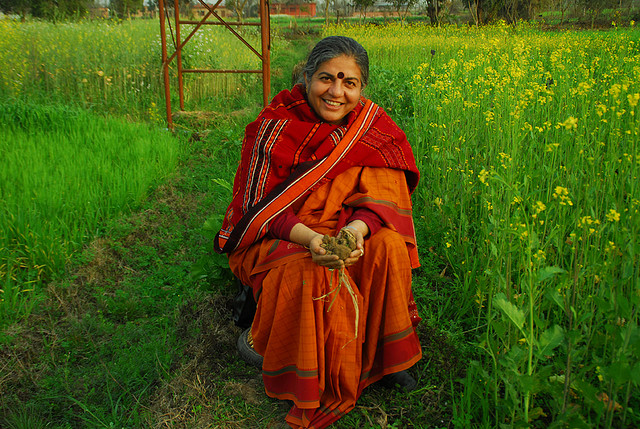
Dr. Vandana Shiva presents "Making Peace With The Earth", in Calgary, Sept. 24, 2011
 |
| photo of Vandana Shiva with the Earth, is from here |
All that follows is from *here*:
Dr. Vandana Shiva presents "Making Peace with the Earth", Calgary
Saturday, September 24, 2011 - 10:00am - 11:00am
Location:
Red & White Club, McMahon Stadium, 1833 Crowchild Trail NW
Contact Name:
Danielle Paydli
Contact Phone:
(306) 242-4097
Contact Email:
Danielle.Paydli@oxfam.ca
URL:
http://www.ucalgary.ca/peacestudies/ShivaSeptemberEvent
Dr. Vandana Shiva receives 2011 Calgary Peace Prize & presents "Making Peace with the Earth" on Sept 24. Register today.
Please join on us Saturday, September 24 at the Red & White Club as Alderman Gian-Carlo Carra & Chancellor Emeritus Joanne Cuthbertson present the 2011 Calgary Peace Prize to Dr. Vandana Shiva, philosopher, environmental activist, eco feminist and author of several books. Her acceptance speech is titled "Making Peace with the Earth". During this event, organizations and businesses that are involved in peace, social justice, environment, development, women's issues, food policy advocacy and natural health will be presenting and selling their products. Vandana Shiva books will be on sale at this event. Tickets are $12. For tickets, visit the Univeristy of Calgary: http://www.ucalgary.ca/peacestudies/ShivaSeptemberEvent
Consortium for Peace Studies would like to thank the following organizations and people for supporting/ sponsoring the Calgary Peace Prize 2011:
Oxfam Canada, Calgary Food Policy, Alberta Food Policy, Slow Food Calgary, Calgary Seedy Saturday, Hugo Bonjean – Author, Community Natural Foods, Planet Organic, Ten Thousand Villages, The Zeitgeist Society of Calgary, The Arusha Centre, River Café, Project Ploughshares, Initiatives of Change, Bullfrog Energy, Sheldon Chumir Foundation, David Swann (Liberal Party), Vogel and Company (lawyers), EPCOR Centre, Green Calgary, Indian Canada Association of Calgary, Shastri Indo Canada Institute, Judy MacLauchlan of UC Senate, Faculty of Social Work at UC, Faculty of Environmental Design at UC, Faculty of Nursing at UC, Social Work Student Association at UC, Political Science Students at UC, Eco Club at UC, U of C Student Union
Friday, July 29, 2011
Vandana Shiva on 'growth fetishism' and more: "Who Pollutes: The Rich and Powerful or Poor and Powerless?"
What follows is being cross-posted from ZCommunications. Please click on the title below to link back.

Who Pollutes: The Rich and Powerful or Poor and Powerless?
Saturday, July 23, 2011
On the 29th of June, Prime Minister Manmohan Singh met with editors of a few newspapers. When asked about whether he had been putting pressure on the Environment Ministry to approve environmentally destructive projects, he said “yes”, and justified by quoting Indira Gandhi “poverty is the biggest polluter, we need to have a balance”. Indira Gandhi had said this in Stockholm in 1972 at the first Environmental Conference. She had also quoted from the Atharvaveda –“Whatever, I dig of you, O Earth,May that grow quickly upon you,O Pure One, may my thrust never pierce thyVital points, thy heart”.The Prime Minister has conveniently ignored the more significant quote.The Prime Minister’s duty is to uphold the nation’s constitution and nations laws, including environmental laws, not subvert them. By admitting that he has been putting pressure on the environment ministry, he has admitted that he is subverting the law. Most commentators view the removal of Jairam Ramesh from the Environment Ministry during the July 12th, 2011 cabinet reshuffle as a further step in environmental deregulation.While quoting Indira Gandhi to justify his subversion of environmental law, the Prime Minister seems to have forgotten that Indira Gandhi created the country’s environmental governance structure during her tenure as Prime Minister. It was Indira Gandhi’s intervention that supported the call of movements and scientists to not build a hydro-electric project in Silent Valley in Kerala saving a biodiversity rich ecosystem. It was Indira Gandhi’s concern that Mussorie, the queen of the hills, was being stripped naked by limestone mining that led to the Environment Ministry to take action. We were invited to do the study of the environmental impact of limestone mining in Doon Valley in 1981. Our study became the basis of the Supreme Court case. In 1983, the Supreme Court shut down the mines.In the pre-trade liberalization days, it was accepted that if commerce undermines ecosystems which support life, then commercial activity must stop, because life must carry on. Art. 21 of the Constitution make it the duty of the state to protect life. Since ecological processes support life, the state has a duty to protect ecology.Under Prof. Manmohan Singh’s leadership since the 1990’s based on “growth fetishism”, all ecological devastation is justified in the name of growth. Who is driving this ecological devastation and the pollution? The rich and powerful corporations or the poor and powerless women, farmers, tribals and the displaced rural communities who become urban slum dwellers?The poor live in the places polluted by the rich. They do not cause the pollution. And they live in polluted places because they are displaced from their homes in rural areas where they have lived sustainably for millennia.They are victims of pollution because they are victims of dispossession. This is environmental injustice. And it is an inevitable consequence of outsourcing of pollution from rich countries in the garb of FDI.Coastal Orissa is a case in point. In the Jagatsingpur district where POSCO’s giant steel plant is planned as the highest FDI of $ 12 billion farmers, grow biodiversity – betel vines and paddy, coconut and cashew, fruits and fish. There is no pollution and no waste. There is a prosperity that GDP does not count. This economy of sustenance is being uprooted with violence to enable POSCO to export our iron-ore and steel. Every law of the land including the Forest Rights Act and the Coastal Zone Regulation Act are being violated as committee after committee has recognized. And when the Ministry of Environment Committees affirms the violation of laws, it is the Prime Minister who puts pressure on the Environment Minister to give an approval to POSCO. It was the women and children of Govindpur, Dinkia and Nuagaon who lay down in front of the police in the scorching sun to stop the land grab in June. They were still forming a human barricade when I visited on 23rd June.The Prime Minister is intervening to promote this land grab and resource grab. POSCO gets our land and our resources. What we will inherit from the POSCO project is ecological destruction, pollution, displaced people and the destruction of our democracy.In India, it is the corporations that are building giant coal based power plants who are major climate polluters. It is the automobile industry that pushes more cars on our roads that are leading to higher carbon dioxide emissions. Emissions from the use of fossil fuel are driven by the economically powerful, not the poor. But it is the poor who are most vulnerable to the floods, droughts and cyclones that climate change intensifies.The same applies for toxic pollution. In 1996, we filed a case in the Supreme Court to stop the import of toxic waste from the U.S. This waste was generated by rich consumers in the U.S, not by the poor in India who put their lives at risk sorting out the toxic garbage. The Bhopal disaster and it its still continuing toxic pollution was not caused by the poor who died in thousands. It was caused by Union Carbide, now owned by Dow.A major issue related to toxics is the pesticide, endosulfan. The U.N has banned it. Most countries of the world have banned it. The Supreme Court has ordered an interim ban. 1000 people have died in Kasargod where endosulfan was sprayed on Cashew plantations for 20 years. More than 9000 are crippled. The innocent victims did not cause the toxic pollution. It was caused by powerful corporations who influence decisions and have blocked a ban on endosulfan, even as people die and children are born disabled.Toxic agrichemicals harm all life. Synthetic fertilizers run into rivers and oceans, creating “dead zones”. Nitrogen oxide released from nitrogen fertilizers accumulates in the atmosphere as a green house gas that is 300 times more damaging than carbon dioxide. These synthetic fertilizers also make bombs as the recent terrorist attacks in Mumbai and the Oklahoma bombings in the U.S have shown.We now have a new form of pollution in agriculture – genetic pollution from genetically engineered crops. Genetic pollution is destroying biodiversity and devastating farmers livelihoods.The poor do not cause chemical and genetic pollution – giant chemical / biotechnology corporations do. And the chemical corporations are also the gene giants who now control seed. Here too, instead of being the voice of poor and vulnerable farmers, the Prime Minister is the voice of powerful global corporations through his repeated reference to genetic engineering as the second Green Revolution.Whether it is atmospheric pollution, toxic pollution, genetic pollution or urban waste pollution, environmental pollution is an externality of a greed based economy which privatizes profit and natural resources and socializes pollution. The rich accumulate the land, the biodiversity, the water, the air and the profits. The poor bear the burden of dispossession and accumulated pollution.We expect the Prime Minister to uphold India’s Constitution and environmental laws not subvert them. We do not expect him to support and promote the polluters. We expect our Prime Minister to recognize that the poor are victims of pollution and environmental degradation, not its cause. We expect the Prime Minister to remember that he holds our precious natural heritage and natural capital in trust for future generations, not to be given away to greedy corporations and destroyed for short term profits.
We expect our Prime Minister to grow beyond his “growth fetishism” and recognize that we are all part of Mother Earth, and pollution is violence against the Earth and people.
Subscribe to:
Posts (Atom)