Showing posts with label Indigenous experience. Show all posts

Wednesday, November 23, 2016

The Original U.S. Viral Fake News Story: The Good White Man's Thanksgiving


image is from here
On this eve of Thanksgiving, I will post a link to the true story, not the Good White Man story, of Thanksgiving. The Wampanoag story.

From this website: http://indiancountrytodaymedianetwork.com/2012/11/23/what-really-happened-first-thanksgiving-wampanoag-side-tale-and-whats-done-today-145807, an excerpt:

So the Pilgrims didn’t invite the Wampanoags to sit down and eat turkey and drink some beer?
[laughs] Ah, no. Well, let’s put it this way. People did eat together [but not in what is portrayed as “the first Thanksgiving]. It was our homeland and our territory and we walked all through their villages all the time. The differences in how they behaved, how they ate, how they prepared things was a lot for both cultures to work with each other. But in those days, it was sort of like today when you go out on a boat in the open sea and you see another boat and everyone is waving and very friendly—it’s because they’re vulnerable and need to rely on each other if something happens. In those days, the English really needed to rely on us and, yes, they were polite as best they could be, but they regarded us as savages nonetheless.


Saturday, February 27, 2016

Military Perpetrators of Sexual Slavery, Rape, and Murder Found Guilty in Guatemala

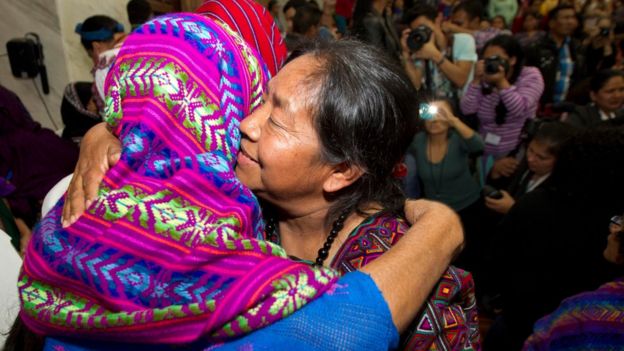
There were jubilant scenes in court when the verdict was announced
[this AP image is from here]
Mientras exista justicia para el más débil, para el desfavorecido, hay esperanza en un futuro digno para todos.  [translation at the bottom of this post]


"This is historic, it is a great step for women and above all for the victims" -- Rigoberta Menchu, Nobel Peace Prize winner who attended the hearing


From the BBC, 27 February 2016:

Guatemala: Rape sentences in landmark military trial

A Guatemala court has sentenced two former members of the military to 360 years in jail for the murder, rape and sexual enslavement of indigenous women.

Francisco Reyes Giron and Heriberto Valdez Asij were found guilty of crimes against humanity.

The historic ruling is the first successful prosecution for sexual violence committed during Guatemala's military conflict in the 1980s.

There were jubilant scenes in court as the judge read out the sentence.

"This is historic, it is a great step for women and above all for the victims," said Nobel Peace Prize winner Rigoberta Menchu, who attended the hearing.

Francisco Reyes Giron, who was the commander of the Sepur Zarco military base, was found guilty of holding 15 women in sexual and domestic slavery and for killing one woman and her two daughters.

Heriberto Valdez Asij, a paramilitary who carried out commissions for the army, was convicted for the same enslavement, as well as the forced disappearance of seven men.

The victims have been demanding accountability for the crimes at Sepur Zarco for decades.

For the rest of that story, please go to *this BBC site*. But for more, please also go to Global Voices or Intercontinental Cry for *this report*. From that article, this excerpt:

While international observers praised the efforts of the national courts, a deep reflection came from the national organisation comprising all universities — the CEUG (in Spanish, Coordinadora Estudiantil Universitaria de Guatemala), which has played a crucial role recently in the battle against corruption, summarised in one line why the ruling is vital for the future of the nation:

Mientras exista justicia para el más débil, para el desfavorecido, hay esperanza en un futuro digno para todos. 

[As long as there is justice for the underdog, for the vulnerable, there is hope for a dignifying future for all of us #SepurZarco]


Wednesday, November 2, 2011

CRAPPY HALLOWEEN: The Today Show, Brian Williams, Rock Center, and their collective CROCK OF CRAP

The CRAP-loaded media has been pissing me off a lot lately. I'll highlight a few reasons why.


Watch at 2:20 into this clip from the Today Show. How many things are disgustingly wrong with dressing a white-appearing woman and a chihuahua in "Indian Chief" costumes?


The Today Show cast, writers, and producers, and the writers and producers for Brian Williams and Rock Center are collectively nothing more than shills and sold-out vehicles for the Racist-Misogynist Right-wing and for ecocidal Big Oil.

On the Today Show on Halloween, there was an unbelievably blatant display of white supremacist racism. There was a segment on costumes for human and dog, and it was presented as a fashion show. Much to my disgust and horror (not the kind one might expect on Halloween), a white-appearing woman and a dog she was carrying came out dressed in what I can only refer to as a perverse native Amerikkkan costume: feathered headdress on each of them and a “Pocahontas”-type dress on the woman. And no one—not Matt Lauer or anyone else bothering to comment on how inappropriate, hurtful, and racist such an exploitive display of religious and cultural callousness and cruelty is. In case Matt and other NBC news and entertainment cronies are not aware of it, we live in a country where genocide against American Indians is on-going, and one of the ways it occurs is by appropriating and exploiting Native American cultures and religions; also by honoring with holidays the genocidal rapist savage named Christopher Columbus and by celebrating the beginning of the end of life as it was lived for thousands of years on Turtle Island, when Murderous Settlers sat down with Wampanoag Indians in "New England". See the following link for more:


We are also being fed the most racist-misogynist story--an endless story about how missing white girls and women matter, and missing or murdered girls and women of color do not:

http://www.hulu.com/watch/295168/nbc-today-show-investigator-takes-tour-of-missing-baby%E2%80%99s-home

Let's read a report about all the stories that are "too dark" for the Today Show and the NBC Nightly News to report on:

http://madamenoire.com/79158/no-one-misses-the-missing-black-girls/


Also on NBC is a new "news" program hosted by the nightly news anchor for NBC, Brian Williams. It is called “Rock Center” for Rockefeller Center in mid-town Manhattan. Let's keep in mind that Rockefellers helped make Corporate Capitalism the sleazy, greedy, unjust system it is. The Rockefellers have been the largest beneficiaries of the privately owned Federal Reserve Bank. The Fed makes damn sure the Filthy Rich stay ever filthier and even richer. For more, please see here: http://www.apfn.net/doc-100_bankruptcy27.htm

The first story of the hour was about there is an economic oasis in this miserable-for-the-middle-class economy. (This is an economy and economic system that has been miserable and murderous for working poor people for far longer than three years.) The media loves to toss us bones and pretend it is good news. In this case it's worse than that. There is no oasis, only the opportunity to make Big Oil Execs and their Shareholders ever more filthy rich than they already are. In a small town in Montana fracking is taking over, destroying the Earth, using up and polluting water, and turning the land of the Black Feet into wasteland. It is being funded by Big Oil and we are led to believe “it's all good” there. There's absolutely nothing sustainable about what's going on. It's same old ecocidal, genocidal atrocity packaged up NBC with by Brian Williams as the friendly-faced deliverer of more bad news that he actually believes is good. White people get to move there and get jobs doing awful things. They may get a house for a home out of it. When oil is no longer in the rocks there, the economy will die and the area will likely become a Ghost Town.

Let's see how sleazily the story-writers for Brian Williams and the very white Harry Smith evade responsibility for the systemic problems with the US globalised economy, which murders millions worldwide and is utterly unsustainable. Instead of responsible reporting, we are told that all any one needs is "opportunity" which is code for "Our immoral economic system will not offer you any meaningful way to live; but if you're privileged enough, or are willing to do work that most people cannot do, you may get the chance to earn enough money to stay in debt for the rest of your life."


http://www.bing.com/videos/watch/video/boomtown-north-dakota-town-becomes-hot-job-market/60kg0iy?cpkey=70e0703b-3ba2-434e-aabb-1c56c22aecf9%7c%7c%7c%7c

See, for the unacknowledged future of the story above:
Overview:
In order to fully understand the geographic concept of natural resource use, students should learn about the ways that resource extraction affects the physical and human landscape. In this lesson, they will discuss how a specific economic activity in a region can facilitate the creation of towns, which often turn into ghost towns if the economic activity ends.
On the same program, xenophobia, racism, and misogyny combined forces to produce a vile segment on the danger of Chinese women coming the US to give birth, so that their child is US-born and entitled to all that the US has to offer, such as a failing (and murderous) economic system, gross and rampant racism, wholesale destruction of the Earth, and heteropatriarchal practices that the US Right thinks are good for what ails Amerikkka. While it was noted that not many women from China are actually doing what the report said Chinese women are doing, it was also noted, in a way that made me think FOX News and NBC were now one and the same, that any and every incident of this occurring was an outrage and must be stopped.

From *the Asian Nation website*: 
Empress Tsu-his ruled China from 1898 to 1908 from the Dragon Throne. The New York Times described her as "the wicked witch of the East, a reptilian dragon lady who had arranged the poisoning, strangling, beheading, or forced suicide of anyone who had ever challenged her autocratic rule." The shadow of the Dragon Lady -- with her cruel, perverse, and inhuman ways -- continued to darken encounters between Asian women and the West they flocked to for refuge.
Far from being predatory, many of the first Asian women to come to the U.S. in the mid-1800s were disadvantaged Chinese women, who were tricked, kidnapped, or smuggled into the country to serve the predominantly male Chinese community as prostitutes. The impression that all Asian women were prostitutes, born at that time, "colored the public perception of, attitude toward, and action against all Chinese women for almost a century," writes historian Sucheng Chan.
Police and legislators singled out Chinese women for special restrictions "not so much because they were prostitutes as such (since there were also many White prostitutes around) but because -- as Chinese -- they allegedly brought in especially virulent strains of venereal diseases, introduced opium addiction, and enticed White boys into a life of sin," Chan also writes. Chinese women who were not prostitutes ended up bearing the brunt of the Chinese exclusion laws that passed in the late 1800s.

Racist-Misogynist Corporate greed and exploitation of the poor, working class, and middle class is apparently not an outrage to The Filthy Rich. Neither is the destruction of the Earth. Why doesn't Brian Williams report on the history and present of forced sterilisation of women of color in the US? Why doesn't the CROCK Center report on how Right-wing Republican cockholes work so diligently to control US women of color's and white women's reproductive organs and choices? Would such reports reveal that it is not Chinese women who exploit and abuse our system, but rather Filthy Rich White US Men?

What “offends” the big white cockholes who run this country is a very few Chinese women coming here. Last time I checked—and thanks to a friend of mine for reminding me of this—the US is heavily indebted to China because The Filthy Rich have run what was an apparently functional (while completely dysfunctional and deadly) economic system into the ground, where it now must blow water into rocks to get oil and call that “good”.

Why doesn't Brian get any other point of view—utilising all the many news reporters and newscasters he boasts will be appearing on the program over the weeks—on things like fracking, the harm of Big Oil to people, animals, and the Earth, and xenophobic racism and misogyny? Is Brian not able to do this? Is he just a puppet for his show's corporate producers. (Yes, he is.) Brian Williams is not allowed to say anything at all that might threaten the profits of those he serves—those who have bought his soul and who own his spirit.

If he does have a soul that is not thoroughly possessed by NBC Execs and Shareholders, then let him do a half-hour interview with Dr. Vandana Shiva on all that is fucked up about fracking and Big Oil's solutions to economic problems faced by the middle class. The sad truth is that even if he wanted to do it, his bosses wouldn't let him. You won't see Dr. Shiva on Rock Center any time soon. The only Asian women you'll see are the ones filling up a propaganda segment pretending it is Chinese women, not white US men, ripping us off and taking advantage of our allegedly moral and honorable and good systems of governance and commerce.

http://www.bing.com/videos/watch/video/born-in-the-u-s-a-chinese-women-escape-one-child-policy/6c5e6t7

NBC wants us to believe that everything out of the friendly-faced Brian Williams' mouth is truthful and responsible, when most of what he reports is neither.

Shame on you, Brian Williams and Harry Smith--and, especially, on your writers and producers--for misleading the US public and doing so to fatten the wallets and pad the off-shore bank accounts of the Filthy Rich. Does NBC stand for Nothing But CRAP?


(Note: CRAP: corporate racist atrocious patriarchy)

Thursday, July 7, 2011

Women's Worlds 2011: 800 march on Parliament for murdered and missing Indigenous women

This is what racism plus misogyny means (from the article that follows):
According to Statistics Canada, Indigenous Canadian women are five times more likely to die of violence than other women.
All that follows is from *here* at rabble.ca news.

Women's Worlds 2011: 800 march on Parliament for murdered and missing Aboriginal women

| July 6, 2011
Photo: Elizabeth Pickett

Women's Worlds 2011 is a major international conference taking place in Ottawa-Gatineau from July 3 to 7, 2011. It is 'a global convergence to advance women's equality through research, exchange, leadership, and action' with speakers and performers from a diversity of backgrounds and countries. rabble.ca is proud to be the exclusive online media sponsor.

The Aboriginal Women's Leadership Circle, a volunteer advisory body comprised of Aboriginal [First Nations, Inuit, Métis] women, collaborated within WW 2011 toward the development of wide-ranging thematic and artistic content.

The Opening Ceremony on Sunday night featured a celebration of Aboriginal culture while Monday night's "Indigenous Feminisms Rock," entertainment followed by a two-hour talk-show-style conversation led by Jessica Yee of the Native Youth Sexual Health Network. The show featured special guests Lee Maracle, award-winning author and artist, Qwo-Li Driskill, a poet, author and Two-Spirit Queer activist, and Andrea Smith, co-founder of INCITE! Women of Color Against Violence. This event provided the lead-in to a march on Parliament Hill on Tuesday.

Eight hundred feminists from the congress marched to Parliament Hill in solidarity with their missing and murdered Canadian First Nations sisters. Among the marchers were women from the U.S., Denmark, Norway, Sweden, South America, Latin America, Thailand and southeast Asia along with Indigenous women from territories across Canada, all were demanding that the federal government and all citizens continue to confront and investigate the disappearance of First Nations women and girls.
The march was led by the Nemisak Singers playing traditional hand drums and welcomed to Algonquin territory at Parliament Hill by Algonquin Nation Elder Bertha Commanda. Ms. Commanda gave a brief history of the Harper government's egregious treatment of "Sisters in Spirit," a project of the Native Women's Association of Canada (NWAC) that laid the groundwork for research into the disappearances and deaths of close to 600 women and girls across Canada over the last three decades.

Sisters in Spirit compiled a database showing that 153 women went missing between 2000 and 2008 alone. Late last year, Conservative MP Shelly Glover, the parliamentary secretary for Indian Affairs, declared the project "finished" and focused a new $10-million national strategy to deal with murdered and missing women cases on police initiatives, denying further funding to Sisters in Spirit or any other indigenous women's group. A new national police support centre for missing persons and unidentified remains will not be up and running before 2013. It is not known what will happen to the data collected by Sisters in Spirit but it seems likely that it will be merged with data of all missing Canadian women, thus erasing the significance the of extremely high numbers of missing Aboriginal women and girls.
Commanda told the gathered women that First Nations women would now require non-government money to preserve and add to the database and to undertake private investigations of cases of missing women and asked us to join in urgent fundraising initiatives.

Laurie Odjick, mother of Maisy Odjick, a young Aboriginal woman who disappeared in 2008, also spoke to those gathered about her struggle for assistance in finding her daughter and vowed to fight on in Maisy's name on behalf of all missing and murdered indigenous women. Jeannette Corbiere Lavell (President of NWAC) offered a passionately critical history of the Harper government's indifference to the specific issues facing First Nation women and the government's intransigence with respect the importance of the continuing contribution of their mothers, sisters and brothers in efforts to stop the violence, to repeated applause and chants of "shame" from the crowd.

Following Corbiere Lavell's remarks, the crowd observed a moment of silence, followed by words from Elder Jo MacQuarrie of the Metis Nation of Ontario.

NWAC is calling for a national action plan to deal with the issues raised by the work of Sisters in Spirit while Battered Women's Support Services, also participating in the Congress and the march, is calling for a national inquiry or Royal Commission. However, Canada's status of women ministers, having just concluded their annual meeting in Gatineau, Quebec, declared their solidarity with Aboriginal women but failed to call for a national action plan on the issue. CBC News reported that federal Status of Women Minister Rona Ambrose stated that "this is an incredibly unsettling and difficult issue for all of us in Canada to deal with, across the country. There are hundreds of missing and murdered aboriginal women." However, she added "governments at all levels are already doing a lot."

Amnesty International Canada says that Canadian police forces and governments have done little to prevent the long understood pattern of racist violence against Indigenous women and has stated that "[all] levels of government should work closely with Indigenous women's organizations to develop a comprehensive and coordinated programme of action to stop violence against Indigenous women."
According to Statistics Canada, Indigenous Canadian women are five times more likely to die of violence than other women.

Elizabeth Pickett is an internet-based feminist freedom fighter, a mother, a grandmother, a blogger, and a poet, seething in Whitby, Ont.

Saturday, July 2, 2011

Continuing my conversation with James Huff (MRA), while he's away

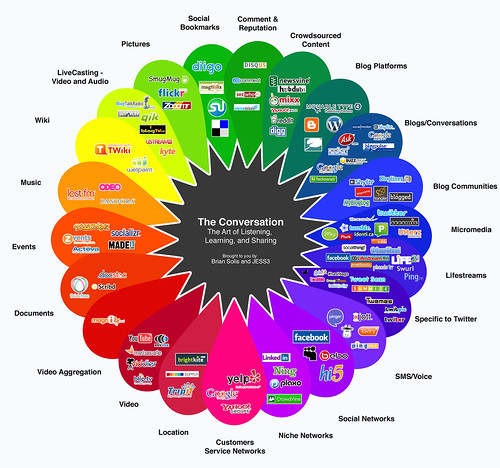
click to enlarge the image, here
A note to my dear readers:

As James Huff has disappeared for the time being—with hopes from me that he'll make a return to our conversation—I'll take the pause button off and continue exploring some of the themes he and I were beginning to explore in our exchange. At least I found that really pretty diagram about conversation!

What follows is for anyone to read, but is directed specifically at James.

So I've been thinkin' a lot about what we've said to one another thus far, and what you haven't answered. The main point I was trying to make is that the world looks one way to you, based on all the information you have about the world you see, and the world looks quite different to me, inclusive of what you experience, but also containing a lot of reality beyond it. You've admitted you don't know much about the world beyond whiteness. Your connections to cultures are limited to those in the US, the UK, Germany, and Australia. I'd say that's a very narrow strip of humanity, relative to the humanity of the whole world. And given how globalised oppressive, mass murderous ideologies like capitalism, white supremacy, heterosexism, colonialism, imperialism, anti-Indigenism, and male supremacy are—especially to the regions of the world you don't know much about—that leaves you with an information deficit. A lack of knowledge sufficient to make your understandings of what's wrong in the world too incomplete.

The world you live in is a small part of a much larger world. That smaller world unfortunately—but deliberately—exists to oppressively control the larger one. Your world operates on oppressive control, not on behaving humanely or responsibly towards the larger world. From globalisation to militarism to white het male supremacy, your world is very callous to the rest of the world—the places where the rest of us live structurally and regionally. You'd experience it as callous also, if you were willing to really open yourself and honestly see what is going on from the perspective of everyone who isn't like you, positionally and locationally speaking. I believe you are fully human, and have the capability of learning and knowing more than you have had the opportunity to learn and know from life around you. But to do that, you'll have to go a bit out of your way, down the mountain so to speak.

The way the world is structured for you, for me also, we don't have to step outside our worlds to live well. We don't have to escape. We can enjoy the privileges and entitlements we are more than welcomed to take advantage of—we are more than welcomed to do so by our people, who benefit from us doing just that. We don't ever have to know who pays the price for what we have: from our inexpensive clothes, to our relatively inexpensive oil, to the other material resources we have in abundance.

It's not just a matter of what we have, James. It's a matter of how we acquired it to begin with. I'm sure you've heard many US white men say, “That's in the past” when African Americans bring up slavery as a fundamental cause for conditions still actively working against anyone who isn't white, but especially against Black, Brown, and Indigenous people in the US. It's surely not in the past if the same mechanisms for maintaining white supremacy are grinding out degradation, discrimination, genocide, and white dominance. 

White supremacy remains one of a few dominant social-political ideologies in the US. Property-owners ruling are regulating the economic and political systems (predominantly white men are running them—are we surprised?). This is done along with the fierce and overtly forceful maintenance of male supremacy, which still dominates the imagination and our institutions that help shape and tether that imagination. How could brutal white supremacy exist only in the past if white dominance, white control, and white power still rule the show, cast the show, and produce the show?

Do you not agree we live in an unconscionably and disgustingly white supremacist country?

I'll leave you with those questions to answer, along with all the others posed earlier.


Tuesday, June 21, 2011

Indigenous Event Alert: Happy Aboriginal Day!

Source: Canadian Heritage and here
To my Aboriginal and Native siblings everywhere, but particularly the Inuit, Métis, and First Nations people in Canada: Happy Aboriginal Day! May this day revitalise the Spirit of All Our relations.

A special hope for a day of celebration to Avi and Clifford. <3

What follows may be linked back to by clicking on the heading.

Happy National Aboriginal Day!

Today is the summer equinox, the longest day of the year, and officially recognized in Canada as National Aboriginal Day. For those of you who are Aboriginal (or native, Indian, Indigenous - OK, that's another blogpost), I'm sure every day is Aboriginal day, but it's still a nice gesture that the Governor General proclaimed this day, back in 1996 as an officially recognized day to celebrate our cultures.

So for those of you who have the day off to do just that, enjoy yourselves. For those who have to be at work, then at least spend a few minutes saying hello to all your Aboriginal friends, watch an Aboriginal film (Dances With Wolves doesn't count), attend a National Aboriginal Day event in your neighbourhood or find some other way to celebrate that won't get you or your boss in trouble.

We still have a long way to go; I am reminded of Ottawa comedian Don Kelly's great line: "Wonderful. We Aboriginal people get a whole day. In Ottawa, even the tulips get a week!"

But still - it's still a good day to be indigenous (or Indian or Aboriginal--OK, I know, enough already)

News:
From APTN's Aboriginal Day Live and Festival website. Please click on the article title below to link back.

APTN Announces 2011 Flag Contest Winner

Aboriginal Peoples Television Network (APTN) is pleased to announce sixteen-year-old Taylor Vanasse is the winner of the fifth annual Aboriginal Day Live Flag Contest. Vanasse’s winning design was chosen from a total of 208 entries received from across Canada.
Vanasse, who resides in Plantagenet, Ontario, designed her flag to show the various Aboriginal cultures in Canada and some of their customs, beliefs and general ways of life. She wrote, “The inukshuk and dog sled represent Arctic tribes like the Inuit. The canoe, the water, the fish and the tipis represent hunting, transportation and shelter. The turtle depicts spirituality and also refers to the Iroquois creation story (Turtle Island – The Creation of North America). Finally, the eagle represents leadership and skill while the feathers are an ode to all Tribal Chiefs and Elders who provided wisdom and guidance to all who needed it. The earth is a symbol of togetherness.”
Her design will be officially unveiled during APTN’s Aboriginal Day Live show in celebration of National Aboriginal Day on Saturday, June 18, 2011. The show will be broadcast live across the nation from Winnipeg, Manitoba. As part of her prize, Vanasse will receive a trip to Winnipeg to be part of the Aboriginal Day Live celebrations and will also receive a cash prize of $500. Additionally, the Rockland District High School, where Vanasse attends, will receive $750 towards the purchase of learning materials.
The winning design will be made into a flag that will be flown above APTN headquarters in Winnipeg, replacing the one created by APTN Aboriginal Day Flag Contest 2010 winner, Dylan Willett. Mini versions of the flag will be distributed to the crowds attending APTN’s Aboriginal Day Live 2011 concert.
Entries from the 2011 contest can be seen on APTN’s Aboriginal Day Live Flag Contest web page or on display in the front window of APTN’s head office in Winnipeg.
Events are from the Vancouver Sun, *here*.


Brandy 
McCallum performs at Trout Lake.
 

Brandy McCallum performs at Trout Lake.

Photograph by: Handout, Files

National Aboriginal Day events today include a free pancake breakfast at 8:30 a.m. at Vancouver Aboriginal Friendship Centre, 1607 E. Hastings.

At 11 a.m., a parade will leave the centre and head along Commercial Drive to Trout Lake where a community celebration takes place from noon to 5 p.m. Performers include Akachuk Children Hoop Dancers and Brandy McCallum. There will also be a teepee village, powwow dancing, arts and crafts tables, a resource fair and canoeing. Organizers expect to feed at least 1,200 people hamburgers and hotdogs during the free community lunch. Details at www.bcnationalaboriginalday.com

At Oppenheimer Park, 400 Powell, free events start at 11 a.m. and go to 4 p.m. Performances take place all day by groups ranging from Harmony of Nations and Ricky Lavallee to Sonny B and Sitting Still Thunder Drum Group. Details: (604) 253-8830.

Thursday, June 2, 2011

Can Enemies Become Allies? A conversation between James Huff and Julian Real, Part 3: Questions await Answers about Truth and Consequences

image is from here
If you're reading this after 10:30pm/2230 GMT on 2 June 2011, then cool. If you've read it before then, it's changed in two sections. Portions have been expanded and clarified--well, I hope they have been. ;)

What follows is the latest correspondence from me to James. I may post his reply here as well or put it into the next post in this series. This is what has happened thus far. Someone named Mastenship showed up on my blog, posting comments--in conjunction with my responses to him--at this post *here on men and rape*.

He also contacted me by email and welcomed respectful correspondence. We have begun that.

*Here's part one*
*Here's part two*
Below is part three.

Central to so many US MRA's beliefs is the anti-feminist nonsense put forth by too many men to name, and a few women too. *Here's a recent post about that*, titled Hearsay and Heresy: Katie Roiphe's Patriarchal Logic is Riddled with Distortions in Katha Pollitt's Classic Feminist Essay, Not Just Bad Sex

His book lists are referenced below.
___________________________________

Hi James,

With regard to information you share with me from the net, it comes across to me as all so speculative or anecdotal. It's not at all what I thought I'd be engaging with; you sent me a link to a piece from Fox News. That network isn't even regarded by serious reporters to be a legitimate source of "news": only propaganda. I can link you to careful analysis of what Fox News does that is not news and that is shoddy propaganda, if you'd like. Let me know.

I've asked you some questions and am hoping you'll respond to them. Obviously it's your decision as to whether to do so and I'm not wanting to rush you. I know that I've written a lot to you in the last days. I'm only asking you to take the time you need to respond directly to the questions that follow in this post.

I also wanted to express that some of what you put forth as logic comes across to me as an exercise in intellectual abstractionism.

My work is not abstract or theoretical, at heart. At heart it is a constant effort to expand consciousness about who feels what sorts of pain and why The feminists I know seek to make women's liberation from men socially existent and solid.  I seek here to carry women's knowledge from around the world to my blog and beyond; to make women's realities as intellectually, emotionally, and viscerally real to men as I can. I'm severely limited in my ability to do this work but I've got great connections to truly amazing and wonderful feminist-identified women worldwide. They are fighting such brave and strong battles against racist and patriarchal injustice. I am so thankful for all they do for humanity.

If I didn't make these connections with women globally I wouldn't know what was going on. I wouldn't know, deeply, what is happening to women in South Africa, Uganda, Egypt, Iraq, Afghanistan, India, Malaysia, Japan, China, North America, Jamaica, Mexico, Colombia, Brazil, and in the UK, across Europe, and in Australia. James, if you're not speaking intimately with women in these places there's no way you'd know what their experience is; extrapolating from selective (and very few) Western news stories wouldn't be wise to do, in my opinion.

I hope you read the post about Katie Roiphe and Katha Pollitt (the link to it is *here*), and took to heart and mind what Katha detailed was really messed up with Katie's work. Seriously flaws in logic and argumentation. Seriously unowned and unrecognised biases and anti-woman views being put forth as objective truth. I don't see why Katie's work is valued by you: it's truly shoddy. It is or ought to be an embarrassment to anyone who values intellectual rigour and truth, honor, and wisdom.

I am wondering how many books by Vandana Shiva have you read?
How many by Catharine A. MacKinnon? They've each written a lot.
How many by Patricia Hill Collins?
By Alice Walker?
By bell hooks? She's written around twenty books--each one dealing with sexism, racism, classism, social analysis and cultural critique, or all of that together.
Have you read the account of the US invasion in Afghanistan by Malalai Joya, who must change where she sleeps most nights to avoid being killed for speaking out against the male supremacists in her country and those invading her country from NATO and the US?
Does her experience matter as much as your Katie Roiphe's? If not, why not?

Malalai and Vandana, and my friend Avi who is Indigenous and is currently living in Sweden, and Andrea Smith who is Indigenous living in North America, are far smarter and wiser than is any Men's Rights writer I've ever encountered. To pay attention to MRAs and Katie and to ignore writer-activists like Malalai, Vandana, Andrea, and to ignore the stories and struggles of women worldwide is to choose to not know much about what's going on with women globally.

Why would someone not wish to know what's happening to women globally? I'm asking you that and ask it often of other men. I hope you'll answer that.

Women are being killed by men across the globe for the "crime" of being a woman. Men are not being killed the world over by women for being men, And women are not killing men around the world who commit crimes against women, who violate women's human rights and human bodies. White men, particularly but not only from the US, are raping and enslaving girls and women across the globe. Is protecting men's rights more important than ending sexual slavery and rape, to you?

How does one purporting to care about human rights not care about that?
What does one have to focus on to not have the pain girls experience register in their own bodies and haunt their minds?

I don't understand your political priorities. At all. You haven't described anything to me that isn't anecdotal or speculative, or, in the case of Roiphe--who is on your favorite authors list, wrong. Just plain wrong. You haven't, as yet, respond to the study on the rape of Indigenous women in the US. You haven't, as yet, responded to my questions. I do not seek to work to place written ads for our respective positions on one another's blogs. That's not something I would consider to be valuable work.

I have come to witness over the last thirty years that white women and women of color are the central activists working around the world for human rights for everyone and for all life. Men the world over are destroying the world and all life. Not all men. But men-not-women.

Women participate in systems of atrocious destruction, of course. White women and rich women especially. But men designed those systems and men still rule those systems.

I hold to bring awareness to the people with the most power and privileges, not those with the least. I hold in highest regard those with the least power and privileges not those with the most. I do not see in your work the recognition that women of color even exist. Or poor men. Or most humans on Earth. Your work appears to me to be directed at only a small segment of society but a segment with extraordinary wealth and unearned entitlements, relative to every other demographic of people on Earth. I don't understand your choice to represent and advocate for only that population. It perplexes and saddens me. It calls forth grief in my heart.

You have indicated to me that you don't know much about what many gay males experience, systematically, that most het men do not. This tells me we live in different realities. Yours is very privileged indeed, which is not to say you haven't know deep pain, wounding, and suffering. I believe you surely have experienced all of that, and hopefully many joys and blessings too.

As far as I can tell, you argue for justice in the courts, without seeming to realise that most men and most women around the world have no access whatsoever to those courtrooms: most humans on Earth cannot afford an attorney and do not find justice in courtrooms even if they should get good legal representation and appear there. The court systems in most places on Earth--including in the US, Canada, the UK, Europe, and Australia, is stacked against women in so many dreadful and horrific ways--putting women in harm's way; not protecting women from men's violence; not protecting children from men's sexual, physical, emotional, and psychological abuses. It appears you would like me to believe the exact and precise opposite is true. Correct me if that's not the case.

But so you know, to do that I'd have to pretend I never spoke to a woman in my life. I'd have to ignore most of what I know to be true, and ignore most of what reality demonstrates. I'd have to choose to be willfully ignorant and steeped only in my own privileges to not know what's going on. I don't think life is rosy for white people. I don't think life is just a breeze for men. But to only focus on what white men experience--as virtually every single MRA I know of does--is to relegate to their unconsciousness the pain and suffering of all people who do not look like them.

James, most people living in this region of the world are not structurally positioned in Western society as we are. And because you and I are male and white we receive so much that most people in the world will never have. (Read *this* for more.) Some call this placement in society "a matter of luck". I call it a direct consequence of us living in a society that unfairly and dishonorably institutionalises economic, political, social, and environmental injustice and terrorism. There's nothing accidental going on if we look at the big picture along with the smaller ones. The small ones build to create the larger one, and the institutional forces show up in interpersonal and intimate ways. Overall, if not always individually, white men in the West benefit more than any other group of humans. For me that's about as obvious as the clear daylit sky being blue and the Great Lakes' waters being wet.

I don't understand well-sighted people believing the sky is orange and well-feeling people believing the water is dry. To believe that white men suffer structurally the most, not least, is a delusional indulgence most people around the world cannot afford to invest in.

Other questions are as follows.

Why, in your opinion, are so few men (those who despise feminists and feminism) so unable to seriously discuss social justice issues?

Why do you think there's so much homophobic and misogynist lingo tossed around among US male soldiers and in civilian life?

Why do you think military training officers use derogatory language about women--calling men "girl" and other terms to degrade and humiliate them, for example, during the training period?

Do you believe that feminist women ought not be castigated, stereotyped, and pigeon-holed by men? Do you believe that men organising against feminist campaigns to achieve human rights is a dishonorable pursuit?

You wrote to me:
I was an avid role-player at the time, and a very prodigious reader.  I studied everything from cooking to quantum physics.

Did you read non-fiction work by women of color, about their experiences in the world? If so, can you tell me what books and authors you read?

I ask you this because I am reminded of a friend I once had who was white and heterosexual and male. He loved science and math. He was into science fiction. He loved frisbee also. And he had walls of books he'd read, in his apartment. I remember looking for anything at all written by a woman of color. There was not one book among his hundreds. He assumed he was VERY well-read. I argued, very politely, that he was not. I argued that he knew very little about the world if he'd never read anything by women of color--and very little by white women either.

Women of color are, by far, the world's majority of people, relative to men of color, white men, and white women. How it was he thought reading the work of mostly white men, along with some Asian and Black and Mexican men was informing him about "all of humanity" was something I knew he'd learned to assume in an educational system (K through 12 and throughout college) that was geared toward building up an idea that has an ideology attached to it. The idea is this: white men are great. White men are geniuses. White men make history. White men write the best writing that has ever been written. No one in his education taught him that women of color are the world's majority of people, who have the most knowledge of what is happening in the world. I doubt anyone told you that either. But you tell me if your professors and teachers told you that without knowing what women of color experience, your life will be starved of knowledge and wisdom.

You have written about qualities you look for in allies--a sort of character check-list. I don't look for that so much in my allies, although I do in my close friends. What I look for in global allies is connection to the real world, not living in denial, not being delusional, not hiding in privilege, and being knowledgeable and wise more than informed and trained. I look for people who are working to assist the most dispossessed and demeaned and degraded humans in their efforts to build humane community and political, economic, and social structures from which humanity can arise wise and sustainably engaged with the rest of the world. How each group of oppressed people figure out how to do this is not for me to say: they know their conditions and choices far better than I could.

While modified, you appear to hold a rather abstract and absolute value of a term that is culturally relative and politically loaded: that term is "logic", or, alternately, "rationality". This is part of a philosophy that is often unconscious of its own hidden values. Usually this type of thinking is accompanied by a belief that ideas equal actions, and abstraction isn't problematic.

You similarly seem to demean or downgrade things like "emotion". Do you realise you are playing out some really old and inaccurate dualisms by expressing yourself this way? Not to mention misogynistic ones. Do you realise that when the emotion-centers of the brain aren't functioning, rational and logical thought isn't possible? You seem to be pretending one can think without feeling. I sense that what you mean is to not be misled by feelings. I'd argue, however, that you are being misled by unexamined dualisms, by cutting yourself off needlessly from emotion, and that you assume the kinds of thinking that result when doing this lead one to find greater and more solid truths. And there are unexamined suppositions and assumptions as well in your writing, about human nature, about how the mind works, about what "human" means, and what corrodes or degrades the human soul. For you emotion appears more toxic than rationality. I'd argue that one without the other produces disorder and deadly outcomes.

I encourage you to become more conscious of these things, and note how your value of them is steeped, very problematically, in Western white male privileges. This is consistent with much of what you write: it demonstrates the extent to which your thinking is shaped by value systems that are pre-determined to find Western white men superior, or smarter, than anyone else. In my experience Western white men are among the least intelligent people I know, because they are structurally positioned to know so little about the world, and because they mistake information for knowledge, and logic for wisdom. I see you doing this regularly, without awareness.

You would learn a lot about how your privileges and power is wed to your values and assumptions by reading many sections of Yurugu, by Dr. Marimba Ani.

You wrote:
Individuals can be very “wrong” or very “right” in their outlook depending on the perspective of the world.  This is why I do not castigate individuals so much as the ideas that they stand for.  I think it folly for any group to do that to another.  It creates a spiral that draws others into logical fallacy and sucks the whole thing into a common playground brawl.

Do you see how you construct meaning from abstract ideals? I construct meaning from human suffering and endurance, from reality. When I shared with you a story about men being humiliated by being made to wear pink uniforms in prison, you told me you laughed a lot and felt they should get far worse than that. I disagreed, arguing, in part, that that form of "punishment" could only work as a deterant to committing future crime if pink was associated with women, and if women were associated with something very degraded in status, and very attached to stigma.

What do you think about that analysis?

You wrote:
Unfortunately, you may be right about me seeing people as an object of study.  Given what I have told you about my experiences, you can be assured that I do that with EVERYONE....including MRAs that I work with.  I had to do it to myself when I rebuilt who I was.....so in truth it is simply a modus operandi that comes naturally to me.  It doesn’t mean that I don’t care....far from it.  It just means that the entire universe comes under this objective lens in search to uncover what I think is the truth.
Even my personal relationships are flavored by this.
I do love though....I do cry.  I have cried over the simple things, so I do understand what it is to PART of the world.  I have cried over a moving piece of music, over a beautiful sunset, over the happiness of a child on Christmas morning.  I have cried over the pain of others. (I had a hard time keeping it together as I wrote those posts to you). It certainly does NOT make me less of a man to FEEL.

I am glad you can feel vulnerable emotions deeply. But this sentiment is betrayed by other values and statements you make, such as the statements that reveal the very considerable value you place on logic and rationality, which you appear to see as in some sort of [false] opposition to emotions and feelings. Can you clarify where you stand on this?

And I want to know if you've cried for women being so badly beaten by boyfriends and husbands that their bones break and never heal properly. Over women who are terrorised in their own homes, by men who promised to love and honor them. I want to know if you've cried over girls being sexually abused, and over children and women being trafficked by men. I want to know if you've cried about all the hundreds of thousands of women locked inside systems of prostitution having semen dumped on their faces, flesh torn internally, being raped by their traditionally male pimps and by their male procurers. The women who have survived these things, and misogynist atrocities, are my closest, dearest friends. They are all radical feminists. And not one of them hates men.

This is my answer: I have not cried. I don't cry much and I go for years without crying. I learned to be distant in myself, far from my feelings, even while I have very intense feelings and experience other people's pain quite intensely. How I do that is to dissociate quickly from what I feel. I don't recommend it as a way to live unless one's life necessarily involves enduring atrocities that no human should have to endure.

I wrote this to you:
I'll share this with you: I think how I use the terms "white" and "man" on my blog are frequently misread and misunderstood, with someone's own preconceptions being layered on top of the meanings I'm wishing to communicate. Or, I'm just terrible at communicating. lol

When I use a term like "white" or "man" I'm speaking not so much of a kind of "being" but rather a kind of doing-in-a-location. The location is one atop a social hierarchy. The doing is such that the hierarchy is reinforced, not dissolved, by the behaviors of those atop the hierarchy. I view those atop a hierarchy as having more power, relative to those on the bottom. This doesn't at all mean I feel or thing or experience people on the bottom as not having agency or power, or will, or anything else. We're all human, to me. But rich people have more opportunities and privileges than do poor people, in my experience. And they have different experiences with being shamed and/or statused for one's economic status. I don't know many poor people who get the best seat in a restaurant for being poor. But merely being rich might afford one this privilege. That's a minor example of what I'm getting at. So the action of whiteness would be to take advantage of the privileges one has for being white, or a man, or rich. Or heterosexual.

I want to know: Does that clarify anything for you about why I do the work I do and with whom I do it? Does that illuminate anything for you about how power operates in the world?

You wrote:
While I may not have had your experiences in the matter, I certainly felt moved by your description of them.  I can only say that my religious views are.....different than most...and have come under attack.  That is really the extent of my personal experience with prejudice.

I am curious to know:  What is your religion or what are your religious views?
You wrote:
Here we stand, each seeking desperately to end anger and pain...each having separate methods and ideologies to to so.  Each of those ideologies are antithetical to each other.  We each consider ourselves knowledgeable in the subjects we want to openly discuss.

I do not seek to end anger and pain, James. I seek to encourage anger at injustice, to illuminate where, how, when, and to whom it happens. I seek to make specific forms of pain felt by those who don't know anything about it, but not by inflicting it, but rather by describing what it is, with hope that someone will find a way to feel it, and join in working to stop not the pain, not the anger, but the systems of great harm, the systems of gross exploitation, the systems of oppression and human subjugation and slavery.

You wrote:
People stand on a set of beliefs, or by logic.  Keep in mind that we know not what the future will bring in the long run in our talks, and we may very well find more common ground than what you think, especially as concerns admitting that there are issues we agree on that need to be addressed, and being able to dissect the cause of those issues.

As I hope you know, there are more slaves now than ever before. This, in my view, ought to be opposed by anything deeply thinking/feeling person. As should rape. As should genocide. Do you agree with that? I don't think people stand on beliefs and logic only. I think people stand on their spiritual connections in the world, to the world, with the world. I think people stand on love, on their hope for loving relationships, on hope for liberation from organised forms of enforced suffering. That's beyond logic for me. It's beyond the mental realm, spilling into the emotional one. This is partly to say: I don't value thought more than feeling. I don't think intellect is worth a damn if one's heart is bitter and closed. I think Hitler and his Nazi troops were highly logical and rational people. And sociopathic and very evil too in what they did with their logic systems. Logic and rationality, alone, has no particular value to me, for me. But their sociopathy was normal in the middle of the last century, across Europe. There are other ways to be human. Feminists practice those other ways of being human and a few hateful people online who you and some other men seek to turn into "all of feminism" don't speak for anyone but themselves. I encourage you to read Alice Walker's The Color Purple, for one great example of feminist (and womanist) writing and being. And to read bell hooks. And to read Patricia Hill Collins' books. There you will find feminism.

You wrote:
Just a note, I did tone down some of the rhetoric within my own blog.  It is an MRA resource, and of course the military note is still there (because of it's identification with my background), but I have removed much of the type of language that may alienate people coming in.  Of course I don't want to be part of the problem.  Please check it out, and you will see what I mean.

Thank you for doing that.

I wrote to you:
And, please keep in mind--it's not the individual tactics; it's the
whole of the experience across one's life--from the bullying in school
to the sexual abuse to the messages in media, to the messages within
the family, to the messages in religious institutions, to the messages
in education, to the way one is treated everywhere one goes, to how
lovers treat you, and on and on. It's the whole bundle of experiences
which have meaning in that context, never as isolated experiences.

[W]
hat most men I know don't get is how many experiences women
have [of misogynist mistreatment, of terrorism by men, of gross
assault by men] that men don't have and have no clue about.


Is that also your experience of the men you know?

Will you consider doing this?

1. Ask all the men you know what they do, over the course of a day and
over a week, to avoid being raped. Then ask all the women you know.
Make a list each time. You'll be shocked at what you find out if you
speak, say, to one hundred men and one hundred women.

2. Ask men what they most fear from women.
Ask women what they fear most from men.

Ask women how many times have women experienced scary situations on
the street? Not only disrespectful situations, but scary ones.

I wrote to you about what many women I know experience often on the street.

It included this:
The women say things like, "Can't you tell I'm on the phone?" Or,
"Please leave me alone." The [male drivers who are stalking the women]
don't care. They do whatever they want.
They feel very, very entitled to behave this way. Often. Regularly.
Many women have these experiences every day they are out in public.


Can you imagine what this is like, when added to the experience of being
raped earlier in one's life?

Do you think men raping women is honorable?

Do you think men terrorising women as common practice is
honorable behavior?

Do you think men joking about raping women is
inconsequential?

You wrote:
   I say both sides because I have seen women come onto MRA boards
and get so flaming mad they threaten to castrate people.  I mean,
people like Erin Pizzy and Evin Rubar had to go underground for years
because of the bomb and death treats they received for speaking their
ideas.

I looked up both people online. I found this:

Pizzey reports that she has been the subject of death threats and boycotts due to her conclusion that most domestic violence is reciprocal, and that women are equally as capable of violence as men.


Does this indicate to you that women around the world, including in North America, the UK, and Australia, are not being terrorised by their husbands and severely beaten by their boyfriends? I accept that women are capable of violence. I wish they'd use it more against the men who terrorise and assault them.

I have known heterosexual domestic violence situations where woman and the man were very abusive to one another--usually with him being verbally, emotionally, psychologically, sexually, and physically abusive, and her being verbally, emotionally, and psychologically abusive. I don't know of one case of a woman terrorising a man, however. Or of a woman murdering a man who was not abusing her. I do know of many, many cases of women who were murdered by men after doing this: leaving them. Not living with them any more. Breaking up with them because of their rage and their wrath. I have known women who live with men who rape them several times a week. (The women never rape the men in retaliation.)

You also mentioned someone named Evin Rubar, who made a film in Sweden called The Sex War.

Did you know, James, that it is frequently mistranslated to English as "The Gender War", which is not accurate?

I found this online:
'Könskriget' is a two-part documentary televised by Swedish national SVT in 2005. The title is most often translated as 'The Gender War' but can more appropriately be translated as 'The Sex War': for this isn't just about man versus woman - this is about woman against sex.

The women involved in this 'struggle' - something they themselves call
'a universal civil war' - aren't merely disappointed with their previous relationships - they want men gone completely, they hate men, they want the male of the species literally eradicated - wiped out.

'Könskriget' was researched, narrated, and produced by Evin Rubar. Both 'Könskriget' and Rubar won several awards for the documentary.

So you are mentioning to me a film made in Sweden that is not available in English to make what point exactly? Are you trying to do what so many MRAs (or, well, faux MRAs) online are doing: stoking an MRA flame-war about those feminists--especially over there in SWEDEN--where men actually get accused of rape when they rape women. Where women actually have HUMAN RIGHTS. Where men cannot get away with raping women and girls around the world. Do you see feminists as less diverse a population that, say, socially unconscious, male supremacy-protecting men? Do you observe contradictions in feminism that don't exist in "your" group? Or, in any groups of human beings working towards complex social-political goals?

Are you mentioning this to me because it proves that women are liars, James? Or just hypocrites? Do you "win" if we can show that some feminists contradict each other? If we show that some feminists don't uphold feminist values 100% of the time? This would appear to assume that anti-feminist or pro-patriarchal men are somehow less hypocritical and less contradictory in their actions and stated beliefs and values. I've seen no evidence of men's integrity, James. Perhaps this is not why you sent me those links. I'll await you telling me why you sent them--what points do you feel get reinforced by the information they provide? And, how do you interpret the information they provide? That would give us a lot more information about your hidden values and unconscious motives.

Are you citing her and the other woman to prove to me that women only lie and that's all they do when they speak of things like atrocious, heinous crimes men commit against women? Are you telling me about these two women because you'd like for me to go "Wow! I guess feminism really IS all wrong!"Or are you just wanting something on your blog and mine that makes MRAs cheer that?

I'm not really sure what you were wanting me to do with that information about those two women. This, to me, is typical, though, of US and UK MRA intellectual tactics. To scour the Earth, in this case all the way to Sweden, to dig up stories that reinforce misogynist, antifeminist men's beliefs that serve to protect their privileges, power, and status, while reinforcing the stigma of women-as-liars and feminists as "crazy". This very common tactic cleverly--or not--diverts attention well away from WHAT MEN ACTUALLY DO TO WOMEN THAT IS ATROCIOUS. And wrong. And immoral. And criminal. And violating, degrading, abusive, violent, harmful, humiliating, subjugating, and oppressive. Are you hoping I'll read up about those two women and neatly forget what men actually do, the world over, to girls and women because they are girls and women?

I won't be doing that any time soon, James. And you even bringing their names into this conversation demonstrates to me the weakness of your arguments about feminism and feminists.

You have demonstrated absolutely no familiarity with feminism or feminists--including what they believe and do. And I don't mean the one thing they believe and do. I mean the hundreds of things they believe, and the thousands of things they do to better humanity the world over--to make it better for women, for men, and for children, and for the Earth and for animals that are not human. You list very few feminist books in your reading list [readers: please see the comments section *here* for that]. You do, however, put Hitler, Marx, and Dworkin on "the same side" of your reading list. Do you understand the ideological differences between those three people? Can you detail those differences to me? If not, I'll conclude you've not read any of those books... carefully and thoughtfully.

What is Andrea Dworkin saying in her work, exactly? Please summarise her work for me. In your own words, from your own reading of her work, not from what MRAs, FR activists, and various ranting-and-raving men have to say, without much intelligence, about Andrea Dworkin. You indicate you are familiar with her work. So am I. I also knew her. So please do tell me what she was saying in her work and I'll offer you my own take on what she's addressing.Most MRAs cannot read her work intelligently at all, and instead feel she hates men because she dares to name what it is men do, and how it is men do, that is the opposite of honorable. And she did so without kissing men's asses and without apologising to men for naming their CRAP.

You have stated that men online who rant and rave against feminists are not MRAs. You do not, as yet, say that the women represented in the film The Sex War do not represent feminists in the US and UK. Why is that? Why the double standard?

I see so many double standards in the arguments of MRAs and, honestly, I don't see much else. I see lots of anger about when something unjust happens to a man, but no regard or concern at all about what happens that is unjust to women. I could argue that if one has integrity, one cares about "injustice"--regardless of who experiences it. The MRAs do not indicate this humane value--against all injustice, for all liberation. They insist, instead, that men are victimised by women, and women's claims of victimisation are greatly exaggerated. They never quite say that men do not systematically rape women. They don't quite declare that men do not oppress women institutionally and interpersonally. Well, some do.

They deny reality in favor of centering their own pain as if no other pain is real or important to attend to and understand. These men come across to me as very emotionally immature, psychologically insecure, and spiritually bankrupt. I honestly don't know what you see in them. Their bigotry is palpable whenever they speak.

And you deal with this by saying those aren't MRAs. MRAs are doing legal work. I know some of those MRAs, James. They are not much more than bitter bigots either.

These are men who hate various groups of men, and most women, but don't admit to doing either. These are men who like to laugh at men's humiliation but who blast feminists for "shaming" men. Do you see the double standard here?

I wrote this to you:
I again want to be clear about this: I have known of many emotionally
abusive parents--emotionally abusive mothers and fathers. What I
haven't known was mothers who also, in addition to the emotional
abuse, sexually abused their sons from age three to thirteen. I know
of too many cases where fathers or surrogate fathers did that, and
also fought for custody, and were granted it, when the women found out
and left the guys. Is that justice?

Is that justice?

What is it that prevents MRAs from acknowledging this rather obvious and glaring truth?

[I]n many many countries, to this day, women and children are still
men's property. As was the case, of course, in the US until after the
turn of the last century.


Do MRAs you know realise this:

The opposite of patriarchy, and what every single activist woman I
know is working for, is a world where NO gender rules the other--the
goal is to dismantle the hierarchy, not reverse the genders in it. I
know of not one woman who is working to create a world in which women
treat men the way men, currently, across the globe, mistreat women.


I'm wondering right now: do you think we don't live in a patriarchal
society? Do you believe the world is not primarily and predominantly
patriarchal? (Meaning, that men rule society and fathers rule in the
home.)


I'd appreciate knowing your answer to that question.
And to these:
Do you think you and I do not live in a patriarchal, male-ruled society?
Do you think patriarchy isn't globalised?

I wrote to you:
Most women I know are caring, loving people. Not bitter. Not mean.
Most feminists I know are among the most humane, caring, loving people
I know. They care about men being raped and about women being
raped--they truly could just care when women are raped. But when MEN
joke about prison rape, these women do not laugh. Because they get
that rape is awful, humiliating, violating, degrading, traumatic,
tearing the flesh. It's not a joke to any woman I know, and it's not a
joke to me either. I see such inhumanity in men about violence and
humiliation--as if it's funny. Who gets to find it funny? Privileged
people who aren't survivors of it.


I wrote to you:
[M]ost men don't have money, and the world's poor are women and
children--who won't see $200 in a whole year. I know you were
referencing the Monopoly game, but no matter what that amount, it isn't
money most women who divorce a man will see. And you and I both
know how many men never pay child support
or alimony, even (and only) if they are ordered to do so by a court.


How honorable are those men, who don't wear a condom and then complain
because they have a child they have to be responsible for? Who forced
those men, such as with gun against head, or a knife against the
throat, to have heterosexual intercourse, as an adult, without a
condom?


I would surely appreciate you succinctly answering those questions, just above.

I wrote:
[M]en are still paid more than women, dollar for dollar. And the only "profession" where women
are paid much more than men is the one where women are most at risk of
being gang-raped repeatedly: performing in the pornography industry.


What do you make of these forms of sexism and misogyny embedded into our economic system?

I wrote:
[T]he women I know
are fighting to get their abused children away from the
father-husbands who battered the women. And the judges ruled that
information ought not "bias the court" as if whether or not a man is
violent in his own home ought to be "beside the point" of whether he
might be a good father. Huh? The women I know are the poor ones
without the resources to get the best attorney.

Perhaps you are referencing the few women in the world who have gobs

of money. But that's not most women. Most women across the globe are
very, very poor.


Do you agree that most men and women do not have money to fight about anything in courts of law?

Do you acknowledge that the men you represent and assist are among the most privileged men on Earth?

You wrote and I responded:
   I know you might find this offensive in my approach...but I
laughed my butt off when I heard about the pink prison attire.

That doesn't surprise me.

 I followed that story in the way-back days.  To tell you the truth, I
think they got what was coming to them.

What? Being humiliated by having to do something they viewed as "feminine"? Do you get how this news story is insulting to all women and girls? What is your daughter to think about that story, if she likes pink? What does she learn about her own value in the world from that story? I'm not sure if you have children, James, but would you want your sons or your daughters learning that things that are "girlie" or "womanly" or "feminine" are so degrading that to make a man wear something that's pink is considered "cruel and unusual punishment"? See, you get to laugh, because for you it's not degrading. For me it is part of that whole: of heterosexual men having more status and less stigma, socially. And that is used against gay men and against women across sexuality. A lot. Daily. In media those messages are ubiquitous--what's associated with women is "lesser" than what's associated with being a manly man.

So, to clarify: I don't find it offensive. I find it predictable and also rather sad. Not really offensive, per se. I find it typical of heterosexual men to laugh at other het men being humiliated by being made to do something "womanly" or "girlie". And that violence--that violence of being seen as "a degraded thing" doesn't visit you, apparently. It visits me a lot. And women a lot. So that's a kind of privilege too. To be able to laugh at things that really do hurt some people a whole lot. To be insensitive to that kind of suffering. To not know who is suffering and why. To not get how thoroughly woman-hating and girl-hating that story is.

Do you see the punishment as grossly misogynistic and sexist--reinforcing an idea that things associated with  women and girls as inferior to men and bring down men's "superior" social standing? If that's not your understanding of what's going on with that punishment, I'd love to what you think is humiliating about wearing pink. Why are the men upset by having to wear that color. What does it represent to them or signify? If not "women", does it signify being "gay"? Don't gay males get called terms that mean "like a woman" often?

You wrote (and I responded):
 In my opinion they should have added purple polka dots to it, too.

Why? To what end? Why can't the men be regarded as human and be shown how to be humane if their crimes were those involving inhumane actions?

 It comes down to my belief in harsher punishments for certain crimes
becoming a deterant to those who would think to commit them.  Make
them walk in someone else’s shoes for a while, ya know?

Those men were not made to walk in women's shoes. They were made to wear pink. They may have been at risk for rape because they were in prison where men rape men a lot--because there are no women to rape. And when they rape men they call the raped men "their bitch". Why? Why does a raped person get called something that is used to further hurt, insult, degrade, and humiliate women?

I'd surely appreciate considered answers to each of those questions.

You wrote (and I responded):
   This does two things.  It creates an identity that draws the lines
in a legal fashion.  It also allows us (both of us) to know when we
are speaking to a true representative of the Men’s Rights Movement.

I am troubled by this, James. Because, for MRAs, whoever calls themself a feminist *is* a feminist, aren't they? Or do the people you know in that group distinguish between women who call themselves feminist and women who *are* feminist? And what means do they use--what methods do they employ--to tell the difference?

 The haters are thrown in the junkbin and can be safely ignored,

Will you, personally, throw them in the junkbin? What I want to know, James, is what are you going to do to stop them from acting out their hatred? What specifically are you going to do? Because they speak in
your name, using a term with which you identify, and if they don't speak for you, how will you distinguish yourself from them, in name? And to whom are they safely put away? Where are they going? In an abstract dustbin which you can pretend is real? It's not real for me because it doesn't exist.

I see this as further evidence of argumentation that rests on abstractionism, not on what is actually happening in the real world of oppression, privilege, terrorism, and murder.

You wrote:
   and it will allow for the type of discourse needed between TRUE
members of the movement, and not these “Johny come latelys” and
“ignorant fools”.

I'd appreciate you detailing the means and methods you'll employ and get other men to employ while you call men to arms, to stop spilling their hatred and and misdirecting the pain of their wounds out onto women in truly despicable, repugnant, inhumane ways.

Julian

Wednesday, June 1, 2011

Hearsay and Heresy: Katie Roiphe's Patriarchal Logic is Riddled with Distortions in Katha Pollitt's Classic Feminist Essay, Not Just Bad Sex

photograph of Katie Roiphe is from here
Sometimes [Katie Roiphe] argues the women's movement has been so successful in moving women into the professions that today's feminists are whining about nothing. And sometimes she argues that men, if seriously challenged to change their ways and habits, will respond with a backlash, keeping women students at arm's length out of a fear of lawsuits, retreating into anxious nerdhood, like her male-feminist classmates, or even, like the male protagonist of David Mamet's Oleanna, becoming violent: "Feminists, Mamet warns, will conjure up the sexist beast if they push far enough."

Coming from a self-proclaimed bad girl and sexual rebel, this last bit of counsel is particularly fainthearted: now who's warning women about the dangers of provoking the savage male?
-- Katha Pollitt, excerpted from Not Just Bad Sex (1993)
Above, Mamet reveals a belief that, when spoken by women, brings scorn and terrorism to those women for allegedly being "virulent man-haters". Yet, overwhelmingly, it is politically active anti-feminists, not politically active feminists, who argue that men's rape of women is inevitable, uncontrollable, and something we ought to roll over and just accept as a part of life. Far too many men also argue that women ought to enjoy it. And their phallocratic logic is stunning: women ought to like it because it brings men to orgasm. Sometimes women argue this nonsense as well, but when they do so they maintain that there is no significant rape problem--unless the victims are all male, such as in the male-only wards of prisons. I was a bit shocked at how much Oprah Winfrey was moved to tears when she had an audience filled with male survivors of childhood sexual abuse. It's not that it wasn't touching. It's not that it wasn't heartening to see men open up about this part of the larger anti-woman atrocity. It's that I've never seen her be that profoundly moved about girls and women who have been raped.

The message to men is that when you suffer, it ought to matter. We--all of society--should weep for your pain. And perhaps we should. Human suffering is human suffering, after all. But when women suffer, well, chances are the women will be told they're exaggerating or making it all up in order to claim this as yet unstatused condition of being "just a victim". No one dared to accuse the men in Oprah's audience of having false memories, or of exaggerating something that deep down they probably really enjoyed. Or that they were just lying in order to get sympathy as "just a victim". Or that they were distorting the truth because they really hate men, or women, or just their own parents. The men were believed in ways I've rarely seen women be so thoroughly believed.

One of many messages in all of this is that shaming, dominating, terrorising, and humiliating boys or men is always wrong and must be opposed. Shaming, dominating, terrorising, and humiliating girls and women, however, is not only socially encouraged; it's practically a prerequisite for heteropatriarchal sexuality to exist at all. What would het sex be without male supremacist "conquest" and men using force to gain uninvited access to women's bodies?

If you're doubting regular het men enjoy gaining unwelcomed access to women's and girls' bodies, just note how many men think that viewing raped women's and girls' bodies online--without the expressed permission of the female humans depicted--is accepted as a normal and harmless form of sex. The harmless sex that is noticed is men masturbating. What is also self-servingly determined to be harmless by the male consumers--using no thoughtful logic at all--is what is happening between (or among) the performers in the pornography. The rape of the women who are drugged, dissociated, and displayed is allegedly unseen in that same pornography. Rape is an atrocity men pretend not to notice. I say 'pretend' because it is the force against the women (and girls) committed by men, and the incested and raped people displayed (as sexxx-things existing only for men's pleasure), and also offline, that is so incredibly and addictively arousing to the het male consumers and procurers. And if most het men who consume internet pornography want to make a case that the pornography they look at isn't of raped women and girls, I welcome them to find out if that's the case. And I'd ask them, "If it is the case, will you stop looking at them and call for an end to the pro-rape pornography industry?" Funny how men don't wish to answer that question at all directly. But not ha-ha funny.

Whenever I mention that the women in these images have been raped, the only answer is "How do you know?" It is not ever, "I ought to reconsider my actions, then." Because the former response puts the issue of truth perpetually in question--which is just how the men like it so they don't have to contend with being male supremacist schmucks for wanting to get off to images of raped women; the latter response would mean men's unjust entitlements to abuse and exploit women is no longer unquestioned and unchallenged.

The level of unqualified callousness men and some women, such as Roiphe, show women survivors of rape would be astounding if it weren't so normal, encouraged, and enforced. That men rape each other in social places where no women exist, ought to clue us into why women are so ubiquitously targeted in men's corporate media as waiting to be raped by men. As Andrea Dworkin so brilliantly determined: it is very important in a society that fuses sex with violence that homophobia be well-established. Otherwise, the men will turn on each other. The implication isn't that men can't help but rape. The message is that manly men like their sex to be forced on women, and whoever they seek it from must submit. Men, collectively, can stop rape. Men, collectively, don't want to. And one of the ways men evade admitting this is by incessantly--and quite adamantly--denying there's a rape problem at all.

Mamet and Roiphe both occupy and fuel this fantasy world where patriarchy is just a word and the rape atrocity is just a misunderstanding or a bad attitude on the part of women who don't much like violation or degradation.

As fiction-laden facts are tossed about illogically and uncompassionately by Roiphe, please keep in mind this statistic, which is only a statistic for those privileged few who don't experience rape at all: one in three Indigenous women (not one in four, five, or ten) in the US is raped, and over 80% of the rapists are white men. Colonisation, rape, and white Western cultural imperialism go together like misogyny, rape, and marriage. Is that heresy or is that truth? And what do we do when a fact is both?

There are people who mentally and sexually adhere to their ideologies in ways that make them inhumane and callous to suffering. And there are people who act out their ideologies without knowing they even have one; they cling to it, however, as a hungry infant clings to a nursing parent's bosom. The problem, in either case, is the damage done to people, animals, and the Earth. We start there--with suffering, and when looking at and responding to the social world, we notice systematically inflicted suffering in particular. But isn't "systematically inflicted suffering" already terribly mired in ideology. Yes and no, depending on what you believe reality is.

Let me demonstrate. If I promote a US axiom, one that this country holds dear as a Sacred Truth, we ought not question its veracity or wisdom, for to do so is to be caught, seemingly psychotically, in some sort of anti-US ideological extremism. There are belief systems that need protecting, and perhaps none is greater than those that comprise the philosophical underpinnings of patriarchal atrocities--rape being one of them.

So if I state that the US's Founding Fathers were not all that great and were, in some ways at least, evil, we are left to question what's wrong with me, because "Founding Fathers" are supposed to only-revered. So for some Patriarchy-worshipers, I speak heresy. And when I say "evil" what I mean is that they conducted themselves in ways that made atrocity more possible, not less.

I won't go into the evil-doings of the Founding Fathers; they are, after all, long dead. And they probably did some cool stuff along with being (which is to say: doing) evil in some regards. They hashed out a document that made some legal room for ideas of social equality, undermining that as a social reality by focusing on things like "pursuit of happiness" rather than "the realisation of a single standard of human dignity for all people". The first is something we can easily pretend exists; the latter--not so much. Unless. Unless we make comprehending atrocity--both cognitively and viscerally--impossible. This is what Roiphe attempts to do, in collusion with many misogynist men who want to rape but don't wish for it to be called that. When women call some of the sex men enjoy "rape" the women are inappropriately and disdainfully called man-haters. When men call some of the rape they want to have "sex" they are called various things, such as libertarians and fighters for freedom. These anglo-patriarchal logic-worshipers only like things to be logical when it suits their political needs, bolstering their privileges and entitlements. Their warped ideologies wrap around truth like an invasive vine, strangling the life out of it. We are left with something deadened--devoid of spirit, wisdom, or even the mere appearance of  knowledgeable intelligence.

What follows is relatively old. I mean pre-home computer old. Yes, THAT old. In my experience, and that of most other humans I know, I have come to witness how male humans are well-supported in taking out every frustration and personal grievance on women-as-a-class and on individual women too. So as a male blogger in such a world, I want to state that I don't think people like Roiphe and Hoff Sommers are worse people than any or all of the men who support rape and defend men's right to commit it as long as we don't call it "rape" (when it is, in life's experience, not in theory, "rape": traumatic, violating, and humiliating).

I don't hold either woman (Roiphe or Hoff Sommers) in high regard. I think they are pro-patriarchal sell-outs, both of 'em. I also think they are intellectually dishonest and count on men's dishonesty to prove them allegedly right. Evidence of some of that follows, regarding Roiphe. Katha Pollitt is not intellectually dishonest. She thinks with an earnest and compassionately alive mind that welcomes truth rather than seeking to evade it at all costs. She holds humanity with regard, not contempt; she's not at all like Roiphe who seems to hold as much contempt for women as she does for men, while pretending to respect both.

Pretending is a big part of living in denial. And I dare anyone to read both Roiphe's arguments and Pollitt's and come to the conclusion that Pollitt is not more humane and also much smarter. Clearly, she is both. How do I come to this conclusion? Because Pollitt can identify what's fucked up about Roiphe's arguments or "logic", while Roiphe cannot do the same with Pollitt's work.

To her credit in an era of cynicism and callousness, Katha Pollitt sees both women and men as at least potentially humane, all deserving to be treated, interpersonally and institutionally, with dignity not disdain.

Thank you, Katha.

photograph of Katha Pollitt is from here
What follows is from *here*. I don't know who Aaron is, but I'm glad he put this online, in the era of blogging. Thanks, Aaron! I did find some mistakes in the text, which I've noted by putting corrections in brackets. You may find the essay that follows, titled "Not Just Bad Sex" (1993), in her collection of essays, Reasonable Creatures: Essays on Women and Feminism,  *here*. I have checked the version typed up for the website just linked to, which is littered with typos, with the versions I could find on Google Books and Amazon.com, and made changes so the text is correct. This, below,  is currently the most accurate online version of this very important and astute essay.
Kathy [sic] Pollitt wrote this review for the 10/4/93 New Yorker about Katie Roiphe's "The Morning After: Sex, Fear and Feminism on Campus".
This is a book anyone involved in rape education should read. Roiphe runs the gamut on some of the most common arguments for victim-blaming. And because the media so embraced her book, and gave Roiphe so much publicity, some of her new arguments have been embraced by those determined to keep gender inequities at the status quo. --Aaron
_____________________________________________

Not Just Bad Sex, by Katha Pollitt

"Stick to straight liquor," my father advised me when I left for college, in the fall of 1967. "That way, you'll always know how drunk you are." I thought he was telling me that real grownups don't drink brandy Alexanders, but, of course, what he was talking about was sex. College boys could get totally plastered, and the worse that would happen to them would be hangovers and missed morning classes. But if I didn't carefully monitor my alcohol intake one of those boys might, as they used to say, take advantage of me. Or, as they say now, date-rape me.

Veiled parental warning like the one my father gave me--don't go alone to a boy's room, always carry "mad money" on a date, just in case--have gone the way of single-sex dorms, parietal hours, female-only curfews, and the three-feet-on-the-floor rule, swept away like so much Victorian bric-a-brac by the sexual revolution, the student movement, and the women's movement. The kids won; the duennas and fussbudgets lost. Or did they? In The Morning After: Sex, Fear, and Feminism on Campus (Little, Brown; $19.95) Katie Roiphe, a twenty-five-year-old Harvard alumna and graduate student of English at Princeton, argues that women's sexual freedom is being curtailed by a new set of hand-wringing fuddy-duddies: feminists. Anti-rape activists, she contends, have manipulated statistics to frighten college women with a nonexistent "epidemic" of rape, date rape, and sexual harassment, and have encouraged them to view "everyday experience"- sexist jokes, professional leers, men's straying hands and other body parts- as intolerable insults and assaults. "Stranger rape" (the intruder with a knife) is rare; true date rape (the frat boy with a fist) is even rarer.

As Roiphe sees it, most students who say they have been date raped are reinterpreting in the cold grey light of dawn the "bad sex" they were too passive to refuse and too enamored of victimhood to acknowledge as their own responsibility. Camille Paglia, move over.

These explosive charges have already made Roiphe a celebrity. The Time Magazine ran an except form her book as a cover story: "Rape Hype Betrays Feminism." Four women's glossies ran respectful prepublication interviews; in Mirabella she was giddily questioned by her own mother, the writer Anne Roiphe. Clearly, Katie Roiphe's message is one that many people want to hear: sexual violence is anomalous, not endemic to American society, and appearances to the contrary can be explained away as a kind of mass hysteria, fomented by man-hating fanatics.

How well does Roiphe support her case? "The Morning After" offers itself as a personal testimony, with Roiphe- to use her own analogy--as a spunky, commonsensical Alice at the mad women's studies-and-deconstructionism tea party familiar from the pages of Paglia and Dinesh D'Souza. As such it's hard to challenge. Maybe Roiphe's classmates really are as she portrays them--waiflike anorexics, male-feminist wimps, the kind of leftist groupthinkers who ostracize anyone who says Alice Walker is a bad writer. Maybe Roiphe was, as the claims, "date-raped" many times and none the worse for it. The general tone of her observations is unpleasantly smug, but in her depiction of a tiny subculture on a few Ivy League campuses, she may well be onto something. The troupe is that "The Morning After," although Roiphe denies this, goes beyond her own privileged experience to make general claims about rape and feminism on American campuses, and it is also, although she denies this, too, a "political polemic." In both respects, it is a careless and irresponsible performance, poorly argues and full of misrepresentations, slapdash research, and gossip. She may be, as she implies, the rare grad student who has actually read "Clarissa," but when it comes to rape and harassment she has not done her homework.

Have radical feminists inundated the nation's campuses with absurd and unfounded charges against men? Roiphe cites a few well publicized incidents: at Princeton, for example, a student told a Take Back the Night rally that she had been date-raped by a young man she eventually admitted she had never met. But Roiphe's claim that such dubious charges represent a new norm rests on hearsay and a few quotations from the wilder shores of feminist theory. "Recently," she writes, "at the University of Michigan, a female teaching assistant almost brought a male student up on charges of sexual harassment," because of some mildly sexist humor in a paper. When is "recently"? In what department of the vast University of Michigan did this incident occur? How does Roiphe know about it--after all, it only "almost" happened--and know that she got it right? Roiphe ridicules classmates for crediting and magnifying every rumor of petty sexism, but she does the same; hysterical accusations are always being made at "a prominent university." Don't they teach the students at Harvard and Princeton anyone about research anymore?

Where I was able to follow up on Roiphe's sources, I found some fairly misleading use of data. Roiphe accuses the legal scholar Susan Estrich of slipping "her ideas about the nature of sexual encounters into her legal analysis" in Real Rape, her study of acquaintance rape and the law--one such idea supposedly being that women are so powerless that even "yes" does not necessarily constitute consent to sex. In fact, in the cited passage Estrich explicitly lays that view aside to pursue her own subject, which is the legal system's victimization of women who say no. Nowhere does Roiphe acknowledge that--whatever may happen in the uncritical, emotional atmosphere of a Take Back the Night rally or a support-group meeting for rape survivors (a term she mocks)--in the real world women who have been raped face enormous obstacles in obtaining justice in the courts or sympathy from their friends and families. Nor does she seem to realize that it is the humiliation and stigmatization and disbelief reported by many rape victims, and documented in many studies, that have helped to produce the campus climate of fear and credulity she deplores. Indeed, the only time Roiphe discusses and actual court case is the argue that the law veers too far to the victim's side:
In 1992 New Jersey's Supreme Court upheld its far-reaching rape laws. Ruling against a teenager charged with raping his date, the court concluded that signs of force or the threat of force is [sic] not necessary to prove the crime of rape--no force, that is, beyond that required for the physical act of penetration. Both the plaintiff and the defendant admitted that they were sexually involved, but the two sides differed on whether what happened that night was rape. It's hard to define anything that happens in that strange, libidinous province of adolescence, but this court upheld the judgment that the girl was raped. If the defendant had been an adult he could have gone to jail for up to ten years. Susan Herman, deputy public defender in the case, remarked, "You not only have to bring a condom on a date, you have to bring a consent form as well."
Roiphe should know better than to rely on a short item in The Trenton Times for an accurate account of a complicated court case, and she misrepresents even the sketchy information the article contains: The girl was not the boy's "date," and they did not both "admit" they were "sexually involved." The two, indeed, disagreed about the central facts of the case. The article does mention something Roiphe chose to omit: the girl was fifteen years old. The Supreme Court opinion further distinguishes this case from Roiphe's general portrait of date-rape cases: the hypersensitive female charging an innocently blundering male with a terrible crime for doing what came naturally and doing it without a peep from her. The offender, it turns out, was dating another girl living in the house where the rape took place, and not the victim, who, far from passively enduring his assault, did what Roiphe implies she did not: She slapped him, demanded that he withdraw, and, in the morning, told her mother, whereupon they went immediately to the police. It is absurd to use this fifteen-year-old victim--who had surely never heard of Catharine MacKinnon or Take Back the Night--as an example of campus feminism gone mad. And it is equally absurd to suggest that the highly regarded New Jersey Supreme Court, which consists of one woman and six middle-aged men, issued a unanimous decision in the victim's favor because it had been corrupted by radical feminism.

The court did affirm that "signs of force or the threat of force"--wounds, torn clothes, the presence of a weapon--were not necessary to prove rape. This affirmation accords with the real life fact that the amount of force necessary to achieve penetration is not much. But it is not true that the court opened the door to rape convictions in the kinds of cases Roiphe takes for the date-rape norm: sex in which the woman says yes but means no, or says yes, means yes, but regrets it later. The court said that consent, which need not be verbal, must be obtained for intercourse. It's easy to parody this view, as the defense counsel did with her joke about a "consent form"--but all that it really means is that a man cannot penetrate a woman without some kind of go-ahead. Roiphe ridicules this notion as "politically correct" and objects to educational materials that remind men that "hearing a clear sober 'yes' to the question 'Do you want to make love?' is very different from thinking, 'Well, she didn't say no.'" But is that such terrible advice? Roiphe herself says she wants women to be more vocal about sex, yet here she is dismissive of the suggestion that men ought to listen to them.

Roiphe's attempt to debunk statistics on the frequency of rape is similarly illinformed. A substantial body of research, but no means all of it conducted by feminists, or even by women, supports the contention that there is a staggering amount of rape and attempted rape in the United States, and that most incidents are not reported to the police- especially when, as it usually the case, victim and offender know each other. For example, the National Women's Study, conducted by the Crime Victims Research and Treatment Center at the Medical University of South Carolina, working under a grant from the National Institute of Drug Abuse, which released its results last year, found that 13 percent of adult American women--one in eight--have been raped at least once, seventy-five percent by someone they knew. (The study used the conservative legal definition of rape which Roiphe favors: "an event that occurred without the woman's consent, involved the use of force or threat of force, and involved sexual penetration of the victim's vagina, mouth or rectum.") Other researchers come up with similar numbers or even higher ones, and are supported by studies querying men about their own behavior: In one such study, 15 percent of the college men sampled said they had used force at least once to obtain intercourse.

Roiphe does not even acknowledge the existence of this sizable body of work--and it seems she hasn't spent much time studying the scholarly journals in which it appears. Instead, she concentrates on a single 1985 article in Ms. magazine, which presented a preliminary journalistic account of an acquaintance-rape study conducted by Dr. Mary Koss, a clinical psychologist now at the University of Arizona. Relying on opinion pieces by Neil Gilbert, a professor of social welfare at Berkeley, Roiphe accuses Koss of inflating her findings--one in eight students raped, one in four the victims of rape or attempted rape--by including as victims women who did not describe their experience as rape--by including as victims women who did not describe their experience as rape, although it met a widely accepted legal definition. It is unclear what Roiphe's point is--that women don't mind being physically forced to have sex as long as no one tells them it's rape? Surely she would not argue that victims of other injustices--fraud, malpractice, job discrimination--have suffered no wrong as long as they are unaware of the law. Roiphe also accuses Koss of upping her numbers by asking respondents if they had ever had sex when they didn't want to because a man give them alcohol or drugs. "Why aren't college women responsible for their own intake of alcohol or drugs?" Roiphe asks, and it may be fair to say that the alcohol question in the study is ambiguously worded. But it's worth noting that the question doesn't come out of feminist fantasyland. It's keyed to a legal definition of rape which in many states includes sex obtained by intentional incapacitation of the victim with intoxicants--the scenario envisioned by my father. Be that as it may, what happens to Koss's figures if the alcohol question is dropped? The number of college women who have been victims of rape or attempted rape drops from one in four to one in five.

One in five, one in eight--what if it's "only" one in ten or twelve? Social science isn't physics. Exact numbers are important, and elusive, but surely what is significant here is that lots of different studies, with different agendas, sample populations, and methods, tend in the same direction. Rather than grapple with these inconvenient data, Roiphe retreats to her own impressions: "If I was really standing in the middle of an epidemic, a crisis, if 25 percent of my female friends were really being raped, wouldn't I know about it?" (Roiphe forgets that the one-in-four figure includes attempts, but let that pass.) As an experiment, I applied Roiphe's anecdotal method myself, and wrote down that I know about my own circle of acquaintance: eight rapes by strangers (including one on a college campus), two sexual assaults (one Central Park, one Prospect Park), one abduction (woman walking down street forced into car full of men), one date rape involving a Mickey Finn, which resulted n pregnancy and abortion, and two stalking (one ex-lover, one deranged fan); plus one brutal beating by a boyfriend, three incidents of childhood incest (none involving therapist-aided "recovered memories"), and one bizarre incident in which a friend went to a man's apartment after meeting him at a party and was forced by him to spend the night under the shower, naked, which he debated whether to kill her, rape her or let her go. The most interesting thing about this tally, however, is that when I mentioned it to a friend he was astonished--he himself knew of only one rape victim in his circle, he said--but he knows several of the women on my list.

It may be that Roiphe's friends have nothing to tell her. Or it may be that they have nothing to tell her. With her adolescent certainty that bad things don't happen, or that they happen only to weaklings, she is not likely to be on the receiving end of many painful, intimate confessions. The one time a fellow-student tells her about being raped (at knifepoint, so it counts), Roiphe cringes like a high-school vegetarian dissecting her first frog: "I was startled... I felt terrible for her, I felt like there was nothing I could say." Confronted with someone whose testimony she can't dismiss or satirize, Roiphe goes blank.

Roiphe is right to point out that cultural attitudes toward rape, harassment, coercion and consent are slowly shifting. It is certainly true that many women today, most of whom would not describe themselves as feminists, feel outraged by male behavior that previous generations--or even those women themselves not so long ago--quietly accepted as "everyday experience." Roiphe may even be right to argue that it muddies the waters when women colloquially speak of "rape" in referring to sex that is caddish or is obtained through verbal or emotional pressure or manipulation, or when they label as "harassment" the occasional leer or off-color comment. But if we lay these terms aside we still have to account for the phenomenon they point to: that women in great numbers--by no means all on elite campuses, by no means all young--feel angry at and exploited by behavior that many men assume is within bounds and no bid deal. Like many of those men, Roiphe would like to short-circuit this larger discussion, as if everything that doesn't meet the legal definition of crime were trivial, and any objection to it mere paranoia. For her, sex is basically a boys' game, with boys' rules, like football, and if a girl wants to make the team--whether by "embracing experience" in bed or by attending a formerly all-male college--she has to play along and risk taking some knocks. But why can't women change the game, and add a few rules of their own? What's so "utopian" about expecting men to act as though there are two people in bed and two sexes in the classroom and the workplace?

Roiphe gives no consistent answer to this question. Sometimes she dismisses the problems as inconsequential: coerced intercourse is bad sex, widespread sexual violence a myth. Sometimes she suggests that the problem is real, but is women's fault: They should be more feisty and vociferous, be more like her and her friends, one of whom she praises for dumping a glass of milk on a boy who grabbed her breast. (Here, in a typical muddle, Roiphe's endorsement of assertive behavior echoes the advice of the antirape education materials she excoriates.) Sometimes she argues the women's movement has been so successful in moving women into the professions that today's feminists are whining about nothing. And sometimes she argues that men, if seriously challenged to change their ways and habits, will respond with a backlash, keeping women students at arm's length out of a fear of lawsuits, retreating into anxious nerdhood, like her male-feminist classmates, or even, like the male protagonist of David Mamet's Oleanna, becoming violent: "Feminists, Mamet warns, will conjure up the sexist beast if they push far enough."

Coming from a self-proclaimed bad girl and sexual rebel, this last bit of counsel is particularly fainthearted: Now who's warning women about the dangers of provoking the savage male? When Roiphe posits a split between her mother's generation of feminists--women eager to enter the world and seize sexual freedom--and those of today, who emphasize the difficulties of doing either, she has it wrong, and not just historically. (Sexual violence was a major theme of seventies feminism, in whose consciousness-raising sessions women first realized that rape was something many of them had in common.) The point she misses is that it was not the theories of academics or of would-be Victorian maidens masquerading as Madonna fans that made sexual violence and harassment an issue. It was the movement of women into male dominated venues--universities, professions, blue-collar trades--in sufficiently great numbers to demand real accommodation from men both at work and in private life. If Roiphe's contention that focussing on "victimhood" reduces women to passivity were right, the experience of Anita Hill would have sent feminists off weeping, en masse, to a separatist commune. Instead, it sparked a wave of activism that revitalized street-level feminism and swept unprecedented numbers of women into Congress.

Roiphe is so intent on demonizing the antirape movement that she misses an an opportunity to address a real deficiency of much contemporary feminism. The problem isn't that acknowledging women's frequent victimization saps their get-up-and-go and allows them to be frail flowers; it's that the discourse about sexuality says so little about female pleasure. Unfortunately, Roiphe, too, is silent on this subject. We hear a lot about heavy drinking, late nights, parties, waking up in strange beds, but we don't hear what made those experiences worth having, except as acts of rebellion. In a revealing anecdote, she cites with approval a friend who tells off obscene phone callers by informing them that she was her high school's "blow job queen." Not to detract from that achievement, but one wonders at the unexamined equation of sexual service and sexual selfhood. Do campus bad girls still define their prowess by male orgasms rather than their own?

It's sad for Roiphe and her classmates that they are coming of age sexually at a time when sex seems more fraught with danger and anxiety than ever. Indeed, AIDS is the uneasily acknowledged spectre hovering over The Morning After: The condom, not the imaginary consent form, is what really put a damper on the campus sex scene. Certainly AIDS gives new urgency to the feminist campaign for female sexual self-determination, and has probably done a lot, at both conscious and unconscious levels, to frame that quest in negative rather than positive terms. But that's just the way we live now--and not only on campus. Rape, coercion, harassment, the man who edits his sexual history and thinks safe sex kills passion, the obscene pone call that is no longer amusing because you're not in the dorm anymore but living by yourself in a not so safe neighborhood and it's three in the morning: it's not very hard to understand why women sometimes sound rather grim about relations between the sexes.

It would be wonderful to hear more from women who are nonetheless "embracing experience," retaining the vital spark of sexual adventure. Roiphe prefers to stick to the oldest put-down of all: Problems? What problems? It's all in your head.