Showing posts with label radical feminism. Show all posts

Friday, February 19, 2016

Is John Stoltenberg Wrong? On Andrea Dworkin, Sex Difference, and Gender Dominance


image of book cover is from here

What follows seeks a careful, thoughtful read of Andrea Dworkin's early writings. I hope to make two points:

1. Andrea's view of 'woman' was directly and politically tied to the female body—unambiguously.
2. John Stoltenberg decontextualises or overvalues key points in some of her early work, points she later abandoned or came to understand as politically problematic. In the process, the core of her work is ignored.

In John's article, "Andrea Dworkin was not Transphobic", he stated that her early views were profound and life-changing for him. From "Andrea Was Not Transphobic" at Feminist Times:
One passage in Woman Hating changed my life forever:
“The discovery is, of course, that “man” and “woman” are fictions, caricatures, cultural constructs. As models they are reductive, totalitarian, inappropriate to human becoming. As roles they are static, demeaning to the female, dead-ended for male and female both.”
That is the opening of the last chapter of the book, chapter 9: "Androgyny: Androgyny, Fucking, and Community." Also from that chapter, page 175:
... The first question then is: What of biology? There are, after all, men and women. They are different, demonstrably so. We are each of one sex or the other. If there are two discrete biological sexes, then it is not hard to argue that there are two discrete modes of human behavior, sex-related, sex-determined. One might argue for a liberalization of sex-based roles, but one cannot justifiably argue for their total redefinition.  
Hormone and chromosome research, attempts to develop new means of human reproduction (life created in, or considerably supported by, the scientist’s laboratory), work with transsexuals, and studies of formation of gender identity in children provide basic information which challenges the notion that there are two discrete biological sexes. That information threatens to transform the traditional biology of sex difference into the radical biology of sex similarity. That is not to say that there is one sex, but that there are many. 
The issue, in part, is this matter of whether there are "two discrete biological sexes". Beginning on page 176, she offers the following evidence of the two not being "discrete", or polar opposites, biologically:
The words “male” and “female, ” “man” and “woman, ” are used only because as yet there are no others. 
1. Men and women have the same basic body structure. Both have both male and female genitals —the clitoris is a vestigial penis, the prostate gland is most probably a vestigial womb. ... 
2. Until the 7th week of fetal development both sexes have precisely the same external genitalia. Basically, the development of sex organs and ducts is the same for males and females and the same two sets of ducts develop in both.  
3. The gonads cannot be said to be entirely male or female. Dr. Mary Jane Sherfey writes: In their somatic organization, the gonads always retain a greater or lesser amount of the opposite-sex tissue which remains functional throughout life. 
4. Chromosomal sex is not necessarily the visible sex of the individual. It happens that a person of one chromosomal sex develops the gonads of the other sex. Gonadal sex and chromosomal sex can be in direct contradiction.  
5. Chromosomal sex is not only XX or XY. There are other chromosomal formations, and not much is known about them or what they signify.  
6. A person can have the gonads of one sex, and the secondary sexual characteristics of the other sex.  
7. Men and women both produce male and female hormones. The amounts and proportions vary greatly, and there is no way to determine biological maleness or femaleness from hormone count.  
8. One hormone can be transformed by the body into its “opposite, ” male into female, female into male.  
9. It is now thought that the male hormone determines the sex drive in both men and women. 
10. The female hormone (progesterone) can have a masculinizing effect. Dr. Sherfey writes:
We may have difficulty conceiving it, but natural selection has no difficulty using sexually heterotypic structures for homotypic purposes. For example, progesterone is the “pregnancy hormone” essential for menstruation and the prolonged pregnancy. It is as uniquely a “female” hormone as one can be. Yet progesterone possesses strong androgenic properties. It may be used to masculinize female embryos. In 1960, Jones (27, 63) demonstrated that progesterone given to human mothers early in pregnancy to prevent threatened miscarriages. . . severely masculinized a female fetus.
11. Visible sex differences are not discrete. There are men with tiny cocks, women with large clits. There are men with highly developed breasts, women with almost no breast development. There are men with wide hips, women with no noticeable hip development. There are men with virtually no body hair, women with much body hair. There are men with high voices, women with low voices. There are men with no facial hair, women who have beards and mustaches.  
12. Height and weight differences between men and women are not discrete. Muscle structures are not discrete. We know the despair of the tall, muscular woman who does not fit the female stereotype; we know also the despair of the small, delicate man who does not fit the male stereotype. 
13. There is compelling cross-cultural evidence that muscle strength and development are culturally determined. There are cultures in which there are no great differences in somatotype of men and women...
14. There are hermaphrodites in nature. Robert T. Francoeur, in Utopian Motherhood: New Trends in Human Reproduction, admits: The medical profession and experimental biologists have always been very skeptical about the existence of functional hermaphrodites among the higher animals and man, though the earthworm, the sea hare, and other lower animals do combine both sexes in the same individual.
We are not being told two sexes don't exist, in nature or otherwise; we are being told they don't exist 'discretely'. Any casual observations of humans around the world, and even within one culture or region, bears that out: females and males are not "opposites" or entirely physically different kinds of people. Due to that, she concludes, "[w]e are justified in making a radical new formulation of the nature of human sexuality. We are, clearly, a multisexed species which has its sexuality spread along a vast fluid continuum where the elements called male and female are not discrete."

This is a crucial point for John in his work. The insight also informs the work of others, many of whom are neither radical nor feminist.

Gender, sex, and sexuality as "a vast fluid continuum" is pursued by many white sexual Liberals and Queer Theorists in the following decades. I describe them as Liberals because, unless exceptionally, they are not engaged in efforts to eradicate colonialist patriarchy from the roots up. And too often they seek to distance themselves from those who do. A problem occurs when focus on sexual fluidity or continuums becomes the primary work, not in collaboration or coalition with radical and feminist activists.

Achieving greater dignity and visibility to those who are intersex or transsexual is a worthwhile endeavor—life saving for some. But seeking visibility in an unchallenged status quo was not the objective, even in this early work of Andrea's. We are being led to consider the following:
"...the concrete implications of multisexuality as we find it articulated in both androgynous mythology and biology necessitate the total redefinition of scenarios of proper human sexual behavior and pragmatic forms of human community. If human beings are multisexed, then all forms of sexual interaction which are directly rooted in the multisexual nature of people must be part of the fabric of human life, accepted into the lexicon of human possibility, integrated into the forms of human community. By redefining human sexuality, or by defining it correctly, we can transform human relationship and the institutions which seek to control that relationship. Sex as the power dynamic between men and women, its primary form sadomasochism, is what we know now. Sex as community between humans, our shared humanity, is the world we must build." 
Isolated from her core message, some of the above can come across as post-modern and Liberal Queer Theory-making. It is important to note, the problem with post-modernism isn't its discursive critique of colonialist patriarchal modernism; it is its belief that changes in language adequately lead to sufficient changes in culture, and therefore society. The problem with Liberalism isn't that it necessarily refuses Radicalism. The problem is that people are seduced by speaking and writing projects that don't disturb the major power-brokers of society. And, it is easier to target radical activists than be accountable to them. It is also pro-hegemonic to ignore those who are most harmed by systems of exploitation and violence, effectively protecting and preserving the status quo.

People, usually those atop various political hierarchies, are far too satisfied to avoid and ignore the most heinous realities: they can also better afford to do so. I know of no one who occupies various positions at the bottom of several political hierarchies who are Liberal or who believe that only reforming colonialist patriarchy is sufficient to save their lives.

Yet, Liberals can and have worked with Radicals; the problem is that because Liberals don't actively pursue radical transformation, they instead attack Radicals and their theories and agendas, often as being illiberal and even conservative. To the extent that people seeking to reform the status quo only endeavor to create more text, more identities, or more laws within patriarchy, they are liberal and a problematic form of post-modern. Academic discourse aside, it means they are invested, often without intent and usually without awareness, in the mass subordination, enslavement, and murder of women and girls.

According to Andrea, "redefining human sexuality", or "defining it correctly" does not, by itself, leave us with something other than "the power dynamic between men and women, its primary form sadomasochism", unless we build it. Dworkin, in this abandoned early theory, is calling for a more complex, non-hierarchical mythology of gender and sex as part of an overall program of dismantling patriarchy. It is not an end unto itself. The goal is not "more genders". The goal is the end of gender-as-hierarchy, and all expressions of male supremacist violence. So if we don't get there by changing terms and sexual categories, how do we?
"We must destroy the very structure of culture as we know it, its art, its churches, its laws." — Andrea Dworkin, "The Rape Atrocity and the Boy Next Door", page 48, Our Blood.
The project isn't primarily discursive (one of creating new theory) or one of expanding identities (as liberal genderqueer proponents do). It is eradicating male supremacist violence, including as it expresses itself through culture, art, religion, and laws.

To appreciate the implications of anything she wrote, one must face this fact:

Andrea's writing was a radical and feminist political act; she wrote as an activist, building revolution into her prose and nonfiction. She wanted patriarchy dead as soon as possible, accomplished by ending all forms of sexual violence against women and girls—against their spirits and minds, and against their female bodies. This, more than anything else, was what I believe Andrea wanted to see achieved.

We must also keep this in mind. With Nikki Craft alone, over a period of years, Andrea carefully selected the contents of the Andrea Dworkin Online Library. The section from Woman Hating now being promoted by John as, according to him, dis-identifying womanhood with femaleness, was not chosen by Andrea as something she wanted to have preserved in cyberspace. What she did choose was a portion of part 2, "The Pornography" as an introduction to a full chapter called "Woman as Victim: Story of O", pp. 53-63, from Woman Hating, copyright © 1974 by Andrea Dworkin.

From "The Pornography":
Pornography, like fairy tale, tells us who we are. It is the structure of male and female mind, the content of our shared erotic identity, the map of each inch and mile of our oppression and despair. Here we move beyond childhood terror. Here the fear is clammy and real, and rightly so. Here we are compelled to ask the real questions: why are we defined in these ways, and how can we bear it?
Now, the opening paragraph from "Woman as Victim: Story of O"
The Story of O, by Pauline Reage, incorporates, along with all literary pornography, principles and characters already isolated in my discussion of children's fairy tales. The female as a figure of innocence and evil enters the adult worldthe brutal world of genitalia. The female manifests in her adult formcunt. She emerges defined by the hole between her legs. In addition, Story of O is more than simple pornography. It claims to define epistemologically what a woman is, what she needs, her processes of thinking and feeling, her proper place. It links men and women in an erotic dance of some magnitude: the sado-masochistic complexion of O is not trivialit is formulated as a cosmic principle which articulates, absolutely, the feminine.
What is epistemically existent is the colossal and subordinating violence done to women's female bodies by men. This, not the separation of female bodies from women's lives, is what Andrea exposed.

Far less frequently quoted than some of what is above, is this: Andrea states, "I think there are a lot of things really wrong with the last chapter of Woman Hating." See, Without Apology: Andrea Dworkin's Art and Politics, by Cindy Jenefsky (1998). The quote is from page 139, in her notes to chapter 3. Her point is not thoroughly discussed so we do not know all of what she meant.

John's article continues:
That belief in the possibility of life beyond gender was a core of both her work and mine. A speech I gave within a few months after our meeting was published as Refusing to Be a Man (the title I gave my first book). In a speech of Andrea’s written about a year later she drew a distinction between reality and truth in order to say that: 
“while the system of gender polarity is real, it is not true…. [T]he system based on this polar model of existence is absolutely real; but the model itself is not true. We are living imprisoned inside a pernicious delusion, a delusion on which all reality as we know it is predicated.”
As already indicated, I do not believe "life beyond gender", per se, was "a core" of her work. The distinction may appear subtle, but here, John is conflating his own literary and political project with hers, implying a mutually reinforcing intellectual pursuit and activist agenda. We are deliberately told the chronology of their early writings. But the thing is, he has not strayed from his earliest points. She moved on.

The speech he links to above appears as chapter 9 in Our Blood, "The Root Cause". I shall excerpt a substantial portion of the speech, here:
One basic principle of reality, universally believed and adhered to with a vengeance, is that there are two sexes, man and woman, and that these sexes are not only distinct from each other, but are opposite. The model often used to describe the nature of these two sexes is that of magnetic poles. The male sex is likened to the positive pole, and the female sex is likened to the negative pole. Brought into proximity with each other, the magnetic fields of these two sexes are supposed to interact, locking the two poles together into a perfect whole. Needless to say, two like poles brought into proximity are supposed to repel each other. 
The male sex, in keeping with its positive designation, has positive qualities; and the female sex, in keeping with its negative designation, does not have any of the positive qualities attributed to the male sex. For instance, according to this model, men are active, strong, and courageous; and women are passive, weak, and fearful. In other words, whatever men are, women are not; whatever men can do, women cannot do; whatever capacities men have, women do not have. Man is the positive and woman is his negative.
... 
This diseased view of woman as the negative of man, "female by virtue of a certain lack of qualities," infects the whole of culture. It is the cancer in the gut of every political and economic system, of every social institution. It is the rot which spoils all human relationships, infests all human psychological reality, and destroys the very fiber of human identity.

This pathological view of female negativity has been enforced on our flesh for thousands of years. The savage mutilation of the female body, undertaken to distinguish us absolutely from men, has occurred on a massive scale.
Here we see the core theme of her work, well reiterated, consistent with the quote above from "The Rape Atrocity". "The diseased view" is not that woman has a female body. "The pathological view" is not that women are female. The sociopathology is the uses and abuses to which women's female bodies are put, in patriarchal cultural mythology and in hard-core practice.

Advocating the addition of other genders, while leaving unchallenged the tyrannical sexual hierarchy that is globalised, is not a revolutionary effort. It is liberal to the core. The big mistake is thinking Dworkin sought to separate women's resistance to patriarchy from being female, or men's efforts to transform themselves from being male. What Andrea sought was the end of any association, presented to us as both truth and reality, of being a woman with being feminine and submissive, or being a man with being masculine and predatory.

Addendum:
Many people I know, respect, and love are intersex, non-binary, or transsexual. There is no unspoken claim here by me that Andrea was anti-transsexual or that she denied the existence of intersex people. She was an astoundingly empathic and compassionate human being, very much against cruel stereotyping and hatred of any group systematically targeted for violence and socially marginalised by the powerful. She wrote in Woman Hating, page 182:
...whatever we choose to make out of the data of what is frequently called Intersex, it is clear that sex determination is not always clearcut and simple. Dr. John Money of Johns Hopkins University has basically isolated these six aspects of sex identity: 
1. Genetic or nuclear sexuality as revealed by indicators like the sex-chromatin or Barr-body, a full chromosomal count and the leucocytic drumstick;
2. Hormonal sexuality which results from a balance that is predominantly androgenic or estrogenic; 
3. Gonadal sexuality which may be clearly ovarian or testicular, but occasionally also mixed; 
4. Internal sexuality as disclosed in the structure of the internal reproductive system; 
5. External genital sexuality as revealed in the external anatomy, and finally; 
6. Psychosexual development which through the external forces of rearing and social conditioning along with the individual's response to these factors directs the development of a personality which is by nature sexual. 
At this point, Dr. Money is more commonly known to have been a child abuser and pro-predation.

And from page 186:
Transsexuality  
How can I really care if we win “the Revolution”? Either way, any way, there will be no place for me. A transsexual friend, in a conversation 
Transsexuality is currently considered a gender disorder, that is, a person learns a gender role which contradicts his/her visible sex. It is a “disease” with a cure: a sex-change operation will change the person’s visible sex and make it consonant with the person’s felt identity.  
Since we know very little about sex identity, and since psychiatrists are committed to the propagation of the cultural structure as it is, it would be premature and not very intelligent to accept the psychiatric judgment that transsexuality is caused by faulty socialization. More probably transsexuality is caused by a faulty society. Transsexuality can be defined as one particular formation of our general multisexuality which is unable to achieve its natural development because of extremely adverse social conditions.  
There is no doubt that in the culture of male-female discreteness, transsexuality is a disaster for the individual transsexual. Every transsexual, white, black, man, woman, rich, poor, is in a state of primary emergency (see p. 185) as a transsexual. There are 3 crucial points here. One, every transsexual has the right to survival on his/her own terms. That means that every transsexual is entitled to a sex-change operation, and it should be provided by the community as one of its functions. This is an emergency measure for an emergency condition. Two, by changing our premises about men and women, role-playing, and polarity, the social situation of transsexuals will be transformed, and transsexuals will be integrated into community, no longer persecuted and despised. Three, community built on androgynous identity will mean the end of transsexuality as we know it. Either the transsexual will be able to expand his/her sexuality into a fluid androgyny, or, as roles disappear, the phenomenon of transsexuality will disappear and that energy will be transformed into new modes of sexual identity and behavior.
She goes on to discuss Transvestism, Bestiality, and Incest, although not in the pro-predation, pro-perpetration ways that MRAs claim. But it should be quite clear that what she proposes here was later rejected for several reasons, in part because it is victim-ignoring, politically naive, and speculative relative to her later work. For example, this, from page 180 of Woman Hating:
It is interesting here to speculate on the perceptions of men like Lionel Tiger (Men in Groups) who in effect project human cultural patterns of dominance and submission on the animal world. For instance, Dr. Sherfey tells us that “In many primate species, the females would be diagnosed hermaphrodites if they were human” (Italics hers.) Most probably, we often simply project our own culturally determined modes of acting and perceiving onto other animals—we effectively screen information that would challenge the notions of male and female which are holy to us. In that case, a bias toward androgyny (instead of the current bias toward polarity) would give us significantly different scenarios of animal behavior.
Nothing too dangerous happens to non-human animals if we don't bother to notice that female and male are not the only presentations of sexed being. A lot happens to them, and to us, if we fail to challenge the ways female human beings across their lifetimes, as girls and as women, are harassed, threatened, beaten, raped, and murdered, precisely for being female women. Colonialist patriarchy is a core problem in the West and beyond. Girls across the globe are imperiled right now, but more generations of girls will continue to be if we ignore the bulk of what Andrea so truthfully described in her work across the 1980s and until her death, about entirely unspeculative gendered atrocities.


Thursday, February 11, 2016

Happy 100th Birthday to Radical Feminist Flo Kennedy!!!

book cover image is from here

With a debt of gratitude to Sherie M. Randolph, below are snippets from two websites honoring Florynce Kennedy, who would have turned 100 today. When herstory is written by whites or men, Black women get marginalised or left out as central figures. Flo Kennedy was a central figure in radical feminism in the 1970s. First up, from Solidarity:

The Lasting Legacy of Florynce Kennedy, Black Feminist Fighter

— Sherie M. Randolph


SEVERAL DECADES AFTER the 1960s political upheavals, very few people recognize the name of the Black feminist lawyer and activist Florynce “Flo” Kennedy (1916-2000). However, during the late 1960s and 1970s Kennedy was the country’s most well-known Black feminist. When reporting on the emergence of the women’s movement, the media covered her early membership in the National Organization for Women (NOW), her leadership of countless guerilla theatre protests and her work as a lawyer helping to repeal New York’s restrictive abortion laws. Indeed, Black feminist Jane Galvin-Lewis and white feminists Gloria Steinem and Ti-Grace Atkinson credit Kennedy with helping to educate a generation of young women about feminism in particular and radical political organizing more generally.

Yet Kennedy’s activism is marginalized or completely erased from most histories of “second wave” feminism. Those rare references to Kennedy usually highlight her as one of the few Black women in the women’s movement. Kennedy is a significant exemplar of the exclusion of key Black feminist organizers from most feminist scholarship on the movement: the erasure of her critical role speaks to the ways in which feminist literature has failed to see Black women as progenitors of contemporary feminism.

In response to such historical effacement, this article resurrects Kennedy’s political contribution to sixties radicalism and uncovers a Black feminist politics and practice that was not only connected to the mainstream feminist movement but was also closely allied to the Black Power struggle. It challenges previously held rigid dichotomies between the Black Power and women’s movements and illuminates the centrality of Black feminism and Flo Kennedy to both movements.

Kennedy asserted that she could “understand feminism [and sexism] better because of the discrimination against Black people.” Her work in Black movements reveals the Black Power movement as a significant force in shaping contemporary feminist struggles.

Earlier feminist movement scholarship ignores or undervalues the connections between Black Power and feminist struggles. Studies of independent Black feminists and the predominantly white feminist movements cite the increased masculinity that kept feminism and Black Power divided. They are not wrong to do so, but positioning Black Power as primarily an antagonistic influence misses what the movement might tell us about how both Black and white feminists understood liberation and revolution.

For the rest of this post, please visit *here* at Solidarity.


*                  *                  *

What follows next is from Colorlines:

Happy 100th Birthday to the Notable, Quotable Black Feminist Flo Kennedy!

Razor-tongued Black feminist lawyer and activist Florynce "Flo" Kennedy would have turned 100 years old today. To celebrate, we offer you some of her powerful, witty and sometimes profane words.

Sherie M. Randolph  FEB 11, 2016 12:33PM EST

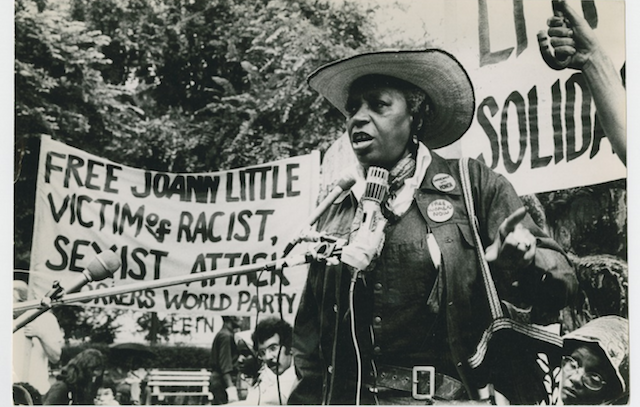
Photo: Bettye Lane
Florynce "Flo" Kennedy speaks at a protest to exonerate a Black victim of attempted rape, Joann Little on July 12, 1975. In 1972, Little, 20, fled her jail cell in Beaufort, North Carolina, after killing the White deputy sheriff who tried to rape her. Little used the jailer’s ice-pick against him and she was placed on trial for murder.  

Florynce "Flo" Kennedy, the charismatic feminist and Black Power activist and lawyer, was born 100 years ago today (February 11). While she is most often remembered as one of the few Black women who worked in the mostly White feminist movement of the 1960s and '70s, Kennedy's influence also flowed from her work within the New Left, Black Power, Civil Rights and autonomous Black Feminist movements.

For the rest of this post, please visit *here* at Colorlines.


                                                *                  *                  *

Finally, to read so much more about Flo Kennedy, please read Sherie's new book:

Florynce "Flo" Kennedy: The Life of a Black Feminist Radical 


Please visit *here* to purchase the book from Charis Books and More, an independent feminist bookstore--for less money than Amazon.com.

Friday, January 29, 2016

Update on "The Conversations Project: The Radical Inclusivity of Radical Feminism"


upper image is from here; lower image is from here 

To me an important breakthrough, I felt, in my work and that of others was the call to use the term white supremacy, over racism because racism in and of itself did not really allow for a discourse of colonization and decolonization, the recognition of the internalized racism within people of color and it was always in a sense keeping things at the level at which whiteness and white people remained at the center of the discussion.  — bell hooks
Quote, p. 68, Critical Foundations in Young Adult Literature (author: Antero Garcia)

[M]y vehicle was going to be truth: not a global, self-deluded truth, not a truth that only I knew and that I wanted other people to follow, but the truth that came from not lying.  Andrea Dworkin
Heartbreak: The Political Memoir of a Feminist Militant, page 21

There is difference and there is power. And who holds the power decides the meaning of the difference. 
— June Jordan
Quote, p. 220, Virtual Equality: The Mainstreaming of Gay and Lesbian Liberation (author: Urvashi Vaid)


To the leaders and moderators of The Conversations Project:

It appears as though you disappeared a lot of my writing from the Facebook group without any direct notice or personally delivered warning that this would occur. For the record, I do not consider myself as having left the group, nor have I received any notification that I am barred. So I think appropriately, I consider myself a part of it. I'll steer clear of any presumptions, as I have been welcomed, quite recently, to continue to post there. But I feel like I'm getting mixed messages. As I think you know, from the start of my involvement, I stated that I will utilise my blog to process or expand upon things I have mentioned there. So this post is simply the latest, and is not intended to be the final analysis.

My last comment, for the record, was to share a link* as an addition to a relevant discussion within the group. This is, in fact, a five-part conversation on trans and feminist issues, which I'd entirely forgotten about. Here is the full series of conversations with Sara, which occurred in late 2010:

Part 1: https://radicalprofeminist.blogspot.com/2010/11/sara-and-julian-discuss-transfeminist.html
Part 2: https://radicalprofeminist.blogspot.com/2010/11/part-2-sara-and-julian-discuss.html
Part 3: https://radicalprofeminist.blogspot.com/2010/12/sara-and-julian-discuss-transfeminist.html
*Part 4: https://radicalprofeminist.blogspot.com/2010/12/sara-and-julian-discuss-transfeminist_03.html
Part 5: https://radicalprofeminist.blogspot.com/2010/12/sara-and-julian-discuss-transfeminist_05.html


To the readers of this blog:

At this point, I've been in the group a full three weeks. A couple of days ago I thought there was a breakthrough in finally acknowledging what that group is and isn't designed to be or prepared to do. I saw that one of the creators might move forward with radical honesty--I appreciated her so much for this indication, but that got immediately thwarted by another member.

What the group cannot as yet do is deeply interrogate key aspects of gender because triggering occurs when several topics and phrases get raised. It also can't, as yet, get far because it doesn't seem committed to looking beyond white norms except to appropriate concepts, experiences, and cultural understandings of those we whites work so diligently to destroy. Sadly, racist appropriation of things like "inclusivity" and "intersectionality" are among many colonial white norms.

As one feature of The Conversations Project, there is a series of interviews with feminists or queer theorists. Some of those have been posted. At last glance, all the experts are white. The principal authors of the project are also white. (And the most vocal members of the group are white-identified.) The project itself is tethered to work and perspectives that cannot be anything but white-centric and so it loses all possibility of radical contribution to Feminist and Queer theory, unless you think more white supremacist theory is radical. But, for whom could that be true?

Gender, there, has appeared to me to be understood as social and psychological, with political meaning as well. And also scientific, using the work of some neurobiologists to note there are not two 'discreet' genders. But that has never been claimed among radical feminists I have known for decades. The dimensions of gender not well-addressed there are the economic, racial, and patriarchally sexual.

Making room for some marginalised voices is identified as radical--and marginalised voices should certainly be heard. But bringing in usually excluded perspectives while not challenging the oppressive norms or exclusionary practices in the center of the room is also designated as radical. I have disagreed.

To date, the group has refused so much of the depth and dimension of Radical Feminist herstory, such as the more radical theories and activist efforts by white women and women of color; it has created an unfortunately narrow breadth of inquiry, even within an already stifling white discourse. An interview with Catharine A. MacKinnon avoided addressing the core issues in MacKinnon's work, such as the maintenance of sex inequality through harassment, degradation, and speech acts. All of Andrea Dworkin's insights on battery and rape, on occupation and subordination, have been ignored.

So it shouldn't come as any surprise that if a group doesn't, together, welcome dealing substantively with such sharp white activists' work, the work of brilliant women of color would be completely occluded. Beyond marginalised. Audre Lorde, Alice Walker, Gloria Anzaldúa, bell hooks, Winona LaDuke, Patricia Hill Collins, Vandana Shiva--all radically feminist writers of theory and art, practitioners of activism, have not been welcomed and are viewed as off topic, too tangential in focus. Have we not heard precisely this excuse during half a century of feminist discourse--and for many centuries?

The Facebook group pays lots of liberal lip service, however sincerely, to the problem of racism and the value of women of color. But the group, as a whole, or through its leadership, will not acknowledge the degree to which it is a white supremacist space. (If you have not as yet, I invite you to read the first quote that introduces this post.) If anyone from that group, or beyond it, wants more detail, just ask, in a comment here, and I'll explicate several points of critique.

Sadly for me, and as mentioned above, it appears someone there has already removed chunks of those critiques, while giving me no notice of that occurring and no opportunity to collect my work before deletion. This speaks to a problem with ethics and process. And smacks of passive-aggressive censure. I welcome whoever did it to own up to that, in a blog comment, or to otherwise explain their reasoning below. They have endeavored to communicate clearly in the past, so I hold out hope for this occurring here in this case.

My perseverance in seeking to address several limitations within the group was seen as distracting from a stated purpose. But to even believe such a direction amounts to a distraction, means one is willfully committed to a lack of knowledge about gender politics in colonial patriarchies. I'm arguing that not even the most privileged of us can afford to ignore how white manhood and capitalism combine with misogynoir and anti-Indigenism to create patriarchal rape culture. And to grasp it, those of us who are white have to learn about others and ourselves from writers like hooks and Collins. As another white member stated there, to my cheers, white people cannot lead us.

I am reminded daily of the refusal to acknowledge the meaning and force of our whiteness. The refusal was tangible there. Blatantly visible in a number of ways. But denied, which is often enough the first line of defense. (And hopefully the only line.)

In short, the group has not been radically feminist, or radically inclusive, if being either means centering voices and theories of women of color and non-binary POC. Nor has it been one that could go far or deep with its conversations. Here's one example: To ask what is patriarchal about the majority-white conflict between what is termed T--Fs and liberal trans activists, was effectively verboten. To ask which of the dynamics and practices participate in rape culture: forget it. No go. Not even a dead end: nothing paved to even get to a dead end. Partly, the reason had to do with triggering, but not by being triggered by men's violence, per se.

Fundamentally, I think it is a support and education group for a few white trans* people who are trauma survivors. I fully support traumatised people gathering in spaces where they, themselves, define and determine the parameters of their own safety. But the only trauma discussed was committed by white natal women. When the most harm you've experienced as a white person is from a few white Radical Lesbian Feminists, one could argue you've somehow managed to avoid the brunt of what patriarchy forces on people. When the harm is interpersonal to the point that the perpetrators have names (and just a few names), I'd argue we are in the realm of a kind of abuse that is not what attempts to kill most women. Most harm is structural, systemic, institutional, including the interpersonal or intimate expressions of it. To the extent the harm named there shows up in institutions, it is due to its application by white men, not white women. Or it is directly caused and controlled by men across ethnicity.

We were not discussing PTSD as arising from misogynist, institutionalised rapist violence. Or as emanating from racism alone, or from misogynoir. The forms of dissociation and denial I personally witnessed in that minority group have been raced white and were not assigned female at birth. (That is meant to be a deeply political, not an anatomical, point.)

Thus far, the group's efforts have had limited applicability to the actual world of oppression. This is partly due to mining only a few bits of some white radical feminists' work. Then combining that with liberally inclusive elements of white-dominated Queer theory. To be clear: the bits are veridical; the elements are estimable. But anti-feminism--the willed erasure of most women and the sources of their subordination and injury, ought not permeate radical pro-feminist conversations. It especially ought not delineate them.


Tuesday, June 10, 2014

White Gay Male Politics and White Lesbian Feminist Challenges

photograph of Marilyn Frye is from here

What follows is a recent and extensive exchange in the comments section of a past post:
Why isn't the Misogyny and Anti-Radical/Anti-Feminism in and beyond Queer communities being seen as just as important to challenge and uproot as Anti-Trans practice?

My responses are partial and inadequate. There's much more to say in response to SuperMattTO's comments. There's much more to critique and challenge. But rather than have the exchange buried in the comments section of another post, I thought I'd share it here.

I welcome further critique and commentary by anyone who has respectful contributions to make.


Blogger SuperMattTO said...
Sometimes you just have to let the past go if you want to change things. The lesbian separatist movement made the LBGT community deeply divided, and, yes, some gay men felt unfairly attacked by some lesbian feminist authors, and did many trans-women. We might just have to forget about the antagonism that used to be.
Wednesday, June 4, 2014 at 1:01:00 PM EDT
 Delete
Blogger Julian Real said...
In my experience, honestly, it wasn't lesbian separatism that divided the community. It was male supremacy and white supremacy. Some women choosing to separate from various status quo society in various ways doesn't divide anything, any more than a group deciding to live somewhere else does. To decide to invest energy in women/wimmin-only spaces make sense to me. What also divides our community is the rape and assault of us as children by adults. And racism, and classism, and misogyny. Would you agree that white and male supremacy divides our community far more than lesbian separatism?
Saturday, June 7, 2014 at 1:20:00 AM EDT
 Delete
Blogger SuperMattTO said...
Well, I wasn't part of the community back then. In 1980, I was 8. But, when I read stuff like the following paper, I see that there is some truth to what some older gay men say about the early lesbian feminist movement. http://www.feminist-reprise.org/docs/fryegayrights.htm
Some of them treated us like enemies just for being gay men. It tends to be those older gay men who remember that period that sometimes express an anti-lesbian sentiment. There must be some men with male supremacist views in the gay community, but I haven't run into it very often. And, I certainly have never met a gay man who says that the reason why we should not be gay bashed is that we are not women. The author of that article seems to have just made that part up, but she accuses us all of being the same. As for your point about women-only space, I have nothing against that.
Saturday, June 7, 2014 at 7:00:00 PM EDT
 Delete
Blogger Julian Real said...
I want to be sure I'm following you here. What's the objection to Frye's essay? What do you understand the problem to be with it? Can you tell me on what page, and what paragraph? Then I can respond to something concrete.

You don't see the sexism and misogyny of gay men, but for those of us who register it in subtle and crude forms, it's fairly blatant and ubiquitous, particularly among white gay men with class privileges. From white gay drag (also blatantly racist, classist, and pro-sex abuse), to anti-feminism, to anti-lesbian politics. To white gay men assimilating into dominant male supremacist society with the only objection to that society being that it won't let in gay men.

Your comment reminds me of whites who say, "I honestly haven't seen much racism among the white people I know." Well, I see it among just about every white person I know. How can whites really know where racism lives, when it lives so invisibly to and among whites? What white person do you know who has a history of being negatively impacted by white supremacy day to night, week to week, year after year?

The same holds true with men, gay and not gay, re: misogyny. It's never far from the surface and too often is all over the surface.

I'm not saying that's all there is: everyone is human and three-dimensional.

Personally, I really liked Frye's essay--and the whole book--when I first read it. It made so much sense of my own experiences and explained why I had gravitated to lesbian-feminism and away from gay-male supremacist politics.

Lesbian feminism and radical feminism were the only two political stances that took sexual violence (including in media such as television and pornography), sexual exploitation and harassment, and child sexual abuse seriously.

Back in the day, if I described some of the abuse I endured in adolescence, gay men would find it erotic and tell me so. Not one woman--lesbian or not, feminist or not, made such a crass remark to me. I think that's because sexual violence and the threat of it is so real, that it's not anything to take lightly.

What is the transformative plan of white gay men you know? What's the radical social agenda? Assimilation is about all I see.

Lesbian feminism and radical feminism have had a consistently anti-status quo agenda and social analysis. Rooting out patriarchy is an agenda among both groups. I don't know of any gay organizations or activist groups who put that on the 'to do' list, even theoretically. Do you?
Sunday, June 8, 2014 at 11:29:00 PM EDT
 Delete
Blogger SuperMattTO said...
I'm too busy to give the long response that you want me to give but teen sexual abuse is very much frowned upon by the gay community. I am sorry that you ran into men that feel otherwise.

Gay men are the other group that has historically taken a stance against childhood sexual abuse. It only took one year for Nambla to be kicked out of most gay pride marches.

Everything is wrong with Frye's essay, but I will have to get back to you on that later when I have more time.
Monday, June 9, 2014 at 6:38:00 AM EDT
 Delete
Blogger SuperMattTO said...
Part I...I had to split my response in half.

Let's take a look at some of her arguments.

1. The presumption of male citizenship.
She claims that gay men think that all men should have the right to certain things like a car and a job but that not all women should. I have never met a gay male who does not think that men and women should be equal in this regard.
2. Worship of the penis.
This is a ridiculous criticism of gay men. If gay men worship penises it is only in a sexual rather than a spiritual way. Gay men like dick because they are sexually attracted to other men. There is no assumption that the male body is superior, or a belief that society at large should worship penises more than vaginas It is just our sexual preference. There are some lesbians that worship the female body the same way that gay men worship the male body, and that is fine to us. It is to be suspected, and nothing about gender superiority should be read into it, unless someone really does believe in gender superiority.
She also says stuff like the following.
"The culture is one in which men are not commonly found laughable when they characterize the female as a castrated male. It is a culture in which an identification of the penis with power, presence and creativity is found plausible-not the brain, the eyes, the mouth or the hand, but the penis. In that culture, any object or image which at all resembles or suggests the proportions of an erect penis will be imbued with or assumed to have special mythic, semantic, psychological or supernatural powers. There is nothing in gay male culture or politics as they appear on the street, in bars, in gay media, which challenges this belief in the magic of the penis."
I'm sorry, but very few gay men believe in that type of male supremacism. She is simply wrong in the way she characterises us.

3. Male homoeroticism, or man-loving.
Again, it is simply because we are gay. There is nothing wrong with gay male homoeroticism, because there is nothing wrong with two men having sex with each other, and it is healthy to have sexual relations and sexual fantasies.
4. Contempt for women, or woman-hating.

She says that this is how gay men feel about being gay-bashed.

"Like most other men who for one reason or another get a taste of what it's like to be a woman in a woman-hating culture, they are inclined to protest, not the injustice of anyone ever being treated so shabbily, but the injustice of their being treated so when they are not women.'

No. I have known a lot of gay men very well, and they simply do not feel that way. Gay men are exceptionally critical of men who act violently towards women, or men who treat women as inferiors. Gay men, by and large simply do not think the way she says we do.

She also claims that all effeminate gay men are simply making fun of women. There are a few very politically incorrect drag queens out there. But, just like not all butch dykes are making fun of men, by and large, most effeminate gay men are not either.
Monday, June 9, 2014 at 11:30:00 AM EDT
 Delete
Blogger SuperMattTO said...
Part II:
5. Compulsory male heterosexuality.
No. We don't believe in that. There might be some gay fathers out there, but compulsory heterosexuality is not one of our beliefs. We are completely offended by it. And, a lot of gay men are also completely bothered by straight men who think lesbians should have to do it with a man. We understand that this is offensive enough that it warrants significant feminist backlash against straight men, but it is totally unfair to lay the blame on us.
6. The presumption of general phallic access.
Who does she think she is protecting by supporting anti-gay sodomy laws. Does she not realise that in the gay male culture that largely condemns coercive sex, the men who take it up the ass want to because they like it? What business does she have trying to stop gay men from doing this? If she is a feminist, she should concern herself more with whether or not some straight men are coercive and whether or not certain aspects of the dominant straight porn culture might promote coercive sex. But, it is wrong to condemn gay men for this. Rather, the would could learn a lot from us, since we firmly believe that only people who really want to take it up the ass should do so.

Indeed, she misunderstands us so badly that she says this.
"The general direction of gay male politics is to claim maleness and male privilege for gay men and to promote the enlargement of the range of presumption of phallic access to the point where it is, in fact, absolutely unlimited."
In what way is it fair to say that about a culture of people who largely condemns people who are sexually coercive, sex with underage boys and girls, and bestiality.
Finally, take a look at this comment.
"The power available to those who choose, who decide in favor of deviance from heterosexual norms, can be very great."
Because she is opposed to male homoeroticism and she thinks that women who choose to live a lesbian lifestyle make more of a difference than lesbians who are simply only attracted to women, she is essentially claiming that only straight or bi women should be allowed to speak for the entire LBGT community. That is heterosexual supremacism showing its ugly head.

Returning now to an earlier comment she made in her paper that gay men are if anything anti-feminist. I disagree with this statement. But, back in 1983, a lot of gay men were being sick of being told what they think by straight women who were pretending to be lesbians, principally because we don't think that way. Many gay men actually to prescribe to a more-or-less feminist ideology.
Monday, June 9, 2014 at 11:33:00 AM EDT
 Delete
Blogger SuperMattTO said...
And, yet another response to some parts of your post that I did not address earlier.

Yes, white supremacy is pervasive in white culture. My experience with gay men is that some of them have a grudge against straight men and some of them hold a grudge against lesbians, but very few hold much of a grudge against straight women. And, I am being as honest as I possibly can. SOME of the lesbophobia that is out there probably has a sexist component, but sometimes it is resentment towards radical feminists who seemed to agree with our oppressors about some issues.

I don't really agree that gay male politics has no feminist component. A lot of the people who oppose gay marriage are gender traditionalists. They say that, for a relationship to work well, there has to be a person with a vagina who cooks, and a person with a penis who mows the lawn. Gay and lesbian marriages violate the view of obligatory gender roles that they want to maintain. And, gay male culture tends to be quite genderless. We don't really maintain that there is such a thing as a male or a female role in relationships or that there is any advantage to introducing the notion of gender into a relationship. Mainstream acceptance of gay marriage will help to dismantle patriarchy.
I have seen a fair number of gay men getting involved in feminist organisations like becauseiamagirl.ca, which does fundraising for underpriviledged girls in third-word countries. But, a gay rights organisation cannot itself take on those types of issues, because it isn't a gay rights issue. That doesn't mean that gay rights activists don't support women's rights though.
As a sidnote, I honestly don't see radical feminists coming up with a viable way to overthrow patriarchy either.
Monday, June 9, 2014 at 2:13:00 PM EDT
 Delete
Blogger Julian Real said...
Lots to respond to.

First, "Gay men are the other group that has historically taken a stance against childhood sexual abuse. It only took one year for Nambla to be kicked out of most gay pride marches."

NAMBLA was supported by many gay men, was supported by gay men to be part of the gay pride parade, and was critiqued most clearly and immediately not by gay men, but by lesbian and feminist women.

"Everything is wrong with Frye's essay...

How could that be? I'll assume that is uncareful rhetoric.
Monday, June 9, 2014 at 10:49:00 PM EDT
 Delete
Blogger Julian Real said...
'I'm sorry, but very few gay men believe in that type of male supremacism. She is simply wrong in the way she characterises us."

Our experiences are different.

3. "Male homoeroticism, or man-loving.
Again, it is simply because we are gay. There is nothing wrong with gay male homoeroticism, because there is nothing wrong with two men having sex with each other, and it is healthy to have sexual relations and sexual fantasies."


The issue for me has been how gay men treat women, lesbians, and feminists over the years. When lesbian feminism began a systematic critique of male supremacist power as it displayed itself against lesbians, gay men parted company with lesbians in the struggle against heteropatriarchy. In and beyond the bdsm gay community, a very narrow kind of patriarchal masculinity and male power is eroticised: it's not just gay men being attracted to one another; it's the celebration of a kind of masculinity that, in the larger world, is deeply oppressive to women, and also to gay men.

You cite this of Frye's:

"Like most other men who for one reason or another get a taste of what it's like to be a woman in a woman-hating culture, they are inclined to protest, not the injustice of anyone ever being treated so shabbily, but the injustice of their being treated so when they are not women.'

You respond:
"No. I have known a lot of gay men very well, and they simply do not feel that way. Gay men are exceptionally critical of men who act violently towards women, or men who treat women as inferiors. Gay men, by and large simply do not think the way she says we do."

Most gay men I know oppose domestic violence and the rape of women by men. Many gay men are vague on what constitutes rape between men. Few gay men have an analysis, let alone organized opposition to 'rape culture', which explains the 'hard-core', uncompromising defence of industry pornography across the board.

Also, most gay men I've known oppose gay bashing because it is violence against queer people, not because it is an expression of misogyny directed at allegedly 'effeminate' men. The fact that straight gay bashing men, and other straight men, call us all manner of names that basically mean 'too much like a woman', demonstrate this is how we are viewed in dominant male culture. Gay men's personal ads reveal this too: "no femmes". I have never seen an ad that reads, "no masculine or butch men". Have you?

"She also claims that all effeminate gay men are simply making fun of women. There are a few very politically incorrect drag queens out there. But, just like not all butch dykes are making fun of men, by and large, most effeminate gay men are not either."

I think you mistakenly read feminist and lesbian analysis to think that when authors critique 'men' or 'gay men' they mean ALL people in that category. This is a sloppy misread, in my view. For if gay men critique hetero men, clearly we don't mean EVERY SINGLE straight boy.

Understanding white gay male drag, particularly when allegedly appearing to be 'Black women'--and I don't mean particular famous women like Diana Ross or Patti LaBelle, it is rarely anything but a misogynist minstrel show, garnering adoration and appreciation from other gay men, while turning 'Black women" into a caricature. That is my experience. Perhaps we live in different cultures, or have done so.
Monday, June 9, 2014 at 11:13:00 PM EDT
 Delete
Blogger Julian Real said...
Also, you might wish to learn about Allen Ginsberg's position on sex with thirteen year old boys. And note how many gay men celebrate him as a positive libertarian.
Monday, June 9, 2014 at 11:16:00 PM EDT
 Delete
Blogger Julian Real said...
Generally, I guess I see you attempting to speak for all gay men across eras, and ignoring a great deal about gay men's historical protection of abuses of male power. Why you rewrite history in this way is not clear to me.

For now, just to offer proof of a example of a prominent gay men who advocates or celebrates sex with children, I'm citing one historical figure who looms large in counterculture, especially if not only among men across sexual orientation. My reason for doing so is not to say Ginsberg is representative of all gay men. It is, rather, to note that when you speak for all gay men, you leave out a lot.

LOFTON: Did you say you had a sexual preference for young boys?

GINSBERG: We're not on trial here. I'm trying to explain.

LOFTON: But in a way, we're all on trial.

GINSBERG: Well, then you must excuse me if I don't adopt the submissive attitude you wish. I got on the air and said that when I was young I was approached by an older man and I don't think it did me any harm. And that I like younger boys and I think that probably almost everybody has an inclination that is erotic toward younger people, including younger boys.

LOFTON: How young were the boys?

GINSBERG: In my case, I'd say fourteen, fifteen, sixteen, seventeen, eighteen.

LOFTON: That you had sex with?

GINSBERG: No, unfortunately I haven't had the chance. [laughs]

Source of the interview snippet is here here.

You may also read Andrea Dworkin's account of his unapologetic predatory attitudes in her book, Heartbreak.
Monday, June 9, 2014 at 11:25:00 PM EDT
 Delete
Blogger Julian Real said...
Regarding this, "As a sidenote, I honestly don't see radical feminists coming up with a viable way to overthrow patriarchy either."

I'd phrase that dramatically differently. I'd say this is more truthful:

With the on-going militant pervasiveness and centuries-old stubbornness of racist patriarchy, it is not yet possible to overthrow it. Such a dismantling and transformation would require that many groups of people band together to fight various man-infestations of white male supremacy, including genocide of Indigenous people globally, opposition to globalisation, the creation of economic justice, the cultural overthrow of rapism, the end of rape, the dissolution of white power and male power, the statusing of lesbianism and radical feminism, and so much more. Ask your gay male friends if they'll get on board with such a project and let me know what they say.
Monday, June 9, 2014 at 11:44:00 PM EDT
 Delete
Blogger SuperMattTO said...
"With the on-going militant pervasiveness and centuries-old stubbornness of racist patriarchy, it is not yet possible to overthrow it. Such a dismantling and transformation would require that many groups of people band together to fight various man-infestations of white male supremacy, including genocide of Indigenous people globally, opposition to globalisation, the creation of economic justice, the cultural overthrow of rapism, the end of rape, the dissolution of white power and male power, the statusing of lesbianism and radical feminism, and so much more. Ask your gay male friends if they'll get on board with such a project and let me know what they say."

Nearly all of my gay male friends would agree with all of those goals.
Tuesday, June 10, 2014 at 9:54:00 AM EDT
 Delete
Blogger SuperMattTO said...

"When lesbian feminism began a systematic critique of male supremacist power as it displayed itself against lesbians, gay men parted company with lesbians in the struggle against heteropatriarchy. In and beyond the bdsm gay community, a very narrow kind of patriarchal masculinity and male power is eroticised: it's not just gay men being attracted to one another; it's the celebration of a kind of masculinity that, in the larger world, is deeply oppressive to women, and also to gay men."

The problem here is that I don't agree with the analysis. Bdsm is consensual and it is all about exploring one's sensual limits, which is what some people find erotic and even sometimes spiritual. I also don't particularly agree with you that there any such thing as masculinity.

Historically, women were treated like sex slave, but there is a real difference between that type of a major human rights violation and consensual sex. Just the fact that some people like bdsm should show you how different these two things really are. I agree with you on the other points you made in the post.

"Gay men's personal ads reveal this too: "no femmes". I have never seen an ad that reads, "no masculine or butch men". Have you?"

That's always bothered me too. It strikes be to be quite politically incorrect, and far too common.

"Understanding white gay male drag, particularly when allegedly appearing to be 'Black women'--and I don't mean particular famous women like Diana Ross or Patti LaBelle, it is rarely anything but a misogynist minstrel show, garnering adoration and appreciation from other gay men, while turning 'Black women" into a caricature. That is my experience. Perhaps we live in different cultures, or have done so."

I know very little about drag. I know that there is some very misogynistic and racist stuff out there. There is a group of guys in my square dance group that dress in drag once per year, and there is nothing misogynistic about it. It is just having fun with outrageous costumes. The same guys come out with other types of outrageous costumes on halloween.
Tuesday, June 10, 2014 at 10:08:00 AM EDT
 Delete
Blogger SuperMattTO said...
What does "the statusing of radical feminism and lesbianism" mean?
Tuesday, June 10, 2014 at 1:00:00 PM EDT
 Delete
Blogger Julian Real said...
"Nearly all of my gay male friends would agree with all of those goals."

Where do you live? I don't mean specifically; what country and city do you live in? I don't know hardly any gay men who would be on board with that political project. I'm glad you do.
Tuesday, June 10, 2014 at 10:03:00 PM EDT
 Delete
Blogger Julian Real said...
"Historically, women were treated like sex slave, but there is a real difference between that type of a major human rights violation and consensual sex."

I agree with the last part but need to qualify the first part. Rape and rough or bdsm consensual sex are not identical, of course. I don't think it's a profeminist position that they are. The point is that they rise out of a similar political ground. And: sexual slavery is far more prevalent now than in the past, of women and girls especially. And it's not about being treated as a sex slave, but actually being one as far as the slavers are concerned. That is: the problem isn't just men thinking some women and girls deserve to be treated as sex slaves. The problem is that women's and girls' humanity is so non-existent in the minds of millions of men, that making them into sex slaves doesn't seem like an injustice or mistreatment of the enslaved people. This has always been true of slavers.

"Just the fact that some people like bdsm should show you how different these two things really are.

This is where your argument is weak in my opinion. Because it leaves out a very crucial fact: that rapists, child molesters, and other perpetrators like what they do. They enjoy it. They get intense pleasure from it. So, if we focus on the perps, there's little difference, with regard to liking it. I realise you're talking about BOTH parties enjoying it, and base its acceptability on the presence of consent. But many women I know have experienced rape and the law would only define it 'consensual sex'.

An excellent critique of 'consent' as a woefully inadequate measure of genuinely respectful sexual practice exists. It ought not be what we base law on. For more, please see, chapter 18. Unequal Sex: A Sex Equality Approach to Sexual Assault, in Women's Lives, Men's Laws, by Catharine A. MacKinnon.

If being sexually assaulted, particularly but not only in childhood, results in dissociation, self-imposed silencing, and a terror of telling any man 'no' when sex is brought into an interaction, how might we know what's genuinely consensual? If she is not safe, or doesn't feel safe to say no, why should an absence of a 'no' be assumed to be a 'yes'?

I've never heard one gay man make these points, because consent is sufficient as a maximum level of agreement for most gay men I know, for most men generally.

As a survivor of child sexual abuse and adult sexual exploitation, I am suggesting that 'consent' is an inadequate measure of mutual respect and regard, particularly for law, but also for relationships.

I'll offer up these points: if society is soaked in misogyny, built on it, bred and raised in it, isn't it likely that what we will enjoy it sexually and socially? Put another way, how could we not enjoy it and absorb it as 'hot', on some level? I'm speaking about many levels of misogyny, not just the most overtly hostile forms that might seem obviously deplorable to more sensitive and aware gay males.
Tuesday, June 10, 2014 at 11:09:00 PM EDT
 Delete
Blogger Julian Real said...
"Gay men's personal ads reveal this too: "no femmes". I have never seen an ad that reads, "no masculine or butch men". Have you?"

That's always bothered me too. It strikes be to be quite politically incorrect, and far too common.


The point isn't the degree to which you or I am bothered by it. Or by gay men's embrace of industry pornography. Or by white gay men's misogyny and racism in drag performance. Or white gay men's protection and defence of white gay men traveling to countries where much poorer people of color live to have sex with young men, or younger males.

The issue is that all of that and more is pervasive in gay community or gay male behavior in the Global North and Australia. That tells us something about our culture, doesn't it? It's not that those things are extreme practices--the problem is not that they are extreme. The problem is that they are normal and reveal the core values of the dominant society.

Gay men's practices aren't less innocent because gay men practice them. Yes, gay men are not positioned to rule society the way het men are. But we don't discount the harm just because the most dominant people aren't the practitioners in these cases.

I know very little about drag. I know that there is some very misogynistic and racist stuff out there.

I find that wording to be troubling. "Some very misogynistic and racist stuff out there." It's not exactly something kind of unfortunate, something only some people enjoy. Again, like the 'no femmes' thing, it's pervasive, embedded in our culture. It's not an entirely peripheral phenomenon. It speaks to something at the center of our world.

There is a group of guys in my square dance group that dress in drag once per year, and there is nothing misogynistic about it. It is just having fun with outrageous costumes. The same guys come out with other types of outrageous costumes on halloween.

How would you or I know whether there's anything misogynistic about it? We're not in a position to know it and name it because, let's face it, males aren't the best at doing so; we miss a lot. Nor are whites the best at knowing and identifying racism when it is expressed.

I don't know how the guys in your dance group dress up, so I won't speak to that. But those gay men who I know who do dress up in drag, actually say they are dressing up 'like a woman'. Such an understanding of 'women' is grossly stereotypical, and really has very little to do 'being like a woman'. For those people (female or male) who are threatened and endangered by the prevalence of such two-dimensionalising and distorting of 'womanhood', it is not confusing to me why so many women would oppose it as not at all progressive.
Tuesday, June 10, 2014 at 11:09:00 PM EDT

Added:

You asked, "What does "the statusing of radical feminism and lesbianism" mean?

As I see it, various perspectives are either statused: valued and held up with regard, or stigmatised: devalued and held down with contempt. This is also true of groups of people. In corporate media, white radical feminism and lesbian feminism are virtually invisible, moreso the radical feminism and lesbian feminism of women of color.

White gay male politics are prominent when 'gay' issues are discussed or reported on. Currently, assimilationist/racist/classist/misogynist white gay male political agendas are embraced by more and more people who value and protect the status quo. Increasingly, radical feminism and lesbian feminism are devalued and marginalised, such as in academic institutions and across status quo society.

P.S. I missed where you wrote you live in Toronto. Thanks for that information. It's useful to know you didn't grow up, or at least don't currently live, in the U.S. The U.S. has very particular historical and contemporary ways of reinforcing white male supremacy. As does Canada.