|
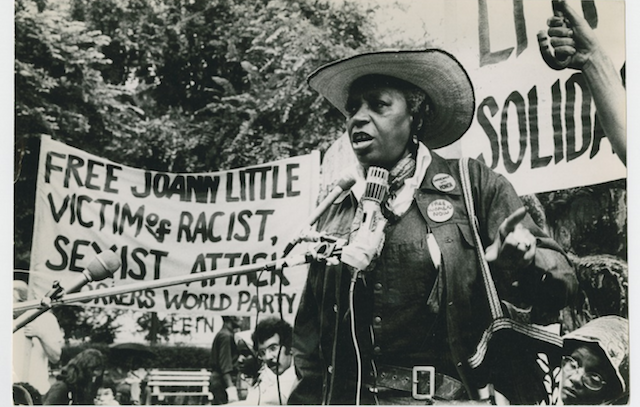
| two images of Audre Lorde's classic feminist text are from here |
The full text of the Audre Lorde speech and essay appears below my intro.
So many people I know fight the debilitating, paralysing fear of speaking out, of being themselves to the best of their knowledge and fierceness, of being grounded in their own liberatory power as they work to share that power to make radical and transformative change collectively and responsibly.
How do we continue these political struggles and campaigns when fear grips us and draws us repeatedly into silence? Is it more important to know what is underneath our fear, or to find ways to move with it? My tendency is to want the understanding before moving into action; it is a useful and self-defeating way to postpone the action.
Due to the above questions and concerns, the following writing surfaces perennially in my life and in the lives of so many women I know. In order to share it with you, I found it as a PDF document online and have replicated it here, as it appears in Sister Outsider: Essays and Speeches by Audre Lorde (Crossing Press, 1984; republished in 2007 with a foreword by Cheryl Clarke).
I have, I hope faithfully, corrected one minor typo from the original and several others that showed up in the pasting process. If you find any other typos, please send me a comment or email so that I may correct it. Note: Audre intentionally does not capitalise 'america'.
This is earnestly presented here under Fair Use law, without any commercial interest and with the sole intention of sharing Lorde's written and spoken wisdom and political efforts to make the lives of Black lesbians and other women of color central to our revolutionary work. That work has been and remains the heart of this blog.
If you have not as yet, I shall greatly and joyfully encourage you to read all fifteen chapters of Sister Outsider. For now,
The Transformation of Silence into Language and Action*
I HAVE COME to believe over and over again that what is most
important to me must be spoken, made verbal and shared, even
at the risk of having it bruised or misunderstood. That the
speaking profits me, beyond any other effect. I am standing here
as a Black lesbian poet, and the meaning of all that waits upon
the fact that I am still alive, and might not have been. Less than
two months ago I was told by two doctors, one female and one
male, that I would have to have breast surgery, and that there
was a 60 to 80 percent chance that the tumor was malignant.
Between that telling and the actual surgery, there was a three-week period of the agony of an involuntary reorganization of
my entire life. The surgery was completed, and the growth was
benign.
But within those three weeks, I was forced to look upon
myself and my living with a harsh and urgent clarity that has
left me still shaken but much stronger. This is a situation faced
by many women, by some of you here today. Some of what I experienced during that time has helped elucidate for me much of
what I feel concerning the transformation of silence into
language and action.
In becoming forcibly and essentially aware of my mortality,
and of what I wished and wanted for my life, however short it
might be, priorities and omissions became strongly etched in a
merciless light, and what I most regretted were my silences. Of
what had I
ever been afraid? To question or to speak as I believed could have meant pain, or death. But we all hurt in so
many different ways, all the time, and pain will either change or
end. Death, on the other hand, is the final silence. And that
might be coming quickly, now, without regard for whether I
had ever spoken what needed to be said, or had only betrayed
myself into small silences, while I planned someday to speak, or
waited for someone else's words. And I began to recognize a
source of power within myself that comes from the knowledge
that while it is most desirable not to be afraid, learning to put
fear into a perspective gave me great strength.
I was going to die, if not sooner then later, whether or not I
had ever spoken myself. My silences had not protected me.
Your silence will not protect you. But for every real word
spoken, for every attempt I had ever made to speak those truths
for which I am still seeking, I had made contact with other
women while we examined the words to fit a world in which we
all believed, bridging our differences. And it was the concern
and caring of all those women which gave me strength and
enabled me to scrutinize the essentials of my living.
The women who sustained me through that period were
Black and white, old and young, lesbian, bisexual, and
heterosexual, and we all shared a war against the tyrannies of
silence. They all gave me a strength and concern without which
I could not have survived intact. Within those weeks of acute
fear came the knowledge
– within the war we are all waging
with the forces of death, subtle and otherwise, conscious or not
– I am not only a casualty, I am also a warrior.
What are the words you do not yet have? What do you need
to say? What are the tyrannies you swallow day by day and attempt to make your own, until you will sicken and die of them,
still in silence? Perhaps for some of you here today, I am the face
of one of your fears. Because I am woman, because I am Black,
because I am lesbian, because I am myself
– a Black woman warrior poet doing my work
– come to ask you, are you doing
yours?
And of course I am afraid, because the transformation of silence
into language and action is an act of self-revelation, and that
always seems fraught with danger. But my daughter, when I told
her of our topic and my difficulty with it, said, "Tell them about how you're never really a whole person if you remain silent,
because there's always that one little piece inside you that wants
to be spoken out, and if you keep ignoring it, it gets madder and
madder and hotter and hotter, and if you don't speak it out one
day it will just up and punch you in the mouth from the inside."
In the cause of silence, each of us draws the face of her own
fear
– fear of contempt, of censure, or some judgment, or
recognition, of challenge, of annihilation. But most of all, I
think, we fear the visibility without which we cannot truly live.
Within this country where racial difference creates a constant, if
unspoken, distortion of vision, Black women have on one hand
always been highly visible, and so, on the other hand, have
been rendered invisible through the depersonalization of
racism. Even within the women's movement, we have had to
fight and still do, for that very visibility which also renders us most vulnerable, our Blackness. For to survive in the mouth of
this dragon we
– all america, we have had to learn this first and
most vital lesson
– that we were never meant to survive. Not as
human beings. And neither were most of you here today, Black
or not. And that visibility which makes us most vulnerable is
that which also is the source of our greatest strength. Because
the machine will try to grind you into dust anyway, whether or
not we speak. We can sit in our corners mute forever while our
sisters and our selves are wasted, while our children are
distorted and destroyed, while our earth is poisoned; we can sit
in our safe corners mute as bottles, and we will still be no less
afraid.
In my house this year we are celebrating the feast of Kwanza,
the African-american festival of harvest which begins the day
after Christmas and lasts for seven days. There are seven principles of Kwanza, one for each day. The first principle is Umoja, which means unity, the decision to strive for and maintain unity in self and community. The principle for yesterday, the second day, was Kujichagulia
– self-determination
– the decision to define ourselves, name ourselves, and speak for ourselves, instead of being defined and spoken for by others. Today is the
third day of Kwanza, and the principle for today is Ujima
– collective work and responsibility
– the decision to build and
maintain ourselves and our communities together and to recognize and solve our problems together.
Each of us is here now because in one way or another we
share a commitment to language and to the power of language,
and to the reclaiming of that language which has been made to
work against us. In the transformation of silence into language
and action, it is vitally necessary for each one of us to establish
or examine her function in that transformation and to
recognize her role as vital within that transformation.
For those of us who write, it is necessary to scrutinize not only
the truth of what we speak, but the truth of that language by
which we speak it. For others, it is to share and spread also
those words that are meaningful to us. But primarily for us all, it
is necessary to teach by living and speaking those truths which
we believe and know beyond understanding. Because in this
way alone we can survive, by taking part in a process of life that
is creative and continuing, that is growth.
And it is never without fear
– of visibility, of the harsh light
of scrutiny and perhaps judgment, of pain, of death. But we
have lived through all of those already, in silence, except death.
And I remind myself all the time now that if I were to have been
born mute, or had maintained an oath of silence my whole life
long for safety, I would still have suffered, and I would still die. It
is very good for establishing perspective.
And where the words of women are crying to be heard, we
must each of us recognize our responsibility to seek those words
out, to read them and share them and examine them in their
pertinence to our lives. That we not hide behind the mockeries
of separations that have been imposed upon us and which so
often we accept as our own. For instance, "I can't possibly teach
Black women's writing
– their experience is so different from mine." Yet how many years have you spent teaching Plato and
Shakespeare and Proust? Or another, "She's a white woman and
what could she possibly have to say to me?" Or, "She's a lesbian,
what would my husband say, or my chairman?" Or again, "This
woman writes of her sons and I have no children." And all the
other endless ways in which we rob ourselves of ourselves and
each other.
We can learn to work and speak when we are afraid in the
same way we have learned to work and speak when we are tired.
For we have been socialized to respect fear more than our own
needs for language and definition, and while we wait in silence
for that final luxury of fearlessness, the weight of that silence
will choke us.
The fact that we are here and that I speak these words is an attempt to break that silence and bridge some of those differences
between us, for it is not difference which immobilizes us, but
silence. And there are so many silences to be broken.
* Paper delivered at the Modern Language Association's "Lesbian and Literature Panel," Chicago, Illinois, December 28, 1977. First published in
Sinister Wisdom 6 (1978) and
The Cancer Journals (Spinsters Ink, San Francisco, 1980).