Showing posts with label white-centrism. Show all posts

Saturday, June 18, 2011

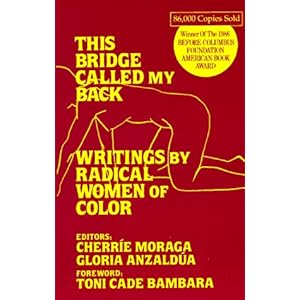
Resources for Inquiry into the Politics of Being White, and the Limits of White Feminism

image of book cover is from here
For more on the above book, please see *here*.

image of book cover is from here
For more on the book above, please see *here*

image of book cover is from here
For more on the book above, please see *here*.

Feminism isn't whites-only--or unraced, but if you judge by some blogs that don't identify their race you might think "Radical Feminist" means all-white all the time. (The blogs that don't identify their race are almost always white because white folks, arrogantly and annoyingly, think of ourselves, quite mistakenly, as unraced). You, dear reader, might have been misled to believe that "radical feminist" means whites-only. Not so.

I've been making a rather well-evidenced case for years that radical feminism is comprised of the experiences, analysis, and justice and liberation struggles of women across the globe--and always has been, even before the term "radical feminism" came into existence in the English language. Yes, white radical feminism has its own history, but in my opinion it shouldn't be conflated with "radical feminism" generally.

I have welcomed discussion among white women about the meaning of being white. I have expected and unsurprisingly found it to be the case that most discussions of whiteness do not take place among white people. Similarly, most discussions of heterosexuality do not take place among heterosexuals, in my experience. Often enough the outsiders are the inquirers, and radical interrogators, and justice-seeking activists. The outsiders are made to feel and are forced to be outside the mainstream because of the unquestioned power, position, and privileges of the relative insiders.

White women and men of color in the United Rapes of Amerikkka do not hold powers of absolute authority and prestige to nearly the extent that white [het] men do. This tends to produce mixed alliances, with each group vying for some attention from and status given from WHM, while WHM give up nothing at all to maintain their own status. Both men of color and white women are known for one thing, among others: the systematic betrayal of women of color in justice-seeking efforts and liberation struggles.

Primarily through friendships, I have witnessed how often this occurs. It is painful to see it happening--especially so frequently; I know it is far more painful to live it than merely to observe it happening in the lives of people close to me. I have lived variations of this, but not this exactly. I have seen, for example, how white Jews jockey for position to achieve the same levels of status, recognition, and reduction of stigma as that which occurs more easily and "naturally" (meaning, structurally, without dominant cultural or political opposition) among white Christians in the US. I have seen white gay men do the same thing. In each case, Jewish white women across sexuality and lesbian white women across ethnicity, respectively, are often betrayed.

Left out of such observations, curiously, is how being Jewish and white, or gay and white, positions oneself to be a better or worse ally to women of color across sexuality. It is uniformly hoped among oppressed people I know that knowledge--emotional, intellectual, and visceral--of being marginalised or oppressed in at least one way (such as by gender, race, religion, ethnicity, economic class, sexuality, disability, age, language, or region) will make understanding the marginalisation and oppression of other people more possible. By "understanding", I mean experienced by proxy to the point of being actually felt in the hearts and minds of those with fewer experiences of being structurally below the top of social hierarchies.

I have little doubt that me being Jewish and gay, as well as white and male, has made identification with some of what women of color--Jewish or not, lesbian or not--endure regularly and routinely, as a matter of course living one's life in a racist-misogynist environment.

I don't know the full brunt of misogyny, but get to feel some of its sting when degraded for being "feminine"--as het men define and determine such arbitrary qualities of human existence. I don't know the full force of racism from whites, but I know how it feels to be seen as Other by white Christians and white Gentiles; to be deemed someone who is not "one of us", where "us" means "better than you and your people".

I have wanted my blog to be a place where intersectional realities come to life. Where stories about abuses and forms of endurance experienced by people across many social divides (divisions in status and stigma, power and privilege, position and location), are made existent and are not hidden or turned into something else, like trivial, an interference, or beside the point.

Part of this discussion involves analysing the meaning and experience of being a white woman. Most of my experiences of white women happened while growing up and throughout my early adulthood. In those years white women were "women" (unraced). My feminist mentor, a white lesbian, was the first person to highlight for me how being white can lead the white person to think they are unraced, or, rather, how it is allegedly only women of color (and men of color) who are raced or shaped profoundly by racism.

Proponents of Liberal Humanism interfere with deeply understanding and challenging how we are all shaped by racism by making anti-radical proclamations such as "racism goes both ways" and "we are all oppressed in a racist system". I disagree strongly with both contentions. I've written about why that is elsewhere on this blog. If interested, please do a search on the right side using the keywords "white supremacy", "whiteness", or "When White isn't Right" for more.

The first person I encountered who discussed whiteness in depth in published work, was Marilyn Frye. She, along with my mentor, also a white feminist and lesbian, gave me hope in the 1980s that being white didn't necessarily mean being in gross denial about the force and fury of white supremacy.

I will be discussing writings by white feminists in future posts. For now, I want to link you, the dear reader, to some resources for further reading. To understand, from reading materials, what whiteness is and does, I recommend reading the work of women of color. I'd say read the work of people of color but in my experience men of color do not sufficiently comprehend how whiteness shapes and insults the lives of women of color. So, do read the work of people of color--who are women.

Here are those links. The source website for these is *here* at feministreprise.org. With hugs thanks to them!!! (I only wish there were more essays and articles by women of color, for whites to read and learn from. There's plenty by Audre Lorde, bell hooks, and so many more writers, theorists, and activists.)


Feminism and Whiteness

Identity Politics and Race: Some Thoughts and Questions by Elliott batTzedek, from Rain and Thunder Issue #5, Winter Solstice 1999.

White Woman Feminist by Marilyn Frye, from Willful Virgin: essays in feminism (Crossing Press, 1992).

On Being White: Thinking Toward a Feminist Understanding of Race and Race Supremacy by Marilyn Frye, from The Politics of Reality: essays in feminist theory (Crossing Press, 1983).

Anthropology by Chrystos, from the "Dyke Humor" issue of Lesbian Ethics (Vol 3 No 3 Summer 1989).

From Practice to Theory, or What is a White Woman Anyway? by Catharine A. MacKinnon. From the excellent anthology Radically Speaking: Feminism Reclaimed. This article is a must-read, a direct challenge to those who would assert that there's no such thing as a woman.

Please see also these articles at other sites:
White Privilege: Unpacking the Invisible Knapsack by Peggy McIntosh
Detour-Spotting for White Anti-Racists by jona olsson (pdf)

I am interested in reading the response essay to MacKinnon's above, called "Whiteness and Women, in Practice and Theory: a Reply to Catharine MacKinnon" by Martha R. Mahoney. Just below is a link to the first page of it. I'm also curious to know if C. A. MacKinnon has responded to this:

http://heinonline.org/HOL/LandingPage?collection=journals&handle=hein.journals/yjfem5&div=13&id=&page=

A friend of mine is trying to locate the whole of it. We'll see what we get.

In the mean time--sometimes far too mean time, here's to more community-building forms of discourse. As someone once remarked to me, "Radicals eat their young." This was meant as a caution about how vicious people can be when defending their own intellectual and political turf. It appear to also be the case that the young do their level best to ignore or dismiss their elders.

The masters of these and other, far more deadly, games are those with the most structural power in society. And in this society of mine, that isn't radicals. But I have noticed, among white radicals in particular, an odd kind of meanness that seems to not understand the meaning of care and compassion at all.


Saturday, February 5, 2011

Pariah: A Film About A Black Lesbian Young Woman Finding Herself in White Het Male Supremacy, Written and Directed by Dee Rees. Produced by her spouse in life and partner in work, Nekisa Cooper

photograph of couple Dee Rees and Nekisa Cooper, filmmakers of "Pariah" is from here

Telling a story is difficult when you struggle to know the story you're telling--because you are living it; because the story isn't done. But any partly autobiographical story will necessarily be a work in process. So it is for partners in life and work, Dee Rees and Nekisa Cooper, writer/director and producer, respectively, of a film getting a lot of attention at Sundance called Pariah. This is a deeply personal story, which means it is also profoundly political.

In a Western world where, far too often, human = white and male, queer = white and male, lesbian = white, and woman = white, it is difficult for me, a white gay male, to fully appreciate the struggles for visibility and validation faced by those of us in the queer community without white and male privileges. Why it is that white queer people think telling stories primarily about whites and men is representative of "us" is beyond me. Most queer people aren't white, after all; most queer people are not male either; and most queer people do not have the kind of economic privileges, social status, and professional clout with which to get films made. So movies from Making Love, to Birdcage, to Brokeback Mountain, to TransAmerica, to The Kids Are All Right do not tell "our" story so much as they tell a small part of our story made to seem complete.

I recommend checking out these films about queer people of color and/or LGBTIQA people who do not live in Anglo-white societies: Black Womyn: Conversations with Lesbians of African Descent; Johnny Greyeyes, The Watermelon Woman, A Litany for Survival: The Life and Work of Audre Lorde, Fire, The Blossoming of Maximo Oliveros, and XXY. I welcome the readers from all over the world alerting me to other films depicting the lives of queer and Two-Spirit people of color, and queer people living in the Pacific Islands, South and Central America, sub-Saharan Africa, Northern Africa and The Middle East, Central Asia, South Asia, Southeast Asia, East Asia, and Black, Brown, Asian, and Indigenous people globally.

White gay activists like Dan Savage state that, increasingly, our people's stories are told in dominant media--on television and in films. But these voices, such as those in Will and Grace and Modern Family, lack authenticity and depth when they are only white or only male (or both). They aren't "us", in other words; they are "the voices of the most privileged" which means the most complex struggles, told as stories in whatever televised or cinematic form, are not familiar to most of us.

As anyone knows who remembers the first lesbian or gay person you saw on television or in film, seeing ourselves reflected back to us in affirming and three-dimensional ways is critically important to our self-esteem and sense of self-worth. This is particularly true for queer youth, who generally and usually do not have any validation or support within families of origin.

I didn't come out to my family of origin until after I was out to myself and my friends. It's the friends that so often help us prepare to tell those family members, who can be liberally accepting or conservatively rejecting. This is one theme in the movie discussed below.

Here is an in-depth article and interview with the filmmakers of Pariah from three and a half years ago when the film only existed as a feature length screenplay and a short film. I have added several links to the article when writers and spiritual-political-creative movements are mentioned, in case any readers here aren't familiar with them. What follows is from Afterellen.com and may be linked back to by clicking on the title just below.


Giving Voice to a "Pariah"

reescooper.jpgpariahclip.jpg

Dee Rees never thought she would become a filmmaker. "My journey into film has been pretty roundabout," she told AfterEllen.com. The Tennessee native started out in the business world, where she met her girlfriend, Nekisa Cooper. The two recently collaborated on the award-winning short film Pariah (Rees wrote and directed; Cooper produced), a coming-of-age story about an African-American lesbian teen who struggles with her sexual orientation in the face of a conservative family.
 
"Going into undergrad, I knew that I loved writing," explained Rees, "but was afraid to major in English or journalism because it didn't seem 'practical.'"

Thankfully, Rees didn't stay long in a field she was unhappy in, but her stint in business did beget the essential partnership behind Pariah's creation. "I met Dee while working at Colgate," Nekisa Cooper recalled in an interview with AfterEllen.com.
 
"We had taken similar paths to get there — we both went to business school and graduated thinking we would take the marketing world by storm," she continued. "Dee was a breath of fresh air for me, and we became fast friends." The pair began dating while Rees looked for graduate programs in which she could follow her true passion.

Her creative drive was originally centered on writing, but film also had a certain appeal. "As I started learning about screenwriting and film programs," Rees said, "I was completely sold on the idea of being able to literally bring my characters to life." She enrolled in film school at New York University, throwing herself into her new craft, and soon called upon Cooper's organizational skills to help produce her films.
 
"I should've gotten an associate's degree from NYU," Cooper said with a laugh, "because I spent so much time going to classes with Dee and meeting the people in that world!"
 
Pariah was a labor of love for both women, who have been blown away by its runaway success on the film festival circuit. The film is the story of Alike (Adepero Oduye), a 17-year-old African-American girl who struggles to find herself and her sexual identity in between two unforgiving worlds. She dons one set of clothes around her gay friends and another around her family, hiding who she is from her judgmental parents.
 
Even the title evokes the outcast, the unwanted — and an emotional chord has been struck within many communities. The film has received high praise and awards from circles as diverse as the Los Angeles Film Festival, Urbanworld and the biggest LGBT film festivals, including Frameline, Outfest, NewFest and the Philadelphia International Gay and Lesbian Film Festival. "It is has been more than we ever could have hoped for," said Cooper.
 

Rees wrote and directed the film as her graduate thesis, with the intention of creating something that could open the doors of communication between families and communities.
 

"I think awareness is the first step in creating change and to opening discussion," she said. "And the film has definitely done that. We were really excited that the film was well-received at Urbanworld [a film festival that focuses on the black community], because it means that people are starting to listen and be open, which was exactly what we were going for."


As a film that encourages discussion, Pariah hits on quite a few heavy topics within its brief running time. Rees sees the film as a parable that everyone can relate to, but it examines the struggles of queer black youth most closely.
 
"Pariah is about identity," Rees explained. "I think that identity is something that everyone has struggled with in some way and at some point in their lives, so I think it's a very universal struggle and experience that all audiences can relate to. At the same time, I did want to bring to light the experiences of gay youth of color because it's a story that hasn't been fully told and needs to be seen and heard."

The project was a tough sell from a production standpoint, hampered by the usual hurdles of making a successful short film: access to good actors, equipment, locations and support that can ruin even the most masterfully written script. "The production experience was extremely intense; it was really hard, dirty work," Rees said. "It was definitely a labor of love, but the actors were amazing. My DP [director of photography], Brad Young, was a genius."
 
She continued: "Nekisa did all the heavy lifting and was a miracle worker in making everything happen and cultivating relationships. [She is] a really supportive and amazing girlfriend and producer, and I feel really lucky to be with her."
The film is a highly personal project for both women. Rees originally wrote Pariah as a feature length, semi-autobiographical piece and based a great deal of Alike's experiences on her own. "Pariah is definitely very personal for me," Rees said.
 
She explained: "When I was growing up, I felt like I was never really comfortable being myself. I've only recently come into and accepted my sexual identity, and when I first moved to New York, it blew my mind that there were these out and proud teenage women who not only knew who they were, but weren't afraid to be themselves. I didn't even know who I was in that sense as a teenager, and I asked myself whether even if I did know back then, would I have had the courage to be who I was? The answer was no."
 
Cooper had a similar connection. "Alike's struggle was and is definitely my struggle, and the struggle of many lesbians," she said. "I wore many masks for a long time — I was one way with my family, one way with my straight white friends, and another way with my straight black friends. It took me a long time to become comfortable with me — with my spirit and all of the good and bad that encompassed it."
 

In fact, some of Alike's experiences are still all too familiar to the filmmakers. In terms of dealing with a lack of acceptance within her own family, Rees said, "[It's] something I'm struggling with now, and something that's going to be a long-term fight for me."
 
Cooper agreed. "Yeah, it's funny, but not funny — our parents haven't seen the film yet, so that kind of will tell you. My family was more accepting, but it's still going to take some time. I'm going to have to sit down with them and sort of preface the film before we watch it together."
 
Cooper grew up as a military brat, constantly moving from town to town. She credits her father's military influence as one of the biggest factors in shaping her savvy business sense and ability to manage a crisis — talents that came in handy during Pariah's production.
 
Rees grew up in rural Tennessee, reading Alice Walker, Maya Angelou, Gloria Naylor, Nikki Giovanni, Zora Neale Hurston and "pretty much any of the writers that were part of the womanist movement and the Harlem renaissance."
 
Living and working together in a creative medium hasn't always been easy, but Cooper and Rees have found a balance that works for them. "I think both of us, coming out of the business world, out of corporate America, we pretty much have a good sense of trying to set boundaries," said Cooper. "I mean, not that it isn't a struggle sometimes — especially when we were in preproduction and shooting — it was kind of difficult to take time just for us and the relationship."
 
That's all changed now that Cooper has left the corporate world for good, and they have both made the jump to the West Coast to pursue their future projects together. "I finally said, 'When are we going to have an opportunity for me to sort of jump?'" Cooper recalled. "So this is it: I'm here — hopefully for the long haul."
Pariah was originally intended to be a feature film, and in fact, the full-length script was written even before the short was made. Rees and Cooper are currently working on making the feature-length Pariah a reality, with Rees finishing up rewrites on the screenplay and Cooper gearing up for the Independent Feature Project market in September.
 
"Nekisa is banging out the final board and budget," Rees said, "and we plan to be done in time for the IFP market this September so that we'll have a complete package and hopefully attract some funders. We've had a lot of industry interest so far and look forward to moving forward soon." She added, "We'd love to shoot this next spring or summer."
 
Additionally, they are currently working on finishing up their feature documentary Eventual Salvation, based on the experiences of Rees' grandmother. "My grandmother is a Louisiana native and was born during the Depression," Rees explained. "She got fed up with all the racism and Jim Crowism here in the United States and decided to move her family to Monrovia, Liberia, in the 1950s.
 
"She lived there for almost 40 years, and remained through much of the civil war until her name turned up on a death list and she was forced to return to the States. In the winter of 2005, with the war finally over and the election of Africa's first female president, Madam Ellen Johnson-Sirleaf, she returned to Liberia to rebuild her home and her community, and Eventual Salvation is the story of that journey."
 
Cooper added: "It is the Africa you haven't seen in the media — images of hope instead of images of despair. Dee, Bradford Young and I are extremely excited to bring these images to the world."
 

Right now, the filmmakers are raising funds to complete the film. "We've been working over the last couple of years to get funding to finish it, basically," Cooper said. "In terms of timing, we're looking to finish it by the end of third quarter this year, and looking to hopefully get it into the festival circuit starting in January."
 
What with getting a feature-length Pariah off the ground and finishing up a multi-year shoot with Eventual Salvation, the filmmakers have their plates full at the moment. But Pariah's success hasn't left them blind to the whims of the business.
 
"This industry is just so fickle," said Cooper ruefully. "You can be hot one day and not the next. But from our perspective, we don't really try to focus on that. We try to focus on telling these stories in the best way that we can." 
*          *           *
PLEASE CONSIDER SUPPORTING THIS FILM MONETARILY, IF YOU ARE FINANCIALLY ABLE TO DO SO. 
The place to do that is HERE: http://www.kickstarter.com/projects/619452369/pariah-the-movie?ref=recently_launched

image of poster for the film, Pariah, is from here

Saturday, January 8, 2011

On Fascism, Forests, and Freedom, including an essay by Dr. Vandana Shiva

image is from here
When we consider the Earth and its many disappearing ecosystems, and the many plants, waterways, animals, and human societies dependent on them, let us keep front and center the hundreds of Indigenous societies and nations within which lives are far more directly connected to matters of pollution, colonisation, and globalisation than are the non-Indigenous people of the white Western/Northern World. Increasingly, along with every other population that lives away from unsustainable cities, Indigenous people who have historically relied on the fertile land and flowing water directly, are being relocated and/or forced into urban areas, far from their sacred sites, alienated from their then-trampled homelands, and away from their ways of surviving as a society. The dominant capitalist invaders come and take over; use up and destroy. That's what they do; that's all they know how to do.

What upsets me about the white het male-led environmental movement is how most of its leaders still assume everything exists for whites, including Indigenous, Black, Brown, and Asian people. It still centers white racist and white supremacist ways of being and thinking as pivotal in creating arguments for why the destruction of the Earth is a bad thing. When I hear whites speak about human "population control" as a necessary condition for achieving eco-justice and relative peace on Earth, I never hear whites calling for a reduction in the white-only population even though it is primarily whites who, over the last few hundred years, have consumed far more resources than any other racial group. And committed more genocide. And committed more ecocide. The malignant cancer of the Earth, culturally and politically, not biologically or genetically, is white and male supremacist, and is upheld most fiercely and lethally by white men.

When whites speak of "population control", I hear the pro-genocidal contempt, disrespect, or disregard for people of color. I hear white voices with thick German accents to my Ashkenazi Jewish ears, white voices feeling oh-so-entitled to tell other (darker) people what they should be doing "for the betterment of all". And, surprise: the not-so-novel idea is for those people of color to stop reproducing so much. Again.

So when whites call for a reduction in human population, in their inspired rallying speeches on behalf of the Earth, let whites call for an end to whiteness (white supremacy), which, along with manhood (male supremacy), are the two deadliest forms of social-cultural-political ideology-as-existence known to humanity. To understand how it is that the White Man came to be so dominant and oppressive, and murderous, please read Yurugu, by Dr. Marimba Ani.

What follows was found by me on ZCommunications but is originally from Asian Age. *Here* is the Asian Age link.

Vandana_shiva__environmentalist__at_rishikesh__2007

Forests And Freedom


Source: Asian Age


2011 is the year of the forest. It is also Rabindranath Tagore’s 150th birth anniversary.

Forests were central to Tagore’s works and institution building as they have been for India’s creative expressions through the centuries.

As Tagore wrote in The Religion of the Forests, the ideal of perfection preached by the forest dwellers of ancient India runs through the heart of our classical literature and still dominates our mind. The forests are sources of water as the women of Chipko showed in the 1970s. They are the storehouse of biodiversity.

The biodiversity of the forest teaches us lessons of democracy, of leaving space for others while drawing sustenance from the common web of life. (In his essay Tapovan, Tagore writes: “Indian civilisation has been distinctive in locating its source of regeneration, material and intellectual, in the forest, not the city. India’s best ideas have come where man was in communion with trees and rivers and lakes, away from the crowds. The peace of the forest has helped the intellectual evolution of man. The culture of the forest has fuelled culture of Indian society. The culture that has arisen from the forest has been influenced by the diverse processes of renewal of life, which are always at play in the forest, varying from species to species, from season to season, in sight and sound and smell. The unifying principle of life in diversity, of democratic pluralism, thus became the principle of Indian civilisation.”

It is this “unity in diversity” that is the basis of both ecological sustainability and democracy. Diversity without unity becomes the source of conflict and contest. Uniformity without diversity becomes the ground for external control. This is true of both nature and culture.

In Tagore’s writings, the forest was not just the source of knowledge and freedom it was the source of beauty and joy, of art and aesthetics, of harmony and perfection. It symbolised the universe. In The Religion of the Forest, the poet says our attitude of mind “guides our attempts to establish relations with the universe either by conquest or by union, either through the cultivation of power or through that of sympathy”.

The forest teaches us union and compassion.

For Tagore, our relationship with the forest and nature is a relationship that allows us to experience our humanity. Humans and nature are not separate we are one.

“In our dreams, nature stands in her own right, proving that she has her great function, to impart the peace of the eternal to human emotions”.

It is this permanence, this peace, this joy of living not by conquest and domination, but by co-existence and cooperation that is at the heart of a forest culture. The forest also teaches us “enoughness” as equity, enjoying the gifts of nature without exploitation and accumulation. In Religion of the Forest, Tagore quotes from the ancient texts, written in the forest:

“Ishavasyam idam sarvam yat kinch jagatyam jagat
Yena tyak tena bhunjitha
Ma gradha kasyasvit dhanam”

(Know all that moves in this moving world as enveloped by god, and find enjoyment through renunciation not through greed of possession)

No species in a forest appropriates the share of other species to nutrients, water, and the sun’s energy. Every species sustains itself in mutual cooperation with others. This is Earth Democracy.

The end of consumerism and accumulation is the beginning of the joy of living. That is why the tribals of contemporary India from Kalinganagar to Niyamgiri and Bastar are resisting leaving their forest homes and abandoning their forest culture. The conflict between greed and compassion, conquest and cooperation, violence and harmony that Tagore wrote about continues today. And it is the forest which can show us the way beyond this conflict by reconnecting to nature and finding sources for own freedom. For the powerful it means freedom from greed. For the excluded it means freedom from want, from hunger and thirst, from dispossession and disposability.

Diversity is at the heart of the living systems of Gaia, including her forests. Tagore defined monocultures as the “exaggeration of sameness” and he wrote: “Life finds its truth and beauty not in exaggeration of sameness, but in harmony.”

Harmony in diversity is the nature of the forest, whereas monotonous sameness is the nature of industrialism based on a mechanical worldview. This is what Tagore saw as the difference between the West and India.

“The civilisation of the West has in it the spirit of the machine which must move; and to that blind movement human lives are offered as fuel, keeping up the stream power” (The Spirit of Freedom).

Globalisation has spread the civilisation based on power and greed and the spirit of the machine worldwide. And the global spread of the “passion of profit-making and the drunkenness of power” is spreading fear of freedoms.

A civilisation based on power and greed is a civilisation based on fear and violence.

“The people who have sacrificed their souls to the passion of profit making and the drunkenness of power are constantly pursued by phantoms of panic and suspicion, and therefore they are ruthless. They are morally incapable of allowing freedom to others” (The Spirit of Freedom).

Greed and accumulation must lead to slavery.

Today the rule of money and greed dominates our society, economy and politics. The culture of conquest is invading into our tribal lands and forests through mining of iron-ore, bauxite and coal.

Every forest area has become a war zone. Every tribal is defined as a “Maoist” by a militarised corporate state appropriating the land and natural resources of the tribals. And every defender of the rights of the forest and forest dwellers is being treated as a criminal. This is the context of Dr Binayak Sen’s life sentence.

If India is to survive ecologically and politically, if India has to stay democratic, if Indian citizen is to be guaranteed, we need to give up the road of conquest and destruction and take the road of union and conservation, we need to cultivate peace and compassion instead of power and violence.

We need to turn, once again, to the forest as our perennial teachers of peace and freedom, of diversity and democracy.

Dr Vandana Shiva is the executive director of Navdanya Trust

Sunday, December 19, 2010

Analysing Below The Belt: Calling Out One Queer White Man who is Liberal in Theory and Practice

image of book cover is from here

The theorist I"m calling out for being racist, misogynistic, and anti-feminist is named Theory-Q on a blog he is a contributor to called a pro-queer (not so pro-lesbian feminist) blog called Below the Belt. What we have in Theory-Q's analysis of Andrea Dworkin's work is a fairly typical example of contemporary academic neo-liberalism. What we also have is him not understanding a whole helluva lot about what Andrea Dworkin was addressing in her work.

In such a liberal/anti-feminist perspective which is academically removed from reality, racist, and patriarchal to the core, social change is understood to potentially or possibly happen through the free exchange of ideas, not through the here-and-now practice of radically transforming who holds power and the forms of power being held. "Change", in Theory-Q's liberal view, might happen when people who hurt other people "get it" that they are behaving in oppressive ways, and once they understood that, this liberal liberally assumes, they'll want to be more humane and do things differently. Or something like that.

This sort of conclusion is a big part of why liberalism fails in achieving anything close to social justice--let alone liberation--for oppressed people. Because it is so bound to these notions that are only plausible in settings where force, apparently, isn't present in threatening and terroristic ways.

The writing I'm critiquing may be read in full here:

http://feed.belowthebelt.org/2010/12/andrea-dworkin-queer-theory-part-ii.html

I'll offer up a whole section of it and will elaborate on my critique. (Here's a link to Part 1: his analysis of Dworkin's earliest work, and my commentary is *here*, to that.)

Here's my posted criticism to him at Below The Belt. 

Hi Theory-Q,

I was really looking forward to this. And I'm deeply disappointed by what I've read. I find your discussion to be problematically neo-liberal in its rejection of understanding power as existing anywhere but in ideas, not in material reality that includes ideas. A man's fist in a woman's face isn't an idea. Nor is gang rape. Nor is sexual slavery. To reduce oppressive harm to "ideas" is to make the social world into "discourse only", and this is an historically specific anti-activist strategy for not dealing with reality as it is experienced by the people sufficient privileges and opportunities to be removed from very visceral danger--not mental at all.

I also find your analysis of Dworkin's work misguided and off-base, and also anti-activist, and I'd be willing to engage with you about any of this, if you'd like to do so.
Today, 3:04:52 AM


On with the excerpts. I posted a whole chunk of Theory-Q's Part 2 on Andrea Dworkin's later work in *this recent post* to A.R.P. What follows is the section from Part 2 which follows that. My commentary will be in brackets and bold. Here he asks:

Can men change?

Another problem with Dworkin’s way of viewing the origins and maintenance of a misogynistic system is that it makes changing the system seem like a virtually impossible task. [This is classic liberal sexist analysis in which the person describing reality is not afforded the humanity to actually know what she's talking about, but is instead inferred to only ever be putting forth "a perspective". Men, it seems, especially if white and wealthy, speak in objective ways--such as Theory-Q does here about Dworkin's work. He doesn't own or even seem to recognise the lenses through which he determines the value of her writing--or lack thereof.]

Indeed, in contrast to Woman Hating, Pornography[: Men Possessing Women] contains hardly any ideas about how misogyny, patriarchy, and sexism can be overcome. [The burden is always on women to come up with those ideas on what men can do differently. As if men can't ever figure this out for themselves. Men, if white especially, are allegedly brilliant--sometimes intellectual geniuses, and yet not a one has figured out how to unravel the ravages of patriarchal atrocity. And in this rather willful ineptitude, they arrogantly proclaim feminist activists "unrealistic" or "out of touch" or "essentialist" or, in this case, also "not helpful enough". That Dworkin's book, Pornography, is primarily descriptive seems to be lost on Theory-Q. That is is a very different book, written in a different historical moment, seems lost on him. He's disappointed that this book is not like the first--to him it comes across as more pessimistic. There is not self-critique by Theory-Q about what might be the cause of such pessimism. There is no insight or empathy with the author who kept herself intellectually engaged with material that was repugnant and insulting to her; that degraded her and all women. He doesn't consider this. He only wants her to offer up those optimistic liberal idealistic proclamations of how we get to the other side. He cannot conceive that perhaps her despair about men rises from the fact that men do so little to challenge and change patriarchal societies. The problem isn't men's, you see; it is hers. The bearer of bad news is required, if a woman, to please balance it out with some good news, or just shut up.]

And indeed – the theoretical framework that Dworkin develops [as opposed, say, to the reality she accurately describes] makes change seem very unlikely [and one more time, with feeling: it couldn't possibly be patriarchal MEN who make change seem very unlikely--it couldn't be her years of experiencing the many ways men promote patriarchal atrocity but won't hold themselves accountable to women for the harms they produce. No. It can't be that. The problem, as we will see again and again, must be hers--it must reside in her sad, twisted mind, not in a sad, twisted world she observes, analyses, and critiques]: boys make conscious decisions to become sexists at a very young age, in response to a practically inevitable phenomenon (the father’s violence). Once made, this decision is fixed, agreed upon, and further ossified at the collective level. ["Ossified" is a crucial term for Theory-Q to toss into the discourse of his disillusionment with radical feminism. It implies a move towards rigidity. It implies that once this stage happens, change is now impossible, or at least improbable. And the problem isn't that men become more hopelessly inhumane from the vantage point of those harmed by them. The problem is that radical feminists speak about men in these ways.] How can we even conceive of men being changed, [like babies in diapers?] if their development into misogynists is viewed as a practical inevitability, an act of individual self-preservation and collective will? [Well, Theory-Q, that's a damn good question. What's the answer? Is it only for women to find out?]

This problem is compounded by Dworkin’s pessimism about the existence of non-misogynistic men, whom she makes out to be almost as rare as unicorns: [Here we must note that again the problem is her attitude about this whole matter of men being misogynists; the problem isn't men being misogynists. We can note, as well, that what she makes men to be out to cannot possible be "what men are"--rarely, if ever, radically engaged in activist ways to dismantle patriarchal society. What if such activists ARE as rare as unicorns? Hush your mouth. Don't speak that way about men! It's too, well, pessimistic!]

“An absence or repudiation of masculine aggression, which is exceptional and which does exist in an eccentric and miniscule minority composed of both homosexual and heterosexual men, distinguishes some men from most, or to be more precise, the needle from the haystack.” (57)

[I'll note this: what she said is true. There. A male person said it is true, so voila!, it must now be true. What part of what she said isn't blatantly obvious? That men rarely repudiate masculine aggression? That the men who do so with political insight into why it might be good to do this are few and far between? Can Theory-Q tell us what percent of men he's known who have taken up radical feminist challenges to men? And who have taken them seriously, in ways that manifest in systematic anti-patriarchal/pro-woman activism? In my experience, the numbers are fewer than one needle in one haystack. Call me a pessimist and shut me up.]

So what kinds of solutions for ending misogyny and gender fascism are conceivable, if non-misogynistic men are so few and far between that they are barely significant? [Again, a good question. Now if only he meant it as an indictment of men's collective behavior and not of Dworkin's intellect and capacity for accurately perceiving reality.] While Pornography offers hardly any concrete solutions to the problem [why would a woman write a book about a form of systemised, industrialised misogyny? What's the point, really, if there's no easy way to compost the CRAP? She's got some nerve, apparently--according to Theory-Q, of taking on the subject in such a "downer" kind of way. It's like those damned Indigenous people who speak ill of genocide, of the white man's genocidal practices, without offering up to the white man some solutions to the problem--for Indigenous people--of being a white man; when WILL these oppressed people learn to shut up if they don't have something nice and optimistic to say about their oppressors?!], Second Wave feminism [which Theory-Q can only understand as white and limited to the mindsets of a handful of women] has given us an idea [just the one, really] of what a response to men, as a gender that is unlikely to change, would look like. [Get ready. We're about to find out what the ONE idea is. I'll tell you this: he's not about to cite Audre Lorde's essay about her hopes for her son found in Sister Outsider. It's called "Man Child: A Black Lesbian Feminist's Response. He's so damned racist he can't conceive of "radical feminists" who aren't white. You watch and see.] For instance, Valerie Solanas [who never identified as a radical feminist] outlined a plan for eliminating the male sex in The SCUM Manifesto, [that red herring that any misogynist worth his weight in CRAP will toss up as the prototypal radical lesbian feminist screed] and a score of theorists (such as Mary Daly and Sheila Jeffreys) [that being two: and both are white; but with Dworkin and Solanis we have four; hardly "a score", if a score still means 20] have advocated a quasi-permanent female separatism from all male influence. Dworkin herself, in a book titled Scapegoat: The Jews, Israel, and Women’s Liberation, argued that the proper response to global misogyny is to establish a women’s homeland with “land and guns” – like the Zionists did in Palestine. [She did propose this as a proper response. She was noting how it is that any population that includes men, when men are under threat, globally, they might actually think to form a nation with geological boundaries, or a fortress of some kind, in and upon which to resist being murdered into extinction. She notes how it is that such a strategy never occurs to men as appropriate for women, and that it occurs rarely to women as well, to do exactly the same thing as what men who were Jewish thought to do in creating the State of Israel as a Jewish homeland. What Theory-Q doesn't inform his readers is that Dworkin never endorsed lesbian separatism as a revolutionary or radical political practice; and when such a form of social organisation had as a premise that men were naturally inferior to women, such as morally, such as by being inherently evil or dangerous, she was outspoken against it. That Theory-Q makes no mention of the speech about the dangers of promoting biological superiority--which was the hardest she ever delivered--is a curious omission, given that he proclaims himself to be so very knowledgeable about her work, from early to late.]

Thus, not only are there empirical problems with Dworkin’s approach to gender issues – it also leads to ethically impoverished responses to sexism whereby the only way to get rid of oppression is to eliminate men, completely separate oneself from them, or take up arms. [Again: the problem is her (ir)rationality: her sketchy empiricism and her rigid approach. Damn those feminists who think taking up arms against men might just be the only way out of the hell that is racist-rapist society. For Theory-Q, we'll again note, the problem isn't the stubbornness of patriarchal social systems to budge and adapt to make room for understanding women as fully human and also treating them accordingly. We have yet to get Theory-Q's brilliant remedies to the patriarchy problem. But he's not done, so perhaps he'll come up with something surprising.] This is what happens when gender relations are portrayed [by those four, no, three, apparently irrational white radical lesbian feminists] as ossified and unchangeable –  [for Theory-Q, this is not what happens when "gender relations" are, in fact, not in the insane imaginings of a few loony feminists, ossified and unchangeable in radically meaningful and liberatory ways] when the oppressors, rather than the systems of oppression, are imbued with rationality, consciousness, and intentionality. [Hmmm. So it's the systems that done it! Those "rational", "conscious", intentional systems! And how, exactly, does a system think? Either rationally or irrationally? Through what means does a human social system have consciousness other than through human minds and the behaviors that manifest those mental forms?]

A Queer(er) Conception [Oh, thank the Lorde. We're gonna get some better solutions--some queerer ones. Finally! Because we all know that radical lesbian feminists just aren't queer enough.]


In my view, therefore, Dworkin’s approach to gender in Pornography [as opposed to CRAP-loaded men's approach to maintaining racist heteropatriarchal gender tyranny] is incompatible with queer theory.  [He says this like it's a BAD thing.] It is an essentialist view that undermines the possibilities for changing gendered behavior, since it posits that misogyny and sexism are rationally chosen at a very young age, reinforced through macro-collective agreement in later-life, and extremely difficult to undo. [What Theory-Q doesn't wish to focus on is this: how and to what degrees ARE institutionalised misogyny, systemic sexism, and gendered behavior in such contexts "extremely difficult to undo". We mustn't ask such a question--those elephants in the room need their rest, after all.] A queer theoretical perspective would be different from this in several important ways. [Well, he's got that right--kind of. Unfortunately, he doesn't speak for all of us Queers--he speaks for a minority population (white, male, privileged in many ways, including by being Western and an English-speaker) that has a majority of time on the alt.media stage and a massive grip on that mic. And he doesn't convey nearly the level of sophistication of intellect and awareness of the political pitfalls of neo-liberalism of, say, Dean Spade.]

Firstly, the adoption of a misogynistic worldview [as opposed to the existence of it, in reality, observed and astutely described by many theorists, including Dworkin, Daly, and Jeffreys] would not be conceived as the result of a rational cost-benefit analysis, derived from experiencing the seemingly inevitable violence of the father. [He's a bit hung up on this father thing. Several early writings by some feminists took this family systems model to heart. And there's merit to it. That misogyny is inculcated and enforced by fathers in nuclear families is kind of a no-brainer. Father/father-figure to daughter incest remains the most common form of child sexual abuse on Earth. And there's a lot of forms of it to choose from. I can't even begin to count the scores of women who have had their sexualities and psyches permanently damaged by witnessing their fathers' pornography collections. But is father-violence the only means through which misogyny is taught and tenured? No.] Instead, the young person would be [would be? or IS? Are we living in a real world, or a world of ideas only?] conceptualized [Oh. Ideas only. Got it.] as coming into contact with social discourses ["discourses"? No fists? No penises used as weapons? No girls being resented for not being boys? No physically and emotionally brutal sexism? Just "discourse"??] about men and women [and, we assume, trans people], and thereby, acquiring ideas [more ideas!] about what they are really like and beginning to see oneself as a gendered being. [This understanding that we come to see ourselves as gendered beings--that this is a process of increased perception, as opposed or in addition to, say, a process of actual power exercised against the bodies and wills of classes of people who, in turn, repress, deny, dissociate, and otherwise resist knowing much about what went down--is neo-liberal to the core; it is, in fact, essentialist in its liberalism.] In that sense, queer theory [Which one? Whose? Does it just exist disembodied from actual thinkers?] does not assume that most fathers are violent (or that most mothers are non-violent), [nor does radical feminism, if we accept that radical feminism does, in fact, have scores of theorists who propose differing and sometimes contradictory, sometimes complimentary explanations for harmful and oppressive social phenomena] and it [that one Queer Theory?] sees the process of gender construction as heavily influenced by the ideas that are dominant in society. [And here is where it gets rather obvious where he's going: social reality is not a product of force at all; not of actions at all; but, rather, of the interplay and exchange of ideas, alone.  Besides "individualism", this perspective that the world turns on ideas is one of a few cornerstones of Western white male supremacist neo-liberal philosophy.]

In seeking to understand why many men are misogynists, queer theorists would most likely [the arrogance of speaking for all those queer theorists really does need to be called out; speak for yourself, Theory-Q, and cite theorists--radical feminist and queer, please] argue that it is because social discourse [not people, not actions people do, not power exchanged unevenly and harmfully; not institutions and systems infused with these structures of oppressive power] is misogynistic, because it contains demeaning ideas about women’s bodies, intellectual abilities, and personalities. [And again: the husband's fist in the woman's face is not a kind of discourse that contains ideas; it is an action that exerts terrifying power through force.] It is therefore not necessary to assume that the decision to become misogynistic is the result of some internal rational calculus – rather, practically everyone drifts into misogyny by virtue of their membership in sexist society. [Drifts? We drift into misogyny? Is misogyny a snowbank? Are we vehicles? What sort of conceptualisation is this? What world is he describing?] I do not think that becoming a sexist is a rational, conscious, purposeful decision – at least not at the individual level. [Except when it is.] And if such decisions do exist, [and, um, they do] they occur in the context of having already been socialized into believing certain things about men and women “in general.” [Ah. So let's see here: the man hits the woman because he's been socialised to think that it's okay for men to hit women, in general. It may well be the case that he has been socialised to believe this. But in fact men are not raised to think battering women generally is okay, because men don't beat up women bosses on anything resembling a regular basis. Men also do not beat up their grandmothers on a regular or systematic basis. No. It's not quite so general as this. What men are trained to do is to beat up women they can beat privately, who are not likely to tell others about being beaten. This is specific to how patriarchal, woman-bashing domestic violence works. And if we examine gang rape, and speak with gang rapists, what we find out is that they were not, in fact, socialised to gang rape. They didn't take courses on how to do it and they didn't necessarily see it on TV. Gang rape pre-exists corporate pornography, so it isn't only brought into the minds and bodies of males that way, either. And yet gang rape, by men, against one girl, one woman, or many, (and occasionally against a male or trans person) happens and has happening against girls and women for centuries. Why? Theory-Q offers us no answers to such questions. But there are clearly other elements, other factors, other forces at work. What are those? Are they ideas only? Is it possible that males make decisions based on what they witness their male buddies doing? And that a fear of rejection by peers is one factor among many about why groups of males participate in the horror that is gang rape? Are not the males "making decisions" when deciding whether or not to join in on the terrifying activity? Is there no "internal rational calculus" at work there? Are these just beasts, without cognitive capabilities and ethical minds? When did they stop being human(e), exactly?] and it is likely he has, but it is not necessarily the case that he has. [So, Theory-Q, what is a male who is behaving misogynistically doing? Is he being mindful? Is he conscious? If "ideas" are the sole carriers of misogyny, who has them? If we just "drift" into being misogynistic, can we drift out of being that way, in some instances? If not, your understanding of how it is we enact misogyny is pretty damned pessimistic, isn't it? And where are those remedies. I'm waiting.]

Secondly, having understood that misogynistic mindsets [never actions] originate in the way that gender is socially constituted, it is then irrelevant whether or not men get together and collectively agree to oppress women, because social discourse already ensures that women will be oppressed. Indeed, we do not need to imagine hypothetical and unrealistic “social contracts” among all men to oppress women because such an action would not even be needed to ensure the subjugation of women. [Which in no way means that men do not, in fact, make social contracts to be misogynistic. We know they do: the act of selling humans who are trafficked is contractual behavior among men, is it not? The romantic ideal of daddy walking his daughter down an aisle and giving her hand, and most of the rest of her, to her bride-groom, is a contractual arrangement created by men, is it not? Are not arranged marriages arranged? Do not frat fellows plot with one another about how best to accomplish date rape?] The ideas that are dominant in society ensure that nearly everybody will be a participant in that subjugation, that it will be embedded in social interactions, and (re)enforced by social institutions. [So adult males, and teen males, and boys of various ages, are not actors with wills? Since when?]

Finally, conceptualizing gender oppression as the result of system-level social discourses inspires different kinds of solutions for gender progress. [Yes: often neo-liberal and ineffectual ones; mostly anti-radical and anti-liberatory ones.] Instead of requiring the elimination of men or separation from them, [to misuse a red herring stereotype] changing social discourse will lead to the possibility [the possibility? Is this what we're going for here--the creation or generation of "possibilities"? Forgive me if I don't show up the party of possibilities.] of changing men and changing gender. [Changing men? Like doing a make-over? Changing gender? Out of a violently enforced hierarchy at which women are on the bottom, among adults?] Queer theory invests the human subject with an ability to change for the better [as yet unrealised but he only promised us possibilities, after all], and in that sense, it enables us to imagine a differently gendered world [will Theory-Q forgive those of us who find "imagining" not quite sufficient enough a goal?] – and one that is not created as such through violence or separatism. [Because white-male sky-god forbid women separate from men! Who will feed the men? Who will clean up after them? Who will buy their clothes, or make them? Who will carry to them their water, or their beer? And wm-sg forbig that women use violence; THAT is only for MEN to use, goddammit! Again other men, against women, against girls, against boys, and against intersex and transgender people too! Oh, and against animals and the Earth. Whose interests are served by ruling out separation from men, and the use of violence in class-based warfare? I'll go out on a limb and say "men's".] In Pornography, Andrea Dworkin’s vision is devoid of this impulse. [For damn good reason, Theory-Q: because it's liberal as hell and totally ineffectual and you've yet to show how your ideas about social change manifest AS social change that meaningfully liberates women from rapist, racist patriarchies. But please, do demonstrate where and how much that is happening.]

Conclusions

Overall, the conceptions of gender relations outlined in Woman Hating and Pornography could not be more different. [That's simply untrue. That's a woefully negligent read of both books.] The former takes a revolutionary approach to gender and sexuality, calling for a complete overthrow of the binary gender system as it stands today. [Yes; that's because that one early book was prescriptive as much as it was descriptive; Pornography is descriptive far more than prescriptive. This doesn't make them different in politic; it makes them different only in the energy expended imagining a future that is without male supremacy. But many, and not all, of the views in Woman Hating carry over through much of her later work. She has publicly critiqued much of the third section of Woman Hating as hopelessly Freudian. See the notes in Without Apology: Andrea Dworkin's Art and Politics, by Cindy Jenefsky.] People are conceptualized as changeable [and that has produced what, exactly, in the reduction or elimination of rape, trafficking, and gynocide?], as having the capacity to transform themselves and to end the gender system as we know it today. [Them's high-falutin' goals, mister. And they are, in fact, "just ideas"--in both senses of the word, "just". Now where's the action to back 'em up?]

These ideas are not found in Pornography. [What?!? No neo-liberal ineffectual ideas??? What kind of feminist was she?!] Instead, this work is so firmly rooted in analyzing the misogynistic system – as it stands today [well, over thirty years ago, actually, Theory-Q; and the pornography industry has only gotten far more cruel and callous, more racist and misogynistic, since then]– that it fails to provide any alternatives. [Well what good is it then? There's no value in "just" making a phenomenon formerly understood to only be "fantasy", and "ideas", and "harmless good fun" recognisable as harm, as oppressive practice, as sadism, as men's hatred of women graphically displayed? Shall we also deem "a failure" any books which describe the history of white supremacy, such as Dr. Marimba Ani's book Yurugu?] Dworkin conceptualizes men as evil, [no, she doesn't; she does quite the opposite actually: she characterises them as products of the civilisations they organise and dominate] unchangeable creatures [that's horseshit, Theory-Q, and you ought to know it, having read so much of her work!] who are rationally, intentionally, consciously and collectively crushing women. [That's because men are rationally, intentionally, and consciously bashing, raping, trafficking, selling, and oppressing women. If you'd like to remain in denial about that, go for it; but don't criticise as irrational one of the few people who didn't flinch from telling the truth about what men do and why they do it.] Unfortunately, with such a portrayal, the scope of conceivable solutions for ending misogyny and patriarchy can only be very narrow. [And, again, "scoping conceivable solutions" is something we're decades past needing. And that you can only support us getting to that point shows me how woefully ill-equipped you are to lead any of us anywhere towards liberation for women from men's rule and ruthlessness.]

***For More Information*** [you might wish to read these other white folks' writings. Theory-Q doesn't seem to notice that the best writings about feminism and womanism and women's resistance movements against patriarchal atrocities and tyranny are not only or primarily by white women; and the book on radical feminism he recommends, titled Daring to be Bad, is not one I'd recommend reading at all.  Nor would I recommend reading any of his other offerings. I'd recommend reading everything you can by the following women: Vandana Shiva; Malalai Joya; Yanar Mohammed; Ruchira Gupta; Andrea Smith; Audre Lorde; Andrea Dworkin; Catharine A. MacKinnon; Patricia Hill Collins; Sheila Jeffreys; Angela Davis; and Marimba Ani. And go from there as far away as you can from neo-liberal philosophers who offer women as a class nothing at all in terms of directing a route out of globalised (while not universal) racist heteropatriarchal hell.]

While her books are, unfortunately, quite hard to find, there are plenty of websites where you can access Andrea Dworkin's work. For more on radical feminism, I recommend Alice Echols' Daring to be Bad, which also reveals further unacknowledged connections between radical feminism and queer theory. On queer theory, Judith Butler's Gender Trouble remains an excellent introduction. For a more contemporary discussion, check out the recently released Feminism is Queer by Mimi Marinucci.

Friday, December 3, 2010

Sara and Julian Discuss Trans/Feminist Issues, part 3: Transsexual, Intergender, and Transgender Definitions; Hormones and Biology; and Racist-Misogynist Lies about Second Wave Feminists

photo of Flo Kennedy's autobiography is from here
image of 1984 collection of second wave writings is from here

JR wrote: "I think saying anyone is raised as a "weird child" is a bit insulting, to be honest. "

Sara responded: I meant that they could be rejected by their family as well, for not conforming to behaviors requested of them. Much like Autistic and Asperger syndrome children are often considered "problem-children" that some parents lobby to have instutionalized or normalized at all costs (The Judge Rotenberg Center in the US is notable for its abuse, and yet the demand makes it remain open even after having been in courts for two decades about child abuse - contingent electric shock and starvation to make them obey, for example).

If trans children were considered okay, then Kenneth J Zucker would be unemployed. He uses behavioral modification to "make people not-trans", or more accurately, more gender-conforming.


Isn't that what the medical establishment and the psychiatric establishment exist to do, both to trans people and non-trans people: to get us all to be more gender conforming? If a psychiatrist and a surgeon require that someone "live as a woman" for a year, for example, before surgery is done, what does "living as a woman" mean if not conforming to heteropatriarchal standards of what a woman is? Can someone live as a butch lesbian for a year and be considered an appropriate candidate for surgery? This is a question about how oppressive those institutions are, not an indictment of anyone who wants the surgery. I think, or hope, I've already been clear that most people who obtain gender surgery are not trans people, by a long-shot. And I think targeting trans people for obtaining surgery--those very few transsexuals who can afford to do so--is misguided to some extent, depending on what the critique of the surgical procedures are. In my experience as an intergender person, I find it VERY difficult to find anyone in the medial world who even wants to understand what being intergender might mean, let alone respect it as a viable way of being. I'm wondering what your own experiences were with this.

Sara also responded with this:
Stuff like removing all feminine things, prevent the color pink from being drawn/worn, encouraging stereotypically masculine things, restricting drawings to male characters, for a "feminine" boy child. Parents wouldn't give him business if they weren't distressed by their feminine boy, or very masculine girl (the threshold is different for girls, you must be extreme to be considered more than a tomboy). Their children are probably not transsexual, or “pre-transsexual”, just simply gender-nonconforming.


I advocate for children being accepted as they are, biologically and emotionally. And wish that children were not "gendered" at all, as the West defines and enforces that process.

Part 3

Sara wrote: I'm not sure an Haitian person, raised in Haiti, would feel rejected by their own society (person of color in a culture of color). I also doubt all girls and women feel they are rejects of society. Or maybe its just all those I know, who seem to like being female and also what it entails in society, without having Stockholm syndrome or something like that. Not necessarily liking ALL that it entails...but I know of no people who think life is ONLY positive.

I wasn't talking about how children feel about being Black, or female-assigned at birth, or being girls. I was speaking about how society disenfranchises or oppresses or subordinates or stigmatises all those groups of children, and adults too. This isn't to say that any given person feels negatively about being whatever they are. Sorry for any confusion about that point.

JR wrote: "The identification of only trans children as "weird" or "considered rejects" by dominant society is simply inaccurate and overgeneralised."

Sara responded: I didn't say they were the only ones. I named Autistics and Aspies above (I'm Aspie myself). There's probably many more groups who feel they are alien, and who are treated as such also.


I hope your Asperger's doesn't hinder you too much. I've known a few folks with it and know it varies considerably from person to person, but I hope for you it hasn't caused you too much grief, particularly from others who love to bully those of us who are "different" as children. I hear you on there being lots of groups of folks who are stigmatised or put down in various ways, for various reasons.

Part 4

JR wrote: "Plenty of us who are trans/intergender didn't know what we were when we were growing up. We might have thought we were just "different" or maybe we didn't feel all that different in our earlier childhoods. There's no one experience, in childhood, of being trans or intergender, and the way some trans activists talk, there's this one kind of experience that all trans and intergender people share--of "knowing" that we weren't meant to be either girls or boys, or that our psyches didn't fit with our bodies, and so on. And I think that's a really gross stereotype about us, to be honest."

Sara responded: Transsexual people know, for sure. They might not know its THAT in childhood, but they know something serious is amiss, and often to do with genitals. It has little to nothing to do with how they are treated socially, gender roles or gender expression. I knew my genitals were wrong for certain, when I was 8. I didn't know why or how I knew it, I just did. I hadn't seen female genitals by then, and even now (at 28) I haven't seen more than surgical result pictures. I've never seen a FAAB vulva.


I get this sense too from the transsexual people I know and am only beginning to realise that "transsexual" isn't "the old passe term" for being transgender. For the purposes of our conversation, Sara, and for the readers too, I'd like for us to agree on what some of these terms mean, between us; I get that beyond the two of us other people may use the terms differently. So, let me know if this works for you. I identify as intergender, as you know. For me this means not really ever feeling like a boy or a girl or identifying, internally, as a boy or a girl; it also means, for me, that I never really understood why any children were or are asked and forced to be boys or girls; I only saw heteropatriarchy as a brutish, cruel, tyrannical system of harm and control, of enforced domination and submission, weaving together misogyny, homophobia, lesbophobia, and inter- and trans-gender phobia into an ugly oppressive society that combines in horrendous ways with racism, heterosexism, and capitalism.

As I understand you and the terms you are using, am I right to conclude that you identify as transsexual, more than as transgender. Would it be fair to say this: we're both transgender, but under that umbrella term, there are some folks with your experience, and some with mine, and some with other experiences too, such as being asexual, genderqueer, Two-Spirit, agendered, gender non-conforming, "socially/problematically" butch if female-girls or female-women (a problem for society, primarily, and secondarily for the individuals because they feel the rejection and shaming from society), feminine if male-boys and male-men (same as before, with the primary problem being society's, not the individual's)?

I would say there are elements of also being transsexual that are part of my experience. For me and for some other pro-radical feminist people I know who are gay or lesbian-identified, we agree amongst ourselves that were we raised now, in this social-political climate, we'd likely find ourselves identifying as transgender and/or transsexual, and possibly pursuing some forms of transsexual processes of transformation, such as by taking hormones and seeking surgery. Personally, I feel grateful I can up during a time when gender was so thoroughly critiqued as political, not as essentially biological. I find the medical establishment and the psychiatric community woefully ignorant on this perspective, and generally unwilling to recognise it as valid because they won't make money from us challenging heteropatriarchy to the roots, and demanding all institutions rid themselves of it.

That said, I think as individuals we must each find our own ways, hopefully with support and in some kind of caring community. And for some of us, some hormone treatments and surgical procedures may be what we need to feel a bit more like ourselves. But I think it is difficult if not impossible to know how "social" those feelings are, including what we feel about our own bodies. For example, because "breasts" and "penises" and "vaginas" are both physical features of human beings and also symbolic as well, we may be feeling alienated from the social meaning of our genitals/sex organs, in some cases. I don't get the sense that's the case with you, given how you felt at age eight. But for those of us who were sexually abused as children, there can be profound "dis-identification" with the parts of our bodies that were involved in the abuse. We can shut down or shut off those parts of us, hold trauma there, etc.

In my case there's little doubt that my non-identification with manhood has partly to do with seeing how boys-who-wanted-to-be-men behaved, and how some men behaved who valued being men, and knowing full well that's not for me. But, it is also the case that I never, ever felt heterosexual or "like a boy" in any significant, meaningful way. I mean I knew I was assigned to be a boy, and was treated like a boy in some ways, and was abused for being a not-masculine-enough boy. So in my own case I think I was intergender and non-het from the start, basically. And I suspect that may be true of a lot of folks, but many get coerced into believing they "are" girls or "are" boys, without really questioning what those terms mean. I think lots of people in my own family just grew up as the gender they were assigned, without question. And for the girls, that meant having babies early in life. And for the boys, that meant impregnating young women early in life, and not bothering to be that responsible about it, leaving the pregnant young women to bear the brunt of responsibility for the pregnancy and birthing and child-rearing. I think heteropatriarchal expectations and enforced ways of being were "acted out", basically. Rampant sexual abuse in my family also meant that there were other reasons for acting out sexually.

Part 5

JR wrote: "A lot of us grow up thinking we're queer/lesbian/gay. And we go with that for a while because trans and intergender experience isn't even identified as someone one can feel or be. And "what we are" and how we understand ourselves is a very social/interactive process, not a fixed biological one, in my view."

Sara responded: That's more in line with transgender identity. Something that has less to do with changing the body, but I can't theorize much on the causes or effects, only that they are probably different at least severely in degree (maybe not in kind), to what causes transsexual people to know their body itself is wrong.


Do you personally feel like your own transsexuality was or is "biological"--do you feel you were born transsexual?

Sara wrote: Intergender, if your sidebar definition is accurate, is explained by agender (no identity) and bigender (both) terms in the LGBTQIA community - especially the asexual (AVEN) and online trans communities, that I know of.

I think that's pretty much the case for the intergender people I know--one person feels like both genders, and I don't really feel like either one. But this gets complicated because of what "gender" is--it's a hierarchical dualism/binary in the dominant West. And if I grew up in a culture with eleven genders or sexualities, what would I be then? How would my experience be different? I can't say. I can only know how I am based on living in the society I've lived in. And I conclude that the amount of terrorism, sadism, violation, intimidation, coercion, manipulation, dishonesty, and inhumanity bound to "gender" as it is enforced in the West cannot be "irrelevant" in how any of us feel about ourselves with regard to gender and sex, at least. (But also with regard to race, ethnicity, and class, which are also so bound to gender and sex.)

Sara wrote: I know that testosterone was poisonous to my body, and that estrogen isn't. And I know that from experience. All testosterone did was make me suicidally depressed, and full of acne for over 8 years (until I cut the testosterone from my life). It didn't give me muscles, a libido, or a masculine-looking frame. It didn't make me hairy either, or make me feel aggressive. I was asexual until I started estrogen (at 24). Now I have what I'd say is a normal-low level of libido.

As someone who is asexual/low in "libido" I'd say that "being sexual" isn't a natural thing, exactly. I'm not sure how we'd know what non-patriarchal normal levels are. (I think all we have in the dominant West are patriarchally determined normal levels and seemingly abnormal levels), but I follow what I think you're saying. I think I am fairly low in testosterone, relative to many males I know. And I know some women who are high in testosterone. And that plays out in our bodies and psyches in various ways. I'm a bit unclear about the sources of your testosterone--don't most us--our bodies--produce all of the so-called sex hormones: androgen, testosterone, progesterone, and estrogen? Isn't it the case that it's the levels that vary, unless something happens to us in utero or after that results in us not producing some of those hormones? Such as when a FAAB woman gets a hysterectomy, which can throw off her hormone levels quite a bit? Or, if a male-bodied adult gets a vasectomy? Are you saying that until you had your own bodily production of testosterone shut down/shut off, that life was a particular kind of hell that ended when it got cut off and when you began to get externally introduced "female" hormones? That they all exist in most people leads many of us to wonder why they are called "female" and "male" at all. Having estrogen and progesterone is something that "normal" male-men have, right? Again, it's all determined to be "normal" or not based on amounts, levels, etc. Is that your sense too?

Part 6

"I know, for a fact, that some lesbian feminists and myself--a radical profeminist--would likely have identified as transgender early in our twenties if we grew up in some of the queer communities that exist now, that promote and welcome transgender experience while also denigrating and insulting radical lesbian feminist experience."


I found out about trans stuff online at 22, where radical feminist stuff wasn't even mentioned for the most. Only Janice Raymond and Sheila Jeffreys would get passing mention if the topic was on that or the history of the trans movement. I never got into LGBT communities, even if I knew they existed, and lived in Montreal most of my life (2 million people city).

What I hear you saying is that you've had little to no exposure to radical feminism. Sara, my life would not be what it is without radical feminism. I don't know how people who question gender get to understanding it without exposure to various radical feminist writers and theorists. Have you read Sister Outsider?

This raises a question that I'm not sure you can answer; in other words I may be asking a question that is simply too hypothetical, and, as a rule, I don't like hypotheticals even though I do get sloppy and use them from time to time. But, what the hell, I'll ask it, and you can let me know if you can't or don't wish to answer it. What I'm wondering is if you had come of age, so to speak, during the period when I did, when there was tons of radical feminist material around, challenging every aspect of gendered being, allowing all kinds of questions to be asked and answered about how patriarchy, racism, capitalism, homophobia, misogyny, heterosexism, and more, shape us into "binarily" gendered beings, and shape us through force, aggression, shame, violation, emotional neglect, and sexual abuse, and spiritual abuse through religious miseducation or molestation and rape by priests and preachers.

We were a generation--or two or more generations--that got to interrogate this stuff thorougly, if never completely--such as deep awareness of how incest impacts a person. For anyone I knew who had been sexually abused, including through "normal" socialisation into heteropatriarchy, radical feminism was invaluable--water in the dessert of male supremacist ignorance and arrogance. It was enormously helpful to me that I grew up in such a time. And, I'll add, I read only a tiny bit of Mary Daly, no Sheila Jeffreys AT ALL (until about four years ago), and no Janice Raymond AT ALL. No Robin Morgan. No Germaine Greer. No Susan Brownmiller. White women didn't equal "radical feminism" for me.

For me the 1970s second wavers were folks like Florynce Kennedy, Pat Parker, Pauli Murray, Alice Walker, Andrea Dworkin, Audre Lorde, Barbara Smith, Gloria Anzaldúa, Chrystos, and Nawal El Saadawi. That's why it pisses me off when folks refer to "second wavers" as only Daly, Jeffreys, and Raymond. Those three women share many values, but they don't represent all of second wave radical feminism by a long-shot. They don't represent second wave radical lesbian feminism either. They are three voices among a chorus of other voices. And there were additional voices coming from slightly other perspectives, such as Angela Davis from a more anti-capitalist/class-critical direction than many white middle class feminists.

Daly and Jeffreys have done amazingly important work, invaluable work in analysing many aspects of patriarchal atrocity and oppression, but their work has been cut up into pieces, butchered, and misused by anti-feminists, some trans and some non-trans, some men and some women, to make it seem like all second wavers were anti-transgender, forgetting to note what Dworkin, another white lesbian radical feminist, said in Woman Hating on the subject. Have you read Woman Hating? In the preface she states that revolutionary feminism has its sheroes, and two of them are Sojourner Truth and Harriet Tubman, neither of whom were activists in the 1970s. What is called "the Second Wave" is a generally racist and inaccurate term for a political analysis that is not stagnant and has been around for decades, at least. It lives on until this day, largely by-passing the liberalism and individualism of much of so-called "Third Wave" writings. Different approaches in feminism have usually co-existed; they don't follow each other in a linear fashion; the feminisms that flourished in the 1970s continue on to this very day; RAWA was formed in the 1970s and is still going strong, for example.

Why do you think there's so much systematically sloppy, overtly inaccurate, and blatantly racist and misogynistic re-telling of "what second wavers believed"? Have you read Backlash by Susan Faludi, cover to cover? If you do, you will understand the forces at work to effectively silence and blatantly distort the work of any radical feminist. Who benefits when the work Cheryl Clarke, Cherríe Moraga, Hattie Gossett, Susan Yung, Ana Oliveira, Rosie Alvarez, Mitsuye Yamada, Merle Woo, Alma Gomez, Jewelle Gomez, Leota Lone Dog, June Jordan, Ntozake Shange, Norma Ramos, Adrienne Rich, Marilyn Frye, bell hooks and so many other U.S. and non-U.S. women of color and white women are erased from the ethnically rich herstory of second wave radical feminism?

JR wrote: "The queer community I've known most intimately purges the radical non-trans lesbian feminists while embracing the liberal feminist or non-feminist transgender people."

Sara responded: Much (but not all, for sure) writing from the radfem point of view is filled with snark and derision towards men, either through nature (inherently) or nurture (raised that way). You might pardon half the LGBT community, and a good portion of the trans community, of being wary of being considered unchangeably evil (can't change either your status at birth, or your childhood – at best you must prove, time and time again, your harmlessness and your lack of evil intent, a guilty until proven innocent).


This commentary to me demonstrates how little you know about radical feminism and second wave feminism. You just demonstrated how much you've bought what dominant culture says about it, including dominant queer culture. And it's just as stereotypical and biased as what you believe "second wavers" think about men and trans people. And about as wrong, too. It's really sad to see this sort of stereotyping going on, to be honest. Can you tell me who you've read of the authors I've named here in this post? What books? What poems? What plays? What novels? What essays? On what are you basing your really harsh judgments? The derision of people who also never read those many, many authors, or bothered to understood what they were reading when they did pick up a book?

Sara wrote: Liberal feminists were reluctant to accept trans people at first, but not totally closed to it, unlike much of the 1970s 2nd wave feminists (who were mainstream, not fringe, then).

I'm gonna ask once more, and I'd seriously appreciate an answer: who are you referring to when you write "1970s 2nd wave feminists"? Which ones? What are their names, please? What are the books you are referring to, please?

Sara wrote: The POV of liberal feminists seem to be mostly of unconditional acceptance of trans people, with some dissenting. The POV of radical feminists seem to be the reverse of that - most opposed to acceptance, with some dissenting (many in numbers, but a fraction of the movement).


What you're saying makes little to no sense of my own readings of international radical feminists like Malalai Joya and RAWA, Yanar Mohammed, Patricia Hill Collins, Catharine MacKinnon, Vandana Shiva, and Ruchira Gupta. At all. I don't know where you're getting these ideas from, but I do want to know where you read them or encountered them so we can, together, trace the lies back to their sources. This experience of hearing your really biased and incredibly narrow views of second wavers and radical feminists is like what I encounter when I speak with male-men who only know about feminism by having "consumed" what pornographer-pimps have said about them. It's very discouraging indeed. Very sad. Very disheartening. To see political views relegated to one decade, when they don't exist there alone, is also terribly sad and discouraging. It tells me a lot about how little most non-queer and queer folks know about the brilliant herstory of feminism--not just from what you say here, Sara, but from what I hear that sounds so much like this, from so many other pro-neoliberal queer folks, who don't care, it appears anyway, to question what is profoundly racist, genocidal, ecocidal, heterosexist, and misogynistic (gynocidal) about neoliberalism. A politic that ignores the world in which women live, struggle, resist, rebel, and die is a doomed one, in the view of this blog and blogger.

I need to stop writing for right now so I can regain my inspiration for this conversation. I seek connection with you, and mutual understanding, not alienation and insult. Please regard what I say about second wave feminism and feminists with an open heart and an open mind. I will work very hard to hear and listen to you with a similarly open mind and open heart. I'm going to post this and await your responses. It seems we both move into other terrain from this point on, so this seems like a good pausing point anyway. But honestly, my heart is heavy with grief right now.

I will post responses to your other comments, however. If many of them are organised around a theme or two, I'll likely make that into a separate post, as I have this one.