Showing posts with label transgender/intergender/queer experience. Show all posts

Thursday, February 11, 2016

The Hidden Essentialisms in White, Trans, Anti-Radical Feminist Discourse


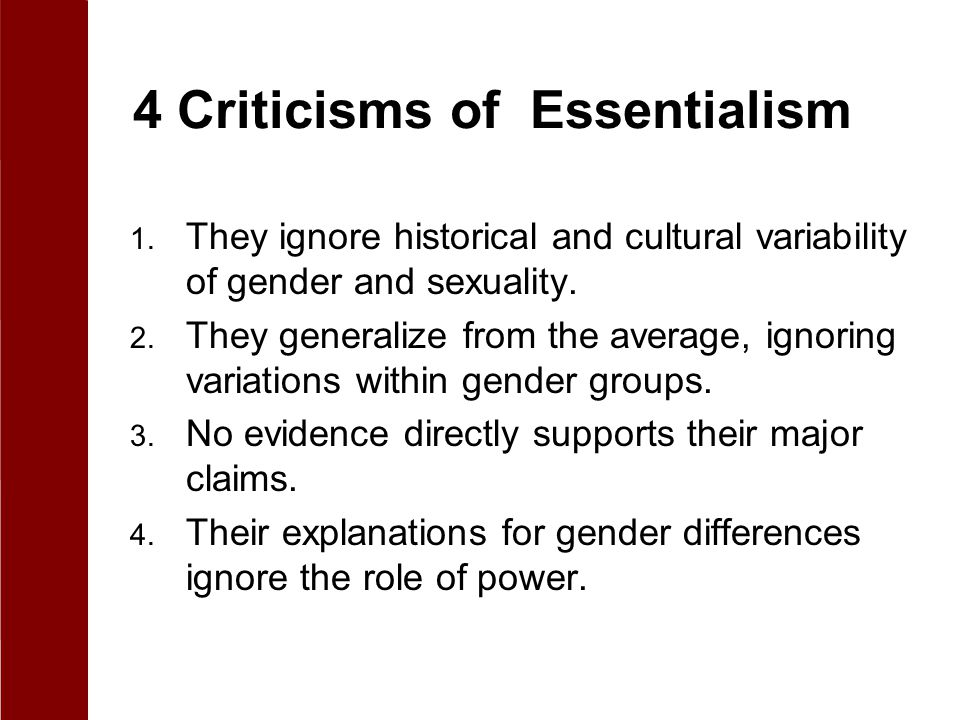
essentalism Power Point slide is from here

I want to explicitly state a Trigger Warning, in particular for survivors of patriarchal sexual atrocities. There is not anything very graphic below, but particular manifestations of rape culture are discussed by me as an important factor in understanding male socialisation and privilege.

I have had the feeling, for years, that important stuff ain't getting named, when I read some arguments white anti-RF pro-trans people make to discredit and distance themselves from those seemingly essentialist white Radical Feminists. What isn't getting named, are the experiences of most people in the world. What isn't getting named are hidden forms of 'essentialism'. I'm not yet hearing anti-essentialist pro-trans activists call this stuff out in trans-friendly spaces, possibly because that would mean decentering whiteness as a norm.

While I made a very small change to some of the content, the whole of what follows has been copied and pasted from the comments section of an A.R.P. post from late 2011: https://radicalprofeminist.blogspot.com/2011/11/andrea-dworkin-on-transsexuality-and-on.html

The comments, however, are brand new as of February 2016.


Blogger enhanta bodlar said...
Julian: it seems like you believe that trans women specifically are subject to male socialization and thus, male privilege--and in the case that they are also white, another level of advantage. However, despite being exposed to a form of male socialization, transgender women do not receive the same social instruction that shapes cisgender males, as they still internalize the example of female behavior that influences female socialization. Trans women's socialization really is distinct to trans women, and in reality they do not really benefit socially from any element of male socialization they may retain.

Blogger Julian Real said...
Hi enhanta,

TW for discussion that includes violating practices in rape culture.

My response is in a few parts.

Thank you so much for your comment. I'll do my best to clarify my position. Most trans women I have known grew up with some levels of male socialisation, male privilege, male entitlements, and so forth. Some with a great deal of it. Here's one example. A white, class-privileged trans woman was raised to be a boy and a man. She excelled in Anglo-white-masculine pursuits, including using firearms, negotiating a world from the vantage point of having wealth, and having a military career. She transitioned in her forties. She got involved with a nontrans lesbian and became controlling and abusive, in ways typical of people socialised to value power and domination as white men practice it. She was possessive. She leaned on her partner for economic survival. (Her family disowned her and she had no poverty survival skills.) This rendered her especially dependent on her partner, who grew up in poverty. She was sexually coercive and insensitive to her partner's reality as an incest survivor. (Of course some nontrans lesbian women can be batterers and committers of sexual assault: the point is that it is still learned from patriarchal socialisation.)

And, of course, regardless of being trans or not, whatever sex or gender we were or are, we are all raised, systematically, to value maleness, manhood, and masculinity. Some of that maleness and manhood is more despised, due to being raced Black or Brown, being effeminate, and so forth. And some forms of femininity and womanhood are less despised in colonial patriarchies, such as lighter-skinned people of color relative to darker-skinned people of color.

So I would say *we all do*, to varying extents: we are, collectively, subjected to colonial and patriarchal male socialisation, regardless of gender. And, in this view, there's no way a U.S.-raised trans woman would be exempt from such male socialisation, even if one never identified as a male, or boy, or man. If the issue is whether and how we benefit from it, I'd argue that, too, is very complicated, due to age, region, ethnicity, race, sexuality, generation, class, weight, height, build, tone of skin, abilities, and religion, among other variables.

Blogger Julian Real said...
When you state this, "transgender women do not receive the same social instruction that shapes cisgender males", do you mean pre-transition or post-transition? And, are you assuming all transgender women are transsexual, or have transitioned in medical or other ways? The current measure of being trans in trans spaces I'm familiar with is how one identifies, not what one has done in an effort to mitigate dysphoria, to whatever (again very varied) extents that has existed in one's life. Many trans, non-gender conforming, and genderqueer people do not identify as male or female, as masculine or feminine, and so have a different relationship to binary socialisation than do those who find meaning in expressing what they understand to be 'one end' of the binary. I find that younger people in queer communities are less 'observant' of the gender binary.

I reject the cis and trans linguistic binary because many, if not most, trans people also carry various forms of what is termed 'cis' privilege--particularly if one did not suffer greatly from dysphoria and if one is not transsexual. "Trans womanness" is not one thing, does not necessitate having dysphoria, does not mean one didn't feel like the gender of the child they were assigned at birth. For some, dysphoria comes later, for some 'dysphoria' isn't the compelling experience leading one to ID as trans.

Also, many people are 'trans' to gender dominants: whites view Black nontrans women's cisgender as unstable, for example. Many nontrans people who cannot but help present as gender ambiguous, or as effeminate males, or as butch lesbians, are not viewed as 'cis' by nontrans people. We all have our own relationships to the values and victimisations of male socialisation.

You write, "they still internalize the example of female behavior that influences female socialization".

On what are you basing that? Again, who is the 'they'? Black women internalising misogynoir? Many nontrans gayboys positively internalise the example of female behavior that influences their own socialisation--this is true of some non-gay boys too. The very elements that are highlighted as 'female behavior' may be embraced by a group of Brown gay men while rejected by white lesbians.

Blogger Julian Real said...
***TW for discussion of the violations of rape culture***:

You continue, "Trans women's socialization really is distinct to trans women, and in reality they do not really benefit socially from any element of male socialization they may retain."

What is this alleged universal (or 'essential') distinction? I'd appreciate it if you could articulate that.

Do class-privileged white trans women not benefit from any element of rich white male socialisation, if that socialisation acculturates someone to be a more successful navigator of white male supremacist society, such as the corporate business world? What are the lessons learned when one's experience in childhood, when socially regarded as an adolescent boy by other boys, was to not be targeted for sexual 'interest' and assault by those boys? Being bullied and being forcibly fingered are two distinct experiences, are they not? How does not being part of the group targeted for sexually violent groping and physical invasion benefit one? Perhaps the answer is: One isn't sexually assaulted by those boys at age 11 through 13. That's quite a specific benefit of male socialisation, is it not? What about a father by-passing 'the boys' bedroom to rape his daughters down the hall? Are you saying there's no benefit to that socialisation, for the trans child who the father regards as a boy (even if this child feared being discovered as a nonbinary child)? This trans child likely does not live with the internalised disgust and shame of their body that their sisters may carry, nor the fear of men entering their sleeping space. That child's shame may be quite different, but we ought not conclude there were no benefits to not being raped from ages three to ten.

To make the arguments you present, we have to essentialise transness, do we not? And cisness as well? And to standardise male and female socialisation out of the real world, such that race and other factors don't 'factor in'?

I look forward to your responses and to continuing the conversation.


Sunday, June 24, 2012

Pornography is the Depiction and Documentation of Sexual and Racial Oppression

image is from here
Below is a revised and expanded version of a comment I posted to a Kyler J.'s blog, A Radical Black Feminist Teenager. To read her post, titled "Erotica is not feminist and other things like Porn, BDSM, and Prostitution", please click *here*.

This is my response, adding to the discussion:
As a white gay intergender [anti-gender] male who has witnessed the effects of pornography on gay males over the last thirty years, I'll add a few thoughts about how corporate pimps exploit the LGBTIQA community.

I completely agree with you that "lesbian porn" is consumed by het men for het men's pleasure. There's nothing progressive about it in terms of its overall social effect, even if the intention by a very few lesbian producers is progressive. (Needless to say, most "lesbian porn" is not produced by lesbians.) Many times het men have asked me, "What about the porn that lesbians make for themselves?" Aside from noting that the question is blatantly (if not always consciously) self-serving, my response is this: Any such porn is such a tiny percentage of the whole of the horrific pornography-prostitution-trafficking industry; to pretend it actually effects any sort of progressive to radical change in the overall aesthetics or agendas of controlling forces (that, in the Western world, is predominantly rich white het men) is to engage in wishful thinking not backed up by "hard-core" reality. And whatever lesbians make, for whatever purposes, will, if it is public (such as being on the internet or for sale), be appropriated by het men. Once consumed by het men, it is then in service to their patriarchal, misogynistic sexual appetites, which, far too often, are acted out against pimped girls and women, usually poor and of color, with no lesbian empowerment in sight. And, as you well note, most of it is not distinguishable from dominant non-lesbian pornography in overall style and content.

The pornography that is marketed to gay males is also produced and owned by white het males and functions to reinforce white supremacy, het supremacy, male supremacy, corporate capitalism, and Western anti-Indigenous imperialism. Gay males have been willing to consume this material for complex reasons, but the effect on our community has been to teach us how to "do sex" the way patriarchal het men "do sex", except to one another not to women and girls. But the aesthetics of het pornography show up in white gay men's actions. A disheartening example of this in the "legitimate" film industry is the new film "Rock of Ages", which Adam Shankman had a strong hand in shaping as the director: the "look" (which means the racist misogynist behavior and the values) of white het men's pornography is infused into it. (You can get a sense of that from the movie's trailer: http://www.youtube.com/watch?v=USxhXb5VC5E)

The effect of gay male consumption of het male-made pornography has been to promote and promulgate white power, masculinist power, and anti-queer heterosexism among gay males of all colors and ages and to forge an alliance between gay and het men against feminist lesbians who have been taking on the rulers of pornography and prostitution, showing them up for what they are: corporate pimps, serial rapists, traffickers, and slave traders of girls and women of all colors.

The pornography of allegedly "transgender" people has been historically racist, anti-transgender, anti-gay, anti-lesbian, and anti-woman. It, too, serves the same dominant forces mentioned above. And it also promotes some very dangerous ideas about what being transgender is: male-bodied people with silicone breast implants and bleached, straightened hair, for example. Similarly to females in the sexxx-ploitation industries, gay and non-gay males, and intersex and transsexual people are economically coerced to alter our bodies to appear the way white het male consumers, procurers, and pimps insist we appear--and do what they profit from us doing. Similarly to "lesbian porn", very destructive portrayals of transsexual people of all colors are marketed by the pornography industry's owners as a niche fetish for non-transgender male consumers.

Liberals habitually promote "gender" as a social difference in need of greater diversification, while the radicals I know believe that it is the power of capitalism and heteropatriarchal white supremacist gender hierarchies that must be abolished. Gender has been diverse outside of white imperialist societies; this is both destroyed and forgotten by ruling classes of people. To argue for diversification of gender while keeping ruling structures in place is to participate in anti-Indigenous genocidal behavior.

Pornography, as an industry, is virulently anti-queer, anti-woman, anti-female, anti-transgender, anti-Black, anti-Brown, anti-Asian, and anti-Indigenous. The fact that many gay males and other queer people have supported it financially and otherwise only speaks to the effectiveness of the ruling class in trying to convince all oppressed people believe that we need to buy what the ruling class sells as if our sexual and social lives depended on it.

Tuesday, January 17, 2012

On being intergender and anti-gender: a profeminist statement

image is from here

A while ago, sometime last year or the year before, I 'came out' as intergender. I understood this name to apply to a set of experiences I'd had since childhood in which I didn't socially or spiritually fit into one or the other of two dominant/enforced gender categories. What's important for me to remember is that gender categories themselves are part of a vicious set of interlocking systems of oppression by race, region, and sex.

In English and in the US, "woman" is a term that linguistically and structurally place women beneath men as both less advantaged and as socially inferior. "Man" is a term used to mean "humanity" which, if you follow the male supremacist logic, means women aren't human--at least not as fully human as men. Were this a linguistic matter alone, I might decide not to pay it much attention. But given that women worldwide, relative to men in their own communities, cultures, and civilisations are often enough economically and sexually subordinated to men, we must note how language and treatment fuse in the human experience.

A white Lesbian once challenged me on my use of the term "intergender" to describe myself. I have never forgotten her challenges. What I realise now is that it is in vogue--and has been for decades--to privilege the naming of ourselves in anti-radical, anti-feminist ways over being responsible to radical activists, including feminists seeking to abolish sex as an oppressive system and gender as a hierarchical and terroristic force.

Nowhere in contemporary white Academic queer-positive theory do I see any commitment to radical social change wherein systems of race and sex are understood as both inhumane and unjust. Instead I see lots of acquiescing around sex and race as naturalised and normalised phenomena. Perhaps now more than ever, we have terms proliferating through our communities that uphold rather than challenge race and sex as markers of who gets treated like shit and who gets treated as if they were fully human.

In our raced and sexed system, only white men are fully advantaged, which isn't to say white men have it all good. And on the class level, whites and all men fare better than women of color.

In white- and male-dominated queer theory, transgender identity has become one way for liberals to test each other's "tolerance" of  "difference", sometimes quoting Audre Lorde when challenging cis people to respect trans existence. But to take tolerance of difference as the end all and be all of political work is, imo, to misunderstand or ignore what Audre Lorde, a radical feminist and a lesbian, was speaking out about. As I see it, her call for oppressed people--namely and specifically, women across sexuality, age, and race--to find mutual regard and respect across such differences, was not to claim that accomplishing this was the sole goal. It was, rather, a means to a far more difficult end: the eradication of gendered and raced oppression entirely. To fight oppression based on sexuality, sex, age, and race is unlikely to be successful if in-fighting and horizontal hostility (to use Flo Kennedy's term) isn't also challenged as employing the master's tools.

I don't see hostility directed against trans people as appropriate, personally and politically. And everything I write, I write from the structural location of someone with lots of social advantage, as a male and as a white person. As a radical, I see the liberal acceptance of terms put forth by conservative and liberal people as inappropriate or pro-status quo.

I want to clarify that me naming myself "intergender" is a subjective experienced molded by social mistreatment in childhood (and beyond), including bullying and harassment by males naming me things that meant "girl" as if being a girl was something all males should avoid. Many males in my childhood seemed preoccupied with avoiding being seen as "like a girl". This preoccupation was never my own in part because I respected girls at least as much as boys, and often more so than boys. But also because I didn't feel like a boy and so wasn't so keen on trying to be something I wasn't.

My political work in adulthood has been to not behave like a man in the male supremacist sense while acknowledging that being a man isn't something I control in the structural or macro-social sense. And to the extent that women experience me politically and personally as a man, I am one, regardless of whether or not such a name feels accurate to me. To try and silence women by saying that they are trans- or inter-phobic for stating their truth is, to me, yet another act of male supremacist bullying on my part.

One of many things that troubles me in the current male- and white-dominated queer discourse on being transgender is the ways in which it is either naturalised--an oppressively conservative intellectual tactic--or made to seem as if it ought to trump all other social and structural realities, such as whether or not someone born and named as "male" acquires and benefits from the various advantages handed to males in male supremacist societies.

There is an argument put forth by some conservative-to-liberal politically active M2F people and some allies of such politically active M2F people. (Such activists are a very tiny minority of trans people who ought not be seen to be representative of most trans people; most trans people do not medically or socially transition and don't identify as M2F.) The argument is this: as soon as someone comes into a M2F transgender (in this case, transsexual) identity or transitions medically or socially to be more like a woman--as some trans and non-trans people narrowly and often oppressively define the term and experience, that necessarily means they don't have any of the advantages that being male has given them.

As someone who accepts and regrets how powerfully oppressive racist and hetero/sexist socialisation acts on us, especially but not only in the first few years of life, I find it untenable that all the ways we males learn to disrespect all who are female, and position ourselves as superior to girls and women,  would vanish when we alter our social and personal understandings of ourselves. Similarly but not in perfect analogy, I find it untenable that if someone white came to realise that they were of mixed ethnic heritage in their mid-twenties, for example, with some of their heritage being European and some of it being African and Indigenous, this would result in all their racist views, values, and political practices simply and suddenly disappearing. I mean really: how could that happen?

Even if our structural location shifts somewhat with this new information and identity, old patterns and habituated practices are well-established aren't they? (I'm not saying gendered and raced ways of being are "fixed" in any absolute sense. I'm saying we learn to be racist and sexist, and as anyone can tell you, such socialisation is difficult to uproot. This is why males who identify as profeminist and whites who call ourselves anti-racist ought not be assumed to be non-sexist and non-racist. But beyond that, our structural, institutionally protected locations as males and whites are not as fluid as our intellectual and emotional locations.

If someone is raised white, does a childhood of believing one is superior to people of color evaporate with the news later in life that one's grandparents and great grandparents weren't all of European and white descent? What are the political means or social mechanisms through which this psychic and structural transformation occurs?

If our political lives worked this way, we need only work together to transition every white person to being, in appearance and identify, a person of color. And voila, white supremacy and its future genocidal ravages would disappear. We need only convince all men that they are really women to end male supremacy's death-grip on humanity. As someone who has been a peripheral part of white-dominated and white supremacist gay male society for decades, I've seen how white gay men accept the idea that we are girls-not-men, and also how we resist, in pro-patriarchal ways, heterosexist and homophobic males who insist we are girls-not-men. In no instance does this social viewpoint result in gay men not being misogynistic. In fact, many of the ways gay males embrace "femininity" and "effeminacy" are grimly and glaringly woman-hating. This hasn't gone unnoticed and unchallenged by many feminist lesbians and a few profeminist gay men.

A claim I hear from some white trans- and queer-identified people is that they/we are unfairly targeted for political interrogation and critique. I'd argue that gay males and lesbians, as well as heterosexual women, have been targeted for such critique for as long as we've existed in heteropatriarchal times and environments. And to confuse the radical critique of lesbian feminists with the critique of patriarchal het men is to turn structural political reality on its head.

I take the white Lesbian's challenges to heart and mind. And I conclude that my political position with regard to gender is to be anti-gender, not pro-gender, not pro-gender binary, not pro-gender hierarchy. Especially, my political position as a white Westerner isn't one of pretending the gender binary or dual sex system I grew up inside, isn't a hierarchy. Sex and gender are hierarchies that exists fundamentally and foremost to allow and encourage non-transitioning men and males to oppress women, girls, and females as patriarchal men define and enforce the terms.


P.S. After publishing this post, I was sent *this* found at Feminist Reprise, by a friend and colleague. It is written by someone who is not anti-trans but will likely be termed "transphobic" for critiquing some of the behavior of a few white M2F trans activists. Here is an excerpt from the whole piece, titled "Radical Feminism and the Transgendered, or, how to write a post that will infuriate everyone", by Jane Doe, 05/15/2006:
Many MTFs I know minimize the effect male privilege has on their behavior. I suppose it is like the proverbial fish who asks "what is water?" - being the beneficiary of male privilege during one's formative years, even if one begins to question one's identity as a man, confers benefits upon one that are invisible to the recipient (although obvious to women, who do not receive these benefits). Since MTFs do not want to be male, they would like to imagine they can just toss male privilege away along with their unwanted boys' clothing. The human mind does not work in this way, however. It is ironic that those resorting to violent, invasive tactics in order to enter the Michigan Women's Music Festival, for example, with the excuse that they are NOT men and should be accepted as women, are resorting to an ingrained male privilege which tells them they have a right to go anywhere they want to go.
I see it is a critical matter of radical sexual politics, not liberal or conservative gender theory, when female's and women's spaces are contested as appropriately exclusive or sovereign by people with male privilege and male supremacist power. It is also a matter of radical sexual politics when a vocal group of people--a tiny minority of class-privileged whites pretending to represent the whole of the population--declares its members immune and exempt from radical and feminist critique of the ways white and male supremacy is enacted socially. Surely white and male supremacy is being enforced when such a declaration of immunity takes place.


Saturday, November 5, 2011

Andrea Dworkin on Transsexuality, and my own thoughts on Trans and "Rad Fem" Politics

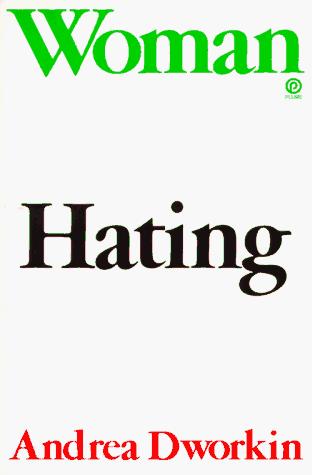
image of book cover is from here
There is an update following the main post, which is below.

Earlier this year I wrote a great deal here about concerns regarding liberal queer politics, including liberal trans politics. Please see those posts for more detailed discussion on those topics, if you wish to. In this post I'll take on some current mischaracterisations and oversimplifications of radical feminism. (I've also posted a fair amount here over the years about misogynist men's nonsense about radical feminists. This post won't concern itself with those virulent anti-feminists.)

Any time anyone speaks of what "those radical feminists" or "those radical lesbian feminists" are doing, or believe, or feel, I'm skeptical to disappointed. For one thing, when "they" are accurately referenced, the criticism of radical feminism tends to reference only a very few region-, race-, and academically-privileged white women.

Two women who get touted as exemplars of radical feminism are Mary Daly and Janice Raymond. So let me begin by saying that while Mary Daly and Janice Raymond are two voices in the herstory of US radical feminism of the last forty years, they aren't "US radical lesbian feminism" to me. Alice Walker and Audre Lorde are two key voices in US radical lesbian feminism. Their work has had a much greater impact on me. Why are they rarely-to-NEVER referred to when anti-radical feminist spokespeople are expressing their own critiques?

One answer is racism: the obnoxious and erroneous contention that all radical feminists are white women is but a wee part of the on-going effort within and beyond the cultivators and purveyors of anti-feminism to erase women of color from the "canon" of radical feminist writers and activists. Another answer is that Lorde and Walker's written views and values don't necessarily match up with those of Daly and Raymond. And this inconvenience for those who wish to lump all radical feminists together as being all "transphobic" or "anti-male" or "anti-sex", isn't so easy if one contends with the depth and breadth of US radical feminist writings.

Personally, I never read Janice Raymond during the long years of my own initial education in radical feminism. I've read very little by Mary Daly. Neither woman represents "radical feminism" to me, while I fully acknowledge the significant--and amazing--contribution to radical lesbian feminist thealogy by Mary Daly. As noted above, Lorde and Walker, and also Andrea Dworkin, have been far more influential in teaching me what radical feminism can do in responsible theory and activist practice.

I found what follows typed up online, on a Tumblr account called Head Girl (*here*), and so cannot vouch for the accuracy of the text, but it sounds like what I remember reading in Woman Hating (1974). I'm checking online for the text and from what I can find there are several inaccuracies in what was at the Tumblr page and so I've made some corrections in what appears below.
Transsexuality

How can I really care if we win “the Revolution”? Either way, any way, there will be no place for me.
A transsexual friend, in conversation
Transsexuality is currently considered a gender disorder, that is, a person learns a gender role which contradicts his/her visible sex. It is a “disease” with a cure: a sex-change operation will change the person’s visible sex and make it consonant with the person’s felt identity.
Since we know very little about sex identity, and since psychiatrists are committed to the propagation of the cultural structure as it is, it would be premature and not very intelligent to accept the psychiatric judgment that transsexuality is caused by a faulty socialization. More probably, transsexuality is caused by faulty society. Transsexuality can be defined as one particular formation of our general multisexuality which is unable to achieve its natural development because of extremely adverse social conditions.
There is no doubt that in the culture of male-female discreteness, transsexuality is a disaster for the individual transsexual. Every transsexual, white, black, man, woman, rich, poor, is in a state of primary emergency (see p. 185) as a transsexual. There are 3 crucial points here. One, every transsexual has the right to survival on his/her own terms. That means every transsexual is entitled to a sex-change operation, and it should be provided by the community as one of its functions. This is an emergency measure for an emergency condition.
Two, by changing our premises about men and women, role-playing and polarity, the social situation of transsexuals will be transformed, and transsexuals will be integrated into community, no longer persecuted and despised.
Three, community built on androgynous identity will mean the end of transsexuality as we know it. Either the transsexual will be able to expand his/her sexuality into a fluid androgyny, or, as roles disappear, the phenomenon of transsexuality will disappear and that energy will be transformed into new modes of sexual identity and behavior.
Andrea Dworkin, in Woman Hating, 1974

At another blog called Transmeditations, with posts written by Joelle Ruby Ryan, there was a post documenting tensions between a few non-trans radical feminist-identified people and one trans-identified person (who I believe also identifies as a radical feminist). The account of what happened is one person's experience of it; I've heard differing accounts by people who were also there about inaccuracies in Joelle's description. But of course that is likely to be the case with any upsetting or triggering experience.

I've commented there, most recently to another commenter. I just saw that my comment was not posted (so far) and I'd like it to be on record here. First, the link to the post and comments is *here*.

Amber is the name of the recent commenter. Here's that comment edited slightly (please see the full comment in context at the site linked to above), and after that is my response to her:

[...] The vicious hate related here truly upset me. Dont these so-called “rad-fems” understand that the people they hate so badly are real people with real things and that they detest am entire group of people, with no reason, who mean them no harm and who are often a great danger but only to themselves.
amber said this on October 26, 2011 at 11:26 pm | Reply
  • Hi amber,
    I know of countless examples of trans-identified people demonstrating willful, purposefully aimed misogyny and anti-feminism at lesbians. From arrogantly insisting on invading lesbian spaces, to disrespecting lesbians interpersonally, I’ve seen it happen and I have read so many accounts of it happening that I really have to challenge, as woefully inaccurate, the statement you make above. Misogyny and anti-lesbianism is flourishing right now in many queer spaces. Gay and bi men have been perpetrating it for decades and more recently far too many trans people do too. Do you doubt that?
    JulianReal said this on Your comment is awaiting moderation. November 3, 2011 at 8:39 pm |Reply

I probably ought to note that people who identify as "rad fem" are not necessarily representatives of radical feminist thought or exemplars of radical feminist practice. I'll tell you a story that illustrates the necessity of me making that point. A pro-radical, pro-feminist male I know told me a year or more ago that he was considering giving up on radical feminism as a valid political theory and practice. I asked him why. He told me that he found some of the beliefs there absurd, such as the anti-sex viewpoints. I told him that radical feminism, in my experience, isn't anti-sex at all. He referenced an online discussion among a few privileged white women that did seem to be anti-sex. I suggested that he not assign to those few women what is most notable and necessary from the vast writings and activism by radical feminist women. It hadn't really occurred to him to doubt the validity of what some "Rad Fem"- identified women said as allegedly accurate about "radical feminist" on the whole. So if Amber is also referring to a few privileged white women online who express themselves as if speaking for all of radical feminism, that might be important to know.

Given the significant contributions to radical feminist theory and practice made by heterosexual and other non-lesbian women, radical lesbian feminism and radical lesbian politics are not the sum total of radical feminism. In fact, I know of at least one Radical Lesbian who doesn't ascribe to what many "traditional" radical feminists believe about gender and sexual oppression. And I know of another woman who has identified more as a revolutionary lesbian feminist than as a radical lesbian feminist for most of her long activist life. Her own views are different than either the Radical Lesbian woman I am referring to or the views of many other radical feminists.

All of this should help build a case for the danger or saying that a single person or group's viewpoints are representative of what all radical feminists believe and do. I find the whole herstory of radical feminist accomplishments--named as such in writing and in life, to be complex, compelling, and anything but monolithic, which isn't to say the term "radical feminism" refers to anything at all.

But the assumption that some online and offline white, class-privileged trans activists or spokespeople--who often enough seem to speak for all trans people--do no harm and mean no harm is nonsense. There are too many examples of gross insensitivity and blatant hateful behavior towards radical lesbian feminist people to pretend that all actions by trans people are benign and free of misogyny and anti-feminism. (How could it be, really, that trans people, as one of many diverse populations of people--many of whom don't identify as "trans"--are free of misogyny and anti-feminism? I know of no group of people who have managed to accomplish that, including the group "radical feminists".)

I don't know what Andrea Dworkin would say about the various contests for safe space and the power to name reality that are currently occurring between those two groups in some places on- and off-line. I also wouldn't presume to know. What I've found in Andrea's writing is a commitment to name male supremacy wherever and whenever it exists, displays itself, and asserts dominance in social and personal spaces. I've seen some trans and many more non-trans people be (or, rather: act) male supremacist in many different ways, almost never owning the male supremacy embedded in the behaviors.

I think there is plenty to critique in contemporary liberal, white, class-privileged trans and non-trans understandings of gender and social justice. I make it a point to have this blog be a space that values such critique. And people telling me I'm "transphobic" or "anti-male" for doing so won't silence me. I find those sorts of accusations typical derailing strategies almost always by people with significant social privilege and power. And I see such strategies being designed and implemented to stop the radical inquiries and interrogations, not deepen and expand them.

Andrea Dworkin's own views developed and deepened. She has critiqued some of what she wrote in Woman Hating and that self-critique may be found in a 1998 book by Cindy Jenefsky titled Without Apology: Andrea Dworkin's Art and Politics. Part of Dworkin's own critique has to do with lack of interrogation of the Freudian influence she accepted in her own understandings of sexuality in her first feminist book. I have never read anything else she wrote since that demonstrates a lessening of regard and respect for transsexual people, however. (Please see the update in purple for more.)

9 Nov. 2011 UPDATE: 
I just found this post, which is a cross-post from other Tumblr accounts but is added to at The Trans Woman's Anti-Violence Project
http://transfeminism.tumblr.com/post/12371381560/andrea-dworkin-wasnt-a-friend-to-trans-people

As an anti-misogyny/anti-patriarchal violence activist, I don't agree with the writer's assessment or conclusions. I think regarding Andrea's views as identical to Jan Raymond's is a spurious thing to do: Andrea had her own voice. What she wrote in her own voice is what should be used to either agree with or disagree with her, not the writings of other women. The guilt by association tactic for condemning a writer-activist is not a respectable or responsible thing to do, imo.

The fact that Andrea didn't speak directly to this issue after writing Woman Hating means something. What it means is up for interpretation, of course. But what I know about Andrea is that she was a deeply compassionate person towards anyone who enduring the violence and violations of male supremacist harm and horror. I do not know Jan Raymond at all. But I did know Andrea and I regard Dworkin's work as a tremendously important resource, theoretical base, and activist approach to all anti-misogyny work. That someone is framing her work as being pro-misogyny (supportive of misogyny directed at some trans people) is rather absurd to me.  On that Tumblr page, there is a statement about Dworkin's promotion of "androgyny" as being terrifying. I'm troubled that an idea in a book that has no institutional or social support in the actual world, is regarded as more of a threat than the rampant, unowned, unacknowledged white and male supremacy inside and outside white-dominated queer communities. Here is that passage:
Also, I think Dworkin’s militant advocacy for replacing the sex binary with a monolithic compulsive androgyny is terrifying. Androgyny as the socially enforced norm would lead to something like the gender repression featured in “The Outcast” episode of Star Trek: The Next Generation, or Tobi Hill-Meyer’s The Genderfellator.
privilegedandgoodlooking:

“Andrea Dworkin (yes, THAT Andrea Dworkin) on Trans people: …
WOMAN HATING- by  Andrea Dworkin 1974
BRB, Continuing to be amazed that Dworkin is like, right next to Raymond and Delay as the patron saints of 2nd wave hardline anti-trans stances.
(via unobject)

As discussed a bit below in the initial post I wrote recently, Dworkin repudiated what was in parts of Woman Hating and what she believed in 1973 and 1974 ought not be held against her, given the amount of more thorough work she did on male supremacy in the twenty years that followed.

I find it troubling that people working to stop misogyny don't attach that work to addressing and challenging male privilege and male supremacy in our lives--including in the lives of people who are queer and trans. I experience that as far more terrifying than Dworkin's later-rejected theory of androgyny from a book published over 35 years ago.

Saturday, September 10, 2011

Liberalism vs. Radicalism: The Invisibilisation of Male Supremacist Power in Liberal Politics, Terminology, and Self-Concepts


image is from here

In this post I will identify distinguishing features of liberal vs. radical points of view on various social justice topics.

First up: “Prostitution”, “Sex Work”, and related terms, experiences, and systems

When I hear liberals discuss prostitution, what I hear most loudly and frequently is a call to advocate for acceptance of prostitutes' rights to sell their bodies for sex to men—or to anyone else. The focus is on the individual in society, not on society's impositions against the individual and the collective. The assumption is that systems of harm and exploitation are a given and that while they are in place, we ought to accept as liberating or a form of freedom the ability of some to sell their bodies for sex to consumers of such “sex”. “Sex” itself isn't especially analysed. Whether men ought to have the right to buy human beings for anything at all—including for sex—is not usually challenged as a “right” that's wrong.

Often enough the gender of the procurers and pimps is erased, rendering prostitution something “some people” do with “other people”. Also not questioned is why it is that “some people” are pimps and procurers, and others are prostitutes and sex workers. I see where the two experiences overlap but not much challenge to why they exist and whose interests and whose power these practices exist to support.

As a radical, my views don't focus on what prostitutes ought to have the freedom to do—other than the freedom to be free from men who sexually abuse other human beings, especially girls and women. I instead focus my attention, analysis, and activism (when opportunities arise for activism to occur) on what anyone ought to have the freedom to not experience: sexual and economic exploitation; sexual abuse including incest, molestation, and rape; harmful impositions of male, white, and Western supremacist values and practices; and the grossest (most invasive and damaging) dimensions of capitalism on classes of human beings.

Starting with the latter, poverty, desperation, and homelessness—each impacted quite significantly by heterosexism, misogyny, and Western white supremacy—are requisite condition for most people engaging in prostitution globally. When I think about and have experienced aspects of the world of sexual exploitation organised into a system of atrocity, I consider whether whole groups of people are more negatively impacted than others, and which groups lead the charge for adoption of methods of making prostitution safer rather than abolishing it as a form of abduction and slavery. If I only listen to the more privileged people (whether class privileged, Western, white, or men) in the system of harm, I might conclude that modifying the system would be a humane course of action. But if I consider how such modifications impact on the less privileged classes and groups of people (such as poor Black, Brown, Asian, and Indigenous girls and women globally, living inside and outside North America and Europe), such reforms look like cruel dismissals of their experience and suffering.

In any radical form of activism, I believe those who are systematically made to suffer most, to be raped most, to die most, ought to be central in any course of activist action. Given all this, liberal views on prostitution don't hold much water for me, although I don't oppose actions designed to make conditions for anyone, inside or outside systems of sexual exploitation, safer rather than less safe.

A radical feminist position on prostitution interrogates most every aspect of what it means to live in a world where prostitution exists. The most glaring omission in the whiter side of the interrogation has to do with prostitution's relationship to white and Western supremacy, in my experience. But white radical feminists, specifically, bring to the challenge questions about what it means to be human, who decides what “sex” is, and which groups or classes of people are in charge of any system of exploitation that, in my experience, liberals usually ignore and see as irrelevant.

The term “sex work” makes the whole of the system of atrocity and slavery non-existent or distinct as a social-political phenomenon, as if “sex work” can exist independently of sexual slavery. (In the world I see and live in, it cannot and does not.)

Next up: transgender and queer terminology

I find it necessary to discuss this issue here because of my own struggles to understand my own “gendered” experience. Conservative and liberal definitions and concepts flood my social world and shape the names I give myself. With thanks to a radical Lesbian activist, I have been questioning and challenging my own use of the term “intergender” to describe my experiences and feelings. I think the most appropriate challenge to me has been to consider how such a term, or the term, “transgender” impacts those who are most egregiously marginalised and abused by gendered systems of violence. Now, the list of who is harmed by gendered systems of violence is long and may well include just about everyone. But as I see it, there are some groups of people who fare particularly poorly given the status quo, at least the status quo of the West and those groups are, 1. Girls and women, and 2. Lesbians and gay males. Obviously the two groups overlap in the experiences of Lesbian girls and women.

What I've seen happen over the last twenty to thirty years is a systematic marginalisation and stigmatisation in liberal circles of radical Lesbian and radical Gay politics, perspectives, and practices; simultaneously there has been a flourishing of liberal queer and trans politics, perspectives, and practices. Similar to liberal understandings of what prostitution is and exists to do, liberal queer understandings of gender generally ignore or avoid dealing with how and to what degree male and white supremacy are fused to our own personal feelings and understandings of ourselves, including the concepts we use to name what we feel and believe about ourselves. Terms are common now in queer circles that do not make male supremacy, for example, at all visible as an ideology woven into concepts and practices that we may embrace as “liberating”. Just as the term and concept of “sex work” avoids naming the white supremacy, misogyny, and capitalist abuses present in any systematised form of sexual-economic exploitation, terms like “intergender” and “transgender” do the same, quite liberally.

Our feelings and experiences are shaped by the concepts and terms available to us socially. In any given era, only some terms and concepts become socially used, while many others, used before and since, get snuffed out. Such is the case generally with terms used to discuss sex, sexuality, sexual orientation, and gender. None of what is discussed in dominant media places male supremacy or patriarchy near or at the center of discussions about who we are and why we believe what we believe.

What being "Gay" means, as well as what "Lesbian" means, have been scrutinised and critiqued through radical lenses for forty-plus years. To all those who say that trans people are being expected to question things no one else in the LGBTIQA community is made to question, I'll remind you that we ALL have been made to question EVERYTHING, down to our assumptions about the biological (vs. cultural-political) nature of our desires, feelings, and identities. See, for example, Adrienne Rich's writing on Compulsory Heterosexuality and Lesbian Existence.

I'll tangentially mention here that I've seen how this has happened in the movements to end intimate, private, relational sexual violence against women. What used to be a movement to end men's battery of women has been re-termed a “domestic violence project”, thereby invisibilising the brutal male supremacy at work in any gendered dynamics, but especially in heterosexist and misogynist ones.

What do concepts and understandings such as “intergender” and “transgender” tell us about ourselves, our world, and what gender is and does? To me, it makes gender into an entirely social, personal, individual, and biological condition, and it becomes political only when people are organised to prevent some het men's rights from being afforded to other people. “Intergender” and “transgender” pretend that “gender” is a social continuum to be expanded, or a biological binary to be explored and respected, not a hierarchy to be overthrown. I see gender as a profoundly political system that is deeply anti-woman, anti-Lesbian, and anti-gay. How do the discourses and activist developments of the last twenty years dovetail with efforts by feminists to derail and demolish the terrifying train of male supremacy? What I see are largely liberal constructions of self and sexuality that in no way implicate male, white, or wealth supremacy as forces shaping our feelings and understandings, which is also to say our experiences of who we are.

In naming myself “intergender” I was attempting to make a statement about how my whole life's experience is one that is outside what is progressively thought of as a dualistic gender binary. It doesn't “fit” with how I saw myself relative to boys my age, across my childhood and into adolescence. Perhaps the only point of familiarity or commonality with other boys was in recognising that my sexual attraction wasn't to “an opposite sex”, physiologically speaking, although as Andrea Dworkin detailed in her book Woman Hating, such an understanding of sex and gender is already distortive and discriminating in oppressive ways. How does “intergender” and “transgender” support radical efforts to end male supremacy? Does it matter if it doesn't?

I'd say the answer to that is fused to the matter of what we understand to be going on, or going down, all around us and in us. For example, if you don't see prostitution as a system that welds capitalism to white and male supremacy, you might view abolition movements to end all forms of trafficking, buying, renting, and enslaving human beings as irrelevant to your cause and condition. But me being gay means my life is fused to the struggles of all people who want to end the tyranny of heterosexuality and masculinism—of heteropatriarchy to use the term which combines those dehumanising and terrifying realities.

It doesn't surprise me that terms like transgender and sex work will fare better than terms like male supremacy and sexual slavery in a liberal social economy which generally refuses to name the extent to which male and white supremacy and capitalism pollute and infect our lives, robbing us of the hope for a freedom that isn't built on systems that require some of us to be sacrificed.

This isn't to marginalise or silence those of us who use those terms; it is, rather, to call on all of us who want something called “freedom” and “liberation” to evaluate, in hopefully loving community, what the deep political implications are of using those terms to begin with. If liberalism is fused to their usage, how might a radical perspective and practice of naming ourselves shift our terminology towards words that don't deny the realities of male and white supremacist and capitalist terrorism.

For the time being, I will not be using the term "intergender" to describe myself. I will, instead, say that I willfully, actively, and imperfectly refuse to behave and "be" as men would have me behave and be in order to fit in with the boys-to-men of patriarchy. And that an awareness of this need to refuse, for my own survival and for the betterment of girls and women, was in me from an early age. This understanding keeps male supremacy central to my own motivations, sensibilities, and feelings without denying or marginalising any of them.

I hope this opens respectful discussion of these and related issues.

Friday, June 24, 2011

A Radical Trans Profeminist Politic--just one intergender, asexual, gay white male's views

image is from here

Hi readers,
 
I want to put forth a radical profeminist trans politic, based on my own life experiences and those of most trans folks I know, who do not fit the stereotype of who gets air time on television. For now I'll discuss some of the issues surrounding my identity. One concern is that with such a narrow view of us, those of us out there struggling to find our way will conclude they must not be [fill in the blank] because, well, we don't feel the way trans spokespeople on television describe their feelings and experiences.

Here's what complicates things--television executives and editors will not usually show anyone trans (and few who are non-trans) talking about gender in a political way if it is to critique the hierarchy; we are only allowed only to discuss gender-as-difference, not gender-as-dominance. No one who is trans is allowed to be feminist, on television. Few people who aren't trans are allowed to be "out" as feminist either. It's terribly discouraging to me because I remember when that wasn't at all the case.
 
I feel the same way about lesbians and gay men who are allowed on television, or who are portrayed on television. To this day, butch women--lesbian or not--are not allowed to have major roles on TV. To this day, few to no queer people of color are allowed on television, and if they are, they're likely encouraged to fulfill a stereotype to make the het audience at home comfortable with their own stereotypes of us. Thank gawd for Wanda Sykes, is all I can say.

I don't have pay channels, so I have no idea how diverse the presentations and representations of LGBTIA people are there. But the invisibilisation of Indigenous people who are queer is absolute. I can find no examples of queer, Two Spirit, lesbian, gay, SGL, trans, or intergender Indigenous people on television. And those spokespeople who are white don't appear to me making room at the mic for our other voices.
See this progressive media and note who speaks for us most often:
http://www.freespeech.org/video/gay-usa-june-09-2011

We must remember that one strategy of genocidal corporations and media is to render completely invisible the voices of Indigenous people, so that when the corporations destroy them, it will not be noticed by the masses of non-Indigenous people. See here for more:

Genocidal war against the Tribal people in India – Int’l program in London
समाचार - मुख्य समाचार      

The issues that press down our lives are well beyond those discussed in "gender and sexuality" classes in white-dominated, middle-class focused, academic settings. Our issues are genocide, racism, homelessness, war, famine, lack of land, lack of clean water, HIV, cholera, and other preventable disease and illness. Our issues are rape, white supremacy, corporate Empire, and the many layers of oppression affecting most women of color on Earth.

I came up at a time when radical lesbian and non-lesbian feminist writings, by women of all colors, was readily available to me. (Please, please, please don't assume "white" when I write "radical feminist" or "radical lesbian feminist"; if I mean white feminist or white lesbian feminist, I'll write that out that way.) I needed that perspective to help me understand what was going on with me. I didn't feel like a boy, but was a male child. I don't identify as a man, but am an adult male.
 
When I was young, my closest family members were girls not boys, and women not men. (There were no trans people in my family  that I know of. There also weren't any lesbian or gay people either.) No one in my family had anything resembling a non-mainstream perspective on humanity. They were either Conservative or Liberal. That was as broad as their spectrum got.
 
I was off the spectrum in so many ways that using their measuring tools, I couldn't calculate anything at all about myself. "Gay" was around as a term, but it didn't really refer to what I am. I'm a male person who is attracted to men. I'm not a man who is attracted to men. What term most describes that? Certainly not heterosexual! I also was not ever someone who objectified women's bodies or desired sexual contact with women in my dreams. I only dream about erotic contact and affection and intimacy with males--boys when I was a child, and men now that I'm in my adulthood.

I term myself intergender and to let you know how invisible THAT category of being is, it doesn't even exist in our alphabet soup of a moniker! That's partly why I add the "IA" at the end of LGBT, for those of us who are intergender, intersex, and asexual.

Speaking also about my family of origin, being asexual also doesn't fit with anyone's conception of how to be human. Even beyond my family, most people across sexual identities think that if I'm attracted to men and have some dreams of an erotic nature, that must mean I desire to have sex. I don't.

I want there to be more options out there, to validate more complex feelings and experiences of self-in-world. I want more ethnicities of trans and queer people speaking for us, leading our movements, and appearing on television as "us". It's all so white out there right now.

I want trans folks to know you might be intergender and pro/feminist, and to have a place to discuss that online. I want asexual and pro/feminist people to have places to be online. Here is one of those places, I hope.

I want people of color to be central in the discussions of our lives. Here is one of the places I hope that can happen.

Welcome.


Wednesday, June 8, 2011

Queer Studies: a non-academic discussion on gender radicalism and the politcs of interrogation

image is from here

                                               6 [x] Radical

A blogger recently wrote to me letting me know that my posts are sometimes rambling, without a central focus. I agree. It's how my mind works often enough and I don't have an editor. With on-going apologies, this is my home for my writings, and they' ll often appear here in rough form. I'd rather get my material out there to be honed another time, than not get it out there at all, which is exactly what happened for years. So, with some regret for the rambling posts that are, admittedly, hard to follow, here's the latest:

What happens when society and communities organise in the absence of radical feminist theory (and practice) on gender?

Answer: conservative and liberal agendas and perspectives flourish and any challenge to them is called hateful. 
Evidence follows...

As many radical people will tell you, our lives would have looked very different if we didn't come upon radical analysis and action designed to challenge society's ideological and institutional forces and moral and political imperatives. I had to question race and sex and gender in my life. To not do so would have been to betray every race-, sex-, and gender-oppressed person I know, including myself.

In white male supremacist societies I've been part of, there are two things that must be reinforced for the status quo to stay dominant: male supremacy and white supremacy. Without very intensive interrogation of and organised resistance to both those ideologies and forces, we are vulnerable to re-enacting them, recreating them, and reinforcing them.

The first criticism I get when I write things like that is this one: "Who are YOU to decide what RADICAL means??" Well, I'm not defining it for everyone. I'm defining it here, on my turf. You have to come here to find out my thoughts, and if you don't like 'em, you can easily steer clear of the place. Right? Yeah, you can.

I define "Radical" in many ways, not at all in keeping with how many whites and men do so. I'm not pro-Marxist, for example, and many white men define "radical" as "being a marxist". I'm not pro-Black Nationalism, because as I've understood it from Black feminist women, it's so masculist as to be anti-woman and anti-feminist too. But some Black men define "radical" as being Black Nationalist. To say I don't identify with those terms and political movements isn't to say I see no value in them. It is to say I also see where they are deeply problematic--meaning especially: heterosexist, gynocidal, or genocidal. I accept that the term "radical" isn't Absolute or ahistorical or transcultural in its meaning, but this doesn't mean it has no meaning or can be used to mean anything at all. The terms "gender radical" and "sex radical" are often used to describe actions which, to me, are anything but radical. They are usually liberal to conservative, as whites define and act out those terms.

I see most people using the term "radical" to mean "getting at the root problem". This means, often enough, not willing to settle for social change strategies that only trim branches, are only assimiliationist, and which refuse to dig out the difficult answers to difficult questions--such as "What is gender?" The radicals I know are the deepest thinkers I know, and are among the most smartest people I know--emotionally and intellectually, not "logistically" or "rationally", which some libertarians seem to think is the only kind of intelligence there is. That's masculist CRAP.

I understand "radicalism" in a context--the one I live in--which is white het male supremacist. This means I've got to interrogate what is white, het, and male supremacist in my views--constantly. Including when I try and come up with a definition of radical. I have defined it several times here, and one of those times is in this post *here*. Indigenism and feminism are the two spiritual-political philosophies that inform my work. As noted in that post, "radical" from an Indigenist point of view might look "conservative" to others. If we're seeking to conserve Indigenist ways of being and doing, we move radically outside the ways of the White Man.

What is unquestionably useful to me about radical feminism--which comes to me from women of all colors, not just white women. Too often I see whites claim the term "radical" as if it belongs only to them. That's fucking racist, to me, and I won't support a radicalism that is owned and occupied by whites who refuse to acknowledge their own white power, privilege, and entitlements.

Gender and sex are incredibly complicated social-personal phenomena. They are not set in stone; they are not uniform; they share many things across cultures but that doesn't mean we can just assume that "gender" is one thing only. Too many whites do this, in my experience. And far too many men.

Politically activist whites who won't interrogate whiteness, and politically activist men who won't address the political harm of manhood as it is constructed and enforced socially, don't get called "radical" by me. Nor do homophobes and lesbophobes. Nor do classists.

As someone who is Jewish, white, male, gay, intergender, asexual, class privileged, and disabled, I look at radicalism through all those lenses of experience.

And I don't assume that if I were Muslim, Black, transsexual, not asexual, poor, and not disabled that I'd hold exactly the same views. This means we'd better be in dialogue, attempting to and succeeding in hearing one another. I don't always do that. Lately especially. I'm often closed to hearing critique, if I'm getting a whole lot of it to the point that it all blurrs together, so individual voices of critique are not distinguishable to me. That's a private-internal experience--I don't always know when that's occurring until I'm in the thick of it. And lately I've found myself in conversations that are loaded with critique and I find myself checking out of them. I won't get into what I think is going on. I want to move on to the topic at hand: transsexuality, transgender experience, and this blogger's radical pro-feminist analysis of gender and sex.

Without that perspective, which has deepened and grown over the decades, I'd be VERY vulnerable to much more white het male conservative philosophies and political pressures to conform--which means to reinforce and enact white het male supremacy in my own life, including in my expressed ideas and feelings.

What radical feminism has done to my understandings of gender and sex cannot be underestimated. I am eternally grateful to all the women of all regions and colors who have been fighting in a very real war which men, by and large, deny exists--men's war against women. By and large, men want to pretend that, if anything, there's a war between the sexes, which neatly positions women on the same ground as men, as if men don't dominate women; as if men are not atop a social-economic-political-religious hierarchy.

Here's a theoretical hypothesis:
In the white het male supremacist West, where radical feminism is rejected, male supremacy thrives.  

Radical feminism is the antidote to male supremacy. It is the only political perspective designed to eradicate male supremacy branch and root: the only one. But that doesn't mean it is only one thing. It is an alive, diverse, and complex set of movements and practices. It shifts from culture to culture and time to time. But rooting out male supremacy is what it is designed to do. In a sense, it lives to do this.


To test this theoretcal hypothesis, I'd have to look at various communities and groups in the white West--which is where I'm located; I don't trust myself to examine societies I'm not part of without bringing into the analysis my own white, Western biases.

In this post, I'm going to very preliminarily and briefly look at three groups: white het men's activist beliefs, white gay men's activist beliefs, and white transgender and transexual activist beliefs. We ought also note how white supremacy and racism are embedded in the views and practices being examined.

1. White Het Activist Men's views and values. Most of these men belief they are fighting for justice, but myopically can only determine something to be "just" if it benefits white het men with class-privilege. The self-serving nature of this viewpoint and activism ought to be readily evident. The political programs put forth by MRAs are classist, racist, heterosexist, and misogynist. All you need to do to see this is to read the material put out by them. And visit their websites: they are loaded up with the most vile bigotry and inaccuracies about every group who isn't them; they're also not terribly insightful about their own group. WHM's activism to promote the agendas of white het men is in direct opposition to anti-racism work and pro-feminist work.

2. White gay men's activism has historically served--surprise!--white gay men, and not lesbian women of any color. White women may benefit some from the white supremacy in the political efforts, and men of color may benefit some from the male supremacy in the political efforts, but not on the deepest levels, in my view. So movements to get queers in the military and to get queer marriage in the US will necessarily mean supporting the racism and misogyny in the military and in marriage--deliberately or not. Marriage is a misogynist and racist and heterosexist institution. It is woefully naive to think that if a long-standing oppressive institution just lets in people who have been kept outside if, it will be radically transformed into one that is no longer racist, misogynistic, and heterosexist. This idea--that things change radically by allowing more people in, is liberal to the core. White gay men's political movements are racist and misogynistic. Any movement that marginalises groups of oppressed people isn't going to do much to liberate those people who are cast out or never let into leadership positions.

3. White "trans" realities--whether transsexual or transgender, have thrived at a time when radical feminism in the US was mostly dead. This means it is very likely to have a radical perspective on gender and sex. Unless it generates its own radicalism, which is entirely possible. When I see the most progressive perspectives put forth by trans activists, I don't see much that is other than conservative or liberal however. Even people who promote more progressive views, like Dean Spade, do not appear to me to hold a very radical view on gender as a structural, political reality that one is raised into despite what one feels about oneself.

This means that deep understandings of how gender works socially are not usually appreciated or respected, and the knowledge and analysis of radical feminists is either ignored or assumed to be anti-trans. It means that trans people (and conservative non-trans people) can promote an idea that we can or ought to be able to name ourselves when girls and women who are not trans, ESPECIALLY of color, have no such power or privilege or entitlement to do so. Too many women of color are told they are not women (or are not womanly) because they are not white. Women of color ought to be supported in claiming an identity as a woman. Dean Spade argues for eliminating gender-specific terms. How is that not misogynistic and racist?

Another point:
I've heard trans activists target radical lesbian feminists without similarly targeting white het men. Why would that be? Do radical feminists have more structural or any other kind of power than white het men? The two groups ought not be similarly targeted: one is oppressed and marginalised; the other is dominant and centrally located in society. I've also seen a lot of energy directed at trans people, on what are reportedly "radical" feminist blogs. The blogs are almost all white--to an alarming degree. The blogs do not demonstrate an analysis if whiteness. So I don't see them as radical.

When I think about a radical viewpoint, it isn't totalitarian in tone or absolute in assumption. It is not carved in stone but neither is it written in the sand. It has integrity, substance, and power. The power it has is to transform oppressive society into liberatory society.

If you scout around in the blogosphere, you'll be hard-pressed to find blogs that don't do one of two things: trash trans people or trash radical lesbian feminists. I reject both as hopelessly unconstructive.

I look to bloggers who are engaging with the issues before us, but not by positioning oneself as superior, more intelligent, or less bigoted than another.

One such blogger is dedgurl. She has a blog called The Vagina Conspiracy. You can find that blog linked to *here*. I encourage you to pay close attention to what she's saying there. The host is trans, a woman, a radical, and a feminist.

One argument put forth by some progressive trans activists is that because gender isn't biological, it ought not be assumed that all females are girls or women, and all males are boys or men. There's a lot that is flawed in such a perspective. One thing that's flawed about it is this: it assumes that by changing what we name each other, or what we identify as, that we are able to radically change our political location, or radically alter our structural position in society.

If I call myself trans, and I do, this doesn't stop me from occupying a social-structural space that is historically informed and currently bolstered by male power, privileges, and entitlements. For other people who were identified as male at birth, who were raised to be boys, who are identified in adulthood as men, the complex of power, privileges, and entitlement, along with places of marginalisation, discrimination, and unwelcomed acquisition of stigmas will be different.

But, in my case, while I don't personally choose to call myself a man--and never have been comfortable doing so--I won't call myself a woman. I don't believe we are one or the other only; I believe society makes us into one or the other to a large degree, but not absolutely.

To believe that people change their location completely by becoming an identity that is at another end of a politically enforced social hierarchy is, to me, to not understand how power, privilege, and entitlements work. These things don't disappear; even if they can be taken away or reduced to some degree. Coming out as gay, for example, well before I came out as intergender, did not bolster my male privileges. But it didn't take away the effects of being raised as a male. I still feel entitled to speak, entitled to be right, entitled to believe I know things I don't know jack shit about, entitled to answer questions based on thinking that if words leave my mouth, there's probably something correct about them.

There are tons of male privileges and entitlements I see in myself--coming out as gay didn't modify them appreciably although it did help ensure that I wouldn't have all the male privileges that white het men have.

I grew up being constructed to have the entitlements and privileges socially and psychically, and once located and learned, there they are. It is for me to be aware of them, to keep them in check, and to own and be responsible for when they show up socially; I do this, in part, by not forgetting where I am located structurally in society.

Another privilege, though, is to believe I don't have to be accountable for my actions. So while I see it as a radical profeminist value to be responsible, my male supremacist upbringing has another perspective on the matter. It often enough wants to tell anyone who disagrees with me to fuck off. Here's another set of privileges and entitlements: the practice of visually violating people. I have felt very entitled to do this. To objectify others if it pleased me to do so. To not be in struggle with that as an aggressive act of political-personal violation of other human beings. I have figured out how to not do it, and how to be responsibly non-violating when around other people. But it sure wasn't men (straight, bi, or gay) who encouraged me to take responsibility. Quite the opposite--men seek to protect one another's "right" (wrong) to violate people in any number of ways. To take possession of people, to acquire from them what we want and call it "ours". This shows up in some allegedly pro-trans medical and social practices. See the white middle class entirely unradical film, Red Without Blue for more. I've written about it in this past post, *here*.

If someone is raised poor and becomes rich, they don't become someone who was never poor. And being raised poor does shape a person to various degrees; it's safe to say it doesn't ever have no effect whatsoever on how one views oneself; it has a structural location so it comes with its own resources for some kinds of power and lack of resources for other kinds of power. Poor people are not made to feel superior to rich people, economically or socially, for example. And they are not welcomed in places that only serve rich people--unless they are the people doing the serving.

If someone is rich and becomes poor, they don't become someone who was always poor and never rich. I've heard class-privileged people declare themselves poor because they have no cash at the moment. This, to me, shows a lot of ignorance about what being poor (and rich) means. If they can call their parents to be wired some money to pay rent or get some food, they're not poor even when they are cashless. Why? Because they're not really cashless. Their social-economic network has reserves of cash. That's not the case with poor people. There's usually no rich uncle or mother to call for support.

I've heard whites declare themselves "not white" because they grew up in a neighborhood of color. This, to me, shows a really ignorant understanding of what it means to be white and of color.

I see people who were raised being identified as male, as boys, coming into identity as a woman and believing this means they are "only women". Why doesn't this mean we are "trans"? Why the rush to distance ourselves from who we are? Why isn't that insistence on being "a woman" or "a man" called "being transphobic"? Why is it presumed acceptable for M2F transsexual people to insist that we are exactly the same, structurally, positionally, in location, in privileges, in entitlements, in power--in all its forms, as people who were never identified as male? This appears to me to be a question most trans folks will not take up seriously. Instead, anyone who asks it is written off as transphobic. But it's a bit too important to just write off as coming from the minds of transphobes, isn't it?

One transsexual person once said to me, "Why are trans people the only group in queer culture to have to interrogate the meaning of who we are?!" My response is this: EVERY group in queer culture is required to interrogate who we are!" Lesbians are interrogated; gay males are interrogated; bi people are interrogated. And for you to not know that indicates you haven't been in queer cultures very long.

The same transsexual person who came here, once told me that patriarchy isn't real. They put forth classically liberal and conservative views and didn't understand how the immersion in those perspectives necessarily shapes one's own understanding of oneself.

I've had plenty of people tell me I'm transphobic, even while I argue for us embracing the term "trans" and not pretending we're not trans if we are. What's transphobic about that? The fact that I see gender as something that happens to someone from birth to death--and that it isn't entirely alterable by surgery or medical interventions? Where's the anti-trans bigotry in such a viewpoint?

This isn't to say I'm not transphobic. I'm racist, heterosexist, sexist, and transphobic. But that doesn't mean that everything that spills out of my mouth, or off my fingertips, is dripping with transphobia.

Another point:
I know plenty of non-trans people who use surgery and medical interventions--from cosmetic surgery to hormone replacement--to shore up their gender identities. I don't argue that non-trans people who don't have that done, if born being identified as a girl, are less a woman as an adult than those who have the procedures done.

But I am asked, by legal folks and doctors, as well as the corporate (racist, misogynist, heterosexist, classist) media, to identify M2F transsexual people as "more womanly" after they have surgery than before. If it's something one was since birth, how does someone become "more womanly" after surgery?

If trans people argue that we always were the gender we weren't assigned, what is that saying about "gender"? What does that mean "gender" is? Is asking for respectful, safe dialogue on this question "transphobic"? I welcome the argument that it necessarily is and that it can only ever be transphobic.

To me, if we're saying we were born into a body that has been assigned the wrong gender, that means it is an entirely psychological, internal experience. Gender happens to people. We are assigned a course in life--females are assigned a course that makes them more vulnerable to harassment, violation, discrimination, and degradation than males are. The process of being treated that way, for some radical feminists, is the process of acquiring a gender. One isn't born with one--it happens to us in social, structural, economic, cultural ways.

Some trans people who are not called "transphobic" argue it is also entirely biological, which ought to put them at odds with the trans people who argue gender isn't based on biology. Gender is a complex of things--"social", "structural", "political", and positional" are some of the things it is, from this radical profeminist's point of view. To deny this is to be anti-radical on gender, to me. It is also functionally male supremacist.

I don't hear, in the voices of trans people who have visited me here, any imperative to name and eradicate male supremacy from society. For those who are made to be women, and who know what that means, getting rid of male supremacy is rather important political work. How is someone arguing gender is not socially enforced on females raised as girls not anti-feminist?

Another point:
I've heard a Women's Health Center be critiqued for being transphobic for having the woman symbol (the same symbol as the one for Venus in astrology), used on the signage. Wow. Does anyone get how antifeminist it is to make it "transphobic" (meaning here: anti-trans woman) to identify as politically woman-centered?

image is from here
To me, this would be like telling gay men to stop using "pink" in our signage because it is sexist. Huh? This is like saying that African Americans using the term "Black" is racist. Huh?

Another point:
When did it get determined--and how, and in what political gestalt--that being transphobic is worse than being a misogynist or antifeminist? Across liberal white middle class blogs, I see people scrambling to make sure they can't or won't be seen and labeled as transphobic, and they're being racist, misogynistic, and antifeminist in the process. That should tell you a lot about the reality I hypothesized earlier: when social change movements occur in anti-radical feminist times, they are likely to promote male supremacy--white male supremacy in this society. I see so many liberal non-trans people being quick to own their "cis-gender" privilege without holding any radical analysis of that term at all. Why is that? Aren't they feminist any more? 

On cis-gender privilege:
This term needs some serious unpacking. Because most trans people have what is determined to be "cis-gender privilege" after all--they are not planning to have surgery; they do not significantly change their appearance across adulthood--any more than non-trans people do; they are not identifiable as "trans" according to the stereotypes and transphobic assumptions about what it means to be trans.

And many non-trans people don't have cis-gender privilege. Do you hear me telling you that the Emperor is wearing no clothes? Do you hear me identifying a white elephant in the room? I hope so.

So what does it mean?

I've interrogated this as well. See *here* for more. What it appears to mean requires us to stereotype in transphobic ways what it means to be trans. It often means passing through the social-medical world without having ones gender called into question, without being humiliated and violated by medical professionals asking really ridiculous questions about one's sexual, gendered self. Well, I hate to inform the white middle class trans folks out there promoting this idea of "cis-gender privilege" but many women of color who are not trans and who are not middle class have that experience. However we look at "cis-gender privilege" it doesn't hold together in any meaningful way at all, unless we stereotype trans AND non-trans people, believing they each have a very different (and stunningly unified) experience of genderedness. To come to that conclusion, I'd argue, is woefully transphobic.

I'll close by saying that I don't believe you can radically alter gender personally or socially while leaving male supremacy in place, unchallenged or only liberally challenged. In the opinion of this blogger, promoting and defending social and political programs in male-dominated, male-controlled society that aim to diversity gender without eradicating male supremacy and patriarchy, that refuse to name and attempt to halt all the normal and systemic violence which makes humans gendered into woman and man, is anti-radical and anti-woman, and transphobic in that it doesn't alleviate the violence done to trans people.

I'll leave it here. Comments that are not transphobic, anti-feminist, anti-lesbian, or anti-woman (as I define those terms) are welcome.

For more on a revolutionary, radical queer agenda, see *here*.