Showing posts with label Asian experience and culture. Show all posts

Tuesday, January 10, 2012

The Radically Feminist Vandana Shiva on Patriarchal Economics and Agribusiness

image is from here
Small farmers, many of them women, are threatened the world over by corporate agribusiness that follows an aggressive economic-cultural-political anti-Life practice steeped and infused with Western White Male Supremacist values and worldviews. In India, among many other places, there is a crisis. Dr. Shiva has been addressing this crisis, offering radically feminist solutions to the problems of an increasingly globalised conservative capitalist patriarchal way of being that is as unethical ans it is unsustainable.

For some of the written history of this analysis and protest, please click on the following link (title):

Monocultures, Monopolies, Myths And The Masculinisation Of Agriculture
by Vandana Shiva
Director Research Foundation for Science,
Technology and Ecology - India

I found what follows at Toward Freedom *here*. But the original is from Al Jazeera and may be linked to at the end of this excerpt.

Vandana Shiva: No Therapy in Retail

E-mail Print PDF
Al Jazeera
The entry of big corporations into the food chain pushes up retail costs and decreases the share of the farmer.

New Delhi, India - In November 2011, when the UPA government announced that it had cleared the entry of big retail chains such as Walmart and Tesco into India through 51 per cent Foreign Direct Investment (FDI) in multi-brand retail, it justified the decision saying that FDI in retail would boost food security and benefit farmers' livelihoods.

But the assurance that FDI in retail would ease inflation did not resolve the political crisis the government was facing; it deepened it. Parliament was stalled for several days of the Winter Session, after which the government was forced to withdraw its decision.

The story of FDI in retail goes back to 2005, when Prime Minister Manmohan Singh signed an agriculture agreement with the US, along with the nuclear agreement. On the board of the US-India Knowledge Initiative in Agriculture, as it is called, sit Monsanto (the world's leading producer of GM seeds), ConAgra (among the world's biggest agribusinesses, along with Cargill) and Walmart (the world's largest retail giant).

Protests had prevented Walmart's entry into retail, but, in 2007, it did get a backdoor entry through a joint-venture with Bharti (their stores go by the names of Easyday and Best Price Modern Wholesale). No back-end infrastructure has been built so far, one of the other claims of the government about why we need retail giants.

The way the UPA government tried to ram through the decision on FDI in retail - without consulting the opposition parties, or even its allies - was clearly undemocratic. But the decision itself was also flawed. It illustrated a disconnect between an ideology based on market fundamentalism - which is the leaning of the present government - and the Indian reality of small farms and small retail.

Tuesday, July 19, 2011

Two books: Sexuality and War, by Evelyne Accad, and Unmaking War, Remaking Men, by Kathleen Barry

I'd like to bring attention to this 1992 book by feminist-author Evelyne Accad, titled:

Sexuality and War: Literary Masks of the Middle East

http://profile.ak.fbcdn.net/hprofile-ak-snc4/50312_368694459342_4324798_n.jpg
photo of Evelyne Accad is from here
and to this 2010 book by long-time white feminist-author, Kathleen Barry, dealing with related themes and issues:

Unmaking War, Remaking Men: How Empathy Can Reshape Our Politics, Our Soldiers and Ourselves

http://www.womensmediacenter.com/blog/wp-content/profile-pics/270.jpg
photo of Kathleen Barry is from here

And I'd like to thank both women for all their many years of work.

One thing that is worth noting, is how it is feminist women, first and foremost, who make the critical connections between men's wars on one another and men's war on women. Masculinist/masculist men, traditionally, make the connections in practice, uncritically.

I'll add this: I have noted to some het men personally, how it is that the ethics and power abuses of their sexual practices are protected by them in a presumed right of privacy, the same right used against women in all manner of atrocious ways. When I challenge het men to speak out and speak up about how they abuse or exploit women using sex as a means of control or harm, they get very silent very fast.

I am reminded of how men who return from war don't speak freely about what they do in military warfare: we are led to believe that this is because the experiences are too painful to recall.

And I'll add this: I live in a society that sets up a culture of dishonesty and protectionism of men's abuses of women and girls. When men do commit violations against female human beings' bodies, these men can be supported by attorneys to not tell the truth about what they did, whether or not they fully understand the political meaning of it.

That said, Accad and Barry explore far more themes far more in depth that I will ever do here. So I welcome you to read both books and bring discussion and activist challenges to the issues they explore.

Friday, May 20, 2011

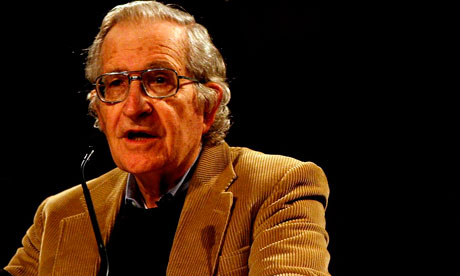
Noam Chomsky on the Death of bin Laden

photo of Noam Chomsky is from here
I like and respect Noam Chomsky. It is not an accident that he's a Jew. Jews in Amerikkka, due entirely to social-structural location, not genes, have a long history of radical social protest and for being outspoken in a drowning sea of white Christian silence and white Gentile acquiescence. The voices of Jews media most promotes are usually liberal and almost entirely Ashkenazi, but there are Jews of color--Sephardi and Mizrahi, within and beyond the US, who also share in the traditions of radically speaking out against injustice.

What I hope is that Noam increasingly incorporates radical feminist and pro-Indigenist political analysis into his work. When I hear Noam speak out against patriarchal abuses of women and girls, as such, and against Western Civilisation's assault against Indigenous People and people of color worldwide, as such, I'll respect him even more.

All that follows is from ZNet and ZCommunications.org.
There is Much More to Say

By Noam Chomsky
Friday, May 20, 2011

After the assassination of bin Laden I received such a deluge of requests for comment that I was unable to respond individually, and on May 4 and later I sent an unedited form response instead, not intending for it to be posted, and expecting to write it up more fully and carefully later on. But it was posted, then circulated. It can now be found, reposted, at http://www.zcommunications.org/my-reaction-to-osama-bin-laden-s-death-by-noam-chomsky.

That was followed by a deluge of reactions from all over the world. It is far from a scientific sample of course, but nevertheless, the tendencies may be of some interest. Overwhelmingly, those from the “third world” were on the order of “thanks for saying what we think.” There were similar ones from the US, but many others were infuriated, often virtually hysterical, with almost no relation to the actual content of the posted form letter. That was true in particular of the posted or published responses brought to my attention. I have received a few requests to comment on several of these. Frankly, it seems to me superfluous. If there is any interest, I’ll nevertheless find some time to do so.

The original letter ends with the comment that “There is much more to say, but even the most obvious and elementary facts should provide us with a good deal to think about.” Here I will fill in some of the gaps, leaving the original otherwise unchanged in all essentials.

Noam Chomsky

May 2011


On May 1, 2011, Osama bin Laden was killed in his virtually unprotected compound by a raiding mission of 79 Navy Seals, who entered Pakistan by helicopter. After many lurid stories were provided by the government and withdrawn, official reports made it increasingly clear that the operation was a planned assassination, multiply violating elementary norms of international law, beginning with the invasion itself.

There appears to have been no attempt to apprehend the unarmed victim, as presumably could have been done by 79 commandos facing no opposition - except, they report, from his wife, also unarmed, who they shot in self-defense when she “lunged” at them (according to the White House).

A plausible reconstruction of the events is provided by veteran Middle East correspondent Yochi Dreazen and colleagues in the Atlantic (http://www.theatlantic.com/politics/archive/2011/05/goal-was-never-to-capture-bin-laden/238330/). Dreazen, formerly the military correspondent for the Wall Street Journal, is senior correspondent for the National Journal Group covering military affairs and national security. According to their investigation, White House planning appears not to have considered the option of capturing OBL alive: “The administration had made clear to the military's clandestine Joint Special Operations Command that it wanted bin Laden dead, according to a senior U.S. official with knowledge of the discussions. A high-ranking military officer briefed on the assault said the SEALs knew their mission was not to take him alive.”

The authors add: “For many at the Pentagon and the Central Intelligence Agency who had spent nearly a decade hunting bin Laden, killing the militant was a necessary and justified act of vengeance.” Furthermore, “Capturing bin Laden alive would have also presented the administration with an array of nettlesome legal and political challenges.” Better, then, to assassinate him, dumping his body into the sea without the autopsy considered essential after a killing, whether considered justified or not – an act that predictably provoked both anger and skepticism in much of the Muslim world.

As the Atlantic inquiry observes, “The decision to kill bin Laden outright was the clearest illustration to date of a little-noticed aspect of the Obama administration's counterterror policy. The Bush administration captured thousands of suspected militants and sent them to detention camps in Afghanistan, Iraq, and Guantanamo Bay. The Obama administration, by contrast, has focused on eliminating individual terrorists rather than attempting to take them alive.” That is one significant difference between Bush and Obama. The authors quote former West German Chancellor Helmut Schmidt, who “told German TV that the U.S. raid was ‘quite clearly a violation of international law’ and that bin Laden should have been detained and put on trial,” contrasting Schmidt with US Attorney General Eric Holder, who “defended the decision to kill bin Laden although he didn't pose an immediate threat to the Navy SEALs, telling a House panel on Tuesday that the assault had been ‘lawful, legitimate and appropriate in every way’.”

The disposal of the body without autopsy was also criticized by allies. The highly regarded British barrister Geoffrey Robertson, who supported the intervention and opposed the execution largely on pragmatic grounds, nevertheless described Obama’s claim that “justice was done” as an “absurdity” that should have been obvious to a former professor of constitutional law (http://www.thedailybeast.com/blogs-and-stories/2011-05-03/osama-bin-laden-death-why-he-should-have-been-captured-not-killed/). Pakistan law “requires a colonial inquest on violent death, and international human rights law insists that the ‘right to life’ mandates an inquiry whenever violent death occurs from government or police action. The U.S. is therefore under a duty to hold an inquiry that will satisfy the world as to the true circumstances of this killing.” Robertson adds that “The law permits criminals to be shot in self-defense if they (or their accomplices) resist arrest in ways that endanger those striving to apprehend them. They should, if possible, be given the opportunity to surrender, but even if they do not come out with their hands up, they must be taken alive if that can be achieved without risk. Exactly how bin Laden came to be ‘shot in the head’ (especially if it was the back of his head, execution-style) therefore requires explanation. Why a hasty ‘burial at sea’ without a post mortem, as the law requires?”

Robertson attributes the murder to “America’s obsessive belief in capital punishment—alone among advanced nations—[which] is reflected in its rejoicing at the manner of bin Laden’s demise.” For example, Nation columnist Eric Alterman writes that “The killing of Osama bin Laden was a just and necessary undertaking.”

Robertson usefully reminds us that “It was not always thus. When the time came to consider the fate of men much more steeped in wickedness than Osama bin Laden -- namely the Nazi leadership -- the British government wanted them hanged within six hours of capture. President Truman demurred, citing the conclusion of Justice Robert Jackson that summary execution ‘would not sit easily on the American conscience or be remembered by our children with pride…the only course is to determine the innocence or guilt of the accused after a hearing as dispassionate as the times will permit and upon a record that will leave our reasons and motives clear’."

The editors of the Daily Beast comment that “The joy is understandable, but to many outsiders, unattractive. It endorses what looks increasingly like a cold-blooded assassination as the White House is now forced to admit that Osama bin Laden was unarmed when he was shot twice in the head.”

In societies that profess some respect for law, suspects are apprehended and brought to fair trial. I stress “suspects.” In June 2002, FBI head Robert Mueller, in what the Washington Post described as “among his most detailed public comments on the origins of the attacks,” could say only that “investigators believe the idea of the Sept. 11 attacks on the World Trade Center and Pentagon came from al Qaeda leaders in Afghanistan, the actual plotting was done in Germany, and the financing came through the United Arab Emirates from sources in Afghanistan…. We think the masterminds of it were in Afghanistan, high in the al Qaeda leadership.” What the FBI believed and thought in June 2002 they didn’t know eight months earlier, when Washington dismissed tentative offers by the Taliban (how serious, we do not know) to extradite bin Laden if they were presented with evidence. Thus it is not true, as the President claimed in his White House statement, that “We quickly learned that the 9/11 attacks were carried out by al Qaeda.”

There has never been any reason to doubt what the FBI believed in mid-2002, but that leaves us far from the proof of guilt required in civilized societies – and whatever the evidence might be, it does not warrant murdering a suspect who could, it seems, have been easily apprehended and brought to trial. Much the same is true of evidence provided since. Thus the 9/11 Commission provided extensive circumstantial evidence of bin Laden’s role in 9/11, based primarily on what it had been told about confessions by prisoners in Guantanamo. It is doubtful that much of that would hold up in an independent court, considering the ways confessions were elicited. But in any event, the conclusions of a congressionally authorized investigation, however convincing one finds them, plainly fall short of a sentence by a credible court, which is what shifts the category of the accused from suspect to convicted. There is much talk of bin Laden's “confession,” but that was a boast, not a confession, with as much credibility as my “confession” that I won the Boston marathon. The boast tells us a lot about his character, but nothing about his responsibility for what he regarded as a great achievement, for which he wanted to take credit.

Again, all of this is, transparently, quite independent of one’s judgments about his responsibility, which seemed clear immediately, even before the FBI inquiry, and still does.

It is worth adding that bin Laden’s responsibility was recognized in much of the Muslim world, and condemned. One significant example is the distinguished Lebanese cleric Sheikh Fadlallah, greatly respected by Hizbollah and Shia groups generally, outside Lebanon as well. He too had been targeted for assassination: by a truck bomb outside a mosque, in a CIA-organized operation in 1985. He escaped, but 80 others were killed, mostly women and girls, as they left the mosque – one of those innumerable crimes that do not enter the annals of terror because of the fallacy of “wrong agency.” Sheikh Fadlallah sharply condemned the 9/11 attacks, as did many other leading figures in the Muslim world, within the Jihadi movement as well. Among others, the head of Hizbollah, Sayyid Hassan Nasrallah, sharply condemned bin Laden and Jihadi ideology.

One of the leading specialists on the Jihadi movement, Fawaz Gerges, suggests that the movement might have been split at that time had the US exploited the opportunity instead of mobilizing the movement, particularly by the attack on Iraq, a great boon to bin Laden, which led to a sharp increase in terror, as intelligence agencies had anticipated. That conclusion was confirmed by the former head of Britain’s domestic intelligence agency MI5 at the Chilcot hearings investigating the background for the war. Confirming other analyses, she testified that both British and US intelligence were aware that Saddam posed no serious threat and that the invasion was likely to increase terror; and that the invasions of Iraq and Afghanistan had radicalized parts of a generation of Muslims who saw the military actions as an “attack on Islam.” As is often the case, security was not a high priority for state action.

It might be instructive to ask ourselves how we would be reacting if Iraqi commandos landed at George W. Bush's compound, assassinated him, and dumped his body in the Atlantic (after proper burial rites, of course). Uncontroversially, he is not a “suspect” but the “decider” who gave the orders to invade Iraq -- that is, to commit the “supreme international crime differing only from other war crimes in that it contains within itself the accumulated evil of the whole” (quoting the Nuremberg Tribunal) for which Nazi criminals were hanged: in Iraq, the hundreds of thousands of deaths, millions of refugees, destruction of much of the country and the national heritage, and the murderous sectarian conflict that has now spread to the rest of the region. Equally uncontroversially, these crimes vastly exceed anything attributed to bin Laden.

To say that all of this is uncontroversial, as it is, is not to imply that it is not denied. The existence of flat earthers does not change the fact that, uncontroversially, the earth is not flat. Similarly, it is uncontroversial that Stalin and Hitler were responsible for horrendous crimes, though loyalists deny it. All of this should, again, be too obvious for comment, and would be, except in an atmosphere of hysteria so extreme that it blocks rational thought.

Similarly, it is uncontroversial that Bush and associates did commit the “supreme international crime,” the crime of aggression, at least if we take the Nuremberg Tribunal seriously. The crime of aggression was defined clearly enough by Justice Robert Jackson, Chief of Counsel for the United States at Nuremberg, reiterated in an authoritative General Assembly resolution. An “aggressor,” Jackson proposed to the Tribunal in his opening statement, is a state that is the first to commit such actions as “Invasion of its armed forces, with or without a declaration of war, of the territory of another State….” No one, even the most extreme supporter of the aggression, denies that Bush and associates did just that.

We might also do well to recall Jackson’s eloquent words at Nuremberg on the principle of universality: “If certain acts of violation of treaties are crimes, they are crimes whether the United States does them or whether Germany does them, and we are not prepared to lay down a rule of criminal conduct against others which we would not be willing to have invoked against us.” And elsewhere: “We must never forget that the record on which we judge these defendants is the record on which history will judge us tomorrow. To pass these defendants a poisoned chalice is to put it to our own lips as well.”

It is also clear that alleged intentions are irrelevant. Japanese fascists apparently did believe that by ravaging China they were laboring to turn it into an “earthly paradise.” We don’t know whether Hitler believed that he was defending Germany from the “wild terror” of the Poles, or was taking over Czechoslovakia to protect its population from ethnic conflict and provide them with the benefits of a superior culture, or was saving the glories of the civilization of the Greeks from barbarians of East and West, as his acolytes claimed (Martin Heidegger). And it’s even conceivable that Bush and company believed that they were protecting the world from destruction by Saddam’s nuclear weapons. All irrelevant, though ardent loyalists on all sides may try to convince themselves otherwise.

We are left with two choices: either Bush and associates are guilty of the “supreme international crime” including all the evils that follow, crimes that go vastly beyond anything attributed to bin Laden; or else we declare that the Nuremberg proceedings were a farce and that the allies were guilty of judicial murder. Again, that is entirely independent of the question of the guilt of those charged: established by the Nuremberg Tribunal in the case of the Nazi criminals, plausibly surmised from the outset in the case of bin Laden.

A few days before the bin Laden assassination, Orlando Bosch died peacefully in Florida, where he resided along with his terrorist accomplice Luis Posada Carilles, and many others. After he was accused of dozens of terrorist crimes by the FBI, Bosch was granted a presidential pardon by Bush I over the objections of the Justice Department, which found the conclusion “inescapable that it would be prejudicial to the public interest for the United States to provide a safe haven for Bosch. ”The coincidence of deaths at once calls to mind the Bush II doctrine, which has “already become a de facto rule of international relations,” according to the noted Harvard international relations specialist Graham Allison. The doctrine revokes “the sovereignty of states that provide sanctuary to terrorists,” Allison writes, referring to the pronouncement of Bush II that “those who harbor terrorists are as guilty as the terrorists themselves,” directed to the Taliban. Such states, therefore, have lost their sovereignty and are fit targets for bombing and terror; for example, the state that harbored Bosch and his associate -- not to mention some rather more significant candidates. When Bush issued this new “de facto rule of international relations,” no one seemed to notice that he was calling for invasion and destruction of the US and murder of its criminal presidents.

None of this is problematic, of course, if we reject Justice Jackson’s principle of universality, and adopt instead the principle that the US is self-immunized against international law and conventions -- as, in fact, the government has frequently made very clear, an important fact, much too little understood.

It is also worth thinking about the name given to the operation: Operation Geronimo. The imperial mentality is so profound that few seem able to perceive that the White House is glorifying bin Laden by calling him “Geronimo” -- the leader of courageous resistance to the invaders who sought to consign his people to the fate of “that hapless race of native Americans, which we are exterminating with such merciless and perfidious cruelty, among the heinous sins of this nation, for which I believe God will one day bring [it] to judgement,” in the words of the great grand strategist John Quincy Adams, the intellectual architect of manifest destiny, long after his own contributions to these sins had passed. Some did comprehend, not surprisingly. The remnants of that hapless race protested vigorously. Choice of the name is reminiscent of the ease with which we name our murder weapons after victims of our crimes: Apache, Blackhawk. Tomahawk,… We might react differently if the Luftwaffe were to call its fighter planes "Jew" and "Gypsy".

The examples mentioned would fall under the category “American exceptionalism,” were it not for the fact that easy suppression of one’s own crimes is virtually ubiquitous among powerful states, at least those that are not defeated and forced to acknowledge reality. Other current illustrations are too numerous to mention. To take just one, of great current significance, consider Obama’s terror weapons (drones) in Pakistan. Suppose that during the 1980s, when they were occupying Afghanistan, the Russians had carried out targeted assassinations in Pakistan aimed at those who were financing, arming and training the insurgents – quite proudly and openly. For example, targeting the CIA station chief in Islamabad, who explained that he “loved” the “noble goal” of his mission: to “kill Soviet Soldiers…not to liberate Afghanistan.” There is no need to imagine the reaction, but there is a crucial distinction: that was them, this is us.

What are the likely consequences of the killing of bin Laden? For the Arab world, it will probably mean little. He had long been a fading presence, and in the past few months was eclipsed by the Arab Spring. His significance in the Arab world is captured by the headline in the New York Times for an op-ed by Middle East/al Qaeda specialist Gilles Kepel; “Bin Laden was Dead Already.” Kepel writes that few in the Arab world are likely to care. That headline might have been dated far earlier, had the US not mobilized the Jihadi movement by the attacks on Afghanistan and Iraq, as suggested by the intelligence agencies and scholarship. As for the Jihadi movement, within it bin Laden was doubtless a venerated symbol, but apparently did not play much more of a role for this “network of networks,” as analysts call it, which undertake mostly independent operations.

The most immediate and significant consequences are likely to be in Pakistan. There is much discussion of Washington's anger that Pakistan didn't turn over bin Laden. Less is said about the fury in Pakistan that the US invaded their territory to carry out a political assassination. Anti-American fervor had already reached a very high peak in Pakistan, and these events are likely to exacerbate it.

Pakistan is the most dangerous country on earth, also the world’s fastest growing nuclear power, with a huge arsenal. It is held together by one stable institution, the military. One of the leading specialists on Pakistan and its military, Anatol Lieven, writes that “if the US ever put Pakistani soldiers in a position where they felt that honour and patriotism required them to fight America, many would be very glad to do so.” And if Pakistan collapsed, an “absolutely inevitable result would be the flow of large numbers of highly trained ex-soldiers, including explosive experts and engineers, to extremist groups.” That is the primary threat he sees of leakage of fissile materials to Jihadi hands, a horrendous eventuality.

The Pakistani military have already been pushed to the edge by US attacks on Pakistani sovereignty. One factor is the drone attacks in Pakistan that Obama escalated immediately after the killing of bin Laden, rubbing salt in the wounds. But there is much more, including the demand that the Pakistani military cooperate in the US war against the Afghan Taliban, whom the overwhelming majority of Pakistanis, the military included, see as fighting a just war of resistance against an invading army, according to Lieven.

The bin Laden operation could have been the spark that set off a conflagration, with dire consequences, particularly if the invading force had been compelled to fight its way out, as was anticipated. Perhaps the assassination was perceived as an “act of vengeance,” as Robertson concludes. Whatever the motive was, it could hardly have been security. As in the case of the “supreme international crime” in Iraq, the bin Laden assassination illustrates that security is often not a high priority for state action, contrary to received doctrine.

There is much more to say, but even the most obvious and elementary facts should provide us with a good deal to think about. 

Sunday, March 13, 2011

Natural Treatment for Radiation Exposure in Japan: Seaweed. Also: Homeopathy for Trauma and Shock

See also *this post* on iodine treatments for thyroid protection.

Please Tweet this:


According to Michio and Aveline Kushi, macrobiotics is very effective in curing radiation sickness. In his book Macrobiotic Diet, Michio Kushi states: ‘At the time of the atomic bombing of Nagasaki in 1945, Tatsuichiro Akizuki, M.D., was director of the Department of Internal Medicine at St. Francis Hospital in Nagasaki. Most patients in the hospital, located one mile from the center of the blast, survived the initial effects of the bomb, but soon after came down with symptoms of radiation sickness from the radioactivity that had been released. Dr. Akizuki fed his staff and patients a strict macrobiotic diet of brown rice, miso* and tamari soy sauce soup, wakame and other sea vegetables , Hokkaido pumpkin, and sea salt and prohibited the consumption of sugar and sweets. As a result, he saved everyone in his hospital, while many other survivors in the city perished from radiation sickness.’”

* miso: paste made from fermented soya beans and barley or rice malt, used in Japanese/macrobiotic cookery
  
Compare On Macrobiotics, Seaweed for important hints re purchasing quality seaweed and Modifilan.

Sites on homeopathic treatment for shock and trauma from earthquake:

http://www.thehomeopathiccoach.com/blog/shock-grief-trauma-and-homeopathy.html

http://www.trademe.co.nz/Chch-earthquake-support/Other/auction-357542731.htm

http://altmedicine.about.com/cs/homeopathy/a/Trauma.htm


Wednesday, February 23, 2011

Asian Lesbian & Gay News Archive (I'm always going to put Lesbian before Gay, any day)

Lesbian (and gay, bisexual, and trans) rights activists celebrated during a rally in New Delhi in July after the city’s highest court decriminalized homosexuality. [source: here]
While much of the world celebrated Gay Pride in June, Mumbai waited. The Queer Azaadi March (“azaadi” means freedom), in fact, is this Sunday, a day after the 62nd anniversary of India’s independence. The implicit association: the freedom of sexual orientation and the country’s freedom from the clutch of colonialism. [source: *here*]
Everything below is from *here*.

Asian Gay & Lesbian News Archive
(listed from the oldest to newest in each section)

We would greatly appreciate your assistance in adding missing news items to this archive. Please contact us if you have copies of regional GLBT news not yet on this list.


Milestones in Asia's Gay and Lesbian Communities:


  • 1st Asian Gay Magazine: Barazoku, Japan, 1971

  • 1st Asian Gay Rights Organization: Indonesia, 1981

  • 1st Thai Gay Magazine: Mithuna, 1983

  • 1st Japanese Gay Rights Organization: JILGA, 1983

  • 1st Taiwanese Gay-Themed Novel: Crystal Boys, 1983

  • 1st Thai Lesbian Organization: Anjaree, 1986

  • 1st Singaporean Gay Magazine: OG, 1987

  • 1st Malaysian Gay AIDS Organization: Pink Triangle, 1988

  • 1st Thai Gay AIDS Organization: FACT, 1988

  • 1st Indian Gay Magazine: Bombay Dost, 1989

  • 1st Asian Gay Film/Video Festival: Hong Kong, 1989

  • 1st Taiwanese Lesbian Activist Organization: Women Zhi Jian, 1990

  • Hong Kong Decriminalization of Homosexuality, 1991

  • 1st International Asian Lesbian Conference: Bangkok, 1991

  • 1st Gay Play in Singapore, Another Tribe by Fong Yong Chin, 1991

  • 1st Japanese International Gay Film/Video Festival: Tokyo, 1992

  • China Decriminalization of Homosexuality: 1993

  • 1st Taiwanese Lesbian Magazine: Ai Bao, 1993

  • 1st Asian Gay Rights Conference: Indonesia, 1993

  • 1st Gay Art Show in Singapore: Tan Peng & John Goss, Feb 20, 1993

  • 1st Asian Gay Pride March: Manila, Jun 26, 1994

  • 1st Japanese Gay Pride March: Tokyo, 1994

  • 1st Indian Gay Conference: Mumbai, 1994

  • 1st Thai Gay and Lesbian Book Shop: Utopia, Dec 13, 1994

  • 1st Asian Gay and Lesbian Internet Portal: Utopia-Asia.com, Dec 13, 1995

  • 1st Taiwanese Gay Wedding: 1996

  • 1st Officially Authorized Taiwanese Gay Magazine: G&L, 1996

  • 1st Thai International Gay Film/Video Festival: Bangkok, Oct 11, 1996

  • 1st International Chinese Tongzhi Conference: Hong Kong, Dec, 1996

  • 1st Asian Lesbian Pride March: Tokyo, 1997

  • 1st Taiwanese Gay Pride Event: Taipei, June 29, 1997

  • Legal Victory in Gay Discrimination Suit: Tokyo, Sep 16, 1997

  • 1st Korean Gay Magazine: Buddy, 1998

  • 1st Chinese National Lesbian Conference: Beijing 1998

  • 1st Thai International Gay Pride Festival: Bangkok, Oct 31, 1999

  • 1st Indonesian Lesbian Organization: Swara Srikandi, 2000

  • 1st Utopia Awards for Gay & Lesbian Pioneers: Bangkok, Nov 4, 2000

  • China Officially Declassifies Homosexuality as a Disease: 2001

  • 1st Chinese Gay Film Festival: Beijing, 2001

  • Thailand Officially Declassifies Homosexuality as a Mental Disorder: 2002

  • 1st Cambodian Gay Pride Event: Phnom Penh, 2003

  • 1st Sri Lankan GLBT AIDS Event: Jul 3, 2003

  • 1st Taiwanese Gay Pride March: Nov 1, 2003

  • 1st Korean Gay Wedding: Mar, 2004

  • 1st Indian Gay and Lesbian Center: Mumbai, Apr 25, 2004

  • 1st Hong Kong GLBT Rights Rally, May 17, 2005

  • 1st Int'l Conference of Asian GLBT Studies: Bangkok, July 7-9, 2005

  • 1st Sri Lankan Pride Celebration: Colombo, July 20, 2005

  • 1st Singaporean Public Pride Festival: Indignation, the month of Aug, 2005

  • Thailand's 1st National Human Rights Day for Sexual Diversity, Nov 29, 2008

  • Shanghai's 1st Pride Week, June 7-14, 2009

  • Dehli Repeals Anti-Homosexual Laws, July 2, 2009

  • Monday, February 21, 2011

    Lesbian Existence in Japan: It's Not Accepted or Supported as much as Gay and Trans Existence is (which isn't much)

    photograph of Kanako Otsuji is from here
    Homosexuality in Japan, from Wikipedia, *here*.
    Despite the recent trends that suggest a new level of tolerance, as well as open scenes in more cosmopolitan cities (such as Tokyo and Osaka), Japanese gay men and lesbian women often conceal their sexuality; with many even marrying persons of the opposite sex to avoid discrimination.

    Politics and law

    Japan has no laws against homosexual activity, and has some legal protections for gay individuals. In addition, there are some legal protections for transgender individuals.
    Consensual sex between adults of the same sex is legal, but some prefectures set the age of consent for same-sex sexual activity higher than for opposite-sex sexual activity.
    While civil rights laws do not extend to protection from discrimination based on sexual orientation, some governments have enacted such laws. The government of Tokyo has passed laws that ban discrimination in employment based on sexual identity.
    The major political parties express little public support for gay rights issues. Despite recommendations from the Council for Human Rights Promotion, the Diet has yet to take action on including sexual orientation in the country's civil rights code.
    Some political figures, however, are beginning to speak publicly about their own homosexuality. Kanako Otsuji, an assemblywoman from Osaka, came out as a lesbian in 2005. Two years earlier, in 2003, Aya Kamikawa became the first openly transgender elected official in Tokyo, Japan.

    Popular culture

    A number of personalities who appear on television in Japan daily are gay or transgender, or cultivate such an image as part of their public persona.
    In recent years, a small number of artists, nearly all male, have begun to speak publicly about their homosexuality. They often appear on various talk shows and other programmes. Dancer and tarento Kabachan, tarento Gakuseifuku Sakamoto, comedian Ken Maeda, and twin pop-culture critics Piko and Osugi are among these.
    Akihiro Miwa, a drag queen and former lover of author Yukio Mishima, is the television advertisement spokesperson for many Japanese companies ranging from beauty to financial products and TEPCO. Kenichi Mikawa, a former pop idol singer who now blurs the line between male and female costuming and make-up, can also regularly be seen on various programs, as can crossdressing entertainer Peter. Singer-songwriter and actress Ataru Nakamura was one of the first transgendered personalities to become highly popular in Japan; in fact, sales of her music rose after she discussed her MTF gender reassignment surgery on the variety show Boku no Ongaku in 2006.
    However, some non-gay entertainers have used stereotypical references to homosexuality to increase their profile. Razor Ramon Hard Gay (HG), a comedian, shot to fame after he began to appear in public wearing a leather harness, hot pants and cap. His outfit, name, and trademark pelvis thrusting and squeals earned him the adoration of fans and the scorn of many in the Japanese gay community.
    Recently, Ai Haruna and Ayana Tsubaki, two high profile transsexual celebrities, have gained popularity and have been making the rounds on some very popular Japanese variety shows.
    Famous LGBT bloggers have began to gain more traction with the Japanese public, even often attracting fans and readers from outside Japan: prime examples being "Agoe" (アゴ江), "Utaguwa" (うたぐわ), and "Gomabukko" (ゴマブッ子).
    A greater amount of gay and transgender characters have also begun appearing (with positive portrayals) on Japanese television, such as the highly successful Hanazakari no Kimitachi e and Last Friends television series.

    Japanese culture has always been a part of my life. Part of my family is Japanese, and I maintain connection with those family members. They are not part of my white family-of-origin, most of whom I have little to no contact with. I grew up with a general regard and respect for Japan and Japanese people, which was unusual for whites of my generation in the U.S, who used to routinely make fun of Japanese people as "tourists with cameras" and other silly stereotypes. (Do U.S. whites really not go around country-hopping with cameras in hand?) '80s hits in the UK and the US, like "Turning Japanese" by the Vapors were deeply offensive to me and I hated hearing it or having to deal with white people thinking it was thematically funny or a good song. It's fucking racist as hell.

    As a white Jew, I had to contend with the term "JAP" being used both derogatorily against people from Japan, not uncommonly uttered by white WWII vets stationed in East Asia, and as a term for "Jewish American Princess", which is anti-Semitic, sexist, and classist.

    There remain many stereotypes of Japanese people in the U.S, and U.S. whites remain largely ignorant about East Asians, often confusing people of one nationality with another, with little concern or care. I hear whites say "Chinese" when they mean "Japanese" and vice versa, and there is little to no protest about such anti-East Asian racism here. The U.S., in other words, remains a very anti-Japanese society, in my view.

    The history of human rights in Japan is quite different than in the U.S. While the white West has invaded and occupied aspects of Japanese life, most especially its economy and through military presence, Japan has kept its own culture distinct from the dominant white U.S. culture. As the dominant U.S. culture is pro-genocide, pro-gynocide, and heavily invested in ecocide as well, this determination to stay distinct is good, I think.

    But this doesn't mean that Japan is a model society for girls, women, or lesbians in particular. Girls are exploited and sexualised in ways that are not even done so routinely in the U.S. Men are very entitled in Japan, including the white men who visit and live there, to have visual access to girls and sexual access to women. Marital rape isn't prosecuted. Battery is unchecked. Social services, including welfare for the unemployed, don't exist as they do in the U.S. And they exist inadequately in the U.S., except for the wealthy and for U.S. mega-corporations which, if they should go broke due to miserable managing, will find a government willing to give them billions of dollars in resources to support their survival and re-emergence. The poor have no such "luck". Corporations, it seems, do not need bootstraps with which to pull themselves up. They have bailouts instead.

    This post concerns one particular group of oppressed women in Japanese society: lesbians, and the struggle for lesbian existence in Japan. Please click on the title to link back to the source website at Japan Today.
    Tuesday, Feb. 28, 2006

    THE ZEIT GIST

    Invisible minority

    Japan's lesbian community in dual struggle for rights, acceptance


    The mysteries surrounding this group have too often become false myths that stereotype the lives of lesbians. Very common is the belief that women become lesbians because of some traumatic experience they've had with a man.
     
    "That's no more valid than asking a straight person if they had a bad experience with someone from the same gender and then become heterosexual," says Kim Oswalt, a Tokyo-based psychotherapist.
     
    "Straight people know they are straight at a young age -- maybe even before having a sexual experience. The same could be said for lesbian and gays -- they may know their orientation at an early age.
     
    "Internalized homophobia is when gays feel like they have to look and act straight to be invisible because there is a culture of repression," says Oswalt. "I have my doubts that the politics of assimilation strengthen the voice of any marginalized group."
     
    On the other hand, even if someone is out of the closet, it's not easy to identify a person's sexual orientation by how they look.
     
    Every Wednesday night, a snug and mellow little Shibuya bar hosts a night called Chestnut and Squirrel, or "kuri to risu" in Japanese. The air is filled with the smell of what organizers call "dyke food," the sounds of ice clinking in so-called "dyke drinks" and the chatter of over a dozen international women.
     
    They may all be there for one common reason, but not one looks much like another.
     
    Within the lesbian "community" are several pocket communities divided by members such as political activists, party girls who are into cruising the bar scene, career women or lesbians with children.
     
    "Sometimes people think that just because two people are lesbians, they're going to get along," says American EV. "But the truth is, I'm not defined by 'being a lesbian.' I'm myself. Being gay is part of who I am, but it's not all of who I am. We all have something in common, but it's just one thing that we have in common. It's not a hobby, like 'I'm gay on Wednesday nights but I scuba dive on Saturdays.' "
     
    Lesbians are all around. They're our nurses, our teachers and our Saturday scuba diving buddies. They're even our friends and our sisters. They just blend in really well, sometimes to the point of invisibility.
     
    "Minority, minority, minority," says Olivia Moss, who wrote her thesis for Cambridge University on Japanese lesbianism in the 1990s.
    "For foreign working women in Tokyo, the minority of being foreign, within the minority of being lesbian, within the minority of being a working woman, means that it's no surprise we're 'invisible' on a large scale.

    Add to this the population who are able to be 'out' at work, and the minority chain just goes on and on and the numbers decrease with the chain."
     
    As Japan has yet to pass same-gender rights or antidiscrimination laws, most women don't fully come out, thus feeding the myth that lesbians don't exist in Japan.
     
    "There's a fear among both foreign and Japanese women that it wouldn't just be taboo but there's a risk of losing your job or of alienating yourself from the so-called straight society," says Moss. Though Kanako Otsuji, an Osaka lawmaker, took a step forward by coming out publicly at last August's gay pride parade in Tokyo, Japanese lesbians have long been lacking public role models.
     
    In 1980, well-known pop singer Naomi Sagara saw her career collapse as she was banished by the public after her former partner announced she was a lesbian.
     
    "I didn't come out until I was 32," says Chu, who is lovingly referred to as Momma and has been helping organize "dyke weekends" (thrice a year get-togethers in Saitama) for over 10 years, as well as hosting food and drinks at Chestnut and Squirrel for four years.
     
    "It's all about repression. I only knew about Naomi Sagara. She was lesbian and it was bad news. But then KD Lang was so cool. When I saw her sing at The Grammys, I thought 'I'm lesbian!' It was finally time for me to consider my sexuality. It must be a visible positive image for women to want to come out."
     
    Chu says lesbian activities hit their peak in 1994, coinciding with the American feminist movement, when leaders of groups in Japan all worked together.
     
    She says since then it has calmed down and because groups have different agendas they have gone their own ways.
     
    Recently Japanese lesbians have been going their own way, with an increasing number choosing the Internet, rather than public places, to meet other women.
     
    "The Net is different from meeting in a bar. I want more. People have lives and experiences, not just parties," says Ayano, who has been meeting Internet friends around Chiba for daytime activities like horseback riding and swan watching since September.
     
    For some, following the personals on the Internet has compromised the strength of lesbian communities.
    "Women can lead double-lives and that counteracts what the possibilities can be. It's easy to find a relationship on the Net by speed dating, but you end up closeting yourself and it affects the structure of that minority group. So then we don't fight for visibility because we've disappeared," says Moss.
     
    "We need to encourage a community where women can express themselves. I feel like the foreign community has a moral obligation to care, contribute and support.
     
    "It's time to work toward building self-awareness within our own foreign lesbian community -- and find ways of breaking down any barriers between ourselves and other communities."
     
    But because of language barriers, the transitory nature of foreigners and the lack of same-gender spousal visas, there are different agendas for the foreign and Japanese lesbian communities.
     
    Perhaps one of the challenges is how to respect the different agendas while at the same time building a strong political base.
     
    Until a broader spectrum of visibility exists, public blindness remains and stigmas are continually reinforced by images of lesbianism brought to the mainstream.
     
    "There are still many who believe in that there are virtually no lesbians in the real Japanese society," says Maki Kimura, a staff member of the Kansai Queer Film Festival and partner of Otsuji.
    "A market where feminine lesbians are objectified and consumed as objects of sexual desire by heterosexual men, say through pornography, has developed.
     
    "There are also a great number of lesbians who marry men due to economic concerns, partly because wage differences are still large between women and men in Japan.
     
    "Even though we describe it as a community, there is not enough sharing of information with each other. Except for personals on the Internet, it's a big problem that there is virtually no media to link Japanese lesbians," says Kimura.
     
    "I want to cut off the vicious cycle of discrimination and prejudice. The more we become visible, the more a systematic change favorable for us will be fostered."
     
    Lesbian links
     
    PA/F (Performance Art/Feminism): Space monthly events in Waseda include performances, fashion shows, speeches by prominent members and contributors to the Japanese lesbian community.
    www.pafnight.com
    LOUD: Resource center and rights group for lesbian and bisexual women in Tokyo 's Nakano district; weekly events and information service.
    www.space-loud.org/loud/modules/english1/
    The Kansai Queer Film Festival is trying its best to reach all the remote parts of Japan (currently in Aomori Prefecture) and welcomes any support for festival fundraising
    www.geocities.jp/kansai_queer_film/english/welcome.htm
    Tokyo International Lesbian and Gay Film Festival
    www.tokyo-lgff.org/
    Tokyo Lesbian and Gay Parade
    www.tlgp.org/

    Wednesday, February 2, 2011

    Iraq: Living in Hiding. The Reality of Men's Rape of Women as Warfare

    Direct from PBS.org, *here*.


    Conflict Zones: Pakistan and Afghanistan


    Iraq: The Hidden Crime of Rape
    By Anna Badkhen

    The three policemen put a burlap sack over Khalida’s head and took her to the Iraqi Interior Ministry in Baghdad. There, they interrogated her and beat her, knocking out her front teeth. Then they tore off her clothes and took turns raping her.

    “After they finished, the fourth man came into the room,” Khalida told me, stubbing out one cigarette to light another. “He was an officer. I could see the rank on his shoulders. He looked at me and said: ‘Oh, it’s my bad luck that you’re bleeding, because it was supposed to be my turn.’” The officer ordered his men to get rid of Khalida. They wrapped her in a blanket, put her in a car, and dumped her, hemorrhaging, on a Baghdad sidewalk.

    “No one knows exactly how many Iraqi women have been raped since the U.S-led invasion in 2003, but activists in Iraq and abroad put the numbers in the thousands.”

    Soon after the rape, Khalida escaped to Jordan, and then to the United States. Her mother and sister still live in Iraq.

    protest
    It took weeks of careful negotiations before the reporters gained the trust of women in the shelter.
    No one knows exactly how many Iraqi women have been raped since the U.S-led invasion in 2003, but activists in Iraq and abroad put the numbers in the thousands.  Human rights groups began to see an increase in rapes in Iraq immediately after the fall of Hussein’s regime, and evidence that different factions were targeting women. In 2008, Amnesty International reported that “crimes specifically aimed at women and girls, including rape, have been committed by members of Islamist armed groups, militias, Iraqi government forces, foreign soldiers within the U.S.-led Multinational Force, and staff of foreign private military security contractors.”

    The report went on to say that such crimes are rarely prosecuted or even recorded by Iraqi officials.

    Under Saddam’s Baath Party rule, security forces used torture and rape against political prisoners; and the dictator’s eldest son, Uday, reportedly ordered any woman who caught his eye to be delivered to his palace. But rape was otherwise not widespread.

    “There was law,” said Yanar Mohammed, an Iraqi women’s rights advocate and feminist. “Nobody would go around raping.”

    “Mohammed became our guide into Iraq’s largely hidden world of sexual abuse against women. Her organization is the only non-governmental group south of the semi-autonomous Kurdish region that operates shelters for rape victims.”

    According to Mohammed, who heads the Organization for Women’s Freedom in Iraq, a nonprofit group that works directly with rape victims, “By the end of 2003, everyone had a story of five or ten women being kidnapped; some were raped and thrown by the side of the street, others were disappeared.”

    Iraqi doctors told me that they also began to see a rise in rape cases one month after the war started. Lawlessness and sectarian violence quickly engulfed Iraq after the fall of Saddam, leaving women particularly vulnerable.  In 2005 alone, Mohammed’s organization estimates that 2,000 girls were raped.

    In March 2009, Oxfam reported that the conflict had left an estimated 740,000 Iraqi widows -- most of them losing their husbands since the 2003 invasion. This means hundreds of thousands of Iraqi women have lost the traditional protection of male family members, including husbands, brothers and fathers, leaving them far more defenseless against rape.

    In many areas across the country where tribal justice has filled a void left by the war, rape victims become casualties of a double jeopardy. They are often shunned and sometimes killed by family members to remove the perceived shame the abuse has brought on the family’s honor.

    protest
    With no other place to go, women often bring their children with them to the shelter.
    Hanna Edwar, head of the Iraqi Women’s Network in Baghdad, told me that the practice, known as “honor killings,” has the tacit support of the Iraqi government. While premeditated murder in Iraq carries a prison sentence of at least 15 years, a typical sentence for honor killings is about six months, she said.

    “Even our own visit to the safe house in Baghdad carried risk for the women there: as foreigners, we could draw unwanted attention to the shelter. To help protect the shelter’s whereabouts, we were not allowed to take along our translator.”

    To find out more about Iraq’s rape crisis, I traveled to Baghdad in March with photojournalist Mimi Chakarova (see her accompanying slideshow). I had already interviewed rape victims from Iraq who were living as refugees in neighboring Jordan. There, I learned of the work Mohammed was doing through her organization in Iraq. It’s also where I met Khalida and heard her story.

    Mohammed became our guide into Iraq’s largely hidden world of sexual abuse against women. Her organization is the only non-governmental group south of the semi-autonomous Kurdish region that operates shelters for rape victims.

    It took weeks of careful negotiations before we were able to gain the confidence of the women who run the clandestine network of shelters and the women who have sought refuge there. Mohammed and other volunteers live in constant fear of reprisals from sectarian militias.
    We stayed at a heavily fortified hotel in downtown Baghdad, outside the relative security of the Green Zone. Whenever we left the hotel, we put on black abaya robes and headscarves to blend in. Interviewing people on the street was out of the question: it would attract too much attention. And when our female Iraqi interpreter did speak to women about their experiences, she often refused to translate their stories because she was embarrassed.

    Often, Iraqi women are too ashamed or afraid to report rape to the police; and when they do report abuse, officials typically dismiss their claims. Confirming the Amnesty report, a government spokesman told me that the Iraqi government does not keep records of rape cases. When I asked why not, he refused to elaborate.

    protest
    Women put on traditional dress before they go out in public.
    Salma Jabou, the advisor to President Jalal Talabani on women’s affairs, told me that Iraq has no laws to protect rape victims. American forces, which are preparing for a gradual withdrawal, also have no authority to interfere. The Ministry for Women’s Affairs, set up in 2003, has made so little difference in protecting women’s rights that Nasal Al-Samaraie, the appointed minister, resigned in March, saying that her mission was “very hard, if not impossible, to achieve.”

    The job is mostly left to non-governmental agencies backed by international aid. Mohammed’s shelter network is partially funded by the international women’s rights organization MADRE, based in New York. MADRE’s spokesperson Yifat Susskind told me that Mohammed’s network has given refuge and counseling to thousands of Iraqi women since the first shelter opened in 2004. Despite the need for more support, Mohammed says the Iraqi government has continually denied her group permission to officially operate the shelters or offered to provide any government assistance. Instead, she houses the women in several rundown, rat-infested apartments, hiding the women not only from potential assailants but also from Iraqi authorities.

    According to a recent report by Amnesty International, gunmen attacked a women’s shelter in the Kurdish- controlled north. The men were believed to be relatives of a woman seeking refuge inside. Mohammed’s shelters are among only a handful of safe houses for rape victims in the entire country.

    Even our own visit to the safe house in Baghdad carried risk for the women there: as foreigners, we could draw unwanted attention to the shelter. To help protect the shelter’s whereabouts, we were not allowed to take along our translator, a postgraduate student at Baghdad University. To reach the safe house, we first had to meet with a volunteer at the organization’s headquarters. There, we put on veils andabayas. For added security, we waited until darkness. Then another volunteer drove us through a dusty maze of Baghdad’s bullet-scarred streets.

    When we arrived, we shuffled through the shelter’s unmarked plywood door the way most Iraqi women move about in a place where they have become targets: eyes cast, heads bowed, and in silence -- like shadows.

    For a glimpse of life inside the shelter, watch the accompanying slideshow: Iraq: Living in Hiding, by Mimi Chakarova.

    Anna Badkhen’s reporting trip to Baghdad was made possible by a grant from the Center for Investigative Reporting.

    Friday, August 13, 2010

    Reality-check: U.S. Government and TIME are Selling More Big Lies about Afghanistan (there's nothing good for Aghan women about U.S. invasion and occupation)

    All that follows is from RAWA's website *here*.


    France. 24, Aug. 1, 2010: Malalai Joya, a leading Afghan activist for women's rights and politican who featured among Time Magazine’s 100 most influential people in 2010, spoke out against what she calls the manipulation of public opinion over the plight of Afghan women: There is no doubt that the Taliban are misogynist barbarians but the US can be a good match for them for the war crimes that it has committed in these nine years, killing around 8,000 civilians in their military operations.

    [From what follows beyond the excerpts:]

    The people with blood on their hands are the U.S. military and the politicians who continue to support and fund the war--and their cheerleaders in the mainstream media.


    [...]

    Time magazine made the point starkly on the cover of this week's edition--it features a photo of a young Afghan woman named Aisha whose nose and ears were cut off by her Taliban husband after she ran away from him. "What happens if we leave Afghanistan?" reads the headline.

    There's something unspeakably cynical about Time's use of such a heart-wrenching image in a calculated attempt to gloss over the cold facts revealed by WikiLeaks and others about the violence and devastation that the U.S. occupation is inflicting in Afghanistan.

    In fact, the young woman pictured on the Time cover was mutilated not in the "long ago" days of Taliban rule, but last year, when tens of thousands of U.S. "liberators" were occupying her country.


    [...]

    FOR MORE than a century, every imperial conquest carried out by the U.S. has been cloaked in more noble and palatable terms. Political leaders talk about "justice" and "liberty" and "democracy," rather than the truth--conquest, colonization and exploitation.

    The victims of the American empire don't have any difficulties seeing through the rhetoric. Like Samia, a 26-year-old woman who participated in a demonstration of hundreds of Afghans on August 1 in Kabul. The protesters directed their anger at both the Taliban and the U.S. In particular, they were demonstrating about a deadly traffic accident in late July involving an SUV driven by DynCorp International contractors that killed four Afghans.

    As Samia told the Washington Post:

    Many times, NATO troops and these cars have killed our innocent people. They never care whether we are Afghans or animals. We want NATO troops and American troops to leave Afghanistan. Even with their huge army, they couldn't do anything in the past 10 years. And in the future, they won't be able to do anything. The result will be just death and casualties, and our innocent Afghan women and children will die.

    Selling the big lie

    Aided by a compliant media, the Obama administration and Pentagon officials are trying to spin a new crop of lies about the necessity of war to "liberate" the Afghan people.


    AS MORE revelations about the brutality and barbarism of the U.S. occupation of Afghanistan emerge, the Obama administration and the Pentagon are countering the truth with more lies--and a shameful public relations offensive aimed at passing off endless war as "liberation."

    Meanwhile, the voices of ordinary Afghans--and the toll of the U.S. war on their lives--are being ignored by politicians and the media alike.

    The release of nearly 92,000 classified documents relating to the war by the WikiLeaks Web site has helped expose the facts about the U.S. occupation of Afghanistan.

    For one thing, they reveal the extent to which Washington's war, now the longest ever fought by the U.S., has done what seemed impossible a few years ago--rehabilitate the image of the Taliban, the country's formerly despised ex-rulers. The WikiLeaks documents also reveal the terrible impact on ordinary Afghans--subjected to indiscriminate bombings, massacres by U.S. soldiers, and rampant corruption by U.S.-installed stooges.

    But the Obama administration and the military is responding to these facts with lies.

    First, they claimed that the documents didn't matter because they only covered the period up to December 2009--before Obama's "surge" strategy went into effect. Then, the line was that the WikiLeaks information was "old news" that didn't reveal anything new about the war.

    When it became clear that those explanations were falling on deaf ears, the White House and Pentagon escalated. They now accuse those who leaked the documents of endangering the lives of both U.S. military personnel and Afghan civilians who may have worked with coalition forces. "The truth is [those who leaked the information] might already have on their hands the blood of some young soldier or that of an Afghan family," said Adm. Michael Mullen, Chair of the Joint Chiefs of Staff.

    In other words, accuse the messenger of murder.

    Salon.com's Glenn Greenwald wasn't alone in pointing out that the WikiLeak documents weren't responsible for putting Afghans at risk, but rather "ten years of bombings, air raids, checkpoint shootings [and] drones." Add to that the Obama administration's green light to a new surge of combat forces and stepped-up "targeted assassinations."

    The people with blood on their hands are the U.S. military and the politicians who continue to support and fund the war--and their cheerleaders in the mainstream media.

    Just how craven has the media response been? On the Washington Post Web site, former Bush administration speechwriter and torture proponent Marc Thiessen called--literally--for war on WikiLeaks founder Julien Assange.

    "Assange is a non-U.S. citizen operating outside the territory of the United States," Thiessen claimed. "This means the government has a wide range of options for dealing with him. It can employ not only law enforcement but also intelligence and military assets to bring Assange to justice and put his criminal syndicate out of business."

    Thiessen went on to argue that the U.S. has the legal authority to kidnap "Assange or his co-conspirators anywhere in the world," even if such a kidnapping violates international law.

    This begs the question: Does Thiessen think the U.S. ought to use Predator drones against Assange? Or perhaps a Navy SEALS assassination team?

    - - - - - - - - - - - - - - - -

    FOR THOSE who aren't convinced that Julian Assange is responsible for all war-related deaths in Afghanistan, the political-media establishment is sending another message--that the leakers are obstructing the U.S. from all the good it's doing in Afghanistan.

    Time magazine made the point starkly on the cover of this week's edition--it features a photo of a young Afghan woman named Aisha whose nose and ears were cut off by her Taliban husband after she ran away from him. "What happens if we leave Afghanistan?" reads the headline.

    There's something unspeakably cynical about Time's use of such a heart-wrenching image in a calculated attempt to gloss over the cold facts revealed by WikiLeaks and others about the violence and devastation that the U.S. occupation is inflicting in Afghanistan.

    In fact, the young woman pictured on the Time cover was mutilated not in the "long ago" days of Taliban rule, but last year, when tens of thousands of U.S. "liberators" were occupying her country.

    The U.S. has failed utterly to marginalize the Taliban since they were toppled at the end of 2001--on the contrary, support for the Taliban has only grown with the crisis of the occupation. What's more, the U.S.-backed regime in Kabul is dependent on support from warlords whose behavior toward women is every bit as savage as the Taliban, as even U.S. officials admit in their honest moments.

    But all this seems to have escaped the U.S. media. On her first show as the new host of ABC's This Week, for example, Christiane Amanpour thrust the Time cover at House Speaker Nancy Pelosi and demanded: "Look, Time magazine, this week, has this as its cover--a girl whose had her nose and ears cut off by the Taliban. You know, to put it right down to its basics, is America going to abandon the women of Afghanistan, the people of Afghanistan again?"

    Pelosi responded: "Well, first of all, we're in Afghanistan because it's in our strategic national interests to be so, for our own national security, to stop terrorism, to increase global security. The women of Afghanistan have been a priority for many of the women in Congress--and men, too, but the women have taken a special interest."

    It's true. The women of Afghanistan have been a "priority"--every time U.S. leaders need a rationale for staying in Afghanistan or a claim of what the war has accomplished to counter the overwhelming evidence of destruction suffered by ordinary Afghans.

    But it is a false claim. Women in Afghanistan have not been liberated--on the contrary, they continue to suffer terrible oppression at the hands of the U.S.-backed regime and its warlord allies.

    In fact, Pelosi's first sentence contained the truth of why the Obama administration remains committed to staying in Afghanistan--because it's "in our strategic national interest."

    Time isn't alone in having suddenly "rediscovered" the question of women's rights at a moment of crisis for the occupation. It was a favorite topic for the right-wing, anti-women Bush administration in the early days of the war, and it has been a popular excuse for liberals to climb on the pro-war bandwagon.

    And the same goes, apparently, for the CIA. As Luncinda Marshall of the Feminist Peace Network pointed out, one of the WikiLeaks documents is a CIA memo citing flagging support for the war among NATO allies, including Germany and France--and it includes a section titled "Appeals by President Obama and Afghan Women Might Gain Traction."

    The memo states: "Afghan women could serve as ideal messengers in humanizing the [International Security Assistance Force] role in combating the Taliban because of women's ability to speak personally and credibly about their experiences under the Taliban, their aspirations for the future, and their fears of a Taliban victory."

    As Marshall writes, "Whether it is possible that Time published this piece as a concerted part of a government public relations effort is not clear, and I'm not suggesting that it was, although it should certainly be investigated. But what is clear is that such a campaign exists with callous disregard of the human rights of Afghan women or respect for a free press."

    - - - - - - - - - - - - - - - -

    FOR MORE than a century, every imperial conquest carried out by the U.S. has been cloaked in more noble and palatable terms. Political leaders talk about "justice" and "liberty" and "democracy," rather than the truth--conquest, colonization and exploitation.

    The victims of the American empire don't have any difficulties seeing through the rhetoric. Like Samia, a 26-year-old woman who participated in a demonstration of hundreds of Afghans on August 1 in Kabul. The protesters directed their anger at both the Taliban and the U.S. In particular, they were demonstrating about a deadly traffic accident in late July involving an SUV driven by DynCorp International contractors that killed four Afghans.

    As Samia told the Washington Post:
    Many times, NATO troops and these cars have killed our innocent people. They never care whether we are Afghans or animals. We want NATO troops and American troops to leave Afghanistan. Even with their huge army, they couldn't do anything in the past 10 years. And in the future, they won't be able to do anything. The result will be just death and casualties, and our innocent Afghan women and children will die.
    Samia is right. The U.S. war on Afghanistan won't bring "liberation"--not to women or anyone else--because it is fundamentally about ensuring and expanding U.S. power in the region, not delivering democracy to people who are seen as expendable by U.S. rulers.

    As Malalai Joya, a former member of the Afghan parliament who was thrown out for challenging the U.S.-backed regime, said in a speech in New York City last year:
    From the sky, the bombs of the occupation forces are falling, killing civilians. And on the ground, there is the Taliban, and also these warlords. So we have three kinds of enemies. But the withdrawal of one enemy--these U.S. occupation forces whose government sends them for war, and that also support the corrupt mafia system of Hamid Karzai with more money and guys--will make it much easier to fight the enemies that are left...

    No nation can bring liberation to another nation. These are nations that can liberate themselves. The nations that pose themselves as liberators to others will lead them into slavery. What we have experienced in Afghanistan and in Iraq proves this point.
    Category: US-NATO, HR Violations, Corruption

    Related 30.07.2010: The terrible truth about the “good war”
    28.07.2010: Afghanistan leak exposes NATO’s incoherent civilian casualty policy
    28.07.2010: Helmand residents accuse NATO of deliberate attack on civilians killing 52
    24.07.2010: 40 innocent civilians killed, 34 injured by US air strikes in Helmand
    24.07.2010: Seven children injured in Helmand airstrike
    10.07.2010: NATO says “errant rounds” killed six Afghan civilians
    28.06.2010: Police official says eight Afghan civilians killed in NATO raid
    17.05.2010: Civilian Casualties Raise Afghan Ire at U.S.
    14.05.2010: Afghans protest against NATO, say 12 civilians killed
    13.05.2010: Afghans protest against “refugee executions” in Iran
    25.04.2010: Protestors burn 16 NATO tankers in Logar to protest killing of civilains
    23.04.2010: Killing of Five Afghan Civilians by US Troops Sparks Protest in Logar
    22.04.2010: Afghanistan War ‘A Waste of Blood and Treasure’
    22.04.2010: No friendly waves only hatred for British troops in Afghan town
    21.04.2010: The Politics of Counting Dead Afghan Civilians
    20.04.2010: Officials: NATO forces kill four Afghan school students
    19.04.2010: McCHRYSTAL LOST IN AFGHANISTAN, IS IGNORANCE THE REAL EXCUSE?
    19.04.2010: Rising Anti-Westernism in Afghanistan
    17.04.2010: Afghans blame troops and Taliban
    16.04.2010: ‘Blood money’ angers Afghans
    16.04.2010: Chilling Afghan claims
    16.04.2010: The end game in Afghanistan
    13.04.2010: Anti-American anger grows in Afghanistan
    12.04.2010: NATO troops kill 4 Afghans on bus - provincial official
    05.04.2010: Wikileaks reveals video showing US air crew shooting down Iraqi civilians
    05.04.2010: US special forces ‘tried to cover-up’ botched Khataba raid in Afghanistan
    03.04.2010: German forces kill 6 Afghan soldiers
    30.03.2010: The Nightmare Will End When We Wake Up! America, Please Open Your Eyes!
    28.03.2010: Bush, Obama and the Corporate Media: Eight Years of Immaculate Deception about America’s Afghan War
    27.03.2010: NATO Tries to Silence a Truth-Teller in Afghanistan After Killing Pregnant Women
    25.03.2010: A Guantanamo Bay in Afghanistan?
    25.03.2010: AFGHANISTAN: Human rights under pressure
    25.03.2010: NATO mortar shell kills a couple and injures woman and children in Khost
    14.03.2010: Nato ‘covered up’ botched night raid in Afghanistan that killed five
    04.03.2010: Afghan survivors describe NATO helicopter assault
    24.02.2010: UN: 346 Afghan children killed in 2009, more than half by NATO
    23.02.2010: Afghans call for Nato to leave after airstrike kills 27 civilians