Showing posts with label Muslim voices. Show all posts

Friday, May 27, 2011

"Sl*twalk"... another point of view

image is from here
The poor people in my family don't walk down the street claiming they are the negative stereotypes rich people assume about them. Their dignity and desire not to participate in their own oppression in such a way is too great for them to do that. The people of color I know well, both women and men, don't walk through the street calling themselves the terms whites hurl at them. Only some structurally privileged women want to publicly use misogynist terms, like "dyke" and "sl*t", and "b*tch". It's part of an anti-radical tactic sometimes called "reclamation". I have lived my adult life using the term "dyke" positively. But I get how that is a race-, gender-, region-, language-, and class-privileged experience to be able to do so.

I'm not comfortable with the term "sl*twalk" being promoted as liberatory or pro-woman as it strikes me as deeply discriminatory against the most poor and otherwise marginalised women who do not have the status to embrace terms like "sl*t" as empowering or part of a liberation movement. The reclamation of oppressive, dehumanising terms--the terms men use to insult and degrade women in an anti-woman society--is not part of my political program, and I don't support it. There are other problems too. Such as trying to salvage a term that describes an idea about a kind of person that is linguistically so culturally relative that to embrace it is to continue to support or "reclaim" the particular anglo-patriarchal cultures in which the term exists, such as those in North America. It's not exactly that all women within a society are oppressing themselves by using those terms; it's that they are oppressing other women.

Ageism: the term conjures a gross stereotype of some women of some ages, none of whom are "sl*ts".

Ableism: the term assumes people walk. Many women do not.

Racism and classism: it is disproportionately race- and class-privileged women who assume that reclaiming misogynist terms and behaviors is empowering to ALL women. It isn't.

Sexism and misogyny: the term is one of the most virulently anti-woman, sexually oppressive terms in the English language.

Heterosexism: the term is generally used against women who are choosing to be sexually available to men, within whatever limited options, with strict codes of compulsory heterosexuality in place. Many women are not choosing to be sexually available to men. And the term invisibilises those women.

The term participates in many other forms of exclusion, discrimination, and marginalisation. Such is the case when privileged few try and show up whenever efforts are made by privileged people to reclaim the terms that are used by men against many multiply disadvantaged, discriminated against women.

I was glad to read this excerpt from another blog, but not for the racism, ethnic insensitivity, and other forms of oppressive privilege on the part of some whites, which result in the need for it to be written at all. Please click on the links below the quoted passage. What follows is something I read over at The Angry Black Woman blog *here*. With thanks to her and also to the author of this writing, Mehreen Kasana.
“As a Muslim feminist woman of color, I cannot relate to Slutwalks as it caters mostly to the definition of emancipation set by white women. Slutwalks deviate in terms of delivering the message against sexual assault. It turns a blind eye to women of cultures where flimsy clothes don’t necessarily lead to rapes. Muslim women get raped too. Nassim Elbardouh is right. “Do Not Rape” Walk sounds better. This isn’t to say that I don’t support Slutwalks. I simply can’t relate to a liberating movement that does not liberate nor acknowledge me. Western feminism, despite its undeniable achievements, still perpetuates the image of a white woman as the liberated one. If these feminists do claim to represent all women, they need to understand the dynamics of the cultures other women hail from. Don’t care if you’re wearing a thong or burka, no one has the right to rape you. Burka clad brown Muslim women get raped too. Represent us. I want a movement that represents me regardless of my color and creed. End victim blaming and rape culture by representing everyone.”

Mehreen Kasana  (via intoxicatedspirit)

30 May 2011 UPDATE: Please also see this:
'SlutWalk completely ignores the way institutional violence is leveled against women of color ... and it wont strip the word “slut” from its hateful meaning. The n-word, for example, is still used to dehumanize black folks, regardless of how many use it among themselves. If SW has proven anything, it is that liberal white women are perfectly comfortable parading their privilege...& ignoring women of color.'

http://tothecurb.wordpress.com/2011/05/13/slutwalk-a-stroll-through-white-supremacy/

Wednesday, May 4, 2011

Anti-Semitism Rears Its Ugly Head in Muslim Press in Jakarta--leave it to someone in Germany to do so: Funny how we don't view White Christians as Dangerous, given them being in charge and all

presumably non-serious white anti-Semitic propagandistic message is from here

The implication in the comments below the article in this post is that white Christians are good, and can only ever be subordinate to the Jew; and that Jews can only ever be assumed to be white. This is assumed even while that has never been historically true--ever. The fallacious idea--a potent one for fascists and oppressed anti-Semites alike--is that (white) Jews REALLY rule, but (white) Christians just APPEAR to rule. This is often what is said about women, and Black people, and the poor, of course.

Patriarchal media--and men themselves--tell us that men don't rule women; women rule men by being all seductive and shit--forgetting, neatly, that it is men that rape and harass and traffic women and girls, not the other way around; white media--and whites themselves--often tell us that whites don't rule Black people, it's Black people, after all, who get into colleges without the grades to back up the admission letters, forgetting, of course, that the matter of getting into colleges is often set by 'who you know' and 'who has money', and Black people, relative to whites in the U.S., have never had more money or more social capital: so generations of wealthier whites get in because their parents did--and not at all because of the grades; media owned, operated, and profited off of by the wealthy tell us that the poor are the greatest thieves of federal tax dollars in the U.S., not the rich, who steal by not even paying taxes, and who steal outright, in every way conceivable--by historically and currently taking land, taking resources, and taking lives.

This is why we cannot organise against the most powerful: because oppressed people always see the most powerful as never being the ones truly in charge; instead we focus on each other as the enemy. Sad. Sad. Sad. See below.

As long as white Christian het men in the U.S. who rule, are seen never to be in charge, how can they be appropriately held to account? As long as political ideologies-in-practice like, oh, say, male supremacy, white supremacy, Christian supremacy, and heterosexism cannot and will not even be NAMED, how can we organise effectively against white Christian het male supremacy? It is still being globalised and it does shape public and private policy around the world--without ever being named by the dominant cultural media.

What follows is an article and two comments from The Jakarta Post. Please click on the title below to link back.

What the death of Osama bin Laden means

Muhamad Ali, Riverside, California | Wed, 05/04/2011 11:02 PM | Opinion
As I watched US President Barack Obama announcing the death of Osama bin Laden with his body buried at sea after Saudi Arabia refused to accept it, I posted my reactions through my Twitter account.

“An ideology is hard to kill with the death of its advocates like Bin Laden, but his death can help reduce his global leadership.”

I tweeted further: “Osama and many terrorists have used Islam to sustain their ideologies and actions, but they don’t represent around 1 billion Muslims in the world.”

However, the death has meant different things to different people around the globe. Many in the US and elsewhere have welcomed and celebrated Bin Laden’s demise as a victory over the leader of number-one terrorist network al-Qaeda.

Obama thinks “we can all agree this is a good day for America”. Obama and Hillary Clinton pointed out that “justice has been served” for the victims of 9/11 in particular, and Americans in general. Many say “the world is now safer”.

American Muslim leaders, including that of CAIR (Council of American-Islamic Relations) welcome the death, because “Osama was a mass murderer”.

Muslim Senator Keith Ellison said Bin Laden was responsible for mass killings in the US, Pakistan, Iraq, Kenya, Tanzania and more, and had caused fear and suffering for many.

Some in the US have expressed their ambivalence toward the death: The killing of a man without trial is clearly not correct for them. Some would expect Bin Laden to have been captured alive.

Some, including self-proclaimed Christians, said “they do not rejoice the death of a human being, no matter how monstrous he was”.

“Judgment and punishment are up to God,” Christian author James Martin wrote. Although he prays that Bin Laden’s departure may lead to peace, as a Christian, he is asked to pray for Bin Laden and at some point forgive him, a command that comes from Jesus.

In Indonesia, when people are preoccupied with domestic problems, including how to deal with the spread of the Negara Islam Indonesia (NII, the Indonesian Islamic State) ideology, including in schools and colleges, mixed responses have been voiced in the media: Many have welcomed the death, whereas others, including the Nahdlatul Ulama (NU) moderate leader Said Aqil Siradj implicitly welcomed it but added that the Allied Forces in Afghanistan, Pakistan, Iraq and Libya could also be regarded as terrorists, radicals and uncivilized.

The US, he implied, should not demonstrate double standards, but serve justice in dealing with terrorism.

Some Islamist leaders have said Bin Laden’s death will not eliminate al-Qaeda. Prosperous Justice Party (PKS) president Luthfi Hasan Ishaaq said the death would have no direct impact in Indonesia because none of Bin Laden’s family has investments here.

He added that violence came from injustice and poverty, so violence would not stop if justice and prosperity were absent.

Another PKS leader commented that al-Qaeda was based on an ideology and had a developed organization and recruitment system and therefore terrorism remained a threat.

Some liberal progressive activists commented that it would be better if Bin Laden were captured alive so he could stand trial and people could hear what he had to say.

Progressive activists commented only a little. One simply observed that when a friend is killed the loss is mourned, but when an enemy is killed, it is rejoiced.

They seem to agree with an analyst that the loss of a symbolic, semi-charismatic leader whose own survival burnished his legend was significant, but that radicalism and violence were not about to end.

Many questions have been raised, including about the future of terrorist ideology: Will terrorism decline? Will the death of Osama bin Laden bring a new world order? How should the world leaders address the root causes of terrorism and reduce its spread in many parts of the world, including Indonesia?

The fatwas or edicts reportedly from Bin Laden have been read and translated into many languages. The edicts issued in 1996, 1998, 2004 and later years contained a global call to war waged against the US and mention some of the reasons for Bin Laden’s ideology of terror: Because of the US presence in the holy sites Mecca and Medina, the unqualified US support of Israel and of the US attacks on Iraq and other “Muslim soil”.

Bin Laden urges the Muslim world to kill American crusaders and Jews, combatants and civilians as well as whoever is in support of them.

For those who show support or sympathy, Bin Laden constitutes a symbol of resistance against the US power. Some observers like Middle Eastern historian Bernard Lewis have argued that Bin Laden was a model for anti-globalization, anti-Westernization and anti-modernism.

Other scholars comment that terrorists as fundamentalists have lived as by-product of modernity.

But the appeal of Bin Laden cannot be overstated because many fatwas were issued to reject such calls. Most Muslims have rejected terrorism, the killing of civilians and the use of violence.

The struggle and discursive debate among Muslim leaders and groups have intensified between those who agree with the ideas but not the violent tactics; those who reject violence and terrorism without qualification; those who sympathize with terrorists and those who commit similar acts of terror in London, Bombay, Manila, Bali, Jakarta and other places.

A survey conducted by Pew Research Center on Muslim publics around the world a few months prior to Bin Laden’s death indicates little support for the al-Qaeda leader. In the Palestinian territories, which he used as rationale for his war, only 34 percent expressed confidence in him to do the right thing in world affairs.

In 2011, about 26 percent of Indonesians supported Bin Laden, compared to 22 percent of Egyptians and 13 percent of Jordanians. These numbers dropped from the figures in 2003 and 2005. This explains why there have been fewer reactions to Bin Laden’s death in the Muslim world than in the US.

Now that Bin Laden has been officially confirmed dead, some people have remained concerned about the perpetration of his ideology.

Others have raised more ethical, philosophical questions about just war, patriotism based on killing, the value of human beings, violence to end violence, soft power and hard power, and the like. Others have pointed to addressing the root causes of terrorism and its circumstances.

The death of a world terrorist seems to have been welcomed by many, albeit in different ways, but this is not sufficient to make this complex world a safer place to live.

The writer is an assistant professor in Islamic studies, Religious Studies Department, University of California, Riverside.

Two disturbing comments were posted at the time I visited. Here they are:
Ahmad G. Ikram, Germany | Wed, 04/05/2011 - 16:05pm
Obama wants to win the next general elections. His advice come from the Jewish lobby, which has now accepts him as a good Christian. His Cairo Declaration some 2 years ago was a farce. Now he is clearly pro-Israel. Obama can perhaps win the next elections and improve his bad image in the US.

No president in the United States can win the elections, if he is not working closely with the powerful Jewish lobby. (Former President Jimmy Carter some two years ago told the plain truth in the CNN).

Moreover, the assassination method reminds me of the Israeli Army, Mossad or Zionists. [The current chief of the CIA is a Jew (Leon Paneta). He would be nominated the new Secretary of Defence in some weeks.] They kill the enemies in this way. The method of assassination has violated the dictum of Christian Agape (Love) for the enemies as well as the International Law. The man, who was assassinated was an inmate from a US Jail and the blood, which was shown in the bungalow of Osama in Abbotabad was probably the blood of this an US-Inmate.

Edo E., Jakarta | Wed, 04/05/2011 - 19:05pm
Yes, Ahmad, Osama has been dead for years, the question is: why now? My first thought was: the freezer, where they kept his corpse, went out of order and the body began irreparably to decompose. So the US-elite had to invent a mission, kill all enemies and throw the real (?) corpse into the sea. A picture of Bin Laden's alleged corpse has already been found of being a manipulated fake.

The Talmudic lobby (disguising as "Jews" to label every attacker as anti Semite) in the US controls the media, the big banks, the US-government, Wall Street and owns the Fed. These misanthropic monsters support Israel as long as it is useful for them, thus there will never be peace in the Near East. And they inflame the "clash of civilizations" to get rid of their 2 big enemies: Islam and Christendom, them being the laughing third party (the same since WW I). Interestingly enough, the latest news say that Bin Laden was "unarmed" when attacked. Together with the "leaked" pictures of Guantanamo, one can see the pattern: to make more Muslims hate the West, especially the USA. The Talmudists are pure evil.

And here's my response to those two commenters:
JulianReal, United States | Wed, 04/05/2011 - 23:05pm
To the commenters: Given that every U.S. president has been Christian, and given that all media is controlled by white Christians, and given that Christianity rules in the U.S., why it is you think Jews (who are not all white, by the way) possess a propagandistic secret power to rule the Western world--and to rule over white Christians, when historically that's never been the case: ever. You'd think if Jews did rule, that somewhere in the Judeo-Christian world Christians wouldn't appear to be on top each and every time. Do you really believe white Christian men, like George W. Bush, Donald Rumsfeld, and Dick Cheney, were and are powerless people? (They're all Christian.) What would happen, I wonder, if Muslims and Jews realised that it is only white Christian men calling the shots and ruling the West?

P.S. And, if the "Jewish lobby" is so all-powerful, how come we've never had a Jewish president? Doesn't that kind of tell you maybe the "white supremacist Christian lobby" is even MORE powerful?

Friday, April 15, 2011

Interview with Writer born in Ghana, raised in the U.S. and now living in Ghana, Meri Nana-Ama Danquah

 From AfricaNews.com. Please click on the title to link back.

Ghana's literary icon: Nana-Ama Danquah

Kent Mensah, AfricaNews editor in Accra, Ghana 
Meri Nana-Ama Danquah is gifted with the prowess of playing with words which compels one to continue to read her works and even call for more. The native Ghanaian is versatile and her literary works exude professionalism. She authored the groundbreaking memoir, Willow Weep for Me: A Black Woman's Journey Through Depression.
Meri Nana-Ama Danquah
She also edited three anthologies: Becoming American: Personal Essays by First Generation Immigrant Women, Shaking the Tree: New Fiction and Memoir by Black Women, and most recently, The Black Body. Danquah's writing has been featured in several magazines and newspapers - The Washington Post, the Los Angeles Times, the Village Voice, Allure, Essence, Emerge and Los Angeles Magazine.

Africanews.com caught up with her in West African nation of Ghana to tell us all about herself and her profession:

Briefly tell us about yourself

Wow. Where to even begin? I was born in Ghana and raised mostly in the United States. I am now based primarily in Accra, Ghana. I'm a mother, an avid reader, an actress, an author, an editor, and a ghostwriter. Hopefully by 2012 I'll be able to add filmmaker to that list.

Obviously, you’re a woman with many hats. Which do you enjoy doing most?

That's like asking a parent to choose which one of their kids he or she loves the most. Each one of the things I do contains a spirit and a magic all its own and, as such, offers its own unique joy and satisfaction.

What motivates you to write?

The need to continue eating and paying bills. Just kidding. Well, maybe I'm being a little serious. I don't think most writers have the luxury, financially or creatively, of being motivated. By that I mean most professional writers, people who are publishing or trying to publish, cannot afford to write only when the "spirit" hits them or when they suddenly find themselves inspired. Completing a full length work requires discipline and hard work, not just inspiration and talent. Also, I think most writers have a backlog of projects. If I didn't have to worry about money for survival and I could devote every hour of every day to my writing, it would still take me more than one lifetime to get through all the ideas for stories, books, plays, and movies that I have floating around in my brain. And as if that's not bad enough, I get new ideas every week so the "to do" list keeps getting longer!

Any role models?

Ah, another "impossible" question. I started out as a poet. In that genre, I admire the work of Lucille Clifton, Audre Lorde, Sharon Olds, Mary Oliver, Kim Addonizio, Yusef Komunyakaa, LeRoi Jones, Kofi Awoonor, Kofi Anyidoho, and Reetika Vazirani. In fiction and nonfiction my tastes are quirky and inconsistent, I can talk more about individual books than individual writers. The Stone Boat by Andrew Solomon is brilliant, as is Drown by Junot Diaz. Edwidge Danticat's Create Dangerously: The Immigrant Artist at Work really spoke to the core of who I am in a way nothing has since, perhaps, Eavan Boland's Object Lessons: The Life of the Woman and the Poet in Our Time. Danzy Senna's Where Did You Sleep Last Night? taught me a lot about the importance of honesty in a writer's work and the price we must sometimes pay for it. Chimamanda Ngozi Adiche's Purple Hibiscus, Helon Habila's Waiting on an Angel, Aminatta Forna's The Devil That Danced on Water, and Sefi Atta's Everything Good Will Come are all breathtaking and they have taught me to not be afraid to write about Africa, in my way and on my terms. I'm anxiously awaiting the May 2011 publication of Catherine McKinley's book Indigo: In Search of the Color That Seduced the World. I've read the first few chapters and was blown away. It's an important and powerful book.

Take us through your leisure time.

People call me a workaholic but I don't see myself that way. I have been blessed with the ability to make my living doing what I most love, so shutting down the computer at 5pm and calling it a day is not as appealing an option for me as it is for some workaday folks. I will often spend my evenings and weekends reading or writing, not because I have to but because I want to. I want to finish that poem or that story and I can think of no place else I'd rather be than at my desk. I also enjoy spending time with my daughter. When she's home from university, she and I hang out a lot. We go to the movies, we travel, we go shopping, we eat out at restaurants or we just sit around and talk. She's got a great sense of humour so we do a lot of laughing together. I have a very small group of girlfriends in Accra, and in Los Angeles, and in Washington, D.C. and in New York. I spend a good deal of time in all of those places. Wherever I happen to be, I always make time to see my sister-friends, as I call them. If I'm dating or in a relationship with someone I will, of course, spend some of my leisure time with him as well.

Which subject(s) interest you most and what are your reasons?

I like to say that I know a little bit about everything in general and a whole lot about nothing in particular. Every subject fascinates me, especially if the person who is teaching or speaking with me is clearly passionate about it. That said, I'm more fascinated by some things than others. I often say that I'm not political but that's not entirely true. I'm extremely political, but not in the way that people use the word these days; I'm not political in the US's Republican/Democrat way or Ghana's NDC/NPP way. Party politics, in my opinion, can be narrow and destructive, with people getting so caught up in the game of one-upping the other side that they forget entirely that their purpose is to serve their constituents and citizens and to do what is in their best interest. I'm more interested in grassroots politics, in everyday people becoming active and realising that they are empowered to navigate their own future and the future of their land. To that end, I'm interested in issues of social justice, especially ones that concern themselves with ending violence against women, exploitation of children for labour, trafficking of human body parts, eradicating poverty and bridging the gap between the haves and the have-nots. I try to do my part to raise awareness about these issues. My reasons? I'll answer that by quoting the English statesman, Edmond Burke, who said, "All that is necessary for the triumph of evil is that good men do nothing."

Among all your writings/books which is your favourite and any particular reason for that?

Once again, it's like asking a parent to choose their favourite child. I'm sure that even if the parent could offer up the name of one child, the answer would change the next day to the name of one of his or her other children. I am proud of all the work that I've done. There are times when I'm more drawn to one than the others but that changes so quickly and often that it's impossible to label any of them a favourite.

Meri Nana-Ama Danquah Photocredit: Korama_A_Danquah
Photo credit: Korama A Danquah

Are writers born or created? Explain.

You're asking me? How would I know? I can only speak for and of myself...and in that case the answer is, "Both." I believe I was born with my love of language, but it was nurtured by all of my mentors, many of whom are people I've never met, authors of books that changed my life and that drew me deeper into this desire to put pen to paper. I also studied. I took independent workshops, I went to formal school programmes.

Who is your audience?

My audience is whoever picks up my work and reads it. The whole point of reading is to be introduced to a world of the author's creation, to see the world from his or her point of view. I would venture to say that it is every writer's wish to have an audience that is beyond his or her wildest imagination, comprised of people who may seemingly be the most unlikely to be drawn to the author's work.

On the average, how long does it take you to complete a book?

When I'm ghostwriting, I can complete a client's book in as little as a few months. The downside, though, is that it means my own work has to be placed on the back burner. Because of this, it has taken me over ten years to complete a book of prose. I'll be spending the months of May and June at a writer's colony in the US to finish that manuscript.

Whose memoir are you hoping to pen one day?

As a writer of literary nonfiction/memoir, I have no desire to pen anyone's memoirs except my own.

How would you describe your style of writing?

I'm the wrong person to ask that question. My job is to write. I'll leave the reviewing, critiquing and describing to those whose job it is to do such things.

When should we expect your next major book?

My next book should be out by 2012, insha'Allah [God willing].

Monday, March 28, 2011

"Stop These Massacres" demands Malalai Joya, on Democracy Now! 28 March 2011 ECD


Now, these 10 years, they changed my country to the center of the drugs. Since 2001 until now, 4,400 percent opium increased in Afghanistan. Afghanistan is now the second most corrupt country in the world. There’s $2 billion the government of Karzai received from the so-called international community, but on there, my people even don’t have enough food to eat. More than 80 percent people are now jobless in Afghanistan and suffer from many other miseries.


It seems the shedding the blood of innocent people in Iraq and Afghanistan was not enough for U.S. government, that now, under the shadow or umbrella of U.N. now, invade Libya, as well, under the beautiful banner of women’s rights, human rights. And again, my message to justice-loving people of U.S., around the world, is that, please raise your voice against this wrong policy. When you see that while Obama’s administration raise hue and cry against Gaddafi regime and its crimes, but in the meantime supporting the dirtiest, much more dirty Gaddafi regime in Pakistan, in Afghanistan, in Iraq, in Israel, in Saudi Arabia, in many other countries.
-- Malalai Joya
Malalai Joya and the women of RAWA are among my living sheroes. May they live long and full lives and see their country unoccupied by the U.S. terrorists.

Please click on the title below to link back to the source web page at Democracy Now! which is where the quote above and all that follows is from.

"Stop These Massacres": Ex-Afghan Parliamentarian Malayia Joya Calls for End to U.S. Occupation of Afghanistan

Play_joya

Former Afghan member of parliament, Malalai Joya, joins us for her first broadcast interview since arriving in the United States on Friday after officials initially denied her application for a travel visa. Her visa was approved Thursday following a protest campaign that included letters from the American Civil Liberties Union and nine members of Congress. Asked why the United States at first refused her visit, Joya says, “I’m talking about the blind bombardment of the U.S.A.-NATO forces, these occupiers, about the occupation of my country... These are, I think, the reasons that the U.S. and NATO, they’re afraid of me.” [includes rush transcript]

Guest:
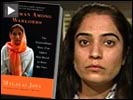
Malalai Joya, former Afghan member of parliament and outspoken critic of warlords, fundamentalists, the Taliban, and of the U.S. occupation of Afghanistan. She is touring the United States to promote the second edition of her autobiography, A Woman Among Warlords.


AMY GOODMAN: In Afghanistan, U.S.-led NATO forces fear increasing opposition after photographs of U.S. troops posing over dead Afghan civilians were published last week. The U.S. Army issued an apology after the images were published in the German news magazine Der Spiegel. Democracy Now! also broadcast the photos last week. And on Sunday, Rolling Stone magazine published similar images and videos in a special report on their website. The photographs are graphic and have been compared to the pictures that emerged from the Abu Ghraib prison in Iraq. The soldiers in the photographs are on trial for forming a secret "kill team" in Afghanistan that murdered unarmed Afghan civilians at random and collected body parts. The images were entered as evidence into the trial.
NATO air strikes have also recently led to civilian deaths. On Friday, NATO air strikes killed seven civilians, including three children, in Helmand province. Earlier in the week, NATO says two civilians were accidentally killed in an air strike in the province of Khost. Two children were killed in another NATO attack last week, and nine boys died in another attack earlier this month.
To discuss the situation in Afghanistan, we’re joined by activist and former Afghan member of parliament, Malalai Joya. The U.S. government initially denied a travel visa to Joya, who has been a vocal critic of the war. Supporters in the U.S. then mounted a protest campaign that included letters from the ACLU, groups of writers and academics, and nine members of Congress, and a mass phone-in to the State Department last Wednesday. On Thursday, consular officials allowed Joya to re-apply without the normal waiting period, and her visa was approved.
Malalai Joya is an outspoken critic of warlords, fundamentalists, the Taliban, and of the US occupation of Afghanistan. She is touring the United States to promote the second edition of her autobiography, A Woman Among Warlords. In 2010, Time magazine named Joya one of the 100 most influential people in the world. She has survived numerous assassination attempts. And she’s joining us right now from Burlington, Vermont.
Malalai Joya, welcome to Democracy Now! First, why did the U.S. government deny you a visa to come into this country?
MALALAI JOYA: Hello, Amy and also to all listeners. Thanks for this interview.
Because I exposed the wrong policy of the U.S. government to justice-loving great people of the U.S., and also I informed them about the wrongdoing of their government, that they’re killing innocent people under the name of the so-called war on terror. And I tell to justice-loving people of the U.S. that their taxpayer money, billions of dollars that their government pay, goes into pocket of the warlords, drug lords and criminals, and now negotiating with the Taliban and Gulbuddin Hekmatyar, these terrorists, as well. So, they are not honest for our people. And I’m talking about the blind bombardment of the U.S.A.-NATO forces, these occupiers, about the occupation of my country to great people of the U.S. These are, I think, the reasons, briefly what I said, that the U.S. and NATO, they’re afraid of me, and now they denied to give me visa. But I’m happy and honored for peace-loving, justice-loving people of the U.S. who put pressure on their government and showed their solidarity with my people once again. And that’s why finally they gave me visa. And I came here to bring the message of my people against occupation, for democracy and peace.
AMY GOODMAN: Malalai, is it true that when you went to the U.S. embassy to get your visa when you were in Afghanistan, they said they were denying it because you were unemployed and live underground?
MALALAI JOYA: Yeah, it was true reasons. I think it was just a mere excuse, that. Also, it was not just something—surprise for me. I could expect that they will refuse to give me visa, because I exposed the wrong policy of these warmongers and their war crime, that what they are doing, under the name of democracy, women’s rights, human rights, against my people.
AMY GOODMAN: Well, explain the living underground. Are you living underground? And what does that mean?
MALALAI JOYA: Underground, yeah, because they are—not only me, most of my people, millions of Afghan, by presence of tens of thousands troops, they don’t have security, which is important, more than food and water. They suffer from injustice, corruption, joblessness, poverty and many other miseries. So, my life, after my speech in 2003, that has been changed, because of telling the truth and I exposed the mask of these fundamentalist warlords, who are a photocopy of the Taliban. And day by day, it is getting risky, because I never do compromise with them, I never sit silent. I even—they want to eliminate. That’s why I have to be underground.
Today, most of women of Afghanistan, not only me, even despite wearing burqa, we are not safe there. This disgusting burqa, which is symbol of oppression, today gives safety to many other Afghans, especially activist women. And despite burqa and bodyguard, not now safe, my life not safe in Afghanistan, as changing the houses. So many other obstacles, not only for me, for other democratic-minded parties, intellectuals, activists that we have, and still they are underground.
AMY GOODMAN: Talk about the situation today in Afghanistan, the series of killings of civilians that the U.S. has had to apologize for, the person in charge, General David Petraeus, having to issue an apology for the first time a few weeks ago, especially around the killing of children. What’s happening?
MALALAI JOYA: You know, our people now, they’re fed up from listening apologies from the White House, these warmongers and NATO governments, and also the puppet regime, mafia corrupt regime of Hamid Karzai. We want the end of this brutal war, this disgusting war, this occupation, as soon as possible. During these 10 years, tens of thousands innocent civilians has been killed, most of them innocent women, children and men. And even they—during these nine years of their occupation, they used white phosphorus cluster bomb. They are bombing our wedding parties. Maybe you heard, as you earlier mentioned the report of Der Spiegel, that even they insult with the dead bodies of my people; these occupation forces make fun with these dead bodies. And their government, when they kill innocent civilians, doing massacres, they pay $2,000, these bloody dollars, to each victim’s family, it means that the lives of Afghans is equal to $2,000 for these warmongers, and while most time my people reject these monies.
Unfortunately, when Obama took office, his first news for my people was more conflict, more war, because he says more troops in Afghanistan. And the result of this was more miseries, more massacres, more tragedies. And also, when compared with the Bush administration, 24 percent civilian deaths increase. And many other miseries, violence are still going on in my country. And for thousand time, the recent report proves that today in Afghanistan, especially these nine years, the killing of my people for them is like killing the birds. But unfortunately, mainstream media, always they slide the truths, and they shamelessly decrease the number of civilian deaths and call them insurgents, terrorists.
AMY GOODMAN: You mentioned—you said the "die teams," what’s called the "kill team," the soldiers that are on trial right now in the United States, these photographs that Democracy Now! has broadcast, these horrendous photographs. And I urge people—I warn you, as we show these photographs, that Der Spiegel showed first, of these so-called kill teams that murdered unarmed Afghan civilians at random and collected body parts as trophies. How much attention is this getting in Afghanistan right now?
MALALAI JOYA: These photos, not only for Afghans, I believe for millions around the world as human being, for justice-loving people around the world, is heartbreaking. And it was not new for our Afghan people, as every day they are bombing, killing civilians, under the name of these terrorists, now negotiating with these fascist Taliban, terrorist Taliban, and also Gulbuddin Hekmatyar. These terrorists come in power, the situation will be more bloody, more disaster for my people.
That’s why every day when they are bombing, when our people know this news, there are many demonstration in Afghanistan. There are right now two kind of resistance in my country. One is the reactionary resistance of these terrorist Taliban that always mainstream media, U.S. government try to make a mountain out of a molehill. Another is resistance of ordinary Afghan people, the students of the universities, democratic-minded parties that we have. For example, Afghanistan Solidarity Party is a democratic-minded party, secular party, that recently they did a demonstration in different part of Afghanistan—in Mazar-i-Sharif, in Kabul, in Jalalabad, in Herat, in Farah province. Hundreds of people joined their demonstration with banners—"U.S. out of Afghanistan"—and against their brutalities, with the pictures of the victim civilians. But nobody listened to their voice, even not only the media in Afghanistan, which is not free and therefore this mafia media give report, also the mainstream media never give report the resistance of these people to justice-loving people around the world. They are the one who should be supported, these democratic-minded parties, intellectuals, activists that we have in Afghanistan. Still they are underground, but they never sit silent through struggle. Let’s support them as much as you can and put pressure on your government, that stop this wrongdoing, this war crime under the name of democracy and women’s rights.
AMY GOODMAN: Can you talk about who exactly the U.S. is working with and negotiating right now with in Afghanistan? With all that is happening in Libya and the Middle East, it seems that Afghanistan, coverage of Afghanistan, has even fallen farther off the radar, if that’s possible, astounding that the U.S. is conducting such a war and there’s so little coverage of it in Afghanistan.
MALALAI JOYA: They want to negotiate with Taliban and also Gulbuddin Hekmatyar, one bunch of terrorists like Northern Alliance who are mentally same like Taliban, only physically has been changed after 9/11. These warlords, their background, you can see on Human Rights Watch website. Many book has been written about them, like I Is for Infidel, Ghost Wars, Bleeding Afghanistan, like Devil’s Game book. If you read, it will help you to know better about these warlords who committed crimes against my people, the civil war from '92 to ’96, before domination of the Taliban. But after 9/11, they imposed on my people with the mask of democracy. That's why Afghanistan, day by day, goes from—the situation goes from worse to worse. And U.S. and NATO, especially U.S. government, created, supported these fundamentalists since Cold War and still don’t want to lose them.
And now these bunch of terrorists, that these 10 years, they become powerful, with suit and tie, with bloody hands. They invite another bunch of terrorists, like Taliban and Gulbuddin Hekmatyar, that the U.S. government in the past put his name on the blacklist as a wanted criminal. Without to say apologies to my people, these terrorists invite them to join this mafia corrupt regime. Mullah Omar is not moderate, that your government—I mean, U.S. government says to justice-loving people of the U.S., around the world, "We are negotiating with moderate Talib." We have no moderate Talib. How do they recognize that when this terrorist is moderate, another one is a not moderate? And Mullah Omar is a terrorist, and if people wish, all of these bunch of killers, like Sayyaf, Rabbani, Qanooni, Mohaqiq, Dostum, Khalili, Ismail Khan, Gulabzoi, Olumi, many other killers who also right now already they are in power and have high posts in Karzai’s regime—they should be brought to the national—International Criminal Court for the war crimes that they committed for all of these brutalities.
Now, these 10 years, they changed my country to the center of the drugs. Since 2001 until now, 4,400 percent opium increased in Afghanistan. Afghanistan is now the second most corrupt country in the world. There’s $2 billion the government of Karzai received from the so-called international community, but on there, my people even don’t have enough food to eat. More than 80 percent people are now jobless in Afghanistan and suffer from many other miseries.
It seems the shedding the blood of innocent people in Iraq and Afghanistan was not enough for U.S. government, that now, under the shadow or umbrella of U.N. now, invade Libya, as well, under the beautiful banner of women’s rights, human rights. And again, my message to justice-loving people of U.S., around the world, is that, please raise your voice against this wrong policy. When you see that while Obama’s administration raise hue and cry against Gaddafi regime and its crimes, but in the meantime supporting the dirtiest, much more dirty Gaddafi regime in Pakistan, in Afghanistan, in Iraq, in Israel, in Saudi Arabia, in many other countries.
AMY GOODMAN: We just have 30 seconds, Malalai Joya. The withdrawal beginning in July, do you believe this will be happening? And what would it mean if U.S. troops left?
MALALAI JOYA: It is just big lies. From one hand, the U.S. and NATO, they tell—the fool not only Afghan people, their own people too, by telling, "We will leave by the middle of 2011." But form another side, a U.S. puppet regime, Karzai’s regime, is talking about permanent U.S. military bases in my country, which is clear they will not leave my country soon. They are there because of their own strategic regional and economic interests.
We want the withdrawal of the troops because their presence, they double our miseries, create more obstacles, problems for the justice-loving, democratic-minded parties that we have, intellectuals, innocent people of my country—day by day getting powerful, eliminate them. So we are squashed between three powerful enemies: warlords, Taliban, occupation forces. With the withdrawal of occupation forces, we will fight two internal enemies. If the occupation forces leave, stop arming the warlords and Taliban, the backbone of these criminals will break. And of course, fight against Taliban and warlords is not easy, but the hopeful point is that—positive point is that my people hate the Taliban and also the warlords. If U.S. and NATO let us a little bit breathe in peace, then we know what to do with our destiny.
They are telling you that "Civil war will happen if we leave Afghanistan," but nobody is talking about today’s civil war. As long as these occupation forces will be there, the worse civil war will be. Democracy never come by military invasion. Democracy never come by bombing, killing innocent civilians, by cluster bomb or white phosphorus. Anyway, we’re fed up from this occupation. Now, my message of my people is this: we don’t want anything good from you, just stop wrong thing, just stop these massacres, just stop support of these criminals, these terrorists. And in the meantime, I’m asking for the solidarity and support of justice-loving people around the world, their moral support, educational support, because it’s the key to world emancipation.
AMY GOODMAN: Malalai Joya, I want to thank you for being with us, former member of the Afghan parliament, has survived numerous assassination attempts. Her book is called A Woman Among Warlords. Malalai Joya was named by Time magazine one of the 100 most influential people in the world.


Creative Commons License The original content of this program is licensed under a Creative Commons Attribution-Noncommercial-No Derivative Works 3.0 United States License. Please attribute legal copies of this work to democracynow.org. Some of the work(s) that this program incorporates, however, may be separately licensed. For further information or additional permissions, contact us.

Friday, March 18, 2011

Feminist Action Alert: The U.S. Government is Very Afraid of Malalai Joya's Speech: never mind that the U.S. is terrorising, raping, and murdering Afghan women

photograph of Malalai Joya is from here

Please click on titles below to link back to the source web pages from Afghan Women's Mission.

US government denies entry visa to Afghan women’s rights activist and author Malalai Joya


For Immediate Release –
 
The United States has denied a travel visa to Malalai Joya, an acclaimed women’s rights activist and former member of Afghanistan’s parliament. Ms. Joya, who was named one of TIME magazine’s 100 most influential people in the world in 2010, was set to begin a three-week US tour to promote an updated edition of her memoir, A Woman Among Warlords, published by Scribner, an imprint of Simon & Schuster.
 
Joya’s publisher at Scribner, Alexis Gargagliano, said, “We had the privilege to publish Ms. Joya, and her earlier 2009 book tour met with wide acclaim. The right of authors to travel and promote their work is central to freedom of expression and the full exchange of ideas.” Joya’s memoir has been translated into over a dozen languages, and she has toured widely including Australia, the UK, Canada, Norway, Germany, Italy, Spain, Portugal, France, and the Netherlands in support of the book over the past two years.
 
Colleagues of Ms. Joya’s report that when she presented herself as scheduled at the U.S. embassy, she was told she was being denied because she was “unemployed” and “lives underground.” Then 27, Joya was the youngest woman elected to Afghanistan’s parliament in 2005. Because of her harsh criticism of warlords and fundamentalists in Afghanistan, she has been the target of at least five assassination attempts. “The reason Joya lives underground is because she faces the constant threat of death for having had the courage to speak up for women’s rights – it’s obscene that the U.S. government would deny her entry,” said Sonali Kolhatkar of the Afghan Women’s Mission, a U.S. based organization that has hosted Joya for speaking tours in the past and is a sponsor of this year’s national tour.
 
Joya has also become an internationally known critic of the US-NATO war in Afghanistan. Organizers argue that the denial of Joya’s visa appears to be a case of what the American Civil Liberties Union describes as “Ideological Exclusion,” which they say violates Americans’ First Amendment right to hear constitutionally protected speech by denying foreign scholars, artists, politicians and others entry to the United States.
Events featuring Malalai Joya are planned, from March 20 until April 10, in New York, New Jersey, Washington DC, Maryland, Massachusetts, Vermont, New Hampshire, Pennsylvania, Illinois, Minnesota, Oregon, Washington and California. Organizers of her speaking tour are encouraging people to contact the Department of State to ask them to fulfill the promise from the Obama Administration of “promoting the global marketplace of ideas” and grant Joya’s visa immediately.
 
Malalai Joya is available for a limited number of interviews. Contact Sonali Kolhatkar (626-676-7884), Prachi Patankar (917-415-0659), or Natalie Reyes (562) 319-3046).

Please click on this link:

ACTION ALERT: Four Things YOU Can Do About Malalai Joya’s Visa Denial

 
* * *
 
Praise for Malalai Joya and A Woman Among Warlords:
 
‘The youngest and most famous of all the women in the Afghan parliament…a powerful symbol of change’
- Guardian
 
‘Quite simply the most passionate and devastating critique of Western intervention in Afghanistan I have ever read.’
- Peace News
 
‘Malalai Joya leaves us with hope that the tormented people of Afghanistan can take their fate into their own hands if they are released from the grip of foreign powers.’
- Noam Chomsky
 
‘Unwavering in her mission to bring true democracy to her country…Women have been known to walk for miles just to touch her. For them, she is their only real hope for a better future’
- Telegraph
 
‘Joya is a model for women everywhere seeking to make the world more just.’
- Six women Nobel Peace Prize laureates
 
‘Joya’s pain and bravery are genuine and can be felt on almost every page’
- Christina Lamb, Sunday Times
 
‘A fascinating account of Afghanistan’s political reality…Malalai Joya has been compared to Burma’s Aung San Suu Kyi’
- Irish Times
 
‘Malalai Joya is a staunch defender of human rights and a powerful voice for Afghan women.’
- Human Rights Watch
 
‘Heroic’
- John Pilger
 
‘Extraordinary’
- The Independent

Monday, March 14, 2011

Feminist Event: When is "War" and "Terrorism" neither? Here's one answer.

25 March 2011 UPDATE (please click on title just below for full update):

Malalai Joya, Afghan war critic, gets U.S. visa


A prominent Afghan feminist and war critic was granted a visa to enter the United States on Thursday - by the same State Department office that turned her down last week - and belatedly started on a speaking tour that is scheduled to wind up in San Francisco.
 
The case of Malalai Joya is the latest of several in which the Obama administration, after at first refusing entry, has allowed a visit by a foreigner who has criticized policies of the United States or its allies.
I am compelled to ask: how are men's wars against each other not part of men's war against women? The elements are all the same, no? Terrorism, domination, invasion, violence, horror, devastation. What's the difference? Oh, men's war against women is often also set up to appear completely normal and non-violent. Institutional. Interpersonal on the most intimate relational levels. Made to seem as though we have nothing to worry about behind the curtain, or under the sheets. And, yes, it's privatised in a way that men's warfare against other men is publicised--even while erroneously reported about by corporate media. When is terror and invasion seen as neither terrorising or invasive? When it is only men only doing each of those only to women. Then it's just "life". Then it's only "love", not ever war.

What follows this paragraph, is from *here*.

Upcoming Colloquium Will Focus on Impact of War on Women Worldwide
Posted on March 13, 2011

Studies Impact through Eyes of Iraqi, Palestinian, Afghan, and early American Women
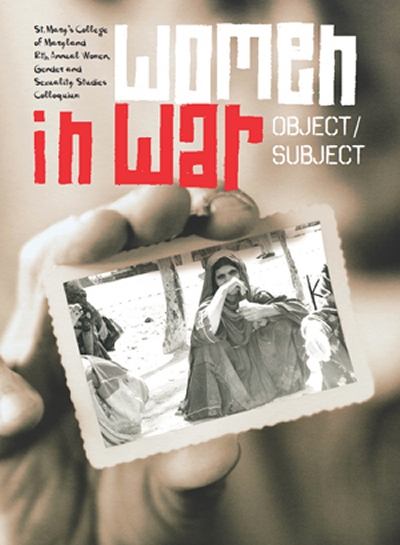
ST. MARY’S CITY, Md. (March 13, 2011) — When we think of how women's lives have been affected by wars in the course of human history, we often think of them as those left behind. Today, however, they fight on the frontlines, are used as weapons, and live as refugees. This year’s 12th annual Women, Gender, and Sexuality Studies Colloquium at St. Mary’s College of Maryland March 22-24 will focus on women as participants in, victims of, and rationales for war.

“Women in War: Object/Subject” will include a photo exhibit of Iraqi refugees, and presentations on Palestinian women living in Israel and women in early American warfare. Malalai Joya, an Afghan politician who was suspended from the Parliament because of her comments, also will be here. Her book, A Woman Among Warlords, comes out in paperback this March; Time magazine named her in its 2010 list of the 100 most influential people in the world. For more information on the colloquium, go to www.smcm.edu/wgsx/annual_colloquium/.

Supported by the Alice McLellan Birney Women Studies Fund, as well as community and college members, the colloquium each spring focuses on a topic critical to the lives of women. It has previously covered subjects as diverse as women in the workforce (2009), marriage in America (2007), and women and technology (2002).

This year’s schedule:

“Collateral Image,” photographic exhibitMarch 22 – April 8. Montgomery Hall Upper Commons. Opening reception at 4 p.m. March 22 in Upper Commons and artist lecture at 8:15 p.m. March 23 in Cole Cinema, Gabriela Bulisova, photographer and photojournalist.

“Gendering the Narratives of Three Generations of Palestinian Women in Israel”4:45 p.m. March 23, Cole Cinema. Isis Nusair, assistant professor of women's studies and international studies at Denison University.

“Neither Battlefield nor Home Front: The Liminality of Women in Early American Warfare, Real and Imagined”4:15 p.m. March 24, Cole Cinema. Andrea Robertson Cremer, assistant professor of history, Macalester College.

“A Woman Among Warlords: The Extraordinary Story of an Afghan Who Dared to Raise Her Voice”8:15 p.m., March 24, Cole Cinema. Malalai Joya, Afghan politician, teacher, and author. Reception and book signing to follow—Aldom Lounge, Campus Center.

Thursday, March 10, 2011

The Herstory of International Women's Day, by Dora Byamukama

photograph of Dora Byamukama is from here
The content of this post is from New Vision (Uganda), *here*.

What is Women's Day about?
Wednesday, 9th March, 2011

By Dora Byamukama

HAVE you ever wondered why March 8 is celebrated as the International Women's Day? We need to go back into history to find out how the International Women's Day came into practice.

It is reported that International Women's Day, originally called International Working Women's Day was originated by Clara Zetkin, a leader of the Social Democratic Party in Germany, who first proposed the idea of a women's day at the Second International Conference of Working Women in Copenhagen, Denmark in 1910.

The conference was attended by over 100 women from 17 countries and included workers' unions, socialist political parties and working women's clubs. This conference established a Women's Day, international in character, to honour the movement for women's rights and to assist in achieving universal suffrage for women. Zetkin's suggestion received unanimous approval and the first International Women's Day was celebrated in 1911.

The focus was on the rights of women workers and in 1908 about 15,000 women in various industries had marched on the streets of New York to press for shorter working hours, better pay and voting rights. They were baton-charged by Police who arrived on horseback. The ensuing struggle between women workers and the Police led to several women being injured and imprisoned for demanding their rights. This incident was one among others that had prompted Zetkin to demand a day that would remember the women's struggle, with a view towards continuing the resistance.

As a result of the decision taken at Copenhagen, International Women's Day was marked for the first time on March 19, 2011 in Austria, Denmark, Germany and Switzerland, where more than one million women and men attended rallies. Apart from the right to vote and to hold public office, they demanded the right to work, to vocational training and to an end to discrimination on the job.

With the passage of time, the meaning of the day was broadened to include political, economic and social rights for women. This year's International Women's Day marks 100 years since its inception. Reasons for its celebration currently vary and include:

  • A time to underscore the importance of women's rights and empowerment in all fields and a reminder that the agenda of women's rights must form the core of the agenda of all governments and nations;


  • Celebration of respect, appreciation and love towards women;


  • Celebration for women's economic, political and social achievements.


  • Simply an occasion for men to express their love for women;


  • A time to take stock of the achievements of women in the political, economic and social spheres and to project on the next goals.


  • A celebration of womanhood- the privilege of being a woman.

    The Theme for the International Women's Day for 2011 is "Act Now: Promote Maternal Health". It is reported that every year, globally, more than half a million women die due to complications of pregnancy or child birth and malaria. According to the Uganda Demographic Health Survey of 2006 about 6000 women annually die due to pregnancy related complications - this translates to about 16 women dying per day. This is a grave situation and the Government has already embarked on upscaling activities that address the issue of maternal mortality. The Government is doing this by implementing the provisions in the Constitution which provides that the state shall protect women and their rights, taking into account their unique status and natural maternal functions in society.

    The NRM Government has also initiated policies and supported enactment of laws that address maternal mortality, these include, creation of awareness and enforcement of the Prohibition of Female Genital Mutilation Act, 2010; the Domestic Violence Act, 2010; the Trafficking in Persons Act, 2009; Community policing, establishment of a domestic violence unit in Police and provision of 60 working days maternity leave and provision for paternity leave, among others.

    Uganda's International Women's Day celebrations of March 8, 2011 etched amazing memories in my mind. A prayer that referred to women as "helpers" attracted murmurs and instant debate as to whether women are "helpers" of men or companions or partners.

    The Islamic faith prayer was led by a lady, who reminded all that failure to accord girls and women equal rights prohibit that person from entering paradise. Then there was a splendid parade by women from the army and police forces. All this was crowned by the granting of medals to female army officers for their heroic acts and gold medalist Inzikuru and launching of the African Women's Decade 2010-2020 by President Museveni.

    The struggle for women's rights is a daily activity. It is women's day on all the 365 days of the year. Success has, to some extent, been secured but more needs to be done. The struggle continues!


  • Friday, March 4, 2011

    Yanar Mohammed Reports on the Protests and Revolutions for Freedom


    image is from here

    All that follows is from MADRE News website, *here*.


    The Day of Iraqi Rage

    Posted on: Thursday, March 3, 2011
    KeywordsIraqMiddle East
    We just received the following update from Yanar Mohammed, the director of our partner organization in Iraq, the Organization of Women's Freedom in Iraq (OWFI). She writes about the spread of demonstrations from the wider region into Iraqi cities and about the violent tactics that Iraqi security forces are using against protestors.


    Last Friday, February 25, was a historic day in Iraq. The revolution earthquakes in Egypt, Tunisia, and Libya sent shockwaves in our direction.

    (Photo at left: Yanar Mohammed, OWFI Director)The main squares of most Iraqi cities were filled with protestors raising the same demands of providing electricity, employment, an end to governmental corruption, and a plea for general freedoms.

    Although the government announced a curfew and closed all streets from vehicular movement, and the highest religious clerics discouraged the people from protesting, almost 70,000 people gathered in the main squares in all of Iraq, united around their main demands.

    For the first time in eight years, the demonstration united people of different religions, ethnicities, sects, and political affiliations to denounce the extreme and continuous corruption and demand a share for the people in the countries resources from oil.

    OWFI plays a role in the political participation of women within movements for national freedoms and liberties in Iraq. Although our numbers are small when compared to the huge demonstrating masses, the purpose was to help organize some of the freedom-loving youth groups which had started from facebook, but grew and multiplied in February. OWFI was one of the organizers of the demonstrations in Baghdad and Samarra raising slogans of change, right to work, and of course, equality.

    --------

    Al Tahrir Demonstration in Baghdad

    Although the demo was announced as a peaceful one, the security forces ended it at 5pm by throwing sound bombs, splashing hot water, shooting plastic bullets, and live bullets at the demonstrators.

    When we would not move, but chant slogans of relentless struggle, the security trucks began to drive down the square to chase and shoot us with live bullets, and beat up many of the demonstrators who fled into the alleys surrounding Al Tahrir square. One of our male supporters was shot in the knee, while two others were beaten by the US-trained anti-riot police and the Iraqi army. Almost 20 people were shot in that day around the square, although the announced numbers were much less. Some died while the wounded were detained.

    For those of us who ran to safety, we had to walk 5 hours in order to reach our homes in streets where cars were not allowed to drive.

    -----

    In the western city of Samarra, OWFI women and men were leading the demonstrators, and raising banners demanding support for the widows who are a majority among the women of Samarra. It was a precedent for a tribal community protest to be led by women.

    At the same time in most Iraqi cities, the army shot the demonstrators in the evening, attempting to disperse the demonstrators. 7 were killed in this city, while 15 were wounded.

    -----

    Demonstrations happened in parallel in the Kurdish North and the South, making it clear that nobody cared for the artificially created division lines of sunni, shia, Arab, Kurd, Turkmen, etc… It was a day of a unified struggle against corruption, oppression, basic rights and freedoms.

    -----

    While most demonstrating groups carried banners demanding reform of the government, the shooting and harassment of the demonstrators by anti-riot police and by the army shifted the slogans toward ones which rejected the oppressive measures.

    ------

    OWFI had carried the banner of "change" since the beginning of the demonstration, and advised groups of cooperating youth demonstrators to do the same. The opposition media picked up the slogan and announced it on local TVs:"…that OWFI activist Yanar Mohammed will demand (Change) in the coming demonstration next Friday."

    ------

    We are organizing for the coming Friday, hoping that the streets will be open, and that the army will let us into Al Tahrir square after 30 hours from now.


    Wish us good luck,
    Yanar Mohammed

    Photos:


    [Yanar also sent the videos below with this note: "please take a look at the short video clips we took of the demonstration before the shooting. We were still smiling as the shooting had not begun."]

    Monday, February 28, 2011

    Houzan Mahmoud and other speakers on the Revolutionary Struggles in Northern Africa and Central Asia

    photograph of Houzan Mahmoud is from here

    I'll confess this from the start: I'm no Marxist. And I'm anti-corporate capitalism. What does that "make me"? It makes me pro-humanity and pro-Earth/Gaia and its diversity of Life. I don't identify with, work with, or organise with people who are on the white male supremacist political spectrum, which runs from State Fascism to (in the U.S.) Christian Fundamentalist Extremist Conservatism, to being a Moderate Republican, a Moderate Democrat, to being a Liberal Humanist, to Social Progressive, to (beyond the U.S.) the political philosophies promoted among Social Democracies, and Socialist Nation-States.

    The reason I'm not Marxist (or any of the other categories above), is because I view Marxism--and most if not all of its manifestations, to be anti-Indigenist (see the work of Winona LaDuke and analysis by Noaman Ali of the work of Ward Churchill, as well as Ward's own work, on this subject) and pro-patriarchal (see the analysis *here* as well as the work of Catharine A. MacKinnon in Toward A Feminist Theory of the State, among other radical feminists, on this subject). The spectrum above doesn't tend to deal with heterosexism either. So that's another point of non-affiliation and non-alliance for me.

    But, people around the world have limited tools with which to combat various forces of destruction. And while I don't identify with many current political movements and philosophies, I do support those people seeking freedom from tyranny, terrorism, and torture. And greed, rampant social oppression and terroristic dehumanisation, and gross unchecked corruption in various countries and by nation-state leaders is a serious problem, including, historically, in North America. The U.S., for example, is a gross violator of international human rights. It has engaged in torture. It is a pro-rape society. It is a society that is white het male supremacist to its foundation. It is an anti-woman society. It is also a society that is anti-lesbian and anti-feminist (actively opposed to the radical efforts of women to attain freedom from patriarchal conditions). And while the liberal media here portrays this country as unequivocally "good" and "moral" this society is neither, if we look at what practices it passively and actively, covertly and overtly, endorses and enforces. That said, here's information on some speakers addressing radical social change in the Middle East, including Northern Africa. I support oppressed people working with the tools available to them to achieve freedom from systematised, institutionalised harm and inhumanity; I rather passively support resistance to the destruction of Life on Earth beyond human life. See, especially, the work of all Indigenous activists and the collected writings of Dr. Vandana Shiva.


    All that follows is from *here*.
    Alan Woods, Serge Goulart and Houzan Mahmoud to speak in London on the Arab revolution

    Written by ULU Marxist Society
    Friday, 25 February 2011 00:00

    On March 3rd the University of London Union Marxists will play host to a very special meeting on the revolutionary events unfolding in the Arab world. Speakers include: Houzan Mahmoud, the representative of the Organisations of Women's Freedom in Iraq and a member of the Worker-Communist Party of Iraq; Serge Goulart, co-ordinator of the Occupied Factory movement in Brazil; and Alan Woods, secretary of the International Marxist Tendency.

    Speakers:
    Houzan Mahmoud (Organisation of Women’s Freedom in Iraq)
    Alan Woods (International Marxist Tendency)
    Serge Goulart (Co-ordinator of the Occupied Factory movement in Brazil)
     
    Dramatic events are unfolding across the Middle East and the Maghreb. Mass uprisings against high prices, unemployment and brutal dictatorship which began in Tunisia have spread throughout the region to the most distant parts of the Arab speaking world. Algeria, Morocco, Libya, Sudan, Bahrain, Jordan, Iraq, Yemen, Kuwait, Djibouti -- the list is growing longer, not by the day but by the hour.
     
    The dictatorial regimes in Tunisia and Egypt have already been toppled by the movement and the same fate now threatens Gaddafi in Libya who has shown his readiness to slaughter his own people in order to cling to power. In Bahrain, which is next to both Iran and Saudi Arabia, the desperate attempt of the monarchy to crush the mass movement in blood has failed.In Iran also there are indications that the mass movement is reviving. There are clear signs of splits in the regime and in the state upon which it rests.Now, in Kurdish Iraq, mass unrest has erupted, threatening the shaky edifice put in place by the imperialists as they try to cut their losses while maintaining influence over the country's affairs and its oil. Everywhere in the region people are on the streets!
     
    The Revolution taking place in the Middle East knows no frontiers, unifying the people of the region in struggle and inspiring people all over the world. The Western Imperialist powers are terrified of the great wave of change engulfing the Middle East and behind limp messages of support for “pro-democracy” movements, they are already manoeuvring to see the movement sold short in their interest. In the midst of these world-changing events it is imperative that we come together in support of the growing Revolution and discuss the nature of these events, what we can do solidify and act on the mass of support in this country, and what inspirations and lessons we can take for our own movements. Anyone is welcome and encouraged to come and share their views!
     
    http://www.militantstudent.com/home/events/icalrepeat.detail/2011/03/03/79/-/london-where-next-for-the-arab-revolution

    On Facebook:
    http://www.facebook.com/home.php#!/event.php?eid=156800401041992
    Last Updated on Saturday, 26 February 2011 20:39

    Saturday, February 12, 2011

    Peace, Blessings, and Congratulations to the People of Egypt! And Nawal El Saadawi on the Revolution

    At Cairo’s Tahrir Square, after President Hosni Mubarak handed over control of the country to the military and left the capital. AP
    A 30-second announcement Friday ended the 30-year autocratic rule of President Hosni Mubarak, setting off a wave of celebration at Tahrir Square and all of Egypt, the roar unsettling regimes across the Middle East.

    Hours after his defiant speech on state television enraged tens of thousands demanding his ouster, Mubarak finally ceded power to the military and left Cairo with wife Suzanne for his retreat in Sharm el-Sheikh on the Red Sea coast.

    Official confirmation of his departure came at 9.30 pm India time when an ashen-faced Omar Suleiman, Vice President and longtime intelligence chief, in a statement on state-run Nile TV, said: “My fellow citizens, in view of these hard circumstances that the country is facing, President Hosni Mubarak has decided to step down as President of the Republic and has asked the higher council of the armed forces to run the affairs of the country.”
    Source for the above, including the photograph, is *here* at Indian Express.

    Egypt is free of Hosni Mubarak as their president. I am happy for the Egyptian people who have persevered for thirty years under his rule, and have now accomplished what many said was impossible: revolution. Peace and blessings to the Egyptian people.


    الصلاة والسلام

    And a thousand congratulations:  

     ألف مبروك


    All that follows is from *here* at CounterPunch.
    Weekend Edition
    February 11 - 13, 2011

    A View from Tahrir Square

    The Egyptian Revolution Unfolds

    By NAWAL EL SAADAWI


    I have lived to witness and participate in the Egyptian Revolution from Jan 25, 2011 until the moment of writing this essay in the morning of Sunday, Feb 6, 2011. Millions of Egyptians, men and women, Muslims and Christians, from all doctrines and beliefs, are united against the current oppressive and corrupt regime, against its revered top pharaoh who “still holds on to his throne even if shedding his people’s blood”, against its corrupt government and the ruling party which hire mercenaries to kill the youths, against its cheating and fake parliament whose members represent illegal properties, women, drugs, and bribes, against its elites who are called ‘the educated elites’ who sold their conscience and pens , destroyed education, public and private morals and culture, and misled the public and individual opinion to gain temporary interests and ruling positions, be small or big ones.

    Young men and children, men and women have spontaneously gone out of their houses, led and protected by themselves , after the security and policemen have failed and the controlling elites of culture and media have crumpled down. After the collapse of the rich and powerful and the self-interested party leaders who have explicitly and implicitly supported the regimes of corrupt dictatorships for about 50 years, opportunism and double-standard and deceiving moral values have fallen down; such values have corrupted both the family and the individuals, spreading chaos under the name of safety, dictatorship under the name of democracy, poverty and unemployment under the name of improvement and prosperity, prostitution and marriage betrayal under the name of morals and freedom of choice, humiliation by and submission to the American and Israeli colonization under the name of aids, partnership, friendship and peace process…such a regime which has jailed those with sincere and creative pens inside cells to separate them and taint their reputation, or send them in to exile inside or outside the country.

    Millions of Egyptian, men and women, went out in the streets in all provinces, cities and villages, in Aswan, Alexandria, Suez, Bour Said, and all parts of the homeland. In Cairo, the capital, we have encamped in Meidan al-Tahrir for 11 days, day and night till now. Meidan al-Tahrir has become our land and our camp. We settle on its asphalt and inside tents as a solid entity of men and women…we will never leave our place even though the police, disguised in civilian clothes, attack us and even if al-Meidan is attacked (like what happened on Feb 2) by mercenaries hired by the regime. Those were given bribes (50 EGP and a chick for a soldier, and the bigger one’s rank the bigger the bribe is).They stormed into al-Meidan riding horses and camels, armed with various weapons (red, yellow, and white ones). One of the horses was about to trample on me while I was standing in al-Meidan with the young men. They carried me away from this primitive attack; I saw them with my own eyes moving around in al-Meidan, shooting everywhere. Amid the dust and smoke which surrounded al-Meidan and its surrounding buildings, I saw firing flames flying in the sky, young men falling, and blood shedding. A semi-military war broke out between the regime’s henchmen and the peaceful Egyptian people who were calling for freedom, dignity and justice. But the defense committee of the revolutionary young men managed to fight back those mercenaries and captured some horses and camels and 100 mercenaries with their IDs, among them were state security officers, central security officers, policemen, and some of them were jobless and criminals who were released from prisons. Some of them confessed that they were bribed with 200 EGP and promised with 5000 EGP if they managed to scatter the youths in al-Meidan by using their swords and sharp weapons. They described the youths who led this revolution as “the kids who made the disturbance” using the language of Mubarak’s big heads who gave orders and money.

    The young men built their tents in the square to get some rest. Women with their infants lied down on the ground in the cold and rain. Hundreds of ladies and girls, never harassed by anyone, walked proudly feeling freedom, dignity, and equality among their fellows. Christians are participating in the revolution side by side with Muslims. I was surrounded by some young men from Muslims Brotherhood: they said to me “We disagree with some of your opinions in your writings but we like and respect you because you have not acted hypocritically with any regime or force inside or outside the country.” During my walk in the square, people were coming to me, men and women, from different directions, embracing and hugging me saying “Dr. Nawal, we are the new generations who have read your books and inspired by your creativity, rebellion and revolution” I swallowed my tears and said “This is a happy occasion for all of us, a celebration of freedom, dignity, equality, creativity, rebellion, and revolution.”

    A young woman, named Rania, “We ask for a new constitution, a civil one, which does not segregate between races, gender, and religion.” Another young man, a Christian named Butrus Dawood, said “We want a civil personal statute which does not segregate between people in terms of doctrine, gender or religion.” A young man named Tariq al-Dimiri declared, “The young men made the revolution and we have to select our interim government and a national committee to change the constitution.” A young man, Mohamed Amin, said “We want to open the People's Assembly and Shura Council and proceed with honest elections to choose a new president and new popular councils.” A young man named Ahmed Galal said, “We are a popular revolution that puts a new social contract, not just demands, slogan of our revolution.”

    Free equality, and social justice, who makes revolution is one who puts the new government rules, chooses the transitional government, selects National Committee which changes the constitution, establishes a committee of governors of the revolution so that opportunists (the owners of wealth and power) are not imposed on us. Committees of governors did not participate with us in the revolution, but comes now to us by plane from Europe or America. Among the Egyptians who lived their lives outside or inside the country now come to become leaders of the revolution. We say: “Who did the revolution are the ones who are leading the revolution. Among us governors from young people of thirty years, forty or fifty years of age. We have competencies in all scientific political and economic fields. We are the ones who form a committee of our governors and our government in transition, and the National Committee to change the constitution and laws. A young Mohamed Said said “I feel proud for the first time in my life because I am Egyptian. Despair and depression were gone and defeat was turned into victory. We paid the price of freedom with the blood of our martyrs. There is no power to bring us back.

    Al-Meidan turned to an entire city with its facilities, and in the hospital thereabout sleep injured and wounded, doctors and nurses from the masses of young people volunteered, residents volunteered with blankets, medicines, cotton and gauze, food and water, something like a dream and fantasy, I am living with the young men and women day and night. Committees were formed among these young men and women to handle all chores from sweeping the Meidan to transporting the injured to hospital, providing food and medicines, taking over the defense of the Meidan and responding to the lies of the system in the media to nominate the names of the Transitional Government and the Committee of governors, and others. Walls for the houses, institutions and taboos that distinguish between citizens, women and men, Muslim and Christians or others faded. We become one nation, no divisions on the basis of sex, religion or other, all demanding the departure of Mubarak and his trial and his men in the party and the government, the bloodshed on Wednesday, 2 February and all days since 25 January, corruption and tyranny over thirty years of rule, and the rest of the interview.

    Nawal el Saadawi, at age 80, has been in Tahrir Square in solidarity with her countryfolk since the beginning of the revolution that has today ended the 30-year dictatorship of Hosni Mubarak. Her many books include: 
    Women and Sex, Woman at Point Zero, The Fall of the Imam, Memoirs From the Women's Prison and A Daughter of Isis.
     
    Translated By Dr. Rabia Redouane, Dept of Modern Languages, Montclair State University