Showing posts with label all war is war against women. Show all posts

Tuesday, July 19, 2011

Two books: Sexuality and War, by Evelyne Accad, and Unmaking War, Remaking Men, by Kathleen Barry

I'd like to bring attention to this 1992 book by feminist-author Evelyne Accad, titled:

Sexuality and War: Literary Masks of the Middle East

http://profile.ak.fbcdn.net/hprofile-ak-snc4/50312_368694459342_4324798_n.jpg
photo of Evelyne Accad is from here
and to this 2010 book by long-time white feminist-author, Kathleen Barry, dealing with related themes and issues:

Unmaking War, Remaking Men: How Empathy Can Reshape Our Politics, Our Soldiers and Ourselves

http://www.womensmediacenter.com/blog/wp-content/profile-pics/270.jpg
photo of Kathleen Barry is from here

And I'd like to thank both women for all their many years of work.

One thing that is worth noting, is how it is feminist women, first and foremost, who make the critical connections between men's wars on one another and men's war on women. Masculinist/masculist men, traditionally, make the connections in practice, uncritically.

I'll add this: I have noted to some het men personally, how it is that the ethics and power abuses of their sexual practices are protected by them in a presumed right of privacy, the same right used against women in all manner of atrocious ways. When I challenge het men to speak out and speak up about how they abuse or exploit women using sex as a means of control or harm, they get very silent very fast.

I am reminded of how men who return from war don't speak freely about what they do in military warfare: we are led to believe that this is because the experiences are too painful to recall.

And I'll add this: I live in a society that sets up a culture of dishonesty and protectionism of men's abuses of women and girls. When men do commit violations against female human beings' bodies, these men can be supported by attorneys to not tell the truth about what they did, whether or not they fully understand the political meaning of it.

That said, Accad and Barry explore far more themes far more in depth that I will ever do here. So I welcome you to read both books and bring discussion and activist challenges to the issues they explore.

Sunday, May 1, 2011

Osama bin Laden is dead. Now can the U.S. get out of Afghanistan and Pakistan?

Or will the U.S. use this death as an excuse to stay in corrupt wars even longer?

The U.S. government has been terroristically and criminally at war against Iraq, Afghanistan, Pakistan, and has military presence in the Middle East and North Africa. Will the death of bin Laden result in the U.S. withdrawing troops? Or will the U.S. remain the most terroristic, militarised, racist nation-state on Earth?

anti-war image is from here

Dear President Obama,


Please withdraw all troops from Afghanistan and everywhere else, cut the military budget, increase taxes on the rich, make corporations earning billions annually pay taxes, and stop looting the poor and middle class. And please stop looting and polluting the Global South too. And stop the genocide against Indigenous people. And rape. And please work to end all forms of exploitation of girls and women.


Julian Real


Saturday, April 2, 2011

Here's a Question: Why Not Listen to and Follow the Orders of the Women of RAWA?

image is from here
Visiting a local Kabul primary school, I asked the teacher there what she thought of Australia's contribution of building schools. Expecting enthusiastic support, I was surprised at her response. "Pff," she scoffed. "We don't need schools. We need teachers. What good is a school when there are no teachers to teach the children? Why wouldn't your government ask us what we really need instead of building empty schools?"


Time and time again I was asked, "Why is your military here? They pay local warlords for protection for their convoys, and they in turn pay the Taliban. Why are you supporting the people you're trying to fight?" It so defies logic that they turn to other explanations; indefinite occupation, control of resources. I struggle to think of other plausible reasons for our presence. "Help us do it by ourselves," my teacher friend pleaded. "It is something we should do by ourselves." (this is an excerpt from what follows in the article below)

If you don't get by now that the U.S. government is a terroristic organisation designed to rule the world by any and all means necessary, or, at least, to try and militarily occupy as much of it as possible, while also killing civilians and non-human Life, then I honestly have to ask if you're paying attention at all to what the U.S. government is doing. The banking industry, the megacorporations that won't and don't pay taxes, and the leadership that is about as corrupt as it gets, will all be presented to you as, somehow, "good" for U.S. Americans, meaning, honestly, rich white het men. Because the laws here don't protect anyone else from rich white het men's abuses, including against rich white women.To Simon Moyle: please instruct all who listen to you to listen to the revolutionary WOMEN of RAWA and in Afghanistan generally. Thank you. And thank you for speaking out against a murderous, corrupt, insane, and barbaric war initiated by the Rich White Man and fought only for HIS interests and no one else's.

The source for what follows is *here*.

Face to face with Afghanistan and a war we cannot win

Simon MoyleThe customs officer pulled me aside as I exited the airport gates. "Sir, was there a reason for your going to Afghanistan on a tourist visa in the ... uh ... current climate?"

I smiled. I know it's not everyone's holiday destination, but I had my reasons.

Afghanistan has from the very beginning been sold to us as "the good war". Yet precious little information about the situation on the ground is allowed to filter through to the Australian people. With a Defence Department which routes everything through its PR department, I decided to travel to Afghanistan to see for myself.


What I saw and heard there belies most of what we are told by our government.


No one - it seems - in Afghanistan supports the Karzai government, with the exception of government officials and the military. Karzai is seen as entirely corrupt and out of touch with everyday people, and his warlord Parliament are only interested in their own wealth. People just get on with their lives, resigned to this veneer of democracy being impenetrable for the ordinary Afghan, with no expectation that these criminals will represent their interests. The only thing stopping the government from being entirely irrelevant is the amount of aid money which flows straight into their pockets, a source of anger for ordinary Afghans.


As a result, even aid has become suspect in Afghanistan - so much of it is militarised, tainted by partisan interests or stripped bare by corruption that only the bravest, most foolish and most desperate are willing to receive it.


Meanwhile, according to a World Health Organisation worker at my hotel, there is nothing stopping the open sewers in the streets of Kabul from running into the water supply. There is no sanitation, and he is shocked a massive outbreak of cholera has not occurred. Additionally, the poor air quality in Kabul kills 3000 people a year through respiratory disease.


Unemployment is at 40%, and people still have to survive on an average wage of $200 per year. Meanwhile, security contractors earn up to $350 per hour. Afghans see this disparity and understandably conclude we are not there to help them.


Poverty and insecurity are in such dire proportions that the day before I departed for Afghanistan, the International Committee for the Red Cross - normally conservative in their statements - declared life for ordinary Afghans to be "untenable".


Women, too, are no more liberated. Outside of Kabul every woman I saw wore a burqua; even inside Kabul most women still wear one. The best work being done in this respect is by organisations like the Revolutionary Association of the Women of Afghanistan (RAWA), and courageous individual women who risk their lives; a job made harder by the perception that such groups are Western influenced.


Visiting a local Kabul primary school, I asked the teacher there what she thought of Australia's contribution of building schools. Expecting enthusiastic support, I was surprised at her response. "Pff," she scoffed. "We don't need schools. We need teachers. What good is a school when there are no teachers to teach the children? Why wouldn't your government ask us what we really need instead of building empty schools?"


Time and time again I was asked, "Why is your military here? They pay local warlords for protection for their convoys, and they in turn pay the Taliban. Why are you supporting the people you're trying to fight?" It so defies logic that they turn to other explanations; indefinite occupation, control of resources. I struggle to think of other plausible reasons for our presence. "Help us do it by ourselves," my teacher friend pleaded. "It is something we should do by ourselves."


Poverty and unemployment fuel the anger here, especially when they see billions spent on aid which does not reach the people, and on a military occupation which is not making them safer. This year is set to be the most violent yet. There is no love for the Taliban, but the foreign militaries are seen as worsening the problem by fuelling the armed resistance and supporting corruption.


The Australian government and Defence Forces might be able to keep us in the dark, but ordinary Afghans are not so easily fooled. We are losing this war. We are militarily supporting a corrupt, criminal regime. We are not making progress; the insurgency is growing every day and Afghans feel increasingly less secure. Even our aid and good intentions are not reaching the people who need them most. As my Afghan friends said, "Peace is a prerequisite for progress."


Hope exists in the strong and resilient Afghan people and the fragile Afghan civil society organisations, groups unfortunately made more fragile by the insecurity of the foreign military presence.


"Why not listen?" my new Afghan friends asked me. Not to the corrupt Karzai government, nor to the military elite, but to the ordinary farmers, taxi drivers, and unemployed of Afghanistan. I'd like to ask the same of my own government.

Simon Moyle is a Melbourne Baptist Minister, husband and father of three.

Monday, March 14, 2011

Feminist Event: When is "War" and "Terrorism" neither? Here's one answer.

25 March 2011 UPDATE (please click on title just below for full update):

Malalai Joya, Afghan war critic, gets U.S. visa


A prominent Afghan feminist and war critic was granted a visa to enter the United States on Thursday - by the same State Department office that turned her down last week - and belatedly started on a speaking tour that is scheduled to wind up in San Francisco.
 
The case of Malalai Joya is the latest of several in which the Obama administration, after at first refusing entry, has allowed a visit by a foreigner who has criticized policies of the United States or its allies.
I am compelled to ask: how are men's wars against each other not part of men's war against women? The elements are all the same, no? Terrorism, domination, invasion, violence, horror, devastation. What's the difference? Oh, men's war against women is often also set up to appear completely normal and non-violent. Institutional. Interpersonal on the most intimate relational levels. Made to seem as though we have nothing to worry about behind the curtain, or under the sheets. And, yes, it's privatised in a way that men's warfare against other men is publicised--even while erroneously reported about by corporate media. When is terror and invasion seen as neither terrorising or invasive? When it is only men only doing each of those only to women. Then it's just "life". Then it's only "love", not ever war.

What follows this paragraph, is from *here*.

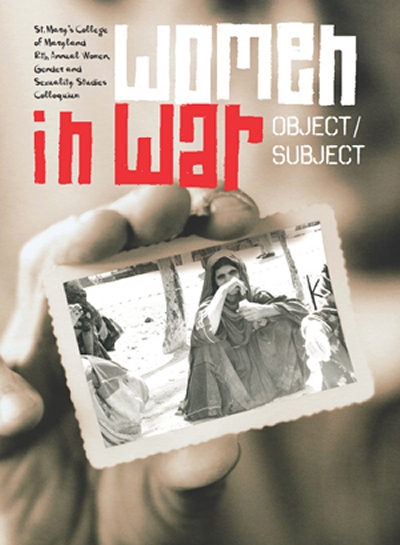
Upcoming Colloquium Will Focus on Impact of War on Women Worldwide
Posted on March 13, 2011

Studies Impact through Eyes of Iraqi, Palestinian, Afghan, and early American Women
ST. MARY’S CITY, Md. (March 13, 2011) — When we think of how women's lives have been affected by wars in the course of human history, we often think of them as those left behind. Today, however, they fight on the frontlines, are used as weapons, and live as refugees. This year’s 12th annual Women, Gender, and Sexuality Studies Colloquium at St. Mary’s College of Maryland March 22-24 will focus on women as participants in, victims of, and rationales for war.

“Women in War: Object/Subject” will include a photo exhibit of Iraqi refugees, and presentations on Palestinian women living in Israel and women in early American warfare. Malalai Joya, an Afghan politician who was suspended from the Parliament because of her comments, also will be here. Her book, A Woman Among Warlords, comes out in paperback this March; Time magazine named her in its 2010 list of the 100 most influential people in the world. For more information on the colloquium, go to www.smcm.edu/wgsx/annual_colloquium/.

Supported by the Alice McLellan Birney Women Studies Fund, as well as community and college members, the colloquium each spring focuses on a topic critical to the lives of women. It has previously covered subjects as diverse as women in the workforce (2009), marriage in America (2007), and women and technology (2002).

This year’s schedule:

“Collateral Image,” photographic exhibit—March 22 – April 8. Montgomery Hall Upper Commons. Opening reception at 4 p.m. March 22 in Upper Commons and artist lecture at 8:15 p.m. March 23 in Cole Cinema, Gabriela Bulisova, photographer and photojournalist.

“Gendering the Narratives of Three Generations of Palestinian Women in Israel”—4:45 p.m. March 23, Cole Cinema. Isis Nusair, assistant professor of women's studies and international studies at Denison University.

“Neither Battlefield nor Home Front: The Liminality of Women in Early American Warfare, Real and Imagined”—4:15 p.m. March 24, Cole Cinema. Andrea Robertson Cremer, assistant professor of history, Macalester College.

“A Woman Among Warlords: The Extraordinary Story of an Afghan Who Dared to Raise Her Voice”—8:15 p.m., March 24, Cole Cinema. Malalai Joya, Afghan politician, teacher, and author. Reception and book signing to follow—Aldom Lounge, Campus Center.

Thursday, March 3, 2011

"The Afghan War is Brutal, Expensive, Unpopular, and Ineffective" by Sonali Kolhatkar

photograph of Sonali Kolhatkar is from here
What part of the article that follows does the U.S. Government not understand?
 
What follows was found *here*.


The Afghan War is Brutal, Expensive, Unpopular, and Ineffective – So Why Are We Spending Billions on It?

Leading Afghan Feminist Wants the U.S. and NATO to Leave Her Nation

"The sad truth is that Obama’s war policies have turned out to be even more of a nightmare than I expected.” – Malalai Joya, A Woman Among Warlords
While millions of Americans are experiencing unemployment, wage stagnation, rising tuition, dwindling social services, and poverty at levels not seen since the Great Depression, an unjustifiably large proportion of our taxes are being used to cause death and destruction in Afghanistan. With Afghanistan being the longest war the U.S. has ever officially waged, we should carefully examine the costs of the war - financial and otherwise - and ask ourselves, is it really worth it?

 
Afghan activist and former Member of Parliament, Malalai Joya, wants the U.S. and NATO out of her country. She will soon embark on a new US speaking tour to help reinvigorate the war debate.

The war costs taxpayers between $500,000 to $1 million per soldier in Afghanistan every year. Since President Obama deployed thousands of more troops than Bush, the escalating war has come with a bloated price tag. So far, we have spent $336 billion on the war, and if Congress approves a request for additional funding, that number will go up to $455.4 billion – nearly half a trillion dollars. According to CostofWar.com, just the $120 billion in additional funding could fund 1.6 million elementary school teachers for a year, 1.9 million firefighters for a year, or $5,550 Pell Grants for 19.3 million students. A single month’s expenses on the Afghanistan war could pay for 46.9 billion meals for the hungry each month. Six months’ worth of Afghanistan war expenses could pay for school supplies for every single child in the world.

In addition to its financial price, the Afghanistan war is costing real human lives. Over the course of the entire war, at least 1,400 U.S. troops have been killed and over 10,000 wounded. The rate of deaths is also increasing, as more than a third of the total troops killed (499) died just during the past year. The price paid by ordinary Afghans is even greater. Not counting so-called insurgents, at least 2,412 civilians were killed and 3,803 were wounded in just the first 10 months of last year – these are most likely conservative estimates. The rate of Afghan civilian deaths is up 20 percent compared to the year before, directly corresponding to the increased troop levels under President Obama. In fact, over the course of the war, U.S.-led military actions have resulted in more direct civilian deaths (5,791 - 9,060) than “insurgent”-led actions (4,949 - 6,499).

Meanwhile, the U.S.-backed government in Afghanistan has no more legitimacy than Egypt’s embattled Mubarak regime. The 2009 elections in which President Hamid Karzai claimed victory were condemned internationally as fraudulent. Released documents showed that 100% of votes from dozens of polling places in provinces like Kandahar were for Karzai. Afghanistan’s Electoral Complaints Commission received thousands of complaints of fraud. Journalists easily purchased voter registration cards on the black market. Despite documentary evidence of criminal activity implicating top government officials and Karzai himself, the U.S. continues to legitimize the central government as the only alternative to the Taliban. There is also little criticism beyond vague assertions of “corruption” of members of the Afghan Parliament. Many Afghan MPs have a history of bloody war crimes, particularly during the post-Soviet era of the early 1990’s when tens of thousands of civilians were maimed, raped, and killed often with U.S.-supplied weapons. Today, those same men, considered the Taliban’s ideological brethren, control private militias, suck up millions of dollars of aid for their private gain, terrorize civilians, and are neck-deep in the drug trade.

It is no wonder then that leading Afghan activist and former Member of Parliament, Malalai Joya, wants the U.S. and NATO out of her country. Having come face-to-face with the brutality of war and the power that U.S.-backed war criminals wield, Joya has been demanding an end to the occupation for years. In her book, A Woman Among Warlords, just out in paperback, Joya explains the situation of ordinary Afghans: “[w]e are caught between two enemies – the Taliban on one side and the U.S./NATO forces and their warlord allies on the other.” She goes on to say that “for our people, Obama is a warmonger, like Bush. He follows the same disastrous policies, only with much more determination and force.”

Joya is the most outspoken Afghan to have been elected to Afghanistan’s Parliament. She is beloved by her people for daring to speak out against U.S.-backed war criminals that dominate the government and is targeted by those very warlords. In fact, Joya has survived at least 4 assassination attempts. She represents a majority of Afghans that want neither a foreign occupation with its fundamentalist lackeys in government nor their enemies the Taliban and Al Qaeda. Despite this, her opinions are rarely reflected in U.S. media.

By most accounts, violence is increasing. According to the Afghanistan NGO Safety Office (ANSO), attacks in Helmand and Kandahar rose by 124% and 20% last year compared to 2009. Furthermore, the violence has now spread to parts of the previously more peaceful North and East, but the U.S. military and its spokespeople continue to cast their failures as successes. For example, in a recent letter to U.S. troops, General David Petraeus said, “Throughout the past year, you and our Afghan partners worked together to halt a downward security spiral in much of the country and to reverse it in some areas of great importance.” He went on to cite specific progress in the Afghan capital Kabul as well as the traditional Taliban strongholds of the Helmand and Kandahar provinces, ignoring the fact that the number of attacks there are increasing. The ANSO, which provides security advice for organizations operating on the ground in Afghanistan, said in its quarterly report, “No matter how authoritative the source of any such claim [of progress], messages of this nature are solely intended to influence American and European public opinion.” As Malalai Joya says in her book, “It is all a lie – dust in the eyes of the world.”

Like Malalai Joya, most Afghans are painfully aware of the war’s spiral into violence and mayhem: a November 2010 survey by the Afghan Center for Socio-Economic and Opinion Research found that favorable opinions of the U.S. have hit an all-time low of 43% among Afghans. More than twice as many Afghans now blame the U.S. and NATO for violence compared to a year ago. Afghans are also less optimistic about the availability of jobs and economic opportunities, freedom of movement, and the rights of women compared to a year earlier. Americans share the Afghan opinion that the troops should leave. A CNN Opinion Research poll last December found that 63% now oppose the war.

In the last chapter of her book, Joya details her recommendations on how the world can really help Afghans, the first of which is to the end the U.S.-NATO war. She also explains the real humanitarian needs of the Afghan people that the international community could fulfill, and how this would have to go hand-in-hand with disarmament, especially of the warlords that have enjoyed foreign support for so long. Finally, Joya ardently demands all foreign troops to withdraw from her country, making a strong case for how any outbreak of civil war could be minimized through responsible international diplomacy.

According to Joya, “the truth about Afghanistan has been hidden behind a smoke screen of words and images carefully crafted by the United States and its NATO allies and repeated without question by the Western media.” Joya will speak directly to American audiences this spring in a nationwide tour intended to expose the brutality and futility of the war and clear the smoke screen. Her speaking tour comes ahead of a major push by antiwar activists to organize bi-coastal events protesting the Afghanistan war on April 9th and 10th 2011. Starting in mid-March, Joya will begin her tour in New York. From there, she heads to New Jersey, Washington D.C., Maryland, Massachusetts, Vermont, New Hampshire, Pennsylvania, Illinois, Minnesota, Oregon, Washington state, and California. Joya’s tour will culminate with her participation in San Francisco’s April 10th Antiwar Demonstration. Details of Malalai Joya’s Spring 2011 tour are online at www.afghanwomensmission.org.

Joya’s words can help Americans clear the “dust from our eyes” and face the reality that for all our sakes, the Afghanistan war must end sooner rather than later.
 
Sonali Kolhatkar
Sonali Kolhatkar is Co-Director of the Afghan Women's Mission, a US-based non-profit that supports women's rights activists in Afghanistan. Sonali is also co-author of "Bleeding Afghanistan: Washington, Warlords, and the Propaganda of Silence." She is the host and producer of Uprising, a nationally syndicated radio program with the Pacifica Network.

Saturday, February 26, 2011

Feminist Action Alert: Please Stand with Women in Afghanistan to oppose a new bill that would significantly control, imprison, and endanger abused women seeking safety and justice

photo of Afghan women is from here

The first article is from AsiaOne News, *here*. I have edited the first paragraph as it was, to me, exploitive. Everything else in this post is hyperlinked back to the original source. At the end is a link where you can show your support by signing a petition to block passage of the profoundly misogynist and dangerous bill.

Abused Afghan women fear for future of shelters

Sat, Feb 26, 2011
AFP KABUL - At a secret women's shelter in Kabul, a mother with her children [has fled her abusers--family members who assaulted her. She] explains her fears over Afghan government plans to take over the refuges.

The 28-year-old left her home in Laghman province, east Afghanistan, three months ago and now lives at the shelter, which keeps its windows whitewashed and curtains drawn so neighbours do not guess what it is.

"My husband wasn't a good person and all the time he was out and we didn't have any food. When I told my husband's father and his brother to bring food, they abused me," she told AFP while breastfeeding her youngest, aged six weeks.

She plucked up the courage to flee her home but now her father-in-law has followed her to Kabul to try and force her to come back, she says. "He came to the Ministry of Women's Affairs and said 'I want the children.' I'm very worried about this," she explains, speaking on condition of anonymity because of safety fears.

Her story highlights concerns among activists that plans, announced last week, for the women's ministry to take control all 14 of Afghanistan's women's shelters will make it easier for abusers to track down their victims.

The move has drawn criticism from the United States as well as rights groups including Amnesty International and Human Rights Watch.

Activists say government-run shelters are more likely to yield to pressure from families to hand back abused women than if they are run by independent NGOs, as is currently the case.

HRW has accused President Hamid Karzai's government of making the announcement under pressure from powerful conservative, religious elements in Afghan society.

"The government is increasingly dominated by hard-line conservatives who are hostile to the very idea of shelters since they allow women some autonomy from abusive husbands and family members," HRW's Afghanistan researcher Rachel Reid says.

Shafika Noori of NGO Humanitarian Assistance for the Women and Children of Afghanistan (HAWCA) says the new rules would force women to appear before an official committee and face intimate forensic examinations before being admitted to shelters.

"When the women are with us, we can make them safe but when it belongs to the ministry, we think they will give back the women to those people (abusive families) and there will be a deal between the influential people and the ministry," she adds.

She and the 28-year-old rape victim are speaking at a HAWCA-run shelter which was forced to move a few days ago after a controversial national TV show threatened to broadcast the location of all safe houses.

The same show previously suggested that women's shelters acted as a front for prostitution.

In fact, most residents end up at shelters because they face domestic violence or being forced to get married while still children, Noori says.

Another resident, who did not know her age but said it was "less than 20", told of how she fled from war-torn Helmand province in southern Afghanistan because her brothers disapproved of her lover.

"I wanted to marry him but when I told my brothers, they didn't accept it and they beat me," she said, scars still visible on her arms.

The man bought her a mobile phone so they could stay in touch but her brothers heard about this, she added.

"When my older brother found out, he said: 'Now I don't want to beat her, I want to hang her tonight.'"

As the rest of the family ate dinner, she escaped to a nearby international military base. "I put on my brother's clothes and turban and left the house," she said.

Karzai insists the government does not plan to take control of all shelters, saying that only "one or two" were causing problems with corruption and "wastage."
But the US says it is "concerned" by the issue, while Amnesty calls the proposals a "terrible piece of legislation."

Women's activists in Afghanistan say the issue highlights how their work overall has become harder in recent years, despite efforts by the international community to encourage gender equality.

"There are some political issues behind this. It's not just safe houses, I think it's to close down the voice of women in Afghanistan," Noori says.

Another campaigner, speaking in a low voice on condition of anonymity during a meeting at a cafe, adds: "Every year it becomes more dangerous for us. The government is with dark-minded people, you can't be open any more."
*          *          *
Women for Afghan Women writes:

The government of Afghanistan has recently introduced a bill that wrests control of women’s shelters in Afghanistan from the local Afghan women’s NGOs that have founded and run them, and transfers that control to the Ministry of Women’s Affairs (MoWA).  This bill could become the law of the land ANY DAY NOW.

If this bill becomes law:

Women and girls seeking shelter will be required to plead their case before an eight-member Government panel, including conservative members of the Supreme Court and Ministry of Justice.  This panel will determine whether a woman needs to be in a shelter or should be sent to jail or returned to her home (and her abuser).

Women will have to undergo “forensic” exams (virginity tests) to determine whether they have had sex and therefore committed adultery. The tests are medically invalid.

Once admitted to a shelter, women will be forbidden to leave. Their shelter will become their prison. If any family member comes to claim her, even her abuser, she will be handed over to that person, in most cases to be subjected to the harshest retribution for shaming the family.

Also see the NY Times and the Ms. Magazine Blog for more information.

And please, please take a minute or two to sign this petition:

Thanks to Cara at The Curvature for posting on this.

Thursday, February 17, 2011

Radical Feminist Yanar Mohammed's Congratulatory Statement to the People of Egypt (in English)

image, including photograph of Yanar Mohammed, is from here

What follows was found by me *here*.

  ترجم الموضوع الى العربية
 ترجم محتوى الصفحة الى الانكليزية 
باستخدام خدمة كوكول - الموقع غير مسؤول عن الترجمة

Our Earnest Congratulations to The Free People of Egypt

Yanar Mohammed

2011 / 2 / 13
For the first time, we write in joy and celebration of revolutionary victories, after decades of anguish and denunciation of tyrants, mass destruction, and wars that were imposed on us and the people of the region.

After three to four decades of oppression under state terrorism, overseas military hegemonic attacks, and internal religious wars, where people s sufferings were the fuel on which these tyrannies thrived; we finally witness a precedent of overwhelming victory. You have imposed the people s will to defeat and oust a tyrant and regime which had mastered the suppression of the masses, and the confiscation of their freedoms and resources.

Our earnest congratulations go to you, who have victoriously defeated the despots without a bullet shot, no explosions, physical violations, or conspiracies, where your sole weapon was the determination to defeat and change the system. You succeeded in mobilizing ten million angry protestors into a gigantic peaceful demonstration which roared fear so loud into the hearts of the despots in Egypt, the Arab world, and all international bands which support them against the people. Lastly, you proved that the people s will power can defeat the awe and oppression which was built with billions of dollars of foreign aid.

How can the US government justify to the American people that they took their money for 30 years in order to support the Egyptian despot against his people. Those who claim to be heroes of American democracy seem to have no shame in revealing the reality of being long-time supporters of dictators around the world. They make it clear that a capitalist and imperialist rule has no shame or claim of democracy, but only follows the rule of the jungle, applying it locally and internationally, whenever and wherever possible, with their own hands or at the hands of their affiliate dictators. Hopefully, the glorious Egyptian revolution encourages the American people to follow in the same footsteps to rebel against their rulers, oust them and their inhumane regimes which have caused mass-killings around the world … or is too much to expect within a so-called western democracy which has bluffed the world into the myth that the time of revolutions was over.

To the youth, women, and working class heroes of the Egyptian Revolution, we sincerely wish that your demands be realized, whether of a civil non-military government, the total repeal of emergency law, and the change of the system. You have an historic opportunity on your hands of building a totally new political system which will not allow riches for the rulers and hunger for the people, and may secure an equal share for all in the resources of the society, if you further it into a socialist egalitarian system that nurtures all into better lives, which we wish for ourselves in Iraq and for the whole world. Furthermore, and as your revolution is still young, we still worry that the exploiters might find their way to maintain the corrupt system, while exaggerating the importance of a mere change of names and faces.

Whilst the whole world rejoices at the tyrant s stepping down, it was clear that his last cruel and idiotic speech put the last straw on decades of humiliation. With expressions which fueled the extreme anger of rebelling millions, the youth did not delay their response with a most eloquent position of thousands of shoes pointed at him and all the dictators of the region who dare to exploit, suppress and humiliate the masses.

From the revolutionary heroes in Egypt, we learn lessons of unprecedented mobilization of the whole population into a struggle for freedom. We anticipate hearing your great news about taking matters into your own hands, constituting your own revolutionary councils to lead a new era of freedom and equality, without leaving it in the hands of the military, indifferent technocrats, or self-claimed democrats.

Long live the February 11 Revolution

Long live the free people of Egypt

Yanar Mohammed
President of Organization of Women s Freedom in Iraq
February 12, 2011

Thursday, January 6, 2011

Hello, My Name is Dick Cheney and I Am A Warmonger. (Hi Dick!)

image is from here

What follows is cross-posted from AlterNet.org. Please click on the title below to link back.

One assumes against hope that at some point in time liberal, progressive, and radical men on the Left will "get it" that men are waging war against women, and for that we'll need far more than a 12-step program to remedy that recovery effort. We'll need a revolution. And I hope it is increasingly obvious to progressive men that for most women, whether men war against one another or not, men's interpersonal and institutionalised atrocities against women will continue unabated. What would help Afghan and Iraqi women considerably is to get U.S. rapists and warmongers out of those countries. ("Rapists" and "warmongers" being synonyms.)

It is clear to me that men on the Left only consider something "war" if men are killed; it is no different with men on the Right. This is a sad, tragic, callous, and patriarchally conservative viewpoint on "war" and "warfare". So where's that progressivism when we need it? I hope Tom Engelhardt will consider this omission of focus in his next book. But I want to thank him for exposing how addicted to militaristic war the U.S. government, and too many of its followers and apologists, truly are. I suspect if it didn't make the rich richer, the white whiter, and the men manlier, it would cease being an addiction.


Needed: A 12-Step Program for the Warmongers -- The Pentagon Been Hooked on Empire for 30 Years

Washington, the Pentagon, and the U.S. military need to enter rehab for their addiction to waging war and empire across the planet.

If, as 2011 begins, you want to peer into the future, enter my time machine, strap yourself in, and head for the past, that laboratory for all developments of our moment and beyond.

Just as 2010 ended, the American military’s urge to surge resurfaced in a significant way. It seems that “leaders” in the Obama administration and “senior American military commanders” in Afghanistan were acting as a veritable WikiLeaks machine. They slipped information to New York Times reporters Mark Mazzetti and Dexter Filkins about secret planning to increase pressure in the Pakistani tribal borderlands, possibly on the tinderbox province of Baluchistan, and undoubtedly on the Pakistani government and military via cross-border raids by U.S. Special Operations forces in the new year.

In the front-page story those two reporters produced, you could practically slice with a dull knife American military frustration over a war going terribly wrong, over an enemy (shades of Vietnam!) with “sanctuaries” for rest, recuperation, and rearming just over an ill-marked, half-existent border. You could practically taste the chagrin of the military that their war against... well you name it: terrorists, guerrillas, former Islamic fundamentalist allies, Afghan and Pakistani nationalists, and god knows who else... wasn’t proceeding exactly swimmingly. You could practically reach out and be seared by their anger at the Pakistanis for continuing to take American bucks by the billions while playing their own game, rather than an American one, in the region.

If you were of a certain age, you could practically feel (shades of Vietnam again!) that eerily hopeful sense that the next step in spreading the war, the next escalation, could be the decisive one. Admittedly, these days no one talks (as they did in the Vietnam and Iraq years) about turning “corners” or reaching “tipping points,” but you can practically hear those phrases anyway, or at least the mingled hope and desperation that always lurked behind them.

Take this sentence, for instance: “Even with the risks, military commanders say that using American Special Operations troops could bring an intelligence windfall, if militants were captured, brought back across the border into Afghanistan and interrogated.” Can’t you catch the familiar conviction that, when things are going badly, the answer is never “less,” always “more,” that just another decisive step or two and you’ll be around that fateful corner?

In this single New York Times piece (and other hints about cross-border operations), you can sense just how addictive war is for the war planners. Once you begin down the path of invasion and occupation, turning back is as difficult as an addict going cold turkey. With all the sober talk about year-end reviews in Afghanistan, about planning and “progress” (a word used nine times in the relatively brief, vetted “overview” of that review recently released by the White House), about future dates for drawdowns and present tactics, it’s easy to forget that war is a drug. When you’re high on it, your decisions undoubtedly look as rational, even practical, as the public language you tend to use to describe them. But don’t believe it for a second.

Once you’ve shot up this drug, your thinking is impaired. Through its dream-haze, unpleasant history becomes bunk; what others couldn’t do, you fantasize that you can. Forget the fact that crossing similar borders to get similar information and wipe out similar sanctuaries in Cambodia and Laos in the Vietnam War years led to catastrophe for American planners and the peoples of the region. It only widened that war into what in Cambodia would become auto-genocide. Forget the fact that, no matter whom American raiders might capture, they have no hope of capturing the feeling of nationalism (or the tribal equivalent) that, in the face of foreign invaders or a foreign occupation, keeps the under-armed resilient against the mightiest of forces.

Think of the American urge to surge as a manifestation of the war drug’s effect in the world. In what the Bush administration used to call “the Greater Middle East,” Washington is now in its third and grimmest surge iteration. The first took place in the 1980s during the Reagan administration’s anti-Soviet jihad in Afghanistan and proved the highest of highs; the second got rolling as the last century was ending and culminated in the first years of the twenty-first century amid what can only be described as delusions of grandeur, or even imperial megalomania. It focused on a global Pax Americana and the wars that extend it into the distant future. The third started in 2006 in Iraq and is still playing itself out in Afghanistan as 2011 commences.

In Central and South Asia, we could now be heading for the end of the age of American surges, which in practical terms have manifested themselves as the urge to destabilize. Geopolitically, little could be uglier or riskier on our planet at the moment than destabilizing Pakistan -- or the United States. Three decades after the American urge to surge in Afghanistan helped destabilize one imperial superpower, the Soviet Union, the present plans, whatever they may turn out to be, could belatedly destabilize the other superpower of the Cold War era. And what our preeminent group of surgers welcomed as an “unprecedented strategic opportunity” as this century dawned may, in its later stages, be seen as an unprecedented act of strategic desperation.

That, of course, is what drugs, taken over decades, do to you: they give you delusions of grandeur and then leave you on the street, strung out, and without much to call your own. Perhaps it’s fitting that Afghanistan, the country we helped turn into the planet’s leading narco-state, has given us a 30-year high from hell.

So, as the New Year begins, strap yourself into that time machine and travel with me back into the 1980s, so that we can peer into a future we know and see the pattern that lies both behind and ahead of us.

Getting High in Afghanistan


As 2011 begins, what could be eerier than reading secret Soviet documents from the USSR's Afghan debacle of the 1980s? It gives you chills to run across Communist Party General Secretary Mikhail Gorbachev at a Politburo meeting in October 1985, almost six years after Soviet troops first flooded into Afghanistan, reading letters aloud to his colleagues from embittered Soviet citizens (“The Politburo had made a mistake and must correct it as soon as possible -- every day precious lives are lost.”); or, in November 1986, insisting to those same colleagues that the Afghan war must be ended in a year, “at maximum, two.” Yet, with the gut-wrenching sureness history offers, you can’t help but know that, even two years later, even with a strong desire to leave (which has yet to surface among the Washington elite a decade into our own Afghan adventure), imperial pride and fear of loss of “credibility” would keep the Soviets fighting on to 1989.

Or what about Marshal Sergei Akhromeev offering that same Politburo meeting an assessment that any honest American military commander might offer a quarter century later about our own Afghan adventure: “There is no single piece of land in this country that has not been occupied by a Soviet soldier. Nevertheless, the majority of the territory remains in the hands of the rebels.” Or General Boris Gromov, the last commander of the Soviet 40th Army in Afghanistan, boasting “on his last day in the country that ‘[n]o Soviet garrison or major outpost was ever overrun.’”

Or Andrei Gromyko, Chairman of the Presidium of the Supreme Soviet, emphasizing in 1986 the strategic pleasure of their not-so-secret foe, that other great imperial power of the moment: “Concerning the Americans, they are not interested in the settlement of the situation in Afghanistan. On the contrary, it is to their advantage for the war to drag out.” (The same might today be said of a far less impressive foe, al-Qaeda.)

 
Or in 1988, with the war still dragging on, to read a “closed” letter the Communist Party distributed to its members explaining how the Afghan fiasco happened (again, the sort of thing that any honest American leader could say of our Afghan war): “In addition, [we] completely disregarded the most important national and historical factors, above all the fact that the appearance of armed foreigners in Afghanistan was always met with arms in the hands [of the population]... One should not disregard the economic factor either. If the enemy in Afghanistan received weapons and ammunition for hundreds of millions and later even billions of dollars, the Soviet-Afghan side also had to shoulder adequate expenditures. The war in Afghanistan costs us 5 billion rubles a year.”

Or finally the pathetic letter the Soviet Military Command delivered to the head of the UN mission in Afghanistan on February 14, 1989, arguing (just as the American military high command would do of our war effort) that it was “not only unfair but even absurd to draw... parallels” between the Soviet Afghan disaster and the American war in Vietnam. That was, of course, the day the last of 100,000 Soviet soldiers -- just about the number of American soldiers there today -- left Afghan soil heading home to a sclerotic country bled dry by war, its infrastructure aging, its economy crumbling. Riddled by drugs and thoroughly demoralized, the Red Army limped home to a society riddled by drugs and thoroughly demoralized led by a Communist Party significantly delegitimized by its disastrous Afghan adventure, its Islamic territories from Chechnya to Central Asia in increasing turmoil. In November of that same year, the Berlin Wall would be torn down and not long after the Soviet Union would disappear from the face of the Earth.

Reading those documents, you can almost imagine CIA director William Webster and “his euphoric ‘Afghan Team’” toasting the success of the Agency's 10-year effort, its largest paramilitary operation since the Vietnam War. The Reagan administration surge in Pakistan and Afghanistan had been profligate, involving billions of dollars and a massive propaganda campaign, as well as alliances with the Saudis and a Pakistani dictator and his intelligence service to fund and arm the most extreme of the anti-Soviet jihadists of that moment -- “freedom fighters” as they were then commonly called in Washington.

It’s easy to imagine the triumphalist mood of celebration in Washington among those who had intended to give the Soviet Union a full blast of the Vietnam effect. They had used the “war” part of the Cold War to purposely bleed the less powerful, less wealthy of the two superpowers dry. As President Reagan would later write in his memoirs: “The great dynamic of capitalism had given us a powerful weapon in our battle against Communism -- money. The Russians could never win the arms race; we could outspend them forever.”

By 1990, the urge to surge seemed a success beyond imagining. Forget that it had left more than a million Afghans dead (and more dying), that one-third of that impoverished country’s population had been turned into refugees, or that the most extreme of jihadists, including a group that called itself al-Qaeda, had been brought together, funded, and empowered through the Afghan War. More important, the urge to surge in the region was now in the American bloodstream. And who could ever imagine that, in a new century, “our” freedom fighters would become our sworn enemies, or that the Afghans, that backward people in a poor land, could ever be the sort of impediment to American power that they had been to the Soviets?

The Cold War was over. The surge had it. We were supreme. And what better high could there be than that?

Fever Dreams of Military Might

Of course, with the Soviet Union gone, there was no military on the planet that could come close to challenging the American one, nor was there a nascent rival great power on the horizon. Still, a question remained: After centuries of great power rivalry, what did it mean to have a “sole superpower” on planet Earth, and what path should that triumphant power head down? It took a few years, including passing talk about a possible “peace dividend” -- that is, the investment of monies that would have gone into the Cold War, the Pentagon, and the military in infrastructural and other domestic projects -- for this question to be settled, but settled it was, definitively, on September 12, 2001.

And for all the unknown paths that might have been taken in this unique situation, the one chosen was familiar. It was, of course, the very one that had helped lead the Soviet Union to implosion, the investment of national treasure in military power above all else. However, to those high on the urge to surge and now eager to surge globally, when it came to an American future, the fate of the Soviet Union seemed no more relevant than what the Afghans had done to the Red Army. In those glory years, analogies between the greatest power the planet had ever seen and a defeated foe seemed absurd to those who believed themselves the smartest, clearest-headed guys in the room.

Previously, the “arms race,” like any race, had involved at least two, and sometimes more, great powers. Now, it seemed, there would be something new under the sun, an arms race of one, as the U.S. prepared itself for utter dominance into a distant, highly militarized future. The military-industrial complex would, in these years, be further embedded in the warp and woof of American life; the military expanded and privatized (which meant being firmly embraced by crony corporations and hire-a-gun outfits of every sort); and the American “global presence” -- from military bases to aircraft-carrier task forces -- enhanced until, however briefly, the United States became a military presence unique in the annals of history.

Thanks to the destructive acts of 19 jihadis, the urge to surge would with finality overwhelm all other urges in the fall of 2001 -- and there would be a group ready for just such a moment, for (as the newspaper headlines screamed) a “Pearl Harbor of the twenty-first century.”

To take full stock of that group, however, we would first have to pilot our time machine back to June 3, 1997, the day a confident crew of Washington think-tank, academic, and political types calling themselves the Project for the New American Century (PNAC) posted a fin de siècle “statement of principles.” In it, they called for “a military that is strong and ready to meet both present and future challenges; a foreign policy that boldly and purposefully promotes American principles abroad; and national leadership that accepts the United States' global responsibilities.” Crucially, they were demanding that the Clinton administration, or assumedly some future administration with a better sense of American priorities, “increase defense spending significantly.”

The 23 men and two women who signed the initial PNAC statement urging the United States to go for the military option in the twenty-first century would, however, prove something more than your typical crew of think-tank types. After all, not so many years later, after a disputed presidential election settled by the Supreme Court, Dick Cheney would be vice president; I. Lewis (“Scooter”) Libby would be his right-hand man; Donald Rumsfeld would be Secretary of Defense, Paul Wolfowitz, Deputy Secretary of Defense; Zalmay Khalilzad, head of the Bush-Cheney transition team at the Department of Defense and then the first post- invasion U.S. ambassador to Afghanistan, as well as ambassador to Iraq and UN ambassador; Elliot Abrams, special assistant to the president with a post on the National Security Council; Paula Dobriansky, Under Secretary of State for Democracy and Global Affairs; Aaron Friedberg, Deputy Assistant for National Security Affairs and Director of Policy Planning in the office of the vice president; and Jeb Bush, governor of Florida. (Others like John Bolton, who signed on to PNAC later, would be no less well employed.)

This may, in fact, be the first example in history of a think tank coming to power and actually putting its blue-sky suggestions into operation as government policy, or perhaps it’s the only example so far of a government-in-waiting masquerading as an online think tank. In either case, more than 13 years later, the success of that group can still take your breath away, as can both the narrowness -- and scope -- of their thinking, and of their seminal document, “Rebuilding America’s Defenses,” published in September 2000, two months before George W. Bush took the presidency.

This crew of surgers extraordinaires was considering a global situation that, as they saw it, offered Americans an “unprecedented strategic opportunity.” Facing a new century, their ambitions were caught by James Peck in his startling upcoming book, Ideal Illusions: How the U.S. Government Co-opted Human Rights, in this way: “In the [Reagan] era, Washington organized half the planet; in the [Bush era] it sought to organize the whole."

“Rebuilding America’s Defenses,” if remembered at all today, is recalled mainly for a throwaway sentence that looked ominous indeed in retrospect: “Further, the process of transformation [of the military], even if it brings revolutionary change, is likely to be a long one, absent some catastrophic and catalyzing event -- like a new Pearl Harbor.” It remains, however, a remarkable document for other reasons. In many ways canny about the direction war would take in the near future, ranging from the role of drones in air war to the onrushing possibility that cyberwar (or “Net-War,” as they called it) would be the style of future conflict, it was a clarion call to ensure this country’s “unchallenged supremacy” into the distant future by military means alone.

In 1983, in an address to the National Association of Evangelicals, President Ronald Reagan famously called the Soviet Union an “evil empire.” It wanted, as he saw it, what all dark empires (and every evildoer in any James Bond film) desires: unchallenged dominion over the planet -- and it pursued that dominion in the name of a glorious “world revolution.” Now, in the name of American safety and the glories of global democracy, we were -- so the PNAC people both pleaded and demanded -- to do what only evil empires did and achieve global dominion beyond compare over planet Earth.

We could, they insisted in a phrase they liked, enforce an American peace, a Pax Americana, for decades to come, if only we poured our resources, untold billions -- they refused to estimate what the real price might be -- into war preparations and, if necessary, war itself, from the seven seas to the heavens, from manifold new “forward operating bases on land” to space and cyberspace. Pushing “the American security perimeter” ever farther into the distant reaches of the planet (and “patrolling” it via “constabulary missions”) was, they claimed, the only way that “U.S. military supremacy” could be translated into “American geopolitical preeminence.” It was also the only that the “homeland” -- yes, unlike 99.9% of Americans before 9/11, they were already using that term -- could be effectively “defended.”

In making their pitch, they were perfectly willing to acknowledge that the United States was already a military giant among midgets, but they were also eager to suggest as well that our military situation was “deteriorating” fast, that we were “increasingly ill-prepared” or even (gasp!) in “retreat” on a planet without obvious enemies. They couldn’t have thought more globally. (They were, after all, visionaries, as druggies tend to be.) Nor could they have thought longer term. (They were twenty-first century mavens.) And on military matters, they couldn’t have been more up to date.

Yet on the most crucial issues, they -- and so their documents -- couldn’t have been dumber or more misguided. They were fundamentalists when it came to the use of force and idolaters on the subject of the U.S. military. They believed it capable of doing just about anything. As a result, they made a massive miscalculation, mistaking military destructiveness for global power. Nor could they have been less interested in the sinews of global economic power (though they did imagine our future enemy to be China). Nor were they capable of imagining that the greatest military power on the planet might be stopped in its tracks -- in the Greater Middle East, no less -- by a ragtag crew of Iraqis and Afghans. To read “Rebuilding America’s Defenses” today is to see the rabbit hole down which, as if in a fever dream, we would soon disappear.

It was a genuine American tragedy that they came to power and proceeded to put their military-first policies in place; that, on September 12th of the year that “changed everything,” the PNAC people seized the reins of defense and foreign policy, mobilized for war, began channeling American treasure into the military solution they had long desired, and surged. Oh, how they surged!

That urge to surge was infamously caught in notes on Secretary of Defense Donald Rumsfeld’s comments taken on September 11, 2001. "[B]arely five hours after American Airlines Flight 77 plowed into the Pentagon... Rumsfeld was telling his aides to come up with plans for striking Iraq," even though he was already certain that al-Qaeda had launched the attack. ("'Go massive,' the notes quote him as saying. 'Sweep it all up. Things related and not.'")

And so they did. They swept up everything and then watched as their dreams and geopolitical calculations were themselves swept into the dustbin of history. And yet the urge to surge, twisted and ever more desperate, did not abate.

The Soviet Path

To one degree or another, we have been on the Soviet path for years and yet, ever more desperately, we continue to plan more surges. Our military, like the Soviet one, has not lost a battle and has occupied whatever ground it chose to take. Yet, in the process, it has won less than nothing at all. Our country, still far more wealthy than the Soviet Union ever was, has nonetheless entered its Soviet phase. At home, in the increasing emphasis on surveillance of every sort, there is even a hint of what made “soviet” and “totalitarian” synonymous.

The U.S. economy looks increasingly sclerotic; moneys for an aging and rotting infrastructure are long gone; state and city governments are laying off teachers, police, even firefighters; Americans are unemployed in near record numbers; global oil prices (for a country that has in no way begun to wean itself from its dependence on foreign oil) are ominously on the rise; and yet taxpayer money continues to pour into the military and into our foreign wars. It has recently been estimated, for instance, that after spending $11.6 billion in 2011 on the training, supply, and support of the Afghan army and police, the U.S. will continue to spend an average of $6.2 billion a year at least through 2015 (and undoubtedly into an unknown future) -- and that’s but one expense in the estimated $120 billion to $160 billion a year being spent at present on the Afghan War, what can only be described as part of America’s war stimulus package abroad.

And, of course, the talk for 2011 is how to expand the American ground war -- the air version of the same has already been on a sharp escalatory trajectory -- in Pakistan. History and common sense assure us that this can only lead to further disaster. Clear-eyed leaders, military or civilian, would never consider such plans. But Washington’s 30-year high in the region, that urge to surge still coursing through its veins, says otherwise, and it’s not likely to be denied.

Sooner than later, Washington, the Pentagon, and the U.S. military will have to enter rehab. They desperately need a 12-step program for recovery. Until then, the delusions and the madness that go with surge addiction are not likely to end.

[Note on sources: The National Security Archive, filled to bursting with documents from our imperial and Cold War past, is an online treasure. I have relied on it for both the Soviet documents quoted on the Afghan war of the 1980s and an analysis of the American version of that war. For those who are interested in reading PNAC’s “Rebuilding America’s Defenses,” click here and then on the link to the pdf file of the document.]
Tom Engelhardt, editor of Tomdispatch.com, is co-founder of the American Empire Project and author of The American Way of War: How Bush's Wars Became Obama's.

Thursday, December 23, 2010

To any Hebrew Speaking Readers: Malalai Joya's Autobiography

image of book cover is from here
For anyone interested in learning the truth about the war in Afghanistan, and about Joya's life fighting against the U.S. occupation, please read this book, in any language you can. What follows is from *here*.
 
Description
Hebrew version of Malalai Joya book was published by Modern Publishing House in Israel in November 2010 under the title (אישה בין אדוני מלחמה). (More: http://simania.co.il/bookdetails.php) 
Date: Wednesday, 15 December 2010 
Hits: 6 
Filesize: 35.39 KB (288 x 450 px)  

Monday, October 18, 2010

Olive Lembe Kabila Leads Protest March Against Sexual Violence in DR Congo

From Aljazeera.net. Please click on the title to link back. With gratitude and appreciation for all the women protesting against atrocities against women perpetrated by men.

DR Congo women march against rape

Olive Lembe Kabila, wife of Joseph Kabila, president of the Congo, led protest against sexual violence in eastern city.

Last Modified: 17 Oct 2010 19:25 GMT


 The UN estimates that 15,000 women were raped in eastern Democratic Republic of Congo last year [AFP] 

Thousands of women have marched against sexual violence in eastern Democratic Republic of Congo (DRC), where the miseries of war have been compounded by mass rapes.

About 1,700 women who had attended a week-long forum on peace and development in Bukavu, the capital of South Kivu province, joined in the march on Sunday, which was led by Olive Lembe Kabila, the wife of the president, Joseph Kabila.

The atmosphere of the march was colourful and peaceful, and many demonstrators carried banners with slogans such as "No to sexual terrorism".

"Coming here is important because violence towards women is used systematically as a weapon of war," Miriam Nobre, an organiser of the march with the World March of Women, said.

The UN estimates that 15,000 women were raped in eastern DR Congo last year. Numerous Congolese and overseas rebel groups are active in the region, while government forces are also accused of mistreating civilians.

'Regaining dignity'

"We have fought this for years, and now it seems that the international community is genuinely interested in our problems," Nene Rukunghu, a doctor at a hospital in Bukavu where rape victims are treated, said.

"We must fight against impunity, so that the perpetrators of violence are punished, to allow women can regain their dignity. Despite what they endure, Congolese women are strong and able to stand up again," she said.

According to the UN Population Fund, there were 17,507 sexual violence attacks throughout Congo in 2009 - including more than 9,000 in North and South Kivu, which have been at the centre of the conflict in the east.

The scale of rapes and sexual violence has not diminished much this year, according to the fund, known as UNFPA, which collects data in Congo.

It said there were 7,685 attacks in Congo between January and June, including more than 4,500 in the two Kivu provinces.

Abubakar Dungus, a UNFPA spokesman, said 5,427 of the sexual attacks this year - about 70 per cent - were perpetrated "by men in uniform''. It was unclear if he was referring to soldiers or rebels.

Monday, October 4, 2010

The True Terrorists are not who you think "they" are

"the war is terrorism" image is from here
This includes men's war on women; straight people's war on queer people; non-Indigenous people's war on Indigenous people; whites' war on people of color; the rich's war on everyone else; the Global North's war on the Global South; the West's war on the East, and against All Life on the Earth.

I've been noticing the dominant media putting out these vague notions of "possible attacks" in any number of places--seemingly everywhere except by U.S. and NATO military forces who are terrorising many places around the world. We don't hear about those actions as "actual terrorists attacks" but rather as "us protecting ourselves". We will never hear the dominant media give other nations the benefit of THAT doubt, will we? Because anything or anyone that threatens the U.S. is "terroristic" but if the U.S. terrorises, including U.S. men terrorising U.S. women, the media won't determine that to be terror at all. Now why would that be, do ya think?

What follows is from The Guardian (UK). Please click on the title to link back.

Be very afraid – we are being fleeced by purveyors of fear

Home Office threat levels are absurd abstractions of no help to anyone except the security lobby raising cash through fear
In case you missed it, since Monday an "Irish-related" attack on Britain has been "a strong possibility". At the same time, an al-Qaida attack is "highly likely" and "only a matter of time". This presumably means one will occur – though, since August 2006, when this alarmist language was first to put us on continuous alert, terrorism has been like mad flu disease, afflicting Whitehall but strangely absent from the nation at large.

I hesitate to tempt fate, but this dog's dinner of nouns and qualifiers cannot mean anything to the general public. Rather than describing a menace to the British state, the words are more a comment on English teaching in schools. They are verbal garbage, reflecting a habit of bureaucratic mind and relieving public services – airport security, railway guards, traffic police – of the need for courtesy. They just want to keep the public scared and paying taxes.

Travelling on a First Great Western train nowadays is like entering Guantánamo – a cacophony of repetitive announcements telling passengers to protect their belongings at all times and inform the police if they see anything suspicious. Likewise the fatuous frisking of old ladies at airports, the half-hearted searching of bags in shops, the reams of safety literature pouring from the nation's printers. It is the white noise of state fear.

Nothing is as absurd as Home Office "threat levels". They purport to grade the risk of something called an "attack". This is not defined, but graces a crime with the glamour of a soldierly act. It grants terrorism political status and thus dusts the security industry with the glory of defending the realm.

Above all the threat must be kept alive, sorted into classes of low, moderate, substantial, severe and critical. We are currently at severe. What regius professor of English chose these words? I would put severe below substantial, the word being a strengthener of very, while substantial has substance. But I assume Whitehall has done focus groups and sweat tests. Substantial was perhaps greeted with a shrug, while severe brought on the shakes. As for critical – mujahideen "expected imminently" to hurl bombs down Oxford Street – it is surely the most devalued word in the OED.

There is no way a member of the public can sensibly use the information that an al-Qaida threat has altered from substantial to severe. These are abstractions. Are we supposed to calibrate our dread with Theresa May each morning, treating all dark skin as suspicious and every beard as hiding a foe?

The former home secretary, Alan Johnson, raised the al-Qaida threat level in January from substantial to severe, yet added that it would be "pretty daft" to say why. Under his predecessor the security service boasted that it had tabs on 2,000 individual terrorists, 200 networks and 30 active plots. The impression was the more the merrier.

The public pays the police and security services to protect them from these bombs going off, while accepting that occasionally one will get through. But it also pays not constantly to be reminded that there are bad people in the world. It pays to be relieved of fear. May claims to be "alerting not alarming" the public by "raising its awareness". She treats terrorism as, like gay rights and climate change, in need of an Arts Council grant.

In the mid-1970s, the Provisional IRA staged some 50 explosions in London, subjecting the city to far greater mayhem than today. Somehow we survived without the gargantuan counter-terror apparatus in place today. The bombing campaign came nowhere near toppling the British government or infringing the liberty of the state. The chief threat to that freedom today comes not from terrorists but from the government's response to them. Speaking in July on the fifth anniversary of the 7/7 tube attacks, the former head of the Met's Muslim Contact Unit, Robert Lambert, commented that the then Labour government, by taking its lead from a "flawed neocon" analysis of Islam, had "not reduced but increased the chances of terrorist attacks". The government had proclaimed that an evil ideology had entitled it "to derogate from human rights considerations" and "go to war not against terrorism but against ideas, the belief that al-Qaida was a violent end of a subversive movement".

To see what is happening we probably need to return to the old journalistic maxim, follow the money. There is now an extensive police and industrial lobby in Britain dependent for its resources on maintaining a high level of public fear. The lobby thrives on its own failures. The incidents in America on 9/11 (2001) and in London on 7/7 (2005) saw the greatest ever peacetime growth in spending on security. Unlike most forms of public spending, this one could by its nature demand cash with menaces and with no account of value for money.

The fear must be sustained if the resources are to flow. The west has been starkly free of terrorist "attacks" over the past decade. The lobby may plead this proves the money was well spent, but the staggering cost of anti-terrorism since 9/11, including two foreign wars, must have surpassed all actuarial calculation of western lives saved thereby.

Hardly a month goes by without someone in authority reminding us to expect another attack imminently. I have lost count of statements from MI5, the police and other experts that an attack is a matter of "not if, but when". The attacks never occur, or are brilliantly thwarted, like the one reportedly prevented this week, apparently by dropping bombs from drones on Pakistani villages. What is noticeable is that the tempo of such threats increases immediately before Christmas and when the security lobby is involved in a fight over money, as now.

This week the Police Federation chief, Paul McKeever, warned that policing the Olympics would be a "great burden" because of budget cuts. His union has constantly upped the "threat to the Olympics" to win £800m for just two weeks of cover – more even than Beijing. Now it wants more. Meanwhile the Met's John Yates, head of specialist operations, has declared that any cuts to his budget would be exploited by al-Qaida and "leave Britain vulnerable to terrorist attack". This is from a force with so much money that it can spend £48m on a "human resources computer" that is still not ready, and deploy a helicopter and 59 gunmen to kill one Chelsea barrister.

Britain's security/industrial complex has been allowed to run berserk under the long shadow of 9/11 and 7/7. It has been allowed to undermine civil liberty and tax the exchequer of a fortune. Now it has the effrontery to tell Britons that they are not safer but less safe as a result. After 10 years of soaring expenditure, the threat has actually risen.

I do not believe that this apparent failure to deliver value for money is real, or that some catastrophic explosion is imminent. I think this is just another lobby seeking money. As it plays with its words, the rest of us may shrug and go about our business. But I sometimes wonder who is the real terrorist.

Friday, October 1, 2010

Be Part of History: Join the Anti-War March on Washington, October 2, 2010


Photo by Ellen Davidson Veterans' 25 x 17 banner tells it straight to Obama at 555 PA Ave. NW, Washington, D.C.
Image is from here
What is above and below is from @ warisacrime.org. Please click on the title below to link back to their site.

JOIN HISTORIC MARCH ON WASHINGTON OCTOBER 2

We'll be marching to move our money from wars and weapons to jobs, housing, schools, and green energy!

10 2 10 DC: This One is Going To Be Big! -- Watch livestream!


Are you ready to march for peace with new allies, new strength, and the same determination that has kept us out of Iran, that has reduced the War on Iraq, and that will bring U.S. occupying forces out of 150 more countries before we're finished?
Come on October 1st When the War Makers Are in Town!

  • On October 1, walk the halls of Congress for jobs, justice, peace, and healthcare for all. Learn more here.

  • Attend a reception on the Hill with Rep. John Conyers, Rep. Barbara Lee, Rep. Raul Grijalva, Rep. Lynn Woolsey, Rep  Dennis  Kucinich and Bill Fletcher, Jr., on Friday, October 1, 4:00 – 5:00 PM, at the Capitol Visitor Center. Get details and RSVP here.
  • March with US Labor Against the War and our other allies in the peace contingent. Meet at 10:30 AM at 14th & Constitution Ave. NW.

More information: http://www.onenationforpeace.org


In Case Anyone Needed Yet More Redundant Evidence of Iraq War Lies, Here Ya Go:
http://warisacrime.org/content/iraq-war-part-i

The Answer Is In The Numbers, by Bruce Gagnon
http://warisacrime.org/content/answer-numbers-let-it-beat

Clogging and Facilitating, by David Swanson
Text: http://warisacrime.org/content/clogging-and-facilitating
Video: http://warisacrime.org/content/video-david-swanson-george-mason-university

Get your congress member to sign a letter to cut military spending
http://salsa.democracyinaction.org/o/161/p/dia/action/public/?action_KEY=4890