Showing posts with label boys abuse girls. Show all posts

Thursday, February 11, 2016

The Hidden Essentialisms in White, Trans, Anti-Radical Feminist Discourse


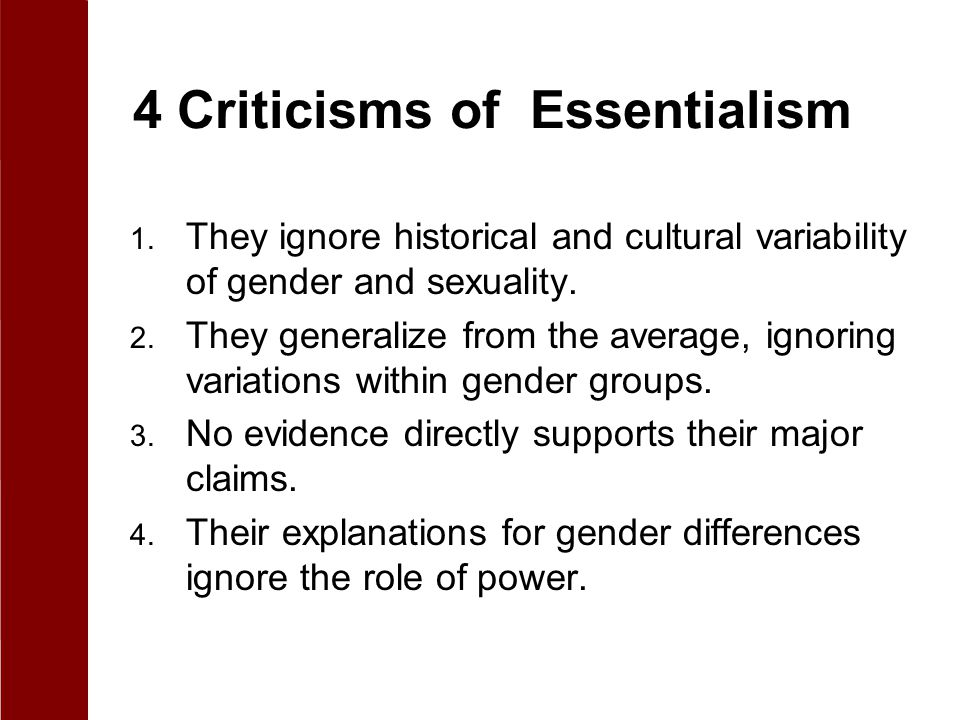
essentalism Power Point slide is from here

I want to explicitly state a Trigger Warning, in particular for survivors of patriarchal sexual atrocities. There is not anything very graphic below, but particular manifestations of rape culture are discussed by me as an important factor in understanding male socialisation and privilege.

I have had the feeling, for years, that important stuff ain't getting named, when I read some arguments white anti-RF pro-trans people make to discredit and distance themselves from those seemingly essentialist white Radical Feminists. What isn't getting named, are the experiences of most people in the world. What isn't getting named are hidden forms of 'essentialism'. I'm not yet hearing anti-essentialist pro-trans activists call this stuff out in trans-friendly spaces, possibly because that would mean decentering whiteness as a norm.

While I made a very small change to some of the content, the whole of what follows has been copied and pasted from the comments section of an A.R.P. post from late 2011: https://radicalprofeminist.blogspot.com/2011/11/andrea-dworkin-on-transsexuality-and-on.html

The comments, however, are brand new as of February 2016.


Blogger enhanta bodlar said...
Julian: it seems like you believe that trans women specifically are subject to male socialization and thus, male privilege--and in the case that they are also white, another level of advantage. However, despite being exposed to a form of male socialization, transgender women do not receive the same social instruction that shapes cisgender males, as they still internalize the example of female behavior that influences female socialization. Trans women's socialization really is distinct to trans women, and in reality they do not really benefit socially from any element of male socialization they may retain.

Blogger Julian Real said...
Hi enhanta,

TW for discussion that includes violating practices in rape culture.

My response is in a few parts.

Thank you so much for your comment. I'll do my best to clarify my position. Most trans women I have known grew up with some levels of male socialisation, male privilege, male entitlements, and so forth. Some with a great deal of it. Here's one example. A white, class-privileged trans woman was raised to be a boy and a man. She excelled in Anglo-white-masculine pursuits, including using firearms, negotiating a world from the vantage point of having wealth, and having a military career. She transitioned in her forties. She got involved with a nontrans lesbian and became controlling and abusive, in ways typical of people socialised to value power and domination as white men practice it. She was possessive. She leaned on her partner for economic survival. (Her family disowned her and she had no poverty survival skills.) This rendered her especially dependent on her partner, who grew up in poverty. She was sexually coercive and insensitive to her partner's reality as an incest survivor. (Of course some nontrans lesbian women can be batterers and committers of sexual assault: the point is that it is still learned from patriarchal socialisation.)

And, of course, regardless of being trans or not, whatever sex or gender we were or are, we are all raised, systematically, to value maleness, manhood, and masculinity. Some of that maleness and manhood is more despised, due to being raced Black or Brown, being effeminate, and so forth. And some forms of femininity and womanhood are less despised in colonial patriarchies, such as lighter-skinned people of color relative to darker-skinned people of color.

So I would say *we all do*, to varying extents: we are, collectively, subjected to colonial and patriarchal male socialisation, regardless of gender. And, in this view, there's no way a U.S.-raised trans woman would be exempt from such male socialisation, even if one never identified as a male, or boy, or man. If the issue is whether and how we benefit from it, I'd argue that, too, is very complicated, due to age, region, ethnicity, race, sexuality, generation, class, weight, height, build, tone of skin, abilities, and religion, among other variables.

Blogger Julian Real said...
When you state this, "transgender women do not receive the same social instruction that shapes cisgender males", do you mean pre-transition or post-transition? And, are you assuming all transgender women are transsexual, or have transitioned in medical or other ways? The current measure of being trans in trans spaces I'm familiar with is how one identifies, not what one has done in an effort to mitigate dysphoria, to whatever (again very varied) extents that has existed in one's life. Many trans, non-gender conforming, and genderqueer people do not identify as male or female, as masculine or feminine, and so have a different relationship to binary socialisation than do those who find meaning in expressing what they understand to be 'one end' of the binary. I find that younger people in queer communities are less 'observant' of the gender binary.

I reject the cis and trans linguistic binary because many, if not most, trans people also carry various forms of what is termed 'cis' privilege--particularly if one did not suffer greatly from dysphoria and if one is not transsexual. "Trans womanness" is not one thing, does not necessitate having dysphoria, does not mean one didn't feel like the gender of the child they were assigned at birth. For some, dysphoria comes later, for some 'dysphoria' isn't the compelling experience leading one to ID as trans.

Also, many people are 'trans' to gender dominants: whites view Black nontrans women's cisgender as unstable, for example. Many nontrans people who cannot but help present as gender ambiguous, or as effeminate males, or as butch lesbians, are not viewed as 'cis' by nontrans people. We all have our own relationships to the values and victimisations of male socialisation.

You write, "they still internalize the example of female behavior that influences female socialization".

On what are you basing that? Again, who is the 'they'? Black women internalising misogynoir? Many nontrans gayboys positively internalise the example of female behavior that influences their own socialisation--this is true of some non-gay boys too. The very elements that are highlighted as 'female behavior' may be embraced by a group of Brown gay men while rejected by white lesbians.

Blogger Julian Real said...
***TW for discussion of the violations of rape culture***:

You continue, "Trans women's socialization really is distinct to trans women, and in reality they do not really benefit socially from any element of male socialization they may retain."

What is this alleged universal (or 'essential') distinction? I'd appreciate it if you could articulate that.

Do class-privileged white trans women not benefit from any element of rich white male socialisation, if that socialisation acculturates someone to be a more successful navigator of white male supremacist society, such as the corporate business world? What are the lessons learned when one's experience in childhood, when socially regarded as an adolescent boy by other boys, was to not be targeted for sexual 'interest' and assault by those boys? Being bullied and being forcibly fingered are two distinct experiences, are they not? How does not being part of the group targeted for sexually violent groping and physical invasion benefit one? Perhaps the answer is: One isn't sexually assaulted by those boys at age 11 through 13. That's quite a specific benefit of male socialisation, is it not? What about a father by-passing 'the boys' bedroom to rape his daughters down the hall? Are you saying there's no benefit to that socialisation, for the trans child who the father regards as a boy (even if this child feared being discovered as a nonbinary child)? This trans child likely does not live with the internalised disgust and shame of their body that their sisters may carry, nor the fear of men entering their sleeping space. That child's shame may be quite different, but we ought not conclude there were no benefits to not being raped from ages three to ten.

To make the arguments you present, we have to essentialise transness, do we not? And cisness as well? And to standardise male and female socialisation out of the real world, such that race and other factors don't 'factor in'?

I look forward to your responses and to continuing the conversation.


Thursday, March 24, 2011

What Calling Boys "Girlie" Does and Means

image of "Maximo Oliveros" (a fictional character in an amazing Filipino movie linked to below) is from here
Revised on 25 March 2011 and revised significantly again on 29 March:

Years ago I wrote a piece, autobiographical, called "The Trauma of the Gendered Child". You can read that *here*. I wrote it before I knew being intergender was something I could say about myself. Since writing it, I've realised that my experience of childhood was not uncommon. Many children, female, male, and intersex, live our lives not feeling like we belong to the gender we are assigned to and forced to become, under penalty of rejection, scorn, and violence.

I'm aware of three movies which deal explicitly with issues of boys who behave in ways that make most het men uncomfortable (and, for different reasons, some gay men too). Those movies are The Blossoming of Maximo Oliveros, Breakfast With Scot, and Ma Vie En Rose. Each of these excellent movies deals with different issues related to being an non-masculinist boy. (Two of those links go to sites where the movies may be watched in full.) If you watch them, please pay attention to and compare the political, economic, regional, cultural, and social realities influencing the decisions of adults in accepting or not accepting their "feminine" boys.)

I believe there is emotional, psychological, and political trauma done to boys who are called "girlie" by their misogynistic-homophobic fathers (or, well, mothers, or other parent-figures). Socially, there is usually a knee-jerk misogynist, anti-girl reaction to this happening. What typically happens in liberal to progressive families and communities is that boys are told "you're not girlie" or "that's not girlie" or are otherwise encouraged to shore up their self-concept as a boy in some ways--including by believing that boys can do anything, no matter the gendered associations.

The misogyny beneath this approach, which I find myself caught in, is to not tackle, head on, the violence to girls of using the term "girlie". It shames boys, yes. But it shames girls too. It communicates to girls and boys that they are of less value, are worth-less, if they are like girls, as determined by misogynistic homophobes. It should surprise no one that most girls identify as girls--they don't have any choice. And the trouble with patriarchal, woman-hating gender tyranny and terrorism is that if girls are like girls--if girls are "girlie"--they too are not valued. There's no way to be a girl in a patriarchal society and be valued, socially, as much as boys and men are valued, if the boys and men are pro-patriarchal, misogynistic, and masculinist.

We live in tricky times, re: gender. If male children grow up being "feminine" we now have doctors and other "experts" telling us that they must be transsexual. Or gay. Or that there's something wrong with them that needs to be medically "fixed". There are far too many children being told there's something "not normal" about being girlie. But being feminine--as defined by patriarchs (and in the U.S. racist patriarchs)--is part of what is normal for boys and some girls too. It is normal even while it is a largely both a mandatory and manufactured concept in the minds of men. Some boys and girls are not feminine, are not masculine, and are not transsexual. And many transsexuals who transition M2F are also not "feminine" and don't desire to be, either. People, trans or not, simply are who they are: human, fine, healthy--except for the society that tells them they are not healthy or fine, or human. And to label children anything other than "normal" (re: gender and sexuality) for being "who they are" is a form of sexual violence, in the opinion of this blogger.

The point of the earlier essay was that labeling and enforcing a gender hierarchy in which "boylie" boys are valued and girls--whether like girls or boys--are not, is sexually traumatic, abusive, and sets children up to act out that violence against themselves and other children. Also against their mothers, often. Boys learn to hit to be masculine, for example, and can and do hit their mothers, especially if they've seen daddy or other men do it. Girls learn to be silent and self-deprecating, and too often self-abusive in other ways too.

I believe that any man who teaches his sons (or daughters) that they are not okay if they are "feminine" or "girlie" ought to be found guilty of psychological child sexual abuse. And any men who devalue their daughters because they are girls ought to be found guilty of the same thing. Because these actions by men do irreparable harm to children. And of course any het man who bullies his family, who is a terrorist or tyrant, who is a rapist and batterer of his female spouse, should never be allowed to be around children or women at all.

I think a healthy response to witnessing a child being told they are too feminine or too much like a girl is to note that there's nothing at all wrong with being "girlie".  That is essentially the message all children need to get, with confidence and social assurance: that there's nothing wrong with being who they are, intrinsically, even while we know that gendering children is social and political, designed to replicate male supremacy and female subordination, and that children absorb social messages about gender as it applies to them.

I hope children can grow up knowing that that girls being "boyie" and boys being "girlie" (or any other combo) doesn't make them transsexual any more than it makes them lesbian or gay. Being transsexual makes them transsexual. Being lesbian makes them lesbian. Being gay makes them gay. Those are complex social-psychological teenage to adult realities that, along with the labels heterosexual or bisexual, are not appropriate to put on pre-pubescent children, in my opinion. It's not that I think pre-pubescent children can't know who they are attracted to and don't learn how to be misogynistic and heterosexist. It's that coming out as a lesbian, as bi, or as gay, is a social experience, not a private intra-psychic one. It requires negotiating social, cultural, political spaces, not just private mental, psychological, emotional spaces. And to label small children as "gay" or "lesbian" or "het" is to layer onto them adult social/cultural ways of being that simply ought not be applied to young children, in my view. To reinforce ideas that being a feminine boy means he's going to be gay, or a non-feminine girl is already a lesbian is to participate in hetero/sexist stereotyping.

When adults proclaim "their" children to be heterosexual, for example, they are projecting or simply reinforcing gross heterosexism. To do so because their son likes sports and their daughter doesn't, is sexist nonsense. This, to me, is a form of psychic sexual violence against children as it leads children to feel bad about themselves if they end up not being heterosexual as homophobic patriarchs violently define and politically defend the term and it being "natural" among children.

And in my experience queer and non-queer communities are increasingly confused about this, to the detriment of queer and non-queer children. Because as soon as young children are labeled anything other than "normal", their understandings of themselves changes and begins to absorb self-concepts and negative feelings they see being attached to those terms. When adults, some of us realise that being "normal" is far from desirable. But I don't believe children are capable of forming strong self-concepts and confident senses of self if they are labeled or feel "abnormal". I personally would rather not be normal; but at age six or even at age sixteen, I wasn't entirely capable of genuinely wishing to be abnormal as a healthy rejection of the status quo.

Being transsexual isn't abnormal either. But, unlike being lesbian, bi, and gay, only a very few children are transsexual--although this will be socially, medically, and culturally determined. I witnessed the harm to teens and young adults who suffered the malpractice, most systematically through the 1990s in the U.S., of them being labeled as ADD and ADHD children. There is currently a social trend among some "specialised" mental health care workers and medical professionals, who are effectively pro-misogynistic and pro-heteropatriarchal, of labeling children both as non-transsexual when they are, or as transsexual when they're not. I've seen this over the decades done by het, bi, lesbian, and gay adults too--of deciding who their children are based on insufficient evidence, or biases from the dominant culture or alternative cultures parents live in.

I'd argue that sexual and gendered identities and conditions are so culturally relative that they can likely only be known and determined in later childhood or adulthood--and even then, as many of us know, such determinations shift with time across adulthood.

Being heterosexual, bisexual, lesbian, gay, transgender, intergender, or transsexual are largely social-cultural-political phenomena. We can note that being Two-Spirit, for example, isn't something any white medical professionals will likely determine anyone to be while they may determine some children, teens, and adults to be non-transsexual or transsexual. Does this mean no one is Two-Spirit? No. It means labels are ideological, cultural, and political. And for many decades, for centuries non-industrialised, Indigenist societies have had differing ways of acknowledging and honoring people who were not what white, English-speaking, Westerners call "straight" or "women" or "men". It is so easy for white, English-speaking Westerners to forget that "heterosexual" is not an acultural, ahistorical, or asocial reality. Not is being lesbian or gay. Nor is being "gendered"--whether non-transgender or transgender.

Each involves finding out what one's own experiences and feelings mean within the societies and cultures we grow up in. In some cases it means finding out about our cultural traditions that have been devalued or traditions that are being destroyed. Our understandings of ourselves--how we come to name ourselves--cannot be done outside of political, social, cultural realms, and young children are not really equipped to know all of that when so young.

Dominant Western society is heteropatriarchal, racist, and favors labeling children in ways that benefit adults, especially adults who profit by this labeling. To label pre-pubescent children in any way as being definitively sexual in one particular way is inhumane, even while it is required by heteropatriarchy: all children are presumed heterosexual until proven otherwise, for example. But, other than for political, cultural, and economic reasons, there's no need to label any young children, period. Children are "human"--and even that term has very culturally specific social and economic meaning.

In my opinion, children deserve to be encouraged to express themselves as they wish, in age-appropriate ways. This means protecting children from adult practices that are traumatic when imposed on or introduced into the lives of children in confusing and abusive ways.

If possible, keep all pornography away from children. And good luck with that. In my opinion, anyone who intentionally makes pornography or other graphic manifestations of racist, rapist society repeatedly available to children should be found guilty of child sexual abuse. I recognise that loving parents may need to show children adult images--not sexually graphic ones--to explain what is and is not appropriate for children to see. Given how pornographic many societies have become, one needn't go further than magazines like Maxim, Vogue, or Seventeen to find these images. Each contains plenty of examples of sexxxualised racism and misogyny. Children never "need" to see graphic, sexxxxually explicit pornography, for any reason, to become healthy adults. That children are so often made into sexxx-objects, disproportionately for white Western men, worldwide, ought to be beyond outrageous. It ought to be completely unacceptable, globally. But that means radically transforming all capitalist, patriarchal, and racist economic and social systems.

I've heard the details of the harm of girls being exposed to their fathers' pornography--written and depicted. Most women I know who have very painful sexual fantasies that are deeply troubling and shame-inducing to them were exposed to their fathers' pornography when young girls. That arranged exposure is also a form of psychological-sexual child abuse by the fathers. The girls I know who also grow up with deep conflict about their own sexuality and self-image are those exposed to normal racist misogynistic media, and those who are incested or molested by males in their families.

Het men, as a class of human beings, are dangerous to children because they are often enough predators and perpetrators of child sexual abuse and rape. They are dangerous to all children. And the denial about that is intense. This reality is displaced by het men onto gay men and lesbian women so that only the latter two groups of adults are stigmatised as "dangerous to children", including sexually.

Because of the sheer number of het-identified men, and also because they are not stigmatised as the most predatory population of adult "child molesters", "procurers", "traffickers", and slavers, this means het-identified and het-behaving men have infinitely more access to children than do gay men or lesbian women. I'm not saying any woman or man or transgender person is not capable of abusing children in many ways, including in overtly sexual ways. I'm saying that the population of adults who most perpetrate overtly psychological and gross sexual abuse against children is het men.

Het men who abuse their children emotionally, physically, sexually, and spiritually are usually not held accountable at all. That tells you a lot about het male supremacy, entitlements, privileges, and power over women and children.

Het men have way too much corrupt and abusive power in society. And the forms of power they have and exercise allows them to do whatever they want to do including anything that is abusive and irresponsible. This includes beating up their spouses, beating their children, raping their spouses, incesting their children, procuring and pimping girls and women, homophobically assaulting children and other men and women, and otherwise terrorising and degrading anyone around them who they can assault without being held accountable by the larger society.

What I hope is that from now on, when I hear of a boy being called "girlie" my response is to cheer, celebrate, and say "congratulations"!!! "Let's throw a girlie-boy party!" And let's not invite anyone who is likely to shame any child who isn't behaving in misogynistically, patriarchally (politically) correct ways.

What complicates this particular matter of gender and children is that toys and so many other products are manufactured in racist capitalist patriarchal societies, and are marketed to children with the understanding that being a girl means being submissive, and being a boy means being active and dominant. Most of what is marketed to girls is sold to ensure girls are submissive and subordinate to boys and men specifically. I think that the "girlie" and "boylie" things that C.R.A.P. manufactures are likely to be harmful to children in the context of living in a society in which male dominance and female submissiveness is normalised, naturalised, and sexxxualised.

As I discuss a bit in the essay linked to atop this post, I didn't neatly fit into any gendered category when growing up. I could play with dolls with a female cousin. I could also play chess with a male relative. In what sense is playing with a doll or playing chess "gendered"? Boys play with dolls, of course, but tend to be sold dolls that are soldiers or superheroes of some kind. It's difficult to know who one is when media and parents tell you there's only one choice.

It took me over forty years of living to come into my own identity as intergender, in part because the term and concept wasn't presented to me as a child, a teenager, or a young adult. We tend to call ourselves terms that are socially real. If a child is not traditionally gendered or sexed, they will likely be especially vulnerable to the terms adults around them use to describe and define them. I choose a term that is hopefully respectful of women and girls, that doesn't allow me, as a male person, to impose my self-naming over and against women and girls, and that honors women and girls as specific groups of people oppressed by men and boys in patriarchal societies from day one onward--as long as those people are perceived to be female by men.

I hope that children, teens, and adults are offered terms that don't make medical interventions necessary. This isn't to make medical intervention "wrong". It is to make it possible to understand our lives as ones which are more collectively politically shaped than individually medically fixed.

I want to thank all the women, and the few men, over the decades, who have refused to raise their children in oppressively gendered ways. Goddess bless you. But let's not forget that it will take collective, sustained, organised activism aimed at the radical transformation of the whole of these societies to ensure that those parents' good work keeps children emotionally, psychologically, politically, and spiritually healthy.

Boys who are identified by adults or peers as "feminine" are wonderful just as they are. They don't need harmful, misogynistic labels or Western patriarchal medical interventions to be wonderful. Spread the word.


Sunday, March 20, 2011

The Revolutionary Collective Liberation of Girls, Globally. A radical profeminist agenda.

photograph of two Indigenous girls in Australia is from here

It is the position of this blog that political theories and actions ought to address and center the experiences of girls and women worldwide. Our work, whoever we are, ought to strive to know, see, and feel the life experiences of those of us who are most traumatised, most starved, most trafficked, most enslaved, most exploited, most violated, most dominated, most silenced, often without clean drinking water, and those of us usually without any academic education, patriarchal political clout, or dominant social status.

In my experience, the lives of girls and women worldwide who are without race, class, ethnic, region, and education privileges, are the girls and women with the most awareness of what the price is for being a girl and a woman in a world that despises any human being regarded socially as "female"--whether or not she is female. (I'm thinking at this moment of anyone who is intersex but who are raised to be girls and women and who are treated as girls and women.)

I am concerned that female human beings privileged by race, class, region, education, and region will do what all men do: ignore the most marginalised and silenced women. This isn't a reference to something called "oppression olympics". I'm speaking quite seriously and directly about the girls and women globally who are experiencing the most traumatic dimensions men's wars--especially and particularly men's war against women and girls; girls and women who have the least access to dominant corporate media, who do not rule countries, do not own corporations, are not multi-millionaires, are slaves, are trafficked, are being intimately and systematically terrorised and violated in the home by men or by one man, are being institutionally oppressed by race, class, sexuality, and gender in ways that generate socially unnoticed forms of post-traumatic stress, because ptsd is not usually considered to be caused by normal, liberal to conservative social institutions.

Someone asked me recently how it is I became conscious of racism and misogyny, of--in my world--white supremacy and male supremacy. I answered that I think that while white, being Jewish in a largely non-Jewish area let me know what ethnic marginalisation and bigotry felt like, and it wasn't difficult to imagine that anti-Black racism, for example, felt similarly awful. And while male, I believe that never being heterosexual brought me in close proximity, or in direct range of the wrath boys and men unleashed on girls and women because girls and woman are also not het men.

But, in addition to those experiences of privilege and marginalised, of structural power and structural oppression, being sexually molested, incested, and assaulted before age thirteen and living with myself as someone who acted some of that abuse out against others before turning seventeen, left me very aware, viscerally, not primarily intellectually, of the harm of oppression when it is systematised and sexualised. And both white supremacy and het male supremacy are profoundly sexualised.

I encounter people who called themselves progressive or radical and their political agendas, too often, don't center the experiences of those of us whose lives are torn apart by sex trauma, by ethnic and race trauma, and by the traumas that come with not being a white het man with class privilege.

There are many political movements which exist to make dominant society friendlier to oppressed people without transforming the systems and dismantling the structures that manufacture and support the ideologies of destruction, denial, trauma, and terrorism, most especially and particularly against girls and women from birth to death.

Whoever think girls and women are a privileged class by gender, will have a hard time making that case comprehensible to me. I've seen my whole life how girls and women's bodies are targeted for all manner of abuse and disdain. The traumas visited upon girls alone, as a class of human beings, are so unfathomably disgusting and horrid that most of us don't wish to think about them, including those of us who lived through them.

I believe that a radical political practice and set of movements and campaigns that strives and succeeds in liberating girls as a specific group, not only as individuals, from all forms of oppression will be a political movement that liberates everyone else too.

Increasingly, I am feeling called to focus on the lives of girls. And to work with adults who prioritise the lives of girls in their political work.

May all girls, one day, know what it is to live in a world where there is no incest, no rape, no sexism, no male supremacy, no racism, no poverty, and no gynocide.


Friday, March 11, 2011

Cross Post from dedgurlcingztheblooze: who will socially care about the 11 year-old girl who was group-raped in Cleveland, Texas?


Sources for this audio post are here:

http://dedgurlcingztheblooze.wordpress.com/2011/03/11/i-wasnt-going-to-talk-about-this/

http://blip.tv/file/4872727


See also this post from What About Our Daughters *here*.

Thank you to The Blogmother, and to dedgurlcingztheblooze.
Here are some of my own thoughts for right now:

My prayers are with that girl. And all the girls the world over being group-raped and raped individually by men and boys, disproportionately Black, Brown, and Indigenous. The society must crumble, as dedgurl says in the audio blog.

Punishing a few perpetrators of atrocity pretends rape would end of only we sent all the rapists to jail. It wouldn't--especially in jail. And also the class-privileged white men who travel the world to rape girls won't ever get put in jail so how does killing or locking up only Black and Brown men solve the rape problem? It may make some individual survivors feel safer to know their assaulter-terrorist-violator is in prison. And I'm not opposed to rapers of children or of women going to prison--let anyone who violates a girl or woman sexually or physically be sent there for the rest of his life, as far as I'm concerned. At least she'll be safer, but only from him. Not by the other male relatives, the other procurers, the other date-rapists, the other boyfriends, the other men wanting a little action.

Most rapes of girls, after all, are committed by their own fathers and step-fathers and other male relatives. And by "sex (read: rape) tourists", procurers, pimps, traffickers, and slavers. None of those men will get put in jail, folks. Group-rape is not the usual way girls and women are raped, even while it is disgustingly, reprehensibly, outrageously common.

So what are we going to do about all that? The political approach is not to pretend justice is served by locking up a few predators. Girls and women remain unsafe no matter how many poor men go to jail. Rape is a reality because in this society, white het men want it to be one. The political approach that has a spiritual center, a humane core, is to radically transform society into an non-predatory, non-misopedic, non-misogynist one where girls and women are not targeted from birth to death for rape and other violations and degradations.

Sunday, March 6, 2011

A piece of writing about men and masculinity: "Fighting Dogs"

image is from here
This is a short piece of writing by my new friend, Miki, who is a very dear and smart bisexual male who lives in Spain and usually writes in Spanish. For the English readers/speakers coming to this blog--I'll go out on a limb and say that just might be a majority of y'all!!--I am glad to have this piece in English to post here.

I told Miki recently that this sort of image does NOTHING for me. I'm gay; I'm not interested in males who put lots of effort into making themselves look like steroid cases. I am disgusted by the media obsession with males-as-rough-and-tumble-fighters.Who have to murder someone to be considered heroic.

You may click on the title just below to link back to the source website. 

Fighting dogs

Posted by: mikiencolor on: August 9, 2009

This is a translation. Original post: http://mikiencolor.wordpress.com/2009/08/06/perros-de-pelea/

They want soldiers, not companions.

They want men, not humans.

Violent, rough, brutes, not lovers, manly men in a perpetual search for blood and submissive female to mount. Implacable to compete, violent to war, fierce to triumph and make proud.

Warriors and conquered is that they want, not citizens. Warriors to invade and subjugate. Sociopaths to execute without a second thought, dead from the waist up to do what needs to be done, not empathic beings with whom to share. Love is conquest, they say, which is consummated by invasion. Conquest, invasion, occupation.

Rough, harsh for working is how they want us, and productive. Disgusting, repugnant, vomitous, repulsive, that’s how they want us. Frightening, terrifying, not sweet, not fearful. Dangerously handsome they want us, not impotent and ugly, soldiers in reserve forever ready for a fight.

Warriors to war with other warriors they want, survivors to initiate future warriors, executioners to educate future executioners, an endless cycle of tyrants, experts in pain and cruelty, they want. Fighting dogs, that’s all they want. What shame gentleness causes them. What contempt they feel for tenderness. Fighting bulls, they want, not docile. Fierce bulls for the ring, bread and circus and unappealable insanity, that’s what they want.

Where are the objectors? Where are you? This is some hell.

Saturday, October 16, 2010

Not Surprising: Men Who Are College Students and Rapists Don't Get Arrested or Even Expelled From School Most of the Time While One in Four Female College Students Will Be Sexually Assaulty By a Male Student/Rapist Before Graduation


image is from here
To hear privileged het men talk, you'd think the social atrocity is het men being falsely accused of rape by a woman or girl. To witness social activity--aka, reality--you realise the atrocity, with regard to rape, is rape: all forms of it, against females of all ages by het males of many ages. To understand how many het male rapists there are registered and actively predatorial and regularly perpetrating rape in colleges across the U.S. is something most het men don't wish to consider, let alone take action against--meaning, to stop rape: to end rape on college campuses and to end rape off college campuses. 

Het men will frequently cry foul when accused of rapes they commit. Few men who rape have the courage or "the balls" to use the lexicon of masculinist men, to admit when they rape a woman and to turn themselves into to appropriate authorities for appropriate consequences. Few of the men who are accurately accused of rape will see a day in jail, let alone many days and nights in jail. 

I wonder what percent of men who are college students (accurately accused of rape by a woman) claim not to be a rapist, to have done nothing wrong, to have committed no crime? What percent of men who are college students and rapers of women students accuse those he rapes of lying if she accuses him of doing what he did? I'd like to know. If anyone knows, please post the answer here. 

Two articles follow. Each may be linked back to their source by clicking on the title.
 
While a man who rapes off-campus could face years in jail for his crime, a man who rapes on-campus is unlikely to even be expelled.

Two Michigan State University basketball players accused of sexually assaulting a young woman in their dorm are off the hook, according to a report released by The Michigan Messenger.
Many elements of the case are typical of campus acquaintance rape scenarios. The accused are college athletes and the assault allegedly occurred after a night of drinking and casual socializing:
The victim told police the players penetrated her in various positions. The victim told detectives the players allegedly asked her ‘how does that feel?’ and ‘how do you want it?’ The victim says she told the players she didn’t want it and gave ‘other indicators she was not a willing participant.’
The victim told police that the players pinned her down, but at one point she freed her arms momentarily and struck one in the face. In response, he allegedly said, “Don’t. Just relax. C’mon baby,” as he continued to assault her.
But what sets this particular case apart from others is that one of the accused players actually corroborates the victim’s statement, admitting to authorities that he knew the young woman was unwilling:
During his interview with detectives, the one player who volunteered a statement corroborated much of the victim’s statement, the report shows. He told investigators that when it was clear from the victim’s statements that she did not want to have sex, he stopped. However, the other player continued ‘despite her reluctance and statements that she did not want to continue.’ The victim confirms that player’s account.
The player told detectives he was concerned “over the girl’s reaction to the circumstances,” noting she was “timid” and “not aggressive.” The player then admitted to detectives that he understood how the woman believed she was not welcome to leave the room, in part because she kept referencing that the two were “bigger” than her.
Given the player’s affirmation of the victim’s statement, the case against the men should have been a “slam dunk.” Accordingly, the MSU Police Department wasted no time sending their report to the prosecutor’s office, with the recommendation that both men be charged with Criminal Sexual Conduct 1, the severest level of sexual assault under Michigan law.

But the assigned prosecutor, Stuart Dunnings, has declined to press charges against the athletes, saying that the prosecutor’s office is not convinced that force or coercion occurred in this case (a judgment directly contradicted by the police report), and that the victim herself chose not to press charges (a claim denied by the victim).

Dunning’s decision, while reprehensible, shouldn’t be surprising. An investigation of sexual assault on campuses conducted last year by The Center for Public Integrity (CPI) found that the number of prosecutions of campus acquaintance rapes is minuscule. When prosecutors turn down these cases, the only available recourse for many victims is to seek justice through their university’s disciplinary system. Unfortunately, most colleges are ill-equipped to investigate and resolve sexual assault cases, and moreover are unwilling to impose harsh sanctions on perpetrators.

A 2002 report [PDF] commissioned by the Department of Justice found a number of inherent problems with university policies and practices regarding sexual assault, including a tendency to “unintentionally condone victim-blaming.” Only 38 percent of schools require sexual assault sensitivity training for campus law enforcement, while only 37 percent fully comply with federal regulations about reporting crimes. The CPI investigation similarly found that even when college administrators deem a student guilty of sexual assault, they are reluctant to expel the perpetrator:
Verdicts are educational, not punitive, opportunities. … Not every sexual offense deserves the harshest penalty, [administrators] argue; not every culpable student is a hardened criminal.
So, while a man who rapes off-campus could face years in jail for his crime, a man who rapes on-campus is unlikely to even be expelled. In too many cases, student rapists face mere suspension or even lighter sanctions. The tendency among administrators to view sexual assaults as “teachable moments” flies in the face of evidence that student rapists are often serial rapists—guilty of victimizing an average of six women during their college career.

The decision to absolve student rapists of their crimes can be costly, as doing so could violate Title IX, the federal civil rights law that bars sex discrimination in publicly funded educational programs. In recent years, the ACLU has won two landmark lawsuits against public universities guilty of letting rapists off the hook. In 2008, Arizona State University paid out $850,000 after it failed to expel an athlete with a history of harassment who later raped a young woman, and in 2007 the University of Colorado paid out $2.5 million after members of its football team sexually assaulted two women.

Whether Michigan State University will take action against the basketball players accused of rape remains to be seen. The prospects don’t look good. While the Office of Postsecondary Education shows that the university reported 32 forcible sex offenses on its campus between 2007 and 2009, it does not show any reports of disciplinary actions associated with those crimes.

Catherine Traywick is an Arizona-based blogger for The Media Consortium.

*          *          *

Rape.
Photo: domesticviolence

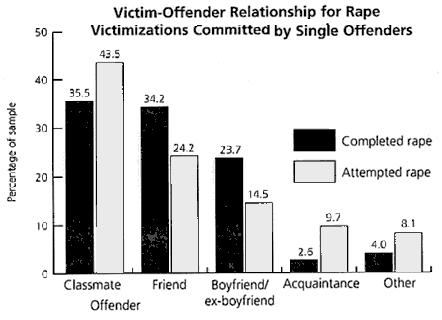
The summer is over. For many female college students it's once again time to hit the books. If your a freshman, it's a brand new life experience. New friends. New romances, and a sense of freedom like no other. It's also a time when we are most vulnerable. How vulnerable? 1 in 4 college females will be raped by the time they walk down the aisle and accept their degree. The statistics are staggering.

A recent study from the Department of Justice estimated that 25 percent of college women will be victims of rape or attempted rape before they graduate within a four-year college period, and that women between the ages of 16 to 24 will experience rape at a rate that's four times higher than the assault rate of all women.

Here's the problem. Many campus assault victims stay quiet or refuse to get help. A lot of times when people think of being raped, they think of someone dressed all in black, lurking in the bushes. This is so very, very far from reality. A rapist can be someone you know. Someone who you are friends with, or even someone you are dating. The bottom line is that when you say...NO.....It means NO.

A wonderful guide that is put out by the Department of Justice is called, Acquaintance Rape of College Students by Rana Sampson. It's a guide that should be read by parents as well as students. Here is the link for the entire booklet: http://www.cops.usdoj.gov/pdf/e03021472.pdf

Rape is a very personal violation. Most women do not want to report it due to all the additional mental anguish it entails. It's also a "he said, she said" assault. They fear that no one will believe them. Well, there is plenty of help out there AND YES THEY WILL BELIEVE YOU. You just have to ask.

The following website, AARDVARK, which stands for An Abuse, Rape and Domestic Violence Aid and Resource Collection, is one of Florida's leading organizations for help in all areas of rape and domestic violence. It has all the information you will need in seeking help by those who know what you are going through. They offer all kinds of resources in your specific town, as well as books and DVD's to help you with this difficult time in your life. Here is their link: http://www.aardvarc.org/dv/states/fldv.shtml

Friday, October 8, 2010

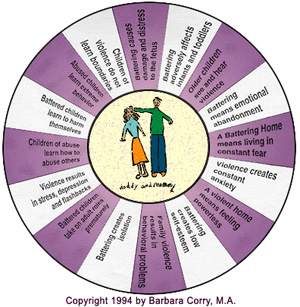
"Domestic Violence Awareness Month" ought to be renamed "Heterosexual Husbands and Boyfriends Beating The Shit Out of Women and Their Children Awareness Millennium"

image is from here

It is Domestic Violence Awareness Month in the U.S. and here is a website devoted to publicising that.

1. Domestic Violence is, it seems to me, the violence done by the U.S. government and corporations and individual oppressors to the oppressed who live within the U.S. and its "territories". Or to it's "territories" and the land and the air and the water. Poverty, for example, is a form of Domestic Violence. So is institutionalised racism, heterosexism, and misogyny.

2. Domestic violence is distinguished from Off-shore Violence. And in looking at the latter what we may note is how warfare is part of each: warfare against women by men who seek patriarchal/male supremacist control of women and girls, and also to regulate and restrict the behavior of boys so that they grow up to be "good patriarchs", meaning mass murders, serial rapists, and batterers of anyone in punching range.

3. Domestic Violence was the name chosen when discussions about the many ways men dominate women through intimate violence because too specific for contemplation, let alone resistance work and activism to stop men's violence against women. It is the generic term for something that isn't at all generic or ungendered. Yes, we need to acknowledge that there is such a thing as battery in lesbian and gay relationships. And of course there are many ways adults in families do violence to children. But the most common form of gendered-sexual violence in families is fathers and father figures incesting/raping/molesting their own daughters or girls they are supposed to be parenting, not preying on.

4. Why doesn't the Anti-Woman Revengelical Fundamentalist Christian White Right [Wrong) acknowledge that their unwritten and unspoken moral code is this: "The Family That Preys Against Female Family Members, Stays Together Due to Stockholm Syndrome and other effects of Dominance and Control"? And realise that feminism is only anti-family if your idea of family includes men dominating women, heterosexism, and violence against women and children, including sexual violence?

5. Why doesn't the Anti-Woman Libertarian Liberal "Left" acknowledge that their unwritten and unspoken code is this: men should have as much freedom of access and rights to violate girls and women as men desire to have, to do whatever it is men wish to do to girls and women that men learn from predatory men and pornographers and pimps. What is are the liberals and libertarians doing to stop incest and rape? Not a whole helluva lot. Why is that? Because rape and incest aren't worth stopping? Or because liberal men believe that in a liberal society incest and rape are part of the price paid for "freedom"? Too fucking high a price, I say.

6. Why isn't homophobic and anti-girl bullying and battery understood as part of Domestic Violence? How many girls and boys have to take their own lives before conservatives and liberals wake up to the fact that children hurting, degrading, humiliating, and terrorising other children isn't socially good or socially necessary. Clearly anti-bullying and anti-battery policies and education programs could be in place in every school system. Sure, there'd have to be less military massacres going on non-domestically, to liberate funds to pay school systems to implement such policies and programs. But the problem with that would be what? Less profit in Dick Cheney's, Donald Rumsfeld's, and David Petraeus's pockets? Those "poor" men will just have to get along with the millions they already have acquired through mass rape and mass murder of "foreign" people of color.

7. Why isn't the violence boys do to girls in school systems and outside school systems discussed? I sporadically hear about is anti-gay bullying, usually by boys against boys, or anti-girl bullying, usually by girls against girls. I'm not suggesting each isn't a serious social problem--both are, as is anti-lesbian violence against girls, which I hear little to nothing at all about. But we also need to focus on the problem of boys sexually harassing, stalking, physically and sexually violating girls, throughout grade school and on into adulthood. And anti-lesbian violence among children too.

8. There's a simple way to end married het men battering women in their home. It is to remove forever from the home any man who is found to have beaten up a woman in the home. And to prevent him from ever having contact with his female spouse or his children, as beating up a child's mother is or ought to be grounds for losing all rights to ever see your child or your spouse again. Sound harsh? To the men who think that's too harsh: Try not beating up women and avoid the harsh consequence. Any man that terrorises or systematically dominates and controls a woman in their home has no right to raise their children, to have custody of them, or to visit them. Sound harsh? To them men who think that's too harsh: systematically demonstrate regard and respecting for women and children; don't terrorising or ridicule anyone; don't dominate and bully anyone; and don't demean and controlling anyone systematically. Try being non-abusive, compassionate, and caring, not vengeful and vindictive and then, guess what? You get to raise your own children! See how easy that can be? It's all, quite literally, in your hands, fellas.

9. As for the men who declare the "equal" problem of women beating men, show me the thousands of x-rays of those men's broken bones, please. Show me the thousands of photos of their badly battered faces. Show me the shelters. Because it's not that class-privileged men aren't economically posititioned to purchase and set up "safe homes" for men abused by women. No. Straight men can do that if need be, what with all those allegedly advanced construction skills (to compliment all the destruction skills). The reality is that there is no need. Meanwhile, men down-play the violence men do to women and up-play the violence women do to men. (Yes, women can and do hurt men (and women) in a variety of ways. I've seen women who have been abused and neglected by men lash out in frustration and pain and say hurtful things to men, sometimes even to their faces. What I haven't ever seen or heard about is this: a woman abuse a man who was never been abused by a man. Not once. I accept that it is often the case that men who batter women witnessed men beating up women somewhere earlier in their lives. But not that they witnessed women beating up men earlier in their lives. So no matter how you look at it, the source problem here is men's violence against women, not women's against men.

10. Funny (not ha-ha funny, and not ta-ta funny) how the major media might mention something about Breast Cancer Awareness Month--never enough, while generally ignoring Heterosexual Husbands and Boyfriends Beating The Shit Out of Women and Their Children Awareness Month. I know queer battery happens too; I'm gay. But I'm all for naming what the endemic problem is that's part of an overall systemic reality of men subordinating women, which is men battering (and raping) women, intimately. And anyone beaten, even in lesbian and gay relationships, is called misogynistic names, which tells you a whole lot about the gendered foundations of domestic violence. The problem is not, as too many abusive het men proclaim the problem to be: "spouses hitting each other". I raised the issue in a recent post: why it is that anti-abortionists don't seem to give a shit that men beat up pregnant women causing untold miscarriages? I mean even if they only care about unborn female foetuses and don't give a damn about out-of-the-womb girls and women, you'd think they'd be overtly anti-battery and anti-rape (including anti-incest): two reasons for unwanted pregnancy and unwanted loss of pregnancy. Two main methods of terrorising and dominating women through force and violation. How about Pernicious and Predatory Patriarchal Privileges Awareness Month? Let's see the morning shows and evening news deal with that issue honestly in town hall meetings.

Friday, October 1, 2010

Bullying, Harassing, and Exploiting Gay Youth: an analytic and personal discussion

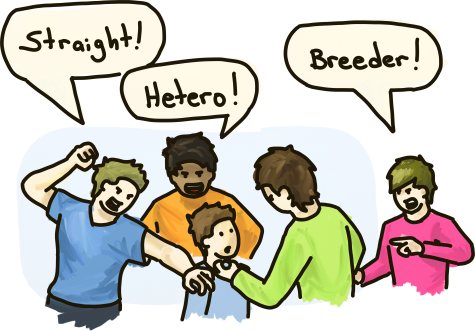
image depicting the practically unimaginable world of "heterophobia"
This article focuses on "gay" youth because of the recent cases of gay male youth killing themselves. I've been thinking and feeling a lot about these horrible stories. One thing I think about is how lesbian girls and the abuses gender non-conforming girls are generally ignored or classified as something else other than "homophobia", "transphobia", and "heterosexist violence". If girls are abused it may be called misogynistic, sexist, or patriarchal harm. But to miss the heterosexism involved in various forms of violence against queer youth is to really "not get it" about what's going on.

The reality is that in most abuse, class, race, gender, and sexuality, as well as age and ability, all coalesce to produce more or less violence. Some of the boys who were picked on--bullied--harassed--tormented--terrorised--were abused because they were smaller in stature, because they didn't want or desire to wear "popular" expensive clothes, or because they were deemed to be "gay" based either on heterosexist, misogynistic, classist, and racist stereotypes or because the child was "out" as gay and was mercilessly mistreated because of that fact.

What is often missed in discussions about these cases is how anti-gay bullying, harassment, terrorism, and exploitation is "sexual abuse". It does what sexual abuse does: it causes deep and overwhelming shame which shapes the self-esteem and behavior of people abused sexually. It causes victims to blame themselves for harm done that they didn't invite or welcome.

To live in a heterosexual world means that one's own non-heterosexuality will inevitably be experienced as "different" at least, and "abnormal" and "bad" in all likelihood. When I hear grieving parents speak about how when they found out their male child was gay they told him they'd accept him no matter what, this perpetuates, however unintentionally, an idea that there is something wrong with being gay. Because if a child expresses "heterosexual interest" parents do not remark, "I love you anyway." And, of course, many parents do not accept or tolerate their child's gayness, instead wanting to frame it up as a phase or something that will hopefully go away. What this leaves some children feeling is that for their parents to be happy the child must go away. And sometimes that leads to thinking about suicide.

Race, ethnicity, ability, class are usually left out of conversations about anti-gay bullying and terrorism. But the more marginalised someone is, the more difficult it may be to "come out" about being tormented. It might also be the case that torment isn't experienced as specifically anti-gay, if one is hearing racist epithets all day long as well as anti-gay ones.

There can be advantages to experiencing a few forms of marginalisation, even while there are obvious detriments. Here's an example. I grew up in a middle and working class area in my "formative years". The region was largely white, and ethnically Italian Christian and Ashkenazi Jewish--Italian Jews were a rarity, but at least some physical characteristics of both groups blended together without much notice. I observed racism and anti-Semitism before I recognised heterosexism and homophobia. Classism wasn't so much on my radar, due to being class-privileged for the most part. I got it about boys being valued more than girls. That was blatant.

You only need to see how shaming it is for a boy to be told publicly he throws like a girl to know that girls are not considered capable, physically (and that boys are expected to be). Girls are perceived by boys, often enough, to be disabled. Chronic physical incompetence is what is assumed to be true about most girls, even while some do excel in sports, especially since Title 9 made girls sports mandatory in any school where there were sports for boys. But class and race factor into how girls are perceived. White girls often stigmatise Black girls as "tough" for example, or as more prone to being angry. I see how this carries into adulthood, where Black women are often seen as simultaneously lesser-than, and also more able to endure abuse. There's a paradoxical sub-human/super-human determination made by whites about Black women, in my experience of whites. How does this get complicated when a Black girl or woman is lesbian? Is it assumed she is both more sub-human AND more super-human? I see Black lesbian women being stigmatised as "courageous" and "strong" and "brave" as if they aren't women enduring all manner of abuse, daily--which hurts the way any insult and abuse hurts.

Stats show that queer kids and disabled kids are VERY likely to be both emotionally/verbally and physically/sexually abused. What then are the chances of disabled queer youth coming through childhood with a healthy sense of self? What is being done to ensure that disabled queer youth CAN come through and be regarded and treated as the fully human people they are? If you are nerdy, or awkward, or shy, small, or fat, how does this impact your experience of queerness, where, particularly when older, being queer and male is assumed to mean you are into being buff and shallow? What is the intellectual to do? I am thinking here of James Baldwin, and how the many points of social discord informed his view of his worlds, and led him from one to another: from Harlem to Paris, for example.

How does sexual abuse that is physical not verbal, compound sexual abuse that is verbal not physical?

Back to my story. Because I was white and Jewish, I saw how I was marginalised and ostracised as not quite white enough in ways that were experientially similar to being seen and treated as not quite boyish enough. Because I had some esteem around my Jewishness--or, at least, I knew it wasn't a characteristic of my being that was "a phase"--I could determine anti-Semitism to be stupid and wrong. This gave me a framework for understanding anti-gay bigotry as similarly stupid and wrong. Having some consciousness around sexism and racism being messed up also helped, but in those cases I wasn't oppressed or ostracised for being of color or a girl. Curiously, though, being Jewish and white, and gay and male, did render me targetable for many of the terms used to degrade and humiliate people of color and girls.

Sexism is the foundation of heterosexism, and there's no social space in which being like a girl, if you're a boy, is "socially staus-giving". I am thinking now of an old song:


Enough with the analysis. Here's the deal. Hearing about these stories of queer kids and young adults taking their lives, or of "only" being mercilessly ridiculed, is heart-wrenching and terribly painful. It makes me feel both rage and despair. I want to hug every queer child and tell them how valuable they are, while knowing that any grown male having contact with any youth is seen as problematic particularly and especially when the adult male is queer. I want to create safe spaces for queer youth. I want queer-dominated elementary and high schools. I want all children to be taught about how some of us are and will be queer in exactly the same way we are taught that there are other differences among us: such as some of us being left-handed and taller, or stronger and better at learning languages. I want sexual orientation to not be stigmatised at all, to not be seen as something we have to protect children from learning about, including very young children. If a child is old enough to register anything we might call "heterosexuality" they are old enough to register and integrate knowledge about being non-heterosexual too. And they should be learning that it is all very deeply human.

Tuesday, August 3, 2010

An Objective and Subjective Experience of The Gender Hierarchy, Gender Identity, and Radical Social Transformation, Part 2

image of women's liberation march is from here

SUMMARY:
This is a series of posts about the effects of promoting ideas and analyses of gender that are not explicitly connected to the reality of male supremacy. Part 1 discusses children, gender stereotypes, social stigma and status, the problem of turning complex social realities into binaries, and of pretending those binaries aren't enforced. Also, this post poses questions about how race, gender, and sexual orientation are conjoined. Part 2 discusses intergender, transgender, queer, and dominant cultural politic choices in the face of male supremacy. The style is analytic and informal, sociological and autobiographical.

The conclusion of the series of posts will, I hope, make the case that social justice movements dealing with gender (and race and class and sexual orientation) are strengthened by offering up an intersectional perspective and by not playing down the reality of male supremacy.

*          *          *

 For part 1, please click here: An Objective and Subjective Experience of The Gender Hierarchy, Gender Identity, and Radical Social Transformation, Part 1

*          *          *

As an intergender male, I have grown up with a different vantagepoint for observing gendered dynamics--as someone who identified more with girls than with boys as a child, and also as someone who knew I wasn't a girl, or a boy. I liked playing jump-rope with the girls who also liked it--some didn't and some preferred to play the sports boys were encouraged to play.

Because I was labeled a boy both in my family and socially, politically loaded dynamics that reinforce what that means were immediately activated. If one is regarded as a boy it can and too often does mean one is generally regarded as better than or superior to girls, more intelligent, better at athletics, more into playing with trucks and video games, more adventurous by nature, less interested in shopping, the color pink, and dolls, and, sometime later, more sexually aggressive and more interested in "sex" as patriarchy defines and enforces it.

While we may resist it in various ways, our socialisation does, to some degrees, "become us". If I am labeled and treated as white throughout my childhood, socially, that's a different childhood than one where I'm labeled "not-white". Same with gender. Same with sexual orientation. I was labeled white, male, gay (and all the pejorative terms that boys hurl verbally at boys who they think are "gay"), and was out to varying degrees as being Jewish. This located me in the center of some "status circles" and at the margins of others. I felt marginalised and also could tell that I was regarded as "better" than girls, socially--especially and particularly by adult men.

I had a brother and didn't feel it was terribly important that there be two boys in one family, if there were only to be two children, especially. (It seemed a bit redundant, and my brother was het and did ALL the traditional boy things, including having Playboy magazines in his bedroom, to affirm in himself a sense that women existed for him to use, whenever he wanted to use them. That Miss September was "his" as much as she was anyone else's. People rarely consider pornography use to be a training in being a procurer of female prostitutes, but that's one dimension of what pornography teaches het boys: that women are shared, visually violated, jerked off to and on, and are put away when one has had an orgasm. Put away for next time. Sometimes boys share their pornography--their "women" with each other, and they all know damn well what the other boy is going to do with those magazines. So this is also homosocial behavior, where boys bond over the shared use of women in magazines.

Boy-sports and academics was what my brother excelled in, which reinforced a kind of masculinity that wasn't inconsistent with what white middle class suburban society expected of him and valued in him. He had sports trophies in his room. He had grade school awards declaring him outstanding in this and that subject.

I wasn't much interested in being like him. I did fine academically, but never achieved what he achieved. I detested boy-sports, seeing it as a way for boys to bond over physical skills that didn't seem important to me to have in the first place. So I couldn't sink a basket? So what? So I couldn't throw a football the right way? So what?

What I got was that all these things were socially "coded" and that the codes shaped what boys did, how they acted--especially with one another when younger boys, and later with girls when a bit older. Just "being a boy" meant, for example, that girls were [fill in the blank with something usually negative]. This means boys develop identity around "not being girls" sort of like how my identity formed around the idea of "not being like my brother". Except my brother and I had our own dynamics, and the larger ones between boys and girls socially were enforced by media, religion, law and every other major institution in the country.

Feminism challenged those assumptions about what it is to be a girl and a boy. Feminists wanted to raise children without the constraints, and the pro-boy-bias that often made girls feel like they weren't as valuable, and that to have value, they'd have to attach themselves romantically or sexually to a boy, at some point.

Feminism spoke to me because that was already my project--the challenge those stigmas and stereotypes, and that unearned status boys had over girls, generally.

What has only recently occurred to me is that growing up from, say, age seven to age twenty, usually involves a fairly dramatic transgender experience. It isn't usually called that, because most males grow up as boys and grow into becoming men, in part by making choices that keep their identity as such shored up. But from Part 1, and deeper reflection on the males I find attractive, I realised that the more a man looks like he's been injecting T into his body, the less appealing his is to me. But, I'm gay, and so if a man injects estrogen into his body, the physical effects don't necessarily make him more attractive to me. Without injections or surgical interventions, I'm drawn to men who are slight of frame, not very muscular, or  not muscular at all, and have slim hips, a flat stomach--no washboard abs necessary or even desired, and who don't treat women like they are from another planet. I can find a guy VERY attractive physically, but then hear him tell male friends some ridiculously sexist joke and lose all sense of finding him attractive.

I have thought Derek Hough is kind of cute. He's on U.S. TV show Dancing With The Stars, which I usually regret watching, but often do. (Unlike So You Think You Can Dance, which I generally enjoy watching.) But in a segment on TV recently about Hugh Hefner--founder of the Playboy Aesthetic and Empire, I saw a clip of Derek at a Playboy mansion party, and I suddenly felt like "he kind of looks gross". The idea that he'd WANT to be at the Playboy mansion, reinforcing his heterosexuality in many objectifying ways--sharing the gawking at buxom, long-legged women who have had breast implants and who die their hair and paint their faces seemed, well, unappealing.

Sexism in men is not a winning quality, imo. But sexism in men is basically required if a man is to be seen, socially, as "a real man" or "a man's man". That latter phrase SO cracks me up because what better term is there for a gay man than "a man's man"?! Why should such a term apply to the likes of John Wayne and Sean Connery, or, for that matter, Mel Gibson?

Heterosexuality is compulsory in every society I know of, and is delivered by the media as conceptually and universally fused to some absurd notion of it as "natural". What's natural about being attracted to macho men or to women who shave their legs and pull out most of the hair off their faces? Neither of those things are natural at all--both are entirely social and political).

Feminism also challenged the premises on which social-political heterosexuality rests, quite unstably. Feminism has been, for me, the only sustained social justice movement that seeks to identify, analyse, and radically transform systems of power that seek to destroy or exploit women for men's use, profit, and benefit.

What I've seen go on in what is now termed "queer" community are various relationships to the status quo. There are queer people who don't seek assimilation into heterosexual society, and some who seek nothing more than to be considered "just like them"--the ones with the normal, natural, god-approved of sexuality and ways of being gendered.

Which brings me to a more contemporary understanding of being transgender. As noted, I think being a gender involves transitioning from pre-pubescent to post-pubescent, and often on for a few years for males, as their frames change, chests expand, muscle mass increases. I've know many skinny eighteen year old "boys" who, when thirty, hardly resemble their former physical selves. And for those of us who are intersex, intergender, or transgender, adolescence can be a particularly difficult time, in part because an adult form of being sexed is developing in and on our bodies in ways that may make our inner sense of self and physical appearance--the aspects that are difficult to disguise--increasingly at odds.

I understand some transgender people, but not all, to be wanting more internal consonance, or harmony, or peace, within their being. To achieve this, various methods are employed, and most of them are exactly the same ones employed by non-transgender people: figuring out how to walk, stand, use ones arms when talking, how to speak, what to say that sounds appropriately gendered, what to wear, whether or not to wear make-up, how much hair to remove from one's body--and what parts to depilitate, and the list goes on.

The only difference between being transgender and non-transgender, is that the transgender people are stigmatised negatively, while non-trans people are not, at least with regard to choices to "be more like the gender they experience themselves to be".

A problem here is that for people seen as female or as women, there is never any preparation that is sufficient--there is no escaping the stigma of being seen as female or as a woman. So this is not exactly a privilege--to be a female or a woman. It always carries negative associations, and exists socially in space that denigrates all that is seen as female, feminine, and womanly. And similarly, to move towards being a man, if successfully accomplished, is to come into a kind of power and privilege. And that may have been internalised already, depending on one's own internal sense of genderedness.

And that is complicated further by race and class and sexuality. So, for example, I was and am intergender, male, white, raised with middle class U.S. values. And I was never heterosexual and was always attracted to other males: to boys and later to men. And so this cast me as "feminine" and more devalued than, say, my het brother.

What I saw many gay men do in the 1980s was abandon the political project of "remedying the denigration of all things feminine, female, and womanly" and instead embrace masculinity--and all its political misogyny. That's what I saw: the betrayal of women by men in lesbian and gay community. And as I see it, gay men, collectively and systematically, have never made any attempt to give up male privilege and power, and to stand with lesbian women solidly on ground that denounces and rejects male supremacy as unbecoming, as an abomination, as inhumanity.


End of part 2.

Monday, June 14, 2010

"By Virtue, Not By Force"? The Boys that Prey Together Will Be Rapists, not anything close to Virtuous

[image of Landon School's crest is from here]

"Virtute et non vi" = "By virtue, not by force"

Landon School for rich boys states the following:
Landon School, an independent, non-sectarian boys' day school, prepares talented boys for productive lives as accomplished, responsible and caring men whose actions are guided by the principles of perseverance, teamwork, honor and fair play.
Unless men intervene in younger males' lives, boys will become rapists, harassers, batterers, pimps, and procurers of girls and women and see all of this as normal and natural. And they will do it while they are boys. This blog post contains graphic stories of misogynist behavior.
Consider this paragraph from another blog, Gender Across Borders, in a post titled “Boys Will Be Boys”: The Connection Between a Sex League Scandal and a Domestic Violence Murder.

What follows, blockquoted, is by Erin Rickard.
Last month I wrote about a domestic violence murder that became national news in the U.S., the death of University of Virginia student Yeardley Love at the hands of her former boyfriend and fellow student George Huguely. Now the private preparatory school Huguely attended, Landon School, is in the news because of an incident that happened there last summer. Maureen Dowd broke the story nationally in a New York Times op-ed on June 8. A group of students created what’s been dubbed a “sex league” game, wherein they divided unknowing girls from neighboring schools into teams named “The Southside Slampigs” and the “Crackwhores,” evaluated the girls’ measurements and attractiveness, and planned a series of parties where they would earn points through sexual encounters with the girls. According to the Washington Post, the “game” was shut down before the first party was held when a parent discovered the boys’ roster and descriptions of the girls posted online. Three freshman boys received in-school suspensions as punishment.
This next paragraphs are from Maureen Dowd's New York Times piece titled "Their Dangerous Swagger":
Landon is where the sons of many prominent members of the community are sent to learn “the code of character,” where “a Landon man” is part of a “true Brotherhood” and is known for his good word, respect and honesty. The school’s Web site boasts about the Landon Civility Code; boys are expected to “work together to eliminate all forms of disrespect” and “respect one another and our surroundings in our decorum, appearance, and interactions.”

The Washington suburban community of private school parents has also been reeling this spring from the tragedy involving former Landon student George Huguely V, a scion of the family that owned the lumber business that helped build the nation’s capital.

Huguely, who was a University of Virginia lacrosse player, was charged in the brutal death of his sometime girlfriend, Yeardley Love, a lacrosse player on the university’s women’s team who also hailed from Maryland.

The lovely young woman’s door was kicked in and her head was smashed over and over into the wall.

The awful crime, chronicled on the cover of People with the headline “Could She Have Been Saved?,” raised haunting questions about why Huguely had not already been reported to authorities, even though other lacrosse players had seen him choke Love at a party and his circle knew that the athlete had attacked a sleeping teammate whom he suspected had kissed Love. Huguely had also been so out-of-control drunk, angry and racially abusive with a policewoman in 2008 that she had to Taser him.

In The Washington Post, the sports columnist Sally Jenkins wrote about the swagger of young male athletes and the culture of silence that protects their thuggish locker-room behavior.

“His teammates and friends, the ones who watched him smash up windows and bottles and heard him rant about Love,” she wrote. “Why didn’t they turn him in? ... Why did they not treat Yeardley Love as their teammate, too?”

Some of the parents of girls drafted for the Landon sex teams think that the punishment for those culpable should have been greater, and the notification to parents should have been more thorough. Was the macho culture of silence in play?

This demonstrates institutional support for white boys' sexual and racist violence against girls and women. Class, race, gender, and sexuality all have a head-on collision in this story, but don't worry: none of the white boys were hurt. An elite educational institution which trains boys to be exceptional, gets mighty permissive when boys want to rape girls and be racist toward women of color who are police officers. What do you imagine would happen to a poor Brown boy or Black girl who expressed race- and gender-specific vitriol and violence towards a white male cop? I imagine the courts would argue the police officer was right to use deadly force. Call me jaded, or just aware of how this country's criminal justice system and educational institutions work to protect rich white boys and men. This is what rich white het men, and their lawyers and institutions value: full access to girls and women in order to insult, degrade, violate, and assault them, and boys respecting other boys.

The White Brotherhood is alive and well, and when it is heterosexual it gets especially virulently misogynistic and dangerous for females of all ages.

Ms. Dowd concludes:
Time for a curriculum overhaul. Young men everywhere must be taught, beyond platitudes, that young women are not prey.
Indeed. Now, how will they accomplish making that lesson socially visible such that area girls are safe and women police officers of color know they won't be mistreated by some rich little white boy?

Out of curiosity, I wanted to see how "objective" online media report things like this. What follows next is from Wikipedia, which is known for its pro-misogynist bias in many cases on many pages.
On June 8, 2010, the New York Times columnist Maureen Dowd published a column drawing attention to last years soon-to-be freshman boys at Landon. The boys allegedly planned a fantasy football-like "draft" in which female students at other local schools were chosen for each "team," and "points" were to be scored on the basis of sexual encounters with those students. Noting that George Huguely V, a University of Virginia student recently charged in the brutal murder of his girlfriend Yeardley Love, was a Landon alumnus, Dowd criticized the school's honor code for what she saw as hypocrisy. Jean Erstling, the director of communications at Landon, was quoted in the column as responding that “Landon has an extensive ethics and character education program which includes as its key tenets respect and honesty. Civility toward women is definitely part of that education program.”
What we can note is the way Wikipedia prefers to report this is as a view existing primarily in Maureen Dowd's mind, as opposed to primarily in reality. What the wealthy boys planned to didn't happen primarily in Ms. Dowd's mind. She saw hypocrisy with the school's honor code. Is the school administration hypocritical? Yes. Did Maureen Dowd note and report this? Yes. Does Wikipedia prefer to make this seem like her point of view might not reflect truth? Yes.

And Jean Erstling is doing what preparatory grade schools and "good colleges'" administrators in the U.S. are notorious for doing: making their schools seem honorable, when rapist values and practices abound.

Shame on Landon School's administrators.

When they implement a mandatory program of teaching boys about endemic male supremacist violence against girls and women, including a feminist analysis of the impact of massive online pornography consumption on boys' views of girls and what girls exist to do, I'll be impressed. And the critique, analysis, and conveyance of non-sexist values and practices ought to be delivered by older boys and traditional college-aged males, who these boys will look up to, not reject as "out of touch adults". Until then, they deserve our collective scrutiny and outrage.