Showing posts with label war. Show all posts

Thursday, January 5, 2012

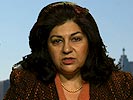
Yanar Mohammed on The War (Men's Against Women) In Iraq

photo of Yanar Mohammed with a male soldier is from here

What follows is an excerpt from an article I read at OpEdNew.com. For the whole article, please go *here*.

... Yanar Mohammed , founding director of the Organization of Women's Freedom in Iraq (OWFI), was interviewed on the state of Iraq as the American occupation ends.  She described Iraqi cities full of destroyed buildings and broken streets, with intermittent electricity and unsafe drinking water.  Iraq, she said, is now a country of 99% poor and 1% rich living in the Green Zone, burdened with the most corrupt government in the world that is giving control of oil resources to multinational oil companies.
Iraqi women "are the biggest losers" in this war, Mohammed asserted, ending up with extreme lack of freedom, lack of social security, lack of opportunity, and increased sexual terror.  Her organization has conducted extensive high-risk investigations into the prevalence and plight of Iraqi widows, women kidnapped and killed, and women trafficked into prostitution. Fifteen percent of Iraq's 1 to 2 million widows are seeking temporary marriages out of economic desperation and extreme insecurity in being a single woman. By 2006, OWFI had observed an "epidemic rise" in the number of women prostituted in brothels, workplaces, and hideouts in Baghdad. Through covert investigation, they learned of the trafficking of women within Iraq for Iraqi men in all regions and for US military, as well as to nearby countries.  Democracy in Iraq has been crushed for women. 
American women soldiers in Iraq were big losers, also.  Nearly 200,000 served there, in as dangerous situations as men.  Though barred from combat, they patrolled streets with machine guns, served as gunners on vehicles, dismantled explosives, driven trucks down bomb-ridden streets, and rescued the dead and injured in battle zones. These same women found themselves, concurrently, caught in a second, more damaging war - a private, preemptive one in the barracks.   As one female soldier put it, "They basically assume that because you are a girl in the Army, you're obligated to have sex with them."  Resisting sexual assault in the barracks spills over to battlefield, according to many women veterans, in the form of relentless verbal sexual harassment, punitive high-risk assignments, and the morbid sense that your back is not being watched. ...

Saturday, December 17, 2011

Yanar Mohammed on the On-going White and Male Supremacist Occupation of Iraq by the US: "This is not a democratic country." ... "Women are the biggest losers in all of this."

image of cartoon is from here

I am hearing arrogant and ridiculous reports in the US from media (owned by corporations that wish to control the minds of any who listen) that Iraq is now a sovereign state. We must ask: if Iraq had as much "presence" in the US, on US soil, would conservative racist/white supremacist white men in the US consider this a sovereign state? Doubtful. What we'd do in response to even a threat of such an occupation is amp up our racist/white supremacist campaigns against all people of color, wage more wars against Central Asia, and do so in the name of "freedom". The arrogance is also showing up in the brazenness of corporate media representatives admitting why US forces occupied and are still illegally and criminally in Iraq. (Not that the US media calls it a crime or a violation, mind you.)

Recently, NBC News, on a program called Rock Center, admitted in very clear language that the US is NOT leaving Iraq, and that many forces remain, including the CIA and other cover operations. (See *here* for more.)

When major corporate news sources admit, also, that the US went to war against the Iraqi people to occupy the country to protect unjust, criminal access to oil reserves there (as if the US has a right to all oil everywhere, and may stake out claims to it using the most blunt and horrific military force at will). But possession of oil and possession of land is all part of a larger struggle at global imperialism which, as you may know, is laid out in a plan concocted by the likes of Donald Rumsfeld--who you'll hear from later in this post--Paul Wolfowitz, and Dick Cheney. Each of those men should be in prison for life for crimes against humanity. For more on this blatantly white male supremacist/Western imperialist effort, see *here*.

What follows is from Democracy Now!, *here*.

Iraqi Women’s Activist Rebuffs U.S. Claims of a Freer Iraq: "This Is Not a Democratic Country"

Yanar_mohammed
Yanar Mohammed, president of the Organization of Women’s Freedom in Iraq, joins us to discuss the impact of the nearly nine-year U.S. occupation, particularly on Iraqi women. "The Iraqi cities are now much more destroyed than they were, I would say, like five years ago," Mohammed says. "In the same time, we have turned to a society of 99 percent poor and 1 percent rich, due to the policies that were imposed in Iraq." Mohammed decries the repression of Iraqi protesters that joined the Arab Spring in a February 25th action. "The women are the biggest loser in all of this. We went to the Iraqi squares. We demonstrated. The Arab Spring was there very strongly but got oppressed in ways that were new to Iraqi people. Anti-riot police of the American style was something that we witnessed there... This is not a democratic country." [includes rush transcript]

AMY GOODMAN: We wanted to also bring into this discussion Yanar Mohammed. She is president of the Organization of Women’s Freedom in Iraq. Usually in Iraq, she right now is joining us from Toronto.
Yanar, talk about this last more than eight years of the invasion and the occupation.
YANAR MOHAMMED: If I start with the basics, the Iraqi cities are now much more destroyed than they were, I would say, like five years ago. All the major buildings are still destroyed. If you drive in the streets of the capital, your car cannot survive more than one month, because all the streets are still broken. So there was no reconstruction for the buildings, for the cities.
And in the same time, we have turned to a society of 99 percent poor and 1 percent rich, due to the policies that were imposed in Iraq. While Iraq has more than one million widows—some of the counts say one million, some of the counts say two million widows—these widows try to survive on a salary of $150, and most of them cannot get this salary because they don’t have proper ID due to internal displacement. And in the same time, the 1 percent, who lives—of Iraqis, who lives in the Green Zone, they drown in a sea of money. And there was a scandal of losing $40 billion from the annual budget of the country, and nobody is accountable for it. So we have—after nine years, we have the most corrupt government in the world.
We are divided to a society of Shias, who are ruling, and Sunnis, who want to get divided from the country of Iraq. We are now on the verge of the division of country according to religions. And to ethnicities, it has already happened. We know that the Kurdish north is now a Kurdistan, the region of Kurdistan. And the constitution that we have in Iraq allows everybody to get divided or to get their autonomy. So now the Sunni parts of Iraq, they want to be their own agents. They don’t want to be part of the central government anymore. And in the same time, destruction is everywhere. Poverty is for all the people but the 1 percent who are living inside the Green Zone.
And I would like to add one thing. If President Obama wants to make it sound like one unified society, that’s not the true story. We are living in a huge military camp, where one million Iraqi men are recruited in the army. And on top of that, there’s almost 50,000 militia members, of the Sadr group and the other Islamist group, who are not only local militias, like army within the country, but they are now being exported to other countries to oppress the Arab Spring in Syria and maybe later on in other countries. We are not a united country, because the Islamic Republic of Iran, which is another country, has the upper hand in Iraq. And the decisions that were done lately about who stays from the Americans and who doesn’t stay inside Iraq was due to the pressure of the Islamic Republic of Iran. They are the decision makers in Iraq.
And the biggest loser out of all of this are the women. Now, by the constitution, there are articles that refer us to the Islamic sharia, when this was not in action in the times of the previous regime. Under Islamic sharia, women are worth half a man legally and one-quarter of a man socially in a marriage. And we still suffer under this. As a women’s organization, we daily meet women who are vulnerable to being bought and sold in the flesh market. We see widows who have no source of income, and nobody to get them IDs for themselves and their children, because they have been internally displaced. So poverty and discrimination against women has become the norm. And the government doesn’t care much about this. They talk about it a lot, but not much is being done about it. And—
JUAN GONZALEZ: Yanar, I’d like to ask you, on another matter, the—we had a quote earlier in the show from President Obama saying that, unlike historical empires of the past, the United States doesn’t go into countries for territory or resources, but because it’s right. Could you talk to us about what has happened to the resources of Iraq, to the oil of Iraq? To what degree now are American companies involved that they were not before the war?
YANAR MOHAMMED: In the last year, we were told that Iraq’s economy is going to be changing, and there’s going to be a new phase of investment. But in reality, those who were invited into the Green Zone were surprised to see that it’s all about privatization, that we have new foreign oil companies. Some of them are already functioning in the south, like British Petroleum, who have an oil field from which they are extracting oil.
They are beginning to—they have brought some foreign workers to work in there, and they have totally discriminatory workplaces where the foreigner is paid much more than the Iraqi. I was told that the foreigners are paid in the thousands of dollars monthly, while an Iraqi employees is paid something like $400. And even the workplaces are very discriminatory and racist, in the sense that the foreigner workers are treated much better than the Iraqi employees.
And the question is, how did they get these foreign oil companies to come into Iraq? Like British Petroleum is one of them. It has many oil fields. It’s functioning. It’s extracting Iraqi oil. On which terms? We, the Iraqi people, don’t know. On which agreement did they come and they are functioning fully in Iraq? We, the Iraqi people, don’t know.
And the question is, why is all the money being shared by the 1 percent who are ruling Iraq and the U.S. administration and all these multinational companies, while the Iraqi widows cannot even have $150 as a salary? Most of the widows we’ve met in our organization do not have one penny coming into their pockets. No government finds themselves accountable for the women of Iraq, who have been turned deprived because of this war.
And I would like to add one thing. There is a new generation of women and men in Iraq who are totally illiterate. You see a woman in her twenties. She might have children, or not, and that’s another story about the widows. But she has witnessed no schooling because of the sectarian war, because of the war on Iraq. It’s a generation of illiteracy in Iraq, while, before this war, you know, we know that Iraq in the 1980s, and even in the following years, it had the highest literacy rate in the Arab world.
And the last point I would like to add, and I would have liked you to ask me about it, is the Arab Spring, when it started in Iraq, specifically on the day of February 25. When the government held a curfew in all the Iraqi cities, especially in Baghdad, we had to walk three hours to reach to the Tahrir Square of Baghdad, and 25,000 people were in that square expressing their political will that this is not the political system that they want to rule them—the Islamist government of the Shia, who is oppressing all the others, the Sunni, who are oppressed in the west, the ethnic divisions on the people.
And mind you, the gender divisions? In the Tahrir Square of Baghdad, many of us women were there, and we were so respected. Nobody told us to put on the veil on, while in these days the prime minister’s office is spreading out policies that all the female workers in the public sector will have to wear decent dress code—decent as in respecting our culture. The prime minister is imposing a mentality of discriminating against women based on Islamic sharia, while the demonstrators of the Arab Spring in Iraq want an egalitarian society.
And one thing that this new democracy, so-called democracy, proved in Iraq is that they were the best in oppressing the Arab Spring in Iraq. They sent us police, army and anti-riot groups to shoot us with live ammunition in the Tahrir Square. They detained and they tortured hundreds and thousands of us demonstrators. And this is because we only led a free demonstration.
And this is not only one demonstration. All the Fridays since the beginning of February have witnessed demonstrations in the main squares of Iraq—Baghdad, Sulaymaniyah, Basra, Samarra, all of Baghdad. People went into the squares, and there were no slogans of asking for a religious government. The U.S. administration came into Iraq: it divided the Iraqi people according to religion, according to their sect, according to their ethnicity. It’s divide and conquer. And now the women are the biggest loser in all of this. We went to the Iraqi squares. We demonstrated. The Arab Spring was there very strongly but got oppressed in ways that were new to Iraqi people. Anti-riot police of the American style was something that we witnessed there. The big vehicles that sprayed us with the hot water, polluted water, pushed us out of these squares. And sound bombs were thrown at us, live ammunition, the full works. This is not a democratic country. And it is not united, because it’s being divided into Sunni, Shiite and Kurdish regions.
AMY GOODMAN: Yanar, I wanted to end by going back to the beginning, if you will, going back to 2003 to the words of then-Secretary of Defense Donald Rumsfeld after the fall of Baghdad.
DEFENSE SECRETARY DONALD RUMSFELD: Iraqis celebrating in the streets, riding American tanks, tearing down the statues of Saddam Hussein in the center of Baghdad, are breathtaking. Watching them, one cannot help but think of the fall of the Berlin Wall and the collapse of the Iron Curtain. We are seeing history unfold, events that will shape the course of a country, the fate of a people, and potentially the future of the region.
AMY GOODMAN: That was Donald Rumsfeld in 2003. Yanar, we have 30 seconds. Your final response?
YANAR MOHAMMED: I think that the victims and the parents of the victims of this war, the half-a-million dead of this war, were not invited to the celebration of the U.S. and the military in Baghdad. They should have been invited to give their say about this Iraqi war that left their families hungry and poor and really unable and helpless.
AMY GOODMAN: Yanar Mohammed, I want to thank you for being with us, president of the Organization of Women’s Freedom in Iraq.

Saturday, October 8, 2011

"I think democracy never comes by military invasion. Democracy without independence and justice is meaningless", states Malalai Joya on the Tenth Anniversary of the Mass Murderous, Anti-Feminist, Anti-Woman War in Afghanistan

GWBush and B. Obama have promised something to the effect of "reducing terror and fear" in the world, yet perpetrate their own organised horrific, imperialistic, terroristic atrocity daily in Afghanistan, for TEN YEARS now. I place no faith in their ability to lead us to a more peaceful world.

What is above and what follows is all from afganwomensmission.org, *here*.

Former Afghan MP, Human Rights Activist and Author of “A Woman Among Warlords,” Malalai Joya, recorded this message on the Tenth Anniversary of the War and Occupation of Afghanistan:  


Transcript of Joya’s message: 

Hi everyone, I would like to thank all supporters and anti-war movements around the world who are marking the dark day of occupation of U.S. and NATO in Afghanistan. 

Respected friends – 10 years ago the U.S. and NATO invaded my country under the fake banners of women’s rights, human rights, and democracy. But after a decade, Afghanistan still remains the most uncivil, most corrupt, and most war torn country in the world. The consequences of the so-called war on terror has only been more bloodshed, crimes, barbarism, human rights, and women’s rights violations, which has doubled the miseries and sorrows of our people.

During these bloody years, tens of thousands of innocent civilians have been killed by occupation forces and terrorist groups. When Barack Obama took office in 2008, unfortunately his first news for my people was more conflict and more war. It was during Obama’s administration that civilian death tolls increased by 24%. And the result of the surge of troops of Obama’s administration is more massacres, more crimes, violence, destruction, pain, and tragedy. That’s why he has proved himself as a warmonger — as second even more dangerous Bush.

According to the Afghanistan Right Monitor in 2010, 7 civilians were killed everyday. U.S. and NATO tell us they will leave Afghanistan by the middle of 2014, but on another hand they’re talking about U.S. permanent military bases in Afghanistan. They will not leave our country soon. They are there for their own strategic regional and economic interests. That is why they want to change Afghanistan into a military and intelligence base in Asia.

The western governments not only betray Afghan people, they betray their own people too. They are wasting their taxpayer money in the blood of their soldiers by supporting a war, which only safeguard the interests of the big corporations and the Afghan criminal warlord rulers.

I think democracy never comes by military invasion. Democracy without independence and justice is meaningless. It is only the nation who can liberate themselves.

I believe that the only solution for the catastrophic situation of Afghanistan is withdrawal of ALL of the troops of our country because their presence is making much harder our struggle for justice and peace. By empowering the reactionary dark minded terrorist groups who are great obstacles for true democratic minded elements. If honestly they leave Afghanistan , the backbone of fundamentalist warlords in Taliban will break.

I hope one-day Afghanistan also will see the glorious uprising like in Middle East countries. As right now we are witnessing the small uprising in some provinces in Afghanistan like Herat, Kunar, Nangarhar, Mazar-e-Sharif, Farah, Kabul, and many other provinces which is a big source of hope for the bright future of Afghanistan.

So now I would like to ask all peace-loving, justice-seekers, anti-war movements and democratic-minded intellectuals, individuals around the world to join their hands with democratic-minded people of our country who are able to fight against fundamentalism and occupation. Therefore, my message to you is please empower my people educationally, as I believe education is a key against ignorance and toward emancipation.

Thank you very much.

Long live freedom. Down with Occupation. 

Find out more about Joya at www.malalaijoya.com.

Ten Years of Invasion, Occupation (not the anti-Wall St. kind), and Racist Mass Murder in Afghanistan: Listening to Reena, FOR A CHANGE!


Yeah, what SHE said. Including about the CRAP-loaded spurious politics behind the distribution of Nobel Peace prizes.

In addition to the video clip above, everything that follows is also from Democracy Now! and may be seen at their site, *here*.
It was 10 years ago today when former President George W. Bush announced the beginning of the war on Afghanistan. It has now has become the longest-running war in U.S. history and there is no end in sight. The Taliban remains in control of major parts of the nation. Peace talks have collapsed. Civilian and troop casualties continue to mount. There have been a number of major setbacks in just the past few weeks. On Sept. 13, militants attacked the U.S. embassy and the NATO headquarters in Kabul. A week later, the Taliban claimed responsibility for assassinating former Afghan president Burhanuddin Rabbani, who headed the Afghan Peace Council. Just this week, the Wall Street Journal reported Afghan President Hamid Karzai has given up on negotiating with the Taliban. To discuss what the future has in store for a nation long-ravaged by war, we speak with “Reena,” a 19-year-old member of the Revolutionary Association of the Women of Afghanistan, who joins us by video Skype in Afghanistan. “Reena” is a pseudonym and her face is concealed since all RAWA members maintain anonymity for security reasons. We’re also joined by independent journalist Anand Gopal, who has reported extensively from Afghanistan and is completing a book on the war. [Includes rush transcript]

AMY GOODMAN: It was ten years ago today when then President George W. Bush announced the beginning of the war.
PRES. GEORGE W. BUSH: On my orders, the United States military has begun strikes against out, terrorist training camps and military installations of the Taliban regime in Afghanistan. These carefully targeted actions are designed to disrupt the use of Afghanistan as a terrorist base of operations, and to attack the military capability of the Taliban regime
AMY GOODMAN: Ten years later, the Afghan war rages on. It has become the longest-running war in U.S. history. There’s no end in sight. The Taliban remains in control of major parts of the nation. Peace talks have collapsed. Civilian and troop casualties continue to mount. There have been a number of major setbacks in just the past few weeks. On September 13, militants attacked the U.S. Embassy and the NATO headquarters in Kabul. A week later, the Taliban claim responsibility for assassinating former Afghan president, Burhanuddin Rabbani, who headed the Afghan Peace Council. Just this week the Wall Street Journal reported Afghan President Hamid Karzai has given up on negotiating with the Taliban. In a recent interview, retired General Stanley McChrystal said the U.S. and NATO were only 50% of the way towards achieving their goals in Afghanistan. Brian Katulis is a senior fellow at the Center for American progress.
BRIAN KATULIS: If you look at the main metric, the measure for success, in the counterinsurgency strategy, it is, how safe is the local population? 2011, this year, will be the deadliest year for Afghan civilians. More than 80% of those deaths are caused by the Taliban insurgency. But the key metric of whether we’re succeeding on a counterinsurgency strategy — are we keeping the local population safe? — the answer is, no. The number has gone up
AMY GOODMAN: To talk more about Afghanistan, we are joined by two guests – first, we go to Afghanistan, to Reena. She’s 19 years old, a member of RAWA, the Revolutionary Association of the Women of Afghanistan. Reena is a pseudonym, her face concealed since all RAWA members maintain anonymity for security reasons. Welcome to Democracy Now!, Reena. Describe what is happening now – ten years after the U.S. invaded Afghanistan.
REENA: Thank you so much, Amy. It is a pleasure to be on your show. Ten years ago when U.S. invaded Afghanistan, they made promises of democracy, women’s rights, and a general improvement in the lives of people. But ten years later, today, the situation is clearly getting worse for our people. Everyday life has not improved. Women’s situation has gotten worse. There is no sign of democracy or freedom or peace anywhere. In fact, civilian deaths have reached 10,000 on this anniversary. And it’s going to continue to rise with the surge of troops and increase in assaults, this will obviously be continuing.
AMY GOODMAN: Here in the United States, we’ve just passed the tenth anniversary of the September 11 attacks. There was a great deal of attention to the young people who grew up in the shadow of the World Trade Center, both specifically and also just in this age metaphorically. You, Reena, or 19 years old. You were nine when the U.S. attacked Afghanistan. Where were you born? What are your thoughts growing up in the Afghan War?
REENA: At that time, I was in Pakistan, in a refugee camp, but I do remember a lot of people who were there at that time, like our close relatives. We lost some people that we knew, some friends, in the bombings of the U.S. So I did not exactly witness the deadlier Civil War of 92-96. I have vague images of the Taliban regime of 96-2001. But this ten year war has definitely had a very deep impact on this generation. The civilian casualties, the fear that people live with these days, the terror that there is in the streets everywhere for the IED attacks or other kinds of threats, it is increasing day by day. It has just made everyone extremely insecure and bad for the people.
AMY GOODMAN: We’re also joined here in New York by Anand Gopal. He reported for The Christian Science Monitor in Afghanistan then for the Wall Street Journal. Now he is writing a book on the war in Afghanistan. Your thoughts ten years later — the longest U.S. war in U.S. history.
ANAND GOPAL: By any metric we look at, the war has gotten worse. Security has gotten precipitously worse every single year. 2011 has seen the most civilians being killed of any year since the war started. We’ve seen the most number of attacks – suicide bombings, roadside bombings, since the war started for any year. The amount of territory the Taliban controls has been undiminished, despite the fact we’ve seeing a major troop surge in the last year or two years. We’ve seen a fragmentation within Afghanistan where the people who we are aligned with are starting to arm themselves and thinking about a post-American scenario where they want to all fight against each other. Really we’re at a knot here in Afghanistan in the last ten years.
AMY GOODMAN: Listening to the talk shows on the cable networks, it is quite remarkable to see how things are turned on their heads. The Republicans talking about Obama presiding over the longest war. The issue of what it means if the U.S. pulls out, and the mantra often repeated that the Taliban will take over. I want to get both of your thoughts on that beginning with Anand.
ANAND GOPAL: The Taliban already have de facto control of almost half of the country in the countryside. Beyond that, what we’re doing in Afghanistan is we are arming militiamen, warlords, strong men, we’re actually going into the countryside and giving them weapons, giving weapons to all sorts of human rights violators and abusers. These are people in many cases who have been disarmed after 2001 and we’re rearming now because we need help in fighting the Taliban. So what that’s actually doing is creating the conditions in which the civil war is more and more likely. In fact that I think the longer we stay and continue this policy, a civil war becomes more likely.
AMY GOODMAN: Reena, your thoughts on the issue of the Taliban?
REENA: Yes, I absolutely agree with him. The U.S. has armed the most dangerous warlords and is continuing to arm and support them. If they were drawn out, yes, a civil war may be inevitable. But again, we have to remember that, as we always say, this war is part of the problem. It is not going to solve anything for us. If the troops withdraw and if they give Afghanistan a chance to decide its own fate, I think things will work out. If they do not support these warlords, as he said, and the U.S. and its allies pressure the other countries not to support the Taliban, then I think maybe a civil war will not take place. It might not be as bloody as it will be if they continue supporting or if this war goes on.
AMY GOODMAN: Reena, a reason often given for staying in Afghanistan — it was one that Laura Bush put forward, it was one that was picked up again, things all turned around, the kind of feminist reason, particularly put forward by the Republicans but many Democrats also support this and Democratic women — that it is about saving the women of Afghanistan. Your response?
REENA: Yes, these claims were all extremely false. If they have brought to power the misogynists, the brothers and creed of Taliban into power, who are the exact copies of Taliban, mentally and have just been physically changed, then I do not think the feminist situation can improve. Today, there are slight improvements in women’s lives in urban areas, but again if you look at statistics, Afghanistan remains the most dangerous place for women. Self-immolation, suicide rates, are extremely high – it has never been this high before. Domestic violence is widespread. Women are poor. They do not have healthcare. It has the highest mortality rate in the world.
There are, as I said, some improvements. And in some aspects, it might have been a little better for a handful of people, for women, but it has definitely has gotten worse for others. There is insecurity, there are threats. They always say that there are six million girls in schools and the schools have opened, but nobody looks at the dropout rates. Nobody looks at the attacks, the threats that the Taliban makes to the girls. And they do not dare go out again. Nobody looks at the quality of the schools. All these things — there have been slight changes. It has been very widely used, and to just highlight a few positive things, but overall, things have gotten worse.
AMY GOODMAN: I want to play a clip from Admiral Mike Mullen, the Chair of the Joint Chiefs of Staff, speaking earlier this week about the Haqqani network threat, blaming the ISI for orchestrating attacks on U.S. targets inside Afghanistan.
ADM. MIKE MULLEN: A second but no less worrisome challenge is the impunity with which certain extremist groups are allowed to operate from Pakistani soil. The Haqqani network, for one, acts as a veritable army of Pakistan’s internal services intelligence agency. With ISI support, Haqqani operatives planned and conducted that truck bomb attack as well as the assault on our embassy.
AMY GOODMAN: Chair of the Joint Chiefs of Staff, Admiral Mike Mullen. Anand Gopal, your response?
ANAND GOPAL: It’s absolutely the case that Pakistan is in some way supporting the Haqqani network and the rest of the Afghan insurgency. But I think it is important to have some historical context in all of this. We once, the U.S., once supported the Haqqani network, back in the ‘80s when we were fighting against the Russians. We poured millions, in fact billions of dollars into Afghanistan to fundamentalists, to Islamic radicals and we’re getting the blowback of that now. And also that has fundamentally changed the dynamic within Pakistan, where we helped create, in a sense, the way that the ISI, the Pakistani Security Agency, acts today. They have been pretty much consistent in the last thirty years in their position. We just changed our position ten years ago.
AMY GOODMAN: And the role that Pakistan — if you could talk further – plays in Afghanistan, and the fact that Pakistan has been supporting or in the past supported the very forces that they’re fighting against, that the U.S. is fighting against in Afghanistan, and helped to establish the ISI, which it now is critiquing.
ANAND GOPAL: Well, there is no doubt that the insurgent leadership, the Haqqani network, the Taliban and other groups, they have a safe haven in Pakistan. There is no doubt that elements of the ISI, the security apparatus, is giving advice and support to the insurgent leadership. Pakistan is planning a double game. On the one hand, they are aligned with the U.S. and getting millions of dollars in aid for military, on the other hand, supporting insurgency.
AMY GOODMAN: Reena, you are 19 years old, you are a young woman who goes back and forth between Pakistan and Afghanistan. How do you function? Reena is not really your name, you’re not saying where you are in Afghanistan, you’re with the organization RAWA. Explain what your group does and how you get around.
REENA: RAWA, the Revolutionary Association of the Women of Afghanistan, was established in 1977 by a martyred leader, Mina, and a group of other young women. It is an anti-fundamentalist group, women’s group, that fights for freedom, democracy, secularism and women’s rights. Because we are the only women’s group that speaks against fundamentalists — the warlords in power today — we have any security issues and we cannot be open in our activities. So we are underground and semi-underground. We function mostly in Afghanistan, but a small part of our activities are also based in Pakistan.
AMY GOODMAN: Malalai Joya make a statement this week where she said, let’s see if I can find it, “we’re at a point today when Afghanistan is at its most violent since war started and the government at its weakest. Civilian casualties higher this year than any previous year, the territory Taliban controls more or less the same as last year, there’s no progress toward making a political solution.” Anand Gopal, what if the U.S. pulled out tomorrow?
ANAND GOPAL: I think if the U.S. pulled out tomorrow, it would be very likely that we would see a civil war. When you talk to Afghans, and particularly in the countryside where the war is being fought, what many of them say is, we want the U.S. troops to pull out and we want there to be some sort of peace settlement from all the sides.
This never really happened, even from day one in 2001. The Afghan state was not constituted on a broad-based system. It was a deal between a certain set of warlords and the U.S. You want to include civil society, groups like RAWA, other groups, and try to come together to tell Afghans to configure their state in some way, which they’ve never had a chance to do until now. So I think a peace settlement of some sort, together with the troops pulling out, would be the only way we can forestall a Civil War.
AMY GOODMAN: Would you say, Reena, that each day of this war increases hostility toward the United States?
REENA: Absolutely. Absolutely, it does, as it has increased from 2001 until now. Because in the start, the people were very hopeful. They had some hope that the U.S. would actually help them, that their situation would improve in the last ten years. But the U.S., unfortunately, supported the war lords, like Sayaff, Abdullah Abdullah, Ismail Khan, Khalili, and they recently killed Burhanuddin Rabbani.
So all this has increased the People’s hostility, in addition in the countryside and in provinces other than Kabul and some other urban cities, the U.S. airstrikes and night raids are increasing day-by-day. This itself is drawing a lot of hostility from the people toward the U.S., and they want them to leave our country as soon as possible.
AMY GOODMAN: Final comments, Anand Gopal, for people to understand and as you both lived in Afghanistan for years covering the war and you come back to the United States and see how generally it is covered as you write your book?
ANAND GOPAL: It is covered very poorly. I think a lot of the discourse about the war in Afghanistan is that it is a series of mistakes. And it is a mistake. But I think at the core underneath those mistakes is a fundamental wrong policy, which was the war on terror, going into Afghanistan and thinking that the occupation of a country can solve the problem of terrorism. I think that everything that we are seeing in Afghanistan today, you can relate it back to that fundamental core issue.
AMY GOODMAN: Reena, I don’t know if you heard the Nobel peace Prize was just announced. It is going to three women from the Arab world and from Africa. Two from Liberia, including the current president of Liberia, and one brave Yemeni activist, the youngest ever to receive the Nobel peace prize. Had you heard about that? Does this matter at all to in Afghanistan?
REENA: Yes, I did read about this. I would like to say that the Nobel Peace Prize is, I do not think, it is a very big prize in the opinion of our people. Because every time there is usually a political motive behind giving it to somebody. And the actual real people who struggle for something or who are trying to get something are never considered for this prize. For example, last year, a warlord woman from our country, Sima Samar, was on the list of these people. She almost won the Nobel Peace Prize. That woman is in the Warlord Party. If not directly, is an agent of other countries. If you can consider giving this prize to such a woman, then it does not mean anything for our people. Anybody else can win it for political reasons or whatever is behind it.
AMY GOODMAN: Your thoughts in that, Anand Gopal?
ANAND GOPAL: I think also more importantly, from the point of view of the Afghans, Barack Obama is a Nobel Peace Prize winner, and he’s the person who increased the number of troops in Afghanistan and increased the violence in fact in Afghanistan. A lot of my Afghan friends question with the value of the Nobel Peace Prize is if it leads to more war in Afghanistan.
AMY GOODMAN: Thank you both for being with us on the 10th anniversary of the U.S. bombing of Afghanistan, now the U.S. engaged in the longest war it has ever been involved with in U.S. history. Anand Gopal, independent journalist, writing a book Afghanistan, previously with the Christian Science Monitor and then the Wall Street Journal.
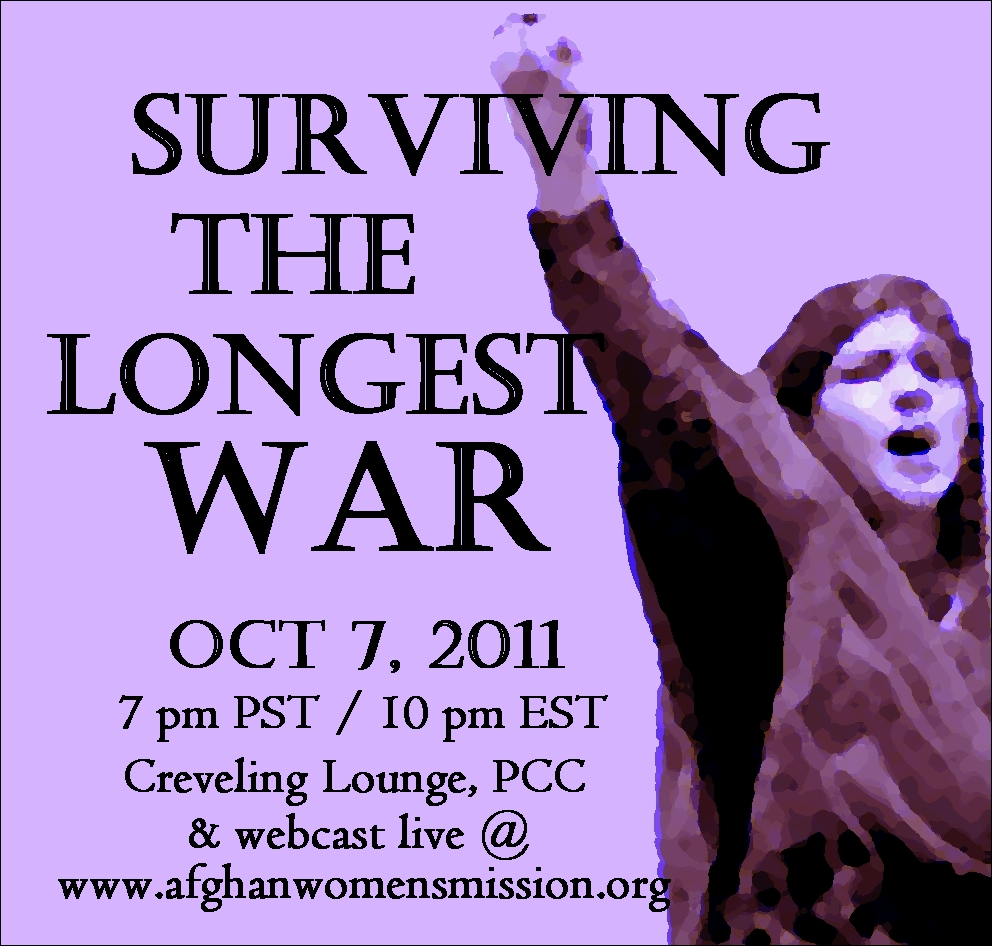
AMY GOODMAN: And Reena, not her real name, speaking to us from Afghanistan, her face covered. She is anonymous for her own protection. Tonight, _KPFK_’s Uprising host, Sonali Kolhatkar. KPFK is the Pacifica Station in Los Angeles—-will be leading a conversation with Reena via live video stream and taking questions from the viewing audience. You can see it at afghanwomensmission.org, we’ll put a link there on our website at democracynow.org.
See also, from afghanwomensmission.org,


On the 10th Anniversary of the U.S. war, an underground activist tells the real story of the Occupation & Afghan Resistance

Reena, a member of the Revolutionary Association of the women of Afghanistan (RAWA), will address American audiences via live video stream.

RSVP for the event on Facebook.
Download the flyer here.

AWM Co-Director and KPFK’s Uprising host Sonali Kolhatkar will lead the conversation with Reena via video streaming in front of a live audience. The event will be webcast live on AWM’s website.

Questions will be drawn from the in-person audience, and the online audience via Facebook.

WHEN: Friday Oct 7 2011 7pm PST / 10 PM EST
WHERE: Creveling Lounge (CC bld, 2nd floor) PCC campus, Pasadena California or @afghanwomensmission.org.

Open to the public. Entrance is free. There will be books and crafts available for sale. 

If you are unable to attend this event, you can watch a live webcast of the entire event on this website! Click here to find out the time of the webcast in your city.

Organized in collaboration with PCC’s Students for Social Justice. KPFK is a media sponsor. 

And please also see this,


For Immediate Release
Contact: Sana Shuja: 504-669-4446
Sonali Kolhatkar: 626-676-7884 

E-mail: press[at]afghanwomensmission[dot]org

Surviving the Longest War: An International Video Webcast

On the Tenth Anniversary of the US war, an underground activist
tells the real story of the Occupation and Afghan Resistance


October 7th 2011, marks the ten year anniversary of the United States’ invasion of Afghanistan. To mark this event, Afghan Women’s Mission (AWM), a U.S.-based non-profit that works in solidarity with the Revolutionary Association of the Women of Afghanistan (RAWA) will hold a special international online talk-back with Reena, a member of RAWA.

“Ten years of war has not made Afghanistan safer for anybody except the fundamentalist warlords in the Afghan government, and the Taliban,” said Reena. This anniversary event, in collaboration with PCC’s Students for Social Justice, will raise serious questions about the official story of the longest war the U.S. has ever officially waged, and will offer the unique perspective of an underground Afghan activist who has witnessed first-hand the impact of the war.

AWM Co-Director and KPFK’s Uprising host Sonali Kolhatkar will lead the conversation with Reena via live video streaming from the Pakistan/Afghanistan region, in front of a live audience. The event will be webcast live on AWM’s website at www.afghanwomensmission.org .

“Using the latest technology available, we are thrilled to be able to broadcast the voice of this young RAWA member – an Afghan speaking for her generation – well beyond the confines of our physical event,” said Kolhatkar. “We invite people from all over the world to mark the tenth anniversary of this war by tuning into our live web video stream of our conversation with Reena.”

Questions for RAWA member Reena will be drawn from the live in-person audience and the online audience via Facebook. The event will take place on Friday October 7th at 7pm PST (10 pm EST) at Creveling Lounge (CC Building, 2nd floor) on the campus of Pasadena City College (PCC).

Nineteen year old Reena was born an Afghan refugee in Pakistan around the time when US-backed fundamentalist fighters started a brutal civil war in Afghanistan. She lived with her family in the border town of Peshawar in severe and impoverished conditions. After moving to a refugee camp run by RAWA, Reena attended one of their literacy courses. She eventually joined the organization, working in various RAWA-run schools and orphanages and is currently a first-year University student. Since Reena was born, she has known only war in her country.

Read Sonali Kolhatkar’s September 11th, 2011 interview with Reena here.

RAWA is on the forefront of the movement for peace in Afghanistan. Their activities focus on women’s rights, human rights, and exposing the fundamentalist crimes of warlords in power, as well as the Taliban. They have criticized all foreign intervention since the time of the Soviet invasion and occupation through to today’s US/NATO war. As the oldest women’s political organization in Afghanistan, RAWA has been promoting human rights and democracy for more than 30 years. Their work is extremely dangerous – all RAWA members, including Reena, use pseudonyms, do not reveal their faces, and live and work underground.

RAWA Predicted the Failure of the War Ten Years Ago

On September 14th 2001 RAWA issued a statement warning the US against waging war on Afghanistan, saying “vast and indiscriminate military attacks on a country that has been facing …disasters for more than two decades will not be a matter of pride.”

On October 11th 2001, four days after the bombs began dropping on Afghanistan, RAWA once more urged the US to do the right thing, predicting accurately the outcome of the war in a statement: “[t]he continuation of US attacks and the increase in the number of innocent civilian victims not only gives an excuse to the Taliban, but also will cause the empowering of the fundamentalist forces in the region and even in the world.”

A month after the war began, when the Taliban were rapidly pushed out of Kabul, RAWA realized that the US was ready to replace the Taliban with their ideological brethren, the Northern Alliance (NA) warlords. They issued yet another international appeal, warning: “[t]he NA will horribly intensify the ethnic and religious conflicts and will never refrain to fan the fire of another brutal and endless civil war in order to retain in power.”

Sadly RAWA’s warnings were ignored and the last ten years have borne out their predictions.

The Human Impact of a Decade of War

Civilian casualties as a result of the ten year long Afghanistan war have been estimated at 17, 611 – 37, 208, with more than half killed directly as a result of U.S.-led military actions (Sources: UN Assistance Mission Afghanistan, Afghan Independent Human Rights Commission, Human Rights Watch, and Associated Press). A recent report by Open Society Foundation found that night raids conducted regularly by US and NATO forces in Afghan villages result in indiscriminate detentions and widespread abuse.

Politically things aren’t much better. Afghanistan’s government, dominated by the US-backed NA warlords whom RAWA warned against, is ranked the second most corrupt in the world after Somalia (Transparency International). Through the Afghan parliament, warlords have passed laws exempting themselves from prosecution for war crimes, curtailing press freedoms, and promoting women’s abuse.

Women in particular continue to suffer. A survey by UNIFEM in January 2011 revealed that a shocking 87% of Afghan women are victims of domestic violence. A UK based charity, Womankind, found that “between 60 and 80 percent of Afghan marriages are forced, with more than half of all girls married before age 16.” While women can run for office in the Afghan parliament, they are only allowed to serve if they accept the status quo. The well-known and popular activist, Malalai Joya, a representative of Farah province, was kicked out of Parliament for criticizing the US-backed warlords and has survived numerous assassination attempts.

According to RAWA member Reena, the first thing that needs to happen is for Americans to “call for the withdrawal of the troops, as the military presence has not helped Afghan people in any way.” Her opinion is supported by a majority of Americans: a Washington Post-ABC News poll in March showed that 64% of poll participants somewhat or strongly felt that the war has not been worth fighting.
RAWA member Reena is available for a limited number of interviews.


Sunday, September 18, 2011

Immediate removal of all troops from Afghanistan: Malalai Joya on the Occupation by the US and NATO

Imagine, if you will, that humane leaders within a country, such as Malalai Joya, get to decide who enters their country and assists in governance, military struggle, or humanitarian aid. Now consider that anything else is terrorism, brutality, and domination of one nation-state by another.

Everything below is from Green Left, *here*. You may also click on the title below to link back to the original source website. Thank you for your work in reporting on this, Annette Maguire.

Malalai Joya. Marrickville Town Hall, September 9. Photo: Annette Maguire

Tuesday, September 13, 2011
Afghan parliament, addressed a packed Marrickville Town Hall on September 9. More than 500 people braved the cold to hear Joya speak defiantly about the war waged on her country by US/NATO forces for the past decade.
On the eve of the 10th anniversary of the September 11 attacks, which became the pretext for the invasion of Afghanistan less than a month later, Joya advocated for immediate removal of all occupying troops.
“I agree with my people that democracy never comes by bombing wedding parties, by committing war crimes,” she said.
Joya exposed Obama’s much-publicised “troop draw-down” as a mere exercise in “image-management”. Afghan President Hamid Karzai has agreed to permanent US control of military bases in the nation.
She said “they don’t want to leave Afghanistan because it’s in the middle of Asia, so it’s a base for US control in the whole region”.
Refuting Prime Minister Julia Gillard’s claim that removing the troops will leave Afghanistan in the hands of the terrorists, Joya said: “Someone should tell Gillard that Afghanistan is already in the hands of terrorists.”
Joya was famously expelled from her parliamentary position after denouncing the warlords and war criminals holding seats in the Afghan parliament.

She identified three forces embattling her people’s lives: the warlords, the Taliban, and occupying troops.
While the Taliban posed right-wing resistance to the occupation, it is “the resistance of ordinary Afghani people that gives hope for the future”.
Joya openly acknowledged that Afghanistan would still face problems even after the removal of troops, and appealed for humanitarian support.
“Nobody says when occupying troops leave, it will be heaven,” she said. “There’s no question we need a helping hand, but that never means we want occupation.
“We don’t want troops, but we want your solidarity — we need educational support, teachers, health clinics … When war-makers and fundamentalists can unite, so can we.”
The Stop the War Coalition Sydney, which organised the public meeting, announced a protest to mark the 10th anniversary of the invasion, on October 8 at noon, Sydney Town Hall.
[The September 9 event was supported by the Marrickville Community Peace Group, the Sydney Peace Foundation and the Centre for Peace and Conflict Studies at the University of Sydney. Malalai Joya's trip to Australia was organised by Stop the War Coalition Sydney and Melbourne Writers Festival. For more information about Stop the War Coalition Sydney visit its website.]

Wednesday, September 14, 2011

What are the lessons of "9/11"?

image is from here

What, exactly, are we supposed to never forget and what are we supposed to never surrender?

The meaning of significant political acts of terrorism are told to us, formed for us, by media that is controlled by white and male supremacist corporate conglomerates owned by a few white het men in the West, each of whom has some very significant "interests" in how stories get told and who gets implicated as "dangerous". Needless to say, white het men must not ever be implicated as "dangerous", while virtually all other groups of people can be, in media--and every other group has been defined by WHM as diseased, dangerous, invasive, threatening, insane, untrustworthy, deceitful, deceptive, and violent.

Below is one link to what Democracy Now! has to say, which, while progressive, usually steers far clear of naming "white supremacy" and "male supremacy" and "capitalism" as the key forces which created both the conditions that made "9/11" possible, but also the spins of it made into solid, largely unquestioned stories distributed in off-line and on-line media. The Twin Towers, let's not forget, is where gross violence against the world was perpetrated, but was called "commerce" instead. The victims of commerce, who died on every other day than "9/11/2001" and also on that day, are not remembered, named, or honored as heroes--ever.

http://hw.libsyn.com/p/c/6/a/c6aadaf3ada64df8/9_11_11_Radio_Show_part_2.mp3?sid=f081207ff8a29b99312a856ae53e7d46&l_sid=18778&l_eid=&l_mid=2714355

Here are some lessons from my point of view:

1. Corporate capitalism, formed out of and steeped and marinated in male and white supremacy, cannot bring peace to anything. It only brings terrorism to the poor, to the Earth and its non-human beings, and to women across race, sexuality, and ethnicity, and to men who are not white or het.

2. The West, including especially the US, is a terrorist state, a terrorist organisation on a grand, horrific scale, and any claims it makes--ad nauseam--to "goodness" and "greatness" are soaked in the blood of those it destroys to maintain itself.

3. The US is a pro-genocidal, racist, rapist white male supremacist State. Any attacks against it will result in massive military force, rapist force, racist force, deadly force, grossly and inexcusably exceeding the force used in any attack against it.

4. The supremacist structures of the US and other Western countries remain something their media won't discuss. How it is that men continually maintain (and abusively use) tools of power such as military warfare, terrorism against classes of people (such as by men across race,. class, and sexuality against women; such as by whites across gender against people of color; such as by the rich against everyone not-rich; such as by the politically powerful against the Earth)? The means and methods have been documented, experienced, reported on, catalogued, and survived (by some). Yet we are made to re-conceive the horrors of the inner and outer workings of these systems of terror as if they are perpetually "not understandable" or "incomprehensible". They are fully understandable and comprehensible to the perpetrators. They are deeply understood by the victims of them.

5. The US keeps its deadly power alive by scapegoating "foreign" groups as THE Terrorists of the World. Whether it be the Japanese and Germans, Communists, the Vietnamese, Central Americans, Mexicans, women, gay men, the poor on welfare, or Muslims, we can note how the enemy is definitionally, defiantly, and absolutely never "us" if "us" includes white het men from the US.


Saturday, September 3, 2011

"Female Trafficking Soars in Iraq", by Rebecca Murray, with news from Yanar Mohammed

All that follows in this cross-post is from *here* at IPSNews.net.

Female Trafficking Soars in Iraq 
By Rebecca Murray

BAGHDAD, Aug 27, 2011 (IPS) - Rania was 16 years old when officials raped her during Saddam Hussein’s 1991 crackdown in Iraq’s Shia south. "My brothers were sentenced to death, and the price to stop this was to offer my body," she says.

Cast out for bringing ‘shame’ to her family, Rania ran away to Baghdad and soon fell into living and working in Baghdad’s red light district.

Prostitution and sex trafficking are epidemic in Iraq, where the violence of military occupation and sectarian strife have smashed national institutions, impoverished the population and torn apart families and neighbourhoods. Over 100,000 civilians have been killed and an estimated 4.4 million Iraqis displaced since 2003.

"Wars and conflicts, wherever they are fought, invariably usher in sickeningly high level of violence against women and girls," Amnesty International states.

Rania worked her way up as a sex trafficker’s deputy, collecting money from clients. "If I had four girls, and about 200 clients a day - it could be about 50 clients for each one of them," she explains.

Sex costs about 100 dollars a session now, Rania says. Many virgin teenage girls are sold for around 5,000 dollars, and trafficked to popular destinations like northern Iraq, Syria and the United Arab Emirates. Non-virgins are about half that price.

Girls who run away to escape domestic violence or forced marriage are the most vulnerable prey for men working for pimps in bus stations and taxi stands. Some girls are also sold into marriages by family relatives, only to be handed over to trafficking rings.

Most of Iraq’s sex traffickers are predominantly female, running squalid brothels in neighbourhoods like the decrepit Al-Battaween district in central Baghdad.

Six years ago, a raid by U.S. troops on Rania’s brothel brought her nefarious career to an abrupt end. The prostitutes were charged along with everyone else for abetting terrorism.

Imprisonment changed Rania’s life. While she served time in Baghdad’s Al-Kadimiyah lock-up – where more than half the female inmates serve time for prostitution – a local women’s support group befriended her. Today she works for them as an undercover researcher, drawing on her years of experience and connections to infiltrate brothels throughout Iraq.

"I deal with all these pimps and sex traffickers," Rania says, covered in black, with black, lacquered fingernails and gold bracelets. "I don’t tell them I’m an activist, I tell them I am a sex trafficker. This is the only way for me to get information. If they discover that I’m an activist I get killed."

In one harrowing experience, Rania and two other girls visited a house in Baghdad’s Al-Jihad district, where girls as young as 16 were held to cater exclusively to the U.S. military. The brothel’s owner told Rania that an Iraqi interpreter employed by the Americans served as the go-between, transporting girls to and from the U.S. airport base.

Rania’s co-workers covertly took photos of the captive teenagers with their mobile phones, but were caught. "One girl went crazy," Rania recalls. "She accused us of spying. I don’t know how we escaped," she exclaims. "We had to run away - barefoot!"

Before the Gulf War in 1991, Iraq enjoyed the highest female literacy rate across the Middle East, and more Iraqi women were employed in skilled professions, like medicine and education, than in any other country in the region.

Twenty years later Iraqi women experience a very different reality. Sharia law increasing dominates everyday life, with issues like marriage, divorce and honour crimes implemented outside of the court system, and adherence to state law.

"Many factors combined to promote the rise of sex trafficking and prostitution in the area," a Norwegian Church Aid report said last year.

"The US-led war and the chaos it has generated; the growing insecurity and lawlessness; corruption of authorities; the upsurge in religious extremism; economic hardship; marriage pressures; gender based violence and recurrent discrimination suffered by women; kidnappings of girls and women; the impunity of perpetrators of crimes, especially those against women; and the development of new technologies associated with the globalisation of the sex industry."

The International Organisation of Migration (IOM) estimates 800,000 humans are trafficked across borders annually, but statistics within Iraq are very difficult to pin down.

Although the Iraqi constitution deems trafficking illegal, there are no criminal laws that effectively prosecute offenders. Perversely, it is often the victims of trafficking and prostitution that are punished.

IOM is currently working with an inter-ministerial panel to lobby for a new reading of the revised counter-trafficking law, which has been stalled by the government since 2009.

"We have reports about trafficking both inside and out of Iraq," says senior deputy minister, Judge Asghar Al-Musawi, at the Ministry of Migration and Displacement.

"However, I admit that Iraqi government institutions are not mature enough to deal with this topic yet, as the departments are still in their growing phase."

Human Rights Watch (HRW) says the government has done little to combat the issue. "This is a phenomenon that wasn’t prevalent in 2003," says HRW researcher, Samer Muscati.

"We don’t have specific statistics. This is the first part to tackle the problem; we need to know how significant and widespread the problem is. This is something the government hasn’t been doing. It hasn’t monitored or cracked down on traffickers, and because of that there is this black hole in terms of information."

Zeina, 18, is an example of an invisible statistic. According to the local Organisation of Women’s Freedom in Iraq (OWFI), she was 13 when her grandfather sold her to a sex trafficker in Dubai for 6,000 dollars. She performed only oral sex with customers until a wealthy man paid 4,000 dollars to take her virginity for one night.

After four years of prostitution, Zeina finally escaped the United Arab Emirates and returned back to her parents in Baghdad. She approached the authorities and took her grandfather to court. However, Zeina has since disappeared. OWFI has learned she was sold again, this time by her mother to a sex trafficker in Erbil.

OWFI director Yanar Mohammed says her office has been threatened for their advocacy against the lucrative trafficking industry, especially reporting on an infamous brothel owner in Al-Battaween district known as Emam.

"In each house there are almost 45 women and it is such a chaotic scene where women get treated like a cheap meat market," describes Mohammed. "You step into the house and see women being exploited sexually, even not behind closed doors. So the woman who runs these houses makes an incredible income, and has a crew around her to protect what she does."

Emam is said to enjoy close ties with the Interior Ministry, and has never had one of her four houses shut down. Despite OWFI’s expose, her operations are unaffected.

Mohammed sighs. "Iraq has a whole generation of women who are in their teens now, whose bodies have been turned into battlefields from criminal ideologies." (END)
 

Friday, August 26, 2011

Feminist Action Alert: Please Read this Report and Sign a Petition to Support Women's Rights Activists In Iraq

AWID Logo
image is from here

What follows is from *here* and is cross-posted at this blog for the purposes of garnering more support and securing more safety and freedom for Yanar Mohammed and other revolutionary feminist activists in Iraq. With great thanks to Yanar Mohammed, to AWID, to trust.org, and to Amanda Shaw.


Warning: the news below is both grim and graphic.

Realistic hope for change comes with sustained (and reported) organising and other actions of resistance and revolution. Prayers and power for all women in Iraq and to the women in any country where US and NATO military forces are occupying, committing gynocidal atrocities that are not reported at all in Western Patriarchal Corporate media. Please take a moment to sign the petition linked to at the end of the body of this report.

You may also link back by clicking on the title below. 

The Word on Women - The Other Tahrir Square: Attacks Continue On Women Human Rights Defenders In Iraq

By AWID Friday Files | 6 hour(s) ago | Comments ( 0 )
By Amanda Shaw
Women have been at the forefront of demonstrations across the Middle East and North Africa (MENA) in the recent popular uprisings, which have received much media and international attention. In contrast, coverage of attacks on women human rights defenders (WHRDs) in Iraq’s Tahrir Square demonstrations has been limited, AWID asks why.
On the frontlines of demonstrations or behind the scenes as tech-savvy organizers, women have played pivotal roles in the recent democratic revolutions and uprisings in the MENA region. Women’s activism and organizing in Tunisia, Egypt, Bahrain, Yemen and Libya has garnered substantial international attention. Yet in spite of several attacks, including sexual assaults, on Iraqi women activists and their organizations since February, women’s roles in Iraq’s Tahrir Square demonstrations have generated less media coverage. And the violence against them has intensified since June, one of the deadliest months so far in 2011 for Iraqis.
The Organization for Women’s Freedom in Iraq (OWFI) is one of the leaders of Iraq’s Tahrir Square demonstrations, helping to organize youth activists and advocating for women’s rights. AWID takes a look at OWFI’s work, the situation of women human rights defenders (WHRDs) in Iraq and asks why the other Tahrir Square is receiving so little international attention.
Women’s Rights and Women Human Rights Defenders in Iraq
Since the U.S. Invasion in 2003, hundreds of thousands of Iraqi civilians have died as a result of the conflict, nearly 4.8 million have been forcefully displaced and almost 750,000 women widowed. Even before the invasion, and as a result of years of economic sanctions and war, Iraqis experienced high rates of violence, displacement, exile, widowhood, unemployment and illiteracy. Today, Iraqi women face violence from all sides: from armies and security forces, sectarian and tribal leaders as well as from private security contractors unaccountable to international law.[1]
Different political factions including opposition and resistance movements have also tended to target women and gender relations in their political projects, whether through physical violence or legislation.[2] According to OWFI’s 2010 Annual Report, women in Iraq experience gender-specific forms of violence that include so-called ‘honour’-based violence, trafficking, violence toward women accused of prostitution, being unveiled, and wearing makeup.[3]
It is within this context of militarization, religious, sectarian and political fragmentation, widespread violence (including various forms of violence against women) and increasingly conservative visions of gender relations that Iraqi WHRDs organize. They face the same denial of civil and political rights as all citizens – including those of peaceful assembly, association, expression and the right to life and security – but with gender-specific consequences.[4] Some Iraqi WHRDs take part in mixed human rights groups or social movements, while others denounce the disappearance of family members  or work directly on women’s rights agendas.
The context of the invasion and occupation of Iraq by foreign troops has led to a particularly problematic dynamic for those working on women’s rights who may be labelled “western” or “traitorous” for their work, which may also be seen by some Islamists as associated with the supposedly secular agenda of the Saddam Hussein regime.[5] Given this difficult context, Iraqi WHRDs may be forced to abandon their political activities, go into exile or focus instead on surviving and caring for family members.
But in spite of these enormous challenges, Iraqi WHRDs continue their work in addressing violence, resisting militarism and organizing for democratic change. Some of the major achievements of the Iraqi women’s movements include campaigns against a discriminatory law governing marriage, divorce and child custody and limiting the constitutional role of Islam, lobbying for gender quotas in political representation as well as working to ensure legislation complies with international conventions such as the Convention on the Elimination of All Forms of Discrimination Against Women (CEDAW).[6]
The Other Tahrir Square
Since 2010’s inconclusive elections, the Iraqi coalition government has been plagued by infighting and financial scandals, while many Iraqis still lack basic services and employment opportunities are few.[7] Inspired in part by events elsewhere in the region, Iraqi citizens have gathered every Friday since February in Baghdad’s own Tahrir Square to protest corruption, poor government and basic services, high unemployment and lack of freedom of expression.
Authorities have responded harshly, banning street demonstrations and attempting to confine large gatherings to football stadiums.[8] As a result, there have been a number of clashes between pro-democracy demonstrators on the one hand and security forces and pro-government demonstrators on the other, resulting in the deaths of at least 125 people, hundreds wounded and the arrest and detention of dozens of activists.[9] Among the activists who have been attacked are several associated with OWFI, which has played a key role and helped to increase women’s visibility in the square demonstrations.
OWFI’s current president, Yanar Mohammed, co-founded the organization during the 2003 U.S. invasion by putting up a sign reading “Women’s Freedom in Iraq” in a burned out bank in Baghdad. OWFI advocates for change in the structures that allow violence against women to be perpetrated with impunity, implementing programs that strengthen women’s political participation and promote freedom from violence. They have established an underground network of safe houses for women escaping violence, advocate for women in prison, organize against sexual trafficking and run a newspaper and radio station. Since its original three members, the size of the organization has grown or shrunk depending on the country’s security situation; OWFI currently has almost 60 activists, hundreds of supporters in person and online and is active in four cities in central, western and southern Iraq.
Targeting OWFI and other Iraqi Activists
Since the Friday Tahrir Square demonstrations began in February of this year, OWFI activists have experienced violent and sexualized attacks, intimidation and harassment preventing them from carrying out their work. There have also been reprisals against their youth allies, including detentions and kidnappings. In an interview posted on the organization’s website, OWFI President, Yanar Mohammed, cites their work in organizing the youth at Tahrir Square as being one of the main reasons why OWFI activists have been targeted.
On Friday June 10th, after the expiration of a one-hundred-day deadline, set by Prime Minister Nouri Al-Maliki for improving basic services, demonstrators gathered because there were no noticeable changes in the provision of electricity, water, jobs, or in ending corruption. At this demonstration, four women from OWFI’s 25-member delegation were attacked, sexually assaulted and beaten by pro-government demonstrators who destroyed their banners, beat them with wooden sticks, and groped their bodies. The attack was seen by OWFI as an attempt to shame the activists in public space.
OWFI activists met in the first week of July to discuss a strategy in the face of this violence, and on July 8th, a bus full of female activists and some youth supporters returned to Tahrir Square with banners reading “Beating of Tahrir Women Increased Our Determination for Change,” and “Instead of fulfilling the promise of the hundred days, they released their thugs on us”.[10] Activists Jannat Basim, Aya Al Lami, and Yanar Mohammed were interviewed by the media and used a megaphone to announce their determination to continue challenging the authorities in spite of repression. But as the delegation left the square, pro-government supporters intimidated and physically attacked youth activists that were accompanying the OWFI delegation, surrounded their bus and attacked the activists through the doors and windows. One youth supporter was kidnapped and later released. Only when foreign journalists were called to the scene did the pro-government supporters abate.
U.S.-based women’s rights organization MADRE has described repression against OWFI as “an attempt to terrorize women who have been the catalysts for demonstrations that call for a new Iraq.” As Yanar Mohammed describes in a MADRE Interview “when the humiliation is sexual, in a society like Iraq, they know it will break the women.”
The Role of International Solidarity
The mainstream media has largely ignored these events and the recent upsurge in violence in Iraq, some citing readers’ “Iraq fatigue” to justify their lack of coverage.[11] According to Yanar Mohammed, media coverage plays an essential role in helping to protect women human rights defenders, “if you are an outspoken feminist in Iraq these days and you are demonstrating in Tahrir Square, you have actually no protection. So media [coverage] is the best protection.” Moreover, international solidarity efforts – campaigns and other forms of calling attention to the work of WHRDs – are made all the more challenging by the complex terrain of an Iraq overwhelmed by foreign intervention. At the same time, Mohammed marks an important distinction:
“Even if the U.S. intervention that happened before – the military intervention – has destroyed our lives, we need a civilian intervention now. We need the American people to support and empower us again so we can take matters into our own hands and hold free elections." [12]
Indeed, broad-based international (and not just U.S.) solidarity with Iraqi WHRDs remains important in helping them continue their work. As female activists occupy center stage elsewhere in the region’s democratic revolutions and uprisings, the activists in Iraq’s Tahrir Square should also be counted among them.
Sign the MADRE petition condemning the attacks on OWFI and other activists here.
Notes:
1. http://www.globalfundforwomen.org/impact/success-stories/153/1827-impact-of-militarism-on-women-in-the-middle-east-a-north-africa
2. Al-Ali, N. and Pratt, N. (2008) “Women’s organizing and the conflict in Iraq since 2003” Feminist Review 88, pg. 74-85. Pg. 75.
3. OWFI Annual Report, 2010.
4. Ibid.
5. Al-Ali, N. and Pratt, N. pg. 81.
6. Al-Ali, N. and Pratt, N. Pg. 76.
7. http://www.npr.org/2011/07/11/137771025/dispute-over-key-jobs-stalls-iraqs-government
8. http://www.hrw.org/en/news/2011/04/21/iraq-widening-crackdown-protests
9. http://edition.cnn.com/2011/WORLD/meast/07/08/iraq.protest/
10. Personal Communication, Yanar Mohammed, 20 July 2011.
11. http://www.newstatesman.com/blogs/the-staggers/2011/07/iraq-iran-largely-term-media
12. http://msmagazine.com/blog/blog/2011/06/13/iraqi-feminists-sexually-assaulted-during-pro-democracy-protests/

Tuesday, July 19, 2011

Two books: Sexuality and War, by Evelyne Accad, and Unmaking War, Remaking Men, by Kathleen Barry

I'd like to bring attention to this 1992 book by feminist-author Evelyne Accad, titled:

Sexuality and War: Literary Masks of the Middle East

http://profile.ak.fbcdn.net/hprofile-ak-snc4/50312_368694459342_4324798_n.jpg
photo of Evelyne Accad is from here
and to this 2010 book by long-time white feminist-author, Kathleen Barry, dealing with related themes and issues:

Unmaking War, Remaking Men: How Empathy Can Reshape Our Politics, Our Soldiers and Ourselves

http://www.womensmediacenter.com/blog/wp-content/profile-pics/270.jpg
photo of Kathleen Barry is from here

And I'd like to thank both women for all their many years of work.

One thing that is worth noting, is how it is feminist women, first and foremost, who make the critical connections between men's wars on one another and men's war on women. Masculinist/masculist men, traditionally, make the connections in practice, uncritically.

I'll add this: I have noted to some het men personally, how it is that the ethics and power abuses of their sexual practices are protected by them in a presumed right of privacy, the same right used against women in all manner of atrocious ways. When I challenge het men to speak out and speak up about how they abuse or exploit women using sex as a means of control or harm, they get very silent very fast.

I am reminded of how men who return from war don't speak freely about what they do in military warfare: we are led to believe that this is because the experiences are too painful to recall.

And I'll add this: I live in a society that sets up a culture of dishonesty and protectionism of men's abuses of women and girls. When men do commit violations against female human beings' bodies, these men can be supported by attorneys to not tell the truth about what they did, whether or not they fully understand the political meaning of it.

That said, Accad and Barry explore far more themes far more in depth that I will ever do here. So I welcome you to read both books and bring discussion and activist challenges to the issues they explore.

Saturday, July 9, 2011

When is Critique seen as "Attack" and when is an Attack not seen as such?

http://i22.photobucket.com/albums/b337/binawe/under_attack_promopic2.jpg
image is from here
It has come to my attention that some people may view my challenge to the white women of Rad Fem Hub as "an attack". I find this understanding (or experience) of my actions as worthy of some discussion and care, in part because it is not my intended practice here or offline to "attack" women in any way. I'm surely capable of attacking women in text, or of shaming women, coming down too hard on women, displacing my anger at whites on a few white women, being condescending or arrogant, and so on. I make no claims that I cannot be oppressive in sexist ways (and I don't think my intention is what matters most). I make the opposite claim, actually: I am structurally positioned to do so quite easily, just as I am positioned to be oppressive to people of color: women, men, intersex, and trans.

White radical lesbian feminist critiques of white, class-privileged, trans politics isn't, necessarily, an "attack" against trans people or a fear-based reaction. To position all critique as only an attack, as only transphobic, is to make thoughtful, engaged discussion across difference almost impossible. Sometimes radical lesbian feminist critique of privileged trans people's political objectives is a thoughtful, important critique. Sometimes it's a series of grossly racist/classist generalisations rooted in profound ignorance of who trans people are, however. White, class-privileged trans people's critiques of radical lesbian feminism are not always "an attack" but they can sometimes be grossly anti-radical and anti-feminist, as well as anti-lesbian and pro-status quo.

My point in the recently published and revised challenge to Rad Fem Hub is to note the ways that the white women there, and beyond that site, are also structurally located to be oppressors to women of color--and to men, intersex, and trans people of color too. I don't see how noting this in a blog post constitutes 'an attack' but I am open to hearing from any women in email or through comments here to the blog if they believe or experience my actions are an attack against some white women.

As I consider all the times the term "attack" is used when a critique takes place, what I notice first and foremost is that challenges to the status quo are almost always regarded as an attack, from the point of view of the privileged; men feel "attacked" by radical feminists, for example; whites feel attacked when white privilege, power, and entitlements are called out. There's no way to challenge whiteness or manhood without some members of each group--or many white men who are part of both groups--expressing to the world that they are "under attack". Meanwhile, everything that white men do that is an assault, a violation, an abuse, an act of terrorism, against women across race is never portrayed by those men as "an attack" or as "acts of terrorism".

Indigenous people defending their land is seen as "an attack" on white society. White society's on-going genocide against Indigenous people isn't discussed or even acknowledged by whites at all.

White America is portrayed by corporate media as perpetually "under attack" by Central Asian Muslims. The truth of the matter is that Central Asian Muslims are grossly under attack by the US and NATO forces. Quite literally and not at all figuratively, "under attack". As in bombed, invaded, and occupied.

Men do, in fact, in practice, not in theory alone, assault, attack, subordinate, dominate, and terrorise women in egregious and horrendous ways. Women do not do this to men except rarely on the interpersonal level. Nonetheless, men proclaim, ceaselessly, how often they are attacked by women.

Whites do, in fact, in practice, not in theory alone, assault, attack, subordinate, dominate, and terrorise people of color across gender and class. There's are no such systems or structures in place in the West for whites to be victimised by people of color, despite how victimised and threatened whites say we feel when we encounter people of color who want to be treated as the fully human beings they are.

Fundamentalist Christian hets proclaim the threat to their lives that lesbians and gay men legally marrying, or practicing our sexuality openly, represent to them. I'd say they ought to consider how their arrogance, obnoxiousness, condescension, domination, and terrorism of queer people threatens our lives.

I hope the double and triple standards are apparent. When Black women speak up against whites and men, what I see is that they are swiftly demonised and regarded as emotionally unstable, dangerous, and a threat to all humanity, if not also the world as a whole. The outspoken Black woman appears to be seen as just slightly less (or more) dangerous to the world as, say, nuclear power plants in a process of melting down. We may wish to note that government and corporate leaders are notorious for downplaying the harm of such reactors, while up-playing the alleged danger-to-dominant-society of Black women with a critique of that society.

As a male, I am positioned to easily oppress or assault women. That's why I work so hard not to. And I worked very hard to make sure my language, tone, and content, while hopefully deeply challenging to all the white women at Rad Fem Hub, was not condescending, dehumanising, aggressive, obnoxious, or otherwise oppressive to the women there.

It would be a sorry state of white supremacy if white males could not call out white women's racism. It would mean that only white women are capable of doing so unabusively. And given that it is my long-standing experience that white women will not and often (for many reasons) can not call out other white women on their blatant or less obvious racism and white supremacist standards and practices, I'd hate to think that the burden of the task must fall to women of color--or, even, to men of color, who surely will be accused of being sexist and misogynistic if they call out a white woman. On a similar structural note, I've seen how men of color willfully and obnoxiously refuse to listen to anything white women have to say about men's sexism and misogyny, as if the white women aren't women at all, but are only white.

It appears too often to also be the case that in the minds and actions of white women, women of color are not women, but are, instead, a kind of man. The power white women displace and project onto women of color is often power only possessed by whites and men. As far as I can see, across the globe, no groups of women of color hold such power, structurally, systemically, or institutionally.

One version of my address, my letter, to the white women of Rad Fem Hub went into some detail about the history of racism among white radical feminist women towards radical feminist women of color. It's a very painful and awful history indeed. I edited most of that out as I didn't want to drift too far away from the primary challenge: to ask and recommend that the white women there deal with their whiteness in more conscientious and apparent ways, on their new blog and in their own lives beyond the blogs they are part of. I bring that challenge to them because I've seen white women and women of color challenge several of those white women and how defensive and in denial the white women get in response, often considering the challenge to be "an attack".

If the challenge to you is for you to interrogate your own positions of power over others, I'd argue that's not an attack unless the challenger is assaulting you or pretending you're not a human being. I welcome knowing where and when I assaulted anyone who has less structural power than I do. I generally attempt to respectfully make make amends when this happens. My challenge to the white women at Rad Fem Hub is no exception. I hope to hear from them if they feel comfortable engaging with me.

And if anyone is flagrantly anti-feminist, racist, heterosexist, or anti-trans, I'm likely going to speak up about it. Hopefully responsibly and respectfully to all concerned, with awareness of how I am politically/structurally positioned relative to those I am critiquing.