Note her signature at the hem of her dress.

http://auburnpub.com/news/local/new-photo-of-harriet-tubman-surfaces-biographer-calls-it-remarkable/article_e1b56432-c234-55f1-b1fb-fbc8cf1fd5b9.html
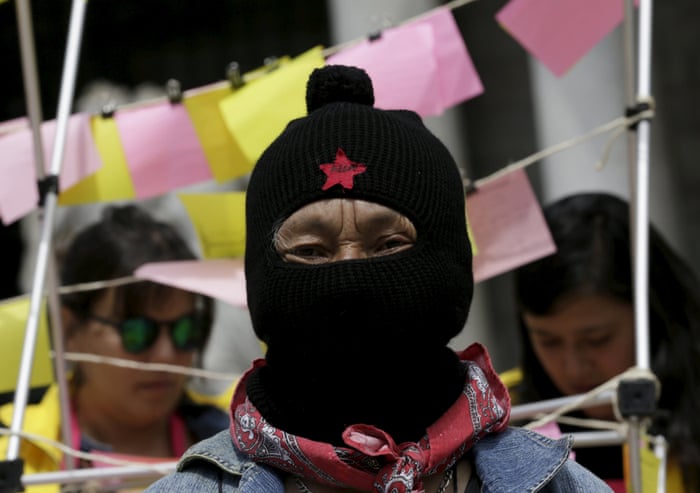 |
Mexico City, MexicoA member of the indigenous Zapatista National Liberation
Army (EZLN) takes part in a demonstration to mark
International Women’s Day, outside the Palacio de
Bellas Artes
Photograph: Henry Romero/Reuters
|
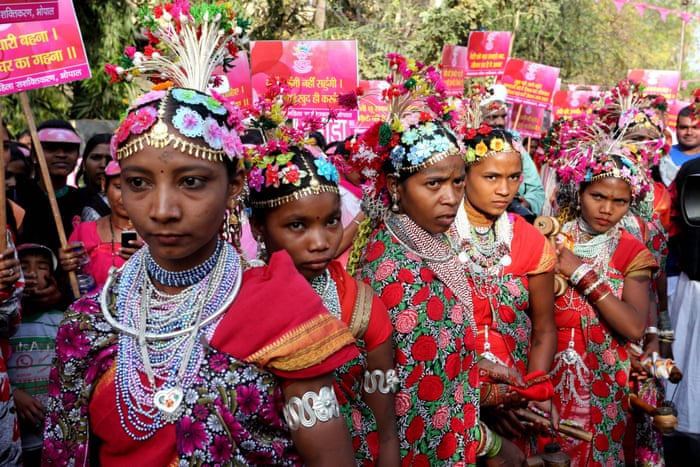 |
Bhopal, IndiaTribal artists during a rally for International Women’s Day
Photograph: Sanjeev Gupta/EPA
|
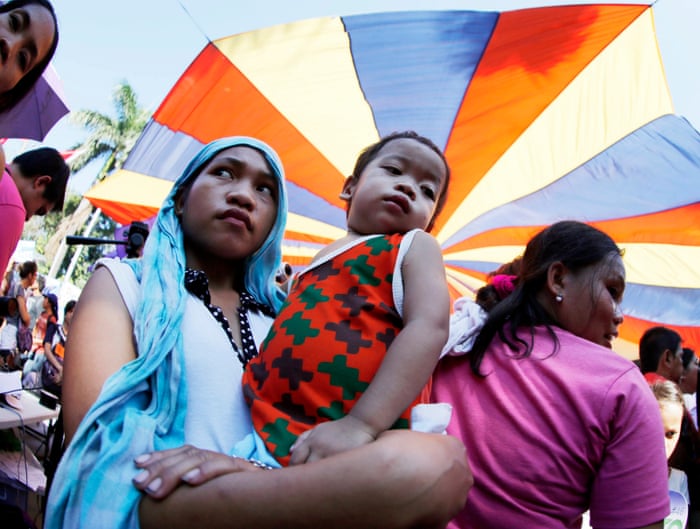 |
Manila, PhilippinesA Filipino mother with her child march during
a parade to mark International Women’s Day
Photograph: Francis R. Malasig/EPA
|
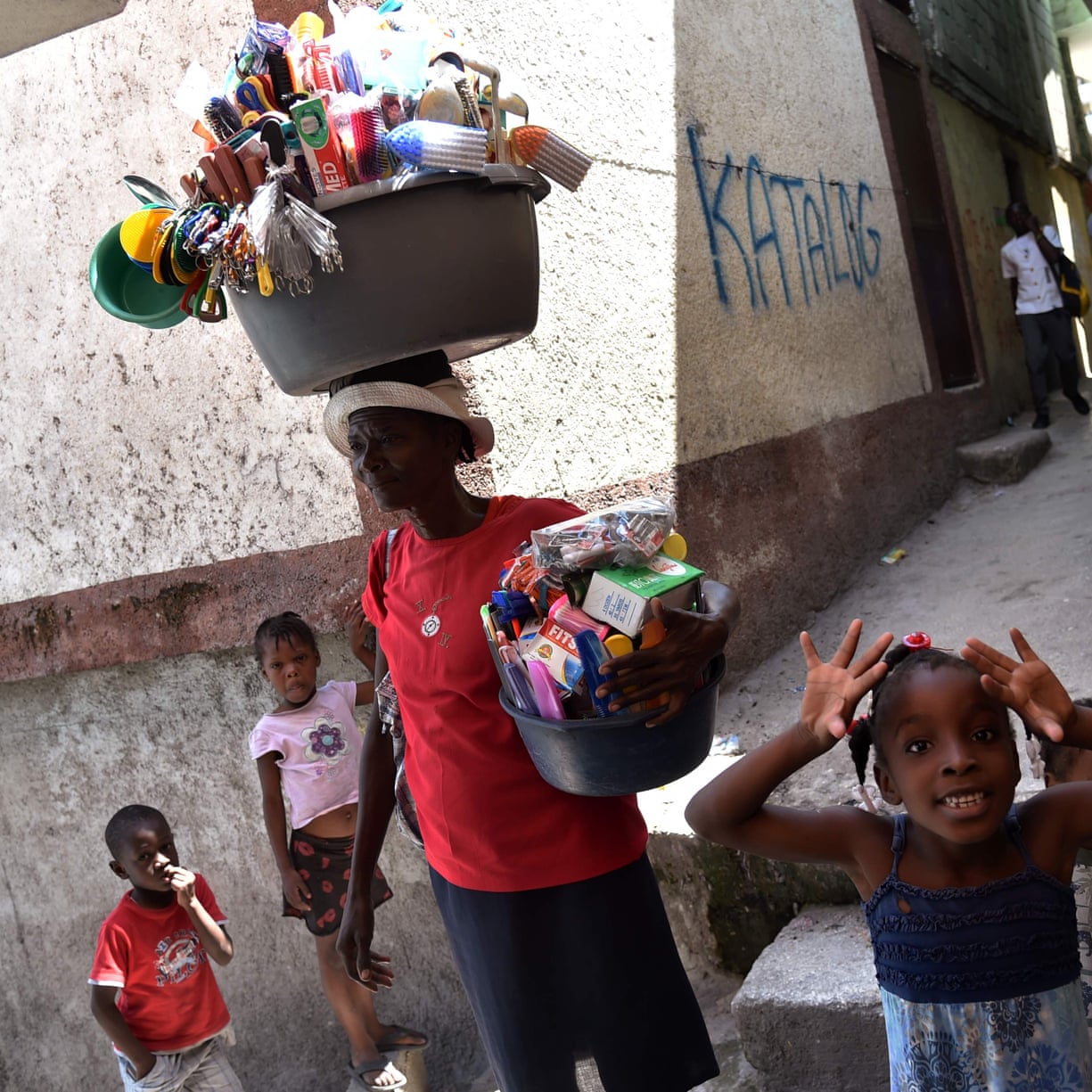 |
Port-au-Prince, HaitiOn International Women’s Day a woman sells
cleaning products near children playing, in Jalousie
neighbourhood, in the commune of Petion Ville
Photograph: Hector Retamal/AFP/Getty Images
|
 |
| image of the Patna High Court, Bihar, India |
 |
| photo of Ruchira Gupta is from here |
 |
| photo of girls learning techniques for empowerment is from here |
"A new law has come into force in Norway making the purchase of sex illegal.This approach rises out of the work of activists such as Ruchira Gupta and the girls and women who are part of it. In part 2, I shall place her voice, and her experiences with those other women and girls, at the center of this discussion.
Norwegian citizens caught paying for prostitutes at home or abroad could face a hefty fine or a six-month prison sentence, authorities say.
The prison sentence could be extended to three years in cases of child prostitution.
The Norwegian authorities say they want to stamp out sex tourism and street prostitution by targeting clients rather than prostitutes...
The tough new measures go further than similar ones introduced by other Nordic countries such as Sweden and Finland.
There has already been a visible decrease in women working on the streets of central Oslo, local media report...
Prostitutes will be offered access to free education and health treatment for those with alcohol or drugs problems."
BBC News, "New Norway Law Bans Buying of Sex," www.news.bbc.co.uk, Jan. 1, 2009

Dr. Vandana Shiva—The New Delhi Rape and Globalization
| February 11, 2013
Dr. Vandana Shiva, economist, environmentalist, and feminist, spoke of the public outcry in India and how the devaluing of women in a global economy set the stage for the New Delhi rape. Adapted from a conversation broadcast last month on Women's Media Center Live with Robin Morgan.
Robin Morgan: In a feminist analysis certainly, everything is connected to everything else. You recently wrote a stunning piece about the ghastly gang rape in New Delhi and the subsequent demonstrations and how violence against women and the economy were all connected. I’d love you, please, to talk about the points that you raised.
Vandana Shiva: I’ve been working on how the economy’s changing—globalization, free trade, WTO, the structural adjustment. I’ve made the connections between those purposes and what happens to women in what is called the New Economy. They even call it the Emerging Economy, as if a 10,000-year-old civilization emerges only when it is locked into corporate globalization.
The first level at where violence against women begins is in the very defining of the economy. Economy means household. It is what women define both inside the physical households, but also the world, inside the planet as the household. As long as the principles of management came out of that, they focused on sustenance, livelihoods, mutual giving—of course, within the typical patriarchies all our societies have had.
[With] free trade globalization, the first thing they do is knock out that major sector of women’s economy and, as Marilyn Waring has written in If Women Counted, install a production boundary to calculate growth.
The Gross Domestic Product grows every time you can pull something out of nature and something out of women customers’ economy, which means every time you destroy nature and women’s livelihoods, and production, and creativity, you can call it growth. It’s created to mobilize finances for the war, and it becomes the dominant number imposed on our world.
I’ve been appointed by the King of Bhutan to an expert group we’ve created because Gross Domestic Product is the wrong measure. The King of Bhutan said we should be looking at the well-being of our people to measure Gross National Happiness.
At this time, growth measured as Gross Domestic Product is already collapsing world-wide. It collapsed with Wall Street. It’s collapsing in Europe right now in front of our eyes. and it will collapse in India after a few years. How long can you sustain an eight or nine percent growth that excludes women as the primary backbone of the economy? That is the first violence.
The second violence is in terms of decision-making and politics. In so many debates in India we hear, “Oh, we can’t have politics in economics.” But every time they make a decision within a patriarchal model of the economy, it is politics. It’s politics that basically says, “Only corporations count, only the powerful count, and we’re going to mutate democracy from being, “By the people, of the people, for the people,” into being “By the corporations, of the corporations, for the corporations—and the powerful.”
The convergence of economic and political power further excludes women, but it also creates a class with immunity and impunity, which can do all levels of violence, change laws, and remove protections. There’s rape at every level—rape of the earth, rape of our resources, rape of the economy, and rape of women, which is what this drastic, dramatic tragedy has woken up India to.
Then there are other levels of violence because displaced people are more vulnerable. I was asked by the National Commission of Women to grapple with what globalization was doing to women in India, in terms of two key factors: water, and food and agriculture. At public hearings around the country, whether in Calcutta or down south, women would speak out boldly about how sexual violence has increased and made them more vulnerable as they were being made economic and ecological refugees.
That is at the very foundation of this new liberal model: everything is a commodity. Everything is property. Everything has a price and nothing has value. Added to the traditional patriarchies of societies, that's created what I call a super-virus of patriarchy. When two viruses hybridize, they start to kill.
Basically it’s a bit like climate change. We’ve had cyclones, but Hurricane Katrina and Hurricane Sandy present a different level of violence. Of course, we know that this is contributed by climate change. We need to start looking at how an economy based on patriarchal fictions—and the corporation is the biggest patriarch in our lives to come—how this patriarchy is combining with traditional patriarchies to unleash even larger violence, both the kind we see on the streets of Delhi and the economic kind, the violence of robbing you of your home, of your foundation.
Our prime minister said recently, it’s these loose-footed migrants that are part of the problem. Because the Delhi rape involved migrants at both ends. The rapists were all living in slums in hugely brutalized conditions, thinking that brutalization is the norm. The poor girl's father had sold his land because farmers aren’t being allowed to make a living. Two hundred and seventy thousand Indian farmers have committed suicide. The rest are hanging on the margins of existence. He moved to Delhi to load luggage at the airport to be able to survive and send his children to school.
The prime minister just called them loose-footed migrants creating problems. I said, “Mr. Prime Minister, they are a product of your policies. They are refugees of your economic policies.” None of these—economics and culture and society—are insulated silos. The patriarchal economic model is becoming the dominant force in our society. Societies have been reduced to the economy. Economy has been reduced to the market. The market has been reduced to what is controlled by finance, capital corporations. And if all you show is women as commodities, selling other commodities, those images start to further distort already damaged brains.
RM: Isn’t it amazing, Vandana, how when you put something in context—the background of the victim and for that matter of the perpetrators—it changes? Also, I'm reminded of your colleague Ruchira Gupta who wrote a piece in which she pointed out that the commodification of women by the rampant growth of pornography and prostitution sends the message that, in fact, this is what women are for. She connects that to the apparently quite dramatic rise in rape in India.
VS: Hugely dramatic. Eight hundred percent since the ‘70s and more than 250 percent since India’s economy, was as they say, made "more open" [with globalization]—more open to more violence against women.
RM: From where I sit here in New York, it seems heartening that women in numbers never seen before and accompanied by men as well have been on the streets in not only Delhi but across India. They haven’t quite made the connections you’re making, but they are on the move protesting violence against women.
What can we do to turn the enormity of this around? It’s always for example, blown me away, that a woman who is, say, in her fifteenth hour of labor, straining away—the doctor and the nurses and the anesthesiologists are all productive because they are wage labor, but the woman who is actually giving birth is not considered in a productive act.
VS: I think that is the foundational error. Everything that replenishes is treated as not producing at all and everything that’s degrades, everything that depletes, is treated as production. I call it the creation boundary, which has given us the fiction of growth and the Gross Domestic Product—that destructive acts are creative acts of produce. The really creative acts of nature—of women in their tremendous diversity and amazing ability to juggle 50 jobs, 50 responsibilities—their whole society and economy are treated as unproductive. That, I think, is the most important shift we need to make.
As you know Robin, I come from the part of the Himalayas where it's recognized that women are the main productive force. They go out in the forests [to work] and there's nothing like the rape [that occurs] when you come into the plains where women are no longer considered productive. When I, with my sister, Dr. Meta Shiva, was studying female feticide, we realized that the map of high growth in the patriarchal measure are the same zones with the high levels of extermination of girls—fifty million girls haven't been allowed to be born in the last few decades.
The response in Delhi is beautiful for a number of reasons.
The first, that the younger generation has come. The younger generation was absent from social movements, especially the middle class because they were getting it so good with globalization—the IT jobs that moved to India. They were all seeing themselves as individual consumers, so society did not matter to them. But this rape reminded them that it could have been them coming back from their IT farms, from their phone call service centers.
The second difference is, while we have had a feminist movement in India for a long time, it was only the women. The beauty now is, young men joined. It was a young man who was defending this girl in that bus. I think for the first time, there’s this new generational solidarity that’s emerging. Those very gutsy young people who are being beaten up and sprayed with tear gas and water canons realized that the state has become militarized. The state itself is a patriarchal institution. It will take time. There will be the hysterical voices saying death sentence, death sentence! But new connections have started to germinate that are really going to make a serious change.
RM: That’s very encouraging. When you look at the global scale of things, I confess that I look to women not only because we are the majority and that permits more peaceable and more, how shall I say, witty and ingenious new strategies, but also because there’s no area that isn’t a women’s issue. We spill over into everything if the connections are made. I definitely see the global women’s movement as the politics of the 21st Century.
VS: We are really living through a period of collapse of all kinds in the patriarchic system. The collapse of the financial economy they’ve built, a collapse of the eco-systems they have raped. The UN has recognized that 90 percent of eco-systems are on the verge of collapse, if not already collapsed. In this period, it’s the creative principle which women bring to bear for the simple reason that they were left to look after the real stuff of life, the goals that really mattered. So they bring both another world view, another mindset, and other capacities, other skills—which is why I run a grandmother’s university at the new school I created in Dehradun called the Earth University.
RM: I love it.
VS: Ghandi always said a prayer, “Make me more womanly.” If there is going to be a future for humanity, it will have to be a womanly future. I go to Europe and young men will bring me my books [to sign] and say, "I'm an ecofeminist, Dr. Shiva." That to me is a major, major shift. A shift to a creative economy where women start defining and playing the leadership role but others recognize that there has to be a mind shift.
RM: Whenever I talk to you, I feel both incredibly depressed because one is made yet again to realize the severity of the situation and at the same time, incredibly optimistic because I get from you a validation of everything that we’ve been trying to do and will do more and even better and with more people involved in the future.
I can’t tell you how grateful I am for your wisdom and your perceptions and for everything that you do.
VS: And Robin, I want to thank you for your vision and leadership and your love.
 |
| photo of activists, including Elvire Eugene (second from left), is from here |
Lawyers and women's activists representing 30 grassroots organizations from across Haiti came together to discuss what needed to be done to address gender-based-violence in post-earthquake Haiti.
The meeting was coordinated by longtime V-Day activist Elvire Eugene, who is connected to many local partners and national networks working on women's issues in Haiti and is well suited to lead critical work on the ground. Judie C. Roy, a former presidential candidate and prominent activist, was also in attendance, as well as members of the Women's Ministry. During the meeting, a Task Force was formed to see the group's work through to completion. Members chose Elvire Eugene, Judie C. Roy and activist Marie Gislhene Mompremier to lead the Task Force.
The Haitian society is essentially macho, and the Haitian politicians and international interests oppress Haiti’s own children. Farmers become victims again and again and women are always held back. But these women continue to support their country.
Our goal is to achieve respect for the rights of Haitian women. Despite their position as poto mitan, as the main carriers of the national economy, rural Haitian women always suffer in our society. Most of these women have no direct access to agricultural lands and income is strictly controlled by men, despite their role in agriculture.
Press Release: Groups Release Report Analyzing Sexual Exploitation in Haiti
Posted on: Thursday, January 12, 2012Keywords: Haiti, Latin American and Caribbean, Combating Violence Against Women, Human Rights AvocacyFOR IMMEDIATE RELEASE:
CONTACT: Stephanie Küng, MADRE, media@madre.org;
Blaine Bookey, Center for Gender & Refugee Studies, bookeybl@uchastings.edu;
Margaret Satterthwaite, NYU Global Justice Clinic, satterth@exchange.law.nyu.edu
Haitian Women and Girls Trading Sex to Survive
Groups Release Report Analyzing Sexual Exploitation
January 12, 2012—New York, NY—Two years after an earthquake devastated Haiti, a report detailing the impact of sexual exploitation on displaced Haitian women and girls has been released. The report is authored by MADRE, the Commission of Women Victims for Victims (KOFAVIV), the International Women’s Human Rights (IWHR) Clinic at the City University of New York (CUNY) School of Law, the Global Justice Clinic at NYU School of Law (GJC) and the Center for Gender & Refugee Studies at UC Hastings College of the Law (CGRS).
The drastic increase in sexual violence in displacement camps has been well documented since the disaster. But another face of the epidemic has emerged as a pressing issue: the sexual exploitation of displaced women and girls.
Displaced women and girls have lost family and community members, along with the protection and safety nets those relationships offered. Because of poverty and a lack of economic opportunity, many women and girls are forced to trade sex for shelter, money or even a single meal. In many cases, those demanding sex are the very people who hold themselves out as representatives of the people—members of camp committees.
The report was compiled based on interviews with Haitian women and girls who have either engaged in transactional sex or who know people who have. Information was also collected through interviews with Haitian government officials, service providers and women’s rights advocates. The report highlights current barriers to addressing sexual exploitation and offers recommendations to protect the human rights of women and girls engaging in transactional sex. In addition, the report offers a unique legal analysis of the protections available for women and girls who have experienced a wide range of human rights violations associated with sexual exchanges.
Marie Eramithe Delva, co-founder of KOFAVIV said today, “Displaced women and girls are being forced by circumstance into survival sex. It is an epidemic, but one that has gotten little attention from the Haitian government or international community.”
Lisa Davis, MADRE Human Rights Advocacy Director and Clinical Professor of Law for the IWHR Clinic at CUNY Law School said today, “International law recognizes that an individual’s decision to engage in sex should be the result of free choice. The majority of women and girls interviewed do not have a choice. They are displaced and with few other options. In turn, they are at increased risk of sexual violence and health threats. We must shed light on this crisis.”
Blaine Bookey, Staff Attorney for the CGRS said today, “Although almost all individuals interviewed for this report recognized that sexual exploitation is widespread, representatives of government agencies responsible for addressing sexual exploitation hold stereotypes related to gender and poverty that present an obstacle to implementing practical solutions. Beyond this, the Haitian government’s inability to develop a meaningful response to sexual exploitation is also due to a stark lack of resources. I am hopeful the report will help breakdown these harmful stereotypes and bring much needed resources to bear.”
Margaret Satterthwaite, Professor of Clinical Law for the GJC and Faculty Director of the Center for Human Rights and Global Justice at NYU School of Law said today, “Survival sex will not end until Haitian women and girls can access what they need to live. Haitian women want economic opportunities and the capacity to access basic resources. The international community should work closely with the Haitian government to create jobs, extend microcredit to women, and provide free education to all.”
Virtual Briefing: Join the authors of this report on Tuesday January 17 at 1 pm EST, for a conference call. RSVP at media@madre.org for call-in information.
To read the report in full, click here.
SEEING REDLinks and things from the CODE RED feminist collective. Visit our website for critical Caribbean feminist commentary. |
| what appears above is from CODE RED's tumblr *here* |
Feminist conversations on Caribbean life
Former Afghan MP, Human Rights Activist and Author of “A Woman Among Warlords,” Malalai Joya, recorded this message on the Tenth Anniversary of the War and Occupation of Afghanistan:
Transcript of Joya’s message:
Hi everyone, I would like to thank all supporters and anti-war movements around the world who are marking the dark day of occupation of U.S. and NATO in Afghanistan.
Respected friends – 10 years ago the U.S. and NATO invaded my country under the fake banners of women’s rights, human rights, and democracy. But after a decade, Afghanistan still remains the most uncivil, most corrupt, and most war torn country in the world. The consequences of the so-called war on terror has only been more bloodshed, crimes, barbarism, human rights, and women’s rights violations, which has doubled the miseries and sorrows of our people.
During these bloody years, tens of thousands of innocent civilians have been killed by occupation forces and terrorist groups. When Barack Obama took office in 2008, unfortunately his first news for my people was more conflict and more war. It was during Obama’s administration that civilian death tolls increased by 24%. And the result of the surge of troops of Obama’s administration is more massacres, more crimes, violence, destruction, pain, and tragedy. That’s why he has proved himself as a warmonger — as second even more dangerous Bush.
According to the Afghanistan Right Monitor in 2010, 7 civilians were killed everyday. U.S. and NATO tell us they will leave Afghanistan by the middle of 2014, but on another hand they’re talking about U.S. permanent military bases in Afghanistan. They will not leave our country soon. They are there for their own strategic regional and economic interests. That is why they want to change Afghanistan into a military and intelligence base in Asia.
The western governments not only betray Afghan people, they betray their own people too. They are wasting their taxpayer money in the blood of their soldiers by supporting a war, which only safeguard the interests of the big corporations and the Afghan criminal warlord rulers.
I think democracy never comes by military invasion. Democracy without independence and justice is meaningless. It is only the nation who can liberate themselves.
I believe that the only solution for the catastrophic situation of Afghanistan is withdrawal of ALL of the troops of our country because their presence is making much harder our struggle for justice and peace. By empowering the reactionary dark minded terrorist groups who are great obstacles for true democratic minded elements. If honestly they leave Afghanistan , the backbone of fundamentalist warlords in Taliban will break.
I hope one-day Afghanistan also will see the glorious uprising like in Middle East countries. As right now we are witnessing the small uprising in some provinces in Afghanistan like Herat, Kunar, Nangarhar, Mazar-e-Sharif, Farah, Kabul, and many other provinces which is a big source of hope for the bright future of Afghanistan.
So now I would like to ask all peace-loving, justice-seekers, anti-war movements and democratic-minded intellectuals, individuals around the world to join their hands with democratic-minded people of our country who are able to fight against fundamentalism and occupation. Therefore, my message to you is please empower my people educationally, as I believe education is a key against ignorance and toward emancipation.
Thank you very much.
Long live freedom. Down with Occupation.
Find out more about Joya at www.malalaijoya.com.
It was 10 years ago today when former President George W. Bush announced the beginning of the war on Afghanistan. It has now has become the longest-running war in U.S. history and there is no end in sight. The Taliban remains in control of major parts of the nation. Peace talks have collapsed. Civilian and troop casualties continue to mount. There have been a number of major setbacks in just the past few weeks. On Sept. 13, militants attacked the U.S. embassy and the NATO headquarters in Kabul. A week later, the Taliban claimed responsibility for assassinating former Afghan president Burhanuddin Rabbani, who headed the Afghan Peace Council. Just this week, the Wall Street Journal reported Afghan President Hamid Karzai has given up on negotiating with the Taliban. To discuss what the future has in store for a nation long-ravaged by war, we speak with “Reena,” a 19-year-old member of the Revolutionary Association of the Women of Afghanistan, who joins us by video Skype in Afghanistan. “Reena” is a pseudonym and her face is concealed since all RAWA members maintain anonymity for security reasons. We’re also joined by independent journalist Anand Gopal, who has reported extensively from Afghanistan and is completing a book on the war. [Includes rush transcript]
AMY GOODMAN: It was ten years ago today when then President George W. Bush announced the beginning of the war.
PRES. GEORGE W. BUSH: On my orders, the United States military has begun strikes against out, terrorist training camps and military installations of the Taliban regime in Afghanistan. These carefully targeted actions are designed to disrupt the use of Afghanistan as a terrorist base of operations, and to attack the military capability of the Taliban regimeAMY GOODMAN: Ten years later, the Afghan war rages on. It has become the longest-running war in U.S. history. There’s no end in sight. The Taliban remains in control of major parts of the nation. Peace talks have collapsed. Civilian and troop casualties continue to mount. There have been a number of major setbacks in just the past few weeks. On September 13, militants attacked the U.S. Embassy and the NATO headquarters in Kabul. A week later, the Taliban claim responsibility for assassinating former Afghan president, Burhanuddin Rabbani, who headed the Afghan Peace Council. Just this week the Wall Street Journal reported Afghan President Hamid Karzai has given up on negotiating with the Taliban. In a recent interview, retired General Stanley McChrystal said the U.S. and NATO were only 50% of the way towards achieving their goals in Afghanistan. Brian Katulis is a senior fellow at the Center for American progress.
BRIAN KATULIS: If you look at the main metric, the measure for success, in the counterinsurgency strategy, it is, how safe is the local population? 2011, this year, will be the deadliest year for Afghan civilians. More than 80% of those deaths are caused by the Taliban insurgency. But the key metric of whether we’re succeeding on a counterinsurgency strategy — are we keeping the local population safe? — the answer is, no. The number has gone upAMY GOODMAN: To talk more about Afghanistan, we are joined by two guests – first, we go to Afghanistan, to Reena. She’s 19 years old, a member of RAWA, the Revolutionary Association of the Women of Afghanistan. Reena is a pseudonym, her face concealed since all RAWA members maintain anonymity for security reasons. Welcome to Democracy Now!, Reena. Describe what is happening now – ten years after the U.S. invaded Afghanistan.
REENA: Thank you so much, Amy. It is a pleasure to be on your show. Ten years ago when U.S. invaded Afghanistan, they made promises of democracy, women’s rights, and a general improvement in the lives of people. But ten years later, today, the situation is clearly getting worse for our people. Everyday life has not improved. Women’s situation has gotten worse. There is no sign of democracy or freedom or peace anywhere. In fact, civilian deaths have reached 10,000 on this anniversary. And it’s going to continue to rise with the surge of troops and increase in assaults, this will obviously be continuing.
AMY GOODMAN: Here in the United States, we’ve just passed the tenth anniversary of the September 11 attacks. There was a great deal of attention to the young people who grew up in the shadow of the World Trade Center, both specifically and also just in this age metaphorically. You, Reena, or 19 years old. You were nine when the U.S. attacked Afghanistan. Where were you born? What are your thoughts growing up in the Afghan War?
REENA: At that time, I was in Pakistan, in a refugee camp, but I do remember a lot of people who were there at that time, like our close relatives. We lost some people that we knew, some friends, in the bombings of the U.S. So I did not exactly witness the deadlier Civil War of 92-96. I have vague images of the Taliban regime of 96-2001. But this ten year war has definitely had a very deep impact on this generation. The civilian casualties, the fear that people live with these days, the terror that there is in the streets everywhere for the IED attacks or other kinds of threats, it is increasing day by day. It has just made everyone extremely insecure and bad for the people.
AMY GOODMAN: We’re also joined here in New York by Anand Gopal. He reported for The Christian Science Monitor in Afghanistan then for the Wall Street Journal. Now he is writing a book on the war in Afghanistan. Your thoughts ten years later — the longest U.S. war in U.S. history.
ANAND GOPAL: By any metric we look at, the war has gotten worse. Security has gotten precipitously worse every single year. 2011 has seen the most civilians being killed of any year since the war started. We’ve seen the most number of attacks – suicide bombings, roadside bombings, since the war started for any year. The amount of territory the Taliban controls has been undiminished, despite the fact we’ve seeing a major troop surge in the last year or two years. We’ve seen a fragmentation within Afghanistan where the people who we are aligned with are starting to arm themselves and thinking about a post-American scenario where they want to all fight against each other. Really we’re at a knot here in Afghanistan in the last ten years.
AMY GOODMAN: Listening to the talk shows on the cable networks, it is quite remarkable to see how things are turned on their heads. The Republicans talking about Obama presiding over the longest war. The issue of what it means if the U.S. pulls out, and the mantra often repeated that the Taliban will take over. I want to get both of your thoughts on that beginning with Anand.
ANAND GOPAL: The Taliban already have de facto control of almost half of the country in the countryside. Beyond that, what we’re doing in Afghanistan is we are arming militiamen, warlords, strong men, we’re actually going into the countryside and giving them weapons, giving weapons to all sorts of human rights violators and abusers. These are people in many cases who have been disarmed after 2001 and we’re rearming now because we need help in fighting the Taliban. So what that’s actually doing is creating the conditions in which the civil war is more and more likely. In fact that I think the longer we stay and continue this policy, a civil war becomes more likely.
AMY GOODMAN: Reena, your thoughts on the issue of the Taliban?
REENA: Yes, I absolutely agree with him. The U.S. has armed the most dangerous warlords and is continuing to arm and support them. If they were drawn out, yes, a civil war may be inevitable. But again, we have to remember that, as we always say, this war is part of the problem. It is not going to solve anything for us. If the troops withdraw and if they give Afghanistan a chance to decide its own fate, I think things will work out. If they do not support these warlords, as he said, and the U.S. and its allies pressure the other countries not to support the Taliban, then I think maybe a civil war will not take place. It might not be as bloody as it will be if they continue supporting or if this war goes on.
AMY GOODMAN: Reena, a reason often given for staying in Afghanistan — it was one that Laura Bush put forward, it was one that was picked up again, things all turned around, the kind of feminist reason, particularly put forward by the Republicans but many Democrats also support this and Democratic women — that it is about saving the women of Afghanistan. Your response?
REENA: Yes, these claims were all extremely false. If they have brought to power the misogynists, the brothers and creed of Taliban into power, who are the exact copies of Taliban, mentally and have just been physically changed, then I do not think the feminist situation can improve. Today, there are slight improvements in women’s lives in urban areas, but again if you look at statistics, Afghanistan remains the most dangerous place for women. Self-immolation, suicide rates, are extremely high – it has never been this high before. Domestic violence is widespread. Women are poor. They do not have healthcare. It has the highest mortality rate in the world.
There are, as I said, some improvements. And in some aspects, it might have been a little better for a handful of people, for women, but it has definitely has gotten worse for others. There is insecurity, there are threats. They always say that there are six million girls in schools and the schools have opened, but nobody looks at the dropout rates. Nobody looks at the attacks, the threats that the Taliban makes to the girls. And they do not dare go out again. Nobody looks at the quality of the schools. All these things — there have been slight changes. It has been very widely used, and to just highlight a few positive things, but overall, things have gotten worse.
AMY GOODMAN: I want to play a clip from Admiral Mike Mullen, the Chair of the Joint Chiefs of Staff, speaking earlier this week about the Haqqani network threat, blaming the ISI for orchestrating attacks on U.S. targets inside Afghanistan.
ADM. MIKE MULLEN: A second but no less worrisome challenge is the impunity with which certain extremist groups are allowed to operate from Pakistani soil. The Haqqani network, for one, acts as a veritable army of Pakistan’s internal services intelligence agency. With ISI support, Haqqani operatives planned and conducted that truck bomb attack as well as the assault on our embassy.AMY GOODMAN: Chair of the Joint Chiefs of Staff, Admiral Mike Mullen. Anand Gopal, your response?
ANAND GOPAL: It’s absolutely the case that Pakistan is in some way supporting the Haqqani network and the rest of the Afghan insurgency. But I think it is important to have some historical context in all of this. We once, the U.S., once supported the Haqqani network, back in the ‘80s when we were fighting against the Russians. We poured millions, in fact billions of dollars into Afghanistan to fundamentalists, to Islamic radicals and we’re getting the blowback of that now. And also that has fundamentally changed the dynamic within Pakistan, where we helped create, in a sense, the way that the ISI, the Pakistani Security Agency, acts today. They have been pretty much consistent in the last thirty years in their position. We just changed our position ten years ago.
AMY GOODMAN: And the role that Pakistan — if you could talk further – plays in Afghanistan, and the fact that Pakistan has been supporting or in the past supported the very forces that they’re fighting against, that the U.S. is fighting against in Afghanistan, and helped to establish the ISI, which it now is critiquing.
ANAND GOPAL: Well, there is no doubt that the insurgent leadership, the Haqqani network, the Taliban and other groups, they have a safe haven in Pakistan. There is no doubt that elements of the ISI, the security apparatus, is giving advice and support to the insurgent leadership. Pakistan is planning a double game. On the one hand, they are aligned with the U.S. and getting millions of dollars in aid for military, on the other hand, supporting insurgency.
AMY GOODMAN: Reena, you are 19 years old, you are a young woman who goes back and forth between Pakistan and Afghanistan. How do you function? Reena is not really your name, you’re not saying where you are in Afghanistan, you’re with the organization RAWA. Explain what your group does and how you get around.
REENA: RAWA, the Revolutionary Association of the Women of Afghanistan, was established in 1977 by a martyred leader, Mina, and a group of other young women. It is an anti-fundamentalist group, women’s group, that fights for freedom, democracy, secularism and women’s rights. Because we are the only women’s group that speaks against fundamentalists — the warlords in power today — we have any security issues and we cannot be open in our activities. So we are underground and semi-underground. We function mostly in Afghanistan, but a small part of our activities are also based in Pakistan.
AMY GOODMAN: Malalai Joya make a statement this week where she said, let’s see if I can find it, “we’re at a point today when Afghanistan is at its most violent since war started and the government at its weakest. Civilian casualties higher this year than any previous year, the territory Taliban controls more or less the same as last year, there’s no progress toward making a political solution.” Anand Gopal, what if the U.S. pulled out tomorrow?
ANAND GOPAL: I think if the U.S. pulled out tomorrow, it would be very likely that we would see a civil war. When you talk to Afghans, and particularly in the countryside where the war is being fought, what many of them say is, we want the U.S. troops to pull out and we want there to be some sort of peace settlement from all the sides.
This never really happened, even from day one in 2001. The Afghan state was not constituted on a broad-based system. It was a deal between a certain set of warlords and the U.S. You want to include civil society, groups like RAWA, other groups, and try to come together to tell Afghans to configure their state in some way, which they’ve never had a chance to do until now. So I think a peace settlement of some sort, together with the troops pulling out, would be the only way we can forestall a Civil War.
AMY GOODMAN: Would you say, Reena, that each day of this war increases hostility toward the United States?
REENA: Absolutely. Absolutely, it does, as it has increased from 2001 until now. Because in the start, the people were very hopeful. They had some hope that the U.S. would actually help them, that their situation would improve in the last ten years. But the U.S., unfortunately, supported the war lords, like Sayaff, Abdullah Abdullah, Ismail Khan, Khalili, and they recently killed Burhanuddin Rabbani.
So all this has increased the People’s hostility, in addition in the countryside and in provinces other than Kabul and some other urban cities, the U.S. airstrikes and night raids are increasing day-by-day. This itself is drawing a lot of hostility from the people toward the U.S., and they want them to leave our country as soon as possible.
AMY GOODMAN: Final comments, Anand Gopal, for people to understand and as you both lived in Afghanistan for years covering the war and you come back to the United States and see how generally it is covered as you write your book?
ANAND GOPAL: It is covered very poorly. I think a lot of the discourse about the war in Afghanistan is that it is a series of mistakes. And it is a mistake. But I think at the core underneath those mistakes is a fundamental wrong policy, which was the war on terror, going into Afghanistan and thinking that the occupation of a country can solve the problem of terrorism. I think that everything that we are seeing in Afghanistan today, you can relate it back to that fundamental core issue.
AMY GOODMAN: Reena, I don’t know if you heard the Nobel peace Prize was just announced. It is going to three women from the Arab world and from Africa. Two from Liberia, including the current president of Liberia, and one brave Yemeni activist, the youngest ever to receive the Nobel peace prize. Had you heard about that? Does this matter at all to in Afghanistan?
REENA: Yes, I did read about this. I would like to say that the Nobel Peace Prize is, I do not think, it is a very big prize in the opinion of our people. Because every time there is usually a political motive behind giving it to somebody. And the actual real people who struggle for something or who are trying to get something are never considered for this prize. For example, last year, a warlord woman from our country, Sima Samar, was on the list of these people. She almost won the Nobel Peace Prize. That woman is in the Warlord Party. If not directly, is an agent of other countries. If you can consider giving this prize to such a woman, then it does not mean anything for our people. Anybody else can win it for political reasons or whatever is behind it.
AMY GOODMAN: Your thoughts in that, Anand Gopal?
ANAND GOPAL: I think also more importantly, from the point of view of the Afghans, Barack Obama is a Nobel Peace Prize winner, and he’s the person who increased the number of troops in Afghanistan and increased the violence in fact in Afghanistan. A lot of my Afghan friends question with the value of the Nobel Peace Prize is if it leads to more war in Afghanistan.
AMY GOODMAN: Thank you both for being with us on the 10th anniversary of the U.S. bombing of Afghanistan, now the U.S. engaged in the longest war it has ever been involved with in U.S. history. Anand Gopal, independent journalist, writing a book Afghanistan, previously with the Christian Science Monitor and then the Wall Street Journal.
AMY GOODMAN: And Reena, not her real name, speaking to us from Afghanistan, her face covered. She is anonymous for her own protection. Tonight, _KPFK_’s Uprising host, Sonali Kolhatkar. KPFK is the Pacifica Station in Los Angeles—-will be leading a conversation with Reena via live video stream and taking questions from the viewing audience. You can see it at afghanwomensmission.org, we’ll put a link there on our website at democracynow.org.
On the 10th Anniversary of the U.S. war, an underground activist tells the real story of the Occupation & Afghan Resistance
Reena, a member of the Revolutionary Association of the women of Afghanistan (RAWA), will address American audiences via live video stream.
RSVP for the event on Facebook.
Download the flyer here.
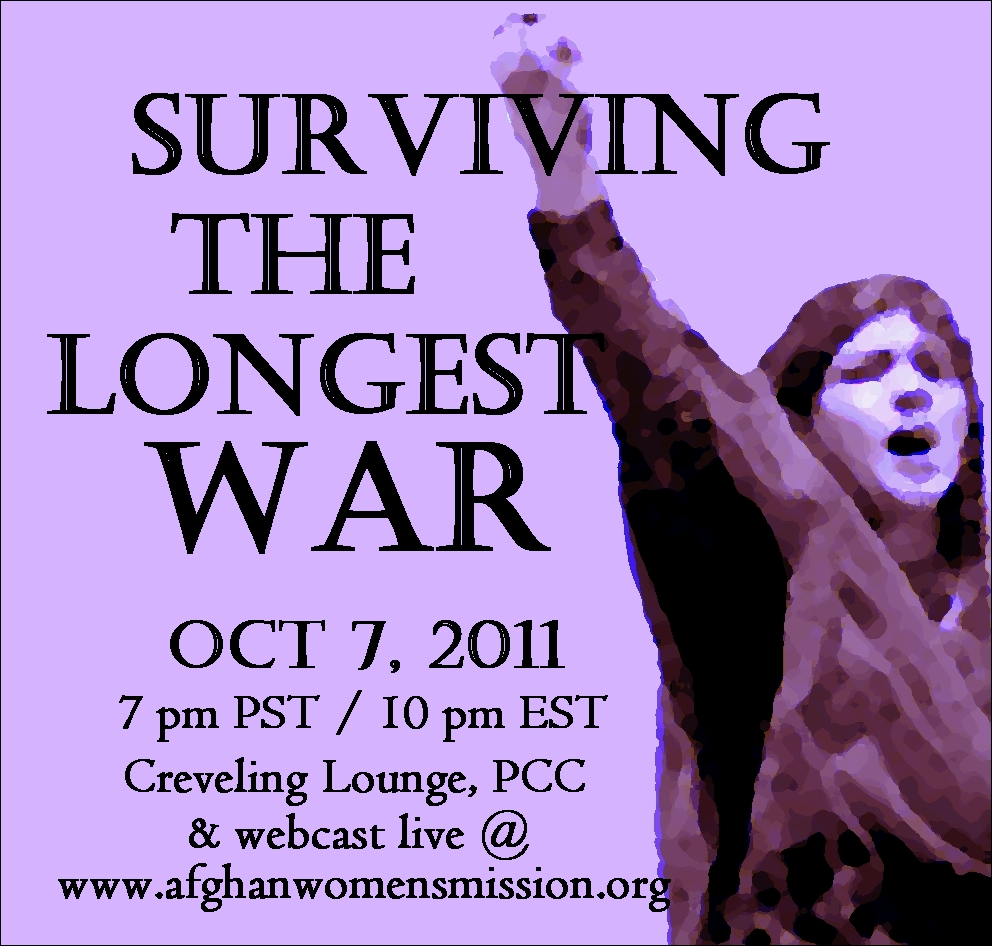
AWM Co-Director and KPFK’s Uprising host Sonali Kolhatkar will lead the conversation with Reena via video streaming in front of a live audience. The event will be webcast live on AWM’s website.
Questions will be drawn from the in-person audience, and the online audience via Facebook.
WHEN: Friday Oct 7 2011 7pm PST / 10 PM EST
WHERE: Creveling Lounge (CC bld, 2nd floor) PCC campus, Pasadena California or @afghanwomensmission.org.
Open to the public. Entrance is free. There will be books and crafts available for sale.
If you are unable to attend this event, you can watch a live webcast of the entire event on this website! Click here to find out the time of the webcast in your city.
Organized in collaboration with PCC’s Students for Social Justice. KPFK is a media sponsor.
Press Releases
Tenth Anniversary of Afghanistan War: RAWA Member Available for Interviews
September 27, 2011
For Immediate Release
Contact: Sana Shuja: 504-669-4446
Sonali Kolhatkar: 626-676-7884
E-mail: press[at]afghanwomensmission[dot]org
Surviving the Longest War: An International Video Webcast
On the Tenth Anniversary of the US war, an underground activist
tells the real story of the Occupation and Afghan Resistance
October 7th 2011, marks the ten year anniversary of the United States’ invasion of Afghanistan. To mark this event, Afghan Women’s Mission (AWM), a U.S.-based non-profit that works in solidarity with the Revolutionary Association of the Women of Afghanistan (RAWA) will hold a special international online talk-back with Reena, a member of RAWA.
“Ten years of war has not made Afghanistan safer for anybody except the fundamentalist warlords in the Afghan government, and the Taliban,” said Reena. This anniversary event, in collaboration with PCC’s Students for Social Justice, will raise serious questions about the official story of the longest war the U.S. has ever officially waged, and will offer the unique perspective of an underground Afghan activist who has witnessed first-hand the impact of the war.
AWM Co-Director and KPFK’s Uprising host Sonali Kolhatkar will lead the conversation with Reena via live video streaming from the Pakistan/Afghanistan region, in front of a live audience. The event will be webcast live on AWM’s website at www.afghanwomensmission.org .
“Using the latest technology available, we are thrilled to be able to broadcast the voice of this young RAWA member – an Afghan speaking for her generation – well beyond the confines of our physical event,” said Kolhatkar. “We invite people from all over the world to mark the tenth anniversary of this war by tuning into our live web video stream of our conversation with Reena.”
Questions for RAWA member Reena will be drawn from the live in-person audience and the online audience via Facebook. The event will take place on Friday October 7th at 7pm PST (10 pm EST) at Creveling Lounge (CC Building, 2nd floor) on the campus of Pasadena City College (PCC).
Nineteen year old Reena was born an Afghan refugee in Pakistan around the time when US-backed fundamentalist fighters started a brutal civil war in Afghanistan. She lived with her family in the border town of Peshawar in severe and impoverished conditions. After moving to a refugee camp run by RAWA, Reena attended one of their literacy courses. She eventually joined the organization, working in various RAWA-run schools and orphanages and is currently a first-year University student. Since Reena was born, she has known only war in her country.
Read Sonali Kolhatkar’s September 11th, 2011 interview with Reena here.
RAWA is on the forefront of the movement for peace in Afghanistan. Their activities focus on women’s rights, human rights, and exposing the fundamentalist crimes of warlords in power, as well as the Taliban. They have criticized all foreign intervention since the time of the Soviet invasion and occupation through to today’s US/NATO war. As the oldest women’s political organization in Afghanistan, RAWA has been promoting human rights and democracy for more than 30 years. Their work is extremely dangerous – all RAWA members, including Reena, use pseudonyms, do not reveal their faces, and live and work underground.
RAWA Predicted the Failure of the War Ten Years Ago
On September 14th 2001 RAWA issued a statement warning the US against waging war on Afghanistan, saying “vast and indiscriminate military attacks on a country that has been facing …disasters for more than two decades will not be a matter of pride.”
On October 11th 2001, four days after the bombs began dropping on Afghanistan, RAWA once more urged the US to do the right thing, predicting accurately the outcome of the war in a statement: “[t]he continuation of US attacks and the increase in the number of innocent civilian victims not only gives an excuse to the Taliban, but also will cause the empowering of the fundamentalist forces in the region and even in the world.”
A month after the war began, when the Taliban were rapidly pushed out of Kabul, RAWA realized that the US was ready to replace the Taliban with their ideological brethren, the Northern Alliance (NA) warlords. They issued yet another international appeal, warning: “[t]he NA will horribly intensify the ethnic and religious conflicts and will never refrain to fan the fire of another brutal and endless civil war in order to retain in power.”
Sadly RAWA’s warnings were ignored and the last ten years have borne out their predictions.
The Human Impact of a Decade of War
Civilian casualties as a result of the ten year long Afghanistan war have been estimated at 17, 611 – 37, 208, with more than half killed directly as a result of U.S.-led military actions (Sources: UN Assistance Mission Afghanistan, Afghan Independent Human Rights Commission, Human Rights Watch, and Associated Press). A recent report by Open Society Foundation found that night raids conducted regularly by US and NATO forces in Afghan villages result in indiscriminate detentions and widespread abuse.
Politically things aren’t much better. Afghanistan’s government, dominated by the US-backed NA warlords whom RAWA warned against, is ranked the second most corrupt in the world after Somalia (Transparency International). Through the Afghan parliament, warlords have passed laws exempting themselves from prosecution for war crimes, curtailing press freedoms, and promoting women’s abuse.
Women in particular continue to suffer. A survey by UNIFEM in January 2011 revealed that a shocking 87% of Afghan women are victims of domestic violence. A UK based charity, Womankind, found that “between 60 and 80 percent of Afghan marriages are forced, with more than half of all girls married before age 16.” While women can run for office in the Afghan parliament, they are only allowed to serve if they accept the status quo. The well-known and popular activist, Malalai Joya, a representative of Farah province, was kicked out of Parliament for criticizing the US-backed warlords and has survived numerous assassination attempts.
According to RAWA member Reena, the first thing that needs to happen is for Americans to “call for the withdrawal of the troops, as the military presence has not helped Afghan people in any way.” Her opinion is supported by a majority of Americans: a Washington Post-ABC News poll in March showed that 64% of poll participants somewhat or strongly felt that the war has not been worth fighting.
RAWA member Reena is available for a limited number of interviews.