Saturday, June 5, 2010

When Men Are Dickheads, They REALLY are Dickheads! See the kind of thinking dickheads do: Read these comments by AllenS and Jason, for example, and "Hoosier Daddy" (get it?), "Trooper York", and "Moose"...

[image of costume made just for 'em is from here]

The topic is men sexually harassing women in the workplace. Click on the title below to link to the post being responded to. My comment, as usual, is last.

""WHAT HATH CATHARINE MACKINNON WROUGHT? Woman Says Citibank Fired Her Because She Was Too Hot.""

56 Comments - Show Original Post 


Blogger Pogo said...
Why blame Catharine MacKinnon? Because the ability to prevent hiring/firing at will through lawsuits was in part her creation, and this is an expected outgrowth of that. IN Europe, many companies refuse to hire for as long as possible because it is impossible to release them once employed. And we are headed down that road. Their are societal benefits to at-will employment that are rarely realized.
6/4/10 7:19 AM
Blogger traditionalguy said...
This must be a joke. She looks like a beautiful and gracious addition to any business, which they knew when they hired her. Another woman, maybe the wife of her boss, must be behind this sudden dress code. Firing her for being attractive is Un-American.
6/4/10 7:22 AM


Blogger AllenS said...
Back in the 70's a beautiful 18 year old honey started working for the company I worked at. It was summertime and she showed up at work wearing a tight fitting top (no bra) that accentuated her large breasts and big nipples. They sent her home to change clothes. She WAS a distraction. I asked her out immediately.
6/4/10 7:27 AM
Blogger Hagar said...
Not included in this photo shoot is a photo in an office power suit that clearly shows her as not only hot and curvaceous, but also not wearing a bra.
6/4/10 7:43 AM
Blogger Moose said...
Catharine MacKinnon was one of the worst things to come out of the UM I ever saw. Her and Andrea Dworkin defined the term deranged...
6/4/10 7:50 AM
Blogger traditionalguy said...
The extreme female figure shown off rather than hidden away is only a threat to cyber-droid half humans that are comuter trained into valuing only half modem and half Amish person units. She shows why the creepy Splice movie plot is so evil. We need to say don't fix what is not broken....and she shows off that a normal woman is totally not broken.
6/4/10 8:01 AM

Blogger rhhardin said...
She exudes incompetence. What's her name, Contessa Brewer, after Imus quietly fired her from news reader on the show, turned up in Page Six saying that Imus doesn't know how to handle beautiful women.
6/4/10 8:04 AM
Blogger Penny said...
More likely HIRED for being "hot".
6/4/10 8:06 AM

Blogger Pogo said...
I have no fear of being fired for being hot. My extreme averageness makes me nigh-invisible. People often think they have already met me because of it. I revel in my unhottitude. (Not like I have a choice.)
6/4/10 8:10 AM

Blogger Shanna said...
[Her two male] managers gave her a list of clothing items she would not be allowed to wear: turtlenecks, pencil skirts, and fitted suits. And three-inch heels. Turtlenecks and pencil skirts? Those are too sexy? I imagine she was wearing things a bit too tight and that was the actual problem, but this list is ridiculous. There does have to be a way to tell people they are wearing things that are too tight/inappropriate for work without getting in trouble, however telling one person (as opposed to the whole office) to not wear suits, turtlenecks and pencil skirts is going too far. We'll see what comes of this, I guess.
6/4/10 8:14 AM

Blogger Freeman Hunt said...
'I can't help it that I have curves,' Lorenzana told the Daily News. And I'm not going to go eat and gain 50 or 100 pounds because my job wants me to be the same size as everyone else.' That lack of tact makes me think that poor performance, as Citibank claims, was the reason for her firing. Also, her lawsuit seems to assume that no other attractive people work at Citibank. I find that hard to believe.
6/4/10 8:16 AM
Blogger traditionalguy said...
Rh...What does she exude? Whatever it is made her male colleagues suddenly incontinent. The Amish claim that they long ago solved this problem of beautiful women. But that only works in Pennsylvania and north. Down south we are surrounded by so many beautiful women that we have learned to stand up to the challenge and work well with them. Well maybe not in South Carolina.
6/4/10 8:22 AM
Blogger The Gold Digger said...
There were three receptionists in my building. Two middle-aged and matronly, the other in her early 20s with a figure that wouldn't quit. She wore tight (but mostly tasteful - not too short, not too low) dresses and always looked very done with high heels, long nails, and makeup. I chatted with all three women. I kept telling the hot one that she needed to tone it down. She wasn't violating the company's dress code, but every time an exec's wife (many of them former secretaries and 2nd wives - yes, this was a little Peyton Place) came in and saw her, the wife would not like the image. After three years, she was the one laid off when they had to make cuts. If there had been a performance issue, I would think that would have been addressed much earlier.
6/4/10 8:30 AM

Blogger rhhardin said...
Hotness is actually very stylized; you have to work to make it appear; and be incompetent to want it in your bank job.
6/4/10 8:33 AM
Blogger The Gold Digger said...
Down south we are surrounded by so many beautiful women that we have learned to stand up to the challenge and work well with them. My company moved its headquarters from New York to Memphis and hired a lot of local staff. Apparently, the men were happily astonished at southern women who wore makeup and flirted. I have never worked in New York, but I have visited Boston many times and am always a little bit shocked at the defiant refusal to enhance or even embrace feminine beauty there. (Notable exception: I was in Cambridge and saw two lovely young women dressed nicely with done hair and makeup. I got closer and heard them speaking Spanish and it all became clear. Latin women usually don't do hairy legs and Birkenstocks.)
6/4/10 8:34 AM

Blogger Fred4Pres said...
My wife believes her. She is an attractive woman and was hot when she worked in NYC. When she came in to the office, the women hated you and the men just leered. That said, my wife also said I cannot offer her a job. As for the lawsuit, I think she can find a better job. But if she is looking for publicity, this works too. Did you catch the Althouse like picture on Ace (below the fold)? Some of these posed photos fire up publicity but might also back fire.
6/4/10 8:37 AM

Blogger Calypso Facto said...
Maybe Trooper's got a position available for her at his shop?!? Just reward us with occasional photo journal updates!
6/4/10 9:06 AM

Blogger Scott M said...
All legal matters and high-brow scholarly discourse aside...and speaking purely from experience after years in an office environment, there are two indisputable truths about extremely hot women in the workplace (3 if you want to add the rarity of said hotness). 1) It IS extremely distracting to the males in the workplace. This has nothing to do with maturity or anything else other than biology. It's how we're wired. Maturity and experience can mitigate the outward results, but the internal mechanisms are the same. 2) This one is axiomatic. Regardless of whatever men might do (mostly covertly) in hotness situations like this, the women around her will be absolutely brutal. That's brutal spelled B-I-T-C-H-E-S. Don't argue the point, because everyone with even a modicum of experience in the dynamics of woman-on-woman catiness has seen this in action. As men, we're usually shocked at the severity, but that makes it none the less real.
6/4/10 9:17 AM

Blogger Freeman Hunt said...
The idea that people are treated badly in the office solely for being good-looking is, from what I have seen, baseless. If there is jealousy, the attractive woman has likely experienced that for a long time and should, by the time of professional life, be adept at navigating and defusing it. In fact, that would be part of being competent.
6/4/10 9:18 AM
Blogger Paul said...
Maybe she should get a job at an ad ad agency instead of at a financial institution. Lots of very attractive women in that business. Also, agencies tend to be about 50-50 male-female, so she wouldn't be constantly surrounded by guys ogling her (only half the time).
6/4/10 9:21 AM
Blogger ALP said...
The "must show my sexuality off at all times" mentality of women like this appears to be a strong feature of South American/Latin cultures. I have a good friend/co-worker from Brazil. I have the utmost respect for this woman. She came to the US with her husband, who abused her and threatened at one point to take their son away and return to Brazil without her. Long terrible story. She lives in a woman's shelter for a about a year, learning English, working and saving her money. She works her butt off as a legal assistant, and is a girlfriend with a heart of gold to her current boyfriend. Her views on men are realistic in terms of relationships - no gold digger here - she just wants a nice guy who is a good friend and a good dad to her kid. This woman has many qualities I admire. Yet, when we go out to lunch, this woman is distraught unless she can catch the eye of any of the men sitting in the restaurant. "We are two women sitting here without wedding rings, and NO ONE is looking at us!!!!" WTF? Why is this even relevant? She then puts on more lipstick, eye flirts the room, until she makes eye contact with SOME MAN, ANY MAN in the room. Once she does, her spirits are immediately, and very clearly lifted. This plays out whenever we go out in public. If she was an American woman, I would not tolerate this obsession with securing the male gaze and male attention from a companion. Further, she is also utterly heartless when it comes to criticizing what she feels to be the shortcomings of the sexual appeal of other women. Asian woman are a favorite target as they have, in the words of my friend, "nothing, NOTHING going on.... (gestures to hip and breast area). She simply cannot understand why a good looking man would be interested in a slim hipped, small breasted Asian woman. This ridiculous, 24/7, over-the-top sexual competitiveness is what leaps out at me when I read this article. This woman is saying: "I am a sexy woman FIRST, FOREMOST - and this is the most important aspect of my existence - the fact that I have to provide some type of banking service is merely secondary. Please do not ask me to back down, ever, from this crucial sexual battle I am fighting with other members of my gender" Good lord woman, give it a rest.
6/4/10 9:29 AM

Blogger Freeman Hunt said...
Yes, I think it might be important to distinguish between very attractive women and "must show my sexuality off at all times," as ALP described, women. I don't think that being in the first category will hurt one's career at all. Being in the second category, however, might.
6/4/10 9:33 AM

Blogger Bruce Hayden said...
The woman is, in short, trying to assert her inalienable right to sexually stimulate all the males in the office and make all the other women insanely jealous. I wouldn't think that to be all that advantageous for the business itself. What will be quite humorous is when, in 20 years or so, maybe even sooner, she is on the other side of this debate. I do think though that women have to decide what they, as a group, want here. Do they want to be treated as androgynous people? Or as sex objects who capitalize on their ability to sexually stimulate all the males around them? They can't have it both ways, since it is close to a zero-sum game. The easy answer would be to make sure that women don't go out of their way to sexually stimulate all the males around (and therefore causing extreme jealousy in all the other women). But, if this woman's law suit succeeds, then that may not be a viable solution (or, maybe businesses like that should just not hire good looking young women who dress to exploit their sexuality). Part of the problem is that female sexuality is a rapidly depreciating asset. It was designed that way, in order to marry off young women and then clear the field for the next batch. And that wouldn't be a problem if women weren't divorcing and delaying marriage at such high rates. But they are, which means a lot of less attractive women on the market, and more Alpha males who can be subverted away from their wives or current girl friends. I do find it humorous though that this is counterposed to the recent lawsuits by Hooter's girls who became a bit heavy for their T-shirts and skimpy shorts, and were let go when they didn't take the weight off. This says to me that women should pick whether they wish to work in a job where male sexual stimulation is advantageous or not advantageous for the business, depending on whether they, themselves, were capable of, and wished to exploit, their capability to sexually stimulate all the males in the vicinity. Then we wouldn't have women working in banks who should be working at Hooter's, and visa versa.
6/4/10 9:40 AM

Blogger Scott M said...
Then we wouldn't have women working in banks who should be working at Hooter's, and visa versa. ...well, THAT'S not a can o' worms...
6/4/10 9:46 AM

Blogger Bruce Hayden said...
Yes, I think it might be important to distinguish between very attractive women and "must show my sexuality off at all times," as ALP described, women. I think that I can understand Freeman's point here, esp. from the photo she uses. And, I agree. My significant other has spent her life hiding her large chest combined with her thin waist (ok, not quite as thin now that she is in her 50s, but still very noticeable). And pants suits instead of skirts so as not to accentuate her dancer's legs. Female sexuality can be played up or played down. The more that a woman has, the more it needs to be played down in many business settings. It is just to distracting for all concerned. Sure, I can emphasize with the woman's desire to have all the men in heat around her at all times, and all the women insanely jealous at the same time. It obviously makes her feel great. The problem is that that likely comes at a high cost in efficiency to her employer. WV: Trophers - Could we be talking about certain large secondary sexual characteristics in reference to this discussion?
6/4/10 9:53 AM
Blogger traditionalguy said...
The answer my friends is blowing in the wind. How many roads must a beautiful woman walk down in 3 inch heels and enlarged breasts before you call her a valuable person? The answer used to be show no ankles and neck high tops... and a veil if necessary...but we are not under that restraint anymore. I blame Jane Russell and Farah Fawcett for freeing the women's sex appeal. Now, why do we think it is a problem again? Are the Muslim prayer/chanting Towers being built in the neighborhoods?
6/4/10 10:01 AM
Blogger Lance said...
A lot of people in this thread are buying Lorenzana's side of the complaint. I think that's a stretch, given Citi's strong denial. Also Lorenzana herself accuses other women at Citi of "dressing equally or more provocatively than she." If that's the case, why would she be singled out? That's not to say Citi won't offer her a settlement, just to make the bad publicity go away.
6/4/10 10:44 AM
Blogger GMay said...
Fred4Pres linking Ace. I knew there was a reason I liked him.
6/4/10 10:45 AM
Blogger lemondog said...
I'm Too Sexy
6/4/10 10:47 AM

Blogger Hoosier Daddy said...
If that photo slideshow of her is indicative of how she dressed for work then I will say that the morons at Citibank have some serious problems. If she was wearing some cootch displaying Allie McBeal skirt I could probably understand but give me a break.
6/4/10 11:00 AM
Blogger pm317 said...
so many questions.. So can I sue Fox now if they don't hire me because I am not sexy enough and don't wear those cleavage showing blouses? Or if I am a company could I explicitly include no cleavage showing deep neck blouses as part of the dress code so I can answer this woman by saying "I told you not to wear that" or should I pretend, we women feminists have arrived and can show all cleavage we want and then sue the company if they fire me (maybe for other reasons) that they fired me because I was sexy. I never liked this new trend of low cut blouses and would never wear them to work -- imagine standing in front 40 some young men and trying to teach them databases wearing something "hot" and calling attention to myself and not databases. Not even the ardent feminist in me would want to do that.
6/4/10 11:07 AM
Blogger edutcher said...
I wasn't that impressed with her looks. Sooner or later, the issue of competence arises and that's the problem. Can she pull her weight? We had 2 women like that at one point and the one who did her share of the work (in hot pants and snug tops she filled magnificently) was universally liked. The other wasn't. So cattiness may play a part, but, if it was any place like where I worked, someone who's coasting on her looks and always trying to get one of the younger guys to do her work will not cut the ice with anybody for very long.
6/4/10 11:11 AM

Blogger Shanna said...
The idea that people are treated badly in the office solely for being good-looking is, from what I have seen, baseless. I think they are likely to be treated better as they are to be treated worse. Although older women/younger women can be an annoying dynamic. If she was an American woman, I would not tolerate this obsession with securing the male gaze and male attention from a companion. Maybe it has something to do with the way Brazilian men act. When I was in France, for example, men stared all the time. I think we have encouraged American men not to stare like that, or it is just culturally not the same. Maybe when you are used to it maybe it freaks you out not to get it. IDK.
6/4/10 11:18 AM

Blogger Scott M said...
Maybe it has something to do with the way Brazilian men act. When I was in France, for example, men stared all the time. I think we have encouraged American men not to stare like that, or it is just culturally not the same. Maybe when you are used to it maybe it freaks you out not to get it. IDK. Definitely cultural. If you think what you cited was bad, try driving in heavy traffic in a Saudi Arabian city with two blonde American women in your car. It was definitely spooky from an American males' point of view. Especially if a bus stopped next to us.
6/4/10 11:21 AM
Blogger ALP said...
With regards to my Brazilian friend, I cut her all kinds of slack in the way she relates to the opposite sex - its the way she was brought up. But I wish you could see how emotionally and psychologically charged she gets by the attention. I simply could not imagine having to fish for validation constantly from my environment, from total strangers (disclosure: my introversion is showing). It puts your state of mind and mood in the hands of random people you don't know - it concedes too much emotional power, IMHO. I think in the US there is a time and a place for this type of sexual competition: nightclubs, swank restaurants, parties, ect... we compartmentalize it. The bank or the workplace is not the place, unless you are in the business of selling attractiveness and sex in the first place (fashion, entertainment...)
6/4/10 11:43 AM
Blogger Shanna said...
I do think though that women have to decide what they, as a group, want here. Women are not a monolithic group, and cannot decide what “they” want any more than men can.
6/4/10 11:50 AM

Blogger The Crack Emcee said...
"Not included in this photo shoot is a photo in an office power suit that clearly shows her as not only hot and curvaceous, but also not wearing a bra." Yea, I caught that one, too. Fuck her. Couple her lack of seriousness with the guys' brain-dead va-va-va-voom attitude and the whole thing is nothing more than an attention-getting farce. I asked it before and I'll ask it again: Who cares? Oh yea: Instapundit. That means it must be important, or interesting, or (here's the truth) insulting to my intelligence. Some people can't help but be part of the problem.
6/4/10 12:22 PM
Blogger Revenant said...
Well, I have no opinion on whether the allegations she's making are true or not. But she's certainly hot!
6/4/10 12:28 PM
Blogger kalmia said...
I think this "causing extreme jealousy to all the other women" assertion is what's a little extreme. I take exception to it anyway. The last time I was an employee, I worked with a young woman (I'll call her T.) who was very hot and flirtatious. She worked as a product manager in a high-tech industry with other product managers (all male), whereas I was a lone technical writer, writing white papers and application notes. I sat next to them and often worked with them, so I observed it all. The men were definitely aroused and distracted by her--she really did flaunt it--but she was extremely good at her job. She caught on technically very quickly (no easy feat), and was far better than any of them at communicating, presenting, and writing. I'm just average looking--nothing spectacular--and I don't dress up for work. I got along with T. just fine. In fact, I really appreciated her. She was smart and competent, and it made my job easier. I'm not aware of any other woman in that office who was bothered by her, either. If they were, then they kept it to themselves. If T. made them feel insecure about their own femininity or attractiveness, they handled it privately. Nobody was ever mean or "catty" to her. We were all professionals, rooted in our own lives, careers, relationships, and families. And it's not just at that company. I'm now a contractor and since then have worked in dozens of other high-tech companies. There's almost always some young woman in any large office who flaunts her sexuality, but I've never once witnessed her female co-workers being "brutal" or anything but polite to her. We all live and work in the real world and we're real people, not SATC characters. I'm not saying it doesn't happen. I'm sure that some women at work are jealous and catty towards women who flaunt their sexuality, just as I'm sure that some men make crude and cruel sexual jokes about them. But this kind of bad behaviour is certainly not so ubiquitous as to be axiomatic. And I suspect that, unlike T., the woman in this article was more of a distraction than an asset to the company.
6/4/10 12:32 PM
Blogger traditionalguy said...
This poor lady has to go thru her life as a brunette and not a blonde. Therefore she needs for the Bank to cut her some slack...after all she is handicapped.
6/4/10 12:35 PM

Blogger Trooper York said...
"Calypso Facto said... Maybe Trooper's got a position available for her at his shop?!? Just reward us with occasional photo journal updates!" Funny you should mention that because I am looking to hire someone but I am not having any luck. As anyone who owns a small business can attest, hiring and firing is one of the hardest parts of owning a small business. Every single employee I have ever hired has been a problem in one way or another. The first girl I hired was a big time flirt and always dressed very provocatively. I guess much like the subject of this article. So the UPS and Post Office guy and eventually cops would show up to flirt. You have to love throwing cops out of your store when they can write you tickets if there is a candy wrapper outside your store. Plus the customers hated her. Another girl always came to work looking like an unmade bed. She wore winkled clothing and proudly said "I love hats. You can wear them when you don't feel like washing your hair." Plus most of the customers scieved her. When you look horrible how can you advise someone on how to look good? Plus size models often shop in the store and ask if they can pick up some hours between gigs since they are sometimes few and far between. So we gave one a chance. She spent more time looking in the mirror than helping customers. When we had a trunk show she was so busy networking and not working that I had to fire her on the spot. Plus the customers hated her. One of the workers I have now has never been on time. Not once. She is never been less than ten minutes late and her record was four hours. She has been with me since day one and is a loyal employee. She does a lot of the physical work in the store like steaming the garments and stocking the racks. So I let the lateness slide more or less and only bark at her when she is more than an hour late. She also sucks at selling but listen you can’t have everything. Working hard without complaining is surprisingly rare. Doesn’t that seem strange in this economy? I know a lot of you are gonna say you gotta do this or you gotta do that. But you can’t replace something with nothing. Often the change is worse than what you had in the first place. You fix one problem and then you get a new one. So when Popo talks about how they want to change the “at-will” provisions, it scares the shit out of small business people. You have to be able to fire people without going to court every freaking time. Otherwise you won’t ever hire anyone, just as Pogo said. So I don’t think I want to hire this girl. Sorry
6/4/10 1:00 PM
Blogger kalmia said...
@ALP: Your friend sounds like what Jung would call an "anima woman."
6/4/10 1:02 PM
Blogger Blue@9 said...
I don't understand the business rationale of firing the hot chick instead of the douchebags who can't function around said hot chick. They work in a commercial bank branch, yes? In that case, hot lady bank reps are always an asset. If I need to do business at a bank, I don't mind walking a few blocks out of my way to go to the branch that has the really nice but smoking hot chick. Really, it makes all the difference in the world during a stressful day. Also, how do these guys operate? When a hot woman customer comes in, do they just stare at boobies and drool? Shouldn't the bank be concerned that it has male employees who are incapacitated by hotness? It reminds me of when I was at a big law firm. Every summer my buddy and I would take out the new summer associate class and get them hammered at some bar. The point wasn't just to show them a good time--We wanted to see who could drink and still maintain a professional demeanor. It's a business necessity in a world where you drink with clients. An attorney who can down four drinks and still converse normally is an asset. One who starts taking off his shirt is not. Similarly, I would think that the ability to function around hot girls is an asset, whereas incapacitation is not.
6/4/10 1:09 PM
Blogger MamaM said...
I find her statement, "I can't help it that I have curves, to be more revealing than her outfits. All women have curves of one kind or another.
6/4/10 1:24 PM
Blogger howzerdo said...
I feel sympathetic to her claim, but then I hate Citibank, so I am probably biased.
6/4/10 2:00 PM
Blogger muddimo said...
Jeez, what a bunch of jerks. There is nothing wrong with the clothes she wears in the photos. "Flaunting her sexuality"? "Must show my sexuality off at all times"? Jealous much? It's her body and she has every right to dress in fashionable clothes. If she looks better in them than most, go see a psychiatrist if it gives you conniptions. The problem is in you.
6/4/10 3:30 PM
Blogger muddimo said...
Ditto what Blue@9 said.
6/4/10 3:32 PM


Blogger Luke Lea said...
Ann's jealous? Or just exploiting this other hottie to get more attention? Either way is ok by me!
6/4/10 4:07 PM

Blogger Bruce Hayden said...
Jeez, what a bunch of jerks. There is nothing wrong with the clothes she wears in the photos. "Flaunting her sexuality"? "Must show my sexuality off at all times"? Jealous much? It's her body and she has every right to dress in fashionable clothes. If she looks better in them than most, go see a psychiatrist if it gives you conniptions. The problem is in you. No, the problem is the other employees, male and female, as well as customers - though I might concede that if her looks and sexuality bring in more customers (and, in particular, more deposits), then that may be sufficient to overcome the costs of her on the employee side.
6/4/10 4:35 PM
Blogger MamaM said...
In the pictures, she appears to exude a strong confidence in her sexuality and physical attractiveness. I would consider such confidence to be an asset if it were balanced with awareness and respect. If her job required her to engage with the public as a representative of Citibank, then it might have been wise for her to determine what image the company valued or regarded to be work appropriate if she wished to remain in their employ. There are lots of different ways curves of all kinds can be artfully, attractively and professionally presented.
6/4/10 5:25 PM
Blogger Blue@9 said...
No, the problem is the other employees, male and female, as well as customers - though I might concede that if her looks and sexuality bring in more customers (and, in particular, more deposits), then that may be sufficient to overcome the costs of her on the employee side. Speaking as a man, papers are always more fun to sign when a Homeric set of busoms are resting on them.
6/4/10 5:36 PM
Blogger Joe said...
I'm amazed at how many people simply buy into her story. I'm not siding with Citibank; I'm simply reserving judgment to find out what the actual story is and am betting it's not what's being claimed.
6/4/10 9:49 PM
Blogger Jason said...
Shit... You New Yorkers must be plagued with a lot of ugly women! She's a typical office worker down here in Miami. Actually, in a lot of upscale offices, she'd be below the average. Dime a dozen down here. Yo amo Florida! WV: "crevi." It was thinking about "crevice," but then thought better of it.
6/5/10 12:03 AM
Blogger Jason said...
Let's take a closer look at those breasts!
6/5/10 12:04 AM
Blogger Issob Morocco said...
Can we just blame the education system at the University of Michigan? Methinks that is the root of the evil MacKinnon has wrought.
6/5/10 9:30 AM
Blogger Julian Real said...
What's more of a social problem? Men who sexually harass women and male bosses who tell women "If you don't have sex with me, you're fired", or women working to make there are laws that make that harassment illegal? What's worse? Men raping women (some men raping some women: white men are 80% of the rapists of Native American women--you know that, right? And that one in three Native American women will be raped? See the Amnesty International report for the gross details)or women fighting to stop rapists from getting away with it? What's worse? Men beating up women to the point of breaking their bones and requiring hospitalisation, or women striving to make men doing that accountable? What's worse? White men traveling to many places in Asia to "have sex" with children, trafficking children, enslaving children--mostly female--or feminists fighting to stop this practice? Methinks the problem is the abuses and atrocities against women men have wrought for centuries and millennia, that men don't care about stopping and pretend aren't going on "as much as feminists say it is". Because women's speech is always more dangerous than men's actions, right? (Wrong.) And because it happening as much as it does isn't worth working to stop, right men? (Wrong.) Why don't men stop one another from raping women--and men and boys and girls? From battering women? From street harassing women? From harassing women in offices and factories? From incesting girls? From trafficking and sexually enslaving millions of girls and women? Are you collectively not smart enough to figure out how to stop other men from committing these crimes against humanity? You sure know how to organise when women try and stop you from doing whatever you want wherever and whenever you want to, that violates women's human rights. I realise not ALL men do these awful things. I'm talking about the millions of men who do and the men who don't call other men out for doing it. (In my experience, that combination amounts to at least 95% of men.) Boys, have you got smart answers to those questions? Or just smart-ass ones? Or do you just want to keep on pretending that the social problem is women fighting for women's human rights to not be treated in obnoxious, harmful, domineering, disgusting, and dehumanising ways by men? No, not ALL men. Just the men who do some or all that AND the men who don't, but who bash feminists online and offline, and who blame feminism for your woes, rather than calling out heterosexual brothers, fathers, step-fathers, heterosexual male neighbors, and the heterosexual male friends who DO rape, batter, incest, traffic, pimp, procure, and harass women. What's stopping you all from holding other men accountable? Oh, right: you're too busy pretending the problem here is one woman who effectively legally fights men's assumed right to sexually harass women. Grow up, boys. Grow a brain, grow a heart, and grow some courage. You make very good wizards in making social harm disappear, but you make terrible human beings unless and until you call out other men who mistreat women in deplorable ways that women DO NOT treat men in ways that are "a social problem".
6/5/10 4:50 PM

Friday, June 4, 2010

Sacred Places Conference for Indigenous Peoples in California (June 12 -13-, 2010ECD): Registration must be in by the 7th of June

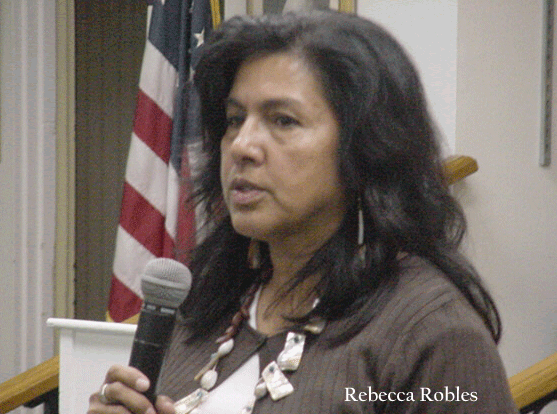
[photograph of Rebecca Robles is from here]

Rebecca Robles (Acjachemen) is the
Co-Director of United Coalition to Protect Panhe, 
and will be one of the featured speakers. 

What follows is from Censored News, here. Thank you, Brenda.

SACRED PLACES CONVENTION FOR INDIGENOUS PEOPLES
Saturday, June 12—Sunday, June 13, 2010
Puvungna, California State University Long Beach
RESERVE YOUR SPOT AT THE CONVENTION TODAY! Registration Deadline is Monday, June 7, 2010.

Indigenous sacred places are central to the ongoing spiritual, mental, and physical health of the people and the survival of Tribal Nations. The purpose of this two-day Convention is to empower Indigenous peoples and Indian Nations to collaborate effectively in our work. This Convention will enhance Native governance and cultural competency throughout Indian Country by building the capacity of present and future Indigenous leaders to protect sacred places and cultural resources.

Convention Goals:
· Promote information sharing among Indian Nations, grassroots Indigenous led organizations, Indigenous sacred places activists, and community organizers on strategies for successful sacred place protection;
· Build the capacity of Convention participants to protect their sacred sites; identify points of collaboration for local, state, and national legislative, policy, and community action to promote the protection of Indigenous sacred places;
· Increase the community organizing skills of Convention participants;
· Engage tribal youth on the issue of Indigenous sacred place protection; and,
· Develop a strategic plan for further statewide and national collaboration of Indigenous peoples on sacred place protection issues.

Workshop Topics:
· Best Practices for Indigenous Sacred Place Protection in California;
· Media Tools for the Protection of Sacred Places;
· Environmental Tools for the Protection of Sacred Places;
· Sacred Place Protection: Updates from Across the Nation;
· Sacred Place Protection in the International Arena; and,
· Coalition-Building & Community Organizing in Indigenous Communities.

Keynote Speakers & Panelists:
· Chief Caleen Sisk Franco, Winnemem Wintu Spiritual Leader
· Preston Arrowweed, Quechan Elder and Spiritual Leader
· Dave Singleton, Program Analyst, Native American Heritage Commission
· Greg Castro, Salinan, Archaeological Resources Committee, State Historic Resources Commission
· Desire Martinez, Tongva Archaeologist
· Rebecca Robles, Acjachemen, Co-Director, United Coalition to Protect Panhe
· Morning Star Gali, International Indian Treaty Council
· Alberta Nells, Navajo, Youth of the Peaks, and many more!

Please join us in our efforts to help build the capacity of Indigenous peoples to protect our sacred places and cultural resources. Email Angela at angela.ucpp@gmail.com to register. Please include your name, contact information, tribal affiliation, and how many days you plan to attend.

Registrations must be received by Monday, June 7, 2010!
Posted by brendanorrell@gmail.com

Haiti Update: Conditions at the Start of Storm Season; and Noam Chomsky: Earthquake Aid should go to Haiti's popular organisations, not to contractors or NGOs; a Brief Chronology of Events in Haiti

[image of the national flag of Haiti is from here]
From here:
First, a brief snapshot of Haiti. The country shares the western third of the Caribbean island of Hispaniola with the Dominican Republic. It lies east of Cuba, west of Puerto Rico, and is about midway between south Florida and Venezuela. Haiti is small, around the size of Maryland in square miles, and has a population of about 8.8 million according to World Bank figures. It's two-thirds mountainous, with the remainder consisting of great valleys, extensive plateaus and small plains. Port-au-Prince is the capital and largest city. The country has some oil, natural gas and other mineral wealth, but it's main value is its human resource that corporate giants covet in an offshore cheap labor paradise for Wal-Mart's "Always Low Prices." The nation's official name is the Republique d'Haiti. Few people in all history have suffered as much as Haitians, and it began when Columbus arrived. From then to now, they've endured enslavement, genocidal slaughter as well as brutal exploitation and predation. Hope for change arose with Jean-Bertrand Aristide's 1990 election, but it wasn't to be. On February 29, 2004, a US-led coup d'etat shattered the dream for the second time. In the middle of the night, US Marines abducted Haiti's President and flew him against his will to the Central African Republic.
When you hear about Haiti, if you're still of the mind that what they have endured is a natural disaster, you might wish to familiarise yourself with the U.S. (and France's) role in destabilising the country. There's more on this later in this post, but here's a snippet/excerpt:
[President Bill] Clinton of course supported the military junta, another little hidden story...he strongly supported it in fact. He even allowed the Texaco Oil Company to send oil to the junta in violation of presidential directives; Bush Sr. did so as well—well, he finally allowed the president to return, but on condition that he accept the programs of Marc Bazin, the US candidate that he had defeated in the 1990 election. And that meant a harsh neoliberal program, no import barriers. That means that Haiti has to import rice and other agricultural commodities from the US from US agribusiness, which is getting a huge part of its profits from state subsidies. So you get highly subsidized US agribusiness pouring commodities into Haiti; I mean, Haitian rice farmers are efficient but nobody can compete with that, so that accelerated the flight into the cities. And it wasn’t that they didn’t know it was going to happen. USAID was publishing reports in 1995 saying, yes this is going to destroy Haitian agriculture and that’s a good thing. And you get the flight into the cities and you get food riots in 2008, because they can’t produce their own food. And now you get this class-based catastrophe. After this history—it’s only a tiny piece of it—the United States should be paying massive reparations, not just aid. And France as well. The French role is grotesque. -- Noam Chomsky [the rest of this interview appears later in this post]
From Alternet, here:

HAITI: "We are again exposed to catastrophe"
04 Jun 2010 19:19:25 GMT
Source: IRIN

Reuters and AlertNet are not responsible for the content of this article or for any external internet sites. The views expressed are the author's alone.

DAKAR, 4 June 2010 (IRIN) - The rain and winds signalling the start of Haiti's storm season are already taking a toll on the makeshift shelters housing people displaced by the January earthquake, and aid agencies warn that there could be worse to come.

"Tarpaulins are generally holding up better than tents, but even the best tarpaulin or best tent is not a good place to live during the rainy or hurricane season," Timo Lüge, communications officer of the interagency group overseeing shelter, told IRIN. "Many camps get flooded each time it rains, and living conditions are dire."
Some 1.5 million displaced people are living in camps.
Aid agencies are working to build sturdier, portable housing with raised floors as quickly as possible; 1,873 of a planned 120,000 transitional shelters have been built – enough to house 9,365 people – but completing 120,000 could take about one year, Lüge said.
Funding and materials are on hand, but land tenure issues and rubble removal are hampering the process. "It will take many months to secure land, buy the required materials, transport them and finish construction," he said.
"With building materials for over 7,000 transitional shelters in country, the biggest challenge for shelter cluster [the interagency group handling shelter] members is a lack of available land on which to build," the UN Office for the Coordination of Humanitarian Affairs (OCHA) in Haiti said in its 24 May bulletin.
In the meantime aid agencies are distributing wood, nails, rope and other materials and disseminating guidance, including in a poster in Creole, on how to reinforce and waterproof existing shelters, Lüge said.
In a recent survey of 28 sites international relief agency Oxfam found that "extreme overcrowding" and poor drainage raised the risk of flooding and disease. The OCHA bulletin said there was not enough water for washing, which compromised hygiene. Cases of diarrhoeal disease were low, but skin diseases from lack of water were frequent.
Catastrophe
The US National Oceanic and Atmospheric Administration has predicted an "active to extremely active" hurricane season in the Atlantic Basin. OCHA said in a 1 June communiqué: "With so many people still so vulnerable after the recent earthquake, a serious hurricane this year could be devastating." Haiti's Department of Civil Defence has been identifying buildings, such as schools, that could serve as communal hurricane shelters.
Jean-Ferdinand Jean-Jacques, who lives with his wife and children in Caremaga camp, in the Maïs-Gaté 2 area of the capital, Port-au-Prince, said damage from early storms had been considerable. "Most tents are flooded as we speak; they are rotting from the bottom up. People are working on putting sandbags at the base of their tents."
Harold Desaugustes, a member of the Caremaga camp committee, told IRIN: "Already, the winds and rain have destroyed temporary shelters of people who do not have proper tents. With the storms starting, we are again exposed to catastrophe."
He said many people, including his family, live in rudimentary shelters of plastic sheeting and poles.

"Sometimes, in the middle of the night, the structure crashes in from the rain and winds."
He recently bought a second piece of plastic sheeting after the first was blown away by the wind.
Desaugustes's household consists of 16 people, including five children under the age of six. "We generally ask other camp residents who have tents to allow our children to sleep there – a couple of the kids here, a couple there."
np/he
© IRIN. All rights reserved. More humanitarian news and analysis: http://www.IRINnews.org

*          *          *
From here:, at HaitiAction.net:

Haiti Earthquake aid should go to Haiti's popular organizations, not to contractors or NGOs

Noam Chomsky Post-Earthquake interview
by Keane Bhatt

For decades, Noam Chomsky has been an analyst and activist working in support of the Haitian people. In addition to his revolutionary linguistics career at MIT, he has written, lectured and protested against injustice for 40 years. He is co-author, along with Paul Farmer and Amy Goodman of "Getting Haiti Right This Time: The U.S. and the Coup." His analysis “The Tragedy of Haiti” from his 1993 book Year 501: The Conquest Continues is available for free online. This interview was conducted in late February 2010 by phone and email. It was first published in ¡Reclama! magazine. The interviewer thanks Peter Hallward for his kind assistance.

Keane Bhatt: Recently you signed a letter to the Guardian protesting the militarization of emergency relief. It criticized a prioritization of security and military control to the detriment of rescue and relief.

Noam Chomsky: I think there was an overemphasis in the early stage on militarization rather than directly providing relief. I don’t think it has any long-term significance...the United States has comparative advantage in military force. It tends to react to anything at first with military force, that’s what it’s good at. And I think they overdid it. There was more military force than was necessary; some of the doctors that were in Haiti, including those from Partners in Health who have been there for a long time, felt that there was an element of racism in believing that Haitians were going to riot and they had to be controlled and so on, but there was very little indication of that; it was very calm and quiet. The emphasis on militarization did probably delay somewhat the provision of relief. I went along with the general thrust of the petition that there was too much militarization.

Keane Bhatt: IF this militarization of relief was not intentionally extreme but rather just a default response of the US, is it just serendipity that there is a massive troop presence available to manage the rapidly mounting popular protests post-earthquake? Surprisingly large, politicized group comprised of survivors has already mobilized around demanding Aristide’s return, French reparations instead of charity, and so on.

Noam Chomsky: So far, at least, I don’t know of any employment of the troops to subdue protests. It might come, but I suspect a more urgent concern is the impending disaster of the rainy season, terrible to contemplate.

Keane Bhatt: Regarding relief work, aside from Partners in Health, Al Jazeera noted that the Cuban medical team was the first to set up medical facilities among the debris and constitutes the largest contingent of medical workers in Haiti, something that preceded the earthquake. If their performance in Pakistan [earthquake of 2005] is any indicator, they will probably be the last to leave. Cuba seems to have an exemplary, decades-long conduct in foreign assistance.

Noam Chomsky: Well, the Cubans were already there before the earthquake. They had a couple hundred doctors there. And yes, they sent doctors very quickly; they had medical facilities there very quickly. Venezuela also sent aid quite quickly; Venezuela was also the first country and the only country at any scale to cancel totally the debt. There was considerable debt to Venezuela because of PetroCaribe, and it’s rather striking that Venezuela and Cuba were not invited to the donors’ meeting in Montreal.

Actually the prime minister of Haiti, Bellerive, went out of his way to thank three countries: the Dominican Republic, Cuba and Venezuela for their rapid provision of aid. What Al Jazeera said about Pakistan is quite correct. In that terrible earthquake a couple of years ago, the Cubans were really the only ones who went into the very difficult areas high up in the mountains where it’s very hard to live. They’re the ones who stayed after everyone else left. And none of that gets reported in the United States. But the fact of the matter is, whatever you think about Cuba, its internationalism is pretty dramatic. And the people who’ve been working in Haiti for years have been awestruck by Cuban medical aid as they were in Pakistan, in fact. That’s an old story. I mean, the Cuban contribution to the liberation of Africa is just overwhelming. And you can find that in scholarship, but the public doesn’t know anything about it.

Keane Bhatt: On that point, you’ve talked about how “states are not moral agents. They act in their own interests. And that means the interests of powerful forces within them.” How does the history of exemplary humanitarian work as Cuban state policy relate to that thought?

Noam Chomsky: Well, I think it’s just been a core part of the Cuban revolution to have a very high level of internationalism. I mean, these cases you’ve mentioned are cases in point, but the most extreme case was the liberation of Africa. Take the case of Angola for example, and there are real connections between Cuba and Angola—much of the Cuban population comes from Angola. But South Africa, with US support, after the fall of the Portuguese empire, invaded Angola and Mozambique to establish their own puppet regime there. They were trying to protect Namibia, to protect apartheid, and nobody did much about it; but the Cubans sent forces, and furthermore they sent black soldiers and they defeated a white mercenary army, which not only rescued Angola but it sent a shock throughout the continent—it was a psychic shock—white mercenaries were purported to be invincible, and a black army defeated them and sent them back fleeing into South Africa. Well that gave a real shot in the arm to the liberation movements, and it also was a lesson to the white South Africans that the end is coming. They can’t just hope to subdue the continent on racist grounds. Now, it didn’t end the wars. The South African attacks in Angola and Mozambique continued until the late 1980s, with strong US support. And it was no joke. According to the UN estimates they killed a million and a half people in Angola and Mozambique, nothing slight. Nevertheless, the Cuban intervention had a huge effect, also on other countries of Africa. And one the most striking aspects of it is that they took no credit for it. They wanted credit to be taken by the nationalist movements in Africa. So in fact none of this was even known until an American researcher, Piero Gleijeses unearthed the evidence from the Cuban archives and African sources and published it in scholarly journals and a scholarly book, and it’s just an astonishing story but barely known—one out of a million people has ever heard of it.

Keane Bhatt: You mentioned the Venezuelan debt cancellation. At the same time, the G7 is in the process of eliminating bilateral debt. Why is that?

Noam Chomsky: Well they’re talking about it, yeah. The Venezuelans were first. And they just completely canceled the debt. G7 refused. In the Montreal meeting, they refused to even discuss it. Later, they indicated that they might do something. Maybe they’re embarrassed by the Venezuelan action. But I’m not sure how it’s playing out. As far as the IMF is concerned—the IMF is basically an offshoot of the US Treasury Department—they’ve talked about it but so far they have not agreed, as far as I can discover, to cancel the debt.

Keane Bhatt: Bellerive, Prime Minister of Haiti, thanked the Dominican Republic, Cuba and Venezuela. The DR has been lauded for its relief efforts: providing food, materials and medical care, for example. But at the same time there are reports from the border of Dominican troops forcibly deporting family members of Haitian patients and sometimes even the patients themselves, in Jimaní, for example. What is your take on these contrary developments taking place and is there any historical context that you would like to add?

Noam Chomsky: Well, what the Dominican Republic does is up to Dominicans to decide, but the much more striking thing from my perspective, is that the United States has not brought in any—barely any refugees—even for medical treatment. And that was harshly condemned by the dean of the University of Miami Medical School who thought it was just criminal not to bring Haitians to Miami where there’s marvelous medical facilities while they have to do surgery with, you know, hacksaws in Haiti. And in fact one of the first US reactions to the earthquake was to send in the Coast Guard to ensure that there wouldn’t be any attempt to flee from Haiti. I mean, that’s atrocious. The United States is the richest country in the world, it’s right next door to Haiti. It should be offering every possible means of assistance to Haitians.

Furthermore there’s a little bit of background here. I mean, the earthquake in Haiti was a class-based catastrophe. It didn’t much harm the wealthy elite up in the hills, they were shaken but not destroyed. On the other hand the people who were living in the miserable urban slums, huge numbers of them, they were devastated. Maybe a couple hundred thousand were killed. How come they were living there? They were living there because of—it goes back to the French colonial system—but in the past century, they were living there because of US policies, consistent policies.

Keane Bhatt: You’re talking about the forcible decimation of peasant agriculture in the 1990s?

Noam Chomsky: It started with Woodrow Wilson. When Wilson invaded all of Hispaniola, Haiti and the DR, the Wilson invasion was pretty brutal in both parts of Hispaniola. But it was much worse in Haiti. And the reasons were very clearly stated.

Keane Bhatt: Racism.

Noam Chomsky: Yeah. The State Department said, well, the Dominicans have some European blood so they’re not quite so bad. But the Haitians are pure nigger. So Wilson sent the marines to disband the Haitian parliament because they wouldn’t permit US corporations to buy up Haitian lands. And he forced them to do it. Well, that’s one of the many atrocities and crimes. Just keeping to this, that accelerated the destruction of Haitian agriculture and the flight of people from the countryside to the cities. Now that continued under Reagan. Under Reagan, USAID and the World Bank set up very explicit programs, explicitly designed to destroy Haitian agriculture. They didn’t cover it up. They gave an argument that Haiti shouldn’t have an agricultural system, it should have assembly plants; women working to stitch baseballs in miserable conditions. Well that was another blow to Haitian agriculture, but nevertheless even under Reagan, Haiti was producing most of its own rice when Clinton came along.

When Clinton restored Aristide—Clinton of course supported the military junta, another little hidden story...he strongly supported it in fact. He even allowed the Texaco Oil Company to send oil to the junta in violation of presidential directives; Bush Sr. did so as well—well, he finally allowed the president to return, but on condition that he accept the programs of Marc Bazin, the US candidate that he had defeated in the 1990 election. And that meant a harsh neoliberal program, no import barriers. That means that Haiti has to import rice and other agricultural commodities from the US from US agribusiness, which is getting a huge part of its profits from state subsidies. So you get highly subsidized US agribusiness pouring commodities into Haiti; I mean, Haitian rice farmers are efficient but nobody can compete with that, so that accelerated the flight into the cities. And it wasn’t that they didn’t know it was going to happen. USAID was publishing reports in 1995 saying, yes this is going to destroy Haitian agriculture and that’s a good thing. And you get the flight into the cities and you get food riots in 2008, because they can’t produce their own food. And now you get this class-based catastrophe. After this history—it’s only a tiny piece of it—the United States should be paying massive reparations, not just aid. And France as well. The French role is grotesque.

Keane Bhatt: May I ask, regarding Aristide’s languishing in exile, was he right to go back to Haiti in 1994 in the way that he did, with US troops? Also, was he right to agree, under enormous pressure of course, to the neoliberal reforms laid out in the Paris Accords?

Noam Chomsky: Well, I happened to be in Haiti almost at that time—1993. I was there for a while; this was the peak of the terror. And I’ve been in a lot of awful places in the world. Some of the worst, in fact. But I don’t think I’ve ever seen anything like the misery and the terror that was going on in Haiti under the junta, with Clinton’s backing at that time. And there was a lot of discussion, I talked for example to the late Father Gerard Jean-Juste, one of the most popular figures in Haiti, who the government recently forced out, he was then underground in a church but Haitian friends took me to him. He was very close to large parts of the population. I talked to labor leaders who’d been beaten and tortured but were willing to talk, and to activists and others. And what most of them said is, Father Jean-Juste for example, what he said is, “Look, I don’t want a marine invasion, I think it’s a bad idea. But on the other hand,” he said, “my people, the people in the slums—La Saline, Cite Soleil and so on, they just can’t take it anymore.” He said, “the torture is too awful, the terror is too awful. They’ll accept anything that’ll put an end to it.” And that was the dilemma. I don’t have an answer to that.

Keane Bhatt: Was Aristide wrong to argue against calls (made by some of his more militant supporters) for armed struggle inside Haiti to restore democracy after the 1991 coup?

Noam Chomsky: Not in my opinion. Armed struggle would have led to a horrendous slaughter.

Keane Bhatt: On February 17th, Sarkozy was greeted to street protests by thousands of Haitians holding up images of Aristide, demanding his return, and demanding reparations for what the French extorted in exchange for recognizing Haiti’s independence. At that same address, Preval was shouted down and he withdrew into his jeep. With this kind of sentiment brewing in Haiti right now, do you see Aristide’s return as an important priority, or is it something that might be desirable but not that pressing?

Noam Chomsky: Well, the answer to that question is going to be given in Washington. The United States and France, the two traditional torturers of Haiti, essentially kidnapped Aristide in 2004 after having blocked any international aid to the country under very dubious pretexts, not credible grounds, which of course extremely harmed this fragile economy. There was chaos and the US and France and Canada flew in, kidnapped Aristide—they said they rescued him, they actually kidnapped him—they flew him off to Central Africa, his party Fanmi Lavalas is banned, which probably accounts for the very low turnout in the recent elections, and the United States has been trying to keep Aristide not only from Haiti, but from the entire hemisphere.

Keane Bhatt: By which way is Aristide compelled to remain exiled? How exactly is his persona non grata status in the hemisphere maintained and by whom? What is preventing him from flying into a sympathetic country near Haiti, like Venezuela, for example?

Noam Chomsky: He might be able to go to Venezuela, but if he tried to go to the Dominican Republic, for example, they wouldn’t let him in. And there’s good reason for that. International affairs is very much like the mafia, and the small storekeeper doesn’t offend the Godfather. It’s too dangerous. We can pretend it’s otherwise, but that’s the way it is. There was one country, I think it was Jamaica if I remember correctly, that did allow Aristide in, over serious US pressure and protest. And not a lot of countries are willing to take the risk of offending the United States. It’s a dangerous, violent superpower. I don’t have to tell you, you know the history of the Dominican Republic. I don’t have to tell you about it—that’s the way it works.

Keane Bhatt: Using, as you’ve said, the historical US legacy in the DR, can we turn to recent Dominican history? As this humanitarian aid is provided on behalf of the DR, and it fills in the vacuum left by a weak Haitian state, if we go back to the events leading up to the coup of 2004, it worked under US aegis to actively destabilize Haiti by training the paramilitary rebels, Guy Philippe and Louis Jodel Chamblain…

Noam Chomsky: I know. And providing a base for them.

Keane Bhatt: Is there some kind of a contradiction to provide charity for people who you’ve actually worked to dismantle and destabilize?

Noam Chomsky: Well, you can call it a contradiction if you like, but it’s also a contradiction for Sarkozy and Clinton to appear in Haiti without abject apologies for the terrible crimes that France and the U.S. under Clinton, particularly, have carried out against Haiti. But they don’t do it. The head of Toyota has to go to Congress and apologize for hours because some people were killed by Toyota cars, but does Clinton have to go and apologize for what he did to Haiti? He dealt a death blow. Does Sarkozy have to apologize for the fact that Haiti was France’s richest colony and a source of a lot of France’s wealth and they destroyed the country and then posed an indemnity as a price for liberating themselves, which the country was never able to get out of?

A couple of years ago, in 2002 I think, Aristide appealed to France, to Chirac, to pay some remuneration for the huge debt that Haiti had to pay them…

Keane Bhatt: Twenty-one billion dollars…

Noam Chomsky: Yeah, for this huge debt that Haiti had to pay them. And they did set up a commission led by Regis Debray, a former radical. And the commission said that France has no need to give any compensation at all. In other words, first we rob and then destroy them, and then when they ask for a little bit of help, we kick them in the face. It’s not surprising.

Keane Bhatt: Although at the same time there are sources that say that while France put up an indifferent front, it was actually worried about a head of state bringing a legal case with overwhelming documentary evidence for international arbitration.

Noam Chomsky: Well, they really didn’t have to worry, because the way power politics works, the World Court can’t do anything. Look, there’s one country in the world at the moment which has refused to accept World Court decision—that’s the United States. Is anybody going to do anything about it?

Keane Bhatt: You mentioned Clinton, now UN special envoy to Haiti, who intends to woo foreign investors and continue on a low-wage textile focus for Haitian economic development. The lens of neoliberal economist Paul Collier, special adviser to the UN in 2009, dominates the UN perspective of Haiti. An advocate of sweatshop-led growth himself, he’s lavished praise on the much-resented MINUSTAH occupation force there, and has even said that the Dominican Republic "is not engaged in the sort of activities, such as clandestine support for guerrilla groups, that beset many other fragile states.” Can a true humanitarian like Paul Farmer—representing a different development model based on fair wages, public health, strengthening the Haitian state—influence the UN as deputy special envoy?

Noam Chomsky: It's a hard choice. I don't blame him for trying. We live in this world, not another one that we'd prefer, and sometimes it's necessary to follow painful paths if we hope to provide at least a little help for suffering people. Like Father Jean-Juste and the marines.

Keane Bhatt: You’ve talked about how the media created an artificial distinction between the South American ‘Bad Left’ and ‘Good Left,’ omitting Brazil's important collaboration with Venezuela in the interest of maintaining this view. However, with respect to Haiti, hasn’t Brazil legitimately earned a secure place within the ‘Good Left’? A center-left government of the South has spearheaded the MINUSTAH occupation and has pledged to increase its presence, after taking it over from the imperial architects of the coup (US, France, Canada). What factors made it so vigorous in supporting another deposed president of an equally geopolitically-unimportant country in recent times (Zelaya of Honduras)?

Noam Chomsky: Good questions. I haven't seen anything useful on Brazil's decisions on these matters.

Keane Bhatt: Any comments on the US media regarding Haiti following the earthquake? For example, Pat Robertson’s ‘pact with the devil,’ David Brooks’ ‘progress-resistant culture,’ pleas with transnational capital to create more sweatshops (Kirstof), Aristide being a despot and a cheat (Jon Lee Anderson). Even Amy Wilentz has compared Aristide to Duvalier in the New York Times.

Noam Chomsky: It's been mainly awful, but I haven't kept a record. The worst part is ignoring our own disgraceful role in helping to create the catastrophe, and consequent refusal to react as any decent person should—with massive reparations, directed to popular organizations. Same with France.

Keane Bhatt: I guess my final question is for the future: there have been a discouraging two decades, from 1990-2010, about the popular mobilization for political change in Haiti, and how to proceed, and I guess now that the Haitian people have struggled so hard through parliamentary democracy for 25 years and have so little to show for it, what are the lessons learned and possible strategies now that they’ve exhausted this parliamentary, democratic approach? Two coups d’etat and thousands tortured and murdered in this process.

Noam Chomsky: The lessons are, unfortunately, that a small weak country that is facing an extremely hostile and very violent superpower will not make much progress unless there’s a strong solidarity movement within the superpower that will restrain its actions. With more support within the United States, I think the Haitian efforts could have succeeded.

And that applies right now. Take the aid that’s coming in. There is aid coming in—we have to show we’re nice people and so on. But the aid ought to be going to Haitian popular organizations. Not to contractors, not to NGOs—to Haitian popular organizations, and they’re the ones that should be deciding what to do with it. Well you know, that’s not the agenda of G7. They don’t want popular organizations; they don’t like popular movements; they don’t like democracy for that matter. What they want is for the rich and powerful to run things. Well, if there was a strong solidarity movement in the United States and the world, it could change that.


Brief Chronology of Events in Haiti
courtesy Peter Hallward, Damming the Flood

August 14, 1791 A slave uprising begins in northern Saint-Domingue
Februrary 4, 1794 Abolition of French colonial slavery
January 1, 1804 Saint-Domingue is renamed Haiti, and declares itself independent of France
1825 France recognizes Haitian independence for the payment of 150 million francs (later reduced to 90 million as compensation for lost property)
1915-34 The United States (under Woodrow Wilson) invades and occupies Haiti
September 22, 1957 Francois Duvalier (‘Papa Doc’) becomes president
April 21, 1971 Francois Duvalier dies and is succeeded by his son Jean-Claude (‘Baby Doc’)
February 7, 1986 ‘Baby Doc’ is pushed out of Haiti by a popular uprising; General Henry Namphy takes power
December 16, 1990 Jean-Bertrand Aristide is elected with 67% of the vote; his prime minister is Rene Preval
September 30, 1991 General Raoul Cedras overthrows Aristide, who goes into exile; over the next few years several thousands of Aristide’s supporters are killed
Summer 1993 The paramilitary death squad FRAPH is formed, led by Toto Constant and Jodel Chamblain
September 19, 1994 US soldiers occupy Haiti for the second time; Aristide returns from exile
Early 1995 Aristide disbands Haiti’s armed forces
Mid-1995 Aristide’s party Fanmi Lavalas wins legislative elections
December 17, 1995 Rene Preval is elected with 88% of the vote
Late 1996 Formation of Fanmi Lavalas in opposition to ex-Lavalas faction
May 21, 2000 Fanmi Lavalas wins landlide victories at all levels of government; opponents form a US-backed coalition called the Convergence Democratique
November 26, 2000 Aristide is re-elected with 92% of the vote
July 28, 2001 First of many commando raids on police stations and other government facilities by ex-soliers based in the Dominican Republic, led by Guy Philippe
December 17, 2001 Ex-soldiers attack the presidential palace, provoking popular reprisals against the offices of parties belonging to Convergence Democratique
April 2003 Aristide asks France to repay the money it extorted from Haiti
January 1, 2004 Haiti celebrates bicentenary of independence from France
February 5, 2004 Full-scale insurgency begins, Chamblain overruns Cap Haitien
February 29, 2004 Aristide is forced onto a US jet and flown to the Central African Republic
March 2004 US troops occupy Haiti for a third time, interim government is formed with Gerard Latortue as P.M., the Lancet estimates thousands killed by police and anti-Lavalas paramilitaries
June 2004 US-led force is replaced by a UN stabilization mission (MINUSTAH)
February 7, 2006 Preval wins presidential elections with 51% of the vote
January 12, 2010 Catastrophic earthquake rocks Port-au-Prince

Storm Relief Resources for People In Guatemala

[image of sinkhole is from here]

A series of natural and infrastructural disasters--never unrelated to Western globalisation and the draining of resources--natural and human--for the Rich White West, are impacting many people in Guatemala. Pacano Volcano has erupted and then Tropical Storm Agatha came through. Rains and possible water pipe problems have resulted in a giant and horrifying sinkhole, which indicates ground instability and personal insecurity for everyone in the area. (I mean, if you are not living in Guatemala and are reading this, can you imagine this opening up suddenly near you?) Relief efforts are needed, and some basics for living are needed immediately.

Next up is a cross post from my friend at The Feminist Texican, Melissa. Thank you so much, Melissa, for compiling this list. <3 Julian

What follows next is from here.

Here’s a list of organizations with direct connections to Guatemala.  I also wanted to point out that Mayan Families (linked below) is an organization that helps indigenous Mayan families. You can make a general monetary donation, or if you scroll down their donations page, you can donate money for specific items.

Right now, they say money for food, sweaters for girls and boys, underwear and socks for girls and boys, and shoes of all sizes (but nothing over size 8 ) are most urgently needed.

via Link for Health (which seems to have the most updated info regarding relief efforts):

In all cases, it is best to donate to an organization’s non-restricted/general fund.  They will know how best to channel the funds.  Click on the group’s name, to access their donations page.  All of these organizations can provide a tax-receipt for US donors.

As Green As It Gets:  Is channeling help and funds directly to help their farmers in and around San Miguel Escobar.

Common Hope (Familias de Esperanza):  Is currently supporting the relief efforts east of La Antigua.  They are using funds to provide essentials (diapers, food, water, etc.) to those who have lost their homes.

ConstruCasa:  Home building NGO – will be working in the mountains around La Antigua, to aid those who have lost their homes.

Finding Freedom:  An American NGO that is wiring funds to first line relief personnel.   This includes Hugo Suarez’ relief efforts.

Mayan Families:  Family support charity in the Lake Atitlan region.  They will be directly aiding families displaced by this storm.  Many of these families were also displaced by Hurricane Stan in 2005, and Mayan Families was there for them then, too.

Rotary Clubs of Guatemala:  The Rotary Clubs in Guatemala are all hard at work providing first-line disaster relief.  To support their efforts, please follow the link to the Rotary page of the Ft. Collins, Colorado chapter.  The Ft. Collins club has strong relationships with chapters all over Guatemala, and will channel the funds to the areas with the most need.

Wuqú Kawoq:  Health care providers, who provide culturally sensitive care to indigenous individuals, using their native dialect.  As I type, this group is en route to the Lake Atitlan area to provide immediate care.  This group also plans to be manufacturing water filters in Lake Atitlan within the next two weeks.

*           *           *

What follows next is from here, from The Miami Herald.

Tropical Storm Agatha leaves trail of destruction in Guatemala

Tropical Storm Agatha has left more than 179 people dead, and the damage toll nationwide was extensive.

Special to The Miami Herald

Guatemalans flocked to relief shelters Tuesday after Tropical Storm Agatha swept away roads and bridges, opened up a massive sinkhole in the capital and left thousands homeless.
The first major storm of the hurricane season left at least 179 dead across Central America as record rainfall wreaked havoc on mountainous regions. It came days after the eruption of the Pacaya Volcano, which displaced thousands in Guatemala.

"We're better off here than in our homes," said Victor Arellano as he huddled with his family in a makeshift shelter outside the village of Calderas, just south of Guatemala's capital. "The rocks have left huge holes in the roof, and we fear for our lives when the volcano rumbles again. We have no place to go."

The government, which has struggled to cope with the expanding disaster, has quickly become overwhelmed, residents say.

"There are emergencies everywhere in the capital,'' said Mayra Escobar as she swept a layer of thick, black sand from her doorstep in downtown Guatemala City. ``We haven't received help from the government, but we're doing our best to help each other. We're waiting for help."

The damage toll nationwide was extensive. Many in remote communities throughout the western part of the country were cut off from aid and relief supplies. Officials and aid workers were still assessing the situation in those areas and planning their response.

"Everyone is meeting and gathering information at this point, trying to figure out what has happened. The reports are slowly coming in," said Anne Bousquet, a representative for Catholic Relief Services.

"We're trying to figure out what people know and coordinate a response, but it's difficult because the hardest hit areas are the least accessible."

U.S. Southern Command said Tuesday that it had deployed four helicopters to Guatemala from the Soto Cano Air Base in Honduras. The aircraft will conduct aerial assessments and transport emergency relief supplies to areas impacted by the disaster, military officials said from Southcom's headquarters in Miami.


On Monday, President Alvaro Colom announced that Guatemala had asked the World Bank for an $85 million loan to address the storm and damage from Thursday's volcano eruption.

The eruption left several inches of volcanic sand covering much of the city, and forced the closure of the country's largest airport. The airport remained out of service Tuesday as workers scrambled to clear the runway, while Pacaya continued to spew ash.

Agatha's rains hit soon after the volcano eruption, washing much of the sand into already overtaxed drainage systems, clogging sewers and exacerbating flooding in much of the city.

"The problem is that when this ash is mixed with water, it turns into paste which dries into a cement-like substance," said Mario Gómez, a spokesman for the city. "It's very difficult to clean up, and it has gotten into the drainage and sewers of much of the city at this point."

Officials blame the combination of water and ash for creating the almost perfectly round sinkhole, which swallowed part of a city block in downtown Guatemala City. The gaping hole measures approximately 60 feet wide and plunges more than 100 feet, although experts said it might grow larger in coming days.

The sinkhole consumed the intersection of two downtown streets and a three-story building in a mixed-use commercial and residential area. The building housed a sewing factory, which is believed to have been virtually empty Saturday when it crashed into the hole. Authorities have reported no deaths related to the sinkhole although a couple residents are reportedly missing.

"It's not just the storm that causes this," said government worker Carlos Hernández, who was manning a sonar-imaging machine as a team searched for other potential faults in the ground nearby. "It's broken tubes, improperly routed sewers and these things that wash away the foundation of the urban area. Then along comes the storm, and this is what results."

The rains caused additional problems for residents of towns close to the volcano, who had been forced to flee their homes Thursday and Friday, after burning rocks, some measuring a foot across, rained down on communities near the volcano.

Some 115,000 people nationwide were displaced by the combined effects of the volcano and storm. About half of those people are in temporary shelters. The death toll had risen to 152 in Guatemala by late Tuesday, with dozens more killed in neighboring El Salvador and Honduras. But washed-out bridges and roads meant the exact count would probably not be known for some time.

"Getting detailed information is proving difficult," said Bousquet. "The number of deaths could be a lot higher. We haven't been able to access the areas that are cut off, to reach the people who are more needy."

With roads washed out, officials were organizing supply drops by helicopter in some remote areas where food and water were already in short supply.

The Ministry of Health warned that stagnating water could lead to outbreaks of dengue and malaria. But officials and aid workers were also worried about long-term damage to crops and residences in remote, highly impoverished rural areas. Agatha is feared to have wiped out significant amounts of the corn and beans planted by subsistence farmers in several regions.

"There are the immediate needs," Bousquet said, "and there is the longer term strategy on housing for many who don't have homes to go back to. We also have to look beyond the immediate and figure out how to reestablish those livelihoods that have been lost."