This blog exists to support liberatory collectivist activism that seeks to uproot patriarchy, colonialism, and capitalism. It also acts to center the experiences, theories, and agendas of radical and feminist women of color.
When atrocity happens to women, men often don't know about it even while men do what it is men don't remember. When I remember what happened to the Jews of Europe in the early to middle part of the last century, I wonder how it can be that U.S. white Jews with class privilege can now so easily overlook the contemporary genocide Indigenous people in North America and beyond. I know how it can be. We say "we didn't know", the same excuse used by white gentile Germans. Utter this phrase to Jews of European descent with regard to how the Nazi Holocaust (HaShoah) could occur, to people who lost family in WWII in concentration camps, and you'll likely be met with an expression of exasperation and anger. Appropriately. When I attempt to bring the topic of white's genocide against Native Americans, I am met with a look of disbelief or incomprehension. What kind of genocide do you mean?
The kind that results in the organised, systematic destruction of a people, I might say. The kind that causes the dissolution of culture, sickness, and mass death. Is the presence of genocide only to be measured against the particularly heinous methods used by Nazis in Europe? If there are no gas chambers and ovens, but there is virulent colonialism and racism, is a genocide not occurring?
I won't get too far into what the Israeli military is doing to Palestinian people, not because I think it unworthy of attention, but because my Jewishness is not connected to Israel. I have a homeland called New York City. Israeli Jews are not, directly, my people. I have no personal emotional or political connection to them. My people are white U.S. Americans, and U.S. Jews of every color. As a white U.S. Jew, I do have blood on my hands to the extent that the U.S. actively supports racist, murderous apartheid in Israel and the region. I oppose the oppression and destruction of Muslim Palestinians by Israeli Jews. And the ethnic and religious divides there are not so sharp as one might believe if one only consumes U.S. media. Muslims and Palestinians live in Israel. Israeli Jews and Muslims live in Palestine. Generally, though, I am far too ignorant about the particulars of the history there to have much of use to say that could be considered informed.
I haven't even read Dworkin's book, Scapegoat: The Jews, Israel, and Women's Liberation. I have read a review of it by Veronica A. Ouma (*here*), but some of the assertions about Dworkin's political views are inaccurate, such as stating she supported or advocated female supremacy. She most certainly, and explicitly, did not. Proof of that is here:
Two days from now marks the eight anniversary of Andrea's unexpected death on 9 April 2005. I miss her voice in my world. She spoke against inhumanity in so many forms. There are few people who show such literary commitment to justice and liberation for women. I remember her. I remember those six million Jews destroyed in Europe from 1935-45. And the other five million killed during that time, in that place, who were not Jewish. I remember, on the 19th anniversary of the beginning of the Rwandan Genocide, the 800,000 Tutsis killed by Hutu extremists. I remember Indigenous Americans exterminated on this land and those who are being destroyed currently. On this day, Yom HaShoah, I remember that past and this present.
This post's links detail why 'First World'-only justice movements, for people in the First World, are anti-woman if they don't center the experiences of women around the world enduring injustices and horrors not generally experienced by privileged women, and men, in the First World.
For me, a white male from the misnamed First World, seeing images is going to be as bad as it gets. I won't endure the experience of holding a baby with horrifying birth defects, nor will I be a woman who lives in a country where these birth defects, rape, military invasion, and white, patriarchal, imperialist terrorism are, together, committed by the military from the U.S. I can suffer from seeing images and hearing stories, but that's quite different from being the terrorised, horrified person in them.
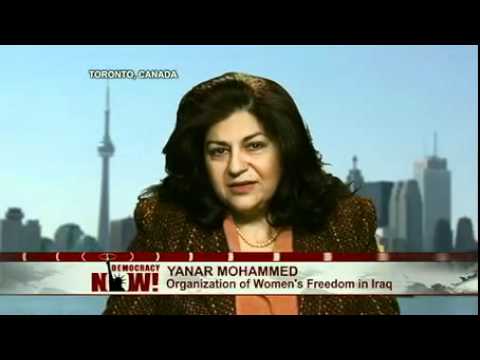
The U.S. war on Iraq began ten years ago this week. Democracy Now! has been reporting on this war's crimes against humanity, and what U.S. media will not tell us about it. We must, collectively, require accountability and justice from the U.S. for these war crimes.
NERMEENSHAIKH: And what do you see has happened in Iraq in these last 10 years?
YANARMOHAMMED:
It’s just getting worse. We are again in a police state. We have
armies, police and all kinds of intelligence institutions around us. We
have SWAT. We have anti-riot. It’s all kinds of security institutions around us.
And on top of that, I see the women in my
country getting much weaker. I see an epidemic rise in certain kinds of
birth defects. And when we try to organize women—we sent women from my
organization to a town in Haweeja. We were surprised to see hundreds of
children that had birth disabilities. We see things in Iraq that we’ve
never seen in our lives.
I also see young women, orphans of war, female
orphans of war, that are being trafficked. And the state absolutely has
no obligation towards them. The young women who are being trafficked
come to our organization and to our shelters. They don’t even have the
right to citizenship in Iraq. We are speaking here about tens of
thousands of orphans of war who are absolutely not being taken care of.
Neither the Iraqi government nor the U.S. experts in Iraq do anything
about it.
Here, Arundhati Roy speaks out about the complete psychosis of U.S. leaders in thinking things are better for women in Afghanistan now than ten-plus years ago:
We are dealing with a psychopathic situation.
And all of us, including myself, we can’t do anything but keep being
reasonable, keep saying what needs to be said. But that doesn’t seem to
help the situation, because, of course, as we know, after Iraq, there’s
been Libya, there’s Syria, and the rhetoric of, you know, democracy
versus radical Islam. When you look at the countries that were attacked,
none of them were Wahhabi Islamic fundamentalist countries. Those ones
are supported, financed by the U.S., so there is a real collusion
between radical Islam and capitalism. What is going on is really a
different kind of battle.
And, you know, most people are led up a path
which keeps them busy. And in a way, all of us are being kept busy,
while the real business at the heart of it—I mean, apart from the people
who suffered during the war. Let’s not forget the sanctions. Let’s not
forget Madeleine Albright saying that a million children dying in Iraq
because of the sanctions was a hard price but worth it. I mean, she was
the victim, it seems, of the sanctions; you know, her softness was
called upon, and she had to brazen herself to do it. And today, you have
the Democrats bombing Pakistan, destroying that country, too. So, just
in this last decade, Afghanistan, Pakistan, Iraq, Libya, Syria—all these
countries have been—have been shattered.
You know, we heard a lot about why—you know,
the war in Afghanistan was fought for feminist reasons, and the Marines
were really on this feminist mission. But today, all the women in all
these countries have been driven back into medieval situations. Women
who were liberated, women who were doctors and lawyers and poets and
writers and—you know, pushed back into this Shia set against Sunnis. The
U.S. is supporting al-Qaeda militias all over this region and
pretending that it’s fighting Islam. So we are in a situation of—it is
psychopathic.
IWD is now an official holiday in Afghanistan, Armenia, Azerbaijan,
Belarus, Burkina Faso, Cambodia, China (for women only), Cuba, Georgia,
Guinea-Bissau, Eritrea, Kazakhstan, Kyrgyzstan, Laos, Madagascar (for
women only), Moldova, Mongolia, Montenegro, Nepal (for women only),
Russia, Tajikistan, Turkmenistan, Uganda, Ukraine, Uzbekistan, Vietnam
and Zambia. The tradition sees men honouring their mothers, wives,
girlfriends, colleagues, etc with flowers and small gifts. In some
countries IWD has the equivalent status of Mother's Day where children
give small presents to their mothers and grandmothers.
In celebration of all the work, all the hard labor, all the unrecognised contributions women across the globe make to humanity, especially to their own humanity, I post this in honor of women around the world!
This occurred on 17 February 2013. I do not know who held the camera but am grateful they recorded Chief Jacqueline Thomas's address.
One of my most significant learnings as someone white, and also as someone male, has been to place the joys, the concerns, the dangerous and deadly conditions, the horrific gynocidal and genocidal realities, the survival strategies, the stories, the perspectives, the philosophies, the analyses, and the ethics of women of color at the center of my heart and mind. And, for whatever it can do, at the center of my blog.
Below is a collection of three recent news articles about the one and only Yoko Ono. Monday, February 18th is her 80th birthday. Happy Birthday, Great Woman/Artist/Activist!! Thank you for decades of your creativity, sensitivity, and strength. Love, Julian
Before we get to the articles, immediately below are sister and brother, Martha and Rufus Wainwright, singing "Happy Birthday" to Yoko Ono in English and German--and she's there, in Berlin!!! Her son Sean Ono Lennon is MC'ing the event. You get to hear him briefly at the end.
See *here* for more on that special concert for her.
(Please click on the article titles to link back to their source website.)
On Monday, Yoko Ono, a collaborator
with everyone from John Cage to John Lennon to Dirty Loud, will turn 80.
She'll be a rocktogenarian. They say it's her birthday. Happy birthday
to her.
Artist, poet, musician, philanthropist,
activist, performance/conceptual art pioneer, Ono is now a world-beating
disco diva, having enjoyed nine consecutive No. 1 hits on the Billboard
Dance charts. She's become a favorite artist for the mashup/remix DJs
of the moment.
"I say I'm a lucky girl," Ono says by e-mail.
An
explosion of Ono-related activity greets her 80th. There's a bunch of
books. Of her own work, there's the lovely Yoko Ono: An Invisible
Flower, of drawings and one-line poems, and The Infinite Universe at
Dawn. And Yoko Ono: Collector of Skies, by Nell Beram and Carolyn
Boriss-Krimsky.
There are art retrospectives around
the world, including Half-A-Wind Show, which opened Friday at the
Schirn Kuntshalle in Frankfurt, Germany, from which it will tour the
world.
All of her albums will be reissued this year. A new one's in the works with her floating orchestra, the Plastic Ono Band.
The
indie band tUnE-yArDs has released a 10-inch single with a new version
of her 1972 rocker "We're All Water" and a remix of her 1973 tune
"Warrior Woman." It's to benefit the Rockaway Waterfront Alliance, which
funnels aid to the region hit by Hurricane Sandy.
Many
musicians of the last 40 years look to Yoko Ono as a pioneer and idol.
She is widely revered by punk rockers as one of the first to do real
punk. New Wavers see her as a mom to the movement.
She
has cowritten and released a new dance tune, "Hold Me," with DJ Dave
Aude, with remixes by Dirty Loud, Emjae, Tommie Sunshine, and R3hab.
Lady Gaga's a Yoko Ono scholar, as are RZA and Polyphonic Spree.
Sandy. Fracking. Peace. The Beatles. Punk. Disco. Even to her, it must seem surreal sometimes.
"I wandered into doing music with the most prominent musicians in avant-garde, jazz, rock in history, and now this," she writes.
Her
first husband, Toshi Ichiyanagi, was an avant-garde composer. Together,
they performed with John Cage. Her friend Ornette Coleman helped invent
free jazz. She brought to John Lennon's music things she'd been up to
for decades already.
As for the music of 2013, she likes the creativity and sonic iconoclasm of the mash-up generation.
"I
think the producers in the dance world are the stars now. They bring
over 10 thousand music lovers to the festivals, whenever they decide to
do one. That's because their field of music is creating a revolution in
music. I respect them and love the field."
She and
the planet have seen many revolutions since her birth in 1933 in Tokyo.
Her father was an international banker, and the family moved frequently,
to San Francisco in 1935, back to Japan in 1937, to New York in 1940,
back to Japan in 1941.
Twelve-year-old Ono huddled
in a shelter during the March 9, 1945, firebombing of Tokyo (though in a
distant neighborhood). Her family saw hard times for a few years, but
by the early 1950s, they had moved to New York, and Ono was at Sarah
Lawrence College, where she excelled at music theory and sight-singing.
Ono
was a regular at the bohemian/Beat gatherings and loft concerts of the
1950s, forerunners of the "happenings" of the 1960s. Her 1969 Bed-Ins
with Lennon, protesting the Vietnam War, were but one stop in a lifelong
activism for peace. Her Imagine Peace Tower, a column of skyward
searchlights on Viey Island near Reykjavik, Iceland, will light up
Monday for her birthday. On her Twitter account, Ono encourages people
to tweet the Tower (@IPTower) with good thoughts.
She
and son Sean Lennon launched Artists Against Fracking in July. They and
actress Susan Sarandon did a protest tour last month of Pennsylvania
fracking sites such as Franklin Forks.
You have to ask: Where does she get the energy?
"When
you are in love," Ono says, "when you are crazy about something and
doing it because of that, there is no scheduling challenge, and it is
never a burden. . . . I get the energy from loving what I do."
Could
anybody really write her biography? "I don't think it is that necessary
to have a biography of me," she says. "One will never be able to check
the whole of me. Even I couldn't."
--
Contact John Timpane at 215-854-4406
or jt@phillynews.com, or follow on Twitter, @jtimpane.
___ (c)2013 The Philadelphia Inquirer Visit The Philadelphia Inquirer at www.philly.com Distributed by MCT Information Services
February 18 is Yoko Ono’s 80th birthday—it’s a day to celebrate her
art, music and activism. She’s done more in the last year than most of
us do in a decade: campaigned against fracking and honored Julian
Assange; mounted a major retrospective of her art in London last summer
at the prestigious Serpentine Gallery, and another, bigger one in
Frankfurt last week at the celebrated Kunsthalle Schirn; and made music
with the Plastic Ono Band.
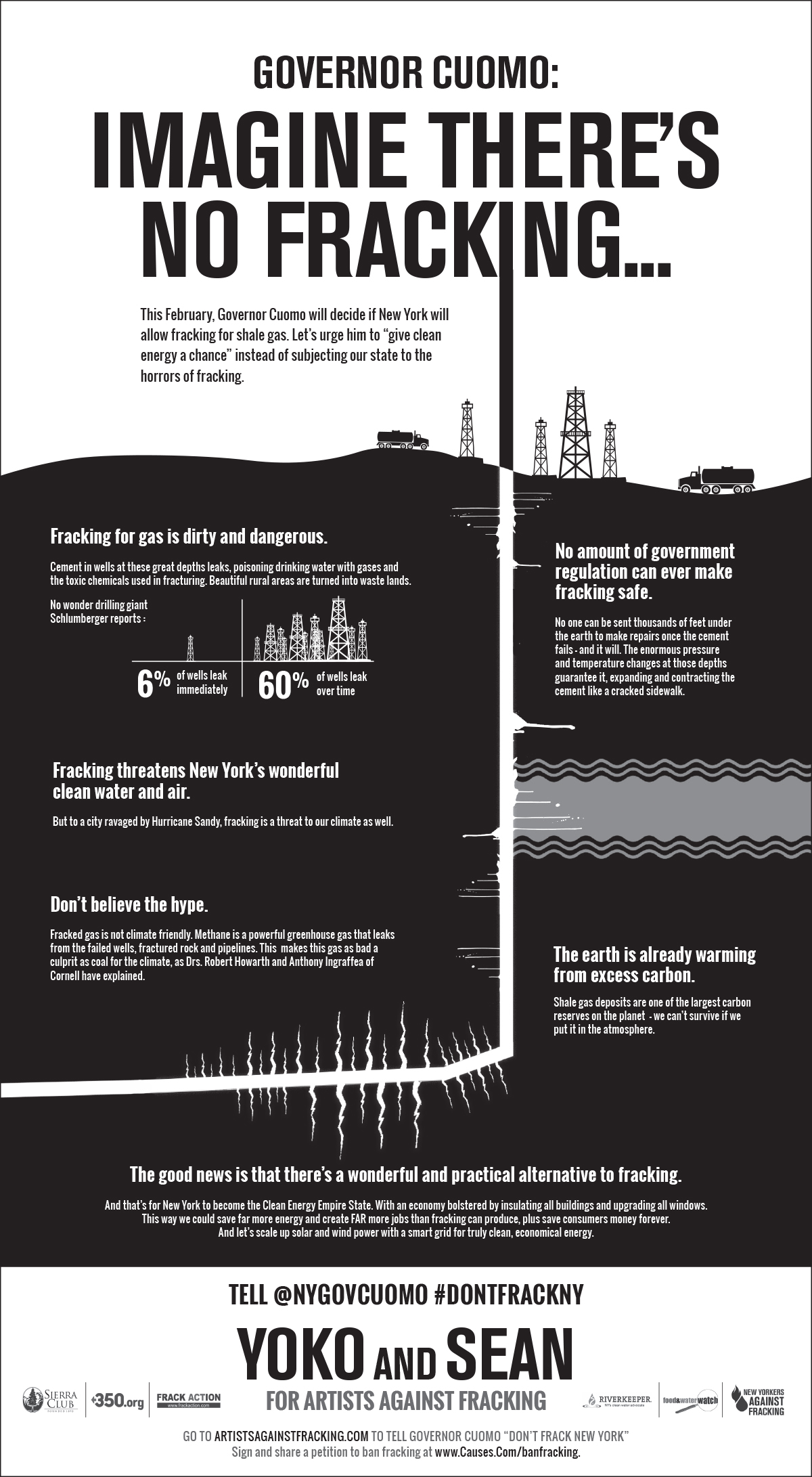
The anti-fracking campaign has been her biggest political undertaking in several years. First there were the billboards and full-page ads in The New York Times (and also The Nation): “Imagine There’s No Fracking”—addressed to New York Governor Andrew Cuomo, signed “Yoko and Sean” (her son, Sean Ono Lennon).
But the anti-fracking campaign involves a lot more than billboards. She organized Artists Against Fracking,
and signed up more than 200 people, including Salman Rushdie, Jeff
Koons, Alec Baldwin, Martha Stewart, David Geffen, Anne Hathaway, Jimmy
Fallon—and Lady Gaga, with her 34 million Twitter followers. In Albany
in January she delivered
an anti-fracking petition to Governor Cuomo with more than 50,000
signatures. Also in January she and Sean and Susan Sarandon led a bus tour of Dimock, Pennsylvania, where the local water supply has been contaminated by fracking. And now she is running a new TV ad.
She explained the problem with fracking concisely in The New York Timesletters
column in December: “Evidence shows that there is no amount of
regulation that can make fracking safe.… 6 percent of the wells leak
immediately and 60 percent leak over time, poisoning drinking water and
putting the powerful greenhouse gas methane into our atmosphere… We need
to develop truly clean energy, not dirty water created by fracking.”
And the campaign had a victory last week, when Governor Cuomo
announced a delay in the decision on fracking for more study of health
effects. The New York Times story quoted Donald Trump as spokesman for the pro-fracking forces, and Yoko as the voice of the opposition.
“Imagine There’s No Fracking” of course recalls a certain song that
begins “Imagine there’s no heaven,” which in turn was based on Yoko’s
1964 book Grapefruit, with its conceptual art “instructions”:
“imagine one thousand suns in the sky…” The anti-fracking billboards
also recall her antiwar activism in the 1960s, when she and Lennon put
up billboards in Times Square in 1969, and then in cities all over the
world: “War is Over: If You Want It.”
On another front, she honored
Julian Assange at a public event in Manhattan on February 3. At her
annual Courage Award ceremony, she told an audience of activists,
artists and some diplomats that “Julian Assange took a courageous step
by rightfully returning what belongs to the public domain. For that
reason, I believe we need to stand behind him.” Assange, who has taken
refuge in the Ecuadorian Embassy in London, accepted the award via two
of his legal counselors: Baltasar Garzón Real of Spain—he’s the
prosecutor who pursued Pinochet for crimes against humanity—and Michael
Ratner, the legendary President Emeritus of the Center for
Constitutional Rights, who delivered Assange’s acceptance speech to the
audience that included Laurie Anderson, John Waters, Lou Reed and Daniel
Ellsberg.
Earlier in 2012 Yoko honored Russia’s feminist punk band Pussy Riot,
whose members are currently in jail after criticizing Vladimir Putin.
She also paid tribute to Rachel Corrie, the 23-year-old American
activist who was crushed to death by an Israeli bulldozer in 2003 while
she was protesting the demolition of Palestinian homes.
Then there are the retrospectives of her career as an artist, a
career which began before the Beatles and continues today, fifty years
later. From the beginning she has mixed conceptual art and performance
art. Her work has been playful and sometimes painful, and includes films
as well as those “instructions” that require the viewer’s
participation.
One of my favorite recent discoveries was a piece in the
highly-regarded land art group show, “Ends of the Earth,” last year in
LA at the Museum of Contemporary Art. I had never thought of Yoko doing
work related to people like Robert Smithson of Spiral Jetty. But the land art show opened with Yoko’s Sky TV
from 1966: an old TV set broadcasts a live feed, from a video camera on
the roof, of the sky above the museum. It’s surprising and delightful,
and “real” in way that’s different from everything else in the museum.
It’s also a pioneering work of video art. (Sky TV is a permanent installation in New York City at the Asia Society.)
And we have her music—especially the unforgettable “Walking on Thin Ice” from December, 1980. The “Thin Ice” video is part of the Frankfurt retrospective, along with Sky TV.
One more thing that made this past year a good one: for those who
were still wondering whether Yoko broke up the Beatles, Paul McCartney
declared officially that she did not. When John met Yoko in 1968, he
explained, “part of her attraction was her avant garde side.… She showed
him another way to be, which was very attractive to him. So it was time
for John to leave”—but “he was definitely going to leave, one way or
another." The story was headline news.
And of course we have Lennon’s wonderful songs about her: from the
1969 song about their wedding, that begins “Standing on the dock in
Southhampton” (the Beatles’ last number-one hit), to Lennon on the 1971 Imagine album, singing “In the middle of the night I call your name…” to 1980’s Double Fantasy, and “Even after all these years/I miss you when you’re not here…”
To celebrate her 80th birthday she’s playing
a live concert in Berlin at the legendary Volksbuhne, the “People’s
Theater,” with the current Plastic Ono Band, headed by Sean.
The largest-ever retrospective of works of Yoko Ono, once
described by her late husband John Lennon as "the most famous unknown
artist in the world", opened Friday in Frankfurt's Schirn Kunsthalle.
Ono,
who turns 80 next week, "is a unique, indeed perhaps even a mythical
figure, not only in the art world, but in the field of music and the
peace and feminist movements as well," said the museum's director Max
Hollein.
Most people probably know Ono as the wife and widow of
the Beatle, John Lennon who was shot dead outside his New York apartment
in 1980.
And the two famously staged "Bed-Ins" in 1969 as a non-violent protest against war.
But
Ono, born on February 18, 1933, was an avant-garde conceptual artist in
her own right long before she met Lennon and was associated with the
likes of composer John Cage and the founder of the Fluxus contemporary
art movement, George Maciunas.
"She is familiar to practically
everyone, yet only very few people are fully aware of the outstanding
artistic oeuvre she has created. Yoko Ono's 80th birthday offers us an
ideal opportunity to change that," Hollein said.
The exhibition,
entitled "Half-a-wind show. A retrospective", surveys around 200
objects, films, spatial installations, photographs, drawings and textual
pieces from the past 60 years of Ono's career.
It pays particular
attention to works from the 1960s and 1970s, featuring groundbreaking
works such as the "Instructions for Paintings" first shown in 1961 and
1962 and the performance "Cut Piece" from 1964, in which the audience
was invited to cut the clothes from the artist's body with sharp
scissors while she sat on the stage.
A number of large-scale
installations and recent works are also on display and Ono has also
developed a new work -- the installation and performance "Moving
Mountains" -- specifically for the Frankfurt exhibition.
Curator
Ingrid Pfeiffer said Ono's work "often tends toward the immaterial, the
substance of which consists to a lesser extent of objects and
installations but to a significant degree of ideas and texts. It is not
easily presented."
Ono, wearing her trademark sunglasses, told a news conference that Lennon "used to say to me: 'bring me some truth'."
"We artists have the dignity to tell the truth to the people, unlike politicians," she said.
"But
we only know half the truth. The other half is invisible. You have to
imagine it, you are the creator, you have to participate. You change the
world by being yourself."
The exhibition runs in Frankfurt until
May 12 after which it will tour to Denmark and Austria and then move to
the Guggenheim museum in Bilbao in Spain.
These two excellent pieces of writing: the article from Racism Review, and the book by Sharon Patricia Holland, speak to the issues raised in a recent post on attraction.
I'll write more soon but wanted to get this up now:
It speaks so much to me about why white folks encouraging other whites to practice being
less racist with people of color in dating situations would be a
detrimental, dangerous, and disastrous thing to recommend.