This blog exists to support liberatory collectivist activism that seeks to uproot patriarchy, colonialism, and capitalism. It also acts to center the experiences, theories, and agendas of radical and feminist women of color.
This occurred on 17 February 2013. I do not know who held the camera but am grateful they recorded Chief Jacqueline Thomas's address.
One of my most significant learnings as someone white, and also as someone male, has been to place the joys, the concerns, the dangerous and deadly conditions, the horrific gynocidal and genocidal realities, the survival strategies, the stories, the perspectives, the philosophies, the analyses, and the ethics of women of color at the center of my heart and mind. And, for whatever it can do, at the center of my blog.
Below is a collection of three recent news articles about the one and only Yoko Ono. Monday, February 18th is her 80th birthday. Happy Birthday, Great Woman/Artist/Activist!! Thank you for decades of your creativity, sensitivity, and strength. Love, Julian
Before we get to the articles, immediately below are sister and brother, Martha and Rufus Wainwright, singing "Happy Birthday" to Yoko Ono in English and German--and she's there, in Berlin!!! Her son Sean Ono Lennon is MC'ing the event. You get to hear him briefly at the end.
See *here* for more on that special concert for her.
(Please click on the article titles to link back to their source website.)
On Monday, Yoko Ono, a collaborator
with everyone from John Cage to John Lennon to Dirty Loud, will turn 80.
She'll be a rocktogenarian. They say it's her birthday. Happy birthday
to her.
Artist, poet, musician, philanthropist,
activist, performance/conceptual art pioneer, Ono is now a world-beating
disco diva, having enjoyed nine consecutive No. 1 hits on the Billboard
Dance charts. She's become a favorite artist for the mashup/remix DJs
of the moment.
"I say I'm a lucky girl," Ono says by e-mail.
An
explosion of Ono-related activity greets her 80th. There's a bunch of
books. Of her own work, there's the lovely Yoko Ono: An Invisible
Flower, of drawings and one-line poems, and The Infinite Universe at
Dawn. And Yoko Ono: Collector of Skies, by Nell Beram and Carolyn
Boriss-Krimsky.
There are art retrospectives around
the world, including Half-A-Wind Show, which opened Friday at the
Schirn Kuntshalle in Frankfurt, Germany, from which it will tour the
world.
All of her albums will be reissued this year. A new one's in the works with her floating orchestra, the Plastic Ono Band.
The
indie band tUnE-yArDs has released a 10-inch single with a new version
of her 1972 rocker "We're All Water" and a remix of her 1973 tune
"Warrior Woman." It's to benefit the Rockaway Waterfront Alliance, which
funnels aid to the region hit by Hurricane Sandy.
Many
musicians of the last 40 years look to Yoko Ono as a pioneer and idol.
She is widely revered by punk rockers as one of the first to do real
punk. New Wavers see her as a mom to the movement.
She
has cowritten and released a new dance tune, "Hold Me," with DJ Dave
Aude, with remixes by Dirty Loud, Emjae, Tommie Sunshine, and R3hab.
Lady Gaga's a Yoko Ono scholar, as are RZA and Polyphonic Spree.
Sandy. Fracking. Peace. The Beatles. Punk. Disco. Even to her, it must seem surreal sometimes.
"I wandered into doing music with the most prominent musicians in avant-garde, jazz, rock in history, and now this," she writes.
Her
first husband, Toshi Ichiyanagi, was an avant-garde composer. Together,
they performed with John Cage. Her friend Ornette Coleman helped invent
free jazz. She brought to John Lennon's music things she'd been up to
for decades already.
As for the music of 2013, she likes the creativity and sonic iconoclasm of the mash-up generation.
"I
think the producers in the dance world are the stars now. They bring
over 10 thousand music lovers to the festivals, whenever they decide to
do one. That's because their field of music is creating a revolution in
music. I respect them and love the field."
She and
the planet have seen many revolutions since her birth in 1933 in Tokyo.
Her father was an international banker, and the family moved frequently,
to San Francisco in 1935, back to Japan in 1937, to New York in 1940,
back to Japan in 1941.
Twelve-year-old Ono huddled
in a shelter during the March 9, 1945, firebombing of Tokyo (though in a
distant neighborhood). Her family saw hard times for a few years, but
by the early 1950s, they had moved to New York, and Ono was at Sarah
Lawrence College, where she excelled at music theory and sight-singing.
Ono
was a regular at the bohemian/Beat gatherings and loft concerts of the
1950s, forerunners of the "happenings" of the 1960s. Her 1969 Bed-Ins
with Lennon, protesting the Vietnam War, were but one stop in a lifelong
activism for peace. Her Imagine Peace Tower, a column of skyward
searchlights on Viey Island near Reykjavik, Iceland, will light up
Monday for her birthday. On her Twitter account, Ono encourages people
to tweet the Tower (@IPTower) with good thoughts.
She
and son Sean Lennon launched Artists Against Fracking in July. They and
actress Susan Sarandon did a protest tour last month of Pennsylvania
fracking sites such as Franklin Forks.
You have to ask: Where does she get the energy?
"When
you are in love," Ono says, "when you are crazy about something and
doing it because of that, there is no scheduling challenge, and it is
never a burden. . . . I get the energy from loving what I do."
Could
anybody really write her biography? "I don't think it is that necessary
to have a biography of me," she says. "One will never be able to check
the whole of me. Even I couldn't."
--
Contact John Timpane at 215-854-4406
or jt@phillynews.com, or follow on Twitter, @jtimpane.
___ (c)2013 The Philadelphia Inquirer Visit The Philadelphia Inquirer at www.philly.com Distributed by MCT Information Services
February 18 is Yoko Ono’s 80th birthday—it’s a day to celebrate her
art, music and activism. She’s done more in the last year than most of
us do in a decade: campaigned against fracking and honored Julian
Assange; mounted a major retrospective of her art in London last summer
at the prestigious Serpentine Gallery, and another, bigger one in
Frankfurt last week at the celebrated Kunsthalle Schirn; and made music
with the Plastic Ono Band.
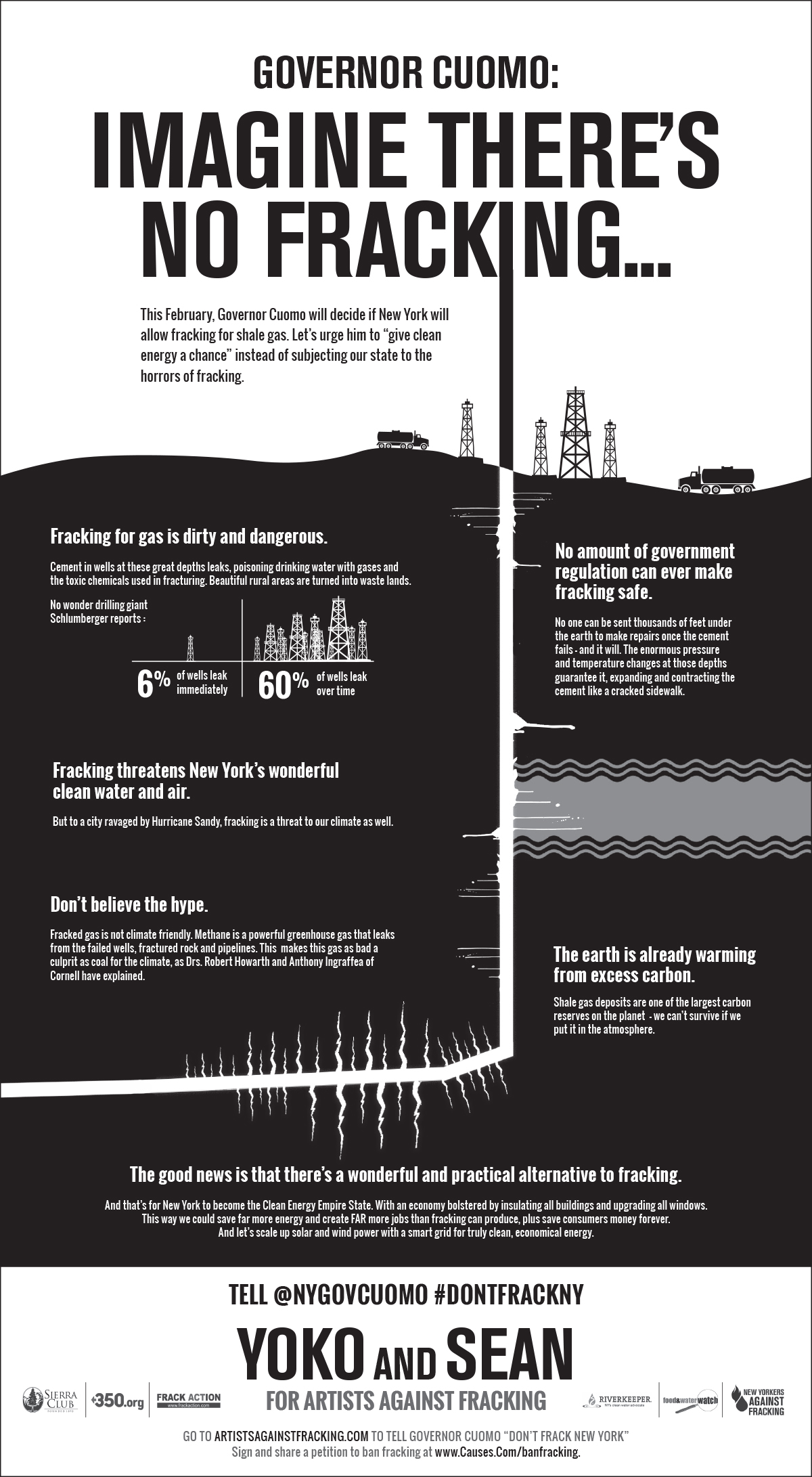
The anti-fracking campaign has been her biggest political undertaking in several years. First there were the billboards and full-page ads in The New York Times (and also The Nation): “Imagine There’s No Fracking”—addressed to New York Governor Andrew Cuomo, signed “Yoko and Sean” (her son, Sean Ono Lennon).
But the anti-fracking campaign involves a lot more than billboards. She organized Artists Against Fracking,
and signed up more than 200 people, including Salman Rushdie, Jeff
Koons, Alec Baldwin, Martha Stewart, David Geffen, Anne Hathaway, Jimmy
Fallon—and Lady Gaga, with her 34 million Twitter followers. In Albany
in January she delivered
an anti-fracking petition to Governor Cuomo with more than 50,000
signatures. Also in January she and Sean and Susan Sarandon led a bus tour of Dimock, Pennsylvania, where the local water supply has been contaminated by fracking. And now she is running a new TV ad.
She explained the problem with fracking concisely in The New York Timesletters
column in December: “Evidence shows that there is no amount of
regulation that can make fracking safe.… 6 percent of the wells leak
immediately and 60 percent leak over time, poisoning drinking water and
putting the powerful greenhouse gas methane into our atmosphere… We need
to develop truly clean energy, not dirty water created by fracking.”
And the campaign had a victory last week, when Governor Cuomo
announced a delay in the decision on fracking for more study of health
effects. The New York Times story quoted Donald Trump as spokesman for the pro-fracking forces, and Yoko as the voice of the opposition.
“Imagine There’s No Fracking” of course recalls a certain song that
begins “Imagine there’s no heaven,” which in turn was based on Yoko’s
1964 book Grapefruit, with its conceptual art “instructions”:
“imagine one thousand suns in the sky…” The anti-fracking billboards
also recall her antiwar activism in the 1960s, when she and Lennon put
up billboards in Times Square in 1969, and then in cities all over the
world: “War is Over: If You Want It.”
On another front, she honored
Julian Assange at a public event in Manhattan on February 3. At her
annual Courage Award ceremony, she told an audience of activists,
artists and some diplomats that “Julian Assange took a courageous step
by rightfully returning what belongs to the public domain. For that
reason, I believe we need to stand behind him.” Assange, who has taken
refuge in the Ecuadorian Embassy in London, accepted the award via two
of his legal counselors: Baltasar Garzón Real of Spain—he’s the
prosecutor who pursued Pinochet for crimes against humanity—and Michael
Ratner, the legendary President Emeritus of the Center for
Constitutional Rights, who delivered Assange’s acceptance speech to the
audience that included Laurie Anderson, John Waters, Lou Reed and Daniel
Ellsberg.
Earlier in 2012 Yoko honored Russia’s feminist punk band Pussy Riot,
whose members are currently in jail after criticizing Vladimir Putin.
She also paid tribute to Rachel Corrie, the 23-year-old American
activist who was crushed to death by an Israeli bulldozer in 2003 while
she was protesting the demolition of Palestinian homes.
Then there are the retrospectives of her career as an artist, a
career which began before the Beatles and continues today, fifty years
later. From the beginning she has mixed conceptual art and performance
art. Her work has been playful and sometimes painful, and includes films
as well as those “instructions” that require the viewer’s
participation.
One of my favorite recent discoveries was a piece in the
highly-regarded land art group show, “Ends of the Earth,” last year in
LA at the Museum of Contemporary Art. I had never thought of Yoko doing
work related to people like Robert Smithson of Spiral Jetty. But the land art show opened with Yoko’s Sky TV
from 1966: an old TV set broadcasts a live feed, from a video camera on
the roof, of the sky above the museum. It’s surprising and delightful,
and “real” in way that’s different from everything else in the museum.
It’s also a pioneering work of video art. (Sky TV is a permanent installation in New York City at the Asia Society.)
And we have her music—especially the unforgettable “Walking on Thin Ice” from December, 1980. The “Thin Ice” video is part of the Frankfurt retrospective, along with Sky TV.
One more thing that made this past year a good one: for those who
were still wondering whether Yoko broke up the Beatles, Paul McCartney
declared officially that she did not. When John met Yoko in 1968, he
explained, “part of her attraction was her avant garde side.… She showed
him another way to be, which was very attractive to him. So it was time
for John to leave”—but “he was definitely going to leave, one way or
another." The story was headline news.
And of course we have Lennon’s wonderful songs about her: from the
1969 song about their wedding, that begins “Standing on the dock in
Southhampton” (the Beatles’ last number-one hit), to Lennon on the 1971 Imagine album, singing “In the middle of the night I call your name…” to 1980’s Double Fantasy, and “Even after all these years/I miss you when you’re not here…”
To celebrate her 80th birthday she’s playing
a live concert in Berlin at the legendary Volksbuhne, the “People’s
Theater,” with the current Plastic Ono Band, headed by Sean.
The largest-ever retrospective of works of Yoko Ono, once
described by her late husband John Lennon as "the most famous unknown
artist in the world", opened Friday in Frankfurt's Schirn Kunsthalle.
Ono,
who turns 80 next week, "is a unique, indeed perhaps even a mythical
figure, not only in the art world, but in the field of music and the
peace and feminist movements as well," said the museum's director Max
Hollein.
Most people probably know Ono as the wife and widow of
the Beatle, John Lennon who was shot dead outside his New York apartment
in 1980.
And the two famously staged "Bed-Ins" in 1969 as a non-violent protest against war.
But
Ono, born on February 18, 1933, was an avant-garde conceptual artist in
her own right long before she met Lennon and was associated with the
likes of composer John Cage and the founder of the Fluxus contemporary
art movement, George Maciunas.
"She is familiar to practically
everyone, yet only very few people are fully aware of the outstanding
artistic oeuvre she has created. Yoko Ono's 80th birthday offers us an
ideal opportunity to change that," Hollein said.
The exhibition,
entitled "Half-a-wind show. A retrospective", surveys around 200
objects, films, spatial installations, photographs, drawings and textual
pieces from the past 60 years of Ono's career.
It pays particular
attention to works from the 1960s and 1970s, featuring groundbreaking
works such as the "Instructions for Paintings" first shown in 1961 and
1962 and the performance "Cut Piece" from 1964, in which the audience
was invited to cut the clothes from the artist's body with sharp
scissors while she sat on the stage.
A number of large-scale
installations and recent works are also on display and Ono has also
developed a new work -- the installation and performance "Moving
Mountains" -- specifically for the Frankfurt exhibition.
Curator
Ingrid Pfeiffer said Ono's work "often tends toward the immaterial, the
substance of which consists to a lesser extent of objects and
installations but to a significant degree of ideas and texts. It is not
easily presented."
Ono, wearing her trademark sunglasses, told a news conference that Lennon "used to say to me: 'bring me some truth'."
"We artists have the dignity to tell the truth to the people, unlike politicians," she said.
"But
we only know half the truth. The other half is invisible. You have to
imagine it, you are the creator, you have to participate. You change the
world by being yourself."
The exhibition runs in Frankfurt until
May 12 after which it will tour to Denmark and Austria and then move to
the Guggenheim museum in Bilbao in Spain.
These two excellent pieces of writing: the article from Racism Review, and the book by Sharon Patricia Holland, speak to the issues raised in a recent post on attraction.
I'll write more soon but wanted to get this up now:
It speaks so much to me about why white folks encouraging other whites to practice being
less racist with people of color in dating situations would be a
detrimental, dangerous, and disastrous thing to recommend.
I haven't written about it lately, but I do love the Beatles. All four. I miss John and George. No, I don't wish Pete Best had remained the drummer because Ringo's love of his three bandmates was some of the glue that held them together as long as they were. I do wish Stu Sutcliffe had lived. To those who know who Pete and Stu are, who also love the Beatles, drop me a note and say hi.
I've heard that half of all Beatles songs were about love. While the Rolling Stones were singing about women as things to be used or put down, John, Paul, and George were writing sensitive songs about women they loved very much, including their mothers who died when they were teenagers, in the case of John and Paul.
I probably believed at one point in time, "All You Need Is Love". And depending on how you understand what love is and what constitutes loving action, I might still agree. As long as it is considered loving to work at radically transforming oppressive systems into humane ones. As long as it is loving to be pro-revolution with the result of change being more love and less hate, more peace and less war, more health and less suffering, more sustainable living and less destructive consumption.
It has been curious to me for some time, as a Jew, that Christians look to a Jew named Jesus for inspiration, support, and healing, but usually forget that his loving actions included challenging a corrupt State, standing with oppressed and denigrated people, including women in prostitution, and rejected any kind of human King or Ruler, instead calling on people to follow something found deep in their hearts. One colleague of mine, who is Christian, Black, and feminist, finds what's radical about his teachings, while most men and whites apparently cannot. Maybe they don't want to do what he's asking them to do because for men and whites, there's a very material and social advantage to maintaining, or at least not interrupting, male and white supremacy.
Jesus sounds like a bit of an anarchist to me.
The Buddha was a rich young man who had to break out of his confined, very privileged life to see how people suffered in ways that never occurred to him. His heart was broken open by what he found out and he spent a great deal of time contemplating what it all meant that some suffer as they do. This led to insights about who we are and can be when we see Samsara for what it is: a realm of human suffering that is not the only realm of Being.
I once heard from a Rabbi that the mystical version of a Jewish G-d isn't one gender, calls on us to bring together the broken pieces of our collective soul, and, with love, heal ourselves and each other.
I don't practice a religion. I'm not atheistic but I'm not exactly a theist either. What I understand to be G-d isn't quite as personified as the Western gods I grew up learning about. Rather than G-d as a being, I think more about G-d as Being and Becoming, showing up in existence and action, and in everything else too.
If love is an action as well as a feeling and experience, then love calls on me to speak out against injustice and systematic harm. Love calls on me to be self-critical, self-compassionate, and critical and compassionate with others also.
I've made mistakes demonstrating a willingness to be critical without showing the compassion. To myself and to others. Mostly to myself.
I am working on bringing more love to the work I do. If I slip up, I hope you'll let me know what I did that wasn't loving so I have a chance to learn from increased awareness of the effects of my actions, to apologise, and to do better in the future.
I chose the chart above to open this post not because it is one that reflects my beliefs, but because I think it does represent some dominant views about how relationships form and progress.
As I noted at the beginning of my last post, I recently submitted two comments to a white transgender feminist's
blog. She didn't publish them but did explain that she wouldn't be posting them.
I'd like for the topics to be addressed to allow any of my readers
to comment here on these issues. I think each issue is relevant to building respectful, radical, revolutionary community. So I've posted links to her blog's two
posts (with my revised comments) here and in my last post, also published today at A.R.P. I've
revised my comment quite a bit below to elaborate on and clarify points I'm trying to make.
Thank you to A Radical TransFeminist for promoting and supporting these discussions.
The discussion there, as I understand it, was about challenging our
internalised and externalised supremacist attitudes and practices,
including the practice of focusing our attention on those atop various
hierarchies and leaving out of our vision of attractiveness those lower
on various political-social hierarchies.
Related discussions and struggles elsewhere have focused on getting masculinist, pornographic, and predatory values, aesthetics, and practices out of our sexual, romantic, social, and economic lives. This one divided up the white queer community I was part of decades ago. (Masculinism and pornography won out, unfortunately. But with the awareness of the disproportionate number of queer people who are survivors of sexual abuse, particularly in childhood, at least predatory practice has been consistently challenged.) Yet another set of concerns and challenges relates to how lightness of skin, straightness and lightness of hair, and eye shape and color become a measure of
attractiveness and value within and without communities of color, including Jewish communities.
Another dimension of this struggle is the one towards decolonial love, something I've heard only a very few white people talk about as an ethical value and political-personal necessity. Novelist Junot Diaz addresses this and intersectionally related matters *here* in a video of a speech he gave last year. This speech generated a very good and deep discussion among many activists and artists I know, which is taking place in email. And, I'll include a link to a critique of his work *here* at the blog QueerBlackFeminist.
I’d written something a while back that I’d like to post a link to
here as response-piece to what you’ve written above and in your second
post on the subject.
To summarise my reason for linking to it, I experience
the perspective above as pro-compulsory sexuality and as pro-sexual, in the liberal sense. I
question whether the challenge before many of us, rather than
expanding who we find attractive sexually or romantically, is challenging
why we find anyone “attractive” in the dominant sense. An argument I read somewhere stated that we ought to see the beauty in everyone. But that sentiment, while admirable on some level, unfortunately puts
aside the issue of what ‘beauty’ is in imperialist, racist, colonialist, capitalist,
patriarchal societies. I hear a clear demand that we challenge the
ways we internalise oppression, writing off classes of people as unattractive.
That makes me uncomfortable. But why?
I get how white singer John Mayer stating that his genital is white supremacist is racist and misogynistic in all kinds of ways. I’m arguing
that it wouldn’t be my counsel or charge to him, or wish for him, to
find Black or Brown people attractive and to act on that; he’s clearly
so bigoted that such interaction flowing from his white and male
entitlements to get what he wants would quite likely trigger and oppress
anyone of color; it would be my counsel that he interrogate what an
attraction to whiteness means and is and see where that leads him.
I live in a dominant culture that requires us to manifest (well, sell
and purchase) ‘beauty’ in some form. That requirement comes with the belief and
attitude that being not-beautiful is to also be worthless, except
perhaps as labor. Implicit in a charge for us to expand the
populations of classes of people we find attractive, I see a somewhat
anti-asexual charge to be attracted to people in the first place.
I want to support the effort to encourage meaningful, caring, honest,
intimate, counter-hegemonic, decolonial mutual relationships among
people as a way to build sustainable, healthy, revolutionary community; I
just take issue with that being identified as primarily a matter of
attraction and sexual interest. I see our struggle as this: to form
friendships first–whatever else follows. Friendship, as many feminists
and womanists have written over the decades, normally requires and
presupposes a kind of equality of interest and needs. Romantic and
sexual relating, historically and traditionally, requires and
presupposes inequality. This is why sexual relationships are compulsory
and institutionalised and friendships, however ubiquitous, are not.
There’s an appeal here in my remarks for people who occupy oppressive positions structurally to stop engaging in the
practices that traditionally oppress, and nurture those that
traditionally do not, in part because doing something with history and
tradition behind it is, I’d say, going to be less exhausting than doing
otherwise. Not that ease is a primary value. There's little about challenging and transforming the status quo that is easy. But an argument I hear a
lot is how self-condemning it can be for lesbian, gay, het, and queer
people to continually interrogate their/our lack of attraction to women
or men or transgender people. The process of coming out as lesbian or gay, as I understand it personally and from personal friendships with lesbian women, involves unlearning heteronormative and patriarhcal ways of being, ways of feeling, and ways of acting. It may also lead to challenging ageist, racist, and classist assumptions, among others.
Speaking as a profeminist gay male, radically rejecting heterosexuality and heterosexism means rejecting the ways het men have arranged for people to meet and get to know each other. What het male culture appears to prize is a kind of attractiveness that is directly related to appearance, not substance. Looks are what matter first and often enough, most. Sexual desirability, determined and defined by het men, is what the human objects of het men's attention are supposed to achieve. To reject het men's standards for being "sexy" and "attractive" is to be deemed ugly and worthless--except as labor--by them.
I see the bar and club scenes as doomed to replicate heterosexist and heteronormative standards of appealing to one another as sexy things, as sex objects, as people who must do a whole lot to ourselves before we leave home to go to the bar or club.
So one question is this: in what social spaces are we supposed to challenge ourselves to be attracted to people lower on various social-political hierarchies? In the workplace? In the home? On the street? All of those places are sites of misogynist and racist oppression, and of ageism, of ableism, of classism.
It has been mentioned that if one’s social circle is white,
that’s what needs to be challenged. A proposed antidote to someone's all-white circle of potential dates or mates is to
bring white folks into potentially romantic or sexual contact with
people of color. This, to me, privileges a value of white people expanding our dating pool, but in no way identifies what the benefit would be to people of color, should that pool-expansion occur. So I begin with friendship as a foundation for
revolutionary community and affection, not with attraction and sexual
behavior as that base. In the realm of friendship, physical and sexual attractiveness isn't a
primary value; shared intellectual pursuits, common interests, similar
senses of humor, and how people might be helpful to one another are at
least as important.
White people, or men, learning to do 'attraction behavior' less oppressively isn't something I hear oppressed people wanting tried out on them. As a survivor of sexual abuse, as an asexual person, as a gay
person, and as a Jew in a Christian-dominated country, I certainly don’t want more people smiling at me or
approaching me because of ‘attraction’. I’d welcome someone getting to
know me in contexts where it is appropriate for us to know each other,
due to progressive economic, social, or political work, not in contexts
where ‘getting to know someone’ is the sole or primary objective. Not where the reason for people wanting to seek out each other's company is to raise the possibility of obtaining sexual contact or fostering romantic feelings.
I don't want to negotiate social spaces where I'm increasingly put in the position to say no or yes to the advances of het-identified men who are challenging themselves to be open to dating or bedding gay men. Not discussed thus far is the issue of who along the hierarchies ought to be entitled to approach whom? I'd see it as radical if the challenge wasn't for oppressors to find those we oppress more suitable for dating and mating, but rather for us to altogether stop approaching (for the purposes of getting a date or "a fuck") those we oppress.
As I think Catharine A. MacKinnon states in one of her books of essays, consent isn’t all that
meaningful a lived concept for women if one only ever is in the position of saying no or yes to
the advances of men. One would have to live in a world where such
advances are neither compulsory nor anticipated to know what one wants
from and with men. I can extrapolate from that to other hierarchies.
I
feel that very personally and very strongly, as someone who is gay and a survivor of child sexual abuse and adult sexual exploitation, who
unhealthily while normally feels compelled to meet the sexual, emotional, and
affectional needs of someone who shows interest in me, especially when
they are men. As I contemplate finding someone attractive, and
contemplating being found attractive, such imaginings are
problematically bound up with racist, anti-Semitic, anti-Muslim, misogynist,
ableist, ageist, heterosexist, transphobic 'beauty' standards and oppressive interpersonal habits and social customs. Challenging the standards without also challenging and interrupting the oppressive dynamics and habits surrounding them is, for me, a set-up for more oppressive behavior to occur, not less.
To even imagine
someone being ‘interested’ in me–when they don’t know me–means that I am
led to try and change myself in self-oppressive, self-objectifying, and
dehumanising ways. Opting out of the social attraction circuit, like
opting out of the social sexual-behavior circuit, can be personally and
interpersonally liberatory. I don’t see that course of action identified
as valuable and viable in the discussion thus far.
I'm not comfortable with anyone white addressing an audience that isn't only white with a set of demands for what we should do that is deliberately designed to inflict on people of color our own social learning curve. I’ll add that I experience the term “demand” here, in this context, as white or
race-superior. Why? Because making demands on readers is something I
only experience whites and men feeling entitled to do--and doing regularly. In other words,
it demonstrates having enough racial (or, in my own case, also sexual)
social power to even proceed in doing it. I believe those of us in dominant structural positions, by race, class, gender, sexuality, age, ability, and so forth, ought not demand something
from our political peers that will likely violate and trigger those we oppress.
Also on the matter of race, was the race awareness training session
for bi community activists in the UK either white-led, white-organised,
or majority-white in attendance? If any of those, I’d then proceed to
articulate a critique of such a process for arriving at what terms are
most racially respectful and appropriate. Recognising that there are
some significant differences between U.S. and UK dominant society that I
might not be sensitive-enough to, I’ll add that I prefer the term
'racially oppressed', to 'minority-ethnic' when discussing who is
subordinated, marginalised, and imperiled by race. For me, the latter
term problematically reinforces whiteness as normal-majority and
race-neutral. It also pretends that whites aren’t a global minority. It
also conflates race with ethnicity.
While this comment contains challenges, I want that to be held in the
context of me strongly encouraging you to keep up the great work. I’m
thoroughly enjoying reading your deeply thoughtful pro-radical posts. I
find you, a white blogger, to be deeply and sincerely committed to
complex, intersectional, counter-hegemonic practice and that’s as rare
in my experience as finding a man who does the same.