Sunday, June 5, 2011

The WHM Supremacist Christian-controlled Press, Islamophobia, and Misogyny: the Reporting of the Murder of Katya Koran

image is from here
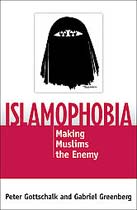
It's strange to me that a book about Islamophobia would have this cover. Islamophobia is a xenophobic Western phenomenon that includes the stereotyping, persecuting, and mass murder of Muslim women and men, particularly but not only in or from Central Asia. Are we supposed to be sure we view this bigotry and violence towards followers of Islam as something aimed primarily at women? Is "the covered woman" supposed to adequately represent Islam? Usually men who abuse women want to pretend the "real" harmed ones are all male. That's why the cover is strange to me--not because Muslim women are spared abuse from Muslim men, Christian men, Jewish men, and women who are not Muslim; they are not spared. 

For whom do women publicly represent the members of a Ibrahimic/Abrahamic religion? When white Christians write about Christianity, do they assume an image of a female on the cover will suffice?

image is from here
Apparently not. Here we have a cover showing a dark--get it? DARK, as in black, as in NOT WHITE--hand hovering behind "the" cross. That cross was one Roman soldiers killed hundreds or more Jews on. That it has become a symbol of something non-Jewish is already strange enough. But we can notice no women on the cover; in fact, we have two men--maybe gay, so maybe too feminine--too much like het men imagine het women to be? On this book cover, women are only represented symbolically in the lower right--and it's appears to me to represent the allegedly topsy-turvy morals of lesbians--because of course the morals of het white Christian het men haven't been tumbling around at all. (Cough.)

From the website promoting this vile book:
Gay apologists continually claim that there is an unreported epidemic of hate crime against members of their community. The author tackles this contention head on by analyzing statistics from various police departments and by examining just how law enforcement concludes whether or not a particular incident qualifies as a hate crime. His critique simply blows away the assertion that homosexuals qualify as a persecuted minority in Canadian society. He also exposes that the way the police delimit such crime is seriously flawed, at least in part because of their dependence on the testimony of the “victim.”
In the closing portion of his book, Emmanuel explores the term “Christophobia” and how it has informed his views on hate crime legislation. He concludes that while there are a number of factors driving legislation of this kind, one of the most basic factors is a “thoughtless and irrational reaction to Christians, Christianity and Christian teaching.” He points out that the moral absolutism of Christianity is totally at odds with moral relativism, the reigning philosophy of our age. His implicit conclusion is that people with an animus toward Christian absolutist values exhibit such hostility precisely because their moral relativism brings them into conflict with eternal Christian values. On a personal note, one could wish that Emmanuel had done a more thorough job of developing his assertions for “Christophobia” as being a key factor behind hate speech legislation, given that he chose to use the term in the title of his book.
In an interesting chapter entitled, “Stop Being Defensive,” the author takes careful aim at the common practice among Christians of issuing disclaimers whenever they critique homosexuality. Emmanuel does not approve, for instance, of disavowing hatred by saying, “While I may not morally agree with the homosexual lifestyle, I certainly do not hate them as persons.” He maintains that such “defensiveness” is unnecessary, plays into the hands of the other side, is a concession to political correctness, and is not helpful in advancing our cause in the culture war. While I endorse strongly most everything in this excellent book, I must confess that I see this point of view as misguided. Simply put, we must deal with the reality that gays and lesbians have succeeded in convincing the population that they are victims of ongoing hatred. It’s not true, of course, but perception is just as important as reality. Millions of moderate people who are not on one side or the other of this question must hear Christians renounce hatred for homosexual people. In the present cultural and political context, silence on this point simply gives fodder for gay apologists to use against us. [source: *here*]
As should be clear to most everyone, there is a direct relationship between the persecution of lesbians and gay men and the persecution, discrimination against, and domination of women generally, by men. While the debate above appears to be concerned with Christian het men vs. "homosexuals", we might take a moment to remind ourselves that Christian white het men are committing atrocities against the following groups of people: Christian white het women; Jewish and Muslim het women; lesbians of all religions and ethnicities; Jewish, Muslim, and Christian Black and Brown men; women of color of all sexualities; and Indigenous people across gender. That's quite a list to be targeted--all without the Western dominant press seeming to notice. Certainly without the corporate media posting notice to beware of this group of politically active extremists and terrorist.
 
White Male Supremacist Media cannot accurately report on the politically motivated death of a woman or girl, at the hands of one man or boy, or many men or boys,  unless the politics involved are connected to some demonised group of men, such as Islamic men. Because if non-Islamic men kill women, we are left to question other dominant societies, like white Christian male-dominated society, white secular male-dominated society. White Christian or secular men are not to be demonised; we're too busy giving them medals for murdering Islamic men and women across Central Asia, calling them heroes for their efforts and murderous "accomplishments". Do we need many more stories like this partially fabricated one, partially corrected below, to prove these points? A very young Ukrainian non-Muslim woman, Katya Koran, was murdered by a man, a boy, or a group of males. This is the salient political feature of this crime and human rights violation. Beyond the male supremacy and masculinist violence, we might notice the very particular patriarchal atrocities of the Christian-dominated European man.

My heartfelt condolences to the loved ones of Katya Koran.

Please click on the title below to link back to the source website. Shame on Western men's media. Please click on the title just below to link back.


Murder of beauty pageant contestant not connected to Islam

01 June 2011, Wednesday / YUSUF ERDOĞDU , KIEV

The murder of Ukrainian teenager Katya Koren (19) was not connected to Shariah law, as had earlier been reported in the media, with reports stating that she had been stoned to death for participating in beauty pageants.

The British Daily Mail newspaper reported that Koren was Muslim and that she was killed by three Muslim youths who claimed her death was justified under Islam. According to the daily, one of the three said Koren violated Shariah law and that he did not have any regrets regarding the murder.

The media was put to the test on Islamophobia worldwide as numerous websites covered the story without checking the facts, including in Turkey. Ukrainian authorities told the Cihan news agency that the report was made up and that the murdered teenager was Christian with Russian roots.

In a news conference in Simferopol, Crimean police officer Sergey Reznikov said they did not see any religious motives behind the killing and that the possibility of a sexual motive seems highly possible. "A student did it, killing his classmate. There is no other underlying reason, neither religious nor linked with inter-ethnic conflicts," said Reznikov.

The Ukrainian Interior Ministry also issued a statement and said that those who stoned the 19-year-old to death did not use Shariah law as a justification. Crimean authorities told the Cihan news agency that one of Koren's male classmates was detained as part of an investigation into the girl's death. The boy's statement, made in the presence of his lawyer and a teacher, was recorded. In his initial statement he said he helped the girl find something in forest and killed her there; however, he later denied this. Ukrainian authorities said police teams are continuing to search for the other assailants.

Mejlis of the Crimean Tatar People Chairman Mustafa Abdülcemil Qırımoğlu, commonly known as Mustafa Cemiloğlu in Turkey, said the detained teenager, Bilal Gaziyev, who is of Crimean Tatar descent, was pressured by police into accepting the blame for the murder. “The killing was covered in a distorted way, as if it was a religiously motivated murder, by the media around the world. The girl was not Muslim. All these [reports] are a provocation and fabricated news,” he told Cihan.

Rape Atrocity Denial: Men's not-so-secret Weapons in Protecting Male Supremacy

image is from here
• Feminism is hated because women are hated. Anti-feminism is a direct expression of misogyny; it is the political defense of women hating. -- Andrea Dworkin
• Being a Jew, one learns to believe in the reality of cruelty and one learns to recognize indifference to human suffering as a fact. -- Andrea Dworkin
• Woman is not born: she is made. In the making, her humanity is destroyed. She becomes symbol of this, symbol of that: mother of the earth, slut of the universe; but she never becomes herself because it is forbidden for her to do so. -- Andrea Dworkin [source for all three quotes is *here*]
I'll add this:

Andrea Dworkin is hated because women are hated.  And because she spoke women's truths to men's violently protected power.

As a Jew with family roots that go to Europe, I comprehend with stunned silence the level of atrocity-denial it must take for people to pretend HaShoah never occurred. One might shake one's head at the racist, anti-Semitic fools who do so but as they are the group in charge shaking one's head isn't nearly enough.

I suppose in an era of Photoshopping and other digital methods of altering images, we might expect that some people aiming to keep white Christian supremacy alive would accuse those who lived through nightmares to deny Nazi genocidal atrocity ever happened. How convenient for one's effort to maintain destructive, sadistic power that one denies is power, eh?

One might be tempted to cut the HaShoah-deniers some slack, given that the horror happened seventy years ago. Except for one thing: it is happening now against Indigenous people globally, and in particular in North America, in a time and place that is regarded as being oh-so-civil. Which, of course Hitler believed Nazi-ruled Germany was also. Now Germany currently has a relatively strong economy--albeit with debt incurred in propping up the pitiful economies of other European nations. And it has managed this, this time, without wiping out hated ethnic groups, and is banning nuclear power plants. Humane action can replace inhumane action.

In North America, the story is entirely different. Indigenous women are the poorest of the poor, the most raped of the raped, and the most invisibilised of the invisible. It's not just that whites don't wish to discuss this egregious elephant in the room, but most truly do not know genocide is happening right now, in part, I suppose, because the term genocide has been equated with tremendous levels of mass murder occurring in a very short period of time. But when the mass murder and attempts at complete cultural obliteration happens slowly while deliberately--with the apparent unawareness of the white masses--in what sense is this not also genocide?

Whites will and do come up with excuses for why we don't know about this, and why we aren't engaged in revolt against the forces which maintain this inhumanity. It's because media--white-owned--doesn't report on it. It's because systematic activism and resistance movements against the status quo--which Indigenous people all over the world are waging and have been waging for several hundred years--is not registered as important and desperate. Fighting for one's life--one's individual life and one's cultural life--is only seen as notable to Christian white het male supremacist media when it is white het men doing it, with the mythological threats being women, gays, and people of color: Muslim Arab and Asian, Ashkenazi Jewish, Black Christian, Brown Christian, and Indigenous. If you're positioned below this dominant group in various ways--such as being a woman who is Jewish and Black, you'll be rendered completely invisible in status quo society's vision of itself  which it uses media to construct in the public imagination. If you're lesbian and of color, you'll not find yourself on television. If you're trans and not M2F or F2M, you'll not find yourself on television. If you're gay, poor, and Brown, you'll not find yourself on television. The Christian whites don't want to know about us. They'd just assume we all go away.

But as lesbian Indigenous poet Chrystos has written, oppressed people--her people in particular, are Not Vanishing.

image is from here

Men deny rape is as serious a human rights problem as the imbalance of wealth distribution. Men deny rape in so many ways and for so many reasons you'd think the rest of us would determine this to be proof there must be a whole lot of men-raping-women going on. You really only need ask all the women you know how many women they know are rape-survivors and domestic terrorism survivors to know that rape is endemic and isn't going away. It could go away, but that would require men to not be in denial about it, to defend it, to protect their entitlements to practice it without negative consequence--to the male rapists.

Thirty-five years ago, Andrea Dworkin produced a brilliant radical feminist book called Our Blood. How many men have read both Not Vanishing and Our Blood, that you know? One? None? If Christian white het men were being assaulted by people who were not Christian, not white, not het, and not men, and they wrote about it, and about how they are figuring out how to survive it, I believe those books would be required reading across the educational system. Everyone would be made to read them. They'd stay in print. They'd be passed around among white het men, with a look in the eyes that says, "this speaks to our pain and our endurance".

In Our Blood, there is a very important speech, delivered March 1, 1975, called "The Rape Atrocity and The Boy Next Door". From that speech and essay we have this quote, which every man on Earth ought to have memorised in his own language.
Men who want to support women in our struggle for freedom and justice should understand that it is not terrifically important to us that they learn to cry; it is important to us that they stop the crimes of violence against us. -- Andrea Dworkin
Indeed. Almost without exception, men will self-centeredly respond: "What about the men and boys who are raped?" To this inhumane response I reply: What about the millions of girls, daily?

What shall we conclude about the moral character of white het men who will not acknowledge the pain and endurance of other people, non-male people--people these white men structurally oppress? What is the level of humanity of these rape apologists and perpetrator-protectors? How ought they be regarded or reviled, statused or stigmatised, by society? This is how they are regarded and statused: as heroes, as geniuses, as brilliant creators. This is how they, as a group, are reviled and stigmatised: not at all, in any way.

If you combine the forces and practices of genocide with gynocide, you get a truly horrifying statistic, which is numbers placed over the violence men do to women. One women in three will be raped by a man--mostly by a white het man--if she's an Indigenous woman in North America. See *this study by Amnesty International* for much more on that. And for more understanding of gynocide and genocide, please see chapter one of Andrea Smith's brilliant book, Conquest: Sexual Violence and American Indian Genocide: "Sexual Violence As a Tool of Genocide".

image is from here
For Indigenous women's stories of survival of many forms of men's violence, please read Sharing Our Stories of Survival: Native Women Surviving Violence.

If you don't get what's incredibly fucked up about this gross protectionism of white het men and their abuses of other people, you're either in great denial yourself, or you're one of lying perpetrators of it.

theoreticalgrrrl, in a recent comment to this blog, noted how many women she knows well are survivors of the rape atrocity. I hope you read it, *here* in a recent post called Hearsay and Heresy.

I welcome all readers of this blog to post their own knowledge of the globalised rape atrocity, committed by men against women, with no relief for women, and no responsibility by men, in sight.

Here's part of what I know:

My mother was raped in a place that was supposed to keep her safe. She was also incested by her father, years prior to that.

My aunt and her daughters were incested by an uncle.

One of those daughters was, many decades later, anally raped by her husband when he was drunk.

A female relative's sister threw herself in front of a train to escape being domestically terrorised--which includes rape--by her husband.

A dear female friend was raped while a prostitute when she was a teenager. She was later street raped by a strange man. And another strange man tried to rape her. She escaped.

Another dear female friend was molested three times one summer by three different men.

Another dear female friend was incested by her father and years later was street raped.

Another friend has been raped in her marriage by her husband, too many times to count. He has been a domestic terrorist.

Another dear friend was raped, as an underage teenager, at knife-point by a young man she didn't know.

Another dear friend was drugged into semi-consciousness in a hotel room by an "accomplished" man who is a serial rapist: his name is Joseph Brooks. He raped many women over thirty years, usually using drugs to physically disable the women. I am relieved to report he is dead.

I could go on and on. Statistically, I'd say, easily, seven of ten women I know is a rape survivor; ninety-nine of one hundred women I know is a survivor of some form of sexual assault or attempted sexual assault with one male or several males being the perpretrator. And none of them reported the rapes to the police, to a lawyer, to the FBI, or to a mental or physical health care provider. Not one.

Please share your stories here, in ways that keep the survivors completely anonymous and safe.

To men: please organise to end men's sexual assault of girls, and rape of women. The reason why men must do this is because it is only men's responsibility to do so.


Saturday, June 4, 2011

Masculism and Feminism: Distinguishing Profeminist Philosophy from Propatriarchal Philosophy

image is from here

Parts of this post were added to and revised on 4 June 2011 ECD. The original post from June 2 has been deleted.

This is posted with gratitude to all Feminist Philosophers and Thealogians.

For me, thoughtful action in the world is not governed by liberal "humanism", although there probably are far worse philosophies to live by. For me, it's about "feminism". That means it's all about the radical liberation of humanity from CRAP--with women's liberation from patriarchy, white supremacy, and capitalism being a necessity. I've seen, over thirty years, all of the reasons people give for claiming to be humanist-not-feminist, and it always seems to me to operate from this premise: what happens to men that is awful is "equal" to what happens to women that is atrocious. I don't believe that for one second, while I know full well men suffer for being human--as do women, as does everyone. It's the level of systematic suffering I focus on here, and the ways it is structured into society's stories about itself, into language, into expression, into feeling.

While humanism is present in many people's views of humanity, so too is masculism, and it is that philosophy that usually goes unnamed, with people assuming that the ways men think that are pro-man, must also be pro-human and, in theory, also pro-woman. But it doesn't actually work that way in reality. In reality men are not the only synonym for "humanity" and the humanity of men is far too often inhumane. Enter feminism.

Feminism is a corrective philosophy--or, well, set of philosophies. Hard as it may be for men to digest this, there isn't just one. These philosophies are a necessary political interventions designed to reveal the masculism in humanism and the male dominance in women's lives. Focusing on men's lives, with men being the only ones who name their experience and effect in the world isn't likely to reveal much about how those ways of being and doing impact women.

I'd like to place a lens in front of the mental eye, with the hope that doing so makes it easier to analyse and apprehend the serious problems structurally embedded in thinking and acting of many privileged, college-educated white men who speak English as a first language. The problems aren't only there. Many men embody them in action and thought; women can too. But women can't do so in their own collective interests. Men do so, all too frequently accepting that it is best for everyone, ignoring the fact that men aren't everyone.

I offer this lens to assist us in noticing how thinking--the form of the thoughts, their structure, their content--is shaped by the values taught by dominant society, not usually naming what it is doing honestly or accurately. So, for example, men usually lie after committing rape, and men often don't understand when their rape of someone has occurred. There's denial aplenty. When men are brought information about their own behavior, they claim--callously and arrogantly--that women lie about rape and don't understand that it hasn't occurred nearly so often as women imagine it--as if rape is primarily imagined. (It is, primarily, endured and survived.)

It is my contention that the reason so many men who value patriarchy while denying its existence, who value male supremacy while denying it is a ruling ideology, who value misogyny while denying they ever express it, cannot intelligently read radical feminist writings is because their minds are structured in such a masculinist way (not biologically) that it is not predisposed to comprehending any other thinking that exposes masculism as problematic. (A variation of the term is "masculinism".)

I suspect that for many Western pro-patriarchal men--who will swear to their white male sky-god (whether dead or not) that they are all for equality--reading the political work of radical feminist philosophers and activists is so challenging because to adequately "listen" to what its saying, they'd have to shut down or shut up. In my experience, pro-patriarchal men do one or both, but try to appear to do them only on their own terms.

I want to be clear about something called philosophical dualism. It is one thing to promote it unconsciously, not even realising one is doing it, not realising the subtle or not-so-subtle effect it is having. It is quite another to use the device--one of taking reality and forming it, mentally, into two discreet camps--to illustrate aspects of life in patriarchal societies that normally go unnamed. What follows are not intended to be read as Absolutes. They are intended to be read by supple minds, capable of noticing nuance and multi-facetedness.

If what follows "doesn't compute" then read it like a poem or stare at it like a painting, and give up trying to cognitively understand it. Let it wash over you and soak in.

Feminism is a complex set of practices, values, philosophical investigations, social inquiries, and political challenges to the status quo in societies ruled and dominated by men in all or most spheres of human life.

Masculism is a less complex set of practices, values, philosophical assumptions, social and political postures designed to preserve the status quo in societies ruled and dominated by men in all or most spheres of human life.

Feminism, usually, is practiced consciously and conscientiously. Masculism, usually, is practiced unconsciously and far too frequently without conscience.

Feminism seeks a world in which it is no longer needed. Masculism shapes and re-shapes a world that cannot function (however unsustainably) without it.

Feminism is Indigenism. Masculism is the White Man's Ways.

Feminism seeks justice in the radical sense which means liberation beyond men's parameters of justice. Masculism reinforces in the conservative patriarchal sense, which means it reinforces injustice which it posits as just.

Feminism is open as to what human nature is and dictates about society's form and function. Masculism is closed, and dictatorial about what society's form and function should be.

Feminism is wild and unstoppable. Masculism is orderly and civilised. By "civilised" I mean this: savage with a veneer of sophistication, and dead-ended.
Feminism seeks new forms and new ways of thinking and being. Masculism rejects new forms and new ways of thinking, seeing them as threatening. They are threatening--to masculism.

Feminism is life-worshipping. Masculism is death-worshipping.

Feminism is not life-worshiping because mostly wombed people practice it. It is life-worshipping because it values freedom and liberation far beyond the imaginings of people like the Founding Fathers of the US of A.

Masculism is not death-worshiping because mostly men practice it with force and power. It is death-worshiping because it believes a use of power to dominate is necessary to maintain a good society.

Feminism is smart and intelligent. Masculism is not smart while thinking it is the definition of intelligence. (In doing this, it shows how ignorant it is.)

Feminism is smart because it acts from an integrated place consciously combining emotion with reason, feeling with thought, apprehension with comprehension. Masculism is not smart because it acts from a dis-integrated place of thinking reason is better without emotion, thought is better without feeling, and comprehension is better without apprehension (or receptivity to non-rational knowledge).
Non-rational knowledge is the foundation of feminism. 'Non-rational knowledge' is an oxymoron to masculism.
Feminism is subjective and subjectifying. Masculism is objective and objectifying.

Feminism is Audre Lorde's Erotic. Masculism is Max Hardcore's pornography.

Masculism is sadism and masochism, domination and submission. Feminism is intimacy, passion, and communion.
Feminism delights seeing how things come together. Masculism delights in seeing things blown apart.
Feminism is both/and. Masculism is either/or.
Feminism is possibility linked to promise. Masculism is probability latched to certainty.
Feminism is warm blackness and all the colors. Masculism is harsh and white, glaring and uninviting.

Feminism is welcoming. Masculism is violating.

Feminism is peace. Masculism is war.

Feminism is cooperation. Masculism is competition.

Feminism is assertion. Masculism is aggression.

Feminism is egalitarian in structure. Masculism is hierarchical in structure.

Feminism gives and takes. Masculism is vampiric, sucking the life out of everything it touches.

Feminism value sharing resources. Masculism values WINNING, owning, and possessing resources. (Charlie Sheen, take note.)
Feminism is a barter economy. Masculism is corporate capitalism.
Feminism sees sex as experience to be shared. Masculism sees sex as a thing to be had.

Feminism combines the knowledge of the body with the knowledge of the mind, realising there is no biological or spiritual distinction. Masculism regards the mind as in charge of the body, and the body as capable of betraying the mind. It believes they are relatively distinct biological and spiritual phenomena.

Feminism values logic and sensation. Masculism only values logic, which renders it hopelessly illogical and devoid of sensory meaning.

Feminism is infused with rational and non-rational knowledge of that which is deep within and also vastly beyond itself. Masculism is self-centered to its cold, cold core.

Feminism is self-aware. Masculism is self-absorbed.
Feminism is a belly laugh. Masculism is a snarky smirk.

Feminism is compassion. Masculism is conceit and condescension.
Feminism is an intransitive verb. Masculism is a proper noun.
Feminism is subject-oriented. Masculism is object-obsessed.
Feminism and Indigenism will outlive masculism. Masculism is withering as we speak.

Feminism is ocean, storm, and sky. Masculism is a dead idea washed ashore, disintegrating.

*          *          *

If you are masculinist in your thinking and behavior, it is not likely you will see feminism as valuable. Instead, you will see it as a threat to your existence. This sense of threat is at the core of men's opposition to feminism. They usually pretend their defences against it are due to other things. This is because they are not conscious of what they are feeling and why.

Because they feel threatened, and because they are fundamentally oppositional and hierarchical, they imagine women want to "take over" and "win". They cannot quite imagine women want something beyond competition, domination, and warfare. They cannot imagine a kind of human being--here called "humane being" that is not like them or that does not want to be just like them. This is because they are so self-centered and so self-absorbed.

(Pro-feminism enjoys this post as prose or poem. Pro-masculism compulsively wants to identify where it is illogical, hypocritical, or irrationally contradictory.)

Thursday, June 2, 2011

Christina Hoff Sommers' Pro-Patriarchal Agenda Suits Anti-Feminist Men Just Fine

photo of Christina Hoff Sommers is from here
Chistina Hoff Sommers, to many intelligent women, is a feminist in the sense that George W. Bush is anti-capitalist. In the sense in which Barack Obama is anti-war. In the sense that Nuclear Power is completely safe, especially north of Tokyo. In the sense that Ronald McDonald--apparently about to be retired-- is vegan. You get the point, I hope.

I agree with those many intelligent women. Her scholarship is as flawed as her arguments.

Let's take a look at just how wrong she is. Below are two reviews of Sommer's anti-feminist tract, Who Stole Feminism? The answer is that men stole it and while trying to bury it, women like Sommers and Katie Roiphe came along and dumped dirt on it by the shovelful before the men took over, as usual. Please click on each of the titles to link back to the source website.

The 'Stolen Feminism' Hoax
Anti-Feminist Attack Based on Error-Filled Anecdotes

By Laura Flanders


In her book, Who Stole Feminism? How Women Have Betrayed Women, Christina Hoff Sommers sounds the alarm. "American feminism is currently dominated by a group of women who seek to persuade the public that American women are not the free creatures we think we are," she writes. Such feminists have "alienated and silenced women and men alike." Where once there were Reds under the bed, now there is the Fem Menace by every blackboard: "These consciousness-raisers are driving out the scholars on many campuses."

Unlike the "well adjusted" women of the 19th Century "first wave" of feminism, "gender feminists" (as Sommers calls the modern ones she doesn't like) are manipulating facts, squelching debate and running off with money and influence.

"The gender feminists have proved very adroit in getting financial support from governmental and private sources. They hold the keys to many bureaucratic fiefdoms," Sommers reports, without citing statistics. "It is now virtually impossible to be appointed to high administrative office in any university system without having passed muster with the gender feminists," she asserts.

Even as Sommers berates feminists for embracing "victimhood," she complains that classicists like herself are under personal attack: "To criticize feminist ideology is now hazardous in the extreme."

Sommers, an associate professor at Clark University, is entitled to her opinions. The problem is that her book, published this year by Simon & Schuster, claims to be about facts. The National Review (6/21/94) excerpted a portion under the headline "Why Feminism's Vital Statistics Are Always Wrong." Her book is filled with the same kind of errors, unsubstantiated charges and citations of "advocacy research" that she claims to find in the work of the feminists she takes to task.

Anti-Feminist Folktales

Reviewing the book in the Wall Street Journal (7/1/94), Melanie Kirkpatrick enthused: "One of the strengths of Who Stole Feminism is its lack of a political agenda.... Ms. Sommers simply lines up her facts and shoots one bullseye after another."

In fact, like anti-"p.c." writers before her, Sommers relies heavily on a handful of oft-repeated anti-feminist anecdotes--or folktales. In Who Stole Feminism, readers find again the tale told by Katie Roiphe (The Morning After) and Sarah Crichton of Newsweek (10/25/93) of the rape-on-campus study that included the question, "Have you had sexual intercourse when you didn't want to because a man gave you alcohol or drugs?" Like Roiphe and Crichton, Sommers exaggerates the importance of the question-- she claims that "once you remove the positive responses to question eight, the finding that one in four college women is a victim of rape or attempted rape drops to one in nine."

Mary Koss, the study's author, explicitly writes in Current Controversies in Family Violence(a book Sommers makes reference to) that when answers to that question are removed, the victims of rape or attempted rape fall from one in four to one in five. The one in nine figure related to completed rapes alone, as reported in a newspaper story Sommers apparently misread.

Sommers also retells the story of the English professor at Pennsylvania State University who "took offense" at Goya's The Naked Maja, a reproduction of which was hanging in her classroom. According to Sommers, who sources only the Pottsville Republican, the professor "filed formal harassment charges" and got the painting removed. The professor, Nancy Stumhofer, says she never objected to the painting but to male students' comments about it while she tried to teach. "I never claimed I had been sexually harassed by the painting," Stumhofer pointed out in Democratic Culture (Spring/94). Nor were formal charges were ever filed.

In arguing against feminist claims that wife-beating was tolerated in English common law, Sommers quotes the 18th Century legal historian William Blackstone: "The husband was prohibited from using any violence to his wife...." The ellipsis conceals a Latin phrase that Sommers either didn't bother to translate or decided to ignore. In English it reads: "other than that which lawfully and reasonably belongs to the husband for the due government and correction of his wife" (Linda Hirshman, L.A. Times op-ed,7/31/94). In other words, the complete text says the exact opposite of Sommers' partial quotation.

Even when Sommers spots an authentic feminist foul-up, she makes errors of her own. Naomi Wolf, in her book The Beauty Myth, claims that there are 150,000 deaths from anorexia a year. Sommers points out that this is actually an estimate of the number of cases of anorexia per year. Then she states that the actual number of deaths from anorexia is "less than 100 [deaths] per year." This number is highly dubious, since it is based on a count of death certificates, which rarely list anorexia as a cause of death; anorexia-related deaths are usually listed as heart failure or suicide. Studies of anorexia suggest that the long-term fatality rate maybe 15 percent or higher (The Course of Eating Disorders, Herzog et al, eds.).

As Sommers writes: "Where were the fact checkers, the editors, the skeptical journalists?" Naomi Wolf has long since admitted her error, as has Gloria Steinem who repeated it. Sommers herself seems to have a harder time facing facts and correcting her errors.

'Sea of Credulity'

In her account of a campaign sparked by FAIR to get NBC to play a 30-second public service announcement about domestic violence before its broadcast of the 1993 Super Bowl game, Sommers repeats uncritically one reporter's version of the incident, and adds fresh errors of her own.

Sommers writes that there wasn't "any basis for saying that there was a significant rise in domestic violence on Super Bowl Sunday." Her book suggests that she never read FAIR's January 18, 1993 news release, which spelled out the grounds for addressing domestic violence on Super Bowl Sunday. That release stated: "The Super Bowl is one of the most widely viewed television events every year. Unfortunately, women's shelters report that Super Bowl Sunday is also one of the worst days of the year for violence against women in the home." The release cited press reports (New York Times, 1/5/92, 1/22/92; Chicago Tribune, 1/27/91) based on the accounts of those who work with battered women.

In contrast to a "roiling sea of media credulity"-- including at least one journalist who had been writing about the Super Bowl-related violence for years before FAIR's campaign--Sommers praises "a lone island of professional integrity": Ken Ringle, a Washington Post staffwriter. Ringle is hardly to be held up as an ethical model: The American Journalism Review (5/93) found that, in his Super Bowl article, he appeared "to have twisted and used quotes selectively to support his thesis," and noted that the Post's ombudsman had acknowledged "inaccuracies and flaws" in his reporting. Sommers cites the AJR article in a footnote, but declines to quote it.

Sommers claims to be a skeptic who believes in going to the original source, but neither she nor Ringle ever called the national FAIR office in New York to check their stories or get copies of the materials that FAIR distributed. Nor did Sommers consult a calender: Her "chronology" put the Super Bowl on January 30, which was actually a Saturday.

Sommers also claims that around the Super Bowl, "a very large mailing was sent by Dobisky Associates, FAIR's publicists, warning at risk women: Don't remain at home with him during the game." Had Sommers (or Ringle) called FAIR, s/he would have discovered that FAIR has never worked with Dobisky Associates--and had never heard of the firm before Ringle's piece.

In her account, Sommers uses quotes from a psychotherapist named Michael Lindsey that appeared in Ringle's piece. One of his comments she quotes twice, for emphasis. She doesn't mention that the Post's ombudsman had acknowledged that Lindsey's remarks had been taken out of context by Ringle.

Nor does Sommers mention that the views attributed to Lindsey by Ringle--critical of FAIR's Super Bowl efforts and of a link between football and domestic violence--were directly contradicted by accurate quotes from Lindsey in the same day's New York Times (1/31/93): "That PSA will save lives," said Lindsey. "It will give people the permission to call for help. The same way so much violence in football gives people permission to batter."

Right-Wing Feminism?

Sommers claims that she's a feminist, and journalists have largely taken her at her word. She has been identified as such on television, and many of the reviews of Who Stole Feminism? ran under headlines such as "Rebel in the Sisterhood" (Boston Globe, 6/16/94) or "A Feminist on the Outs" (Time, 8/1/94).

Yet Sommers was quoted in Esquire earlier this year (2/94): "There are a lot of homely women in women's studies. Preaching these anti-male, anti-sex sermons is a way for them to compensate for various heartaches--they're just mad at the beautiful girls."

*          *          *

The War Against Boys: How Misguided Feminism Is Harming Our Young Men
By Christina Hoff Sommers
Simon & Schuster. 251 pp. $25
Reviewed by E. Anthony Rotundo, who is the author of "American Manhood: Transformations in Masculinity from the Revolution to the Modern Era." He also teaches at Phillips Academy in Andover, Mass.
Sunday, July 2, 2000
The era from the 1870s to the 1970s could well be called "The Century of the Boy." Building on the tradition of male dominance far older than their nation, Americans conceived a cultural romance with boyhood that penetrated every facet of American life. Tom Sawyer and Huck Finn became iconic figures, boys' games such as baseball and football emerged as men's preoccupations and ultimately as metaphors for work, statecraft and life itself, and figures like the cowboy and the playboy modeled American manhood for the nation and the world. Theodore Roosevelt, whose enduring popularity is rooted in his "boyishness," declared that a man "won't be much of a man unless he is a good deal of a boy." Cultural image influenced daily behavior. Our common patterns of schoolroom practice and our dominant psychologies of childhood were boy-centered.
And so, when modern feminism emerged in the 1960s and '70s, the infatuation with boyhood made a natural target. Feminist critics have brought girls' needs and problems the public attention they were long denied. Now, as the conversation on gender continues, a growing body of commentators – teachers, psychologists, conservative critics and feminists themselves – are calling attention to troubling patterns in the performance of boys.
As parents and professionals struggle for a sense of focus on these issues, Christina Hoff Sommers, a fellow at the American Enterprise Institute and a longtime critic of feminism, has published a new book on the subject. The War Against Boys accuses feminists and their fellow travellers in education and government of waging war against American boys. The media have already provided a forum for her charges, with the Atlantic Monthly running excerpts from the book as a cover story. Such widely heralded claims require careful scrutiny.
Sommers's specific accusations fall into two broad categories. One is education. She charges that feminists invented a crisis in girls' education while ignoring major problems in boys' academic performance. She directs her animus especially at How Schools Shortchange Girls, a study funded by the American Association of University Women. The study found a pattern of male-dominated, male-oriented classrooms and linked it to patterns of academic underperformance and low self-esteem in girls. Sommers cites other studies that dispute the AAUW findings and describes an AAUW lobbying campaign to hoodwink the media into accepting those findings. She also details patterns of male underachievement in reading, writing and extracurricular activity, saying that girls are thriving while boys are failing.
Sommers's second area of concern in the purported war against boys is the way in which adults socialize boys, both in and out of school. She objects to the feminist idea that violence perpetrated by boys is a product of male culture or masculine ideals. She also rejects the notions common among feminist scholars that boys need to have better access to their gentler emotions and that they shouldn't be pressured to push away from their mothers at an early age. Sommers charges that these notions lack supporting data and points with scorn at certain attempts (non-competitive games; doll play for boys) to apply these notions to the raising of boys. She says that such ideas about socializing boys differently are harmful because they disregard boys' true nature – and she says that we need to respect that nature because masculinity is responsible for the great achievements of human culture.
Sommers proposes several measures to improve boys' academic achievement, including all-boy schools, lecture-and-drill teaching methods, phonics instruction and more frequent testing. To curb violence among boys, she advocates emphasizing "directive" moral instruction instead of dismantling traditional codes of manhood.
Examined carefully, Sommers's case does not hold up well. She persistently misrepresents scholarly debate, ignores evidence that contradicts her assertions, and directs intense scrutiny at studies she opposes while giving a free critical ride to research she supports. A few examples of her style of argument will have to stand for a much larger pattern.
Let's look first at education. Sommers says that feminists have ignored the educational problems of boys, starting with How Schools Shortchange Girls. This argument runs into the inconvenient fact that the first and best-known study documenting patterns of male underachievement in school was sponsored by none other than the AAUW, in a follow-up to their study of girls' performance. It's an inconvenient fact that a women's organization led the way in studying the problems of boys, so Sommers attacks the AAUW for underpublicizing the study (she cites no data to support this charge). As for Sommers's claim that "girls and young women are thriving" academically, there have been many studies since Shortchange that contradict her, but she does not examine them. She describes studies that support her position but does not subject them to the same critical scrutiny to which she subjects Shortchange. Indeed, the AAUW follow-up study that included boys (and which Sommers strongly approves) reached the following conclusion, as quoted by Sommers: "Inequity can (and does) work in both directions." Sommers's own Table 2 shows that girls lag behind boys in percentages taking calculus, physics, AP/honors chemistry, engineering and astronomy at the high school level. Sommers applies a zero-sum model to gender concerns in education. It doesn't seem to occur to her that each sex faces significant problems that need redress.
Sommers's complaints about feminist proposals to socialize boys differently also rest on weak support. To advance her claim that boys have a true nature rooted in biology, she disregards the inconvenient evidence. When discussing the nature-nurture controversy in matters of gender, Sommers presents only the evidence for biological determinism, as if this were a settled issue among scholars in the field. In fact, the debate on this topic is lively and far from conclusive. Most studies of sex difference in various forms of behavior show no statistically significant difference. The studies that do find differences between the sexes tend to find much greater variation of behavior within each sex than between the averages of the two sexes. In other words, we're far more commonly human than we are male or female. Sommers, however, adheres to a literal-minded interpretation of genetic influence. As she sees it, men have one genetic makeup and women have another. This causes prenatal hormonal differences and contrasts in anatomies, which in turn create sharp differences that endure over the life cycle. Sommers believes in unchangeable, "hard-wired" male and female natures.
She contrasts her position with the constructionist view that attributes sex difference solely to culture. Her thinking allows no middle ground, even though that ground is well-occupied in debates on the subject. In the moderate position, heredity sets a range of possibilities for each individual and then environment determines the variation within that range. Male and female behavior patterns, then, are not set in granite – they vary. This model is consistent not only with the results of sex-difference studies but also with new knowledge about the brain which shows that brain structure and function change in response to experience.
In the context of Sommers's book, the issue of nature and nurture is much more than a matter of idle speculation. Her position that male nature is set in genetic stone is crucial to her argument. She sees the changes in educational method, child-rearing and moral education advanced by feminists and other liberals as violations of true male nature and therefore as a war against boys. But if maleness and femaleness can vary in response to life experience, then a host of feminist concerns must be taken seriously. For example, if boys' behavior can change in response to cultural messages, then the glorification of male violence in entertainment media is indeed a serious problem. Her proposals for improving boys' education and reducing anti-social behavior have limited or questionable research support. The value of phonics instruction, lecture-and-drill teaching methods and frequent testing is hotly debated among education scholars (a debate Sommers does not examine). Her enthusiasm for all-boy schools is based on experiments in Britain that are too recent to be usefully evaluated and on a few glowing anecdotes of questionable generality from the United States. Her advocacy of directive moral education rests on no hard evidence at all. Apparently, ideological enthusiasm is sufficient reason to suspend critical thinking as long as the ideology is the right one.
In the end, Sommers fails to prove either claim in the title of her book. She does not show that there is a "war against boys." All she can show is that feminists are attacking her "boys-will-be-boys" concept of boyhood, just as she attacks their more flexible notion. The difference between attacking a concept and attacking millions of real children is both enormous and patently obvious. Sommers's title, then, is not just wrong but inexcusably misleading. For the claim in her subtitle that "misguided feminism is harming our young men," she does not present a shred of credible supporting evidence but rather advances her position by assertion and abstract argumentation.
Had Sommers written a calm, factual presentation of boys' academic and social problems, this could have been a valuable book. Boys do lag behind girls in reading and writing, and they do trail in extracurricular participation. They are both perpetrators and victims of violence more often than girls are. But Sommers's book is a work of neither dispassionate social science nor reflective scholarship; it is a conservative polemic. Sommers focuses less on boys than on the feminists and cultural liberals against whom she has a long-standing animus. As a society, we sorely need a discussion of boyhood that is thoughtful and searching. This intemperate book is a hindrance to such conversation.
© 2000 The Washington Post Company

Can Enemies Become Allies? A conversation between James Huff and Julian Real, Part 3: Questions await Answers about Truth and Consequences

image is from here
If you're reading this after 10:30pm/2230 GMT on 2 June 2011, then cool. If you've read it before then, it's changed in two sections. Portions have been expanded and clarified--well, I hope they have been. ;)

What follows is the latest correspondence from me to James. I may post his reply here as well or put it into the next post in this series. This is what has happened thus far. Someone named Mastenship showed up on my blog, posting comments--in conjunction with my responses to him--at this post *here on men and rape*.

He also contacted me by email and welcomed respectful correspondence. We have begun that.

*Here's part one*
*Here's part two*
Below is part three.

Central to so many US MRA's beliefs is the anti-feminist nonsense put forth by too many men to name, and a few women too. *Here's a recent post about that*, titled Hearsay and Heresy: Katie Roiphe's Patriarchal Logic is Riddled with Distortions in Katha Pollitt's Classic Feminist Essay, Not Just Bad Sex

His book lists are referenced below.
___________________________________

Hi James,

With regard to information you share with me from the net, it comes across to me as all so speculative or anecdotal. It's not at all what I thought I'd be engaging with; you sent me a link to a piece from Fox News. That network isn't even regarded by serious reporters to be a legitimate source of "news": only propaganda. I can link you to careful analysis of what Fox News does that is not news and that is shoddy propaganda, if you'd like. Let me know.

I've asked you some questions and am hoping you'll respond to them. Obviously it's your decision as to whether to do so and I'm not wanting to rush you. I know that I've written a lot to you in the last days. I'm only asking you to take the time you need to respond directly to the questions that follow in this post.

I also wanted to express that some of what you put forth as logic comes across to me as an exercise in intellectual abstractionism.

My work is not abstract or theoretical, at heart. At heart it is a constant effort to expand consciousness about who feels what sorts of pain and why The feminists I know seek to make women's liberation from men socially existent and solid.  I seek here to carry women's knowledge from around the world to my blog and beyond; to make women's realities as intellectually, emotionally, and viscerally real to men as I can. I'm severely limited in my ability to do this work but I've got great connections to truly amazing and wonderful feminist-identified women worldwide. They are fighting such brave and strong battles against racist and patriarchal injustice. I am so thankful for all they do for humanity.

If I didn't make these connections with women globally I wouldn't know what was going on. I wouldn't know, deeply, what is happening to women in South Africa, Uganda, Egypt, Iraq, Afghanistan, India, Malaysia, Japan, China, North America, Jamaica, Mexico, Colombia, Brazil, and in the UK, across Europe, and in Australia. James, if you're not speaking intimately with women in these places there's no way you'd know what their experience is; extrapolating from selective (and very few) Western news stories wouldn't be wise to do, in my opinion.

I hope you read the post about Katie Roiphe and Katha Pollitt (the link to it is *here*), and took to heart and mind what Katha detailed was really messed up with Katie's work. Seriously flaws in logic and argumentation. Seriously unowned and unrecognised biases and anti-woman views being put forth as objective truth. I don't see why Katie's work is valued by you: it's truly shoddy. It is or ought to be an embarrassment to anyone who values intellectual rigour and truth, honor, and wisdom.

I am wondering how many books by Vandana Shiva have you read?
How many by Catharine A. MacKinnon? They've each written a lot.
How many by Patricia Hill Collins?
By Alice Walker?
By bell hooks? She's written around twenty books--each one dealing with sexism, racism, classism, social analysis and cultural critique, or all of that together.
Have you read the account of the US invasion in Afghanistan by Malalai Joya, who must change where she sleeps most nights to avoid being killed for speaking out against the male supremacists in her country and those invading her country from NATO and the US?
Does her experience matter as much as your Katie Roiphe's? If not, why not?

Malalai and Vandana, and my friend Avi who is Indigenous and is currently living in Sweden, and Andrea Smith who is Indigenous living in North America, are far smarter and wiser than is any Men's Rights writer I've ever encountered. To pay attention to MRAs and Katie and to ignore writer-activists like Malalai, Vandana, Andrea, and to ignore the stories and struggles of women worldwide is to choose to not know much about what's going on with women globally.

Why would someone not wish to know what's happening to women globally? I'm asking you that and ask it often of other men. I hope you'll answer that.

Women are being killed by men across the globe for the "crime" of being a woman. Men are not being killed the world over by women for being men, And women are not killing men around the world who commit crimes against women, who violate women's human rights and human bodies. White men, particularly but not only from the US, are raping and enslaving girls and women across the globe. Is protecting men's rights more important than ending sexual slavery and rape, to you?

How does one purporting to care about human rights not care about that?
What does one have to focus on to not have the pain girls experience register in their own bodies and haunt their minds?

I don't understand your political priorities. At all. You haven't described anything to me that isn't anecdotal or speculative, or, in the case of Roiphe--who is on your favorite authors list, wrong. Just plain wrong. You haven't, as yet, respond to the study on the rape of Indigenous women in the US. You haven't, as yet, responded to my questions. I do not seek to work to place written ads for our respective positions on one another's blogs. That's not something I would consider to be valuable work.

I have come to witness over the last thirty years that white women and women of color are the central activists working around the world for human rights for everyone and for all life. Men the world over are destroying the world and all life. Not all men. But men-not-women.

Women participate in systems of atrocious destruction, of course. White women and rich women especially. But men designed those systems and men still rule those systems.

I hold to bring awareness to the people with the most power and privileges, not those with the least. I hold in highest regard those with the least power and privileges not those with the most. I do not see in your work the recognition that women of color even exist. Or poor men. Or most humans on Earth. Your work appears to me to be directed at only a small segment of society but a segment with extraordinary wealth and unearned entitlements, relative to every other demographic of people on Earth. I don't understand your choice to represent and advocate for only that population. It perplexes and saddens me. It calls forth grief in my heart.

You have indicated to me that you don't know much about what many gay males experience, systematically, that most het men do not. This tells me we live in different realities. Yours is very privileged indeed, which is not to say you haven't know deep pain, wounding, and suffering. I believe you surely have experienced all of that, and hopefully many joys and blessings too.

As far as I can tell, you argue for justice in the courts, without seeming to realise that most men and most women around the world have no access whatsoever to those courtrooms: most humans on Earth cannot afford an attorney and do not find justice in courtrooms even if they should get good legal representation and appear there. The court systems in most places on Earth--including in the US, Canada, the UK, Europe, and Australia, is stacked against women in so many dreadful and horrific ways--putting women in harm's way; not protecting women from men's violence; not protecting children from men's sexual, physical, emotional, and psychological abuses. It appears you would like me to believe the exact and precise opposite is true. Correct me if that's not the case.

But so you know, to do that I'd have to pretend I never spoke to a woman in my life. I'd have to ignore most of what I know to be true, and ignore most of what reality demonstrates. I'd have to choose to be willfully ignorant and steeped only in my own privileges to not know what's going on. I don't think life is rosy for white people. I don't think life is just a breeze for men. But to only focus on what white men experience--as virtually every single MRA I know of does--is to relegate to their unconsciousness the pain and suffering of all people who do not look like them.

James, most people living in this region of the world are not structurally positioned in Western society as we are. And because you and I are male and white we receive so much that most people in the world will never have. (Read *this* for more.) Some call this placement in society "a matter of luck". I call it a direct consequence of us living in a society that unfairly and dishonorably institutionalises economic, political, social, and environmental injustice and terrorism. There's nothing accidental going on if we look at the big picture along with the smaller ones. The small ones build to create the larger one, and the institutional forces show up in interpersonal and intimate ways. Overall, if not always individually, white men in the West benefit more than any other group of humans. For me that's about as obvious as the clear daylit sky being blue and the Great Lakes' waters being wet.

I don't understand well-sighted people believing the sky is orange and well-feeling people believing the water is dry. To believe that white men suffer structurally the most, not least, is a delusional indulgence most people around the world cannot afford to invest in.

Other questions are as follows.

Why, in your opinion, are so few men (those who despise feminists and feminism) so unable to seriously discuss social justice issues?

Why do you think there's so much homophobic and misogynist lingo tossed around among US male soldiers and in civilian life?

Why do you think military training officers use derogatory language about women--calling men "girl" and other terms to degrade and humiliate them, for example, during the training period?

Do you believe that feminist women ought not be castigated, stereotyped, and pigeon-holed by men? Do you believe that men organising against feminist campaigns to achieve human rights is a dishonorable pursuit?

You wrote to me:
I was an avid role-player at the time, and a very prodigious reader.  I studied everything from cooking to quantum physics.

Did you read non-fiction work by women of color, about their experiences in the world? If so, can you tell me what books and authors you read?

I ask you this because I am reminded of a friend I once had who was white and heterosexual and male. He loved science and math. He was into science fiction. He loved frisbee also. And he had walls of books he'd read, in his apartment. I remember looking for anything at all written by a woman of color. There was not one book among his hundreds. He assumed he was VERY well-read. I argued, very politely, that he was not. I argued that he knew very little about the world if he'd never read anything by women of color--and very little by white women either.

Women of color are, by far, the world's majority of people, relative to men of color, white men, and white women. How it was he thought reading the work of mostly white men, along with some Asian and Black and Mexican men was informing him about "all of humanity" was something I knew he'd learned to assume in an educational system (K through 12 and throughout college) that was geared toward building up an idea that has an ideology attached to it. The idea is this: white men are great. White men are geniuses. White men make history. White men write the best writing that has ever been written. No one in his education taught him that women of color are the world's majority of people, who have the most knowledge of what is happening in the world. I doubt anyone told you that either. But you tell me if your professors and teachers told you that without knowing what women of color experience, your life will be starved of knowledge and wisdom.

You have written about qualities you look for in allies--a sort of character check-list. I don't look for that so much in my allies, although I do in my close friends. What I look for in global allies is connection to the real world, not living in denial, not being delusional, not hiding in privilege, and being knowledgeable and wise more than informed and trained. I look for people who are working to assist the most dispossessed and demeaned and degraded humans in their efforts to build humane community and political, economic, and social structures from which humanity can arise wise and sustainably engaged with the rest of the world. How each group of oppressed people figure out how to do this is not for me to say: they know their conditions and choices far better than I could.

While modified, you appear to hold a rather abstract and absolute value of a term that is culturally relative and politically loaded: that term is "logic", or, alternately, "rationality". This is part of a philosophy that is often unconscious of its own hidden values. Usually this type of thinking is accompanied by a belief that ideas equal actions, and abstraction isn't problematic.

You similarly seem to demean or downgrade things like "emotion". Do you realise you are playing out some really old and inaccurate dualisms by expressing yourself this way? Not to mention misogynistic ones. Do you realise that when the emotion-centers of the brain aren't functioning, rational and logical thought isn't possible? You seem to be pretending one can think without feeling. I sense that what you mean is to not be misled by feelings. I'd argue, however, that you are being misled by unexamined dualisms, by cutting yourself off needlessly from emotion, and that you assume the kinds of thinking that result when doing this lead one to find greater and more solid truths. And there are unexamined suppositions and assumptions as well in your writing, about human nature, about how the mind works, about what "human" means, and what corrodes or degrades the human soul. For you emotion appears more toxic than rationality. I'd argue that one without the other produces disorder and deadly outcomes.

I encourage you to become more conscious of these things, and note how your value of them is steeped, very problematically, in Western white male privileges. This is consistent with much of what you write: it demonstrates the extent to which your thinking is shaped by value systems that are pre-determined to find Western white men superior, or smarter, than anyone else. In my experience Western white men are among the least intelligent people I know, because they are structurally positioned to know so little about the world, and because they mistake information for knowledge, and logic for wisdom. I see you doing this regularly, without awareness.

You would learn a lot about how your privileges and power is wed to your values and assumptions by reading many sections of Yurugu, by Dr. Marimba Ani.

You wrote:
Individuals can be very “wrong” or very “right” in their outlook depending on the perspective of the world.  This is why I do not castigate individuals so much as the ideas that they stand for.  I think it folly for any group to do that to another.  It creates a spiral that draws others into logical fallacy and sucks the whole thing into a common playground brawl.

Do you see how you construct meaning from abstract ideals? I construct meaning from human suffering and endurance, from reality. When I shared with you a story about men being humiliated by being made to wear pink uniforms in prison, you told me you laughed a lot and felt they should get far worse than that. I disagreed, arguing, in part, that that form of "punishment" could only work as a deterant to committing future crime if pink was associated with women, and if women were associated with something very degraded in status, and very attached to stigma.

What do you think about that analysis?

You wrote:
Unfortunately, you may be right about me seeing people as an object of study.  Given what I have told you about my experiences, you can be assured that I do that with EVERYONE....including MRAs that I work with.  I had to do it to myself when I rebuilt who I was.....so in truth it is simply a modus operandi that comes naturally to me.  It doesn’t mean that I don’t care....far from it.  It just means that the entire universe comes under this objective lens in search to uncover what I think is the truth.
Even my personal relationships are flavored by this.
I do love though....I do cry.  I have cried over the simple things, so I do understand what it is to PART of the world.  I have cried over a moving piece of music, over a beautiful sunset, over the happiness of a child on Christmas morning.  I have cried over the pain of others. (I had a hard time keeping it together as I wrote those posts to you). It certainly does NOT make me less of a man to FEEL.

I am glad you can feel vulnerable emotions deeply. But this sentiment is betrayed by other values and statements you make, such as the statements that reveal the very considerable value you place on logic and rationality, which you appear to see as in some sort of [false] opposition to emotions and feelings. Can you clarify where you stand on this?

And I want to know if you've cried for women being so badly beaten by boyfriends and husbands that their bones break and never heal properly. Over women who are terrorised in their own homes, by men who promised to love and honor them. I want to know if you've cried over girls being sexually abused, and over children and women being trafficked by men. I want to know if you've cried about all the hundreds of thousands of women locked inside systems of prostitution having semen dumped on their faces, flesh torn internally, being raped by their traditionally male pimps and by their male procurers. The women who have survived these things, and misogynist atrocities, are my closest, dearest friends. They are all radical feminists. And not one of them hates men.

This is my answer: I have not cried. I don't cry much and I go for years without crying. I learned to be distant in myself, far from my feelings, even while I have very intense feelings and experience other people's pain quite intensely. How I do that is to dissociate quickly from what I feel. I don't recommend it as a way to live unless one's life necessarily involves enduring atrocities that no human should have to endure.

I wrote this to you:
I'll share this with you: I think how I use the terms "white" and "man" on my blog are frequently misread and misunderstood, with someone's own preconceptions being layered on top of the meanings I'm wishing to communicate. Or, I'm just terrible at communicating. lol

When I use a term like "white" or "man" I'm speaking not so much of a kind of "being" but rather a kind of doing-in-a-location. The location is one atop a social hierarchy. The doing is such that the hierarchy is reinforced, not dissolved, by the behaviors of those atop the hierarchy. I view those atop a hierarchy as having more power, relative to those on the bottom. This doesn't at all mean I feel or thing or experience people on the bottom as not having agency or power, or will, or anything else. We're all human, to me. But rich people have more opportunities and privileges than do poor people, in my experience. And they have different experiences with being shamed and/or statused for one's economic status. I don't know many poor people who get the best seat in a restaurant for being poor. But merely being rich might afford one this privilege. That's a minor example of what I'm getting at. So the action of whiteness would be to take advantage of the privileges one has for being white, or a man, or rich. Or heterosexual.

I want to know: Does that clarify anything for you about why I do the work I do and with whom I do it? Does that illuminate anything for you about how power operates in the world?

You wrote:
While I may not have had your experiences in the matter, I certainly felt moved by your description of them.  I can only say that my religious views are.....different than most...and have come under attack.  That is really the extent of my personal experience with prejudice.

I am curious to know:  What is your religion or what are your religious views?
You wrote:
Here we stand, each seeking desperately to end anger and pain...each having separate methods and ideologies to to so.  Each of those ideologies are antithetical to each other.  We each consider ourselves knowledgeable in the subjects we want to openly discuss.

I do not seek to end anger and pain, James. I seek to encourage anger at injustice, to illuminate where, how, when, and to whom it happens. I seek to make specific forms of pain felt by those who don't know anything about it, but not by inflicting it, but rather by describing what it is, with hope that someone will find a way to feel it, and join in working to stop not the pain, not the anger, but the systems of great harm, the systems of gross exploitation, the systems of oppression and human subjugation and slavery.

You wrote:
People stand on a set of beliefs, or by logic.  Keep in mind that we know not what the future will bring in the long run in our talks, and we may very well find more common ground than what you think, especially as concerns admitting that there are issues we agree on that need to be addressed, and being able to dissect the cause of those issues.

As I hope you know, there are more slaves now than ever before. This, in my view, ought to be opposed by anything deeply thinking/feeling person. As should rape. As should genocide. Do you agree with that? I don't think people stand on beliefs and logic only. I think people stand on their spiritual connections in the world, to the world, with the world. I think people stand on love, on their hope for loving relationships, on hope for liberation from organised forms of enforced suffering. That's beyond logic for me. It's beyond the mental realm, spilling into the emotional one. This is partly to say: I don't value thought more than feeling. I don't think intellect is worth a damn if one's heart is bitter and closed. I think Hitler and his Nazi troops were highly logical and rational people. And sociopathic and very evil too in what they did with their logic systems. Logic and rationality, alone, has no particular value to me, for me. But their sociopathy was normal in the middle of the last century, across Europe. There are other ways to be human. Feminists practice those other ways of being human and a few hateful people online who you and some other men seek to turn into "all of feminism" don't speak for anyone but themselves. I encourage you to read Alice Walker's The Color Purple, for one great example of feminist (and womanist) writing and being. And to read bell hooks. And to read Patricia Hill Collins' books. There you will find feminism.

You wrote:
Just a note, I did tone down some of the rhetoric within my own blog.  It is an MRA resource, and of course the military note is still there (because of it's identification with my background), but I have removed much of the type of language that may alienate people coming in.  Of course I don't want to be part of the problem.  Please check it out, and you will see what I mean.

Thank you for doing that.

I wrote to you:
And, please keep in mind--it's not the individual tactics; it's the
whole of the experience across one's life--from the bullying in school
to the sexual abuse to the messages in media, to the messages within
the family, to the messages in religious institutions, to the messages
in education, to the way one is treated everywhere one goes, to how
lovers treat you, and on and on. It's the whole bundle of experiences
which have meaning in that context, never as isolated experiences.

[W]
hat most men I know don't get is how many experiences women
have [of misogynist mistreatment, of terrorism by men, of gross
assault by men] that men don't have and have no clue about.


Is that also your experience of the men you know?

Will you consider doing this?

1. Ask all the men you know what they do, over the course of a day and
over a week, to avoid being raped. Then ask all the women you know.
Make a list each time. You'll be shocked at what you find out if you
speak, say, to one hundred men and one hundred women.

2. Ask men what they most fear from women.
Ask women what they fear most from men.

Ask women how many times have women experienced scary situations on
the street? Not only disrespectful situations, but scary ones.

I wrote to you about what many women I know experience often on the street.

It included this:
The women say things like, "Can't you tell I'm on the phone?" Or,
"Please leave me alone." The [male drivers who are stalking the women]
don't care. They do whatever they want.
They feel very, very entitled to behave this way. Often. Regularly.
Many women have these experiences every day they are out in public.


Can you imagine what this is like, when added to the experience of being
raped earlier in one's life?

Do you think men raping women is honorable?

Do you think men terrorising women as common practice is
honorable behavior?

Do you think men joking about raping women is
inconsequential?

You wrote:
   I say both sides because I have seen women come onto MRA boards
and get so flaming mad they threaten to castrate people.  I mean,
people like Erin Pizzy and Evin Rubar had to go underground for years
because of the bomb and death treats they received for speaking their
ideas.

I looked up both people online. I found this:

Pizzey reports that she has been the subject of death threats and boycotts due to her conclusion that most domestic violence is reciprocal, and that women are equally as capable of violence as men.


Does this indicate to you that women around the world, including in North America, the UK, and Australia, are not being terrorised by their husbands and severely beaten by their boyfriends? I accept that women are capable of violence. I wish they'd use it more against the men who terrorise and assault them.

I have known heterosexual domestic violence situations where woman and the man were very abusive to one another--usually with him being verbally, emotionally, psychologically, sexually, and physically abusive, and her being verbally, emotionally, and psychologically abusive. I don't know of one case of a woman terrorising a man, however. Or of a woman murdering a man who was not abusing her. I do know of many, many cases of women who were murdered by men after doing this: leaving them. Not living with them any more. Breaking up with them because of their rage and their wrath. I have known women who live with men who rape them several times a week. (The women never rape the men in retaliation.)

You also mentioned someone named Evin Rubar, who made a film in Sweden called The Sex War.

Did you know, James, that it is frequently mistranslated to English as "The Gender War", which is not accurate?

I found this online:
'Könskriget' is a two-part documentary televised by Swedish national SVT in 2005. The title is most often translated as 'The Gender War' but can more appropriately be translated as 'The Sex War': for this isn't just about man versus woman - this is about woman against sex.

The women involved in this 'struggle' - something they themselves call
'a universal civil war' - aren't merely disappointed with their previous relationships - they want men gone completely, they hate men, they want the male of the species literally eradicated - wiped out.

'Könskriget' was researched, narrated, and produced by Evin Rubar. Both 'Könskriget' and Rubar won several awards for the documentary.

So you are mentioning to me a film made in Sweden that is not available in English to make what point exactly? Are you trying to do what so many MRAs (or, well, faux MRAs) online are doing: stoking an MRA flame-war about those feminists--especially over there in SWEDEN--where men actually get accused of rape when they rape women. Where women actually have HUMAN RIGHTS. Where men cannot get away with raping women and girls around the world. Do you see feminists as less diverse a population that, say, socially unconscious, male supremacy-protecting men? Do you observe contradictions in feminism that don't exist in "your" group? Or, in any groups of human beings working towards complex social-political goals?

Are you mentioning this to me because it proves that women are liars, James? Or just hypocrites? Do you "win" if we can show that some feminists contradict each other? If we show that some feminists don't uphold feminist values 100% of the time? This would appear to assume that anti-feminist or pro-patriarchal men are somehow less hypocritical and less contradictory in their actions and stated beliefs and values. I've seen no evidence of men's integrity, James. Perhaps this is not why you sent me those links. I'll await you telling me why you sent them--what points do you feel get reinforced by the information they provide? And, how do you interpret the information they provide? That would give us a lot more information about your hidden values and unconscious motives.

Are you citing her and the other woman to prove to me that women only lie and that's all they do when they speak of things like atrocious, heinous crimes men commit against women? Are you telling me about these two women because you'd like for me to go "Wow! I guess feminism really IS all wrong!"Or are you just wanting something on your blog and mine that makes MRAs cheer that?

I'm not really sure what you were wanting me to do with that information about those two women. This, to me, is typical, though, of US and UK MRA intellectual tactics. To scour the Earth, in this case all the way to Sweden, to dig up stories that reinforce misogynist, antifeminist men's beliefs that serve to protect their privileges, power, and status, while reinforcing the stigma of women-as-liars and feminists as "crazy". This very common tactic cleverly--or not--diverts attention well away from WHAT MEN ACTUALLY DO TO WOMEN THAT IS ATROCIOUS. And wrong. And immoral. And criminal. And violating, degrading, abusive, violent, harmful, humiliating, subjugating, and oppressive. Are you hoping I'll read up about those two women and neatly forget what men actually do, the world over, to girls and women because they are girls and women?

I won't be doing that any time soon, James. And you even bringing their names into this conversation demonstrates to me the weakness of your arguments about feminism and feminists.

You have demonstrated absolutely no familiarity with feminism or feminists--including what they believe and do. And I don't mean the one thing they believe and do. I mean the hundreds of things they believe, and the thousands of things they do to better humanity the world over--to make it better for women, for men, and for children, and for the Earth and for animals that are not human. You list very few feminist books in your reading list [readers: please see the comments section *here* for that]. You do, however, put Hitler, Marx, and Dworkin on "the same side" of your reading list. Do you understand the ideological differences between those three people? Can you detail those differences to me? If not, I'll conclude you've not read any of those books... carefully and thoughtfully.

What is Andrea Dworkin saying in her work, exactly? Please summarise her work for me. In your own words, from your own reading of her work, not from what MRAs, FR activists, and various ranting-and-raving men have to say, without much intelligence, about Andrea Dworkin. You indicate you are familiar with her work. So am I. I also knew her. So please do tell me what she was saying in her work and I'll offer you my own take on what she's addressing.Most MRAs cannot read her work intelligently at all, and instead feel she hates men because she dares to name what it is men do, and how it is men do, that is the opposite of honorable. And she did so without kissing men's asses and without apologising to men for naming their CRAP.

You have stated that men online who rant and rave against feminists are not MRAs. You do not, as yet, say that the women represented in the film The Sex War do not represent feminists in the US and UK. Why is that? Why the double standard?

I see so many double standards in the arguments of MRAs and, honestly, I don't see much else. I see lots of anger about when something unjust happens to a man, but no regard or concern at all about what happens that is unjust to women. I could argue that if one has integrity, one cares about "injustice"--regardless of who experiences it. The MRAs do not indicate this humane value--against all injustice, for all liberation. They insist, instead, that men are victimised by women, and women's claims of victimisation are greatly exaggerated. They never quite say that men do not systematically rape women. They don't quite declare that men do not oppress women institutionally and interpersonally. Well, some do.

They deny reality in favor of centering their own pain as if no other pain is real or important to attend to and understand. These men come across to me as very emotionally immature, psychologically insecure, and spiritually bankrupt. I honestly don't know what you see in them. Their bigotry is palpable whenever they speak.

And you deal with this by saying those aren't MRAs. MRAs are doing legal work. I know some of those MRAs, James. They are not much more than bitter bigots either.

These are men who hate various groups of men, and most women, but don't admit to doing either. These are men who like to laugh at men's humiliation but who blast feminists for "shaming" men. Do you see the double standard here?

I wrote this to you:
I again want to be clear about this: I have known of many emotionally
abusive parents--emotionally abusive mothers and fathers. What I
haven't known was mothers who also, in addition to the emotional
abuse, sexually abused their sons from age three to thirteen. I know
of too many cases where fathers or surrogate fathers did that, and
also fought for custody, and were granted it, when the women found out
and left the guys. Is that justice?

Is that justice?

What is it that prevents MRAs from acknowledging this rather obvious and glaring truth?

[I]n many many countries, to this day, women and children are still
men's property. As was the case, of course, in the US until after the
turn of the last century.


Do MRAs you know realise this:

The opposite of patriarchy, and what every single activist woman I
know is working for, is a world where NO gender rules the other--the
goal is to dismantle the hierarchy, not reverse the genders in it. I
know of not one woman who is working to create a world in which women
treat men the way men, currently, across the globe, mistreat women.


I'm wondering right now: do you think we don't live in a patriarchal
society? Do you believe the world is not primarily and predominantly
patriarchal? (Meaning, that men rule society and fathers rule in the
home.)


I'd appreciate knowing your answer to that question.
And to these:
Do you think you and I do not live in a patriarchal, male-ruled society?
Do you think patriarchy isn't globalised?

I wrote to you:
Most women I know are caring, loving people. Not bitter. Not mean.
Most feminists I know are among the most humane, caring, loving people
I know. They care about men being raped and about women being
raped--they truly could just care when women are raped. But when MEN
joke about prison rape, these women do not laugh. Because they get
that rape is awful, humiliating, violating, degrading, traumatic,
tearing the flesh. It's not a joke to any woman I know, and it's not a
joke to me either. I see such inhumanity in men about violence and
humiliation--as if it's funny. Who gets to find it funny? Privileged
people who aren't survivors of it.


I wrote to you:
[M]ost men don't have money, and the world's poor are women and
children--who won't see $200 in a whole year. I know you were
referencing the Monopoly game, but no matter what that amount, it isn't
money most women who divorce a man will see. And you and I both
know how many men never pay child support
or alimony, even (and only) if they are ordered to do so by a court.


How honorable are those men, who don't wear a condom and then complain
because they have a child they have to be responsible for? Who forced
those men, such as with gun against head, or a knife against the
throat, to have heterosexual intercourse, as an adult, without a
condom?


I would surely appreciate you succinctly answering those questions, just above.

I wrote:
[M]en are still paid more than women, dollar for dollar. And the only "profession" where women
are paid much more than men is the one where women are most at risk of
being gang-raped repeatedly: performing in the pornography industry.


What do you make of these forms of sexism and misogyny embedded into our economic system?

I wrote:
[T]he women I know
are fighting to get their abused children away from the
father-husbands who battered the women. And the judges ruled that
information ought not "bias the court" as if whether or not a man is
violent in his own home ought to be "beside the point" of whether he
might be a good father. Huh? The women I know are the poor ones
without the resources to get the best attorney.

Perhaps you are referencing the few women in the world who have gobs

of money. But that's not most women. Most women across the globe are
very, very poor.


Do you agree that most men and women do not have money to fight about anything in courts of law?

Do you acknowledge that the men you represent and assist are among the most privileged men on Earth?

You wrote and I responded:
   I know you might find this offensive in my approach...but I
laughed my butt off when I heard about the pink prison attire.

That doesn't surprise me.

 I followed that story in the way-back days.  To tell you the truth, I
think they got what was coming to them.

What? Being humiliated by having to do something they viewed as "feminine"? Do you get how this news story is insulting to all women and girls? What is your daughter to think about that story, if she likes pink? What does she learn about her own value in the world from that story? I'm not sure if you have children, James, but would you want your sons or your daughters learning that things that are "girlie" or "womanly" or "feminine" are so degrading that to make a man wear something that's pink is considered "cruel and unusual punishment"? See, you get to laugh, because for you it's not degrading. For me it is part of that whole: of heterosexual men having more status and less stigma, socially. And that is used against gay men and against women across sexuality. A lot. Daily. In media those messages are ubiquitous--what's associated with women is "lesser" than what's associated with being a manly man.

So, to clarify: I don't find it offensive. I find it predictable and also rather sad. Not really offensive, per se. I find it typical of heterosexual men to laugh at other het men being humiliated by being made to do something "womanly" or "girlie". And that violence--that violence of being seen as "a degraded thing" doesn't visit you, apparently. It visits me a lot. And women a lot. So that's a kind of privilege too. To be able to laugh at things that really do hurt some people a whole lot. To be insensitive to that kind of suffering. To not know who is suffering and why. To not get how thoroughly woman-hating and girl-hating that story is.

Do you see the punishment as grossly misogynistic and sexist--reinforcing an idea that things associated with  women and girls as inferior to men and bring down men's "superior" social standing? If that's not your understanding of what's going on with that punishment, I'd love to what you think is humiliating about wearing pink. Why are the men upset by having to wear that color. What does it represent to them or signify? If not "women", does it signify being "gay"? Don't gay males get called terms that mean "like a woman" often?

You wrote (and I responded):
 In my opinion they should have added purple polka dots to it, too.

Why? To what end? Why can't the men be regarded as human and be shown how to be humane if their crimes were those involving inhumane actions?

 It comes down to my belief in harsher punishments for certain crimes
becoming a deterant to those who would think to commit them.  Make
them walk in someone else’s shoes for a while, ya know?

Those men were not made to walk in women's shoes. They were made to wear pink. They may have been at risk for rape because they were in prison where men rape men a lot--because there are no women to rape. And when they rape men they call the raped men "their bitch". Why? Why does a raped person get called something that is used to further hurt, insult, degrade, and humiliate women?

I'd surely appreciate considered answers to each of those questions.

You wrote (and I responded):
   This does two things.  It creates an identity that draws the lines
in a legal fashion.  It also allows us (both of us) to know when we
are speaking to a true representative of the Men’s Rights Movement.

I am troubled by this, James. Because, for MRAs, whoever calls themself a feminist *is* a feminist, aren't they? Or do the people you know in that group distinguish between women who call themselves feminist and women who *are* feminist? And what means do they use--what methods do they employ--to tell the difference?

 The haters are thrown in the junkbin and can be safely ignored,

Will you, personally, throw them in the junkbin? What I want to know, James, is what are you going to do to stop them from acting out their hatred? What specifically are you going to do? Because they speak in
your name, using a term with which you identify, and if they don't speak for you, how will you distinguish yourself from them, in name? And to whom are they safely put away? Where are they going? In an abstract dustbin which you can pretend is real? It's not real for me because it doesn't exist.

I see this as further evidence of argumentation that rests on abstractionism, not on what is actually happening in the real world of oppression, privilege, terrorism, and murder.

You wrote:
   and it will allow for the type of discourse needed between TRUE
members of the movement, and not these “Johny come latelys” and
“ignorant fools”.

I'd appreciate you detailing the means and methods you'll employ and get other men to employ while you call men to arms, to stop spilling their hatred and and misdirecting the pain of their wounds out onto women in truly despicable, repugnant, inhumane ways.

Julian