Wednesday, February 2, 2011

Iraq: Living in Hiding. The Reality of Men's Rape of Women as Warfare

Direct from PBS.org, *here*.


Conflict Zones: Pakistan and Afghanistan


Iraq: The Hidden Crime of Rape
By Anna Badkhen

The three policemen put a burlap sack over Khalida’s head and took her to the Iraqi Interior Ministry in Baghdad. There, they interrogated her and beat her, knocking out her front teeth. Then they tore off her clothes and took turns raping her.

“After they finished, the fourth man came into the room,” Khalida told me, stubbing out one cigarette to light another. “He was an officer. I could see the rank on his shoulders. He looked at me and said: ‘Oh, it’s my bad luck that you’re bleeding, because it was supposed to be my turn.’” The officer ordered his men to get rid of Khalida. They wrapped her in a blanket, put her in a car, and dumped her, hemorrhaging, on a Baghdad sidewalk.

“No one knows exactly how many Iraqi women have been raped since the U.S-led invasion in 2003, but activists in Iraq and abroad put the numbers in the thousands.”

Soon after the rape, Khalida escaped to Jordan, and then to the United States. Her mother and sister still live in Iraq.

protest
It took weeks of careful negotiations before the reporters gained the trust of women in the shelter.
No one knows exactly how many Iraqi women have been raped since the U.S-led invasion in 2003, but activists in Iraq and abroad put the numbers in the thousands.  Human rights groups began to see an increase in rapes in Iraq immediately after the fall of Hussein’s regime, and evidence that different factions were targeting women. In 2008, Amnesty International reported that “crimes specifically aimed at women and girls, including rape, have been committed by members of Islamist armed groups, militias, Iraqi government forces, foreign soldiers within the U.S.-led Multinational Force, and staff of foreign private military security contractors.”

The report went on to say that such crimes are rarely prosecuted or even recorded by Iraqi officials.

Under Saddam’s Baath Party rule, security forces used torture and rape against political prisoners; and the dictator’s eldest son, Uday, reportedly ordered any woman who caught his eye to be delivered to his palace. But rape was otherwise not widespread.

“There was law,” said Yanar Mohammed, an Iraqi women’s rights advocate and feminist. “Nobody would go around raping.”

“Mohammed became our guide into Iraq’s largely hidden world of sexual abuse against women. Her organization is the only non-governmental group south of the semi-autonomous Kurdish region that operates shelters for rape victims.”

According to Mohammed, who heads the Organization for Women’s Freedom in Iraq, a nonprofit group that works directly with rape victims, “By the end of 2003, everyone had a story of five or ten women being kidnapped; some were raped and thrown by the side of the street, others were disappeared.”

Iraqi doctors told me that they also began to see a rise in rape cases one month after the war started. Lawlessness and sectarian violence quickly engulfed Iraq after the fall of Saddam, leaving women particularly vulnerable.  In 2005 alone, Mohammed’s organization estimates that 2,000 girls were raped.

In March 2009, Oxfam reported that the conflict had left an estimated 740,000 Iraqi widows -- most of them losing their husbands since the 2003 invasion. This means hundreds of thousands of Iraqi women have lost the traditional protection of male family members, including husbands, brothers and fathers, leaving them far more defenseless against rape.

In many areas across the country where tribal justice has filled a void left by the war, rape victims become casualties of a double jeopardy. They are often shunned and sometimes killed by family members to remove the perceived shame the abuse has brought on the family’s honor.

protest
With no other place to go, women often bring their children with them to the shelter.
Hanna Edwar, head of the Iraqi Women’s Network in Baghdad, told me that the practice, known as “honor killings,” has the tacit support of the Iraqi government. While premeditated murder in Iraq carries a prison sentence of at least 15 years, a typical sentence for honor killings is about six months, she said.

“Even our own visit to the safe house in Baghdad carried risk for the women there: as foreigners, we could draw unwanted attention to the shelter. To help protect the shelter’s whereabouts, we were not allowed to take along our translator.”

To find out more about Iraq’s rape crisis, I traveled to Baghdad in March with photojournalist Mimi Chakarova (see her accompanying slideshow). I had already interviewed rape victims from Iraq who were living as refugees in neighboring Jordan. There, I learned of the work Mohammed was doing through her organization in Iraq. It’s also where I met Khalida and heard her story.

Mohammed became our guide into Iraq’s largely hidden world of sexual abuse against women. Her organization is the only non-governmental group south of the semi-autonomous Kurdish region that operates shelters for rape victims.

It took weeks of careful negotiations before we were able to gain the confidence of the women who run the clandestine network of shelters and the women who have sought refuge there. Mohammed and other volunteers live in constant fear of reprisals from sectarian militias.
We stayed at a heavily fortified hotel in downtown Baghdad, outside the relative security of the Green Zone. Whenever we left the hotel, we put on black abaya robes and headscarves to blend in. Interviewing people on the street was out of the question: it would attract too much attention. And when our female Iraqi interpreter did speak to women about their experiences, she often refused to translate their stories because she was embarrassed.

Often, Iraqi women are too ashamed or afraid to report rape to the police; and when they do report abuse, officials typically dismiss their claims. Confirming the Amnesty report, a government spokesman told me that the Iraqi government does not keep records of rape cases. When I asked why not, he refused to elaborate.

protest
Women put on traditional dress before they go out in public.
Salma Jabou, the advisor to President Jalal Talabani on women’s affairs, told me that Iraq has no laws to protect rape victims. American forces, which are preparing for a gradual withdrawal, also have no authority to interfere. The Ministry for Women’s Affairs, set up in 2003, has made so little difference in protecting women’s rights that Nasal Al-Samaraie, the appointed minister, resigned in March, saying that her mission was “very hard, if not impossible, to achieve.”

The job is mostly left to non-governmental agencies backed by international aid. Mohammed’s shelter network is partially funded by the international women’s rights organization MADRE, based in New York. MADRE’s spokesperson Yifat Susskind told me that Mohammed’s network has given refuge and counseling to thousands of Iraqi women since the first shelter opened in 2004. Despite the need for more support, Mohammed says the Iraqi government has continually denied her group permission to officially operate the shelters or offered to provide any government assistance. Instead, she houses the women in several rundown, rat-infested apartments, hiding the women not only from potential assailants but also from Iraqi authorities.

According to a recent report by Amnesty International, gunmen attacked a women’s shelter in the Kurdish- controlled north. The men were believed to be relatives of a woman seeking refuge inside. Mohammed’s shelters are among only a handful of safe houses for rape victims in the entire country.

Even our own visit to the safe house in Baghdad carried risk for the women there: as foreigners, we could draw unwanted attention to the shelter. To help protect the shelter’s whereabouts, we were not allowed to take along our translator, a postgraduate student at Baghdad University. To reach the safe house, we first had to meet with a volunteer at the organization’s headquarters. There, we put on veils andabayas. For added security, we waited until darkness. Then another volunteer drove us through a dusty maze of Baghdad’s bullet-scarred streets.

When we arrived, we shuffled through the shelter’s unmarked plywood door the way most Iraqi women move about in a place where they have become targets: eyes cast, heads bowed, and in silence -- like shadows.

For a glimpse of life inside the shelter, watch the accompanying slideshow: Iraq: Living in Hiding, by Mimi Chakarova.

Anna Badkhen’s reporting trip to Baghdad was made possible by a grant from the Center for Investigative Reporting.

Tuesday, February 1, 2011

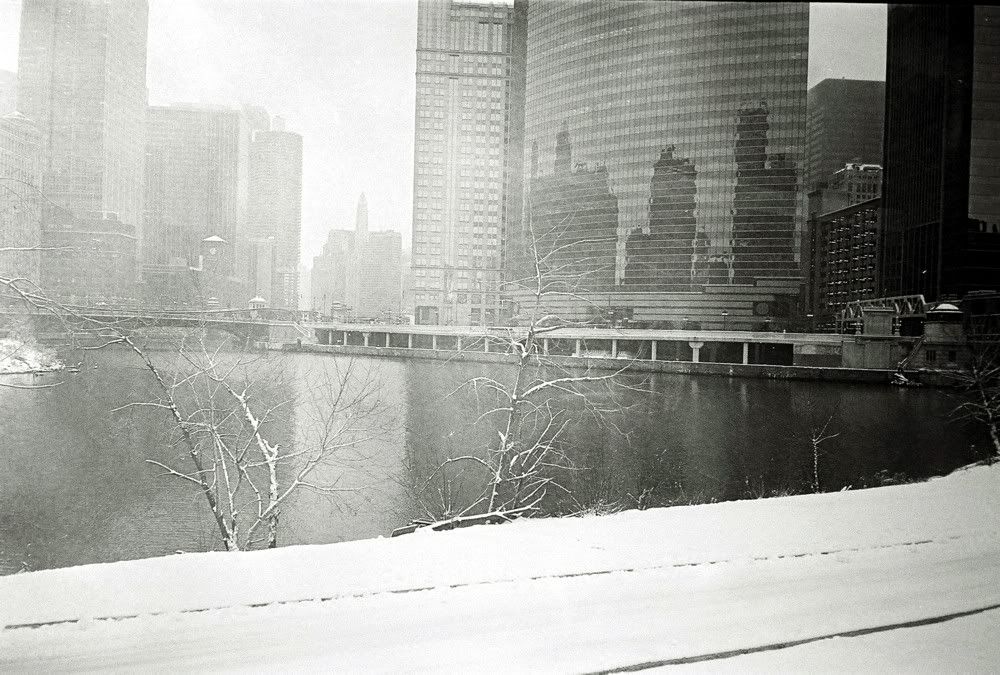
As The Chicago Blizzard Hits, I wonder: Why is there so much attention on Weather, and not so much on Rape-as-Terrorism, Planned Poverty, Genocide, and U.S. corporate flagrant maintenance of Ecocide?

image of Chicago in winter is from here
I live where it snows in the winter-time. It snows a lot. It snows regularly. Some of those are big storms. We have had a lot of storms in the U.S., and this is probably partly due to corporate pollution, which is also responsible for floods in many places, mud-slides (only possible in places where all the trees have been removed). The devastation of global earthquakes in the last 13 months has been devastating because of Western white greed, stealing the trees from Haiti, for example, to benefit Europe. This is the history and this is the present: white male-dominated and/or white-majority countries lay claim to the resources of other places, as if the rest of the world, and the Earth itself, exists to meet the needs of whites at the expense of everyone and everything else.

When will the early-day programs such as Good Morning White America (a title that comes from the late, great Flo Kennedy), Today in Whiteland, and The CBS White Morning Show, and the all-day networks like CNN (Corporate News Network), MSNBC (Male Supremacist New Broadcasting Company), and FOX (Fucking Outrageous Xenophobia), start reporting on things more dire than a winter weather snow system?

Things like rape-as-terrorism, which is part of men's war against women? Or things like poverty as a planned systematic assault against those who didn't have parents who left them lots of money? Or corporate destruction of the Earth, or U.S. cultural and military imperialism, named as such? Or the Prison Industrial Complex? I'm waiting, but I'm not holding my breath.


Monday, January 31, 2011

Questioning M2F Entitlements that Women Raised as Girls Don't Have: More on Trans Political Agendas, Practices, and the Challenges of Radical Feminism (or Radical Pro-Feminism)

image is from here
NOTE: on 9 Feb. 2011, I changed the title of this post to remove the term "cisgender women" and replace it with "women raised as girls". I did this in response to one of the comments posted below.

In the last few months, I have posted probably two dozen times about issues in trans and radical feminist politics. And, to date, almost no one has been willing to engage with these issues in responsible, respectful ways.

I understand why any of us who are queer/genderqueer/trans/intergender/GNC would want to lay claim to 'being one gender', if that gender is not the one someone was raised as but didn't experience oneself as being, when the defining feature of our outsiderhood is that we've had a mixed gender experience.

I don't understand the politics of fighting for trans-visibility while also demanding to be termed in ways that renounce or refuse to acknowledge being transgender or transsexual as anything other that conservatively assimilationist. I also want to point out that working to be termed "women" or "men", if M2F or F2M erases or invalidates the experiences of women who were girls as a distinct social-political experience, and, for that matter, the experience of men raised as boys. It also makes a very transphobic assumption that most trans people are living lives that are not what is termed "cisgender". Lest we forget, most trans people have bodies that are not surgically altered, that appear gender ambiguous; as the gender they are socially perceived to be; as the gender which has or doesn't have male privileges and entitlements embedded in it.

Someone whose name I don't have permission to use wrote to me recently pointing out a few other issues with the concept of "cisgender". I have slightly modified some of the points raised to me in that email and I thank them for writing.

"Cisgender privilege" is specifically defined in a way that excludes anyone who does not want to transition, or transition completely. If you do not hate the way your primary and secondary genitalia is formed or appears, or if you do not strongly dis-identify with your genitals--enough to get drugs or surgery to change them--then apparently you're cisgendered and carry all the privileges the term is designed to confer. (This is how the term has been described by some trans activists and trans spokespeople.)

So the idea that someone is "privileged" specifically for not wanting to get drugs or surgery on or to reshape their genitalia, when most people can't afford to do so, is oxymoronic.

If you are genderqueer but do not want to alter yourself surgically or with hormones, does that mean:

a. you're comfortable with the way you are perceived?
b. you are judgmental and dismissive of the people who are different than you?

Don't both "a" and "b" both have to be true for cisgender privilege to exist? In my experience, genderqueer people are unlikely to find those both to be true of them as individuals.

While I understand anyone not wanting to so consistently be living along the outer margins of status quo society (often in only some regards), to do so by denying one's acquired, practiced, and structurally well-protected privileges is, to my view, status quo political behaviour that reeks of white and male supremacy. When a few vocal white M2F pseudo-spokespeople for "trans experience" do it, I certainly experience it as male supremacist. As a person in trans/intergender community, does my subjectivity and perspective on this matter as much as the white class-privileged M2F person who claims to not be male supremacist? You'd think, because I am male, that it would.

"You call me what I demand to be called, or else you will be stigmatised and marked as a bigot and hater" is not a politic or a practice that is enforceable or practical for most oppressed people to employ. Why, then, do M2F transsexuals get to employ it as if it is an entitlement and a right? How many women of color, trans or not, get to be termed what they most wish to be called? How many men of color, trans or not, have that luxury?

A queer white, ethnicity-, class-, ability-, and profession-privileged person named Noah has showed up here accusing me--a gay, Jewish, disabled, non-profession-statused, transgender/intergender person, of being "transphobic", as if me advocating a responsible radically pro-feminist trans politic is anti-trans!

A very anti-radical, anti-feminist race-privileged, class-privileged transsexual person named Sara has come here and made individualistic arguments that show no regard or respect for the anti-patriarchal efforts of women to remove all man-infestations of anti-lesbian white male supremacy from the Earth. Sara basically denies there is such a thing as "patriarchy".

A non-transgender person, a Latina woman vlogger who calls herself Divinity, who works in close alliance with a well-known white misogynist/anti-feminist non-trans man/troll has expressed gross disregard and disrespect for the radical feminist of color politic and ethic of naming white male privilege where and when it rears its entitled head.

I have posted thoughtful responses to each of these people. Only Sara has been willing to engage respectfully, if not responsibly. Noah has presented gross condescension as "respectful engagement". Divinity has not engaged with me at all.

I have noted several instances where male supremacist and other oppressor privileges are present in some arguments put forth by a few trans people. What I see online, argued determinedly and systematically by a very few transsexual and transgender people, is not what I see or experience offline.

What trans people I know off-line request is to be respected as people, to be shown basic human regard, to be treated with consideration, to not be assumed to be anti-feminist, and to be termed "transgender", understanding gender to be socially constructed. Their stance with regard to radical feminism--white and of color; lesbian and not--does not resemble or support the views expressed by people like Divinity, Sara, and Noah.

For a few very privileged M2F transsexual people (claiming status as spokespeople for all trans people) to demand use of arguments or terms that obfuscate or evade responsibility and accountability for the political privileges one carries is just plain ol' status quo oppressor behavior. (Including statements like this one: "Any critique of trans experience is regarded as transphobic." This would mean that trans people questioning our own experiences, and interrogating the meanings of our emotions and feelings, is "transphobic", which of course is horseshit. It would also mean that lesbian feminists with totally legitimate political critiques, such as Carolyn Gage's analysis of the life of Tenna Brandon, is transphobic and not useful to our experience and political agendas. I think work such as that must be engaged with. Pun intended.)

I will expect those few transsexual cyber-"activists" who pose as pseudo-spokespeople and non-trans Internet trolls who claim to speak for all trans people, or who claim to "represent", legally and otherwise, ALL trans people, to do one of two things:

1. To disrespectfully and/or unintelligently and/or anti-radically and/or anti-feministly respond to what is in this post because they have the privilege and entitlement to be disrespectful without being accountable.

2. To ignore and disregard anyone with whom they disagree because they have the status and power to not need to engage with people with fewer privileges who are charging the male-privileged pseudo-spokespeople with defending and upholding male supremacy.

For me, queer politicals as it manifests interpersonally and socially fails to even achieve being "progressive" in the ways it supports lack of insight and analysis into what "gender" means and is, politically, in Western or Western-colonised societies. Traversing a hierarchy by changing external gender cues (and I'm understanding this is done for some people to feel less internal disonnance), is to privilege the capacity to do so (a privilege not available to most people) while also acting on the entitlement to deny privileges one either believes they never had (M2F), or to deny the threat to women and girls of privileges and entitlements one moves into (F2M).

Poor people who become rich acquire privileges while also carrying a legacy of having been poor. Rich people who become poor, if raised rich, do not lose their class privileges in so many regards.

Many class-privileged people I know, when in college, claim to be "poor". This term is used so often as to de-politicise the social meaning and global experience of poverty. I've always called out people who do this: not having money readily available isn't "poverty" if one is raised with class-privilege. It is a temporary loss of some of the abilities one has with money in the bank.

While gender privilege acquisition, or loss, is not the same as wealth acquisition or loss, what remains constant-while-not static is the effect of one's upbringing on how one engages with the world.

There is a pretense and claim of "never having been a boy" that a few very vocal, very cyber-dominant F2M pseudo-spokespeople make. This must be called out in all cases: the issue is not whether one "was a boy"; the issue is whether one was raised with male privileges, whether they were consciously and willfully acquired and acted out, or not. As a child who never felt like a boy, who didn't identify with boys, who didn't like or gravitate towards "boy-behavior", and who was bullied and ostracised throughout my social childhood for playing with and befriending girls-as-political peers, for doing "girly" things, for "throwing like a girl", for refusing to play boy team sports, I nonetheless acquired plenty of male privileges and entitlements--far more than any F2M across a similar period of one's life.

The proof (for me) of the unacknowledged male privileges, entitlements, dominance, supremacy, and power is that when this charge is made by a few M2F transsexual people--of never having or not having male privileges and entitlements--it can be dismissed by those few M2F pseudo-spokespeople by consistently calling the exposer of this political truth "grossly insensitive" or "being a bigot". Where else does this happen?

Anyone hear of these terms: "femi-nazi" and "misandrist"?


I personally-politically find the appropriation of the term "feminazi" to be anti-Semitic but it too, as I know you all too well know m Andrea, is another linguistic device loaded with political meaning, used against women who resist and challenge men's domination and rule. I ought not and will not tell you what terms to use to describe yourself online. I'm only noting that I find the term anti-Semitic, particularly when used by non-Jewish people. (And, m Andrea, I don't know whether or not you are Jewish.)

But what I'm addressing also applies to the terms: "femi-fascist", "misandrist", and "misandry". They are over-used enough, deliberately and systematically, in radio and other media, and often online, in certain very privileged circles, so that hopefully a few people who are men or who are defenders of men will also believe the terms refer to something that is socially and structurally existent (even though it isn't). Misogyny is structurally/socially existent. Male supremacy is also. White supremacy and dominance and rule of the wealthy is also.

In conclusion, for this post, I'll note that there are rather glaring political problems with the terminology constructed within some trans circles to marginalise and portray girls who grow up to be women as "oppressors" of trans people, or as having privileges trans people do not. Again, most trans people are not surgically or hormonally transitioning and are in the same perceived category as any woman or girl, or any female person who is genderqueer but not trans. There is also a glaring level of unacknowledged privilege among the few M2F and other transgender and transsexual people who are claiming that girls and women raised as girls have more privileges than they do. Among those privileges is the power to name reality and to socially name, with authority, "who one's oppressor is".

Our collective social justice and political liberation struggles are not served by refusing to own or discuss when and where white and male privileges are present but denied.

I welcome respectful discussion on these and related issues.

Saturday, January 29, 2011

Questioning Science at Questioning Transphobia: an engaging discussion

image is from here

[6 Feb. 2011 NOTE: I misunderstood who the author is of the post linked to below. Apologies both to Lisa and the actual author, Quinnae Moongazer. I've made the corrections in my response as it now appears below.]

At Questioning Transphobia, there is a very thoughtful post which I've responded to. My comment is so damned long, however, that I'm not sure it will even be accepted by the system that accepts comments for submission. (I know some commenters here are very frustrated with Blogger for not being able to easily submit comments, especially lengthy ones. As am I.)

Below is a link to that post. I recommend reading it and the twenty or so comments following it. You may get there by clicking on the title of the post just below. As I don't copy and paste it here, all that follows is the link to it and my response. I have typo corrected and otherwise revised my response since submitting it to the discussion at the Questioning Transphobia blog.

Raiders of the Lost Etiology


Hi Quinnae. Thanks for this post! I have responses to you and a few commenters above as well. This make be a multi-post comment.

I'll first out myself as white, class-privileged, gay, male, Western, Jewish, intergender, and disabled. I'll also state general agreement and support for your post, an the comment of GallingGalla.

Some of what I am reading above is deeply troubling to me, however. I find it problematic, racist, and overly steeped in unquestioned Western argumentation.

I'll begin with this passage from Em:
I do believe however that there is a blindingly obvious form of absolute biological proof of trans people though – and that is the existence of trans people, all over the world, and in all different cultures, with all different tones of skin colour, socioeconomic brackets, religions and speaking all sorts of different languages (these things have all been proposed by people opposed to biological proof of gay, ADHD, Dyslexia, trans, etc.)

As Quinnae notes above, there are plenty of scientists always at the ready to naturalise, biologise, or "evolutionise" things like global warming, white supremacy, male supremacy, and heterosexism, and the existence of "gender". Trans experience isn't global, Em. It doesn't show up in all societies. To say this is to be grossly racist, to me.

Male supremacy is global while not universal, as is white supremacist racism, as are the environmental and economic effects of corporate capitalism. This observation ought not be made into an argument that such phenomena are natural, biological, or inevitable, imo.

To make this claim--that being trans is biological-not-social--is to practice a kind of Anglo-English-Western imperialism of language overlaid onto other cultures--typical of Westerners and whites, in my experience. We view "gender"--our contemporary very historically, culturally, and regionally specific forms of it--as "universal" because we only see what we want to see.

Many cisgender people do this and now some transgender people do this, and in neither case is it unoppressive or respectful of the incredible diversity of Indigenous (and non-Indigenous) social experience, worldview, and values.

Two-Spirited being is not, as I understand it from Two-Spirit people, reducible or appropriately translated to being  "trans"; not is it ("it" being "not one thing") an expression of "genderedness" alone; nor is it a form of "bisexuality".

That Two-Spirited Being is considered by non-Indigenous peoples and specifically Western whites to be all of those, or some of those, only means white Westerners cannot conceive of gender and sex in ways that we don't regard as existent.

Being Two-Spirited and the ways that "Gender" and "Sexuality" express themselves--as whites define and defend those terms, as well as Two-Spirited reasons for being, are quite diverse, not universal, and don't break down into being "cis" and "trans", "het" and "not het", or "man" and "woman". The whole worldview into which Two-Spirited being exists is outside the dominant paradigms of white het male supremacist civilisation.

Some cultures and societies--and whole vast civilisations that still exist and have been around for tens of thousands of years--haven't had or don't have any understanding of "gender" the way English-speaking Westerners do. Even in Sweden, "Gender" is generally an academic concept more than a social reality. So being "transgender" as opposed to "transsexual"--a distinction made in our community, is not even possible in many parts of the world.

As many trans people have expressed to me and elsewhere: "I don't know what I would be or what I'd consider myself to be if I didn't grow up where and when I did. I don't know how I'd understand my feelings and experiences, or what conclusions I'd come to about their cause and remedy."

Being "trans" is a culturally relative experience, which in no way makes it illegitimate or deserving of hatred, discrimination, or violence. It is as legitimate as being Black. And being "Black" is not a biological condition. It is a cultural and political one.

Using "biology" as a means of achieving "realness" is, as Quinnae says, typically eugenic approach to solidifying identity and appeasing anxieties. As a Jew, who has noted our passing through another International [Nazi] Holocaust Remembrance Day, I strongly oppose all attempts to "legitimise" ourselves using the Western scientific method.

And as someone who is pro-Indigenist and anti-racist, I morally object to irresponsibly or sloppily applying our terms onto other people and societies we know little to nothing about.

Does this seem to be a reasonable objection and political position, Em?

Proving through science that ADHD and depression is "real"--as in measurable through blood tests and brain scans and treatable by psychopharmacology; or that autism is "diagnosable" early in life; or that "sexual orientation" can be detected in utero, fails (miserably and dangerously) to produce any explanations for the values embedded in the Western scientific project, which, from the start and through to this day are gynocidal and genocidal. Any "orientation" is, it seems to me, necessarily social, relative, and anti-biological, as that term "biological" is tossed about. This applies to sex, gender, ethnicity, culture, class, and race. Cardiovascular disease, many cancers, and diabetes are "real" and are medically diagnosable. They are also, very clearly, consequences and conditions of living in dominant Western civilisation or other societies profoundly effected by it. We can trace the emergence of these illnesses and diseases to the emergence of the influence of the dominant civilisation that produces them. So, in this sense: is diabetes *primarily* a biological condition, or a cultural and social one?

For much more on the unowned and hypocritical racist values in white Western science and philosophy, please read the relevant chapters of Yurugu by Dr. Marimba Ani. See also the collected work of Dr. Vandana Shiva for the dangers of not keeping in check one's own worldviews and assumptions about human and social nature.

Quinnae wrote:
Everyone’s gender is constructed, no one is born a man or a woman.

This statement, when made--word for word--by cisgender radical lesbian feminists, is called "grossly transphobic", "bigoted", and "oppressive". Does that mean it is, intrinsically? I'd say it is a well-reasoned/intuited/felt observation about ourselves in patriarchal society.

Meanwhile, ALL the trans people I know offline make no claims whatsoever about trans experience being asocial or ahistorical. We accept that it is what it is in the era and region it shows up in. Our understandings of it are shaped by our concepts--which are highly relative--by our worldviews, by our assumptions about what 'biology' is, by what 'nature' is, etc.

Keep in mind, Em, that to Western scientists, "chi" energy or life-force is non-existent. It is not scientifically measurable. So, then, does it exist? Even Western medicines like homeopathy have no explanation or "proven validity" in the U.S. medical world. Does that mean homeopathy is ineffective in ending ear infections in infants and young children?

Lisa wrote:
Where are the studies that inquire why cis people are cis?

There are many hundreds of years of very pro-patriarchal Western "scientific" studies and philosophical positions arguing everything from the fact that there is only one sex: male (and that females are 'inverted' males)--see "Making Sex" by Thomas Laqueur. There are thousands of studies demonstrating that there are only two sexes: male and female, with males being naturally dominant and superior and making an argument for surgical interventions against the bodies of intersex babies, children, and adolescents.

Those of us who are intersex question how even terming ourselves "intersex" reinforces the scientific argument for surgical interventions. I fully accept that some of us are intersex. But those of us who are intersex (and intergender, transsexual, and transgender) are named this within a context of a sex-gender hierarchy posing dangerously as an apolitical binary.

How dominant society understands, names, and "treats" intersex people's bodies is profoundly social and political. So it is with transsexual people. And everyone else too.

There are scientists who have been making the case, for a very long time, that men's rape of women is inevitable. Some allegedly moral religious "scholars" and leaders note that manhood and maleness are more divine than womanhood and femaleness.

Most scientific studies try and make a case for white het male supremacy being existent naturally; such studies make claims of being entirely objective and without political bias.

Scientific arguments are put forth that heterosexuality is natural and biological, as well as G-d-approved. They have cropped up especially since various forms of Lesbian and Gay Liberation movements have come on the scene.

Why do we wish to grasp so tightly to The Master's Tools? This is answered, in part, by what aaskew is addressing above.

But clinging to science for personal self-validation, esteem, is accomplished--if in fact it is accomplished--undermines social justice movements for liberation from the tyranny of social hierarchies posing as biological binaries. It is a bit like believing in homo/hetero-sexuality being "natural": we utterly dismiss and invisibilise all of the women who have chosen to be lesbian when we try and make the case for a "gay gene". We do this generally in ways that deny and invisibilise patriarchy as a force constructing and policing our identities.

And, you have to dismiss a whole lot of social/cultural/historical experience to arrive at such a conclusion (that "sex" or "gender" is primarily or only natural).

We reinforce very dangerous premises to feel this temporary peace-of-mind that would best be arrived at on a collective level through other, more political and communal means.

Those tools are harming whole groups of people, even while they may serve the most privileged among the marginalised. Are we to be accountable to those of us who are harmed and destroyed by these "studies" and this "science", or aren't we?

Shall only the most privileged among those of us who are genderqueer get to decide to what extent appropriating the dominant discources and scientific studies is harmful and destructive? Ought not those Two-Spirit and other Indigenous People worldwide get to weigh in? How about poor queer people of color in the Global East and South?

I am concerned that the lens is narrowed down, above, to assume that whites and Westerners know much about anything at all. I think we know very little that is of value, actually. Ours is an anti-sustainable, death-worshipping, rape-glorifying, genocide-celebrating civilisation, after all.

Are our dominant society's tools to be accepted to allow a few of us feel better, when it means the political philosophies and arguments underlying gynocide, genocide, and ecocide must be bolstered? What is the primary moral principle in that strategy for achieving "wholeness"? Whose "wholeness" gets privileged here? The Earth's? Indigenous People's? Cisgender women and girls? Or a few class-, education-, region-, and race-privileged trans people?

I am calling out to the commenters, here and elsewhere across the blogosphere, for a more responsible trans-affirming ethic and political practice.

LBTQI Palestinian Women and Gay Orthodox Jewish Men Speak Out

photo of Palestinian human rights activists is from here

I found this at the website linked to by clicking on the title.

New Book on LBTQI Palestine Women Released

Palestinian Gay Women publishes Waqfet Banat, a collection of personal stories shared by Palestinian Lesbian, Bisexual, Transgender, Queer and Intersex (LBTQI).

WaqfetBanat-2010-09-20-13-58.jpg
Waqfet Banat is a sincere narration of personal stories shared by Palestinian Lesbian, Bisexual, Transgender, Queer and Intersex (LBTQI)women; stories we were often unable to share with those closest to us.  

With this edition, we tell our stories, portraying our struggles; many of which we fought alone, defying all odds, in search of our identity, questioning our sexual orientation, and finally realizing that this is who we are?this is who we really are.

Waqfet Banat is now available for sale in English, in order to purchase a copy please send a $ 25 or 20EUR check (including shipment) to:  Aswat- Palestinian Gay Women. P.O Box 44628, Haifa 31445

What follows is from YouTube:

Friday, January 28, 2011

Celebrating the Career and Mourning the Loss of the Marvelous Gladys Horton (1945 - 2011), age 65, not 66

Photograph of Gladys Horton (1945-2011) is from here

I loved Motown music when growing up. All of the sounds emanating nationally and internationally from Detroit through the 1960s and 1970s found their way into my ears and through my body. Motown, for a time, was the music I most loved to dance to. For this reason and others, I mourn the loss of one of the most distinctive, upbeat-while-plaintive female lead singers of that era and genre, Gladys Horton. At fifteen (!!), she brought Berry Gordy his first #1 smash hit: "Please Mr. Postman" which would later be picked up and whitened by the Beatles.

What is strange to me is that Ms. Horton's passing has been noted (briefly) in some media, including in print media, but they can't agree on what day she passed, nor how old she was at the time of her passing. I know there was controversy about when George Harrison was born: February 24th or 25th? This confusion can happen whenever anyone is born or passes close to midnight. Medical reports may written up recording a time that may differ from eye-witness accounts of such indelible moments into and out of live. But this level of erroneous reporting seems totally messed up to me (and when I say "messed up" what I mean is racist and sexist). Will the age and date-of-death of any of the white British male band-mates who comprised members of The British Invasion, to name but one music genre contemporaneous with a portion of the U.S.'s Motown success, be misrepresented in the mass media, and in Billboard, specifically? Will media really get wrong the day and age of any living member of The Dave Clark Five, or Herman's Hermits, for example, when such time comes when one of them passes on?

Can no one at the Associated Press do the math? She was born on May 30, 1945, which would mean she lived only until the terribly young age of 65. She would have turned 66 later this year.

The cause and specifics of her health struggles also remind me of the very lethal scourge that is cardiovascular disease among all U.S. women, but particularly African American women, what with it being a stress-related condition, with Black women having to endure and resist the systematic assaults and everyday aggravations both of racism and sexism from birth on to what is far too often an early death.

What follows was found by me at billboard.com and may be linked back to by clicking on the title. This material produced largely by the Associated Press, is edited by me and those edits appear in the form of strike-throughs, the adding of the correct age, and minor additions to the text which appear in bold and in brackets. The material is being reproduced here for the purposes of honoring an artist's life and passing, for political commentary and analysis, and not for material or personal gain.

Gladys Horton of the Marvelettes Dies at 66 65

by Associated Press  |   January 27, 2011 12:02 EST
Getty Images

The Marvelettes
Gladys Horton, who co-founded the 1960s Motown group The Marvelettes and sang on hits including "Please Mr. Postman," has died in Los Angeles at age 66 [65].

Her son, Vaughn Thornton, says Horton died Wednesday night [not on Thursday, as some media are reporting] in a Sherman Oaks nursing home where she had been recovering from a stroke.


Video: The Marvelettes sing "Please Mr. Postman"
Horton was a teenager in the Detroit suburb of Inkster when she and some friends formed a group they called "The Casinyets," which was short for "can't sing yet."

When Georgia Dobbins had to leave, Horton became lead singer. The group changed its name to The Marvelettes, and Horton was 15 when Motown released "Please Mr. Postman" in 1961. "Postman" reached No. 1 on the Billboard Hot 100 on Dec. 16, 1961 and was the first No. 1 for Berry Gordy's Motown Record Corporation.

The Marvelettes went on to chart a total of 23 Hot 100 hits, including "Postman," "Playboy" (No. 7), "Beechwood 4-5789" (No. 17) and "Don't Mess With Bill" (No. 7). Horton was replaced as lead singer in 1965 and left the group two years later.

(Additional reporting by Monica Herrera, Billboard.com)

On International Holocaust Remembrance Day: This Jew asks, "What other genocides and mass atrocities are remembered and acknowledged in this way?"

photograph displaying grotesque anti-Semitic atrocity in a Nazi Death Camp pit is from here.
The gruesome photograph is cropped. I'm using the cropped version only because it allows for a visual reminder of what mass-death looks like, without the ability to focus in on the expressions on the faces or personal details of the bodies of those who perished. Generally, I won't put images of deceased people on this blog. We must note from the start, here, that only some humans will ever be regarded as human enough to support an international mourning of their loss.

At one website where the uncropped image exists, *here*, a commenter makes the following statement, referring to the importance of not forgetting the Nazi Holocaust and specifically addressing the matter of not forgetting who Adolph Hitler was and what he accomplished as a cultural-political leader in Germany in the 1930s and across half of the 1940s:
The man was a monster, supported by other monsters, and worshipped by millions. Sad to think he only gets less than a page in the new history books. Once he is forgotten we are doomed to repeat the horrors again.
A monster with other monsters: no. Monstrosity: yes. On the matter of repeated horrors, see all that follows. At the bottom of this post is copied text about "International Holocaust Remembrance Day", which occurred just yesterday. At the bottom of that piece, are links to related materials. It is the article to which the last link leads that I'll be addressing here, in an open letter to its authors.

I'm never sure what the function of such remembrance days is, other than to acknowledge those killed by and who survive genocidal atrocity with some level of collective respect and reverence. The perishing of approximately a dozen million people (some estimate the number of millions to be higher) across the span of five or so years, accomplished not by disease or famine (neither of which is apolitical), is something that ought not be forgotten and any and all social forces and dynamics that made such a heinous event happen ought be studied and not forgotten, in the service of preventing other similar atrocities. I am fully supportive of making time to remember those lost to political atrocity. The question immediately rises, though: whose political atrocities count, both as politically motivated crimes against humanity, and as genocides? And, why only a day of remembrance? Why not, in addition to that, an every-day accounting of our on-going atrocities?

What follows next is an article from Politico.com, and you may link back to it by clicking on the title. My commentary to the authors is in brackets and in bold.

Marking liberation from Auschwitz

Supporters of longtime opposition leader Alassane Ouattara take to
 the streets in Abidjan, Ivory Coast. | AP Photo
A political march regarding the state television chief in Ivory Coast coast turned violent in 2010. | AP Photo Close

By MICHAEL ABRAMOWITZ & MARK HANIS | 1/27/11 3:57 AM EST

Today marks the anniversary of the liberation of Auschwitz-Birkenau, the largest Nazi death camp. The United Nations designated this date International Holocaust Remembrance Day to honor the memory of those killed during the [Nazi] Holocaust and to rededicate ourselves to doing all we can to prevent such horrible crimes from happening again.  

[Michael and Mark, I hope you are aware of the horrible crimes that have happened in North America in the period of time inclusive of and since the anti-Semitic and otherwise anti-human Nazi atrocities during WWII occurred. 

I hope you know, for example, that forced sterilisation of many ethnic groups of women, and the boarding and brutalising, including sexually, of First Nations and American Indian children was common practice through the 1960s. Human rights has yet to be realised in the Great Nation of the United States, which is responsible for millions of deaths globally, since the 1960s. Genocide against Indigenous Peoples cross-continentally, and in North America specifically, is on-going, is never-ending, and isn't so much a matter of what those of us who are white and Jewish ought "never forget" as it is a matter we ought to finally recognise as happening. In order to never forget something it must first be acknowledged, and not denied even as it occurs. This is, most certainly, the case with genocide of Indigenous people on this continent, and to Indigenous people globally perpetrated by our government policies and corporate heads wreaking havoc on the Earth which includes the sacred ground and homelands of so many nations of Native people. 

We still have an annual holiday, a whole day set aside for remembrance, during which we are encouraged to celebrate and honor a man who was a European invader, a serial rapist, a trafficker of girls, and a racist mass murderer. I'm sure you know his name: Christopher Columbus. I have written about this rapist savage, *here*. The piece was originally titled "A broch tzu Columbus: a curse on Columbus." 

As a Jew, I find it beyond comprehension and any claim to national morality that the U.S. has been celebrating this monstrous terrorist's life and horrific "accomplishments" for over one hundred years. We also take four days per year towards the end of November to celebrate the beginning of what remains the feast which symbolises the start of the largest genocide, in terms of gross numbers of those barbarically massacred, that the world has ever known. (Estimates range from 70 to 90 million people destroyed, which includes scores of nations and hundreds of cultures and ethnic groups. Here. Not over there.

What do you make of a popular information website promoting an idea that As many or more Europeans were killed by American Indians were American Indians killed by European men? See *here* for more. What would your own response be to an established Wikipedia page promoting the idea that as many Nazis were killed by Jews as Jews killed by Nazis, across the 1930s and through the mid-1940s? In what sense is such a webpage not outrageously propagandistic and horrendously racist? Where is our outrage?)

What do you feel about the fact that there are, presently, race-specific atrocities completely denied by white people who benefit from it in the U.S.: against the Indigenous Peoples of the Americas, and also against Black and Brown people. What do you make of this act of omission by whites who control or have the most access to our media?]

Given the bloody history of the past five decades — in Cambodia, Rwanda, the Balkans, Darfur and other places [I'm wondering why you limit the global scope to part of Southeast Asia, two regions of sub-Saharan Africa, and part of Europe: what is the function of ignoring the genocide happening in North America? I'd argue it is ignored because white men and their media in the U.S. do not believe they are in any way responsible the genocides you do list; this assumption is terribly, horribly false: U.S. and European white men are implicated quite directly in each and every one of them]— a healthy degree of skepticism is warranted about politicians’ commitment to the lofty goal of “never again.” [Especially when current genocides against many Indigenous Nations, against many ethnic groups--each happening in the U.S.--will not even be referenced, discussed, footnoted, or alluded to in a piece like yours. Nor will such atrocities be given a day during which we pledge to remember to stop committing them.] However, we believe that progress is discernible. Efforts by the United Nations and among member states to make genocide prevention a priority, coupled with a new focus by government officials and civil society [Given that the majority of those states are responsible for perpetrating genocide presently, committing other racist atrocity, and maintaining massive systematic crimes against women and girls to this day and well into tomorrow, what is your definition of "civil"?] on keeping political crises from metastasizing into massive violence against civilians, offer hope that a world without genocide is attainable. [Who are "civilians"? Are African Americans "civilians"? Are Mexicans and Mexican-Amricans? Are American Indians? Are women and girls across ethnicity and race? What are "political crises" and what constitutes "massive violence"? Men's rape of women and girls? Men's battery and sexual assault of women and children? Men's trafficking and sexual slavery of women and girls? I would appreciate an answer to this and any other questions posed to you here.]

Nearly 17 years ago, the United Nations looked the other way as genocide unfolded in Rwanda. So it was more than a little noteworthy last week when two senior U.N. officials, charged with monitoring for the threat of such grave crimes, bluntly warned about “the possibility of genocide, crimes against humanity, war crimes and ethnic cleansing” in the Ivory Coast. [And also between the Atlantic Coast and the Pacific Coast of the United States, no? Again, my charge is that you are focusing on the possibility of genocide, crimes against humanity, war crimes, ethnic cleansing programs, and other mass atrocities over there so as to avoid discussing those happening right here. What is the social function of rendering completely invisible the numerous and horrifying mass atrocities against women--white and of color? And against Black and Brown men and women living in the U.S.? Is the maintenance of a system of poverty inside and outside the U.S. a crime against humanity and form of ethnic cleansing, as far as you are concerned? Is what is happening to American Indians now cultural, spiritual, and physical genocide or isn't it?]

The Security Council has reinforced the U.N. peacekeeping force in the country, and numerous governments in Africa and elsewhere [in the U.S.?] are pressing Laurent Gbagbo to step down after the internationally recognized victory of opposition leader Alassane Ouattara in November’s election.

In Sudan, a referendum likely to result in partition of the country later this year proceeded relatively peacefully, following an intense diplomatic push by the United States and other countries. [This is the first time in this article you mention the actions of the United States. It is when the U.S. promotes ending atrocity, not when the U.S. government and its military and adult white male citizenry perpetrate it. Do you get the political function of these selective offerings of what the U.S. does?] Only six months ago, there were serious questions about whether the referendum would occur on time, and many feared a return to the sweeping violence, even genocide, that has plagued Africa’s largest country since its independence in 1956. [1956. That would be the year the following occurred in the U.S. Civil Rights struggle (source: *here*):
University of Alabama admits Autherine Lucy as its first African-American student, February 3, after prolonged litigation in federal court. White students and Tuscaloosa residents riot on February 6, and Lucy is suspended, allegedly for her own safety; she is later expelled for criticizing the university.

Special session of the Virginia legislature in August adopts program of "massive resistance" to school desegregation that calls for the closing of schools under desegregation orders.

Governor Frank Clement orders the National Guard to restore order in Clinton, Tennessee, on September 2 after white mobs attempt to block the desegregation of the high school.

Eisenhower is reelected on November 6.

Supreme Court affirms ruling of lower federal court in Browder v. Gayle declaring segregation on Alabama intrastate buses to be unconstitutional, November 13.

Montgomery boycott ends on December 21 as municipal buses begin operating on a desegregated basis. (Read Ted Poston in The New York Post, June 19, 1956 reporting on the boycott.)
1956 would also be the year in the U.S. marking state recognition (by North Carolina) of an Indigenous Nation, the Lumbee. Federal recognition has yet to occur. From *here*:
The Lumbee are the present-day descendants of the Cheraw Tribe and have continuously existed in and around Robeson County since the early part of the eighteenth century. (Note: A brief timeline of Lumbee history can be found by clicking here.) In 1885, the tribe was recognized as Indian by the State of North Carolina. The tribe has sought full federal recognition from the United States Government since 1888. In 1956, Congress passed the Lumbee Act, which recognized the tribe as Indian. However, the Act withheld the full benefits of federal recognition from the tribe. Efforts are currently underway to pass federal legislation that grants full recognition to the Lumbee Tribe of North Carolina.
It was also a year of U.S. atrocity against Vietnamese people in the "United States War", called "The Vietnam War" by U.S.ers, so as not to so directly implicate and name U.S. Americans as the genocidal mass murders, based on their national/ethnic identity.

It was also a year in which there was a massive campaign to domesticate women in middle class and suburban homes. Poorer women, usually Black, were already being exploited for labor in other ways, including by being economically forced to clean whites' homes and care for whites' children, leaving their own children at home.]

Severe dangers remain in both the Ivory Coast and Sudan [and in the U.S.?]— particularly in the long-troubled Darfur region, [what about the long-troubled regions where the Navajo and Dakota live?] where violence has surged in recent months. However, there is reason to hope that governments around the world are finally getting the message that investing to prevent mass atrocities is not only sound humanitarian policy but also far more cost effective — avoiding huge costs of handling refugees, reconstruction and other requirements that inevitably follow genocide. Genocidal states also are invariably failed states, which incubate terrorism, pandemic diseases and other scourges. [This appears to me to be about as morally bankrupt an argument for stopping genocide as I can imagine: because of what it might cost the perpetrators? Because it might incite violence or spread disease which will impact and infect the killers and their accomplices? Is that the moral/ethical point you are wanting to promote?]

Just last year, the United Nations reaffirmed its commitment to a “Responsibility to Protect,” making clear that its members are willing to step in to protect civilians from genocide, ethnic cleansing and other atrocities [such as trafficking and rape?] when countries are unwilling or unable to do so. New U.N. offices on RtoP and Genocide Prevention are working to shine a light on situations where these crimes are occurring or likely to occur. [Will any light be shone on the genocide in the U.S.? Will any ray reach the plight of women and girls surviving--or not--men's abuses them as women and as girls? Are female people across age capable of being recognized as a politically harmed group of citizens, in your opinion?]

The Obama administration has appointed, for the first time, a White House director of war crimes and atrocities at the National Security Council and established an interagency prevention committee to address potential threats of genocide and mass atrocities. [What does it mean, to you, that this is occurring "for the first time"? Is it because the U.S. has not understood the Maafa and slavery and segregation of African and African-descended people as a crime and atrocity--specifically: a genocidal one? Were not the lives of millions of West Africans lost in the trans-Atlantic journey into hell-on-Earth, and on sea? Were human beings not laid down in shackles due to their race? What definitional dimension of "genocide" is missing? 

Do we not mention what happened and continues to happen to Black people in the U.S. "genocide" because the U.S. government and the military and police forces collectively imprison Black and Brown people as a means of ethnic cleansing? Do we avoid discussing anything we do as "terrorism" and "an atrocity" because the U.S. not-so-covertly requires and presently maintains mass atrocities including terroristic assaults against women and girls, nationally and internationally; mass atrocities and terroristic assaults against poor people and people of color, regionally and globally? Do we avoid "the g word" for what the U.S. has always done because the actual, current crimes against American Indians and other Indigenous people are not at all a "potential threat" but are, rather, a present and very active form of genocide? Is it because we don't do "reparations" for people we are still genocidally killing? Do we wait to see whose left, hoping there will be few to no people to pay? How do you compare the stunning silence by white U.S. citizens, civil people, who rather defiantly refuse to acknowledge or regard an on-going genocide, as compared to the silence and inaction of "the good Germans"? Are all of these reasons why we cannot categorise over 500 years of white men's brutality against Black people as genocidal, if for 200 to 300 of those years white men who settled in what became the U.S. were among the slavers?]

Congress also has taken some tentative steps toward endorsing genocide prevention as a matter of policy. [What is your opinion on why these steps are tentative? And isn't it shameful that the U.S. is only considering doing any of this now (tentatively)?] On the last day of its recent session, the Senate passed a resolution that recognizes the U.S. national interest in “helping to prevent and mitigate acts of genocide and other mass atrocities against civilians and supporting and encouraging efforts to develop a whole government approach to prevent and mitigate such acts.” [Can you link me to the U.S. government's plans to prevent and mitigate rape, battery, pimping, trafficking, racist abuses by police forces, the blatantly illegal and forced imprisonment of Black, Brown, and Muslim people of any ethnicity, genocidal activities maintained by the U.S. government and U.S.-based corporations corruptly feigning residency abroad?]

As important as these steps taken by Washington is the continued growth of a vibrant and vocal constituency of citizens and nongovernmental organizations committed to the abolition of genocide and other mass atrocities. Governments everywhere are on notice that they risk public opprobrium and embarrassment if they fail to respond effectively to the kind of killing that took place in Rwanda or Darfur. [This capacity to feel such embarrassment--or regret, remorse, or shame, to move out of denial, to release this country's citizens from governmental and media-imposed delusions of grandeur--appears to me to exist beyond or outside the clinically sociopathic consciousness of those who rule in the U.S. Do you agree?]

Despite these gains, considerable work remains. [Let's start by recognising the genocide against Indigenous North Americans and against all women and girls. And by removing from our national calendar the shameful, disgraceful holidays of Columbus Day and Thanksgiving.] Much of this agenda was laid out in the December 2008 report by the Genocide Prevention Task Force, co-chaired by Madeleine Albright and William Cohen. The report recommends an array of measures aimed at strengthening government capacity to prevent mass atrocities. [Might it be prudent to start with a "Genocide Acknowledgment and Recognition Task Force"?]

Some of the recommendations have been adopted, but many have not — including a strong presidential statement of policy on preventing genocide, the creation of an international atrocities prevention network and greater funding for crisis prevention in countries at risk. [Such as for white men's terrorist activities uniquely targeting women and girls across ethnicity, and for terrorist activities against Black, Brown, Muslim, and Indigenous people across the U.S., and across the rest of the Americas? If what the U.S. military is doing in Afghanistan and Iraq and in other parts of Asia isn't terrorism, pray tell, what is it? Shall we consider our support of a white supremacist Israeli Apartheid state, displacing, relocating, policing, militarily brutalising, and mass murdering Palestinians, while also discriminating against people of color within Israel--Jews and non-Jews--to be "civil" and humane?]

This must be accompanied by continued efforts to build a permanent anti-genocide constituency around the world that will hold all governments [including the U.S.'s? Are human rights activists, including feminists, right to assume that "all" would include the U.S. government?] accountable for turning “never again” into a reality. This task requires organization and massive public education about the moral, financial and national security costs of genocide. [How about the cost in human life, in grief, in suffering, in will to resist, to those groups the U.S. government, its corporations, and militarily protected institutions systematically violate, exploit, dominate, and destroy? Would you agree that considering them in any assessment of cost would be moral, appropriate, and responsible?]

Achieving this goal would be a worthy accomplishment to celebrate on another International Holocaust Remembrance Day. [When kosher pigs fly.]

Michael Abramowitz is director of the Committee on Conscience, the genocide prevention initiative of the U.S. Holocaust Memorial Museum. Mark Hanis is co-founder and president of the newly merged Genocide Intervention Network / Save Darfur Coalition. 

And finally, this. Please click on the title to link back.

International Holocaust Remembrance Day

January 27 marks the anniversary of the liberation of Auschwitz-Birkenau, the largest Nazi death camp. In 2005, the United Nations General Assembly designated this day as International Holocaust Remembrance Day (IHRD), an annual day of commemoration to honor the victims of the Nazi era. Every member nation of the U.N. has an obligation to honor the memory of Holocaust victims and develop educational programs as part of an international resolve to help prevent future acts of genocide. The U.N. resolution that created IHRD rejects denial of the Holocaust, and condemns discrimination and violence based on religion or ethnicity.

To commemorate International Holocaust Remembrance Day on January 27, 2011, the U.S. Holocaust Memorial Museum will host a candle-lighting ceremony attended by the Washington, D.C. diplomatic community, Holocaust survivors, and the general public. The ceremony will take place in the Museum's Hall of Remembrance.

Read or watch President Barack Obama’s remarks commemorating International Holocaust Remembrance Day in 2010, which acknowledges the work of Sara Bloomfield and the Museum in preserving the memory of the Holocaust.

In addition, each April or May the United States officially commemorates the Holocaust during the national Days of Remembrance. The Museum is mandated by the U.S. Congress to lead the nation in commemorating this day.

Visit http://www.ushmm.org/remembrance/dor/ for more information and resources.

Watch a CBS public service announcement about International Holocaust Remembrance Day, featuring Katie Couric and the Museum.

Read an International Holocaust Remembrance Day Op-ed on preventing genocide today.