Sunday, December 12, 2010

A Radical Profeminist Analysis of Cisgender Privileges (aka, "Cis", Non-Transgender, and Non-Transsexual Privileges)

image above is from here
NOTE: Some of this post was revised on 15 April 2013.

What is "privilege" and what different types of privilege are there, particularly in the U.S.? Here's a good resource to answer that question. Note that it is a PDF file and so needs to be downloaded or opened in something like Google Documents. It is concise and clearly presented. It does note that for privileges to be challenged, the social/structural systems of power that maintain them must be challenged.

tjlp.files.wordpress.com/2010/01/privilege101.pdf

Practically by definition, if one is socially marginalised from dominant cultures and groups, one will experience a loss of some privileges afforded to those who are viewed as normal, acceptable, respectable, "like us", "one of us", etc.

What follows later is one of the most prevalent lists of cisgender privileges, sometimes also termed "non-trans privilege" that I could find. There are others. *Here's one* that is far more extensive.

If you click on and read that list, ask yourself this question: who is the "I" that is the speaker? (It is written in first person, from the point of view of someone who is not transsexual or transgender?) As I read over the list, more and more people came to mind who do not have the privileges listed.

The list does not apply to most girls and women I know.
It does not apply to most people of color I know.
It doesn't apply to most poor people I know.
It doesn't apply to most queer and gender non-conforming people I know.

There's no way in hell, for example, that the "I" in the list linked to above, is an Indigenous North American woman who is not transsexual or transgender. There's no way the "I" is a fat woman. There's no way the "I" is anyone who doesn't have education privilege. Or who is poor. Or who doesn't speak English as a first language. This is to say, most people who are NOT transgender and transsexual also don't have most of those privileges, and the assumptions about what it means to be transgender or transsexual are tremendously bound up with having enormous privileges to begin with. I'll expand on that point throughout the rest of this post.

From the above list, the "I" appears to me to be only this narrow demographic of person; the "I" is almost no one else, beyond the narrow demographic. The "I" is someone who is a sexuality-privileged, class-privileged, size-privileged, gender-privileged, age-privileged, able-body-privileged, government status/immigration status-privileged, ethnicity-privileged, religion-privileged, education-privileged, person who is not an incest, rape, battery, pornography industry, prostitution, trafficking, or slavery survivor. Über alles (above all else), the "I" is someone who must possess and be structurally located to receive and benefit from white and male privilege.

The "I" who has most or all of those privileges is only a white het man with every other form of privilege imaginable. Put most simply, most of the privileges on that list are privileges that most non-trans women do not have

From that list, I'll note this last item:
My right to inhabit my currently chosen gender is universally considered valid, regardless of my gendered behavior as a child, or how I felt about being forced into the gender I inhabited then. If I require medical treatment to keep up an appearance that matches my gender, it will be granted immediately and without question.

There is a presumption there--quite a massively privileged one--that "gender" is chosen at all. This goes against what I know, see, hear, experience, and realise from almost everyone I know who is gendered, including transsexual, transgender, intergender, and what is termed 'cis' gender people. Gender is the following, for most human beings I am aware of in the West and many beyond the West: medically and governmentally mandated; culturally imposed and enforced from birth and at least until death--and usually after death; religiously and secularly bolstered; customarily assigned-at-birth; politically enforced; structured into interpersonal and institutional practices; enforced and regulated by CRAPs officials, including by the population "men" and also through these ideological and social forces: male supremacy, heterosexism, white supremacy, and capitalism.

What gender is not, usually and fundamentally in CRAP, is this: held primarily as a subjective experience. For most women I know, "gender" is a way of being treated, responded to, ignored, mistreated, abused. It is a way of being ostracised, degraded, humiliated, discriminated against, disenfranchised, marginalised, violated, subordinated, terrorised, and targeted for all manner of interpersonal and institutional violence and contempt. The way of understanding "gender" or "the gender I inhabit" (in italics above) is, to my way of thinking and in my experience, profoundly privileged. 

Building from this, and every other observation made thus far, it is appearing to me that the group which identifies itself as "transgender" or "transsexual" and who writes about their experiences, who claim to be the spokespeople for "the group", may well be a very, very privileged group of people: people with these privileges, at least: race, education, class, and gender. How can a group marginalised and misunderstood or utterly ignored by mass media and beyond also be privileged? I'd argue many groups with enormous power are not identified, described, or presented accurately or responsibly in the media and beyond. Among those groups are: the rich, the most privileged men, the most privileged whites, and the most activist among male supremacist and white supremacists. How often do such groups get identified as terrorists, genocidalists, rapists, and callous, inhumane criminals? How often do such groups get portrayed, because they are of that group, as dangerous, untrustworthy, threatening, tyrannically domineering, oppressively controlling, and largely responsible for the maintenance of enormous atrocity?

What follows next is the list I see most often online used to educate non-trans people about transgender experience, specifically by alerting the reader to non-trans privileges. It is from this URL, and others:

This is the contents of that posting. I will place in brackets, bold, and italics my own critiques of these passages.

Please read and re-post this list to make people aware of the hardships often faced by transgender individuals that cisgender people take for granted on a daily basis.
  1. Strangers don't assume they can ask me what my genitals look like and how I have sex. [I  am reminded of how many women are visually and physically accosted on the street, or street raped, or sexually harassed by people they don't know. This is a lack of privilege far beyond "being asked about what one's genitals look like." As for that, specifically, as a gay male, I can tell you that strangers, depending on situation, do feel entitled to ask me about the shape and size of my genitals and how I have sex. I've grown to avoid many places where strangers go, just to avoid having this experience. And this has nothing at all to do with me being intergender. Non-trans intersex people, if out as intersex, are vulnerable to being asked what their genitals look like and how they have sex. In my pornographised, phallocentric society, lesbian women are oppressively asked, "How DO you have sex?!" as if sex without a man-with-penis being present, or watching voyeuristically, isn't even "sex". To this day, it is still considered a heteropatriarchally valid if obnoxious question to ask a lesbian woman who has never had sexual intercourse with a non-trans man, "Are you still 'a virgin'?"
  2. My validity as a man/woman/human is not based upon how much surgery I've had or how well I "pass" as a non-Trans person. [In my experience of my working class and poor family members, who comprise "most people", economically, surgeries are not an option. No one in my family has had, for example, a face lift. One family member had the weight of her breasts lessened surgically, because she was experiencing back pain chronically. That was decades ago, when the relative cost of such procedures was less, and working and middle class people earned more, relative to the rich. This matter of "passing" as "non-trans" assumes a culture that is even cognizant of what being transgender is. And in my experience, the only cultures that are "studied" in such matters are education-privileged ones. Most of my family never went to college and would have no freakin' idea what "non-trans" or "cis gender" means. They've likely never utterly the terms and likely never will. This speaks to a thesis of this post: that the very phenomenon of "being transgender and transsexual" in the white West, in CRAP, is largely a product of being very, very privileged. That the identities and understandings and analysis depend on having those privileges. I am someone who is intergender-identified, and, I'd say, "who is intergendered". I'm a classic example of someone with the multiple privileges required to even make such a statement.]
  3. When initiating sex with someone, I do not have to worry that they won't be able to deal with my parts [I find this extremely disturbing, as the way it is phrased implies a profoundly disembodied, fetishised, or consumerist way of thinking about the human experience/body. "Won't be able to deal with 'my parts'?" That's such a male supremacist way to even identify oneself, imo.] or that having sex with me will cause my partner to question his or her own sexual orientation. [As a someone who has never been heterosexual, it is my experience that many of us who are not heterosexual have plenty of people question their sexual orientation when dealing with the prospect of being sexual with us. It's a commonplace occurrence. And the language "when initiating sex with someone" is also steeped in male supremacist experience, imo. The phrasing carries the entitlement to initiate and engage in sex with others.]
  4. I am not excluded from events which are either explicitly or de facto[2] men-born-men or women-born-women only. [In the U.S., which is not as much like many other places around the world, few places are organised to have places where women "meet" only with women, unless one is part of an orthodox religious community, or unless one is sex-segregated based on economic factors, such as working in textile sweat shops, or cleaning hotel rooms. Those are not places where women "meet" in the way that I hear the term being used. There's no willful, uncoerced, free experience of "being women together" in which women gather because it is what they prefer to do. The word "meet" here implies a kind of leisure activity, or non-work experience. In most cases, "women-only" spaces, if and where they exist, are a mandatory product of CRAP. Those spaces are, often, an enforced and reinforcing condition of heteropatriarchy. Such spaces aren't organised to provide participants with "gender privilege". They are, instead, the spaces in which one may be reminded one's gender is not privileged.]
  5. My politics are not questioned based on the choices I make with regard to my body. [This also falls into the category of having many privileges as a prerequisite for even approaching the topic. My family's "politics" are not questioned based on much having to do with anything other than "who did you vote for?" or statements like "I wish there could be peace and justice in the Middle East". The spaces where one's politics are understood to refer to daily interpersonal experience across many social hierarchies are limited to some academic and activist communities where my own family won't be likely to be found. Beyond that, most feminist women I know have their politics questioned depending on what they do with their bodies, in terms of attire, how they wear their hair, what size they are, what they eat, what they do sexually, what they do with regard to pregnancy or child-rearing, what they do that involves the medical establishment, and what they do professionally, as paid work, with their bodies. But the extent to which those actions are 'choices' or are, instead, following oppressive social directives, or are done under conditions of coercion, threat, and terrorism, is largely due to places of privilege. The choices my non-trans white female relatives make about their bodies are varied, but none violate the terms of white heteropatriarchy. If they did violate those terms, their 'political allegiances' to heteropatriarchy would be questioned, not necessarily in those terms. This would also be the case if boys in my family expressed an interest in doing anything with regard to their own bodies that is seen as girl-like.]
  6. I don't have to hear "so have you had THE surgery?" or "oh, so you're REALLY a [incorrect sex or gender]?" each time I come out to someone. [This is in the same category of requiring pre-existing privileges to even be an issue one is dealing with. With regard to surgery, most especially, class-privilege. With regard to obnoxious interrogation about what gender one really is, this might apply to anyone who is intersex, or to anyone who is not gender conforming. I'm thinking now of particular butch white women who have endured that level of interrogation and insult.]
  7. I am not expected to constantly defend my medical decisions. [Same critique as above: multiple positions of privilege are usually required to this to even become an issue. It also demonstrates a woeful ignorance or lack of sensitivity to the fact that many, many women have surgeries performed on them, as do many intersex people, against their will. Does the person who wrote that realise whole populations of women have had sterilisation forced on them? The fact that for so many women "surgery" is forced or socially coerced ought to sound alarms for anyone who speaks of "surgery" in such a way as to assume it is only ever elective and wanted. I am reminded of how rich white folks speak of contacting the police, as if doing so will generally be a good experience where you will be respected, regarded, and not grossly interrogated, seen and treated only as a criminal, or tossed into prison for no reason at all.]
  8. Strangers do not ask me what my "real name" [birth name] is and then assume that they have a right to call me by that name. [I wish the person who wrote this would speak with Indigenous people, with immigrant people, with elderly people, with anyone for whom English is not a first, preferred, or unenforced language, who do not have the privilege of being called what they would prefer to be called. I wish the person who wrote that would recognise that most women do not get called what they prefer to be called. Most non-trans women get called all kinds of things, including, especially, b*tch, because and only because they are women.]
  9. People do not disrespect me by using incorrect pronouns even after they've been corrected. [This is also in the "lots of privileges already required" category. My family of origin frequently has called me "she" and "aunt" because they know I am gay, for example. Lots of men routintely get called "ladies" in the military, or "girl", or derogatory terms used against women, in order to communicate a general disdain and contempt for women, and a threat of rape or other punishments if they don't "man up" appropriately, according to utterly grotesque and horrifying military standards of what it means to even be appropriately human.]
  10. I do not have to worry that someone wants to be my friend or have sex with me in order to prove his or her "hipness" or good politics. [Same "lots of privileges already required" category. In what communities does this happen, exactly? In rural U.S. communities? In communities where there are no academic institutions of "higher" learning? Where does this person live? What's "hip" in most places is being  classist, racist, misogynistic, and homophobic. That's what's perennially "in" in most places in the West, in CRAP. And any place where that's not the case is a very elite and privileged space, and not one I have had much experience finding--liberal protestations to the contrary notwithstanding.]
  11. I do not have to worry about whether I will be able to find a bathroom to use or whether I will be safe changing in a locker room. [This is the case for most many gender non-conforming folks, many butch women, many feminine men, many androgynous-looking people, many genderqueer people, and it is not the case for most transgender people, because most transgender people "pass". So this "privilege" isn't accurately located with the right population, imo. I'm intergender/transgender and possibly transsexual--depending on how we define these things--and I am only at risk in men's rooms because men are in men's rooms and any place where there are men is potentially dangerous, such as in one's home of origin, if one or more men lived there. We need to distinguish between "feeling safe" and "being safe". And only the most privileged people combine the two into only one experience where what they mean is "feeling safe". Most women are not safe, regardless of whether they feel safe or not. Most women are not safe in their homes, on the street, in the workplaces outside of homes, etc. Most visibly transsexual people, who are a minority of people in the "trans community", do not get beaten up, threatened, or otherwise assaulted in women's rest rooms. And if I'm wrong about that, I'll own it and stand corrected. But, from what I hear from women, many gender non-conforming women who are not transsexual do feel unsafe in many places, including any place where there is lesbophobia, misogyny, and heterosexism, and they feel that way because they are systematically and systemically unsafe.]
  12. When engaging in political action, I do not have to worry about the gendered repercussions of being arrested. (i.e. what will happen to me if the cops find out that my genitals do not match my gendered appearance? Will I end up in a cell with people of my own gender?) [The race and class privilege built into this statement ought to be fairly obvious, if not distractingly glaring. In what universe do poor women and women of color not have to worry about the "gendered" repercussions of being arrested? What part of being arrested, if you're a woman, is "ungendered" exactly? This statement shows a profound lack of awareness of what it means to be a woman.]
  13. I do not have to defend my right to be a part of "Queer" and gays and lesbians will not try to exclude me from OUR movement in order to gain political legitimacy for themselves. [In my current experience, this is far more the case for radical lesbian feminists, for radical activists, for radical gay males, for anti-CRAP queers, than it is for anyone who identifies only as trans within queer spaces. For the last many years--meaning ten, at least--there have been events and opportunities created to educate folks about what it means to be "trans" when there are no comparable events or opportunities to understand what being a lesbian is from any radical feminist point of view. There is little to no space made for intergender people, for bisexual people, and for asexual people in our movement. There is little space made for anyone at all who critiques liberal politics in our movement. And so, to summarise, all the radical lesbian feminists I know do not even feel like they have a seat at the table of our community. Speaking personally, I haven't felt welcomed in white queer spaces, in white queer movements, for at least twenty years, because I do not enjoy or welcome being in spaces that promote male and white supremacist practices and blatant misogyny. Radicals are purged from liberal movements in order to gain political legitimacy for themselves: that's a well-chronicled part of the history of the U.S. Civil Rights Movement and the Western Women's Movement.]
  14. My experience of gender (or gendered spaces) is not viewed as "baggage" by others of the gender in which I live. [Most women I know, who only exist in "gendered spaces", who never, ever exist outside of them, who systematically are made experience gender as something imposed and enforced, terroristically and tyrannically, and commonly and normally, are viewed as having gender-specific "baggage". That's partly why almost every woman I know is called "the b word" on a semi-regular basis. Isn't the definition of "being a woman" in CRAP, "someone who has waaaaay too much emotional baggage"?]
  15. I do not have to choose between either invisibility ("passing") or being consistently "othered" and/or tokenised based on my gender. [This applies to every woman of color I know who may be able to "pass" as white. This applies to every woman I know who may be able to pass as heterosexual, but who is not heterosexual.]
  16. I am not told that my sexual orientation and gender identity are mutually exclusive. [This is in the "you've already got to be very privileged" category. Who in society is told "the truth" about their sexuality and gender? Who in society is told that sexual orientation is what it is? That gender is what it is? Who in society is told the degrees to which both are constructed forcefully for us? The assumption here is that being told your sexual orientation and gender identity are not mutually exclusive is "a privilege". For whom is that a privilege? For girls and women who are raised to be het women who will likely experience rape and battery at some point in their lives from "the man or men who love them"? And in what sense are these things completely independent of one another, anyway? In what sense is being a heterosexual man independent from "being a real man", as CRAP-enforcers define such things? In what sense is being a heterosexual woman independent from "being a real woman", in CRAP? I've never, ever experienced "being told what it means to be a man" as something that is distinct or mutually exclusive from what it means to be gay.]
  17. When I go to the gym or a public pool, I can use the showers. [Again, this is true for most trans people. And the repeated assumption that "trans" means "visibly transsexual" is grossly stereotyping our community. Trans people are not gender non-conforming, necessarily. Trans people are not transsexual, necessarily. And trans people are not visibly transsexual even if they are transsexual, necessarily. A transsexual person who "passes" as the gender they identify as has far more public restroom and public shower and locker room privileges than women who are gender non-conforming by "virtue" of not looking the way "women are presumed to look in CRAP. This also shows a gross insensitivity to those of us who are child sexual abuse survivors, and those of us who are or were targeted as queer by hets. My experience of males who are survivors of child sexual assault or who are queer, or both, is that we do not use public rest rooms and showers and locker rooms with anything akin to "ease" or "with privilege". Can we? Yes, we can. So the fact that "we can" is a privilege, I suppose. But that's kind of like saying "Can a dark-skinned person walk through a predominantly white upper middle class neighborhood (including the one that person may live in) without ever facing discrimination and harassment from neighbors and police?" Yes, they can. Are they likely to be harassed by the police, or have white neighbors be alarmed if they do? Yup. Can women walk alone at night on city streets, or down country roads? Yes, they can, if physically able to. Can we assume women will be free from male supremacist threat and assault when doing so? No.]
  18. If I end up in the emergency room, I do not have to worry that my gender will keep me from receiving appropriate treatment nor will all of my medical issues be seen as a product of my gender. ("Your nose is running and your throat hurts? Must be due to the hormones!") [This applies to all women, as far as I can tell. If you're experiencing heart attack symptoms you won't be as readily identified as having that problem unless you're a man. If you're experiencing "mood" or mental health issues, you will not likely be diagnosed free of gross forms of sexism. And this is exponentially worse of you are a woman without class, education, language, size, age, ability, and race privileges. What I find racist and sexist in much of this list is an assumption about non-trans females of color. If one is Black, Brown, Asian, or Indigenous, the racial categorisation and stereotyping by social dominants impacts how one is treated as a woman in the medical world and beyond. This is also true for non-trans females who are white. How many non-trans women, with access to the medical world, are told their medical symptoms are "in their head" or that their complains are a product of their hormones?]
  19. My health insurance provider (or public health system) does not specifically exclude me from receiving benefits or treatments available to others because of my gender. [This is also privilege-dependent, as many women do not have access to health care, period. Many women don't  have health insurance (or are not part of a public health system that regards them as human).]
  20. When I express my internal identities in my daily life, I am not considered "mentally ill" by the medical establishment. [Mentally ill, mentally disabled, psychiatrically ill, and intellectually, cognitively, emotionally, mentally, and psychiatrically marginalised people cannot speak about our experiences with internal identities without being labeled as "mentally ill" either; so the statement is grossly able-ist to me, as someone who is disabled, in assuming that there are spaces in the psychiatric and mental health care worlds where people are judged in an unbiased, non-stereotypical, non-judgmental, non-oppressive way, if we speak about our inner lives and mental health struggles in any way (not just with regard to issues of gender dysphoria or transgender experience). For what women is it safe to speak about such things? For poor women? For women of color? For many white women? Who gets treated fairly and humanely by mental health systems? So, in conclusion, this is not "a privilege" that non-trans women have, in my view. Not most non-trans women, anyway.]
  21. I am not required to undergo extensive psychological evaluation in order to receive basic medical care. [This is also very problematic. Most people who are not class-privileged undergo lots of extensive self-critical scrutiny, and may allow medical conditions to get to very dangerous points in their progression, before even approaching "basic medical care". Most poor people don't even have adequate access to "basic medical care". And when they get "care" it isn't usually life-enhancing. When many women of many classes, ethnicities, races, and backgrounds, seek medical care, the experience can be triggering and trauamatic for all kinds of reasons. The writer of this list seems unaware of the realities of being poor in the U.S. And there is a particular vulnerability that comes with being a woman who have been female-bodied their whole lives, because of the risks--the lack of privileges--of living as a female-bodied person one's whole life. Trauma accrues and intensifies. Abuses collect and the impact multiples as one gets older. Living in what is termed "a female body" for one's whole life cannot reasonably be understood to be "a privilege" in CRAP. Not with any appreciation or regard for what women and girls experience and too often endure, anyway.]
  22. The medical establishment does not serve as a "gatekeeper" which disallows self-determination of what happens to my body. [Bullshit. The medical establishment has a gross and atrocious history of violating girls and women, of forcing some groups of girls and women--most notably Indigenous, Black, and Brown women, and mentally and physically disabled girls and women--to be sterilised, experimented on, and so forth. The medical establishment has a far more atrocious history of sexually abusing intersex children than non-intersex males. The medical establishment impacts the lives of poor girls and women in incalculable ways, in part by not providing health care, through medical neglect when seen by medical professionals, by doing procedures and assessments that are inhumane or otherwise oppressive, or by ignoring this population when it calculates risk and remedies for various conditions that never included poor women, but instead focused all of its research one middle class white folks, assuming that was a "universal" sample.]
  23. People do not use me as a scapegoat for their own unresolved gender issues. [This may be the most outrageously gender-ignorant statement of the bunch. In what social world do boys and men not use girls and women, individually or collectively, as "a scapegoat for their own unresolved gender issues." What do you call "rape" and "battery" and "sexual harassment"? If that's not evidence of men's perpetual state of needing to shore up their political/structural male supremacist/misogynist identities and "communise" male supremacist power through practice, practice, and more practice, pray tell, what it is it? This, along with many other statements, demonstrates gross ignorance and denial about what women experience in CRAP.]
My analysis brings me to conclude that the many, but not all, of the political origins and effects of the term "cis gender privilege" function to reinforce male supremacy, misogyny, and CRAP in ways its most privileged proponents won't or don't yet own. My conclusions thus far are that the social construction in language of a way of "being privileged" or "not being privileged" is mostly being used against non-trans women, and is strategically designed--consciously or not, to further oppress non-trans women as a class of human beings, and to subordinate that class to people who have had or currently have male privileges, among others.

I welcome readers to draw their own conclusions about this list of "cis gender privileges" as it applies to most non-trans women on Earth.

    Thursday, December 9, 2010

    The Trans/Gender Politics of Shaming Women-as-Women, Around and Beyond the Queer, Antifeminist Blogosphere

    image of painting, "Women of Amphissa", by Lawrence and Laura Alma-Tadena (1887) is from here
    [Note: this post was slightly revised by its author, on 11 Dec. 2010. And again revised on 1 April 2013.]

    When I speak here in this post of women, the Anglo-English term (also sometimes spelled wimmin), usually what I am referring to is people who exist in a system where gender is a binaried and hierarchical system of oppressive and brutal power. In such a system, the population of "women", typically and normally--not anecdotally, are defined and depicted this way: 
    • Human beings stereotypically and systematically presented in "great Western art" such as the painting above, as all being all five of these things: heterosexual objects, white, weak, thin, and costumed in flimsy, see-through clothes.When this population is not white, they are presented in additionally stereotypical ways in art and advertising.
    • Human beings born with what is termed by medical professionals to be a vagina and vulva, and not a penis and scrotum, regardless of their hormone or chromosome pattern, and regardless of whether or not the person has a vagina and vulva.
    • Human beings who, when born, may hear declarations of a life sentence of politically subordinate sexual status fused to the phrase, "It's a girl!!"
    • Human beings who are raised to be girls-not-boys, whatever that means across era, region, and culture.
    • Human beings who are seen as the group in the West who "can't throw well" and who are often seen to be not "behaving in an appropriately gendered way" if they are very active in or excel at team sports such as football/soccer, baseball, cricket, and basketball.
    • Human beings who are told to beware of boys.
    • Human beings who are assumed to be doing something negative if, when teenagers, they have lots of sex with other people, or, even, with themselves.
    • Human beings who, it is assumed, if they are "normal", will willingly accept a penis or phallic object somewhere into their body, and that this will occur many times over the course of their lifetime. They will not be termed "perverted" or "queer" for doing this, although they might be termed "loose" and "easy" for doing this with more than one person.
    • Human beings who, from day one through one's last day, are socially-politically targeted as THE MOST APPROPRIATE population to incest and rape when there are multiple (at least two) genders to choose among. When any other gendered person is incested or raped, they are not only seen by the dominant gender as becoming more like "girls and women", but are often targeted for such violation and terrorism because they are too much like girls or women. (As is the case with some gay males, and some genderqueer and transgender people.)
    • Human beings who are molested, incested, and raped twice as much by the time they are 21 as "the other gender".
    • Human beings who, from an early age, are socialised to want to be good mothers or mommies (US) or mummies (UK), primary parents, care-givers to people young and old, attentive and respectful of the needs of others.
    • Human beings who are assumed to exist for "the other gender", "men", or any people who are not women.
    • Human beings who are coerced or forced to be accommodating, accepting, appeasing, attention-giving, submissive, subservient, and subordinated to "the other gender" (in Anglo-English, called "men") in almost all ways, according to "great" religious texts and social custom.
    • Human beings who, during adolescence and through portions of adulthood, bleed out of their genitals, with such bleeding being assumed to be "natural" yet, according to "the other gender" also dirty; these are humans who have products sold to them to absorb the blood and make their genitals smell "fresh" and unnaturally perfumed, like a spring meadow or a floral bouquet, but not at all like human genitals.
    • Human beings who are assumed to exist to get pregnant, whether or not they do and whether or not they can biologically or for other reasons, like, say: the choice not to.
    • Human beings who, when the say they never want children, are not told they are selfish, heartless, and soulless for feeling that way.
    • Human beings who, when they wish to have children, are not violently prevented from doing so by being systematically and forcibly sterilised by allegedly professional medical personnel of "the other gender".
    • Human beings who are assumed to be "bad parents" if they aren't perfect or aren't fully present, as opposed to the members of another gender who are assumed to be bad parents only if they are overtly abusive or never present.
    • Human beings who are ostracised and put down for being selfish, self-absorbed, self-centered, arrogant, egotistical, self-aggrandising, aggressive, and ambitious. (If if goes unnoticed when someone is any of those things regularly, it is usually because the person isn't a "woman".)
    • Human beings who are, on average, paid less for doing comparable work than work done by "the other gender". Or who are not paid at all for doing "women's work".
    • Human beings who do most of the world's work, including hard labor, but are not usually recognised, appreciated, praised, or given million-dollar annual bonuses for doing so. 
    • Human beings who are enslaved, trafficked, and procured for sex-and-violence from "the other gender" because--and only because--the other gender demands it, requires it, and is willing to pay slavers, traffickers, and pimps, to make sure this practice is always available.
    • Human beings who are called the following names routinely, because they act in ways the other gender deems "negative" (meaning, they behave in ways that humans behave irrespective of gender or sexuality): b*tch, c*nt, nag, h*, wh*re, and sl*t.
    • Human beings who aren't hardly ever called "p*ssy-whipped" because they are already assumed to be sufficiently subordinated and degraded, by culture, nature, or G-d, in ways that term blatantly implies.
    • Human beings who, when they witness members of "the other gender" in a gender binary system telling one another "don't be such a girl" or "what are you, a woman?" are reminded of a socially inferior status, a negative stigma, because "the other gender" often feels as if they are being intentionally humiliated, degraded, and insulted.
    • Human beings who, when visibly afraid, are not seen to be acting in ways that shame their whole gender.
    • Human beings who, when socially shamed, are expected, interpersonally and socially, to bend to the will of the shamer, regardless of the shamer's gender.
    • Human beings who, as a group, from day one to their last days, are never systematically and structurally given male supremacist privileges and entitlements.

    I hope that's clear. We may note that nothing about the above list "biologises" gender in any "essentialist" way. But neither does it pretend gender, in racist patriarchal societies, is disembodied or can be made surgically. Gendering is a social-structural-political process that begins with day one and continues through to the end of one's days. It's an additive process temporally, but not by adding on parts or taking away parts of one's anatomy. It is not subjective alone, while it is also, obviously, very subjectively experienced. But it is also socially and collectively experienced among and by a group of people designated and treated as girls-then-women by men who oppress them and by the male supremacist systems which keep specifically gendered insults, degradations, and atrocities aimed at girls and women for being girls and women.

    The characteristics I want to focus on for this post are the two in bold & italics, above.

    When one of two trans-governmentally/internationally/trans-continentally recognised genders shames the other, only one is expected to bend to the will of the gender doing the shaming. EXPECTED to. ASSUMED to. And if they do not, they WILL hear about it. They will hear about it verbally, or they may "hear about it" by being physically assaulted or killed. There are systems of exploitation, coercion, and terrorism socially in place, institutionalised, industrialised, and coded in custom and law, to regulate the degrees to which one gender may refuse the will and wants of the other without penalty or punishment. There's no level playing field here. It doesn't go "both ways".

    Let's pretend "A" = men, and "B" = women for the discussion that follows.

    For example, if one member of "gender A" wishes to obtain sex from someone they are partnered to and living with who is of the population "gender B" (if in a binary social gender system) and the "B" person says "Not now" repeatedly, it is socially assumed that if this occurs over a period of months, it might be acceptable for "A" to rent out people from whom to obtain sex.

    Should "B" do the same thing, they will be considered abnormal for doing so and also will generally be determined to be behaving in a way that is deplorable. Meanwhile, "A" doing exactly the same thing will be assumed to be "only behaving in accordance with the healthy natural needs [of their gender]", as if renting humans for sex had anything at all to do with nature, health, or needs.

    Should an "B" person who is partnered to and living with a "A" person, and "B" would like "A" to cook them at least one meal a day for the rest of their time living together, and to wash all their clothes, and to clean their abode, and to do primary child-care if they have children--however they acquire them, that is assumed to be asking a helluva lot. If "A" wants "B" to cook at least one meal a day, and have one's clothes washed, the home cleaned up, the children cared for, it is assumed to be "natural" for things to work that way, or "in keeping with G-d's laws" or the reason the universe creating As and Bs, even while most of human community across culture and history wasn't and isn't organised in this oppressive-to-women way. (CRAP is not universal, and never was. It's rulers and terrorists just want it to be.)

    What we can note is there is an entirely different set of expectations and assumptions about the behaviors of these two groups: one is assumed to exist for and perform for, and no disappoint and meet the needs of the other.

    Now, I'm snapping this reality into a much smaller circle of humanity, sometimes referred to as "queer community" or LGBTQ" community. When predominantly white gay men got AIDS in the Western world, it was lesbians and other gay men, and bisexuals, and heterosexual women, who took care of them. Heterosexual men, by and large, did not. When AIDS shifted from primarily infecting and killing whites to infecting and killing people of color, and from primarily infecting and killing men to doing the same to women, we may note that white gay and het men are not the populations of people who do the caring and attending to the needs of those afflicted and infected.

    Now I'm snapping us back into the larger human community.

    When it comes to providing care, interpersonally or socially, one group is expected to care for the other: women are expected to care for men. The expectation is backed up with manipulative and coercive or overtly violent, aggressive force.

    When it comes to "making space" or "accommodating" one group, it only works one way: those without B privileges and entitlements are expected to make space for and accommodate the needs, wishes, wants, and whims, of A people.

    Now I'm going to snap us into a more complex sexed and gendered reality--a society in which there are people born and heralded with comments like "It's a boy!!!", who are raised to be boys, who are also socialised to be men, but who may never have felt like a boy or a man. And, those brought into the world hearing (if not yet understanding) "It's a girl!!!", who are then raised to be girls, and who are also socialised to be women, but who never felt like a girl or a woman. We'll call these people "transsexual", "transgender", and "intergender".

    Note: Some of these people may also be intersex, but being intersex doesn't distinguish "trans" and "intergender" people from "non-trans" and "non-intergender" people.

    What I've observed in queer and non-queer communities is this: that the group "women" as identified atop this post, are expected to be accommodating to "everyone else" including transgender and transsexual people, regardless of how the trans people experience and name their own genders and sexes.When shame is applied systematically as a tool for coercion, it only works one way, usually, with few exceptions, which I'll get to in a moment.

    If any woman refuses to accept how non-women (as identified above, atop this post) identify themselves, they are assumed to be behaving in cruel, bigoted, insensitive, callous, and contemptuous ways. There is social permission on the blogosphere to systematically shame that population (often termed "cis women" or "cisgender women") or any portion of that population, who refuses to bend to the will and wishes of trans people.

    Question: If any man refuses to accept how trans people identify themselves, well, you know, they're men. So what'd'ya gonna do?
    Answer: You focus back on those horrible women who won't accept you.

    Question: If you want social services, such as rape-trauma support counseling and other resources for surviving rape, and men, as a class, refuse to offer you any, what'd'ya gonna do?
    Answer: You focus on women who you expect to open their services for one another, to you.

    Question: If non-trans men gather in ways that are exclusive--"men-only"--and you want to attend as a transgender or transsexual person, and they don't want you there, what'd'ya gonna do?
    Answer: Focus on getting women to be "accommodating" and "accessible" and "accepting" and "tolerant" and "understanding" and "congenial". Because Lorde knows those men aren't gonna be any of those things, usually, as a class of gendered people.

    The man and male supremacy that shows up through socialisation, structural conditioning, and learned political entitlements dictates which political groups are expected to accommodate others, or which groups will be systematically threatened, harassed, bullied, violated, and/or terrorised if they don't accept other groups.

    This is what I see happening on the internet, and off of it: the political group "women", as defined above, is assumed to be a group that WILL accommodate the needs and wishes and wants of non-women, including when some members of the non-women identify as women.

    And this is where the politics of shame and force really kick into high gear. Should some women refuse to accept that some people with some conditioned/structurally "gifted" male supremacist entitlements and privileges, acquired or afforded in childhood or beyond it, those women will be shamed, ridiculed, called misogynistic names, and be threatened in various ways, with at the very least insult, degradation, and derision. They won't simply be "critiqued" for not accepting and accommodating the needs and wishes of trans people. Which political group may only be critiqued, but usually not also systematically shamed harassed, insulted, degraded, ridiculed, called nasty/derogatory gender-specific names, and threatened or terrorised? Men.

    I'm calling out the sexual/gender politics, racist and misogynistic to the core, of some women being targeted on transsexual and transgender blogs (on the blogs of people who have had some male privileges or entitlements for part of their lives) for such derision and misogynist bigotry, when most men are not. If that's not misogyny and sexism in action, pray tell, what is it?

    I've been calling out the sexual/gender politics, racist and misogynistic to the core, of men being sexist to women, of men being insulting and degrading to women, of men being threatening and terroristic to women.

    The politics of this blog call for anyone with male supremacist privileges, past or present, and anyone with male supremacist entitlements, past or present, to be called out as sexist and misogynist, if not also racist, when they target "only women" for derision and ridicule.

    I've seen several radical lesbian feminists (including Sheila Jeffreys, Mary Daly, Germaine Greer, Janice Raymond, and the women of blog, AROOO), most of them white, some of them Black, be regarded as nothing more than bigots and b*tches for not accommodating to the wishes and needs of trans people. I can link to their blogs and specific posts in which they rail against these women. And I see no comparable complaints or targeting of MEN, of men who are writers and activists, of men who are bloggers, for behaving in non-accommodating and non-accepting and "intolerant" ways. What's up with that?

    If that isn't a form of gross misogyny online, what is it?

    Nothing in this post should be assumed to render non-existent many different forms of experiencing gender dysphoria; and nothing about what is above denies intersex conditions of being. For those who don't know, I am intergender. I have never felt like a boy or a girl when young, or like a man or a woman when an adult. I know that transsexual people have experiences of self-in-society that I do not have. I don't presume to know what those are, but I can, through listening, empathise with many of the experiences I hear about.

    As noted, gender within a racist patriarchal context--in the personal and social spaces I term "CRAP"--is a category of social-structural-political meaning. It has connections to human physiology and expectations about what one's body exists to do, but not in any logical or absolute ways. What being "a woman" is, has varied with culture and era. Being a woman isn't one experience. But neither is it completely undefinable. It is not abstract, the way too many post-structuralist/pomo theorists pretend it is.

    A woman friend of mine was raped a couple of years ago. She experiences pain in specific parts of her body--that pain in her body is part of the trauma and the post-trauma of rape. The meaning of that part of her body is social and personal. The rape of her body shapes her experience of herself in profound ways. And it is not the same experience, exactly, as a male being raped. It isn't not because males being raped is not terrible or horrible or traumatic. It is different because since birth, parts of her body (which is also to say, her being) have been targeted "for rape", and that's part of what she's had to live with--that social-terroristic reality--since birth through to this day.

    To promote a political course of action in which one claims as one's individual and group right, the entitlement to name oneself with the primary political term a specifically and horribly oppressed group of people use to name themselves, that is also forced upon them, is to be so grossly insensitive to that condition of being human, that it warrants calling out, as long as it takes for the people to fully and viscerally understand that they are committing an act of misappropriating another political groups' experience and are violating their being through naming themselves as that group. What is called for is significantly more compassionate and non-defensive, non-offencive listening to those women/wimmin who are calling out the misogyny in many trans terms and some transgender and transsexual actions. I must note that the transgender and transsexual people I know offline are sensitive to women's/wimmin's concerns and don't obnoxiously demand to be respected for appropriating them.

    John Lennon Is Kept Alive in Minds and Hearts, Globally, on December 8, 2010: And Yoko Ono offers a story of remembrance, of laughter, not of tears

    photo taken on Dec. 8, 2010, at Strawberry Fields in Central Park, NYC, across from the Dakota, Yoko's home

    Cards, candles and pictures adorned a John Lennon memorial in Central Park, New York

    [This A.R.P. post is a companion post to one done earlier in the day. You may link to it *here*. See also the post of fellow Beatle fan and feminist blogger, Cara, *here* on her blog, The Curvature.]

    Above is a BBC News photo which appears the article on the source website, may be linked to by clicking on the title which appears later in this post ["John Lennon celebrated on anniversary"]. But first a story from feminist and artist, Yoko Ono, published in Wednesday's New York Times. You may link back by clicking on the title. The photo just below is also from that NYT piece and is credited to its photographer in the caption.
    photography courtesy of Kishin Shinoyam. For more by her, on her amazing images of Yoko and John, please see *here*.
    Op-Ed Contributor

    The Tea Maker

    JOHN and I are in our Dakota kitchen in the middle of the night. Three cats — Sasha, Micha and Charo — are looking up at John, who is making tea for us two.

    Sasha is all white, Micha is all black. They are both gorgeous, classy Persian cats. Charo, on the other hand, is a mutt. John used to have a special love for Charo. “You’ve got a funny face, Charo!” he would say, and pat her.

    “Yoko, Yoko, you’re supposed to first put the tea bags in, and then the hot water.” John took the role of the tea maker, for being English. So I gave up doing it.

    It was nice to be up in the middle of the night, when there was no sound in the house, and sip the tea John would make. One night, however, John said: “I was talking to Aunt Mimi this afternoon and she says you are supposed to put the hot water in first. Then the tea bag. I could swear she taught me to put the tea bag in first, but ...”

    “So all this time, we were doing it wrong?”

    “Yeah ...”

    We both cracked up. That was in 1980. Neither of us knew that it was to be the last year of our life together.

    This would have been the 70th birthday year for John if only he was here. But people are not questioning if he is here or not. They just love him and are keeping him alive with their love. I’ve received notes from people in all corners of the world letting me know that they were celebrating this year to thank John for having given us so much in his 40 short years on earth.

    The most important gift we received from him was not words, but deeds. He believed in Truth, and had dared to speak up. We all knew that he upset certain powerful people with it. But that was John. He couldn’t have been any other way. If he were here now, I think he would still be shouting the truth. Without the truth, there would be no way to achieve world peace.

    On this day, the day he was assassinated, what I remember is the night we both cracked up drinking tea.

    They say teenagers laugh at the drop of a hat. Nowadays I see many teenagers sad and angry with each other. John and I were hardly teenagers. But my memory of us is that we were a couple who laughed.


    Yoko Ono is an artist.

    *           *           *


    John Lennon celebrated on anniversary


    John Lennon fans have sung his songs, laid flowers and lit candles on the 30th anniversary of the Beatle's death.

    Vigils have been held in New York, where the music legend was shot dead, and his home city of Liverpool.

    "I really do feel like I got a sense of peace here tonight," said Adam Byrne, 34, from Liverpool. "I think his message is still as strong as ever."

    His widow Yoko Ono played a concert in Tokyo, while gatherings have also taken place in cities from Prague to Havana.

    The musician was 40 years old when he was killed by crazed fan M*** C****** [edited by Julian] outside the Dakota Building in Manhattan.

    In Liverpool, several hundred people with candles and glowsticks braved cold temperatures to sing Lennon songs and listen to poetry inspired by the late Beatle.

    The vigil was held next to a peace monument that was unveiled by his first wife Cynthia and son Julian in October and has been dedicated to John Lennon.

    A giant photograph of John with Julian watched over the crowd, alongside a banner bearing the name of one of John's signature songs, Give Peace A Chance.
    John Lennon vigil in Liverpool  
    Crowds gathered around a peace monument (right) dedicated to Lennon in Liverpool


    "That message is still loud and clear today as much now as it was then," said Mr Byrne.

    "It's nice to see that people still remember John and we still carry a piece of John with us. Peace is possible."

    Chris McIver, from the Wirral, said it was a "very nice, peaceful, happy evening".

    "We're here just to remember John and to reflect on the night that we heard the news ourselves, to think of John and to celebrate."

    Mr McIver recalled hearing the news of Lennon's death on TV. "I just couldn't believe it," he said.

    "I remember just going into the lounge, sitting on a chair and I couldn't move for about an hour. I was in complete shock."

    Phil Hanson, another fan in Liverpool's Chavasse Park, described the atmosphere as "lovely, warm and loving".

    "He's one of my idols," he said. "John Lennon saved my life. I've even got a tattoo of him on my arm."

    We still learn so much from him today. John, I love you!” End Quote Yoko Ono

    In New York, hundreds of fans gathered in Central Park, near the spot where Lennon was shot.

    Flowers were laid in the Strawberry Fields area, which was converted to a memorial garden after his death.

    Ono performed at a charity concert in Japan called Dream Power John Lennon Super Live, which raises money for schools for deprived children all over the world.

    "On this tragic anniversary please join me in remembering John with deep love and respect," she said in a statement.

    "In his short lived life of 40 years, he has given so much to the world. The world was lucky to have known him.

    "We still learn so much from him today. John, I love you!"

    Their son Sean, now a musician, used Twitter to respond to the tributes to his father.

    "Thank you for all the kind words," he said. "Let's all just pray for peace on earth. That's what he cared about most."

    More on This Story

    Related stories

    Wednesday, December 8, 2010

    ((°J°)) Remembering Feminist John Lennon (9 Oct 1940 - 8 Dec 1980)

    ((°J°))

    This was a favorite photograph of John Lennon's of himself with his partner in art and life, Yoko Ono. It was taken by famed Rock n' Roll photographer, Bob Gruen. Thanks Bob, for taking such wonderful portraits of the Ono Lennons. For more, please see www.bobgruen.com and also here.

    [There is a companion A.R.P. post that accompanies this one, posted later the same day, which may be found *here*.]
    We are both sensitive people and we were hurt a lot by it. I mean, we couldn't understand it. When you're in love, when somebody says something like, 'How can you be with that woman?' you say, 'What do you mean? I am with this goddess of love, the fulfillment of my whole life. Why are you saying this? Why do you want to throw a rock at her or punish me for being in love with her?' Our love helped us survive it, but some of it was pretty violent. There were a few times when we nearly went under, but we managed to survive it and here we are.
    -- John Lennon


    Thirty years ago. It was a Monday night. I was watching TV. A special announcement came on with a very sober-looking newsperson stating that John Lennon had been brought to the Roosevelt Hospital after being shot and was pronounced dead on arrival.

    Shock. What???!!! No. Can't be. No.

    But it was the case. I spent the next hours in grief, having two radios on, each one broadcasting various memorial programming, mostly airing Beatles and John Lennon/Yoko Ono songs. Double Fantasy had been released weeks earlier and had brought their music back into the lives of the public. The whole album was a love song in the form of a musical conversation between Yoko and John.

    And it was off to school in the morning, with my eyes only wanting to find the eyes of one other person: a classmate who I knew would be mourning too. She came in looking so sad. The way I felt. So very sad. We hugged. Everyone else, for most part, seemed oblivious. It was just another day. Hardly. John Lennon was gone. It was inconceivable, yet true. Grief and mourning is the soul's process of coming to terms with great loss, however personal or social.

    Three decades have passed since that night. In those years there have been many wars by the U.S. against the rest of the world--both military and economic. In that time many millions of women have been brutalised by men who believe they have the right to do so.

    What has struck me most in the remembrances of John since what would have been his 70th birthday on 9 October 2010 and since, through to this day, is how little mention has been made about his feminism, his attraction to Yoko Ono as a romantic/idealistic/artistic/creative/intellectual/political equal. When media folks remember his activism, it is focused on him being against the Vietnam war (which he was, at least since 1966), and for peace. But John understood that being for peace means being against men's control and brutality of women. He understood that being pro-feminist is the principled, honorable stance for any man to take. If they're humane, that is. If they wish to be fully human. I am hoping more men will get the message and take it to heart, and to other men.

    John Lennon always had a deep connection to several women. His love of specific women he knew was a force, directing him lyrically and in life. John admitted his propensity for violence against women (and also towards other men). He understood it was no way to be a man, and he figuring out how to stop it, even while so much of his earlier socialisation had promoted him being a brute, misdirecting his own feelings of grief and anger and hurt and frustration through his male supremacist entitlement to harm others. He learned how to not be violent against women, which shows us that every man can. He missed out on raising his first child, Julian. He was sure not to make that mistake with his second son, Sean, who he stayed home with during Sean's first five years, until John was murdered in front of their home in The Dakota apartment building, across from Central Park in NYC.

    I remember seeing live footage of tons of fans gathering there that night, December 8, 1980, singing his songs, tears streaming down their faces. I wished I could have been with them. I found out many years later how difficult that was for Yoko, to hear her deceased husband's songs all night long. But she understood their need to gather.

    Sean picks up John's love of Yoko in singing this track of his father's, written by John to his mother, Julia, about his love for his spiritual-intellectual-political-creative life-partner Yoko Ono, who aside from being a great visual, conceptual, and musical artist, is also John's widow and Sean's mom:


    When you think of John Lennon today, please remember the man who learned how to stop being violent to women in his life. Remember the man who chose to spend time with a woman who sparked his imagination more than three guys he'd spent the prior several years with and how this choice of his outraged so many men, who believe there is nothing more sacred than male bonding and that women "get in the way". Remember the quote that begins this post, about how hurt they each were that so many people said such ignorant and insensitive things about their love for one another, and about Yoko Ono specifically. Remember the man who understood that Yoko Ono was not beneath him or above him--she was with him, as an equal: a partner in love and life. And please don't forget that he was her love too. The love story isn't just about what she gave to him.


    From The Scotsman. After the short article is one more video by John Lennon about his love for Yoko Ono. Please click on the title to link back.

    Yoko Ono plea for love on 30th anniversary of John Lennon's death 

    Published Date: 08 December 2010

    By Claire Smith

    John Lennon's widow Yoko Ono gave a heartfelt plea for the former Beatle to be remembered "with deep love and respect" on 30th anniversary of his murder today.

    As she spoke yesterday of her continued love for the star, she said: "On this tragic anniversary, please join me in remembering John with deep love and respect.

    "In his short-lived life of 40 years, he has given so much to the world.

    "The world was lucky to have known him. We still learn so much from him today. John, I love you."

    Ono, who was beside Lennon when he was gunned down in New York 30 years ago today, will lead the tributes as millions of people pay their respects to the Imagine singer.

    She will perform at a charity concert she has organised in Japan called Dream Power John Lennon Super Live.

    Jerry Goldman from the Beatles Story, a museum dedicated to the band, was behind the European Peace Monument coming to Liverpool.

    He said: "Although the European Peace Monument has only been on public display for just over a month, it's already taken on a global significance of its own.

    "People from all over the world are coming to the city to pay their respects and consider Lennon's message of peace through his music.

    "The city is very excited that we finally have a focal point at which to remember Lennon and look forward to a vigil that will reach out to people the world over."

    The vigil of remembrance will last from 8pm to 9:30pm.

    Lennon was shot dead outside the Dakota building where the couple lived in Manhattan on 8 December, 1980, two months after his 40th birthday.

    Fans on the other side of the Atlantic are expected to pay their respects at the Strawberry Fields memorial garden in Central Park, directly opposite the spot where he was shot by crazed fan M*** C******. [edited by Julian]
    • Last Updated: 07 December 2010 9:14 PM
    • Source: The Scotsman
    • Location: Edinburgh 

    Tuesday, December 7, 2010

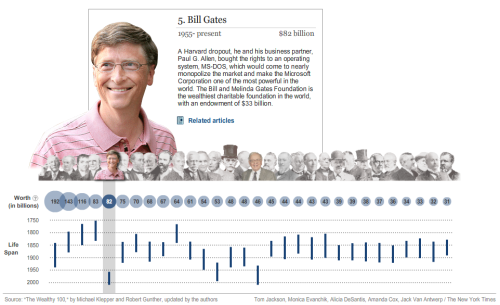
    Who are "The Rich"? What is their race? Their gender? How many of the most wealthy are non-white? How many are not men? Let's have a looksee, shall we?

    image/chart is from here
    An excerpt of the featured article that follows in this post:
    That story [of how the wealthy got super-wealthy and came to dominate all of U.S. political life] begins in the late 1970s and continues through the Obama years, a period in which American policy has been so skewed toward the rich that we're now living through the worst period of income inequality in modern history. Consider the statistics: 50 years ago, the wealthiest 1% of Americans accounted for one of every 10 dollars of the nation's income; today, it's nearly one in every four. Between 1979 and 2006, the average post-tax household income (including benefits) of the wealthiest 1% increased by 256%; the poorest households saw an increase of 11%; middle class homes, 21%, much of which was due to the arrival of two-job families.
    [...] On the one hand, the number of Americans earning a steady income declined by 4.5 million between 2008 and 2009, and the average wage in the U.S. dipped by 1.2%, to $39,055. On the other hand, the average wage among Americans earning more than $50 million per year was $91 million in 2008 and $84 million in 2009.

    Harvard University economist Lawrence Katz put the situation Americans now find themselves in this way:

    "Think of the American economy as a large apartment block. A century ago -- even 30 years ago -- it was the object of envy. But in the last generation its character has changed. The penthouses at the top keep getting larger and larger. The apartments in the middle are feeling more and more squeezed and the basement has flooded. To round it off, the elevator is no longer working.
    This means that those drowning in the basement have no way up and out. And those at the top can make their servants climb stairs to supply them with fresh food and clean laundry, and new "things", and portfolio statements.

    Reflecting on the image atop this post, what do we notice when we scan a list of super rich U.S. Americans? AlterNet calls them "Oligarchs" which is true enough, or not quite true enough, depending on what you want to say about them. What they are, in addition to oligarchs (and oilgarchs), is kyriarchs, and, quite specifically, white male supremacists, disproportionately overtly or covertly pimping and procuring women and girls. What you need to know, aside from the fact that they dominate and control all of us, is that they also fund and profit from war, genocide, rape, wage and sexual slavery, child sex trafficking, prostitution, poverty, famine, the disappearance of animal species, and ecocide, whether they admit it or not. All of 'em.

    And what they are, almost every single one of 'em are WHITE and MEN. Now how could that be in this land of opportunity for all? Could it be because in corporate capitalist Amerikkka, where capital has always been defined, controlled, and regulated by rich white men, that rich white men financially benefit the most from the economic system? I'm gonna say, "Yup" to that question.

    And, to be clear, it's not because the rich white men, most if not all of 'em heterosexual, are any of the following: the smartest U.S. Americans; the hardest working U.S. Americans; the least lazy U.S. Americans; the least criminal U.S. Americans; the least corrupt and most honorable U.S. Americans. What these fellas are, if we're going to grab at adjectives, is this: greedy mutherfuckers who use a system that rewards corruption and abuse of power, dominance and control of laws and governments, and regulation of public opinion about them through ownership and production of news and diversionary media.

    image of text is from here

    You'd kind of think with Dems being the majority in the House and the Senate that blocking tax cuts for the wealthiest fuckers in the country would be a no-brainer. But again, these folks that weasel their way into high paying positions didn't usually get their because they were smart, wise, good, or honorable. They got there usually because they knew how to play the corruption game, and were willing to sell their souls to play it.
    Including President Obama. Sorry to say. I've seen little to no evidence he has anything resembling "integrity" since he's taken office and sent more troops to Afghanistan to rape and murder Afghan children and women--oh, and to pay corrupt misogynists lots of money to continue to be corrupt. But, you'll note, he's nowhere near the most wealthy of all U.S. Americans. And that's primarily because he's Black. And while relatives on his mom's side may have gone back to being slave owners, relatives on his dad's side are African, not African American.

    So there's no GREAT WHITE wealth coming down through inheritance, built on the backs of Black slaves, built on the sexual and labor exploitation of Black women, built on the bloody battlefields where illegal alien invader European men, and other colonists and settlers, butchered Indigenous North Americans by the scores of millions. And scores of millions of women were raped in the process too, by white het men--the men who keep telling us all that them be the ones who built Amerikkka into the great nation [still genocidal, still rapist; still warring against non-white men and all women] that it was and remains. There may have been some inherited wealth on President Obama's mom's side. I don't know for sure. But this I know: white women have primarily achieved wealth by taking care of white wealthy men.
     
    And those who refused to take care of white wealthy men, and who acquired property and wealth in other ways, historically in the U.S. and Europe, were burned as witches by the tens of thousands, if not hundreds of thousands. So there's a whole lot of massacring going on to make sure them white boys stay on top in the wicked white West. And they stay on top of everything there is to stay on top of--every conceivable social-political-economic hierarchy there is. Except, of course, the "most honorable, moral, compassionate, socially and politically responsible citizens" list. They come out damn low on that list.
     
    If we gave out awards for greatness, a kind of greatness that demonstrates concern and regard for whole classes of oppressed people, I'd give one of those awards posthumously to Harriet Tubman. And to Sojourner Truth. And to Fannie Lou Hamer. And to Johnnie Tillmon. And to Andrea Dworkin. And to Audre Lorde. And to those among the living also: to Angela Davis and to Catharine A. MacKinnon. And to many thousands of women of all races and ethnicities who have been the smartest U.S.ers--the most brilliant, the most intellectually rigorous, the wisest, the strongest, and the bravest, while also, always, the most vulnerable.
     
    To the rich white men, I only will ask: How do you sleep at night? I know it's relatively easy if you don't have a conscience, but I imagine that some of you--a few at least--must still have one.

    In the piece that follows on oligarchy in the U.S., here's a partial list of terms the author uses to describe "people":

    the rich; liberals; conservatives; Democrats; Republicans; front groups, deep-pocketed donors; the right-wing; shadowy outsider organisations; candidates; Republican consultant Fred Malek; former Republican Senator Norm Coleman; the U.S. Chamber of Commerce; Karl Rove; conservative candidates across the country; Barack Obama; wealthy Democrats; Left-wing media mogul David Brock; liberal and centrist Democrats; Chamber of Commerce and others of its ilk; the Obama administration; Democratic strategist and fundraiser Harold Ickes; voters; friendly lawmakers; Steven Law; citizens in large numbers; labor unions; political parties; a swelling middle class; working and middle classes; wealthy counterparts.

    What you need to ask yourself is how many of those people were poor women of color? What percent? Who are "people" in the U.S dominant imagination? And what does this tell us about the interlinking of white, male, and class supremacy? Will progressive media give us that answer? Let's read and see.

    What follows is from AlterNet.org. Please click on the title to link back.
    Creating a country of the rich, by the rich, and for the rich.
    There is a war underway. I'm not talking about Washington’s bloody misadventures in Afghanistan and Iraq, but a war within our own borders. It’s a war fought on the airwaves, on television and radio and over the Internet, a war of words and images, of half-truth, innuendo, and raging lies. I'm talking about a political war, pitting liberals against conservatives, Democrats against Republicans. I'm talking about a spending war, fueled by stealthy front groups and deep-pocketed anonymous donors. It’s a war that's poised to topple what's left of American democracy.

    The right wing won the opening battle. In the 2010 midterm elections, shadowy outside organizations (who didn’t have to disclose their donors until well after Election Day, if at all) backing Republican candidates doled out $190 million, outspending their adversaries by a more than two-to-one margin, according to the Center for Responsive Politics. American Action Network, operated by Republican consultant Fred Malek and former Republican Senator Norm Coleman, spent $26 million; the U.S. Chamber of Commerce plunked down $33 million; and Karl Rove's American Crossroads and Crossroads GPS shelled out a combined $38.6 million. Their investments in conservative candidates across the country paid off: the 62 House seats and six Senate seats claimed by Republicans were the most in the postwar era -- literally, a historic victory.

    Knocked out of their complacency, no longer basking in the glow of Barack Obama's 2008 victory, wealthy Democrats are now plotting their response. Left-wing media mogul David Brock plans to create an outside group dubbed American Bridge in response to Rove's Crossroads outfits that will fight in the trenches of 2012 campaign spending. Many more outfits like Brock's will surely follow, as liberal and centrist Democrats brace for a promised $500 million onslaught by the Chamber of Commerce and others of its ilk.

    Even the Obama administration, which shunned outside groups in 2008, has opened the door to a covert spending war. The Democrats will now fight fire with fire. "Is small money better? You bet. But we're in a fucking fight," Democratic strategist and fundraiser Harold Ickes told me recently. "And if you're in a fistfight, then you're in a fistfight, and you use all legal means available."

    The endgame here, of course, is non-stop war. No longer will outside groups come and go every two years. Now, such groups will be running attack ads, sending out mailers, and deploying robo-calls year-round in what is going to become a perpetual campaign to sway voters and elect friendly lawmakers. "We're definitely building a foundation," was how American Crossroads president Steven Law put it.

    This is what nowadays passes for the heart and soul of American democracy. It used to be that citizens in large numbers, mobilized by labor unions or political parties or a single uniting cause, determined the course of American politics. After World War II, a swelling middle class was the most powerful voting bloc, while, in those same decades, the working and middle classes enjoyed comparatively greater economic prosperity than their wealthy counterparts. Kiss all that goodbye. We're now a country run by rich people.

    Not surprisingly, political power has a way of following wealth. What that means is: you can't understand how the rich seized control of American politics, and arguably American society, without understanding how a small group of Americans got so much money in the first place.

    That story begins in the late 1970s and continues through the Obama years, a period in which American policy has been so skewed toward the rich that we're now living through the worst period of income inequality in modern history. Consider the statistics: 50 years ago, the wealthiest 1% of Americans accounted for one of every 10 dollars of the nation's income; today, it's nearly one in every four. Between 1979 and 2006, the average post-tax household income (including benefits) of the wealthiest 1% increased by 256%; the poorest households saw an increase of 11%; middle class homes, 21%, much of which was due to the arrival of two-job families.

    Tax guru David Cay Johnston recently crunched new Social Security Administration data and discovered an even starker divide. On the one hand, the number of Americans earning a steady income declined by 4.5 million between 2008 and 2009, and the average wage in the U.S. dipped by 1.2%, to $39,055. On the other hand, the average wage among Americans earning more than $50 million per year was $91 million in 2008 and $84 million in 2009.

    Harvard University economist Lawrence Katz put the situation Americans now find themselves in this way:

    "Think of the American economy as a large apartment block. A century ago -- even 30 years ago -- it was the object of envy. But in the last generation its character has changed. The penthouses at the top keep getting larger and larger. The apartments in the middle are feeling more and more squeezed and the basement has flooded. To round it off, the elevator is no longer working. That broken elevator is what gets people down the most."

    Let's call those select few in the penthouse the New Oligarchy, an awesomely rich sliver of Americans raking in an outsized share of the nation's wealth. They're oil magnates and media tycoons, corporate executives and hedge-fund traders, philanthropists and entertainers. Depending on where you want to draw the line, they're the top 1%, or the top 0.1%, or even the top 0.01% of the population. And when the Supreme Court handed down its controversial Citizens United decision in January, it broke the floodgates so that a torrent of anonymous donations from this oligarchic class could flood back down from the heights and inundate the political lands below.

    "The Thirty-Year War"

    How did we get here? How did a middle-class-heavy nation transform itself into an oligarchy? You'll find answers to these questions in Winner-Take-All Politics, a revelatory new book by political scientists Jacob Hacker and Paul Pierson. The authors treat the present figures we have on American wealth and poverty as a crime scene littered with clues and suspects, dead-ends and alibis.

    Unlike so many pundits, politicians, and academics, Hacker and Pierson resist blaming the usual suspects: globalization, the rise of an information-based economy, and the demise of manufacturing. The culprit in their crime drama is American politics itself over the last three decades. The clues to understanding the rise of an American oligarchy, they believe, won’t be found in New York or New Delhi, but on Capitol Hill, along Pennsylvania Avenue, and around K Street, that haven in a heartless world for Washington’s lobbyists.

    "Step by step and debate by debate," they write, "America's public officials have rewritten the rules of American politics and the American economy in ways that have benefitted the few at the expense of the many."

     
    Most accounts of American income inequality begin in the 1980s with the reign of President Ronald Reagan, the anti-government icon whose "Reaganomics" are commonly fingered as the catalyst for today's problems. Wrong, say Hacker and Pierson. The origins of oligarchy lay in the late 1970s and in the unlikely figure of Jimmy Carter, a Democratic president presiding over a Congress controlled by Democrats. It was Carter's successes and failures, they argue, that kicked off what economist Paul Krugman has labeled “the Great Divergence."

    In 1978, the Carter administration and Congress took a red pen to the tax code, slashing the top rate of the capital gains tax from 48% to 28% -- an enormous boon for wealthy Americans. At the same time, the most ambitious effort in decades to reform American labor law in order to make it easer to unionize died in the Senate, despite a 61-vote Democratic supermajority. Likewise, a proposed Office of Consumer Representation, a $15 million advocacy agency that was to work on behalf of average Americans, was defeated by an increasingly powerful business lobby.

    Ronald Reagan, you could say, simply took the baton passed to him by Carter. His 1981 Economic Recovery and Tax Act (ERTA) bundled a medley of goodies any oligarch would love, including tax cuts for corporations, ample reductions in the capital gains and estate taxes, and a 10% income tax exclusion for married couples in two-earner families. "ERTA was Ronald Reagan's greatest legislative triumph, a fundamental rewriting of the nation's tax laws in favor of winner-take-all outcomes," Hacker and Pierson conclude.

    The groundwork had by then been laid for the rich to pull definitively and staggering ahead of everyone else. The momentum of the tax-cut fervor carried through the presidencies of George H.W. Bush and Bill Clinton, and in 2000 became the campaign trail rallying cry of George W. Bush. It was Bush II, after all, who told a room full of wealthy donors at an $800-a-plate dinner, "Some people call you the elites; I call you my base," and who pledged that his 2001 tax cuts would be a boon for all Americans. They weren't: according to Hacker and Pierson, 51% of their benefits go to the top 1% of earners.

    Those cuts will be around a lot longer if the GOP has its way. Take Republican Congressman Dave Camp's word for it. On November 16th, Camp, a Republican from Michigan, said the only acceptable solution when it came to the Bush-era tax cuts was not just upholding them for all earners, rich and poor, but passing more such cuts. Anything in between, any form of compromise, including President Obama's proposal to extend the Bush cuts for the working and middle classes but not the wealthy, was "a terrible idea and a total non-starter."

    Why should you care what Dave Camp says? Here’s the answer: in January, he's set to inherit the chairman's gavel on the powerful House Ways and Means Committee, the body tasked with writing the nation's tax laws. And though most Americans wouldn't even recognize his name, Camp's message surely left America's wealthy elites breathing a long sigh of relief. You could sum it up like this: Fear not, wealthy Americans, your money is safe. The policies that made you rich aren't going anywhere.

    Tear Down This Law


    Where rewriting the tax code proved too politically difficult, demolishing regulations worked almost as well. This has been especially true in the world of finance. There, a legacy of deregulation transformed banking from a relatively staid industry into a casino culture, ushering in an era of eye-popping profits, lavish bonuses, and the "financialization" of the American economy.

    April 6, 1998: it's a useful starting point in the story of financial deregulation. On that day, two well-known Wall Street denizens, Citicorp and Travelers Group, agreed to a historic $140 billion merger. The deal required much lobbying, but eventually the chiefs of these banks won an exemption from the Glass-Steagall Act, the New Deal-era law walling off commercial banks from riskier investment houses. The resulting institution, dubbed Citigroup, would be the largest supermarket bank in history, a marriage of teller windows and trading desks, customer banking and high-stakes investing -- all suddenly under one deregulated roof. It would prove an explosive, if not disastrous, mix.

    The merger stirred visions of a future in which the U.S. would dominate the planet financially. All that stood in the way was undue regulatory red tape. At least that's the way free marketeers like then-Republican Senator Phil Gramm of Texas saw it. Gramm, who as an aide to presidential candidate John McCain infamously called America a "nation of whiners," was, in fact, the driving force behind two of the most influential pieces of deregulation in recent history.

    In 1999, President Clinton signed the Gramm-Leach-Bliley Act, a bevy of deregulatory measures that obliterated Glass-Steagall. In December of the following year, Gramm quietly snuck the 262-page Commodity Futures Modernization Act into a massive $384-billion spending bill. Gramm's bill blocked regulators like the Securities and Exchange Commission (SEC) from cracking down on the shadowy "over-the-counter derivatives" market, home to billions of dollars of opaque financial instruments that would, years later, nearly demolish the American economy.

    As presidents, both Bill Clinton and George W. Bush wrapped their arms around financial deregulation. As a result, in a binge of financial gluttony, Wall Street grew fat in ways never previously seen. Between 1929, the year the Great Depression began, and 1988, Wall Street's profits averaged 1.2% of the nation's gross domestic product; in 2005, that figure peaked at 3.3% as industry bonuses soared ever-higher. In 2009, bad times for most Americans, bonuses hit $20 billion. So much wealth in so few hands. Nothing explains the rise of the new American oligarchy more starkly.

    Of course, it's not just what politicians did that helped create today's oligarchy, but what they failed to do. A classic example: in the 1990s, the Financial Accounting Standards Board (FASB), a private American accounting regulator, set its sights on a loophole big enough to drive a financial Mack truck through. Until then, stock options included in executives' skyrocketing pay packages -- potentially worth tens of millions of dollars when exercised -- were valued at zero when issued. That's right: zero, zilch, nada. When FASB and the SEC tried to close the loophole, however, big business leapt to its defense. An avalanche of money went into the pockets of an army of K Street lobbyists and leviathan business trade associations. In the end, nothing happened. Or rather, everything continued happening. The loophole remained.

    Citizen United's
    Brave New World


    Hacker and Pierson ably guide us through 30 years of "winner-take-all" policymaking, politicking, and -- from the point of view of the wealthy -- judicious inaction. They offer an eye-opening journey across the landscape that helped foster the New Oligarchs, but one crucial vista appeared too late for the authors to include.

    No understanding of the rise of our New Oligarchs could be complete without exploring the effects of the Supreme Court's January Citizens United decision, which set their power in cement more effectively than any tax cut ever could. Before Citizens United, the rich used their wealth to subtly shape policy, woo politicians, and influence elections. Now, with so much money flowing into their hands and the contribution faucets wide open, they can simply buy American politics so long as the price is right.

    There's no mistaking how, in less than a year, Citizens United has radically tilted the political playing field. Along with several other major court rulings, it ushered in American Crossroads, American Action Network, and many similar groups that now can reel in unlimited donations with pathetically few requirements to disclose their funders.

    What the present Supreme Court, itself the fruit of successive tax-cutting and deregulating administrations, has ensured is this: that in an American “democracy,” only the public will remain in the dark. Even for dedicated reporters, tracking down these groups is like chasing shadows: official addresses lead to P.O. boxes; phone calls go unreturned; doors are shut in your face.

    The limited glimpse we have of the people bankrolling these shadowy outfits is a who's-who of the New Oligarchy: the billionaire Koch Brothers ($21.5 billion); financier George Soros ($11 billion); hedge-fund CEO Paul Singer (his fund, Elliott Management, is worth $17 billion); investor Harold Simmons (net worth: $4.5 billion); New York venture capitalist Kenneth Langone ($1.1 billion); and real estate tycoon Bob Perry ($600 million).

    Then there's the roster of corporations who have used their largesse to influence American politics. Health insurance companies, including UnitedHealth Group and Cigna, gave a whopping $86.2 million to the U.S. Chamber to kill the public option, funneling the money through the industry trade group America's Health Insurance Plans. And corporate titans like Goldman Sachs, Prudential Financial, and Dow Chemical have given millions more to the Chamber to lobby against new financial and chemical regulations.

    As a result, the central story of the 2010 midterm elections isn’t Republican victory or Democratic defeat or Tea Party anger; it’s this blitzkrieg of outside spending, most of which came from right-leaning groups like Rove's American Crossroads and the U.S. Chamber of Commerce. It's a grim illustration of what happens when so much money ends up in the hands of so few. And with campaign finance reforms soundly defeated for years to come, the spending wars will only get worse.

    Indeed, pundits predict that spending in the 2012 elections will smash all records. Think of it this way: in 2008, total election spending reached $5.3 billion, while the $1.8 billion spent on the presidential race alone more than doubled 2004's total. How high could we go in 2012? $7 billion? $10 billion? It looks like the sky’s the limit.

    We don't need to wait for 2012 to arrive, however, to know that the sheer amount of money being pumped into American politics makes a mockery out of our democracy (or what's left of it). Worse yet, few solutions exist to staunch the cash flow: the DISCLOSE Act, intended to counter the effects of Citizens United, twice failed in the Senate this year; and the best option, public financing of elections, can't even get a hearing in Washington.

    Until lawmakers cap the amount of money in politics, while forcing donors to reveal their identities and not hide in the shadows, the New Oligarchy will only grow in stature and influence. Left unchecked, this ultimate elite will continue to root out the few members of Congress not beholden to them and their “contributions” (see: Wisconsin's Russ Feingold) and will replace them with lawmakers eager to do their bidding, a Congress full of obedient placeholders ready to give their donors what they want.

    Never before has the United States looked so much like a country of the rich, by the rich, and for the rich.

    Andy Kroll, an associate editor at TomDispatch, is a reporter for Mother Jones magazine. He lives in Washington, D.C. To listen to him discuss the geometry of delusion in the Ponzi Era on the latest TomCast audio interview, click here, or download it as a podcast by clicking here.