Tuesday, December 7, 2010

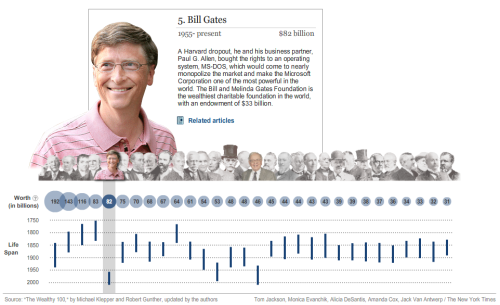
Who are "The Rich"? What is their race? Their gender? How many of the most wealthy are non-white? How many are not men? Let's have a looksee, shall we?

image/chart is from here
An excerpt of the featured article that follows in this post:
That story [of how the wealthy got super-wealthy and came to dominate all of U.S. political life] begins in the late 1970s and continues through the Obama years, a period in which American policy has been so skewed toward the rich that we're now living through the worst period of income inequality in modern history. Consider the statistics: 50 years ago, the wealthiest 1% of Americans accounted for one of every 10 dollars of the nation's income; today, it's nearly one in every four. Between 1979 and 2006, the average post-tax household income (including benefits) of the wealthiest 1% increased by 256%; the poorest households saw an increase of 11%; middle class homes, 21%, much of which was due to the arrival of two-job families.
[...] On the one hand, the number of Americans earning a steady income declined by 4.5 million between 2008 and 2009, and the average wage in the U.S. dipped by 1.2%, to $39,055. On the other hand, the average wage among Americans earning more than $50 million per year was $91 million in 2008 and $84 million in 2009.

Harvard University economist Lawrence Katz put the situation Americans now find themselves in this way:

"Think of the American economy as a large apartment block. A century ago -- even 30 years ago -- it was the object of envy. But in the last generation its character has changed. The penthouses at the top keep getting larger and larger. The apartments in the middle are feeling more and more squeezed and the basement has flooded. To round it off, the elevator is no longer working.
This means that those drowning in the basement have no way up and out. And those at the top can make their servants climb stairs to supply them with fresh food and clean laundry, and new "things", and portfolio statements.

Reflecting on the image atop this post, what do we notice when we scan a list of super rich U.S. Americans? AlterNet calls them "Oligarchs" which is true enough, or not quite true enough, depending on what you want to say about them. What they are, in addition to oligarchs (and oilgarchs), is kyriarchs, and, quite specifically, white male supremacists, disproportionately overtly or covertly pimping and procuring women and girls. What you need to know, aside from the fact that they dominate and control all of us, is that they also fund and profit from war, genocide, rape, wage and sexual slavery, child sex trafficking, prostitution, poverty, famine, the disappearance of animal species, and ecocide, whether they admit it or not. All of 'em.

And what they are, almost every single one of 'em are WHITE and MEN. Now how could that be in this land of opportunity for all? Could it be because in corporate capitalist Amerikkka, where capital has always been defined, controlled, and regulated by rich white men, that rich white men financially benefit the most from the economic system? I'm gonna say, "Yup" to that question.

And, to be clear, it's not because the rich white men, most if not all of 'em heterosexual, are any of the following: the smartest U.S. Americans; the hardest working U.S. Americans; the least lazy U.S. Americans; the least criminal U.S. Americans; the least corrupt and most honorable U.S. Americans. What these fellas are, if we're going to grab at adjectives, is this: greedy mutherfuckers who use a system that rewards corruption and abuse of power, dominance and control of laws and governments, and regulation of public opinion about them through ownership and production of news and diversionary media.

image of text is from here

You'd kind of think with Dems being the majority in the House and the Senate that blocking tax cuts for the wealthiest fuckers in the country would be a no-brainer. But again, these folks that weasel their way into high paying positions didn't usually get their because they were smart, wise, good, or honorable. They got there usually because they knew how to play the corruption game, and were willing to sell their souls to play it.
Including President Obama. Sorry to say. I've seen little to no evidence he has anything resembling "integrity" since he's taken office and sent more troops to Afghanistan to rape and murder Afghan children and women--oh, and to pay corrupt misogynists lots of money to continue to be corrupt. But, you'll note, he's nowhere near the most wealthy of all U.S. Americans. And that's primarily because he's Black. And while relatives on his mom's side may have gone back to being slave owners, relatives on his dad's side are African, not African American.

So there's no GREAT WHITE wealth coming down through inheritance, built on the backs of Black slaves, built on the sexual and labor exploitation of Black women, built on the bloody battlefields where illegal alien invader European men, and other colonists and settlers, butchered Indigenous North Americans by the scores of millions. And scores of millions of women were raped in the process too, by white het men--the men who keep telling us all that them be the ones who built Amerikkka into the great nation [still genocidal, still rapist; still warring against non-white men and all women] that it was and remains. There may have been some inherited wealth on President Obama's mom's side. I don't know for sure. But this I know: white women have primarily achieved wealth by taking care of white wealthy men.
 
And those who refused to take care of white wealthy men, and who acquired property and wealth in other ways, historically in the U.S. and Europe, were burned as witches by the tens of thousands, if not hundreds of thousands. So there's a whole lot of massacring going on to make sure them white boys stay on top in the wicked white West. And they stay on top of everything there is to stay on top of--every conceivable social-political-economic hierarchy there is. Except, of course, the "most honorable, moral, compassionate, socially and politically responsible citizens" list. They come out damn low on that list.
 
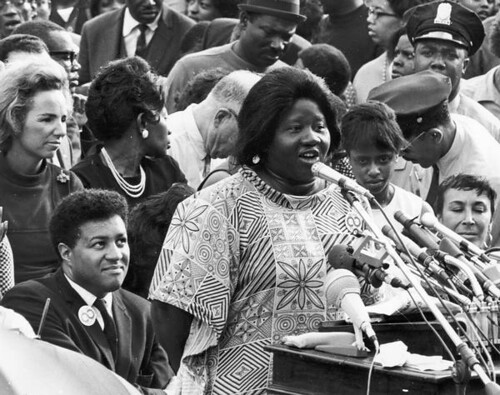
If we gave out awards for greatness, a kind of greatness that demonstrates concern and regard for whole classes of oppressed people, I'd give one of those awards posthumously to Harriet Tubman. And to Sojourner Truth. And to Fannie Lou Hamer. And to Johnnie Tillmon. And to Andrea Dworkin. And to Audre Lorde. And to those among the living also: to Angela Davis and to Catharine A. MacKinnon. And to many thousands of women of all races and ethnicities who have been the smartest U.S.ers--the most brilliant, the most intellectually rigorous, the wisest, the strongest, and the bravest, while also, always, the most vulnerable.
 
To the rich white men, I only will ask: How do you sleep at night? I know it's relatively easy if you don't have a conscience, but I imagine that some of you--a few at least--must still have one.

In the piece that follows on oligarchy in the U.S., here's a partial list of terms the author uses to describe "people":

the rich; liberals; conservatives; Democrats; Republicans; front groups, deep-pocketed donors; the right-wing; shadowy outsider organisations; candidates; Republican consultant Fred Malek; former Republican Senator Norm Coleman; the U.S. Chamber of Commerce; Karl Rove; conservative candidates across the country; Barack Obama; wealthy Democrats; Left-wing media mogul David Brock; liberal and centrist Democrats; Chamber of Commerce and others of its ilk; the Obama administration; Democratic strategist and fundraiser Harold Ickes; voters; friendly lawmakers; Steven Law; citizens in large numbers; labor unions; political parties; a swelling middle class; working and middle classes; wealthy counterparts.

What you need to ask yourself is how many of those people were poor women of color? What percent? Who are "people" in the U.S dominant imagination? And what does this tell us about the interlinking of white, male, and class supremacy? Will progressive media give us that answer? Let's read and see.

What follows is from AlterNet.org. Please click on the title to link back.
Creating a country of the rich, by the rich, and for the rich.
There is a war underway. I'm not talking about Washington’s bloody misadventures in Afghanistan and Iraq, but a war within our own borders. It’s a war fought on the airwaves, on television and radio and over the Internet, a war of words and images, of half-truth, innuendo, and raging lies. I'm talking about a political war, pitting liberals against conservatives, Democrats against Republicans. I'm talking about a spending war, fueled by stealthy front groups and deep-pocketed anonymous donors. It’s a war that's poised to topple what's left of American democracy.

The right wing won the opening battle. In the 2010 midterm elections, shadowy outside organizations (who didn’t have to disclose their donors until well after Election Day, if at all) backing Republican candidates doled out $190 million, outspending their adversaries by a more than two-to-one margin, according to the Center for Responsive Politics. American Action Network, operated by Republican consultant Fred Malek and former Republican Senator Norm Coleman, spent $26 million; the U.S. Chamber of Commerce plunked down $33 million; and Karl Rove's American Crossroads and Crossroads GPS shelled out a combined $38.6 million. Their investments in conservative candidates across the country paid off: the 62 House seats and six Senate seats claimed by Republicans were the most in the postwar era -- literally, a historic victory.

Knocked out of their complacency, no longer basking in the glow of Barack Obama's 2008 victory, wealthy Democrats are now plotting their response. Left-wing media mogul David Brock plans to create an outside group dubbed American Bridge in response to Rove's Crossroads outfits that will fight in the trenches of 2012 campaign spending. Many more outfits like Brock's will surely follow, as liberal and centrist Democrats brace for a promised $500 million onslaught by the Chamber of Commerce and others of its ilk.

Even the Obama administration, which shunned outside groups in 2008, has opened the door to a covert spending war. The Democrats will now fight fire with fire. "Is small money better? You bet. But we're in a fucking fight," Democratic strategist and fundraiser Harold Ickes told me recently. "And if you're in a fistfight, then you're in a fistfight, and you use all legal means available."

The endgame here, of course, is non-stop war. No longer will outside groups come and go every two years. Now, such groups will be running attack ads, sending out mailers, and deploying robo-calls year-round in what is going to become a perpetual campaign to sway voters and elect friendly lawmakers. "We're definitely building a foundation," was how American Crossroads president Steven Law put it.

This is what nowadays passes for the heart and soul of American democracy. It used to be that citizens in large numbers, mobilized by labor unions or political parties or a single uniting cause, determined the course of American politics. After World War II, a swelling middle class was the most powerful voting bloc, while, in those same decades, the working and middle classes enjoyed comparatively greater economic prosperity than their wealthy counterparts. Kiss all that goodbye. We're now a country run by rich people.

Not surprisingly, political power has a way of following wealth. What that means is: you can't understand how the rich seized control of American politics, and arguably American society, without understanding how a small group of Americans got so much money in the first place.

That story begins in the late 1970s and continues through the Obama years, a period in which American policy has been so skewed toward the rich that we're now living through the worst period of income inequality in modern history. Consider the statistics: 50 years ago, the wealthiest 1% of Americans accounted for one of every 10 dollars of the nation's income; today, it's nearly one in every four. Between 1979 and 2006, the average post-tax household income (including benefits) of the wealthiest 1% increased by 256%; the poorest households saw an increase of 11%; middle class homes, 21%, much of which was due to the arrival of two-job families.

Tax guru David Cay Johnston recently crunched new Social Security Administration data and discovered an even starker divide. On the one hand, the number of Americans earning a steady income declined by 4.5 million between 2008 and 2009, and the average wage in the U.S. dipped by 1.2%, to $39,055. On the other hand, the average wage among Americans earning more than $50 million per year was $91 million in 2008 and $84 million in 2009.

Harvard University economist Lawrence Katz put the situation Americans now find themselves in this way:

"Think of the American economy as a large apartment block. A century ago -- even 30 years ago -- it was the object of envy. But in the last generation its character has changed. The penthouses at the top keep getting larger and larger. The apartments in the middle are feeling more and more squeezed and the basement has flooded. To round it off, the elevator is no longer working. That broken elevator is what gets people down the most."

Let's call those select few in the penthouse the New Oligarchy, an awesomely rich sliver of Americans raking in an outsized share of the nation's wealth. They're oil magnates and media tycoons, corporate executives and hedge-fund traders, philanthropists and entertainers. Depending on where you want to draw the line, they're the top 1%, or the top 0.1%, or even the top 0.01% of the population. And when the Supreme Court handed down its controversial Citizens United decision in January, it broke the floodgates so that a torrent of anonymous donations from this oligarchic class could flood back down from the heights and inundate the political lands below.

"The Thirty-Year War"

How did we get here? How did a middle-class-heavy nation transform itself into an oligarchy? You'll find answers to these questions in Winner-Take-All Politics, a revelatory new book by political scientists Jacob Hacker and Paul Pierson. The authors treat the present figures we have on American wealth and poverty as a crime scene littered with clues and suspects, dead-ends and alibis.

Unlike so many pundits, politicians, and academics, Hacker and Pierson resist blaming the usual suspects: globalization, the rise of an information-based economy, and the demise of manufacturing. The culprit in their crime drama is American politics itself over the last three decades. The clues to understanding the rise of an American oligarchy, they believe, won’t be found in New York or New Delhi, but on Capitol Hill, along Pennsylvania Avenue, and around K Street, that haven in a heartless world for Washington’s lobbyists.

"Step by step and debate by debate," they write, "America's public officials have rewritten the rules of American politics and the American economy in ways that have benefitted the few at the expense of the many."

 
Most accounts of American income inequality begin in the 1980s with the reign of President Ronald Reagan, the anti-government icon whose "Reaganomics" are commonly fingered as the catalyst for today's problems. Wrong, say Hacker and Pierson. The origins of oligarchy lay in the late 1970s and in the unlikely figure of Jimmy Carter, a Democratic president presiding over a Congress controlled by Democrats. It was Carter's successes and failures, they argue, that kicked off what economist Paul Krugman has labeled “the Great Divergence."

In 1978, the Carter administration and Congress took a red pen to the tax code, slashing the top rate of the capital gains tax from 48% to 28% -- an enormous boon for wealthy Americans. At the same time, the most ambitious effort in decades to reform American labor law in order to make it easer to unionize died in the Senate, despite a 61-vote Democratic supermajority. Likewise, a proposed Office of Consumer Representation, a $15 million advocacy agency that was to work on behalf of average Americans, was defeated by an increasingly powerful business lobby.

Ronald Reagan, you could say, simply took the baton passed to him by Carter. His 1981 Economic Recovery and Tax Act (ERTA) bundled a medley of goodies any oligarch would love, including tax cuts for corporations, ample reductions in the capital gains and estate taxes, and a 10% income tax exclusion for married couples in two-earner families. "ERTA was Ronald Reagan's greatest legislative triumph, a fundamental rewriting of the nation's tax laws in favor of winner-take-all outcomes," Hacker and Pierson conclude.

The groundwork had by then been laid for the rich to pull definitively and staggering ahead of everyone else. The momentum of the tax-cut fervor carried through the presidencies of George H.W. Bush and Bill Clinton, and in 2000 became the campaign trail rallying cry of George W. Bush. It was Bush II, after all, who told a room full of wealthy donors at an $800-a-plate dinner, "Some people call you the elites; I call you my base," and who pledged that his 2001 tax cuts would be a boon for all Americans. They weren't: according to Hacker and Pierson, 51% of their benefits go to the top 1% of earners.

Those cuts will be around a lot longer if the GOP has its way. Take Republican Congressman Dave Camp's word for it. On November 16th, Camp, a Republican from Michigan, said the only acceptable solution when it came to the Bush-era tax cuts was not just upholding them for all earners, rich and poor, but passing more such cuts. Anything in between, any form of compromise, including President Obama's proposal to extend the Bush cuts for the working and middle classes but not the wealthy, was "a terrible idea and a total non-starter."

Why should you care what Dave Camp says? Here’s the answer: in January, he's set to inherit the chairman's gavel on the powerful House Ways and Means Committee, the body tasked with writing the nation's tax laws. And though most Americans wouldn't even recognize his name, Camp's message surely left America's wealthy elites breathing a long sigh of relief. You could sum it up like this: Fear not, wealthy Americans, your money is safe. The policies that made you rich aren't going anywhere.

Tear Down This Law


Where rewriting the tax code proved too politically difficult, demolishing regulations worked almost as well. This has been especially true in the world of finance. There, a legacy of deregulation transformed banking from a relatively staid industry into a casino culture, ushering in an era of eye-popping profits, lavish bonuses, and the "financialization" of the American economy.

April 6, 1998: it's a useful starting point in the story of financial deregulation. On that day, two well-known Wall Street denizens, Citicorp and Travelers Group, agreed to a historic $140 billion merger. The deal required much lobbying, but eventually the chiefs of these banks won an exemption from the Glass-Steagall Act, the New Deal-era law walling off commercial banks from riskier investment houses. The resulting institution, dubbed Citigroup, would be the largest supermarket bank in history, a marriage of teller windows and trading desks, customer banking and high-stakes investing -- all suddenly under one deregulated roof. It would prove an explosive, if not disastrous, mix.

The merger stirred visions of a future in which the U.S. would dominate the planet financially. All that stood in the way was undue regulatory red tape. At least that's the way free marketeers like then-Republican Senator Phil Gramm of Texas saw it. Gramm, who as an aide to presidential candidate John McCain infamously called America a "nation of whiners," was, in fact, the driving force behind two of the most influential pieces of deregulation in recent history.

In 1999, President Clinton signed the Gramm-Leach-Bliley Act, a bevy of deregulatory measures that obliterated Glass-Steagall. In December of the following year, Gramm quietly snuck the 262-page Commodity Futures Modernization Act into a massive $384-billion spending bill. Gramm's bill blocked regulators like the Securities and Exchange Commission (SEC) from cracking down on the shadowy "over-the-counter derivatives" market, home to billions of dollars of opaque financial instruments that would, years later, nearly demolish the American economy.

As presidents, both Bill Clinton and George W. Bush wrapped their arms around financial deregulation. As a result, in a binge of financial gluttony, Wall Street grew fat in ways never previously seen. Between 1929, the year the Great Depression began, and 1988, Wall Street's profits averaged 1.2% of the nation's gross domestic product; in 2005, that figure peaked at 3.3% as industry bonuses soared ever-higher. In 2009, bad times for most Americans, bonuses hit $20 billion. So much wealth in so few hands. Nothing explains the rise of the new American oligarchy more starkly.

Of course, it's not just what politicians did that helped create today's oligarchy, but what they failed to do. A classic example: in the 1990s, the Financial Accounting Standards Board (FASB), a private American accounting regulator, set its sights on a loophole big enough to drive a financial Mack truck through. Until then, stock options included in executives' skyrocketing pay packages -- potentially worth tens of millions of dollars when exercised -- were valued at zero when issued. That's right: zero, zilch, nada. When FASB and the SEC tried to close the loophole, however, big business leapt to its defense. An avalanche of money went into the pockets of an army of K Street lobbyists and leviathan business trade associations. In the end, nothing happened. Or rather, everything continued happening. The loophole remained.

Citizen United's
Brave New World


Hacker and Pierson ably guide us through 30 years of "winner-take-all" policymaking, politicking, and -- from the point of view of the wealthy -- judicious inaction. They offer an eye-opening journey across the landscape that helped foster the New Oligarchs, but one crucial vista appeared too late for the authors to include.

No understanding of the rise of our New Oligarchs could be complete without exploring the effects of the Supreme Court's January Citizens United decision, which set their power in cement more effectively than any tax cut ever could. Before Citizens United, the rich used their wealth to subtly shape policy, woo politicians, and influence elections. Now, with so much money flowing into their hands and the contribution faucets wide open, they can simply buy American politics so long as the price is right.

There's no mistaking how, in less than a year, Citizens United has radically tilted the political playing field. Along with several other major court rulings, it ushered in American Crossroads, American Action Network, and many similar groups that now can reel in unlimited donations with pathetically few requirements to disclose their funders.

What the present Supreme Court, itself the fruit of successive tax-cutting and deregulating administrations, has ensured is this: that in an American “democracy,” only the public will remain in the dark. Even for dedicated reporters, tracking down these groups is like chasing shadows: official addresses lead to P.O. boxes; phone calls go unreturned; doors are shut in your face.

The limited glimpse we have of the people bankrolling these shadowy outfits is a who's-who of the New Oligarchy: the billionaire Koch Brothers ($21.5 billion); financier George Soros ($11 billion); hedge-fund CEO Paul Singer (his fund, Elliott Management, is worth $17 billion); investor Harold Simmons (net worth: $4.5 billion); New York venture capitalist Kenneth Langone ($1.1 billion); and real estate tycoon Bob Perry ($600 million).

Then there's the roster of corporations who have used their largesse to influence American politics. Health insurance companies, including UnitedHealth Group and Cigna, gave a whopping $86.2 million to the U.S. Chamber to kill the public option, funneling the money through the industry trade group America's Health Insurance Plans. And corporate titans like Goldman Sachs, Prudential Financial, and Dow Chemical have given millions more to the Chamber to lobby against new financial and chemical regulations.

As a result, the central story of the 2010 midterm elections isn’t Republican victory or Democratic defeat or Tea Party anger; it’s this blitzkrieg of outside spending, most of which came from right-leaning groups like Rove's American Crossroads and the U.S. Chamber of Commerce. It's a grim illustration of what happens when so much money ends up in the hands of so few. And with campaign finance reforms soundly defeated for years to come, the spending wars will only get worse.

Indeed, pundits predict that spending in the 2012 elections will smash all records. Think of it this way: in 2008, total election spending reached $5.3 billion, while the $1.8 billion spent on the presidential race alone more than doubled 2004's total. How high could we go in 2012? $7 billion? $10 billion? It looks like the sky’s the limit.

We don't need to wait for 2012 to arrive, however, to know that the sheer amount of money being pumped into American politics makes a mockery out of our democracy (or what's left of it). Worse yet, few solutions exist to staunch the cash flow: the DISCLOSE Act, intended to counter the effects of Citizens United, twice failed in the Senate this year; and the best option, public financing of elections, can't even get a hearing in Washington.

Until lawmakers cap the amount of money in politics, while forcing donors to reveal their identities and not hide in the shadows, the New Oligarchy will only grow in stature and influence. Left unchecked, this ultimate elite will continue to root out the few members of Congress not beholden to them and their “contributions” (see: Wisconsin's Russ Feingold) and will replace them with lawmakers eager to do their bidding, a Congress full of obedient placeholders ready to give their donors what they want.

Never before has the United States looked so much like a country of the rich, by the rich, and for the rich.

Andy Kroll, an associate editor at TomDispatch, is a reporter for Mother Jones magazine. He lives in Washington, D.C. To listen to him discuss the geometry of delusion in the Ponzi Era on the latest TomCast audio interview, click here, or download it as a podcast by clicking here.

"Welfare is a Women's Issue" (Ms., 1972), by a U.S. Feminist Shero and Welfare Warrior, Johnnie Tillmon (1926 - 1995)

image of book on women and welfare, with Johnnie Tillmon front and center, is from here
Johnnie Tillmon is mentioned throughout the book above. As well she should be.
She is one of several defining voices addressing the welfare state
as part of the racist patriarchal state called the U.S. 
More on the book may be found
*at Amazon.com* and *on Google Books*.

The full image that was made into the cover of Welfare Warriors:
photograph of Johnnie Tillmon is from here

Behold herstory.

What follows is a brilliant piece of writing. Below it is biographical information the author, feminist activist Johnnie Tillmon. It is with full permission from Ms. (thank you, Jessica!) that I reprint the article here on A.R.P.

It is originally from Ms. magazine's very first issue in 1972!
It re-appeared in Ms. thirty years later. Please click on the title to link back to the source website of this writing, at msmagazine.com.

FEATURE | spring 2002

Spring 2002 Table of Contents 


Welfare is a Women's Issue (1972)

by Johnnie Tillmon


I'm a woman. I'm a black woman. I'm a poor woman. I'm a fat woman. I'm a middle-aged woman. And I'm on welfare.

In this country, if you're any one of those things you count less as a human being. If you're all those things, you don't count at all. Except as a statistic.

I am 45 years old. I have raised six children. There are millions of statistics like me. Some on welfare. Some not. And some, really poor, who don't even know they're entitled to welfare. Not all of them are black. Not at all. In fact, the majority-about two-thirds-of all the poor families in the country are white.

Welfare's like a traffic accident. It can happen to anybody, but especially it happens to women.

And that's why welfare is a women's issue. For a lot of middle-class women in this country, Women's Liberation is a matter of concern. For women on welfare it's a matter of survival.

Survival. That's why we had to go on welfare. And that's why we can't get off welfare now. Not us women. Not until we do something about liberating poor women in this country.

Because up until now we've been raised to expect to work, all our lives, for nothing. Because we are the worst educated, the least-skilled, and the lowest-paid people there are. Because we have to be almost totally responsible for our children. Because we are regarded by everybody as dependents. That's why we are on welfare. And that's why we stay on it.

Welfare is the most prejudiced institution in this country, even more than marriage, which it tries to imitate. Let me explain that a little.

Ninety-nine percent of welfare families are headed by women. There is no man around. In half the states there can't be men around because A.F.D.C. (Aid to Families With Dependent Children) says if there is an "able-bodied" man around, then you can't be on welfare. If the kids are going to eat, and the man can't get a job, then he's got to go.

Welfare is like a super-sexist marriage. You trade in a man for the man. But you can't divorce him if he treats you bad. He can divorce you, of course, cut you off anytime he wants. But in that case, he keeps the kids, not you.The man runs everything. In ordinary marriage, sex is supposed to be for your husband. On A.F.D.C., you're not supposed to have any sex at all. You give up control of your own body. It's a condition of aid. You may even have to agree to get your tubes tied so you can never have more children just to avoid being cut off welfare.

The man, the welfare system, controls your money. He tells you what to buy, what not to buy, where to buy it, and how much things cost. If things-rent, for instance-really cost more than he says they do, it's just too bad for you. He's always right.

That's why Governor [Ronald] Reagan can get away with slandering welfare recipients, calling them "lazy parasites," "pigs at the trough," and such. We've been trained to believe that the only reason people are on welfare is because there's something wrong with their character. If people have "motivation," if people only want to work, they can, and they will be able to support themselves and their kids in decency.

The truth is a job doesn't necessarily mean an adequate income. There are some ten million jobs that now pay less than the minimum wage, and if you're a woman, you've got the best chance of getting one. Why would a 45-year-old woman work all day in a laundry ironing shirts at 90-some cents an hour? Because she knows there's some place lower she could be. She could be on welfare. Society needs women on welfare as "examples" to let every woman, factory workers and housewife workers alike, know what will happen if she lets up, if she's laid off, if she tries to go it alone without a man. So these ladies stay on their feet or on their knees all their lives instead of asking why they're only getting 90-some cents an hour, instead of daring to fight and complain.

Maybe we poor welfare women will really liberate women in this country. We've already started on our own welfare plan. Along with other welfare recipients, we have organized so we can have some voice. Our group is called the National Welfare Rights Organization (N.W.R.O.). We put together our own welfare plan, called Guaranteed Adequate Income (G.A.I.), which would eliminate sexism from welfare. There would be no "categories"-men, women, children, single, married, kids, no kids-just poor people who need aid. You'd get paid according to need and family size only and that would be upped as the cost of living goes up.

As far as I'm concerned, the ladies of N.W.R.O. are the front-line troops of women's freedom. Both because we have so few illusions and because our issues are so important to all women-the right to a living wage for women's work, the right to life itself.


*          *          *
What follows next is from *here* at blackpast.org.

Tillmon, Johnnie (1926-1995)


 Johnnie Tillmon was born in Scott, Arkansas, in 1926. A migrant sharecropper’s daughter, she moved to California in 1959 to join her brothers and worked as a union shop steward in a Compton laundry. Tillmon organized workers and became involved in a community association called the Nickerson Garden Planning Organization which was established to improve living conditions in the housing project.

Tillmon became ill in 1963, and was advised to seek welfare. She was hesitant at first, but decided to apply for assistance to take care of her children. She immediately learned how welfare recipients were harassed by caseworkers who went to their apartments looking for evidence of extra support and who designated how they should spend money. In order to fight against this dehumanized treatment, Tillmon organized people on welfare in the housing project and founded one of the first grassroots welfare mothers’ organizations called ANC (Aid to Needy Children) Mothers Anonymous, in 1963. When a former CORE activist, George Wiley, brought together local welfare recipients’ groups and transformed them into a national movement, ANC Mothers joined the movement and became a part of the National Welfare Rights Organization (NWRO). Tillmon quickly emerged as a leader and became a chairperson of the NWRO. Together with other welfare mothers, she struggled for adequate income, dignity, justice, and democratic participation.

While the NWRO was officially run by welfare recipients, the male middle-class staff managed the finances and administered the national office, wielding great influence over the organization. Tillmon and other welfare mothers became increasingly critical of Wiley and his supporters who dominated leadership positions, and sought to place control of the organization in the hands of the welfare recipients. When the number of recipients rapidly increased and the NWRO was under fierce attack, the internal conflict between the staff members and welfare recipients came to the forefront. While Wiley and his advisors tried to mobilize the working poor, especially the white blue-collar workers, into the welfare rights movement, welfare mothers led by Tillmon sought to align with a women’s movement and gain support from feminist organizations such as the National Organization for Women (NOW).

In 1972, Tillmon published an article in Ms magazine entitled “Welfare Is a Women’s Issue,” articulating how the welfare system controlled the lives of women on welfare and constantly placed them under the scrutiny of government authorities. She tried to broaden the horizon of the feminist movement by redefining poverty as a “women’s issue.” When Wiley resigned in late 1972, Tillmon was chosen as the new Executive Director of the NWRO. The funding for the organization, however, had become depleted by the time she became the director. After the NWRO folded in 1975, Tillmon returned to Los Angeles, continuing her struggle for welfare rights at the local and state levels. In 1995 Tillmon passed away at the age of 69. 

Sources:
Johnnie Tillmon, “Welfare is a Women’s Issue,” Ms Magazine (Spring, 1972): 111-16; Guida West, The National Welfare Rights Movement: The Social Protest of Poor Women (New York: Praeger, 1981); Premilla Nadasen, Welfare Warriors: The Welfare Rights Movement in the United States (New York: Routledge, 2005).
 
Contributor(s):
Tsuchiya, Kazuyo
University of California, San Diego
 
*          *          *

For more on Johnnie Tillmon and her activist work, please also visit these linked-to websites:

Monday, December 6, 2010

Calling All Intersex, Intergender, Asexual, Anti-binary Gender Radicals and Anti-Heteropatriarchy Activists

image for trans/gender activism is from here


I am wanting to organise support and empowerment to those of us who are not part of the binaries of sex and gender to gather in cyberspaces to discuss how to better support radical feminist activism and other radical women's activism who may not ever identify as "feminist". (It is, after all, an English word, and for most humans, English is not a first language. And many women do perceive "feminist" to be a specifically "Western" or "white" term, and that doesn't mean those activists aren't doing radical anti-patriarchal work.

The sex and gender binaries are set up patriarchally and oppressively in the West, and elsewhere--but not universally, with violence, with coercion, with harassment, with subordinating practices including bullying, beating, and rape. These forms of violence, as well as institutional discrimination and industrial strength degradation, disproportionately targets females, girls, "feminised" or "feminine" children and adults, and women. The violence and discrimination is disproportionately perpetrated by males, boys, and men, against girls and women, and also against male children and adults.

Class and race are gendered such that being dominant in any hierarchy adds "masculine" status and privileges, while being "on the bottom" of any hierarchy "feminises" the oppressed groups.

 Across class, race, region, and ethnicity, there are people who "don't fit" the binaries, because the binaries are not natural or inclusive of all humans. One strategy has been for gay men to claim to be "real men", which often has misogynistic implications and courses of political action. Another strategy has been for transgender and transsexual people to insist on being identified using the terms of the master which reinforce the oppressive/misogynistic/patriarchal binary.

I'm hoping to hear from people, by email, by comment, here, who support the group "woman" being identified as radical feminists identify that group: the people who are not male and not men who are oppressed by male supremacy and by men interpersonally and institutionally for being "girls" and "women".

I'm wanting to support the realities and existence of asexual people, who, for many reasons, opt out of hetero/sexual social rules and codes of conduct, including how we "do" relationships, and how we express affection and intimacy. I'm wanting to explore, here, how being sexual can be a form of acting out child sexual abuse or heteropatriarchal upbringing. I see heteropatriarchal upbringing as a form of spiritual and psychic harm, privileging some, punishing others. Some of us, like me, experience both privileging and punishment. As someone who is asexual, politically and personally, I reject hetero/patriarchal ways of being in relationship as inhumane and oppressive, misogynistic and often racist and classist too. I see my white gay class-privileged brothers not usually questioning and resisting CRAP, instead of confronting and working to end capitalist, racist heteropatriarchy.

I'm wanting to support the realities of lesbian existence, of women's existence, who do experience assaults against their female bodies because of the political meaning of them in patriarchal societies. I believe this experience of oppression, dehumanisation, degradation, violation, and subordination due to being a girl or a woman with a female body warrants respect and regard as we strategise resistance movements and political courses of action to challenge the ideologies and imperatives of white het male supremacy and to effectively compost CRAP.

I'm also calling on all WHITE WESTERN non-trans and trans activists who proclaim "transgender people" or "transsexuals" to be THE MOST OPPRESSED GROUP ON EARTH to knock off the racist, Western privileged nonsense. It's an insult to all people of color, especially girls and women, who experience things you'll never even hear about, unless you go out of your way to do so. This isn't to minimise anyone's pain or suffering, but it is to note that you DO have white and Western privileges, and often non-ESL and non-Third and Fourth World privileges. And, in case you didn't notice, most non-trans women and girls do not.

Thoughts? Interest? I welcome hearing from people who basically are in agreement here, not from non-trans and trans activists who want to reinforce the gender binary by insisting that everyone is either "one [dominant, statused] gender" or "the opposite [subordinated, stigmatised] one". And from intersex people generally--those who were raised as girls or as boys, but who have had to find their own ways as intersex people, who had surgeries they didn't welcome or want, or who have had no surgeries and want to be fully statused as complete and whole human beings just as you are.

How Much "Gender Variance" Will CRAP Tolerate? A Radical Profeminist Query

image of a kind of androgynous gender restroom symbol is from here

Across queer cultures, particularly class- and race- and region- privileged ones, I see discussion after discussion about the need to promote gender variance in media and in society beyond media.

I support media projects that seek to visibilise people who are not represented by dominant media if and when those invisible people are fighting against racism, heterosexism, misogyny, genocide, and ecocide. Without defining the much-needed politics, one may be left supporting abstract goals of "more visibility for everyone"--a very liberal notion--which would, by definition, include more exposure in media to the pursuits of those who think slavery is awesome, white nationalism is desperately needed, anti-Muslim terrorism needs to be amped up, and lesbian feminist women are nothing more than "man-haters", "prudes", "transphobes" and "intolerant bigots". The lesbian feminists I have been honored to know across my lifetime are sheros, warriors, and radicals who refuse to accept conditions of race and gender oppression as natural or inevitable. They are not man-haters: they are woman-lovers; they are not prudes: they are passionate and prudent; they are not transphobes: they offer a critique of queer and dominant cultures that include investigating and interrogating the depths of sex and gender, turning over every stone, not just the ones easiest to lift. And they are not bigots: they are women who speak truth to power.

I await filmmakers making films that promote radical points of view, revolutionary actions, anti-WHM conservative and anti-WHM liberal stances on everything under the sun. I await media that names white het male supremacy as a globalised endemic problem, a murderous and otherwise tyrannical and lethal one.

If whites and class-privileged folks wish to promote gender as "in need of variance" without naming male supremacy and patriarchy as the forces which keep it narrow and hierarchical, they are participating in a dangerous form of liberalism, of invisibilisation of the cost of gender to over half the population of people on Earth: women raised as girls. The promotion of "women" as a category that is de-politicised, that is assumed to be able to exist apart from its ties to white het male supremacist objectives and aims that are explicitly and egregiously oppressive-to-women-and-girls, is an anti-radical, anti-profeminist project, in the view of this blog.

I oppose the patriarchal, pro-pimp promotion of wearing or implanting fake breasts as a way to "be a woman". I oppose CRAP's medical establishment promoting genital surgery, such as labiaplasty, as a way to "be a woman". I am against cultural and academic efforts to pretending that contemporary Western womanhood is a disembodied experience, as if most women and girls aren't in bodies that are specifically targeted for specific forms of invasion and violation, punishment and predation, objectification and dehumanisation.

In our lived lives, human "vaginas" and human "female breasts" are targeted for exploitation and violence because they are seen by male supremacist as "parts" of women that must be abused and violated, along with every other "part" of women's bodies and lives.

To "deconstruct" (read: abstract and delegitimise) women from the bodies most women live in, and have lived in since birth through girlhood to adulthood, is to remove from analysis the experiences of that political group of people, rendering claims that it is a political group "exclusivist" or "bigoted". Whose interests are served by taking the focus off of what happens to that political group? My answer: Men's and patriarchy's.

On a related note: why don't those of us who are intersex, intergender, transsexual, and transgender demand from the State, the government, the right to be identified "as we are" regardless of what levels of hormonal or surgical procedures we have had or will have. "What we are" is this: intersex, intergender, transsexual, and transgender, and why can't, for example, TG be listed as our "sex/gender" on forms that ask for such information? Why do we all have to be forced into saying "I'm a woman" or "I'm a man" if we're adults? There are, after all, intersex people who may not be "female" or "male". Why can't intersex people gain legitimacy as being "I" for intersex, not "F" or "M"? I'm not saying that some intersex people don't or won't identify as male or female. But when surgeons are at the ready to snip and cut children's genitals to "make them male" or "make them female" one has to ask: why can't genitals be something else too? Why does the binary have to be surgically enforced against the will of people who never asked for it or welcomed it?

I'm advocating for a progressive to radical "Gender Variance" movement, which does exist in some places among some individuals, that rejects the inhumanity and tyranny of dominant culture forcing of all of us into only binary categories. And I also support acknowledging that people assigned female at birth, raised to be girls, who are then identified and treated and structurally positioned as "women" in adulthood, or mistreated for being femme women, or mistreated for being butch women, be validated and respected as a distinct political group, who have the right to offer one another social-political services and support, who have the right to gather together, without other people insisting they are part of that group when they are not FAAB, raised to be a girl, socially statused as a woman as an adult.

There is, without much question or challenge, a distinct political group called "men" who were assigned male at birth, raised to be boys, and institutionally identified and structurally positioned as "the superior gender" over and against women. To blur or obfuscate the meaning of this group as anything other than "the dominant sex/gender" is to make organised resistance to that group's oppression of non-males and non-men more difficult, in the view of this blog.

Gender Terms: An introduction to the lingo of gender in the Anglo-white West

image is from here
Increasingly, for now, I am wanting to analyse how dominant society presents information about "gender". My experience  within my own queer realms, is that in the last twenty years, there has been a concerted effort to de-politicise gender, presenting it instead as an ever-increasingly fluid and complex social reality, as if whte het male supremacy has effectively disappeared as an ideological and institutionalised force that determines a great deal about how gender is expressed, enforced, and sometimes survived.
 
From Below The Belt blog: 1.14.2010. Please click on the title just below to link back. My comment follows, along with a couple by another member of Below The Belt, who goes by the moniker aqueertheory.

Gender 101

My previous (and first post) dealt with the concept of femme gender and whether or not it needs to be legitimized. An excellent suggestion was made that I make myself clear on what I mean by gender and the terms that I’m using and that I do a little Gender 101.

Usually with a 101, we start with vocabulary so that we can understand the words being used. Here are some common terms that are used when talking about sex and gender:

Sex: A term used to describe a type of physical body, can be based on primary and secondary sex characteristics, hormones, and/or chromosomes.

Primary Sex Characteristics: Sex characteristics that are directly related to the reproductive system and encompass genitals

Secondary Sex Characteristics: Sex characteristics that are not directly part of reproductive organs and develop during puberty (such as breasts)

Genitals: External sex organs that are directly related to the reproductive system

Reproductive System: The organs of a body that allow a species to reproduce

Gender: A social and psychological identity

Gender Roles: Sets of behavior and assigned by society that are supposed to correspond to traditional ideas about gender

Male Sex: Usually assigned at birth based on primary sex characteristics, such as the presence of a penis, scrotum, and testicles. The assignment can be based on hormones, other primary sex characteristics, secondary sex characteristics, chromosomes

Female Sex: Usually assigned at birth based on primary sex characteristics, such as the presence of a clitoris, vagina and vulva. The assignment can be based on hormones, other primary sex characteristics, secondary sex characteristics, chromosomes

Man: A gender identity socially assigned to those who are assigned with the male sex at birth as well as a gender identity that one may come to through experiences and identification.

Woman: A gender identity socially assigned to those who are assigned with the female sex at birth as well as a gender identity that one may come to through experiences and identification.

Gender Fluid: A person whose gender identity and presentation fluctuates

Third Gender: A person whose gender identity and presentation does not fit within concepts of man or woman

Intersex: Intersex bodies are that do not fit within the concept of an exclusively male or female sexed body.

Biological Sex: A term used to describe the sex of the physical body – a controversial term

Cisgendered: A term used to describe those whose gender identity matches that of the sex they were assigned at birth

Transgender: An umbrella term to describe those whose gender identity falls outside of the normative assignment of male sex = male gender and masculine behavior and gender presentation, or of female sex = female gender and feminine behavior and gender presentation

Transsexual: A term originating in the medical field to describe one who has through medicine changed a part of their sex either through hormones or surgery

Feminine: Characteristics of a person that are associated with femaleness and female gender roles

Masculine: Characteristics of a person that are associated with maleness and male gender roles

Butch: Can be used to mean a masculine gender identity for a person assigned female at birth, or a masculine gender identity for a gay-identified man or a gender identity that encompasses some masculine or what is defined as butch characteristics originating in the lesbian community

Femme: Can be used to mean a feminine gender identity for a person assigned female at birth that identifies as a lesbian, or a feminine gender identity for a gay-identified man or a gender identity that encompasses some feminine or what is defined as Femme characteristics originating in the lesbian community

Boi: Usually a term for a young masculine or gender fluid identified person who was assigned female at birth, also commonly used among young gay-identified men

Boy: Used as a term for a young masculine or male-identified person, sometimes used by anyone with a young masculine gender identity

Girl: Used as a term for a young feminine or female-identified person

Grrl: A term originating among third-wave feminists to replace traditional ideas of young girls as tender and passive

Effeminate: Gender characteristics associated with the behavior of gay men
Normative: Follows cultural and social norms

We are usually taught that there are two sexes – male and female-and two corresponding genders to the two sexes – man and woman, in some circles, that is considered the end all and be all of sexed bodies and gender identities. In other circles it is acknowledged that there are more than two sexes, that there are those who are intersex, and that the range of sexed bodies is quite large with no clear demarcation between the two. Historically and currently in some areas, the concept that there are two sexes has been considered a simple fact of biology and that there are two corresponding genders a simple organizing principle of society.

Recent developments in gender studies, and findings in anthropology and sociology have challenged both viewpoints. Several theorists, namely Anne Fausto-Sterling have challenged the idea that sex as we know it is a biological fact. She points out that the range of sexed bodies is far larger than simply male or female and that historically and currently our concepts of what constitutes ‘male’ or ‘female’ hormones, the penis and/or the clitoris as well as secondary sex characteristics have been socially influenced for as long as the concepts have been around. Other challenges on Western concepts of gender can be found in comparative Anthropological gender studies show that many other cultures have a different gender structure, they may have more than two genders or entirely different characteristics assigned to the genders they have, even if they two follow the male=man and female=woman taxonomy.

However, one does not necessarily need to look to academia to understand and know that many people’s lived experience differs from what is considered normative in terms of sex and gender. Communities of differently sexed and differently gendered folks, and other sexual minorities such as the BDSM-Leather-Fetish and LGBT communities, have a wide variety of gender identities that are created, celebrated, contested and that move into other communities. The world at large includes a plethora of sexed bodies and gendered experiences and the ways in which I have experienced the world as someone who identifies as a Femme, but not necessarily a woman, and the experiences of others all across the sex and gender spectrum are the types of experiences I would like to examine, celebrate and delve into in my writing. This is just the tip of the iceberg – it is Gender 101 and I look forward to Gender 201 and beyond.
aqueertheory

Nice post! One of the best things about setting out a list of definitions is that they can then be played around with and the nuances in them can really be brought out. Just some things I would add: 

Sex: A term used to describe a type of physical body, can be based on primary and secondary sex characteristics, hormones, and/or chromosomes. Nevertheless, some people's assigned sex, usually given at birth, might not match the sex that they feel themselves to be. Hence, sex may also be a psychic, experiential and mental phenomenon. And others might not feel a belonging to any particular sex, preferring to identify as "genderqueer."

Gender Roles: Sets of behavior, life-style patterns, occupations (the list can go on...) assigned by society that are supposed to correspond to traditional ideas about gender

Third Gender (this could be agender, genderqueer, fourth, fifth gender etc...): A person whose gender identity and presentation does not fit within concepts of man or woman
Saturday, January 23, 2010, 9:42:03 AM
– Like – Reply
 
aqueertheory
Cisgendered: A term used to describe those whose gender identity matches that of the sex they were assigned at birth. Perhaps we need to differentiate between sex and gender here, because there doesn't necessarily need to be a "match" between sex and gender. For instance, Julia Serano understands the terms "transsexual" and "cissexual" to refer more to people who identify and live as a sex that is different from the one they are assigned at birth: http://juliaserano.livejournal.com/14700.html
 
“Trans” means “across” or “on the opposite side of,” whereas “cis” means “on the same side of.” So if someone who was assigned one sex at birth, but comes to identify and live as a member of the other sex, is called a “transsexual” (because they have crossed from one sex to the other), then the someone who lives and identifies as the sex they were assigned at birth is called a “cissexual.”
 
One thing that we might reconsider, also, is defining primary sex characteristics and genitals in terms of reproductive function or the reproductive system. I think it might be better to emphasize that these organs function also for pleasure and relaxation, for bonding with a partner, for excretion etc... The argument that penises and vaginas' main function is reproductive is usually used by conservatives to claim privileges and superiority for heterosexuality and the two-parent heterosexual family. On the other hand, recognizing the multiple functions of these body parts might be essential to free us from the idea that the most legitimate sex is the kind that occurs for reproductive purposes. Actually, I would wager that most of the sex in the world does not occur with that goal in mind. 
 
In any case, really interesting post, looking forward to Gender 201 and to more discussion on these definitions!

Julian Real
I just want to add to the list:

Asexual: someone who doesn't desire or wish to participate in compulsory sexual cultures. Sometimes this term is used to describe people who have no identifiable "libido" or "sex drive" or sexual attraction and interest as that is generally understood to occur in the human population.

Intergender: an identity or experience of not feeling like either of the two enforced Western/non-Indigenous genders, and/or someone who feels like both of them.

And to add to this one:

Intersex: Intersex people are those whose bodies or physiologies don't match what dominant society says "a male person" or "a female person" are supposed to biologically be or physiologically look like. There are various conditions identified by the dominant medical establishment as "intersex conditions" of birth, some of which may become more noticeable during puberty.

Gender: in contemporary Western and non-Indigenist cultures, it is enforced as a binary, oppositional, hierarchical system of power relations, in which men oppress, dominate, and subordinate females, girls, women, and boys and men presumed to be gay or perceived to be "too feminine".

*          *          * 

For more information, see these webpages:


From that site is this information:

Asexuals, while typically lacking in sexual desire for either sex, may engage in purely emotional romantic relationships. Terms concerning this:
  • aromantic: lack of romantic attraction towards anyone of any gender
  • biromantic: romantic attraction towards person(s) of either gender
  • heteroromantic: romantic attraction towards person(s) of the opposite gender
  • homoromantic: romantic attraction towards person(s) of the same gender
  • panromantic: romantic attraction towards person(s) of any gender or lack of gender
  • transromantic: romantic attraction towards person(s) of variant or ambiguous gender
  • polyromantic: romantic attraction towards person(s) of more than one gender or sex but without implying, as biromantic does, that there are only two genders or sexes
Also, we ought to note that some people who are what has traditionally in the West been termed "bisexual" may identify instead as one of several other terms: pansexual, omnisexual, or ambisexual (think "ambidextrous":  someone who can write or do other activities with either hand).

Also completely left out of the Gender 101 discussion are Two-Spirit people. Two-Spirit, is a term used to describe various people in many different Indigenous ethnic groups. It is not exactly synonymous with being either "intersex", "bisexual", or "third gender", but may refer to each of those in some cases. As is the case with many non-anglo-origin terms, Two-Spirit doesn't translate neatly into Western-Anglo conceptions of gender and sex. Two-Spirit may refer to someone with a Third Gender, or it may refer to someone who is understood to possess what are traditionally seen as masculine and feminine traits of behaviors. How it is understood, and other terms for similar states of being, are varied among the many hundreds of Indigenous cultures, and we ought not assume one term, such as Two-Spirit, is adequate to mean all of those ways of being across cultures. In the non-Indigenous West, the term is sometimes, if rarely, included in the list of other queer terms, such as by stating that queer people includes those who are "Lesbian, Gay, Bisexual, Transgender, and Two-Spirit."

Also left out in the Gender 101 list is this term:

Cissexual: [from Wikipedia] Cissexual is an adjective used in the context of gender issues to describe "people who are not transsexual and who have only ever experienced their mental and physical sexes as being aligned". Julia Serano uses the term in her book "Whipping Girl" but does not claim to have coined it. Helen Boyd, author of "My Husband Betty" and "She's Not the Man I Married", has argued on her blog that "cissexual" is a less loaded term than "cisgender" and make fewer assumptions about the person's relationship to gender roles and the transgender community. Should not be confused with sissy.

Sheila Jeffreys and Cordelia Fine Call Out [White Het] Male Supremacist End-of-Year Corporate Procurement Parties That Promote and Provide Sexist-Misogynist Exploitation to WHM Employees

image of Jeffreys' book cover is from here

Larry Flynt and Co. are up to their old tricks, promoting old tricks picking up women who work in sexxxism industries. Skinflynt Larry is a pimp, plain and simple. He's a come-from-rags white racist dickhead who found a niche in the early corporate pornography industry, making his living off poorer women's backs, and fronts. He's a scumbag of the highest lowest order. That Milos Forman and Woody Harrelson portrayed him as a Free Speech Hero is as much as joke as it is an insult to the women heros and sheros who fight trafficking and are, therefore, fighting for human's to have free speech and freer lives--lives free from procurement, pimping, trafficking, and sexual slavery.

Sheila Jeffreys has been exposing the politics of pimping for a long time. In one of her more recent books, The Industrial Vagina, she connects the dots of men's determination to have 24/7 access to incested and raped girls and women. That liberals across sexuality refuse to engage with her work, because she is [fill in the blank] means that we all collectively lose in our abilities to more fully understand the Western History of Men's Abuses of Women Through Sex. I recommend reading all of Jeffreys' books, especially a feminist classic: The Idea of Prostitution; a must-read on the patriarchal politics of sex-liberalism: Anticlimax: A Feminist Perspective on the Sexual Revolution; the best book yet on what's liberal and fucked up, misogynistic, and anti-lesbian about male supremacist queer culture: Unpacking Queer Politics, as well as The Industrial Vagina. See also, The Spinster and Her Enemies; The Lesbian Heresy; and Beauty and Misogyny.

In what follows, there is this, about which I want to offer a critique:
British women's rights group the Fawcett Society released a report on the sex industry's infiltration of the workplace. It found the use of lap-dancing clubs and pornography was ''a major new threat to women's equality at work''.
I find it critically important to never forget and to always work with the women who are in the industries, forced or coerced to suck off and fuck men. Because, in the view of this blog, it is threatening to women's equality--at work including work in racist sexxxism industries, at home, on the street, in urban, suburban, and rural areas, across race, age, class, and region, than enforcing social practices wherein men get to stick their dicks in women and girls as a male supremacist "right", a patriarchal "entitlement", and as a way to demean and subordinate women sexually and otherwise, to men who want women to be, as Jennifer Drew in the UK names it, "sexual service stations". As stated above, it appears that there is a concern only for equality for non-sexxxism industry women workers. Equality for women isn't possible economically in a system that is capitalist, racist, and misogynistic. That's the root truth of the matter. Anti-Indigenist societies, genocidal and gynocidal societies, cannot and will not achieve "equality" for women. To pretend that we can accomplish this with CRAP uncomposted is to be in denial about how CRAP works to subordinate, rape, and murder women as a class of human beings raised as girls and expected to both take care of men and endlessly absorb and endure men's misogynist behaviors and institutions.

What follows is a cross-post from The Age.com.au.

Naked truth of a new glass ceiling

Suzy Freeman-Greene
December 6, 2010
ILlustration: Andrew Dyson Illustration: Andrew Dyson

Women are excluded if corporate entertainment is focused on lap dancing clubs, where their presence might spoil the fun.

It's the festive season and on their websites, strip clubs are spruiking for business. Xplicit Gentlemen's Club caters for corporate functions and ''Christmas break-ups''. The Men's Gallery advertises corporate poker events (with optional topless dealer), alongside a picture of a naked woman covered in betting chips.

Showgirls Bar20 has a function room called ''the boardroom,'' and another called ''the schoolroom'', where ''lots of naughty girls in uniform'' are waiting to be taught ''a thing or two''. Hustler Gentlemen's Club offers a ''saucy Santa'', unforgettable corporate events and ''sexy caddies'' for corporate golf days.
Advertisement: Story continues below

''It's not hard to see that - whatever your moral take on strip joints and lap-dancing clubs - using them as corporate entertainment serves to exclude women,'' observes Melbourne psychologist Cordelia Fine in her book Delusions of Gender.

Unsurprisingly, she writes, researchers have found that male employees are reluctant to bring female colleagues along to strip clubs. They might spoil their fun ''by reminding them that women are more than simply bodies to be looked at''.

Yet if women avoid these outings, they're missing a networking opportunity. It's a bind that Sheila Jeffreys, a professor of politics at Melbourne University, calls ''the new glass ceiling''. The Hustler Club even advertises an ''end-of-financial-year'' boat cruise and lunch. But entertaining clients or co-workers at these clubs, says Jeffreys, creates a masculine, misogynist business culture.

The use of ''gentlemen's clubs'' for corporate entertaining is part of a broader normalisation of lap-dancing and strip venues, which market themselves as ''nightclubs'' or ''entertainment''. But if they're part of the sex industry, should they be taken more seriously?

This week, the Coalition Against Trafficking in Women Australia is releasing a report on Victorian strip clubs. It says these clubs are proliferating and by describing themselves as ''entertainment'', are not subject to the same restrictions as brothels.

But the coalition argues strip clubs and prostitution are interconnected.

''The activities that take place in the clubs . . . often involve a good deal of physical interaction between male buyers and the women who strip.

''Strip clubs often provide links to other 'sex industry services' and in some clubs, the full range of prostitution services is available, even though they are technically illegal,'' its report says.

There is not much local detail in the report to back up the latter assertion, though clubs overseas (including an English Spearmint Rhino) have been sprung offering prostitutes to police. Professor Jeffreys, a coalition member, says part of the problem is that little research has been done on Melbourne strip clubs.

But she points out that under Victorian law, sexual services defined as ''prostitution'' include masturbating another person, watching someone insert an object into her vagina, and watching two people engage in an act of sexual penetration.

She argues that private lap dances that bring a man to orgasm fall under this definition. Then there are the deals offering ''two girls who go all the way'' or a raunchy fruit and vegetable act or 10 guys the chance ''to party'' with two girls in a stretch Hummer. Indeed, in 2008, then Consumer Affairs Minister Tony Robinson observed that tabletop dancing clubs provide, ''perhaps not the full suite of sexually explicit services but a fair component of them''.

King Street's first strip club opened in 1992. Since then, the industry has burgeoned in Victoria ''with 20 licensed venues and many other stripping related businesses''. Strip culture has become more mainstream and many venues also offer male strippers for hens' nights.

The coalition is calling for strip clubs to be regulated in the same way as brothels. ''This means that they would be licensed, subject to planning restrictions, unable to obtain liquor licenses and (their) owners would need criminal record checks.''

It says lap dances place women at risk of sexual assault (strippers in one American study described being bitten, groped and spat on). And it notes that Victoria Police argued earlier this year that Showgirls Bar 20 did not deserve to serve alcohol as it had failed to stop violence in and around the club.

I find the coalition's report problematic as it seems to regard stripping, in general, as a form of prostitution - an equation I, and many others, would reject. But I think it's time we had a debate about the normalisation of gentlemen's clubs and I bristle when I hear them called ''nightclubs''. At a nightclub, men and women are on an equal footing.

Last year, British women's rights group the Fawcett Society released a report on the sex industry's infiltration of the workplace. It found the use of lap-dancing clubs and pornography was ''a major new threat to women's equality at work''.

The British experience is different to our own. But as we agonise about the lack of women in senior management, what message is sent to female police or accountants or salespeople if their workmates head off to socialise at a gentlemen's club?

Suzy Freeman-Greene is an Age staff writer.

DikiLeaks: What The Poor Poor Rich Men Don't Want You To Know About Their Wealth and Privilege

If you can't figure out why the rich-ass Republicans are fighting gold tooth and manicured nail to prevent themselves from having to pay more in taxes, just consult the following two charts and Rachel Maddow's video clip, especially the last minute of it.

pie chart showing which people hoard the earnings is from here
chart showing how much the rich want to keep annually in their greedy little pockets (read: Swiss Bank Accounts) is from here
And here's Rachel, to make this all much clearer. You can skip the first half or so. Just view the part about the Bush tax cuts and why they were set to expire, and everything that comes after that, including the comments of some poor, poor rich white guy who wants to keep money that is better spent paying down the debt and closing the deficit.


What the most privileged poor, poor rich men don't want you to know is that they are not competent to do much--certainly not the things they claim to be experts at doing.

They can't run financial institutions--except into the ground.

No matter how much Viagra and Cialis they take, they remain effectively impotent at doing anything systemically and systematically good for humanity and the Earth.

They can't win wars. They wage them until people demand they end, then they end, being responsive to "the people" and pretend like they would have won if only "the people" hadn't complained so much about the cost--financial and in human life and environmental disaster. They say they are brilliant at math, yet can't figure out how to add up the cost of war and subtract the price of loss of human and environmental life and conclude that there's a net loss, always.

They don't want to fix the deficit problem. Being in debt is "The American Way". If they wanted to end the debt and close the deficit, they'd all voluntarily give the government their millions stashed away in Switzerland and the Cayman Islands that doesn't go into creating jobs anywhere at all. They'd give up a few of their homes and give that cash to the government too, and would stop complaining that doing things like this is dangerous to "democracy" and "freedom". The only freedom it endangers is the super rich's freedom to be completely unaccountable for the corrupt tax codes and corporate welfare system they've created in order to play golf and ride on yachts and decide in what home Christmas will be celebrated this year.

They don't want to admit that they know much of what they support is a huge waste of money, such as pouring millions into the hands of people known to be corrupt. (Am I referring to Afghan leaders and military personnel or U.S. corporate heads who should have been fired but instead get million dollar bonuses?)

They don't know the meaning of the word "sustainable". "Sustainable" doesn't mean "the electric car", for example. Or carpooling. Or finding an alternative way to get to work once a week. Or recycling.

They see but don't care how capitalism doesn't work for the poor, and they see and care that it does work for the very rich but only in ways that are utterly corrupt. The super rich know exactly how corrupt they are--exactly how exploitive, exactly how oppressive and callous and inhumane, but don't care, because they're comfortable and callous and inhumane.

They don't care that genocide is happening now, today, in North America--including in the U.S., as well as around the globe and that globalisation is part of the cause. 

They don't seem to appreciate that the greatest threat to heterosexual marriage isn't lesbians and gay men being able to marry, but it is het men's marital infidelity, use of women in prostitution, fathers' molestation and rape of their own children, men beating the shit out of the women they say they love so very, very much, and heterosexism generally.

They don't challenge the Pope when he says he'll allow men to use condoms if the men are prostitutes, but not if the men are priests who are fucking children. (The logical phallusy seems to be that there is no call for condom use when children are raped by priests because pre-pubescent children can't get pregnant.)

They don't get that men can and must stop raping women. They think what men do is inevitable, like some giant ball on a giant hill that, once sent down, can't stop, ever.

They don't get that sexual trafficking is an atrocity that must be stopped by all means necessary--especially by criminalising all pimping and procuring--including on the corporate level, and that to not make that a priority, along with ending rape, poverty, and genocide, is a sign of their gross incompetence and negligence and inhumanity.

They don't get that killing the messengers of the CRAP they do but want to keep classified isn't a solution to their own corruption; it's a way to keep being corrupt. And we still hear the screams of suffering they cause the world. Even if they sleep well every night.

As they slumber, may all of them who are Christian find Jesus yelling at them for being hypocrites and tyrants, in the course of their otherwise pleasant dreams.