Wednesday, July 17, 2013

Please sign this petition in support of Marissa Alexander, who fired a gun in the air to ward off her abuser and got twenty years in prison

 All that follows is from *here*.

PARDON Abused Mother Marissa Alexander for Standing Her Ground

PARDON Abused Mother Marissa Alexander for Standing Her Ground
  • signatures: 75,533

  • signature goal: 100,000
  • Target: Florida Governor Rick Scott
  • Sponsored by: Susan Vaughan

The Stand Your Ground Defense failed domestic abuse victim Marissa Alexander - who didn't shoot anyone.

Only after enduring a year of violence from her husband Rico Gray, who has a documented history of abuse, did she arm herself for protection.

The next threat came just nine days after giving birth to their daughter. Gray, in a rage, cornered her and threatened to kill her. But instead of shooting him, she aimed upward. The only thing she hit was the ceiling.

Gray ran into the street, claiming she threatened to kill him and his boys. Marissa, on his word alone, was arrested and charged with aggravated assault with a deadly weapon.

For protecting her life and children she was just sentenced to twenty years in prison, even though Gray has since admitted his intention to harm her. There's no excuse for Florida to deny this responsible mother her freedom.

Marissa is currently in the process of appealing her conviction. Tell Governor Scott to PARDON Marissa NOW!

Click the following link to sign in support of Marissa Alexander: http://www.thepetitionsite.com/503/600/056/dont-imprison-marissa-alexander-for-standing-her-ground/#letter 


Trayvon Martin and the on-going Genocide of Black and Brown People

image of the late Trayvon Martin is from here

I suggest we ought to understand what happened to Trayvon Martin--his murder at the hands and gun of known serial criminal son-of-a-judge* George Zimmerman (see here, and here: trigger warning for details of child sexual abuse)--through much broader lenses than those used by white male-owned corporate media.  I view such an injustice and grievous act, another loss added to the millions of others, in the context of seeing how many Black and Brown people around the world are allowed to die an unnatural death from the following:

--gross economic discrimination, violence, and terrorism,

--pollution, theft, and destruction of water systems and other natural resources,

--imperialist invasion and occupation,

--wrongful/unjust incarceration alongside serial and mass murder inside and outside the criminal justice system owned and operated by white men and supported by white women

--willful media and medical abuse, negligence, and neglect,

-- coerced and forced indebtedness and dependence on white/colonial societies,

--sexual trafficking and sexual and economic slavery,

--many other forms of well-organised and institutionalised inhumanity leading to disease, depression, and premature death

I come to the conclusion that what happened to Trayvon Martin, including the injustice his family has to endure from a white-majority jury, is neither accidental, aberrant, or anecdotal. (Not, really, that there was any doubt.)

What happened to him is what happens in many different ways to Black and Brown people globally: being targeted for harassment, assault, and death both one at a time and en masse.

If and to whatever extent Trayvon had the courage and will to fight back, it surely wasn't sufficient to save his own life or to take the life of his stalker. We can only hope Black and Brown people prevail. Chances for survival and success beyond survival would greatly and dramatically increase if whites would organise to release the institutional strangling grip of economic, social, and interpersonal murder.

*Thanks to Carolyn Gage for publicly pointing out the particular political significance of this with regard to why he's never been found guilty of anything he's done that is criminal--including messing with a cop, and more recently this murder of a youth.

May Trayvon Martin, and all the other murdered Black and Brown women, men, and children, rest in a kind of peace not socially offered or available while alive.

I close with this statement about the killer, by bell hooks:
"White supremacy has taught him that all people of color are threats irrespective of their behavior. Capitalism has taught him that, at all costs, his property can and must be protected. Patriarchy has taught him that his masculinity has to be proved by the willingness to conquer fear through aggression; that it would be unmanly to ask questions before taking action. Mass media then brings us the news of this in a newspeak manner that sounds almost jocular and celebratory, as though no tragedy has happened, as though the sacrifice of a young life was necessary to uphold property values and white patriarchal honor. Viewers are encouraged to feel sympathy for the white male home owner who made a mistake. The fact that this mistake led to the violent death of an innocent young man does not register; the narrative is worded in a manner that encourages viewers to identify with the one who made the mistake by doing what we are led to feel we might all do to “protect our property at all costs from any sense of perceived threat." This is what the worship of death looks like.
- bell hooks on the Zimmerman verdict    


Thursday, June 20, 2013

Why we shouldn't just be offended by Paula Deen's racist remarks

photograph of Paula Deen is from here

The latest trending example of white's racism showing itself on the level of language-use, is white Southern cooking show/merch millionaire, Paula Deen. Here's the transcript of her deposition which is now being widely circulated and critiqued.

A common white liberal response is to be offended. And I'm not sure there's much wrong with being offended. But the problem, if the only response is to feel offended, is that we don't see racism for what it is. We accept it as the 2004 Academy Award-winning film Crash, depicts it: a problem located in how individuals act. We see it as a matter of sensibilities, feelings, and behavior between people. We psychologise and sociologise it because our response is psychological and we reduce it to a social problem.

What is also being discussed with this case is the culture of white Southerners: romantisizing that old, old culture of building an economy on slavery and apartheid and then holding that past in a romantic air. But why the nostalgia for a culture that isn't only "old": U.S. Southern white and Northern white society and its economy is still dependent on slavery. And genocide. Both are on-going and both have never gone away. Apartheid has morphed into different manifestations, but segregation built on violence and discrimination is still part and parcel of how the U.S. operates, economically, educationally, culturally, religiously, and politically.

The danger of targeting Paula Deen's attitudes and language-use (or her acceptance of her family's language-use) as "the problem" is that the deeper, more pernicious, and far more deadly problem is never even named, let alone challenged, let alone eradicated. It stays invisible which is exactly how many white supremacists, who are far more influential and powerful than Paula Deen, like it.

The problem beneath Deen's remarks is white supremacy as a political system that is institutionalised and invisibilised by whites. It simultaneously shapes and saturates, regulates and relies on capitalism, class, and colonialism; militarism, imperialism, and war; dominant forms of Christianity, gender, sexuality, and, of course: race. This is where white supremacy lives and prospers. It also shows up as offensive language, aka actionable hate speech, but according to some rules (which do shift over time).

What are the rules, currently? They include whites making racist jokes on stage and otherwise publicly, sometimes without using the most overly harmful (not just offensive) terms; whites discriminating overtly against Black and Brown people, in hiring practices, in housing decisions, in every area of social and economic life; whites holding onto our deep racism, freely displaying it when with other whites for mutual supremacist validation and as part of a larger project of white power-hoarding. The rules allow for cloaking white supremacy in calls for colorblindness and treating everyone as equal on an unequal shooting field. The rules allow for practicing slavery and committing genocide out of view of the corporate media, which intentionally ignores the atrocities, pretending a fictitious fiscal cliff or a factual revelation of Paula Deen's usually hidden remarks ought to be of central concern.

Identifying the racism problem only as a matter of language, culture, or societal mores means those with race privilege stay dissociated from it as an organised system of power that is foundationally structured into in every political institution we have, including "patriarchy". The problem with white anti-sexists pretending that "male supremacy" is our only problem is that what we know as male supremacy in the West is bound to and dependent on white supremacy. The problem with progressives being anti-capitalist, or environmentalist, or vegan, without working to eradicate male or white supremacy, is that pretending each isn't embedded in what we're fighting against means we're protecting both. Lethally.


Saturday, May 18, 2013

Who Among the non-Indigenous Stand with Indigenous People to End Genocide?


https://blogger.googleusercontent.com/img/b/R29vZ2xl/AVvXsEi0s9ga1_hJHtWPrTXTRUF_vjyGoqbLk4yw845Tcd2FMpuxrrFmPmPry5UnDjx3TGLswydT26UYDtswIUTSQIMA05Edyyu1kV7PPaaP1ILiSzZfxVKj_pswEBbvoG9VTRP5d-cygVgRhgOQ/s1600/DSC_0494.jpg
photo of Indigenous activist Rigoberta Menchú is from here
I'm not sure what has to happen for genocide to end. Hopefully not the disappearance of all despised and oppressed people. Hopefully not the destruction of all Indigenous people and their homelands, if they still have their homelands. See these two stories if you are not aware that genocide is on-going. The first was shown on NBC, which surprised me as corporate media usually ignores these realities, and/or profits from them. But thank you to Ann Curry for reporting this infuriating story.


And from Democracy Now!, this recent interview with Rigoberta Menchú:
http://www.democracynow.org/2013/5/15/nobel_laureate_rigoberta_mench_hails_genocide


One small step is to sign this petition:

http://www.change.org/en-GB/petitions/ministry-of-environment-quito-ecuador-stop-selling-last-of-the-ecuadorian-amazon-rainforest-to-oil-companies

Please let me know what else is being done.


Tuesday, April 9, 2013

Kroicher and Julian Discuss Sexism and Male Privilege

image is from here
Greetings, A.R.P. readers and other visitors.

A commenter named Kroicher has offered some remarks that I accepted under an old blog post. As the exchange between us is getting somewhat involved, I wanted to share it as a new post for anyone who might be interested.

Here's the link to where our exchange began, in this post "Defining Misandry". Kroicher's latest comment has been broken up by me and is presented below in pieces, in italics and bold, with my responses in between. To read it whole, I invite you to go to the post linked to just above and scroll down to the comments section.


Kroicher, it's very rare for me to meet a male who actually wants to discuss some of these issues. So, thanks for that. :)

My issue with what you posted here is that the link's contents participates in a very over-used, tired pattern of patriarchally conservative men/misogynists/antifeminists posting quotes by a few women--a dozen or so usually, sometimes less--and making a case that there's some kind of serious problem in the world with women hating men when the actual social problem is woman-hating men. That you linked us to such a place here on a pro-feminist blog didn't feel respectful of radical feminism to me, and I don't experience it as respectful to the radical feminists and other women (not all of them would self-identify as radical) whose quotes are made to represent all of who they are, or all of what they each have to offer through their work.

So while you state that you "haven't attacked any author personally, nor have I gone against any particular train of thought" you deliberately linked us to a page that does exactly that. The people on such sites do it quite maliciously, with no regard for the significance and importance of radical feminist thought, analysis, and activism.

I'll respond more to a few points you make, and welcome you to respond.

You wrote: 
I was merely pointing out the convenience there is in any trend or fashion (for some or many social and political movements become fashionable for some people) to personally or needlessly belittling people.

For me, Kroicher, that statement participates in privileged abstractionism. It's something I see men and whites do all the time--by-pass something atrocious, like violence against women and girls, or patriarchal and racist destruction of humanity, and focus on the matter of needlessly belittling people. The social world is filled with things like slavery--millions of girls sexually enslaved, battery, rape, hunger, loss of homeland, trafficking, and poverty. In such a world, few people I know, who experience and study oppression, would name "needless belittling" as what is most painful in their lives. Do you see that? That you also state what you're doing is done "merely", is a strategy I often see males and whites engage in: downplay our words, while over-stating or over-emphasising the allegedly negative effects of the speech of people we oppress.

For me, I try and approach any radically feminist writing with the attitude that there's something in there I need to learn, to more deeply understand. Men dismissing (at best, and dissing at worst) feminist text for its tone, or for some of its content, is anti-intellectual and an anti-feminist practice, I'd say. This leads me to wonder exactly what, in class, you're objecting to.

You wrote: 
As I said, and alas this may sound pure rhetoric ... what angers me is dogmatism and ignorance

It's a privilege to be irritated by such things to the point of speaking out against them publicly. What is perhaps difficult for you to appreciate is that for many women around the world, objecting to dogmatism and ignorance is met with violence from men. Objecting to a husband's or boyfriend's or pimp's dogmatism and ignorance may be met with rape and other forms of sexual assault. Sometimes women are killed for objecting to the tone or content in a man's hostile, dogmatic, and ignorant words.

You and I get to be put off by having our feelings hurt--to register it as "an offence", because you and I don't live in a world where our adult bodies are targeted for gross violation, dehumanising objectification and threatening approach by sexually violent aggressors. Given that most of the time we will find our voices relatively valued and appreciated, when our opinions and views are met with objection, or--heaven forbid--a request to speak less, it is indeed a challenge to our presumed power to do as we wish, including saying what we want, when we want to.

More than one woman of color I know can't get employment because their humanity isn't synonymous with "competence" in a White Man's World. Even though the two women I'm now thinking of are at least as smart and competent as any white man I know, they will not generally be considered "appropriate for the job"--for many jobs they are over-skilled for. What can they do about patriarchal and racist dogmatism and ignorance? What they can do--and actually do--is fear homelessness and hunger. Complaining isn't really much of an option, or it won't get them anywhere if they do it publicly. Can they complain to the interviewer who they know is treating them with condescension or contempt? Can they describe it to a white psychotherapist and trust that the therapist won't assume they are exaggerating or overreacting?

You and I do get to complain publicly about any perceived insult, any experienced mistreatment. We won't suffer many consequences for airing them. And there will always--always--be lots of men around to say, "Wow, man. That sucks!" (And often enough they'll add something misogynist about any woman who unintentionally hurt you.)

You wrote:
when it comes to cultural studies, my opinions have been aggressively cast aside more than once for not agreeing with my radical feminist teacher's regular agenda.

What does "aggressive" mean exactly? What was done? Were you threatened? Did women put a fist in your face? Did someone grab you?

Men tend to view women's disagreements and objections, stated firmly and without apology, as acts of "aggression". Do you recognise that as being the case?

Also, I find your use of the word "agenda" to be sexist. Do you call what it is men teach--from their own biases or just from a standard patriarchal perspective, "an agenda"? This is an assumption on my part: I bet you've heard many sexist perspectives from male teachers, many assumptions about how the world works, and what constitutes "great" literature, art, or music, that is steeped in many patriarchal biases. I'd bet those male professors who teach such patriarchal perspectives--without ever naming them as such, without ever saying it is a bias--have, as a regular agenda, the invisibilisation and denigration of women's contributions to those disciplines.

I'm glad you realise "I wasn't a victim of misandry, and I didn't 'suffer' due to a biased opinion on men -- these are far too strong concepts for what happens there."

It's not just that it would overstate it to call it misandry. It's that calling it misandry doesn't properly appreciate what is going on, politically, in that room, every time you speak--no matter what you say. More on this in a moment.

You wrote: 
I have, however, been belittled by dogmatism and ignorance, deemed inadequate even to comment because of my supposedly biased and privileged condition.

I'd say it's because of your privileged position that you can speak about it as a serious wrong, as a personal injustice.

I'm sorry you've been belittled in your life. I get how that's painful, hurtful, and can feel diminishing. And in a classroom of mostly women, there's plenty for you to learn about the social over-valuation of your male voice; it may be experienced by at least some of the women there as hurtful or harmful or needlessly belittling, or maybe they experience you as casting aside views that they deeply value.

You wrote:
I'm sure you'd agree: whether I'm a male or not has nothing to do with having a voice in such a discussion. My arguments should suffice (or not, if that's the case).

I strongly--but not aggressively--disagree with that. Such a view pretends something that this blog tries to make very clear--that many radical feminist writings try and make very clear: wherever you go, Kroicher, and whatever you do, your male privileges and entitlements--and the power to oppress that backs them up--arrives with you and cannot be removed or set aside. Well, unless we want to deny structural political reality, which is sometimes what a liberal academy tries to do. But the denial of structural political reality is exactly what people do who complain about the problem of women's 'misandry' against white, wealthy, heterosexual men.

Often enough and far too often, male privileges are expressed in ways we don't take responsibility for or even recognise as problematic.

As someone who has seen plenty of feminists speak in academic settings, I'll share with you this sociological observation: When the audience is 80% or 90% or 98% female, the questions asked of the guest feminist will be disproportionately asked by the males in the room. Why? Because males learn from an early age to feel entitled to speak our minds, to ask questions, to challenge others intellectually or physically.

Imagine that every woman in your classroom, including your professor, has seen this play out dozens to hundreds of times: men dominating social space, taking up women's intellectual time and energy, all the while expecting to be very carefully listened to and always humanely responded to. Add to that this: the women, since childhood, have seen how their voices and opinions are dismissed or denigrated. They have seen how their their views, when not to a man's liking, results in her being insulted or degraded. Do you get how outrageous it might be to see a male in a classroom of females be upset he isn't being treated appropriately?

It's not that your upset doesn't matter. It's that the dynamic in the classroom, as you describe it thus far, can feel a lot like this: Very rich men complaining about losing $100,000 dollars in the stock market in a week, but complaining to a room of men who have only ever lived in poverty. And the rich men wanting the sympathy and comfort of the poor men. And expecting it. And being hurt when they don't get that sympathy and comfort.

You wrote:
Maybe I'm just complaining, I know. But it's frustrating. I am trying to have a better, broader understanding of the world, to be fair and respectful as I always did. But I had fingers pointed at me before I could speak my mind.

Could you please give me a couple of examples from your classroom experience of what was said to you, and what you said first that they were responding to? Because it doesn't quite make sense that people were pointing fingers at you before you spoke at all. Did you ask what they were pointing out? Did you take time to hear what they had to say? Is it possible that what you present as respectful and fair, isn't received that way?

You wrote: 
It's true that there are many men obsessed with misandry. Man who'd like nothing better than to complain about any kind of nuisance in their lives (do I fit here?). 

Probably. But not "any kind of nuisance" exactly. What I hear you complaining about is a perceived mistreatment by people who you structurally and perhaps also interpersonally oppress, people you may be belittling and harming in ways you likely won't see or name as mistreatment. I'm not presuming you're rude and don't know it. I'm suggesting that maybe you opening your mouth to critique something that is intensely valuable to many women, in a classroom in which you're one of the only males, might be seen as obnoxious and oppressive, for good reasons.

You wrote: 
But also to deny it completely as a "made-up" word-thing, pure jest and jokes, I find it hard to believe. I won't be turned to a cynic.

I'm not exactly sure what you mean by "a cynic". Am I correct in assuming that it means you won't accept reality being denied?

What I think is "made up" is this, Kroicher: a world in which men are systematically insulted and degraded by women. What I think is actually the case is this: a world in which women are terrorised, brutalised, and degraded in every conceivable way, by men, and a world in which men are very rarely insulted and degraded by one or a few women. It happens so rarely, in fact, that when it does occur, very privileged men collect the comments, the quotes, and pass them around on the internet as evidence that feminists (meaning, in this instance, women who speak out for justice for women, without apology) are hateful. Is isn't possible to collect in one place the comments men make about women, about feminists, that are hateful and dehumanising. I don't mean the comments men have made across the centuries. I mean just the comments men are making only in one hour of any one day across the globe.

I'll share a story with you:
When I first read Valerie Solanas's SCUM Manifesto--not named by her, but by a man, by the way--I was fascinated by it. It was unlike anything I had ever written. It shocked and stunned me. Years later, I read some of it to a group of women friends who weren't familiar with it and asked if I'd read it out loud. When I did so, it felt really different to me. Less enthalling and more mean-spirited. Several years after that, a pro-feminist male friend from another country, for whom English was a second language, asked me what I thought of it. I told him it had been important to me but lately I found it to be unconstructively mean at times. He then told me how significant that text was to him, to his understanding of the social psychology of patriarchal, Western, European-descended masculinity. So I put my feelings aside to consider that, and to remember what effect it first had on me. And to find what was of value in it and not use its tone--as I experienced it--or some of the characterisations, as a reason to distance myself from it. Because a question few men ask is this: What would have to happen to a woman, that is done to women routinely, that would produce a text like that?

Here are some of my favorite radical feminist quotes--and you can note how none of them are ever quoted by the men who love to hate feminism:
Forget about the fact that capitalism requires the existence of a mass underclass of surplus labor. Lying takes the form of mass media creating the myth that [the] feminist movement has completely transformed society, so much so that the politics of patriarchal power have been inverted and that men, particularly white men, just like emasculated black men, have become the victims of dominating women...When this collective cultural consumption of and attachment to misinformation couples with the layers of lying individuals do in their personal lives, our capacity to face reality is severely diminished as is our will to intervene and change unjust circumstances. -- bell hooks, Teaching to Transgress: Education as the Practice of Freedom, p. 27-29

'[T]hose who point out that women are being victimized are said to victimize women. Those who resist the reduction of women to sex are said to reduce women to sex. Subordinating women harms no one when pornographers do it, but when feminists see women being subordinated in pornography and say so, they are harming women. Words do nothing except when feminists use them. Go figure.' -- Catharine A. MacKinnon, Women's Lives, Men's Laws, page 350.

If I hated men, I would treat men the way that men treat women! -- Beth Chamblin

Men who want to support women in our struggle for freedom and justice should understand that it is not terrifically important to us that they learn to cry; it is important to us that they stop the crimes of violence against us. -- Andrea Dworkin, ‘The Rape Atrocity and the Boy Next Door’, speech at State University of New York, 1 March 1975. In Our Blood, chapter 4 (1976)

(For the rest of my favorite radical feminist quotes, see *here*.)

I'm wondering, Kroicher, when you're feeling hurt or ignored, do you usually turn to women or to men for solace and comfort? It is likely you turn to women because most men learn it is women's job to take care of men emotionally and spiritually, and sexually, and in most other ways. As I'm sure you know, men tend to assume women exist to comfort us when we're hurt.

In classes where there are at least as many males and females, and a male challenges you or dismisses something you've said, do you feel the same way as when women do it in your cultural studies class?

Would you please send me, or post as a comment, the required readings for that cultural studies class, as well as the name of the course? I'm especially interested to know which radical feminists your professor is suggesting you to study and learn from.

I await your reply.


Post script:
While I was composing this, and after I posted it, Kroicher submitted another comment, which addresses some of what I am speaking about above. So I want to include that here.
Again I say: what angers me isn't feminism (be it radical or not) -- it never was. Dogmatism, chauvinism, ignorance. I took a step into ignorance by linking this comment to quotations with no context. I think I owe you an apology. I did take the quotations at face value. I never do this, and I shouldn't have done it this time.

I believe in feminism. Or rather, to be more sincere, I believe in equality and respect at the core of social relations. I understand what it is to be privileged, and I try my best never to use that privilege. Some things pass us by unnoticed, however -- I am not a hypocrite.

As a white heterosexual male I've learned to be silent with many topics regarding prejudice and privilege (mostly because of my experience in such discussions), but I refuse to become a cynic. Fortunately, this has proved to be an enriching experience.

Thank you.

Thank you, Kroicher. Apology accepted.

Sunday, April 7, 2013

Yom HaShoah and The Question of Memory: Whose memory matters?

image is from here
In response to visiting the U.S. [Nazi] Holocaust Memorial Museum, white Western Jewish feminist Andrea Dworkin wrote, The Unremembered: Searching for Women at the Holocaust Memorial Museum.
 
When atrocity happens to women, men often don't know about it even while men do what it is men don't remember. When I remember what happened to the Jews of Europe in the early to middle part of the last century, I wonder how it can be that U.S. white Jews with class privilege can now so easily overlook the contemporary genocide Indigenous people in North America and beyond. I know how it can be. We say "we didn't know", the same excuse used by white gentile Germans. Utter this phrase to Jews of European descent with regard to how the Nazi Holocaust (HaShoah) could occur, to people who lost family in WWII in concentration camps, and you'll likely be met with an expression of exasperation and anger. Appropriately. When I attempt to bring the topic of white's genocide against Native Americans, I am met with a look of disbelief or incomprehension. What kind of genocide do you mean?

The kind that results in the organised, systematic destruction of a people, I might say. The kind that causes the dissolution of culture, sickness, and mass death. Is the presence of genocide only to be measured against the particularly heinous methods used by Nazis in Europe? If there are no gas chambers and ovens, but there is virulent colonialism and racism, is a genocide not occurring? 
I won't get too far into what the Israeli military is doing to Palestinian people, not because I think it unworthy of attention, but because my Jewishness is not connected to Israel. I have a homeland called New York City. Israeli Jews are not, directly, my people. I have no personal emotional or political connection to them. My people are white U.S. Americans, and U.S. Jews of every color. As a white U.S. Jew, I do have blood on my hands to the extent that the U.S. actively supports racist, murderous apartheid in Israel and the region. I oppose the oppression and destruction of Muslim Palestinians by Israeli Jews. And the ethnic and religious divides there are not so sharp as one might believe if one only consumes U.S. media. Muslims and Palestinians live in Israel. Israeli Jews and Muslims live in Palestine. Generally, though, I am far too ignorant about the particulars of the history there to have much of use to say that could be considered informed.

I haven't even read Dworkin's book, Scapegoat: The Jews, Israel, and Women's Liberation. I have read a review of it by Veronica A. Ouma (*here*), but some of the assertions about Dworkin's political views are inaccurate, such as stating she supported or advocated female supremacy. She most certainly, and explicitly, did not. Proof of that is here:

Biological Superiority:

The World's Most Dangerous and Deadly Idea
 
Two days from now marks the eight anniversary of Andrea's unexpected death on 9 April 2005. I miss her voice in my world. She spoke against inhumanity in so many forms. There are few people who show such literary commitment to justice and liberation for women. I remember her. I remember those six million Jews destroyed in Europe from 1935-45. And the other five million killed during that time, in that place, who were not Jewish. I remember, on the 19th anniversary of the beginning of the Rwandan Genocide, the 800,000 Tutsis killed by Hutu extremists. I remember Indigenous Americans exterminated on this land and those who are being destroyed currently. On this day, Yom HaShoah, I remember that past and this present.

Friday, March 22, 2013

Terrorism and Horror in Iraq and Afghanistan: reports from Yanar Mohammed and Arundhati Roy

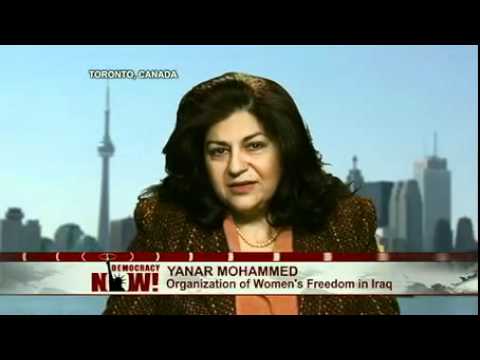
This is an older video still of Yanar Mohammed appearing on Democracy Now! She now lives and works in Iraq. The image is from here.

image of Arundhati Roy is from here
This post's links detail why 'First World'-only justice movements, for people in the First World, are anti-woman if they don't center the experiences of women around the world enduring injustices and horrors not generally experienced by privileged women, and men, in the First World.

For me, a white male from the misnamed First World, seeing images is going to be as bad as it gets. I won't endure the experience of holding a baby with horrifying birth defects, nor will I be a woman who lives in a country where these birth defects, rape, military invasion, and white, patriarchal, imperialist terrorism are, together, committed by the military from the U.S. I can suffer from seeing images and hearing stories, but that's quite different from being the terrorised, horrified person in them.

The U.S. war on Iraq began ten years ago this week. Democracy Now! has been reporting on this war's crimes against humanity, and what U.S. media will not tell us about it. We must, collectively, require accountability and justice from the U.S. for these war crimes.

http://www.democracynow.org/2013/3/20/dahr_jamail_returns_to_iraq_to

Here, Yanar Mohammed speaks about the atrocities facing women:

http://www.democracynow.org/2013/3/20/right_to_heal_iraqi_civilians_join

An excerpt of the transcript:
NERMEEN SHAIKH: And what do you see has happened in Iraq in these last 10 years?
YANAR MOHAMMED: It’s just getting worse. We are again in a police state. We have armies, police and all kinds of intelligence institutions around us. We have SWAT. We have anti-riot. It’s all kinds of security institutions around us.

And on top of that, I see the women in my country getting much weaker. I see an epidemic rise in certain kinds of birth defects. And when we try to organize women—we sent women from my organization to a town in Haweeja. We were surprised to see hundreds of children that had birth disabilities. We see things in Iraq that we’ve never seen in our lives.

I also see young women, orphans of war, female orphans of war, that are being trafficked. And the state absolutely has no obligation towards them. The young women who are being trafficked come to our organization and to our shelters. They don’t even have the right to citizenship in Iraq. We are speaking here about tens of thousands of orphans of war who are absolutely not being taken care of. Neither the Iraqi government nor the U.S. experts in Iraq do anything about it.

Here, Arundhati Roy speaks out about the complete psychosis of U.S. leaders in thinking things are better for women in Afghanistan now than ten-plus years ago:

http://www.democracynow.org/2013/3/18/arundhati_roy_on_iraq_wars_10th

Below is an excerpt from the transcript:
We are dealing with a psychopathic situation. And all of us, including myself, we can’t do anything but keep being reasonable, keep saying what needs to be said. But that doesn’t seem to help the situation, because, of course, as we know, after Iraq, there’s been Libya, there’s Syria, and the rhetoric of, you know, democracy versus radical Islam. When you look at the countries that were attacked, none of them were Wahhabi Islamic fundamentalist countries. Those ones are supported, financed by the U.S., so there is a real collusion between radical Islam and capitalism. What is going on is really a different kind of battle.
And, you know, most people are led up a path which keeps them busy. And in a way, all of us are being kept busy, while the real business at the heart of it—I mean, apart from the people who suffered during the war. Let’s not forget the sanctions. Let’s not forget Madeleine Albright saying that a million children dying in Iraq because of the sanctions was a hard price but worth it. I mean, she was the victim, it seems, of the sanctions; you know, her softness was called upon, and she had to brazen herself to do it. And today, you have the Democrats bombing Pakistan, destroying that country, too. So, just in this last decade, Afghanistan, Pakistan, Iraq, Libya, Syria—all these countries have been—have been shattered.
You know, we heard a lot about why—you know, the war in Afghanistan was fought for feminist reasons, and the Marines were really on this feminist mission. But today, all the women in all these countries have been driven back into medieval situations. Women who were liberated, women who were doctors and lawyers and poets and writers and—you know, pushed back into this Shia set against Sunnis. The U.S. is supporting al-Qaeda militias all over this region and pretending that it’s fighting Islam. So we are in a situation of—it is psychopathic.