Friday, September 16, 2011

Individual vs. Collective Opportunity: which do we have in the US? (Answer: neither, really)

image of hurricane Katrina is from here
President Obama responded, in my mind cynically, to a criticism by Professor Cornel West and performer Tavis Smiley (see *here* for more). They charge, quite accurately, that he has ignored and been entirely unconcerned and uncaring, in policy and practice, to the plight of the poor in the US, and in particular to the struggles of African American males.

In the US currently, the reported (as opposed to actual) poverty rate among whites is much less than among African Americans. This is a consequence primarily of white supremacy fused to corporate capitalism. No other possibility exists in opportunity or in present life, than Black people in the US remaining significantly and substantively poorer than whites, collectively. Never mind Oprah Winfrey or Barack Obama: it is not simply “opportunity” that got them where they worked very hard to be. It is also a white dominated society's wish to appease anti-racism critics who use individual successes as “proof” that the system can work for any one of us. It most certainly cannot.

The collective and systemic truth of the truly perilous and dire situation for African Americans, among other groups of color, is one that President Obama, for all his intelligence, seems unable to comprehend or at least publicly declare: his “solution” is to attempt to increase opportunities for individuals, never for the collective. (And however inadequate those proposals are [link to his speech] they will not be supported by Conservative elected politicians—every one of 'em voted into office with the great help of corrupt media and corrupt wealth, neither of which is available to poor US Americans as a group.

Unaddressed by any of them is what Black, Brown, and Indigenous women (especially lesbians) in the US face: the devastating combination of capitalism's cruelties heaped onto the other cruelties of white, male, and het supremacy. To hear most prominent Black men in the US speak, you'd think Black (het) men always have it worse than Black (het) women. But to believe that you'd have to pretend that patriarchy, male supremacy, misogyny, and heterosexism don't exist at all, both within Black communities and in the larger white-dominated society. Every manifestation of male power over and against women impacts the lives of Black women—not just white men's misogyny, for example.

But returning to the concerns of West and Smiley, how is it that a very smart US president—of any color—could not get it that the US is well-organised to ensure that some groups of people are held down and spit on while the same US leaders promote the power and interests of a few—and not a few “individuals” either? How is it that Bill Clinton or Barack Obama don't get it that corporate capitalism exists, deregulated or not, to crush the life out of the poor while exploiting their labor and other human resources?

Far more cynical and cruel than President Obama are the white, male, and het supremacist activists who comprise the leadership of the ultra-ConservativeTea Party movement, an extremist activist political organisation looking out only for the interests and power-protection of the wealthiest, whitest, and most heterosexistly male members of society? Among them is the current early leader in the bid for president, governor of Texas, (P)Rick Perry.

The Tea Party, including Perry, advocates a particular vision of the US in which Social Security and Medicare, as federal programs, no longer exist as humane mechanisms to support the lives of the most dispossessed (read: structurally, systematically oppressed) members of society. Dispossessed by intention and design, not effect and bad luck. Nothing is accidental about who is poor in this country, if we look at groups of people, not individuals only.

What the Tea Party, GWBush and Co., Bill Clinton, and Barack Obama all have in common is the downright evil practice of extolling the alleged virtues of a “free” market economy tied to rampant militarism which imprisons most US Americans in debt and despair while horrifically destroying people abroad: particularly the people of Central Asia who happen to live in a region that has oil resources under what remains of its topsoil. The policies of these and other activist leaders are genocide, gynocide, and ecocide wrapped up in liberal platitudes.

Chief among the platitudes is this idea that our economic and social-political systems exist to offer meaningful opportunity to all US citizens. Contemporary forms of capitalism allowed to exist by the wealthy offer nothing of the kind; neither do contemporary forms of white, male, and het supremacy. All these well-organised and well-protected systems of power ensure that varied forms of gross violence and exploitation will be visited upon people who are not wealthy, white, male, or het.

Consider images brought to you by a weather reporter of a hurricane forming in the Atlantic Ocean as it makes its way toward the Caribbean, Gulf coast, and East Coast of the US. Consider how the weather is described as “a system”, sometimes a ferocious one merciless in its power to destroy what humans have constructed.

Consider how such a system, if well-organised, infused with enough energy, structured to swirl at great enough speeds with enough force, will do great harm. How much harm we cannot predict, as evidenced when Hurricane Irene swept up the Mid-Atlantic coast to the Northeast, cutting inland into New England. Consider how Hurricane Katrina, several years ago, in collaboration with ridiculous urban planning and construction along the Gulf coast, in collaboration with a woefully negligent US government, resulted in horror and pain that was thought to be impossible in the US, even in largely Black areas of the country.

The weather system called “a hurricane” in the US, has a structure—the visible structure is part of what constitutes such a system from other weather phenomena.

Corporate capitalism has a structure and it is hierarchical with a concentration of wealth among an elite few and a base of poverty shared among the many. Using the “right” to ownership of property as a means of control with State power backing it, the wealthy can and do exact great force against the poor and working people, exploiting them while telling them they have “opportunity” to also become as ruthless as they are.

In the US, this economic system with its earlier incarnations has resulted in an on-going genocide and has required on-going forms of slavery to be able to exist at all. Part of its structure is raced with white supremacy as one ruling ideology-in-practice. Male supremacy is another: rape and social subordination are two methods of its production: mass terrorism and submission are its objectives. Between the two is the spirit- and sex-shaming ideology-in-practice known as heterosexism. Braided, enforced, and enacted together, they strangle the power, will, and hope out of many of us, leaving us damaged, degraded, and depressed—if not dead. But—always more than the ruling oppressive forces would like—some of us keep fighting those virulently inhumane systems of domination and destruction with a vision of a world of unmilitarised peace, cooperative living, and mutual respect.

What is often missing in humane resistance movements is sustained, collective, group-based radical activism. Currently, struggles to make the US more humane are more like an occasional gust of wind than a well-formed lasting hurricane.

Using the ocean as a metaphor, single waves of activism can perhaps bring attention to horrible conditions and may shift the shape of a beach-front temporarily. But I look forward to the power of the oppressed forming into great unrelenting waves of revolutionary social, economic, and political transformation until the CRAP-infested shore is entirely washed away, allowing Indigenist ways of living to thrive again on this Earth.


Wednesday, September 14, 2011

What are the lessons of "9/11"?

image is from here

What, exactly, are we supposed to never forget and what are we supposed to never surrender?

The meaning of significant political acts of terrorism are told to us, formed for us, by media that is controlled by white and male supremacist corporate conglomerates owned by a few white het men in the West, each of whom has some very significant "interests" in how stories get told and who gets implicated as "dangerous". Needless to say, white het men must not ever be implicated as "dangerous", while virtually all other groups of people can be, in media--and every other group has been defined by WHM as diseased, dangerous, invasive, threatening, insane, untrustworthy, deceitful, deceptive, and violent.

Below is one link to what Democracy Now! has to say, which, while progressive, usually steers far clear of naming "white supremacy" and "male supremacy" and "capitalism" as the key forces which created both the conditions that made "9/11" possible, but also the spins of it made into solid, largely unquestioned stories distributed in off-line and on-line media. The Twin Towers, let's not forget, is where gross violence against the world was perpetrated, but was called "commerce" instead. The victims of commerce, who died on every other day than "9/11/2001" and also on that day, are not remembered, named, or honored as heroes--ever.

http://hw.libsyn.com/p/c/6/a/c6aadaf3ada64df8/9_11_11_Radio_Show_part_2.mp3?sid=f081207ff8a29b99312a856ae53e7d46&l_sid=18778&l_eid=&l_mid=2714355

Here are some lessons from my point of view:

1. Corporate capitalism, formed out of and steeped and marinated in male and white supremacy, cannot bring peace to anything. It only brings terrorism to the poor, to the Earth and its non-human beings, and to women across race, sexuality, and ethnicity, and to men who are not white or het.

2. The West, including especially the US, is a terrorist state, a terrorist organisation on a grand, horrific scale, and any claims it makes--ad nauseam--to "goodness" and "greatness" are soaked in the blood of those it destroys to maintain itself.

3. The US is a pro-genocidal, racist, rapist white male supremacist State. Any attacks against it will result in massive military force, rapist force, racist force, deadly force, grossly and inexcusably exceeding the force used in any attack against it.

4. The supremacist structures of the US and other Western countries remain something their media won't discuss. How it is that men continually maintain (and abusively use) tools of power such as military warfare, terrorism against classes of people (such as by men across race,. class, and sexuality against women; such as by whites across gender against people of color; such as by the rich against everyone not-rich; such as by the politically powerful against the Earth)? The means and methods have been documented, experienced, reported on, catalogued, and survived (by some). Yet we are made to re-conceive the horrors of the inner and outer workings of these systems of terror as if they are perpetually "not understandable" or "incomprehensible". They are fully understandable and comprehensible to the perpetrators. They are deeply understood by the victims of them.

5. The US keeps its deadly power alive by scapegoating "foreign" groups as THE Terrorists of the World. Whether it be the Japanese and Germans, Communists, the Vietnamese, Central Americans, Mexicans, women, gay men, the poor on welfare, or Muslims, we can note how the enemy is definitionally, defiantly, and absolutely never "us" if "us" includes white het men from the US.


Saturday, September 10, 2011

Liberalism vs. Radicalism: The Invisibilisation of Male Supremacist Power in Liberal Politics, Terminology, and Self-Concepts


image is from here

In this post I will identify distinguishing features of liberal vs. radical points of view on various social justice topics.

First up: “Prostitution”, “Sex Work”, and related terms, experiences, and systems

When I hear liberals discuss prostitution, what I hear most loudly and frequently is a call to advocate for acceptance of prostitutes' rights to sell their bodies for sex to men—or to anyone else. The focus is on the individual in society, not on society's impositions against the individual and the collective. The assumption is that systems of harm and exploitation are a given and that while they are in place, we ought to accept as liberating or a form of freedom the ability of some to sell their bodies for sex to consumers of such “sex”. “Sex” itself isn't especially analysed. Whether men ought to have the right to buy human beings for anything at all—including for sex—is not usually challenged as a “right” that's wrong.

Often enough the gender of the procurers and pimps is erased, rendering prostitution something “some people” do with “other people”. Also not questioned is why it is that “some people” are pimps and procurers, and others are prostitutes and sex workers. I see where the two experiences overlap but not much challenge to why they exist and whose interests and whose power these practices exist to support.

As a radical, my views don't focus on what prostitutes ought to have the freedom to do—other than the freedom to be free from men who sexually abuse other human beings, especially girls and women. I instead focus my attention, analysis, and activism (when opportunities arise for activism to occur) on what anyone ought to have the freedom to not experience: sexual and economic exploitation; sexual abuse including incest, molestation, and rape; harmful impositions of male, white, and Western supremacist values and practices; and the grossest (most invasive and damaging) dimensions of capitalism on classes of human beings.

Starting with the latter, poverty, desperation, and homelessness—each impacted quite significantly by heterosexism, misogyny, and Western white supremacy—are requisite condition for most people engaging in prostitution globally. When I think about and have experienced aspects of the world of sexual exploitation organised into a system of atrocity, I consider whether whole groups of people are more negatively impacted than others, and which groups lead the charge for adoption of methods of making prostitution safer rather than abolishing it as a form of abduction and slavery. If I only listen to the more privileged people (whether class privileged, Western, white, or men) in the system of harm, I might conclude that modifying the system would be a humane course of action. But if I consider how such modifications impact on the less privileged classes and groups of people (such as poor Black, Brown, Asian, and Indigenous girls and women globally, living inside and outside North America and Europe), such reforms look like cruel dismissals of their experience and suffering.

In any radical form of activism, I believe those who are systematically made to suffer most, to be raped most, to die most, ought to be central in any course of activist action. Given all this, liberal views on prostitution don't hold much water for me, although I don't oppose actions designed to make conditions for anyone, inside or outside systems of sexual exploitation, safer rather than less safe.

A radical feminist position on prostitution interrogates most every aspect of what it means to live in a world where prostitution exists. The most glaring omission in the whiter side of the interrogation has to do with prostitution's relationship to white and Western supremacy, in my experience. But white radical feminists, specifically, bring to the challenge questions about what it means to be human, who decides what “sex” is, and which groups or classes of people are in charge of any system of exploitation that, in my experience, liberals usually ignore and see as irrelevant.

The term “sex work” makes the whole of the system of atrocity and slavery non-existent or distinct as a social-political phenomenon, as if “sex work” can exist independently of sexual slavery. (In the world I see and live in, it cannot and does not.)

Next up: transgender and queer terminology

I find it necessary to discuss this issue here because of my own struggles to understand my own “gendered” experience. Conservative and liberal definitions and concepts flood my social world and shape the names I give myself. With thanks to a radical Lesbian activist, I have been questioning and challenging my own use of the term “intergender” to describe my experiences and feelings. I think the most appropriate challenge to me has been to consider how such a term, or the term, “transgender” impacts those who are most egregiously marginalised and abused by gendered systems of violence. Now, the list of who is harmed by gendered systems of violence is long and may well include just about everyone. But as I see it, there are some groups of people who fare particularly poorly given the status quo, at least the status quo of the West and those groups are, 1. Girls and women, and 2. Lesbians and gay males. Obviously the two groups overlap in the experiences of Lesbian girls and women.

What I've seen happen over the last twenty to thirty years is a systematic marginalisation and stigmatisation in liberal circles of radical Lesbian and radical Gay politics, perspectives, and practices; simultaneously there has been a flourishing of liberal queer and trans politics, perspectives, and practices. Similar to liberal understandings of what prostitution is and exists to do, liberal queer understandings of gender generally ignore or avoid dealing with how and to what degree male and white supremacy are fused to our own personal feelings and understandings of ourselves, including the concepts we use to name what we feel and believe about ourselves. Terms are common now in queer circles that do not make male supremacy, for example, at all visible as an ideology woven into concepts and practices that we may embrace as “liberating”. Just as the term and concept of “sex work” avoids naming the white supremacy, misogyny, and capitalist abuses present in any systematised form of sexual-economic exploitation, terms like “intergender” and “transgender” do the same, quite liberally.

Our feelings and experiences are shaped by the concepts and terms available to us socially. In any given era, only some terms and concepts become socially used, while many others, used before and since, get snuffed out. Such is the case generally with terms used to discuss sex, sexuality, sexual orientation, and gender. None of what is discussed in dominant media places male supremacy or patriarchy near or at the center of discussions about who we are and why we believe what we believe.

What being "Gay" means, as well as what "Lesbian" means, have been scrutinised and critiqued through radical lenses for forty-plus years. To all those who say that trans people are being expected to question things no one else in the LGBTIQA community is made to question, I'll remind you that we ALL have been made to question EVERYTHING, down to our assumptions about the biological (vs. cultural-political) nature of our desires, feelings, and identities. See, for example, Adrienne Rich's writing on Compulsory Heterosexuality and Lesbian Existence.

I'll tangentially mention here that I've seen how this has happened in the movements to end intimate, private, relational sexual violence against women. What used to be a movement to end men's battery of women has been re-termed a “domestic violence project”, thereby invisibilising the brutal male supremacy at work in any gendered dynamics, but especially in heterosexist and misogynist ones.

What do concepts and understandings such as “intergender” and “transgender” tell us about ourselves, our world, and what gender is and does? To me, it makes gender into an entirely social, personal, individual, and biological condition, and it becomes political only when people are organised to prevent some het men's rights from being afforded to other people. “Intergender” and “transgender” pretend that “gender” is a social continuum to be expanded, or a biological binary to be explored and respected, not a hierarchy to be overthrown. I see gender as a profoundly political system that is deeply anti-woman, anti-Lesbian, and anti-gay. How do the discourses and activist developments of the last twenty years dovetail with efforts by feminists to derail and demolish the terrifying train of male supremacy? What I see are largely liberal constructions of self and sexuality that in no way implicate male, white, or wealth supremacy as forces shaping our feelings and understandings, which is also to say our experiences of who we are.

In naming myself “intergender” I was attempting to make a statement about how my whole life's experience is one that is outside what is progressively thought of as a dualistic gender binary. It doesn't “fit” with how I saw myself relative to boys my age, across my childhood and into adolescence. Perhaps the only point of familiarity or commonality with other boys was in recognising that my sexual attraction wasn't to “an opposite sex”, physiologically speaking, although as Andrea Dworkin detailed in her book Woman Hating, such an understanding of sex and gender is already distortive and discriminating in oppressive ways. How does “intergender” and “transgender” support radical efforts to end male supremacy? Does it matter if it doesn't?

I'd say the answer to that is fused to the matter of what we understand to be going on, or going down, all around us and in us. For example, if you don't see prostitution as a system that welds capitalism to white and male supremacy, you might view abolition movements to end all forms of trafficking, buying, renting, and enslaving human beings as irrelevant to your cause and condition. But me being gay means my life is fused to the struggles of all people who want to end the tyranny of heterosexuality and masculinism—of heteropatriarchy to use the term which combines those dehumanising and terrifying realities.

It doesn't surprise me that terms like transgender and sex work will fare better than terms like male supremacy and sexual slavery in a liberal social economy which generally refuses to name the extent to which male and white supremacy and capitalism pollute and infect our lives, robbing us of the hope for a freedom that isn't built on systems that require some of us to be sacrificed.

This isn't to marginalise or silence those of us who use those terms; it is, rather, to call on all of us who want something called “freedom” and “liberation” to evaluate, in hopefully loving community, what the deep political implications are of using those terms to begin with. If liberalism is fused to their usage, how might a radical perspective and practice of naming ourselves shift our terminology towards words that don't deny the realities of male and white supremacist and capitalist terrorism.

For the time being, I will not be using the term "intergender" to describe myself. I will, instead, say that I willfully, actively, and imperfectly refuse to behave and "be" as men would have me behave and be in order to fit in with the boys-to-men of patriarchy. And that an awareness of this need to refuse, for my own survival and for the betterment of girls and women, was in me from an early age. This understanding keeps male supremacy central to my own motivations, sensibilities, and feelings without denying or marginalising any of them.

I hope this opens respectful discussion of these and related issues.

Saturday, September 3, 2011

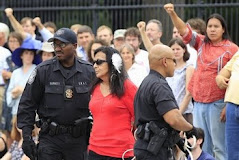
From Censored News: Indigenous Activism Outside the White (Supremacy) House: Arresting the Wrong People

Everything that follows was found at Brenda Norrells' website Censored News. Please visit that website for more on these acts of heroic protest, *HERE*:


VIDEO: Kandi Mossett: Halt the tar sands


See also the summaries of news reports below.


NOW: 244 people ready to be arrested at the White House

NOW: 244 people ready to be arrested at the White House 
City bus brought in to tak them to jail. As of yesterday, 1009 people arrested. Tar Sands Action mobile upload.

NOW! Crowd readies for arrest at the White House

NOW! Crowd readies for arrest at the White House 
WHITE HOUSE: Today is the final day of two weeks of sit-ins and arrests to halt the tar sands. Morning message to President Obama: "We're here Mr. President. Will you offer the same courtesy you offered the corporate lobbyists at the Chamber?" Photo mobile upload Tar Sands Action.

Lakota Debra White Plume arrested at White House

Lakota Debra White Plume arrested at White House 
Protest to stop the tar sands. AP photo in India Times.

Heroes arrested at White House Tar Sands Protest

Heroes arrested at White House Tar Sands Protest 
Kandi Mossett, Mandan, Hidatsa, and Arikara, from North Dakota, arrested today at White House Tar Sans Protest. Photo Shadia Fayne Wood.

"Female Trafficking Soars in Iraq", by Rebecca Murray, with news from Yanar Mohammed

All that follows in this cross-post is from *here* at IPSNews.net.

Female Trafficking Soars in Iraq 
By Rebecca Murray

BAGHDAD, Aug 27, 2011 (IPS) - Rania was 16 years old when officials raped her during Saddam Hussein’s 1991 crackdown in Iraq’s Shia south. "My brothers were sentenced to death, and the price to stop this was to offer my body," she says.

Cast out for bringing ‘shame’ to her family, Rania ran away to Baghdad and soon fell into living and working in Baghdad’s red light district.

Prostitution and sex trafficking are epidemic in Iraq, where the violence of military occupation and sectarian strife have smashed national institutions, impoverished the population and torn apart families and neighbourhoods. Over 100,000 civilians have been killed and an estimated 4.4 million Iraqis displaced since 2003.

"Wars and conflicts, wherever they are fought, invariably usher in sickeningly high level of violence against women and girls," Amnesty International states.

Rania worked her way up as a sex trafficker’s deputy, collecting money from clients. "If I had four girls, and about 200 clients a day - it could be about 50 clients for each one of them," she explains.

Sex costs about 100 dollars a session now, Rania says. Many virgin teenage girls are sold for around 5,000 dollars, and trafficked to popular destinations like northern Iraq, Syria and the United Arab Emirates. Non-virgins are about half that price.

Girls who run away to escape domestic violence or forced marriage are the most vulnerable prey for men working for pimps in bus stations and taxi stands. Some girls are also sold into marriages by family relatives, only to be handed over to trafficking rings.

Most of Iraq’s sex traffickers are predominantly female, running squalid brothels in neighbourhoods like the decrepit Al-Battaween district in central Baghdad.

Six years ago, a raid by U.S. troops on Rania’s brothel brought her nefarious career to an abrupt end. The prostitutes were charged along with everyone else for abetting terrorism.

Imprisonment changed Rania’s life. While she served time in Baghdad’s Al-Kadimiyah lock-up – where more than half the female inmates serve time for prostitution – a local women’s support group befriended her. Today she works for them as an undercover researcher, drawing on her years of experience and connections to infiltrate brothels throughout Iraq.

"I deal with all these pimps and sex traffickers," Rania says, covered in black, with black, lacquered fingernails and gold bracelets. "I don’t tell them I’m an activist, I tell them I am a sex trafficker. This is the only way for me to get information. If they discover that I’m an activist I get killed."

In one harrowing experience, Rania and two other girls visited a house in Baghdad’s Al-Jihad district, where girls as young as 16 were held to cater exclusively to the U.S. military. The brothel’s owner told Rania that an Iraqi interpreter employed by the Americans served as the go-between, transporting girls to and from the U.S. airport base.

Rania’s co-workers covertly took photos of the captive teenagers with their mobile phones, but were caught. "One girl went crazy," Rania recalls. "She accused us of spying. I don’t know how we escaped," she exclaims. "We had to run away - barefoot!"

Before the Gulf War in 1991, Iraq enjoyed the highest female literacy rate across the Middle East, and more Iraqi women were employed in skilled professions, like medicine and education, than in any other country in the region.

Twenty years later Iraqi women experience a very different reality. Sharia law increasing dominates everyday life, with issues like marriage, divorce and honour crimes implemented outside of the court system, and adherence to state law.

"Many factors combined to promote the rise of sex trafficking and prostitution in the area," a Norwegian Church Aid report said last year.

"The US-led war and the chaos it has generated; the growing insecurity and lawlessness; corruption of authorities; the upsurge in religious extremism; economic hardship; marriage pressures; gender based violence and recurrent discrimination suffered by women; kidnappings of girls and women; the impunity of perpetrators of crimes, especially those against women; and the development of new technologies associated with the globalisation of the sex industry."

The International Organisation of Migration (IOM) estimates 800,000 humans are trafficked across borders annually, but statistics within Iraq are very difficult to pin down.

Although the Iraqi constitution deems trafficking illegal, there are no criminal laws that effectively prosecute offenders. Perversely, it is often the victims of trafficking and prostitution that are punished.

IOM is currently working with an inter-ministerial panel to lobby for a new reading of the revised counter-trafficking law, which has been stalled by the government since 2009.

"We have reports about trafficking both inside and out of Iraq," says senior deputy minister, Judge Asghar Al-Musawi, at the Ministry of Migration and Displacement.

"However, I admit that Iraqi government institutions are not mature enough to deal with this topic yet, as the departments are still in their growing phase."

Human Rights Watch (HRW) says the government has done little to combat the issue. "This is a phenomenon that wasn’t prevalent in 2003," says HRW researcher, Samer Muscati.

"We don’t have specific statistics. This is the first part to tackle the problem; we need to know how significant and widespread the problem is. This is something the government hasn’t been doing. It hasn’t monitored or cracked down on traffickers, and because of that there is this black hole in terms of information."

Zeina, 18, is an example of an invisible statistic. According to the local Organisation of Women’s Freedom in Iraq (OWFI), she was 13 when her grandfather sold her to a sex trafficker in Dubai for 6,000 dollars. She performed only oral sex with customers until a wealthy man paid 4,000 dollars to take her virginity for one night.

After four years of prostitution, Zeina finally escaped the United Arab Emirates and returned back to her parents in Baghdad. She approached the authorities and took her grandfather to court. However, Zeina has since disappeared. OWFI has learned she was sold again, this time by her mother to a sex trafficker in Erbil.

OWFI director Yanar Mohammed says her office has been threatened for their advocacy against the lucrative trafficking industry, especially reporting on an infamous brothel owner in Al-Battaween district known as Emam.

"In each house there are almost 45 women and it is such a chaotic scene where women get treated like a cheap meat market," describes Mohammed. "You step into the house and see women being exploited sexually, even not behind closed doors. So the woman who runs these houses makes an incredible income, and has a crew around her to protect what she does."

Emam is said to enjoy close ties with the Interior Ministry, and has never had one of her four houses shut down. Despite OWFI’s expose, her operations are unaffected.

Mohammed sighs. "Iraq has a whole generation of women who are in their teens now, whose bodies have been turned into battlefields from criminal ideologies." (END)
 

Thursday, September 1, 2011

Problems on this end

I'm having trouble getting online for a few reasons. I apologise for the delays in posting and responding to new comments, and for the gaps between posts too. 

Saturday, August 27, 2011

On Whether "Patriarchy" is the Root of All Other Oppressions. Q: Who benefits from this perspective? A: Rich folks and whites

This post exists to support, in an unsolicited way, of a series of posts by Lb over to The Vagina Conspiracy, a radical feminist blog by a Black woman. (See *here* and also below for that series.)

White radical feminists, historically and presently, often promote an idea and it is this: "patriarchy" (seemingly unraced or beyond race or inclusive of all races) is the root problem, the root oppression, and, from a radical/root perspective, activism focused on eradication patriarchy is sufficient to liberate women from the systemic oppressive realities that confine, subjugate, dominate, and destroy them. I'll address my problems with this perspective in a moment. Lb addresses her problems with it here:


The Root from Lb'rashon Breed on Vimeo.


The Root 2 from Lb'rashon Breed on Vimeo.


The Root - Clarification from Lb'rashon Breed on Vimeo.


Before I go on, I'll note that many white radical feminists arrived at this perspective in part because of their long-standing frustrations and dead-ends with radical activist and Leftist men across race conveniently "forgetting" to address patriarchy, misogyny, sexism, and male supremacy in their own ranks, among their own groups, in their own agendas, in theory and in practice. I have argued with more white anti-Capitalist men than I can count--some of whom are marxists--about the glaring omission of "patriarchy" in their understanding of what needs to be radically challenged socially. Across the last several decades and to this very day it is beyond rare to find any man (across race, region, sexuality, class, and age) who takes patriarchy seriously as an oppressive social-political-economic form (often termed by men: "civilisation" or "society" or "capitalism" but never managing to appropriately identify how and where men are in charge). Patriarchy exists to place women beneath men in every way patriarchs can.

Also, Liberalism as a political frame that historically comes from white Europe and has specific form in North America, the UK, Australia, and in other places globally, ignores patriarchy as a system of atrocity and oppression when it comes to presenting plans of so-called progressive personal-political action. Liberalism tends towards obfuscating systems of oppression. It does this in several ways and detailing those ways is beyond the focus of this post. But basically, Liberals contend with systems of harm--when they do so--by pretending that unorganised individual action is sufficient to bring about adequate social change. Liberals also pretend that ideas or thoughts alone carry as much weight as economic, social, and political acts of force, aggression, hostility, colonisation, and dominance.

Practitioners of White and Western forms of Liberalism (including its more restrictive and repressive cousins, White and Western forms of Conservatism) don't publicly acknowledge they are operating out of a Liberal framework. They also don't usually address most forms of violating and lethal oppressive force, actually, but the fact that it doesn't deal with patriarchy and has no plan of action to eradicate it from social-political-economic worlds, doesn't excuse it from taking this matter on, seriously and systematically, with organised revolutionary vision.

Part of how systems of oppression achieve success is by rendering the oppressed only capable of attempting to survive the harms promulgated by the inhumane systems. If one is dealing with depression, poverty, PTSD, and hateful aggression directed against oneself and one's people daily, it may be difficult to find time, will, and energy to fight the larger systems in organised ways with larger groups of people. That said, most radical and revolutionary activists are not privileged by wealth, lack of warfare, or by race, class, and gender. But most people are not race- and class-privileged, after all.

In countries that value corporate or State-funded academic learning as a site of "primary knowledge", we find that class- and education-privileged people are often assumed to possess the best qualifications to lead the rest of us out of trouble and into a better world. I probably used to believe this was the case to some degree at least: that only the "best and brightest" as determined by CRAP, could know what we need to do to end all forms of oppression. I not only don't believe that any more, but I also believe that the generally Liberal Academy has its own agenda and accomplishing anti-patriarchal, anti-racist, economically humane revolution for all women it is not.

Jessica Yee has edited a book that deals with this in much more detail. I hope in the coming months to discuss that book titled Feminism FOR REAL: Deconstructing the Academic Industrial Complex of Feminism. You may link to it *here*.

Across the last several decades, radical and feminist women of color have challenged many assumptions that are white supremacist and that are seemingly intransigently enthenched in white radical feminism and white liberal feminism. The white supremacy is entrenched, in part, by "radical feminists" who don't own or behave responsibly (meaning here: accountably to women of color) with the race-privilege, race-entitlement, and race-power loaded into their perspectives and courses of proposed or practiced action.

After publishing a recent post on this subject (see *here* for that), someone posted a comment which will not be published at this blog as it violates my Comments Policy: it's grossly racist, for one thing. It was submitted by someone who calls themself "Unknown". In it, there was an assumption that me challenging or naming the racism in white radical feminism was a divisive maneuver, was highly manipulative, and is an anti-feminist thing to do. What is often forgotten by whites is exactly how divisive and anti-feminist racism is in white radical feminism (and in white anti-radical, anti-feminist circles too). Typically, whites see the naming of our power and privileges as whites as "divisive" and the divisions they unintentionally highlight are those among white people.Whites don't relish having our collective power diminished, among all of us or among various constituencies of white people, including among conservatives, liberals, radicals.

The critique in the unpublished comment I suppose was sent in order to shame or silence me and others who name white power as such. That I am male (and white) is supposed to be cause for me to never name racism in any group other than white men. To clarify: that's not my politic (and is obviously not my practice), any more than it is my politic to not name sexism in any group other than white men. This blog exists to call out, name, challenge, analyse, and support activism fighting all forms of heterosexism, racism, and misogyny: including the racist misogyny that is so unchecked and unchallenged generally by white women, by white men, and by men of color--all across barriers of class, region, and sexuality.

So if you're not comfortable with me doing that, don't read the posts at this blog. My powers are incredibly limited due to not being part of any major industry, any academic institution, or any political office. I also don't own or control any media franchises, religious institutions, or tech software. But if you come here, please expect to see any expressions of classism, xenophobia, genocide, racism, heterosexism, and misogyny that I encounter socially called out for what it is and for what it does.

We can recall that anyone across race and gender who calls out white power as the destructive racist-misogynist force that it is, will be told to shut up by someone who is uncomfortable having a light shone on it. And so whether it is by a woman of color, a man of color, a white woman, or a white man (or male), I expect to see silencing tactics--rather than respectful tactics of mutual engagement--be employed. "Unknown" did a fine job of illustrating the knee-jerk reactive defence of white power, cloaked as being anti-feminist in this instance, that anyone challenging it is likely to experience. Sad but true. But beyond sad it is dangerous.

The danger is the important thing to not forget. For ideas, thoughts, and ideologies that are liberal, white supremacist, male supremacist, and heterosexist, all are powerful to the extent that they are practiced systematically, are structured into social systems, and are politically protected as speech and action both.

I support radical and feminist women of color challenging male and white supremacy in every environment they are in, endure, and fight against. I support anyone doing so in ways that are not, in and of themselves, misogynistic and racist.