Sunday, June 19, 2011

Who's Got (More) Power? Radical Lesbian Feminists or Liberal Trans Activists (I'd say "Neither")

image of transgender visibility symbol is from here
[Revised later in the day after the initial posting on 19 June 2011.]

20 June 2011 update: 
I wrote to Lisa Harney at Questioning Transphobia, asking her if she'd also be willing to talk about some of this post.

Here's that comment, which has yet to be received and responded to.

Your comment is awaiting moderation.
Hi Lisa,
I’ve been trying to reach out and get some constructive discussion going around trans and radical feminist issues and tensions, to try and resolve some of the divides.
Are you open to doing that? Here’s my latest post on thee subject, and if you wish to, I welcome you to email me or post a comment to my site letting me know of your interest in discussing stuff further.
Cheers.
Julian

I found a post by a trans and radical feminist blogger named Joelle Ruby Ryan and posted a comment. Her post illustrates tensions between Radical Lesbian Feminists and Liberal Trans Activists. My understanding is that Joelle is a Radical Feminist Queer Trans Woman-identified writer and professor, and so I've welcomed her to discuss the issues that exist between the two groups--both of whom are relatively small and each of which is greatly marginalised from mainstream society.

*Here's a link* to her post, which identifies Sheila Jeffreys as a dangerous hate-monger.  This post is not about Sheila Jeffreys. This post's concerns extend beyond Sheila, to those tensions between the two non-unified groups. While you'd never know this from reading MRA sites, neither radical feminist nor trans ideology is readily identifiable as "one viewpoint". To call each "one ideology" is already getting oneself into trouble, drifting rather dramatically from social-political reality almost always misperceived as simpler than it is.

For those new to the views presented by this blogger, I identify Liberal politics as effectively (if not always intentionally) genocidal and gynocidal. While I find Sheila Jeffeys' views to be 'her own', I'll acknowledge they are not outside the current discourses found among some white radical feminists. So, to all of us I ask this preliminary ethical question: What's worse? Promoting bigotry or actually committing mass oppression, terrorism, and murder? I know there's an argument that Sheila's promotion of transphobic bigotry leads to all many other forms of violence, but that's a bit unsubstantiated--we cannot know the extent to which her own views, those that are bigoted and those that critical, lead others to commit systematic violence against trans people. We can, quite effectively, track how Liberalism-in-action directs societies to be systemically gynocidal and genocidal. I have attempted to do so here, across many posts from many activists and sources internationally.

This is a point of contention, for me, with Liberalism. There is a propensity for Liberal activists to view all forms of inhumane violence equally. But in reality it is rarely done. People across political locations tend to downplay the horror and terror of their own violence against others; trans activists participate in this process of minimisation when they discursively or verbally assault Radical Lesbian Feminists: they typically identify how they've been harmed but don't as readily identify how they've been harmful to others. Meanwhile, those same people across political locations, and others such as US Conservatives, will typically amplify the effects of violence "done to us".

The US government will proclaim what happened on Sept. 11, 2001 as the most violent action to occur in human history--or, at least, in US history. Focusing on what's gone on within the US alone, we may note that seeing the attacks on "9/11" quite effectively forgets and disappears extreme violence such as the US patriots' and government's genocide against Indigenous North Americans; white colonialists' slavery and the whole of the Maafa; the trafficking of raped girls and women; the rape of girls and women who are not trafficked; domestic terrorism of women in heterosexual marriages and other primary heterosexual relationships; and so many other forms of gross violence--all considered either non-existent (though denial and delusion), natural (by essentialising many expressions of the culturally, historically, regionally relative human "nature" of "Man"), or normal (read: acceptable, god-ordained, and inevitable).

On the subject of denial and its relationship to dominance, we can note that it takes a lot of privilege to pretend that Liberalism isn't misogyny, transphobia, racism, genocide, and other mass atrocity; you have to believe in Liberalism's stated benign-to-benevolent objectives and ignore that it has never met and cannot meet any of them because it has no means and methods by which to do so. Instead, it makes promises it cannot keep and allows and encourages all manner of horror to play out unimpeded, with lip service paid to the wrongs it protects.

Aside from dedgurl, Dean Spade, and Joelle Ryan, all the trans people I know personally of are Liberal to Progressive. At least one of the trans visitors to this blog, Sara, is a social-political Conservative. The Conservative-to-Liberal position on the unceasingly misogynist gender hierarchy is that it is a matter or condition of difference, unbridled from something Radicals call "male supremacy".

Justice, for Liberals, is achieved only theoretically, when, at some future time, non-trans women and men along with all trans people are all equal to one another in rights and entitlements. We must ignore the fact that even if this were to occur among all the white and class-privileged folks who gain maginalised access to the media microphone most of the time, it still wouldn't be true due to continuing systems of inequality known as racism, heterosexism, and classism. The Conservative position is that gender is natural through and through--completely free of human encumbrances like "ideology". Conservatism holds that pesky anti-patriarchal laws which try and regulate what men do are not only unnatural, but against a white male sky-god's right, good, and wise plan for us. Needless to say, I disagree with both the Liberal and the Conservative positions.

In Dean Spade's views, I find Liberalism embedded in the practice, not Radicalism, with regard to gender. And that's assuming a definition of Radical that I uphold and promote. I'm not meaning to say that Dean or anyone else has to adopt my definitions. I use the definitions I have here to make my posts more comprehensible and consistent with one another. I've spent a few posts identifying what I mean by Radicalism and Radical Profeminism. I welcome visitors to read those posts. Two of them* are "What Does Radical Mean Here" and "On Radical Identities and the Consciousness of some White Bloggers".

I hear Dean promoting the need to end gender but not by doing what Radical Feminists argue must happen for gender to end: removing all manifestations of male supremacy from all social and psychic worlds. I am not familiar with Joelle's views and values enough to come to any conclusion about where she stands on "gender". I don't presume she is an adherent of Spade's views. Due to how she identifies, I suspect her view is a more complex and nuanced viewpoint than any standard Liberal or Radical politic.

One problem with the presentation of women's identity within some trans communities is that it effectively distances womanness--the social-political condition, not the essentialised bodies--with having been raised, in fact and in reality, as a girl while also being socially perceived as a girl, from birth onward, across culture and region. I note this general, lived reality without declaring that it is absolutely universal. For many women if not all women, oppression based on gender is a cumulative experience of domination, degradation, and disregard, not one of choosing one identity among other options. It is a very serious matter of what happens to one's socially targeted body from birth to death. "Women", in this view, are forcibly made far more than they are freely willed into existence. To the extent they are willed at all, it is men's, not women's wills at the helm.

Much of Queer and Trans political viewpoints posit gender as Difference (not Dominance) and as Chosen Identity (not Forced Condition). Women's identity as "women", from a Radical viewpoint, is a response to the oppression. There is something comparable at work, but not identical, with many racial identities.

Blackness is not a born or freely chosen condition or identity. I take this perspective from Black activists: It is a culturally varied condition that is taken up collectively as an identity for the purposes of survival. This is the case within Aboriginal society as well as African American society. Raced force culminates in identities, not the other way around. The identities may well live out that force in many ways but the force must be institutionally or systemically in place before the identities come into existence.

Seen this way, race and gender as differing identities are responses to a virulently and viciously enforced patriarchal white supremacy or an otherwise raced male supremacy (such as in Japan) that insists on maintaining a political force cloaked as the identity: "Whiteness" in the US, Germany, and South Africa; allegedly supreme or inferiorised race among other nation-states.

Blackness is not only that, however. For it is always the case that anyone with any identity, occupying any political/structural position, is fully human and therefore not describable by identity. The conceit of whites and men is that they often enough discursively and institutionally disappear their race and gender by claiming to represent humanity as a whole. (This can only be done if the force of white and male supremacy is already firmly embedded in the institutions and systems within any given society.) In doing so they highlight other raced conditions and gender identities as somehow other than what they are.We end up with identities fused to power, privilege, and entitlement, capable of making statements like, "Feminists keep viewing me as a man; I'm a Human!" Or, "Black people want me to take responsibility for the unjust ways of my whiteness, but all I am is human." This ability to dislocate oneself from time, place, history, culture, socially organised force reeks with entitlement. What woman of any color has the capability of doing so? Even if she attempts to declare herself "just human" separate from her foremothers and other women contemporarily terrorised and dominated by men, there will be men to remind her exactly what social position they want for her to occupy. This is how oppressive power works: If social dominants want you to be somewhere, you are there. If social subordinates want dominants to not be dominant, well, keep hoping for things to change.

The theoretical and experiential parallels and intersections between race and gender have been most acutely and analytically identified by women of color who are theorists, activists, and citizens of countries ruled by others who refuse to place them in the most privileged position. For example, the Black women I know, most of whom are not rich or middle class, describe lives narrowed and obstructed with encounters with several social-political-economic hierarchies. These happen in various environments and social forms, from economic exclusion to interpersonal insult to institutional discrimination. The limitations of freely lived life are structural not personal. Shifting identity doesn't bring meaningful liberation. Effective liberation is understood to be collective not individualistic. Opposing this liberation are the members of many political groups, including white men, white women, and men of color.

Indigenism, as I understand it in limited ways, rises as a spiritual, social, cultural philosophy, or Ways, that is in response to (murderously anti-Indigenist) CRAP. Identifying as "Indian" in North America, or here or elsewhere as "Native", or "Aboriginal" or Indigenous", is always contingent on there being a colonising, often imperialistic, always pro-industrialising oppressive invading and occupying force, known colloquially in my part of the world as "Western Civilisation".

To see gender or race only as difference and identity is to ignore the political forces keeping each a very vicious hierarchy intended to do harm to those who are not ever on top. Many Radical Feminists I know object to any politic which, along with traditional white male supremacist ideologies, seeks to obscure or invisibilise the male supremacist political force that constructs and gives social meaning and manifestation to "gender".

At issue is not only whether and to what degrees Sheila Jeffreys promotes bigotry about and hatred towards trans-identifiable people. I want to distinguish between people who are identified as trans (whether or not they are) and the rest of us who are trans-identified (whether or not we are ever targeted as such by non-trans people). We ought not forget that most trans people aren't socially perceived as being trans; most trans people have what a few academic trans people call "cis gender privilege". I maintain that this form of privilege isn't socially clarifying or politically useful to the collectivist struggle if most trans people have it, and many non-trans women do not. I've yet to hear any trans activists discuss this problem with the term. I accept that on a more individualistic level, the concept has deeply meaningful resonance.

Also at issue is the matter of anti-feminism and anti-Radicalism among Liberals--trans and non-trans people. Part of this shows up as an over-valuation of the power of  Radical Lesbian Feminists. As we can see with politically Conservative MRAs and other Conservative anti-feminists, a key argument put forth by enemies of Women's Liberation is that feminists simultaneously want and already have too much power. I've seen similarly racist and patriarchal self-serving attempts to discredit, disregard, and degrade Radical Feminism--Lesbian and not; Black, Brown, Indigenous, Asian and white--by ascribing to it forms and manifestations of power, relative to racist heteropatriarchal power, that it has never had--and still doesn't have. In particular, I note how white Lesbians and Black women across sexuality are assumed to be far more dangerous-to-society than they have yet to demonstrate; they occupy no such places to substantively change the political configuration of the societies in which they currently live.

Within this dynamic emerges another: positioning non-trans women in a gender hierarchy as "the oppressor". Lost in such discourse and efforts at divisiveness, in such presentations of reality, is the role non-trans men play in determining the rest of our lives, not absolutely or in an essentialist way, but in a profoundly politically significant and substantive way. Again, there is a history that is alive and well, which targets women as The Problem population, ignoring or staying in denial about what non-trans men do to everyone--including to other non-trans men and to trans people across gender. MRAs are simplistically fond of calling feminists "fascists" and "man-haters", while ignoring the many actual ways men are fascistic trans-haters, woman-haters, and man-haters.

When I visit many Liberal to Conservative (racist and heteropatriarchal) trans blogs, I see few to no discussions of how men oppress anyone who is gendered to be "not a man who was raised as a boy". At these same blogs I see Radical Lesbian Feminism, and Radical Feminism generally, targeted as THE ideological and practiced form of anti-trans intellectual and political activity. Whose interests are served by rendering invisible the harm men do and by over-stating the power of R.L.F? I'd argue any politic that does this disappearing act of racist and patriarchal abuses, while also unfairly targeting R.L.F. is anti-woman and anti-trans, which is also to say effectively murderously misogynistic and racist, while also lethally (not just theoretically and discursively) transphobic. This means that whatever Sheila Jeffreys writes, it is structurally, positionally impotent relative to what Liberals and Conservatives do--including what Liberal and Conservative trans activists and writers do.

I welcome Radical trans writers and activists like Dean Spade and Joelle Ryan to call this out and hold Conservative and Liberal trans allies to account. Without Radical trans activists and bloggers doing so, we are left with trans bloggers calling Radical Lesbian Feminists "transphobic" while R.L.F.s remain the only activists seeking to end the systems that make transphobia socially/structurally possible. This is beyond ironic. It's misogynist.

I'll add this question: does being transphobic have more sting and stigma than being misogynistic and racist? From my views on Liberal feminist blogs, it appears to be the case. I've seen many white, class-privileged Feminist bloggers who are not trans or queer, be far more careful to not be transphobic and wedded to cis gender privileges (as a few white trans spokespeople very narrowly, define it in ways perilously steeped in classism), while those same bloggers remain unresponsive, unaccountable, and otherwise dehumanising to Radical Lesbian Feminists of all colors. This leads me to highlight that inside many Queer communities, anti-Radical Lesbian politics and practices, both Feminist and Separatist, have intensified precisely while Conservative to Liberal Trans politics have begun to take root. The connections between the two phenomena ought to be carefully examined by anyone who is pro-trans, pro-woman, and pro-Lesbian. Lesbophobia ought not disappear as a potent charge as long as transphobia and "misandry" carry stigma and sting.

In my experience, Liberalism isn't seriously called out (or even understood) by anyone other than Radicals. Conservatives don't like it, but they need it desperately as their conjoined nemesis; both Liberalism and Conservatism share more in common than the issues that make it appear they are oppositional political philosophies-in-action.

What I hear Radical Lesbian Feminists calling out about trans politics is its Liberalism and Conservatism. This is as valid a critique as the R.L.F. critiques of Gay politics, Liberal Lesbian politics, and heterosexual politics. Many trans people have brought me this argument: why do Radical Lesbian Feminists target trans people for a form of personal-political interrogation that is not leveled at anyone else. My response is that R.L.F. critiques have been and are brought to bear on everyone, of every sexual and gender expression and politic, including on its own. To not know this is to demonstrate significant ignorance about the history of Radical Lesbian Feminism.

In queer community, particularly but not only over the last twenty years, I've seen a whiddling down of R.L.F. philosophies, with very sharp intellectual knives held steady in the hands of het men, het women, gay men, bi men and women, and more recently by Conservative and Liberal trans activists. These critiques are not intended to make R.L.F. more effective; they are intended to render R.L.F. non-existent. These Conservative and Liberal challenges are predictably pro-status quo.

Academic Liberal post-modern philosophies are used to keep the institutional powers of the status quo in place, even while socially activist Radical post-modern philosophies were designed to expose and challenge the hypocrisies and horrors of that same status quo. In queer community now, Liberalism and Conservatism reigns supreme. Radical trans viewpoints are refused and refuted as being transphobic.

This doesn't mean LGBTIA communities ought to be regarded as more dangerous--or, even, just as dangerous--as het male-dominated communities. Queer communities of all colors are never atop a social hierarchy of gendered and raced sexuality. Neither are Radical Feminist philosophies rising out of communities of all colors and sexualities. It is this last point that I hope was made clear in my response to Joelle Ruby Ryan.

Here's that response:

  1. Hi Joelle,
    I am a transgender, gay, pro-feminist male. White too. I believe I have written to you inviting you to engage in mutually respectful discussion on many of these issues. But maybe I thought of it and didn’t follow through! Entirely possible. :P Anyway, I hope you will engage in mutually respectful discussion with me at my blog and here at your own, on trans and radical feminist issues, especially where they intersect. For now, do you really believe that Sheila Jeffreys ought not speak at any college? (Most have stated policies similar to that at Wheelock, don’t they? Maybe I’m wrong about that. Maybe it’s regional, with more progressive values showing up in the statements of intent in colleges in the US Northeast.) In my experience, colleges are not places of radical activism, by and large; they are places of liberal discourse, rarely practicing any radical activism on any issues at all. (As you may know better than I do, they are not in the business of promoting social change which threatens their own foundational values and practices.)

    Part of my experience is that when very marginalised groups of activists are routinely targeted from many angles, from disparate political groups, they can become kind of rigid and defensive, but not the kind of rigid that is fascistic or structurally domineering. I get that you’re not applying the term to radical feminists. But I just want to state here that I think applying it to radical lesbian feminists who are not trans is a misuse of the term. Perhaps we agree on this point: non-trans radical lesbian feminists have no state power from which to exercise methods of social control. They have no police force, no military, no law-makers, no courts in which people are sentenced to years in hellish prisons. They have no educators either in K through 12 or in university, in leadership within the state proper. Do you support people ascribing such power–fascistic power–to some truly marginalised people who get some books published and rarely gather at conferences? I realise you are not calling that power of being published “fascistic”. I hear you stating that you won’t tolerate hate speech from Christo-fascists or from radical lesbian feminists. But are you aware of how often the writings of radical lesbian feminists are called “censorial” and “fascist” by many people across many political locations?

    I’m wanting to bridge some divides with you. Are you open to discussion with me? I’m happy to mutually set some ground-rules that would make the environment safer or more constructive for us in discussion.
*For more, please see this recent post titled, "Who Will Transgender and Transsexual Activists Support in Men's War Against Women?"

Saturday, June 18, 2011

Resources for Inquiry into the Politics of Being White, and the Limits of White Feminism

image of book cover is from here
For more on the above book, please see *here*.

image of book cover is from here
For more on the book above, please see *here*. 

image of book cover is from here
For more on the book above, please see *here*.

Feminism isn't whites-only--or unraced, but if you judge by some blogs that don't identify their race you might think "Radical Feminist" means all-white all the time. (The blogs that don't identify their race are almost always white because white folks, arrogantly and annoyingly, think of ourselves, quite mistakenly, as unraced). You, dear reader, might have been misled to believe that "radical feminist" means whites-only. Not so.

I've been making a rather well-evidenced case for years that radical feminism is comprised of the experiences, analysis, and justice and liberation struggles of women across the globe--and always has been, even before the term "radical feminism" came into existence in the English language. Yes, white radical feminism has its own history, but in my opinion it shouldn't be conflated with "radical feminism" generally.

I have welcomed discussion among white women about the meaning of being white. I have expected and unsurprisingly found it to be the case that most discussions of whiteness do not take place among white people. Similarly, most discussions of heterosexuality do not take place among heterosexuals, in my experience. Often enough the outsiders are the inquirers, and radical interrogators, and justice-seeking activists. The outsiders are made to feel and are forced to be outside the mainstream because of the unquestioned power, position, and privileges of the relative insiders.

White women and men of color in the United Rapes of Amerikkka do not hold powers of absolute authority and prestige to nearly the extent that white [het] men do. This tends to produce mixed alliances, with each group vying for some attention from and status given from WHM, while WHM give up nothing at all to maintain their own status. Both men of color and white women are known for one thing, among others: the systematic betrayal of women of color in justice-seeking efforts and liberation struggles.

Primarily through friendships, I have witnessed how often this occurs. It is painful to see it happening--especially so frequently; I know it is far more painful to live it than merely to observe it happening in the lives of people close to me. I have lived variations of this, but not this exactly. I have seen, for example, how white Jews jockey for position to achieve the same levels of status, recognition, and reduction of stigma as that which occurs more easily and "naturally" (meaning, structurally, without dominant cultural or political opposition) among white Christians in the US. I have seen white gay men do the same thing. In each case, Jewish white women across sexuality and lesbian white women across ethnicity, respectively, are often betrayed.

Left out of such observations, curiously, is how being Jewish and white, or gay and white, positions oneself to be a better or worse ally to women of color across sexuality. It is uniformly hoped among oppressed people I know that knowledge--emotional, intellectual, and visceral--of being marginalised or oppressed in at least one way (such as by gender, race, religion, ethnicity, economic class, sexuality, disability, age, language, or region) will make understanding the marginalisation and oppression of other people more possible. By "understanding", I mean experienced by proxy to the point of being actually felt in the hearts and minds of those with fewer experiences of being structurally below the top of social hierarchies.

I have little doubt that me being Jewish and gay, as well as white and male, has made identification with some of what women of color--Jewish or not, lesbian or not--endure regularly and routinely, as a matter of course living one's life in a racist-misogynist environment.

I don't know the full brunt of misogyny, but get to feel some of its sting when degraded for being "feminine"--as het men define and determine such arbitrary qualities of human existence. I don't know the full force of racism from whites, but I know how it feels to be seen as Other by white Christians and white Gentiles; to be deemed someone who is not "one of us", where "us" means "better than you and your people".

I have wanted my blog to be a place where intersectional realities come to life. Where stories about abuses and forms of endurance experienced by people across many social divides (divisions in status and stigma, power and privilege, position and location), are made existent and are not hidden or turned into something else, like trivial, an interference, or beside the point.

Part of this discussion involves analysing the meaning and experience of being a white woman. Most of my experiences of white women happened while growing up and throughout my early adulthood. In those years white women were "women" (unraced). My feminist mentor, a white lesbian, was the first person to highlight for me how being white can lead the white person to think they are unraced, or, rather, how it is allegedly only women of color (and men of color) who are raced or shaped profoundly by racism.

Proponents of Liberal Humanism interfere with deeply understanding and challenging how we are all shaped by racism by making anti-radical proclamations such as "racism goes both ways" and "we are all oppressed in a racist system". I disagree strongly with both contentions. I've written about why that is elsewhere on this blog. If interested, please do a search on the right side using the keywords "white supremacy", "whiteness", or "When White isn't Right" for more.

The first person I encountered who discussed whiteness in depth in published work, was Marilyn Frye. She, along with my mentor, also a white feminist and lesbian, gave me hope in the 1980s that being white didn't necessarily mean being in gross denial about the force and fury of white supremacy.

I will be discussing writings by white feminists in future posts. For now, I want to link you, the dear reader, to some resources for further reading. To understand, from reading materials, what whiteness is and does, I recommend reading the work of women of color. I'd say read the work of people of color but in my experience men of color do not sufficiently comprehend how whiteness shapes and insults the lives of women of color. So, do read the work of people of color--who are women.

Here are those links. The source website for these is *here* at feministreprise.org. With hugs thanks to them!!! (I only wish there were more essays and articles by women of color, for whites to read and learn from. There's plenty by Audre Lorde, bell hooks, and so many more writers, theorists, and activists.)


Feminism and Whiteness

Identity Politics and Race: Some Thoughts and Questions by Elliott batTzedek, from Rain and Thunder Issue #5, Winter Solstice 1999.

White Woman Feminist by Marilyn Frye, from Willful Virgin: essays in feminism (Crossing Press, 1992).

On Being White: Thinking Toward a Feminist Understanding of Race and Race Supremacy by Marilyn Frye, from The Politics of Reality: essays in feminist theory (Crossing Press, 1983).

Anthropology by Chrystos, from the "Dyke Humor" issue of Lesbian Ethics (Vol 3 No 3 Summer 1989).

From Practice to Theory, or What is a White Woman Anyway? by Catharine A. MacKinnon. From the excellent anthology Radically Speaking: Feminism Reclaimed. This article is a must-read, a direct challenge to those who would assert that there's no such thing as a woman.

Please see also these articles at other sites:
White Privilege: Unpacking the Invisible Knapsack by Peggy McIntosh
Detour-Spotting for White Anti-Racists by jona olsson (pdf)

I am interested in reading the response essay to MacKinnon's above, called "Whiteness and Women, in Practice and Theory: a Reply to Catharine MacKinnon" by Martha R. Mahoney. Just below is a link to the first page of it. I'm also curious to know if C. A. MacKinnon has responded to this:

http://heinonline.org/HOL/LandingPage?collection=journals&handle=hein.journals/yjfem5&div=13&id=&page=

A friend of mine is trying to locate the whole of it. We'll see what we get.

In the mean time--sometimes far too mean time, here's to more community-building forms of discourse. As someone once remarked to me, "Radicals eat their young." This was meant as a caution about how vicious people can be when defending their own intellectual and political turf. It appear to also be the case that the young do their level best to ignore or dismiss their elders.

The masters of these and other, far more deadly, games are those with the most structural power in society. And in this society of mine, that isn't radicals. But I have noticed, among white radicals in particular, an odd kind of meanness that seems to not understand the meaning of care and compassion at all.


White Patriarchal Illiteracy and White Radical Feminist Writing: Exposing the Inability to Comprehend and Contextually Analyse Excerpted or Made Up Quotes

image is from here
I have no idea what the tiny writing under the term "Anti-feminism" is referring to, nor why there are badly photoshopped bracelets on the wrist above. I also have little to no idea how Tumblr works or even what it is. Yes, I'm old-school; I just do facebook, twitter, blogger, and email.

Not knowing something is one thing. Making CRAP up as if you believe you know something is quite another. In my direct, interpersonal experience, human adult males are notorious for doing this. We'll answer questions we know nothing about, just because we feel like we should know. And, often enough, we feel like we should know the answers because we feel entitled to act as if we know everything.

I've written a fair amount about the ridicu-list (credit to Anderson Cooper for that term) of quotes being passed around online as if doing so proves a point. The point it proves to me is that white "Educated" men can't read or intelligently analyse text, if the text is written by a white radical feminist. And, apparently, these same white men cannot read anything at all by radical feminists of color.

Below is the content of a Tumblr page I came across. If someone can make sense of who wrote what, please clue me in!! This concerns the list of white feminist quotes making the rounds among white anti-feminists online. Please click on "A Copy Of" just below to link back to the original post... or whatever it's called on Tumblr! I have only a couple of things to add, in brackets and bold.

A Copy Of

I am:
25. Male. Veteran.
interested in:
Guns. Politics. Violence. Civil rights. Compost.

My other blogs:
imperfetk
Hipsters With Guns
Trigger warning for some mention of rape in my commentary -Conquering the Bad Press
stfufauxminists:
feminismfreedomfighters:

Feminism Is a Hate Group

When some of the most prominent feminists and famous women make openly hateful anti-male statements, and the mainstream feminist organizations say and do nothing to distance themselves from such public statements, then it’s clear that the hatred of men has an accepted place in mainstream feminism.
 Does this seem like a harsh assessment of feminism? Perhaps.
Is it true? Absolutely.
One of the main problems with “feminism” is that it exploits the legitimate claims of equal rights as a cloak to usher in its devisive, hateful and neurotic interests. Interests that are plainly anti-male and not at all about equal rights.
For example, here are some quotes from famous feminists.
  • “I feel that ‘man-hating’ is an honourable and viable political act, that the oppressed have a right to class-hatred against the class that is oppressing them.” – Robin Morgan, Ms. Magazine Editor
  • “To call a man an animal is to flatter him; he’s a machine, a walking dildo.”  -– Valerie Solanas
  • “I want to see a man beaten to a bloody pulp with a high-heel shoved in his mouth, like an apple in the mouth of a pig.” — Andrea Dworkin
  • “Rape is nothing more or less than a conscious process of intimidation by which all men keep all women in a state of fear” — Susan Brownmiller
  • “The more famous and powerful I get the more power I have to hurt men.” — Sharon Stone
  • “In a patriarchal society, all heterosexual intercourse is rape because women, as a group, are not strong enough to give meaningful consent.” — Catherine MacKinnon
  • “The proportion of men must be reduced to and maintained at approximately 10% of the human race.” — Sally Miller Gearhart
  • “Men who are unjustly accused of rape can sometimes gain from the experience.” – Catherine Comins
  • “All men are rapists and that’s all they are” — Marilyn French
  • “Probably the only place where a man can feel really secure is in a maximum security prison, except for the imminent threat of release.” — Germaine Greer.
The quotations above are from Kelly Mac’s blog. Kelly is ‘a woman against feminism’ because of its anti-male agenda. You can read more of Kelly Mac’s blog at http://awomanagainstfeminism.blogspot.com/
Kelly sums it up nicely:
“If you’re going to say feminism is not a man-hating movement, I’m going to have to insist that you provide links either to sites showing feminists condemning the statements listed above, or feminists telling women to respect men as men.“
http://www.womenagainstmen.com/media/feminism-is-a-hate-group.html
-
While my knee-jerk reaction would be to provide several links (and a free asskicking,) I think this is foremost problem Feminism faces today. Not only does every misandrist with a chip on their shoulder don the mantle of Feminism, but they state such things very publicly without retribution. As much as I dislike this article, I do have to agree with some things. In order to reclaim the term Feminism, I personally think it’s important to start policing these elements within our ranks—or at least actively disassociating ourselves from those that would use Feminism as the hammer and social justice as the anvil to pummel people into a new era of inequality. 
Thoughts? Questions? Comments? Gifs? I’ll start because it’s Tumblr and a necessity.
Let’s make Feminism awesome again.
[There was a video image here that was deleted by me, Julian. And, I'm not sure who wrote what comes next, but aside from not noticing that the C. A. MacKinnon "quote" is not something she ever said or wrote, and that her first name is misspelled, I agree with it.]

Ok I have a problem with this.
By no means do I think that you can conquer anything - be it an oppressive social system or “bad press” - by succumbing to it.
First of all, the post gives ten examples of supposedly man-hating comments coming from ten different supposed feminists. If ten is all that can be dredged up out of about 100 years of a movements existence - hell, even 40 years since they didn’t mention anything about suffragists and the first wave, I’d say that’s a pretty good ratio. 
Let’s take that number and put it up against the amount of woman-hating comments made by the same media that is giving feminists “bad press”. I think that’s something interesting to do. The same media that openly shames victims of rape, that is more interested in reporting on what women politicians wear or what “catfight” they might get into, that body polices women regularly. 
Golly, I’d hate to get “bad press” from an entity like that.
Now, I think that first statement is actually onto something. Really think about it. Why do feminists have to play so much nicer than patriarchy plays with us? Men, who have historically been the group with the most power - at least on the level of gender - cannot handle women hating them? Really? I wonder why that is? Women have handled the brunt of massive societal hatred for years - institutionalized oppression at the hands of men who were in power. And hey, that still continues today, right anti-choice politicians? 
So I guess that every time a woman who calls herself a feminist - or just so happens to be a celebrity! - gets fucking sick of it and makes a statement about men not being wonderful fucking human beings - well they get kicked out of the feminist club, because I mean, I wouldn’t want the patriarchal mass media to get the wrong idea, right? 
Oh and also will people stop holding up Valerie Solanas as some kind of feminist icon? When the fuck did that get started? Oh, right, when people needed a way to discredit feminism - again. 
Oh, and Brownmiller’s statement? Spot-fucking-on. What she said is the truth. She said it was a conscious process. She didn’t say all men were consciously participating in it. However, it is a systematic means of oppression. If it wasn’t, there wouldn’t be massive victim-blaming campaigns that attempt to limit the actions and freedoms of women (don’t go here, don’t drink, don’t walk alone, don’t wear that, don’t leave your house, etc. etc.).
Rape is a tool of oppression, and when men don’t actively fight against its use as that kind of oppressive mechanism they are complicit in it - and indeed, they benefit from it. If they didn’t, there would be no need for its existence in the first place. The benefit is from the continued lack of accountability on the part of men who do rape. Women are constantly in a state of fear, because when a rape culture persists there is no one to trust - and that is oppression. Spot-fucking-on there was nothing man-hating about that and to say otherwise is bullshittery.
Also, Sharon fucking Stone? Really? And did she say that she wanted to hurt men? Fucking christ, context much? I mean really, men have the power to hurt women as it stands - some revel in it (rape jokes, domestic violence jokes, etc. etc.). Oh, but one celebrity who also happens to be a woman makes a statement about simply having the power to hurt men - not even saying she wants to - and that is obvious misandry. Who the fuck are we kidding here? So now it’s bad for women to have power - and that’s feminism?
And Catherine Mackinnon’s quote isn’t man-hating either. It might be anti-sex [Julian's note: it's not anti-sex either; she never said it: see *here* for more], which is a legitimate criticism, but man-hating? Pointing out that women as a class lack power to consent - which is true, our culture has fucked up definitions of consent - is not hating men. 
Oh, and the Marilyn French one I had to look up, because I’ve read her work and it’s not outlandish. Oh look, here’s some context. I’ve not read the entirety of this work, but the entire context of the statement casts doubt on the notion that this statement is outright “man-hating”. Seems to me like more a comment on lived experience.
Also, uh, Germaine Greer’s statement? Definitely need more context there. 
So let’s see…that’s 7 out of 10 that really aren’t that man-hating at all or arguably taken out of context. So now we have 3 statements from 3 people…in a 40 year span. I’ll say again: I’d like to compare that to actions, to laws that were enacted that allowed men to rape their wives. To being barred from voting on the laws one must obey. To being forced into pregnancy due to a combination of un-addressed rape culture and cis men making decisions for uterus bearers. To years of barred access to controlling fertility and reproduction - whether by choosing when you had sex or by choosing what method of birth control you could use. Constant infantalization, objectification. Violence. Continued under representation of women and other marginalized people in media and legitimate positions of power that goes un-addressed - or if someone like Justice Sotomayor gets nominated a culture that wonders whether or not there will ever be more men nominated the highest court which has been 99.99% male for over a century. 
So I wonder why, as feminists, we have to divert our energy to denouncing the few statements of man-hating that might occur within our movement when there is still so much more work to be done to combat the hatred that our culture - and men who support the continued cultural status quo - have for women. 
Fuck the bad press. I don’t want them singing the praises of a lobotomized feminism in between sexist yogurt commercials and The Bachelor.
Fuck. that. I’ll start denouncing man-hating in this movement when men start denouncing woman-hating in this culture.

*          *          *

Julian here. I recommend reading this passage from Marilyn French's book, The Women's Room:

“I asked him how he felt about her now. He thought of her as ultimately desirable, but his memory of her was singed with anger. He had loved her, he had wanted her, and he had done nothing. He was angry with her but angrier with himself. ‘What could you have done?’ ‘I could have raped her.’
“I wasn’t even surprised. This guy was unbearably stiff and boring, impossible correct, Christian, mild, meek all that. But at heart, a rapist.”
“I know all this, I’ve known it always,” Mira said faintly.
“That story – and God knows how many others, how many pieces of history, laws, traditions, customs – everything congealed for me while I walked the streets of Chicago with Chris, watching the men looking at her. And it became an absolute truth for me. Whatever they may be in public life, whatever their relationships with men, in their relations with women, all men are rapists, and that’s all they are. They rape us with their eyes, their laws, and their codes.”
Mira’s head lay in her hand. “I have two sons,” she said softly.
“Yes. That’s one way they keep their power. We love our sons. Thank God I don’t have one. It would hold me back.” [Val's] face was fierce.
Mira sat up. “Hold you back?”
“Everything came together. That guy – the minister – and the way Tad treated Chris, the kid who raped her, the lawyers who raped her soul, the courts and the way they treated her, the cops with their guns hanging down and the way they looked at her, and the men on the streets, one after another, looking at her, making remarks. There was no way I could protect her from it, and he way she’s feeling now, no way I can help her to bear it.
“And my mind was wandering, I wasn’t able to control it. I thought about marriage and its laws, about fear of going out at night, fear of traveling, about the conspiracy among men to treat women as inconsequential – there are more ways to rape than one. Women are invisible, trivial, or demons, castrators; they are servants or cunt, and sometimes both at once. … All these years, these centuries, these millennia, and all that hate – look at the books – and under it all, the same threat, the same act: rape.

I also recommend reading all of Sister Outsider by Audre Lorde. And anything by Alice Walker, bell hooks, Andrea Smith, Yanar Mohammed, Vandana Shiva, Yanar Mohammed, and Patricia Hill Collins. And then, maybe, we can begin a conversation about what radical feminists, who aren't only white, believe about men. Start with "Man-Child" in Sister Outsider.

Friday, June 17, 2011

Fictional Functional Families, Hugh Hefner, and the Matter of Freedom of Choice

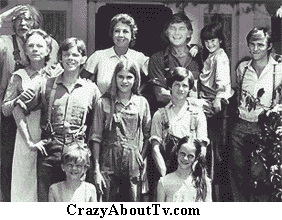
photo of the cast of The Waltons is from here

I watch some very mainstream television. This would be a confession if I thought there was something shameful about doing so, but as I have a television and an internet connection too slow to play video (films), what, honestly, are my choices? Corporate TV is what I get, along with Democracy Now! Today I watched an old episode of The Waltons from one of its last years on the airwaves, when the grandparents, mother, and John-Boy were no longer on the show. The show didn't do as well in the ratings when the extended nuclear family unraveled due to real-life issues like desire to change jobs, illness, and death.

I loved The Waltons. And the person in the program I most identified with was... well, there were two. As an intergender male, one was John-Boy, because he was such a caring, sensitive male. The other was Erin, the next-to-youngest girl, because she was sort of invisible as she wasn't statused by being the oldest or the youngest. (I most identified with Jan Brady in The Brady Bunch, for many of the same reasons.)

As I watched today, I thought about how many television shows I grew up with starred all-white casts, usually Christian ones too. The Waltons, The Brady Bunch, The The Partridge Family, and Little House on the Prairie were among my favorite shows. I soaked in programs that featured fictional functional families, and functional meant white, Christian, and only heterosexual. I was a gay kid living in a Jewish family. What was I supposed to think of myself by wishing I was part of those families?

What were Black and Brown, Asian, and Indigenous children supposed to long for, to feel that displaced sense of belonging to a fictional family demonstrating unconditional love? How do you feel unconditional love if you're not the color of the family you're watching being loving? There were no dramatic series depicting a nuclear-ish family that was Latina, Asian, or Indigenous. There were a few shows featuring Black families, but only situation comedies. I remember hearing Oprah Winfrey describe the effect of seeing a Black family behave affectionately on television. It happened when Claire and Heathcliff Huxtable cuddled on their couch. She was moved to tears, realising she had gone for all her life to that point never seeing this reflected back to her. I could relate to what she was saying, as I was yearning to see a gay couple of any color relate that way in their fictional home. I'm still waiting to see it. I'm sorry Oprah had to wait until the 1980s to see a Black woman and man be sweet to one another on television.


I'll Fly Away was one of the first dramatic program featuring a Black family but they had a supportive role that existed around the world of the main family in the show: a white one. I loved I'll Fly Away too. Regina Taylor was great in a role that didn't give her or her TV family enough air-time.

photograph of Regina Taylor is from here
For those who don't know--and I'm guessing most of you don't--I'll Fly Away was a dramatic series that ran for a couple of years in the early 1990s. Like The Waltons, it was set in the US south. But it took place a couple of decades later, during the Civil Rights struggles. Lilly Harper was the name of a character who, in the story, was hired to work in the home of a widowed white het male lawyer, in part to take care of his three children and also to cook their meals. Occasionally, the storyline took us to her home and life away from the white main characters, especially as her involvement in the Civil Rights movement increased. The lack of central attention on her own life as "more than housekeeper to whites" was not exactly the intention of the show's creators. The network would only support a show that still kept the primary spotlight on white people. From Wikipedia:
Series creators Joshua Brand and John Falsey have stated that the inspiration for the series was the classic 1962 film To Kill a Mockingbird. While the film centers around attorney Atticus Finch and his family, the pair wondered about the life of Calpurnia, the Finches' African-American maid. Her story goes unexplored in the movie. A serious and seemingly well-educated individual who is respected by her employers, Calpurnia is the inspiration for the character Lilly Harper in I'll Fly Away.
We might take a moment to consider what the employment options were for a woman who was the African American and Southern at that time. We can assume becoming President of the US was not possible, no matter how hard she tugged on those bootstraps. Things have changed since then, but not nearly deeply enough. The proportion of Black women in the US who will be filthy rich remains far less than the proportion of white men. A huge reason for that is laws governing inheritance. Most white families keep their money to themselves.

Options for Black women in the US: what they currently? Not for one woman, but for millions?

I'm watching to see how Oprah Winfrey rescues her network (OWN) from low ratings. I believe she will. She knows far too much about television production and how to get and keep high ratings to not be successful with OWN. She's beginning to put out a brand with some new programming featuring troubled celebrities, which allows her to combine her two most popular elements from the talk show that recently finished out a 25-year career. Those two elements are celebrities and emotional well-being. When watching a news story about the Oprah Winfrey talk show ending, a white middle-class woman spoke about how it was her lifeline to reminders that she has a spiritual life, and to not neglect it.

This tells us so much about CRAP--that it is an anti-spiritual, emotionally unhealthy existence, devoted to consuming, exploiting, and surviving by destroying most of what is around us, if not also ourselves. That a television program that reminds us we are spiritual beings having a human experience is a rarity. And those that also remind us we are existing inside truly vile systems of hierarchical oppression are non-existent. This means we don't really understand how those systems work. And, often enough, we deny they exist at all.

But back to emotional well-being for a moment. If you're really privileged, if you control a lot of the conditions of your life--such as by being economically secure, by not living in a shack--as many millions of good people do, by not being subjected to rape and the threat of rape daily and nightly--you might believe what many white class-privileged people believe: that your well-being is yours to determine.

It is partly ours to determine. But it is also determined by forces around and beyond us. Noticing this means we are called, perhaps, to organise and change those forces so they are more humane and just. But corporate television is owned by powerful companies that are invested in destruction of people, animals, and the Earth, and don't want us organising. So they won't tell us about those systems of harm and inhumanity--how they work, what they are designed to do, and so on.

Understanding those systems and structures has been a primary goal of mine for a long time. Since being nine years old, I'd say. At nine I began to see how things were really fucked up socially with regard to race, ethnicity, and gender. Eventually I added sexuality to the list too. Last on for me was economic status and class.

The principles by which we live our lives--our core philosophies for "good living", are structured for us if we are receiving them from corporate television or by authors who promote values that are not going to prevent them from appearing on corporate television to promote their books. Dr. Phil was supported by Oprah Winfrey. He has the most viewed daytime talk show in the US, now that Oprah's show has stopped airing new episodes.

On OWN, I saw him speaking with the former Duchess of York, Sarah Ferguson. She has a reality show detailing her journey towards greater self-awareness and personal emotional healing. She had a rough childhood emotionally but was stable economically. (Her mother left her when she was twelve, and her father was affectionally distant and very emotionally abusive.) Rarely are connections made between economic poverty and emotional distress, I find. People who are poor are assumed, if living in the US, to be able to pull themselves up from their bootstraps and find happiness in the upper middle class world that remains exclusive and exclusionary to most poor people, by design.

When we're told anyone can do something, we might notice we're not told "everyone can do it"--or even "many". We might notice that US society values pursuing happiness, not achieving it--unless you're very privileged. Even then happiness might not be yours, but not having to worry about health care and housing, not having to work three jobs to still not be able to pay your bills and feed your children, goes a long way towards being happy. While a few poor, Black, sexually abused children might be able to grow up, like Oprah, and become rich, not all poor people can. Not all Black people can. Not all sexually abused children can. And they can't not because they can't find their bootstraps. They can't because the capitalist, racist, child-hating systems they live in manufacture poverty, oil companies manufacture ecocide and the pornography industry manufactures contempt for women of all colors.

Being told "you can be whoever you want to be" was spoken a lot as President Obama won the election. What wasn't said is that "If we have one Black president, we won't be able to have another one for a score of years; probably longer." What we're not told is that "You won't be able to be president if you're a woman who is Black, Brown, Asian, or Indigenous. Not even a white Christian woman has been president, although I suspect that if Hillary Clinton were the Democratic nominee in 2008, she would have won the top office. How long do you think it will take for us to have an Indigenous president of any gender? A person born in the US also won't become president if they're Jewish or Muslim, even if they're white, male, and heterosexual.

The limitations on what we can do are not discussed as much as the apparent freedoms we have to become whatever we want. I want to live in a world where children and women are not routinely and customarily sexually assaulted. I want a world where no Indigenous people are facing genocidal destruction. I want a world without military wars, without warlords, and without patriarchal tyrants and terrorists. But I suppose that's asking for too much.

So back to the small world of our own private emotional worlds that I'm supposed to be preoccupied with if I'm allowed to think about such things at all.

Online, I found what follows, from *here*. The author discusses the same program on OWN that I watched. For those who don't know, Sarah "Fergie" Ferguson was married to Prince Andrew of the British Royal Family, but lost the marriage and a lot more. But she's not homeless because Prince Andrew is paying her rent. That's what knowing and being loved and cared about by rich people can do for you. But if the rich are the few--increasingly the tinier few--this means, necessarily, that there will be fewer non-rich people who know them that well.

As I'm not generally cynical, I find some of the concepts here quite moving.
Hi beautiful and powerful women;
While watching the new reality show, "Finding Sarah", I had a breakthrough moment or an "aha" moment as Oprah calls it. Fergie was talking with Dr. Phil and he was explaining why some of us are "blocked" at certain phases of our lives - We all have a personal truth, and that truth is what we really believe about ourselves when nobody is looking or listening. It's what we truly believe about ourselves in the core of our souls. He said, "Personal truth is so important because I think we generate the results in our life that we believe we deserve." I had to rewind that statement several times to totally absorb those powerful words. "Wow", what do I believe I deserve? Have I been blocking myself from all the universe has to share with me by believing I'm undeserving? Dr. Phil went on to say, "If you have a damaged personal truth, you generate the results that match that." "When we grow up, people write on the slate of who we are. People like parents write on our slate. But the most tragic thing of all is when we pick up the pen and start writing and we write the same things they did.." What is your personal truth? What is my personal truth? Do we have a damaged personal truth? That's a powerful question that deserves some honest quiet time to reflect. If your personal truth was damaged like mine was as a child, it's time for us to take that story and write in the the beautiful truth about who we are and what we deserve. We are amazing children and women of God, and while our parents were doing their best to gift us what they could, they probably didn't have the tools to sculpt the masterpiece we are meant to be. Now it's our responsibility to accept God's grace, love, and power so we may soar like angels... The more we have, the more we have to share with one another. We are all beautiful and so deserving of all the miracles, love, abundance, and magic this world and the universe has to share with us. Know how precious and beautiful you are and I ,too, will try to see God's beauty in me. I love all of you and I believe your personal truth is amazing!
You will note that there's no mention of how society, as a whole, or media in particular, writes on our slates. And how even if we have caring families with loving care-givers, a hostile world all jagged and nasty with rape and racism will still find ways to write on our slates.

I had loving care-givers. Several of them. I never went to bed not having eaten all day, and I always had a bed to sleep in. We might say I was lucky, but a whole lot of that not going to bed hungry and having a bed has to do with the particulars of my family's history of being white and therefore able to get employed in certain ways that weren't available to people of color.

I also was bullied for years, sexually abused and sexually assaulted, and endured anti-Semitism and a whole fucking lot of homophobic violence.

The sexual assault, perhaps even more than the bullying, wrote on my slate. What the assaulter wrote on me was this:

You are worthless. You are nothing. You are a thing for me to use as I see fit. You are something for me to wipe myself on. You are dirty. You are bad. You are aren't human in the way that I am human--I get to do stuff to you and you don't get to do stuff to me. Your value is in being used.

As  many feminists have noted, this is power boiled down to its essence: the ability to act. The ability to have what one wants done to be done. Crystal Harris just broke off her engagement to Hugh Hefner. He's 85 and she's sixty years younger than him. She decided she didn't want to be a well-kept prisoner. I'm glad. Apparently Hugh is quite a tyrant at home. He demands that things go his way all the damn time. He has movie nights and the women he wants there have to be there--two old movies on two nights; a new movie on the third night. He wants to play cards at certain times, so that's what the women around him do because they know if they don't they'll be tossed out on their exploitively photographed butts. Hugh Hefner is a silk-pajama'ed pimp who figured out how to be a publisher. That's what he ought to be well-known for. But corporate media will tout him as a fighter for justice and freedom; "only his own freedom" is the part that's left out.

I wanted to prostitute myself to procurers on and off during parts of my life and probably the one thing that kept me from doing it was not being homeless and broke. And when I seriously contemplated doing so, I'd come into contact, very strongly, with those messages that the serial rapist of children wrote on my slate. And knowing that selling myself to strange men would deepen the grooves of those etched messages left me very conflicted about following through with what be might be called a compulsion that wasn't acted out for many years.

I acted it out with a male cousin for a few years in motel rooms, answering his calls for sex as he wanted it. That did more deeply etch some of those messages--particularly the ones that told me I was undesirable except to be used. I'm now thinking about how when a man is interested in me that fact alone is triggering. Now I know why: it triggers what, in my memory, is the stuff that happens next: being used and abused.

I am celibate and I am asexual and it is with those conditions in place that I pursue my own form of happiness that doesn't look much like what corporate media tells me I should be acquiring to get it.

I know many people, mostly not white, mostly not men, who also choose to not have sex with other people. Some of them have active and enjoyable sexual relationships with themselves: I call that being celibate. I don't welcome or want sex: I call that being asexual.

I'm not anti-sex any more than I'm anti-food. I think sex can be as good as eating, as nutritious and fulfilling, and as bad compulsively eating CRAPpy food or getting food poisoning. And when you need food, you eat what's available. And when people want sex or romance with others, sometimes they take what they can get.

I watched female cousins choose men who were neglectful and abusive, get divorced, and then meet men who were far more loving. I suspect that they learned something about their value by being so devalued in their first marriages and, importantly, understanding that the messenger was wrong. In reflecting on their first husbands, I am struck with how these young men were very much like many other men around at that time, living in that culture. Curiously, the second husbands were from other states and other cultures. When they had a real opportunity to eat better food, they did. One of my cousins now runs regularly and eats mostly organic food. We didn't know what organic food was when we were kids. We were too busy eating peanut butter with added sugar and hydrogenated oil; with marshmallow fluff, which was basically all sugar; on very white bread made from bleached, bromated flour. The culture wasn't yet selling whole grain bread in the grocery stores. We take what is available, often enough. And that isn't the same as having freedom of choice.

I saw a man on television who was being interviewed by news media. He and his children had no clean water to drink, and no home, and were drinking water gathered from a stream where people washed their clothes and bodies. Thirsty in the heat, he was pouring it into his mouth and, one presumes, into the mouths of his children. He was being as good a care-giver as he could be within the conditions he was living inside. How he was far more like how most people live than how the members of the The Brady Bunch, or even the Depression-era Waltons lived. I remember reading an article in the New York Times about how the Waltons on television we're being depicted at all like how poor whites in that part of the US were actually living during that time in history. The punishing poverty common to that area of the US was removed from their story.

I wanted to believe it was close enough, because believing the television shows were dishonest was too difficult to accept. I needed it too much--to be the Truth. If television lied, that meant I had nothing into which to find my lonely hopes fulfilled.


Why doesn't Facebook have an "important!" button, in addition to "like"?

image is from here

...if it works to end racism, heterosexism, 
corporate abuse and exploitation, 
ecocide, genocide, and sexism.

image is from here

We can note the need for it below. I just came across this after posting a link to my facebook page, and realised there's no way in hell I'm clicking "like" on a group called "Sexism". I would click "important" though. (It also might help to name the group "Opposing Sexism".)

Related to Your Post


Sexism
4,932 like this.

Are Women's Rights also Human Rights? An Answer for James Huff and Any Man who Denies Patriarchal Atrocity Exists

image is from here
There is a pause on my conversation with Men's Rights activist James Huff. He has had some personal issues (not negative) that are taking up his free time but has assured me when that time is restored to his schedule he'll get back to our discussion--and will answer my questions.

In my conversation thus far with James, it has become clear that his views of the world are shaped by his experiences, with what he reads and otherwise studies being an integral part of his experience. I offer what follows as expansive education for James and for all men who minimise the frequency and effect of patriarchal atrocities also called "normal life". It is my contention that people who are structurally positioned to not know about those of us who are located elsewhere (structurally, not necessarily regionally), routinely utilise privileges and entitlements to refuse to know, to ignore, to deny the very harsh and horrific realities of most other people on Earth.

Men don't have to know what women experience as terrorism from men. Whites don't have to know what people of color experience that white people and white supremacist institutions make impossible for people of color to ignore and deny. Non-Indigenous people can believe genocide is only something that has happened decades or centuries ago in most places around the world, not currently; it happens currently, globally, to Indigenous people, and part of non-Indigenous people's education ought to include knowing the means by which contemporary genocides are unrelentingly occurring. Heterosexual males don't have to experience the worst of heterosexism, and therefore can believe that being lesbian and gay is just another way of being and not also a particular way of surviving heterosexist norms, including normalised violence. I have begun to let James know about this, and he has been movingly receptive.

Refusing to know something is difficult when it is punched into your face, rammed into your body, or robbing you of your homeland, culture, and future. The statused refusers get to name misogynist-racist-heterosexist reality one thing while it is named something else entirely by those of us stigmatised on the receiving end of the force. Part of how privileged people name reality is to frame it as a set of intellectual ideas and limited experiences.

Poverty is experienced as an idea by rich people. Genocide is something that isn't happening in North America and globally to Indigenous people, according to most whites. Rape culture is experienced as theory by men. Domestic terrorism is not a term that is even used by men, unless referring to how men threaten each other's governments within one's own country.

Denying the most potent aspects of reality happens in marginalised communities too. The few trans activists who are getting to the microphone are pretending "gender" is solely a matter of difference, with the problem being the rigidity of a two-sex binary. To radical feminists, the problem of gender is one of dominance, with meaning and substance communicated through force, coercion, violation, and subordination--by men against women. To deny that gender, in the West and elsewhere, is about dominance more than it is about difference is to refuse to know a whole lot about what is happening to girls and women around the world. It also means one cannot know much about what is happening to oneself on the social-political level, if one is transsexual.

Some of us who are marginalised socially participate in the systems of denial defended by social dominants. We can do this more easily if we are denied the analytic tools and activist means of taking on the deeper issues. Trans people's and non-trans people's rejection of radical feminism's key insights is one way to perpetuate and promote this denial. I'd argue that only the most privileged trans people can afford to not know that gender is domination and subordination of human beings designated as girls and women by people who identify as men. For the few trans people who physically transition their gendered identities within the hierarchy, the violence that visits women for being women, instituted by men, will likely show up. There is a collective cost to humanity when any group denies the systemic and systematic violence visited on some of us.

James is someone who has as much privilege and entitlement as anyone can have in the US; he could be wealthier, perhaps. But he and most of his MRA brothers who make themselves known have economic entitlements and privileges (such as to ignore poverty as a systemic political problem). He and most of his MRA brothers have race entitlements and privilege (such as to pretend that whites don't describe and treat Black, Brown, and Asian people in ways that are dehumanising: including classist, misogynist, heterosexist, and racist). He and most of his MRA brothers have gender and sexuality entitlements and privilege (such as ignoring how lesbians, gay and trans people experience the world due to being on the receiving end of the force, coercion, insult, degradation, and domination of heterosexism).

Indeed, if James wishes to, he can deny there are such things as political privileges and social entitlements all together. He and his brothers can pretend those unjust rewards and unfair advantages are distributed based on structural social location (and not biology or nature). He can fundamentally deny there is patriarchal force operating in the world. His brothers regularly do. He can also deny whiteness means gross dominance over and against people of color.This means and his brothers likely prefer to see whiteness as a natural occurrence, like having light skin with little pigment.

When privileged and entitled white men hear me discuss whiteness and manhood as political forces, they often and mistakenly pretend I'm being a bigot, rather that describing structured, institutionalised social reality. It is useful to privileged white men to ignore these realities and to deny them, and to refuse to learn about them: they get to think what happens to them that appears to be unfair or unjust is the most terrible thing happening on Earth. This is one point at which social denial turns into dangerous delusion.

I offer the following to James, and other privileged men, as descriptive of one key part of what's wrong with the world we are living in: it is ruled and regulated by men, against women with no systemic relief or radical reform for women as a class.

What follows is from *here*.

Are women's rights, human rights?

By Kali Goldstone - posted Friday, 17 June 2011
Gender persecution is "aggression against and exploitation of women, because [they] are women, systemically and systematically." Even though women can be abused similarly to the ways in which men are abused, women are also violated in specific ways in which men are not. Notably, if men are violated in such ways, they become the exception to the rule.

Many of these "sex-specific violations are sexual and reproductive" including rape, sexual murder, battery, 'honor killings,' suttee, dowry burnings, Female Genital Mutilation (FGM), prostitution, forced abortion, sterilization and motherhood and sexual violence of any kind. A 1989 UN report declares that the "risk of violence and violation within the household is one thing women, irrespective of their social position, creed, color or culture, share in common."

So this begs the question, how come the international legal order is not predicated on the need to address such crimes even though many are expressly prohibited in international law and all of them within armed conflicts? Why is the presence of this pattern of destruction of women, as women, a reality, but absent in international law?


It's a Man's World:

Perhaps some of the answers lie in the fact that violations of men are better understood within the dynamic of human rights violations, as such ideas were based upon the experience of men. Law was created by men, whose perceptions were translated into ideas that were analogous with the male orientated experience. In turn, this experience dictated national and international conceptions of the human rights dynamic.

Domestically, the state is male, in that it chose to perpetuate the pre-state civil society distribution of power and resources, whereby women were dominated by men. This dichotomy was accepted as normal, neutral and good and characterized as a state of equality.

However, these state paradigms are not neutral at all. They are a self-fulfilling prophecy in relation to men as a group. These men did not provide for those who did not have such rights, like women. This was not even contemplated. The fact that they denied rights to women, for example the right to vote, is not in their interest to acknowledge. This was the beginning of the manifestation of gender blinded law.

In reality, domestic law rarely acknowledges that women are violated in these ways. For example, 33 of 50 U.S. states regard spousal rape as a lesser crime with the perpetrator charged with related crimes such as assault, battery or spousal abuse. In some countries, women are even criminalized for the behavior perpetrated against them. In Afghanistan, Saudi Arabia and Iran, if a married woman is raped, she will often be charged with adultery and the penalty for such a crime can be death.

As Catharine MacKinnon suggests "gender is an inequality of power, a social status based on who is permitted to do what to whom." Humankind maintains a legal way of thinking about equality which was created by Aristotle: legal equality is to treat similarly situated people alike. Therefore, 'equality' becomes the right to be treated like the white male given that white man's culture is the dominant culture.

History dictates the subordination of women to men and thus women's enforced inequality is a reality of which is mirrored in domestic and international law. "When men sit in rooms, being states, they are largely being men."

Throughout the world women have had, and still have, so little voice and influence in public debate and within their governments.

Moreover, women are routinely violated every day, in every country, in times of war and peace. Even though atrocities like rape and sexual murder are officially illegal, these practices are commonly permitted under domestic and international law. They are permissible and understood as an "excess of passion in peace," or the "spoils of victory in war," or as the "liberties . . . of their perpetrators."

In 1948 the Universal Declaration of Human Rights defined what being human is and the rights associated with being a human. It has been 63 years since its inception. Yet, within the human rights paradigm, what is perpetrated against women is viewed as either "too specific to women to be seen as human or too generic to human beings to be seen as about women."

The State vs. Women:

In terms of men's private acts against women, a legal exception exists in wartime. Atrocities committed by soldiers against civilians are always, in essence, state acts. However, "men do in war what they do in peace." In this way, the lack of acknowledgement and action that defines peacetime continues in war when it comes to the treatment of women, regardless of international humanitarian law.

The parties to the conflict and the atrocities perpetrated are covered by international humanitarian law. Yet, as we can see unfolding in Darfur and the Congo, rarely are international instruments, invoked to prevent or stop the atrocities or hold the perpetrators accountable.

The more a conflict can be defined as internal, as domestic, as social, the "more feminized the victims become no matter the gender," thus reducing the likelihood that international human rights will be established as being violated, irrespective of the reality of that war.

It must be understood that this is not because women's human rights have not been violated, it is because the violations of women have been obscured.

This shroud occurs in two distinct ways. Firstly, when women are violated like men, the abuse is not characterized as violations of women's human rights. For example, when women, with men, are murdered and buried in mass graves, beaten and tortured, these women are defined in history as part of a group, as Colombian (nationality) or Jewish (religion). The specific crimes that they as women faced, are lost in the identity of a more readily distinguishable group.

Secondly, in peacetime, contained by daily hostilities, women are raped and assaulted by partners, family and friends. However, these atrocities are not distinguished as human rights violations, their victims become the "desaparecidos of everyday life," and what is done to them "smells of sex."
Thus when a husband abuses his wife in her home, humanity is not seen to be violated.

Link Between Gender Based Crimes and Human Rights Law:

No international instrument expressly prohibits gender-based crimes. There is no enumerated ground in any international convention that includes 'based on sex or gender' as an element.

An example of this is the Refugee Convention, which fails to reference gender as a ground for persecution. Article 1A(2) explicitly marks "race, religion, nationality, membership to a particular social group or political opinion" as reasons for persecution. Therefore, a woman cannot receive surrogate protection from another country on the basis that she is being persecuted because she is a woman.

There are only rare references to sex or gender in international humanitarian law or to any crimes that include sex as an element. Crimes against humanity, which can often be gendered, for example rape, sexual slavery, enforced prostitution and forced pregnancy, are not a component of treaty law, they are characterized as international customary law. Hence there is no duty to prevent such atrocities and very little impetus for one state to interfere in another's internal affairs.

However, it must be noted that the Rome Statute of the International Criminal Court (ICC) changed this. In article 7(1)(h) the ICC defined persecution on the basis of gender as a crime against humanity, while in 7(1)(g) "rape, sexual slavery, enforced prostitution, forced pregnancy, enforced sterilization, or any other form of sexual violence of comparable gravity" are considered crimes against humanity when "committed as part of a widespread or systematic attack directed against any civilian population." 

Furthermore, while many international crimes are based on sex, for example, rape in war and trafficking in women, international law has a tendency to "suppress their gendered element." There is no international crime that acknowledges the "destruction of women as women, as a group or as members of the group."

The Convention on the Elimination of All Forms of Discrimination Against Women (CEDAW) classifies such discrimination against women in "largely gender-neutral and referential terms." CEDAW guarantees the enjoyment of rights "on a basis of equality of men and women."
However, this has been construed non-substantively and claims by individuals or groups, claims against governments who remain inactive, and claims against private parties, have been regarded as impermissible.

Nevertheless, the CEDAW committee has finally recognized violence against women as a type of sex discrimination, thus making states accountable for 'private acts' if they fail to prevent, investigate or punish discriminatory acts of violence. But this is impossible to enforce.

While Art. 3 and 26 of the International Covenant on Civil and Political Rights (ICCPR), guarantees sex equality, only the Optional Protocol allows complaints by individuals coupled with state parties. Nonetheless, only those states that have expressly signed and accepted this Optional Protocol can enable individuals or groups of that state to report breaches of the Convention.

Many states who are signatories to the ICCPR have not signed onto the Optional Protocol. For example, the United States has not signed or ratified the protocol and only after the war did the former Yugoslavian states separately sign on. The ICCPR cannot be interpreted retrospectively, thus successfully denying victims of the war in the former Yugoslavia from reporting past atrocities.

Furthermore, the International Court of the Former Yugoslavia (ICTY) has inherited the present construction of humanitarian crimes in its founding statute, which seeks to diminish women's harm and has yet to expressly distinguish gender based crimes.

In Art. 5(g) of the ICTY statute, rape is only established as a crime against humanity, not as a tool of genocide. Like other domestic and international forums, the ICTY is hindered by "legally institutionalized sex inequality," is easily manipulated by the historical denial of sexual and reproductive harm to women, and is obligated to grant institutional deference to states.

Yet again, state sovereignty is used as a tool by the international legal order to ensure that the ICTY does not effectively address sexual and reproductive atrocities committed in the former Yugoslavia and does not provide justice for those who are left without effective recourse for violations of their human rights.

Hence there is only a limited practical and bona fide link between the types of sexual and reproductive atrocities committed against women, as women, and the international human rights law available to such victims to hold the perpetrators accountable or to seek surrogate protection.

It is glaringly obvious that if a society does not grant you rights, so that a state does not have to even deny them to prevent you from possessing them, then the fact that they are somewhat expressly guaranteed in international law, is useless.

The law must liberate itself from this "essentialist circularity." One way of achieving this might be to empower women to confront the state committing such human rights violations against them, through international and domestic forums coupled with the ability to directly challenge men in society who harm them.

It must be recognized in law that the violation of women sexually and reproductively is a "form of unequal treatment." The links between marriage, battery, sexual harassment, rape, prostitution and sexual humiliation in the home, at work, in pornography, in brothels and in the streets, must be made in order to fully grasp the unequal treatment of women by society and thus the law.

Cultural practices like aborting female fetuses, female infanticide and the deprivation of nutrition to girls and women, which guarantees that millions of girls are never even born or mature to become second class citizens, needs to be incorporated into the human rights discourse and instruments.
Further, rape in genocide must be understood to be what Andrea Dworkin coined as "gynocide;" the destruction of women as women, as a group or as members of the group.

Catharine MacKinnon urges that grounds like ethnicity and sex be joined so that crimes against humanity like suttee, FGM, honor killings and rape perpetrated in rape/death camps can be defined as what they really are: "destructive acts against women "in part" on ethnic grounds combined with sex."
Perhaps then, women will be granted legal avenues for prevention, recourse to and accountability for reproductive and sexual crimes committed against them. Perhaps then, when a woman is harmed reproductively or sexually, in war or in peace, humanity will be understood to have been violated.

Wednesday, June 15, 2011

On "radical" identities and the consciousness of some white bloggers

image is from here

NOTE: This is not directed at every white woman I know. It is directed at many white women I do not know.

I've been encountering some white privilege, power, and entitlements in my regular encounters with folks. This is nothing new. Recently the whitness is showing up in a variety of ways but it there is one form that I will address right now.

Just so you know--if you're new to this blog, I stand strongly in political and spiritual solidarity with women of color who are, as far as I can see, always fighting at least two institutionalised ideologies: male supremacy and white supremacy, if not also other forms of oppression and domination such as capitalism, heterosexism, anti-Semitism, anti-Islamic violence, anti-Indigenous genocide. I will call out any expression of white supremacy I encounter.

There are some white women online who are calling themselves "radical" who deny that women can oppress women. This is as messed up a viewpoint as men claiming they cannot oppress other men due to race, class, and other conditions. Some men do argue this, of course. Some white het men believe it because they deny there are any systems of oppression, any social-political hierarchies, working at all. Some WHM (white het men) claim they wish to be spoken about as if they are only individuals, not as part of an institutionally protected, privileged group. With that as their request, they then proceed to understand women only as a group--and are numbingly stupid about the diversity of perspective and analysis among feminists.

Especially, patriarchy- and white supremacy-protecting WHM argue that feminists are all man-haters, never bothering to offer up a substantive argument other than throwing around quotes. (They also stay astoundingly silent about all the published men who state quite clearly that men are rapists by nature--a position not belonging to radical feminism.) Their two-dozen favorite quotes (see *here* for more about this) by all-white feminists are allegedly all the proof they need that "those damned feminists hate men so much!" Why they seem so determined to ignore the work of radical feminists of color is beyond me--unless it is because they assume women of color aren't worth paying attention to. Anyone with a computer and a mouse can easily gather up about a thousand times as many quotes online from white het men who demonstrate disgusting levels of misogyny, and racism, homophobia, and general callousness to cruelty committed or controlled predominantly by WHM.

These WHM activists go on and on about Black people as one group, lesbians as one group, Mexican people as one group, and Asian people as one group, Indigenous people as one group--if they care to notice there are Indigenous people at all. This often means that these political WHM cannot comprehend the existence and diversity among lesbian women of color and how their experiences might vary from white lesbian women's. Other men believe, for example, that if men are poor or not white they are not capable of oppressing women. I've heard and seen plenty of arguments by het men of color that they are only oppressed, and are not oppressors to women in their own communities and regions. Bullshit.

The willful ignorance isn't limited to het men, however.

Here's a quick anecdote about a white, class-privileged gay man I once knew through a mutual friend. My friend and this white gay man worked together in retail and I ran into him when going to this store.

The man I didn't know especially well, but who welcoming of getting to know me better, thought he's impress me with his humor. He told me a joke that was racist. I won't repeat it. I was deeply upset by it and he was quite surprised I would be so alarmed. This is often my experience with whites--we assume we're all good with the racism. I'm not. So I didn't laugh and indicated that I didn't find his "joke" funny. When he realised this he went on to explain to me why it was okay for him to tell it. He said Whoopi Goldberg told the joke, and he was gay so he can't be racist. (Because, you know, he's oppressed by sexual orientation so apparently that means he can't oppress anyone else.)

I asked my friend how it could be that this white guy thought I'd welcome hearing that joke. He told me the following: [racist white guy in denial] told me a joke--kind of like the one he told you but not with the racist parts; I told him you would probably like it. So that's how come [racist white guy] thought it would be okay. I told my friend the actual joke shared and he too was shocked. Neither of us are friends with [racist white guy in denial].

Every feminist friend I know would call him out on a bogus argument that gay men can't oppress women because the men are gay.

Enduring one form of marginalisation or subjugation doesn't mean one is positioned socially and structurally to not oppress anyone or any group to which one doesn't belong. Every woman I know personally understands that men who are gay can be oppressive to women--particularly lesbian, in some communities, if we share social spaces. Although the Sheila Jeffreys' book, Unpacking Queer Politics, is being trashed without thoughtful engagement or analysis by many people occupying many different social spheres, it does engage the reader in an important conversation about how gay men's behavior and values oppresses lesbian women. At the time of this writing, I can count on zero hands the number of white gay men who have responded responsibly to her arguments.

Every woman I know also understands that men of color can be oppressive to women across race and sexuality. How does it happen then, that white and het women cannot be oppressive to any other women (or, for that matter, to men of color, and to gay men if the women are het)? With what understanding of social harm and hierarchy, and through what privileged and protected lens does one get to believe that? How convenient for not taking full political responsibility for one's whiteness or heterosexuality, eh? And, what's more, these women have all had plenty of opportunity to learn about their white supremacy and heterosexism as they've been called out on each of these rearing its oppressive head in many social spaces.

To believe that because one is a [white het] woman--with just about every form of privilege and entitlement on Earth--one cannot be an oppressor either individually or institutionally, totally invisibilises how a very central force in many societies works: that force is white supremacy. It also renders white women invisible as whites and women of color invisible as people who are both women and of color, all due to white women's political slight of hand which they summarise as "women can't oppress women". Apparently, for race- and region-privileged women do not have any other structural locations on Earth other than as women: unraced.

When I learned recently that a few radical-identified white het women believed this, I realised I'd heard it before, many times, and that it might help explain why it is that so many white "radical" women do not deal with their racism, their white privilege, and the meaning and forms of their white power and entitlements. I'll press pause on the unacknowledged or blatantly denied heterosexism issue for now. The racism I've witnessed isn't only demonstrated and denied by het white women.

I reflected back on the drag shows co-organised by white lesbians and white gay men. The lesbians called themselves "radical" because they sincerely thought they were. When I challenged them on co-creating spaces that were overtly hostile and insulting to lesbian (and other) women of color, to poor women of color, to men of color also, they pretended my concern was not as important as their need to be entertained by each other. They treated the matter as if it were abstract. To them, it was abstract because they've never taken the time to immerse themselves intimately in the communities and lives of people without race privilege. They don't ever have to live the lives of lesbian women of color and they can believe that white lesbian experience is all they need to consider or show concern about when organising to defend lesbian experience.

I will continue to call out white supremacist queer people who also misuse the term "radical"--according to the radical women of color I know, not primarily according to me. Too often patriarchy protected practices like gender bending are promoted as radical or revolutionary. There are several problems with that viewpoint. One is that their political practice is based on understanding the social problem as "gender" or "the gender binary" and not male supremacy--and white supremacy and heterosexism and capitalism, among other forms of organised harm and horror.

It isn't that difficult to translate dynamics that are male supremacist to those that are white supremacist. One central reason it isn't difficult is because both systems of harm and dehumanisation inform each other, shape each other, and feed off of one another, in white male supremacist societies.

Here are a few clues one, if a blogger, might be acting out of white privilege, power, and entitlements.

--your blog doesn't identify your race as white if you're white
--your blog or identity doesn't include your stated understanding of how and where you step on the backs of others to be where you are. I mean collectively: how your people got to be where they are
--you believe you are radical because you comprehend how white women are oppressed by white men, but don't understand any other form of oppression and apparently don't make it your business to do so
--you feel very entitled to "own" and "define" the term "radical" because you are white; it doesn't occur to you that you're not radical if you promote your own white supremacy by ignoring your white privileges and power
--you put down white trans people because the white trans people you know have liberal political agendas, meaning pro-status quo; you don't consider how being white supremacist is deeply pro-status quo and dangerously conservative

I have similarly called out sexist and misogynist men of color who believe themselves to be radical; often enough, men of color who see themselves as radicals will limit their political consciousness to understanding how white supremacy degradingly effects men of color.

Now, most of the white power I encounter belongs to and is exercised by men; I don't wish to pretend that white women hold more white power than do white men. Intersectional analyses of power means that one benefits in complex ways when one holds more than one position atop a hierarchy. Being white and male, for example--as I am--means something different than being white plus male. It's not only an additive thing to me--this life that is lived in positions of power relative to other groups of people. It's also exponential. This is why I view white men's white power as greater than white women's. Also because if white women exercise any form of power in ways that white men disapprove of, it will be the white men who get their way--institutionally if not always interpersonally. But often enough, white men will kill white women if the men don't approve of how the white women are behaving.

One key way I see white women ignore and deny their own white power is to pretend that violence only happens interpersonally. Typically, white blogs that are pro-feminist deal with issues of rape, harassment, the practices of heterosexuality, and other interpersonal and intimate harm, but not, for example with issues of poverty, racism, HIV, and starvation that isn't only isn't individually experienced but is also politically imposed as a form of genocide.

This is because poverty, racism, and most other forms of atrocity and terrorism are profoundly interlocking institutionalised realities (as is rape; as is sexism). Poverty, in particular, isn't always so easily identified as only something individuals do to other individuals. We can note that rich people don't have to walk down the street harassing poor people individually; they do, often enough, however, work behind the scenes to pass city legislation to ban poor people from congregating or home-making in various parts of a city. The deals are made out of view of the poor people who will be most negatively effected.

I'm not comfortable defining myself as "radical" unless I am open to looking at and working to challenge all areas of my privilege, in collaboration with women who are negatively effected by that privilege; this necessarily means engaging with women of color across sexuality and with lesbian women across race and ethnicity. "Radical" is not primarily a mindset or a viewpoint, to me. What it is, is a commitment to action demonstrated actively. Action to call oneself out, to hold oneself accountable, and--importantly--to be personally and socially available to be accountable--to not hide out in only-white or only-male or only-het spaces for example.

These same white het women promoting ideas that they cannot oppress the women they do, in fact, oppress were also working to silence Lesbian women. It appears they don't see their heterosexuality as a position of power over and against women marginalised by sexual-political orientation--which really means by the het supremacy that women also participate in.

The anti-trans perspectives among some white non-trans women "radical" bloggers is fierce and self-righteous. If only their critiques of whiteness were as rigorous.

Suffice it to say if we work with this as a definition of what radical feminists oppose--"if it hurts women, feminists are against it"--we are left to know, beyond any glare of doubt, that racism is anti-woman if the women are women of color. This means that racism is also a form of misogyny. To any white woman who is against misogyny: are you against the misogyny you promote and protect, that negatively impacts the lives of women of color, by you ignoring your own white privilege and power?

White women, usually, like pro-status quo white men, do not care enough to consider how their lives are not at all like women without race privilege. I've witnessed how women of color are expected to pass white women's litmus tests of whether or not they are radical--such as on pornography or prostitution. They don't consider that their own use of "radical" ought to be up for question if they can't identify what it is women of color face the world over that white women do not.

I call this out as a white male, knowing that if a white woman called out the same stuff she'd be verbally harassed and otherwise threatened for doing so by other white women seeking to maintain the very real power of the White Sisterhood. Both because of my male privileges and power, and because I do not seek solidarity with racist white women, I don't feel as vulnerable to such ostracism as some of my anti-racist white sisters do. So I'm speaking out here because if and when I don't, the task falls, as usual, to women of color. If the white women promoting this racist nonsense don't wish to hear it from a white male because being responsive to me is engaging in sexist practice to them, perhaps they'll listen to white radical lesbian feminist, Marilyn Frye, *here*.

I hope they'll consider the very radical act of believing what radical women of color say about white women's privileges and power to be oppressors. They could start with Audre Lorde, bell hooks, and Andrea Smith.

(For more on radicalism and blogging, see *this post*.)