Monday, April 18, 2011

What do The F Word, 60 Minutes, Piers Morgan, and A. C. Grayling have in common? (Clue: the silencing of radical feminist women of color)

image of Audre Lorde is from here

photo of Angela Davis is from here

image/photo of Marimba Ani is from here

photo of Yanar Mohammed is from here

photo of Vandana Shiva is from here

photo of Andrea Smith is from here

I often blog about things that come before me, sometimes because I seek out various bits of news or media, and sometimes because news comes to me. This post is a process of combining the two.

I received a link to a podcast of a program called The F Word (F is for Feminist), the program title of which asked this question: "Where have all the radicals gone?" The program features audio of a speech and interviews with Andrea Dworkin and Sheila Jeffreys. (Link provided below.) My immediate response is that the radical feminists are all over the Earth, particularly but not only in Asia. My question back to the producers of The F Word is this: are whites willing to listen to and interview radical feminist women of color who aren't from white-majority countries? (If it's an expense issue, there's always Skype.)

In his assessment of "feminism", A. C. Grayling does some really fucked up things. Read all about that *here* if you wish. But one of the things he does is assume feminism is all-white, and that women who are not white could benefit from the "advanced" ideas of white US and UK feminists.

I've also just recently seen a segment on 60 Minutes on rape. (For more on that, please see *here*.) The focus was a story about a college campus rape, of one woman by three men. The woman is white. The three men are Black. Also seen recently was an episode of a show I thought I'd stop watching week 1: Piers Morgan Tonight. On the program I saw, his guests were Demi Moore and Ashton Kutcher. They were there to discuss their "Real Men Don't Buy Women" campaign. (You can read more about that campaign *here*, at Huffington Post.) The problem with the campaign is that it puts mostly white het men front and center, pretending white men know a goddamned thing about ending rape or trafficking. Why not put the faces and voices of women of color who fight against rape and trafficking on the campaign cover, and also promote their work and perspectives on the atrocities? Because it isn't and won't be whites who solve the problem of trafficking. It will be women and girls of color around the world. It already is.

What all of these stories have in common are racist themes. Here's a list of the dangerously racist-misogynist themes.

--Feminism, especially radical feminism, is allegedly something only white women created and something that only white women can share with the world, for the betterment of the world, which is comprised of women of color, in the majority. This appears to be the viewpoint presented on a podcast of The F Word, as well as by A. C. Grayling in his 2009 book, Ideas That Matter.

--Black men, according to this 60 Minutes report, rape white women. Black men, according to 60 Minutes, don't rape Black women. And when rape happens, feminists of color are rarely to never invited in front of the US camera to explain the sexual (and racial) politics of rape and how media does and doesn't report on it as an act of terrorism by het men against women and girls, usually within an ethnic group, with the exception of class-privileged white het men, who, disproportionately, go out of their way travel all around the world to rape women and girls of all regions and colors.

--When US and UK white het men rape girls and women, the racial, regional, and national identities of the men are often not explicitly revealed. And when Black men assault white women, you can be damn sure the white male media will identify the rapists by race, to perpetuate the myth that the group white women have to fear most is Black men. And that's a giant load of C.R.A.P. Class privileged white het Christian men, specifically, are the most dangerous, predatory, serial raping men on Earth.

--White het men (from Hollywood and music celebrities to Bill Gates) are (allegedly) heroes, good guys, and can lead us all to be better people and make the world a better place.

They can't. Why? Because they and Bill Gates aren't doing anything substantive, radical, or revolutionary to stop C.R.A.P. His agenda and other Big White Men's humanitarian work (like that of Bono and Sting) is to educate poor children and end diseases in the Third World so they can become part of globalised Western/Global North systems of C.R.A.P. too, ultimately making other white men a lot more money. That view is a bit cynical. I'd feel less cynical if Bill Gates, Bono, and Sting, gave their money to organisations like RAWA, MADRE, The Audre Lorde Project, and groups of women working to end corporate capitalism which "bottom line" is white patriarchy in white sheep's clothing.

If famous WHM explicitly spoke out against patriarchal or male supremacist atrocities against girls and women, in those terms, and white supremacist atrocities too, that'd be helpful to the cause of composting C.R.A.P.

Instead, we'll get platitudes on the importance of ending poverty, illiteracy, disease, and famine, never bothering to notice how wealthy white men from Europe and the US profit, as a distinct demographic and economic class, from any effort that doesn't directly take power out of white het men's hands, individually, structurally, institutionally, and systematically, and redistribute that power into the hands of women of all colors, individually, structurally, institutionally, and systematically.

Taken together, these and hundreds of other media stories promoted by conservative, liberal, progressive, commercial mainstream media, and independent media, all tell a more-or-less single story in which women of color are not central figures in feminism, do not construct and build the foundational ideas found in feminist philosophy and activism, including in what is termed "radical feminism" philosophy and activism, and are not understood to be or promoted as role models, heroes, and leaders.

For years I have seen how these themes and memes impact women of color who are doing radical feminist work--some of whom use and embrace that term, some of whom do not. It means they are invalidated, unacknowledged, and invisibilised--silenced and erased--by white media. When this is done consistently enough, it appears to be "fact" and "reality" that feminists, especially radical feminists, are only white.

And it can appear that white women have to fear rape from Black het men, not from white het men or, more simply, "het men". And it can appear that women of color are not raped at all, or that when girls and women of color are raped, it doesn't matter to the media, which then communicates that it isn't important to the media-consuming public, which also communicates to raped girls and women that the assaults against them--sexual, social, and economic--don't matter.

I think all of this is very dangerous. I'm advocating that programs  like The F Word, Piers Morgan, 60 Minutes, and people like A. C. Grayling promote as central to feminism, the ideas and contributions--in philosophy, in society, in activism--of women of color, particularly and especially Black, Brown, Latina, Asian, Middle Eastern, Arab Muslim, and Indigenous women. I'm recommending that such programs and individuals, with far more public clout and political power in the mainstream world that any woman of color--even Oprah Winfrey--recognise who really is leading us out of hell-on-Earth. The people who are doing so, in the majority, are generally not white and are especially not male.

Women from Africa, Asia, the Americas, and from Indigenous populations globally, are responsible for the most revolutionary, radical, and complex perspectives and political campaigns to resist and rebel against patriarchy in all it's many regional and globalised forms. Why don't whites know this?

I leave it to you to answer that question. And, please do listen to this podcast, to get more of a sense of what I'm referring to. And, please take the words and perspectives of Andrea Dworkin and Sheila Jeffreys seriously. Andrea was and Sheila still is one of many important radical feminist writer-activists, most of whom are not white. For more discussion of the important work of radical feminist women of all regions and races, please see the post I did recently on A. C. Grayling, linked to above and again *here*. I will add that I do not believe whites can adequately comprehend the complexities and issues facing women of color globally. And that every region, the women of that region are the experts on their lives, and know best how to resist the forces, including the force of patriarchal white supremacy and misogynistic racism, in their organised efforts to survive and thrive. See the work of RAWA and MADRE for more.

What "radical" too often means when whites speak or write of it, when it is paired up with the term "feminist" is 'dealing explicitly with sexuality as men understand it'. This is but one area of central focus in radical feminism, globally. There are others. And if all your work centers only the writings and activism of whites who only write about male sexuality as it is acted upon the world terroristically and gynocidally, it is likely you'll never come to understand, appreciate, or support the work of most of the world's women, who have far more to contend with and survive than men's understanding and practice of sexuality, or white queer people's understanding and practice of transsexuality. I wish there was more coalition work among women across region. But men sure do fuck up most attempts at that.

I'll add that most of the whites I see online using and identifying themselves as "radical" do not appear to be radical to me. Their analyses and visions do not, usually or responsibly, center the experiences, struggles, and solutions put forth by women of color globally. Sometimes lip service is paid to women of color. Usually women of color are condescended to, marginalised, or ignored in white spaces, in my experience.

I'll leave you today with this: many women who do not identify as radical or as feminist, are the some of the women I most look to as exemplars and proponents of radical feminist revolutionary theory and practice.

All that follows is from The F Word. I want to thank Sheila Jeffreys for her critically important work. And, as you ought to know, I adore Andrea Dworkin. Enjoy the show.

The F Word

Where have all the radicals gone? When feminism gets moderate

| April 15, 2011
  •  

Show Notes:

In a world where feminism as a whole is often touted as a bad word, radical feminism in particular is marginalized, not only by the mainstream media, but often within third-wave feminist discourse. Are we afraid to be 'too' radical at the risk of alienating the masses? Or is radical feminism simply misunderstood?
This radio documentary asks: Where have all the radicals gone? Has feminism been swept up in the neoliberal current? Have we de-radicalized in order to be more palatable to the masses? In the face of strippercize, Sarah Palin, and 'post-feminism,' is feminism in need of a re-radicalization?
Featuring an interview with renowned feminist scholar, Sheila Jeffreys, your host Meghan Murphy explores all these questions and more.
Veering quite a bit in format from The F Word's regular programming, this extensive exploration of radical feminism and how it relates to contemporary feminist discourse is a little more academic in nature. Hang in there!

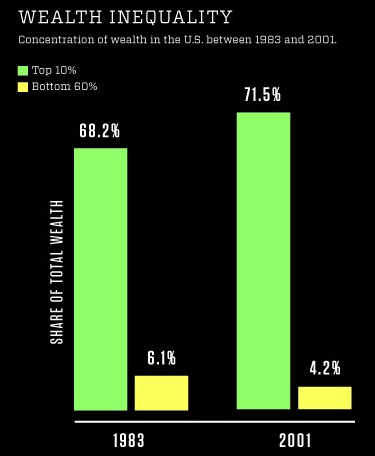
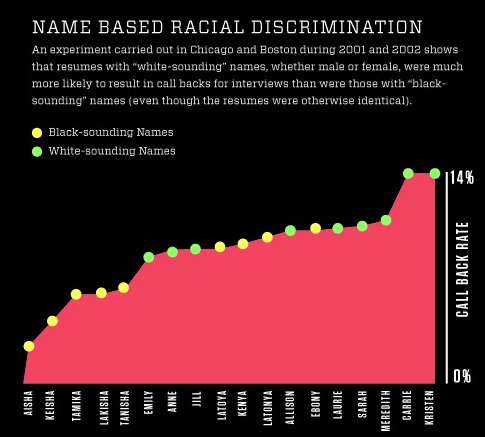
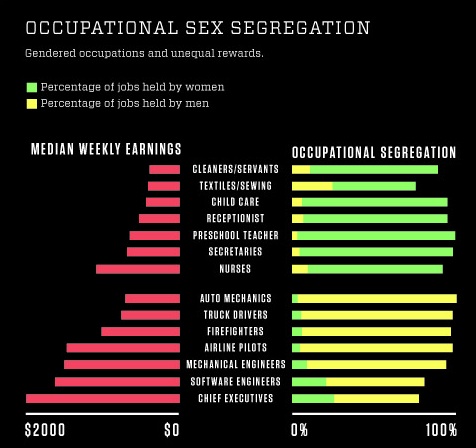
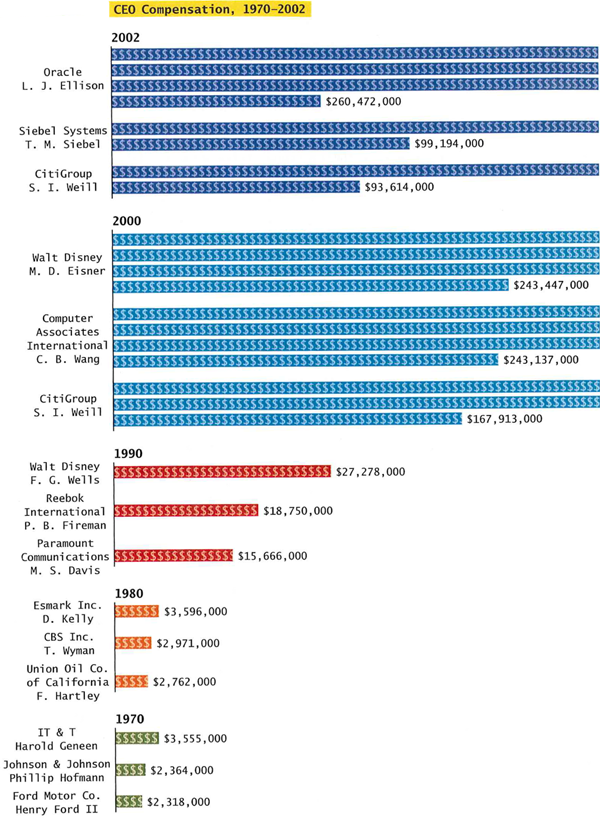
In the West: Oligarchy = White Supremacy = Patriarchy = Corporate Capitalism (get it?)

image is from here

image is from here


image is from here


CEO Compensation 1970-2000 (Conley, D.)

[source: *here*]

Sunday, April 17, 2011

Ideas That [Don't] Matter: The Concepts about Feminism A. C. Grayling Gets Wrong in his new book

portrait of A. C. Grayling and some books piled on a desk in a posh room is from here
I would argue that men with very distinct hairstyles want to be known. They want an identity that is viewable. I've seen this with Michel Foucault and Ken Wilber too. Often the people who want to be known for their image are "men of ideas". What is it with white male thinkers making this sort of physical statement? I was going to say "philosophers" but that term is quite overused when it comes to what white men do, and is rarely used to describe men of color or any women, such as Marimba Ani and Andrea Dworkin. Women are called "theorists" perhaps. Men are called Philosophers. There's a difference in status between men and women, and between whites and people of color, in white male supremacist societies I've been part of or have seen depicted, culturally, in film or literature. The differences in status are hierarchically arranged, and are oppressive-to-lethal to those on the bottom.

A. C. Grayling is an author and he teaches at some colleges. Here's how he puts it, on his website:
Anthony Grayling MA, DPhil (Oxon) FRSL, FRSA is Professor of Philosophy at Birkbeck College, University of London, and a Supernumerary Fellow of St Anne's College, Oxford. He has written and edited over twenty books on philosophy and other subjects; among his most recent are "Ideas That Matter", "Liberty in the Age of Terror" and "To Set Prometheus Free". 
For several years he wrote the "Last Word" column for the Guardian newspaper and now writes a column for the Times. He is a frequent contributor to the Literary Review, Observer, Independent on Sunday, Times Literary Supplement, Index on Censorship and New Statesman, and is an equally frequent broadcaster on BBC Radios 4, 3 and the World Service. He writes the Thinking Read column for the Barnes and Noble Review in New York, is the Editor of Online Review London, and a Contributing Editor of Prospect magazine. 
In addition he sits on the editorial boards of several academic journals, and for nearly ten years was the Honorary Secretary of the principal British philosophical association, the Aristotelian Society. He is a past chairman of June Fourth, a human rights group concerned with China, and is a representative to the UN Human Rights Council for the International Humanist and Ethical Union. 
Anthony Grayling was a Fellow of the World Economic Forum for several years, and a member of its C-100 group on relations between the West and the Islamic world. 
He is a Trustee of the London Library, a Fellow of the Royal Society of Literature and also a Fellow of the Royal Society of Arts. In 2003 he was a Booker Prize judge, and in 2010 is a judge of the Art Fund prize.
Here's a list of some of the things he's been published in: http://www.acgrayling.com/publications

Given all this studying, reading, and writing, and gathering of prestigious, status-giving experience (in the eyes of other similarly statused white men, especially), you'd think he might actually be semi-intelligent on the matter of feminism and the global condition of women and how white men, in particular, have a key role in the destruction of women and girls' lives across every continent except Antarctica. (No such luck.)

18 April 2011 note: I've decided to put the uninterrupted text here first. You can then read my thorough analysis and critique afterwards. With only one exception--due to him using a term I object to being used--I present his words as they appear in his book.

What has been typed by me below, posted here for the purposes of much-needed political and ethical critique, appears published on pages 150, 151, and 152 of Grayling's 2009 book titled Ideas That Matter: The Concepts That Shape the 21st Century. It is the entirety of a section on Feminism. As you shall see, I argue it is a truly racist, misleading, sexist, and inaccurate, lie-promoting summary of feminism. And it is likely his understanding of feminism comes primarily or only from secondary sources.

On those three book pages, which doesn't amount to much when typed into a blog post, he presents his racist, white-washed, inaccurate account of "feminism", located by him largely in the U.S. and UK, with the pages' content focusing on 18th, 19th, and 20th centuries. He adds truly disgusting, stunningly politically colonialistic, culturally imperialistic 21st century prescriptions for what "advanced" white women ought to do for those supposedly all-poor, allegedly backwards Brown and Black women who don't live where whites do--apparently. (I'm not kidding. He says this C.R.A.P. You'll see.)
Feminism is a complex set of overlapping movements in the political, social and cultural spheres aimed at promoting and defending the interests of women in society. One way of expressing the aim of this set of movements would be to say that feminists seek to achieve equal rights with men, not the least equal pay for equal work; but some more radical feminists wish to bring about a dispensation in which male status and pay cease to be what define women's aspirations.
So diverse are the perspectives and concerns of feminism that it cannot be accounted by a single ideology. Nevertheless there is a core of questions on which much feminist activism and theory focuses, including questions about the nature of sex and gender and their social construction, women's experience, violence against women, the historical and institutional basis of patriarchy (male domination) and the correlative subjection of women, stereotyping and sexual objectification, the right methods required for combating the forces and factors that militate against the achievement of feminist aims, and much besides.
The very first feminism on record might be found in Aristophanes's play Lysistrata, in which the women of Athens and its allies decide to force their menfolk to stop the Peloponnesian War by refusing them sexual favours until they do so. They succeed. If organized activity by women had continued and diversified into areas of social injustice affecting women, the episode dramatized by Aristophanes would have become feminism proper.
One has to look to the eighteenth century to see the first proper intimations of organized feminist consciousness, in the views of the Marquis de Condorcet and later in the writings of the remarkable Mary Wollstonecraft. The term 'feminism' was coined in French (feminisme) by the socialist Charles Fourier, and John Stuart Mill's The Subjection of Women (1869) gives it one of its best early statements; the book begins with the words, 'The object of this Essay is to explain as clearly as I am able ... that the principle which regulates the existing social relations between the two sexes -- the legal subordination of one sex to the other -- is wrong itself, and now one of the chief hindrances to human improvement; and that it ought to be replaced by a principle of perfect equality, admitting no power or privilege on the one side, nor disability on the other.' 
The first great victories for feminism are arguably those of suffragism -- the campaign for the vote -- and access to universities and medical schools. Both campaigns began in the nineteenth century and by the 1920s were more or less assured of victory if not already victorious. But these gains served only to highlight many remaining barriers to fairness; for example, women with university degrees were still denied access to jobs carrying influence, power and high renumeration, either being refused access outright or meeting the 'glass ceiling' that prevented them from rising above a certain level of seniority.
The gainers of the qualified victories just mentioned are often called 'first-wave feminists'. The second wave was given its impetus by two  influential books, Simone de Beauvoir's The Second Sex and Betty Friedan's The Feminine Mystique. In the turbulent 1960s, with many interconnected social and political upheavals occurring -- not least the civil liberties movement in the United States over the rights of African Americans -- together with a sexual revolution spurred by the contraceptive pill and liberalized attitudes, feminists found many opportunities to advance their case.
In the early 1970s in the United States two events favouring the situation of women occurred:  the Equal Rights Amendment to the US Constitution was passed by Congress [though not ratified], and the Roe versus Wade abortion case accorded women 'the right to choose'.
Since these major battles, feminism (now 'third-wave feminism') has taken many forms ranging from the liberal to the radical-- from the quest for social and economic equality with men to separatist rejection of men, from theoretical interests to activism, from assertion of equal rights to arguments for special protections for women that (for example) include limiting male free speech (centrally focused on pornography), and much besides-- and there are also movements that deny the male-female dichotomy altogether ('Queer Theory'). On some classifications there are at least two and perhaps three dozen identifiable types of feminist movement. Whereas most people of either sex in the advanced world agree that equal pay and opportunity should be available to all equally qualified people irrespective of sex, race, or any other putative ground of difference, few agree with the extreme feminism exemplified by Andrea Dworkin's claim that all penetrative sexual intercourse is rape.
Feminism of all stripes has benefited from the work of eloquent and powerful advocates for various of its aspects and movements, among them Susan Brownmiller, Judith Butler, Mary Daly, Carol Gilligan, Germaine Greer, Catherine MacKinnon, Juliet Mitchell and Sheila Rowbotham.
In view of the fact that the future health and safety of the world depend on the economic, educational and political advance of women, not least in Third World and developing countries, and among these not least again in the Middle East, it seems that the most vigorous and assertive feminist action should be targeted at a dramatic improvement of the of the lot of women in these places. Among Arab women in Middle East the literacy rate is only 47 per cent; in parts of central and east Africa girls are subjected to the horrors and dangers of [genital cutting]. [I replaced the term you use A.C. No woman I know from any region who experiences these practices appreciates being used by the likes of you to additionally "otherise" them and make them seem only disfigured and disabled]; in many parts of Africa it is found that if women receive just a few years of elementary schooling, they have fewer and healthier children, and gain access to rights and benefits that ignorance seals from them.
If 'First World' women have the means and the knowledge to help their sisters in these disadvantaged circumstances would strain every sinew to do so, the prospects not just for the women themselves but for the world as a whole would be transformed. The feminist challenge should surely place this struggle at its centre. [End.]
Now I offer my commentary and analysis in brackets and bold within the same three-page passage. I'll close with some additional concerns about his professional, public life.
Feminism is a complex set of overlapping movements in the political, social and cultural [and economic] spheres aimed at promoting and defending the interests of women in society [while also unearthing, interrogating, and challenging the underlying misogynist-racist and woman-degrading values and practices, structures and systems, ideologies and institutions that constitute and comprise any given society]. One way of expressing the aim of this set of movements would be to say that feminists seek to achieve equal rights with men, not the least equal pay for equal work; but some more radical [meaning: not 'extreme' but rather 'seeking to get to the root'] feminists wish to bring about a dispensation in which male [defined and protected] status and pay [and woman-degrading and woman-subordinating patriarchal practices] cease to be what define women's aspirations.

So diverse are the perspectives and concerns of feminism [which includes diversity of region, era, race, ethnicity, age, language, and fundamental worldview] that it cannot be accounted by a single ideology. [I agree with him about that. At issue is the narrowness of his grasp of what feminists have been, contemplate, and challenge, which shall be blatantly demonstrated soon.] Nevertheless there is a core of questions on which much feminist activism and theory focuses [particularly, as he will note, in the white West], including questions about the nature of sex and gender and their social construction [and the nature of 'nature' itself, and its theoretical construction as something for men to conquer, assault, and possess], women's experience [and being], [men's] violence against women, the historical and institutional basis of patriarchy (male domination [and the accompanying man-ufactured ideology: male supremacy]) and the correlative [meaning: necessarily and willfully resultant--causally so] subjection [and assault] of women, stereotyping [, erasing, dehumanising, invalidating, ignoring,] and sexual objectification [, fetishisation, pornographisation, demonisation, and enslavement], the right methods required for combating the [male-protected] forces and [the perniciously globalised while socially, culturally, regionally, and temporally specific] factors that militate [meaning: serve as a powerful or conclusive factor in working] against the achievement of feminist aims, and much besides. [I'm curious to know what "and much besides" refers to in his understanding or experience.]

The very first [example of literary] feminism on record might [or, rather, is not to] be found in [comic writer] Aristophanes's play Lysistrata, in which the women of Athens and its allies decide to force their menfolk to stop the Peloponnesian War by refusing them sexual favours until they do so. [There are problems here. First, it is unreasonable to assume that the very first feminist action--literary or otherwise--was written by a man even with many women being prevented from achieving a male supremacist, pro-patriarchal education for centuries to come. Second, to call this play "feminist" is to not understand the play's cultural function as comic theatre at all. Nor is it to understand the political climate: men ruled women. Period. While in some city-states women could own property, not so in Athens. In Athens women were a man's possession--either her father's or her husband's. (And Goddess Athena help the woman who had neither--or either.) There was no such authority of women to demand anything at all, least of all that men stop war, or rape. Third, I find the word choice "decide to force their menfolk to stop ... war"--this alone indicates some comical fantasy of the play writer; Western patriarchal forces were already organised to prevent women from having this power. The phrasing suggests what was likely an absurd idea of the time and place: that men belong to women, which given the treatment of women at the time is, indeed, "comical"; this status of women relative to men has not been the case in reality in the non-Indigenous Western world before or since the era of Aristophanes and Plato. Fourth, the phrase "refusing them sexual favours until they do so" is hardly what one might think: in the play, it involves women dressing scantily; nuff said. The comic play and the presentation of it here as "feminist", carries with it so many misogynistic assumptions: that women might actually have or have had the sexual power over men such that wars can be prevented if only women withdraw sexual rights of access to men that women did not socially or lawfully possess; that men view sex as something women offer men as "favours", rather than something men take from women as a male supremacist and rapist right or entitlement. Women in that society were property; wives were sexual slaves.  Masters aggressively and callously take labor from slaves. Slaves are whipped or beaten for not submitting "properly". Slaves don't offer "favours" to slave-owners. This view of women's almost totalitarian sexual power must have been uproariously funny to the men-only audience, viewing and enjoying a production of this play.] They succeed. [Histerical. That Aristophanes! He's such a laugh riot. To get a sense of what this play is actually about, please see *here*] If organized activity by women had continued [in men's misogynistic imaginations, such as that comic playwright's?] and diversified into areas of social injustice affecting women [unlike anything depicted in that play], the episode dramatized by Aristophanes would have become feminism proper. [What's "feminism proper"? Is that opposed to feminism improper? Regardless, this assessment is not grounded in reality. The power arrangements were not in place for such gendered resistance, let alone for women to have leverage or control over men's behaviors such as rape and war.]

One has to look to the [white West again, this time in the] eighteenth century to see the first proper [there's that 'legitimising' word again] intimations [meaning (perhaps): communicated evidence] of organized feminist consciousness, in the views of the Marquis de Condorcet [another man; he was in favor of some form of equality between the sexes and among the races. But in case you're not getting the "thrust" of this writing--A. C. is intimating that it was men at least as much as women who are responsible for "proper" feminism.  I say: bullshit.] and later in the writings of the remarkable Mary Wollstonecraft. The term 'feminism' was coined in French (feminisme) by the socialist Charles Fourier, and John Stuart Mill's The Subjection of Women (1869) gives it one of its best early statements; the book begins with the words, 'The object of this Essay is to explain as clearly as I am able ... that the principle which regulates the existing social relations between the two sexes -- the legal subordination of one sex to the other -- is wrong itself, and now one of the chief hindrances to human improvement; and that it ought to be replaced by a principle of perfect equality, admitting no power or privilege on the one side, nor disability on the other.' [Even if Grayling can't see feminism beyond the white West, why doesn't he tell us anything about Mary Astell, Lady Chudleigh, Mary Collier, Mme. De Beaumer, Bluestockings, Catherine Sawbridge Macaulay, Constantia (Judith Sargent Stevens Murray), Olympe de Gouges--all women, many of whom wrote before Condorcet, Fourier, and Mill--all men?]

The first great victories for feminism [in the white West as A. C. understands it] are arguably those of suffragism -- the campaign for the vote -- and access to universities and medical schools. [I'll introduce a rather key objection to this way of understanding feminism's roots and early activities: it completely relegates women of color to being non-existent; it ignores how Indigenous, Black, and Brown women introduced key concepts and lived as key figures in their own societies and also in dominant white-majority societies, demonstrating how to "do" gender differently. It is clear, and it becomes far clearer as we progress here, that A. C. cannot and will not consider the possibility that women who were not white are the founders and shapers of contemporary feminist movements because he only can view "ideas that matter" as happening in white societies; and later you'll see how he even assumes that it can only be "advanced" white women who bring "ideas that matter" to poor women of color. He barely considers anyone but white men to be the founders of any worthwhile ideas-that-matter. I am skeptical about the seemingly unrecognised biases A. C. shows, flagrantly, in not being able to conceive, understand, seek out, or promote the ideas, theories, philosophies, of women of color on their own terms, in their own cultural contexts, including in a white-dominant contenxt. Indigenous women's ideas and actions shaped white women's understandings and beliefs in the possibility of equality among the sexes. This has been documented by Sally Roesch Wagner.] Both campaigns began in the nineteenth century and by the 1920s were more or less assured of victory if not already victorious. But these gains served only to highlight many remaining barriers to fairness; for example, women with university degrees were still denied access to jobs carrying influence, power and high renumeration, either being refused access outright or meeting the 'glass ceiling' that prevented them from rising above a certain level of seniority. [By this time two very key figures in feminist herstory have already lived and died, leaving their mark: Sojourner Truth and Harriet Tubman. Why no mention of them? There were and remain far more fundamental issues to contend with: such as whether girls and women are to be treated as human beings by men; whether women are allowed to possess their own bodies and lives; whether girls and women are to be trafficked--a practice that C. Columbus introduced upon arrival in the islands and land masses later known as the Americas; and whether men's speech, in using women's bodies to say what pimps believe women are for, is more socially important than women's rights to not be depicted and actually used as wh*res and slaves for rape and other abuses. Grayling clues us into his views on some of these matters below. And it's not pretty.]
The gainers of the qualified victories just mentioned are often called 'first-wave feminists'. The second wave was given its impetus by two  influential books, Simone de Beauvoir's The Second Sex and Betty Friedan's The Feminine Mystique. In the turbulent 1960s, with many interconnected social and political upheavals occurring -- not least the civil liberties movement in the United States over the rights of African Americans -- together with a sexual revolution spurred by the contraceptive pill and liberalized attitudes, feminists found many opportunities to advance their case. ["African Americans", just above, appears to only refer to men. But we must consider the contributions to feminism that Black women--feminists--in the U.S. made, such as Johnnie Tillmon. I have seen enough white-washed accounts of feminist herstory to know that A. C. is only parroting what he's read in those racist secondary sources. And it is also important to note that what most women do that is organised resistance to patriarchal atrocity and ideology, is not done by women who define themselves necessarily as "feminist". Grayling shows that if the idea-makers are men, they needn't identify as "feminist". But if they are women, they probably ought to identify in ways that white women with education and class privilege identify, or else their ideas don't matter to him because he never sees them as ideas-that-matter to begin with. He makes no mention of the rather important ideas in the books Women, Race, and Class and Yurugu. He can write far more about some forgotten white man (who, prior to reading those few pages in his book, I'd never heard of in my life) and ignore Angela Davis and Marimba Ani's contemporary work because he's white and male and few people will call him out on it. Indeed, few people in his social or academic circles will have read and promote the work--the ideas that matter--of Angela Davis and Marimba Ani. I'll pick up this point of critique later.]
In the early 1970s in the United States two events favouring the situation [situation?? The economic, sexual, and social subordination and gross exploitation of girls and women by men is far more than a "situation"; as a writer he ought to know language choice matters, and one of the ways we shape history is by using minimising terms to describe horrific histories of atrocity; would he say that the Jews in Europe dealt with many "situations" over the centuries? Perhaps he would. But he ought not] of women occurred:  the Equal Rights Amendment to the US Constitution was passed by Congress [though not ratified], and the Roe versus Wade abortion case accorded women 'the right to choose'. [Roe v. Wade was a flawed effort by placing women's bodies under the law as private--arguing the government has no business invading privacy; the issue was not a right to choose at all; it was a right to consider women's bodies private rather than public, no matter how publicly (and privately) harassed and exploited women were. C. A. MacKinnon has argued convincingly that it would have made, and would make, far more sense to frame the issue as a civil rights one, not as a matter of privacy. "Privacy" in practice allows men to do things like commit incest (routine molestation, nightly assault, serial rape) against girls, and routine, serial rape against women to whom the men are married--U.S. white men and UK white men too--lots of men, not just men in Central Asia and Africa that A. C. speaks about condescendingly later on. Historically and currently, many people do not choose to be pregnant but get pregnant nonetheless--including in the West; many people do not choose to be forcibly sterilised--this happens disproportionately to Black, Brown, and Indigenous women and girls in the U.S. and is perpetrated by "civil" and "advanced" white men. Women do not choose whether men will or will not assault them, use a condom during the assault, or beat the shit out of a woman he has forcibly impregnated so that she miscarries the pregnancy. Women do not currently possess their own bodies in any way that resembles or approximates how men possess their own. Why doesn't A. C. Grayling promote the ideas of feminists who accurately call out white men for institutionally rigging the courts in the U.S., UK, and Australia, so that unrepentant raping and battering men get custody of the children they have already abused--abuse that includes beating up and raping their mothers in earshot or in view of the children?]
[I'll address the rest of my comments directly to you, Mr. Grayling.  I welcome your responses to the points raised above and the direct questions and matters I address to you below.]
Since these major battles [and so many others that you don't discuss], feminism (now 'third-wave feminism') [Here you also borrow from flawed and racist academic analyses of feminism as happening in distinct "waves", which are not historically or politically accurate; Indigenous women's resistance to the White Man, for example; Black and Brown women's resistance to the White Man, and to Black and Brown men too, is not accounted for in these allegedly distinct "waves"; and, regardless, you show no understanding at all of how so-called second-wave and third-wave feminism co-exist and interact] has taken many forms ranging from the liberal to the radical [for some, liberal  feminist campaigns are termed 'third-wave'; radical campaigns are understood as 'second-wave': this is also an inaccurate and often racist understanding and perspective; but second-wave feminists are presently active--they weren't a phase that existed and died away, much to misogynist and anti-feminist men's dismay and discontent; RAWA is the oldest revolutionary feminist organisation--and it has never existed in the U.S. or the UK. They've been pro-radical/pro-revolution all many the decades they've existed. So what "wave" are they, A. C.? And why don't you bother to mention them and the work they do--and the ideas-that-matter that they publish? What are the main ideas that rise out of various Indigenous feminists' work? Can you describe and discuss even one?]-- from the quest for social and economic equality with men [with which men, Grayling? With poor white men? With poor Black and Brown men? With Indigenous men? No. It appears, yet again, that people of color barely exist to you and that women of color, specifically, don't even register in your mind as existing in any central way at all] to separatist rejection of men [this is typically mislabeled "second-wave" and is not ever termed a 'third-wave' phenomenon, in my experience; and how male-centric to assume that separatism is a "rejection of men" and not a fully conscious choice to live WITH women? Were men who went to all-male academies, before they admitted women, "rejecting all women"? Why is women choosing to be with women necessarily framed up as something DONE TO MEN, rather than done for women? His misogyny and anti-lesbian biases leak through here], from theoretical interests to activism, from assertion of equal rights to arguments for special protections [special??] for women that (for example) include limiting male free speech (centrally focused on pornography) [ah, more misogyny and anti-feminism leaking into his discourse; the rights of women to not be filmed and photographed being trafficked and raped doesn't register in his mind as conceivable in terms of even being "a right"; the only "right" or "special protection" he advocates is for pimp-speech to dominate and silence women by traumatising women into silence and dissociation], and much besides [like what, A. C.? How about the challenge to end genocide--half of all people murdered genocidally are women, after all; what about stopping wealthy white men from trafficking and purchasing girls from across the globe; what about stopping white men from making Indigenous women and girls in the U.S. the most raped female population by ethnicity or race?]-- and there are also movements that deny the male-female dichotomy altogether ('Queer Theory'). [That's because gender is a social idea, as is "sex"; and feminists were interrogating that issue well before "Queer Theory" took it up in an academic setting. You are aware, aren't you, Grayling, that some societies have more than two genders, more than two sexes, and that the Western identities and labels are historically and regionally specific? You know that for a long time in the West it was assumed, by "smart" and "educated" MEN who would now be called heterosexual, that there was only one sex, right? You know the history of the term "invert", don't you? I'm curious about why there are quotation marks around the term Queer Theory? And I'm wondering also why you assume it has much or any relation to what feminists are doing. Because a significant amount of academic Queer Theory is liberal,  pro-patriarchal, anti-woman, and anti-lesbian.] On some classifications there are at least two and perhaps three dozen identifiable types of feminist movement. [For those who indulge in typology of feminism, rather than the typology of and political challenge to male supremacists and forms of patriarchy.] Whereas most people of either sex in the advanced [!!!] world [which means traditional, uncolonised Indigenous societies are what, A. C.? Behind, inferior, an impediment or obstacle to proper "advancement" of "civilisation"? Has it occurred to you that Western civilisation is in fact grossly savage and sadistic, cruel beyond any imagination, not at all "civil" or "advanced", and is also utterly unsustainable while militantly and egregiously ecocidal? What's the "advanced" part again?] agree that equal pay and opportunity should be available to all equally qualified people irrespective of sex, race, or any other putative ground of difference, few agree with the extreme [didn't you use the word "radical" earlier?] feminism exemplified by Andrea Dworkin's claim that all penetrative sexual intercourse is rape. [Ah. You're a liar, A. C. Please show us all where she wrote that or said it in a recorded speech? Have you seen this about that lie as it has been spread around, starting in pornography, as if either or both Andrea Dworkin or Catharine A. MacKinnon said it? And please note the spelling of the latter political philosopher's name. She's much smarter than you are, by the way. You might want to actually read her work some time.]
Feminism of all stripes [feminism doesn't come in stripes; prisoners do] has benefited from the work of eloquent and powerful advocates for various of its aspects and movements, among them [hey, A. C., just for kicks, let's see how many of the women you list as eloquent and powerful are not white!] Susan Brownmiller [white], Judith Butler [white], Mary Daly [white], Carol Gilligan [white], Germaine Greer [white], Catherine MacKinnon [white] [first name spelled wrong; a certain sign that secondary sources only were referenced], Juliet Mitchell [white] and Sheila Rowbotham [white]. [Hmmm. Your racist sexism is showing, Grayling. No Audre Lorde? Barbara Smith? Alice Walker? bell hooks? Patricia Hill Collins? Andrea Smith? Malalai Joya? Yanar Mohammed? Vandana Shiva? What do you consider the work of Marimba Ani to be? Feminist, anti-racist, or both? Just to clue you in, Audre Lorde's work is far more foundational and important than Butler's in both feminism and queer theory.]

In view of the fact that the future health and safety of the world [of men, for men, by men] depend on the economic, educational and political advance [!! there's that nasty word again] of women [educational as in the genocidal, sexually and spiritually abusive education Indigenous girls and boys got in North America through the 1960s?], not least in Third World and developing countries [your "First World" racism is showing again, this time a bit more nakedly; you may wish to read the collected works of Vandana Shiva before you start your arrogant preaching about how whites must help those poor, only-suffering, only-victimised Brown and Black people on those "other" continents and in those "other" regions--who couldn't possibly be brilliantly organising their own political and economic strategies for survival and beyond], and among these not least again in the Middle East [yeah, like that region: read Ms. Joya and Ms. Mohammed's work, why don't you, and learn something about how unfathomably fucked up your "advanced" society is--and its 'ethics' are] and parts of south Asia [ah, and that region: please study the activist work of Ruchira Gupta and Vandana Shiva--again, for some of the most "advanced" feminist theory you're going to find anywhere in the world], it seems that the most vigorous and assertive feminist action should be targeted [like a coloniser's ethnic-cleansing bomb or a strategic military plan?] at a dramatic improvement of the of the lot of women in these places. [Why not consider the lot of white women and women of color in your own country, sir? Do the women in your country have a "lot"? Or is that just a term you use for people you think of as "not advanced" and "not improved"?] Among Arab women in Middle East the literacy rate is only 47 per cent [you're really just unable to stop yourself from trotting out all these racist-misogynist tropes, in the guise of 'facts', aren't you? I assure you, plenty of Middle Eastern women have had very good educations; Yanar Mohammed is one of them--and she is much smarter than you, sir]; in parts of central and east Africa girls are subjected to the horrors and dangers of [genital cutting]. [I replaced the term you use A.C., which no woman I know from any region who experiences these practices appreciates being used by the likes of you to additionally "otherise" and make them seem only disfigured and disabled]; in many parts of Africa it is found that if women receive just a few years of elementary schooling, they have fewer and healthier children [because no matter what, let's be sure to mention that the social function of women isn't to grow up and be somebody--like you--but to have babies. (Did you produce babies, A. C. How many?) And if you're Black or Brown you're agenda should be to have fewer babies, shouldn't it? What about those extra-large white Christian families I see across the U.S.--conceived not because the women choose to, but because the husband won't use birth control and feels entitled to force himself oh "his" wife? What about the lack of education and health care available to so many children in the West? Oops. We're supposed to pretend we don't have "their" non-advanced problems], and gain access to rights and benefits that ignorance seals from them. [What an ignorant, condescending, socially and culturally illiterate white male supremacist bigot you are. Truly. You should be ashamed of yourself. Why don't you read some of the writings of Dora Byamukama and educate yourself about your own deeply entrenched regional, racial, sexual, and cultural stupidity.]

If 'First World' [if you mean WHITE, why don't you say so? Many of the great feminists I named above are 'First World' but you failed to notice or mention them at all] women have the means and the knowledge to help their sisters [dood: you're a fool. What makes you think women of color regard anyone white as "their sisters" necessarily? And what's your evidence that whites regard people of color as fully human? You get that whites--women and men--unrepentantly and lethally oppress women and men of color, right?] in these disadvantaged circumstances would strain every sinew to do so [and what about white MEN straining some sinews to end things like globalised capitalism, poverty, famine, militarism, overpopulation, trafficking and sexual slavery? Are you able to promote that agenda as a moral or ethical idea that matters? Are you able to understanding how the white West is directly and murderously implicated, causally, with every economic, political atrocity going on in sub-Saharan Africa and Central and South Asia? Men from Europe produce and market munitions to many countries in Africa. Why don't you mention that when you mention Africa? What's the function of rendering invisible how European men influence and enforce rapist-racist atrocities? Are you able to call on "advanced" and "educated" white men to stop being so fucking ignorant and to wake up and start listening to the moral and ethical leaders of this world--who are women of all colors, including especially from Central and South Asia, and sub-Saharan Africa? And also Indigenous women globally? Is that political prescription an idea that might matter?], the prospects not just for the women themselves but for the world [meaning men: the world of men, by men, for men] as a whole would be transformed. [Because you surely don't think men are going to to jack shit to end all the atrocities, do you? And because you won't call on men to take up these issues--the ones that most harm women and girls--you pass off that work to your white, educated, advanced "sisters" don't you, brother?] The feminist challenge should surely place this struggle at its centre. [No, sir. YOU and all your many "brothers" should place the struggles of ALL women at YOUR moral, ethical, and political centre. Or are you morally,  ethically, and politically incapable of calling on men to stop rape, racism, trafficking, using the misogynist court system to give custody of children, immorally and unethically, to battering and incest perpetrating men... oh, and military warfare? You might try suggesting to other class privileged white men like yourself that you all stop traumatising and terrorising women with unwelcomed and unwanted sexual "favours".]
I'll close this post by noting that I am deeply concerned about him ever having been chairperson of June Fourth, a human rights group concerned with China, and do not feel encouraged in him being a non-colonialistic, unbigoted representative to the UN Human Rights Council for the International Humanist and Ethical Union. That he has been a Fellow of the World Economic Forum for several years, and a member of its C-100 group on relations between the West and the Islamic world, only leads me to wonder what those who appointed or approved him having those roles understood his racist, sexist philosophy and ethical position to be. I hope such Union and Forum decision-makers will reconsider offering him such statused positions in the future.

Saturday, April 16, 2011

Gilbert Mercier doesn't quite explain how U.S. Empire "Exceptionalism" = Genocide, Rape, and Slavery for Everyone who isn't a Rich, Christian, White, Het Man, and not the "liberty, egalitarianism, individualism, or justice for all" CRAP

image is from here

When white het (or not-het) men write critically about the U.S., they rarely to never speak about it as a patriarchal nation-state. They rarely to never speak about it as a misogynistic-racist-heterosexist-genocidal breeding ground which only benefits wealthier white het men, and mostly Christian ones at that. Why is that, do you think? Does "Empire" not have a gendered political purpose--to perpetuate the rule of men over women, and males over females? Does it not have a particularly lethal agenda for all Indigenous people? Does it promote lesbian existence as anything other than existing for het men's sexxxist entertainment? For which population is focusing on such matters a distraction or irrelevancy? You have one guess.

What follows is from News Junkie Post. Please click on the title below to link back.

US Empire: American Exceptionalism Is No Shining City On A Hill


The concept of American exceptionalism is as old as the United States, and it implies that the country has a qualitative difference from other nations. This notion of been “special” gives Americans the sense that playing a lead role in world affair is part of their “natural” historic calling. However there is nothing historically exceptional about this: the Roman empire also viewed itself as a system superior to other nations so did the British and the French empires more recently.

On the topic of American exceptionalism, which he often called “Americanism”, Seymour Martin Lipset noted that “America’s ideology can be described in five words: liberty, egalitarism, individualism, populism and laissez-faire. The revolutionary ideology, which became American creed, is liberalism in its eighteenth and nineteenth-century meaning. It departed from conservatism Toryism , statist communitarianism, mercantilism and noblesse- oblige dominant in monarchical state-church formed cultures.” Naturally identifying America’s system as a unique ideology, just like calling its successful colonial war against Britain a revolution is a fallacy. For once, America was never based on social equality, as rigid class distinctions always remained through the United States history.


In reality, the United States has never broken from European social models. American exceptionalism implies a sense of superiority, just like in the case of the British empire, the French empire and the Roman empire. In such imperialist systems, class inequality was never challenged, and, as matter of fact, served as corner stone of the imperial structure. In American history, the only exception to this system based on social inequality was during the post World War II era of the economic “miracle”. The period from 1945 to the mid 1970s was characterized by major economic growth, an absence of big economic downturns, and a much higher level of social mobility on a massive scale. This time-frame saw a tremendous expansion of higher education-from 2.5 million people to 12 million going to colleges and universities, and this education explosion, naturally, fostered this upward mobility where the “American dream” became possible for the middle-class.


Regardless of  real domestic social progress made in America after the birth of the empire in 1945, for the proponents of American exceptionalism- this includes the entire political class- the myth of the United States defined as a “shinning city on a hill” has always been a rational to justify the pursuit of imperialism. Recently, in his address to the nation to justify the military intervention in Libya, President Obama said that “America was different”, as if the US had a special role in history as a force for good. In “Democracy In America”, Frenchman Alexis de Tocqueville was lyrical in his  propaganda-like adulation of American exceptionalism, defining it almost as divine providence.


“When the earth was given to men by the Creator, the earth was inexhaustible. But men were weak and ignorant, and when they had learned to take advantage of the treasures which it contained, they already covered its surface and were soon obliged to earn by the sword an asylum for respose and freedom. Just then North America was discovered, as if it had been kept in reserve by the Deity and had risen from beneath the waters of the deluge.” wrote de Tocqueville.


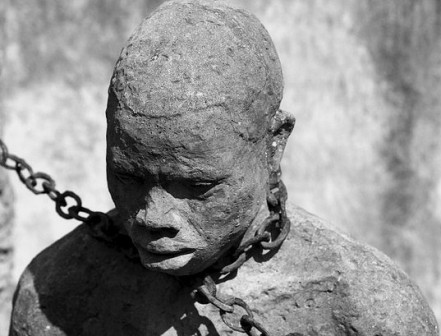
This notion originated by the French author, and dully amplified ever since, defining the United States as the “divine gift” of a moral and virtuous land is a cruel fairy-tale. It is mainly convenient to ease up America’s deep guilt. After all, the brutal birth of this nation took place under the curse of two cardinal sins: the theft of Native American land after committing a genocide on their population; the hideous crime of slavery, with slaves building the immense wealth for the few, in a new feudal system, with their sweat, tears and blood.

Also from Gilbert Mercier, please see this:

Tax Day: A Third Of Your Tax Money Is Spent On Wars And Security

Julian's note: "Security", here, means the racist-misogynist, oil-hoarding, ecocidal bombing of human beings in Central Asia and North Africa. Just in case the word "security" doesn't quite make that clear.

Join the Anti-Genocide Action: Religious Ceremony at Sogorea Te (aka, Glen Cove). Help Block and Stop the White Man's Bulldozers Destroying Sacred Ground

image is from here

What follows is from Censored News, with thanks to Brenda Norrell. Please click on the title below to link back.

Glen Cove: Native Americans occupy sacred place

As Bulldozers May Arrive Any Day at Ancient Burial Site, Native Americans To Occupy Sacred Land at Glen Cove in Vallejo
Spiritual Ceremony and Occupation Beginning Friday, April 15, 2011 at 8 am
Press statement
Vallejo, California (April 14, 2011) – Faced with the imminent arrival of bulldozers at the Native American sacred burial site at Glen Cove, Vallejo, members of the local Native American community will hold a religious ceremony to commence an occupation of Sogorea Te, otherwise known as Glen Cove, in the City of Vallejo beginning at 8 am on Friday, April 15, 2011. Native Americans and their supporters have vowed to physically block bulldozers or any other work that would desecrate the burial site.

Native American activists consider this to be the last stand in a struggle that has been going on for over a decade, since the Greater Vallejo Recreation District (GVRD) first proposed plans for a “fully featured public park” including construction of a paved parking lot, paved hiking trails, 1000 pound picnic tables and a public restroom on top of the 3500 year old burial site.

On Wednesday, April 13th, Sacred Site Protection and Rights of Indigenous Tribes (SSP&RIT), a Vallejo-based community organization, filed an administrative civil rights complaint to the State of California alleging that the City and GVRD are discriminating on the basis of race in threatening to destroy and desecrate significant parts of the Glen Cove Shellmound and burial site, for harming Native Americans’ religious and spiritual well-being, and effectively excluding Native Americans from their right to full participation in decision-making regarding the site.

The history and cultural value of the site has never been disputed. Human remains have been consistently unearthed as the area around the site has been developed.  Native Americans continue to hold ceremonies at Sogorea Te just as they have for thousands of years. The Glen Cove Shell Mound spans fifteen acres along the Carquinez Strait.  It is the final resting place of many Indigenous People dating back more than 3,500 years, and has served as a traditional meeting place for dozens of California Indian tribes.  The site continues to be spiritually important to California tribes. The Glen Cove site is acknowledged by GVRD and the City to have many burials and to be an important cultural site, yet they are moving forward as early as Friday with plans to build a toilet and parking lot on this sacred site and to grade a hill that likely contains human remains and important cultural artifacts.

SSP&RIT have asked GVRD to reconsider their plans to grade the hill and build toilets and a parking lot at the site.

Glen Cove is located near the intersection of South Regatta and Whitesides Drive in Vallejo.
For more information and directions: www.protectglencove.org
                                                                                               
Contact:
Norman “Wounded Knee” Deocampo 707-373-7195
Corrina Gould 510-575-8408
Mark Anquoe (415) 680 0110
Morning Star Gali (510) 827 6719
 

Anti-Genocide and Indigenous Action Alert: Treaty 8 First Nations in Oil Sands Region: Traditional livelihoods threatened

photo of Chief Allan Adam (Athabasca Chipewyan First Nation) is from here
Please click on the title below to link back to the source where I found this, at Censored News. With thanks to Brenda Norrell.

Treaty 8 First Nations in Oil Sands Region: Traditional livelihoods threatened

Draft Land Use Plan Infringes Treaty 8First Nations in Oil Sands Region say that the Lower Athabasca Regional Plan does not protect enough land and resources to sustain their traditional livelihood and creates legal risk for Alberta

By Chief Allan Adam, Athabasca Chipewyan First Nation
April 8, 2011, Fort McMurray

On April 5, 2011, Alberta Government’s Department of Sustainable Resource Development, headed by Minister Mel Knight, released the draft Lower Athabasca Region Plan (LARP).  The draft plan proposes a 16% increase to conservation areas in the oil sands region, which is significantly less than the recommendations from the Regional Advisory Council (RAC), who advised up to 32%, and considerably less than recommendations from First Nations.

The Athabasca Chipewyan First Nation, who has aboriginal and treaty Rights throughout the LARP area are left wondering how they will sustain their traditional livelihood and protect their cultural existence on what amounts to scattered, small parcels of land.  According to Chief Allan Adam the LARP represents “… an economic assimilation of our people.  How can we maintain our culture, protect our livelihood and continue practicing our treaty rights under these conditions.  LARP is an infringement of our Rights and the government has a duty and obligation to ensure that we have the ability to practice and maintain those Rights now and into the future.”

Chief Adam explained that “Alberta is doing more of the same thing and expecting a different result.  The provincial government consistently fails to meet even our basic needs when it comes to air, land and water within the region and fails to meaningfully engage First Nations in land management decisions in accordance with our aboriginal and treaty rights.  Until Alberta makes meaningful efforts to protect land, regulate industry and ensure that First Nations are at the table as full partners to develop solutions to the serious environmental challenges that government and industry are creating, they can count on our opposition to further development within the region.”  

The ACFN depends on the environment in order to sustain their protected treaty right to hunt, fish and trap.  The government has a duty and obligation under Treaty 8 and the Constitution Act to ensure that the environment will be protected in ways that are sufficient to sustain First Nations use of the ecosystems.  The goal of Chief Adam is to ensure that the members of the ACFN have the ability to practice their treaty rights.  With the inadequate process that was used to develop LARP, it is clear that the ACFN’s voice was not heard.  The ACFN submitted numerous documents to the RAC regarding the environment, sustainability and the importance of the practice of the rights and culture to ACFN’s wellbeing.  

At a community meeting held with the GOA in Fort Chipewyan on January 18, 2011 the ACFN membership unanimously agreed that the consultation on the LARP process was unfair.  Lionel Lepine, member of the ACFN is worried about his ability to maintain his way of life and the ability to continue practicing his treaty rights.  According to Lionel, “…the LARP will be a cultural annihilation. As the land continues to be developed, where will I go to teach my children their cultural way of life?”  Leslie Cardinal another ACFN member stated that “The government of Canada formally endorsed the United Nations Declaration on the Rights of Indigenous Peoples in a manner that is consistent with Canada’s Constitution and laws.  The UN Declaration is clear that Indigenous people have the right to maintain and strengthen their distinctive spiritual relationship with their traditionally owned or otherwise occupied and used lands, territories, waters and other resources and to uphold their responsibilities to future generations.  The LARP is not consistent with the international or Canadian laws.”  According to Chief Adam, “It is obvious that the ACFN was not heard and that the government is not listening.  One thing is clear, we will be reviewing the LARP and what it means to our continued use and practice of our rights and make a decision on how to proceed due to the infringements.”

ACFN will be completing a detailed review of the draft LARP over the next 60 days and will continue their attempts to have Alberta consult them in a meaningful way on land and resource use planning and decision-making in the oil sands region.  Athabasca Chipewyan First Nation traditional lands and treaty rights extend throughout the Lower Athabasca oil sands region.  The ACFN signed Treaty 8 in 1899 at Fort Chipewyan on Lake Athabasca.  Today, the majority of members reside in Fort Chipewyan and Fort McMurray.

For more information contact:

Athabasca Chipewyan First Nation
Chief Allan Adam, Athabasca Chipewyan First Nation
780-713-1220

Economic Justice Action Alert: Michael Moore: "The Execs at GE Are Laughing at What a Bunch of Suckers We Are for Filing Our Taxes -- Let's Make Them PAY!"!!!!!!!!!

image of Michael Moore is from here
I'm not a fan of Michael Moore but nor do I jump on the "despise Michael Moore" bandwagons either. To me, he is a white het male supremacist who is also a progressive liberal when it comes to U.S. economic and military policies. He doesn't ever name patriarchy (or misogyny) as a problem, never addresses the horrific depth of white supremacy, nor does he see heterosexism and anti-Indigenism as foundational to the existence of the U.S.

That said, he gets some good points across in some media precisely because he doesn't do any of the above. Even his movie on capitalism has to make it sound as though he likes capitalism.

His politics need to be radically reworked into a more pro-feminist, pro-Indigenous, anti-heterosexism policy or series of campaigns, but let's hear what he has to say on an upcoming tax-day related action.

What follows is from AlterNet. You may click on the title to link back.
 
The joke's on us, folks. GE and tons of other corporations will have a tax bill for 2010 of ZERO.
Friends,
Do you wonder (like I do) what the tax accountants and executives are doing over at GE this weekend? Frantically rushing to fill out their IRS returns like the rest of us?

Hardly. They're taking the weekend off to throw themselves a big party and have a hearty laugh at all of us. It must really crack them up to see us like suckers scurrying around to make sure we report everything to Uncle Sam -- and even send him a check, if necessary.

The joke's on us, folks. GE and tons of other corporations will have a tax bill for 2010 of ZERO. GE had $14.2 billion in profits in 2010. Yet they will contribute NOTHING to the federal government while every last dime is soaked from us.

In the latest budget deal, our politicians could have tackled the deficit by stopping the flow of these ill-gotten billions to corporations. Instead they cut billions from "wasteful" programs that do "wasteful" things, like create new jobs, drive economic growth, and help the needy and our nation's children. It's Democracy in reverse and it sickens me.

GE spends $20 million a year to lobby Congress to throw themselves this party. But do you know what speaks louder than $20 million? 20 million votes! 20 million people, and more, standing together and taking to the streets. That starts now, with you.

This coming Monday, April 18th is Tax Day -- and that's the day when "we the people" will demand our country back from these corporations in events all across the country. You can find the nearest event to you here.

MoveOn members -- along with union, community, and environmental allies -- will gather outside the headquarters and local offices of the biggest corporate tax dodgers to deliver tax bills from the American people. And we'll demand that our leaders make these corporate deadbeats pay.

We're doing this because we don't buy into the Big Lie: that greedy teachers caused the crash on Wall Street! That the selfish firefighters sent millions of jobs overseas! That pregnant woman, infants, and children are sending us into deficit!

No, it was the big corporations that did this. It was the CEOs and the top 1% of the country. THEY brought on the mortgage crisis. THEY made off with trillions of dollars from our economy. THEY are systematically destroying the middle class. And THEY have bought and sold the very people elected to represent us!

On Monday, we will have something to say to Exxon, Chevron, and the big banks that crashed our economy and got billions in bailouts, like Citigroup and Bank of America, who pay little or no federal income tax. In fact, the IRS will likely give them a tax REBATE. If that doesn't boggle your mind then nothing will.
The Tax Day events are about sending this message: We are coming after you, we are stopping you and we are going to return the money, jobs, and homes you stole from the people. This is your tipping point, Corporate America. And I, for one, am glad it's going to happen this Monday.

If you've never been to an event like this before, this is the time. And don't go alone, because none of us can win this fight by ourselves. Plus, it's more fun and exciting to go along with friends and family to be part of real democracy in action -- not the store-bought kind Big Business gets on Capitol Hill.
I really hope you can make it. This is our chance, my friends. Take the time on Monday to
make your voice heard. I can guarantee you I will. Please join me.

Yours,

Michael Moore
Michael Moore is an Academy Award-winning filmmaker and author. He directed and produced Roger & Me, Bowling for Columbine, Fahrenheit 9/11, and Sicko. He has also written seven books, most recently, Mike’s Election Guide 2008