Monday, February 7, 2011

Calgary Peace Prize Going to Dr. Vandana Shiva, March 10, 2011 ECD

photograph of Dr. Vandana Shiva is from here

What follows is from Slow Food Calgary. You may link back by clicking on the title below.

Dr. Vandana Shiva to receive the Calgary Peace Prize


Filed February 6th, 2011, in Community, Events, Global.

On March 10th, the University of Calgary’s Consortium for Peace Studies will award Dr. Vandana Shiva, a world-renowned environmental activist from New Dehli, The Calgary Peace Prize.

The awards ceremony and banquet will be held at the Calgary Golf & Country Club.
Tickets are available via the U of C’s secure Net Community: TICKETS

About Vandana Shiva:

Time Magazine identified Dr. Shiva as an environmental “hero” in 2003 and Asia Week has called her one of the five most powerful communicators in Asia. Dr. Shiva has pioneered the organic movement in India and established Navdanya, the country’s biggest network of seed keepers and organic producers. Dr. Shiva has authored many books including Soil Not Oil, Earth Democracy, Stolen Harvest, Staying Alive, Water Wars and Biopiracy. Her work has earned these distinctions: The Alternative Nobel Prize (Right Livelihood Award, 1993), Order of the Golden Ark, Global 500 Award of UN and Earth Day International Award, Lennon ONO grant for peace award by Yoko Ono, Yo Dona Award by Yo Dona Magazine, Spain and Sydney Peace Prize 2010.

On March 10th in Calgary, Dr Shiva will be receive the University of Calgary’s Consortium for Peace Studies’ $5,000 prize and will speak about her commitment to social justice, the empowerment of women in developing countries, human rights for small farming communities, and about her scientific analysis of environmental sustainability.

About the Calgary Peace Prize:

The Calgary Peace Prize was established by the Consortium for Peace Studies at the University of Calgary in 2006. The prize recognizes outstanding individuals from the global community, whose work has made the world a safer and less violent place. The Consortium for Peace Studies has established this prize to recognize outstanding contributions in peace work, and to highlight Calgary’s commitment to furthering global peace. Past recipients include: Mayor Tadatoshi Akiba of Hiroshima, Japan, His Royal Highness Prince El Hassan Bin Talal of Jordan, former UN High Commissioner for Human Rights Madam Louise Arbour and journalist Sally Armstrong.

An Honest, Open Letter to the LGBTIQA Blogging Community (Lesbian, Gay, Bisexual, Transgender /Transsexual, Intersex/Intergender, Queer/Questioning, and Asexual)

image is from here

Dear Queer Community,

It seems to me there's kind of a general culture online of throwing around of hateful and disrespectful speech, particularly if not uniquely in the queer blogosphere. I see this in many blogs which I won't name in part because there are too many to name. That said, the list isn't uncountable. It's a definite number--perhaps growing, perhaps not. But what I'm seeing is a rather nasty, almost compulsively snarky, and generally unconstructive way of engaging that seems to do little more than demonstrate that yes, we can insult each other and treat each other in emotionally harmful ways, while never really engaging in meaningful dialogue and respectfully agreeing to disagree.

I also find that our online blogging community both is and is not a voice for the offline community. After checking this out with several people in our community as citizens and activists, what I find is that many of the terms we use to divide ourselves up, to fuel tensions and deepen disagreements do not exist offline in general discourse. This means one of three things:

--the realities we discuss here are not relevant to the lives of people who do not blog, or
--what we discuss does not reflect actual lived life of most LBGTIQA people, or
--how we discuss things is elitist and removed from how people offline speak of their lives and their struggles

I think particular environments are likely to creating their own ways of being and doing things. And in the blogging world, it seems, being snarky, nasty, mean, and hateful is too often held as both acceptable and a worthwhile endeavor.While it may benefit a few individuals to write about other groups of people in demeaning and grossly stereotypical ways, I wonder what the effect is generally on our capacity to care about one another or at least see one another as full human beings.

I hold out little hope that white het men will "come around" and care about the concerns radical activists working to end male and white supremacy, and Western corporate tyranny, and U.S. militarism-as-foreign-policy. I want them to get it and challenge one another accordingly. But I don't have much hope for that. The levels of protections and privileges, the forms of power and the range of entitlements, that WHM possess and maintain, are so encouraging of living in denial about what everyone who isn't a WHM experiences. The denials is a consequence of not experiencing what most people around the world experience.

If you are not raped, or your body isn't socially targeted for rape, and your gender isn't targeted for rape, how are you to know what it feels like to hear that another woman has been raped? How are you to register "rape" as a form of gendered terrorism that men commit disproportionately and intentionally against women and girls? If  you are white, how are you to know the forms of invisibility and stigma people of color carry within them that are inflicted and maintained by white society?

What people raised with male privileges (however modified they might be by other factors), don't generally acknowledge, is the degree to which they shape the behavior of the people with them. I find the same dynamic operating among whites: willful denial of privileges based on race.

What I see in our community is men and males who (intentionally or not) disrespect and hurt women--lesbians and women who are not lesbian--without regard for the effect, except to take pleasure when the effect is damaging to women.What I have observed is gay men, bisexual men, trans men, and trans women raised with male privileges, discounting women's experience as not sufficiently real or valid to take seriously. Or to cause one to make changes in one's own male-privileged and/or misogynistic behavior.

I would say that white racism, male supremacy, and an attachment to the values of corporate capitalism are three forces that combine to make our community one more place where many women are not safe from abuse and harassment. I see this harassment and abuse online, on blogs that seem to think that radical feminists--the few they name--are able to inflict oppressive harm systematically against some in our community the way that men do. To me, that's utter nonsense. How, structurally, would that even be possible? How could that happen systemically, when radical feminists aren't in charge of any dominant systems? Men and males are in charge, not women, not females. And in the West, whites are in charge--not people of color.

Unowned and irresponsible use of white and male privileges are two things I see being acted out on blogs. Gay men disrespect women, lesbian or not, and male-privileged people, trans or not, disrespect radical lesbian feminists--the few they name or believe they know.

I have yet to see one book written by a radical lesbian feminist responsibly and respectfully engaged with. Not one. Why is that? I see writings by men engaged with as if the author was a person deserving of respect and regard. Whole academic disciplines are organised around the ideas and ideologies of men, too often white men. But when the author, the historian, the social and cultural critic, the activist, is a lesbian-identified woman who is not transgender or transsexual, there is not such engagement or care to understand the meaning of the work.

I welcome someone linking me to even one gay male-privileged, bi male-privileged, or trans male-privileged blogger who responsibly, thoughtfully, carefully, respectfully analyses and engages with just one book written by a radical lesbian feminist. Just one. Or with just one activist who is a radical lesbian feminist. Just one. Because I'm beginning to wonder whether anyone who is not a radical lesbian feminist is even capable of doing this. I mean emotionally and intellectually capable. I mean spiritually and politically capable. I have "virtually" no evidence of such engagement happening. And I believe that ought to be a concern for all of us. Because radical lesbian feminism is one of the most pro-liberatory and intentionally anti-status quo movements to rise out of our community, or one portion of it. I know many lesbians do not identify as queer or feel a part of queer community. But het male society does locate lesbians of any political affiliation or identity as "who is queer", and we are defined, often enough, by our oppressors.

Why won't non-lesbian, non-feminist, non-radical people engage responsible and respectfully with radical lesbian feminist authors and activists? I'd like someone to explain why without being anti-feminist, misogynistic, or arrogantly male supremacist when doing so.

Yours in the struggle,

Julian

Saturday, February 5, 2011

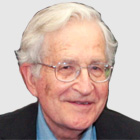
Noam Chomsky on the U.S.'s interest in Egypt's Independence from the West

image is from here
That the U.S. has never had a moral center or anything resembling a soul ought to be obvious from the amount of atrocity it has committed in the name of liberation and freedom for rich white het men. Whenever conflict and attempts at social and political transformation happen anywhere in the world, the myopic, self-centered,  and sociopathic U.S. has only one response: "How will this effect us?" What are "our interests" in this conflict? In what ways should be be interfering and controlling the outcome? The assumption, a white male supremacist one, is that this white male supremacist country is entitled to interfere with any sovereign nation on Earth, including Indigenous ones. 
The U.S. believes itself, quite delusionally, to be on the side of good in every effort to secure its place as global bully and pillager. This, despite evidence to the contrary:
Washington provided $12m in military aid to Tunisia. As it happens, Tunisia was one of only five foreign beneficiaries [of aid from the U.S.]: Israel (routinely); the two Middle East dictatorships Egypt and Jordan; and Colombia, which has long had the worst human-rights record and the most US military aid in the hemisphere. -- Noam Chomsky
Is it any wonder that so many in the U.S. are depressed, have mental health struggles, and are hurting? When your government is morally bankrupt, what does it mean to have ethical integrity or to be politically healthy? How can a society so hell-bent on greed and destruction, on domination and rape, be revered and regarded as "good" by any nation across the globe, or even by itself and its own citizens?

I wish the people of Egypt a swift and peaceful exchange of power, from one that was ruthless and corrupt (not unlike the U.S. regime), to one that is democratic and just (unlike the U.S. regime).
What follows is from The Guardian but is by Noam Chomsky. Please click on the title below to link back.

It's not radical Islam that worries the US – it's independence

The nature of any regime it backs in the Arab world is secondary to control. Subjects are ignored until they break their chains
'The Arab world is on fire," al-Jazeera reported last week, while throughout the region, western allies "are quickly losing their influence". The shock wave was set in motion by the dramatic uprising in Tunisia that drove out a western-backed dictator, with reverberations especially in Egypt, where demonstrators overwhelmed a dictator's brutal police.

Observers compared it to the toppling of Russian domains in 1989, but there are important differences. Crucially, no Mikhail Gorbachev exists among the great powers that support the Arab dictators. Rather, Washington and its allies keep to the well-established principle that democracy is acceptable only insofar as it conforms to strategic and economic objectives: fine in enemy territory (up to a point), but not in our backyard, please, unless properly tamed.

One 1989 comparison has some validity: Romania, where Washington maintained its support for Nicolae Ceausescu, the most vicious of the east European dictators, until the allegiance became untenable. Then Washington hailed his overthrow while the past was erased. That is a standard pattern: Ferdinand Marcos, Jean-Claude Duvalier, Chun Doo-hwan, Suharto and many other useful gangsters. It may be under way in the case of Hosni Mubarak, along with routine efforts to try to ensure a successor regime will not veer far from the approved path. The current hope appears to be Mubarak loyalist General Omar Suleiman, just named Egypt's vice-president. Suleiman, the longtime head of the intelligence services, is despised by the rebelling public almost as much as the dictator himself.

A common refrain among pundits is that fear of radical Islam requires (reluctant) opposition to democracy on pragmatic grounds. While not without some merit, the formulation is misleading. The general threat has always been independence. The US and its allies have regularly supported radical Islamists, sometimes to prevent the threat of secular nationalism.

A familiar example is Saudi Arabia, the ideological centre of radical Islam (and of Islamic terror). Another in a long list is Zia ul-Haq, the most brutal of Pakistan's dictators and President Reagan's favorite, who carried out a programme of radical Islamisation (with Saudi funding).

"The traditional argument put forward in and out of the Arab world is that there is nothing wrong, everything is under control," says Marwan Muasher, a former Jordanian official and now director of Middle East research for the Carnegie Endowment. "With this line of thinking, entrenched forces argue that opponents and outsiders calling for reform are exaggerating the conditions on the ground."

Therefore the public can be dismissed. The doctrine traces far back and generalises worldwide, to US home territory as well. In the event of unrest, tactical shifts may be necessary, but always with an eye to reasserting control.

The vibrant democracy movement in Tunisia was directed against "a police state, with little freedom of expression or association, and serious human rights problems", ruled by a dictator whose family was hated for their venality. So said US ambassador Robert Godec in a July 2009 cable released by WikiLeaks.

Therefore to some observers the WikiLeaks "documents should create a comforting feeling among the American public that officials aren't asleep at the switch" – indeed, that the cables are so supportive of US policies that it is almost as if Obama is leaking them himself (or so Jacob Heilbrunn writes in The National Interest.)

"America should give Assange a medal," says a headline in the Financial Times, where Gideon Rachman writes: "America's foreign policy comes across as principled, intelligent and pragmatic … the public position taken by the US on any given issue is usually the private position as well."

In this view, WikiLeaks undermines "conspiracy theorists" who question the noble motives Washington proclaims.

Godec's cable supports these judgments – at least if we look no further. If we do, as foreign policy analyst Stephen Zunes reports in Foreign Policy in Focus, we find that, with Godec's information in hand, Washington provided $12m in military aid to Tunisia. As it happens, Tunisia was one of only five foreign beneficiaries: Israel (routinely); the two Middle East dictatorships Egypt and Jordan; and Colombia, which has long had the worst human-rights record and the most US military aid in the hemisphere.

Heilbrunn's exhibit A is Arab support for US policies targeting Iran, revealed by leaked cables. Rachman too seizes on this example, as did the media generally, hailing these encouraging revelations. The reactions illustrate how profound is the contempt for democracy in the educated culture.

Unmentioned is what the population thinks – easily discovered. According to polls released by the Brookings Institution in August, some Arabs agree with Washington and western commentators that Iran is a threat: 10%. In contrast, they regard the US and Israel as the major threats (77%; 88%).

Arab opinion is so hostile to Washington's policies that a majority (57%) think regional security would be enhanced if Iran had nuclear weapons. Still, "there is nothing wrong, everything is under control" (as Muasher describes the prevailing fantasy). The dictators support us. Their subjects can be ignored – unless they break their chains, and then policy must be adjusted.

Other leaks also appear to lend support to the enthusiastic judgments about Washington's nobility. In July 2009, Hugo Llorens, U.S. ambassador to Honduras, informed Washington of an embassy investigation of "legal and constitutional issues surrounding the 28 June forced removal of President Manuel 'Mel' Zelaya."

The embassy concluded that "there is no doubt that the military, supreme court and national congress conspired on 28 June in what constituted an illegal and unconstitutional coup against the executive branch". Very admirable, except that President Obama proceeded to break with almost all of Latin America and Europe by supporting the coup regime and dismissing subsequent atrocities.

Perhaps the most remarkable WikiLeaks revelations have to do with Pakistan, reviewed by foreign policy analyst Fred Branfman in Truthdig.

The cables reveal that the US embassy is well aware that Washington's war in Afghanistan and Pakistan not only intensifies rampant anti-Americanism but also "risks destabilising the Pakistani state" and even raises a threat of the ultimate nightmare: that nuclear weapons might fall into the hands of Islamic terrorists.

Again, the revelations "should create a comforting feeling … that officials are not asleep at the switch" (Heilbrunn's words) – while Washington marches stalwartly toward disaster.© 2011 Noam Chomsky

A Slightly Belated Happy Chinese New Year (Feb. 3, 2011) to all who celebrate the holiday!!

image is from here
Wishing everyone a peaceful, joyous, prosperous new year! -- Julian

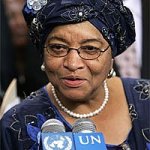
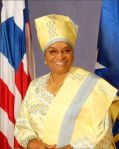
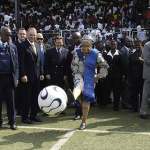
Madam President Ellen Johnson Sirleaf of Liberia

All that follows is from *here* at the African Heritage blog.
 

Madam President: Ellen Johnson Sirleaf

Iron Lady
Iron Lady: Ellen Johnson Sirleaf
There is a say which often goes as such: “When things are so bad that they are irreparable, men leave the power to women or minorities!” (Just look at the USA!) Well… that’s what they will definitely say about Liberia, a country which had been in war for so many years and decades, that the system was so broken down, the country was a mess, no government, no law, no nothing!

Mme President
President of Liberia: Mrs. Ellen Johnson Sirleaf
And then was elected Mrs. Ellen Johnson Sirleaf! The first African female head of state! We even beat the USA, we got our woman in power! Yes… here comes the Iron lady of Africa. Few words will express what the inauguration of Mrs Sirleaf meant to me, and thousands of other girls and women across the continent. Truth be told, very few of us ever thought possible the day a woman would be president on our continent. Very few of us thought possible an actual country ruled by a woman, in Africa….! When I was young, I had read about Nzingha the queen of Angola, Hatshepsut the She-pharaoh of Egypt, Beatrice of Congo, Empress Zewditu of Ethiopia… to name just a few; but these emblematic African female leaders seemed so far removed from me, buried in the sands of the past, that as a young African woman my dreams to see a charismatic woman leader in the modern era seemed to be just that… a dream (I still wanted my dream to become a reality)!

Ellen Johnson Sirleaf
Don't mess with my president!
Ellen Johnson Sirleaf is an achieved economist who served as minister of finance of Liberia in the late 70′s. She once supported Charles Taylor against the bloody government of Samuel Doe… but later on criticized him once she realized he was perpetrating bloody crimes in Liberia as well. After Samuel Doe’s coup in 1980, she went into exile in Kenya where she worked for Citibank as director. She returned to Liberia to run against Doe, but was sentenced to 10 years in jail, and was again forced into exile. She later repeated the scenario in 1997 when she ran against Charles Taylor, but lost. She finally won the elections in 2005 to be the first elected female head of state of Liberia, and Africa. Hers is a story of perseverance, endurance, determination, courage, hard work, and above all love for her country. What brought her back so many times to Liberia? Lord only knows! What made her want to challenge Samuel Doe, Charles Taylor, Prince Johnson, etc…? The good Lord only knows! One thing is sure, this is definitely an Iron Lady!
 
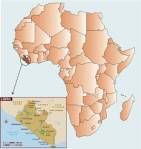
Liberia
Liberia
The video you will see below is a documentary on her first year in power entitled Madam President! It highlights her struggles and victories. How do you re-build a country where there are no institutions? where there are children soldiers? where there is no law? and where a claim to land means nothing after years of war! How do you do that? Well… watch Madam president! surround yourself with the best minds, and some strong women as well! I tell you… Watch and raise your hat to Mrs. President! Yeah… that’s right! Our very first woman president!
 
To find out more, check out Ellen Johnson Sirleaf on Wikipedia, read her book “This Child Will Be Great“. Laura Bush wrote a piece on her in Time Magazine after she and Condoleezza Rice attended Sirleaf’s inauguration. Ellen Johnson Sirleaf was awarded the Presidential Medal of Freedom in 2007 by president Bush. Check out Follow the Leader to learn more about the people who made the documentary, and this article by BBC.

Madame La Présidente

Check out the rest: Madam president Part 2 and Madam president Part 3

Earnestine "Amma" Smith's story told by her granddaughter, Dee Rees, in the 2008 film Eventual Salvation

Before the feature length film, Pariah, was made, Dee Rees made a very moving film about her grandmother, Earnestine "Amma" Smith. I am happy to promote it through this post.


Founded in 1847 as a home for former African-American slaves, the West African nation of Liberia has welcomed generations of expatriate Americans fleeing racism. One such immigrant was Earnestine “Amma” Smith, who settled in the capital, Monrovia, in 1958. An educator and landowner, Amma fled her new home during the recent deadly civil wars. Smith’s granddaughter, documentary filmmaker Dee Rees, accompanies Amma on her return to a new Liberia, now governed by Africa’s first woman president, as she attempts to rebuild her life.

Pariah: A Film About A Black Lesbian Young Woman Finding Herself in White Het Male Supremacy, Written and Directed by Dee Rees. Produced by her spouse in life and partner in work, Nekisa Cooper

photograph of couple Dee Rees and Nekisa Cooper, filmmakers of "Pariah" is from here

Telling a story is difficult when you struggle to know the story you're telling--because you are living it; because the story isn't done. But any partly autobiographical story will necessarily be a work in process. So it is for partners in life and work, Dee Rees and Nekisa Cooper, writer/director and producer, respectively, of a film getting a lot of attention at Sundance called Pariah. This is a deeply personal story, which means it is also profoundly political.

In a Western world where, far too often, human = white and male, queer = white and male, lesbian = white, and woman = white, it is difficult for me, a white gay male, to fully appreciate the struggles for visibility and validation faced by those of us in the queer community without white and male privileges. Why it is that white queer people think telling stories primarily about whites and men is representative of "us" is beyond me. Most queer people aren't white, after all; most queer people are not male either; and most queer people do not have the kind of economic privileges, social status, and professional clout with which to get films made. So movies from Making Love, to Birdcage, to Brokeback Mountain, to TransAmerica, to The Kids Are All Right do not tell "our" story so much as they tell a small part of our story made to seem complete.

I recommend checking out these films about queer people of color and/or LGBTIQA people who do not live in Anglo-white societies: Black Womyn: Conversations with Lesbians of African Descent; Johnny Greyeyes, The Watermelon Woman, A Litany for Survival: The Life and Work of Audre Lorde, Fire, The Blossoming of Maximo Oliveros, and XXY. I welcome the readers from all over the world alerting me to other films depicting the lives of queer and Two-Spirit people of color, and queer people living in the Pacific Islands, South and Central America, sub-Saharan Africa, Northern Africa and The Middle East, Central Asia, South Asia, Southeast Asia, East Asia, and Black, Brown, Asian, and Indigenous people globally.

White gay activists like Dan Savage state that, increasingly, our people's stories are told in dominant media--on television and in films. But these voices, such as those in Will and Grace and Modern Family, lack authenticity and depth when they are only white or only male (or both). They aren't "us", in other words; they are "the voices of the most privileged" which means the most complex struggles, told as stories in whatever televised or cinematic form, are not familiar to most of us.

As anyone knows who remembers the first lesbian or gay person you saw on television or in film, seeing ourselves reflected back to us in affirming and three-dimensional ways is critically important to our self-esteem and sense of self-worth. This is particularly true for queer youth, who generally and usually do not have any validation or support within families of origin.

I didn't come out to my family of origin until after I was out to myself and my friends. It's the friends that so often help us prepare to tell those family members, who can be liberally accepting or conservatively rejecting. This is one theme in the movie discussed below.

Here is an in-depth article and interview with the filmmakers of Pariah from three and a half years ago when the film only existed as a feature length screenplay and a short film. I have added several links to the article when writers and spiritual-political-creative movements are mentioned, in case any readers here aren't familiar with them. What follows is from Afterellen.com and may be linked back to by clicking on the title just below.


Giving Voice to a "Pariah"

reescooper.jpgpariahclip.jpg

Dee Rees never thought she would become a filmmaker. "My journey into film has been pretty roundabout," she told AfterEllen.com. The Tennessee native started out in the business world, where she met her girlfriend, Nekisa Cooper. The two recently collaborated on the award-winning short film Pariah (Rees wrote and directed; Cooper produced), a coming-of-age story about an African-American lesbian teen who struggles with her sexual orientation in the face of a conservative family.
 
"Going into undergrad, I knew that I loved writing," explained Rees, "but was afraid to major in English or journalism because it didn't seem 'practical.'"

Thankfully, Rees didn't stay long in a field she was unhappy in, but her stint in business did beget the essential partnership behind Pariah's creation. "I met Dee while working at Colgate," Nekisa Cooper recalled in an interview with AfterEllen.com.
 
"We had taken similar paths to get there — we both went to business school and graduated thinking we would take the marketing world by storm," she continued. "Dee was a breath of fresh air for me, and we became fast friends." The pair began dating while Rees looked for graduate programs in which she could follow her true passion.

Her creative drive was originally centered on writing, but film also had a certain appeal. "As I started learning about screenwriting and film programs," Rees said, "I was completely sold on the idea of being able to literally bring my characters to life." She enrolled in film school at New York University, throwing herself into her new craft, and soon called upon Cooper's organizational skills to help produce her films.
 
"I should've gotten an associate's degree from NYU," Cooper said with a laugh, "because I spent so much time going to classes with Dee and meeting the people in that world!"
 
Pariah was a labor of love for both women, who have been blown away by its runaway success on the film festival circuit. The film is the story of Alike (Adepero Oduye), a 17-year-old African-American girl who struggles to find herself and her sexual identity in between two unforgiving worlds. She dons one set of clothes around her gay friends and another around her family, hiding who she is from her judgmental parents.
 
Even the title evokes the outcast, the unwanted — and an emotional chord has been struck within many communities. The film has received high praise and awards from circles as diverse as the Los Angeles Film Festival, Urbanworld and the biggest LGBT film festivals, including Frameline, Outfest, NewFest and the Philadelphia International Gay and Lesbian Film Festival. "It is has been more than we ever could have hoped for," said Cooper.
 

Rees wrote and directed the film as her graduate thesis, with the intention of creating something that could open the doors of communication between families and communities.
 

"I think awareness is the first step in creating change and to opening discussion," she said. "And the film has definitely done that. We were really excited that the film was well-received at Urbanworld [a film festival that focuses on the black community], because it means that people are starting to listen and be open, which was exactly what we were going for."


As a film that encourages discussion, Pariah hits on quite a few heavy topics within its brief running time. Rees sees the film as a parable that everyone can relate to, but it examines the struggles of queer black youth most closely.
 
"Pariah is about identity," Rees explained. "I think that identity is something that everyone has struggled with in some way and at some point in their lives, so I think it's a very universal struggle and experience that all audiences can relate to. At the same time, I did want to bring to light the experiences of gay youth of color because it's a story that hasn't been fully told and needs to be seen and heard."

The project was a tough sell from a production standpoint, hampered by the usual hurdles of making a successful short film: access to good actors, equipment, locations and support that can ruin even the most masterfully written script. "The production experience was extremely intense; it was really hard, dirty work," Rees said. "It was definitely a labor of love, but the actors were amazing. My DP [director of photography], Brad Young, was a genius."
 
She continued: "Nekisa did all the heavy lifting and was a miracle worker in making everything happen and cultivating relationships. [She is] a really supportive and amazing girlfriend and producer, and I feel really lucky to be with her."
The film is a highly personal project for both women. Rees originally wrote Pariah as a feature length, semi-autobiographical piece and based a great deal of Alike's experiences on her own. "Pariah is definitely very personal for me," Rees said.
 
She explained: "When I was growing up, I felt like I was never really comfortable being myself. I've only recently come into and accepted my sexual identity, and when I first moved to New York, it blew my mind that there were these out and proud teenage women who not only knew who they were, but weren't afraid to be themselves. I didn't even know who I was in that sense as a teenager, and I asked myself whether even if I did know back then, would I have had the courage to be who I was? The answer was no."
 
Cooper had a similar connection. "Alike's struggle was and is definitely my struggle, and the struggle of many lesbians," she said. "I wore many masks for a long time — I was one way with my family, one way with my straight white friends, and another way with my straight black friends. It took me a long time to become comfortable with me — with my spirit and all of the good and bad that encompassed it."
 

In fact, some of Alike's experiences are still all too familiar to the filmmakers. In terms of dealing with a lack of acceptance within her own family, Rees said, "[It's] something I'm struggling with now, and something that's going to be a long-term fight for me."
 
Cooper agreed. "Yeah, it's funny, but not funny — our parents haven't seen the film yet, so that kind of will tell you. My family was more accepting, but it's still going to take some time. I'm going to have to sit down with them and sort of preface the film before we watch it together."
 
Cooper grew up as a military brat, constantly moving from town to town. She credits her father's military influence as one of the biggest factors in shaping her savvy business sense and ability to manage a crisis — talents that came in handy during Pariah's production.
 
Rees grew up in rural Tennessee, reading Alice Walker, Maya Angelou, Gloria Naylor, Nikki Giovanni, Zora Neale Hurston and "pretty much any of the writers that were part of the womanist movement and the Harlem renaissance."
 
Living and working together in a creative medium hasn't always been easy, but Cooper and Rees have found a balance that works for them. "I think both of us, coming out of the business world, out of corporate America, we pretty much have a good sense of trying to set boundaries," said Cooper. "I mean, not that it isn't a struggle sometimes — especially when we were in preproduction and shooting — it was kind of difficult to take time just for us and the relationship."
 
That's all changed now that Cooper has left the corporate world for good, and they have both made the jump to the West Coast to pursue their future projects together. "I finally said, 'When are we going to have an opportunity for me to sort of jump?'" Cooper recalled. "So this is it: I'm here — hopefully for the long haul."
Pariah was originally intended to be a feature film, and in fact, the full-length script was written even before the short was made. Rees and Cooper are currently working on making the feature-length Pariah a reality, with Rees finishing up rewrites on the screenplay and Cooper gearing up for the Independent Feature Project market in September.
 
"Nekisa is banging out the final board and budget," Rees said, "and we plan to be done in time for the IFP market this September so that we'll have a complete package and hopefully attract some funders. We've had a lot of industry interest so far and look forward to moving forward soon." She added, "We'd love to shoot this next spring or summer."
 
Additionally, they are currently working on finishing up their feature documentary Eventual Salvation, based on the experiences of Rees' grandmother. "My grandmother is a Louisiana native and was born during the Depression," Rees explained. "She got fed up with all the racism and Jim Crowism here in the United States and decided to move her family to Monrovia, Liberia, in the 1950s.
 
"She lived there for almost 40 years, and remained through much of the civil war until her name turned up on a death list and she was forced to return to the States. In the winter of 2005, with the war finally over and the election of Africa's first female president, Madam Ellen Johnson-Sirleaf, she returned to Liberia to rebuild her home and her community, and Eventual Salvation is the story of that journey."
 
Cooper added: "It is the Africa you haven't seen in the media — images of hope instead of images of despair. Dee, Bradford Young and I are extremely excited to bring these images to the world."
 

Right now, the filmmakers are raising funds to complete the film. "We've been working over the last couple of years to get funding to finish it, basically," Cooper said. "In terms of timing, we're looking to finish it by the end of third quarter this year, and looking to hopefully get it into the festival circuit starting in January."
 
What with getting a feature-length Pariah off the ground and finishing up a multi-year shoot with Eventual Salvation, the filmmakers have their plates full at the moment. But Pariah's success hasn't left them blind to the whims of the business.
 
"This industry is just so fickle," said Cooper ruefully. "You can be hot one day and not the next. But from our perspective, we don't really try to focus on that. We try to focus on telling these stories in the best way that we can." 
*          *           *
PLEASE CONSIDER SUPPORTING THIS FILM MONETARILY, IF YOU ARE FINANCIALLY ABLE TO DO SO. 
The place to do that is HERE: http://www.kickstarter.com/projects/619452369/pariah-the-movie?ref=recently_launched

image of poster for the film, Pariah, is from here