Thursday, December 2, 2010

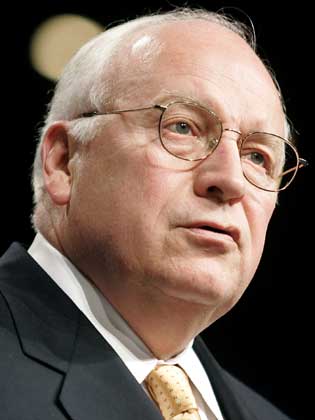
Dick Cheney WANTED FOR INTERNATIONAL CRIMINAL ACTIVITIES: the question is, which ones?

dick cheney 11 Nigeria to charge 
Dick Cheney in $180 million bribery case, issue Interpol arrest warrant
photo of an international criminal  who has yet to be held
accountable for his crimes against humanity is from here

What follows is a cross post from RawStory.com. Please click on the title to link back.

Nigeria to charge Dick Cheney in $180 million bribery case, issue Interpol arrest warrant

By John Byrne
Thursday, December 2nd, 2010 -- 8:37 am

The energy services company Dick Cheney ran prior to becoming Vice President of the United States was atop the tongue of liberals each time it was awarded a contract in Iraq.

Now the company's name, Halliburton, is being spoken somewhere else: Nigeria.

According to a story filed late Wednesday, Cheney will be indicted in a Nigerian bribery case as part of an investigation into an alleged $180 million bribery scandal.

"Last week, Nigeria arrested at least 23 officials from companies including Halliburton, Saipem, Technip and a former subsidiary of Panalpina Welttransport Holding AG in connection with alleged illegal payments to Nigerian officials. Those detained were all freed on bail on Nov. 29," Bloomberg News' Elisha Bala-Gbogbo wrote.

"Authorities in the West African nation are probing Halliburton, Saipem and Technip for the alleged payment of $180 million in bribes to win a $6 billion liquefied natural-gas contract," Bala-Gbogbo added. "Panalpina is being investigated for illegal payments it allegedly made to Nigerian customs officials on behalf of Royal Dutch Shell Plc."

The prosecuting counsel for the country's Economic and Financial Crimes Commission said that indictments will be handed down in the next three days and that an arrest warrant for Cheney "will be issued and transmitted through Interpol."

Adds Bloomberg, "Obla said charges will be filed against current and former chief executive officers of Halliburton, including Cheney, who was CEO from 1995 to 2000, and its former unit KBR Inc., based in Houston, Texas; Technip SA, Europe’s second-largest oilfield- services provider; Eni SpA, Italy’s biggest oil company; and Saipem Construction Co., a unit of Eni. Obla didn’t identify the former officials whom he said held office when the alleged bribes were paid."

A spokesman for Cheney declined to comment.  


The US Securities and Exchange Committee probe focused on the deal as early as 2004. Wrote The Washington Post at the time:
The Nigerian project, started in the early 1990s, was worth almost $5 billion to TSKJ, a partnership that included a KBR predecessor, as well as companies from France, Japan and the Netherlands.

At issue are payments made to Tristar, a Gibraltar company that had a consulting arrangement with a corporation formed by TSKJ to "administer the contracts and execute the work" in Nigeria, a Halliburton spokeswoman said in response to questions.

KBR, the engineering and construction subsidiary of Halliburton, was formed when Halliburton acquired Dresser Industries Inc. in 1998. It was a combination of Halliburton's Brown & Root and Dresser's M.W. Kellogg Co. Officials from the SEC and Cheney's office declined to comment.
Early on Thursday, Halliburton said they hadn't seen the new charges, but still denied their involvement.

"Halliburton's oil-field services operations in Nigeria have never in any way been part of the LNG project and none of the Halliburton employees have ever had any connection to or participation in that project," Tara Mullee Agard, a spokeswoman for the Houston-based company, said in an e-mailed response to Bloomberg.

Added Bloomberg: "Halliburton Co., the world's second- largest oilfield-services provider, said it hasn't seen any amended charges by Nigerian authorities who plan to indict current and former employees in a bribery scandal."

First Nations and American Indian Societies and Gender: a primer for whites

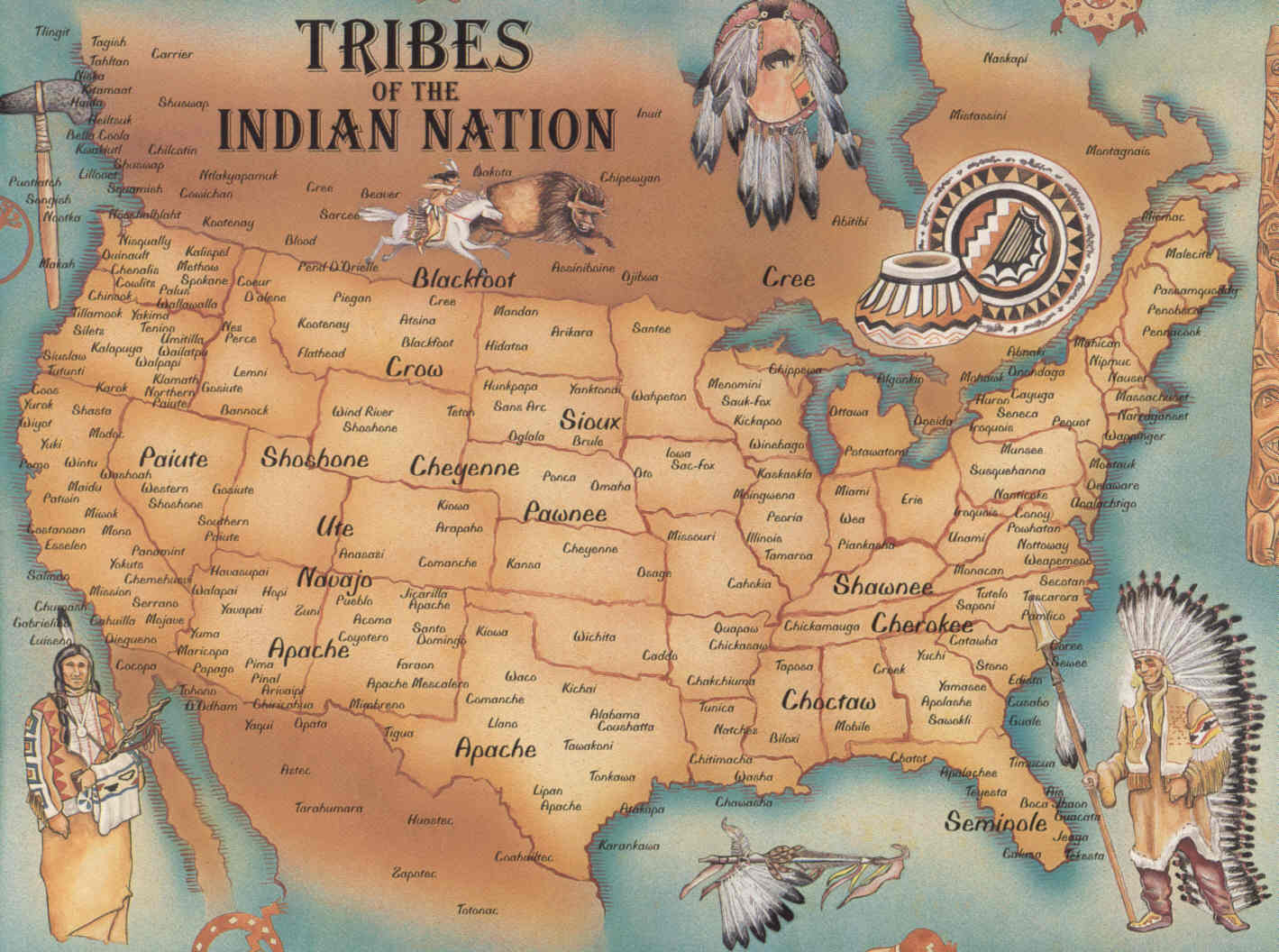
image of map, available to be seen larger, is from here
The above map might more accurately be called: 


Nations of The Indigenous Peoples 
of the North American Region

But I expect things I encounter about First Nations peoples and American Indians that are not from the people directly to be inaccurate most of the time.

I just heard the news that the prominent, famous actor who is from the U.S. but lives in France has been cast in yet another terribly racist role: that of Tonto. The actor's name is Johnny Depp and he has gone from being someone whose work I respected, to being among my least favorite actors. He keeps doing work that is so grotesquely racist that it is stunning to me that such films, as the Pirates of the Caribbean series, are still able to be funded. It's not surprising to me that they are funded; just stunning. That anything so racist is funded by Hollywood comes as no surprise whatsoever. I hope the producers and Johnny Depp are targeted for protest and boycott. The last thing I want to see is any movie about "The Lone Ranger" and his "sidekick" Tonto--perpetuating the racist/genocidal mythology that "it's all good" between the White Man and the Red Man, or, in the case of the image below, the whiter man and the greyer man.

image of "Tonto and The Lone Ranger" is from here

"Tonto" was played by First Nations athlete and actor, Jay Silverheels, Mohawk, born on the Six Nations of the Grand First River Nation, Ontario in 1937. In the early 1960s, assisted in the establishment of the Indian Actors Workshop in Echo Park, California as a place where American Indian actors could develop their acting skills. The workshop is still active. Jay died in 1980 at the age of 67. I think the white guy had a name and a a life too. The horse was named "Silver" in the TV series, "The Lone Ranger". Both characters' histories go back to a late 1930's serial.

But it's not really all that good--I mean between the White Man and the Red Nations. It's mostly quite atrocious, actually, if the whole ugly truth is to be told. It's particularly atrocious for the American Indian and First Nations women who are systematically raped and prostituted by and for the White Het Man. And the sooner Hollywood gets that straight and responsibly, not exploitively, portrays that reality accurately (and not with Kevin Costner as some sort of white hero, either) the better.
Even outside of Hollywood, stereotypes abound in white dominant culture about what it means to be American Indian. Growing up, within white-dominated queer culture, I heard tale of "the Berdache" as a great example of how much more liberal Native Americans were--you know, all those Native Americans who shared one culture that had this place in it for the Berdache.

About that term, from Wikipedia, *here*:
The term berdache is also used to indicate "two-spirit" individuals, but is increasingly considered outdated and inappropriate. According to the American Heritage Dictionary, 4th. ed., berdache is North American French, tracing back, through European French, Italian, Arabic, Persian, Middle Persian, and Old Iranian, to Proto Indo-European welƏ, "to strike, to wound"; making the term "berdache" a linguistic relative of such words as "Valhalla", "Valkyrie" and "vulnerable".

There are, in fact, many indigenous terms for these individuals in the various Native American languages — including Lakota winktje and Navajo nádleehí (Burrus & Keller, 2006: p. 73).

Berdache is a generic term that was used primarily by anthropologists in the past (no longer an accepted concept or term within the field). It is a loan from French bardache implying a male prostitute or catamite. The word's origin is complex: the French derives from the Spanish bardaxa or bardaje / bardaja via Italian bardasso or berdasia via Arabic bardaj: البَرْدَجُ" meaning "captive, captured" from Persian bardaj < Middle Persian vartak < Old Iranian *varta-, cognate to Avestan varəta- "seized, prisoner," formed from an Indo-European root *welə- meaning "to strike, wound." The term berdache is widely considered offensive, due to its roots.

Use of the term has widely been replaced with two-spirit (except in scholarly literature,) which originated in Winnipeg, Canada in 1990 during the third annual intertribal Native American/First Nations gay and lesbian conference. It is a calque of the Ojibwa phrase niizh manidoowag (two spirits). It was chosen to distance Native/First Nations people from non-natives as well as from the words berdache and gay.
The concepts of gender and "traditional" gender and sex roles--if by that we mean "Western white heteropatriarchal" gender and sex roles--are culturally-specific and temporally relative ideas and realities. The atrocious racist/misogynistic/heterosexist reality of the last half-millennium especially but also for far longer than that, is that many, but not all, Indigenous/Aboriginal/Native/First Nations peoples have been invaded and occupied by whites and their customs, religions, and languages. Invasion came with variations: colonisation of people who lived on land before whites came, and mass murder of those people. Colonisation was done by white women and men. Mass murder was usually done by white men.

A perhaps incalculable number of whole cultures and nations were destroyed; in North America alone it is estimated that between 70-90 million people were savagely and barbarically slaughtered by the creators of modern "civilisation" and that this slaughter was part of the meaning and value of "being civilised" and/or "Christian". Many nations and cultures so invaded still survive and have had to negotiate survival in the presence of the occupying force, usually euro-anglo-white. Both women and men of anglo-white-euro-Christian descent and belief have played various sadistic and criminal roles in the destruction of Indigenous peoples, particularly but not only in what Westerners/whites call North America.

Prior to and also since invasion, there have been many varied ways of being gendered, sexed, and/or expressing sexuality. Some of these forms of relating and being were not constant over the course of one's lifetime. Some were modified according to economics--not capitalist economics, but "economics" as in "what a people needed to do to survive". If what we call "men" were needed to cook and sew, then in some instances men cooked and sewed. If what we call "women" were needed to slaughter non-human animals and engage in warfare with enemies, then in some instances they did so. I have written a while ago about one "woman" as the white West defines this term, who did fight with the males of her people. Her name was Lozen, she was Chihenne-Chiricahua Apache, and her story is *here*.

It is a serious problem of subjective language and worldview that when white Westerners tend to "study" other peoples, we tend to impose our own values, assumptions, worldviews, and philosophies onto the people we are studying. This can manifest in many ways that make meeting with other people and sharing ideas and concepts difficult if not impossible, because rarely do whites and Westerners seek to give up our own views of things and "check them at the door" when entering the spaces of other societies. So we tend to collapse or condense what we see that may be more diverse than what we "know" into pre-packaged categories we bring with us. Societies have existed and still do exist that are matrilineal and matriarchal, or one or the other but not both.

Assumptions by some whites and Westerners that "only patriarchy" exists now is wrong, and racist. Assumptions by some whites and Westerners that there are only two genders or sexualities are wrong and racist. Assumptions by some whites and Westerners that gender is only a dominator-hierarchy for all people living on the Earth is wrong and racist. What is not common to human history, much as some white het men fear it, is this: a matriarchal society which subordinates men to women. This is not evidenced in societies known about or written about. What appears to be the case is that some patriarchal societies were and are especially brutal to women. Some of these patriarchally brutal societies were Indigenous. Most current patriarchal societies that are pro-rape and pro-male supremacist are not Indigenous.

I recommend reading what follows, if you are white and non-Indigenous, ethnically or racially. When you are finished, I imagine that you, like me, will find it far more difficult to make assumptions about "Native Americans honoring a third gender" or "not honoring a third gender", or "embracing homosexuality as well as heterosexuality" or "not embracing homosexuality as comparably valuable to heterosexuality". This is because "homosexuality", "heterosexuality", and "gender" are, in and of themselves, anglo-white-euro concepts that don't apply to all peoples, especially to people who do not rise out of those regions where white-anglo-euro people lived or live, or once colonised or colonise to this day.

I'll note that terms like "Sioux" and "Iroquois" are not Indigenous terms chosen by the people who are called those national names. They may have been appropriated, but what we know is that their linguistic heritage is French, not Indigenous North American. That is what what appears below offers alternative names for the people who are sometimes called "Iroquois" and "Sioux". In one case the non-French term was provided by Wikipedia. In the other case I added the non-French terms.

What follows is, by and large, from Wikipedia. Please click on the title to link back to the source web page.

Gender roles in First Nations and Native American tribes

This article concerns the "traditional" gender roles of some of the Native American, Canadian First Nation and Aboriginal peoples, and the Indigenous peoples of North America. The roles vary greatly from region to region and from tribe to tribe, and in some cases even from band to band within a tribe or people. Pre-Columbian era gender role traditions may be a historical heritage, and not in contemporary practice.

Contents


Algonquians

In the traditions of the major Algonquian First Nations, a more or less egalitarian view of gender roles is taken. Chastity and marital fidelity are emphasized as honourable aspects of character, for both men and women. Historically, certain Algonquian bands were noted for the stability of their conjugal unions, as opposed to their serially monogamous Iroquois neighbours, whose marriages were often short-lived. The responsibility of caring for young children was shared between both parents to a greater extent among the Algonquians than among most other native groups.

Among the Ojibwa and Menominee, both in the past and on present-day reserves/reservations, agricultural activity is often based on the collaborative work of married couples. For example, the harvest of manoomin (wild rice) is done by couples in special canoes (traditionally made of birch bark, although in recent years some aluminum ones have begun to appear). One spouse, the "poler", pushes the canoe with a directional pole, while the other, the "knocker", sits or stands in the canoe and thrashes the rice against the rim beam (a process which can garner 200 kg of rice daily). The partners may take turns at knocking and poling, since poling is harder.

The Mississauga were considered "cast-off" by the Anishinaabe tribes because the Mississauga practised polygynous marriage, and violated other aspects of Midewiwin morality.[citation needed]

The Tidewater and Chesapeake tribes (ie: Powhatan and Nottoway people), although they spoke an Algonquian language, culturally shared less commonalities with other Algonquians. They were culturally closer to Southeast Indians, and had a gender-based division of labour more akin to that of the Southeast tribes.


Apache

Although the traditional Apache had different adult gender roles for men and women, the skills of both were taught to both boys and girls. They all learned how to cook, follow tracks, skin leather and sew stitches, ride horses, and use weapons. This was done because the Apache realized that new and unforeseen situations would require that gender roles change over time in order for the tribe to survive and adapt. [1]


Dene – Athabascans

The Dene tribe (Athapaskans) of Athabascan speaking people, are patriarchal and patrilineal. During the 16th through mid-19th centuries, among the Dene in Alberta, married women were the first to go hungry if food was not available,[2] and in the early trading era were often expected to carry burdens of meat or furs on their backs. According to historian Carl Waldman, the Chipewyan (Denesuline) Athabascan women were "at the mercy of their husbands", and their lot was probably worse than the women of any other aboriginal tribe.


Inuit

Gender roles vary widely among the Inuit. Early Inuit were likely very pragmatic and had few preconceptions concerning "appropriate" male and female roles.

Over time, various views of gender were developed, for example:
  • In the Baffinland Inuit settlements of the Frobisher Bay and Pangnirtung areas, "traditional" gender roles and ideologies are strikingly similar to and have been influenced by those of late 19th-century and early 20th-century Britain.[citation needed]
  • The Greenlanders and Caribou Inuit are very egalitarian with regard to gender.
  • There are no known "third gender" roles in Inuit culture, and almost throughout the Inuit cultural region male or female homosexuality was not respected.[citation needed]


Iroquois or Haudenosaunee

Although different roles were traditionally assumed for males and females, they overlapped to a significant degree. The Great Law of Dekanawida gives approximately equal rights to each sex. The chief was always male, but was elected by women.
In the Iroquois culture up until the middle of the 19th century serial monogamy was common among the Iroquoians. Although adultery was frowned upon, divorce and remarriage were not. Due to the Iroquois matrilineal system, children usually stayed with the mother rather than the father, if divorce occurred. Most divorced mothers quickly remarried. [3]


Navajo

The third gender role of Nadle (meaning "one who is transformed" or "one who changes"), beyond contemporary anglo-american definition limits of homosexuality, was part of the Navajo Nation society, a "two-spirit" cultural role. The renowned 19th century Navajo artist Hosteen Klah (1849–1896) is an example. [4][5][6]


Osage

The Osage, although considered patriarchal like all Siouans, did not have rigidly defined gender roles. During the 18th century the care of corn and squash crops was done primarily by women, although men also participated, and men's participation in the growing of these crops increased greatly during the 19th century. When the Osages sent expeditions onto the plains for trading and Bison hunting; the expedition groups were composed largely of men, but women were frequently found in the groups as well, according to contemporary writings of the French who traded with them.


Pacific Northwest Coast peoples

The wide variance in gender roles between Pacific Northwest Coast peoples has been a subject of sociological study for a century and a half, as is their different history of having gone directly from hunting-and-gathering to commerce and exploration.[citation needed]

The Haida are matriarchal or matrilineal, whereas many other Pacific Coast peoples are patriarchal, or patrilineal. The Kwakwaka'wakw are considered bilineal.[citation needed]

It was erroneously thought by many 19th-century anthropologists that the Kwakwaka'wakw were becoming more patrilineal as time went on, but studies of history show that the opposite was in fact taking place.[citation needed] (Some early anthropologists subscribed to the now-disproven hypothesis that all societies move from matriarchy to patriarchy as they advance.)[citation needed]

Of the inland Ktunaxa people, or "Kootenai tribe," the early 19th century person Kaúxuma Núpika lived a third gender role of the culture, beyond contemporary anglo-american definition limits of homosexuality. [7]


Puebloan peoples

Of the Puebloan peoples, the Tanoans and Hopi are matrilineal, with property inherited through the maternal line. Men do most of the agricultural fieldwork, except for corn planting which is a community event in which both men and women participate. The native Tanoan religious system, unlike Hopi mythology, was dominated by men, as was the tribe's political system. [8]

Spanish records and native traditions indicate that when the Pueblo settlements were being built (after those of the Ancient Pueblo Peoples during the 15th to 18th centuries), the work was done by both sexes: framing of the poles was the man's role in pueblo-building, but the mixing of plaster and the concretion of walls were done by women. Hopi pueblos are said to have been built by men and women working together, although whether they followed this cooperation of labor is obscure.

Among the Hopi, unlike in many other tribes, the arts of weaving and leatherwork were not confined to women, but were done by men as well. Many Hopi husbands made moccasins for their wives, sometimes from the skins of jackrabbits they collected in hunting. [9]

A third gender role of Lhamana (Ihamana), beyond contemporary anglo-american definition limits of homosexuality, is accepted by many Pueblo peoples, as part of the "two-spirit" cultural role. The 19th century Zuni person We'wha (1849–1896) is an example. [10][11]


Sioux or Lakota or Dakota or Santee

The Sioux are patriarchal and have historically had highly defined gender roles. In the 19th century, a number of ritualized customs pertaining to gender were recorded among the Sioux, e.g. that the women were to walk five feet behind the men in processions (among the Lakota), and that men customarily harvested wild rice whereas women harvested all other grain (among the Dakota or Santee).[12]

A third gender role of Badés, beyond contemporary anglo-american definition limits of male or female homosexuality, is accepted by many Sioux, as part of the "two-spirit" cultural role. The 19th century Crow people Osh-Tisch and Pine Leaf are examples. [13][14][15][16]


See also


References

  1. ^ 100 Native Americans Who Shaped American History, Juettner, 2007.
  2. ^ Waldman & Braun
  3. ^ A History of the Native Americans, passim.
  4. ^ Franc Johnson Newcomb (1980-06). Hosteen Klah: Navaho Medicine Man and Sand Painter. University of Oklahoma Press. ISBN 0806110082.
  5. ^ Lapahie, Harrison, Jr. Hosteen Klah (Sir Left Handed). Lapahie.com. 2001 (retrieved 19 Oct 2009)
  6. ^ Berlo, Janet C. and Ruth B. Phillips. Native North American Art. Oxford: Oxford University Press, ISBN 978-0-19-284218-3 . pg. 34
  7. ^ Salmonson, Jessica Amanda. (1991) The Encyclopedia of Amazons. Paragon House. Pages 39 and 267. ISBN 1-55778-420-5
  8. ^ A History of the Native Americans, 2001.
  9. ^ American Indians Yesterday and Today, Grant, 1958.
  10. ^ Aldrich, Robert & Wotherspoon, Garry, editors (2001). Who's Who in Gay and Lesbian History, from Antiquity to WWII. Routledge, London. ISBN 978-0-415-15983-8
  11. ^ http://andrejkoymasky.com/liv/fam/biow2/weiwha01.html . accessed 7/4/2010
  12. ^ Jonathan Periam, Home and Farm Manual, 1884, likely citing USDA brief on "Wild Rice".
  13. ^ Will Roscoe (2000). Changing Ones: Third and Fourth Genders in Native North America. Palgrave Macmillan. p. 25, 35. ISBN 0312224796
  14. ^ Sabine Lang (1998). Men as women, women as men: changing gender in Native American cultures. University of Texas Press. p. 117. ISBN 0292747012
  15. ^ Thomas D. Bonner (Ed.): The Life and Adventures of James P. Beckwourth, Harper & Brothers, New York, 1856, p. 201–203, 403
  16. ^ Edwin T. Denig: Five Indian Tribes at the Upper Missouri, University of Oklahoma Press, Norman, 1961, p. 195–200

Sources and further reading
Wednesday, December 1, 2010

World AIDS Day Blog: The Honourable Dora Byamukama, Ugandan Feminist Activist, Addresses the Crisis

photograph of Ugandan feminist activist Dora Byamukama is from here
Women continue to be at particular risk of exposure to HIV/AIDS. The reasons why women are hardest hit by HIV/AIDS are mixed and hinge on economic challenges, social attitudes, and the need for sustained political intervention.

Economic challenges stem from limited opportunities. For example the Makerere Female Scholarship Initiative that supports girls from disadvantaged backgrounds has only seen 600 girls graduate. It was clear that most of the applicants could not be availed with an opportunity to access higher education.

One beneficiary narrated that she would have already been married if she had not got the scholarship. Much as there is nothing wrong with getting married, the fact is that women’s economic dependence on men deprives them of the ability to refuse sexual practices that expose them to AIDS. And therefore when women get married at a point when they are not in a position to earn a living, they are doomed to economic dependence and this in most cases perpetuates a cycle of marrying off their daughters at an early age too.

Indeed, women’s dependence on men also stems from cultural and religious beliefs that treat women as inferior to men. These cultural and religious beliefs lead to widespread practices like wife inheritance, which increase women’s likelihood of contracting HIV/AIDs. There is therefore urgent need to review and restate cultural and religious principles so that they take into account prevailing circumstances. 
-- The Honourable Dora Byamukama, Ugandan feminist's statement*, Wednesday, December 1, 2010
[*See also the end of this post for a source link.]
From Avert.org:

Started on 1st December 1988, World AIDS Day is about raising money, increasing awareness, fighting prejudice and improving education. The World AIDS Day theme for 2010 is 'Universal Access and Human Rights'. World AIDS Day is important for reminding people that HIV has not gone away, and that there are many things still to be done.

According to UNAIDS estimates, there are now 33.3 million people living with HIV, including 2.5 million children. During 2009 some 2.6 million people became newly infected with the virus and an estimated 1.8 million people died from AIDS.1

The vast majority of people with HIV and AIDS live in lower- and middle-income countries. But HIV today is a threat to men, women and children on all continents around the world.

Also from Avert.org:
“This epidemic unfortunately remains an epidemic of women.” - Michel Sidibé, Executive Director of UNAIDS1
At the end of 2009 it was estimated that out of the 33.3 million adults worldwide living with HIV and AIDS, more than half are women.2 It is suggested that 98 percent of these women live in developing countries.3 The AIDS epidemic has had a unique impact on women, which has been exacerbated by their role within society and their biological vulnerability to HIV infection.

Generally women are at a greater risk of heterosexual transmission of HIV. Biologically women are twice more likely to become infected with HIV through unprotected heterosexual intercourse than men. In many countries women are less likely to be able to negotiate condom use and are more likely to be subjected to non-consensual sex.4 5

Additionally, millions of women have been indirectly affected by the HIV and AIDS epidemic. Women’s childbearing role means that they have to contend with issues such as mother-to-child transmission of HIV. The responsibility of caring for AIDS patients and orphans is also an issue that has a greater effect on women.

There are a number of things that can be done in order to reduce the burden of the epidemic among women. These include promoting and protecting women's human rights, increasing education and awareness among women and encouraging the development of new preventative technologies such as post-exposure prophylaxis and microbicides.

Also from Avert.org:

Both HIV prevalence rates and the numbers of people dying from AIDS vary greatly between African countries.

In Somalia and Senegal the HIV prevalence is under 1% of the adult population, whereas in Namibia, Zambia and Zimbabwe around 10-15% of adults are infected with HIV. Southern Africa is the worst impacted by AIDS; in South Africa the HIV prevalence is 17.8% and in three other southern African countries, the national adult HIV prevalence rate now exceeds 20%. These countries are Botswana (24.8%), Lesotho (23.6%) and Swaziland (25.9%).3

West Africa has been less affected by HIV and AIDS, but some countries are experiencing rising HIV prevalence rates. In Cameroon HIV prevalence is now estimated at 5.3% and in Gabon it stands at 5.2%. In Nigeria, HIV prevalence is low (3.6%) compared to the rest of Africa. However, because of its large population (it is the most populous country in sub-Saharan Africa), this equates to around 3.3 million people living with HIV.4

Adult HIV prevalence in East Africa exceeds 5% in Uganda, Kenya and Tanzania.5

Overall, rates of new HIV infections in sub-Saharan Africa appear to have peaked in the late 1990s, and HIV prevalence seems to have declined slightly, although it remains at an extremely high level. History of AIDS in Africa has more information about how HIV prevalence has changed over time.


*Source for opening passage in blockquote is from *here* @ NewVision.


Haitian Women Find Power and Safety with Rape Whistles

photo of a woman with anti-rape whistle is from here

I've just blogged recently (*here*) on how alternative-progressive and dominant-corporate media both fail to centralise the experiences of Haitian women and their human lives. Here's one report that does just that. What follows is a cross post from PeaceWomen.org promoting a campaign by MADRE. Please click on the title to link back.


Campain: Haitian Women Find Power and Safety in Rape Whistles

Date: October 27, 2010
Source: opposingviews.com
Organization: MADRE
Theme: Protection, Violence Against Women,
Country: Haiti

Diana and Lisa’s recent trip to Haiti reminded us of the remarkable power in a simple tool: a plastic whistle. During their visit, women from KOFAVIV, an organization founded by and for rape survivors, gathered in circles, singing, clapping, and dancing in place as brightly-colored whistles bounced from lanyards around their necks. The whistles, which the women blow in three long bursts to alert each other of attack, are a security lifeline in camp residents’ fight against a continuing epidemic of sexual violence.

“Personally,” said one, “I feel like I am a strong, fearless woman when I have my whistle, especially when other women are responding with their own whistle. We stand tall to run after these men who think they can take control.” Women and girls of all ages, many of whom lost family members and support systems in the devastating quake, often face isolated walks on unlit paths patrolled by violent gangs, and recent reports (including MADRE’s own, co-authored with IJDH) also list numerous incidents of attackers entering their tents or dragging them off in broad daylight. Yet camp residents repeat that simple whistles and flashlights continue to play a key role in their independently-formed, women-run security patrols’ success against the violence.

Our new initiative to collect and distribute these lifesaving tools dovetails with MADRE’s continuing campaign to bring more of those same flashlights and whistles to the women of Guatemala. There, gender-motivated violence has reached such epidemic levels -- 4,000 women murdered in the last ten years, and the number continues to rise -- that feminist and human rights workers around the world have recognized it as a strategy of “femicide”. In the face of a similar lack of police protection and government intervention, flashlights and whistles collected and sent by our Helping Hands team provide Guatemalan women with the power to take back their own right to security.

We know that these are only temporary measures. More lasting solutions must come from government policies that prioritize ending violence against women. They must come from post-disaster reconstruction policies that place women's voices at the center. But we also know that whistles can save women's lives today. Click here or email us at helpinghands@madre.org to find out more.

PeaceWomen.org is a project of the Women's International League for Peace and Freedom, United Nations Office.
777 UN Plaza, 6th Floor, New York, NY 10017, USA

Haiti's Elections Discussed at The Final Call, with No Mention of Gender at all. TIME doesn't do much better in respectfully discussing, Mirlanda Manigat, Haiti's leading woman candidate

Admittedly in Spanish, not Haitian French, this image is from here at MADRE, also linked to below, a site and amazing human rights organisation that respectfully honors women of all colors
This post contains two articles-in-full being cross-posted. Each may be linked back to by clicking on the title.

The first is from The Final Call. Whenever an article about people in crisis neglects to mention gender, at all, as even existing, one can bet one thing not being discussed is men's violence against women and sexism in general. Both institutionalised sexism and men's violence against women are serious problems impacting the lives and precipitating the deaths of Haitian women and girls, which, as in most places, constitutes over half the country's human population.

Haiti lost three key feminist organisers there at the time of the earthquake eleven months ago. Note the image used at The Final Call, as it appears only males live in Haiti.

Below the article by TFC, is a TIME magazine piece, reprinted at the website for the Rassemblement des Démocrates Nationaux Progressistes d'Haïti. It discusses the only woman candidate, Mirlande Manigat. Should she be victorious in a run-off election in January, she would become Haiti's first female leader; she also has a political critique of Haitian government and non-Haitian NGOs. Yet TFC has only eight words of description about Ms. Manigat: "who has been a longtime voice of opposition". I call that lack of attentive regard and discussion about her candidacy outright "sexism".

In the TIME piece, pay attention to another form of sexism used to promote her candidacy: from noting her attire, her soft-spoken demeanor (which makes her not seem like an "insurgent"), and her being grandmotherly. TIME also informs us of the fact that she is a doctoral graduate of a European university, which has its own function in Western media to "legitimise" her as "a smart person" while also making her seem like someone who would give you a big hug and offer you some milk and cookies. But TIME won't mention men's violence against women either. When the victims of men's crimes are not white, TIME won't give the issue the time of day. They will comment in stupid ways about being a rapper, however. A quote from what appears below:
[...] the country was exhilarated by the outsider candidacy of Haitian-American hip-hop star and philanthropist Wyclef Jean. When Haiti's electoral council disqualified Jean's bid in August on residency grounds, the question was where his support, especially among the large cohort of young voters, would shift. 
To the surprise of many pundits, much of it seems to have moved from the gold chains of rapper Jean to the pearl strands of matriarch Manigat.

haiti_edt12-07-2010.jpg
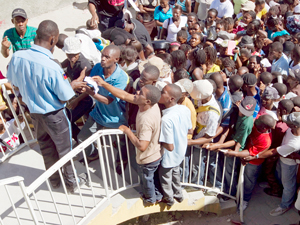
People stand in line for their Haitian National Identification cards so they can vote. With the November 28 general elections in Haiti came controversy and charges the elections were rigged. Photo: UN Photo/Logan Abassi

Haiti's elections, compromise and the future

By FinalCall.com News | Last updated: Nov 30, 2010 - 12:29:36 PM

Reeling from cholera and seeing an electoral process stumble forward under horrible conditions, the Haitian people attempted to vote. Elections for president and legislators Nov. 28 have drawn complaints and accusations of ballot stuffing, denial of the right to vote and intimidation and other problems.

Charges of rigging votes, buying votes, denying votes or tossing votes isn't new anytime there is a “democratic process” from St. Petersburg, Fla., to Chicago, Il., to Cleveland, Ohio to Port-au-Prince in Haiti.

The troubling thing for Haiti, however, is that the country is at a critical juncture and some attempt at defusing popular dissatisfaction and anger would be good for today and tomorrow.

It has been almost a year since an earthquake plunged the country into a crisis. Instead of news about progress and success, the most widespread news has been of deaths from cholera and clashes with UN peacekeepers, who many believe are responsible for the deadly outbreak. The disease is linked to sanitation and is waterborne. It causes diarrhea, dehydration and can be fatal. The street battles with peacekeepers have also been fed by feelings that UN troops are an occupying army, not a pro-Haitian security force.

Ten months after the earthquake, some 1.3 million people remain homeless, still living in tents, under tarps or wherever they can find a place to lay their heads—despite the sun, the rain, the dust, the noise, the disease. That people are literally dying because they cannot get clean water is one sign of Haiti's vulnerability, how badly the international community has failed and how Haiti's hobbled national government has floundered.

But in the midst of this chaos could be a sign of hope for the future and it may have come from those who have issued complaints about the voting. After Sunday elections, 12 of the parties or candidates came together to issue some joint declarations about problems with the elections and the need to cancel the elections. Two major candidates backed away from the statement the next day, but still have called for calm.

Perhaps that joint declaration and calls for calm can open the door for some sort of compromise as a way to defuse a possible explosion as frustration and anger mount. Two popular presidential candidates and reported frontrunners—Mirlande Manigat, who has been a longtime voice of opposition, and popular musician Michel Martelly backed away from calls to cancel the election. Mr. Martelly was reported to be leading in some places where the ballots were tallied.

The results of the elections aren't expected until Dec. 7 and a final tally should come Dec. 20 for what were described as chaotic elections at best.

“Even if calls to cancel the election go unheeded, the results may not be decisive; a runoff would take place January 16 if no candidate wins the requisite 50-percent-plus-one portion of votes in the first round. Voters cast ballots not only for President René Préval's successor, but also for 11 of 30 seats in the Senate and all 99 seats in the Chamber of Deputies,” noted the Council of the Americas, which describes itself as an international business organization concerned with development and the rule of law.

“MINUSTAH (the UN peacekeeper force) estimated that roughly 4.5 million voters were eligible to vote at 11,000 polling stations in 1,500 voter districts throughout Haiti. But The New York Times reports that, with services still in disarray because of earthquake destruction, electoral authorities had delivered fewer than half of roughly 400,000 new and replacement identification cards needed to vote,” the council said.

Election observers from the international community admitted problems but said voting issues were not bad enough to scrap the election. Haiti's election council has stood by its democratic product—which has not moved those who see the council as an extension of current President Rene Preval and handpicked successor Jude Celestin.

Wyclef Jean, the Haitian American musician and humanitarian, has called for some type of international involvement, fearing the country could explode into violence if the situation is not handled properly and quickly. He was ruled ineligible to run for president but joined in the process by supporting “Sweet Mickey” Martelly.

There are plenty of Haitian and non-Haitian voices calling for cancellation of the elections.

Mark Weisbrot, co-director of the Center for Economic and Policy Research said, “From the banning of the country's most popular party from the ballot to election day irregularities including numerous reports of ballot stuffing and the disenfranchisement of numerous eligible voters, these elections were an obvious farce from start to finish.”

“The international community should reject these elections and affirm support for democratic institutions in Haiti. Otherwise, Haiti could be left with a government that is widely seen as illegitimate,” he said.

“In Cite Soleil, for example—a Fanmi Lavalas party stronghold with a population of around 300,000—less than 100,000 people were registered to vote,” according to the center. “It is clear that the sentiment here is that the international community should have done something to provide for people's basic needs, such as shelter, drinkable water and sanitation, and get some of the other life-threatening conditions—including the cholera outbreak—under control, before trying to hold elections,” said one staff person for the center. Lavalas is the popular party of ousted President Jean Bertrand Aristide, a champion of the Haitian masses, which was ruled ineligible in this election.

With the number of candidates, the voting problems and daily suffering in Haiti, there are more than enough sparks that could ignite this powder keg.

But none of the candidates were expected to garner the 50 percent of the vote necessary to win the presidency outright; meaning a Jan. 16 run-off between the top two vote getters would be required. Perhaps an interim government could be established to give election participants some share of power as either new elections are planned or a unity government is formed. It would not allow the Preval government, which is not very popular, to solely remain in charge. But a unity government could begin to heal wounds and promote unity key to overcoming major problems. Such an idea may seem naïve or impossible, but one thing is certain: If Haiti explodes there will be no winners, only losers and more years of suffering and unnecessary deaths. Against that backdrop, you can also expect the world to turn its back, excuse itself of responsibility, allow bodies to pile up and say “Haitians did this to themselves.”
*          *          *

The Woman Who Would Be Haiti's Next President

By Tim Padgett and Jessica Desvarieux / Port-au-Prince Monday, Nov. 15, 2010

The woman who could be the next President of Haiti — and the first female to be elected to that office — doesn't strike you as an insurgent when she walks into a room.


But Mirlande Manigat, a smartly dressed, soft-spoken, 70-year-old Sorbonne Ph.D., insists she's after nothing less than a "rupture" with Haiti's dysfunctional political establishment. "Not one that's violent or brutal, but there must be change," Manigat said in an interview with TIME at her campaign's Port-au-Prince headquarters. "We can't leave so many millions of Haitians abandoned anymore."

So far, her message is resonating inside the western hemisphere's poorest country, which was ravaged in January by an earthquake that killed some 230,000 people — and is beset now by a cholera outbreak that has claimed almost 1,000. Two weeks before Haiti's Nov. 28 presidential election, voter polls show Manigat the clear front runner in a field of 19 candidates. In the most recent survey by Haiti's independent Economic Forum, released late last week, Manigat significantly widened her lead over President René Préval's hand-picked candidate, engineer Jude Celestin, to eight points, 30% to 22%.

That the government's choice is trailing isn't a surprise: Préval's often AWOL response to the apocalyptic quake has alienated most Haitians from his INITE (Unity) Party. Their frustration with Haiti's corrupt, incompetent political elite, which many feel INITE represents, is a big reason the country was exhilarated by the outsider candidacy of Haitian-American hip-hop star and philanthropist Wyclef Jean. When Haiti's electoral council disqualified Jean's bid in August on residency grounds, the question was where his support, especially among the large cohort of young voters, would shift.

To the surprise of many pundits, much of it seems to have moved from the gold chains of rapper Jean to the pearl strands of matriarch Manigat. (She's also eclipsing Michel "Sweet Micky" Martelly, himself a Haitian pop-music star, who ranks third in the Forum poll with just 11%.) If so, one reason may well be that "many Haitians feel the time has come for a woman to lead the country," says prominent Haitian historian and political analyst Georges Michel. "So here's Manigat, a well-respected scholar. She takes many of the populist positions that [Jean] had, and they respond to her grandmotherly image. To a lot of them, it seems to inspire confidence and trust." Those qualities will be in loud demand, because Haiti's next President will oversee some $10 billion in reconstruction aid pledged by international donors.

Even though she's a woman, Manigat is by no means a political outsider. She is, in fact, a former First Lady, the wife of former President Leslie Manigat. They met in the 1960s at the University of Paris, where he taught history while in exile — having been condemned to death at home by brutal Haitian dictator François "Papa Doc" Duvalier, who died in 1971 — and she was his student. They married in 1970, living in France, Trinidad and Venezuela before returning to Haiti in 1986 after the ouster of Duvalier's son and successor, dictator Jean-Claude "Baby Doc" Duvalier.

In 1988, Leslie Manigat, under the banner of the Assembly of Progressive National Democrats (RDNP), won the presidency in an election marred by military meddling. After only four months in office, he was overthrown in a coup. He ran again in 2006 and finished a distant second to Préval. But although Préval did not win the 50% necessary to avoid a second round, the electoral council never held a runoff — and in protest, Mirlande Manigat withdrew as the RDNP's Senate candidate. "I cannot support illegality," she said of her controversial move.

In that regard, Manigat and her supporters may see Nov. 28 as a chance for revenge, especially since many Haitians believe her 80-year-old husband will be a power behind her throne if she wins. But Manigat insists that she and the RDNP — which she calls a center-left, "capitalist with a human face" party in the tradition of successful moderate Latin American leftists like Brazilian President Luiz Inácio Lula da Silva — want to check a venal elite that she accuses of "grave social indifference and insensitivity. It was there before, but after the earthquake it has shown itself in worse ways."

Manigat, vice rector of the Université Quisqueya in Port-au-Prince, tells TIME that along with tackling Haiti's nightmarish inequality via reforms like universal access to public education — only about half of the country's children even attend school — one of her big aims is to make the Haitian state something more than an effete subordinate of foreign NGOs. "There are many NGOs positioning themselves to receive the [$10 billion], yet they want to operate outside of state control," says Manigat. "My government will not operate the NGO way."

Manigat feels Haiti's earthquake recovery "has not really started" — admittedly, rubble removal and the rehousing of some 1.5 million displaced Haitians have been frustratingly slow — but like most of the candidates, she's not specific about how she'd hasten it. She backs changing Haiti's constitution to allow dual citizenship, which could aid the country's reconstruction by tapping into the resources and talents of the vast Haitian diaspora, including more than a million Haitian Americans. But critics, based on some of her teachings of Haitian constitutional law, fear that Manigat could have authoritarian designs to expand presidential powers — which she denies.

Manigat has been helped by the uncharismatic campaigning of Celestin, 48, a relatively unknown technocrat. On the stump in the southern port city of Jacmel recently, he repeated his less-than-electric slogan of "stability and continuity" while touching on criticisms of the Préval government by saying, "We know that there were things that were a little ignored." That has pushed erstwhile Préval supporters like Port-au-Prince carpenter Jourdanie Damler, 35, to Manigat's camp. "The INITE guys have forgotten about us," says Damler. "I'll try Madame Manigat."

Since no candidate is likely to win 50% of the vote in the first round, the race will probably come down to a Jan. 16 runoff (less than a month before the Feb. 7 inauguration). Some wonder how Haiti can even conduct a credible election given the lingering quake chaos and cholera epidemic. Manigat says the vote "has to happen" for Haiti to move forward, but after the 2006 dispute, she adds, she and the RDNP "will be vigilant against fraud trickery." This grandmother won't tolerate it.

Source: http://www.time.com/time/world/article/0,8599,2031412,00.html?xid=rss-topstories-polar

Should Men's Violence Against Women in the UK be understood as Hate Crime?

image is from here

As someone who I consider to be one of two UK correspondents here at A.R.P. , Jennifer Drew, has noted to me many times, "men" is almost always left out of expressions like "violence against women". Now, granted, do we really think "ending violence against women" means, for example, "ending women's violence against women" or "children's violence against women"? No. (Unless you consider men to be children.) But it is part of the master plan Master's Plan is to invisibilise the perpetrators of oppressor-crime, whether they be rich, white, globally Western, globally Northern, non-Indigenous, het, or male. So, we are left with this question, one which I have asked myself many, many times in reference to North America. I am pretty much on the same page as Julie, here. If a crime is misogynistic, it is, by definition, a hate crime, although not in the legal sense... yet. Another issue fought for by feminist activists is to have the effects of violence be what determines their categorisation, over and beyond the intentions of the perpetrators.Because, as we all know, men claim to do violence to women for all kinds of reasons--most especially because the men "love" the women, and also because those women asked for it, consented to it, didn't run out of the house after the first incident, didn't call the police, didn't say "NO!" enough times, etc.

Any understandings made legal, which highlight the reality of male supremacy as a social-political form of terrorism by men against women and others seen as womanly, is socially beneficial, humane, and in the service to liberation for this oppressed group as long as such laws name male supremacy or patriarchy as one of several social conditions in which women live and die. I very much appreciate Julie Long's discussion below.

I'll state that I'm opposed to non-survivors of female genital cutting using the term female g*n*t*l m*t*l*t**n--without the asterisks, as, to my understanding, it is not appreciated or welcomed by many survivors of involuntary female genital cutting/surgery. The term, in the white, white West, conjures a kind of practice that only "they" do--those darker people from darker continents or countries (or whatever they are*). This is not only inaccurate, but it perpetuates a white supremacist mythology about the "barbarism" of darker-skinned people that is not evidenced if we look at who commits the most barbaric acts against women and girls across race, ethnicity, and region. Overwhelmingly, historically and cross-culturally, in the last 500 years, anyway, that group is Western/white heterosexual men. That this is rarely-to-never specified when discussing global violence is yet another example of how perpetrating groups, particularly when Western, male, white, and heterosexual, are protected in speech, through social custom, by religion, and also in law.

*Western whites, for an allegedly and self-identified well-educated group, remain speciously ignorant about what constitutes a country and a continent, unless it is dominated and occupied by whites. I'll do a separate post on this.

Warning: graphic descriptions of men's violence against women are contained in the article below. It is one of those really disturbing articles that feels to me to be a bit sensationalistic and exploitive of the victims, but that's probably because Western white male supremacy notoriously sensationalises and exploits any and all violence against women, especially men's. That said, I find it a compelling piece of political analytic writing.

Should violence against women in the UK be seen as hate crime?


Woman-hating continues to occupy a central and too-often unrecognised and unchallenged position within our culture. Julia Long argues that approaches to stop such violence will fail unless they also address issues of endemic cultural misogyny

About the author
Dr Julia Long is a feminist activist and academic. She is active with the London Feminist Network, co-organising the annual national UK ‘Reclaim the Night’ march, and with OBJECT, a UK-based group which campaigns against sex object culture

On 25 February 2008, Levi Bellfield was convicted in the British courts of the murders of two young women, Marsha McDonnell and Amelie Delagrange, and the attempted murder of a third, Kate Sheedy, whom he had run over repeatedly, leaving her with extensive and horrific injuries. Prior to these convictions, Bellfield had faced other charges of abduction, false imprisonment and attempted murder of women, and in 2010 he was charged with the abduction and murder of thirteen-year-old Amanda Dowler. Police believe that he may be linked to a dozen further crimes against women in West London, and former partners testify to being beaten and raped by Bellfield.

Following his trial and conviction, police and media reports spoke of Bellfield’s ‘hatred’ and ‘intense loathing’ of women; a former girlfriend described how he had confessed that he would wait in alleyways wanting to "hurt, kill, stab or rape women" and told of how she had discovered pornographic pictures on which Bellfield had slashed the faces of blonde models. Bellfield had a reputation for sexually harassing under-age girls, pestering them from a van with blacked-out windows in which he kept a mattress, blankets and a baseball bat.

If Bellfield’s hate-motivated violence had been directed at victims on the basis of their perceived race, religion or belief, sexual orientation, disability or transgender identity, his crimes would clearly have been recognised as hate crimes. However, under UK legislation, women as a group are not recognised as a ‘hate crime’ identity category. What are the implications of this? And would it be desirable for violence against women to be recognised as a form of hate crime?

Feminist understandings of violence against women

Unlike the murders carried out by Bellfield, most acts of violence against women are perpetrated by men known to the victim. According to the End Violence Against Women Coalition: ‘Each year across the UK 3 million women experience violence, and there are many more living with the legacies of abuse experienced in the past. In the UK it includes: domestic violence, rape and sexual violence, sexual harassment, female genital mutilation, forced marriage, crimes in the name of honour, trafficking and sexual exploitation. It is mostly committed by men that women know or are in a close relationship with’. Of the 1,000 women who are subjected to rape or attempted rape each week, most are attacked by men they know, whether as partners, friends or acquaintances. One in four UK women have been affected by domestic violence and according to the Department of Health two women are killed each week by a violent male partner or ex-partner.

Recognition of violence against women as a widespread and serious issue is attributable to four decades of feminist activism, research and scholarship. Feminist campaigns have put violence against women on the political agenda; activists have set up services for victims and brought about important changes in how the criminal justice system deals with violence against women. One of the most important achievements of feminism has been to locate patriarchal power, gender inequality and misogyny at the heart of all forms of violence against women. Feminists make connections between individual acts of rape, sexual harassment, domestic violence and femicide, the broader context of women’s ongoing inequality, and a culture which variously normalises, trivialises or glamorises violence against women. In making these connections, second wave, radical feminists such as Andrea Dworkin and Susan Brownmiller [*] argued that violence against women occurs within a misogynistic culture, underpinned, enabled and sustained by patriarchal power relations.

However, the struggle for these insights to influence mainstream debates and attitudes to violence against women is ongoing. Within mainstream culture, media, politics and the legal system, violence against women continues to be viewed primarily as a personal, individualised issue. Incidents of violence tend to be seen as either the actions of ‘monsters’ or ‘psychopaths’ (as in the case of Bellfield); the result of unfortunate domestic disputes or choice of spouse; or as attributable to negligence on the part of the woman herself - her clothing, her location, her behaviour, whether she had consumed alcohol. In the UK, considerations of patriarchy only tend to enter mainstream debates when the violence is perpetrated within minority ethnic communities, where it is then seen as evidence of ‘backward’ cultural attitudes to women.

Given that violence against women, in spite of its pervasiveness, continues to be constructed within mainstream discourses as a mainly individualised issue, it is pertinent to consider how feminist insights might best be brought to bear in order to transform debates on violence against women. Would including women as a category protected under hate crime legislation help to bring about a recognition of the systematic and generalised nature of violence against women, and highlight the crucial role of structural power relations between women and men?

Implications of UK hate crime legislation
  • Hate crime is recognised as ‘different’ to other crime within the UK criminal justice system. According to the UK Home Office, it is ‘different’ because: hate crime targets people because of their identity. It is a form of discrimination that infringes human rights and keeps people from enjoying the full benefits of our society
  • research has shown that hate crimes cause greater psychological harm than similar crimes without a motivation of prejudice
  • hate crime creates fear in victims, groups and communities and encourages communities to turn on each other.
The nature and effects of hate crime means that it is seen as particularly serious: Section 146 of the Criminal Justice Act 2003 imposes a duty on courts to increase the sentence for any offence aggravated by hostility based on the victim's sexual orientation or disability. Evidence of hostility based on disability, sexual orientation or presumed sexual orientation must be seen as something that makes the offence more serious. Similar provisions already exist in relation to race, resulting from The Stephen Lawrence Inquiry which also resulted in the imposition of minimum tariffs in relation to the sentencing of murderers motivated by hostility.

Violence against women as hate crime?


The British Home Office description of hate crime would seem to fit very well with crimes of violence against women, as is demonstrated by replacing ‘hate crime’ with ‘violence against women’ in the bullet points above: the resulting description neatly encapsulates several of the key feminist insights regarding the systematic nature and structural effects of violence against women. Similarly, a recognition of the particularly serious nature of these crimes when it comes to sentencing would also seem appropriate and desirable.

However, feminist campaigners have expressed reservations regarding the desirability of utilising a ‘hate crime’ approach. Firstly, hate crime legislation is generally designed to deal with ‘stranger’ or ‘outsider’ violence: violence from a person outside of one’s personal and social circles. Whilst this would obviously apply in cases like Bellfield described above, it is less useful in dealing with the majority of incidents of violence against women, where the perpetrator is likely to be a partner, ex-partner, acquaintance or friend. Campaigners believe that women victims would be unlikely to perceive these acts of violence as motivated by hate or prejudice. Activist Hilary McCollum doubts that defining violence against women and girls as hate crime would help its victims access services and redress: ‘Many people covered by the existing hate crime definition don’t readily identify their experiences with the term – ‘hate’ can feel too big a word, especially for crimes committed by people known to the victim’.

McCollum also voices concern at what she sees as the inadequacies of current hate crime legislation in addressing issues of intersectionality, and the depoliticising tendencies of the term ‘hate’. Without a full consideration and integration of power relations, McCollum argues, ‘hate crimes can be depoliticised as motivated by irrational prejudice, rather than domination, exclusion and control’. Other feminist campaigners express concerns that if violence against women was included alongside other hate crime categories, recognition of its specificities, scale and prevalence could be lost, and funding might consequently be jeopardised.

‘Hate crime’: a useful concept?

The reservations of feminist campaigners with regard to hate crime approaches highlight important inadequacies in the way that such approaches frame acts of violence based on structural inequalities. However, I would argue that the concept of hate crime does at least bring considerations of discrimination and the generalised effects of violence into the picture. The notion of hate crime facilitates and supports a recognition that inequalities and discrimination experienced by certain groups exist on a spectrum that ranges from racist, homophobic and disablist language, through discrimination in employment, goods and services, and ultimately to acts of violence and murder. So whilst the term has its problems, it does at least serve to make links between cultural attitudes, discrimination and acts of violence. What is necessary is a further re-framing of the issue in order to recognise that power and control are key motivations for violence against women and girls, and that individual acts of violence are supported by a context of structural inequality and cultural misogyny.

Returning to the Bellfield case mentioned at the beginning of this article, it should be noted that just three days prior to Bellfield’s conviction, two other men had been found guilty of murder. Steve Wright had murdered five young women in Ipswich, East Anglia, and Mark Dixie was convicted of murdering an eighteen year old woman, and then raping her while she was dead or dying. Both men had previous histories of violence against women. Speaking of all three cases, Kira Cochrane observed in The Guardian:

In each case, what comes through most strongly is just how open, violent and persistent the killer’s misogyny was, and how they were allowed to indulge it, and even boast of it, for years. The reports paint a picture of a society in which misogyny is taken as a given.
Whether violence against women is viewed as hate crime or not, it is evident that woman-hating continues to occupy a central and too-often unrecognised and unchallenged position within our culture, and that approaches to stop such violence will fail unless they also address issues of endemic cultural misogyny.


This article is published by Julia Long, and openDemocracy.net under a Creative Commons licence. You may republish it without needing further permission, with attribution for non-commercial purposes following these guidelines. These rules apply to one-off or infrequent use. For all re-print, syndication and educational use please see read our republishing guidelines or contact us. Some articles on this site are published under different terms. No images on the site or in articles may be re-used without permission unless specifically licensed under Creative Commons. 
[*] Julian's note: those two are white U.S. feminists. Many second wave radical feminists of color, of many ethnic backgrounds, from many regions around the world, have argued this as well, but in far more intersectionally responsible ways than has Brownmiller. Dworkin's work is more responsible in this regard. Radical feminist women of color more aptly note how white supremacy and capitalism, along with patriarchy, are key systems perpetrating violence against women, including by fueling and funding white men's violence against women of color. Susan Brownmiller's work, as far as I am concerned, is irresponsibly white supremacist and racist. This is not to say that her work is unimportant or ought not be read and respected for what it offers us by way of deep insights into men's violence against women as systemic and terroristic. It is to say she misuses racist stereotypes to make some of her points, particularly with regard to the myth of Black men raping white women and by disregarding the role Black women had in anti-lynching activism. For more on this, please see Angela Davis's work, *here*.
This blog exists to de-center the whiteness and redress the racism that typically permeates white historical analysis both of feminism and of men's violence against women. This blogger favors understanding, appreciating, and promoting the critical roles radical feminist women of color, and many other Asian, Black, Brown, and Indigenous have played in all justice movements, including against genocide, gynocide, and ecocide, while also honoring the many white women who have done amazing work to help us collectively understand and confront male supremacist atrocities and cultures.