Wednesday, December 1, 2010

Haiti's Elections Discussed at The Final Call, with No Mention of Gender at all. TIME doesn't do much better in respectfully discussing, Mirlanda Manigat, Haiti's leading woman candidate

Admittedly in Spanish, not Haitian French, this image is from here at MADRE, also linked to below, a site and amazing human rights organisation that respectfully honors women of all colors
This post contains two articles-in-full being cross-posted. Each may be linked back to by clicking on the title.

The first is from The Final Call. Whenever an article about people in crisis neglects to mention gender, at all, as even existing, one can bet one thing not being discussed is men's violence against women and sexism in general. Both institutionalised sexism and men's violence against women are serious problems impacting the lives and precipitating the deaths of Haitian women and girls, which, as in most places, constitutes over half the country's human population.

Haiti lost three key feminist organisers there at the time of the earthquake eleven months ago. Note the image used at The Final Call, as it appears only males live in Haiti.

Below the article by TFC, is a TIME magazine piece, reprinted at the website for the Rassemblement des Démocrates Nationaux Progressistes d'Haïti. It discusses the only woman candidate, Mirlande Manigat. Should she be victorious in a run-off election in January, she would become Haiti's first female leader; she also has a political critique of Haitian government and non-Haitian NGOs. Yet TFC has only eight words of description about Ms. Manigat: "who has been a longtime voice of opposition". I call that lack of attentive regard and discussion about her candidacy outright "sexism".

In the TIME piece, pay attention to another form of sexism used to promote her candidacy: from noting her attire, her soft-spoken demeanor (which makes her not seem like an "insurgent"), and her being grandmotherly. TIME also informs us of the fact that she is a doctoral graduate of a European university, which has its own function in Western media to "legitimise" her as "a smart person" while also making her seem like someone who would give you a big hug and offer you some milk and cookies. But TIME won't mention men's violence against women either. When the victims of men's crimes are not white, TIME won't give the issue the time of day. They will comment in stupid ways about being a rapper, however. A quote from what appears below:
[...] the country was exhilarated by the outsider candidacy of Haitian-American hip-hop star and philanthropist Wyclef Jean. When Haiti's electoral council disqualified Jean's bid in August on residency grounds, the question was where his support, especially among the large cohort of young voters, would shift. 
To the surprise of many pundits, much of it seems to have moved from the gold chains of rapper Jean to the pearl strands of matriarch Manigat.
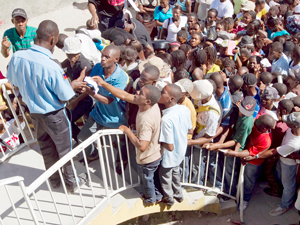
haiti_edt12-07-2010.jpg
People stand in line for their Haitian National Identification cards so they can vote. With the November 28 general elections in Haiti came controversy and charges the elections were rigged. Photo: UN Photo/Logan Abassi

Haiti's elections, compromise and the future

By FinalCall.com News | Last updated: Nov 30, 2010 - 12:29:36 PM

Reeling from cholera and seeing an electoral process stumble forward under horrible conditions, the Haitian people attempted to vote. Elections for president and legislators Nov. 28 have drawn complaints and accusations of ballot stuffing, denial of the right to vote and intimidation and other problems.

Charges of rigging votes, buying votes, denying votes or tossing votes isn't new anytime there is a “democratic process” from St. Petersburg, Fla., to Chicago, Il., to Cleveland, Ohio to Port-au-Prince in Haiti.

The troubling thing for Haiti, however, is that the country is at a critical juncture and some attempt at defusing popular dissatisfaction and anger would be good for today and tomorrow.

It has been almost a year since an earthquake plunged the country into a crisis. Instead of news about progress and success, the most widespread news has been of deaths from cholera and clashes with UN peacekeepers, who many believe are responsible for the deadly outbreak. The disease is linked to sanitation and is waterborne. It causes diarrhea, dehydration and can be fatal. The street battles with peacekeepers have also been fed by feelings that UN troops are an occupying army, not a pro-Haitian security force.

Ten months after the earthquake, some 1.3 million people remain homeless, still living in tents, under tarps or wherever they can find a place to lay their heads—despite the sun, the rain, the dust, the noise, the disease. That people are literally dying because they cannot get clean water is one sign of Haiti's vulnerability, how badly the international community has failed and how Haiti's hobbled national government has floundered.

But in the midst of this chaos could be a sign of hope for the future and it may have come from those who have issued complaints about the voting. After Sunday elections, 12 of the parties or candidates came together to issue some joint declarations about problems with the elections and the need to cancel the elections. Two major candidates backed away from the statement the next day, but still have called for calm.

Perhaps that joint declaration and calls for calm can open the door for some sort of compromise as a way to defuse a possible explosion as frustration and anger mount. Two popular presidential candidates and reported frontrunners—Mirlande Manigat, who has been a longtime voice of opposition, and popular musician Michel Martelly backed away from calls to cancel the election. Mr. Martelly was reported to be leading in some places where the ballots were tallied.

The results of the elections aren't expected until Dec. 7 and a final tally should come Dec. 20 for what were described as chaotic elections at best.

“Even if calls to cancel the election go unheeded, the results may not be decisive; a runoff would take place January 16 if no candidate wins the requisite 50-percent-plus-one portion of votes in the first round. Voters cast ballots not only for President René Préval's successor, but also for 11 of 30 seats in the Senate and all 99 seats in the Chamber of Deputies,” noted the Council of the Americas, which describes itself as an international business organization concerned with development and the rule of law.

“MINUSTAH (the UN peacekeeper force) estimated that roughly 4.5 million voters were eligible to vote at 11,000 polling stations in 1,500 voter districts throughout Haiti. But The New York Times reports that, with services still in disarray because of earthquake destruction, electoral authorities had delivered fewer than half of roughly 400,000 new and replacement identification cards needed to vote,” the council said.

Election observers from the international community admitted problems but said voting issues were not bad enough to scrap the election. Haiti's election council has stood by its democratic product—which has not moved those who see the council as an extension of current President Rene Preval and handpicked successor Jude Celestin.

Wyclef Jean, the Haitian American musician and humanitarian, has called for some type of international involvement, fearing the country could explode into violence if the situation is not handled properly and quickly. He was ruled ineligible to run for president but joined in the process by supporting “Sweet Mickey” Martelly.

There are plenty of Haitian and non-Haitian voices calling for cancellation of the elections.

Mark Weisbrot, co-director of the Center for Economic and Policy Research said, “From the banning of the country's most popular party from the ballot to election day irregularities including numerous reports of ballot stuffing and the disenfranchisement of numerous eligible voters, these elections were an obvious farce from start to finish.”

“The international community should reject these elections and affirm support for democratic institutions in Haiti. Otherwise, Haiti could be left with a government that is widely seen as illegitimate,” he said.

“In Cite Soleil, for example—a Fanmi Lavalas party stronghold with a population of around 300,000—less than 100,000 people were registered to vote,” according to the center. “It is clear that the sentiment here is that the international community should have done something to provide for people's basic needs, such as shelter, drinkable water and sanitation, and get some of the other life-threatening conditions—including the cholera outbreak—under control, before trying to hold elections,” said one staff person for the center. Lavalas is the popular party of ousted President Jean Bertrand Aristide, a champion of the Haitian masses, which was ruled ineligible in this election.

With the number of candidates, the voting problems and daily suffering in Haiti, there are more than enough sparks that could ignite this powder keg.

But none of the candidates were expected to garner the 50 percent of the vote necessary to win the presidency outright; meaning a Jan. 16 run-off between the top two vote getters would be required. Perhaps an interim government could be established to give election participants some share of power as either new elections are planned or a unity government is formed. It would not allow the Preval government, which is not very popular, to solely remain in charge. But a unity government could begin to heal wounds and promote unity key to overcoming major problems. Such an idea may seem naïve or impossible, but one thing is certain: If Haiti explodes there will be no winners, only losers and more years of suffering and unnecessary deaths. Against that backdrop, you can also expect the world to turn its back, excuse itself of responsibility, allow bodies to pile up and say “Haitians did this to themselves.”
*          *          *

The Woman Who Would Be Haiti's Next President

By Tim Padgett and Jessica Desvarieux / Port-au-Prince Monday, Nov. 15, 2010

The woman who could be the next President of Haiti — and the first female to be elected to that office — doesn't strike you as an insurgent when she walks into a room.


But Mirlande Manigat, a smartly dressed, soft-spoken, 70-year-old Sorbonne Ph.D., insists she's after nothing less than a "rupture" with Haiti's dysfunctional political establishment. "Not one that's violent or brutal, but there must be change," Manigat said in an interview with TIME at her campaign's Port-au-Prince headquarters. "We can't leave so many millions of Haitians abandoned anymore."

So far, her message is resonating inside the western hemisphere's poorest country, which was ravaged in January by an earthquake that killed some 230,000 people — and is beset now by a cholera outbreak that has claimed almost 1,000. Two weeks before Haiti's Nov. 28 presidential election, voter polls show Manigat the clear front runner in a field of 19 candidates. In the most recent survey by Haiti's independent Economic Forum, released late last week, Manigat significantly widened her lead over President René Préval's hand-picked candidate, engineer Jude Celestin, to eight points, 30% to 22%.

That the government's choice is trailing isn't a surprise: Préval's often AWOL response to the apocalyptic quake has alienated most Haitians from his INITE (Unity) Party. Their frustration with Haiti's corrupt, incompetent political elite, which many feel INITE represents, is a big reason the country was exhilarated by the outsider candidacy of Haitian-American hip-hop star and philanthropist Wyclef Jean. When Haiti's electoral council disqualified Jean's bid in August on residency grounds, the question was where his support, especially among the large cohort of young voters, would shift.

To the surprise of many pundits, much of it seems to have moved from the gold chains of rapper Jean to the pearl strands of matriarch Manigat. (She's also eclipsing Michel "Sweet Micky" Martelly, himself a Haitian pop-music star, who ranks third in the Forum poll with just 11%.) If so, one reason may well be that "many Haitians feel the time has come for a woman to lead the country," says prominent Haitian historian and political analyst Georges Michel. "So here's Manigat, a well-respected scholar. She takes many of the populist positions that [Jean] had, and they respond to her grandmotherly image. To a lot of them, it seems to inspire confidence and trust." Those qualities will be in loud demand, because Haiti's next President will oversee some $10 billion in reconstruction aid pledged by international donors.

Even though she's a woman, Manigat is by no means a political outsider. She is, in fact, a former First Lady, the wife of former President Leslie Manigat. They met in the 1960s at the University of Paris, where he taught history while in exile — having been condemned to death at home by brutal Haitian dictator François "Papa Doc" Duvalier, who died in 1971 — and she was his student. They married in 1970, living in France, Trinidad and Venezuela before returning to Haiti in 1986 after the ouster of Duvalier's son and successor, dictator Jean-Claude "Baby Doc" Duvalier.

In 1988, Leslie Manigat, under the banner of the Assembly of Progressive National Democrats (RDNP), won the presidency in an election marred by military meddling. After only four months in office, he was overthrown in a coup. He ran again in 2006 and finished a distant second to Préval. But although Préval did not win the 50% necessary to avoid a second round, the electoral council never held a runoff — and in protest, Mirlande Manigat withdrew as the RDNP's Senate candidate. "I cannot support illegality," she said of her controversial move.

In that regard, Manigat and her supporters may see Nov. 28 as a chance for revenge, especially since many Haitians believe her 80-year-old husband will be a power behind her throne if she wins. But Manigat insists that she and the RDNP — which she calls a center-left, "capitalist with a human face" party in the tradition of successful moderate Latin American leftists like Brazilian President Luiz Inácio Lula da Silva — want to check a venal elite that she accuses of "grave social indifference and insensitivity. It was there before, but after the earthquake it has shown itself in worse ways."

Manigat, vice rector of the Université Quisqueya in Port-au-Prince, tells TIME that along with tackling Haiti's nightmarish inequality via reforms like universal access to public education — only about half of the country's children even attend school — one of her big aims is to make the Haitian state something more than an effete subordinate of foreign NGOs. "There are many NGOs positioning themselves to receive the [$10 billion], yet they want to operate outside of state control," says Manigat. "My government will not operate the NGO way."

Manigat feels Haiti's earthquake recovery "has not really started" — admittedly, rubble removal and the rehousing of some 1.5 million displaced Haitians have been frustratingly slow — but like most of the candidates, she's not specific about how she'd hasten it. She backs changing Haiti's constitution to allow dual citizenship, which could aid the country's reconstruction by tapping into the resources and talents of the vast Haitian diaspora, including more than a million Haitian Americans. But critics, based on some of her teachings of Haitian constitutional law, fear that Manigat could have authoritarian designs to expand presidential powers — which she denies.

Manigat has been helped by the uncharismatic campaigning of Celestin, 48, a relatively unknown technocrat. On the stump in the southern port city of Jacmel recently, he repeated his less-than-electric slogan of "stability and continuity" while touching on criticisms of the Préval government by saying, "We know that there were things that were a little ignored." That has pushed erstwhile Préval supporters like Port-au-Prince carpenter Jourdanie Damler, 35, to Manigat's camp. "The INITE guys have forgotten about us," says Damler. "I'll try Madame Manigat."

Since no candidate is likely to win 50% of the vote in the first round, the race will probably come down to a Jan. 16 runoff (less than a month before the Feb. 7 inauguration). Some wonder how Haiti can even conduct a credible election given the lingering quake chaos and cholera epidemic. Manigat says the vote "has to happen" for Haiti to move forward, but after the 2006 dispute, she adds, she and the RDNP "will be vigilant against fraud trickery." This grandmother won't tolerate it.

Source: http://www.time.com/time/world/article/0,8599,2031412,00.html?xid=rss-topstories-polar

Should Men's Violence Against Women in the UK be understood as Hate Crime?

image is from here

As someone who I consider to be one of two UK correspondents here at A.R.P. , Jennifer Drew, has noted to me many times, "men" is almost always left out of expressions like "violence against women". Now, granted, do we really think "ending violence against women" means, for example, "ending women's violence against women" or "children's violence against women"? No. (Unless you consider men to be children.) But it is part of the master plan Master's Plan is to invisibilise the perpetrators of oppressor-crime, whether they be rich, white, globally Western, globally Northern, non-Indigenous, het, or male. So, we are left with this question, one which I have asked myself many, many times in reference to North America. I am pretty much on the same page as Julie, here. If a crime is misogynistic, it is, by definition, a hate crime, although not in the legal sense... yet. Another issue fought for by feminist activists is to have the effects of violence be what determines their categorisation, over and beyond the intentions of the perpetrators.Because, as we all know, men claim to do violence to women for all kinds of reasons--most especially because the men "love" the women, and also because those women asked for it, consented to it, didn't run out of the house after the first incident, didn't call the police, didn't say "NO!" enough times, etc.

Any understandings made legal, which highlight the reality of male supremacy as a social-political form of terrorism by men against women and others seen as womanly, is socially beneficial, humane, and in the service to liberation for this oppressed group as long as such laws name male supremacy or patriarchy as one of several social conditions in which women live and die. I very much appreciate Julie Long's discussion below.

I'll state that I'm opposed to non-survivors of female genital cutting using the term female g*n*t*l m*t*l*t**n--without the asterisks, as, to my understanding, it is not appreciated or welcomed by many survivors of involuntary female genital cutting/surgery. The term, in the white, white West, conjures a kind of practice that only "they" do--those darker people from darker continents or countries (or whatever they are*). This is not only inaccurate, but it perpetuates a white supremacist mythology about the "barbarism" of darker-skinned people that is not evidenced if we look at who commits the most barbaric acts against women and girls across race, ethnicity, and region. Overwhelmingly, historically and cross-culturally, in the last 500 years, anyway, that group is Western/white heterosexual men. That this is rarely-to-never specified when discussing global violence is yet another example of how perpetrating groups, particularly when Western, male, white, and heterosexual, are protected in speech, through social custom, by religion, and also in law.

*Western whites, for an allegedly and self-identified well-educated group, remain speciously ignorant about what constitutes a country and a continent, unless it is dominated and occupied by whites. I'll do a separate post on this.

Warning: graphic descriptions of men's violence against women are contained in the article below. It is one of those really disturbing articles that feels to me to be a bit sensationalistic and exploitive of the victims, but that's probably because Western white male supremacy notoriously sensationalises and exploits any and all violence against women, especially men's. That said, I find it a compelling piece of political analytic writing.

Should violence against women in the UK be seen as hate crime?


Woman-hating continues to occupy a central and too-often unrecognised and unchallenged position within our culture. Julia Long argues that approaches to stop such violence will fail unless they also address issues of endemic cultural misogyny

About the author
Dr Julia Long is a feminist activist and academic. She is active with the London Feminist Network, co-organising the annual national UK ‘Reclaim the Night’ march, and with OBJECT, a UK-based group which campaigns against sex object culture

On 25 February 2008, Levi Bellfield was convicted in the British courts of the murders of two young women, Marsha McDonnell and Amelie Delagrange, and the attempted murder of a third, Kate Sheedy, whom he had run over repeatedly, leaving her with extensive and horrific injuries. Prior to these convictions, Bellfield had faced other charges of abduction, false imprisonment and attempted murder of women, and in 2010 he was charged with the abduction and murder of thirteen-year-old Amanda Dowler. Police believe that he may be linked to a dozen further crimes against women in West London, and former partners testify to being beaten and raped by Bellfield.

Following his trial and conviction, police and media reports spoke of Bellfield’s ‘hatred’ and ‘intense loathing’ of women; a former girlfriend described how he had confessed that he would wait in alleyways wanting to "hurt, kill, stab or rape women" and told of how she had discovered pornographic pictures on which Bellfield had slashed the faces of blonde models. Bellfield had a reputation for sexually harassing under-age girls, pestering them from a van with blacked-out windows in which he kept a mattress, blankets and a baseball bat.

If Bellfield’s hate-motivated violence had been directed at victims on the basis of their perceived race, religion or belief, sexual orientation, disability or transgender identity, his crimes would clearly have been recognised as hate crimes. However, under UK legislation, women as a group are not recognised as a ‘hate crime’ identity category. What are the implications of this? And would it be desirable for violence against women to be recognised as a form of hate crime?

Feminist understandings of violence against women

Unlike the murders carried out by Bellfield, most acts of violence against women are perpetrated by men known to the victim. According to the End Violence Against Women Coalition: ‘Each year across the UK 3 million women experience violence, and there are many more living with the legacies of abuse experienced in the past. In the UK it includes: domestic violence, rape and sexual violence, sexual harassment, female genital mutilation, forced marriage, crimes in the name of honour, trafficking and sexual exploitation. It is mostly committed by men that women know or are in a close relationship with’. Of the 1,000 women who are subjected to rape or attempted rape each week, most are attacked by men they know, whether as partners, friends or acquaintances. One in four UK women have been affected by domestic violence and according to the Department of Health two women are killed each week by a violent male partner or ex-partner.

Recognition of violence against women as a widespread and serious issue is attributable to four decades of feminist activism, research and scholarship. Feminist campaigns have put violence against women on the political agenda; activists have set up services for victims and brought about important changes in how the criminal justice system deals with violence against women. One of the most important achievements of feminism has been to locate patriarchal power, gender inequality and misogyny at the heart of all forms of violence against women. Feminists make connections between individual acts of rape, sexual harassment, domestic violence and femicide, the broader context of women’s ongoing inequality, and a culture which variously normalises, trivialises or glamorises violence against women. In making these connections, second wave, radical feminists such as Andrea Dworkin and Susan Brownmiller [*] argued that violence against women occurs within a misogynistic culture, underpinned, enabled and sustained by patriarchal power relations.

However, the struggle for these insights to influence mainstream debates and attitudes to violence against women is ongoing. Within mainstream culture, media, politics and the legal system, violence against women continues to be viewed primarily as a personal, individualised issue. Incidents of violence tend to be seen as either the actions of ‘monsters’ or ‘psychopaths’ (as in the case of Bellfield); the result of unfortunate domestic disputes or choice of spouse; or as attributable to negligence on the part of the woman herself - her clothing, her location, her behaviour, whether she had consumed alcohol. In the UK, considerations of patriarchy only tend to enter mainstream debates when the violence is perpetrated within minority ethnic communities, where it is then seen as evidence of ‘backward’ cultural attitudes to women.

Given that violence against women, in spite of its pervasiveness, continues to be constructed within mainstream discourses as a mainly individualised issue, it is pertinent to consider how feminist insights might best be brought to bear in order to transform debates on violence against women. Would including women as a category protected under hate crime legislation help to bring about a recognition of the systematic and generalised nature of violence against women, and highlight the crucial role of structural power relations between women and men?

Implications of UK hate crime legislation
  • Hate crime is recognised as ‘different’ to other crime within the UK criminal justice system. According to the UK Home Office, it is ‘different’ because: hate crime targets people because of their identity. It is a form of discrimination that infringes human rights and keeps people from enjoying the full benefits of our society
  • research has shown that hate crimes cause greater psychological harm than similar crimes without a motivation of prejudice
  • hate crime creates fear in victims, groups and communities and encourages communities to turn on each other.
The nature and effects of hate crime means that it is seen as particularly serious: Section 146 of the Criminal Justice Act 2003 imposes a duty on courts to increase the sentence for any offence aggravated by hostility based on the victim's sexual orientation or disability. Evidence of hostility based on disability, sexual orientation or presumed sexual orientation must be seen as something that makes the offence more serious. Similar provisions already exist in relation to race, resulting from The Stephen Lawrence Inquiry which also resulted in the imposition of minimum tariffs in relation to the sentencing of murderers motivated by hostility.

Violence against women as hate crime?


The British Home Office description of hate crime would seem to fit very well with crimes of violence against women, as is demonstrated by replacing ‘hate crime’ with ‘violence against women’ in the bullet points above: the resulting description neatly encapsulates several of the key feminist insights regarding the systematic nature and structural effects of violence against women. Similarly, a recognition of the particularly serious nature of these crimes when it comes to sentencing would also seem appropriate and desirable.

However, feminist campaigners have expressed reservations regarding the desirability of utilising a ‘hate crime’ approach. Firstly, hate crime legislation is generally designed to deal with ‘stranger’ or ‘outsider’ violence: violence from a person outside of one’s personal and social circles. Whilst this would obviously apply in cases like Bellfield described above, it is less useful in dealing with the majority of incidents of violence against women, where the perpetrator is likely to be a partner, ex-partner, acquaintance or friend. Campaigners believe that women victims would be unlikely to perceive these acts of violence as motivated by hate or prejudice. Activist Hilary McCollum doubts that defining violence against women and girls as hate crime would help its victims access services and redress: ‘Many people covered by the existing hate crime definition don’t readily identify their experiences with the term – ‘hate’ can feel too big a word, especially for crimes committed by people known to the victim’.

McCollum also voices concern at what she sees as the inadequacies of current hate crime legislation in addressing issues of intersectionality, and the depoliticising tendencies of the term ‘hate’. Without a full consideration and integration of power relations, McCollum argues, ‘hate crimes can be depoliticised as motivated by irrational prejudice, rather than domination, exclusion and control’. Other feminist campaigners express concerns that if violence against women was included alongside other hate crime categories, recognition of its specificities, scale and prevalence could be lost, and funding might consequently be jeopardised.

‘Hate crime’: a useful concept?

The reservations of feminist campaigners with regard to hate crime approaches highlight important inadequacies in the way that such approaches frame acts of violence based on structural inequalities. However, I would argue that the concept of hate crime does at least bring considerations of discrimination and the generalised effects of violence into the picture. The notion of hate crime facilitates and supports a recognition that inequalities and discrimination experienced by certain groups exist on a spectrum that ranges from racist, homophobic and disablist language, through discrimination in employment, goods and services, and ultimately to acts of violence and murder. So whilst the term has its problems, it does at least serve to make links between cultural attitudes, discrimination and acts of violence. What is necessary is a further re-framing of the issue in order to recognise that power and control are key motivations for violence against women and girls, and that individual acts of violence are supported by a context of structural inequality and cultural misogyny.

Returning to the Bellfield case mentioned at the beginning of this article, it should be noted that just three days prior to Bellfield’s conviction, two other men had been found guilty of murder. Steve Wright had murdered five young women in Ipswich, East Anglia, and Mark Dixie was convicted of murdering an eighteen year old woman, and then raping her while she was dead or dying. Both men had previous histories of violence against women. Speaking of all three cases, Kira Cochrane observed in The Guardian:

In each case, what comes through most strongly is just how open, violent and persistent the killer’s misogyny was, and how they were allowed to indulge it, and even boast of it, for years. The reports paint a picture of a society in which misogyny is taken as a given.
Whether violence against women is viewed as hate crime or not, it is evident that woman-hating continues to occupy a central and too-often unrecognised and unchallenged position within our culture, and that approaches to stop such violence will fail unless they also address issues of endemic cultural misogyny.


This article is published by Julia Long, and openDemocracy.net under a Creative Commons licence. You may republish it without needing further permission, with attribution for non-commercial purposes following these guidelines. These rules apply to one-off or infrequent use. For all re-print, syndication and educational use please see read our republishing guidelines or contact us. Some articles on this site are published under different terms. No images on the site or in articles may be re-used without permission unless specifically licensed under Creative Commons. 
[*] Julian's note: those two are white U.S. feminists. Many second wave radical feminists of color, of many ethnic backgrounds, from many regions around the world, have argued this as well, but in far more intersectionally responsible ways than has Brownmiller. Dworkin's work is more responsible in this regard. Radical feminist women of color more aptly note how white supremacy and capitalism, along with patriarchy, are key systems perpetrating violence against women, including by fueling and funding white men's violence against women of color. Susan Brownmiller's work, as far as I am concerned, is irresponsibly white supremacist and racist. This is not to say that her work is unimportant or ought not be read and respected for what it offers us by way of deep insights into men's violence against women as systemic and terroristic. It is to say she misuses racist stereotypes to make some of her points, particularly with regard to the myth of Black men raping white women and by disregarding the role Black women had in anti-lynching activism. For more on this, please see Angela Davis's work, *here*.
This blog exists to de-center the whiteness and redress the racism that typically permeates white historical analysis both of feminism and of men's violence against women. This blogger favors understanding, appreciating, and promoting the critical roles radical feminist women of color, and many other Asian, Black, Brown, and Indigenous have played in all justice movements, including against genocide, gynocide, and ecocide, while also honoring the many white women who have done amazing work to help us collectively understand and confront male supremacist atrocities and cultures.

Tuesday, November 30, 2010

Muchas Gracias Ecuador! News About the Pro-Earth Activists Who Have Filed A Lawsuit Against BP (Brutish Petroleum)


image of horrendously devastated water bird and the Gulf of Mexico's sea is from here

I posted a very brief note a few days ago about this historic event. But here's more about it, cross-posted from Whenua Fenua Enua Vanua. With thanks to Ana. Please click on the title to link back.

11/30/10


Historic Moment in the defence of the Rights of Nature

Quito, Ecuador, 26 November 2010

A historic case was filed by an international coalition of defenders of nature’s rights at the Constitutional court of Ecuador against BP and its crimes against nature. Ecuador recognises the rights of nature in its current constitution adopted in 2008. The rights of nature are universal. This provides the fundamental basis for this legal case.

The case was brought with regard to the massive environmental disaster caused when BP’s Deepwater Horizon rig exploded on April 20, 2010. That incident exposed BP’s drive to maximise profit with total disregard of nature and its rights. The company constantly lied with regard to the scale of the
disaster and toped this up by using unusually high amounts of toxic chemical dispersants to cover up the spill. This disaster was not limited to the Gulf Coast but has wider reach through the movement of water as well as atmospheric pollutions.

The defenders of nature are not seeking financial compensation since the harm done to nature cannot be compensated for in monetary terms. Some of the key demands in the case include that BP should release all data and information on the ecological destruction caused by the oil spill. Another
demand is that they should also to refrain from extracting as much oil underground as they spilled in the Gulf of Mexico incident.

Besides this case the activists called for support for the Yasuni ITT proposal of the Ecuadorian government to leave the oil in that sensitive ecosystem underground. They also urged the US government to extend the moratorium on offshore oil drilling.

Speaking after filing the case, the defenders of nature insisted that phasing out crude oil as a major energy source should be an issue of critical importance at the climate conference in Cancun. It is the key way to phase out the current carbon economy, tackle climate change and halt the forces
that are driving the current global crises.

The case was jointly filed by

1. Vandana Shiva, (eco-feminist and winner of the1993 Right Livelihood
Award, considered the Alternative Nobel Prize)

2. Nnimmo Bassey (Friends of the Earth Nigeria and Coordinator of
Oilwatch international and 2010 laureate of the Right Livelihood Award)

3. Delfín Tenesaca (President of ECUARUNARI, indigenous Andean
ecuadorean organisation)

4. Blanca Chancoso (ecuadorean indigenous leader)

5. Líder Góngora (representative of the ancestral peoples of Mangroves)

6. Alberto Acosta (Ex President of the Constitutional Assembly of
Ecuador)

7. Ana Luz Valdéz (representative of social movements from Chiapas,
México)

8. Diana Murcia (Colombian human rights lawyer) and

9. Cecilia Chérrez (President of Acción Ecológica, Ecuador)

Monday, November 29, 2010

Part 2: Sara and Julian Discuss Trans/Feminist Issues: a few more thoughts on the Michigan Womyn's Music Festival, and on to the matter of Cisgender Women's Privileges

This image is from here. We can note how it doesn't include political location and structural position as part of how identity is defined, decided upon, imposed, enforced, and determined. This is, typical to U.S. dominant culture, a highly individualistic and apolitical understanding of "identity". For whom isn't "oppression" a factor in their identity?
[Part 1 of this exchange is *here*. What follows is Part 2.]

JR wrote: "The truth about MWMF is that there's no way to know who was FAAB and who wasn't, unless the person gets naked while there or is known by participants to not be FAAB. So intersex women, trans men, and trans women have likely attended."

Sara responded: Yeah, they first vocally expelled trans women they knew were trans. But eventually got against doing pantie-checks and adopted a DADT policy instead, still telling potential trans women going there that doing so was disrespecting the policy and they should feel ashamed for that.

    I've never been there myself and have no intention to go, either. My only take in the debate is to be against injustice.

    It's a bit hypocritical to say "for all women" and then define women as "not trans-women" (or like they say: FAAB).


As I understand it, the issue is that some people with male privilege want to attend and claim to not have male privileges. Not necessarily in those terms, but that's the political gist of it, as I see it. If Black people wish to gather without people who have white privileges and entitlements, to convene and celebrate what it means to be Black, I am all for it. And if someone shows up who is not visually identifiable in terms of distinct race as such things are constructed in the U.S., and many Black attendees experience the person as throwing white privilege all over the place, and want that person to leave, they should have the ethical/communal right to do so. That's my view. And if a white person shows up and claims (completely genuinely) they have always felt Black, grew up in Black community, identified always as Black, and see themselves as Black, I also support Black people not letting that person into their gathering.

Identity is not a product of subjective experience only or, often, even primarily. If that were true, lots and lots of white middle class New Agers who felt "Native American" (maybe especially "in a past life") or who were into "Indian culture" ever since they could remember (as they stereotypically and exploitively understood it), would have been claiming to be "generic Native American--heritage, language, affiliation, or nation unknown", while holding onto VERY white privileges and entitlements. And the very act of claiming, in all earnestness and sincerity, to be part of a group you aren't part of, if you structurally oppress that group, is even more proof that you aren't a respectful member of that group, not proof you are. And, just to be clear here, as I understand it from American Indians and First Nations people, there are varying ways of determining ethnic membership and skin color isn't one of them. So I'm not saying that "white" people can't be American Indian or First Nation in heritage and identity.

But in the dominant U.S., identity, along with subjective experience of self, is also a product of how one is experienced interpersonally and socially, and how one is structurally positioned and located in political hierarchies. Some women, for example, may well be predatory, and if women don't feel safe with her being around, then they should be able to request that she leaves and not returns, based on her behavior being disrespectful, threatening, hostile, or violating to other women.

Sara, do you see it as an injustice for an oppressed group to be violated by people who are structurally oppressive, by being born and raised with privileges FAAB women didn't have as girls or as women? Do you see it as an injustice or a social wrong for women to be made to accept into a gathering members of the human community they don't wish to have there, when that decision is not based on race, ethnicity, class, age, ability, or appearance?

I think a key point of contention in these debates, which I imagine you and I will explore much more, is the issue of who carries cisgender privilege, and what cisgender privileges mean, for example, when the cisgender person was always gender non-conforming or always appeared to not "fit" the dominant categories that were or are socially enforced, with terroristic force.

You might have heard of the Vancouver Rape Relief vs Kimberly Nixon court stuff that went on until 2007?

Yes. I have.

Their argument is about FAAB, again - but the way they "spotted" this particular one was through looks, and they brought arguments against "masculine looks" (defacto also excluding butch women), wether it be clothes or just "your face looks too masculine".
    I agree they only should hire women, but not their reasoning that reeks of lookism. And they never proved their point about the need of FAAB-only. They only asserted it was so.
    One wonders how they deal with not triggering victims of female-female rape. Since the concept of triggering was central to their court plea.


I will get back to you on this case. I need to research it a bit. I won't forget to pick up these points you make, though. And I thank you for raising them.

"No, that's not the same. You repeatedly keep ignoring the issue--that the person or people excluded are not politically structured in the same location, socially, as those who the gathering was designed to support. Those who seek to exclude are politically located beneath those they seek to exclude, structurally speaking and evidenced in behavior."

    You might not agree, but it's evident that women in general are located structurally above trans women in general. Like white women are located above black women, or Jewish women.


I'd like to know what your conception is of trans women. Are you speaking here only of trans women who have had MtF surgery or hormone therapies? Are you speaking of trans women who, regardless of therapies being approached and surgeries being performed, pass as women in the larger population, or those who don't? What about trans women who have decided not to transition, but who choose to present as genderqueer? And who, to most people, appear to be and are regarded socially and politically as male-men? It is a frustration for many of us who are trans and intergender that the term "trans woman" gets used and repeatedly discussed as if this is an identifiable population who are more oppressed than cisgender women, when no such group exists in such a readily identifiable way.

You say "women in general are located structurally above trans women in general." I assume you are using the term "woman" in the first part of the sentence to mean cisgender women. I see very cloudy evidence for making that statement and think it presumes far too much about the conditions impacting cisgender women's lives and trans women's lives.

For example, we might say that gay men are always more oppressed than straight men. And while gay men have a different relationship to homophobia and heterosexism than straight men, I've known "fey" straight men who have been queer-bashed, and gay men who have always been assumed to be straight. So if we're speaking of "who gets beaten because they are targeted as gay" it doesn't always play out that it is gay men. Some straight men are beaten for being gay too, even while they're not gay or bisexual.

Here's another example. A lesbian cisgender woman onced remarked to me that, in some ways, she has more privilege that heterosexual women. That goes against "conventional thinking" in anti-oppression activist circles--she was part of such circles at the time she made this statement to me. She wouldn't deny that lesbian women are targeted generally and in specifically harmful and hurtful ways for anti-lesbian violence, which may be institutional as much or more than being interpersonally experienced. But she noted that living intimately with members of the population who are raised to sexualise your oppression is not "a privilege" among women. It is a danger. And to the extent that lesbian women don't choose to "regularly sleep with men--or one man", they are not putting themselves at the same risk for rape as those women, often heterosexual or bisexual, who do regularly sleep with men--or one man. Heterosexual women are more likely to be battered and abused by a man than by a woman. So is her socialisation to live with men--or one man--intimately, "a privilege"? Yes, if she's married to a man she may, statistically and in fact, in her own life, benefit temporarily or for the long term in economic ways, but she's also made vulnerable due to that economic advantage, when and if it is there. She's vulnerable to homelessness upon divorce, for example.

You then state: "Like white women are located above Black women, or Jewish women."
First, many Jewish women are white. So that gets problematic right away. I'm someone who does believe that if all other aspects of being are politically on par, white women live more privileged lives than Black women in a white male supremacist society. And I'd say that white Christian women in the U.S. have privileges over and against white Jewish or Muslim women, Jewish women of color, Black Christian or Muslim women. So, in that sense, white Christian women are structurally located above those other groups of women, in the U.S., generally speaking.

I'll respond to your evidence about how it is you arrive at the conclusion that trans women are structurally positioned below cisgender women, as we proceed here.

The incredibly high suicide rate speaks for itself (50% attempt and about 20% overall succeed).

That's so very sad. Tragic.

And given that stats are often calculated based on LGBT youth, for example, I'd welcome knowing your source for that statistic. Not because I don't believe it--it feels accurate to me, however horrible it also feels to contemplate that. But because I just want to know how they gathered that information, given this, which is a common problem for our community (from Wikipedia--admittedly, not the best resource for such things):

Though it is impossible to know the suicide rate of LGBT youth because sexuality and gender minorities are often hidden and even unknown, particularly in this age group. Further research is currently being done to explain the prevalence of suicide among LGBT youths.

Are we assuming the people we're talking about are white and class-privileged? Because most stats are based on people with race and class privilege. Poor and of color populations are routinely not factored into such statistics because the researchers don't bother to find out how such populations are impacted by mental health issues, depression, suicidality, suicide, or violence and murder. If a poor woman is murdered and her body is found, is it assumed she was a prostitute, compared to when a rich woman's body is found? If she's Black or Brown and her body is found, is there an assumption then, by media, that she died of drugs, HIV/AIDS, or prostitution-related harm? How would we know her cause of death? If someone is a drug addict, and they die, how and when do we know that was a suicide or not? If most suicidally depressed women--trans or not--do not seek out mental health services because the services, personnel, agencies, and institutions are so terribly racist, heterosexist, and classist--or just plain inaccessible or unavailable--how can we really know how many women--trans or not--commit suicide?

But there's also housing, employment and hospital discrimination, simply for being trans women.

I'm wondering, right now, if there's any meaningful difference in how cisgender women in prostitution survive--what their chances are of being assaulted and worse, compared to trans women in prostitution. I'm wondering if the issue is "being trans" or "being visually gender non-conforming". Because it seems to me that, again, there's a huge assumption here that "trans women" are all, everywhere, recognised and identified as such by housing personnel, employers, and hospital workers. Are you wanting to make that kind of stereotypical statement about "trans women"? Again, isn't the issue here more about who appears to be gender conforming and who doesn't--regardless of whether or not they are trans?

Being left to die on the pavement after you got hit by a car, is not a privilege. Nor is it one to have the paramedics laugh at you instead of helping you. This really happened to a trans woman, a couple years back.

I can well imagine--against some internal resistance--that there are despicable experiences visited upon trans women in life and in death. And the thoughts make me shudder as is the reality that poor people are more likely to be left unattended when in life threatening situations: the Katrina/U.S. government neglect disaster is proof enough of that. The incident you cite is horrible--beyond words horrible. But that is an example of a story that is anecdotal, however true and horrid it is in its indication of some cisgender people's utter cruelty and gross inhumanity--was the person who hit her a cisgender het man? Were the paramedics cisgender het men? I ask because this might be a case of a combination of forms of gross bigotry and inhumanity--combining homophobia--if they registered the victim not as trans but as a "cross-dressing 'homo'", for example. Do we know how the paramedics identified the victim in their gross humor? It could be a kind of anti-lesbian gender non-conforming misogyny, also. I believe you oppose conclusions about oppression based on anecdotal evidence. There are so many unanswered questions about that one atrocity. I raise those examples of how some non-trans people respond grossly and inhumanely to trans people because so many non-trans people don't even accurately identify trans people AS trans people. So I wouldn't assume, for example, that the victim was mistreated because they were perceived to be transgender, but rather because they were perceived to be a "cross-dresser". That's as likely to be the bigotry one would encounter, depending on how one's body matches with society's restrictive homophobic, lesbophobic, transphobic, classist, racist, and heterosexist ideas about "appropriate" attire personal presentation. And none of that means a transgender person wasn't mistreated in grotesquely dehumanising ways--regardless of what was in the minds of the abusers.

I have absolutely no doubt that atrocious things happen to some trans women. I'd be in tremendous denial to state anything contrary to that. But moving from that awareness to a conclusion that trans women are oppressed structurally by non-trans women is not reachable, for me, based on anecdotal stories, because we all have them about every population. Paramedics, for example, laugh at many people--such as obese people. And I'm willing to bet that all the people involved in the degrading behavior weren't cisgender women, but were cisgender men. Do you know if that was the case? And, sorry to make you recount those details.

I almost didn't get my last job. They figured I was trans if only for the name mismatch (legal and current usage) and the head woman in HR thought it might be better for me not to get hired, for my sake. The formator and the scheduling guy thought I would do fine, and I got hired. The people who worked there were generally not mainstream (videogame testing needs hardcore gamers, of which there are few), so I didn't get harassed or anything.

Not hiring me "for my own sake" wouldn't have been much help even had there been discrimination and harassment. I need income like everyone else.


I totally agree. I totally agree that the apparently cisgender (?) woman was not doing you any favors at all. I'm curious to know how you know she was cisgender. I can also imagine scenarios where, for example, a Jewish person tells another Jew, "it'd be better if you didn't work here" because the place is crawling with Christian anti-Semitism. Same with a gay male doing the hiring for a position in a place that is virulently homophobic. But, assuming that woman was cisgender, that'd be actionable discrimination, as far as I can tell. Fortunately, you did get hired. I wonder what she has to say about this now? Have you run into her since? I'd be curious to know if she's been confronted on her discriminatory attitude--not necessarily or even preferably by you, but by anyone. Is it still actionable, do you think? I'm not saying you should risk your job to pursue a case, or that you even have the will or energy to do such a thing, but I am wondering if those other people you encountered in the hiring process are required to report her discriminatory behavior.

I'll close for now and look forward to your responses. I'm glad you got the job!!! I hope you're relatively happy with it. :)

When Het Men Aren't In Denial or Busy Defending Patriarchal Atrocities, They Can Say Some Profoundly Truthful Things About Themselves

image from the movie, A Serbian Film, is from here
Case in point:
This kind of content – sexual violence as horror, and the male sex drive as monster - really hasn’t been explored this way on film before. I found myself reminded of the most distressing literary explorations of the subject that I have ever encountered: American Psycho, Jack Ketchum’s The Girl Next Door, but even more so than those – Andrea Dworkin’s Pornography: Men Possessing Women. Any heterosexual male who has ever read Dworkin has doubtless gone through the same cycle I did of being enraged by the assertions made of our gender, yet ultimately coming to the crushing realisation that everything said about the masculine was true: the drive to dominate, to brutalise, to attempt to satiate the ultimately insatiable appetite.
The above passage is from a review of a movie called A Serbian Film. The full review may be read *here*. There's plenty of sexualised violence against women in the film. And it's being discussed as if extreme misogyny something new in cinema. Apparently the author forgot about Snuff, and most films by Brian DePalma and David Lynch. Or mainstream pornography films.

The reviewer, Ben Bussey, seems to be making a simultanously pro-feminist and anti-feminist point: that men desire to torture women, and that men will torture women because men desire to do so. See, for example, this portion of his review.
This, I think, is the overriding theme that has made A Serbian Film the hot topic it is. At the screening, director Spasojevic reiterated his assertion that the film’s primary function is to serve as a metaphor for life in his home nation (and while I do not doubt his conviction, I must say I do not entirely approve of filmmakers promoting so specific a reading of their work; there’s a lot to be said for leaving things open to interpretation). But to my mind the film is really driven by the universal theme of the male sex drive, and of course the universal taboos of rape and paedophilia. It is not anti-porn per se - central protagonist Milos (the also remarkable Srdjan Todorovic) is portrayed as a well-balanced, down-to-earth family man, never frowned upon for his chosen profession – but tough questions are asked about where ‘good’ porn ends and ‘bad’ porn begins, and just how much it takes for a man to embrace those heinous impulses which, like it or not, on some level exist within us all.
If this is what he's saying, I will say that I don't agree with him that a rape-impulse (and practice) in men being an inevitability, or asocial. Or biological. Or natural. Or universal. Such a viewpoint, that men will rape women and that this terroristic action is not due to conditioning one gets in the political formation of patriarchal manhood in rapist-protecting societies, is one that MRAs and "anti-misandrists" ought to be getting their boxers in a bunch about. Because, as has been noted here many times: when men openly say what men do, when it is in agreement with what radical feminists notice about men's behavior, the men are not called out as man-haters by other men (or, for that matter, as woman-haters). It is only when radical feminists note what men do that men deny doing that those women get called man-haters, not woman-lovers, and not truth-tellers.

You know how THEY mistreat lesbians over THERE. Don't you?

image is from here

One of many things radical feminists of color brought to my consciousness was how to responsibly speak about conditions women face globally. For example, not letting white people always speak for women of color. Not assuming that one person of color speaks for everyone else. Not assuming that what happens in the Global North is the same as what happens in the Global South. Not assuming that the West and the East are the opposite of each other. Not assuming Asia means Korea, Japan, and China only. Knowing that one in five women in the world is Chinese. Not assuming Indigenous people are all gone. Knowing that the people who understand globalised economics the best are poor and of color, not rich and white. Understanding that access to clean water is a critically gendered issue for most women on Earth. The list is endless, really. And I strive to keep learning because the list is endless.

The bottom line for me is to do my best to center the many experiences and analyses of radical women of color in the formation of values and activism this blog supports. And to make sure to support marginalised voices from the Global South and East in Northern and Western media I have access to, including progressive and justice-seeking radical media. And to support the activism of women from the Fourth World.

A critical evaluation by radical women of color is how completely hypocritical white men's cultures and values can be and often are. White men say one thing and do another: like preach about contraception being bad while promoting and protecting men raping children and women and also then condemning girls and women for wanting abortions as if pregnancies were all immaculate.

White men cover each others tracks. White men have one another's backs. The spoken and unspoken bonds among white men make them a formidable bunch to try and challenge and hold accountable. White het men usually and generally don't have a clue about what the majority of human beings experience that is WHM supremacist in origin. And this makes that group very ignorant about the world and also very dangerous, in part because they think they know everything about everyone. They think they are the experts. They think that G-d looks like them. And they think women, especially lesbian women of color, are not created in G-d's image. They don't grasp the spirituality in The Color Purple by Alice Walker (not by Steven Spielberg). They don't get what the women in For Colored Girls are talking about--in soliloquies written by Ntozake Shange (not Tyler Perry). White men can grasp it all because they are human. But white men usually don't because they think only they are fully human.

A typical expression of U.S./Western/WHM Supremacist Hypocrisy-As-A-Way-Of-Life is to deny that what happens in other places--places far away from "US", also happen right here, right now, where we are, where we live. Like genocide or terrorism. For now, let's take the issue of terroristic violence against lesbians. Some progressive media in the white West have been focused on those outrageous Africans--you know--those BLACK Africans, who have a country or a culture or a continent or something like that? Yeah, THOSE Africans! The ones who hate gays and lesbians and want them all to die. You know. Those people over there, not here, who think that violence against lesbians and gay men is okay? Yeah, THOSE people, far away from "US".

Consider, if you would, the following two stories and let me know if your conclusion is that the U.S. wants lesbian women to live lives free of sexual/gender violence.

First, from pinkpaper,com, news from a country in Southern Africa. Please click on the title to link back.

First lesbian couple come out in Botswana

A lesbian couple have made history in Botswana by becoming the first to publicly reveal their relationship despite homosexuality being illegal in the country.
news.PinkPaper.com
Monday, 29 November 2010
28 November 2010

jonnybotswana

A lesbian couple have made history in Botswana by becoming the first to publicly reveal their relationship despite homosexuality being illegal in the country.

Onkemetse Pule, 26, and Lawrence Kwataka, 24, met through the dating pages of their local newspaper, The Voice, ten months ago, and they have since informed family members of their relationship.

Homosexuality is currently illegal in Botswana, but they felt the time was right for them to show the way for other gay and lesbian couples even though those found having been engaged in gay acts can face imprisonment.

Pule told The Voice: “We have nothing to hide. People should know that lesbian relationships exist. It’s only that we are not being given a chance to express it in the same way as those in a heterosexual relationship. We want the same rights and freedom of expression. If we kiss and hug, hold hands in public, we don’t want to face the prospect of arrest for what society regards as a crime.

The couple, known gay rights activists in the country, believe there are many other gay people in Botswana who are afraid to come out for fear of persecution and discrimination.

“Until gay and lesbians are given the same rights, people will continue to stare and snigger at us with a nudge that says, ‘look at them," they say.

“We are not the only ones – there are many other couples out there. We have friends who feel the same way and just want to spend their time together without making a big deal out of it. Our society needs to remove the labels that say ‘gay’ or ‘straight’ or ‘bisexual’ or whatever, and accept people as people.”

Earlier this month Botswana's government voted in favour of removing sexual orientation from a UN resolution on minorities protected from discriminatory grounds for execution.

But last month former president, Festus Mogae, urged African leaders to decriminalise homosexuality to help the fight against AIDS on the continent. He said: “There was no need to discriminate and stigmatise homosexuals and sex workers because they are part of society.”

Under Mogae’s leadership and that of current President Ian Khama, no one has been prosecuted in the country for being gay for more than three years.

*          *          *
Next, we have this, from North America, or some country or culture in it. It's so hard to keep those countries in North America "straight". From rawstory.com. Clicking on the title will link you back to the source site.

Judge: Let lesbians into military so male GIs can turn them straight

By Daniel Tencer
Thursday, November 25th, 2010 -- 6:09 pm

 Judge: Let lesbians into military so male GIs can turn 
them straight


Did judge suggest corrective rape for lesbian soldiers?


The conservative news site The Daily Caller has removed part of an article that suggested lesbians be allowed into the US military so that their male colleagues can "convert" them.

Critics say the article went as far as to suggest corrective rape for lesbians.

"Lesbians should be allowed to serve, gay men should not," declared Joe Rehyansky in an article published Monday. Rehyansky, an Army veteran who served in Vietnam, is a part-time magistrate in Hamilton County, Tennessee, and a former assistant district attorney.

In the original article, Rehyansky concluded that his lesbians-only policy "would get the distaff part of our homosexual population off our collective ‘Broke Back,’ thus giving straight male GIs a fair shot at converting lesbians and bringing them into the mainstream."

That alarmed some LGBT activists, who note that much of the article before that comment argued that men are rapists by nature. Rehyansky's argument that gay men should continue to be banned from the military was based on this notion:
[S]houldn’t the overwhelmingly straight warriors who answer their county’s call be spared the indignity of showering with other men who achieve lascivious enjoyment from the sight of those lithe naked bodies, and who may be tempted to seek more than the view? They are, after all, guys.
In the early evolutionary years of the human species, Rehyansky argued, "It fell to men to swing through the trees and scour the caves in search of as many women as possible to subdue and impregnate — a tough job but someone had to do it."

Writing at TBD.com, Amanda Hess reads between the lines of Rehyansky's article: "Once all the lesbians are easily accessible in one place, an army of straight dudes will turn them all straight, presumably through that time-tested tactic of subduing and impregnating women against their will."

Hess reports that The Daily Caller briefly dropped the article when it began to gain attention, only to put it back online but without the "converting lesbians" comment. The comment has since been republished at other Web sites.

According to his LinkedIn profile, Rehyansky's specialties are "sending criminals to prison" and "astute political analysis."

The Daily Caller was launched earlier this year by Tucker Carlson, formerly of CNN and MSNBC and now a Fox News contributor, and Neil Patel, a former adviser to Vice President Dick Cheney.

Sunday, November 28, 2010

Some Essential Reading: Works by Audre Lorde

image of book cover of The Cancer Journals is from here

I found this on About.com and thought I'd post it here for y'all. (Click on the title to link back.) I have to say that The Cancer Journals is rarely mentioned as essential feminist reading, but, for me, it surely is. Along with her poems and essays and speeches, The Cancer Journals offers critical understanding of the experience of battling life-threatening illness and Audre uniquely notes how race, sexuality, gender, and other dimensions of political being are forged and enforced by CRAP to try and ensure no Black women survive. 
 
Her discussions of surgery and prosthetic devices were and are tremendously important to me, and her courage to speak out about these issues, at a time when no one was, is astounding. And, sadly, we live in a time when no one is speaking out about this matter of wearing prosthetic breast-forms, which are never, ever women's breasts: the presence of implants, reconstructed breasts, and inserts into the bra do not "make someone a woman". She also notes the chilling realities of how environmental terrorism, along with white and male supremacy, is part of women's lives. Chemicals manufactured to make us sick are not part of a sustainable society. 
 
I honor Audre Lorde's courage to time and again face her own vulnerabilities which were never only her own, and were also very much her own.

Essential Feminist Books By Audre Lorde

The Warrior Poet Also Wrote Warrior Prose

By , About.com Contributing Writer
Audre Lorde was a poet who contributed greatly to feminist theory. She called herself a "Black lesbian feminist warrior poet." As a feminist poet, a lesbian mother, an artist, and a child of West Indian immigrants, she rejected descriptions that limited her or other women to only one category. Books by Audre Lorde include not just feminist poetry, but also memoir, essay and personal mythology.

Audre Lorde's writings offer stories of life experience and her vision of black feminist consciousness. The "warrior poet," as she described herself, offered both warrior poetry and warrior prose.A Few Essential Audre Lorde Books
  • Cables to Rage (1970)
    Audre Lorde's second published volume of poetry was Cables to Rage. The poems in Cables to Rage explore themes of love, relationships, childbirth and raising children. The poem "Martha," which appears in Cables to Rage, is often called Audre Lorde's first overtly lesbian poem.
  • From a Land Where Other People Live (1973)
    Audre Lorde's third volume of poetry, From a Land Where Other People Live, explores the complexities of identity while also developing the theme of injustice. During the 1960s and 1970s, in both poetry and life, Audre Lorde fought against using one-word labels to dismiss or marginalize those who are labeled. From a Land Where Other People Live was nominated for a National Book Award.
  • Coal (1976)
    Coal reached a larger audience and continued Audre Lorde's exploration of multiple layers of identity. The poem "Coal" begins "I/is the total black, being spoken/from the earth's inside." The substance of coal is a metaphor for her own essence, a blackness from inside of the earth that provides essential fuel and becomes a diamond.y
  • The Cancer Journals (1980)
    The Cancer Journals
    chronicles Audre Lorde's experience with breast cancer. The book is a collection of her writings, part essay and part memoir. Audre Lorde began writing journal entries six months after her mastectomy. She asks in The Cancer Journals where she can find a model or guide to help her understand how to deal with cancer. She also questions Western medicine and asserts that women should control their own health and healing.
  • Zami A New Spelling of My Name (1982)
    Zami: A New Spelling of My Name is Audre Lorde's "biomythography." She weaves poetry, stories and real-life recollections of her coming of age in New York City. She also recalls early experiences with poetry and the political women's scene. The book meanders through school, work, love and family with equally vivid memories of childhood classrooms, a factory job or the 1950s lesbian bars in New York.>
  • Sister Outsider (1984)
    Sister Outsider is another collection of Audre Lorde's writings, essays and speeches. Feminism, racism, emotion, sexism within the black community, racism within the feminist community - all of these ideas and more were examined in Audre Lorde's life and writing. In Sister Outsider, she continues to grapple with erotic power, personal power and wholeness. Significant essays in Sister Outsider include:
    • "The Uses of the Erotic: The Erotic as Power"
    • "Scratching the Surface: Some Notes on Barriers to Women and Loving"
    • "The Uses of Anger: Women Responding to Racism"
    • "An Open Letter to Mary Daly," written in 1979